EP1256437B1 - Verfahren zur Herstellung IR-reflektierender Körper aus schlagzähem Kunststoff - Google Patents
Verfahren zur Herstellung IR-reflektierender Körper aus schlagzähem Kunststoff Download PDFInfo
- Publication number
- EP1256437B1 EP1256437B1 EP02007543A EP02007543A EP1256437B1 EP 1256437 B1 EP1256437 B1 EP 1256437B1 EP 02007543 A EP02007543 A EP 02007543A EP 02007543 A EP02007543 A EP 02007543A EP 1256437 B1 EP1256437 B1 EP 1256437B1
- Authority
- EP
- European Patent Office
- Prior art keywords
- pigment
- melt
- impact
- weight
- polymethyl methacrylate
- Prior art date
- Legal status (The legal status is an assumption and is not a legal conclusion. Google has not performed a legal analysis and makes no representation as to the accuracy of the status listed.)
- Expired - Lifetime
Links
- 229920003023 plastic Polymers 0.000 title claims abstract description 38
- 239000004033 plastic Substances 0.000 title claims abstract description 38
- 238000004519 manufacturing process Methods 0.000 title claims abstract description 9
- 239000000049 pigment Substances 0.000 claims abstract description 72
- 239000002245 particle Substances 0.000 claims abstract description 44
- 238000000034 method Methods 0.000 claims abstract description 18
- 229920001169 thermoplastic Polymers 0.000 claims abstract description 13
- 229910044991 metal oxide Inorganic materials 0.000 claims abstract description 10
- 150000004706 metal oxides Chemical class 0.000 claims abstract description 10
- 229920003229 poly(methyl methacrylate) Polymers 0.000 claims description 51
- 239000004926 polymethyl methacrylate Substances 0.000 claims description 50
- 239000000155 melt Substances 0.000 claims description 23
- GWEVSGVZZGPLCZ-UHFFFAOYSA-N Titan oxide Chemical compound O=[Ti]=O GWEVSGVZZGPLCZ-UHFFFAOYSA-N 0.000 claims description 17
- 239000000203 mixture Substances 0.000 claims description 17
- 239000011159 matrix material Substances 0.000 claims description 13
- 238000001125 extrusion Methods 0.000 claims description 12
- 229920000642 polymer Polymers 0.000 claims description 11
- 239000004416 thermosoftening plastic Substances 0.000 claims description 11
- 238000012545 processing Methods 0.000 claims description 9
- 239000010445 mica Substances 0.000 claims description 8
- 229910052618 mica group Inorganic materials 0.000 claims description 8
- 238000002156 mixing Methods 0.000 claims description 8
- 239000004609 Impact Modifier Substances 0.000 claims description 7
- 238000001816 cooling Methods 0.000 claims description 3
- 238000010008 shearing Methods 0.000 claims description 2
- 239000008188 pellet Substances 0.000 claims 4
- VYPSYNLAJGMNEJ-UHFFFAOYSA-N Silicium dioxide Chemical compound O=[Si]=O VYPSYNLAJGMNEJ-UHFFFAOYSA-N 0.000 claims 2
- 229910052681 coesite Inorganic materials 0.000 claims 1
- 229910052906 cristobalite Inorganic materials 0.000 claims 1
- 239000000377 silicon dioxide Substances 0.000 claims 1
- 229910052682 stishovite Inorganic materials 0.000 claims 1
- 229910052905 tridymite Inorganic materials 0.000 claims 1
- 239000010410 layer Substances 0.000 description 29
- 239000008187 granular material Substances 0.000 description 19
- 239000012071 phase Substances 0.000 description 17
- 239000004908 Emulsion polymer Substances 0.000 description 13
- 239000012463 white pigment Substances 0.000 description 12
- BAPJBEWLBFYGME-UHFFFAOYSA-N Methyl acrylate Chemical compound COC(=O)C=C BAPJBEWLBFYGME-UHFFFAOYSA-N 0.000 description 10
- 229910010413 TiO 2 Inorganic materials 0.000 description 9
- 239000000463 material Substances 0.000 description 9
- 229920001971 elastomer Polymers 0.000 description 7
- 239000000806 elastomer Substances 0.000 description 7
- 239000012815 thermoplastic material Substances 0.000 description 7
- VVQNEPGJFQJSBK-UHFFFAOYSA-N Methyl methacrylate Chemical group COC(=O)C(C)=C VVQNEPGJFQJSBK-UHFFFAOYSA-N 0.000 description 6
- 238000002834 transmittance Methods 0.000 description 6
- NIXOWILDQLNWCW-UHFFFAOYSA-M Acrylate Chemical compound [O-]C(=O)C=C NIXOWILDQLNWCW-UHFFFAOYSA-M 0.000 description 5
- 229920002972 Acrylic fiber Polymers 0.000 description 5
- 230000000875 corresponding effect Effects 0.000 description 5
- 238000000465 moulding Methods 0.000 description 5
- -1 polyethylene Polymers 0.000 description 5
- XLYOFNOQVPJJNP-UHFFFAOYSA-N water Substances O XLYOFNOQVPJJNP-UHFFFAOYSA-N 0.000 description 5
- 238000000576 coating method Methods 0.000 description 4
- 150000001875 compounds Chemical class 0.000 description 4
- 230000000694 effects Effects 0.000 description 4
- 238000002360 preparation method Methods 0.000 description 4
- 230000005855 radiation Effects 0.000 description 4
- 238000012360 testing method Methods 0.000 description 4
- LYCAIKOWRPUZTN-UHFFFAOYSA-N Ethylene glycol Chemical compound OCCO LYCAIKOWRPUZTN-UHFFFAOYSA-N 0.000 description 3
- 239000004594 Masterbatch (MB) Substances 0.000 description 3
- NIXOWILDQLNWCW-UHFFFAOYSA-N acrylic acid group Chemical group C(C=C)(=O)O NIXOWILDQLNWCW-UHFFFAOYSA-N 0.000 description 3
- TZCXTZWJZNENPQ-UHFFFAOYSA-L barium sulfate Chemical compound [Ba+2].[O-]S([O-])(=O)=O TZCXTZWJZNENPQ-UHFFFAOYSA-L 0.000 description 3
- 230000005540 biological transmission Effects 0.000 description 3
- CQEYYJKEWSMYFG-UHFFFAOYSA-N butyl acrylate Chemical compound CCCCOC(=O)C=C CQEYYJKEWSMYFG-UHFFFAOYSA-N 0.000 description 3
- 239000003431 cross linking reagent Substances 0.000 description 3
- 230000007423 decrease Effects 0.000 description 3
- 239000004816 latex Substances 0.000 description 3
- 229920000126 latex Polymers 0.000 description 3
- 239000000178 monomer Substances 0.000 description 3
- 239000004408 titanium dioxide Substances 0.000 description 3
- MYRTYDVEIRVNKP-UHFFFAOYSA-N 1,2-Divinylbenzene Chemical compound C=CC1=CC=CC=C1C=C MYRTYDVEIRVNKP-UHFFFAOYSA-N 0.000 description 2
- 125000003903 2-propenyl group Chemical group [H]C([*])([H])C([H])=C([H])[H] 0.000 description 2
- JIGUQPWFLRLWPJ-UHFFFAOYSA-N Ethyl acrylate Chemical compound CCOC(=O)C=C JIGUQPWFLRLWPJ-UHFFFAOYSA-N 0.000 description 2
- 239000004952 Polyamide Substances 0.000 description 2
- 229910004298 SiO 2 Inorganic materials 0.000 description 2
- PPBRXRYQALVLMV-UHFFFAOYSA-N Styrene Chemical compound C=CC1=CC=CC=C1 PPBRXRYQALVLMV-UHFFFAOYSA-N 0.000 description 2
- 150000001252 acrylic acid derivatives Chemical class 0.000 description 2
- 125000005250 alkyl acrylate group Chemical group 0.000 description 2
- 238000000149 argon plasma sintering Methods 0.000 description 2
- 150000001491 aromatic compounds Chemical class 0.000 description 2
- 239000011230 binding agent Substances 0.000 description 2
- 229940073609 bismuth oxychloride Drugs 0.000 description 2
- WERYXYBDKMZEQL-UHFFFAOYSA-N butane-1,4-diol Chemical compound OCCCCO WERYXYBDKMZEQL-UHFFFAOYSA-N 0.000 description 2
- 230000000052 comparative effect Effects 0.000 description 2
- 239000003995 emulsifying agent Substances 0.000 description 2
- 230000010006 flight Effects 0.000 description 2
- 239000011521 glass Substances 0.000 description 2
- 239000002346 layers by function Substances 0.000 description 2
- BWOROQSFKKODDR-UHFFFAOYSA-N oxobismuth;hydrochloride Chemical compound Cl.[Bi]=O BWOROQSFKKODDR-UHFFFAOYSA-N 0.000 description 2
- PNJWIWWMYCMZRO-UHFFFAOYSA-N pent‐4‐en‐2‐one Natural products CC(=O)CC=C PNJWIWWMYCMZRO-UHFFFAOYSA-N 0.000 description 2
- 229920002647 polyamide Polymers 0.000 description 2
- 239000004417 polycarbonate Substances 0.000 description 2
- 229920000515 polycarbonate Polymers 0.000 description 2
- 229920002818 (Hydroxyethyl)methacrylate Polymers 0.000 description 1
- MFEVGQHCNVXMER-UHFFFAOYSA-L 1,3,2$l^{2}-dioxaplumbetan-4-one Chemical compound [Pb+2].[O-]C([O-])=O MFEVGQHCNVXMER-UHFFFAOYSA-L 0.000 description 1
- YAJYJWXEWKRTPO-UHFFFAOYSA-N 2,3,3,4,4,5-hexamethylhexane-2-thiol Chemical compound CC(C)C(C)(C)C(C)(C)C(C)(C)S YAJYJWXEWKRTPO-UHFFFAOYSA-N 0.000 description 1
- BJELTSYBAHKXRW-UHFFFAOYSA-N 2,4,6-triallyloxy-1,3,5-triazine Chemical compound C=CCOC1=NC(OCC=C)=NC(OCC=C)=N1 BJELTSYBAHKXRW-UHFFFAOYSA-N 0.000 description 1
- QFNYOIKHNYCFRG-UHFFFAOYSA-N 2-(2-phenoxyethoxy)ethyl prop-2-enoate Chemical compound C=CC(=O)OCCOCCOC1=CC=CC=C1 QFNYOIKHNYCFRG-UHFFFAOYSA-N 0.000 description 1
- GOXQRTZXKQZDDN-UHFFFAOYSA-N 2-Ethylhexyl acrylate Chemical compound CCCCC(CC)COC(=O)C=C GOXQRTZXKQZDDN-UHFFFAOYSA-N 0.000 description 1
- OWHSTLLOZWTNTQ-UHFFFAOYSA-N 2-ethylhexyl 2-sulfanylacetate Chemical compound CCCCC(CC)COC(=O)CS OWHSTLLOZWTNTQ-UHFFFAOYSA-N 0.000 description 1
- RZVINYQDSSQUKO-UHFFFAOYSA-N 2-phenoxyethyl prop-2-enoate Chemical compound C=CC(=O)OCCOC1=CC=CC=C1 RZVINYQDSSQUKO-UHFFFAOYSA-N 0.000 description 1
- HPSGLFKWHYAKSF-UHFFFAOYSA-N 2-phenylethyl prop-2-enoate Chemical compound C=CC(=O)OCCC1=CC=CC=C1 HPSGLFKWHYAKSF-UHFFFAOYSA-N 0.000 description 1
- PKBZUGSITIBLFK-UHFFFAOYSA-N 3-phenylpropyl prop-2-enoate Chemical compound C=CC(=O)OCCCC1=CC=CC=C1 PKBZUGSITIBLFK-UHFFFAOYSA-N 0.000 description 1
- WOBHKFSMXKNTIM-UHFFFAOYSA-N Hydroxyethyl methacrylate Chemical compound CC(=C)C(=O)OCCO WOBHKFSMXKNTIM-UHFFFAOYSA-N 0.000 description 1
- 229910000003 Lead carbonate Inorganic materials 0.000 description 1
- 239000004698 Polyethylene Substances 0.000 description 1
- ZJCCRDAZUWHFQH-UHFFFAOYSA-N Trimethylolpropane Chemical compound CCC(CO)(CO)CO ZJCCRDAZUWHFQH-UHFFFAOYSA-N 0.000 description 1
- 229910000004 White lead Inorganic materials 0.000 description 1
- 239000006096 absorbing agent Substances 0.000 description 1
- 230000002378 acidificating effect Effects 0.000 description 1
- 239000000654 additive Substances 0.000 description 1
- 125000000217 alkyl group Chemical group 0.000 description 1
- 150000008051 alkyl sulfates Chemical class 0.000 description 1
- 229940045714 alkyl sulfonate alkylating agent Drugs 0.000 description 1
- 150000008052 alkyl sulfonates Chemical class 0.000 description 1
- XYLMUPLGERFSHI-UHFFFAOYSA-N alpha-Methylstyrene Chemical compound CC(=C)C1=CC=CC=C1 XYLMUPLGERFSHI-UHFFFAOYSA-N 0.000 description 1
- 230000003321 amplification Effects 0.000 description 1
- 230000003667 anti-reflective effect Effects 0.000 description 1
- 238000013459 approach Methods 0.000 description 1
- 239000008346 aqueous phase Substances 0.000 description 1
- GCTPMLUUWLLESL-UHFFFAOYSA-N benzyl prop-2-enoate Chemical compound C=CC(=O)OCC1=CC=CC=C1 GCTPMLUUWLLESL-UHFFFAOYSA-N 0.000 description 1
- 230000008033 biological extinction Effects 0.000 description 1
- 230000015572 biosynthetic process Effects 0.000 description 1
- 239000013590 bulk material Substances 0.000 description 1
- 238000012662 bulk polymerization Methods 0.000 description 1
- 238000003490 calendering Methods 0.000 description 1
- 229910052799 carbon Inorganic materials 0.000 description 1
- 125000004432 carbon atom Chemical group C* 0.000 description 1
- 239000011248 coating agent Substances 0.000 description 1
- 239000011247 coating layer Substances 0.000 description 1
- 230000001427 coherent effect Effects 0.000 description 1
- 239000011258 core-shell material Substances 0.000 description 1
- 238000005336 cracking Methods 0.000 description 1
- 229920006037 cross link polymer Polymers 0.000 description 1
- FWLDHHJLVGRRHD-UHFFFAOYSA-N decyl prop-2-enoate Chemical compound CCCCCCCCCCOC(=O)C=C FWLDHHJLVGRRHD-UHFFFAOYSA-N 0.000 description 1
- 150000002009 diols Chemical class 0.000 description 1
- 238000007580 dry-mixing Methods 0.000 description 1
- 239000000839 emulsion Substances 0.000 description 1
- 238000007720 emulsion polymerization reaction Methods 0.000 description 1
- 239000010419 fine particle Substances 0.000 description 1
- 239000011888 foil Substances 0.000 description 1
- 239000012634 fragment Substances 0.000 description 1
- 230000004313 glare Effects 0.000 description 1
- 230000009477 glass transition Effects 0.000 description 1
- 238000005469 granulation Methods 0.000 description 1
- 230000003179 granulation Effects 0.000 description 1
- 230000005484 gravity Effects 0.000 description 1
- 238000010438 heat treatment Methods 0.000 description 1
- LNMQRPPRQDGUDR-UHFFFAOYSA-N hexyl prop-2-enoate Chemical compound CCCCCCOC(=O)C=C LNMQRPPRQDGUDR-UHFFFAOYSA-N 0.000 description 1
- 230000001771 impaired effect Effects 0.000 description 1
- 239000012535 impurity Substances 0.000 description 1
- 238000010348 incorporation Methods 0.000 description 1
- 238000001746 injection moulding Methods 0.000 description 1
- 229910052500 inorganic mineral Inorganic materials 0.000 description 1
- 238000009413 insulation Methods 0.000 description 1
- 238000002955 isolation Methods 0.000 description 1
- RYZCLUQMCYZBJQ-UHFFFAOYSA-H lead(2+);dicarbonate;dihydroxide Chemical compound [OH-].[OH-].[Pb+2].[Pb+2].[Pb+2].[O-]C([O-])=O.[O-]C([O-])=O RYZCLUQMCYZBJQ-UHFFFAOYSA-H 0.000 description 1
- 230000005923 long-lasting effect Effects 0.000 description 1
- 230000007774 longterm Effects 0.000 description 1
- 238000005259 measurement Methods 0.000 description 1
- 238000002844 melting Methods 0.000 description 1
- 230000008018 melting Effects 0.000 description 1
- CERQOIWHTDAKMF-UHFFFAOYSA-M methacrylate group Chemical group C(C(=C)C)(=O)[O-] CERQOIWHTDAKMF-UHFFFAOYSA-M 0.000 description 1
- 238000000386 microscopy Methods 0.000 description 1
- 239000011707 mineral Substances 0.000 description 1
- 230000007935 neutral effect Effects 0.000 description 1
- 238000003199 nucleic acid amplification method Methods 0.000 description 1
- 229940065472 octyl acrylate Drugs 0.000 description 1
- ANISOHQJBAQUQP-UHFFFAOYSA-N octyl prop-2-enoate Chemical compound CCCCCCCCOC(=O)C=C ANISOHQJBAQUQP-UHFFFAOYSA-N 0.000 description 1
- 238000010422 painting Methods 0.000 description 1
- WXZMFSXDPGVJKK-UHFFFAOYSA-N pentaerythritol Chemical compound OCC(CO)(CO)CO WXZMFSXDPGVJKK-UHFFFAOYSA-N 0.000 description 1
- ULDDEWDFUNBUCM-UHFFFAOYSA-N pentyl prop-2-enoate Chemical compound CCCCCOC(=O)C=C ULDDEWDFUNBUCM-UHFFFAOYSA-N 0.000 description 1
- 150000002978 peroxides Chemical class 0.000 description 1
- JRKICGRDRMAZLK-UHFFFAOYSA-L persulfate group Chemical group S(=O)(=O)([O-])OOS(=O)(=O)[O-] JRKICGRDRMAZLK-UHFFFAOYSA-L 0.000 description 1
- WRAQQYDMVSCOTE-UHFFFAOYSA-N phenyl prop-2-enoate Chemical compound C=CC(=O)OC1=CC=CC=C1 WRAQQYDMVSCOTE-UHFFFAOYSA-N 0.000 description 1
- 230000019612 pigmentation Effects 0.000 description 1
- 229920001485 poly(butyl acrylate) polymer Polymers 0.000 description 1
- 229920000573 polyethylene Polymers 0.000 description 1
- 239000003505 polymerization initiator Substances 0.000 description 1
- 230000000379 polymerizing effect Effects 0.000 description 1
- 239000000843 powder Substances 0.000 description 1
- 238000001556 precipitation Methods 0.000 description 1
- HJWLCRVIBGQPNF-UHFFFAOYSA-N prop-2-enylbenzene Chemical compound C=CCC1=CC=CC=C1 HJWLCRVIBGQPNF-UHFFFAOYSA-N 0.000 description 1
- LYBIZMNPXTXVMV-UHFFFAOYSA-N propan-2-yl prop-2-enoate Chemical compound CC(C)OC(=O)C=C LYBIZMNPXTXVMV-UHFFFAOYSA-N 0.000 description 1
- PNXMTCDJUBJHQJ-UHFFFAOYSA-N propyl prop-2-enoate Chemical compound CCCOC(=O)C=C PNXMTCDJUBJHQJ-UHFFFAOYSA-N 0.000 description 1
- 230000003763 resistance to breakage Effects 0.000 description 1
- 238000007763 reverse roll coating Methods 0.000 description 1
- 230000003678 scratch resistant effect Effects 0.000 description 1
- 239000000243 solution Substances 0.000 description 1
- 238000003892 spreading Methods 0.000 description 1
- 230000037072 sun protection Effects 0.000 description 1
- 239000000725 suspension Substances 0.000 description 1
- 238000009827 uniform distribution Methods 0.000 description 1
- 238000004383 yellowing Methods 0.000 description 1
Classifications
-
- C—CHEMISTRY; METALLURGY
- C08—ORGANIC MACROMOLECULAR COMPOUNDS; THEIR PREPARATION OR CHEMICAL WORKING-UP; COMPOSITIONS BASED THEREON
- C08J—WORKING-UP; GENERAL PROCESSES OF COMPOUNDING; AFTER-TREATMENT NOT COVERED BY SUBCLASSES C08B, C08C, C08F, C08G or C08H
- C08J3/00—Processes of treating or compounding macromolecular substances
- C08J3/20—Compounding polymers with additives, e.g. colouring
- C08J3/22—Compounding polymers with additives, e.g. colouring using masterbatch techniques
- C08J3/226—Compounding polymers with additives, e.g. colouring using masterbatch techniques using a polymer as a carrier
-
- B—PERFORMING OPERATIONS; TRANSPORTING
- B29—WORKING OF PLASTICS; WORKING OF SUBSTANCES IN A PLASTIC STATE IN GENERAL
- B29B—PREPARATION OR PRETREATMENT OF THE MATERIAL TO BE SHAPED; MAKING GRANULES OR PREFORMS; RECOVERY OF PLASTICS OR OTHER CONSTITUENTS OF WASTE MATERIAL CONTAINING PLASTICS
- B29B7/00—Mixing; Kneading
- B29B7/80—Component parts, details or accessories; Auxiliary operations
- B29B7/88—Adding charges, i.e. additives
- B29B7/90—Fillers or reinforcements, e.g. fibres
-
- B—PERFORMING OPERATIONS; TRANSPORTING
- B29—WORKING OF PLASTICS; WORKING OF SUBSTANCES IN A PLASTIC STATE IN GENERAL
- B29B—PREPARATION OR PRETREATMENT OF THE MATERIAL TO BE SHAPED; MAKING GRANULES OR PREFORMS; RECOVERY OF PLASTICS OR OTHER CONSTITUENTS OF WASTE MATERIAL CONTAINING PLASTICS
- B29B9/00—Making granules
- B29B9/02—Making granules by dividing preformed material
- B29B9/06—Making granules by dividing preformed material in the form of filamentary material, e.g. combined with extrusion
-
- B—PERFORMING OPERATIONS; TRANSPORTING
- B29—WORKING OF PLASTICS; WORKING OF SUBSTANCES IN A PLASTIC STATE IN GENERAL
- B29B—PREPARATION OR PRETREATMENT OF THE MATERIAL TO BE SHAPED; MAKING GRANULES OR PREFORMS; RECOVERY OF PLASTICS OR OTHER CONSTITUENTS OF WASTE MATERIAL CONTAINING PLASTICS
- B29B9/00—Making granules
- B29B9/12—Making granules characterised by structure or composition
-
- B—PERFORMING OPERATIONS; TRANSPORTING
- B29—WORKING OF PLASTICS; WORKING OF SUBSTANCES IN A PLASTIC STATE IN GENERAL
- B29C—SHAPING OR JOINING OF PLASTICS; SHAPING OF MATERIAL IN A PLASTIC STATE, NOT OTHERWISE PROVIDED FOR; AFTER-TREATMENT OF THE SHAPED PRODUCTS, e.g. REPAIRING
- B29C48/00—Extrusion moulding, i.e. expressing the moulding material through a die or nozzle which imparts the desired form; Apparatus therefor
- B29C48/022—Extrusion moulding, i.e. expressing the moulding material through a die or nozzle which imparts the desired form; Apparatus therefor characterised by the choice of material
-
- B—PERFORMING OPERATIONS; TRANSPORTING
- B29—WORKING OF PLASTICS; WORKING OF SUBSTANCES IN A PLASTIC STATE IN GENERAL
- B29C—SHAPING OR JOINING OF PLASTICS; SHAPING OF MATERIAL IN A PLASTIC STATE, NOT OTHERWISE PROVIDED FOR; AFTER-TREATMENT OF THE SHAPED PRODUCTS, e.g. REPAIRING
- B29C48/00—Extrusion moulding, i.e. expressing the moulding material through a die or nozzle which imparts the desired form; Apparatus therefor
- B29C48/03—Extrusion moulding, i.e. expressing the moulding material through a die or nozzle which imparts the desired form; Apparatus therefor characterised by the shape of the extruded material at extrusion
- B29C48/07—Flat, e.g. panels
-
- B—PERFORMING OPERATIONS; TRANSPORTING
- B29—WORKING OF PLASTICS; WORKING OF SUBSTANCES IN A PLASTIC STATE IN GENERAL
- B29C—SHAPING OR JOINING OF PLASTICS; SHAPING OF MATERIAL IN A PLASTIC STATE, NOT OTHERWISE PROVIDED FOR; AFTER-TREATMENT OF THE SHAPED PRODUCTS, e.g. REPAIRING
- B29C48/00—Extrusion moulding, i.e. expressing the moulding material through a die or nozzle which imparts the desired form; Apparatus therefor
- B29C48/03—Extrusion moulding, i.e. expressing the moulding material through a die or nozzle which imparts the desired form; Apparatus therefor characterised by the shape of the extruded material at extrusion
- B29C48/07—Flat, e.g. panels
- B29C48/08—Flat, e.g. panels flexible, e.g. films
-
- B—PERFORMING OPERATIONS; TRANSPORTING
- B29—WORKING OF PLASTICS; WORKING OF SUBSTANCES IN A PLASTIC STATE IN GENERAL
- B29C—SHAPING OR JOINING OF PLASTICS; SHAPING OF MATERIAL IN A PLASTIC STATE, NOT OTHERWISE PROVIDED FOR; AFTER-TREATMENT OF THE SHAPED PRODUCTS, e.g. REPAIRING
- B29C48/00—Extrusion moulding, i.e. expressing the moulding material through a die or nozzle which imparts the desired form; Apparatus therefor
- B29C48/25—Component parts, details or accessories; Auxiliary operations
- B29C48/36—Means for plasticising or homogenising the moulding material or forcing it through the nozzle or die
- B29C48/375—Plasticisers, homogenisers or feeders comprising two or more stages
- B29C48/38—Plasticisers, homogenisers or feeders comprising two or more stages using two or more serially arranged screws in the same barrel
-
- B—PERFORMING OPERATIONS; TRANSPORTING
- B29—WORKING OF PLASTICS; WORKING OF SUBSTANCES IN A PLASTIC STATE IN GENERAL
- B29C—SHAPING OR JOINING OF PLASTICS; SHAPING OF MATERIAL IN A PLASTIC STATE, NOT OTHERWISE PROVIDED FOR; AFTER-TREATMENT OF THE SHAPED PRODUCTS, e.g. REPAIRING
- B29C70/00—Shaping composites, i.e. plastics material comprising reinforcements, fillers or preformed parts, e.g. inserts
- B29C70/58—Shaping composites, i.e. plastics material comprising reinforcements, fillers or preformed parts, e.g. inserts comprising fillers only, e.g. particles, powder, beads, flakes, spheres
- B29C70/585—Shaping composites, i.e. plastics material comprising reinforcements, fillers or preformed parts, e.g. inserts comprising fillers only, e.g. particles, powder, beads, flakes, spheres incorporation of light reflecting filler, e.g. lamellae to obtain pearlescent effet
-
- B—PERFORMING OPERATIONS; TRANSPORTING
- B29—WORKING OF PLASTICS; WORKING OF SUBSTANCES IN A PLASTIC STATE IN GENERAL
- B29C—SHAPING OR JOINING OF PLASTICS; SHAPING OF MATERIAL IN A PLASTIC STATE, NOT OTHERWISE PROVIDED FOR; AFTER-TREATMENT OF THE SHAPED PRODUCTS, e.g. REPAIRING
- B29C48/00—Extrusion moulding, i.e. expressing the moulding material through a die or nozzle which imparts the desired form; Apparatus therefor
- B29C48/03—Extrusion moulding, i.e. expressing the moulding material through a die or nozzle which imparts the desired form; Apparatus therefor characterised by the shape of the extruded material at extrusion
- B29C48/09—Articles with cross-sections having partially or fully enclosed cavities, e.g. pipes or channels
-
- C—CHEMISTRY; METALLURGY
- C08—ORGANIC MACROMOLECULAR COMPOUNDS; THEIR PREPARATION OR CHEMICAL WORKING-UP; COMPOSITIONS BASED THEREON
- C08J—WORKING-UP; GENERAL PROCESSES OF COMPOUNDING; AFTER-TREATMENT NOT COVERED BY SUBCLASSES C08B, C08C, C08F, C08G or C08H
- C08J2333/00—Characterised by the use of homopolymers or copolymers of compounds having one or more unsaturated aliphatic radicals, each having only one carbon-to-carbon double bond, and only one being terminated by only one carboxyl radical, or of salts, anhydrides, esters, amides, imides, or nitriles thereof; Derivatives of such polymers
- C08J2333/04—Characterised by the use of homopolymers or copolymers of compounds having one or more unsaturated aliphatic radicals, each having only one carbon-to-carbon double bond, and only one being terminated by only one carboxyl radical, or of salts, anhydrides, esters, amides, imides, or nitriles thereof; Derivatives of such polymers esters
- C08J2333/06—Characterised by the use of homopolymers or copolymers of compounds having one or more unsaturated aliphatic radicals, each having only one carbon-to-carbon double bond, and only one being terminated by only one carboxyl radical, or of salts, anhydrides, esters, amides, imides, or nitriles thereof; Derivatives of such polymers esters of esters containing only carbon, hydrogen, and oxygen, the oxygen atom being present only as part of the carboxyl radical
- C08J2333/10—Homopolymers or copolymers of methacrylic acid esters
- C08J2333/12—Homopolymers or copolymers of methyl methacrylate
-
- Y—GENERAL TAGGING OF NEW TECHNOLOGICAL DEVELOPMENTS; GENERAL TAGGING OF CROSS-SECTIONAL TECHNOLOGIES SPANNING OVER SEVERAL SECTIONS OF THE IPC; TECHNICAL SUBJECTS COVERED BY FORMER USPC CROSS-REFERENCE ART COLLECTIONS [XRACs] AND DIGESTS
- Y10—TECHNICAL SUBJECTS COVERED BY FORMER USPC
- Y10T—TECHNICAL SUBJECTS COVERED BY FORMER US CLASSIFICATION
- Y10T428/00—Stock material or miscellaneous articles
- Y10T428/249921—Web or sheet containing structurally defined element or component
-
- Y—GENERAL TAGGING OF NEW TECHNOLOGICAL DEVELOPMENTS; GENERAL TAGGING OF CROSS-SECTIONAL TECHNOLOGIES SPANNING OVER SEVERAL SECTIONS OF THE IPC; TECHNICAL SUBJECTS COVERED BY FORMER USPC CROSS-REFERENCE ART COLLECTIONS [XRACs] AND DIGESTS
- Y10—TECHNICAL SUBJECTS COVERED BY FORMER USPC
- Y10T—TECHNICAL SUBJECTS COVERED BY FORMER US CLASSIFICATION
- Y10T428/00—Stock material or miscellaneous articles
- Y10T428/29—Coated or structually defined flake, particle, cell, strand, strand portion, rod, filament, macroscopic fiber or mass thereof
- Y10T428/2913—Rod, strand, filament or fiber
Definitions
- the invention relates to a method for producing IR-reflecting grains of impact-resistant plastic.
- DE 25 44 245 describes the use of slices of polymethyl methacrylate containing light-reflecting particles oriented parallel to the surface.
- the pigment particles used cause a selective reflection in the infrared range, which can be characterized by a selectivity index of greater than 1.
- IR-reflecting pigments TiO 2 , lead carbonate and bismuth oxychloride are called.
- anatase-type TiO 2 pigment deposited on mica platelets in a layer thickness of approximately 120 ⁇ m is highlighted as particularly advantageous.
- the particles are dispersed in concentrations of 0.01 to 1% by weight in a partially polymerized methymethacrylate.
- the suspension is then polymerized in a chamber between glass plates to polymethylmethacrylate. If the chamber is stored horizontally, the contained pigment-mica particles can increasingly align parallel to the surface of the disk as it descends, so that the desired IR-reflecting effect occurs in the polymerized disks. This parallel alignment of the IR-reflecting particles can be further improved if the glass plates of the chamber are additionally circulated a few times with each other while the polymerizing material is still in the gel state.
- EP-A 0 548 822 describes translucent, IR-reflecting bodies with sun protection and thermal insulation effect, such as plates, web plates or skylights, with a transmission T in the visible range of 45 to 75% (light transmission factor for daylight (standard illuminant D65) ⁇ D65 ), a total energy transmittance g of 30 to 60% and a ratio T / g or ⁇ D65 / g> 1.15 (according to DIN 67 507), which consists of a rigid, amorphous base material of translucent plastic and a translucent coating material with a content of 20 to 40 wt.
- % of IR-reflecting particles which consist of a 60 to 120 nm thick layer of titanium dioxide on a platelet-shaped carrier pigment, can be produced by coextrusion or coatings such as painting or by reverse roll coating.
- the IR-reflecting particles are contained in a 5 to 40 micrometer thick, adhering to the base material coating layer of a transparent, water-insoluble binder and aligned parallel to the surface.
- rutile type TiO 2 pigments are used.
- a twin-screw extruder with counter-rotating closely meshing screws is used and the pigment is incorporated directly into the melt.
- DE 196 18 569 A1 describes multilayer interference pigments consisting of a transparent support material coated with alternating layers of low and high refractive index metal oxides, the difference in refractive index being at least 0.1.
- mica platelets with an alternating layer of TiO 2 / SiO 2 / TiO 2 be provided.
- Pigments, as in the DE 196 18 569 A1 are described, are suitable for the pigmentation of agricultural films to keep the infrared radiation of the sun away and so excessive heating, z. B. of greenhouses to prevent.
- EP-A 0 733 754 describes web multiple plates made of an impact modified polymethylmethacrylate.
- JP-OS 08-53555 describes IR-reflective sheets of acrylic plastic containing impact modifiers based on butyl acrylate-containing, crosslinked emulsion polymers, and IR-reflective pigments in amounts of 0.5 to 30 wt .-%.
- the possible layer thicknesses are from 10 ⁇ m to 5 mm for boards with coextruded layers or for full boards.
- the processing of the pigments with the toughened acrylic plastic apparently takes place first by mixing pigment and granules in the dry state and subsequent extrusion to form a granulate.
- JP-OS 08-52335 describes IR-reflecting sheets or foils having a thickness of at least 0.5 mm made of polycarbonate, which are provided with coextruded layer of an impact-modified acrylic plastic containing IR-reflecting pigments in amounts of 0.5 to 20 wt .-% , The coextruded layers are given in thicknesses of 20 to 300 ⁇ m.
- the processing of the pigments with the toughened acrylic plastic takes place by dry mixing of pigment and granules in a tumble mixer and subsequent extrusion into a granulate.
- EP-A 0 733 754 Ridge multiple sheets are obtained with high weather resistance and very good resistance to hail.
- the recommends EP-A 0 733 754 the application of a functional IR-reflecting layer, such as those from the EP-A 0 548 822 is known.
- a functional IR-reflecting layer such as those from the EP-A 0 548 822
- the additional, z. B. coextruded pigment layer which gives an excellent IR reflection, is not as hail resistant, as a plate without additional functional layer.
- the IR-reflective layer, the z. B. 25 wt .-% IR-reflective pigment compared to the underlying impact polymethylmethacrylate as brittle.
- JP-OS 08-53555 and JP-OS 08-52335 describe the extrusion and coextrusion of impact-modified acrylic plastic containing IR reflective Pigments. Since both components are mixed under dry conditions, a high level of pigment breakage is unavoidable. This leads to the fact that the efficiency of the IR reflection in comparison to the amount of pigment used can not be optimal, since the pigment fragments reduce the transmission but reflect IR waves only poorly or not at all.
- the object is achieved by a method for producing a translucent, IR-reflecting plastic body, consisting entirely or at least partially of an impact-resistant thermoplastic material containing 0.01 to 2 wt .-% of IR-reflecting particles, coated with a metal oxide flaky Carrier pigments, by processing a plastic mixture by extrusion or coextrusion, characterized, in that first of all a premix of from 5 to 40% by weight of the IR-reflecting particles is produced with a low-viscosity thermoplastic by passing the IR-reflecting particles with the melt of the low-viscosity thermoplastic at a temperature of at least 280 ° C.
- the pigment in the granular form is better protected against breakage by mixing the IR-reflecting particles with the melt of the low-viscosity thermoplastic at a temperature of at least 280 ° C in a non-pressurized non-shear zone of a twin-screw extruder.
- the invention relates to a method for producing a translucent, IR-reflecting plastic body, consisting wholly or at least partially of an impact-resistant thermoplastic material containing 0.01 to 2, preferably 0.1 to 1.5, particularly preferably 0.5 to 1, 3 wt .-% of IR-reflecting particles of coated with a metal oxide platelet-shaped carrier pigments.
- the processing is carried out by extrusion of molding compositions by first producing a premix of 5 to 40 wt .-% of the IR-reflecting particles with a low-viscosity thermoplastic material, wherein the IR-reflecting particles with the melt of the low-viscosity thermoplastic at a temperature of at least 280 ° C, preferably 290 ° C to 320 ° C, in a non-pressurized, non-shear zone of a twin-screw extruder, preferably a co-rotating twin screw extruder, mixed, extruded, transferred into granular form and then the granules directly or as a melt with the Granules of an impact-modified polymethyl methacrylate, consisting of a polymer matrix and an impact modifier, mixed in an extruder, the plastic mixture is extruded or coextruded together with another melt of a thermoplastic material in the desired shape and after cooling of the extru dats the desired plastic body receives.
- the premix it is preferred, because it is particularly gentle on the IR-reflecting pigments contained, to mix the granules of the premix with the granules of a toughened polymethyl methacrylate and to melt these dry mixtures together on entry into the extruder.
- the granules of the masterbatch may also be added to the melt of the toughened polymethylmethacrylate.
- the fracture fraction of the IR-reflecting pigment can obviously be further reduced if a granulate is produced from the premix which is obtained by precipitation of the extrudate at a temperature or surface temperature of at least 50, preferably 60 to 90 ° C. Apparently, the granules in this temperature range still has a certain softness, the pigment breakage during the knocking process keeps low.
- the melt viscosity at the processing temperature should be compared to the melt viscosity of the polymethyl methacrylate matrix, which is impact resistant Polymethylmethacrylate is present, by 20 to 80%, preferably 40 to 60% lower.
- thermoplastic plastic polymethyl methacrylate As low-viscosity thermoplastic plastic polymethyl methacrylate is preferred.
- the melt viscosity can, for. B. 200 to 300 Pas.
- Suitable melt indices according to ISO 1133 (230 ° C / 3.8 kg) may, for. B. in the range of 6 and 40, preferably 10 to 30 g / 10 min.
- the molecular weight Mw (weight average) should be in the range of 5 ⁇ 10 4 to 1.5 ⁇ 10 5 .
- Suitable is z.
- thermoplastic material can be z. B. also by mixing of more viscous plastics with very low viscosity plastics, so-called flow improvers reach.
- thermoplastic materials are also suitable for the premix, except polymethyl methacrylate having only insignificant or not appreciably impaired the properties impact-modified polymethylmethacrylate.
- Suitable IR-reflecting pigments, IR-reflecting particles of, coated with a metal oxide platelet-shaped carrier pigments are, for. B. off DE 25 44 245 B2 . EP-A 548 822 . DE 196 18 569 A1 known.
- IR-reflecting particles are known, for example as so-called pearlescent pigments. They are layered or platelet-shaped. In general, they have a diameter of 20 to 100 microns.
- the infrared reflection is based on a double reflection of the light at the top and bottom of the surface parallel aligned particles.
- the rays reflected at the top and bottom of the particle may either be amplified or extinguished by interference.
- the thickness of the particles is chosen according to the invention such that the light passing through the particle falls into the visible range and the light most strongly reflected by the particle falls into the infrared range.
- pigments which satisfy the stated ratio of thickness and refractive index. These include titanium dioxide, eg. Anatase-type, basic lead carbonate or bismuth oxychloride. Particularly advantageous is rutile-type titanium dioxide which has been deposited on mica particles or similar platelet-shaped minerals in a defined layer thickness. This pigment results in light-scattering coatings that are particularly suitable for all types of roof glazing and skylights. Unlike the anatase type, this pigment does not catalyze the plastic matrix, allowing for weather-resistant, long-lasting products. Particularly suitable because less susceptible to breakage during processing are size-fractionated products to which the pigment particles have an average diameter or a particle size of 5 to 25 microns. The measurement can be carried out by means of laser diffraction. Preferably, at least 95, preferably 98% of the particles have a size less than 25 microns.
- IR-reflecting particles in which the carrier pigment, for.
- the carrier pigment for.
- the carrier pigment for.
- the carrier pigment for.
- the carrier pigment for.
- the carrier pigment for.
- the carrier pigment for.
- the carrier pigment for.
- the carrier pigment for.
- the carrier pigment for.
- the carrier pigment for.
- the carrier pigment for.
- the carrier pigment for.
- the carrier pigment for.
- the carrier pigment for.
- the carrier pigment for.
- the carrier pigment for.
- the carrier pigment for.
- the carrier pigment for.
- the carrier pigment for.
- the carrier pigment for.
- the carrier pigment for.
- the carrier pigment for.
- the carrier pigment for.
- the carrier pigment for.
- the carrier pigment for.
- the carrier pigment for.
- the carrier pigment for.
- the carrier pigment for.
- the carrier pigment for.
- the carrier pigment for.
- the carrier pigment for.
- the carrier pigment for.
- the carrier pigment for.
- the carrier pigment for.
- IR-reflecting particles in which the carrier pigment is coated with alternating layers of metal oxides.
- DE 196 18 569 A1 describes corresponding multilayer interference pigments, consisting of a transparent support materials which are coated with alternating layers of metal oxides with low and high refractive index, wherein the difference in the refractive index is at least 0.1.
- mica platelets with an alternating layer of TiO 2 / SiO 2 / TiO 2 be provided, wherein the sum of the layer thicknesses in the range of 150 to 300 nm may be (suitable, for example, the commercial pearlescent AC 870, manufacturer Fa KGaA, Darmstadt, Germany)
- the impact polymethyl methacrylate may, for. B. composed of p1) 4 to 30 wt .-% of an elastomeric phase from p2) 70 to 96 wt .-% of a thermoplastic matrix phase of polymethyl methacrylate, up to 20 parts by weight, based on 100 parts by weight of P, to may contain suitable comonomer, wherein the refractive indices of the elastomer phase E and the matrix phase M differ by a maximum of n ⁇ 0.02 and wherein the sum of p1) + p2) makes up 100 wt .-%.
- the elastomer phase of crosslinked polymer phase is from 60 to 99.9 parts by weight of alkyl acrylate and / or aryl acrylate, from 0.1 to 10 parts by weight of suitable crosslinking agents and optionally from 0 to 30 parts by weight of suitable monofunctional ethylenically unsaturated monomers built up.
- the alkyl acrylates used are preferably C 2 -C 10 -alkyl acrylates, for example ethyl acrylate, propyl acrylate, isopropyl acrylate, amyl acrylate, hexyl acrylate, octyl acrylate, decyl acrylate, and particularly preferably butyl acrylate and 2-ethylhexyl acrylate.
- Preferred acrylates are phenyl acrylate, 2-phenylethyl acrylate, 3-phenyl-1-propyl acrylate, 2-phenoxyethyl acrylate, 2-phenoxyethoxyethyl acrylate, and particularly preferably benzyl acrylate.
- the crosslinking agents are generally compounds having at least two ethylenically unsaturated, radically polymerizable radicals.
- compounds having two ethylenically unsaturated, radically polymerizable radicals may be mentioned by way of example: (meth) acrylic esters of diols, such as ethylene glycol di (meth) acrylate or 1,4-butanediol di (meth) acrylate, aromatic compounds such as divinylbenzene, and compounds with at least one allyl group, such as allyl (meth) acrylate.
- comonomers optionally contained in 0 to 30 parts by weight in the elastomer phase, serve primarily to approximate the generally lower refractive index of the elastomer phase to those of Matrix phase M.
- comonomers with comparatively high refractive indices will be chosen, for example free-radically polymerizable aromatic compounds. Examples include: vinyl toluene, styrene or ⁇ -methyl styrene, which are used in amounts such that they do not affect the weather resistance of the impact polymethylmethacrylate.
- the matrix phase M covalently bonded to the elastomer phase at least 5% by weight consists of a polymethyl methacrylate P which is composed of 80 to 100 parts by weight of methyl methacrylate units and has a glass transition temperature of at least 70 ° C. Furthermore, 0 to 20 parts by weight of further ethylenically unsaturated, free-radically polymerizable comonomer units may be present in the polymethyl methacrylate, preferably alkyl (meth) acrylates having 1 to 4 carbon atoms in the alkyl radical.
- the average molecular weight M W of the polymethyl methacrylate is favorably between 10 4 and 10 6 , preferably between 3 x 10 4 and 5 x 10 5 daltons (for the determination of M W , for example, compare HF Mark et al., Encyclopedia of Polymer Science and Engineering, 2nd ed., Vol. 10, pp. 1ff, J. Wiley, New York, 1989 ).
- the elastomer phase is part of two- or multi-stage emulsion polymers which consist in the outer shell of the polymethyl methacrylates forming the matrix phase.
- emulsion polymers having an at least three-stage structure, formed from a core of polymethyl methacrylate, a first shell S1 of the elastomer phase and a second shell S2 of polymethyl methacrylate, it being possible for other shells to connect alternately in accordance with the shells S1 and S2.
- the proportion of emulsion polymers on impact resistant Polymethylmethacrylate is between 5 and 70% by weight, preferably between 10 and 50% by weight, the remaining parts by weight being made up of the polymethylmethacrylate plastic not contained in the latex particles.
- the impact-resistant polymethyl methacrylate is prepared by mixing the emulsion polymer with the polymethyl methacrylate, for example, the components are mixed and then the water phase and the emulsifiers are separated or wherein first the emulsion is isolated from the aqueous phase and then with, for example by continuous bulk polymerization Polymethylmethacrylate is melt-mixed.
- the latex particles which form the emulsion polymer should have a diameter between 0.1 and 3 ⁇ m, preferably between 0.15 and 1 ⁇ m.
- European Patent 0 113 925 U.S. Patent 4,513,118
- the use of long-chain alkyl sulfates or alkyl sulfonates is advantageous as emulsifiers.
- Suitable polymerization initiators are the pertinent known azo compounds or organic or inorganic peroxides, such as, for example, persulfates, which are generally used in amounts of between 10 -3 and 1% by weight, based on the monomers:
- W of the polymethyl methacrylate present in the emulsion polymer are the molecular weight regulators known in the art, such as, for example Mercapto compounds, such as 2-ethylhexyl thioglycolate or tert-dodecylmercaptan.
- emulsion polymers which are coagulated and dehydrated in an extruder.
- the melt is divided in the dewatering zone of the extruder into several sections, which are each conveyed in separate screw flights.
- the melt phase is thereby stowed in at least one of these flights in the intake nip of the twin screw to form a locally narrow pressure gradient to a coherent melt cake.
- the water is allowed to flow down before the border of the melt cake under the action of gravity down through at least one exhaust port that the melt cake is not in contact with a continuous water phase.
- Plastic body produced by the process according to the invention, consisting of the plastic mixture obtained according to the method, have a hail resistance in the hailstorm test according to SIA V280 (Swiss Standard SN Building 564 280, 1996 edition, test 9, test modified by use with polyamide balls with about 20 mm Diameter and passage without ice flakes) of at least 4 J, preferably at least 4.5 J, more preferably at least 5 J.
- the hail resistance H 20 is the lowest measured energy in [J], which still causes a fraction of the sample with 20mm balls.
- the selectivity index SKZ T / g according to DIN 67 507 is more than 1.15, preferably at least 1.2 or 1.3 to 1.4.
- T light transmittance for daylight (standard illuminant D65) ⁇ D65
- g total energy transmittance
- SKZ ratio T / g and ⁇ D65 / g, respectively).
- the plastic body may consist wholly or partly of the plastic mixture. It is preferably a flat plate or a hollow body, in particular a multi-web plate, preferably a web triple or quadruple plate, more preferably a double-walled plate. Other geometries such. B. web plates with oblique webs, so-called truss plates are possible.
- the plastic body may consist entirely of the plastic mixture and z. B. have the shape of a double-walled sheet. This has the advantage that relatively good SKZ values can be obtained.
- the SKZ is usually worse than with double-skin sheets, since the light transmittance for daylight (T or ⁇ D65 ) here more decreases than the total energy transmittance for radiant energy (g) and the ratio T / g thus decreases.
- the plastic body may also consist only partially of the plastic mixture, wherein the partial portion of the coextruded belt of a web plate, with a thickness of 1 to 6, preferably 2 to 4 mm may be.
- This has the advantage that virtually any multi-web plates Stegdreifach- or Stegvierfachplatten with the same good SKZ and Hail impact resistance can be realized.
- the belt of such plates is sufficiently thick to obtain the desired SKZ values even with low concentrations of IR-reflecting particles.
- the plastic body may expediently depending on the purpose z. B. a light transmittance for daylight (T or ⁇ D65 ) in the range of 10 to 70, preferably 15 to 55, z. B. 20 to 40%.
- plastic body is as a roofing or facade element, z. As for greenhouse or conservatory roofing or for light strips in staircases, etc. ..
- the plastic body From the side facing the light, the plastic body has a pink, pearlescent-like shiny color impression, as it is also known from commercially available IR-reflective plastic bodies.
- a light-scattering pigment eg. B. a white pigment, z.
- barium sulfate added in amounts of 0.5 to 5 wt .-%. This has the technical advantage that the glare effect in translucent sun is mitigated by the light is scattered.
- the hail impact resistance does not decrease, may even increase when a white pigment, e.g. As barium sulfate (BaSO 4 ), in combination with impact modifier and IR-reflective pigment is present.
- a white pigment e.g. As barium sulfate (BaSO 4 )
- BaSO 4 barium sulfate
- the white pigment can also be added in powder form during the extrusion process.
- the premix is prepared by adding 25% by weight of the pigment Iriodin® 9223, Rutile Perllila (manufacturer Merck KGaA, Darmstadt, Germany) into the melt of a polymer of 91% by weight of methyl methacrylate and 9% by weight of methyl acrylate 300 ° C incorporated.
- the pigment is added via a side feed, without pressure in a non-pressure, non-shearing extruder zone via a volumetric screw feed system.
- the granulation to granules with a length of 2.5 to 3.5 mm and a diameter of 2 to 3 mm is carried out at 80 ° C (surface temperature).
- Toughened polymethyl methacrylate having a polymer matrix of a polymer of 97% by weight of methyl methacrylate and 3% by weight of methyl acrylate with 15% by weight of polybutyl acrylate, obtained by mixing 64% by weight of polymethyl methacrylate with 36% by weight of a core
- Shell emulsion polymer of the composition 20 parts by weight cross-linked polymethyl methacrylate core; 44 parts by weight of crosslinked polybutyl acrylate-co-styrene, which has the same refractive index as the polymer matrix, as the first shell and 36 parts by weight of polymethyl methacrylate as a second shell
- Corresponding emulsion polymers can be prepared, for example, according to the EP-A 113 924 to be obtained).
- 16 mm thick double-walled sheets are prepared by extrusion by mixing the granules of the toughened polymethyl methacrylate and the granules of the premix of Example 1 with the IR-reflective pigment in the ratio 133: 1 and in a twin-screw extruder at about 240 to 260 ° C by a Extrusion die are extruded for a double-skin plate. The extrudate is stabilized after exiting the extrusion die in a vacuum calibration and cooled.
- Double-walled sheet of impact-resistant polymethylmethacrylate with white pigment (BaSO 4 ).
- the addition of the IR-reflecting pigment takes place in granular form of the premix described.
- BaSO 4 contained at 20% by weight in a polymer of 97% by weight of methyl methacrylate and 3% by weight of methyl acrylate in a final concentration of 2% by weight, was added as white pigment.
- Double-walled sheet of impact-resistant polymethyl methacrylate with white pigment (without IR pigment).
- BaSO 4 contained at 20% by weight in a polymer of 97% by weight of methyl methacrylate and 3% by weight of methyl acrylate in a final concentration of 2% by weight, was added as white pigment.
- Double-walled sheet made of impact-resistant polymethylmethacrylate with white pigment is added.
- the addition of the IR-reflecting pigment is effected by adding bulk material (in dry form, without a premix) to the melt of the toughened polymethylmethacrylate.
- a premix is prepared analogously to Example 1 with the difference that the melt temperature during incorporation of the pigment is only 265 ° C.
- the granules of Examples 1 and 7 are melted and examined microscopically in a thin layer.
- the granules are melted in an extruder and in a coextrusion process (see, eg. EP-B 548 822 , in particular example 4) as approximately 30 micron thick coextrusion on simultaneously extruded 16 mm thick double-walled polymethyl methacrylate plates.
- the selectivity indices (SKZ T / g or ⁇ D65 / g) of the plates obtained according to DIN 67 507 are determined.
Landscapes
- Engineering & Computer Science (AREA)
- Mechanical Engineering (AREA)
- Chemical & Material Sciences (AREA)
- Organic Chemistry (AREA)
- Health & Medical Sciences (AREA)
- Chemical Kinetics & Catalysis (AREA)
- Medicinal Chemistry (AREA)
- Polymers & Plastics (AREA)
- Composite Materials (AREA)
- Extrusion Moulding Of Plastics Or The Like (AREA)
- Compositions Of Macromolecular Compounds (AREA)
- Optical Elements Other Than Lenses (AREA)
- Processes Of Treating Macromolecular Substances (AREA)
- Laminated Bodies (AREA)
- Manufacture Of Macromolecular Shaped Articles (AREA)
- Processing And Handling Of Plastics And Other Materials For Molding In General (AREA)
Description
- Die Erfindung betrifft ein Verfahren zur Herstellung IR-reflektierender Körner aus schlagzähem Kunststoff.
-
DE 25 44 245 beschreibt die Verwendung von Scheiben aus Polymethylmethacrylat mit einem Gehalt an lichtreflektierenden parallel zur Oberfläche ausgerichteten Teilchen. Die verwendeten Pigmentteilchen bewirken dabei eine selektive Reflektion im Infrarot-Bereich, die sich durch eine Selektivitätskennzahl von größer 1 charakterisieren läßt. Als IR-reflektierende Pigmente werden TiO2, Bleicarbonat und Wismutoxychlorid genannt. Die Verwendung von TiO2-Pigment vom Anatas-Typ, das in einer Schichtdicke von ca. 120 µm auf Glimmer-Plättchen niedergeschlagen ist, wird als besonders vorteilhaft hervorgehoben. - Die Teilchen werden in Konzentrationen von 0,01 bis 1 Gew.-% in einem teilweise polymerisierten Methymethacrylat dispergiert. Die Suspension wird anschließend in einer Kammer zwischen Glasplatten zu Polymethylmethacrylat auspolymerisiert. Lagert man die Kammer dabei waagerecht, können sich die enthaltenen Pigment-Glimmer-Teilchen beim Absinken verstärkt parallel zur Scheibenoberfläche ausrichten, so daß der gewünschte IR-reflektierende Effekt in den auspolymerisierten Scheiben auftritt. Diese Parallelausrichtung der IR-reflektierenden Teilchen kann nochmals verbessert werden, wenn die Glasplatten der Kammer zusätzlich einige Male zueinander kreisend bewegt werden, während sich das polymerisierende Material noch im Gelzustand befindet.
-
DE 25 44 245 erwähnt weiterhin die Möglichkeit die IR-reflektierenden Pigmente auch in Formmassen einzuarbeiten. Die Pigment sollen sich dann bei der Verarbeitung durch Kalandrieren, Extrudieren oder Spritzgießen weitgehend oberflächenparallel ausrichten. -
EP-A 0 548 822 beschreibt lichtdurchlässige, IR-reflektierende Körper mit Sonnenschutz- und Wärmedämmwirkung, wie Platten, Stegplatten oder Lichtkuppeln, mit einer Transmission T im sichtbaren Bereich von 45 bis 75 % (Lichttransmissionsgrad für Tageslicht (Normlichtart D65) τD65), einem Gesamtenergiedurchlaßgrad g von 30 bis 60 % und einem Verhältnis T/g bzw. τD65/g >1,15 (nach DIN 67 507), die sich aus einem ein steifen, amorphen Basismaterial aus lichtdurchlässigem Kunststoff und einem lichtdurchlässigen Überzugsmaterial mit einem Gehalt von 20 bis 40 Gew.-% an IR-reflektierenden Teilchen, die aus einer 60 bis 120 nm dicken Schicht von Titandioxid auf einem blättchenförmigen Trägerpigment bestehen, durch Coextrusion oder Beschichtungen wie Lackieren oder durch Reverse-Roll-Coating herstellen lassen. Die IR-reflektierenden Teilchen sind dabei in einer 5 bis 40 Mikrometer dicken, an dem Basismaterial haftenden Überzugsschicht aus einem transparenten, wasserunlöslichen Bindemittel enthalten und parallel zur Oberfläche ausgerichtet. In den Beispielen werden TiO2-Pigmente vom Rutil-Typ eingesetzt. Für die Coextrusion wird empfohlen, ein Bindemittel für die IR-reflektierende Schicht mit einer niedrigeren Schmelzviskosität als der des Basismaterials zu wählen. Um den Bruch der Pigmente zu vermeiden, wird ein Zweischneckenextruder mit gegenläufigen dicht kämmenden Schnecken verwendet und das Pigment direkt in die Schmelze eingearbeitet. - Handelsüblich sind z.B. Stegmehrfachplatten aus Polymethylmethacrylat mit coextrudierter IR-reflektierender Ausrüstung gemäß
EP-A 0 548 822 . Ebenso sind Stegmehrfachplatten aus Polycarbonat mit entsprechender IR-reflektierender Ausrüstung bekannt, wobei sich zum Zweck verbesserter Witterungsbeständigkeit auf der coextrudierten Pigmentschicht noch eine weitere coextrudierte Schicht enthaltend UV-Absorber befindet. -
DE 196 18 569 A1 beschreibt mehrschichtige Interferenzpigmente, bestehend aus einem transparenten Trägermaterialien, die mit alternierenden Schichten von Metalloxiden mit niedriger und hoher Brechzahl beschichtet sind, wobei die Differenz der Brechzahl mindestens 0,1 beträgt. Auf diese Weise können z. B. Glimmerplättchen mit einer alternierenden Schicht aus TiO2/SiO2/TiO2 versehen sein. Pigmente, wie sie in derDE 196 18 569 A1 beschrieben werden, eignen sich zur Pigmentierung von Agrarfolien, um die Infrarotstrahlung der Sonne fern zu halten und so eine übermäßige Erwärmung, z. B. von Gewächshäusern, zu verhindern. -
EP-A 0 733 754 beschreibt Stegmehrfachplatten aus einem schlagzäh modifizierten Polymethylmethacrylat. Je nach Schlagzähigkeit des eingesetzten Materials wird ab einer definierten Mindestdicke des Obergurtes der Stegmehrfachplatten der Vorteil hoher Bruchbeständigkeit, insbesondere bei der Belastung durch Hagelschlag, erreicht. Dabei wird eine Belastbarkeit im Hagelbeschußtest mit Polyamidkugeln von mindestens 2 J, bevorzugt mindestens 5 J, angestrebt. Weiterhin wird erwähnt, daß es möglich ist, die erfindungsgemäßen Stegmehrfachplatten zusätzlich an der Außen- oder Innenseite mit funktionellen Schichten, wie Kratzfest-, Antireflex-, wasserspreitenden oder auch IR-reflektierenden Beschichtungen auszurüsten. -
JP-OS 08-53555 -
JP-OS 08-52335 - Gemäß
EP-A 0 733 754 werden Stegmehrfachplatten mit hoher Witterungsbeständigkeit und sehr guter Beständigkeit gegen Hagelschlag erhalten. Für eine zusätzliche IR-reflektierende Ausrüstung empfiehlt dieEP-A 0 733 754 das Aufbringen einer funktionellen IR-reflektierenden Schicht, wie sie z.B. aus derEP-A 0 548 822 bekannt ist. Es hat sich jedoch gezeigt, daß bei dieser Vorgehensweise der Nachteil besteht, daß die zusätzliche, z. B. coextrudierte Pigmentschicht, die eine hervorragende IR-Reflektion vermittelt, nicht so hagelbeständig ist, wie eine Platte ohne zusätzliche funktionelle Schicht. Bei Hagelbelastung erweist sich die IR-reflektierende Schicht, die z. B. 25 Gew.-% IR-reflektierendes Pigment enthalten kann, gegenüber dem darunterliegenden Schlagzähen Polymethylmethacrylat als spröde. Dies kann bei Hageleinwirkung zur Ausbildung winziger Risse in der IR-reflektierenden Schicht führen. Diese zunächst kaum sichtbaren Risse können sich dann, wenn die Platte bestimmungsgemäß der Witterung ausgesetzt ist, fortsetzen, so daß zumindest nach einiger Zeit ein Abblättern der IR-reflektierenden Schicht auftreten kann. -
DE 25 44 245 erwähnt die Möglichkeit die IR-reflektierenden Pigmente auch in Formmassen einzuarbeiten, wobei sich die Pigment in Zuge der Verarbeitung weitgehend oberflächenparallel ausrichten. Es hat sich jedoch gezeigt, daß auf diese Weise nicht eine derEP-A 0 548 822 entsprechende Wirkung erzielt werden kann. Die Ausrichtung der Teilchen in einem Kunststoffkörper aus z. B. extrudierten Formmasse mit darin gleichmäßig verteilten IR-reflektierendem Pigment ist nicht so gut wie bei einer coextrudierten oder lackierten separaten Schicht. Ein Problem scheint dabei auch allgemein die recht hohe Bruchanfälligkeit entsprechender Teilchen zu sein. Die weniger gute oberflächenparallele Ausrichtung in Kombination mit vergleichsweise hohem Bruchanteil führen im allgemeinen zu unbefriedigenden Ergebnissen. - Dies gilt insbesondere für Kunststoffkörper mit vergleichsweise komplizierter Geometrie, die von der einfachen Plattenform abweichen, und bei deren Herstellung während der Extrusion unterschiedliche Schmelzeströmungsrichtungen und Scherkräfte auftreten, die die Pigmentteilchen in verschiedene Ausrichtungen zwingen und damit auch insgesamt höheren mechanischen Belastungen aussetzen. Zu nennen sind insbesondere Hohlkörper, wie Stegdoppelplatten und in besonderer Weise kompliziertere Hohlkörper wie Stegmehrfachplatten, Fachwerkplatten etc..
-
JP-OS 08-53555 JP-OS 08-52335 - Es wurde daher als Aufgabe gesehen ein Verfahren bereitzustellen, das IR-reflektierende und zugleich besonders hagelschlagbeständige Kunststoffkörper mit hoher Witterungsbeständigkeit zugänglich macht.
- Die Aufgabe wird gelöst durch ein Verfahren zur Herstellung eines lichtdurchlässigen, IR-reflektierenden Kunststoffkörpers, bestehend ganz oder zumindest teilweise aus einem schlagzähen thermoplastischen Kunststoff, enthaltend 0,01 bis 2 Gew.-% an IR-reflektierenden Teilchen aus, mit einem Metalloxid beschichteten blättchenförmigen Trägerpigmenten, mittels Verarbeitung einer Kunststoffmischung durch Extrusion oder Coextrusion,
dadurch gekennzeichnet,
daß man zunächst eine Vormischung von 5 bis 40 Gew.-% der IR-reflektierenden Teilchen mit einem niedrigviskosen thermoplastischen Kunststoff erzeugt, indem man die IR-reflektierenden Teilchen mit der Schmelze des niedrigviskosen thermoplastischen Kunststoffs bei einer Temperatur von mindestens 280 °C in einer drucklosen, nicht scherenden Zone eines Doppelschnecken-Extruders vermischt, extrudiert, in Granulatform überführt und anschließend das Granulat direkt oder als Schmelze mit dem Granulat oder der Schmelze eines schlagzähmodifizierten Polymethylmethacrylats, bestehend aus einer Polymermatrix und einem Schlagzähmodifizierungsmittel, in einem Extruder vermischt, die Kunststoff-Mischung extrudiert oder zusammen mit einer weiteren Schmelze eines thermoplastischen Kunststoffs in der gewünschten Form coextrudiert und nach den Abkühlen des Extrudats den gewünschten Kunststoffkörper erhält. - Offenbar ist das Pigment in der Granulatform dann besser gegenüber Bruch geschützt, wenn man die IR-reflektierenden Teilchen mit der Schmelze des niedrigviskosen thermoplastischen Kunststoffs bei einer Temperatur von mindestens 280 °C in einer drucklosen, nicht scherenden Zone eines Doppelschnecken-Extruders vermischt.
- Ebenfalls nicht vorhersehbar war es, daß die Hagelbeständigkeit gegenüber schlagzähem Polymethylmethacrylat ohne Zusatz von IR-reflektierenden Pigment zunimmt. Dies ermöglicht es entweder, Körper mit höherer Hagelbeständigkeit bereitzustellen oder aber die Menge des in der Formmasse enthaltenen Schlagzähmodifizierers zu reduzieren. Letzteres führt zur Kostenersparnis, da das Schlagzähmodifizierungsmittel stets aufwendiger in der Herstellung ist als die Polymethylmethacrylat-Matrix.
- Gegenüber den bekannten Stegmehrfachplatten aus Polymethylmethacrylat mit coextrudierter IR-reflektierender Ausrüstung besteht der Vorteil, das eine verbesserte Hagelfestigkeit und damit verbesserte Langzeitbeständigkeit erreicht wird. Coextrusionsschichten mit hohem Pigmentanteil und damit das Risiko erhöhter Sprödigkeit bei Hageleinwirkung und der damit verbundenen Rißbildung sind nicht notwendig.
- Die Erfindung betrifft ein Verfahren zur Herstellung eines lichtdurchlässigen, IR-reflektierenden Kunststoffkörpers, bestehend ganz oder zumindest teilweise aus einem schlagzähen thermoplastischen Kunststoff, enthaltend 0,01 bis 2, bevorzugt 0,1 bis 1,5, besonders bevorzugt 0,5 bis 1,3 Gew.-% an IR-refiektierenden Teilchen aus, mit einem Metalloxid beschichteten blättchenförmigen Trägerpigmenten.
- Die Verarbeitung erfolgt durch Extrusion von Formmassen, indem man zunächst eine Vormischung von 5 bis 40 Gew.-% der IR-reflektierenden Teilchen mit einem niedrigviskosen thermoplastischen Kunststoff erzeugt, wobei man die IR-reflektierenden Teilchen mit der Schmelze des niedrigviskosen thermoplastischen Kunststoffs bei einer Temperatur von mindestens 280 °C, bevorzugt 290 °C bis 320 °C, in einer drucklosen, nicht scherenden Zone eines Doppelschnecken-Extruders, bevorzugt eines gleichläufigen Doppelschneckenextruders, vermischt, extrudiert, in Granulatform überführt wird und anschließend das Granulat direkt oder als Schmelze mit dem Granulat eines schlagzähmodifizierten Polymethylmethacrylats, bestehend aus einer Polymermatrix und einem Schlagzähmodifizierungsmittel, in einem Extruder vermischt, die Kunststoff-Mischung extrudiert oder zusammen mit einer weiteren Schmelze eines thermoplastischen Kunststoffs in der gewünschten Form coextrudiert und nach den Abkühlen des Extrudats den gewünschten Kunststoffkörper erhält.
- Bevorzugt, weil besonders schonend für die enthaltenen IR-reflektierenden Pigmente, ist es, das Granulat der Vormischung mit dem Granulat des eines schlagzähmodifizierten Polymethylmethacrylats zu vermischen und diese trockene Mischung beim Eintrag in den Extruder gemeinsam aufzuschmelzen. Das Granulat der Vormischung kann auch in die Schmelze des schlagzähmodifizierten Polymethylmethacrylats gegeben werden. Hier ist es jedoch schwierig eine gleichmäßige Verteilung in der Masse ohne zu hohen Bruchanteil der Pigmente zu erreichen. Auch möglich, jedoch weniger bevorzugt ist es, die Granulate getrennt, z. B. in einem Haupt- und einem Nebenextruder zu schmelzen und anschließend die Schmelzeströme in einem Extruder, meist dem Hauptextruder, zu vereinen. Es scheint weniger schonend für die Pigmente zu sein, wenn die Vormischung in ihrer konzentrierten Form aufgeschmolzen und zunächst in dieser Form verarbeitet wird.
- Der Bruchanteil des IR-reflektierenden Pigments kann offenbar noch weiter reduziert werden, wenn man von der Vormischung ein Granulat erzeugt, welches durch Abschlag des Extrudats bei einer Temperatur bzw. Oberflächentemperatur von mindestens 50, bevorzugt bei 60 bis 90 °C erhalten wird. Offenbar besitzt das Granulat in diesem Temperaturbereich noch eine gewisse Weichheit, die Pigmentbruch beim Abschlagvorgang gering hält.
- Niedrigviskose thermoplastische Kunststoffe sind solche mit einer Schmelzviskosität im Bereich von 100 bis 3500, bevorzugt 200 bis 1000 Pas gemessen nach DIN 54 811, Verfahren B 220°C/5 MPa (Düse L/D =4 : 1). Die Schmelzviskosität bei Verarbeitungstemperatur soll im Vergleich zur Schmelzviskosität der Polymethylmethacrylat-Matrix, die im schlagzähen Polymethylmethacrylat vorhanden ist, um 20 bis 80 %, bevorzugt 40 bis 60 % niedriger liegen.
- Als niedrigviskoser thermoplastischer Kunststoff ist Polymethylmethacrylat bevorzugt. Die Schmelzviskosität kann z. B. 200 bis 300 Pas betragen. Geeignete Schmelzindices nach ISO 1133 (230 °C/3,8 kg) können z. B. im Bereich von 6 und 40, bevorzugt 10 bis 30 g/10 min liegen. Das Molekulargewicht Mw (Gewichtsmittel) soll im Bereich von 5 x 10⁴ bis 1,5 x 10⁵ liegen. Geeignet ist z. B. ein Polymethylmethacrylat, das aus 80 bis 92, bevorzugt 84 bis 96 Gew.-% Methylmethacrylat-Einheiten und aus 8 bis 20, bevorzugt 4 bis 16 Gew.-% von weicheren Monomeren besteht. Zu nennen sind z. B. Hydroxyethylmethacrylat, Ethylacrylat, Butylacrylat oder bevorzugt Methylacrylat. Das gewünschte Fließverhalten des thermoplastischen Kunststoffs läßt sich z. B. auch durch Mischung von höher viskoseren Kunststoffen mit sehr niedrig viskosen Kunststoffen, sogenannten Fließverbesserern, erreichen.
- Da dem schlagzähmodifizierten Polymethylmethacrylat nur vergleichsweise geringe Mengen der Vormischung enthaltend das blättchenförmige Trägerpigment zugesetzt werden, kommen für die Vormischung außer Polymethylmethacrylat auch andere niedrigviskose thermoplastischen Kunststoff in Betracht solange dadurch die Eigenschaften schlagzähmodifizierten Polymethylmethacrylat nur unwesentlich oder nicht merklich beeinträchtigt werden. Geeignet sein kann z. B. auch Polyethylen sein.
- Geeignete IR-reflektierende Pigmente, IR-reflektierende Teilchen aus, mit einem Metalloxid beschichteten plättchenförmigen Trägerpigmenten, sind z. B. aus
DE 25 44 245 B2 ,EP-A 548 822 DE 196 18 569 A1 bekannt.
IR-reflektierende Teilchen sind bekannt, z.B. als sogenannte Perlglanzpigmente. Sie sind schicht- bzw. blättchenförmig aufgebaut. In der Regel haben sie einen Durchmesser von 20 bis 100 µm. - Physikalisch beruht die Infrarotreflexion auf einer doppelten Reflexion des Lichtes an der Ober- und Unterseite der oberflächenparallel ausgerichteten Teilchen. Je nach der Dicke des Teilchens und der Wellenlänge des eingestrahlten Lichtes können sich die an der Oberseite und der Unterseite des Teilchens reflektierten Strahlen durch Interferenz entweder verstärken oder auslöschen. Ein Verstärkung der reflektierten Strahlung tritt bei senkrechtem Strahlungseinfall ein, wenn
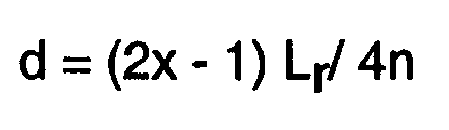


- Daraus folgt, daß bei einer bestimmten Schichtdicke d Licht der Wellenlänge Lr am stärksten reflektiert wird und Licht der halb so großen Wellenlänge Lt am stärksten durchgelassen wird. Die Dicke der Teilchen ist erfindungsgemäß so gewählt, daß das durch das Teilchen hindurchtretende Licht in den sichtbaren Bereich und das von dem Teilchen am stärksten reflektierte Licht in den Infrarotbereich fällt.
- Es sind verschiedene Pigmente bekannt, die das angegebene Verhältnis von Dicke und Brechungsindex erfüllen. Dazu gehören Titandioxid, z. B. vom Anatas-Typ, basisches Bleicarbonat oder Wismutoxychlorid. Besonders vorteilhaft ist Titandioxid vom Rutil-Typ, das auf Glimmerteilchen oder ähnlichen blättchenförmigen Mineralstoffen in definierter Schichtdicke niedergeschlagen wurde. Dieses Pigment ergibt lichtstreuende Beschichtungen, die für alle Arten von Dachverglasungen und Oberlichtern besonders gut geeignet sind. Anders als der Anatas-Typ greift dieses Pigment die Kunststoffmatrix nicht katalytisch an und ermöglich so witterungsbeständige, langlebige Produkte. Besonders geeignet da weniger bruchanfällig bei der Verarbeitung sind größenfraktionierte Produkte, denen die Pigmentteilchen einen mittleren Durchmesser bzw. eine Korngröße von 5 bis 25 µm aufweisen. Die Messung kann mittels Laserbeugung erfolgen. Bevorzugt haben mindestens 95, bevorzugt 98 % der Teilchen eine Größe kleiner 25 µm.
- Bevorzugt setzt man IR-reflektierende Teilchen ein, bei denen das Trägerpigment, z. B. Glimmer, mit einer 90 bis 150 nm, bevorzugt 100 bis 140 nm dicken TiO2-Schicht beschichtet ist (Als Schichtdicke d gilt dann nur die TiO2-Schicht, nicht die Unterlage aus Glimmer).
- Geeignet sind auch IR-reflektierende Teilchen, bei denen das Trägerpigment mit alternierenden Schichten von Metalloxiden beschichtet ist.
DE 196 18 569 A1 beschreibt entsprechende mehrschichtige Interferenzpigmente, bestehend aus einem transparenten Trägermaterialien, die mit alternierenden Schichten von Metalloxiden mit niedriger und hoher Brechzahl beschichtet sind, wobei die Differenz der Brechzahl mindestens 0,1 beträgt. Auf diese Weise können z. B. Glimmerplättchen mit einer alternierenden Schicht aus TiO2/SiO2/TiO2 versehen sein, wobei die Summe der Schichtdicken im Bereich von 150 bis 300 nm liegen kann (Geeignet ist z. B. das handelsübliche Perlglanzpigment AC 870, Hersteller Fa. Merck KGaA, Darmstadt, Deutschland) - Schlagzähmodifiziertes Polymethylmethacrylat und dessen Herstellung ist z. B. aus
EP-A 0 733 754 bekannt. - Das schlagzähe Polymethylmethacrylat kann z. B. aufgebaut aus p1) 4 bis 30 Gew.-% einer Elastomerphase aus p2) 70 bis 96 Gew.-% einer thermoplastischen Matrixphase aus Polymethylmethacrylat, das bis zu 20 Gew.-Teilen, bezogen auf 100 Gew.-Teile P, an geeigneten Comonomeranteilen enthalten kann, wobei die Brechungsindices der Elastomerphase E und der Matrixphase M um maximal n ≤ 0,02 voneinander abweichen und wobei die Summe von p1) + p2) 100 Gew.-% ausmacht.
- Die Elastomerphase aus vernetzter Polymerphase ist aus 60 bis 99,9 Gew.-Teilen Alkylacrylat und/oder Arylacrylat, aus 0,1 bis 10 Gew.-Teilen geeigneten Vernetzungsmitteln und gegebenenfalls aus 0 bis 30 Gew.-Teilen an geeigneten monofunktionellen ethylenisch ungesättigten Monomeren aufgebaut.
- Vorzugsweise werden als Alkylacrylate C2 - C10-Alkylacrylate eingesetzt, wie beispielsweise Ethylacrylat, Propylacrylat, iso-Propylacrylat, Amylacrylat, Hexylacrylat, Octylacrylat, Decylacrylat, sowie besonders bevorzugt Butylacrylat und 2-Ethylhexylacrylat. Bevorzugte Acrylate sind Phenylacrylat, 2-Phenylethylacrylat, 3-Phenyl-1-propylacrylat, 2-Phenoxyethylacrylat, 2-Phenoxyethoxyethylacrylat, sowie besonders bevorzugt Benzylacrylat. Die Vernetzungsmittel sind im allgemeinen Verbindungen mit mindestens zwei ethylenisch ungesättigten, radikalisch polymerisierbaren Resten. Als Vertreter für Verbindungen mit zwei ethylenisch ungesättigten, radikalisch polymerisierbaren Resten seien beispielhaft genannt: (Meth)acrylester von Diolen, wie beispielsweise Ethylenglykoldi(meth)acrylat oder 1,4-Butandioldi(meth)acrylat, aromatische Verbindungen, wie beispielsweise Divinylbenzol, sowie Verbindungen mit mindestens einer Allylgruppe, wie beispielsweise Allyl(meth)acrylat. Als Vernetzungsmittel mit drei oder mehr ethylenisch ungesättigten, radikalisch polymerisierbaren Resten seien beispielhaft Triallylcyanurat, Trimethylolpropantri(meth)acrylat sowie Pentaerythritetra(meth)acrylat genannt. Weitere Beispiele hierzu werden beispielsweise in
US-P 4,513,118 angegeben. - Die gegebenenfalls in 0 bis 30 Gew.-Teilen in der Elastomerphase enthaltenen Comonomeren, dienen vornehmlich der Angleichung des in der Regel niedrigeren Brechungsindex der Elastomerphase an denjenigen der Matrixphase M. Vorzugsweise werden also Comonomere mit vergleichsweise hohen Brechungs-indices gewählt werden, wie beispielsweise radikalisch polymerisierbare aromatische Verbindungen. Beispielhaft seien genannt: Vinyltoluol, Styrol oder α-Methylstyrol, die in solchen Mengen verwendet werden, daß sie die Witterungsbeständigkeit des schlagzähen Polymethylmethacrylats nicht beeinträchtigen.
- Die mit der Elastomerphase zumindest zu 5 Gew.-% kovalent verbundene Matrixphase M besteht aus einem Polymethylmethacrylat P, das aus 80 bis 100 Gew.-Teilen Methylmethacrylat-Einheiten aufgebaut ist, und weist eine Glasübergangstemperatur von wenigstens 70 °C auf. Weiterhin können im Polymethylmethacrylat 0 bis 20 Gew.-Teile weitere ethylenisch ungesättigte, radikalisch polymerisierbare Comonomereinheiten anwesend sein, vorzugsweise Alkyl(meth)acrylate mit 1 bis 4 Kohlenstoffatomen im Alkylrest. Das mittlere Molekulargewicht MW des Polymethylmethacrylats beträgt günstigerweise zwischen 104 und 106, vorzugsweise zwischen 3 x 10⁴ und 5 x 10⁵ Dalton (zur Bestimmung von MW vergleiche beispielsweise H.F. Mark et.al., Encyclopedia of Polymer Science and Engineering, 2nd Ed., Vol. 10, Seiten 1ff, J. Wiley, New York, 1989).
- Vorzugsweise ist die Elastomerphase Bestandteil zwei- oder mehrstufiger Emulsionspolymerisate , die in der äußeren Hülle aus dem die Matrixphase bildenden Polymethylmethacrylate bestehen. Besonders bevorzugt sind Emulsionspolymerisate mit einem wenigstens dreistufigen Aufbau, gebildet aus einem Kern aus Polymethylmethacrylat , einer ersten Schale S1 aus der Elastomerphase und einer zweiten Schale S2 aus Polymethylmethacrylat, wobei sich weitere Schalen entsprechend den Schalen S1 und S2 alternierend anschließen können. Der Anteil der Emulsionspolymerisate am schlagzähen Polymethylmethacrylat beträgt zwischen 5 und 70 Gew.-%, vorzugsweise zwischen 10 und 50 Gew.-%, wobei die restlichen Gewichtsanteile von dem nicht in den Latexteilchen enthaltenen Polymethylmethacrylat-Kunststoff ausgemacht werden.
- Vorzugsweise wird das schlagzähe Polymethylmethacrylat durch Abmischen des Emulsionspolymerisats mit dem Polymethylmethacrylat hergestellt, wobei beispielsweise die Bestandteile gemischt werden und anschließend die Wasserphase und die Emulgatoren abgetrennt werden oder wobei zunächst das Emulsionspolymerisat aus der wäßrigen Phase isoliert wird und anschließend mit dem, beispielsweise durch kontinuierliche Substanzpolymerisation hergestellten Polymethylmethacrylat in der Schmelze gemischt wird. Insgesamt sollen die Latexteilchen, die das Emulsionspolymerisat bilden, einen Durchmesser zwischen 0,1 und 3 µm, bevorzugt zwischen 0,15 und 1 µm aufweisen. Prinzipiell ist der Aufbau solcher Latexteilchen und die Isolierung des Emulsionspolymerisats für zweistufige Emulsionspolymerisate beispielsweise in
EP-Patent 0 033 999 (=US-Patent 4,543,383 ) und für dreistufige Emulsionspolymerisate beispielsweise inEP-Patent 0 113 925 (=US-Patent 4,513,118 ) beschrieben. Bei der wäßrigen Emulsionspolymerisation arbeitet man zweckmäßigerweise im neutralen oder leicht sauren pH-Bereich, wobei der Verwendung langkettiger Alkylsulfate bzw. Alkylsulfonate als Emulgatoren günstig ist. Als Polymerisationsinitiatoren dienen zweckmäßig die einschlägig bekannten Azoverbindungen bzw. organische oder anorganische Peroxide, wie beispielsweise Persulfate, die im allgemeinen in Mengen zwischen 10-3 und 1 Gew.-%, bezogen auf die Monomeren, verwendet werden: Zur Einstellung des zuvor beschriebenen Molekulargewichts MW des im Emulsionspolymerisat anwesenden Polymethylmethacrylats dienen die einschlägig bekannten Molekulargewichtsregler, wie beispielsweise Mercaptoverbindungen, wie 2-Ethylhexylthioglykolat oder tert.-Dodecylmercaptan. - Besonders bevorzugt sind solche Emulsionspolymerisate, die im einem Extruder coaguliert und entwässert werden. Die Schmelze wird dabei in der Entwässerungszone des Extruders in mehrere Abschnitte unterteilt, die jeweils in voneinander getrennten Schneckengängen gefördert werden. Die Schmelzephase wird dabei in wenigstens einem dieser Schneckengänge im Einzugsspalt der Doppelschnecke unter Bildung eines örtlich eng begrenzten Druckgradienten zu einem zusammenhängenden Schmelzekuchen gestaut. Dabei wird das Wasser vor der Grenze des Schmelzekuchens unter der Wirkung der Schwerkraft derart nach unten durch wenigstens eine Abzugsöffnung abfließen gelassen, daß der Schmelzekuchen nicht mit einer zusammenhängenden Wasserphase in Berührung steht. Dadurch werden die im Wasser enthaltenen Zusatzstoffe und Verunreinigungen effektiv entfernt, so das ein besonders witterungsstabiles nicht zur Vergilbung neigendes Material erhalten wird (s. dazu
EP-A 0 683 028 und als zweistufiges VerfahrenDE 197 18 597 C1 ). - Kunststoffkörper, herstellbar nach dem erfindungsgemäßen Verfahren, bestehend aus der verfahrensgemäß erhaltenen Kunststoffmischung, weisen eine Hagelbeständigkeit in der Hagelschlagprüfung nach SIA V280 (Schweizer Norm SN Bauwesen 564 280, Ausgabe 1996, Prüfung 9, Test modifiziert durch die Verwendung mit Polyamidkugeln mit ca. 20 mm Durchmesser und Durchführung ohne Eisschuppen) von mindestens 4 J, bevorzugt mindestens 4,5 J, besonders bevorzugt mindestens 5 J. Die Hagelbeständigkeit H20 ist die niedrigste gemessene Energie in [J], die mit 20mm Kugeln noch einen Bruch der Probe verursacht.
- Die Selektivitätskennzahl SKZ T/g s.o. nach DIN 67 507 beträgt mehr als 1,15, bevorzugt mindestens 1,2 oder 1,3 bis 1,4 auf. (T = Lichttransmissionsgrad für Tageslicht (Normlichtart D65) τD65, g = Gesamtenergiedurchlaßgrad, SKZ = Verhältnis T/g bzw. τD65/g).
- Der Kunststoffkörper kann ganz oder teilweise aus der Kunststoff-Mischung bestehen. Bevorzugt handelt es sich um eine flache Platte oder einen Hohlkörper, insbesondere eine Stegmehrfachplatte, bevorzugt eine Stegdreifach- oder Stegvierfachplatte, besonders bevorzugt eine Stegdoppelplatte. Auch andere Geometrien wie z. B. Stegplatten mit schrägen Stegen, sogenannte Fachwerkplatten, sind möglich.
- Der Kunststoffkörper kann ganz aus der Kunststoff-Mischung bestehen und z. B. die Form einer Stegdoppelplatte haben. Dies hat den Vorteil, daß relativ gute SKZ-Werte erhalten werden können. Bei Stegdreifach- oder Stegvierfachplatten, die ganz aus der Kunststoff-Mischung bestehen, ist die SKZ in der Regel schlechter als bei Stegdoppelplatten, da der Lichttransmissionsgrad für Tageslicht (T bzw. τD65) hier stärker abfällt als die Gesamtenergiedurchlaßgrad für Strahlungsenergie (g) und das Verhältnis T/g somit abnimmt.
- Der Kunststoffkörper kann auch nur teilweise aus der Kunststoff-Mischung bestehen, wobei der teilweise Anteil der coextrudierte Gurt einer Stegmehrfachplatte, mit einer Dicke von 1 bis 6, bevorzugt 2 bis 4 mm sein kann. Dies hat den Vorteil, daß praktisch beliebige Stegmehrfachplatten Stegdreifach- oder Stegvierfachplatten mit gleich guter SKZ und Hagelschlagbeständigkeit realisiert werden können. Dabei ist der Gurt solcher Platten ausreichend dick, um die gewünschten SKZ-Werte auch mit niedrigen Konzentrationen von IR-reflektierenden Teilchen zu erhalten.
- Der Kunststoffkörper kann zweckmäßigerweise je nach Verwendungzweck z. B. einen Lichttransmissionsgrad für Tageslicht (T bzw. τD65) im Bereich von 10 bis 70, bevorzugt 15 bis 55, z. B. 20 bis 40 % aufweisen.
- Die bevorzugte Verwendung des Kunststoffkörpers erfolgt als Bedachungs- oder Fassadenelement, z. B. für Gewächshaus- oder Wintergärtenbedachungen oder für Lichtbänder in Treppenhäusern etc..
- Von der dem Licht zugewandten Seite weisen die Kunststoffkörper einen rosa, perlmutt-ähnlich glänzenden Farbeindruck auf, wie er auch von handelsüblichen IR-reflektierend ausgerüsteten Kunststoffkörpern bekannt ist. In der Durchsicht gegen das Licht erhält man einen grünlichen Farbeindruck. In vielen Fällen möchte man diesen grünlichen Farbeindruck mildern, indem man ein lichtstreuendes Pigment, z. B. ein Weißpigment, z. B. Bariumsulfat, in Mengen von 0,5 bis 5 Gew.-% zusetzt. Die hat den technischen Vorteil, daß der Blendeffekt bei durchscheinender Sonne gemildert wird, indem das Licht gestreut wird.
- Überraschenderweise wurde auch gefunden, daß die Hagelschlagbeständigkeit nicht abnimmt, sogar zunehmen kann, wenn ein Weißpigment, z. B. Bariumsulfat (BaSO4), in Kombination mit Schlagzähmodifizierer und IR-reflektierendem Pigment vorliegt. Bevorzugt stellt man das Weißpigment, wie auch das IR-reflektierende Pigment als konzentrierte Vormischung in Granulatform, enthaltend z. B. 10 bis 30 Gew.-% Weißpigment, bereit und fügt es während des Extrusionsverfahrens zur Herstellung der Kunststoffkörper hinzu. Man kann das Weißpigment jedoch auch in Pulverform beim Extrusionsvorgang zugeben.
- Herstellung einer Vormischung in Granulatform aus einer niedrigviskosen Polymethylmethacrylat-Schmelze und IR-reflektierendem Pigment
- Die Vormischung wird hergestellt, indem 25 Gew.-% des Pigments Iriodin® 9223, Rutil Perllila (Hersteller Fa. Merck KGaA, Darmstadt, Germany) in die Schmelze eines Polymerisats aus 91 Gew.-% Methylmethacrylat und 9 Gew.-% Methylacrylat bei 300 °C einarbeitet. Dabei wird das Polymerisat in einem gleichläufigen Doppelschneckenextruder (D = 34, Modell Fa. Leistritz) geschmolzen und gefördert. Die Pigmentzugabe erfolgt über eine Seiteneinspeisung, drucklos in einer drucklosen nicht scherenden Extruderzone über ein volumetrisch arbeitendes Schneckendosiersystem. Die Granulierung zu Granulat mit einer Länge von 2,5 bis 3,5 mm und einem Durchmesser von 2 bis 3 mm erfolgt bei 80 °C (Oberflächentemperatur).
- Herstellung von 16 mm Stegdoppelplatten aus der Vormischung aus Beispiel 1 und schlagzähmodifiziertem Polymethylmethacrylat.
- Schlagzähmodifiziertes Polymethylmethacrylat mit einer Polymermatrix aus einem Polymerisat aus 97 Gew.-% Methylmethacrylat und 3 Gew.-% Methylacrylat mit 15 Gew.-% Anteil an Polybutylacrylat, erhalten durch Abmischen von 64 Gew.-% Polymethylmethacrylat mit 36 Gew.-% eines Kern-Schale-Emulsionspolymerisats der Zusammensetzung 20 Gew.-Teile vernetzter Polmethylmethacrylat-Kern; 44 Gew.-Teile vernetztes Polybutylacrylat-co-Styrol, das den selben Brechungsindex wie Polymermatrix aufweist, als erste Schale sowie 36 Gew.-Teile Polymethylmethacrylat als zweite Schale (Entsprechende Emulsionspolymerisate können z. B. gemäß der
EP-A 113 924 - Anschließend werden 16 mm dicke Stegdoppelplatten durch Extrusion hergestellt, indem das Granulat des schlagzähmodifizierten Polymethylmethacrylats und das Granulat der Vormischung aus Beispiel 1 mit dem IR-reflektierenden Pigment im Verhältnis 133 : 1 gemischt werden und in einem Doppelschneckenextruder bei etwa 240 bis 260 °C durch eine Extrusionsdüse für eine Stegdoppelplatte extrudiert werden. Das Extrudat wird nach dem Austritt aus der Extrusionsdüse in einer Vakuumkalibrierung stabilisiert und abgekühlt.
- Stegdoppelplatte aus schlagzähem Polymethylmethacrylat mit Weißpigment (BaSO4). Der Zusatz des IR-reflektierenden Pigments erfolgt in Granulatform der beschriebenen Vormischung.
- Als Weißpigment wurde BaSO4, enthalten zu 20 Gew.-% in einem Polymerisat aus 97 Gew.-% Methylmethacrylat und 3 Gew.-% Methylacrylat in einer Endkonzentration von 2 Gew.-% zugegeben.
- Stegdoppelplatte aus schlagzähem Polymethylmethacrylat ohne Weißpigment. (farblos). Der Zusatz des IR-reflektierenden Pigments erfolgt in Granulatform der beschriebenen Vormischung.
- Stegdoppelplatte aus schlagzähem Polymethylmethacrylat mit Weißpigment (ohne IR-Pigment).
- Als Weißpigment wurde BaSO4, enthalten zu 20 Gew.-% in einem Polymerisat aus 97 Gew.-% Methylmethacrylat und 3 Gew.-% Methylacrylat in einer Endkonzentration von 2 Gew.-% zugegeben.
- Stegdoppelplatte aus schlagzähem Polymethylmethacrylat mit Weißpigment. Der Zusatz des IR-reflektierenden Pigments erfolgt durch Zugabe als Schüttgut (in trockener Form, ohne eine Vormischung) zur Schmelze des schlagzähmodifizierten Polymethylmethacrylats.
- Die nachstehende Tabelle 1 fast die Eigenschaften der Stegdoppelplatten aus den Bespielen 3 bis 6 zusammen:
Tabelle 1 Bsp. IR-Pigment-Zugabe aus Vormischung IR-Pigment-Zugabe ohne Vormischung Weißpigment τD65[%] g [%] SKZ = τD65/g Hagel H20[J] 3 + - + 47,3 38,0 1,24 4,4 4 + - - 52,2 39,7 1,31 7,3 5 - - + 76,0 72.9 1,04 2,9 6 - + - 26,7 33,8 0,79 3,9 - Effekt der Schmelzetemperatur bei der Herstellung einer Vormischung, enthaltend IR-reflektierendes Pigment
- Eine Vormischung wird analog zu Beispiel 1 hergestellt mit dem Unterschied, daß die Schmelzetemperatur bei der Einarbeitung des Pigments nur 265 °C beträgt.
- Die Granulate aus Beispiel 1 und 7 werden geschmolzen und in dünner Schicht mikroskopisch begutachtet.
- Zusätzlich wird die Schmelzviskosität nach DIN 54 811, Verfahren B 220 °C / 5 MPa (Düse L/D = 4/1) bestimmt.
- Die Granulate werden in einem Extruder geschmolzen und in einem Coextrusionsverfahren (s. z. B.
EP-B 548 822 - Das Ergebnis ist in der nachstehenden Tabelle 2 dargestellt.
Tabelle 2: Beispiel 1 7 Schmelzetemperatur bei Herstellung der Vormischung 300 °C 265 °C Mikroskopie Nur wenig Pigmentbruch sichtbar deutlich mehr Pigmentbruch als in Beispiel 1, viel Feinstanteile, Pigmente verrundet Schmelzviskosität nach DIN 54 811, Verfahren B 220 °C / 5 Mpa Düse L/D = 4/1 717 Pas 935 Pas SKZ = τD65/g 1,36 1,24
Claims (6)
- Verfahren zur Herstellung eines lichtdurchlässigen, IR-reflektierenden Kunststoffkörpers, bestehend ganz oder zumindest teilweise aus einem schlagzähen thermoplastischen Kunststoff, enthaltend 0,01 bis 2 Gew.-% an IR-reflektierenden Teilchen aus, mit einem Metalloxid beschichteten blättchenförmigen Trägerpigmenten, mittels Verarbeitung einer Kunststoffmischung durch Extrusion oder Coextrusion,
dadurch gekennzeichnet,
daß zunächst eine Vormischung von 5 bis 40 Gew.-% der IR-reflektierenden Teilchen mit einem niedrigviskosen thermoplastischen Kunststoff erzeugt wird, indem die IR-reflektierenden Teilchen mit der Schmelze des niedrigviskosen thermoplastischen Kunststoffs bei einer Temperatur von mindestens 280 °C in einer drucklosen, nicht scherenden Zone eines Doppelschnecken-Extruders vermischt, extrudiert und in Granulatform überführt werden und anschließend das Granulat direkt oder als Schmelze mit dem Granulat oder der Schmelze eines schlagzähmodifizierten Polymethylmethacrylats, bestehend aus einer Polymermatrix und einem Schlagzähmodifizierungsmittel, in einem Extruder vermischt wird, die Kunststoff-Mischung extrudiert oder zusammen mit einer weiteren Schmelze eines thermoplastischen Kunststoffs coextrudiert wird und nach dem Abkühlen des Extrudats der Kunststoffkörper erhalten wird. - Verfahren nach Anspruch 1, dadurch gekennzeichnet, daß von der Vormischung ein Granulat erzeugt wird, welches durch Abschlag des Extrudats bei einer Temperatur von mindestens 50 °C erhalten wird.
- Verfahren nach Anspruch 1 oder 2, dadurch gekennzeichnet, daß IR-reflektierende Teilchen eingesetzt werden, bei denen das Trägerpigment mit einer 90 bis 150 nm dicken TiO2-Schicht beschichtet ist.
- Verfahren nach einem oder mehreren der Ansprüche 1 bis 3, daß IR-reflektierende Teilchen eingesetzt werden, bei denen das Trägerpigment mit alternierenden Schichten von Metalloxiden beschichtet ist
- Verfahren nach Anspruch 4, dadurch gekennzeichnet, daß die alternierenden Schichten von Metalloxiden aus TiO2 /SiO2/TiO2 mit einer Summe der Schichtdicken von 150 bis 300 nm bestehen.
- Verfahren nach einem oder mehreren der Ansprüche 1 bis 3, dadurch gekennzeichnet, daß IR-reflektierende Teilchen aus mit einer 90 bis 150 nm dicken TiO2-Schicht versehenen Glimmerplättchen eingesetzt werden.
Applications Claiming Priority (2)
| Application Number | Priority Date | Filing Date | Title |
|---|---|---|---|
| DE10122315 | 2001-05-08 | ||
| DE10122315A DE10122315A1 (de) | 2001-05-08 | 2001-05-08 | IR-reflektierende Körper aus schlagzähem Kunststoff und ein Verfahren zu ihrer Herstellung |
Publications (2)
| Publication Number | Publication Date |
|---|---|
| EP1256437A1 EP1256437A1 (de) | 2002-11-13 |
| EP1256437B1 true EP1256437B1 (de) | 2009-10-14 |
Family
ID=7684021
Family Applications (1)
| Application Number | Title | Priority Date | Filing Date |
|---|---|---|---|
| EP02007543A Expired - Lifetime EP1256437B1 (de) | 2001-05-08 | 2002-04-03 | Verfahren zur Herstellung IR-reflektierender Körper aus schlagzähem Kunststoff |
Country Status (7)
| Country | Link |
|---|---|
| US (3) | US7129285B2 (de) |
| EP (1) | EP1256437B1 (de) |
| AT (1) | ATE445494T1 (de) |
| DE (2) | DE10122315A1 (de) |
| DK (1) | DK1256437T3 (de) |
| ES (1) | ES2335195T3 (de) |
| PT (1) | PT1256437E (de) |
Families Citing this family (21)
| Publication number | Priority date | Publication date | Assignee | Title |
|---|---|---|---|---|
| CA2323569A1 (en) * | 2000-10-18 | 2002-04-18 | Advanced Numerical Methods Ltd. | Elastic presentation space |
| DE10122315A1 (de) * | 2001-05-08 | 2002-11-14 | Roehm Gmbh | IR-reflektierende Körper aus schlagzähem Kunststoff und ein Verfahren zu ihrer Herstellung |
| DE10160569A1 (de) * | 2001-12-10 | 2003-06-26 | Bayer Ag | Mehrschichtiges Erzeugnis |
| KR100970059B1 (ko) * | 2002-08-07 | 2010-07-16 | 테크노 폴리머 가부시키가이샤 | 저 축열성 열가소성 수지 조성물 및 성형품 |
| DE10335863A1 (de) * | 2003-08-06 | 2005-03-03 | Clariant Gmbh | Kontinuierliches Verfahren zur Herstellung eines Pigment-Masterbatches |
| US7455899B2 (en) * | 2003-10-07 | 2008-11-25 | 3M Innovative Properties Company | Non-white construction surface |
| US20050142329A1 (en) * | 2003-12-24 | 2005-06-30 | Anderson Mark T. | Energy efficient construction surfaces |
| DE102004058083A1 (de) * | 2004-12-01 | 2006-06-08 | Röhm GmbH & Co. KG | Gedeckt eingefärbte, infrarotreflektierende Kunststoffformmasse |
| DE102005005208A1 (de) * | 2005-02-03 | 2006-08-10 | Röhm GmbH & Co. KG | Transluzente UV-durchlässige Tafel mit IR-reflektierender Wirkung |
| DE102005007481A1 (de) * | 2005-02-17 | 2006-08-31 | Röhm GmbH & Co. KG | Polymethacrylat mit Perlglanzeffekt |
| DE102006011820A1 (de) * | 2006-03-13 | 2007-09-20 | Röhm Gmbh | PLEXIGLASR -Oberfläche mit rutschhemmenden Eigenschaften und damit ausgestattete Sanitärelemente |
| DE102006029613A1 (de) | 2006-06-26 | 2007-12-27 | Röhm Gmbh | Transparenter Kunststoff-Verbund |
| US8820133B2 (en) * | 2008-02-01 | 2014-09-02 | Apple Inc. | Co-extruded materials and methods |
| US7820083B2 (en) * | 2008-02-11 | 2010-10-26 | Fortson-Peek Company, Inc. | Wet reflective pavement marking and method |
| CA2793773A1 (en) | 2010-03-19 | 2011-09-22 | Evonik Roehm Gmbh | Coated sheet-like plastic material with reduced tendency to colonization by algae, process for the in-line production thereof and use |
| DE102011088835A1 (de) * | 2011-12-16 | 2013-06-20 | Evonik Industries Ag | Verfahren zur Herstellung von Lichtleitkörpern und deren Verwendung in Beleuchtungseinheit |
| MX348270B (es) * | 2011-12-20 | 2017-06-05 | Dow Global Technologies Llc | Una composicion de moledo por rotacion. |
| WO2013108814A1 (ja) * | 2012-01-17 | 2013-07-25 | 大日本印刷株式会社 | 電子線硬化性樹脂組成物、リフレクター用樹脂フレーム、リフレクター、半導体発光装置、及び成形体の製造方法 |
| CN115260650A (zh) | 2013-10-14 | 2022-11-01 | 埃卡特有限公司 | 含有至少一种金属颜料的塑料组合物、其制备方法和用途 |
| EP4015181A1 (de) * | 2020-12-17 | 2022-06-22 | Schlenk Metallic Pigments GmbH | Verfahren zur in situ-erzeugung von pigmenten in kunststoff |
| EP4177311A1 (de) * | 2021-11-04 | 2023-05-10 | LANXESS Performance Materials GmbH | Verwendung von polyamid 6 |
Family Cites Families (9)
| Publication number | Priority date | Publication date | Assignee | Title |
|---|---|---|---|---|
| DE2544245C3 (de) | 1975-10-03 | 1981-12-17 | Röhm GmbH, 6100 Darmstadt | Infrarot-reflektierendes Verglasungsmaterial |
| US4057607A (en) * | 1975-12-19 | 1977-11-08 | Celanese Corporation | Process for preparing shear degradable particle-containing resin powders |
| DE2719170A1 (de) * | 1977-04-29 | 1978-11-02 | Dynamit Nobel Ag | Verfahren zum schutz von pvc- schichten gegen sonnenlichteinwirkungen und bauteil auf pvc-basis |
| US5115016A (en) * | 1986-12-30 | 1992-05-19 | General Electric Company | Reinforced polyester molding compositions having high gloss and improved resistance to warping |
| ES2089356T3 (es) * | 1991-12-21 | 1996-10-01 | Roehm Gmbh | Cuerpo reflectante de infrarrojo. |
| DE29504997U1 (de) * | 1995-03-24 | 1995-06-01 | Röhm GmbH & Co. KG, 64293 Darmstadt | Hagelschlagbeständige Stegmehrfachplatte aus Polymethylmethacrylat |
| JP2001503190A (ja) | 1996-10-21 | 2001-03-06 | レーム ゲゼルシヤフト ミツト ベシユレンクテル ハフツング | 光ガイドプレート |
| DE10035204A1 (de) * | 1999-09-13 | 2001-03-15 | Merck Patent Gmbh | Lasermarkierbare Kunststoffe |
| DE10122315A1 (de) * | 2001-05-08 | 2002-11-14 | Roehm Gmbh | IR-reflektierende Körper aus schlagzähem Kunststoff und ein Verfahren zu ihrer Herstellung |
-
2001
- 2001-05-08 DE DE10122315A patent/DE10122315A1/de not_active Ceased
-
2002
- 2002-04-03 DE DE50213912T patent/DE50213912D1/de not_active Expired - Lifetime
- 2002-04-03 ES ES02007543T patent/ES2335195T3/es not_active Expired - Lifetime
- 2002-04-03 PT PT02007543T patent/PT1256437E/pt unknown
- 2002-04-03 EP EP02007543A patent/EP1256437B1/de not_active Expired - Lifetime
- 2002-04-03 DK DK02007543.8T patent/DK1256437T3/da active
- 2002-04-03 AT AT02007543T patent/ATE445494T1/de active
- 2002-05-07 US US10/139,385 patent/US7129285B2/en not_active Expired - Fee Related
-
2006
- 2006-05-26 US US11/441,111 patent/US7696265B2/en not_active Expired - Fee Related
-
2009
- 2009-12-01 US US12/628,381 patent/US8293815B2/en not_active Expired - Fee Related
Also Published As
| Publication number | Publication date |
|---|---|
| US20100075142A1 (en) | 2010-03-25 |
| ATE445494T1 (de) | 2009-10-15 |
| DE50213912D1 (de) | 2009-11-26 |
| EP1256437A1 (de) | 2002-11-13 |
| US20030031850A1 (en) | 2003-02-13 |
| US7129285B2 (en) | 2006-10-31 |
| US8293815B2 (en) | 2012-10-23 |
| DK1256437T3 (da) | 2010-03-01 |
| US20060217461A1 (en) | 2006-09-28 |
| ES2335195T3 (es) | 2010-03-23 |
| DE10122315A1 (de) | 2002-11-14 |
| US7696265B2 (en) | 2010-04-13 |
| PT1256437E (pt) | 2010-01-18 |
Similar Documents
| Publication | Publication Date | Title |
|---|---|---|
| EP0548822B1 (de) | IR-reflektierender Körper | |
| EP1270176B1 (de) | Extrusionswerkzeug zur Herstellung von Hohlkammerprofilplatten aus thermoplastischem Kunststoff mit innen liegender coextrudierter Schicht | |
| EP1256437A1 (de) | IR-reflektierende Körper aus schlagzähem Kunststoff und ein Verfahren zur ihrer Herstellung | |
| EP1414645B1 (de) | Kunststoffkörper mit niedriger wärmeleitfähigkeit, hoher lichttransmission und absorption im nahen infrarotbereich | |
| DE2544245C3 (de) | Infrarot-reflektierendes Verglasungsmaterial | |
| EP1363141B1 (de) | Infrarot reflektierendes Material | |
| DE10392543T5 (de) | Harzfolie für die Abschirmung von Wärmewellen und flüssiges Additiv zu ihrer Herstellung | |
| EP2709843B1 (de) | Mehrschichtverbunde mit verbesserten physikalischen eigenschaften | |
| EP2571687A1 (de) | Formmasse oder beschichtungssystem (pmma-frei) mit ir reflektierenden eigenschaften in kombination mit einer pmma-haltigen deckschicht oder folie | |
| DE60034692T2 (de) | Verfahren zur herstellung von schmelzverarbeitbare zusammensetzungen, zusammensetzungen und artikeln | |
| DE69923327T2 (de) | Acrylatisches material | |
| EP0733754B1 (de) | Hagelschlagbeständige Stegmehrfachplatte aus Polymethylmethacrylat | |
| EP0828599A1 (de) | Amorphe eingefärbte platte aus einem kristallisierbaren thermoplast | |
| DE602004000558T2 (de) | Glanz verringernde Polymerzusammensetzung | |
| DE69426915T2 (de) | Verfahren zur Herstellung einer Verbundplatte aus Polycarbonat zur Verwendung in Gebäuden, insbesondere in Treibhäusern | |
| EP0501329A2 (de) | Verträgliche Polymermischungen | |
| EP1844355A1 (de) | Transzluzente uv-durchl[ssige tafel mit ir-reflektierender wirkung | |
| DE19823991A1 (de) | Platte aus einem Thermoplast | |
| WO2009103375A1 (de) | Stegplatten mit photosynthetisch aktiver strahlung | |
| WO1997034759A2 (de) | Amorphe platte aus einem kristallisierbaren polyalkylennaphthalat | |
| WO2009027218A1 (de) | Lichtdurchlässiger sonnenenergiekollektor | |
| DE10046619A1 (de) | Kunststoff-Zusammensetzung, Verfahren zu deren Herstellung sowie deren Verwendung, insbesondere als Barrieremedium |
Legal Events
| Date | Code | Title | Description |
|---|---|---|---|
| PUAI | Public reference made under article 153(3) epc to a published international application that has entered the european phase |
Free format text: ORIGINAL CODE: 0009012 |
|
| AK | Designated contracting states |
Kind code of ref document: A1 Designated state(s): AT BE CH CY DE DK ES FI FR GB GR IE IT LI LU MC NL PT SE TR |
|
| AX | Request for extension of the european patent |
Free format text: AL;LT;LV;MK;RO;SI |
|
| 17P | Request for examination filed |
Effective date: 20021010 |
|
| AKX | Designation fees paid |
Designated state(s): AT BE CH CY DE DK ES FI FR GB GR IE IT LI LU MC NL PT SE TR |
|
| 17Q | First examination report despatched |
Effective date: 20040223 |
|
| GRAP | Despatch of communication of intention to grant a patent |
Free format text: ORIGINAL CODE: EPIDOSNIGR1 |
|
| RTI1 | Title (correction) |
Free format text: METHOD OF MANUFACTURING OF INFRARED REFLECTING ARTICLES MADE FROM IMPACT RESISTANT PLASTIC |
|
| GRAS | Grant fee paid |
Free format text: ORIGINAL CODE: EPIDOSNIGR3 |
|
| APBN | Date of receipt of notice of appeal recorded |
Free format text: ORIGINAL CODE: EPIDOSNNOA2E |
|
| APBR | Date of receipt of statement of grounds of appeal recorded |
Free format text: ORIGINAL CODE: EPIDOSNNOA3E |
|
| APAF | Appeal reference modified |
Free format text: ORIGINAL CODE: EPIDOSCREFNE |
|
| RAP1 | Party data changed (applicant data changed or rights of an application transferred) |
Owner name: ROEHM GMBH |
|
| RAP1 | Party data changed (applicant data changed or rights of an application transferred) |
Owner name: EVONIK ROEHM GMBH |
|
| RAP1 | Party data changed (applicant data changed or rights of an application transferred) |
Owner name: EVONIK ROEHM GMBH |
|
| RAP1 | Party data changed (applicant data changed or rights of an application transferred) |
Owner name: EVONIK ROEHM GMBH |
|
| APBT | Appeal procedure closed |
Free format text: ORIGINAL CODE: EPIDOSNNOA9E |
|
| RAP1 | Party data changed (applicant data changed or rights of an application transferred) |
Owner name: EVONIK ROEHM GMBH |
|
| GRAC | Information related to communication of intention to grant a patent modified |
Free format text: ORIGINAL CODE: EPIDOSCIGR1 |
|
| GRAL | Information related to payment of fee for publishing/printing deleted |
Free format text: ORIGINAL CODE: EPIDOSDIGR3 |
|
| GRAS | Grant fee paid |
Free format text: ORIGINAL CODE: EPIDOSNIGR3 |
|
| GRAA | (expected) grant |
Free format text: ORIGINAL CODE: 0009210 |
|
| AK | Designated contracting states |
Kind code of ref document: B1 Designated state(s): AT BE CH CY DE DK ES FI FR GB GR IE IT LI LU MC NL PT SE TR |
|
| REG | Reference to a national code |
Ref country code: GB Ref legal event code: FG4D Free format text: NOT ENGLISH |
|
| REG | Reference to a national code |
Ref country code: CH Ref legal event code: EP |
|
| REG | Reference to a national code |
Ref country code: IE Ref legal event code: FG4D |
|
| REF | Corresponds to: |
Ref document number: 50213912 Country of ref document: DE Date of ref document: 20091126 Kind code of ref document: P |
|
| REG | Reference to a national code |
Ref country code: PT Ref legal event code: SC4A Free format text: AVAILABILITY OF NATIONAL TRANSLATION Effective date: 20100111 |
|
| REG | Reference to a national code |
Ref country code: SE Ref legal event code: TRGR |
|
| REG | Reference to a national code |
Ref country code: DK Ref legal event code: T3 |
|
| REG | Reference to a national code |
Ref country code: ES Ref legal event code: FG2A Ref document number: 2335195 Country of ref document: ES Kind code of ref document: T3 |
|
| PG25 | Lapsed in a contracting state [announced via postgrant information from national office to epo] |
Ref country code: FI Free format text: LAPSE BECAUSE OF FAILURE TO SUBMIT A TRANSLATION OF THE DESCRIPTION OR TO PAY THE FEE WITHIN THE PRESCRIBED TIME-LIMIT Effective date: 20091014 |
|
| REG | Reference to a national code |
Ref country code: IE Ref legal event code: FD4D |
|
| PG25 | Lapsed in a contracting state [announced via postgrant information from national office to epo] |
Ref country code: IE Free format text: LAPSE BECAUSE OF FAILURE TO SUBMIT A TRANSLATION OF THE DESCRIPTION OR TO PAY THE FEE WITHIN THE PRESCRIBED TIME-LIMIT Effective date: 20091014 |
|
| PLBE | No opposition filed within time limit |
Free format text: ORIGINAL CODE: 0009261 |
|
| STAA | Information on the status of an ep patent application or granted ep patent |
Free format text: STATUS: NO OPPOSITION FILED WITHIN TIME LIMIT |
|
| 26N | No opposition filed |
Effective date: 20100715 |
|
| PG25 | Lapsed in a contracting state [announced via postgrant information from national office to epo] |
Ref country code: GR Free format text: LAPSE BECAUSE OF FAILURE TO SUBMIT A TRANSLATION OF THE DESCRIPTION OR TO PAY THE FEE WITHIN THE PRESCRIBED TIME-LIMIT Effective date: 20100115 |
|
| PG25 | Lapsed in a contracting state [announced via postgrant information from national office to epo] |
Ref country code: MC Free format text: LAPSE BECAUSE OF NON-PAYMENT OF DUE FEES Effective date: 20100430 |
|
| PG25 | Lapsed in a contracting state [announced via postgrant information from national office to epo] |
Ref country code: CY Free format text: LAPSE BECAUSE OF FAILURE TO SUBMIT A TRANSLATION OF THE DESCRIPTION OR TO PAY THE FEE WITHIN THE PRESCRIBED TIME-LIMIT Effective date: 20091014 |
|
| PG25 | Lapsed in a contracting state [announced via postgrant information from national office to epo] |
Ref country code: LU Free format text: LAPSE BECAUSE OF NON-PAYMENT OF DUE FEES Effective date: 20100403 |
|
| PG25 | Lapsed in a contracting state [announced via postgrant information from national office to epo] |
Ref country code: TR Free format text: LAPSE BECAUSE OF FAILURE TO SUBMIT A TRANSLATION OF THE DESCRIPTION OR TO PAY THE FEE WITHIN THE PRESCRIBED TIME-LIMIT Effective date: 20091014 |
|
| PGFP | Annual fee paid to national office [announced via postgrant information from national office to epo] |
Ref country code: ES Payment date: 20120424 Year of fee payment: 11 |
|
| PGFP | Annual fee paid to national office [announced via postgrant information from national office to epo] |
Ref country code: AT Payment date: 20120411 Year of fee payment: 11 |
|
| PGFP | Annual fee paid to national office [announced via postgrant information from national office to epo] |
Ref country code: GB Payment date: 20130418 Year of fee payment: 12 Ref country code: SE Payment date: 20130418 Year of fee payment: 12 Ref country code: DK Payment date: 20130418 Year of fee payment: 12 Ref country code: CH Payment date: 20130422 Year of fee payment: 12 Ref country code: DE Payment date: 20130419 Year of fee payment: 12 Ref country code: BE Payment date: 20130418 Year of fee payment: 12 |
|
| PGFP | Annual fee paid to national office [announced via postgrant information from national office to epo] |
Ref country code: NL Payment date: 20130418 Year of fee payment: 12 Ref country code: FR Payment date: 20130515 Year of fee payment: 12 Ref country code: IT Payment date: 20130429 Year of fee payment: 12 Ref country code: PT Payment date: 20130403 Year of fee payment: 12 |
|
| REG | Reference to a national code |
Ref country code: PT Ref legal event code: MM4A Free format text: LAPSE DUE TO NON-PAYMENT OF FEES Effective date: 20141003 |
|
| REG | Reference to a national code |
Ref country code: DE Ref legal event code: R119 Ref document number: 50213912 Country of ref document: DE |
|
| REG | Reference to a national code |
Ref country code: DK Ref legal event code: EBP Effective date: 20140430 |
|
| REG | Reference to a national code |
Ref country code: NL Ref legal event code: V1 Effective date: 20141101 |
|
| REG | Reference to a national code |
Ref country code: CH Ref legal event code: PL |
|
| REG | Reference to a national code |
Ref country code: SE Ref legal event code: EUG |
|
| REG | Reference to a national code |
Ref country code: AT Ref legal event code: MM01 Ref document number: 445494 Country of ref document: AT Kind code of ref document: T Effective date: 20140403 |
|
| GBPC | Gb: european patent ceased through non-payment of renewal fee |
Effective date: 20140403 |
|
| REG | Reference to a national code |
Ref country code: DE Ref legal event code: R119 Ref document number: 50213912 Country of ref document: DE Effective date: 20141101 |
|
| REG | Reference to a national code |
Ref country code: FR Ref legal event code: ST Effective date: 20141231 |
|
| PG25 | Lapsed in a contracting state [announced via postgrant information from national office to epo] |
Ref country code: PT Free format text: LAPSE BECAUSE OF NON-PAYMENT OF DUE FEES Effective date: 20141003 Ref country code: DE Free format text: LAPSE BECAUSE OF NON-PAYMENT OF DUE FEES Effective date: 20141101 Ref country code: CH Free format text: LAPSE BECAUSE OF NON-PAYMENT OF DUE FEES Effective date: 20140430 Ref country code: LI Free format text: LAPSE BECAUSE OF NON-PAYMENT OF DUE FEES Effective date: 20140430 Ref country code: GB Free format text: LAPSE BECAUSE OF NON-PAYMENT OF DUE FEES Effective date: 20140403 Ref country code: SE Free format text: LAPSE BECAUSE OF NON-PAYMENT OF DUE FEES Effective date: 20140404 |
|
| PG25 | Lapsed in a contracting state [announced via postgrant information from national office to epo] |
Ref country code: NL Free format text: LAPSE BECAUSE OF NON-PAYMENT OF DUE FEES Effective date: 20141101 Ref country code: AT Free format text: LAPSE BECAUSE OF NON-PAYMENT OF DUE FEES Effective date: 20140403 Ref country code: FR Free format text: LAPSE BECAUSE OF NON-PAYMENT OF DUE FEES Effective date: 20140430 |
|
| PG25 | Lapsed in a contracting state [announced via postgrant information from national office to epo] |
Ref country code: IT Free format text: LAPSE BECAUSE OF NON-PAYMENT OF DUE FEES Effective date: 20140403 |
|
| PG25 | Lapsed in a contracting state [announced via postgrant information from national office to epo] |
Ref country code: DK Free format text: LAPSE BECAUSE OF NON-PAYMENT OF DUE FEES Effective date: 20140430 |
|
| REG | Reference to a national code |
Ref country code: ES Ref legal event code: FD2A Effective date: 20150529 |
|
| PG25 | Lapsed in a contracting state [announced via postgrant information from national office to epo] |
Ref country code: ES Free format text: LAPSE BECAUSE OF NON-PAYMENT OF DUE FEES Effective date: 20140404 |
|
| PG25 | Lapsed in a contracting state [announced via postgrant information from national office to epo] |
Ref country code: BE Free format text: LAPSE BECAUSE OF NON-PAYMENT OF DUE FEES Effective date: 20140430 |