EP1256597A2 - Weisse, biaxal orientierte Folie aus einem kristallisierbaren Thermoplasten mit hohem Weissgrad und mit zusätzlicher Funktionalität - Google Patents
Weisse, biaxal orientierte Folie aus einem kristallisierbaren Thermoplasten mit hohem Weissgrad und mit zusätzlicher Funktionalität Download PDFInfo
- Publication number
- EP1256597A2 EP1256597A2 EP02005255A EP02005255A EP1256597A2 EP 1256597 A2 EP1256597 A2 EP 1256597A2 EP 02005255 A EP02005255 A EP 02005255A EP 02005255 A EP02005255 A EP 02005255A EP 1256597 A2 EP1256597 A2 EP 1256597A2
- Authority
- EP
- European Patent Office
- Prior art keywords
- film
- weight
- ppm
- film according
- optical brightener
- Prior art date
- Legal status (The legal status is an assumption and is not a legal conclusion. Google has not performed a legal analysis and makes no representation as to the accuracy of the status listed.)
- Granted
Links
Classifications
-
- C—CHEMISTRY; METALLURGY
- C08—ORGANIC MACROMOLECULAR COMPOUNDS; THEIR PREPARATION OR CHEMICAL WORKING-UP; COMPOSITIONS BASED THEREON
- C08J—WORKING-UP; GENERAL PROCESSES OF COMPOUNDING; AFTER-TREATMENT NOT COVERED BY SUBCLASSES C08B, C08C, C08F, C08G or C08H
- C08J5/00—Manufacture of articles or shaped materials containing macromolecular substances
- C08J5/18—Manufacture of films or sheets
-
- C—CHEMISTRY; METALLURGY
- C08—ORGANIC MACROMOLECULAR COMPOUNDS; THEIR PREPARATION OR CHEMICAL WORKING-UP; COMPOSITIONS BASED THEREON
- C08K—Use of inorganic or non-macromolecular organic substances as compounding ingredients
- C08K3/00—Use of inorganic substances as compounding ingredients
- C08K3/18—Oxygen-containing compounds, e.g. metal carbonyls
- C08K3/20—Oxides; Hydroxides
- C08K3/22—Oxides; Hydroxides of metals
-
- C—CHEMISTRY; METALLURGY
- C08—ORGANIC MACROMOLECULAR COMPOUNDS; THEIR PREPARATION OR CHEMICAL WORKING-UP; COMPOSITIONS BASED THEREON
- C08K—Use of inorganic or non-macromolecular organic substances as compounding ingredients
- C08K5/00—Use of organic ingredients
- C08K5/0008—Organic ingredients according to more than one of the "one dot" groups of C08K5/01 - C08K5/59
- C08K5/0041—Optical brightening agents, organic pigments
-
- C—CHEMISTRY; METALLURGY
- C08—ORGANIC MACROMOLECULAR COMPOUNDS; THEIR PREPARATION OR CHEMICAL WORKING-UP; COMPOSITIONS BASED THEREON
- C08J—WORKING-UP; GENERAL PROCESSES OF COMPOUNDING; AFTER-TREATMENT NOT COVERED BY SUBCLASSES C08B, C08C, C08F, C08G or C08H
- C08J2367/00—Characterised by the use of polyesters obtained by reactions forming a carboxylic ester link in the main chain; Derivatives of such polymers
- C08J2367/02—Polyesters derived from dicarboxylic acids and dihydroxy compounds
-
- C—CHEMISTRY; METALLURGY
- C08—ORGANIC MACROMOLECULAR COMPOUNDS; THEIR PREPARATION OR CHEMICAL WORKING-UP; COMPOSITIONS BASED THEREON
- C08K—Use of inorganic or non-macromolecular organic substances as compounding ingredients
- C08K3/00—Use of inorganic substances as compounding ingredients
- C08K3/18—Oxygen-containing compounds, e.g. metal carbonyls
- C08K3/20—Oxides; Hydroxides
- C08K3/22—Oxides; Hydroxides of metals
- C08K2003/2237—Oxides; Hydroxides of metals of titanium
- C08K2003/2241—Titanium dioxide
-
- Y—GENERAL TAGGING OF NEW TECHNOLOGICAL DEVELOPMENTS; GENERAL TAGGING OF CROSS-SECTIONAL TECHNOLOGIES SPANNING OVER SEVERAL SECTIONS OF THE IPC; TECHNICAL SUBJECTS COVERED BY FORMER USPC CROSS-REFERENCE ART COLLECTIONS [XRACs] AND DIGESTS
- Y10—TECHNICAL SUBJECTS COVERED BY FORMER USPC
- Y10S—TECHNICAL SUBJECTS COVERED BY FORMER USPC CROSS-REFERENCE ART COLLECTIONS [XRACs] AND DIGESTS
- Y10S428/00—Stock material or miscellaneous articles
- Y10S428/91—Product with molecular orientation
-
- Y—GENERAL TAGGING OF NEW TECHNOLOGICAL DEVELOPMENTS; GENERAL TAGGING OF CROSS-SECTIONAL TECHNOLOGIES SPANNING OVER SEVERAL SECTIONS OF THE IPC; TECHNICAL SUBJECTS COVERED BY FORMER USPC CROSS-REFERENCE ART COLLECTIONS [XRACs] AND DIGESTS
- Y10—TECHNICAL SUBJECTS COVERED BY FORMER USPC
- Y10T—TECHNICAL SUBJECTS COVERED BY FORMER US CLASSIFICATION
- Y10T428/00—Stock material or miscellaneous articles
- Y10T428/249921—Web or sheet containing structurally defined element or component
- Y10T428/249953—Composite having voids in a component [e.g., porous, cellular, etc.]
-
- Y—GENERAL TAGGING OF NEW TECHNOLOGICAL DEVELOPMENTS; GENERAL TAGGING OF CROSS-SECTIONAL TECHNOLOGIES SPANNING OVER SEVERAL SECTIONS OF THE IPC; TECHNICAL SUBJECTS COVERED BY FORMER USPC CROSS-REFERENCE ART COLLECTIONS [XRACs] AND DIGESTS
- Y10—TECHNICAL SUBJECTS COVERED BY FORMER USPC
- Y10T—TECHNICAL SUBJECTS COVERED BY FORMER US CLASSIFICATION
- Y10T428/00—Stock material or miscellaneous articles
- Y10T428/249921—Web or sheet containing structurally defined element or component
- Y10T428/249953—Composite having voids in a component [e.g., porous, cellular, etc.]
- Y10T428/249955—Void-containing component partially impregnated with adjacent component
- Y10T428/249958—Void-containing component is synthetic resin or natural rubbers
-
- Y—GENERAL TAGGING OF NEW TECHNOLOGICAL DEVELOPMENTS; GENERAL TAGGING OF CROSS-SECTIONAL TECHNOLOGIES SPANNING OVER SEVERAL SECTIONS OF THE IPC; TECHNICAL SUBJECTS COVERED BY FORMER USPC CROSS-REFERENCE ART COLLECTIONS [XRACs] AND DIGESTS
- Y10—TECHNICAL SUBJECTS COVERED BY FORMER USPC
- Y10T—TECHNICAL SUBJECTS COVERED BY FORMER US CLASSIFICATION
- Y10T428/00—Stock material or miscellaneous articles
- Y10T428/31504—Composite [nonstructural laminate]
- Y10T428/31786—Of polyester [e.g., alkyd, etc.]
Definitions
- the invention relates to a white, biaxially oriented film made of a crystallizable Thermoplastic with high whiteness, the thickness of which ranges from 10 to 500 ⁇ m lies. It contains at least one rutile-type titanium dioxide as pigment and one optical brightener in the presence or absence of other additives and draws is characterized by at least one additional functionality.
- additional Functionality includes UV stability, yellowing resistance, photooxidative Stability, flame retardant finish and sealability.
- Such a slide can have one or more of the functional properties. All of these Films are characterized by their economic thermoformability and good stretchability and characterized by very good optical and mechanical properties.
- the invention further relates to a method for producing this film and its Use.
- White films with a thickness between 10 and 500 microns are well known.
- the whiteness of these known films is usually ⁇ 80%.
- the films have an undesirable yellowness, i.e. the slides are not brilliant white.
- the yellowness index which depends on the thickness, is 10 up to 100 ⁇ m thick foils at> 45.
- the object of the present invention is to overcome the disadvantages of Avoid prior art.
- the invention therefore relates to a white, biaxially oriented film with a Thickness in the range of 10 to 500 microns, the main component of which is at least one Crystallizable thermoplastic, characterized in that the film at least one rutile-type titanium dioxide as white pigment and at least one contains optical brighteners in the presence or absence of further additives, and is provided with at least one additional functionality.
- the invention further relates to a method for producing this film and its Use.
- the expression "further or additional functionality” includes the UV stability, Yellowing resistance, photooxidative stability, flame retardant finish and Sealability, further that it is coated on one or both surfaces and / or is corona-treated on one or both sides. Such a film can possess one or more of the functional properties.
- An additional functionality means that the film with a flame retardant and / or equipped with UV stabilizers and / or with a soluble dye is colored and / or is sealable and / or on one or is coated on both surfaces and / or on one or both sides is corona treated.
- the good optical properties include, for example, a homogeneous, streak-free coloring across the entire film width and length, low Transparency ( ⁇ 40%) and an acceptable surface gloss ( ⁇ 10).
- a low yellowness index means that the yellowness index of the films according to the Invention with a film thickness in the range from 10 to 500 ⁇ m at ⁇ 40, preferably ⁇ 35, in particular ⁇ 30.
- a high degree of whiteness means that the whiteness of the films is ⁇ 85%, is preferably ⁇ 87%, in particular ⁇ 90%.
- the good mechanical properties include a high modulus of elasticity (E MD > 3300 N / mm 2 ; E TD > 4800 N / mm 2 ) and good tensile strength values (in MD> 130 N / mm 2 ; in TD> 180 N) / mm 2 ) and good elongation at break values in the longitudinal and transverse directions (in MD>120%; in TD> 70%).
- the good stretchability means that the film is both in its manufacture can be oriented in the longitudinal as well as in the transverse direction excellently and without tears.
- Thermoformability means that the film can be used on commercial thermoforming machines without inefficient pre-drying to complex and large areas Deep-drawing moldings or thermoforming.
- the film according to the invention is recyclable, i.e. that while waste material from the film production during operation can be slipped back into the production process, especially without Loss of optical and mechanical properties, e.g. without that Adversely affect the yellowness index of the film.
- the main component of the film is at least one crystallizable thermoplastic.
- Suitable crystallizable or partially crystalline thermoplastics are, for example Polyethylene terephthalate (PET), polyethylene naphthalate (PEN), polybutylene terephthalate (PBT), bibenzene-modified polyethylene terephthalate (PETBB), bibenzene-modified polybutylene terephthalate (PBTBB), bibenzene-modified polyethylene naphthalate (PENBB) or mixtures thereof, with polyethylene terephthalate and polyethylene naphthalate are preferred.
- PET Polyethylene terephthalate
- PEN polyethylene naphthalate
- PBT polybutylene terephthalate
- PBTBB bibenzene-modified polyethylene terephthalate
- PBTBB bibenzene-modified polyethylene naphthalate
- PENBB bibenzene-modified polyethylene naphthalate
- DMT Dimethyl terephthalate
- EG ethylene glycol
- PG propylene glycol
- 1,4-butanediol Terephthalic acid
- TA Terephthalic acid
- benzene dicarboxylic acid 2,6-naphthalene dicarboxylate
- NDA 2,6-naphthalene dicarboxylic acid
- IPA isophthalic acid
- trans and / or cis-1,4-cyclohexanedimethanol c-CHDM, t-CHDM or c / t-CHDM
- crystallizable thermoplastics are understood to be crystallizable Homopolymers, crystallizable copolymers, crystallizable compounds, crystallizable recyclate and other variations of crystallizable thermoplastics.
- Preferred starting materials for the production of the film are crystallizable Thermoplastics, which have a crystallite melting point Tm, measured with DSC (differential Scanning Calorimetry) with a heating rate of 20 ° C / min, of 180 ° C up to 365 ° C, preferably from 180 ° C to 310 ° C, a crystallization temperature range Tc from 75 ° C to 280 ° C, a glass transition temperature Tg of 65 ° C to 130 ° C, a density, measured according to DIN 53479, from 1.10 to 1.45 and have a crystallinity of 5% to 65%, preferably 20% to 65%.
- Tm crystallite melting point measured with DSC (differential Scanning Calorimetry) with a heating rate of 20 ° C / min, of 180 ° C up to 365 ° C, preferably from 180 ° C to 310 ° C, a crystallization temperature range Tc from 75 ° C to 280 ° C, a
- thermoformability it is important that the crystallizable thermoplastic Diethylene glycol content of ⁇ 1.0% by weight, preferably ⁇ 1.2% by weight, in particular ⁇ 1.3% by weight and / or a polyethylene glycol content of ⁇ 1.0% by weight, preferably ⁇ 1.2% by weight, in particular ⁇ 1.3% by weight and / or an isophthalic acid content of 3% to 10% by weight.
- the main ingredient means that the amount of thermoplastic is preferably in the range of 50 to 98 wt .-%, in particular from 75 to 95 wt .-%.
- the film according to the invention can be either single-layer or multi-layer his. It can also be coated with various copolyesters or adhesion promoters his. It generally contains the films for the purpose of economical production usual antiblocking and lubricants.
- the film is made of at least one Core layer and at least one top layer, with a particular three-layer A-B-A or A-B-C structure is preferred.
- thermoplastic of the core layer has a similar standard viscosity as the thermoplastic of the top layer (s), that adjoins the core layer.
- the cover layers can be made from one Polyethylene terephthalate, from a bibenzene-modified polyethylene terephthalate polymer, from a bibenzene-modified and / or unmodified polyethylene naphthalate polymer or from a bibenzol-modified and / or unmodified Polyethylene terephthalate-polyethylene naphthalate copolymers or compound consist.
- thermoplastics also have the cover layers Standard viscosities similar to the thermoplastic of the core layer.
- the components of the film added to the thermoplastic can both Base layer as well as one or both outer layers are metered. Therefor the extrusion process is available, preferably including the masterbatch process on.
- the grain size and the bulk weight of the masterbatch is similar to that of the thermoplastic, so that a homogeneous distribution and thus a homogeneous achievement of the desired properties the film, for example the white coloring, the flame retardancy and UV stability can take place.
- thermoplastic itself comes as a carrier material, e.g. the polyethylene terephthalate or other polymers with the thermoplastic are sufficiently tolerated. This is used for film production Masterbatch mixed with the thermoplastic intended as film raw material and treated together in an extruder, the ingredients being together merge and thus be dissolved in the thermoplastic.
- the film according to the invention contains at least one rutile-type titanium dioxide as Pigment, the amount of pigment preferably being in the range from 2 to 25% by weight is based on the weight of the crystallizable thermoplastic. According to the invention
- the titanium dioxide is processed using the so-called masterbatch technology at Film production metered.
- the film also contains at least one optical brightener, the optical Brighteners in amounts of 10 to 50,000 ppm, preferably 20 to 30,000 ppm, in particular from 50 to 25,000 ppm, based on the weight of the crystallizable Thermoplastic, is used.
- the optical brightener is also over the so-called masterbatch technology metered in.
- Suitable optical brighteners are benzoxazole derivatives, triazines, phenylcoumarins and bis-sterylbiphenyls; preferred are ®Tinopal (Ciba-Geigy, Basel, Switzerland), ®Hostalux KS (Clariant, Germany) and ®Eastobrite OB-1 (Eastman Chemicals, Germany).
- thermoplastics it is sometimes useful, in addition to the optical brightener Add soluble blue dyes to thermoplastics.
- soluble blue dyes For example, ®Sudanblau 2 (BASF, Ludwigshafen) has proven to be.
- These dyes are used in amounts of 10 ppm to 10,000 ppm, preferably 20 up to 5,000 ppm, in particular 50 to 1,000 ppm, based on the weight of the crystallizable thermoplastics.
- optical brighteners used according to the invention are able to withstand UV rays absorb in the range of 360 to 380 nm and as a longer-wave, emit visible blue-violet light again.
- the titanium dioxide particles consist predominantly of rutile, which is compared to Anatase shows a higher opacity.
- the titanium dioxide particles consist of at least 95% by weight of rutile. You can by a usual method, e.g. after the chloride or sulfate process, getting produced.
- Their amount in the core layer is advantageously 2 to 25% by weight, based on the weight of the core layer.
- the average particle size is relatively small and is preferably in the range from 0.1 to 0.5, in particular from 0.1 to 0.3 ⁇ m (sedimentation method).
- Titanium dioxide of the type described produces within the polymer matrix no vacuoles during film production.
- TiO 2 is photoactive. When exposed to UV rays, free radicals form on the surface of the particles. These free radicals can migrate into the polymer matrix, which leads to degradation reactions and yellowing. To avoid this, the TiO 2 particles can be coated oxidically.
- the particularly suitable oxides for the coating include the oxides of aluminum, silicon, zinc or magnesium or mixtures of two or more of these compounds.
- TiO 2 particles with a coating of several of these compounds are, for. B. described in EP-A-0 044 515 and EP-A-0 078 633.
- the coating can contain organic compounds with polar and non-polar groups. The organic compounds must be sufficiently thermostable in the production of the film by extrusion of the polymer melt.
- Preferred organic compounds are alkanols and fatty acids with 8 to 30 C atoms in the alkyl group, in particular fatty acids and primary n-alkanols with 12 to 24 C atoms, and polydiorganosiloxanes and / or polyorganohydrogensiloxanes such as, for. B. polydimethylsiloxane and polymethylhydrogensiloxane.
- the coating for the titanium dioxide particles generally consists of 1.0 to 12.0, preferably 2.0 to 6.0 g of inorganic oxides and / or 0.5 to 3.0, preferably 0.7 to 1.5 g of organic compounds, based on 100.0 g of titanium dioxide particles.
- the coating is usually applied to the particles in aqueous Suspension applied.
- the inorganic oxides can be made from water-soluble Connections, e.g. B. alkali, especially sodium nitrate, sodium silicate (water glass) or precipitated silica in the aqueous suspension.
- inorganic oxides such as Al 2 O 3 or SiO 2 are also the hydroxides or their various dewatering stages such. B. understand oxide hydrate without knowing its exact composition and structure. On the TiO 2 pigment after the annealing and grinding in aqueous suspension, the oxide hydrates such. B. of aluminum and / or silicon, the pigments are then washed and dried. This precipitation can thus take place directly in a suspension, as occurs in the manufacturing process after the annealing and the subsequent wet grinding. The oxides and / or oxide hydrates of the respective metals are precipitated from the water-soluble metal salts in the known pH range.
- the oxide hydrate is precipitated by adding aqueous ammonia solution or sodium hydroxide solution in the pH range between 5 and 9, preferably between 7 and 8.5.
- aqueous ammonia solution or sodium hydroxide solution in the pH range between 5 and 9, preferably between 7 and 8.5.
- the pH of the TiO 2 suspension presented should be in the strongly alkaline range (pH: ⁇ 8).
- the precipitation then takes place by adding mineral acid such as sulfuric acid in the pH range 5 to 8.
- the suspension is stirred for a further 15 minutes to about 2 hours, the precipitated layers undergoing aging.
- the coated product is separated from the aqueous dispersion and, after washing, is dried at an elevated temperature, preferably at 70 to 100 ° C.
- the film according to the invention contains Titanium dioxide from Kerr McGee (®Tronox RFK2) or Sachtleben (®Hombitan of classes R or RC).
- the film Due to the synergistic effect of the rutile-type titanium dioxide and the optical Brightener, the film has a whiteness of ⁇ 85%, preferably ⁇ 87%, in particular ⁇ 90% in combination with a yellowness index of ⁇ 40, preferably ⁇ 35, in particular ⁇ 30 with a thickness in the range from 10 ⁇ m to 500 ⁇ m.
- the film looks extremely white visually, it has no yellow tinge.
- the film can also be corona-treated on at least one side and / or at least one side with a scratch-resistant coating, with a copolyester or with a Adhesion promoter coated and / or with ethylene-vinyl alcohol copolymer, polyvinyl alcohol or be coated with polyvinylidene dichloride.
- the films can be coated with metals such as aluminum or ceramic materials such as SiO x or Al x O y , preferably in an off-line process. This improves their gas barrier properties in particular.
- thermoforming process usually includes the steps of pre-drying, heating, Forming, cooling, demolding, tempering.
- the thermoforming process found that the films according to the invention without pre-drying Surprisingly, let it deep-draw.
- This advantage compared to thermoformable Polycarbonate or polymethyl methacrylate films, in which predrying times from 10 to 15 hours, depending on the thickness at temperatures of 100 ° C up to 120 ° C are required, drastically reduces the costs of the forming process.
- predrying times from 10 to 15 hours, depending on the thickness at temperatures of 100 ° C up to 120 ° C are required, drastically reduces the costs of the forming process.
- the film can also be used, for example, as a roll in the thermoforming process be fed.
- step Film Pre-drying not mandatory Mold temperature 100 to 140 ° C Heating time per 10 ⁇ m film thickness ⁇ 5 sec per 10 ⁇ m film thickness Foil temperature when deforming 100 to 160 ° C Possible stretch factor 1.0 to 2.5 Detail reproduction outstanding Shrinkage ⁇ 1.5%
- the film according to the invention can be UV-stable be equipped.
- thermoplastics especially the ultraviolet portion of solar radiation, i.e. H. the wavelength range from 280 to 400 nm, induces degradation processes with thermoplastics, as a result, not only the visual appearance through entering Color change or yellowing changes, but also by the mechanical-physical Properties of the films from the thermoplastics extremely negative to be influenced.
- Polyethylene terephthalates for example, start below 360 nm UV light to absorb, their absorption increases considerably below 320 nm and is very pronounced below 300 nm.
- the maximum absorption is Range between 280 and 300 nm.
- the photooxidation of polyethylene terephthalates can also take place via hydrogen elimination in the ⁇ -position of the ester groups to form hydroperoxides and their decomposition products as well as related chain splits (H. Day, D. M. Wiles: J. Appl. Polym. Sci 16, 1972, page 203).
- UV stabilizers i.e. UV absorbers as light stabilizers are chemical compounds which in the physical and chemical processes of light-induced Degradation can intervene. Soot and other pigments can also partially Effect sun protection. However, these substances are for films according to the Invention unsuitable because they lead to discoloration or color change.
- Suitable UV stabilizers as light stabilizers are UV stabilizers which at least 70%, preferably 80%, particularly preferably 90%, of UV light in the wavelength range from 180 nm to 380 nm, preferably 280 to 350 nm absorb. These are particularly suitable if they are in the temperature range are thermally stable from 260 to 300 ° C, i.e. not into fission products decompose and do not lead to outgassing.
- 2-hydroxybenzophenones are suitable, 2-hydroxybenzotriazoles, nickel-organic compounds, Salicylic acid esters, cinnamic acid ester derivatives, resorcinol monobenzoates, oxalic acid anilides, Hydroxybenzoic acid esters, benzoxazinones, sterically hindered amines and Triazines, the 2-hydroxybenzotriazoles, the benzoxazinones and the triazines are preferred.
- the film according to the invention contains at least one UV stabilizer Sunscreen, the concentration of the UV stabilizer preferably in Range from 0.01 to 5.0% by weight, in particular in the range from 0.1 to 3.0% by weight, based on the weight of the layer of crystallizable thermoplastic.
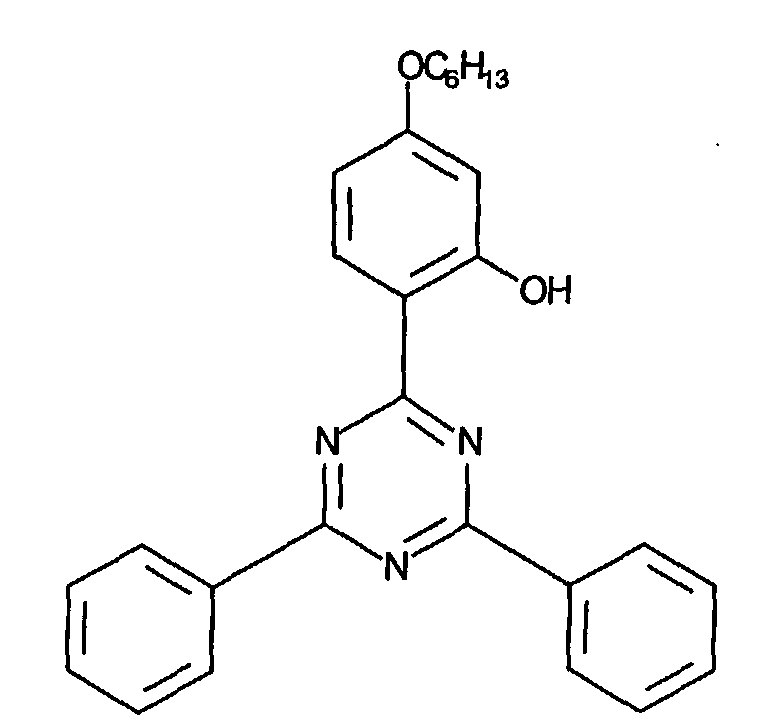
- the film contains 0.01 to 5.0% by weight of 2- (4,6-diphenyl-1,3,5-triazin-2-yl) -5-hexyloxyphenol of the formula or 0.01% to 5.0% by weight of 2,2-methylene-bis (6- (2H-benzotriazol-2-yl) -4- (1,1,2,2-tetramethylpropyl) - phenol of the formula or 0.1 to 5.0% by weight of 2,2 '- (1,4-phenylene) bis [4H-3,1-benzoxazin-4-one] of the formula
- mixtures of these UV stabilizers can also be used or mixtures of at least one of these UV stabilizers with others UV stabilizers are used, the total concentration of light stabilizers preferably between 0.1 and 5.0% by weight, particularly preferably in Range from 0.5 to 3.0 wt .-%, based on the weight of the equipped Layer.
- An optionally flame-retardant effect means that the film according to the Invention in a so-called fire protection test the conditions according to DIN 4102 part 2 and in particular the conditions according to DIN 4102 part 1 and in building material class B 2 and in particular B1 of the flame retardant materials can be classified.
- the film which is optionally flame-retardant, is said to pass the UL test 94 "Horizontal Burning Test for Flammability of Plastic Material" pass that it can be classified in the 94 VTM-0 class.
- the film according to the invention contains a flame retardant, which over the so-called masterbatch technology metered in directly during film production is, the concentration of the flame retardant in the range of 0.5 to 30.0 % By weight, preferably from 1.0 to 20.0% by weight, based on the weight of the Layer of the crystallizable thermoplastic, lies.
- concentration of the Flame retardants in the masterbatch are generally in the range of 5.0 to 60.0% by weight.
- the flame retardant is or can be dispersed in the carrier material also be chemically bound in thermoplastics.
- Typical flame retardants include bromine compounds, chlorinated paraffins and other chlorine compounds, antimony trioxide, aluminum trihydrates, the Halogen compounds due to the resulting halogen-containing by-products are disadvantageous. Furthermore, the low light resistance is one of them equipped film in addition to the development of hydrogen halide in the event of a fire extremely disadvantageous.
- Suitable flame retardants according to the invention are used, for example, organic phosphorus compounds such as Carboxyphosphinic acids, their anhydrides and alkanephosphonic esters, preferably methanephosphonic acid ester. It is essential that the organic Phosphorus compound is soluble in the thermoplastic, otherwise the required optical properties are not met.
- hydrolysis stabilizer Since the flame retardants generally have a certain sensitivity to hydrolysis have, the additional use of a hydrolysis stabilizer may be useful.
- Phenolic stabilizers, alkali / alkaline earth stearates and / or alkali / alkaline earth carbonates are generally used as hydrolysis stabilizers in amounts of 0.01 to 1.0% by weight. Phenolic stabilizers are preferred in an amount of 0.05 to 0.6% by weight, in particular 0.15 to 0.3% by weight and with a molar mass of more than 500 g / mol. Pentaerythritol tetrakis 3- (3,5-di- tert -butyl-4-hydroxyphenyl) propionate or 1,3,5-trimethyl-2,4,6-tris (3,5-di- tert .- butyl-4-hydroxybenzyl) benzene are particularly advantageous.
- the flame retardant film contains according to the invention, the main constituent is a crystallizable PET, titanium dioxide, an optical brightener, 1.0 to 20.0 wt .-% of a soluble in thermal load organic phosphorus compound as a flame retardant and 0.1 to 1.0% by weight a hydrolysis stabilizer.
- the flame retardant is ®Amgard P 1045 from the company Albright & Wilson preferred.
- thermoplastics to be used according to the invention This information regarding flame retardants and hydrolysis stabilizers also applies in With regard to other thermoplastics to be used according to the invention.
- Fire protection tests according to DIN 4102 and the UL test are very surprising shown that it is quite sufficient in the case of a three-layer film, the Equip 0.5 to 2.0 mm thick top layers with flame retardant to achieve a to achieve improved flame retardancy. If necessary and with high fire protection requirements the core layer can also be equipped with flame retardant, d. H. include so-called basic equipment.
- No embrittlement after thermal stress means that the film after 100 Hours of annealing at 100 ° C in a forced air oven, no embrittlement and has no adverse mechanical properties.
- films in the thickness range 10 - 350 ⁇ m the requirements of building material classes B2 and B1 according to DIN 4102 and the UL test 94.
- the surface gloss of the films according to the invention measured according to DIN 67530 (Measuring angle 20 °) is ⁇ 15, preferably ⁇ 20 and the light transmission L *, measured according to ASTM D 1003, is ⁇ 85%, preferably ⁇ 80%, which for the achieved effect in combination with the white coloring is surprisingly good.
- the film is according to the Invention constructed at least three layers and then includes a special one Embodiment as layers, the base layer B, the sealable cover layer A and the top layer C, which may or may not be sealable.
- the cover layer C is sealable are the cover layers A and C identical.
- the sealable cover layer applied to base layer B by coextrusion A is based on polyester copolymers and consists of essentially from copolyesters, consisting predominantly of isophthalic and terephthalic acid units and are composed of ethylene glycol units. The remaining monomer units come from other aliphatic, cycloaliphatic or aromatic diols or dicarboxylic acids, as also in the base layer can occur.
- the preferred copolyesters that are desired Providing sealing properties are those made from ethylene terephthalate and Ethylene isophthalate units and are composed of ethylene glycol units.
- the proportion of ethylene terephthalate is 40 to 95 mol% and the corresponding proportion of ethylene isophthalate 60 to 5 mol%.
- copolyesters in which the Proportion of ethylene terephthalate 50 to 90 mol% and the corresponding proportion Ethylene isophthalate is 50 to 10 mol% and in particular copolyester which the proportion of ethylene terephthalate 60 to 85 mol% and the corresponding The proportion of ethylene isophthalate is 40 to 15 mol%.
- non-sealable top layer C or for any existing one
- the same polymers can be used as intermediate layers was previously described for the base layer.
- the desired sealing and processing properties of the Film according to the invention are made from the combination of the properties of the used copolyesters for the sealable top layer and the topographies the sealable cover layer A and the sealable or non-sealable Obtain top layer C.
- the seal starting temperature of 130 ° C and the seal seam strength of at least 0.6 N / 15mm is achieved when the sealable outer layer A Copolymers described in more detail above can be used.
- the handling of the film is poor because the surface of the sealable Cover layer A tends to block. The film can hardly be wrapped and is for further processing on high-speed packaging machines not suitable.
- To improve handling of the film and processability it is necessary to modify the sealable outer layer A. This is best done with the help of suitable antiblocking agents from a selected one Size that is added to the sealing layer in a certain concentration in such a way that on the one hand the blocking is minimized and on the other hand the Sealing properties are only slightly deteriorated.
- the film can also corona°. be flame treated.
- the treatment intensity is chosen so that the surface tension the film is generally over 45 mN / m.
- the production of the film according to the invention can, for example, according to a Extrusion processes take place in an extrusion line.
- the economic production includes that the raw materials or the raw material components, which are required to produce the film, with commercially available Industrial dryers, such as vacuum (i.e. under reduced pressure), fluidized bed, Fluid bed or fixed bed dryer (shaft dryer), can be dried.
- Industrial dryers such as vacuum (i.e. under reduced pressure), fluidized bed, Fluid bed or fixed bed dryer (shaft dryer), can be dried.
- the additives used according to the invention do not outgas or wall coverings in the dryers form that the raw materials do not stick and cannot be broken down thermally.
- the dryers mentioned generally work at normal pressure with temperatures between 100 and 170 ° C.
- the raw material goes through a temperature range of approx. 30 ° C to 130 ° C a reduced pressure of 50 mbar. After that is a so-called drying in a hopper at temperatures from 100 to 130 ° C and a dwell time required from 3 to 6 hours.
- the masterbatch which contains the hydrolysis stabilizer contains and the masterbatch, which may contain the flame retardant and optionally contains the UV stabilizer, each pre-crystallized or pre-dried becomes.
- This predrying involves gradual heating of the masterbatch under reduced pressure (20 to 80 mbar, preferably 30 to 60 mbar, in particular 40 to 50 mbar) and with stirring and optionally post-drying at constant, elevated temperature also under reduced pressure.
- the masterbatch is preferably taken from a dosing tank at room temperature in the desired mixture together with the polymers of the base and / or Cover layers and possibly other raw material components in batches a vacuum dryer, which has a temperature spectrum in the course of the drying or dwell time from 10 ° C to 160 ° C, preferably 20 ° C to 150 ° C, in particular 30 ° C to 130 ° C, filled.
- the raw material mixture becomes 10, in particular a 4-hour dwell time to 70 rpm, preferably 15 to 65 rpm, in particular 20 to 60 rpm.
- the pre-crystallized or pre-dried raw material mixture is in one downstream also evacuated container at 90 ° to 180 ° C, preferably 100 ° C to 170 ° C, especially 110 ° C to 160 ° C for 2 to 8 hours, preferably 3 to 7 hours, especially 4 to 6 hours after-drying.
- the film was also found to be excellent in Can be oriented longitudinally and transversely without tears.
- the films can be made from a thermoplastic raw material, the Titanium dioxide of the rutile type, the optical brightener, optionally the blue one Dye and with other raw materials and / or other usual ones Additives in the usual amount of 0.1 to a maximum of 10.0% by weight both as monofilms as well as multilayer, optionally coextruded films with the same or differently formed surfaces, one being For example, the surface is pigmented and the other surface is not a pigment contains. Likewise, one or both surfaces of the film can be made according to known ones Process can be provided with a conventional functional coating.
- the titanium dioxide and the optical Brightener and optionally the blue dye preferably in the core layer contain. If necessary, the cover layers can also be equipped.
- the amount refers here Additives to the weight of the thermoplastics in the equipped with the additives layer
- the polymers or raw material mixtures are fed to one extruder or, in the case of multilayer films, to several extruders. Any foreign bodies or impurities that may be present can be filtered off from the polymer melt before extrusion.
- the melt (s) are then formed into flat melt films in a mono nozzle or, in the multilayer case, in a multilayer nozzle, and in the multilayer case are layered one on top of the other.
- the monofilm or the multilayer film is then quenched with the aid of a cooling roller and solidified as a largely amorphous, ie unoriented, film.
- This film is then heated again and stretched in the longitudinal and transverse directions or in the transverse and in the longitudinal direction or in the longitudinal, in the transverse and again in the longitudinal direction and / or transverse direction.
- the first longitudinal stretching can optionally. be carried out simultaneously with the transverse stretching (simultaneous stretching). This is followed by the heat setting of the film at oven temperatures of 200 to 280 ° C, especially at 220 to 270 ° C.
- the film is then cooled and wound up.
- the surprising combination of excellent properties makes it suitable the film according to the invention excellent for a variety of different Indoor and outdoor applications, for example for interior cladding, for stand construction and trade fair articles, for displays, for signs, for labels, in shop and shelf construction, as short-lived advertising signs, labels or others Promotional items, as a lamination medium and for food applications, for medical applications, in the construction sector, for outdoor applications, as furniture film, as packaging film or in the freezer area.
- the individual are measured Properties according to the following standards or procedures.
- the DEG / PEG / IPA content is determined by gas chromatography after saponification in methanolic KOH and neutralization with aqueous HCl determined.
- the surface gloss is measured at a measuring angle of 20 ° according to DIN 67530 measured.
- the surface defects and the homogeneous coloring are determined visually.
- the modulus of elasticity, the tensile strength and the elongation at break are in the longitudinal and transverse directions measured according to ISO 527-1-2.
- the standard viscosity SV (DCE) is measured based on DIN 53726 in dichloroacetic acid.
- the UV stability is tested according to the test specification ISO 4892 as follows tester Atlas Ci 65 Weather Ometer test conditions ISO 4892, ie artificial weathering exposure time 1000 hours (per page) radiotherapy 0.5 W / m 2 , 340 nm temperature 63 ° C Relative humidity 50% Xenon lamp inner and outer filter made of borosilicate irradiation cycles 102 minutes of UV light, then 18 minutes of UV light with water spraying the samples, then again 102 minutes of UV light, etc.
- the yellowness index (YID) is the deviation from the colorlessness in the direction of "yellow” and is measured according to DIN 6167.
- the fire behavior is according to DIN 4102 part 2, building material class B2 and according to DIN 4102 part 1, building material class B1 and determined according to UL test 94.
- the degree of whiteness is determined according to Berger, with generally more than 20 Foil layers are placed on top of each other. The degree of whiteness is determined with the help of the electric remission photometer ®ELREPHO from Zeiss, Oberkochem (DE), standard illuminant C, 2 ° normal observer.
- a white standard a pellet made of barium sulfate (DIN 5033, part 9) is used. A detailed one Description is e.g. in Hansl Loos "color measurement", publisher profession and school, Itzehoe (1989).
- the surface tension was measured using the so-called ink method (DIN 53364).
- the sealing device HSG / ET from Brugger heat sealed samples (Sealing seam 20 mm x 100 mm) made, the film at different Temperatures with the help of two heated sealing jaws at a sealing pressure of 2 bar and a sealing time of 0.5 seconds is sealed. From the sealed Samples were cut test strips 15 mm wide. The T-seal strength was measured as in the determination of the seal seam strength.
- the Seal start temperature is the temperature at which a seal seam strength of at least 0.5 N / 15 mm is reached.
- seal seam strength two 15 mm wide film strips are used superimposed and at 130 ° C, a sealing time of 0.5 seconds and one Sealing pressure of 2 bar (device: Brugger type NDS, one-sided heated sealing jaw) sealed.
- the seal seam strength is determined according to the T-Peel method.
- the polyethylene terephthalate (clear raw material) from which the films were made and the polyethylene terephthalate used to make the masterbatches had a standard viscosity SV (DCE) of 810, which is an intrinsic Unless otherwise stated, viscosity corresponds to 0.658 dl / g.
- DCE standard viscosity SV
- a 50 ⁇ m thick white film was produced, which was the main component Polyethylene terephthalate (type RT49, KoSa, Germany), 6% titanium dioxide of the rutile type (®Tronox RFK2, Kerr McGee, Germany), 192 ppm optical brightener (®Hostalux KS, Clariant, Germany) and 30 ppm blue dye ®Sudan blue 2 (BASF, Germany).
- Polyethylene terephthalate type RT49, KoSa, Germany
- 6% titanium dioxide of the rutile type (®Tronox RFK2, Kerr McGee, Germany)
- 192 ppm optical brightener ®Hostalux KS, Clariant, Germany
- 30 ppm blue dye ®Sudan blue 2 (BASF, Germany).
- the additives titanium dioxide, optical brightener and blue dye were used as Masterbatches added.
- the masterbatch (1) consists of 50% titanium dioxide, 0.16% optical Brightener and 49.84% clear raw material.
- the masterbatch (2) also contains Clear raw material 1500 ppm blue dye.
- the film was coated on both sides with an aqueous dispersion using the “reverse gravure-roll coating” method.
- the dispersion contained 4.2% by weight of hydrophilic polyester (5-Na-sulfoisophthalic acid-containing PET / IPA polyester, type SP41, Ticona, USA), 0.15% by weight of colloidal silicon dioxide (®Nalco 1060, Irish Nalco Chemistry, Germany) as an antiblocking agent and 0.15% by weight ammonium carbonate (Merck, Germany) as a pH buffer.
- the wet application weight was 2 g / m 2 per coated side.
- the calculated thickness of the coating was 40 nm.
- Example 2 Analogously to Example 1, a 50 ⁇ m thick film coated on both sides was used manufactured. It contained 12% by weight of masterbatch (1) and 88% by weight of clear raw material, but no blue dye.
- a 50 ⁇ m thick, coextruded white A-B-A film was produced, with A stands for the cover layers and B for the core layer.
- the 47 ⁇ m recipe thick core layer corresponded to the recipe of Example 2.
- the 1.5 ⁇ m thick Top layers contained 93% by weight of clear raw material and 7% by weight of a masterbatch, which in addition to clear raw material 10,000 ppm silicon dioxide (®Sylobloc 44 H, Fa. Grace, Germany).
- the film was on a cover layer A analogous to that Recipe from Example 1 coated on one side. This film stood out a high surface gloss.
- Example 2 Analogously to Example 2, a 50 ⁇ m thick monofilm was produced, the difference to Example 2 additionally 0.6% by weight of the UV stabilizer 2- (4,6-diphenyl-1,3,5-triazin-2-yl) -5- (hexyl) oxyphenol (®Tinuvin 1577 from Ciba-Geigy) contained (Melting point 149 ° C, thermally stable up to approx. 330 ° C), which in the form of a 20.0 % By weight of masterbatches was added.
- UV stabilizer 2- 4,6-diphenyl-1,3,5-triazin-2-yl) -5- (hexyl) oxyphenol
- ®Tinuvin 1577 from Ciba-Geigy
- a 50 ⁇ m thick, coextruded A-B-A film was produced.
- the main component of the 46 ⁇ m thick base layer B was PET, 6.0% by weight Rutile-type titanium dioxide, 200 ppm optical brightener, 0.2% by weight hydrolysis stabilizer and 4.0 wt% flame retardant.
- the layer still contained 30.0% by weight of the self-regenerate that is inherent in film production.
- the two 2 ⁇ m thick top layers contained 0.1% by weight of Sylobloc 44 H as an anti-blocking agent.
- the titanium dioxide and the optical brightener were in the form of a masterbatch metered in, in addition to PET 50.0% by weight titanium dioxide (rutile type) and 0.16% contained optical brighteners.
- the Sylobloc 44 H was not soluble in PET is incorporated into the PET at the raw material manufacturer.
- the hydrolysis stabilizer and the flame retardant were metered in in the form of a master batch.
- the masterbatch consisted of 20.0% by weight of flame retardant (methanephosphonic acid bis- (5-ethyl-2-methyl-2-oxo-2 ⁇ 5 - [1,3,2] dioxaphosphinan-5-ylmethyl ester)), 1 , 0 wt .-% hydrolysis stabilizer (pentaerythritol tetrakis-3- (3,5-di- tert -butyl-4-hydroxylphenyl propionate) and 79.0 wt .-% PET together.
- Example 5 Analogously to Example 5, a 50 ⁇ m thick, A-B-A film was produced. The difference Example 5 became the film after longitudinal stretching as in Example 1, but only one-sided, coated. After the transverse stretching, the calculated thickness was Coating at 40 nm.
- a 50 ⁇ m thick, coextruded, sealable A-B-C film was produced.
- the main component of the 48 ⁇ m thick base layer B was PET, 6.0% by weight Titanium dioxide (rutile type, 0.2 ⁇ m particle diameter, Kerr McGee), 20 ppm des optical brightener from Example 1 and 30.0 wt .-% of the inherent in the Self-generated film production.
- the titanium dioxide and the optical brightener were metered in via masterbatch.
- the Titanium dioxide content was 50%.
- the optical brightener content was 0.016%. The remaining amount was 100% clear raw material.
- a copolyester of 78 mol% ethylene terephthalate and 22 mol% ethylene isophthalate was used as the thermoplastic (produced by the transesterification process with Mn as transesterification catalyst, Mn concentration: 100 ppm). It also contained 3.0% by weight of a masterbatch composed of 97.75% by weight of the copolyester mentioned, 1.0% by weight of Sylobloc 44 H and 1.25% by weight of ®Aerosil TT 600 (pyrogenic SiO 2 from Degussa).
- the 1 ⁇ m thick top layer C contained 3.0% by weight of a masterbatch from 97.75% by weight PET, 1.0% by weight Sylobloc 44 H and 1.25% by weight Aerosil TT 600 as an anti-blocking agent.
- Example 7 Analogously to Example 7, a 50 ⁇ m thick, coextruded, sealable A-B-C film was used produced with the difference that the non-sealable cover layer C was coated on one side after the longitudinal stretching as in Example 6. After Transverse stretching, the calculated thickness of the coating was 40 nm.
- Example 7 Analogously to Example 7, a 50 ⁇ m thick, coextruded, sealable A-B-C film was used produced with the difference that the non-sealable cover layer C corona treated has been. The intensity was chosen so that the surface tension was> 45 mN / m.
- a 50 ⁇ m thick monofilm was produced which, as in Example 2, 6.0% by weight Titanium dioxide and 200 ppm optical brightener, analogous to Example 4, 0.6% by weight UV stabilizer and analogously to Example 5, 0.2% by weight hydrolysis stabilizer and 4.0% by weight flame retardant. contained.
- the additives were made according to the Information dosed as a master batch.
- the film was coated on both sides as in Example 1. After the transverse stretching, the calculated thickness of the coating was 40 nm.
- the formulation of the 47 ⁇ m thick base layer B corresponded to the formulation of Monofilm from Example 10, so it contained an optical one in addition to PET titanium dioxide Brightener, a UV stabilizer, a flame retardant and a hydrolysis stabilizer.
- a 50 ⁇ m thick monofilm was produced which corresponded to Example 2. However, the film did not contain an optical brightener.
- a 50 ⁇ m thick white monofilm was produced according to Example 2, you In addition to clear raw material, however, it contained 6.0% by weight of anatase-type titanium dioxide (®Hombitan LW-S-U, Sachtleben, Germany). However, the film contained none optical brightener.
- the properties of the films produced can be found in the table below.
Landscapes
- Chemical & Material Sciences (AREA)
- Organic Chemistry (AREA)
- Health & Medical Sciences (AREA)
- Chemical Kinetics & Catalysis (AREA)
- Medicinal Chemistry (AREA)
- Polymers & Plastics (AREA)
- Manufacturing & Machinery (AREA)
- Engineering & Computer Science (AREA)
- Materials Engineering (AREA)
- Manufacture Of Macromolecular Shaped Articles (AREA)
- Compositions Of Macromolecular Compounds (AREA)
- Laminated Bodies (AREA)
- Shaping By String And By Release Of Stress In Plastics And The Like (AREA)
Abstract
Description
| Verfahrensschritt | Folie gemäß der Erfindung |
| Vortrocknen | nicht erforderlich |
| Temperatur der Form | 100 bis 140 °C |
| Aufheizzeit pro 10 µm Foliendicke | < 5 sec pro 10 µm Foliendicke |
| Folientemperatur beim Verformen | 100 bis 160 °C |
| Möglicher Verstreckfaktor | 1,0 bis 2,5 |
| Detailwiedergabe | hervorragend |
| Schrumpf (Schwindung) | < 1,5 % |


- der UV-Stabilisator eine mangelnde thermische Stabilität hat und sich bei Temperaturen zwischen 200 °C und 240 °C zersetzt oder ausgast,
- große Mengen (ca. 10 bis 15 Gew.-%) UV-Stabilisator eingearbeitet werden müssen, damit das UV-Licht absorbiert wird und die Folie nicht geschädigt wird.
- Düsenablagerungen, was zu Profilschwankungen führt;
- Walzenablagerungen vom UV-Stabilisator, was zur Beeinträchtigung der optischen Eigenschaften (schlechte Trübung, Klebedefekt, inhomogene Oberfläche) führt;
- Ablagerungen im Produktionsprozess. Daher war es mehr als überraschend, daß bereits mit niedrigen Konzentrationen des erfindungsgemäß eingesetzen UV-Stabilisators ein hervorragender UV-Schutz erzielt wurde. Sehr überraschend war, daß sich bei diesem hervorragenden UV-Schutz
- der Gelbwert der Folie im Vergleich zu einer nicht-stabilisierten Folie im Rahmen der Meßgenauigkeit nicht ändert,
- keine Ausgasungen, keine Düsenablagerungen einstellen, wodurch die Folie eine exzellente Optik aufweist und ein ausgezeichnetes Profil und eine ausgezeichnete Planlage hat,
- sich die UV-stabilisierte Folie durch eine hervorragende Laufsicherheit auszeichnet, so daß sie verfahrenssicher hergestellt werden kann. Damit ist die Folie auch wirtschaftlich rentabel.
| Testgerät | Atlas Ci 65 Weather Ometer |
| Testbedingungen | ISO 4892, d. h. künstliche Bewitterung |
| Bestrahlungszeit | 1000 Stunden (pro Seite) |
| Bestrahlung | 0,5 W/m2, 340 nm |
| Temperatur | 63 °C |
| Relative Luftfeuchte | 50 % |
| Xenonlampe | innerer und äußerer Filter aus Borosilikat |
| Bestrahlungszyklen | 102 Minuten UV-Licht, dann 18 Minuten UV-Licht mit Wasserbesprühung der Proben dann wieder 102 Minuten UV-Licht usw. |

Claims (16)
- Weiße, biaxial orientierte Folie mit einer Dicke im Bereich von 10 bis 500 µm, deren Hauptbestandteil mindestens ein kristallisierbarerThermoplast ist, dadurch gekennzeichnet, daß die Folie mindestens ein Titandioxid vom Rutil-Typ als Weißpigment und mindestens einen optischen Aufheller in Gegenwart oder Abwesenheit weiterer Zusätze enthält, sowie mit mindestens einer weiteren Funktionalität versehen ist.
- Folie nach Anspruch 1, dadurch gekennzeichnet, daß der kristallisierte Thermoplast ein Polyethylenterephthalat, Polybutylenterephthalat, Polyethylennaphthalat, bibenzolmodifiziertes Polyethylenterephthalat oder Mischungen daraus, vorzugsweise Polyethylenterephthalat oder Polyethylennaphthalat ist.
- Folie nach Anspruch 1 oder 2, dadurch gekennzeichnet, daß das Weißpigment in einer Konzentration im Bereich von 2,0 bis 25,0 Gew.-%, vorzugsweise von 2,0 bis 23,0 Gew.-%, insbesondere 3,0 bis 20,0 Gew.-%, bezogen auf das Gewicht des Thermoplasten, enthalten ist.
- Folie nach einem oder mehreren der Ansprüche 1 bis 3, dadurch gekennzeichnet, daß als optischer Aufheller mindestens ein Benzoxazol-, Triazin-, Phenylcumarin- und Bis-sterylbiphenyl-Derivat in Mengen von 10 bis 50.000 ppm, vorzugsweise von 20 bis 30.000 ppm, insbesondere von 50 bis 25.000 ppm, bezogen auf das Gewicht des kristallisierbaren Thermoplasten, enthalten ist.
- Folie nach einem oder mehreren der Ansprüche 1 bis 4, dadurch gekennzeichnet, daß die Folie zur Erzielung mindestens einer weiteren Funktionalität mit einem Flammschutzmittel und/oder mit UV-Stabilisatoren (UV-Absorber) ausgerüstet und/oder siegelfähig und/oder auf einer oder beiden Oberflächen beschichtet und/oder auf einer oder beiden Seiten coronabehandelt und neben dem optischen Aufheller mit einem löslichen Farbstoff versehen ist.
- Folie nach Anspruch 5, dadurch gekennzeichnet, daß die Konzentration des UV-Absorbers im Bereich von 0,01 bis 5,0 Gew.- % vorzugsweise 0,1 bis 3 Gew.-%, die Konzentration des Flammschutzmittels im Bereich von 0,5 bis 30,0 Gew.-%, vorzugsweise von 1,0 bis 20,0 Gew.-% und die Konzentration des löslichen Farbstoffs im Bereich von 10 bis 10.000 ppm, vorzugsweise 20 bis 5.000 ppm, insbesondere 50 bis 1.000 ppm liegt.
- Folie nach Anspruch 5 oder 6, dadurch gekennzeichnet, daß die UV-Absorber als 2-Hydroxybenzophenone, 2-Hydroxybenzotriazole, nickelorganische Verbindungen, Salicylsäureester, Zimtsäureester-Derivate, Resorcinmonobenzoate, Oxalsäureanilide, Hydroxybenzoesäureester, sterisch gehinderte Amine und Triazine, vorzugsweise 2-Hydroxybenzotriazole und Triazine und insbesondere 2-(4,6-Diphenyl-1,3,5-triazin-2-yl)-5-(hexyl)oxyphenol oder 2,2'-Methylen-bis(6-(2H-benzotriazol-2-yl)-4-(1,1,2,2,-tetramethylpropyl)-phenol vorliegen.
- Folie nach einem oder mehreren der Ansprüche 5 bis 7, dadurch gekennzeichnet, daß das Flammschutzmittel als organische Phosphorverbindung, vorzugsweise Carboxyphosphinsäuren, deren Anhydride oder als Alkanphosphonsäureester, bevorzugt als Methanphosphonsäure-bis-(5-ethyl-2-methyl-2-oxo-2λ5-[1,3,2]dioxaphosphinan-5-ylmethylester), vorliegt.
- Folie nach einem oder mehreren der Ansprüche 1 bis 8, dadurch gekennzeichnet, daß ein Hydrolysestabilisator in Form von phenolischen Stabilisatoren, Alkali-/Erdalkalistearaten und/oder Alkali-/Erdalkalicarbonaten in einer Menge von 0,01 bis 1,0 Gew.-%, vorzugsweise phenolische Stabilisatoren in einer Menge von 0,05 bis 0,6 Gew.-%, insbesondere 0,15 bis 0,3 Gew.-% und mit einer Molmasse von mehr als 500 g/mol, enthalten ist.
- Folie nach einem oder mehreren der Ansprüche 1 bis 9, dadurch gekennzeichnet, daß ein Regenerat enthalten ist.
- Verfahren zur Herstellung einer weißen, biaxial orientierte Folie mit einer Dicke im Bereich von 10 bis 500 µm, deren Hauptbestandteil mindestens ein kristallisierbarer Thermoplast ist, dadurch gekennzeichnet, daß ein kristallisierbarer Thermoplast mit mindestens einem Titandioxid vom Rutil-Typ als Weißpigment und mindestens einen optischen Aufheller und weiteren, eine Funktionalität verleihenden Substanzen nach einem Extrusionsverfahren zu einem flachen Schmelzefilm ausgeformt, mit Hilfe einer Kühlwalze zu einer weitgehend amorphen Vorfolie abgeschreckt und verfestigt wird., diese Folie anschließend erneut erhitzt und mindestens einmal in Längs- und Querrichtung gestreckt, dann bei Temperaturen von 200 bis 280°C thermofixiert und schließlich abgekühlt und aufgewickelt wird.
- Verfahren nach Anspruch 11, dadurch gekennzeichnet, daß die Folie zur Erzielung mindestens einerweiteren Funktionalität mit einem Flammschutzmittel und/oder mit UV-Stabilisatoren ausgerüstet und/oder mit mindestens einer Siegelschicht ausgerüstet und/oder auf einer oder beiden Oberflächen beschichtet und/oder auf einer oder beiden Seiten coronabehandelt und neben dem optischen Aufheller mit einem löslichen Farbstoff versehen wird.
- Verfahren nach Anspruch 11 oder 12, dadurch gekennzeichnet, daß das Titandioxid vom Rutil-Typ, der optische Aufheller und die weiteren, eine Funktionalität verleihenden Substanzen bei der Folienherstellung in den Extruder zudosiert werden, wobei die Zugabe über die Masterbatch - Technologie bevorzugt ist.
- Verfahren nach einem oder mehreren Ansprüche 11 bis 13, dadurch gekennzeichnet, daß ein Regenerat eingesetzt wird.
- Verwendung der Folie nach einem oder mehreren Ansprüche 1 bis 10 für die Anwendung im Innen - und Außenbereich.
- Verwendung nach Anspruch 15 für Innenraumverkleidungen, für Messebau und Messeartikel, für Displays, für Schilder, für Etiketten, im Laden- und Regalbau, als kurzlebige Werbeschilder, Labels oder anderer Werbeartikel, als Kaschiermedium und für Lebensmittelanwendungen, für medizinische Anwendungen, im Bausektor, als Möbelfolie, als Verpackungsfolie oder im Tiefkühlbereich.
Applications Claiming Priority (2)
| Application Number | Priority Date | Filing Date | Title |
|---|---|---|---|
| DE10112493 | 2001-03-15 | ||
| DE10112493A DE10112493A1 (de) | 2001-03-15 | 2001-03-15 | Weiße, biaxial orientierte Folie aus einem kristallisierbaren Thermoplasten mit hohem Weißgrad und mit zusätzlicher Funktionalität |
Publications (3)
| Publication Number | Publication Date |
|---|---|
| EP1256597A2 true EP1256597A2 (de) | 2002-11-13 |
| EP1256597A3 EP1256597A3 (de) | 2003-08-13 |
| EP1256597B1 EP1256597B1 (de) | 2005-11-09 |
Family
ID=7677582
Family Applications (1)
| Application Number | Title | Priority Date | Filing Date |
|---|---|---|---|
| EP02005255A Expired - Lifetime EP1256597B1 (de) | 2001-03-15 | 2002-03-11 | Weisse, biaxal orientierte Folie aus einem kristallisierbaren Thermoplasten mit hohem Weissgrad und mit zusätzlicher Funktionalität |
Country Status (5)
| Country | Link |
|---|---|
| US (1) | US6872446B2 (de) |
| EP (1) | EP1256597B1 (de) |
| JP (1) | JP2002326279A (de) |
| KR (1) | KR20020073395A (de) |
| DE (2) | DE10112493A1 (de) |
Cited By (3)
| Publication number | Priority date | Publication date | Assignee | Title |
|---|---|---|---|---|
| EP1454741A3 (de) * | 2003-03-07 | 2007-11-07 | Klöckner Pentaplast GmbH & Co. KG | Kunststoff-Folie für Möbel oder Möbelteile |
| US7541088B2 (en) | 2006-09-27 | 2009-06-02 | Mitsubishi Polyester Film Gmbh | Laser-markable film |
| CN112334306A (zh) * | 2018-05-29 | 2021-02-05 | 科思创知识产权两合公司 | 具有高耐候稳定性的由聚碳酸酯制成的不透明多层制品 |
Families Citing this family (22)
| Publication number | Priority date | Publication date | Assignee | Title |
|---|---|---|---|---|
| JP2003524691A (ja) * | 2000-01-20 | 2003-08-19 | ミツビシ ポリエステル フィルム ジーエムビーエイチ | 結晶性熱可塑性樹脂から成り熱成型可能で難燃性および耐紫外線性を有する白色フィルム及びその使用ならびにその製造方法 |
| DE10002171A1 (de) * | 2000-01-20 | 2001-07-26 | Mitsubishi Polyester Film Gmbh | Transparente, schwerentflammbare, UV-stabile Folie aus einem kristallisierbaren Thermoplasten, Verfahren zu ihrer Herstellung und ihre Verwendung |
| DE10002163A1 (de) * | 2000-01-20 | 2001-07-26 | Mitsubishi Polyester Film Gmbh | Weiße, schwerentflammbare, UV-stabile Folie aus einem kristallisierbaren Thermoplasten, Verfahren zu ihrer Herstellung und ihre Verwendung |
| DE10007672A1 (de) * | 2000-02-19 | 2001-08-23 | Mitsubishi Polyester Film Gmbh | Weiß-opake, schwer entflammbare, UV-stabilisierte Folie mit niedriger Transparenz aus einem kristallisierbaren Thermoplasten |
| EP1347477A3 (de) * | 2002-03-06 | 2006-02-01 | Mitsubishi Polyester Film GmbH | Biaxial orientierte, flammhemmend ausgerüstete Folie aus einem kristallisierbaren Thermoplasten, Verfahren zu ihrer Herstellung und ihre Verwendung |
| EP1342746A1 (de) * | 2002-03-06 | 2003-09-10 | Mitsubishi Polyester Film GmbH | Biaxial orientierte, hydrolysebeständige Kondensatorfolie aus einem kristallisierbaren Thermoplasten, Verfahren zu ihrer Herstellung und ihre Verwendung |
| DE10222348A1 (de) * | 2002-05-21 | 2003-12-04 | Mitsubishi Polyester Film Gmbh | Biaxial orientierte, hydrolysebeständige Folie aus einem Thermoplast mit einem Hydrolysestabilisator, Verfahren zu ihrer Herstellung, ihre Verwendung sowie aus der Folie hergestellte Kondensatoren |
| WO2004036661A2 (en) * | 2002-10-15 | 2004-04-29 | Solvay Advanced Polymers, Llc | Anti-yellowing polycondensation polymer compositions and articles |
| WO2005105903A2 (en) * | 2004-05-05 | 2005-11-10 | Garware Polyester Ltd. | Low density white polyester film |
| US7118213B2 (en) * | 2004-06-01 | 2006-10-10 | Johnson & Johnson Vision Care, Inc. | Promotional aid |
| US7375167B2 (en) | 2005-05-09 | 2008-05-20 | Basf Se | Hydrolysis-resistance composition |
| DE502006001168D1 (de) * | 2005-06-01 | 2008-09-04 | Mitsubishi Polyester Film Gmbh | Weiss-opake Folie mit niedriger Transparenz und verbesserter Durchschlagsfestigkeit |
| US20070134470A1 (en) * | 2005-12-09 | 2007-06-14 | Martin Jesberger | Multilayer, white, biaxially oriented polyester film |
| US9074407B2 (en) | 2010-02-05 | 2015-07-07 | Mitsubishi Polyester Film Gmbh | Multilayer polyester film with high optical density with a total thickness of max. 60 μm two white layers and a carbon-black containing outer layer |
| DE102010007139A1 (de) * | 2010-02-05 | 2011-08-11 | Mitsubishi Polyester Film GmbH, 65203 | Mehrschichtige Polyesterfolie hoher optischer Dichte mit einer Gesamtdicke von maximal 60 μm mit zwei weißen Schichten und einer rußhaltigen Außenschicht |
| KR101705241B1 (ko) * | 2010-11-04 | 2017-02-09 | 에스케이씨 주식회사 | 백색 폴리에스터 필름 및 이의 제조방법 |
| WO2013002595A2 (en) * | 2011-06-30 | 2013-01-03 | Kolon Industries, Inc. | White film |
| KR102005474B1 (ko) * | 2012-02-23 | 2019-07-31 | 코오롱인더스트리 주식회사 | 태양광모듈용 백시트 및 이의 제조방법 |
| JP6041097B2 (ja) * | 2012-09-21 | 2016-12-07 | 東洋製罐株式会社 | 包装材およびそれを用いてなる包装構造 |
| JP5673905B1 (ja) * | 2013-05-23 | 2015-02-18 | 東洋製罐グループホールディングス株式会社 | 液層を表面に有する多層構造体 |
| JP6716540B2 (ja) * | 2014-08-14 | 2020-07-01 | ミツビシ ポリエステル フィルム インク | 塗布ポリエステルフィルムを含む積層体 |
| US10639873B1 (en) * | 2017-07-26 | 2020-05-05 | Toray Plastics (America), Inc. | Heat sealing polyester films with low coefficient of friction |
Family Cites Families (19)
| Publication number | Priority date | Publication date | Assignee | Title |
|---|---|---|---|---|
| DE2346787C3 (de) | 1973-09-17 | 1980-05-08 | Hoechst Ag, 6000 Frankfurt | Schwer entflammbare lineare Polyester, Verfahren zu deren Herstellung und deren Verwendung |
| DE2454189C3 (de) * | 1974-11-15 | 1980-08-14 | Hoechst Ag, 6000 Frankfurt | Verfahren zur Herstellung von schwer entflammbaren linearen Polyestern |
| US4415684A (en) * | 1977-09-21 | 1983-11-15 | The B. F. Goodrich Company | UV-Light stabilized compositions containing substituted 1,5-diazacycloalkanes |
| US4812501A (en) * | 1986-04-23 | 1989-03-14 | Ciba-Geigy Corporation | 1,3,2-oxazaphospholidine stabilizers |
| US5075481A (en) * | 1990-08-23 | 1991-12-24 | Ciba-Geigy Corporation | Poly-1,3,2-oxazaphospholidine stabilizers |
| US5306606A (en) * | 1990-12-31 | 1994-04-26 | Konica Corporation | Biaxially stretched polyester film comprising a coating layer containing a salt of a sulfonic acid type polymer |
| EP0798112B1 (de) * | 1992-07-22 | 2003-09-17 | Teijin Limited | Biaxial orientierter mehrschichtiger Polyesterfilm, geeignet zum Kleben auf Metallblech |
| DE4325684A1 (de) * | 1993-07-30 | 1995-02-02 | Hoechst Ag | Verfahren zur Herstellung eines Farbbilds, Schichtmaterial zur Durchführung des Verfahrens und nach dem Verfahren erhaltenes Farbbild |
| GB9321184D0 (en) | 1993-10-14 | 1993-12-01 | Ici Plc | Polymeric film |
| US5660931A (en) | 1994-03-17 | 1997-08-26 | Skc Limited | Polymeric film with paper-like characteristics |
| GB9423182D0 (en) | 1994-11-17 | 1995-01-04 | Ici Plc | Polymeric film |
| DE19607046A1 (de) | 1996-02-24 | 1997-08-28 | Hoechst Ag | Mischungen von optischen Aufhellern für Kunststoffe |
| GB9617078D0 (en) * | 1996-08-14 | 1996-09-25 | Ici Plc | Polymeric film |
| DE19705249A1 (de) * | 1997-02-12 | 1998-08-13 | Zimmer Ag | Verfahren zur Herstellung von Polypropylenterphthalat |
| US6270888B1 (en) * | 1997-08-07 | 2001-08-07 | Dupont Teijin Films Us Limited Partner | Polymeric film |
| DE69942518D1 (de) | 1998-03-10 | 2010-08-05 | Mitsubishi Polyester Film Corp | Weisser Polyesterfilm |
| DE10002153A1 (de) * | 2000-01-20 | 2001-07-26 | Mitsubishi Polyester Film Gmbh | Amorphe, weiße, schwerentflammbare, UV-stabile, thermoformbare Folie, Verfahren zu ihrer Herstellung und ihre Verwendung |
| DE10007673A1 (de) * | 2000-02-19 | 2001-08-23 | Mitsubishi Polyester Film Gmbh | Weiß-opake, UV-stabilisierte Folie mit niedriger Transparenz aus einem kristallisierbaren Thermoplasten |
| DE10009246A1 (de) * | 2000-02-28 | 2001-08-30 | Mitsubishi Polyester Film Gmbh | Weiße, biaxial orientierte und UV-stabilisierte Polyesterfolie mit Cycloolefinocopolymer (COC), Verfahren zu ihrer Herstellung und ihre Verwendung |
-
2001
- 2001-03-15 DE DE10112493A patent/DE10112493A1/de not_active Withdrawn
-
2002
- 2002-02-27 US US10/084,028 patent/US6872446B2/en not_active Expired - Lifetime
- 2002-03-11 EP EP02005255A patent/EP1256597B1/de not_active Expired - Lifetime
- 2002-03-11 DE DE50204819T patent/DE50204819D1/de not_active Expired - Lifetime
- 2002-03-12 JP JP2002066967A patent/JP2002326279A/ja active Pending
- 2002-03-13 KR KR1020020013563A patent/KR20020073395A/ko not_active Ceased
Cited By (3)
| Publication number | Priority date | Publication date | Assignee | Title |
|---|---|---|---|---|
| EP1454741A3 (de) * | 2003-03-07 | 2007-11-07 | Klöckner Pentaplast GmbH & Co. KG | Kunststoff-Folie für Möbel oder Möbelteile |
| US7541088B2 (en) | 2006-09-27 | 2009-06-02 | Mitsubishi Polyester Film Gmbh | Laser-markable film |
| CN112334306A (zh) * | 2018-05-29 | 2021-02-05 | 科思创知识产权两合公司 | 具有高耐候稳定性的由聚碳酸酯制成的不透明多层制品 |
Also Published As
| Publication number | Publication date |
|---|---|
| US6872446B2 (en) | 2005-03-29 |
| JP2002326279A (ja) | 2002-11-12 |
| EP1256597B1 (de) | 2005-11-09 |
| KR20020073395A (ko) | 2002-09-26 |
| EP1256597A3 (de) | 2003-08-13 |
| US20020187328A1 (en) | 2002-12-12 |
| DE10112493A1 (de) | 2002-09-19 |
| DE50204819D1 (de) | 2005-12-15 |
Similar Documents
| Publication | Publication Date | Title |
|---|---|---|
| EP1256597B1 (de) | Weisse, biaxal orientierte Folie aus einem kristallisierbaren Thermoplasten mit hohem Weissgrad und mit zusätzlicher Funktionalität | |
| EP1728815B1 (de) | Weiss-opake Folie mit niedriger Transparenz und verbesserter Durchschlagsfestigkeit | |
| EP1262511A2 (de) | Gedeckt eingefärbte, hydrolysbeständige, biaxial orientierte Folie aus einem kristallisierbaren Thermoplasten und Verfahren zu ihrer Herstellung | |
| EP1274788B1 (de) | Weisse, schwerentflammbare, uv-stabile, thermoformbare folie aus einem kristallisierbaren thermoplasten | |
| EP1614536A2 (de) | Mehrschichtige, matte, thermoformbare, IR-reflektierende Polyesterfolie | |
| EP1193050B1 (de) | Hydrolysebeständig ausgerüstete, transparente, biaxial orientierte Folie aus einem kristallisierbaren Thermoplasten und Verfahren zu ihrer Herstellung | |
| EP1614707A1 (de) | Matte, thermoformbare, IR-reflektierende Polyesterfolie | |
| DE10148306A1 (de) | Hydrolysebeständig ausgerüstete, transparente, amorphe Folie aus einem kristallisierbaren Thermoplasten und Verfahren zu ihrer Herstellung | |
| EP1272551B1 (de) | Weisse, schwerentflammbare, uv-stabile folie aus einem kristallisierbaren thermoplasten, verfahren zu ihrer herstellung und ihre verwendung | |
| EP1274776B1 (de) | Weisse, flammhemmend ausgerüstete folie aus einem kristallisierbaren thermoplasten, verfahren zu ihrer herstellung und verwendung | |
| WO2002070253A1 (de) | Amorphe, gedeckt eingefärbte, funktionalisierte folie aus einem bibenzolmodifizierten thermoplasten, verfahren zu ihrer herstellung und ihre verwendung | |
| WO2002068511A1 (de) | Amorphe, funktionalisierte folie aus einem bibenzolmodifizierten thermoplasten, verfahren zu ihrer herstellung und ihre verwendung | |
| EP1276793B1 (de) | Weisse, flammhemmend ausgerüstete, orientierte folie aus einem kristallisierbaren thermoplasten, verfahren zu ihrer herstellung und ihre verwendung | |
| DE10002153A1 (de) | Amorphe, weiße, schwerentflammbare, UV-stabile, thermoformbare Folie, Verfahren zu ihrer Herstellung und ihre Verwendung | |
| DE10105110A1 (de) | Gedeckt eingefärbte, antimikrobielle, biaxial orientierte, teilkristalline Folie aus einem kristallisierbaren Thermoplast mit zusätzlicher Funktionalität, Verfahren zu ihrer Herstellung und ihre Verwendung | |
| EP1245618B1 (de) | Weisse, biaxial orientierte Folie aus einem kristallisierbaren Thermoplasten mit guter Schneidbarkeit | |
| WO2002062578A1 (de) | Gedeckt eingefärbte, antimikrobielle, biaxial orientierte, teilkristalline folie aus einem kristallisierbaren thermoplasten | |
| DE10043784A1 (de) | Transparente, teilkristalline, funktionalisierte Folie aus einem bibenzolmodifizierten Thermoplasten, Verfahren zu ihrer Herstellung und ihre Verwendung | |
| DE10043781A1 (de) | Weiß-opake, mit zusätzlichen Funktionalitäten versehene kristalline Folie aus einem bibenzolmodifizierten Thermoplasten, Verfahren zu ihrer Herstellung und ihre Verwendung | |
| DE10043779A1 (de) | Matte, mehrschichtige, funktionalisierte Folie aus einem bibenzolmodifizierten Thermoplasten, Verfahren zu ihrer Herstellung und ihre Verwendung | |
| WO2002055592A1 (de) | Weisse, antimikrobielle, biaxial orientierte, teilkristalline folie aus einem kristallisierbaren thermoplasten | |
| DE10101906A1 (de) | Amorphe, gedeckt eingefärbte, antimikrobiell ausgerüstete Folie aus einem kristallisierbaren Thermoplast mit zusätzlicher Funktionalität, Verfahren zu ihrer Herstellung und ihre Verwendung | |
| DE10100705A1 (de) | Funktionalisierte,weiße,antimikrobielle,biaxial orientierte, teilkristalline Folie aus einem kristallisierbaren Thermoplasten | |
| DE10101903A1 (de) | Amorphe, antimikrobiell ausgerüstete, transparente Folie aus einem kristallisierbaren Thermoplast mit zusätzlicher Funktionalität, Verfahren zu ihrer Herstellung und ihre Verwendung | |
| WO2002057349A1 (de) | Amorphe, antimikrobiell ausgerüstete, transparente folie aus einem kristallisierbaren thermoplasten, verfahren zu ihrer herstellung und ihre verwendung |
Legal Events
| Date | Code | Title | Description |
|---|---|---|---|
| PUAI | Public reference made under article 153(3) epc to a published international application that has entered the european phase |
Free format text: ORIGINAL CODE: 0009012 |
|
| AK | Designated contracting states |
Kind code of ref document: A2 Designated state(s): AT BE CH CY DE DK ES FI FR GB GR IE IT LI LU MC NL PT SE TR |
|
| AX | Request for extension of the european patent |
Free format text: AL;LT;LV;MK;RO;SI |
|
| PUAL | Search report despatched |
Free format text: ORIGINAL CODE: 0009013 |
|
| AK | Designated contracting states |
Designated state(s): AT BE CH CY DE DK ES FI FR GB GR IE IT LI LU MC NL PT SE TR |
|
| AX | Request for extension of the european patent |
Extension state: AL LT LV MK RO SI |
|
| 17P | Request for examination filed |
Effective date: 20040213 |
|
| AKX | Designation fees paid |
Designated state(s): DE FR GB IT LU NL |
|
| 17Q | First examination report despatched |
Effective date: 20040423 |
|
| GRAP | Despatch of communication of intention to grant a patent |
Free format text: ORIGINAL CODE: EPIDOSNIGR1 |
|
| GRAS | Grant fee paid |
Free format text: ORIGINAL CODE: EPIDOSNIGR3 |
|
| GRAA | (expected) grant |
Free format text: ORIGINAL CODE: 0009210 |
|
| AK | Designated contracting states |
Kind code of ref document: B1 Designated state(s): DE FR GB IT LU NL |
|
| PG25 | Lapsed in a contracting state [announced via postgrant information from national office to epo] |
Ref country code: IT Free format text: LAPSE BECAUSE OF FAILURE TO SUBMIT A TRANSLATION OF THE DESCRIPTION OR TO PAY THE FEE WITHIN THE PRESCRIBED TIME-LIMIT;WARNING: LAPSES OF ITALIAN PATENTS WITH EFFECTIVE DATE BEFORE 2007 MAY HAVE OCCURRED AT ANY TIME BEFORE 2007. THE CORRECT EFFECTIVE DATE MAY BE DIFFERENT FROM THE ONE RECORDED. Effective date: 20051109 Ref country code: NL Free format text: LAPSE BECAUSE OF FAILURE TO SUBMIT A TRANSLATION OF THE DESCRIPTION OR TO PAY THE FEE WITHIN THE PRESCRIBED TIME-LIMIT Effective date: 20051109 |
|
| REG | Reference to a national code |
Ref country code: GB Ref legal event code: FG4D Free format text: NOT ENGLISH |
|
| REF | Corresponds to: |
Ref document number: 50204819 Country of ref document: DE Date of ref document: 20051215 Kind code of ref document: P |
|
| PGFP | Annual fee paid to national office [announced via postgrant information from national office to epo] |
Ref country code: FR Payment date: 20060308 Year of fee payment: 5 |
|
| GBT | Gb: translation of ep patent filed (gb section 77(6)(a)/1977) |
Effective date: 20060222 |
|
| NLV1 | Nl: lapsed or annulled due to failure to fulfill the requirements of art. 29p and 29m of the patents act | ||
| PLBE | No opposition filed within time limit |
Free format text: ORIGINAL CODE: 0009261 |
|
| STAA | Information on the status of an ep patent application or granted ep patent |
Free format text: STATUS: NO OPPOSITION FILED WITHIN TIME LIMIT |
|
| 26N | No opposition filed |
Effective date: 20060810 |
|
| EN | Fr: translation not filed | ||
| PG25 | Lapsed in a contracting state [announced via postgrant information from national office to epo] |
Ref country code: FR Free format text: LAPSE BECAUSE OF FAILURE TO SUBMIT A TRANSLATION OF THE DESCRIPTION OR TO PAY THE FEE WITHIN THE PRESCRIBED TIME-LIMIT Effective date: 20061229 |
|
| PGFP | Annual fee paid to national office [announced via postgrant information from national office to epo] |
Ref country code: GB Payment date: 20180328 Year of fee payment: 17 |
|
| PGFP | Annual fee paid to national office [announced via postgrant information from national office to epo] |
Ref country code: DE Payment date: 20180528 Year of fee payment: 17 |
|
| PGFP | Annual fee paid to national office [announced via postgrant information from national office to epo] |
Ref country code: LU Payment date: 20180319 Year of fee payment: 17 |
|
| REG | Reference to a national code |
Ref country code: DE Ref legal event code: R119 Ref document number: 50204819 Country of ref document: DE |
|
| GBPC | Gb: european patent ceased through non-payment of renewal fee |
Effective date: 20190311 |
|
| PG25 | Lapsed in a contracting state [announced via postgrant information from national office to epo] |
Ref country code: LU Free format text: LAPSE BECAUSE OF NON-PAYMENT OF DUE FEES Effective date: 20190311 |
|
| PG25 | Lapsed in a contracting state [announced via postgrant information from national office to epo] |
Ref country code: DE Free format text: LAPSE BECAUSE OF NON-PAYMENT OF DUE FEES Effective date: 20191001 Ref country code: GB Free format text: LAPSE BECAUSE OF NON-PAYMENT OF DUE FEES Effective date: 20190311 |