EP1256799A2 - Methode und Gerät für die rasche Analyse von Aldehyd beinhaltenden Desinfektionsmitteln - Google Patents
Methode und Gerät für die rasche Analyse von Aldehyd beinhaltenden Desinfektionsmitteln Download PDFInfo
- Publication number
- EP1256799A2 EP1256799A2 EP02251868A EP02251868A EP1256799A2 EP 1256799 A2 EP1256799 A2 EP 1256799A2 EP 02251868 A EP02251868 A EP 02251868A EP 02251868 A EP02251868 A EP 02251868A EP 1256799 A2 EP1256799 A2 EP 1256799A2
- Authority
- EP
- European Patent Office
- Prior art keywords
- aldehyde
- compound
- color
- mmole
- measuring device
- Prior art date
- Legal status (The legal status is an assumption and is not a legal conclusion. Google has not performed a legal analysis and makes no representation as to the accuracy of the status listed.)
- Ceased
Links
Images



Classifications
-
- G—PHYSICS
- G01—MEASURING; TESTING
- G01N—INVESTIGATING OR ANALYSING MATERIALS BY DETERMINING THEIR CHEMICAL OR PHYSICAL PROPERTIES
- G01N31/00—Investigating or analysing non-biological materials by the use of the chemical methods specified in the subgroup; Apparatus specially adapted for such methods
- G01N31/22—Investigating or analysing non-biological materials by the use of the chemical methods specified in the subgroup; Apparatus specially adapted for such methods using chemical indicators
-
- Y—GENERAL TAGGING OF NEW TECHNOLOGICAL DEVELOPMENTS; GENERAL TAGGING OF CROSS-SECTIONAL TECHNOLOGIES SPANNING OVER SEVERAL SECTIONS OF THE IPC; TECHNICAL SUBJECTS COVERED BY FORMER USPC CROSS-REFERENCE ART COLLECTIONS [XRACs] AND DIGESTS
- Y10—TECHNICAL SUBJECTS COVERED BY FORMER USPC
- Y10T—TECHNICAL SUBJECTS COVERED BY FORMER US CLASSIFICATION
- Y10T436/00—Chemistry: analytical and immunological testing
- Y10T436/20—Oxygen containing
- Y10T436/200833—Carbonyl, ether, aldehyde or ketone containing
Definitions
- the field of the invention relates to a method and device to detect a point of interest of an aldehyde in a test sample such as a disinfectant.
- OPA o -phthalaldehyde
- glutaraldehyde concentrations are mainly instrumental measurements that could be classified into chromatographic measurement (chromatographic, HPLC analysis) or non-chromatographic measurement (direct spectroscopic assay).
- HPLC analysis OPA or glutaraldehyde are measured by both a derivative method or a non-derivative method.
- the most common derivative method is to convert OPA or glutaraldehyde to 2,4-dinotrophenylhydrazones by reacting OPA with 2,4-dinitrophenylhydrazine. Since the UV absorption is greatly enhanced, this method is valuable for low level OPA or glutaraldehyde measurements especially in environmental analysis.
- OPA or glutaraldehyde could be measured directly without making derivatives first.
- OPA or glutaraldehyde may be analyzed easily with GC analysis.
- OPA or glutaraldehyde could be measured directly with spectrophotometric methods.
- one drawback to this method is that there must be no interference at the specific wavelength used. For example, OPA or glutaraldehyde could be oxidized slowly by air and the carboxylic acid formed may interfere in such assays.
- the current invention provides another method without the above problems.
- the chemistry principle could also be used for the strip approach, in a preferred embodiment it is used for the color change of a solution.
- the present invention is drawn to a method of determining the presence of a point of interest of an aldehyde in a test sample which includes the steps of:
- the compound having an amino group is an amino acid.
- the amino acid is glycine or lysine.
- the compound that reacts with the carbonyl group of the aldehyde is selected from the group including a salt of bisulfite, a salt of cyanide, hydrazine, and hydroxylamine.
- the aldehyde includes a germicide.
- the germicide is selected from the group including OPA, glutaraldehyde, and formaldehyde.
- the compound having an amino group is mixed with the test sample at the same time as the compound that reacts with the carbonyl group of the aldehyde. In an alternate embodiment, the compound having an amino group is added to the test sample after the compound that reacts with the carbonyl group of the aldehyde.
- the first color produced by the first reacting step may be colorless.
- the method may also include drawing up a fixed volume of an aldehyde-containing test sample before or during the first reacting step.
- the fixed volume may be loaded to a measuring device having a gas or vapor permeable but liquid impermeable membrane.
- the fixed volume may be loaded to a measuring device containing the compound for the first reacting step or the compound for the second reacting step.
- a liquid measuring device including at least one compartment for determining the presence of a point of interest of an aldehyde in a test sample including a first compartment having a proximal and distal end which contains an amount of a first compound that reacts with a carbonyl group of the aldehyde in a first reacting step, wherein the amount is sufficient to react with the aldehyde to the point of interest to produce a first color.
- the first compartment further includes a compound having an amino group that reacts with the aldehyde to produce a second color.
- the liquid measuring device may optionally include a second compartment in liquid communication with said first compartment by means of a valve.
- the valve is a one-way valve. In an alternate embodiment, the valve is an on/off valve. In a preferred embodiment, the second compartment of the liquid measuring device includes a compound having an amino group that reacts with the aldehyde to produce a second color.
- the liquid measuring device may be either a syringe or pipet.
- the liquid measuring device includes a gas or vapor permeable but liquid impermeable membrane between the proximal and distal end of the first compartment.
- the liquid measuring device includes a filter at or near the distal end of the first compartment. Additionally, the liquid measuring device may also include a valve at or near the distal end of the first compartment. In one embodiment, the valve is a one-way valve. In an alternate embodiment, the valve is an on/off valve.
- the liquid measuring device may include a needle assembly.
- the needle assembly includes a needle cap.
- the aldehyde in the test sample is selected from the group including OPA, glutaraldehyde, and formaldehyde.
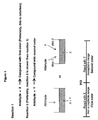
- Figure 1 shows the basic principles of the described assay.
- Reaction 1 shows the reaction of aldehyde with compound X to produce a compound with a first color.
- the first color is colorless.
- Reaction 2 shows the reaction of aldehyde and Y to form a compound with a second color.
- reaction 2 is slower than Reaction 1. If the concentration of aldehyde is below the POI (point of interest) only compound X will react and the resulting solution will be the first color as shown in the bottom half of the figure. In the presence of a level of aldehyde that is equal to or more than the POI, a solution with the second color or the combined color of the first color and the second color will be formed.
- POI point of interest
- Figure 2 shows a pipette and two variants of a syringe with a gas or vapor permeable liquid impermeable barrier.
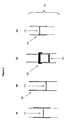
- Figure 3A shows the coupling of the gas or vapor permeable liquid impermeable barrier to the syringe or pipette.
- Figure 3B illustrates how inserts 4 at the top of the pipette or syringe attach the gas or vapor permeable liquid impermeable barrier to the pipette or syringe.
- Figure 3C illustrates a holder 5 that holds the inserts in place.
- Figure 3D shows the inserts and the coupling of the gas or vapor permeable liquid impermeable barrier.
- Figure 4 is an expanded view of figure 3C which shows a gas or vapor permeable liquid impermeable barrier 1, an insert 4, and a holder 5.
- Figure 5 shows one embodiment of the invention where the position of the gas or vapor permeable liquid impermeable membrane is adjusted by means of a screw.
- Figures 6A and 6B show embodiments of the liquid delivery apparatus with all chemicals in one chamber.
- Figure 6C shows a two chambered embodiment of the liquid delivery apparatus.
- the test sample may be taken into the first chamber for reaction with the first compound such as compound X in Figure 1. Then the sample is moved by means of a one-way valve or a manual ON/OFF valve 8 into the second chamber where the test sample reacts with the second compound such as compound Y of Figure 1.
- Aldehydes react with amino-containing compounds like amino acids or amines to form an imine or more commonly known as a Schiff's base, which is often colored. Taking glycine as an example: Another known aldehyde reaction is the sodium bisulfite carbonyl addition reaction.
- the sodium bisulfite addition reaction is more favorable than that of Schiff's formation since the former reaction is fast and hard to reverse.
- a compound containing an amino group such as an amino acid
- a reagent such as sodium bisulfite
- the aldehyde will react first with sodium bisulfite and then with the amino acid. Therefore, it is possible to design a color pass/fail reaction by controlling the amount of reagents to react with aldehydes such as formaldehyde, OPA or glutaraldehyde.
- the key is the amount of reagent such as sodium bisulfite which is designed to react with the aldehyde without a color being developed in the presence of an amino acid.
- any remaining aldehyde will then react with the amino acid to develop a colored solution.
- an aldehyde such as formaldehyde, OPA or glutaraldehyde
- a test solution such as a disinfectant solution.
- the formaldehyde, OPA or glutaraldehyde concentration is below an acceptable specification.
- the specific concentration can be set to any point by adjusting the amounts of the chemical reagents used or by using different amounts of aldehyde (formaldehyde, OPA or glutaraldehyde) in the test solution.
- a color pass/fail reaction for determination of excess aldehyde by control of reagents which react with aldehyde is described.
- the key is the amount of reagent such as sodium bisulfite which is designed to react with the Point of Interest (POI) level of aldehyde without a color being developed in the presence of a compound containing an amino group such as an amino acid. Any "extra" aldehyde, exceeding the POI, will then react with the compound containing an amino group, causing a color to be developed.
- the aldehyde is either OPA or glutaraldehyde and the compound containing the amino group is an amino acid. This method is especially useful for quality control where components only needed to be examined in pre-determined ranges.
- a number of reagents which are known to react quickly with aldehydes may be used in the practice of the invention. These include any chemicals which can oxidize or reduce the aldehyde group and any chemicals which can react with and alter the carbonyl functional group of the aldehyde. Examples of such reagents are disclosed in Morrison & Boyd, "Organic Chemistry", Chapter 19, Allyn and Bacon, 3 rd edition, 1973, which is herein incorporated by reference.
- Such reagents include, but are not limited to, Ag(NH 3 ) 2 ; KMnO 4 ; K 2 Cr 2 O 7 ; H 2 + Ni, Pt, or Pd; LiAlH 4 or NaBH 4 , then H + ; Zn (Hg), conc. HCI; NH 2 NH 2 , base; Grignard reagents; salts of cyanide and bisulfite; ammonia derivatives such as hydroxylamine, hydrazine, phenylhydrazine, and semicarbazide; reactions with alcohols in the presence of acid; and reactions with acid or base such as the Cannizzaro reaction, the aldol condensation, and the Perkin condensation.
- the reagent which reacts with the aldehyde is a salt of either bisulfite or cyanide.
- Both compounds X and Y react with the aldehyde in the figure.
- X reacts much faster than Y.
- the reaction of X with aldehyde results in a colorless compound whereas the reaction of Y with aldehyde results in a colored compound.
- a point of interest is chosen and the amount of X that will react with the point of interest is determined.
- the aldehyde is mixed with X and Y, the aldehyde will react first with compound X which is kinetically and thermodynamically favored. Any excess aldehyde will then react with compound Y to form a colored solution.
- the concentration of aldehyde is above the point of interest.
- the determination may be made visually, with or without a color chart. Alternatively, a spectrophotometer may be used. If the reaction between the aldehyde and compound X is not kinetically and thermodynamically favored, then compound Y can be added after the aldehyde reacts with compound X as shown in Figure 1.
- liquid-measuring device such as a pipette or syringe, for carrying out the assay.
- This device could be used for any "fixed-volume” measurement and transfer in chemistry, biochemistry, clinical chemistry or other industries.
- the apparatus may be a syringe or pipette with one or more barrels and plungers and a membrane barrier with or without a coupling device.
- the membrane barrier is a gas or vapor permeable and liquid impermeable barrier. In the presence of certain pressure differences between the two sides of the barrier, the gas or vapor flows through the membrane but not the liquid.
- Any suitable gas or vapor permeable and liquid impermeable materials can be used for this purpose. Some examples include, but are not limited to, nonwoven polyolefin, such as TyvekTM (non-woven polyethylene), or CSR (non-woven polypropylene central supply room), wrapping material and any other hydrophobic filtering materials.
- the device contains an insert and a holder.
- the syringe or pipette apparatus may also contain valves to control the flow of liquid.
- the membrane barrier can be thermally bound to the syringe or pipet. It can also be attached to the syringe or pipet with an adhesive or connected to the syringe barrel by a coupling device.
- the coupling device may be connected to an insert for altering the position of the membrane barrier. The position of the membrane barrier can be adjusted by the length of the insert.
- the insert may be secured with a holder.
- the membrane barrier is a gas or vapor permeable but liquid impermeable barrier.
- the membrane barrier is positioned such that the liquid can only be filled up to the barrier.
- the invention has several preferred embodiments.
- a gas or vapor permeable liquid impermeable membrane 1 is fixed into the pipette 7 or syringe 6 and held in place at the desired maximum volume by means known in the art.
- the syringe includes a plunger 3.
- the syringe can have a metal or plastic needle with or without a needle cap.
- a coupling device 2 is used which is larger or smaller than the diameter of the pipette 7 or syringe 6. Two parts of the pipet or syringe with different lengths can be joined together with such a coupling device.
- FIGS 3A, 3B, 3C, 3D and Figure 4 Coupling of the membrane barrier to the syringe or pipette is shown in Figures 3A, 3B, 3C, 3D and Figure 4.
- the membrane can be inserted into the syringe or pipet from the top of the pipette or syringe by an insert 4 which may be secured with a holder 5 and its position varied by any means known in the art such as by a screw ( Figure 5) or a slidable adjustment (Figure 4).
- Figure 3D shows an insert which has a larger diameter than the pipette or syringe.
- Figures 6A, 6B and 6C illustrate the use of the measuring device with this invention.
- Figures 6A and 6B show a syringe with a gas or vapor permeable liquid impermeable barrier and two chemicals.
- the liquid can be filled in the syringe by inserting the plastic needle into the sample solution, pulling the plunger to create a negative pressure in the syringe, and loading the liquid into the syringe.
- the measuring device can have a filtering material (Figure 6A) or valve ( Figure 6B) to retain the chemicals in the barrel.
- the chemical in the syringe can be in either a liquid or solid form.
- the valve can be a one-way valve or a manual ON/OFF valve.
- Figure 6C provides another embodiment for mixing more than one reactant successively. It has two chambers 9, 10. A fixed volume of any solution including, but not limited to an aldehyde is drawn up through a one-way valve or an ON/OFF valve 8 into the first chamber 9 where it mixes with the first reactant, for example sodium bisulfite. After a predetermined time, the reactants flow through a second one-way valve or an ON/OFF valve 8 into a second reaction chamber 10 which might contain an amine such as lysine, for example, to complete the reaction. Alternatively, a three-way valve can be used instead of two one-way valves.
- the pass/fail conclusion is consistent and convenient. Preferably, there is no need to guess the color. The user's only conclusion will be "colored” or “not colored.”
- the liquid transferring device is consistent and convenient. A fixed volume of liquid can be taken by a simple operation. Third, the solution color is easier to visualize than a test strip paper since the test strip paper itself is colored, leading to false positive results. Fourth, the color displaying time can be adjusted by adding a base to make the reaction faster or an acid to make the reaction slower. Fifth, the color being displayed can be adjusted by choosing different amino acids or amines. Sixth, the darkness of the color being displayed can be adjusted by the amount of the amino acids or amines. Seventh, the assay is extremely easy to run and interpret. And finally, the liquid transferring device could be used for any "fixed-volume" transfer in chemistry, biochemistry, clinical chemistry or other industries.
- Example 1 Sodium bisulfite, glycine and OPA were added and the OPA to sodium bisulfite mole ratio was adjusted as in Example 1.
- Table 2 shows three points of interest (POI). The first POI, was the 2:1 mole ratio, the second POI was the 1.75:1 mole ratio and the third POI was the 1.5:1 mole ratio of OPA to sodium bisulfite.
- the 2:1 ratio 5 minutes were needed to display the initial color.
- For the 1.75:1 ratio 13 minutes were needed to display the initial color.
- For the 1.5:1 ratio color was not displayed for a few days.
- reaction volume is varied by varying the amount of OPA solution from 400 ⁇ l to 800 ⁇ l.
- the assay is independent of volume.
- the OPA to sodium bisulfite mole ratio is a key parameter of the assay.
- Example 2 Sodium bisulfite, glycine and OPA were added and the OPA to sodium bisulfite mole ratio was adjusted as in Example 2. As shown in Table 3, the first POI was in the range of 6'20"-7'20" range and the time needed for color change was very consistent. However, for the second POI, there was some variation for this time (17-24'). Without being bound by any mechanism, this may be due to the visual limitation or it may mean that at diluted concentration, the color development is more likely to be influenced by micro reaction condition variations, such as temperature, pH or even the exposure of sunlight.
- Example 1 Sodium bisulfite, glycine and OPA were added as in Example 1. Since the POI position is controlled by the OPA to sodium bisulfite mole ratio, by changing the OPA volume, one should be able to switch the POI to basically any OPA concentration range. Thus, in Table 4, the actual OPA moles taken in Vial 1, Vial 2 and Vial 3 are equal to Vial 3, Vial 4 and Vial 5 in Table 3.
- one of the key factors for this invention is the mole ratio of aldehyde to sodium bisulfite. Similar results were obtained for DL-alanine, ⁇ -amino-n-caproic acid and L-lysine, except that different end colors were observed.
- Example 5 Further experiments with OPA for POI's in the range of 0.35% and 0.30%.
- Example 7 Other Amino Acids with Added Base (100 ⁇ L).
- Example 8 Activated Cidex solution (containing 2.1 % glutaraldehyde) with Lysine
- aldehyde-sodium bisulfite complex 5 is more stable than aldehyde-sodium bisulfite complex 6 , we would see a larger POI range from glutaraldehyde.
- the different POI ranges from OPA and glutaraldehyde might be a result of the competence of aldehyde-sodium bisulfite formation and the aldehyde/amino acid Schiff's base formation both kinetically and thermodynamically.
- the time may vary.
- the lysine can be added immediately after the aldehyde is mixed with the NaHSO 3 .
- the assay described can be applied generally to aldehydes and amines to provide a pass/fail type assay of aldehyde content.
- the aldehyde solution can be measured and transferred by means known in the art such as by a regular pipet or syringe.
- the aldehyde solution can be measured and transferred using a liquid measuring device as described herein which features a gas or vapor permeable, liquid impermeable, membrane.
- the use of the liquid measuring device containing the gas or vapor permeable, liquid impermeable membrane of the present disclosure has the advantage that the liquid can be transferred easily using a simple operation with consistent results.
- Compound X and Compound Y may be in one vial or in two separate vials. They may be transferred using either a pipet or syringe.
- the aldehyde may be added to compound X and the resulting mixture added to compound Y, the aldehyde may be added to compounds X and Y together, or the aldehyde and chemical Y can be added to the chemical X consecutively.
- the measuring and/or transferring of the aldehyde test sample can be conducted with a regular pipet or syringe.
- the gas or vapor permeable liquid impermeable barrier adds many benefits as described previously.
- the Compound X may be in a first chamber 9.
- the aldehyde is drawn up through the valve 8, up to the gas or vapor permeable liquid impermeable barrier 1.
- the aldehyde and compound X are transferred to a second chamber 10, through a valve 8 which is either a one-way or an on/off valve, where they react with compound Y.
- the color in the second chamber 10 is observed and the presence or absence of excess aldehyde in the test sample determined.
Landscapes
- Life Sciences & Earth Sciences (AREA)
- Health & Medical Sciences (AREA)
- General Health & Medical Sciences (AREA)
- General Physics & Mathematics (AREA)
- Physics & Mathematics (AREA)
- Chemical & Material Sciences (AREA)
- Analytical Chemistry (AREA)
- Biochemistry (AREA)
- Biophysics (AREA)
- Molecular Biology (AREA)
- Immunology (AREA)
- Pathology (AREA)
- Investigating Or Analyzing Non-Biological Materials By The Use Of Chemical Means (AREA)
- Investigating Or Analysing Materials By The Use Of Chemical Reactions (AREA)
- Organic Low-Molecular-Weight Compounds And Preparation Thereof (AREA)
- Measuring Or Testing Involving Enzymes Or Micro-Organisms (AREA)
Applications Claiming Priority (2)
| Application Number | Priority Date | Filing Date | Title |
|---|---|---|---|
| US810872 | 2001-03-16 | ||
| US09/810,872 US20030054562A1 (en) | 2001-03-16 | 2001-03-16 | Method and apparatus for rapidly assaying aldehyde-containing disinfectant |
Publications (2)
| Publication Number | Publication Date |
|---|---|
| EP1256799A2 true EP1256799A2 (de) | 2002-11-13 |
| EP1256799A3 EP1256799A3 (de) | 2003-03-05 |
Family
ID=25204925
Family Applications (1)
| Application Number | Title | Priority Date | Filing Date |
|---|---|---|---|
| EP02251868A Ceased EP1256799A3 (de) | 2001-03-16 | 2002-03-15 | Methode und Gerät für die rasche Analyse von Aldehyd beinhaltenden Desinfektionsmitteln |
Country Status (6)
| Country | Link |
|---|---|
| US (1) | US20030054562A1 (de) |
| EP (1) | EP1256799A3 (de) |
| JP (1) | JP2002350418A (de) |
| KR (1) | KR20020073392A (de) |
| AU (1) | AU2030402A (de) |
| CA (1) | CA2376344A1 (de) |
Cited By (2)
| Publication number | Priority date | Publication date | Assignee | Title |
|---|---|---|---|---|
| EP1707943A3 (de) * | 2005-03-30 | 2007-11-21 | Ethicon, Inc. | Integratorsystem und Verfahren zur raschen Feststellung der Wirksamkeit einer Germizidbehandlung |
| CN106970078A (zh) * | 2017-05-15 | 2017-07-21 | 北京长江脉医药科技有限责任公司 | 一种检测邻苯二甲醛的试纸及其制备和检测方法 |
Families Citing this family (2)
| Publication number | Priority date | Publication date | Assignee | Title |
|---|---|---|---|---|
| FR3069534B1 (fr) * | 2017-07-28 | 2020-10-16 | Commissariat Energie Atomique | Preparation de nouveaux capteurs et filtres d'aldehydes et/ ou de cetones |
| CN115656161B (zh) * | 2022-10-25 | 2025-07-29 | 利康医药科技江苏有限公司 | 一种邻苯二甲醛消毒液浓度检测指示卡及其制备方法 |
Family Cites Families (6)
| Publication number | Priority date | Publication date | Assignee | Title |
|---|---|---|---|---|
| US4471055A (en) * | 1982-03-26 | 1984-09-11 | Minnesota Mining And Manufacturing Company | Process and kit for determining concentrations of aldehydes |
| US4521376A (en) * | 1983-06-13 | 1985-06-04 | Info-Chem Inc. | Glutaraldehyde indicator |
| US4753891A (en) * | 1985-05-24 | 1988-06-28 | Akzo N.V. | Schiff test for rapid detection of low levels of aldehydes |
| US5071769A (en) * | 1986-12-22 | 1991-12-10 | Abbott Laboratories | Method and device for ketone measurement |
| JP3355584B2 (ja) * | 1993-08-11 | 2002-12-09 | 日油技研工業株式会社 | ホルムアルデヒド殺菌検知用インジケータ組成物およびインジケータインク |
| AT4098U1 (de) * | 1999-12-13 | 2001-01-25 | Adalbert Dipl Ing Dr Prior | Schnelltest zur formaldehydbestimmung |
-
2001
- 2001-03-16 US US09/810,872 patent/US20030054562A1/en not_active Abandoned
-
2002
- 2002-03-04 AU AU20304/02A patent/AU2030402A/en not_active Abandoned
- 2002-03-12 CA CA002376344A patent/CA2376344A1/en not_active Abandoned
- 2002-03-13 KR KR1020020013431A patent/KR20020073392A/ko not_active Ceased
- 2002-03-15 EP EP02251868A patent/EP1256799A3/de not_active Ceased
- 2002-03-15 JP JP2002072853A patent/JP2002350418A/ja active Pending
Cited By (6)
| Publication number | Priority date | Publication date | Assignee | Title |
|---|---|---|---|---|
| EP1707943A3 (de) * | 2005-03-30 | 2007-11-21 | Ethicon, Inc. | Integratorsystem und Verfahren zur raschen Feststellung der Wirksamkeit einer Germizidbehandlung |
| RU2425693C2 (ru) * | 2005-03-30 | 2011-08-10 | Этикон, Инк. | Интеграторная система и способ быстрого определения эффективности гермицидной обработки |
| AU2006201247B2 (en) * | 2005-03-30 | 2012-02-02 | Ethicon, Inc. | Integrator system and method for rapidly determining effectiveness of a germicidal treatment |
| US8343768B2 (en) | 2005-03-30 | 2013-01-01 | Ethicon, Inc. | Integrator system and method for rapidly determining effectiveness of a germicidal treatment |
| TWI446935B (zh) * | 2005-03-30 | 2014-08-01 | Ethicon Inc | 用於快速測定殺菌處理功效之整合系統及方法 |
| CN106970078A (zh) * | 2017-05-15 | 2017-07-21 | 北京长江脉医药科技有限责任公司 | 一种检测邻苯二甲醛的试纸及其制备和检测方法 |
Also Published As
| Publication number | Publication date |
|---|---|
| US20030054562A1 (en) | 2003-03-20 |
| EP1256799A3 (de) | 2003-03-05 |
| CA2376344A1 (en) | 2002-09-16 |
| AU2030402A (en) | 2002-09-19 |
| KR20020073392A (ko) | 2002-09-26 |
| JP2002350418A (ja) | 2002-12-04 |
Similar Documents
| Publication | Publication Date | Title |
|---|---|---|
| AU2007200440A1 (en) | Liquid measuring device and method of using | |
| AU659525B2 (en) | Improved oxidative coupling dye for spectrophotometric quantitative analysis of analytes | |
| EP1500930A1 (de) | Verfahren zur messung der formaldehydkonzentration von gas und messinstrument | |
| JP5296054B2 (ja) | 診断用液体のマイクロ流体装置内への圧電ディスペンシング | |
| US20180243737A1 (en) | Assay devices and method of detecting a target analyte | |
| EP1256799A2 (de) | Methode und Gerät für die rasche Analyse von Aldehyd beinhaltenden Desinfektionsmitteln | |
| US20020168777A1 (en) | MBTH for aliphatic aldehyde measurement | |
| AU2006236077A1 (en) | Method and apparatus for rapidly assaying aldehyde-containing disinfectant | |
| AU2007200682A1 (en) | Liquid measuring device and method of using | |
| US3542649A (en) | Color developing composition consisting of an enzyme,a salicylate and a hypochlorite donor | |
| RU2368897C1 (ru) | Индикатор для определения ионов кадмия (ii) в растворе | |
| JP5461389B2 (ja) | 試薬表面への診断液のピエゾ計量分配 | |
| RU2677329C1 (ru) | Индикаторная трубка для определения 1,1-диметилгидразина в воздухе | |
| Mroz et al. | Fluorescence assay for picomole quantities of ammonia | |
| JP2007006880A (ja) | 酵素の計測方法および計測装置 | |
| US3592741A (en) | Method for analysis of urea | |
| Wahbi et al. | Spectrofluorimetric determination of guanethidine sulphate, guanfacine hydrochloride, guanoclor sulphate and guanoxan sulphate in tablets and biological fluids, using benzoin | |
| Stieg | CHEMILUMINESCENT MULTICOMPONENT DETERMINATION OF TRACE METALS. | |
| RU2220094C2 (ru) | Способ идентификации водорода пероксида | |
| EP3968009A1 (de) | Verfahren zur bestimmung von ammonium | |
| 조영범 | New paper based ammonia and pH sensors utilizing controlled sample transport and efficient colorimetric detection | |
| EP0597900A1 (de) | Kolorimetrische Bestimmung von Magnesiumionen in Flüssigkeiten |
Legal Events
| Date | Code | Title | Description |
|---|---|---|---|
| PUAI | Public reference made under article 153(3) epc to a published international application that has entered the european phase |
Free format text: ORIGINAL CODE: 0009012 |
|
| AK | Designated contracting states |
Kind code of ref document: A2 Designated state(s): AT BE CH CY DE DK ES FI FR GB GR IE IT LI LU MC NL PT SE TR |
|
| AX | Request for extension of the european patent |
Free format text: AL;LT;LV;MK;RO;SI |
|
| PUAL | Search report despatched |
Free format text: ORIGINAL CODE: 0009013 |
|
| AK | Designated contracting states |
Kind code of ref document: A3 Designated state(s): AT BE CH CY DE DK ES FI FR GB GR IE IT LI LU MC NL PT SE TR Designated state(s): AT BE CH CY DE DK ES FI FR GB GR IE IT LI LU MC NL PT SE TR |
|
| AX | Request for extension of the european patent |
Extension state: AL LT LV MK RO SI |
|
| 17P | Request for examination filed |
Effective date: 20030811 |
|
| AKX | Designation fees paid |
Designated state(s): DE ES FR GB IT |
|
| 17Q | First examination report despatched |
Effective date: 20061004 |
|
| STAA | Information on the status of an ep patent application or granted ep patent |
Free format text: STATUS: THE APPLICATION HAS BEEN REFUSED |
|
| 18R | Application refused |
Effective date: 20090530 |