EP1258092B1 - System und verfahren zum schutz von datenströmen in hardwarekomponenten - Google Patents
System und verfahren zum schutz von datenströmen in hardwarekomponenten Download PDFInfo
- Publication number
- EP1258092B1 EP1258092B1 EP01953044A EP01953044A EP1258092B1 EP 1258092 B1 EP1258092 B1 EP 1258092B1 EP 01953044 A EP01953044 A EP 01953044A EP 01953044 A EP01953044 A EP 01953044A EP 1258092 B1 EP1258092 B1 EP 1258092B1
- Authority
- EP
- European Patent Office
- Prior art keywords
- content
- client
- recited
- key
- tone
- Prior art date
- Legal status (The legal status is an assumption and is not a legal conclusion. Google has not performed a legal analysis and makes no representation as to the accuracy of the status listed.)
- Expired - Lifetime
Links
- 238000000034 method Methods 0.000 title claims description 34
- 230000000737 periodic effect Effects 0.000 claims abstract description 6
- 238000012545 processing Methods 0.000 claims description 21
- 230000008569 process Effects 0.000 claims description 18
- 230000006837 decompression Effects 0.000 claims description 3
- 238000005516 engineering process Methods 0.000 description 11
- 238000010586 diagram Methods 0.000 description 8
- 230000006835 compression Effects 0.000 description 7
- 238000007906 compression Methods 0.000 description 7
- 238000013459 approach Methods 0.000 description 6
- 239000002131 composite material Substances 0.000 description 3
- 230000006870 function Effects 0.000 description 3
- 230000015572 biosynthetic process Effects 0.000 description 2
- 238000004891 communication Methods 0.000 description 2
- 238000012986 modification Methods 0.000 description 2
- 230000004048 modification Effects 0.000 description 2
- 230000004224 protection Effects 0.000 description 2
- 238000005070 sampling Methods 0.000 description 2
- 238000003786 synthesis reaction Methods 0.000 description 2
- 238000012546 transfer Methods 0.000 description 2
- XOJVVFBFDXDTEG-UHFFFAOYSA-N Norphytane Natural products CC(C)CCCC(C)CCCC(C)CCCC(C)C XOJVVFBFDXDTEG-UHFFFAOYSA-N 0.000 description 1
- 230000002730 additional effect Effects 0.000 description 1
- 239000008272 agar Substances 0.000 description 1
- 238000004458 analytical method Methods 0.000 description 1
- 230000003466 anti-cipated effect Effects 0.000 description 1
- 230000009286 beneficial effect Effects 0.000 description 1
- 230000008901 benefit Effects 0.000 description 1
- 230000008859 change Effects 0.000 description 1
- 230000001419 dependent effect Effects 0.000 description 1
- 238000001514 detection method Methods 0.000 description 1
- 230000006866 deterioration Effects 0.000 description 1
- 230000010339 dilation Effects 0.000 description 1
- 238000009432 framing Methods 0.000 description 1
- 239000007788 liquid Substances 0.000 description 1
- 238000007726 management method Methods 0.000 description 1
- 239000000463 material Substances 0.000 description 1
- 230000002085 persistent effect Effects 0.000 description 1
- 238000009877 rendering Methods 0.000 description 1
- 230000004044 response Effects 0.000 description 1
- 230000005236 sound signal Effects 0.000 description 1
- 238000011144 upstream manufacturing Methods 0.000 description 1
- 238000012795 verification Methods 0.000 description 1
Images




Classifications
-
- H—ELECTRICITY
- H04—ELECTRIC COMMUNICATION TECHNIQUE
- H04N—PICTORIAL COMMUNICATION, e.g. TELEVISION
- H04N21/00—Selective content distribution, e.g. interactive television or video on demand [VOD]
- H04N21/80—Generation or processing of content or additional data by content creator independently of the distribution process; Content per se
- H04N21/83—Generation or processing of protective or descriptive data associated with content; Content structuring
- H04N21/835—Generation of protective data, e.g. certificates
-
- H—ELECTRICITY
- H04—ELECTRIC COMMUNICATION TECHNIQUE
- H04K—SECRET COMMUNICATION; JAMMING OF COMMUNICATION
- H04K1/00—Secret communication
- H04K1/02—Secret communication by adding a second signal to make the desired signal unintelligible
-
- H—ELECTRICITY
- H04—ELECTRIC COMMUNICATION TECHNIQUE
- H04N—PICTORIAL COMMUNICATION, e.g. TELEVISION
- H04N5/00—Details of television systems
- H04N5/76—Television signal recording
- H04N5/91—Television signal processing therefor
- H04N5/913—Television signal processing therefor for scrambling ; for copy protection
-
- G—PHYSICS
- G11—INFORMATION STORAGE
- G11B—INFORMATION STORAGE BASED ON RELATIVE MOVEMENT BETWEEN RECORD CARRIER AND TRANSDUCER
- G11B20/00—Signal processing not specific to the method of recording or reproducing; Circuits therefor
- G11B20/00086—Circuits for prevention of unauthorised reproduction or copying, e.g. piracy
-
- G—PHYSICS
- G11—INFORMATION STORAGE
- G11B—INFORMATION STORAGE BASED ON RELATIVE MOVEMENT BETWEEN RECORD CARRIER AND TRANSDUCER
- G11B20/00—Signal processing not specific to the method of recording or reproducing; Circuits therefor
- G11B20/00086—Circuits for prevention of unauthorised reproduction or copying, e.g. piracy
- G11B20/0021—Circuits for prevention of unauthorised reproduction or copying, e.g. piracy involving encryption or decryption of contents recorded on or reproduced from a record carrier
-
- H—ELECTRICITY
- H04—ELECTRIC COMMUNICATION TECHNIQUE
- H04N—PICTORIAL COMMUNICATION, e.g. TELEVISION
- H04N5/00—Details of television systems
- H04N5/76—Television signal recording
- H04N5/91—Television signal processing therefor
- H04N5/913—Television signal processing therefor for scrambling ; for copy protection
- H04N2005/91357—Television signal processing therefor for scrambling ; for copy protection by modifying the video signal
- H04N2005/91364—Television signal processing therefor for scrambling ; for copy protection by modifying the video signal the video signal being scrambled
-
- H—ELECTRICITY
- H04—ELECTRIC COMMUNICATION TECHNIQUE
- H04N—PICTORIAL COMMUNICATION, e.g. TELEVISION
- H04N7/00—Television systems
- H04N7/16—Analogue secrecy systems; Analogue subscription systems
- H04N7/167—Systems rendering the television signal unintelligible and subsequently intelligible
- H04N7/1675—Providing digital key or authorisation information for generation or regeneration of the scrambling sequence
Definitions
- This invention relates to systems and methods for protecting data content, such as audio and video data. More particularly, this invention relates to protecting data streams in hardware components.
- Piracy of digital content, especially online digital content, is not yet a great problem.
- Most premium content that is available on the Web is of low value, and therefore casual and organized pirates do not yet see an attractive business stealing and reselling content.
- higher-value content is becoming available. Books and audio recordings are available now, and as bandwidths increase, video content will start to appear. With the increase in value of online digital content, the attractiveness of organized and casual theft increases.
- the unusual property of content is that the publisher (or reseller) gives or sells the content to a client, but continues to restrict rights to use the content even after the content is under the sole physical control of the client. For instance, a publisher will typically retain copyright to a work so that the client cannot reproduce or publish the work without permission. A publisher could also adjust pricing according to whether the client is allowed to make a persistent copy, or is just allowed to view the content online as it is delivered. These scenarios reveal a peculiar arrangement. The user that possesses the digital bits often does not have full rights to their use; instead, the provider retains at least some of the rights. In a very real sense, the legitimate user of a computer can be an adversary of the data or content provider.
- Digital rights management is therefore fast becoming a central requirement if online commerce is to continue its rapid growth.
- Content providers and the computer industry must quickly address technologies and protocols for ensuring that digital content is properly handled in accordance with the rights granted by the publisher. If measures are not taken, traditional content providers may be put out of business by widespread theft or, more likely, will refuse altogether to deliver content online.
- FIG. 1 shows a representative prior art system 20 having a content producer/provider 22 that produces original content (e.g., audio, video) and distributes the content over a network 24 to a client 26.
- the content producer/provider 22 has a content storage 30 to store digital data streams of original content and a distribution server 32 that transfers the content over the network 24 (e.g., Internet).
- the distribution server 32 includes an encoder 34 that encrypts and compresses the data prior to distribution over the network. In this manner, the data is protected in route over the public network 24.
- the client 26 is equipped with a processor 40, a memory 42, and one or more media output devices 44 (e.g., monitor, display, sound card, speakers, etc.).
- the processor 40 runs various tools to process the data stream, such as tools to decompress the stream, decrypt the data, filter the content, and apply controls (tone, volume, etc.).
- An operating system 50 is stored in the memory 42 and executes on the processor 40.
- the operating system 50 implements a media player 52 that is capable of playing streaming media content, including both audio and video data.
- the media player 52 has a decoder 54 that provides the tools run by the processor 40 to decompress and decrypt the content.
- Liquid Audio allows a content provider to restrict content to being played only on one machine.
- the product secures the source material by keeping an encrypted copy of the content on disk, and keeping a decryption key safely somewhere.
- Fig. 2 shows client-side components to illustrate how raw data bits may be stolen despite protections in delivery and storage of the content.
- Encrypted and compressed data is received from the network at a communication port 60.
- the data is passed to the media player 52, which implements decryption/decompression tools 54 to decrypt and decompress the content stream.
- the media player 52 outputs a pulse code modulated (PCM) data stream, which is essentially the raw sequence of digitized samples without compression and encryption.
- PCM pulse code modulated
- the media player 52 calls to an operating system API (application program interface) layer 62 to submit the PCM data to a mixer 64 (or other processing component).
- the mixer may be implemented, for example, using ACM (audio compression manager) or DirectX technology from Microsoft Corporation.
- the mixer 64 processes the PCM data with other sources to produce a desired output.
- the processed data is passed to a driver 66 (software and/or hardware) which outputs the data to the media output device(s) 44, such as a sound card and speaker, or a display.
- the data is left unprotected throughout the operating system software and hardware of the client device.
- the data is eventually passed to the lower level software and hardware components in a clear (unencrypted) form, which can be stolen.
- an attacker might introduce a fake driver 72 to receive the data from the mixer 64 and store the raw data on a storage medium 74 for illicit use that is not contemplated by the content provider (e.g., redistribution, multiple plays, etc.).
- the media player is implemented using DirectX API layers.
- DirectX is an open standard that allows software applications to read sound and video data.
- a software package (e.g., "Total Recorder” software package) can install itself as if it were a sound card driver (i.e., fake driver 72) and all audio or video that flows into this virtual sound driver can be captured into a standard sound file (e.g. in ".wav” format).
- a sound card driver i.e., fake driver 72
- all audio or video that flows into this virtual sound driver can be captured into a standard sound file (e.g. in ".wav” format).
- the DirectX architecture defines how to control and process streams of multimedia data using modular components called filters .
- filters include compressors, decompressors, renderers, mixers, parsers, splitters, and tuners for both audio and video data types.
- the filters have input or output pins, or both, and are connected to each other in a configuration called a filter graph .
- Applications use an object called the filter graph manager to assemble the filter graph and move data through it.
- the filter graph manager provides a set of Component Object Model (COM) interfaces so that applications can access the filter graph. Applications can directly call the filter graph manager interfaces to control the media stream or retrieve filter events, or they can use the media player control to play back media files.
- COM Component Object Model
- Applications can directly call the filter graph manager interfaces to control the media stream or retrieve filter events, or they can use the media player control to play back media files.
- the reader is directed to the Microsoft web site Microsoft.com, and the file path for "directx" for more background information on DirectX, filter graphs, and individual filters.
- DirectX architecture One of the main attractions to the DirectX architecture is that it is modular and extensible. Unfortunately, these same advantageous attributes may be manipulated for improper use. For instance, thief may insert a "T" into the filter graph to siphon compressed or uncompressed data to disk.
- Another approach is to keep the data encrypted until it reaches the driver layer 66.
- This approach has a drawback in that it may lead to poor quality output because some processing results from the filters do not transfer cleanly through the decryption algorithm when the encrypted data is subsequently decrypted, oftentimes rendering the data unrecoverable.
- an encrypted MPEG stream It will lose the MPEG transport layer framing and the filter graph will be unable to handle it.
- Another example is PCM audio. If the encrypted audio is mixed with another signal (e.g., a "ding" from a mail program), decryption is impossible.
- a volume control that multiplies an encrypted audio bit stream by a constant renders an encrypted stream unrecoverable.
- PATENT ABSTRACTS OF JAPAN vol. 010, no. 141 (E-406), 24 May 1986 & JP 61 003542 A, 9 January 1986 discloses a transmitter/receiver, wherein a pseudo-random signal and a pilot signal are superimposed on a voice signal, the result is transmitted and the pseudo random signal formed from the pilot signal is subtracted from the reception signal at the reception side to obtain the original sound signal.
- This invention concerns an architecture for protecting data streams in the operating system and hardware components of a computer.
- a server serves encrypted and compressed content over a network to a client.
- the client receives the content and decrypts and decompresses it.
- the content is in the form of a pulse code modulated (PCM) data stream, which is essentially the raw sequence of digitized samples without compression and encryption.
- PCM data stream is ready for processing (e.g., adjusting volume, mixing other sources, etc.).
- the client implements a set of tools to process the PCM data, such as filter graph technologies at the operating system level.
- the client scrambles the PCM data.
- One technique is to add noise by adding a random signal to the content. More particularly, the client has a scrambler to produce periodic sets of deterministic tone patterns. The scrambler modulates the amplitude of the tone patterns based on a first key, thereby embedding the first key into the modulated tone patterns. The scrambler also generates a random signal based on the first key and a second key. The tone patterns and random signal are added to the PCM data to scramble the content.
- the scrambled content is passed to a filter graph or other processing system.
- the content is processed while in its scrambled state. Any attacker attempting to siphon off the bits while being processed in the filter graph will capture only noisy data, which is worthless for redistribution or copying purposes.
- the scrambled data is passed to a driver for output.
- the driver implements a descrambler to unscramble the content by subtracting out the noise.
- the descrambler detects the tone patterns in the content and recovers the first key from the varying amplitudes of the tone patterns.
- the descrambler also receives the second key via a separate channel (e.g., a cryptographically secured path) and generates the same random signal based on the recovered first key and the second key.
- the descrambler subtracts the tone patterns and the random signal from the scrambled content to restore the PCM data to an unscrambled state, but with the modifications resulting from the processing.
- the server scrambles the content prior to distribution over the network.
- the server-based scrambler cooperates with, or is integrated into, a compressing unit that compresses the content so that the compression algorithm does not render the scrambled content unrecoverable.
- Fig. 3 shows a client-side architecture 100 that protects data streams (e.g., audio and video data) in the client computer.
- the client may be implemented as a general purpose computing unit (e.g., desktop PC, laptop, etc.) having a processor, volatile memory, non-volatile memory, and an operating system. It may also be implemented as other devices, such as cable modems, set-top boxes, audio/video appliances, and the like.
- Fig. 3 shows a software/hardware architecture 100 implemented on the client computer. It is assumed that the client implements a tamper-resistant software application that connects to a content provider's server using an SSL (secure socket layer) or other secure and authenticated connection to purchase, store, and playback content.
- SSL secure socket layer
- the tamper-resistant software stops attackers from easily modifying this component or extracting keys. However, at some point the audio must be handed to the operating system for playback.
- the architecture 100 includes a communication layer or port 60 that receives encrypted and compressed data from a server over a network.
- the data is typically encrypted using well-know algorithms (e.g., RSA) and compressed using well-known compression techniques (e.g., AVI, MPEG, ASF, WMA, MP3).
- the data is passed to the media player 102, which is preferably implemented as the "Windows Media Player” from Microsoft Corporation.
- the "Windows Media Player” is implemented using DirectX API (application programming interface) layers, a group of technologies designed by Microsoft to make Windows-based computers a suitable platform for running and displaying applications rich in multimedia elements such as full-color graphics, video, 3-D animation, and surround sound.
- DirectX API application programming interface
- the media player 102 implements decryption/decompression tools 104 to decrypt and decompress the content stream.
- the content is in the form of a pulse code modulated (PCM) data stream, which is essentially the raw sequence of digitized samples without compression and encryption.
- PCM pulse code modulated
- the media player 102 also implements a scrambler 106 to scramble the PCM data.
- the scrambler 106 modifies the data to such an extent that the bits, if stolen, would be essentially useless. For instance, scrambled audio may have a large amount of noise that sounds out and cannot be removed, thereby negating any value in the stolen data.
- the scrambled version of the audio or video looks sufficiently like real audio or video to the filters in the filter graph that normal, unmodified decoders or signal processing components work well.
- the scrambled content "looks like” unmodified content, but still guards against theft.
- the scrambled PCM data is passed through an operating system API layer 62 to a filter graph 108, which processes the PCM data by adding one or more other signals, adjusting volume or tone, and so forth.
- the filter graph 108 processes the scrambled PCM data as if the data were the original, unscrambled PCM data.
- the filter graph 108 has one or more filters, such as a mixer, volume, tone, encoder, render, and the like that process the PCM data. It is noted that the filter graph 108 is shown for discussion purposes, but other types of signal processing technologies may be substituted for the filter graph.
- the processed data is passed to a driver 110, which may be implemented in software and/or hardware.
- the driver 110 implements a descrambler 112 to unscramble the scrambled PCM data and restore the PCM data to its pre-scrambled condition, plus the modifications made as a result of the filter graph processing.
- the descrambler 112 outputs the unscrambled, modified PCM data to the media output device(s) 44.
- the scrambler 106 and descrambler 112 utilize one or more secret keys 114 to generate the scrambling signal that is added to the PCM data.
- the keys 114 may be passed between the media player 102 and the driver 110 through an in-band channel accompanying the scrambled data, and/or via an out-of-band channel separate from the data path (e.g. the IOCTL device I/O control channel in DirectX).
- an in-band channel accompanying the scrambled data
- an out-of-band channel separate from the data path
- the media player 102 and driver 110, and the keys utilized to scramble and unscramble PCM data is described below in more detail with reference to Fig. 4 .
- the scrambling architecture protects the content while it is being processed by the operating system and lower level hardware components.
- An attacker hoping to siphon off raw bits from the filter graph 108 using a fake driver 72 instead receives scrambled data that is worthless from a recording or redistribution standpoint, thereby eliminating any financial incentive for the theft.
- One approach is to add noise to the signal.
- one noise-addition scheme is to generate a set of speech, music or noise-like functions using a session key and add those functions to the signal, either directly in the time domain or in a frequency or wavelet domain.
- the choice of function, its amplitude, phase, and dilation is selected on the basis of the key generator. Adding a few tens of noise bursts per second renders the signal worthless to an attacker, and the space that the attacker must "search" to remove the noise is quite large, even if the attacker knows the noise basis.
- the noise signal can be subtracted exactly to return to the unscrambled state.
- time-domain scrambling the signal is broken into frames (e.g., 2 or 3 seconds), and each frame is broken into several segments. Within each frame, segments are permuted and reassembled. Typically, each frame uses a different permutation.
- a secret key controls the sequence of permutations.
- frequency-domain scrambling the signal is partitioned into overlapping frames (e.g., 50 ms), which are then mapped to the frequency domain via an FFT-based filter bank. The frequency bands are permuted and sent through a synthesis filter bank. Again, a secret key controls the sequence of permutations. Frequency-domain scrambling is harder to break than time-domain scrambling, but has the disadvantage of the additional computations for the analysis and synthesis filter banks.
- time-domain and frequency-domain scrambling are disadvantages that the scrambled signal cannot go through a mixer (e.g. a filter graph mixer such as 108 in Fig. 3 ), because after descrambling, the mixed signals would end up being scrambled.
- a mixer e.g. a filter graph mixer such as 108 in Fig. 3
- noise addition described below, overcomes this problem: signals mixed to the scrambled audio remain intact after descrambling.
- Fig. 4 shows client-side components that implement a noise-addition-based scrambling process to protect content while the content is being handled in the operating system and hardware components of the client computer. More particularly, Fig. 4 shows an exemplary implementation of the scrambler 100 at the media player 102 and the descrambler 112 at the driver 110. The scrambling process is described with additional reference to the flow diagram of Fig. 5 . These steps are performed by the various software and/or hardware components shown in Fig. 4 .
- the process begins with the receipt of an encrypted and compressed data stream (e.g., audio, video) at the media player 102 (steps 200 and 202).
- the media player utilizes tools 104 to decrypt and decompress the stream, resulting in a PCM data stream (step 204).
- the scrambler 106 scrambles the PCM data by adding noise to the data (step 206).
- the scrambler 106 has a tone burst generator and modulator 120 to generate a synchronization tone and a cryptographic pseudo random number generator (PRNG) 122 to generate a random signal. Both the sync tone and the random signal are added to the PCM data to produce noisy or scrambled PCM data.
- PRNG cryptographic pseudo random number generator
- the tone burst generator 120 and PRNG 122 use two levels of keys to create the sync tone and random signal: (1) an "in-band” key 124, and (2) an "out-of-band” or “session” key 126. Both the tone burst generator 120 and the PRNG 122 use the in-band key 124, while only the PRNG 122 uses the out-of-band key 126.
- the keys may be implemented, for example, with large bit length, such as 56-bit or 128-bit keys.
- the tone burst generator and modulator 120 uses the in-band key to generate sets of tone bursts that can be easily recognized at the descrambler (step 208 in Fig. 5 ).
- the tone patterns are added periodically to the PCM data signal, such as every 100 ms.
- Fig. 6 shows an exemplary sync tone 300 having a deterministic pattern of bursts of alternating plus/minus values.
- the bursts may have one of two different amplitudes, such as +0.5/-0.5 or +1/-1. Modulating the amplitude of each burst pattern allows the scrambler to encode one bit or piece of information per burst sequence. For instance, one sequence of tone bursts 302 utilizes +1/-1 to represent a first binary value (e.g., 1) and a different sequence of tone bursts 304 utilizes +0.5/-0.5 to represent a second binary value (e.g., 0).
- a first binary value e.g. 1
- a different sequence of tone bursts 304 utilizes +0.5/-0.5 to represent a second binary value (e.g., 0).
- the in-band key 124 is embedded into the sets of tone burst sequences as an aggregate of the bits in order to pass the key along with the data to the driver.
- the in-band key can be changed with each audio/video clip, with sets of clips, or even within clips.
- the sync tone 300 has a frequency that is preferably one-half the sampling frequency of the original signal.
- the tone burst generator 120 For audio data with a sampling frequency of 44.1 kHz, the tone burst generator 120 generates a synchronization tone at 22.05 kHz.
- the tone can be easily detected at the descrambler and removed. Alternatively, even if the descrambler does not remove completely the sync tone, a digital-to-analog converter used in the driver or sound card will remove this tone frequency.
- the cryptographic PRNG 122 generates a pseudo random signal using the in-band key and the out-of-band session key (step 210 in Fig. 5 ).
- Fig. 7 shows an exemplary random sequence 400 having a random pattern of data values with amplitudes of +1 or -1.
- the PRNG 122 is implemented to provide an equal chance of a +1 or -1 output, with the overall average being zero to avoid introducing a DC shift to the original data signal.
- the session key 126 is kept independent of the data and passed over a separate channel 128 from the data path.
- the session key 126 is protected using a cryptographic key exchange (e.g., a Diffie-Hellman exchange and authentication) to ensure that the key 126 is safely transported from the media player 102 to the driver 110 over the channel 128 (which can be the IOCTL device control channel in DirectX, for example).
- a cryptographic key exchange e.g., a Diffie-Hellman exchange and authentication
- the scrambler 106 or media player 102 is equipped with encryption and signing capabilities to encrypt and sign the session key for secure transportation to the driver 110 and descrambler 112.
- the scrambler 106 adds the sync tone bursts and the random signal to the PCM data via adders 130 to scramble the data (step 212 in Fig 5 ).
- the original signal i.e., PCM data
- the random signal can be normalized to return the composite signal to a range anticipated by the filter graph 108.
- the PCM data may be multiplied by a factor 0.75 and the random signal may be multiplied by a factor 0.25 prior to adding the two signals to nominalize the resulting composite signal.
- the scrambled PCM data is passed to the filter graph 108 where it is processed and mixed with other sources (step 214 in Fig. 5 ).
- the filter graph may have one or more filters to process the data.
- the filter graph may adjust the volume of the signal or may impose an arbitrary delay as part of a processing step.
- the filters operate on the noisy data as if the data were the raw PCM data.
- the filter graph outputs the modified noisy data to the driver 110.
- the descrambler 112 at the driver 110 descrambles the modified noisy PCM data by removing the noise component from the data.
- the descrambler 112 has a tone detector and demodulator 140, a cryptographic PRNG 142, and a hardware interface 144.
- the tone detector and demodulator 140 detects the synchronization tone in the composite signal, measures any volume and delay introduced by the filter graph 108, and demodulates the tones to recover the in-band key 124 (step 218 in Fig. 5 ).
- the tone detector 140 passes the recovered in-band key 124 to the PRNG 142.
- the descrambler 112 also receives the session key 126 from the out-of-band channel 128, decrypts and authenticates it, and gives the key 126 to the PRNG 142.
- the descrambler is equipped with decryption and verification means to decrypt and authenticate the session key as having been sent from the media player 102.
- the PRNG 142 implements the same algorithm as that used in the media driver's PRNG 122. Given the same in-band key 124 and session key 126, the PRNG 142 recreates the same random signal that was previously added to the PCM data at the media player (step 220 in Fig. 5 ).
- the descrambler 112 subtracts the sync tone and random signal from the noisy PCM data via subtractors 146 to remove the noise (step 222 in Fig. 5 ).
- the PCM data is passed through the hardware interface 144 to the output devices (e.g., sound card, display) where the process ends (steps 224 and 226).
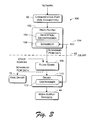
- Fig. 8 shows one implementation of the tone detector and demodulator 140 implemented at the descrambler 112.
- the tone detector and demodulator has a matched filter 500 to detect the sync tone in the noisy PCM data.
- y ( n ) When the position of the tone pattern h ( n ) is aligned with the tone components in the signal, y ( n ) has a maximum. The position of the first maximum determines the delay 506 by which the tone and PRNG noise patterns should be moved in time in order to align properly with the modified noisy data.
- the delay value and the noisy data are passed to a peak search module 502 that estimates any volume change imposed by the filter graph 108.
- the module estimates the appropriate gain 508 (by which the regenerated tone bursts and PRGN noise should be multiplied prior to the subtraction 146) through a search procedure, in which a gain estimate is iteratively refined until the signal energy after tone subtraction is minimized.
- the regenerated sync tone with the correct gain and delay is produced in module 510.
- Detection of the in-band key is performed by amplitude demodulation module 512. For each tone burst, the module compares the burst amplitude with the average tone burst amplitude measure over a few past intervals. If the amplitude is above the average (say the amplitude is equal to 1.0 and the average is 0.75), then a bit of the key is demodulated as having one binary value (say "one"). If the amplitude is below that average (say the amplitude is equal to 0.5 and the average is 0.75), then a bit of the key is demodulated as having the other binary value (say "zero"). The process is repeated for subsequent tone burst until all bits of the in-band key 124 are recovered. The in-band key 124 can then be used by the cryptographic PRNG 142 to regenerate the random noise sequence to be subtracted from the scrambled signal.
- noise is introduced to the content by adding both a sync tone and a random signal.
- the content may be scrambled by XORing at least a portion of the content with a random bit stream generated by the PRNG 122. For instance, for 16 bit audio, the least significant 13 bits are XORed with bits generated by the PRNG 122. This effectively scrambles the content, with the additional property that one cannot "overflow" the integer representing the sound. To descramble the content, the lower bits are once again XORed with the same random bit stream.
- the scrambling architecture is beneficial in that it protects the data content while in the operating system and hardware components of the computer. Another advantage is that the architecture integrates well with the existing DirectX technology.
Landscapes
- Engineering & Computer Science (AREA)
- Signal Processing (AREA)
- Computer Networks & Wireless Communication (AREA)
- Multimedia (AREA)
- Computer Security & Cryptography (AREA)
- Storage Device Security (AREA)
- Two-Way Televisions, Distribution Of Moving Picture Or The Like (AREA)
- Reverberation, Karaoke And Other Acoustics (AREA)
- Communication Control (AREA)
Claims (34)
- Client (26), umfassend:einen Prozessor (40);einen Speicher (42);eine oder mehrere Ausgabevorrichtungen (44);einen Inhaltsabspieler (102), der in dem Speicher gespeichert ist und auf dem Prozessor ausgeführt wird, um Inhalt in den einen oder mehreren Ausgabevorrichtungen abzuspielen;ein Betriebssystem, das in dem Speicher gespeichert ist und auf dem Prozessor ausgeführt wird, wobei das Betriebssystem Verarbeitungswerkzeuge zum Verarbeiten des Inhaltes zur Unterstützung des Inhaltsabspielers aufweist; undein Verwürfelungssystem zum Verwürfeln des Inhaltes, bevor der Inhalt von den Verarbeitungswerkzeugen des Betriebssystems verarbeitet wird, und zum Entwürfeln des Inhaltes, nachdem der Inhalt von den Verarbeitungswerkzeugen des Betriebssystems verarbeitet worden ist,wobei das Verwürfelungssystem ein Pseudozufallssignal zum Inhalt addiert, um einen verrauschten, oder verwürfelten, Inhalt zu erzeugen, und das Pseudozufallssignal von dem verwürfelten Inhalt subtrahiert, um den Inhalt wiederherzustellen, wobei das Verarbeiten des verwürfelten Inhaltes eines oder mehrere von einem Mischen mit anderen Quellensignalen, einem Anpassen des Volumens des verwürfelten Inhaltssignals und einem Auferlegen einer Verzögerung umfasst.
- Client nach Anspruch 1, wobei die Verarbeitungswerkzeuge einen Filtergraph (108) mit einem oder mehreren Filtern, die den Inhalt verarbeiten, umfasst.
- Client nach Anspruch 1 oder 2, wobei der Inhaltsabspieler den Inhalt in einem verschlüsselten und komprimierten Format empfängt, wobei der Inhaltsabspieler den Inhalt entschlüsselt und dekomprimiert.
- Client nach einem der Ansprüche 1 bis 3, wobei das Verwürfelungssystem das Pseudozufallssignal zu dem Inhalt im Sinne eines Addierens von Rauschen zu dem Inhalt addiert.
- Client nach einem der Ansprüche 1 bis 3, wobei das Verwürfelungssystem eine XOR-Operation an wenigstens einer Teilmenge des Inhaltes mit einem Zufallsstream von Bits vornimmt.
- Client nach einem der Ansprüche 1 bis 5, wobei das Betriebssystem wenigstens einen Treiber (110) für die Ausgabevorrichtungen (99) aufweist und das Verwürfelungssystem umfasst:einen Verwürfler (106), der sich an dem Abspieler befindet, um den Inhalt zu verwürfeln, um verwürfelten Inhalt zu erzeugen; undeinen Entwürfler (112), der sich an dem Treiber (110) befindet, um den verwürfelten Inhalt zu entwürfeln, um den Inhalt wiederherzustellen.
- Client nach Anspruch 1, wobei das Verwürfelungssystem einen periodischen Synchronisierungston und das Pseudozufallssignal zu dem Inhalt addiert, um verwürfelten Inhalt zu erzeugen, und den Synchronisierungston und das Pseudozufallssignal von dem verwürfelten Inhalt subtrahiert, um den Inhalt wiederherzustellen.
- Client nach Anspruch 1, wobei das Verwürfelungssystem wenigstens einen Schlüssel zum Verwürfeln des Inhaltes einsetzt.
- Client nach Anspruch 1, wobei das Verwürfelungssystem umfasst:einen Tongenerator (120) zum Erzeugen von periodischen Sets von Tonmustern mit variierenden Amplituden auf Grundlage eines ersten Schlüssels (124);einen ersten Zufallszahlengenerator (122) zum Erzeugen des Pseudozufallssignals auf Grundlage des ersten Schlüssels und eines zweiten Schlüssels (126);einen Addierer (130) zum Addieren der Tonmuster und des Pseudozufallssignals zu dem Inhalt, um verwürfelten Inhalt zu erzeugen;einen Tonerfasser (140) zum Erfassen der Tonmuster in dem verwürfelten Inhalt und Wiederherstellen des ersten Schlüssels aus den variierenden Amplituden der Tonmuster;einen zweiten Zufallszahlengenerator (142) zum Erzeugen eines Pseudozufallssignals auf Grundlage des wiederhergestellten ersten Schlüssels und des zweiten Schlüssels; undeinen Subtrahierer (146) zum Subtrahieren der Tonmuster und des Pseudozufallssignals von dem verwürfelten Inhalt, um den Inhalt wiederherzustellen.
- Client nach Anspruch 9, wobei der zweite Schlüssel über einen Kanal geleitet wird, der von dem verwürfelten Inhalt getrennt ist.
- Client nach Anspruch 9, wobei der zweite Schlüssel zwischen dem ersten und zweiten Zufallszahlengenerator über einen sicheren Weg (128) ausgetauscht wird.
- Client nach Anspruch 9, wobei das Verwürfelungssystem in Software implementiert ist, die in dem Speicher gespeichert ist und auf dem Prozessor ausgeführt wird.
- Client nach Anspruch 9, wobei der Tongenerator, der erste Zufallszahlengenerator und der Addierer in einem Inhaltsverwürfler (106) zum Verwürfeln von Inhalt umfasst sind.
- Client nach Anspruch 13, wobei der Tongenerator die Amplituden auf eine Weise moduliert, die den ersten Schlüssel in die Sets von Tonmustern einbettet.
- Client nach Anspruch 13, wobei der Tongenerator die Tonmuster mit einer von zwei Amplituden erzeugt, wobei Tonmuster mit einer ersten Amplitude (302) einen ersten Binärwert darstellen und Tonmuster mit einer zweiten Amplitude (304) einen zweiten Binärwert darstellen, wobei der erste Schlüssel in die Sets von Tonmustern als Ensemble aus den ersten und zweiten Binärwerten codiert wird.
- Client nach einem der Ansprüche 13 bis 15, wobei der zweite Schlüssel zum sicheren Transport an den Entwürfler verschlüsselt wird.
- Client nach einem der Ansprüche 13 bis 16, wobei des Weiteren ein Medienabspieler zum Abspielen von Multimediainhalt umfasst ist, wobei der Medienabspieler den Inhaltsverwürfler umfasst.
- Client nach einem der Ansprüche 13 bis 16, wobei das Betriebssystem den Inhaltsverwürfler umfasst.
- Client nach Anspruch 9 oder 13, wobei der Tonerfasser, der zweite Zufallszahlengenerator und der Subtrahierer in einem Inhaltsentwürfler (112) zum Entwürfeln von verwürfeltem Inhalt umfasst sind,
wobei der Tonerfasser des Weiteren dem Erfassen von periodischen Sets von Tonmustern in dem verwürfelten Inhalt und dem Demodulieren von Amplituden der Sets dient, um einen ersten Schlüssel wiederherzustellen. - Client nach Anspruch 19, wobei die Tonmuster eine von zwei Amplituden derart aufweisen, dass Tonmuster mit einer ersten Amplitude (302) einen ersten Binärwert darstellen und Tonmuster mit einer zweiten Amplitude (304) eine zweiten Binärwert darstellen, wobei der Tongenerator die ersten und zweiten Binärwerte aus den variierenden Amplituden zum Wiederherstellen des ersten Schlüssels verwendet.
- Client nach Anspruch 19 oder 20, wobei der zweite Schlüssel getrennt von dem verwürfelten Inhalt empfangen wird.
- Client nach einem der Ansprüche 19 bis 21, wobei das Betriebssystem den Inhaltsentwürfler umfasst.
- Client-Server-System, umfassend einen Client nach Anspruch 1, des Weiteren umfassend:einen Server zum Bereitstellen von Inhalt für den Client, wobei der Server einen Codierer zum Verschlüsseln und Komprimieren des Inhaltes zur Erzeugung von codiertem Inhalt aufweist;wobei der Client den codierten Inhalt von dem Server empfängt und einen Decoder zum Entschlüsseln und Dekomprimieren des codierten Inhaltes zum Wiederherstellen des Inhaltes aufweist;wobei das Verwürfelungssystem des Clients einen Verwürfler zum Verwürfeln des Inhaltes nach der Verschlüsselung und Dekomprimierung aufweist, wobei der Inhalt, während er durch den Client verarbeitet wird, verwürfelt bleibt; unddas Verwürfelungssystem des Clients des Weiteren einen Entwürfler zum Entwürfeln des Inhaltes nach dem Verarbeiten zum nachfolgenden Abspielen aufweist.
- Client-Server-System nach Anspruch 23, wobei der Client des Weiteren mit einem Treiber (110) ausgestattet ist; wobei der Verwürfler (106) als Teil des Inhaltsabspielers implementiert ist und der Entwürfler (112) als Teil des Treibers implementiert ist.
- Client-Server-System nach Anspruch 23, wobei der Client ein Betriebssystem betreibt und der Inhalt verwürfelt wird, während er von dem Betriebssystem bearbeitet wird.
- Verfahren zum Schützen von Inhalt innerhalb einer Computervorrichtung, umfassend:Empfangen (202) von codiertem Inhalt;Decodieren (204) des codierten Inhaltes zum Wiederherstellen des Inhaltes;Verwürfeln (206) des Inhaltes nach dem Decodieren durch Addieren eines Pseudozufallssignals zu dem Inhalt zum Erzeugen eines verrauschten, oder verwürfelten, Inhaltes;Verarbeiten (214) des Inhaltes während des Verwürfelns, umfassend eines oder mehrere von einem Mischen mit anderen Quellensignalen, einem Anpassen des Volumens des verwürfelten Inhaltssignals und einem Auferlegen einer Verzögerung;Entwürfeln (216) des Inhaltes nach dem Verarbeiten durch Subtrahieren des Pseudozufallssignals von dem verwürfelten Inhalt zum Wiederherstellen des Inhaltes; undAbspielen (224) des Inhaltes.
- Verfahren nach Anspruch 26, wobei das Verwürfeln ein Addieren des Pseudozufallssignals zu dem Inhalt im Sinne eines Addierens von Rauschen zu dem Inhalt umfasst.
- Verfahren nach Anspruch 26, wobei das Verwürfeln ein Durchführen einer XOR-Operation an wenigstens einer Teilmenge des Inhaltes mit einem Zufallsstream von Bits umfasst.
- Verfahren nach Anspruch 26, wobei das Verwürfeln ein periodisches Addieren von Sets von Synchronisierungstönen zu dem Inhalt und ein Addieren des Pseudozufallssignals zu dem Inhalt umfasst.
- Verfahren nach Anspruch 29, wobei das Entwürfeln ein Erfassen der Sets von Synchronisierungstönen in dem Inhalt, ein Subtrahieren der Synchronisierungstöne von dem Inhalt und ein Subtrahieren des Pseudozufallssignals von dem Inhalt umfasst.
- Verfahren nach Anspruch 26, wobei das Verwürfeln umfasst:Erzeugen (208) von periodischen Sets von Tonmustern mit variierenden Amplituden auf Grundlage eines ersten Schlüssels;Erzeugen (210) des Pseudozufallssignals auf Grundlage des ersten Schlüssels und eines zweiten Schlüssels; undAddieren (212) der Tonmuster und des Pseudozufallssignals zu dem Inhalt.
- Verfahren nach Anspruch 31, wobei das Entwürfeln umfasst:Erfassen (218) der Tonmuster in dem Inhalt;Wiederherstellen (218) des ersten Schlüssels aus den variierenden Amplituden der Tonmuster;Erzeugen (220) eines Pseudozufallssignals auf Grundlage des wiederhergestellten ersten Schlüssels und des zweiten Schlüssels; undSubtrahieren (222) der Tonmuster und des Pseudozufallssignals von dem verwürfelten Inhalt zum Wiederherstellen des Inhalts.
- Verfahren nach Anspruch 26, wobei das Verarbeiten ein Leiten des Inhaltes durch einen Filtergraph umfasst.
- Computerlesbares Medium mit computerausführbaren Anweisungen, die bei Ausführung das Verfahren nach einem der Ansprüche 26 bis 23 durchführen.
Priority Applications (1)
| Application Number | Priority Date | Filing Date | Title |
|---|---|---|---|
| EP09006597A EP2088705B1 (de) | 2000-02-17 | 2001-01-17 | System und Verfahren zum Schützen von Datenströmen in Hardwarekomponenten |
Applications Claiming Priority (3)
| Application Number | Priority Date | Filing Date | Title |
|---|---|---|---|
| US09/507,478 US7069590B1 (en) | 2000-02-17 | 2000-02-17 | System and method for protecting data streams in hardware components |
| US507478 | 2000-02-17 | ||
| PCT/US2001/001683 WO2001061904A1 (en) | 2000-02-17 | 2001-01-17 | System and method for protecting data streams in hardware components |
Related Child Applications (2)
| Application Number | Title | Priority Date | Filing Date |
|---|---|---|---|
| EP09006597A Division EP2088705B1 (de) | 2000-02-17 | 2001-01-17 | System und Verfahren zum Schützen von Datenströmen in Hardwarekomponenten |
| EP09006597.0 Division-Into | 2009-05-15 |
Publications (2)
| Publication Number | Publication Date |
|---|---|
| EP1258092A1 EP1258092A1 (de) | 2002-11-20 |
| EP1258092B1 true EP1258092B1 (de) | 2011-11-23 |
Family
ID=24018802
Family Applications (2)
| Application Number | Title | Priority Date | Filing Date |
|---|---|---|---|
| EP09006597A Expired - Lifetime EP2088705B1 (de) | 2000-02-17 | 2001-01-17 | System und Verfahren zum Schützen von Datenströmen in Hardwarekomponenten |
| EP01953044A Expired - Lifetime EP1258092B1 (de) | 2000-02-17 | 2001-01-17 | System und verfahren zum schutz von datenströmen in hardwarekomponenten |
Family Applications Before (1)
| Application Number | Title | Priority Date | Filing Date |
|---|---|---|---|
| EP09006597A Expired - Lifetime EP2088705B1 (de) | 2000-02-17 | 2001-01-17 | System und Verfahren zum Schützen von Datenströmen in Hardwarekomponenten |
Country Status (9)
| Country | Link |
|---|---|
| US (3) | US7069590B1 (de) |
| EP (2) | EP2088705B1 (de) |
| JP (1) | JP2003523694A (de) |
| KR (2) | KR100802894B1 (de) |
| CN (2) | CN1783765A (de) |
| AT (2) | ATE499769T1 (de) |
| AU (1) | AU2001229604A1 (de) |
| DE (1) | DE60144125D1 (de) |
| WO (1) | WO2001061904A1 (de) |
Families Citing this family (34)
| Publication number | Priority date | Publication date | Assignee | Title |
|---|---|---|---|---|
| US7107448B1 (en) * | 2000-06-04 | 2006-09-12 | Intertrust Technologies Corporation | Systems and methods for governing content rendering, protection, and management applications |
| US7007025B1 (en) * | 2001-06-08 | 2006-02-28 | Xsides Corporation | Method and system for maintaining secure data input and output |
| US7578002B2 (en) * | 2002-11-25 | 2009-08-18 | Trimble Navigation Limited | Controlling interaction of deliverable electronic media |
| JP4343551B2 (ja) * | 2003-02-25 | 2009-10-14 | パイオニア株式会社 | 情報提供システムおよび情報提供プログラム等 |
| IL155416A0 (en) * | 2003-04-13 | 2003-11-23 | Nds Ltd | System for securing access to data streams |
| JP2007504743A (ja) * | 2003-09-04 | 2007-03-01 | コニンクリユケ フィリップス エレクトロニクス エヌ.ブイ. | フルデジタルホームシネマ |
| FR2866451B1 (fr) * | 2004-02-18 | 2008-02-29 | Cit Alcatel | Procede et dispositif de transformation d'un systeme d'exploitation en vue de la protection d'un programme informatique contre des intrusions exterieures |
| US9219729B2 (en) * | 2004-05-19 | 2015-12-22 | Philip Drope | Multimedia network system with content importation, content exportation, and integrated content management |
| US20060230169A1 (en) * | 2004-11-15 | 2006-10-12 | Kaplan Mark M | System and method to simultaneously transcode audio and video content for optimized streaming via mobile telecommunications |
| JP4738146B2 (ja) * | 2005-11-28 | 2011-08-03 | 株式会社東芝 | 情報処理装置、および音声出力方法 |
| JP2007164526A (ja) * | 2005-12-14 | 2007-06-28 | Canon Inc | 情報処理装置及び方法 |
| US8001267B2 (en) | 2005-12-15 | 2011-08-16 | International Business Machines Corporation | Apparatus, system, and method for automatically verifying access to a multipathed target at boot time |
| US7882562B2 (en) * | 2005-12-15 | 2011-02-01 | International Business Machines Corporation | Apparatus, system, and method for deploying iSCSI parameters to a diskless computing device |
| US8166166B2 (en) | 2005-12-15 | 2012-04-24 | International Business Machines Corporation | Apparatus system and method for distributing configuration parameter |
| AT504196B1 (de) * | 2006-09-15 | 2012-04-15 | Frequentis Gmbh | Verfahren und system zur übertragung von vertraulichen und nicht vertraulichen daten |
| US7978848B2 (en) * | 2007-01-09 | 2011-07-12 | Microsoft Corporation | Content encryption schema for integrating digital rights management with encrypted multicast |
| US8345871B2 (en) * | 2007-03-15 | 2013-01-01 | Palo Alto Research Center Incorporated | Fast authentication over slow channels |
| EP1975831A1 (de) * | 2007-03-27 | 2008-10-01 | Thomson Licensing, Inc. | Vorrichtung und Verfahren zur digitalen Verarbeitung der Inhaltsverwaltung zum Ermöglichen eines auferlegten Arbeitsflusses |
| CN100485708C (zh) * | 2007-08-07 | 2009-05-06 | 江雨 | 一种输入数据的安全处理方法及装置 |
| US8732236B2 (en) * | 2008-12-05 | 2014-05-20 | Social Communications Company | Managing network communications between network nodes and stream transport protocol |
| WO2009151502A2 (en) * | 2008-04-08 | 2009-12-17 | Allgress, Inc. | Enterprise information security management software used to prove return on investment of security projects and activities using interactive graphs |
| JP5721634B2 (ja) * | 2008-12-05 | 2015-05-20 | ソーシャル・コミュニケーションズ・カンパニー | リアルタイムカーネル |
| JP5559306B2 (ja) * | 2009-04-24 | 2014-07-23 | アルグレス・インコーポレイテッド | 対話的グラフを用いた予測モデリングのための企業情報セキュリティ管理ソフトウェア |
| US8200480B2 (en) * | 2009-09-30 | 2012-06-12 | International Business Machines Corporation | Deriving geographic distribution of physiological or psychological conditions of human speakers while preserving personal privacy |
| US9420336B1 (en) * | 2009-11-05 | 2016-08-16 | Cisco Technology, Inc. | Localization of customer premises equipment in a digital communication network |
| WO2012118917A2 (en) | 2011-03-03 | 2012-09-07 | Social Communications Company | Realtime communications and network browsing client |
| GB2511479A (en) * | 2012-12-17 | 2014-09-10 | Librae Ltd | Interacting toys |
| US9953598B2 (en) * | 2014-05-29 | 2018-04-24 | Samsung Electronics Co., Ltd. | Method of controlling display driver IC with improved noise characteristics |
| DE102014212467B3 (de) | 2014-06-27 | 2015-10-15 | Siemens Aktiengesellschaft | Bereitstellen eines gesicherten Replika-Pseudo-Zufallsrauschsignals |
| US11399286B2 (en) * | 2019-08-20 | 2022-07-26 | Qualcomm Incorporated | Scrambling for wireless communications |
| EP4143706A4 (de) * | 2020-04-27 | 2024-08-14 | 5Gen Care Limited | Netzwerkvorrichtung mit schutz der privatsphäre |
| US10904057B1 (en) * | 2020-06-02 | 2021-01-26 | Northrop Grumman Systems Corporation | Dithering of waveform samples using a set of time dilation functions for suppressing the features to enhance LPI/LPD properties |
| DE102021105402A1 (de) * | 2021-03-05 | 2022-09-08 | Infineon Technologies Ag | Datenverarbeitungsvorrichtung und verfahren zum übermitteln von daten über einen bus |
| CN117688389A (zh) * | 2022-08-25 | 2024-03-12 | 武汉联影智融医疗科技有限公司 | 心电数据处理方法、装置、心电信号采集盒和存储介质 |
Family Cites Families (19)
| Publication number | Priority date | Publication date | Assignee | Title |
|---|---|---|---|---|
| US3624297A (en) * | 1969-04-21 | 1971-11-30 | Motorola Inc | Tone-controlled speech scrambler |
| US3723878A (en) * | 1970-07-30 | 1973-03-27 | Technical Communications Corp | Voice privacy device |
| US4188580A (en) | 1977-10-20 | 1980-02-12 | Telesync Corporation | Secure communication system |
| US4475208A (en) | 1982-01-18 | 1984-10-02 | Ricketts James A | Wired spread spectrum data communication system |
| JPS613542A (ja) | 1984-06-15 | 1986-01-09 | Sony Corp | 送受信装置 |
| ZA862839B (en) * | 1985-05-24 | 1986-12-30 | Scientific Atlanta | Method and apparatus for scrambling and descrambling television signals |
| KR950007547B1 (ko) | 1993-06-23 | 1995-07-12 | 대우중공업주식회사 | 가스 절단기의 예열 제어장치 |
| KR960010499B1 (ko) * | 1993-08-23 | 1996-08-01 | 대우전자 주식회사 | 방송신호의 스크램블링/디스크램블링회로 |
| KR0154793B1 (ko) * | 1995-10-19 | 1998-11-16 | 김광호 | 무선전화기의 비화회로 및 역비화회로 |
| CA2265647C (en) * | 1996-10-16 | 2003-09-23 | International Business Machines Corporation | Method and system for managing access to data through data transformation |
| US6526145B2 (en) * | 1997-01-29 | 2003-02-25 | David M. Marzahn | Data encryptor/decryptor using variable in-place I/O |
| US6047069A (en) * | 1997-07-17 | 2000-04-04 | Hewlett-Packard Company | Method and apparatus for preserving error correction capabilities during data encryption/decryption |
| US6502137B1 (en) * | 1997-10-09 | 2002-12-31 | International Business Machines Corporation | System and method for transferring information over a computer network |
| US6598164B1 (en) * | 1998-04-13 | 2003-07-22 | Nüp2 Incorporated | Device and method for reducing piracy of digitized information |
| US6526091B1 (en) * | 1998-08-17 | 2003-02-25 | Telefonaktiebolaget Lm Ericsson | Communication methods and apparatus based on orthogonal hadamard-based sequences having selected correlation properties |
| EP1009126A1 (de) * | 1998-12-08 | 2000-06-14 | Mindport B.V. | Vorrichtung zur Erzeugung eines Entschlüsselungssignals |
| ATE354255T1 (de) * | 1998-12-08 | 2007-03-15 | Irdeto Access Bv | Informationssignalverarbeitungsverfahren |
| US6539475B1 (en) * | 1998-12-18 | 2003-03-25 | Nec Corporation | Method and system for protecting digital data from unauthorized copying |
| JP3555547B2 (ja) * | 2000-03-27 | 2004-08-18 | 日立プラント建設株式会社 | 回転平膜分離装置 |
-
2000
- 2000-02-17 US US09/507,478 patent/US7069590B1/en not_active Expired - Fee Related
-
2001
- 2001-01-17 WO PCT/US2001/001683 patent/WO2001061904A1/en not_active Ceased
- 2001-01-17 EP EP09006597A patent/EP2088705B1/de not_active Expired - Lifetime
- 2001-01-17 KR KR1020027010508A patent/KR100802894B1/ko not_active Expired - Fee Related
- 2001-01-17 EP EP01953044A patent/EP1258092B1/de not_active Expired - Lifetime
- 2001-01-17 JP JP2001560578A patent/JP2003523694A/ja active Pending
- 2001-01-17 DE DE60144125T patent/DE60144125D1/de not_active Expired - Lifetime
- 2001-01-17 AT AT09006597T patent/ATE499769T1/de not_active IP Right Cessation
- 2001-01-17 AT AT01953044T patent/ATE535066T1/de active
- 2001-01-17 KR KR1020077029635A patent/KR100853608B1/ko not_active Expired - Fee Related
- 2001-01-17 CN CNA200510127055XA patent/CN1783765A/zh active Pending
- 2001-01-17 CN CNB018049710A patent/CN1312877C/zh not_active Expired - Fee Related
- 2001-01-17 AU AU2001229604A patent/AU2001229604A1/en not_active Abandoned
-
2006
- 2006-02-27 US US11/276,371 patent/US20060149678A1/en not_active Abandoned
- 2006-03-20 US US11/277,012 patent/US7502471B2/en not_active Expired - Fee Related
Also Published As
| Publication number | Publication date |
|---|---|
| AU2001229604A1 (en) | 2001-08-27 |
| EP2088705B1 (de) | 2011-02-23 |
| KR20080003467A (ko) | 2008-01-07 |
| KR100853608B1 (ko) | 2008-08-22 |
| US7069590B1 (en) | 2006-06-27 |
| US20060149678A1 (en) | 2006-07-06 |
| CN1783765A (zh) | 2006-06-07 |
| ATE535066T1 (de) | 2011-12-15 |
| KR100802894B1 (ko) | 2008-02-13 |
| EP1258092A1 (de) | 2002-11-20 |
| US20060156412A1 (en) | 2006-07-13 |
| DE60144125D1 (de) | 2011-04-07 |
| EP2088705A1 (de) | 2009-08-12 |
| WO2001061904A1 (en) | 2001-08-23 |
| CN1401169A (zh) | 2003-03-05 |
| CN1312877C (zh) | 2007-04-25 |
| KR20020076308A (ko) | 2002-10-09 |
| US7502471B2 (en) | 2009-03-10 |
| HK1050775A1 (en) | 2003-07-04 |
| JP2003523694A (ja) | 2003-08-05 |
| ATE499769T1 (de) | 2011-03-15 |
Similar Documents
| Publication | Publication Date | Title |
|---|---|---|
| EP1258092B1 (de) | System und verfahren zum schutz von datenströmen in hardwarekomponenten | |
| CN1164112C (zh) | 数字广播接收系统中的防止复制装置和方法 | |
| US10461930B2 (en) | Utilizing data reduction in steganographic and cryptographic systems | |
| JP4080039B2 (ja) | セキュリティ要素からデコーダへ伝送される情報アイテムを保護する方法及びそのような方法を使用する保護システム | |
| CN1170227C (zh) | 保护计算机系统内版权数据的装置和方法 | |
| EP0872073B1 (de) | Steganographisches verfahren und einrichtung | |
| US9171136B2 (en) | Data protection method and device | |
| US7123718B1 (en) | Utilizing data reduction in stegnographic and cryptographic systems | |
| AU781797B2 (en) | Stream continuity enforcement | |
| JP2002539487A (ja) | 信号処理方法及び装置 | |
| HK1050775B (en) | System and method for protecting data streams in hardware components | |
| JP2001156771A (ja) | 暗号化情報伝送方法、暗号化情報伝送装置、及び伝送媒体 | |
| JP2001156772A (ja) | 暗号化情報再生方法及び暗号化情報再生装置 | |
| KR100434252B1 (ko) | 워터마크 생성 및 삽입, 디지털 컨텐츠 및 워터마크추출을 위한 장치 |
Legal Events
| Date | Code | Title | Description |
|---|---|---|---|
| PUAI | Public reference made under article 153(3) epc to a published international application that has entered the european phase |
Free format text: ORIGINAL CODE: 0009012 |
|
| 17P | Request for examination filed |
Effective date: 20020731 |
|
| AK | Designated contracting states |
Kind code of ref document: A1 Designated state(s): AT BE CH CY DE DK ES FI FR GB GR IE IT LI LU MC NL PT SE TR |
|
| AX | Request for extension of the european patent |
Free format text: AL;LT;LV;MK;RO;SI |
|
| 17Q | First examination report despatched |
Effective date: 20080523 |
|
| GRAP | Despatch of communication of intention to grant a patent |
Free format text: ORIGINAL CODE: EPIDOSNIGR1 |
|
| GRAS | Grant fee paid |
Free format text: ORIGINAL CODE: EPIDOSNIGR3 |
|
| GRAA | (expected) grant |
Free format text: ORIGINAL CODE: 0009210 |
|
| AK | Designated contracting states |
Kind code of ref document: B1 Designated state(s): AT BE CH CY DE DK ES FI FR GB GR IE IT LI LU MC NL PT SE TR |
|
| REG | Reference to a national code |
Ref country code: GB Ref legal event code: FG4D |
|
| REG | Reference to a national code |
Ref country code: CH Ref legal event code: EP |
|
| REG | Reference to a national code |
Ref country code: IE Ref legal event code: FG4D |
|
| REG | Reference to a national code |
Ref country code: DE Ref legal event code: R096 Ref document number: 60145705 Country of ref document: DE Effective date: 20120119 |
|
| REG | Reference to a national code |
Ref country code: NL Ref legal event code: VDEP Effective date: 20111123 |
|
| PG25 | Lapsed in a contracting state [announced via postgrant information from national office to epo] |
Ref country code: SE Free format text: LAPSE BECAUSE OF FAILURE TO SUBMIT A TRANSLATION OF THE DESCRIPTION OR TO PAY THE FEE WITHIN THE PRESCRIBED TIME-LIMIT Effective date: 20111123 Ref country code: GR Free format text: LAPSE BECAUSE OF FAILURE TO SUBMIT A TRANSLATION OF THE DESCRIPTION OR TO PAY THE FEE WITHIN THE PRESCRIBED TIME-LIMIT Effective date: 20120224 Ref country code: PT Free format text: LAPSE BECAUSE OF FAILURE TO SUBMIT A TRANSLATION OF THE DESCRIPTION OR TO PAY THE FEE WITHIN THE PRESCRIBED TIME-LIMIT Effective date: 20120323 Ref country code: NL Free format text: LAPSE BECAUSE OF FAILURE TO SUBMIT A TRANSLATION OF THE DESCRIPTION OR TO PAY THE FEE WITHIN THE PRESCRIBED TIME-LIMIT Effective date: 20111123 Ref country code: BE Free format text: LAPSE BECAUSE OF FAILURE TO SUBMIT A TRANSLATION OF THE DESCRIPTION OR TO PAY THE FEE WITHIN THE PRESCRIBED TIME-LIMIT Effective date: 20111123 |
|
| PG25 | Lapsed in a contracting state [announced via postgrant information from national office to epo] |
Ref country code: CY Free format text: LAPSE BECAUSE OF FAILURE TO SUBMIT A TRANSLATION OF THE DESCRIPTION OR TO PAY THE FEE WITHIN THE PRESCRIBED TIME-LIMIT Effective date: 20111123 |
|
| REG | Reference to a national code |
Ref country code: HK Ref legal event code: GR Ref document number: 1050775 Country of ref document: HK |
|
| PG25 | Lapsed in a contracting state [announced via postgrant information from national office to epo] |
Ref country code: DK Free format text: LAPSE BECAUSE OF FAILURE TO SUBMIT A TRANSLATION OF THE DESCRIPTION OR TO PAY THE FEE WITHIN THE PRESCRIBED TIME-LIMIT Effective date: 20111123 |
|
| PG25 | Lapsed in a contracting state [announced via postgrant information from national office to epo] |
Ref country code: IT Free format text: LAPSE BECAUSE OF FAILURE TO SUBMIT A TRANSLATION OF THE DESCRIPTION OR TO PAY THE FEE WITHIN THE PRESCRIBED TIME-LIMIT Effective date: 20111123 Ref country code: MC Free format text: LAPSE BECAUSE OF NON-PAYMENT OF DUE FEES Effective date: 20120131 |
|
| REG | Reference to a national code |
Ref country code: CH Ref legal event code: PL |
|
| REG | Reference to a national code |
Ref country code: AT Ref legal event code: MK05 Ref document number: 535066 Country of ref document: AT Kind code of ref document: T Effective date: 20111123 |
|
| PLBE | No opposition filed within time limit |
Free format text: ORIGINAL CODE: 0009261 |
|
| STAA | Information on the status of an ep patent application or granted ep patent |
Free format text: STATUS: NO OPPOSITION FILED WITHIN TIME LIMIT |
|
| REG | Reference to a national code |
Ref country code: IE Ref legal event code: MM4A |
|
| 26N | No opposition filed |
Effective date: 20120824 |
|
| PG25 | Lapsed in a contracting state [announced via postgrant information from national office to epo] |
Ref country code: LI Free format text: LAPSE BECAUSE OF NON-PAYMENT OF DUE FEES Effective date: 20120131 Ref country code: CH Free format text: LAPSE BECAUSE OF NON-PAYMENT OF DUE FEES Effective date: 20120131 |
|
| REG | Reference to a national code |
Ref country code: DE Ref legal event code: R097 Ref document number: 60145705 Country of ref document: DE Effective date: 20120824 |
|
| PG25 | Lapsed in a contracting state [announced via postgrant information from national office to epo] |
Ref country code: IE Free format text: LAPSE BECAUSE OF NON-PAYMENT OF DUE FEES Effective date: 20120117 Ref country code: AT Free format text: LAPSE BECAUSE OF FAILURE TO SUBMIT A TRANSLATION OF THE DESCRIPTION OR TO PAY THE FEE WITHIN THE PRESCRIBED TIME-LIMIT Effective date: 20111123 |
|
| PG25 | Lapsed in a contracting state [announced via postgrant information from national office to epo] |
Ref country code: ES Free format text: LAPSE BECAUSE OF FAILURE TO SUBMIT A TRANSLATION OF THE DESCRIPTION OR TO PAY THE FEE WITHIN THE PRESCRIBED TIME-LIMIT Effective date: 20120305 |
|
| PG25 | Lapsed in a contracting state [announced via postgrant information from national office to epo] |
Ref country code: FI Free format text: LAPSE BECAUSE OF FAILURE TO SUBMIT A TRANSLATION OF THE DESCRIPTION OR TO PAY THE FEE WITHIN THE PRESCRIBED TIME-LIMIT Effective date: 20111123 |
|
| PG25 | Lapsed in a contracting state [announced via postgrant information from national office to epo] |
Ref country code: TR Free format text: LAPSE BECAUSE OF FAILURE TO SUBMIT A TRANSLATION OF THE DESCRIPTION OR TO PAY THE FEE WITHIN THE PRESCRIBED TIME-LIMIT Effective date: 20111123 |
|
| PG25 | Lapsed in a contracting state [announced via postgrant information from national office to epo] |
Ref country code: LU Free format text: LAPSE BECAUSE OF NON-PAYMENT OF DUE FEES Effective date: 20120117 |
|
| REG | Reference to a national code |
Ref country code: DE Ref legal event code: R082 Ref document number: 60145705 Country of ref document: DE Representative=s name: GRUENECKER, KINKELDEY, STOCKMAIR & SCHWANHAEUS, DE |
|
| REG | Reference to a national code |
Ref country code: GB Ref legal event code: 732E Free format text: REGISTERED BETWEEN 20150108 AND 20150114 |
|
| REG | Reference to a national code |
Ref country code: DE Ref legal event code: R082 Ref document number: 60145705 Country of ref document: DE Representative=s name: GRUENECKER, KINKELDEY, STOCKMAIR & SCHWANHAEUS, DE Effective date: 20150126 Ref country code: DE Ref legal event code: R081 Ref document number: 60145705 Country of ref document: DE Owner name: MICROSOFT TECHNOLOGY LICENSING, LLC, REDMOND, US Free format text: FORMER OWNER: MICROSOFT CORP., REDMOND, WASH., US Effective date: 20150126 Ref country code: DE Ref legal event code: R081 Ref document number: 60145705 Country of ref document: DE Owner name: MICROSOFT TECHNOLOGY LICENSING, LLC, REDMOND, US Free format text: FORMER OWNER: MICROSOFT CORP., REDMOND, WASH., US Effective date: 20111125 Ref country code: DE Ref legal event code: R082 Ref document number: 60145705 Country of ref document: DE Representative=s name: GRUENECKER PATENT- UND RECHTSANWAELTE PARTG MB, DE Effective date: 20150126 |
|
| REG | Reference to a national code |
Ref country code: FR Ref legal event code: TP Owner name: MICROSOFT TECHNOLOGY LICENSING, LLC, US Effective date: 20150724 |
|
| REG | Reference to a national code |
Ref country code: FR Ref legal event code: PLFP Year of fee payment: 16 |
|
| PGFP | Annual fee paid to national office [announced via postgrant information from national office to epo] |
Ref country code: FR Payment date: 20151208 Year of fee payment: 16 |
|
| PGFP | Annual fee paid to national office [announced via postgrant information from national office to epo] |
Ref country code: DE Payment date: 20160112 Year of fee payment: 16 |
|
| PGFP | Annual fee paid to national office [announced via postgrant information from national office to epo] |
Ref country code: GB Payment date: 20160113 Year of fee payment: 16 |
|
| REG | Reference to a national code |
Ref country code: DE Ref legal event code: R119 Ref document number: 60145705 Country of ref document: DE |
|
| GBPC | Gb: european patent ceased through non-payment of renewal fee |
Effective date: 20170117 |
|
| REG | Reference to a national code |
Ref country code: FR Ref legal event code: ST Effective date: 20170929 |
|
| PG25 | Lapsed in a contracting state [announced via postgrant information from national office to epo] |
Ref country code: FR Free format text: LAPSE BECAUSE OF NON-PAYMENT OF DUE FEES Effective date: 20170131 |
|
| PG25 | Lapsed in a contracting state [announced via postgrant information from national office to epo] |
Ref country code: DE Free format text: LAPSE BECAUSE OF NON-PAYMENT OF DUE FEES Effective date: 20170801 Ref country code: GB Free format text: LAPSE BECAUSE OF NON-PAYMENT OF DUE FEES Effective date: 20170117 |