EP1258520A2 - Quantum-Teilungs-Oxidphosphore - Google Patents
Quantum-Teilungs-Oxidphosphore Download PDFInfo
- Publication number
- EP1258520A2 EP1258520A2 EP02253358A EP02253358A EP1258520A2 EP 1258520 A2 EP1258520 A2 EP 1258520A2 EP 02253358 A EP02253358 A EP 02253358A EP 02253358 A EP02253358 A EP 02253358A EP 1258520 A2 EP1258520 A2 EP 1258520A2
- Authority
- EP
- European Patent Office
- Prior art keywords
- phosphor
- splitting
- oxide
- quantum
- range
- Prior art date
- Legal status (The legal status is an assumption and is not a legal conclusion. Google has not performed a legal analysis and makes no representation as to the accuracy of the status listed.)
- Granted
Links
Images
Classifications
-
- H—ELECTRICITY
- H01—ELECTRIC ELEMENTS
- H01J—ELECTRIC DISCHARGE TUBES OR DISCHARGE LAMPS
- H01J61/00—Gas-discharge or vapour-discharge lamps
- H01J61/02—Details
- H01J61/38—Devices for influencing the colour or wavelength of the light
- H01J61/42—Devices for influencing the colour or wavelength of the light by transforming the wavelength of the light by luminescence
- H01J61/44—Devices characterised by the luminescent material
-
- C—CHEMISTRY; METALLURGY
- C09—DYES; PAINTS; POLISHES; NATURAL RESINS; ADHESIVES; COMPOSITIONS NOT OTHERWISE PROVIDED FOR; APPLICATIONS OF MATERIALS NOT OTHERWISE PROVIDED FOR
- C09K—MATERIALS FOR MISCELLANEOUS APPLICATIONS, NOT PROVIDED FOR ELSEWHERE
- C09K11/00—Luminescent materials, e.g. electroluminescent or chemiluminescent
- C09K11/08—Luminescent materials, e.g. electroluminescent or chemiluminescent containing inorganic luminescent materials
- C09K11/77—Luminescent materials, e.g. electroluminescent or chemiluminescent containing inorganic luminescent materials containing rare earth metals
- C09K11/7766—Luminescent materials, e.g. electroluminescent or chemiluminescent containing inorganic luminescent materials containing rare earth metals containing two or more rare earth metals
- C09K11/7774—Aluminates
-
- C—CHEMISTRY; METALLURGY
- C09—DYES; PAINTS; POLISHES; NATURAL RESINS; ADHESIVES; COMPOSITIONS NOT OTHERWISE PROVIDED FOR; APPLICATIONS OF MATERIALS NOT OTHERWISE PROVIDED FOR
- C09K—MATERIALS FOR MISCELLANEOUS APPLICATIONS, NOT PROVIDED FOR ELSEWHERE
- C09K11/00—Luminescent materials, e.g. electroluminescent or chemiluminescent
- C09K11/08—Luminescent materials, e.g. electroluminescent or chemiluminescent containing inorganic luminescent materials
- C09K11/77—Luminescent materials, e.g. electroluminescent or chemiluminescent containing inorganic luminescent materials containing rare earth metals
- C09K11/7766—Luminescent materials, e.g. electroluminescent or chemiluminescent containing inorganic luminescent materials containing rare earth metals containing two or more rare earth metals
- C09K11/778—Borates
Definitions
- This invention relates to oxide-based materials that have one application as phosphors. More particularly, the phosphors are oxides doped with Pr 3+ and Mn 2+ and exhibit quantum splitting when irradiated with vacuum ultraviolet ("VUV") radiation. This invention also relates to a method of making and rules for designing such quantum-splitting phosphors.
- VUV vacuum ultraviolet
- Quantum splitting The conversion of a single ultraviolet (“UV”) photon into two visible photons with the result that the quantum efficiency of luminescence exceeds unity is termed quantum splitting.
- Quantum splitting materials are very desirable for use as phosphors for lighting applications, such as fluorescent lamps.
- a suitable quantum splitting phosphor can, in principle, produce a significantly brighter fluorescent light source due to higher overall luminous output because it can convert to visible light the part of UV radiation that is not absorbed efficiently by traditional phosphors currently used in commercial fluorescent lamps.
- Quantum splitting has been demonstrated previously in fluoride- and oxide-based materials.
- a material comprising 0.1% Pr 3+ in a matrix of YF 3 has been shown to generate more than one visible photon for every absorbed UV photon when excited with radiation having a wavelength of 185 nm.
- fluoride-based compounds do not have sufficient stability to permit their use as phosphors in fluorescent lamps because they are known to react with mercury vapor that is used in such lamps to provide the UV radiation and form materials that do not exhibit quantum splitting.
- producing fluoride-based materials presents a great practical challenge because it involves the use of large quantities of highly reactive and toxic fluorine-based materials.
- U.S. Patent 5,552,082 discloses a lanthanum magnesium borate activated with Pr 3+ ion.
- U.S. Patent 5,571,4151 discloses a strontium magnesium aluminate activated with Pr 3+ ion and charge compensated with Mg 2+ ion. Emission spectra of these materials exhibit a large peak at about 405 nm which is characteristic of quantum splitting. However, these materials still exhibit a considerable emission in the UV wavelength range of less than 350 nm. This part of the emission reduces the overall visible light output that otherwise can be higher. Therefore, it is desirable to provide oxide-based quantum-splitting phosphors that have higher quantum efficiency in the visible range than the prior-art quantum splitting materials. It is also desirable to provide more energy-efficient light sources using quantum-splitting phosphors having higher quantum efficiency. It is further desirable to provide a method for making and rules for guiding the design of materials having high quantum-splitting capability.
- the present invention provides oxide-based phosphors doped with at least Pr 3+ and Mn 2+ ions, which phosphors exhibit quantum splitting when irradiated with VUV radiation.
- VUV radiation as used herein is radiation having wavelength shorter than about 215 nm.
- the oxide phosphors of the present invention are oxides of aluminum or boron having positive counterions selected from Group IIA and IIIA of the Periodic Table.
- the phosphors of the present invention may be used in mercury vapor discharge lamps to provide energy-efficient light sources.
- the oxide-based phosphors are strontium aluminates in which strontium may be partially or completely substituted with calcium and which are doped with at least Pr 3+ and Mn 2+ .
- Such oxide-based phosphors of the present invention have a composition represented by Sr 1-x Ca x Al 12 O 19 :Pr 3+ ,Mn 2+ where 0 ⁇ x ⁇ 1. In this convention, the elements following the colons are the activators in the phosphors.
- the oxide-based phosphors are also doped with Gd 3+ in addition to Pr 3+ and Mn 2+ .
- the oxide-based phosphors are doped with La 3+ and Mg 2+ ions for charge compensation and for minimization of the number of vacancies in the lattice.
- the oxide-based phosphors are lanthanum borate activated with Pr 3+ and Mn 2+ in which lanthanum is partially substituted by gadolinium.
- the borate phosphors may be doped with Mg 2+ .
- Such borate phosphors of the present invention have compositions represented by La 1-x-y-z Gd x Pr y Mn z B 3 O 6 where x is in the range from about 0.005 to about 0.99, y is in the range from about 0.005 to about 0.1, z is in the range from about 0.005 to about 0.5, and x+y+z ⁇ 1.
- Another borate phosphor of the present invention has a formula of La 1-x-y Gd x Pr y Mg 1-z Mn z B 5 O 10 where x is in the range from about 0.005 to about 0.995, y is in the range from about 0.005 to about 0.1, z is in the range from about 0.005 to about 0.5, and x+y ⁇ 1.
- the present invention also provides a method of making improved quantum-splitting aluminate or borate phosphors.
- the aluminate phosphors have a formula of Sr 1-x Ca x Al 12 O 19 :Pr 3+ ,Mn 2+ or Sr 1-x Ca x Al 12 O 19 :Pr 3+ ,Mn 2+ ,A; where 0 ⁇ x ⁇ 1, and A is selected from the group consisting of Gd 3+ , La 3+ , Mg 2+ , and combinations thereof.
- the borate phosphors have a formula of La 1-x-y-z Gd x Pr y Mn z B 3 O 6 where x is in the range from about 0.005 to about 0.99, y is in the range from about 0.005 to about 0.1, z is in the range from about 0.005 to about 0.5, and x+y+z ⁇ 1 or a formula of La 1-x-y-z Gd x Pr y Mg 1-z Mn z B 5 O 10 where x is in the range from about 0.005 to about 0.995, y is in the range from about 0.005 to about 0.1, z is in the range from about 0.005 to about 0.5, and x+y ⁇ 1.
- the method comprises the steps of selecting a desired final composition of the phosphor; mixing together oxygen-containing compounds of praseodymium and manganese, and materials selected from the group consisting of oxygen-containing compounds of strontium, calcium, aluminum, boron, gadolinium, lanthanum, and magnesium so as to achieve the desired final composition; forming a substantially homogeneous mixture of the selected compounds; and firing the substantially homogeneous mixture in a non-oxidizing atmosphere at a temperature and for a time sufficient to result in the desired composition and to maintain the praseodymium ion in the 3+ valence state and manganese ion in the 2+ valence state.
- the present invention provides oxide-based phosphors activated with Pr 3+ and Mn 2+ .
- the phosphors are strontium aluminate and lanthanum borate phosphors activated with at least Pr 3+ and Mn 2+ ions.
- the doping level for Pr 3+ and Mn 2+ are typically in the range from about 0.005 to about 0.1 and from about 0.005 to about 0.5, respectively.
- the strontium ions of the aluminate phosphors of the present invention may be substituted partially or completely by calcium.
- the aluminate phosphor is further doped with gadolinium.
- the preferred doping level for Gd 3+ is in the range from about 0.005 to about 0.995 depending on the host lattice.
- the aluminate phosphor is further doped with La 3+ and Mg 2+ at sufficient levels for charge compensation and for minimization of the number of vacancies in the lattice.
- the aluminate phosphors have a formula of Sr 1-x Ca x Al 12 O 19 :Pr 3+ ,Mn 2+ or Sr 1- x Ca x Al 12 O 19 :Pr 3+ ,Mn 2+ ,A; where 0 ⁇ x ⁇ 1 and A is at least one selected from the group consisting of Gd 3+ , La 3+ , Mg 2+ , and combinations thereof.
- the oxide-based phosphor is a lanthanum borate activated with at least Pr 3+ and Mn 2+ in which lanthanum is partially substituted by gadolinium.
- the borate phosphor may be doped with Mg 2+ .
- the lanthanum borate phosphors of the present invention have a formula of La 1-x-y-z Gd x Pr y Mn z B 3 O 6 where x is in the range from about 0.005 to about 0.5, y is in the range from about 0.005 to about 0.1, z is in the range from about 0.005 to about 0.5, and x+y ⁇ 1.
- the applicants have observed that the strontium aluminate phosphors of the present invention exhibit quantum splitting.
- a lanthanum borate has been shown to possess quantum-splitting capability (U.S. Patent 5,552,082).
- the lanthanum borates of the present invention also are expected to be quantum splitting and have a higher quantum efficiency than the lanthanum borate of the prior art because a substantial amount of radiation emitted by the Pr 3+ ion in the UV range can be transferred through Gd 3+ ions to Mn 2+ ions where it is re-emitted as visible light.
- emission spectra of materials exhibiting quantum-splitting capability show a characteristic peak at about 405 nm, which peak is a result of the first visible photon emitted as the excited Pr 3+ ion radiatively decays from the 1 S 0 energy level to the 1 I 6 energy level.
- an examination of the intensity-versus-wavelength spectrum provides a convenient way of determining whether a material would be quantum splitting, as opposed to using the more time-consuming measurement of quantum efficiency.
- oxides of the present invention should be processed so as to maintain praseodymium as Pr 3+ ion within the oxide lattice.
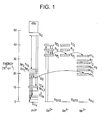
- Figure 1 shows the energy levels of Pr 3+, Gd 3+ , and Mn 2+ ions.
- the transitions from the 1 S 0 energy level of the Pr 3+ ion in the UV range are converted to visible light by a process consisting of successive steps of cross-relaxation with Gd 3+ ions, energy migration across the Gd 3+ sublattice, trapping of that energy by Mn 2+ ions, and emission of visible photon from the excited Mn 2+ ions.
- Figure 1 shows the energy migration over only two Gd 3+ ions, but it should be appreciated that, in reality, the energy migration may occur over many Gd 3+ ions.
- a phosphor having the composition of (Sr 0.65 Gd 0.30 Pr 0.05 )(Al 11.65 Mn 0.1 Mg 0.25 )O 19 was produced and tested to show quantum-splitting capability.
- the mixture was fired at 1400 °C for 6 hours in an atmosphere generated by reactions products of a coconut charcoal and volatized compounds of the decomposition of the above carbonates and oxides. Then the fired material was reblended and fired at 1100 °C for 6 hours in an atmosphere of 1% (by volume) hydrogen in nitrogen to yield the final phosphor.
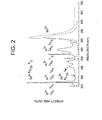
- Figure 2 shows the emission spectrum of this phosphor (dotted line) upon being excited by VUV radiation at a wavelength of 205 nm. Superimposed on this emission spectrum is the excitation spectrum (solid line) showing a large absorption by Gd 3+ at about 272-278 nm. This energy is then transferred between the Gd 3+ and Mn 2+ ions and subsequently emitted as a visible photon as evidenced by the large peak at about 525 nm.
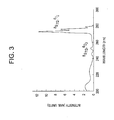
- Figure 3 shows the excitation spectrum of Gd 3+ ion in the above strontium aluminate phosphor of the present invention. This spectrum shows the large absorption of energy at about 272-278 nm.
- the Pr 3+ should occupy a site in the host lattice that results in symmetry so that maximum quantum efficiency may be generated by the phosphor.
- the Pr 3+ -to-oxygen bond distance must exceed about 0.256 nm for quantum splitting to occur.
- the host lattice must have a band gap greater than about 5 eV so that the excited electrons of the activator are not lost into the conduction band of the host lattice.
- the present invention further refines the rules to include the necessity to have (1) a substantial amount of gadolinium in the lattice to allow for a significant energy migration among the Gd 3+ ions and (2) Mn 2+ codopant to trap energy migrating from Gd 3+ ions and convert that energy into visible light.
- a quantum-splitting phosphor of the present invention is made in a process comprising the steps of: (1) selecting the desired final composition of the phosphor such that the phosphor is activated by at least praseodymium and manganese; (2) mixing together oxygen-containing compounds of praseodymium and manganese and materials selected from the group consisting of oxygen-containing compounds of strontium, calcium, aluminum, boron, gadolinium, lanthanum, and magnesium in quantities so as to achieve the desired final composition of the phosphor; (3) forming a substantially homogeneous mixture of the selected compounds; and (4) firing the substantially homogeneous mixture in a non-oxidizing atmosphere at a temperature and for a time sufficient to result in the desired final composition and to maintain the praseodymium ion in the 3+ valence state and the manganese ion in the 2+ valance state.
- the oxygen-containing compounds used in the process may be selected from the group consisting of oxides, carbonates, nitrates, sulfates, oxalates, and combinations thereof.
- the oxygen-containing compounds may be in the hydrated or non-hydrated form.
- the non-oxidizing atmosphere is generated from materials selected from the group consisting of carbon monoxide, carbon dioxide, hydrogen, nitrogen, ammonia, hydrazine, amines, and combinations thereof.
- the firing may be done in any suitable high-temperature equipment in either a batch-wise or a continuous process. The firing may be done isothermally. Alternatively, the process temperature may be ramped from ambient temperature to and then held at the firing temperature.
- the firing temperature is in the range from about 1000 °C to about 2000 °C, preferably from about 1200 °C to about 1700 °C, more preferably from about 1400 °C to about 1600 °C.
- the firing time should be sufficiently long to convert the mixture to the final desired composition. This time also depends on the quantity of materials being processed and the rate and quantity of non-oxidizing materials conducted through the firing equipment to provide the non-oxidizing atmosphere. A typical firing time is less than 10 hours.
- a phosphor of the present invention characterized by quantum-splitting behavior in VUV radiation and stability with regard to an environment in a mercury discharge device may be utilized as a phosphor in a fluorescent lamp.
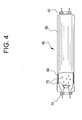
- Figure 4 shows a lamp 50 comprising an evacuated housing 60, a VUV radiation generating means 70 located within housing 60, and a phosphor 80 located within housing 60 and adapted to be excited by VUV radiation.
- lamp 50 is a fluorescent lamp and evacuated housing 60 comprises an evacuated glass tube and associated end caps 62.
- VUV generating means 70 is a combination of mercury vapor and means for generating high-energy electrons to create a mercury vapor discharge to excite the phosphor.
- the means for generating high-energy electrons may be a filament of a metal having a low work function, such as tungsten, or such a filament coated with alkali earth metal oxides as are known in the art.
- the filament is coupled to a high-voltage source to generate electrons from the surface thereof.
- a quantum-splitting phosphor of the present invention may be used in combination with other conventional phosphors used in fluorescent lighting technology.
- a quantum-splitting phosphor of the present invention may be combined with conventional red-emitting and blue-emitting phosphors to produce white light from a mercury discharge lamp. Since the quantum-splitting phosphor of the present invention is transparent to the mercury 254-nm emission line, it may be coated on top of the conventional phosphor layer in the lamp housing so to absorb substantially the mercury 185-nm emission line.
Landscapes
- Chemical & Material Sciences (AREA)
- Inorganic Chemistry (AREA)
- Engineering & Computer Science (AREA)
- Materials Engineering (AREA)
- Organic Chemistry (AREA)
- Luminescent Compositions (AREA)
- Compositions Of Oxide Ceramics (AREA)
- Vessels And Coating Films For Discharge Lamps (AREA)
Applications Claiming Priority (2)
| Application Number | Priority Date | Filing Date | Title |
|---|---|---|---|
| US09/681,666 US6621208B2 (en) | 2001-05-18 | 2001-05-18 | Quantum-splitting oxide-based phosphors, method of producing, and rules for designing the same |
| US681666 | 2001-05-18 |
Publications (3)
| Publication Number | Publication Date |
|---|---|
| EP1258520A2 true EP1258520A2 (de) | 2002-11-20 |
| EP1258520A3 EP1258520A3 (de) | 2005-10-05 |
| EP1258520B1 EP1258520B1 (de) | 2012-03-21 |
Family
ID=24736230
Family Applications (1)
| Application Number | Title | Priority Date | Filing Date |
|---|---|---|---|
| EP02253358A Expired - Lifetime EP1258520B1 (de) | 2001-05-18 | 2002-05-14 | Quantum-Teilungs-Oxidleuchtstoffe |
Country Status (4)
| Country | Link |
|---|---|
| US (1) | US6621208B2 (de) |
| EP (1) | EP1258520B1 (de) |
| JP (1) | JP2003147353A (de) |
| CN (2) | CN100439471C (de) |
Families Citing this family (6)
| Publication number | Priority date | Publication date | Assignee | Title |
|---|---|---|---|---|
| US6669867B2 (en) * | 2001-11-15 | 2003-12-30 | Georgia Tech Research Corporation | Oxide-based quantum cutter method and phosphor system |
| US6982046B2 (en) * | 2003-10-01 | 2006-01-03 | General Electric Company | Light sources with nanometer-sized VUV radiation-absorbing phosphors |
| US7435358B2 (en) * | 2005-06-07 | 2008-10-14 | Osram Sylvania Inc. | UVC-emitting Sr(Al,Mg)12O19:Pr phosphor and lamp containing same |
| US7419621B2 (en) * | 2006-03-07 | 2008-09-02 | Osram Sylvania Inc. | UV-emitting phosphor and lamp containing same |
| US8419974B2 (en) * | 2008-12-11 | 2013-04-16 | General Electric Company | Methods for preparation of nanocrystalline rare earth phosphates for lighting applications |
| CN103866387A (zh) * | 2014-04-01 | 2014-06-18 | 中国科学院福建物质结构研究所 | 掺镱硼酸镧镁激光晶体及其制备方法 |
Citations (6)
| Publication number | Priority date | Publication date | Assignee | Title |
|---|---|---|---|---|
| EP0721008A1 (de) | 1995-01-03 | 1996-07-10 | General Electric Company | Quantum-Teilungs-Oxidphosphoren und Verfahren zur Herstellung desselben |
| US5552082A (en) | 1995-01-03 | 1996-09-03 | General Electric Company | Quantum splitting oxide phosphor and method of making |
| US5571415A (en) | 1994-11-02 | 1996-11-05 | Rohm And Haas Company | Method for preparing porous polymer structures |
| US5788884A (en) | 1996-03-29 | 1998-08-04 | Shin-Etsu Chemical Co., Ltd. | Oil-in-water organopolysiloxane emulsion and method for the preparation thereof |
| US5788883A (en) | 1996-03-29 | 1998-08-04 | General Electric Company | Determination process for determining if quantum splitting phosphors are obtained and novel compositions |
| EP1073089A1 (de) | 1999-07-26 | 2001-01-31 | General Electric Company | Mit Manganese aktivierter grün emittierender SrAl12O19 Phosphor |
Family Cites Families (3)
| Publication number | Priority date | Publication date | Assignee | Title |
|---|---|---|---|---|
| US5571451A (en) | 1995-01-03 | 1996-11-05 | General Electric Company | Quantum splitting oxide phosphor and method of making |
| WO2000024028A1 (en) * | 1998-10-19 | 2000-04-27 | Koninklijke Philips Electronics N.V. | Luminescent material |
| JP3371133B2 (ja) * | 1999-10-25 | 2003-01-27 | 独立行政法人産業技術総合研究所 | 可視光による光メモリー、該メモリーへの記録・読み出し方法、及び該光メモリー用蛍光体の製造方法 |
-
2001
- 2001-05-18 US US09/681,666 patent/US6621208B2/en not_active Expired - Lifetime
-
2002
- 2002-05-14 EP EP02253358A patent/EP1258520B1/de not_active Expired - Lifetime
- 2002-05-17 CN CNB021197830A patent/CN100439471C/zh not_active Expired - Fee Related
- 2002-05-17 JP JP2002142276A patent/JP2003147353A/ja active Pending
- 2002-05-17 CN CN2008101098285A patent/CN101298556B/zh not_active Expired - Fee Related
Patent Citations (6)
| Publication number | Priority date | Publication date | Assignee | Title |
|---|---|---|---|---|
| US5571415A (en) | 1994-11-02 | 1996-11-05 | Rohm And Haas Company | Method for preparing porous polymer structures |
| EP0721008A1 (de) | 1995-01-03 | 1996-07-10 | General Electric Company | Quantum-Teilungs-Oxidphosphoren und Verfahren zur Herstellung desselben |
| US5552082A (en) | 1995-01-03 | 1996-09-03 | General Electric Company | Quantum splitting oxide phosphor and method of making |
| US5788884A (en) | 1996-03-29 | 1998-08-04 | Shin-Etsu Chemical Co., Ltd. | Oil-in-water organopolysiloxane emulsion and method for the preparation thereof |
| US5788883A (en) | 1996-03-29 | 1998-08-04 | General Electric Company | Determination process for determining if quantum splitting phosphors are obtained and novel compositions |
| EP1073089A1 (de) | 1999-07-26 | 2001-01-31 | General Electric Company | Mit Manganese aktivierter grün emittierender SrAl12O19 Phosphor |
Also Published As
| Publication number | Publication date |
|---|---|
| EP1258520B1 (de) | 2012-03-21 |
| CN1386816A (zh) | 2002-12-25 |
| EP1258520A3 (de) | 2005-10-05 |
| JP2003147353A (ja) | 2003-05-21 |
| CN101298556B (zh) | 2012-11-14 |
| CN101298556A (zh) | 2008-11-05 |
| CN100439471C (zh) | 2008-12-03 |
| US20020171356A1 (en) | 2002-11-21 |
| US6621208B2 (en) | 2003-09-16 |
Similar Documents
| Publication | Publication Date | Title |
|---|---|---|
| US6596195B2 (en) | Broad-spectrum terbium-containing garnet phosphors and white-light sources incorporating the same | |
| US7128849B2 (en) | Phosphors containing boron and metals of Group IIIA and IIIB | |
| US6613248B2 (en) | Quantum-splitting oxide-based phosphors and method of producing the same | |
| US7270773B2 (en) | Quantum-splitting fluoride-based phosphors, method of producing, and radiation sources incorporating same | |
| JP5461752B2 (ja) | アルカリ土類金属及び13族金属の酸化物を含む蛍光体及び該蛍光体を組み込む光源 | |
| US7022263B2 (en) | Europium-activated phosphors containing oxides of rare-earth and group-IIIB metals and method of making the same | |
| US6621208B2 (en) | Quantum-splitting oxide-based phosphors, method of producing, and rules for designing the same | |
| EP2540799A1 (de) | Grünes lumineszenzmaterial von terbiumdotiertem gadoliniumborat und herstellungsverfahren dafür | |
| US7019452B2 (en) | Boron-containing red light-emitting phosphors and light sources incorporating the same | |
| WO2006072919A2 (en) | Illumination system comprising barium magnesium aluminate phosphor | |
| KR100669687B1 (ko) | 산화물계 격자 형광체 | |
| JP2006002043A (ja) | 真空紫外線励起用蛍光体、その製造方法及び真空紫外線励起発光素子 | |
| US7208103B2 (en) | Quantum-splitting fluoride-based phosphors, method of producing, and devices incorporating the same | |
| JP3754701B2 (ja) | 蛍光体及びそれを使用した発光素子 | |
| JPWO2007034609A1 (ja) | 紫外発光長残光蛍光体 | |
| KR100725036B1 (ko) | 황산칼슘 계열 형광체 | |
| JPS59193983A (ja) | 希土類珪酸塩螢光体 | |
| JPH0429714B2 (de) |
Legal Events
| Date | Code | Title | Description |
|---|---|---|---|
| PUAI | Public reference made under article 153(3) epc to a published international application that has entered the european phase |
Free format text: ORIGINAL CODE: 0009012 |
|
| AK | Designated contracting states |
Kind code of ref document: A2 Designated state(s): AT BE CH CY DE DK ES FI FR GB GR IE IT LI LU MC NL PT SE TR |
|
| AX | Request for extension of the european patent |
Free format text: AL;LT;LV;MK;RO;SI |
|
| PUAL | Search report despatched |
Free format text: ORIGINAL CODE: 0009013 |
|
| AK | Designated contracting states |
Kind code of ref document: A3 Designated state(s): AT BE CH CY DE DK ES FI FR GB GR IE IT LI LU MC NL PT SE TR |
|
| AX | Request for extension of the european patent |
Extension state: AL LT LV MK RO SI |
|
| RIC1 | Information provided on ipc code assigned before grant |
Ipc: 7C 09K 11/80 A Ipc: 7C 09K 11/64 B Ipc: 7C 09K 11/78 B Ipc: 7H 01J 61/44 B |
|
| 17P | Request for examination filed |
Effective date: 20060405 |
|
| AKX | Designation fees paid |
Designated state(s): DE FR GB IT |
|
| 17Q | First examination report despatched |
Effective date: 20060711 |
|
| REG | Reference to a national code |
Ref country code: DE Ref legal event code: R079 Ref document number: 60242440 Country of ref document: DE Free format text: PREVIOUS MAIN CLASS: C09K0011800000 Ipc: C09K0011770000 |
|
| RIC1 | Information provided on ipc code assigned before grant |
Ipc: C09K 11/77 20060101AFI20110831BHEP |
|
| GRAP | Despatch of communication of intention to grant a patent |
Free format text: ORIGINAL CODE: EPIDOSNIGR1 |
|
| GRAS | Grant fee paid |
Free format text: ORIGINAL CODE: EPIDOSNIGR3 |
|
| GRAA | (expected) grant |
Free format text: ORIGINAL CODE: 0009210 |
|
| AK | Designated contracting states |
Kind code of ref document: B1 Designated state(s): DE FR GB IT |
|
| REG | Reference to a national code |
Ref country code: GB Ref legal event code: FG4D |
|
| REG | Reference to a national code |
Ref country code: DE Ref legal event code: R096 Ref document number: 60242440 Country of ref document: DE Effective date: 20120510 |
|
| PLBE | No opposition filed within time limit |
Free format text: ORIGINAL CODE: 0009261 |
|
| STAA | Information on the status of an ep patent application or granted ep patent |
Free format text: STATUS: NO OPPOSITION FILED WITHIN TIME LIMIT |
|
| 26N | No opposition filed |
Effective date: 20130102 |
|
| REG | Reference to a national code |
Ref country code: DE Ref legal event code: R097 Ref document number: 60242440 Country of ref document: DE Effective date: 20130102 |
|
| REG | Reference to a national code |
Ref country code: FR Ref legal event code: PLFP Year of fee payment: 14 |
|
| PGFP | Annual fee paid to national office [announced via postgrant information from national office to epo] |
Ref country code: GB Payment date: 20150527 Year of fee payment: 14 Ref country code: DE Payment date: 20150528 Year of fee payment: 14 |
|
| PGFP | Annual fee paid to national office [announced via postgrant information from national office to epo] |
Ref country code: FR Payment date: 20150519 Year of fee payment: 14 Ref country code: IT Payment date: 20150527 Year of fee payment: 14 |
|
| REG | Reference to a national code |
Ref country code: DE Ref legal event code: R119 Ref document number: 60242440 Country of ref document: DE |
|
| GBPC | Gb: european patent ceased through non-payment of renewal fee |
Effective date: 20160514 |
|
| PG25 | Lapsed in a contracting state [announced via postgrant information from national office to epo] |
Ref country code: IT Free format text: LAPSE BECAUSE OF NON-PAYMENT OF DUE FEES Effective date: 20160514 |
|
| REG | Reference to a national code |
Ref country code: FR Ref legal event code: ST Effective date: 20170131 |
|
| PG25 | Lapsed in a contracting state [announced via postgrant information from national office to epo] |
Ref country code: DE Free format text: LAPSE BECAUSE OF NON-PAYMENT OF DUE FEES Effective date: 20161201 Ref country code: FR Free format text: LAPSE BECAUSE OF NON-PAYMENT OF DUE FEES Effective date: 20160531 |
|
| PG25 | Lapsed in a contracting state [announced via postgrant information from national office to epo] |
Ref country code: GB Free format text: LAPSE BECAUSE OF NON-PAYMENT OF DUE FEES Effective date: 20160514 |