EP1260177A2 - Analyse von Saccaden zur Bestimmung von Aufmerksamkeitsstörungen verbunden mit Hyperaktivität - Google Patents
Analyse von Saccaden zur Bestimmung von Aufmerksamkeitsstörungen verbunden mit Hyperaktivität Download PDFInfo
- Publication number
- EP1260177A2 EP1260177A2 EP02076882A EP02076882A EP1260177A2 EP 1260177 A2 EP1260177 A2 EP 1260177A2 EP 02076882 A EP02076882 A EP 02076882A EP 02076882 A EP02076882 A EP 02076882A EP 1260177 A2 EP1260177 A2 EP 1260177A2
- Authority
- EP
- European Patent Office
- Prior art keywords
- eye
- adhd
- subject
- time interval
- eye movement
- Prior art date
- Legal status (The legal status is an assumption and is not a legal conclusion. Google has not performed a legal analysis and makes no representation as to the accuracy of the status listed.)
- Withdrawn
Links
- 208000006096 Attention Deficit Disorder with Hyperactivity Diseases 0.000 title claims abstract description 43
- 208000036864 Attention deficit/hyperactivity disease Diseases 0.000 title claims abstract description 42
- 238000001514 detection method Methods 0.000 title description 3
- 230000004434 saccadic eye movement Effects 0.000 title description 3
- 208000015802 attention deficit-hyperactivity disease Diseases 0.000 claims abstract description 36
- 238000000034 method Methods 0.000 claims abstract description 24
- 230000004424 eye movement Effects 0.000 claims abstract description 13
- 238000005070 sampling Methods 0.000 claims abstract description 9
- 230000001133 acceleration Effects 0.000 claims description 12
- 238000003745 diagnosis Methods 0.000 claims description 10
- 230000005855 radiation Effects 0.000 claims description 6
- 239000011521 glass Substances 0.000 claims description 5
- 230000001179 pupillary effect Effects 0.000 claims description 5
- 238000005259 measurement Methods 0.000 claims description 2
- 230000005540 biological transmission Effects 0.000 claims 3
- 230000001678 irradiating effect Effects 0.000 claims 1
- 210000001508 eye Anatomy 0.000 description 12
- 238000012360 testing method Methods 0.000 description 8
- 210000005252 bulbus oculi Anatomy 0.000 description 4
- 230000008859 change Effects 0.000 description 3
- 229940079593 drug Drugs 0.000 description 3
- 239000003814 drug Substances 0.000 description 3
- 210000000744 eyelid Anatomy 0.000 description 3
- 230000000007 visual effect Effects 0.000 description 3
- 210000004556 brain Anatomy 0.000 description 2
- 208000037265 diseases, disorders, signs and symptoms Diseases 0.000 description 2
- JUMYIBMBTDDLNG-OJERSXHUSA-N hydron;methyl (2r)-2-phenyl-2-[(2r)-piperidin-2-yl]acetate;chloride Chemical compound Cl.C([C@@H]1[C@H](C(=O)OC)C=2C=CC=CC=2)CCCN1 JUMYIBMBTDDLNG-OJERSXHUSA-N 0.000 description 2
- 230000002093 peripheral effect Effects 0.000 description 2
- 230000008569 process Effects 0.000 description 2
- 229940099204 ritalin Drugs 0.000 description 2
- 230000002463 transducing effect Effects 0.000 description 2
- 230000001755 vocal effect Effects 0.000 description 2
- 241001408627 Agriopis marginaria Species 0.000 description 1
- 206010002091 Anaesthesia Diseases 0.000 description 1
- 208000019901 Anxiety disease Diseases 0.000 description 1
- 238000012935 Averaging Methods 0.000 description 1
- 241000826760 Barnea Species 0.000 description 1
- 208000026389 Binocular eye movement disease Diseases 0.000 description 1
- 241000287181 Sturnus vulgaris Species 0.000 description 1
- 230000004075 alteration Effects 0.000 description 1
- 230000037005 anaesthesia Effects 0.000 description 1
- 230000036506 anxiety Effects 0.000 description 1
- 230000003542 behavioural effect Effects 0.000 description 1
- 210000004204 blood vessel Anatomy 0.000 description 1
- 238000002405 diagnostic procedure Methods 0.000 description 1
- 238000010586 diagram Methods 0.000 description 1
- 230000008030 elimination Effects 0.000 description 1
- 238000003379 elimination reaction Methods 0.000 description 1
- 238000002474 experimental method Methods 0.000 description 1
- 238000002599 functional magnetic resonance imaging Methods 0.000 description 1
- 230000036541 health Effects 0.000 description 1
- 208000013403 hyperactivity Diseases 0.000 description 1
- 238000003384 imaging method Methods 0.000 description 1
- 201000003723 learning disability Diseases 0.000 description 1
- 238000012986 modification Methods 0.000 description 1
- 230000004048 modification Effects 0.000 description 1
- 238000012544 monitoring process Methods 0.000 description 1
- 230000008450 motivation Effects 0.000 description 1
- 230000003188 neurobehavioral effect Effects 0.000 description 1
- 208000028780 ocular motility disease Diseases 0.000 description 1
- 238000011056 performance test Methods 0.000 description 1
- 230000035479 physiological effects, processes and functions Effects 0.000 description 1
- 230000009257 reactivity Effects 0.000 description 1
- 230000004044 response Effects 0.000 description 1
- 230000001711 saccadic effect Effects 0.000 description 1
- 210000003786 sclera Anatomy 0.000 description 1
- 230000001953 sensory effect Effects 0.000 description 1
- 201000009032 substance abuse Diseases 0.000 description 1
- 231100000736 substance abuse Toxicity 0.000 description 1
- 208000011117 substance-related disease Diseases 0.000 description 1
- 230000001629 suppression Effects 0.000 description 1
- 208000024891 symptom Diseases 0.000 description 1
- 230000002123 temporal effect Effects 0.000 description 1
Images

Classifications
-
- A—HUMAN NECESSITIES
- A61—MEDICAL OR VETERINARY SCIENCE; HYGIENE
- A61B—DIAGNOSIS; SURGERY; IDENTIFICATION
- A61B5/00—Measuring for diagnostic purposes; Identification of persons
- A61B5/01—Measuring temperature of body parts ; Diagnostic temperature sensing, e.g. for malignant or inflamed tissue
-
- A—HUMAN NECESSITIES
- A61—MEDICAL OR VETERINARY SCIENCE; HYGIENE
- A61B—DIAGNOSIS; SURGERY; IDENTIFICATION
- A61B5/00—Measuring for diagnostic purposes; Identification of persons
- A61B5/16—Devices for psychotechnics; Testing reaction times ; Devices for evaluating the psychological state
- A61B5/168—Evaluating attention deficit, hyperactivity
-
- G—PHYSICS
- G16—INFORMATION AND COMMUNICATION TECHNOLOGY [ICT] SPECIALLY ADAPTED FOR SPECIFIC APPLICATION FIELDS
- G16H—HEALTHCARE INFORMATICS, i.e. INFORMATION AND COMMUNICATION TECHNOLOGY [ICT] SPECIALLY ADAPTED FOR THE HANDLING OR PROCESSING OF MEDICAL OR HEALTHCARE DATA
- G16H15/00—ICT specially adapted for medical reports, e.g. generation or transmission thereof
-
- A—HUMAN NECESSITIES
- A61—MEDICAL OR VETERINARY SCIENCE; HYGIENE
- A61B—DIAGNOSIS; SURGERY; IDENTIFICATION
- A61B3/00—Apparatus for testing the eyes; Instruments for examining the eyes
- A61B3/10—Objective types, i.e. instruments for examining the eyes independent of the patients' perceptions or reactions
- A61B3/113—Objective types, i.e. instruments for examining the eyes independent of the patients' perceptions or reactions for determining or recording eye movement
-
- A—HUMAN NECESSITIES
- A61—MEDICAL OR VETERINARY SCIENCE; HYGIENE
- A61B—DIAGNOSIS; SURGERY; IDENTIFICATION
- A61B5/00—Measuring for diagnostic purposes; Identification of persons
- A61B5/0002—Remote monitoring of patients using telemetry, e.g. transmission of vital signals via a communication network
-
- A—HUMAN NECESSITIES
- A61—MEDICAL OR VETERINARY SCIENCE; HYGIENE
- A61B—DIAGNOSIS; SURGERY; IDENTIFICATION
- A61B5/00—Measuring for diagnostic purposes; Identification of persons
- A61B5/16—Devices for psychotechnics; Testing reaction times ; Devices for evaluating the psychological state
- A61B5/163—Devices for psychotechnics; Testing reaction times ; Devices for evaluating the psychological state by tracking eye movement, gaze, or pupil change
-
- A—HUMAN NECESSITIES
- A61—MEDICAL OR VETERINARY SCIENCE; HYGIENE
- A61B—DIAGNOSIS; SURGERY; IDENTIFICATION
- A61B5/00—Measuring for diagnostic purposes; Identification of persons
- A61B5/72—Signal processing specially adapted for physiological signals or for diagnostic purposes
- A61B5/7235—Details of waveform analysis
- A61B5/7253—Details of waveform analysis characterised by using transforms
- A61B5/7257—Details of waveform analysis characterised by using transforms using Fourier transforms
-
- A—HUMAN NECESSITIES
- A61—MEDICAL OR VETERINARY SCIENCE; HYGIENE
- A61B—DIAGNOSIS; SURGERY; IDENTIFICATION
- A61B5/00—Measuring for diagnostic purposes; Identification of persons
- A61B5/72—Signal processing specially adapted for physiological signals or for diagnostic purposes
- A61B5/7235—Details of waveform analysis
- A61B5/7253—Details of waveform analysis characterised by using transforms
- A61B5/726—Details of waveform analysis characterised by using transforms using Wavelet transforms
Definitions
- This invention relates in general to a technique for diagnosing Attention Deficit Hyperactivity Disorder (ADHD) using a biological metric such as eye saccades.
- ADHD Attention Deficit Hyperactivity Disorder
- ADHD is the most common neurobehavioral disorder of childhood as well as among the most prevalent health conditions affecting school-aged children. Between 4% and 12% of school age children (several millions) are affected. $3 billion is spent annually on behalf of students with ADHD. Moreover, in the general population, 9.2% of males and 2.9% of females are found to have behavior consistent with ADHD. Upwards of 10 million adults may be affected.
- ADHD is a difficult disorder to diagnose.
- the core symptoms of ADHD in children include inattention, hyperactivity, and impulsivity.
- ADHD children may experience significant functional problems, such as school difficulties, academic underachievement, poor relationships with family and peers, and low self-esteem.
- Adults with ADHD often have a history of losing jobs, impulsive actions, substance abuse, and broken marriages.
- ADHD often goes undiagnosed if not caught at an early age and affects many adults who may not be aware of the condition.
- ADHD has many look-alike causes (family situations, motivations) and co-morbid conditions (depression, anxiety, learning disabilities).
- Diagnosis of ADHD involves a process of elimination using written and verbal tests. However, there is no one objective, independent valid test for ADHD. Various objective techniques have been proposed but have not yet attained acceptance. These include:
- the primary method for diagnosing ADHD is the use of a bank of written and verbal assessment instruments designed to assess criteria established by American Medical Association (AMA) as described in the Diagnostic and Statistics manual - IV (DSM-IV) and administered by the school psychologist or other licensed practitioner. Most recently the American Academy of Pediatrics issued guidelines, which are widely followed (Clinical Practice Guidelines: Diagnosis of a child with Attention Deficit Hyperactivity Disorder; Pediatrics V5 #105 5 May 2000). In some cases those individuals who meet DSM-IV criteria for ADHD diagnosis are prescribed a drug such as Ritalin. Behavioral observations of the patient while on Ritalin are conducted to assess the impact of prescribed medication.
- AMA American Medical Association
- DSM-IV Diagnostic and Statistics manual - IV
- U.S. Patent Application Serial No. 09/597,610 describes an apparatus and method of determining whether an individual has Attention Deficit Hyperactivity Disorder by analyzing physiologic reactivity patterns (peripheral skin temperature) when the subject is asked to sit quietly in a low stimulus environment for a short period of time.
- a method of determining whether an individual has Attention Deficit Hyperactivity Disorder comprising: sampling the eye movement of a human subject during a predetermined time interval when the subject is in an inactive state to provide sampled eye movement data; and analyzing the sampled eye movement data for a pre-selected parameter, to determine whether said pre-selected parameter has a value indicative of ADHD.
- the invention has the following advantages.
- a technique for diagnosing ADHD is provided which is simple, inexpensive and reliable.
- a signature of ADHD is the angular acceleration of the eyeball.
- the angular acceleration of the eyeball was measured during the same baseline period when the subject was asked to sit quietly.
- a subject 10 is sitting on a chair 12 viewing a blank screen 14.
- the subject is at rest in an inactive state.
- the subject 10 is shown wearing a set of earphones 16 connected via a wire 18 to a sound generating device 19.
- the earphones 16 can be used to block out ambient noise or produce a white noise intended to reduce or eliminate the audio stimulus from the environment during the test.
- the method described in this embodiment of the present invention places the subject in sensory deprived surroundings.
- the subject 10 wears a pair of glasses 20.
- the glasses 20 are connected to module 21 via a wire 22.
- the glasses 20 are equipped with a device 30 shown in Fig. 2 used for measuring the angular acceleration of the eyeball as described in U.S. 4,456,347, issued June 26, 1984, inventor F.A. Stahly.
- the method of measuring the angular acceleration of the eyeball of the subject 10 is described in Fig. 2.
- Fig. 2 As described in U.S. 4,456,347, three light transducing elements comprising an infrared radiator in the form of a light-emitting diode (LED) 31 and a pair of infrared-sensitive photo diodes 32, are supported in a mounting unit such as glasses 20 as shown in (Fig. 1). Appropriate wiring to a small electronic circuit (not shown) connects the light transducing elements 31 and 32. The elements are adjusted so that radiant energy from LED 31 is directed to the surface of the eye 33 (or the closed eyelid) of the wearer so that reflections of that radiation are received by photodiodes 32.
- LED light-emitting diode
- any slight movement of the individual's eye 33 causes a change in the reflectively of the particular area of the individual's eye 33 or closed eyelid on which the radiant energy is impinging. For instance, any resulting alteration of the patterns of tiny blood vessels in the sclera, or any minute modifications in the contours of an eyelid, will result in respective changes in such reflectively. Any such minute change in reflectively is accompanied by a corresponding change in the output signals of photodiodes 32, which vary in amplitude in accordance with the size and duration of the saccadic movement.
- the output of the photodiodes 32 is fed to differential amplifier 34.
- the device 30 receives the differential signal from the amplifier at point "a".
- the signal is collected and then sampled at 1024 s/sec by sampling unit 35, converted to a digital signal by A/D converter 36 and stored in a data file located in storage module 21 as shown in Fig. 1.
- Module 21 can be a digital computer or other type of logic and control unit.
- the equipment shown within the dotted border 30 can be part of a digital data acquisition system such as the DSP-330 made by the J + J Engineering Company. Model 21 can be located at the test site or be remote from it.
- signals can be transmitted over a wireless channel to a remote site for analysis.
- the signals can also be transmitted over any telecommunication channel, telephone, cable, satellite , Internet, etc., for analysis at a remote site.
- the pupillary angle of a human subject is sampled during a predetermined time interval when the subject is in an inactive state.
- the angular acceleration of the eye at equally spaced intervals is measured while the subject 10 stares at the blank screen 14 during the test period.
- the test period can be approximately 10 minutes in length.
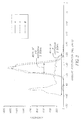
- the measurement data of the angular acceleration of the eye is plotted in the form of a histogram as shown in Figs. 3 and 4.
- the width of the histogram is measured at a chosen fraction of the maximum value and compared to a threshold value. Widths below the threshold value provide a diagnosis of ADHD and widths above the threshold value constitute a diagnosis of normal.
- histograms show the eye acceleration data for 2 subjects A and B.
- Subject A is diagnosed with having ADHD.
- Subject B is diagnosed with not having ADHD.
- the narrower width of Subject A's histogram as compared to Subject B's histogram indicates a smaller range of eye acceleration.
- a is the angular acceleration of the eye in relative units and n is the number of samples and ⁇ is the time at the start of a temporal window containing n samples.
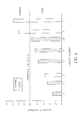
- Fig. 4 the standard deviations of the histograms of the eye saccades measured for 7 (subjects including subjects A & B shown in Fig. 3) are shown. These data were obtained by averaging the histogram widths measured from 5 windows spaced equally in time. With the exception of subject D , all subjects with ADHD diagnosis have narrower histograms then the normal subjects. The data demonstrates that the range of eye motion can be used as a diagnostic method for ADHD.
- the width of a histogram as shown on the ordinate of Fig 4 is less than a threshold value ⁇ the subject is diagnosed as having ADHD, when the width is greater than ⁇ (shown by a dotted line on Fig. 4) the subject is diagnosed as normal. Setting a value of 10 for ⁇ would give only one false positive result out of 8 test runs shown on Fig. 4, an accuracy of 87.5%.
Landscapes
- Health & Medical Sciences (AREA)
- Life Sciences & Earth Sciences (AREA)
- Engineering & Computer Science (AREA)
- Public Health (AREA)
- General Health & Medical Sciences (AREA)
- Medical Informatics (AREA)
- Biomedical Technology (AREA)
- Biophysics (AREA)
- Veterinary Medicine (AREA)
- Animal Behavior & Ethology (AREA)
- Surgery (AREA)
- Developmental Disabilities (AREA)
- Molecular Biology (AREA)
- Heart & Thoracic Surgery (AREA)
- Physics & Mathematics (AREA)
- Pathology (AREA)
- Psychiatry (AREA)
- Primary Health Care (AREA)
- Epidemiology (AREA)
- Social Psychology (AREA)
- Psychology (AREA)
- Hospice & Palliative Care (AREA)
- Educational Technology (AREA)
- Child & Adolescent Psychology (AREA)
- Eye Examination Apparatus (AREA)
- Measurement Of The Respiration, Hearing Ability, Form, And Blood Characteristics Of Living Organisms (AREA)
Applications Claiming Priority (2)
| Application Number | Priority Date | Filing Date | Title |
|---|---|---|---|
| US866183 | 2001-05-25 | ||
| US09/866,183 US6652458B2 (en) | 2000-06-20 | 2001-05-25 | ADHD detection by eye saccades |
Publications (2)
| Publication Number | Publication Date |
|---|---|
| EP1260177A2 true EP1260177A2 (de) | 2002-11-27 |
| EP1260177A3 EP1260177A3 (de) | 2003-01-08 |
Family
ID=25347084
Family Applications (1)
| Application Number | Title | Priority Date | Filing Date |
|---|---|---|---|
| EP02076882A Withdrawn EP1260177A3 (de) | 2001-05-25 | 2002-05-13 | Analyse von Saccaden zur Bestimmung von Aufmerksamkeitsstörungen verbunden mit Hyperaktivität |
Country Status (3)
| Country | Link |
|---|---|
| US (1) | US6652458B2 (de) |
| EP (1) | EP1260177A3 (de) |
| JP (1) | JP2002360518A (de) |
Cited By (4)
| Publication number | Priority date | Publication date | Assignee | Title |
|---|---|---|---|---|
| EP3177200A4 (de) * | 2014-08-04 | 2018-06-13 | New York University | Verfahren und kits zur diagnose, auswertung oder quantifizierung von drogenkonsum, drogenmissbrauch und narkose, internukleärer ophthalmoplegie, aufmerksamkeitsdefizit-/hyperaktivitätsstörung (adhd), chronisch-traumatischer enzephalopathie, erkrankungen des schizophreniespektrums und alkoholkonsum |
| US10610165B2 (en) | 2013-06-17 | 2020-04-07 | New York University | Methods and kits for assessing neurological and ophthalmic function and localizing neurological lesions |
| US11304601B2 (en) | 2012-03-26 | 2022-04-19 | New York University | Methods and kits for assessing central nervous system integrity |
| US11642071B2 (en) | 2016-08-02 | 2023-05-09 | New York University | Methods and kits for assessing neurological function and localizing neurological lesions |
Families Citing this family (36)
| Publication number | Priority date | Publication date | Assignee | Title |
|---|---|---|---|---|
| US6808267B2 (en) * | 2002-10-18 | 2004-10-26 | Childsplay Vision Systems | Method for automated mass screening for visual dysfunction in children |
| SE0203168D0 (sv) * | 2002-10-25 | 2002-10-25 | Hoeganaes Ab | Heat treatment of iron-based components |
| US7682024B2 (en) * | 2003-03-13 | 2010-03-23 | Plant Charles P | Saccadic motion sensing |
| US7731360B2 (en) * | 2003-11-07 | 2010-06-08 | Neuro Kinetics | Portable video oculography system |
| US7742621B2 (en) * | 2006-06-13 | 2010-06-22 | Delphi Technologies, Inc. | Dynamic eye tracking system |
| US20080243005A1 (en) * | 2007-03-30 | 2008-10-02 | Searete Llc, A Limited Liability Corporation Of The State Of Delaware | Computational user-health testing |
| US9301679B2 (en) | 2007-11-01 | 2016-04-05 | Dignity Health | Method of detecting neurological disease |
| US7959578B2 (en) * | 2008-02-01 | 2011-06-14 | Lonky Martin L | Methods and techniques to measure, map and correlate ocular micro-movement and ocular micro-tremor (OMT) signals with cognitive processing capabilities in ADD/ADHD individuals |
| DE102008013731B3 (de) * | 2008-03-11 | 2009-09-17 | Heike Schmidt | Leistungsindikator für Patienten mit ADS-Syndrom |
| US9655515B2 (en) * | 2008-04-08 | 2017-05-23 | Neuro Kinetics | Method of precision eye-tracking through use of iris edge based landmarks in eye geometry |
| US9039631B2 (en) | 2008-10-09 | 2015-05-26 | Neuro Kinetics | Quantitative, non-invasive, clinical diagnosis of traumatic brain injury using VOG device for neurologic testing |
| US10398309B2 (en) | 2008-10-09 | 2019-09-03 | Neuro Kinetics, Inc. | Noninvasive rapid screening of mild traumatic brain injury using combination of subject's objective oculomotor, vestibular and reaction time analytic variables |
| US8585609B2 (en) * | 2008-10-09 | 2013-11-19 | Neuro Kinetics, Inc. | Quantitative, non-invasive, clinical diagnosis of traumatic brain injury using simulated distance visual stimulus device for neurologic testing |
| WO2011062890A1 (en) * | 2009-11-18 | 2011-05-26 | The Mclean Hospital Corporation | Method for diagnosing adhd and related behavioral disorders |
| US8371693B2 (en) * | 2010-03-30 | 2013-02-12 | National University Corporation Shizuoka University | Autism diagnosis support apparatus |
| WO2012103470A2 (en) * | 2011-01-28 | 2012-08-02 | Dignity Health | Method of detecting neurological disease |
| WO2012135822A2 (en) * | 2011-03-31 | 2012-10-04 | University Of South Florida | Device and method for stimulating eye movement |
| ES2589000T3 (es) * | 2012-04-24 | 2016-11-08 | Universitat De Barcelona | Sistema y procedimiento de medir la atención |
| US8808179B1 (en) | 2012-08-06 | 2014-08-19 | James Z. Cinberg | Method and associated apparatus for detecting minor traumatic brain injury |
| EP3003125B1 (de) | 2013-05-31 | 2021-08-11 | Dignity Health | System zur erkennung einer neurologischen krankheit |
| WO2014208761A1 (ja) | 2013-06-28 | 2014-12-31 | 株式会社Jvcケンウッド | 診断支援装置及び診断支援方法 |
| AU2014334870B2 (en) | 2013-10-17 | 2019-06-13 | Children's Healthcare Of Atlanta, Inc. | Methods for assessing infant and child development via eye tracking |
| WO2015191809A1 (en) | 2014-06-11 | 2015-12-17 | Dignity Health | Systems and methods for non-intrusive deception detection |
| AU2015305371B2 (en) | 2014-08-21 | 2019-11-21 | Dignity Health | Systems and methods for using eye movements to determine traumatic brain injury |
| JP6380178B2 (ja) * | 2015-03-16 | 2018-08-29 | 株式会社Jvcケンウッド | 診断支援装置および診断支援方法 |
| US10861605B2 (en) | 2016-08-22 | 2020-12-08 | Aic Innovations Group, Inc. | Method and apparatus for determining health status |
| EP3515284B1 (de) | 2016-09-23 | 2023-09-20 | Novasight Ltd. | Überprüfungsvorrichtung |
| CN106990067A (zh) * | 2017-05-05 | 2017-07-28 | 深圳市科迈爱康科技有限公司 | 远程诊疗机器人 |
| WO2019060298A1 (en) | 2017-09-19 | 2019-03-28 | Neuroenhancement Lab, LLC | METHOD AND APPARATUS FOR NEURO-ACTIVATION |
| US11717686B2 (en) | 2017-12-04 | 2023-08-08 | Neuroenhancement Lab, LLC | Method and apparatus for neuroenhancement to facilitate learning and performance |
| US11478603B2 (en) | 2017-12-31 | 2022-10-25 | Neuroenhancement Lab, LLC | Method and apparatus for neuroenhancement to enhance emotional response |
| US12280219B2 (en) | 2017-12-31 | 2025-04-22 | NeuroLight, Inc. | Method and apparatus for neuroenhancement to enhance emotional response |
| US11364361B2 (en) | 2018-04-20 | 2022-06-21 | Neuroenhancement Lab, LLC | System and method for inducing sleep by transplanting mental states |
| US11452839B2 (en) | 2018-09-14 | 2022-09-27 | Neuroenhancement Lab, LLC | System and method of improving sleep |
| US11786694B2 (en) | 2019-05-24 | 2023-10-17 | NeuroLight, Inc. | Device, method, and app for facilitating sleep |
| KR102262889B1 (ko) * | 2019-08-12 | 2021-06-09 | 주식회사 비엔알아이 | 시선 추적을 이용한 머신 러닝 기반의 읽기 능력 진단 장치 및 방법 |
Citations (6)
| Publication number | Priority date | Publication date | Assignee | Title |
|---|---|---|---|---|
| US4456347A (en) | 1981-08-17 | 1984-06-26 | Limbic Training Systems, Inc. | Method and apparatus for facilitating relaxation |
| US5377100A (en) | 1993-03-08 | 1994-12-27 | The United States Of America As Represented By The Administrator Of The National Aeronautics And Space Administration | Method of encouraging attention by correlating video game difficulty with attention level |
| US6053739A (en) | 1996-04-10 | 2000-04-25 | Stewart; Donald B. | Measurement of attention span and attention deficits |
| US6097980A (en) | 1998-12-24 | 2000-08-01 | Monastra; Vincent J. | Quantitative electroencephalographic (QEEG) process and apparatus for assessing attention deficit hyperactivity disorder |
| US6117075A (en) | 1998-09-21 | 2000-09-12 | Meduck Ltd. | Depth of anesthesia monitor |
| US6394963B1 (en) | 2000-06-20 | 2002-05-28 | Eastman Kodak Company | Technique for diagnosing attention deficit disorder |
Family Cites Families (8)
| Publication number | Priority date | Publication date | Assignee | Title |
|---|---|---|---|---|
| US4889422A (en) * | 1986-01-28 | 1989-12-26 | George Pavlidis | Method and means for detecting dyslexia |
| JPH0655203B2 (ja) * | 1992-07-09 | 1994-07-27 | 株式会社エイ・ティ・アール視聴覚機構研究所 | 視線検出を用いた医療診断装置 |
| JPH074343B2 (ja) * | 1992-09-29 | 1995-01-25 | 株式会社エイ・ティ・アール視聴覚機構研究所 | 奥行き知覚分析装置 |
| US5940801A (en) | 1994-04-26 | 1999-08-17 | Health Hero Network, Inc. | Modular microprocessor-based diagnostic measurement apparatus and method for psychological conditions |
| US5918603A (en) | 1994-05-23 | 1999-07-06 | Health Hero Network, Inc. | Method for treating medical conditions using a microprocessor-based video game |
| US5913310A (en) | 1994-05-23 | 1999-06-22 | Health Hero Network, Inc. | Method for diagnosis and treatment of psychological and emotional disorders using a microprocessor-based video game |
| JPH08105B2 (ja) * | 1992-11-27 | 1996-01-10 | 株式会社エイ・ティ・アール視聴覚機構研究所 | 固視微動検査装置 |
| US6231187B1 (en) * | 1999-02-11 | 2001-05-15 | Queen's University At Kingston | Method and apparatus for detecting eye movement |
-
2001
- 2001-05-25 US US09/866,183 patent/US6652458B2/en not_active Expired - Lifetime
-
2002
- 2002-05-13 EP EP02076882A patent/EP1260177A3/de not_active Withdrawn
- 2002-05-24 JP JP2002150611A patent/JP2002360518A/ja active Pending
Patent Citations (6)
| Publication number | Priority date | Publication date | Assignee | Title |
|---|---|---|---|---|
| US4456347A (en) | 1981-08-17 | 1984-06-26 | Limbic Training Systems, Inc. | Method and apparatus for facilitating relaxation |
| US5377100A (en) | 1993-03-08 | 1994-12-27 | The United States Of America As Represented By The Administrator Of The National Aeronautics And Space Administration | Method of encouraging attention by correlating video game difficulty with attention level |
| US6053739A (en) | 1996-04-10 | 2000-04-25 | Stewart; Donald B. | Measurement of attention span and attention deficits |
| US6117075A (en) | 1998-09-21 | 2000-09-12 | Meduck Ltd. | Depth of anesthesia monitor |
| US6097980A (en) | 1998-12-24 | 2000-08-01 | Monastra; Vincent J. | Quantitative electroencephalographic (QEEG) process and apparatus for assessing attention deficit hyperactivity disorder |
| US6394963B1 (en) | 2000-06-20 | 2002-05-28 | Eastman Kodak Company | Technique for diagnosing attention deficit disorder |
Cited By (6)
| Publication number | Priority date | Publication date | Assignee | Title |
|---|---|---|---|---|
| US11304601B2 (en) | 2012-03-26 | 2022-04-19 | New York University | Methods and kits for assessing central nervous system integrity |
| US10610165B2 (en) | 2013-06-17 | 2020-04-07 | New York University | Methods and kits for assessing neurological and ophthalmic function and localizing neurological lesions |
| US10966669B2 (en) | 2013-06-17 | 2021-04-06 | New York University | Methods and kits for assessing neurological and ophthalmic function and localizing neurological lesions |
| EP3177200A4 (de) * | 2014-08-04 | 2018-06-13 | New York University | Verfahren und kits zur diagnose, auswertung oder quantifizierung von drogenkonsum, drogenmissbrauch und narkose, internukleärer ophthalmoplegie, aufmerksamkeitsdefizit-/hyperaktivitätsstörung (adhd), chronisch-traumatischer enzephalopathie, erkrankungen des schizophreniespektrums und alkoholkonsum |
| US11013441B2 (en) | 2014-08-04 | 2021-05-25 | New York University | Methods and kits for diagnosing, assessing or quantitating drug use, drug abuse and narcosis, internuclear ophthalmoplegia, attention deficit hyperactivity disorder (ADHD), chronic traumatic encephalopathy, schizophrenia spectrum disorders and alcohol consumption |
| US11642071B2 (en) | 2016-08-02 | 2023-05-09 | New York University | Methods and kits for assessing neurological function and localizing neurological lesions |
Also Published As
| Publication number | Publication date |
|---|---|
| US6652458B2 (en) | 2003-11-25 |
| JP2002360518A (ja) | 2002-12-17 |
| EP1260177A3 (de) | 2003-01-08 |
| US20030028081A1 (en) | 2003-02-06 |
Similar Documents
| Publication | Publication Date | Title |
|---|---|---|
| US6652458B2 (en) | ADHD detection by eye saccades | |
| US6565518B2 (en) | Technique for diagnosing attention deficit hyperactivity disorder | |
| US6520921B1 (en) | Method for determining attention deficit hyperactivity disorder (ADHD) medication dosage and for monitoring the effects of (ADHD) medication | |
| US6726624B2 (en) | Method and apparatus for determining attention deficit hyperactivity disorder (adhd) medication dosage and for monitoring the effects of adhd medication on people who have adhd using complementary tests | |
| US20150289813A1 (en) | System and Method for the Biological Diagnosis of Post-Traumatic Stress Disorder: PTSD Electronic Device Application | |
| EP3493728B1 (de) | Verfahren und kits zur beurteilung der neurologischen funktion und zur lokalisierung neurologischer läsionen | |
| US20200107767A1 (en) | Non-Invasive Portable Device and Method to Assess Mental Conditions | |
| US6394963B1 (en) | Technique for diagnosing attention deficit disorder | |
| Chang et al. | Methods of visual assessment in children with cortical visual impairment | |
| US6652470B2 (en) | Using image modification and temperature biofeedback to diagnose and treat ADHD | |
| US20050159671A1 (en) | Method for diagnosing, detecting, and monitoring brain function including neurological disease and disorders | |
| US6527730B2 (en) | Reducing noise in a technique for diagnosing attention deficit hyperactivity disorder | |
| US6746409B2 (en) | Technique for diagnosing attention deficit hyperactivity disorder using complimentary tests | |
| US6482165B1 (en) | Homekit for determining attention deficit hyperactivity disorder | |
| US20220233134A1 (en) | System and Method for Stroke Detection and Prevention | |
| RU2722056C1 (ru) | Способ диагностики парафильных расстройств с применением трекинга глаз | |
| Sinha et al. | Infrared Eye Tracking: Unlocking Communication Pathways for Coma Patients | |
| Gentilini | Eye tracking: diagnostic measure of mild traumatic brain injury | |
| Genthe | Auditory EEG event-related potential latency and amplitude in children with and without attention deficit/hyperactivity disorder |
Legal Events
| Date | Code | Title | Description |
|---|---|---|---|
| PUAI | Public reference made under article 153(3) epc to a published international application that has entered the european phase |
Free format text: ORIGINAL CODE: 0009012 |
|
| PUAL | Search report despatched |
Free format text: ORIGINAL CODE: 0009013 |
|
| AK | Designated contracting states |
Kind code of ref document: A2 Designated state(s): AT BE CH CY DE DK ES FI FR GB GR IE IT LI LU MC NL PT SE TR |
|
| AX | Request for extension of the european patent |
Free format text: AL;LT;LV;MK;RO;SI |
|
| AK | Designated contracting states |
Kind code of ref document: A3 Designated state(s): AT BE CH CY DE DK ES FI FR GB GR IE IT LI LU MC NL PT SE TR |
|
| AX | Request for extension of the european patent |
Free format text: AL;LT;LV;MK;RO;SI |
|
| RIC1 | Information provided on ipc code assigned before grant |
Free format text: 7A 61B 3/113 A, 7A 61B 3/14 B |
|
| 17P | Request for examination filed |
Effective date: 20030708 |
|
| AKX | Designation fees paid |
Designated state(s): CH DE FR GB IT LI SE |
|
| 17Q | First examination report despatched |
Effective date: 20030901 |
|
| RAP1 | Party data changed (applicant data changed or rights of an application transferred) |
Owner name: THE MCLEAN HOSPITAL CORPORATION |
|
| STAA | Information on the status of an ep patent application or granted ep patent |
Free format text: STATUS: THE APPLICATION IS DEEMED TO BE WITHDRAWN |
|
| 18D | Application deemed to be withdrawn |
Effective date: 20040812 |