EP1260729A1 - Reibelemente aus feuerfestem keramischem Kohlenstoff- Verbundwerkstoff - Google Patents
Reibelemente aus feuerfestem keramischem Kohlenstoff- Verbundwerkstoff Download PDFInfo
- Publication number
- EP1260729A1 EP1260729A1 EP02253468A EP02253468A EP1260729A1 EP 1260729 A1 EP1260729 A1 EP 1260729A1 EP 02253468 A EP02253468 A EP 02253468A EP 02253468 A EP02253468 A EP 02253468A EP 1260729 A1 EP1260729 A1 EP 1260729A1
- Authority
- EP
- European Patent Office
- Prior art keywords
- carbon
- matrix
- carbide
- refractory
- particles
- Prior art date
- Legal status (The legal status is an assumption and is not a legal conclusion. Google has not performed a legal analysis and makes no representation as to the accuracy of the status listed.)
- Granted
Links
- 229910052799 carbon Inorganic materials 0.000 title claims abstract description 51
- 239000002131 composite material Substances 0.000 title claims description 28
- OKTJSMMVPCPJKN-UHFFFAOYSA-N Carbon Chemical compound [C] OKTJSMMVPCPJKN-UHFFFAOYSA-N 0.000 claims abstract description 49
- 238000000034 method Methods 0.000 claims abstract description 32
- 239000000463 material Substances 0.000 claims abstract description 29
- 239000002245 particle Substances 0.000 claims abstract description 28
- 229910010271 silicon carbide Inorganic materials 0.000 claims abstract description 16
- HBMJWWWQQXIZIP-UHFFFAOYSA-N silicon carbide Chemical compound [Si+]#[C-] HBMJWWWQQXIZIP-UHFFFAOYSA-N 0.000 claims abstract description 15
- 239000000835 fiber Substances 0.000 claims abstract description 9
- 239000002243 precursor Substances 0.000 claims abstract description 9
- 230000008021 deposition Effects 0.000 claims abstract description 6
- 239000007787 solid Substances 0.000 claims abstract description 6
- 239000011159 matrix material Substances 0.000 claims description 35
- 229910052710 silicon Inorganic materials 0.000 claims description 16
- 239000010703 silicon Substances 0.000 claims description 16
- 238000001564 chemical vapour infiltration Methods 0.000 claims description 15
- 238000006243 chemical reaction Methods 0.000 claims description 12
- 238000000151 deposition Methods 0.000 claims description 9
- 230000008018 melting Effects 0.000 claims description 6
- 238000002844 melting Methods 0.000 claims description 6
- 239000007833 carbon precursor Substances 0.000 claims description 4
- ZOXJGFHDIHLPTG-UHFFFAOYSA-N Boron Chemical compound [B] ZOXJGFHDIHLPTG-UHFFFAOYSA-N 0.000 claims description 3
- 229910052796 boron Inorganic materials 0.000 claims description 3
- 238000003754 machining Methods 0.000 claims description 3
- 238000009826 distribution Methods 0.000 claims description 2
- 229910052580 B4C Inorganic materials 0.000 claims 1
- INAHAJYZKVIDIZ-UHFFFAOYSA-N boron carbide Chemical compound B12B3B4C32B41 INAHAJYZKVIDIZ-UHFFFAOYSA-N 0.000 claims 1
- XUIMIQQOPSSXEZ-UHFFFAOYSA-N Silicon Chemical compound [Si] XUIMIQQOPSSXEZ-UHFFFAOYSA-N 0.000 abstract description 20
- VNWKTOKETHGBQD-UHFFFAOYSA-N methane Chemical compound C VNWKTOKETHGBQD-UHFFFAOYSA-N 0.000 abstract description 7
- 239000011863 silicon-based powder Substances 0.000 abstract description 5
- 239000008187 granular material Substances 0.000 abstract description 2
- 230000002093 peripheral effect Effects 0.000 abstract description 2
- 239000011856 silicon-based particle Substances 0.000 abstract description 2
- CREMABGTGYGIQB-UHFFFAOYSA-N carbon carbon Chemical compound C.C CREMABGTGYGIQB-UHFFFAOYSA-N 0.000 description 19
- 239000011203 carbon fibre reinforced carbon Substances 0.000 description 18
- 239000010410 layer Substances 0.000 description 18
- 238000000280 densification Methods 0.000 description 13
- 239000004744 fabric Substances 0.000 description 9
- 238000010438 heat treatment Methods 0.000 description 5
- 238000001000 micrograph Methods 0.000 description 5
- 239000011230 binding agent Substances 0.000 description 4
- 238000009792 diffusion process Methods 0.000 description 4
- 239000002783 friction material Substances 0.000 description 4
- 238000004519 manufacturing process Methods 0.000 description 4
- 229920000049 Carbon (fiber) Polymers 0.000 description 3
- 239000007788 liquid Substances 0.000 description 3
- 239000000843 powder Substances 0.000 description 3
- 238000002360 preparation method Methods 0.000 description 3
- 239000002344 surface layer Substances 0.000 description 3
- VYPSYNLAJGMNEJ-UHFFFAOYSA-N Silicium dioxide Chemical compound O=[Si]=O VYPSYNLAJGMNEJ-UHFFFAOYSA-N 0.000 description 2
- 229910002804 graphite Inorganic materials 0.000 description 2
- 239000010439 graphite Substances 0.000 description 2
- 238000005470 impregnation Methods 0.000 description 2
- 230000035515 penetration Effects 0.000 description 2
- 229920002239 polyacrylonitrile Polymers 0.000 description 2
- 230000002787 reinforcement Effects 0.000 description 2
- KXGFMDJXCMQABM-UHFFFAOYSA-N 2-methoxy-6-methylphenol Chemical compound [CH]OC1=CC=CC([CH])=C1O KXGFMDJXCMQABM-UHFFFAOYSA-N 0.000 description 1
- -1 SiC modified Carbon/Carbon Composites Chemical class 0.000 description 1
- 239000006229 carbon black Substances 0.000 description 1
- 229910052681 coesite Inorganic materials 0.000 description 1
- 229910052906 cristobalite Inorganic materials 0.000 description 1
- 238000005538 encapsulation Methods 0.000 description 1
- 239000000945 filler Substances 0.000 description 1
- 238000011065 in-situ storage Methods 0.000 description 1
- 238000010348 incorporation Methods 0.000 description 1
- 239000007791 liquid phase Substances 0.000 description 1
- 238000000465 moulding Methods 0.000 description 1
- 239000004745 nonwoven fabric Substances 0.000 description 1
- 230000003287 optical effect Effects 0.000 description 1
- 230000003647 oxidation Effects 0.000 description 1
- 238000007254 oxidation reaction Methods 0.000 description 1
- 239000012071 phase Substances 0.000 description 1
- 229920001568 phenolic resin Polymers 0.000 description 1
- 239000005011 phenolic resin Substances 0.000 description 1
- 239000011148 porous material Substances 0.000 description 1
- 229920005989 resin Polymers 0.000 description 1
- 239000011347 resin Substances 0.000 description 1
- 239000000377 silicon dioxide Substances 0.000 description 1
- 239000007790 solid phase Substances 0.000 description 1
- 230000003068 static effect Effects 0.000 description 1
- 229910052682 stishovite Inorganic materials 0.000 description 1
- 238000000859 sublimation Methods 0.000 description 1
- 230000008022 sublimation Effects 0.000 description 1
- 229910052905 tridymite Inorganic materials 0.000 description 1
Images
Classifications
-
- C—CHEMISTRY; METALLURGY
- C04—CEMENTS; CONCRETE; ARTIFICIAL STONE; CERAMICS; REFRACTORIES
- C04B—LIME, MAGNESIA; SLAG; CEMENTS; COMPOSITIONS THEREOF, e.g. MORTARS, CONCRETE OR LIKE BUILDING MATERIALS; ARTIFICIAL STONE; CERAMICS; REFRACTORIES; TREATMENT OF NATURAL STONE
- C04B35/00—Shaped ceramic products characterised by their composition; Ceramics compositions; Processing powders of inorganic compounds preparatory to the manufacturing of ceramic products
- C04B35/622—Forming processes; Processing powders of inorganic compounds preparatory to the manufacturing of ceramic products
- C04B35/626—Preparing or treating the powders individually or as batches ; preparing or treating macroscopic reinforcing agents for ceramic products, e.g. fibres; mechanical aspects section B
- C04B35/628—Coating the powders or the macroscopic reinforcing agents
- C04B35/62802—Powder coating materials
- C04B35/62828—Non-oxide ceramics
- C04B35/62839—Carbon
-
- B—PERFORMING OPERATIONS; TRANSPORTING
- B32—LAYERED PRODUCTS
- B32B—LAYERED PRODUCTS, i.e. PRODUCTS BUILT-UP OF STRATA OF FLAT OR NON-FLAT, e.g. CELLULAR OR HONEYCOMB, FORM
- B32B18/00—Layered products essentially comprising ceramics, e.g. refractory products
-
- C—CHEMISTRY; METALLURGY
- C04—CEMENTS; CONCRETE; ARTIFICIAL STONE; CERAMICS; REFRACTORIES
- C04B—LIME, MAGNESIA; SLAG; CEMENTS; COMPOSITIONS THEREOF, e.g. MORTARS, CONCRETE OR LIKE BUILDING MATERIALS; ARTIFICIAL STONE; CERAMICS; REFRACTORIES; TREATMENT OF NATURAL STONE
- C04B35/00—Shaped ceramic products characterised by their composition; Ceramics compositions; Processing powders of inorganic compounds preparatory to the manufacturing of ceramic products
- C04B35/515—Shaped ceramic products characterised by their composition; Ceramics compositions; Processing powders of inorganic compounds preparatory to the manufacturing of ceramic products based on non-oxide ceramics
- C04B35/56—Shaped ceramic products characterised by their composition; Ceramics compositions; Processing powders of inorganic compounds preparatory to the manufacturing of ceramic products based on non-oxide ceramics based on carbides or oxycarbides
- C04B35/565—Shaped ceramic products characterised by their composition; Ceramics compositions; Processing powders of inorganic compounds preparatory to the manufacturing of ceramic products based on non-oxide ceramics based on carbides or oxycarbides based on silicon carbide
-
- C—CHEMISTRY; METALLURGY
- C04—CEMENTS; CONCRETE; ARTIFICIAL STONE; CERAMICS; REFRACTORIES
- C04B—LIME, MAGNESIA; SLAG; CEMENTS; COMPOSITIONS THEREOF, e.g. MORTARS, CONCRETE OR LIKE BUILDING MATERIALS; ARTIFICIAL STONE; CERAMICS; REFRACTORIES; TREATMENT OF NATURAL STONE
- C04B35/00—Shaped ceramic products characterised by their composition; Ceramics compositions; Processing powders of inorganic compounds preparatory to the manufacturing of ceramic products
- C04B35/622—Forming processes; Processing powders of inorganic compounds preparatory to the manufacturing of ceramic products
- C04B35/626—Preparing or treating the powders individually or as batches ; preparing or treating macroscopic reinforcing agents for ceramic products, e.g. fibres; mechanical aspects section B
- C04B35/628—Coating the powders or the macroscopic reinforcing agents
- C04B35/62802—Powder coating materials
-
- F—MECHANICAL ENGINEERING; LIGHTING; HEATING; WEAPONS; BLASTING
- F16—ENGINEERING ELEMENTS AND UNITS; GENERAL MEASURES FOR PRODUCING AND MAINTAINING EFFECTIVE FUNCTIONING OF MACHINES OR INSTALLATIONS; THERMAL INSULATION IN GENERAL
- F16D—COUPLINGS FOR TRANSMITTING ROTATION; CLUTCHES; BRAKES
- F16D69/00—Friction linings; Attachment thereof; Selection of coacting friction substances or surfaces
- F16D69/02—Composition of linings ; Methods of manufacturing
- F16D69/023—Composite materials containing carbon and carbon fibres or fibres made of carbonizable material
-
- C—CHEMISTRY; METALLURGY
- C04—CEMENTS; CONCRETE; ARTIFICIAL STONE; CERAMICS; REFRACTORIES
- C04B—LIME, MAGNESIA; SLAG; CEMENTS; COMPOSITIONS THEREOF, e.g. MORTARS, CONCRETE OR LIKE BUILDING MATERIALS; ARTIFICIAL STONE; CERAMICS; REFRACTORIES; TREATMENT OF NATURAL STONE
- C04B2235/00—Aspects relating to ceramic starting mixtures or sintered ceramic products
- C04B2235/02—Composition of constituents of the starting material or of secondary phases of the final product
- C04B2235/30—Constituents and secondary phases not being of a fibrous nature
- C04B2235/42—Non metallic elements added as constituents or additives, e.g. sulfur, phosphor, selenium or tellurium
- C04B2235/428—Silicon
-
- C—CHEMISTRY; METALLURGY
- C04—CEMENTS; CONCRETE; ARTIFICIAL STONE; CERAMICS; REFRACTORIES
- C04B—LIME, MAGNESIA; SLAG; CEMENTS; COMPOSITIONS THEREOF, e.g. MORTARS, CONCRETE OR LIKE BUILDING MATERIALS; ARTIFICIAL STONE; CERAMICS; REFRACTORIES; TREATMENT OF NATURAL STONE
- C04B2235/00—Aspects relating to ceramic starting mixtures or sintered ceramic products
- C04B2235/02—Composition of constituents of the starting material or of secondary phases of the final product
- C04B2235/50—Constituents or additives of the starting mixture chosen for their shape or used because of their shape or their physical appearance
- C04B2235/52—Constituents or additives characterised by their shapes
- C04B2235/5208—Fibers
- C04B2235/5252—Fibers having a specific pre-form
-
- C—CHEMISTRY; METALLURGY
- C04—CEMENTS; CONCRETE; ARTIFICIAL STONE; CERAMICS; REFRACTORIES
- C04B—LIME, MAGNESIA; SLAG; CEMENTS; COMPOSITIONS THEREOF, e.g. MORTARS, CONCRETE OR LIKE BUILDING MATERIALS; ARTIFICIAL STONE; CERAMICS; REFRACTORIES; TREATMENT OF NATURAL STONE
- C04B2235/00—Aspects relating to ceramic starting mixtures or sintered ceramic products
- C04B2235/02—Composition of constituents of the starting material or of secondary phases of the final product
- C04B2235/50—Constituents or additives of the starting mixture chosen for their shape or used because of their shape or their physical appearance
- C04B2235/54—Particle size related information
- C04B2235/5418—Particle size related information expressed by the size of the particles or aggregates thereof
- C04B2235/5436—Particle size related information expressed by the size of the particles or aggregates thereof micrometer sized, i.e. from 1 to 100 micron
-
- C—CHEMISTRY; METALLURGY
- C04—CEMENTS; CONCRETE; ARTIFICIAL STONE; CERAMICS; REFRACTORIES
- C04B—LIME, MAGNESIA; SLAG; CEMENTS; COMPOSITIONS THEREOF, e.g. MORTARS, CONCRETE OR LIKE BUILDING MATERIALS; ARTIFICIAL STONE; CERAMICS; REFRACTORIES; TREATMENT OF NATURAL STONE
- C04B2235/00—Aspects relating to ceramic starting mixtures or sintered ceramic products
- C04B2235/65—Aspects relating to heat treatments of ceramic bodies such as green ceramics or pre-sintered ceramics, e.g. burning, sintering or melting processes
- C04B2235/656—Aspects relating to heat treatments of ceramic bodies such as green ceramics or pre-sintered ceramics, e.g. burning, sintering or melting processes characterised by specific heating conditions during heat treatment
-
- C—CHEMISTRY; METALLURGY
- C04—CEMENTS; CONCRETE; ARTIFICIAL STONE; CERAMICS; REFRACTORIES
- C04B—LIME, MAGNESIA; SLAG; CEMENTS; COMPOSITIONS THEREOF, e.g. MORTARS, CONCRETE OR LIKE BUILDING MATERIALS; ARTIFICIAL STONE; CERAMICS; REFRACTORIES; TREATMENT OF NATURAL STONE
- C04B2235/00—Aspects relating to ceramic starting mixtures or sintered ceramic products
- C04B2235/65—Aspects relating to heat treatments of ceramic bodies such as green ceramics or pre-sintered ceramics, e.g. burning, sintering or melting processes
- C04B2235/66—Specific sintering techniques, e.g. centrifugal sintering
- C04B2235/661—Multi-step sintering
- C04B2235/662—Annealing after sintering
- C04B2235/664—Reductive annealing
-
- C—CHEMISTRY; METALLURGY
- C04—CEMENTS; CONCRETE; ARTIFICIAL STONE; CERAMICS; REFRACTORIES
- C04B—LIME, MAGNESIA; SLAG; CEMENTS; COMPOSITIONS THEREOF, e.g. MORTARS, CONCRETE OR LIKE BUILDING MATERIALS; ARTIFICIAL STONE; CERAMICS; REFRACTORIES; TREATMENT OF NATURAL STONE
- C04B2235/00—Aspects relating to ceramic starting mixtures or sintered ceramic products
- C04B2235/70—Aspects relating to sintered or melt-casted ceramic products
- C04B2235/74—Physical characteristics
- C04B2235/77—Density
-
- C—CHEMISTRY; METALLURGY
- C04—CEMENTS; CONCRETE; ARTIFICIAL STONE; CERAMICS; REFRACTORIES
- C04B—LIME, MAGNESIA; SLAG; CEMENTS; COMPOSITIONS THEREOF, e.g. MORTARS, CONCRETE OR LIKE BUILDING MATERIALS; ARTIFICIAL STONE; CERAMICS; REFRACTORIES; TREATMENT OF NATURAL STONE
- C04B2237/00—Aspects relating to ceramic laminates or to joining of ceramic articles with other articles by heating
- C04B2237/30—Composition of layers of ceramic laminates or of ceramic or metallic articles to be joined by heating, e.g. Si substrates
-
- C—CHEMISTRY; METALLURGY
- C04—CEMENTS; CONCRETE; ARTIFICIAL STONE; CERAMICS; REFRACTORIES
- C04B—LIME, MAGNESIA; SLAG; CEMENTS; COMPOSITIONS THEREOF, e.g. MORTARS, CONCRETE OR LIKE BUILDING MATERIALS; ARTIFICIAL STONE; CERAMICS; REFRACTORIES; TREATMENT OF NATURAL STONE
- C04B2237/00—Aspects relating to ceramic laminates or to joining of ceramic articles with other articles by heating
- C04B2237/30—Composition of layers of ceramic laminates or of ceramic or metallic articles to be joined by heating, e.g. Si substrates
- C04B2237/32—Ceramic
- C04B2237/34—Oxidic
-
- C—CHEMISTRY; METALLURGY
- C04—CEMENTS; CONCRETE; ARTIFICIAL STONE; CERAMICS; REFRACTORIES
- C04B—LIME, MAGNESIA; SLAG; CEMENTS; COMPOSITIONS THEREOF, e.g. MORTARS, CONCRETE OR LIKE BUILDING MATERIALS; ARTIFICIAL STONE; CERAMICS; REFRACTORIES; TREATMENT OF NATURAL STONE
- C04B2237/00—Aspects relating to ceramic laminates or to joining of ceramic articles with other articles by heating
- C04B2237/30—Composition of layers of ceramic laminates or of ceramic or metallic articles to be joined by heating, e.g. Si substrates
- C04B2237/32—Ceramic
- C04B2237/34—Oxidic
- C04B2237/341—Silica or silicates
-
- C—CHEMISTRY; METALLURGY
- C04—CEMENTS; CONCRETE; ARTIFICIAL STONE; CERAMICS; REFRACTORIES
- C04B—LIME, MAGNESIA; SLAG; CEMENTS; COMPOSITIONS THEREOF, e.g. MORTARS, CONCRETE OR LIKE BUILDING MATERIALS; ARTIFICIAL STONE; CERAMICS; REFRACTORIES; TREATMENT OF NATURAL STONE
- C04B2237/00—Aspects relating to ceramic laminates or to joining of ceramic articles with other articles by heating
- C04B2237/30—Composition of layers of ceramic laminates or of ceramic or metallic articles to be joined by heating, e.g. Si substrates
- C04B2237/32—Ceramic
- C04B2237/38—Fiber or whisker reinforced
- C04B2237/385—Carbon or carbon composite
-
- C—CHEMISTRY; METALLURGY
- C04—CEMENTS; CONCRETE; ARTIFICIAL STONE; CERAMICS; REFRACTORIES
- C04B—LIME, MAGNESIA; SLAG; CEMENTS; COMPOSITIONS THEREOF, e.g. MORTARS, CONCRETE OR LIKE BUILDING MATERIALS; ARTIFICIAL STONE; CERAMICS; REFRACTORIES; TREATMENT OF NATURAL STONE
- C04B2237/00—Aspects relating to ceramic laminates or to joining of ceramic articles with other articles by heating
- C04B2237/50—Processing aspects relating to ceramic laminates or to the joining of ceramic articles with other articles by heating
- C04B2237/61—Joining two substrates of which at least one is porous by infiltrating the porous substrate with a liquid, such as a molten metal, causing bonding of the two substrates, e.g. joining two porous carbon substrates by infiltrating with molten silicon
-
- Y—GENERAL TAGGING OF NEW TECHNOLOGICAL DEVELOPMENTS; GENERAL TAGGING OF CROSS-SECTIONAL TECHNOLOGIES SPANNING OVER SEVERAL SECTIONS OF THE IPC; TECHNICAL SUBJECTS COVERED BY FORMER USPC CROSS-REFERENCE ART COLLECTIONS [XRACs] AND DIGESTS
- Y10—TECHNICAL SUBJECTS COVERED BY FORMER USPC
- Y10T—TECHNICAL SUBJECTS COVERED BY FORMER US CLASSIFICATION
- Y10T428/00—Stock material or miscellaneous articles
- Y10T428/30—Self-sustaining carbon mass or layer with impregnant or other layer
Definitions
- the present invention relates to a method for the preparation of a refractory carbide-carbon composite material with carbon fibre reinforcement, more particularly to the preparation of a refractory carbide-carbon composite friction disc for aircraft brakes.
- C-C carbon-carbon
- C-C material is also found to have properties that are not desirable in aircraft brake applications such as oxidation at elevated temperatures, low static friction and variable dynamic friction, especially at low temperatures and low speeds.
- wear rate at taxi speeds is found to be disproportionately high for the relatively small amounts of energy absorbed at those low speeds.
- the high cost of the C-C has limited its use as a friction material in non-aviation applications.
- C-C friction materials typically involve a volume of carbon fibres being restrained in a jig, in a mould or by needling before densification by chemical vapour infiltration (CVI) or impregnation and char of carbonaceous pitch and/or resin material.
- C-C friction materials typically have levels of porosity in the order of 10% - 25%.
- GB 2,137,974 teaches that Si or SiC can be mixed in the powder form with carbon to produce SiC bodies by a moulding route.
- US 4,532,091 gives details of porous bodies compacted from carbon with SiC particles being immersed in molten silicon to produce a SiC body.
- WO 97/22815 and WO 97/18176 describe methods for the manufacture of refractory composite bodies by infiltrating a porous C-C matrix with liquid refractory so that a proportion of the carbon matrix in the C-C is converted to the refractory carbide.
- An example of a refractory element used is silicon, which in the molten state infiltrates the carbon to react and convert a proportion of the carbon matrix to silicon carbide. Silicon, when molten, wets the surface of carbon very readily and this allows excellent penetration of the silicon along carbon fibres and into fibre bundles known as tows. The ease with which silicon wets carbon aids penetration and diffusion of the silicon through the pores into the body of the C-C.
- Such refractory carbide containing composites need final machining, even when near-net shape C-C parts are prepared.
- machining of these materials can be very difficult, requiring expensive tooling and resulting in high scrap rates.
- Areas of aircraft brake discs that are particularly difficult to machine include the drive slots around the inner periphery of the stator discs where the discs are keyed to the torque tube, and the drive slots around the outer periphery of the rotor discs, which are interleaved between the stator discs and keyed to drive bars around the inside of the wheel.
- a friction disc would ideally combine the friction properties of the refractory carbide-carbon composite with the machinability of C-C.
- US 4,815,572 goes some way to providing such a material by only converting the surface layers of the disc. However, the surface layers in the machined drive areas are also converted to carbide and the converted surface layer provided only extends to a depth of a few mm, restricting the wear life of the brake.
- a more specific object is to provide such a method whereby the particles are substantially individually encapsulated within deposited carbon.
- a method of forming a composite article comprising a carbon matrix containing refractory carbide particles, the method comprising the steps of:
- the method includes the optional step of heat-treating the resulting composite article to graphitise any unreacted deposited carbon.
- the deposition in step b) involves a chemical vapour infiltration (CVI) or like process.
- CVI chemical vapour infiltration
- One method of incorporating the refractory is to add it in a powdered form onto layers of carbon fabric, only on the area where it is required.
- the powder could be left on the fabric or incorporated deeper into the fabric by, for example, applying vibration to the fabric.
- Layers of fabric with refractory powder added are then built up, one on top of another, until the required weight of fibre and refractory is reached.
- the layers can then be compressed to the required fibre volume in a jig or by needling.
- CVI or an impregnation and char route can then densify discs to the required density. This will produce a disc with carbon fibre reinforcement and a matrix containing carbon and the refractory element.
- the refractory element can react with all or a portion of the available carbon matrix to produce the refractory carbide either during densification or after densification.
- Examples of refractory carbide forming elements for incorporation into the C-C include but are not limited to silicon and boron, individually or in combination.
- the silicon and boron could be incorporated in their elemental forms or as oxides (SiO 2 , B 2 O 3 etc), the oxide being reduced by a carbothermic reduction to the elemental form and reacted with the carbon matrix to form the carbide.
- the reduction of refractory oxides by carbothermic reaction is described by Jia-Min Lin et al (" Preparation and Properties of SiC modified Carbon / Carbon Composites by Carbothermic Reaction "; Journal of Materials Science Letters, 18 (1999) 1353-1355).
- the refractory could be incorporated into a sheet with a binder or fugitive backing or produced in a fabric sheet form.
- the sheet could be cut to the required annular shape and interleaved between the carbon fabric layers.
- the refractory sheets could, for example, be interleaved between every layer of carbon fabric, between every other layer or at whatever interval frequency is required to give a predetermined concentration of refractory in the finished composite.
- the binder or fugitive backing could be burnt off to leave no residue during the heating stage of the densification cycle, or in a separate heating process prior to the start of the densification cycle.
- the binder or fugitive backing could also incorporate a carbonaceous phase such as a pitch and/or phenolic resin, for example. Such materials could be carbonised prior to densification if required.
- filler material such as graphite powder or carbon black could be incorporated into the binder or fugitive backing with the refractory element. Temperatures selected during processing can result in the refractory and or refractory carbide being present in the solid or liquid phase allowing diffusion and reactions with the carbon matrix to proceed under solid state or liquid state diffusion conditions.
- an article comprising a carbon matrix having within the interior thereof refractory carbide particles, which are substantially individually encapsulated within deposited carbon.
- the refractory carbide particles are distributed to form at least one hard-wearing friction region and at least one machinable region.
- the invention provides a method of forming a composite article comprising carbide particles in a matrix, the method comprising the steps of:
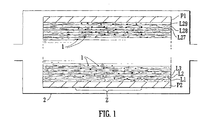
- a CVI deposition chamber 2 is provided with two opposed graphite plates P1 and P2 which clamp a laminate of 29 layers L1 to L29 of non-woven polyacrylonitrile (PAN) fibres, each layer being held together by a needled staple layer.
- the fabric is as described in GB 2,012,671.
- Each layer is in the form of a disc of diameter 83 mm and 1g of silicon powder granules 1 is provided on the upper surface of each layer except uppermost layer L29 in a central region Z of diameter 51mm.
- This stack of cloth layers is clamped between graphite plates P1 and P2 to a thickness of 35 mm to give a fibre volume of 20% before being subjected to a 300 hour CVI densification cycle using a methane based gaseous precursor under conditions known in the art.
- the selective conversion with the refractory carbide-forming elements is carried out by incorporating the refractory element in the selected domains in the body of the composite disc prior to densification.
- the densification process then 'encapsulates' the refractory to prevent it from diffusing or migrating through the composite at temperatures above the melting point of the refractory and/or refractory carbide.
- the composite After densification the composite is removed from between the clamping plates, weighed and the density calculated. The composite is then heat-treated to temperatures in excess of 2000°C in known manner to graphitise the carbon deposit to optimise thermal properties in the composite before being weighed again for density calculation.
- CVI is carried out below 1410°C, the melting point of silicon, and heat treatment is carried out below 2700°C, the sublimation temperature of silicon carbide.
- a laminate was assembled and processed by the method described above using silicon powder screened to a size of less than 63 micrometre.
- the density after CVI was 1.74g/cm 3 and the density after the final heat treatment was 1.71g/cm 3 .
- Example I Micro examination of the resulting sample (Sample I) was then carried out to confirm that the silicon had remained in the region of the sample where it had been placed on the cloth layers. Micro examination was carried out under polarised light to detect any optical activity of the carbon deposit that would indicate the highly graphitisable structure normally obtained with CVI densification.
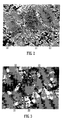
- Figure 2 is a micrograph showing an area of the Sample I composite in the region between the outside edge and where the silicon powder had been placed.
- Optically active carbon deposit 11 can be seen as light coloured areas around the staple fibres 12 and the bundles of continuous fibres 13.
- Figure 3 shows an isolated silicon carbide particle 21 in the Sample I composite.
- the particle clearly shows a deposit of carbon 22 that has grown around it to encapsulate the particle. Further carbon deposits 23 on staple fibres can also be seen. This encapsulation prevents the silicon from migrating through the C-C as it would using conventional siliconising techniques. Generally the particles are more densely packed together in the composite than this micrograph would suggest.
- Example 2 The method of Example I was repeated using silicon powder screened with a mesh size of +150 to 250 micrometre. Micrographs of the resulting sample (Sample 2) similar to those of Figures 2 and 3 were obtained.
- the angular shape of the silicon carbide particle seen in Figure 3 suggests that conversion of the silicon to silicon carbide has occurred in the solid state condition, not in the liquid state. Some or all of the reaction to form silicon carbide may have occurred during the deposition cycle and not during the heat treatment cycle. This suggests a solid state diffusion process is operating as carbon is deposited on the silicon particles during the 300 hour CVI cycle.
- a central wear-resistant region (corresponding to regions (Z)) was formed within a peripheral C-C region which could be readily machined, e.g. to form a disc brake for an aircraft.
- the invention is not limited to the embodiments above.
- the invention is applicable to other methods of densification and processing conditions known in the art.
- the invention is not restricted to brake discs for aircraft and could be applied to other friction applications such as automotive and train clutches and brakes, or applications where refractory carbide-carbon composites require the toughness associated with the C-C.
Landscapes
- Engineering & Computer Science (AREA)
- Chemical & Material Sciences (AREA)
- Ceramic Engineering (AREA)
- Manufacturing & Machinery (AREA)
- Materials Engineering (AREA)
- Structural Engineering (AREA)
- Organic Chemistry (AREA)
- General Engineering & Computer Science (AREA)
- Inorganic Chemistry (AREA)
- Mechanical Engineering (AREA)
- Composite Materials (AREA)
- Braking Arrangements (AREA)
- Ceramic Products (AREA)
Applications Claiming Priority (2)
| Application Number | Priority Date | Filing Date | Title |
|---|---|---|---|
| GBGB0112893.3A GB0112893D0 (en) | 2001-05-25 | 2001-05-25 | Refractory-carbon composite brake friction elements |
| GB0112893 | 2001-05-25 |
Publications (2)
| Publication Number | Publication Date |
|---|---|
| EP1260729A1 true EP1260729A1 (de) | 2002-11-27 |
| EP1260729B1 EP1260729B1 (de) | 2010-02-17 |
Family
ID=9915387
Family Applications (1)
| Application Number | Title | Priority Date | Filing Date |
|---|---|---|---|
| EP02253468A Expired - Lifetime EP1260729B1 (de) | 2001-05-25 | 2002-05-15 | Reibelemente aus feuerfestem keramischem Kohlenstoff- Verbundwerkstoff |
Country Status (4)
| Country | Link |
|---|---|
| US (1) | US7153543B2 (de) |
| EP (1) | EP1260729B1 (de) |
| DE (1) | DE60235337D1 (de) |
| GB (1) | GB0112893D0 (de) |
Cited By (5)
| Publication number | Priority date | Publication date | Assignee | Title |
|---|---|---|---|---|
| US7938236B2 (en) | 2003-07-15 | 2011-05-10 | Meggitt Aerospace Limited | Composite article |
| EP3925942A1 (de) * | 2020-06-15 | 2021-12-22 | Goodrich Corporation | Verbundstoffe und verfahren zur herstellung von verbundstoffen mit vergrössertem volumen an keramischen partikeln |
| US11718569B2 (en) * | 2018-06-01 | 2023-08-08 | Ihi Corporation | Production method for composite material |
| US12528745B2 (en) | 2022-08-12 | 2026-01-20 | Goodrich Corporation | Method to limit silicon in B4C particulate based CMC composites |
| US12565452B2 (en) | 2022-04-12 | 2026-03-03 | Goodrich Corporation | Z-direction reinforced composites and methods of forming z-direction reinforced composites |
Families Citing this family (8)
| Publication number | Priority date | Publication date | Assignee | Title |
|---|---|---|---|---|
| EP1632465A1 (de) * | 2004-09-07 | 2006-03-08 | Sgl Carbon Ag | Durch Nanopartikel modifizierte Carbon-Keramik-Bremsscheiben |
| US20090061085A1 (en) * | 2007-09-04 | 2009-03-05 | Honeywell International Inc. | Expedited manufacture of carbon-carbon composite brake discs |
| US20100279845A1 (en) * | 2009-04-30 | 2010-11-04 | General Electric Company | Process of producing ceramic matrix composites |
| BR112012001174B1 (pt) | 2009-07-17 | 2019-12-17 | Carbon Fibre Preforms Ltd | método para preparar uma matriz de fibra, pré-forma de fibra, artigo, uso de uma pré-forma, e, método para produzir um artigo |
| CN103274714B (zh) * | 2013-06-05 | 2014-09-17 | 东南大学 | 一种改进的二维陶瓷基复合材料Z-pin方法 |
| US9482299B1 (en) | 2015-07-09 | 2016-11-01 | Goodrich Corporation | Multi-leaved core brake disks and assemblies |
| FR3099927B1 (fr) * | 2019-08-12 | 2022-10-21 | Safran Landing Systems | Préforme fibreuse d’une pièce de friction |
| US12054433B2 (en) | 2020-09-11 | 2024-08-06 | General Atomics | Silicon to silicon carbide conversion for ceramic matrix composite fabrication |
Citations (2)
| Publication number | Priority date | Publication date | Assignee | Title |
|---|---|---|---|---|
| US3672936A (en) * | 1968-04-18 | 1972-06-27 | Carborundum Co | Reinforced carbon and graphite articles |
| GB2012671A (en) | 1978-01-12 | 1979-08-01 | Dunlop Ltd | An improved method of making non-woven fabric substrates for carbon fibre reinforced composites |
Family Cites Families (17)
| Publication number | Priority date | Publication date | Assignee | Title |
|---|---|---|---|---|
| US3298921A (en) * | 1965-10-22 | 1967-01-17 | Jack C Bokros | Pyrolytic carbon coated particles for nuclear applications |
| US3552533A (en) | 1968-10-01 | 1971-01-05 | Abex Corp | Carbonized friction article |
| US3936552A (en) * | 1975-02-05 | 1976-02-03 | The B. F. Goodrich Company | Nonmetallic composite friction member |
| US4476164A (en) * | 1982-06-24 | 1984-10-09 | United Technologies Corporation | Deposition of improved SiC coatings on carbon-base materials |
| US4613522A (en) * | 1982-09-29 | 1986-09-23 | Avco Corporation | Oxidation resistant carbon-carbon composites |
| DE3305529A1 (de) | 1983-02-18 | 1984-08-23 | Kernforschungsanlage Jülich GmbH, 5170 Jülich | Verfahren zur herstellung poroeser, durchstroembarer formkoerper aus siliziumkarbid |
| GB2137974B (en) | 1983-04-11 | 1986-08-28 | Atomic Energy Authority Uk | Carbon foam reservoir for silicon |
| US4815572A (en) | 1987-07-24 | 1989-03-28 | Parker-Hannifin Corporation | Brake system with improved brake material |
| FR2643898B1 (fr) * | 1989-03-02 | 1993-05-07 | Europ Propulsion | Procede de fabrication d'un materiau composite a matrice ceramique a tenacite amelioree |
| DE69125941D1 (de) | 1990-08-31 | 1997-06-05 | Aerospace Preforms Ltd | Formteilherstellung aus filament |
| US5455106A (en) * | 1993-10-06 | 1995-10-03 | Hyper-Therm High Temperature Composites, Inc. | Multilayer fiber coating comprising alternate fugitive carbon and ceramic coating material for toughened ceramic composite materials |
| FR2741063B1 (fr) | 1995-11-14 | 1998-02-13 | Europ Propulsion | Procede pour l'introduction dans des substrats poreux d'une composition en fusion a base de silicium |
| GB9525622D0 (en) | 1995-12-15 | 1996-02-14 | Sab Wabco Bromborough Limited | Friction engaging device |
| GB9612882D0 (en) * | 1996-06-20 | 1996-08-21 | Dunlop Ltd | Densification of a porous structure |
| US5871844A (en) * | 1997-04-02 | 1999-02-16 | Fiberite, Inc. | Carbon--carbon parts having filamentized composite fiber substrates and methods of producing the same |
| DE19727586C2 (de) | 1997-06-28 | 2002-10-24 | Daimler Chrysler Ag | Bremseinheit aus Bremsscheibe und Bremsbelag |
| EP1035232B1 (de) * | 1999-03-12 | 2004-12-15 | Goodrich Corporation | Eisenmetallartikel mit Überzug aus einem Oxid des Basismetalls verwendbar für Bremsvorrichtungen et al. |
-
2001
- 2001-05-25 GB GBGB0112893.3A patent/GB0112893D0/en not_active Ceased
-
2002
- 2002-05-15 DE DE60235337T patent/DE60235337D1/de not_active Expired - Lifetime
- 2002-05-15 EP EP02253468A patent/EP1260729B1/de not_active Expired - Lifetime
- 2002-05-23 US US10/153,991 patent/US7153543B2/en not_active Expired - Lifetime
Patent Citations (3)
| Publication number | Priority date | Publication date | Assignee | Title |
|---|---|---|---|---|
| US3672936A (en) * | 1968-04-18 | 1972-06-27 | Carborundum Co | Reinforced carbon and graphite articles |
| US4119189A (en) * | 1968-04-18 | 1978-10-10 | The Carborundum Company | Reinforced carbon and graphite articles |
| GB2012671A (en) | 1978-01-12 | 1979-08-01 | Dunlop Ltd | An improved method of making non-woven fabric substrates for carbon fibre reinforced composites |
Non-Patent Citations (1)
| Title |
|---|
| JIA-MIN LIN ET AL.: "Preparation and Properties of SiC modified Carbon/Carbon Composites by Carbothermic Reaction", JOURNAL OF MATERIALS SCIENCE LETTERS, vol. 18, 1999, pages 1353 - 1355 |
Cited By (7)
| Publication number | Priority date | Publication date | Assignee | Title |
|---|---|---|---|---|
| US7938236B2 (en) | 2003-07-15 | 2011-05-10 | Meggitt Aerospace Limited | Composite article |
| US11718569B2 (en) * | 2018-06-01 | 2023-08-08 | Ihi Corporation | Production method for composite material |
| EP3925942A1 (de) * | 2020-06-15 | 2021-12-22 | Goodrich Corporation | Verbundstoffe und verfahren zur herstellung von verbundstoffen mit vergrössertem volumen an keramischen partikeln |
| US12036782B2 (en) | 2020-06-15 | 2024-07-16 | Goodrich Corporation | Composites and methods of forming composites having an increased volume of ceramic particles |
| US12447715B2 (en) | 2020-06-15 | 2025-10-21 | Goodrich Corporation | Composites and methods of forming composites having an increased volume of ceramic particles |
| US12565452B2 (en) | 2022-04-12 | 2026-03-03 | Goodrich Corporation | Z-direction reinforced composites and methods of forming z-direction reinforced composites |
| US12528745B2 (en) | 2022-08-12 | 2026-01-20 | Goodrich Corporation | Method to limit silicon in B4C particulate based CMC composites |
Also Published As
| Publication number | Publication date |
|---|---|
| US20020176990A1 (en) | 2002-11-28 |
| EP1260729B1 (de) | 2010-02-17 |
| DE60235337D1 (de) | 2010-04-01 |
| GB0112893D0 (en) | 2001-07-18 |
| US7153543B2 (en) | 2006-12-26 |
Similar Documents
| Publication | Publication Date | Title |
|---|---|---|
| EP0300756B1 (de) | Bremselement | |
| EP1326813B1 (de) | Verbundwerkstoffe mit keramischer matrix auf borcarbidbasis | |
| EP1260729B1 (de) | Reibelemente aus feuerfestem keramischem Kohlenstoff- Verbundwerkstoff | |
| JP4375947B2 (ja) | 多層セラミックス複合体とその製造方法 | |
| JP4189888B2 (ja) | 多孔性基体内に溶融したケイ素組成物を送り込む方法 | |
| JP4275862B2 (ja) | ダイヤモンド複合体の製法 | |
| EP3248957B1 (de) | Systeme und verfahren für kohlenstoffstrukturen mit siliciumcarbid-whiskern | |
| EP2686285A1 (de) | Verfahren zur infiltration eines porösen materials mit einem zweiten material und zugehörige anlage | |
| EP1028099B1 (de) | Faserverbundwerkstoff und verfahren zur herstellung | |
| US20020142146A1 (en) | Melted-infiltrated fiber-reinforced composite ceramic | |
| JP2025507648A (ja) | セラミック機能層を備えた高強度カーボン/セラミックブレーキディスク | |
| CA2284617A1 (en) | Fibre-reinforced composite ceramics and method of producing the same | |
| EP1124071B1 (de) | Bremsscheibe für eine Scheibenbremse | |
| US11053168B2 (en) | Systems and methods for carbon structures incorporating silicon carbide | |
| EP1124074B2 (de) | Geformtes Verbundmaterial für Bremsen und Verfahren zu seiner Herstellung | |
| GB2475233A (en) | Process for forming carbon fibre reinforced ceramic composite | |
| EP3072864B1 (de) | Verfahren zur herstellung eines kohlenstoff/kohlenstoff-verbundkörpers mit einer sich selbst bildenden beschichtung | |
| EP1646802B1 (de) | Verbundkörper | |
| HK1121514B (en) | Material for a brake disc | |
| HK1121514A1 (en) | Material for a brake disc |
Legal Events
| Date | Code | Title | Description |
|---|---|---|---|
| PUAI | Public reference made under article 153(3) epc to a published international application that has entered the european phase |
Free format text: ORIGINAL CODE: 0009012 |
|
| AK | Designated contracting states |
Kind code of ref document: A1 Designated state(s): AT BE CH CY DE DK ES FI FR GB GR IE IT LI LU MC NL PT SE TR |
|
| AX | Request for extension of the european patent |
Free format text: AL;LT;LV;MK;RO;SI |
|
| 17P | Request for examination filed |
Effective date: 20030527 |
|
| AKX | Designation fees paid |
Designated state(s): DE ES FR GB IT |
|
| 17Q | First examination report despatched |
Effective date: 20060207 |
|
| RAP1 | Party data changed (applicant data changed or rights of an application transferred) |
Owner name: MEGGITT AEROSPACE LIMITED |
|
| GRAP | Despatch of communication of intention to grant a patent |
Free format text: ORIGINAL CODE: EPIDOSNIGR1 |
|
| GRAS | Grant fee paid |
Free format text: ORIGINAL CODE: EPIDOSNIGR3 |
|
| GRAA | (expected) grant |
Free format text: ORIGINAL CODE: 0009210 |
|
| AK | Designated contracting states |
Kind code of ref document: B1 Designated state(s): DE ES FR GB IT |
|
| REG | Reference to a national code |
Ref country code: GB Ref legal event code: FG4D |
|
| REF | Corresponds to: |
Ref document number: 60235337 Country of ref document: DE Date of ref document: 20100401 Kind code of ref document: P |
|
| PG25 | Lapsed in a contracting state [announced via postgrant information from national office to epo] |
Ref country code: ES Free format text: LAPSE BECAUSE OF FAILURE TO SUBMIT A TRANSLATION OF THE DESCRIPTION OR TO PAY THE FEE WITHIN THE PRESCRIBED TIME-LIMIT Effective date: 20100528 |
|
| PLBE | No opposition filed within time limit |
Free format text: ORIGINAL CODE: 0009261 |
|
| STAA | Information on the status of an ep patent application or granted ep patent |
Free format text: STATUS: NO OPPOSITION FILED WITHIN TIME LIMIT |
|
| 26N | No opposition filed |
Effective date: 20101118 |
|
| REG | Reference to a national code |
Ref country code: FR Ref legal event code: PLFP Year of fee payment: 15 |
|
| REG | Reference to a national code |
Ref country code: FR Ref legal event code: PLFP Year of fee payment: 16 |
|
| REG | Reference to a national code |
Ref country code: FR Ref legal event code: PLFP Year of fee payment: 17 |
|
| PGFP | Annual fee paid to national office [announced via postgrant information from national office to epo] |
Ref country code: FR Payment date: 20210412 Year of fee payment: 20 Ref country code: DE Payment date: 20210420 Year of fee payment: 20 Ref country code: IT Payment date: 20210412 Year of fee payment: 20 |
|
| PGFP | Annual fee paid to national office [announced via postgrant information from national office to epo] |
Ref country code: GB Payment date: 20210421 Year of fee payment: 20 |
|
| REG | Reference to a national code |
Ref country code: DE Ref legal event code: R071 Ref document number: 60235337 Country of ref document: DE |
|
| REG | Reference to a national code |
Ref country code: GB Ref legal event code: PE20 Expiry date: 20220514 |
|
| PG25 | Lapsed in a contracting state [announced via postgrant information from national office to epo] |
Ref country code: GB Free format text: LAPSE BECAUSE OF EXPIRATION OF PROTECTION Effective date: 20220514 |