EP1260968A1 - Verfahren und System zum Erkennen, Indizieren und Suchen von akustischen Signalen - Google Patents
Verfahren und System zum Erkennen, Indizieren und Suchen von akustischen Signalen Download PDFInfo
- Publication number
- EP1260968A1 EP1260968A1 EP02010724A EP02010724A EP1260968A1 EP 1260968 A1 EP1260968 A1 EP 1260968A1 EP 02010724 A EP02010724 A EP 02010724A EP 02010724 A EP02010724 A EP 02010724A EP 1260968 A1 EP1260968 A1 EP 1260968A1
- Authority
- EP
- European Patent Office
- Prior art keywords
- features
- spectral
- source
- sound
- unknown
- Prior art date
- Legal status (The legal status is an assumption and is not a legal conclusion. Google has not performed a legal analysis and makes no representation as to the accuracy of the status listed.)
- Granted
Links
Images








Classifications
-
- G—PHYSICS
- G10—MUSICAL INSTRUMENTS; ACOUSTICS
- G10L—SPEECH ANALYSIS TECHNIQUES OR SPEECH SYNTHESIS; SPEECH RECOGNITION; SPEECH OR VOICE PROCESSING TECHNIQUES; SPEECH OR AUDIO CODING OR DECODING
- G10L21/00—Speech or voice signal processing techniques to produce another audible or non-audible signal, e.g. visual or tactile, in order to modify its quality or its intelligibility
- G10L21/02—Speech enhancement, e.g. noise reduction or echo cancellation
- G10L21/0272—Voice signal separating
- G10L21/028—Voice signal separating using properties of sound source
-
- G—PHYSICS
- G06—COMPUTING OR CALCULATING; COUNTING
- G06F—ELECTRIC DIGITAL DATA PROCESSING
- G06F16/00—Information retrieval; Database structures therefor; File system structures therefor
- G06F16/60—Information retrieval; Database structures therefor; File system structures therefor of audio data
- G06F16/68—Retrieval characterised by using metadata, e.g. metadata not derived from the content or metadata generated manually
- G06F16/683—Retrieval characterised by using metadata, e.g. metadata not derived from the content or metadata generated manually using metadata automatically derived from the content
-
- G—PHYSICS
- G10—MUSICAL INSTRUMENTS; ACOUSTICS
- G10L—SPEECH ANALYSIS TECHNIQUES OR SPEECH SYNTHESIS; SPEECH RECOGNITION; SPEECH OR VOICE PROCESSING TECHNIQUES; SPEECH OR AUDIO CODING OR DECODING
- G10L15/00—Speech recognition
- G10L15/02—Feature extraction for speech recognition; Selection of recognition unit
-
- G—PHYSICS
- G10—MUSICAL INSTRUMENTS; ACOUSTICS
- G10L—SPEECH ANALYSIS TECHNIQUES OR SPEECH SYNTHESIS; SPEECH RECOGNITION; SPEECH OR VOICE PROCESSING TECHNIQUES; SPEECH OR AUDIO CODING OR DECODING
- G10L15/00—Speech recognition
- G10L15/08—Speech classification or search
- G10L15/14—Speech classification or search using statistical models, e.g. Hidden Markov Models [HMMs]
- G10L15/142—Hidden Markov Models [HMMs]
Definitions
- the invention relates generally to the field of acoustic signal processing, and in particular to recognizing, indexing and searching acoustic signals.
- One particular application that could use such a representation scheme is video processing.
- Methods are available for extracting, compressing, searching, and classifying video objects, see for example the various MPEG standards. No such methods exist for "audio" objects, other than when the audio objects are speech. For example, it maybe desired to search through a video library to locate all video segments where John Wayne is galloping on a horse while firing his six-shooter. Certainly it is possible to visually identify John Wayne or a horse. But it much more difficult to pick out the rhythmic clippidy-clop of a galloping horse, and the staccato percussion of a revolver. Recognition of audio events can delineate action in video.
- Another application that could use the representation is sound synthesis. It is not until the features of a sound are identified before it becomes possible to synthetically generate a sound, other than be trial and error.
- non-speech sounds have usually focused on particular classes of non-speech sound, for example, simulating and identifying specific musical instruments, distinguishing submarine sounds from ambient sea sounds and recognition of underwater mammals by their utterances.
- classes of non-speech sound for example, simulating and identifying specific musical instruments, distinguishing submarine sounds from ambient sea sounds and recognition of underwater mammals by their utterances.
- Each of these applications requires a particular arrangement of acoustic features that do not generalize beyond the specific application.
- sound representations could be used to index audio media including a wide range of sound phenomena including environmental sounds, background noises, sound effects (Foley sounds), animal sounds, speech, non-speech utterances and music.
- rich sound tracks such as films or news programs, could be searched by semantic descriptions of content or by similarity to a target audio query. For example, it is desired to locate all film clips where lions roar, or elephants trumpet.
- Indexing and searching audio media is particularly germane to the newly emerging MPEG-7 standard for multimedia.
- the standard needs a unified interface for general sound classes. Encoder compatibility is a factor in the design. Then, a "sound" database with indexes provided by one implementation could be compared with those extracted by a different implementation.
- a computerized method extracts features from an acoustic signal generated from one or more sources.
- the acoustic signal are first windowed and filtered to produce a spectral envelope for each source.
- the dimensionality of the spectral envelope is then reduced to produce a set of features for the acoustic signal.
- the features in the set are clustered to produce a group of features for each of the sources.
- the features in each group include spectral features and corresponding temporal features characterizing each source.
- Each group of features is a quantitative descriptor that is also associated with a qualitative descriptor.
- Hidden Markov models are trained with sets of known features and stored in a database. The database can then be indexed by sets of unknown features to select or recognize like acoustic signals.
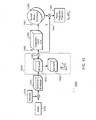
- Figure 1 shows a method 100 for extracting spectral and temporal features 108-109 from a mixture of signals 101 according to my invention.
- My method 100 can be used for characterizing and extracting features from sound recordings for classification of the sound sources and for re-purposing in structured multi-media applications such as parametric synthesis.
- the method can also be used to extract features from other linear mixtures, or for that matter from multi-dimensional mixtures.
- the mixture can be obtained from a single source, or from multiple sources such as a stereo sound source.
- I use statistical techniques based on independent component analysis (ICA).
- ICA independent component analysis
- the resulting basis components are as statistically independent as possible and characterize the structure of the individual features, e.g., sounds, within the mixture source 101. These characteristic structures can be used to classify the signal, or to specify new signals with predictable features.
- the representation according to my invention is capable of synthesizing multiple sound behaviors from a small set of features. It is able to synthesize complex acoustic event structures such as impacts, bounces, smashes and scraping as well as acoustic object properties such as materials, size and shape.
- the audio mixture 101 is first processed by a bank of logarithmic filters 110.
- Each of the filters produces a band-pass signal 111 for a predetermined frequency range.
- forty to fifty band-pass signals 111 are produced with more signals at lower frequency ranges than higher frequency ranges to mimic the frequency response characteristics of the human ear.
- the filters can be a constant-Q (CQ) or wavelet filterbank, or they can be linearly spaced as in a short time fast Fourier transform representation (STFT).
- CQ constant-Q
- STFT short time fast Fourier transform representation
- each of the band-pass signals is "windowed" into short, for example, 20 millisecond segments to produce observation matrices.
- Each matrix can include hundreds of samples.
- the details of steps 110 and 120 are shown in greater detail in Figures 2 and 3. It should be noted that the windowing can be done before the filtering.
- a singular value decomposition (SVD) is applied to the observation matrices 121 to produce reduced dimensionality of the matrices 131.
- SVD were first described by the Italian geometer Beltrami in 1873.
- the singular value decomposition is a well-defined generalization of the principal component analysis (PCA).
- the SVD can decomposes a non-square matrix, thus it is possible to directly decompose the observation matrices in either spectral or temporal orientation without the need for a calculating a covariance matrix. Because the SVD decomposes a non-square matrix directly, without the need for a covariance matrix, the resulting basis is not as susceptible to dynamic range problems as the PCA.
- ICA independent component analysis
- the ICA produces the spectral and temporal features 108-109.
- the spectral features expressed as vectors, correspond to estimates of the statistically most independent component within a segmentation window.
- the temporal features also expressed as vectors, described the evolution of the spectral components during the course of the segment.
- Each pair of spectral and temporal vectors can be combined using a vector outer product to reconstruct a partial spectrum for the given input spectrum. If these spectra are invertable, as a filterbank representation would be, then the independent time-domain signals can be estimated. For each of the independent components described in the scheme, a matrix of compatibility scores for components in the prior segment is made available. This allows tracking of components through time by estimating the most likely successive correspondences. Identical to the backward compatibility matrix, only looking forward in time.
- An independent components decomposition of an audio track can be used to estimate individual signal components within an audio track. Whilst the separation problem is intractable unless a full-rank signal matrix is available (N linear mixes of N sources), the use of independent components of short temporal sections of frequency-domain representations can give approximations to the underlying sources. These approximations can be used for classification and recognition tasks, as well as comparisons between sounds.
- the time frequency distribution can be normalized by the power spectral density (PSD) 115 to diminish the contribution of lower frequency components that carry more energy in some acoustic domains.
- PSD power spectral density
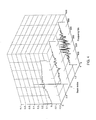
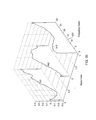
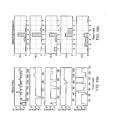
- Figures 4 and 5 respectively show the temporal and spatial decomposition for a percussion shaker instrument played at a regular rhythm.
- the observable structures reveal wide-band articulate components corresponding to the shakes, and horizontal stratification corresponding to the ringing of the metal shell.
- the extracted features can be considered as separable components of an acoustic mixture representing the inherent structure within the source mixture.
- Extracted features can be compared against a set of a-priori classes, determined by pattern-recognition techniques, in order to recognize or identify the components. These classifiers can be in the domain of speech phonemes, sound effects, musical instruments, animal sounds or any other corpus-based analytic models.
- Extracted features can be re-synthesized independently using an inverse filter-bank thus achieving an "unmixing" of the source acoustic mixture.
- An example use separates the singer, drums and guitars from an acoustic recording in order to re-purpose some components or to automatically analyze the musical structure.
- Another example separates an actor's voice from background noise in order to pass the cleaned speech signal to a speech recognizer for automatic transcription of a movie.
- the spectral features and temporal features can be considered separately in order to identify various properties of the acoustic structure of individual sound objects within a mixture.
- Spectral features can delineate such properties are materials, size, shape whereas temporal features can delineate behaviors such as bouncing, breaking and smashing.
- a glass smashing can be distinguished from a glass bouncing, or a clay pot smashing.
- Extracted features can be altered and re-synthesized in order to produce modified synthetic instances of the source sound. If the input sound is a single sound event comprising a plurality of acoustic features, such as a glass smash, then the individual features can be controlled for resynthesis. This is useful for model-based media applications such as generating sound in virtual environments.
- My invention can also be used to index and search a large multimedia database including many different types of sounds, e.g., sound effects, animal sounds, musical instruments, voices, textures, environmental sounds, male sounds, female sounds.
- sounds e.g., sound effects, animal sounds, musical instruments, voices, textures, environmental sounds, male sounds, female sounds.
- sound descriptions are generally divided into two types: qualitative text-based description by category labels, and quantitative description using probabilistic model states.
- Category labels provide qualitative information about sound content. Descriptions in this form are suitable for text-based query applications, such as Internet search engines, or any processing tool that uses text fields.
- the quantitative descriptors include a compact information about an audio segment and can be used for numerical evaluation of sound similarity. For example, these descriptors can be used to identify specific instruments in a video or audio recording.
- the qualitative and quantitative descriptors are well suited to audio query-by-example search applications.
- a description scheme is used for naming sound categories.
- the sound of a dog barking can be given the qualitative category label "Dogs" 610 with “Bark” 611 as a sub-category.
- "Woof” 612 or "Howl” 613 can be desirable sub-categories of "Dogs.”
- the first two sub-categories are closely related, but the third is an entirely different sound event. Therefore, Figure 6 shows four categories are organized into a taxonomy with "Dogs" as the root node 610. Each category has at least one relation link 601 to another category in the taxonomy.
- a contained category is considered a narrower category (NC) 601 than the containing category.
- NC narrower category
- “Woof' is defined as being a nearly synonymous with, but less preferable than, "Bark”. To capture such structure, the following relations are defined as part of my description scheme.
- BC - Broader category means the related category is more general in meaning than the containing category.
- NC - Narrower category means the related category is more specific in meaning than the containing category.
- US - Use the related category that is substantially synonymous with the current category because it is preferred to the current category.
- UF - Use of the current category is preferred to the use of the nearly synonymous related category.
- RC - The related category is not a synonym, quasi-synonym, broader or narrower category, but is associated with the containing category.
- the category and scheme attributes together provide unique identifiers that can be used for referencing categories and taxonomies from the quantitative description schemes, such as the probabilistic models described in greater detail below.
- the label descriptor gives a meaningful semantic label for each category and the relation descriptor describes relationships amongst categorys in the taxonomy according to the invention.
- categories can be combined by the relational links into a classification scheme 700 to make a richer taxonomy; for example, "Barks" 611 is a sub-category of "Dogs” 610 which is a sub-category of "Pets” 701; as is the category “Cats” 710.
- Cats 710 has the sound categories “Meow” 711 and "purr” 712. The following is an example of a simple classification scheme for "Pets" containing two categories: “Dogs" and "Cats”.
- CATS a second scheme, named “CATS”, is instantiated as follows:
- PETS ClassificationScheme
- PETS classifications scheme
- the sound recognition quantitative descriptors describe features of an audio signal to be used with statistical classifiers.
- the sound recognition quantitative descriptors can be used for general sound recognition including sound effects and musical instruments.
- any other descriptor defined within the audio framework can be used for classification.
- spectrum-based representations such as power spectrum slices or frames.
- a each spectrum slice is an n-dimensional vector, with n being the number of spectral channels, with up to 1024 channels of data.
- a logarithmic frequency spectrum as represented by an audio framework descriptor, helps to reduce the dimensionality to around 32 channels. Therefore, spectrum-derived features are generally incompatible with probability model classifiers due to their high dimensionality. Probability classifiers work best with fewer than 10 dimensions.
- an audio spectrum basis descriptor is a container for the basis functions that are used to project the spectrum to the lower-dimensional sub-space suitable for probability model classifiers.
- I determine a basis for each class of sound, and sub-classes.
- the basis captures statistically the most regular features of the sound feature space.
- Dimension reduction occurs by projection of spectrum vectors against a matrix of data-derived basis functions, as described above.
- the basis functions are stored in the columns of a matrix in which the number of rows corresponds to the length of the spectrum vector and the number of columns corresponds to the number of basis functions.
- Basis projection is the matrix product of the spectrum and the basis vectors.
- Figure 8 shows a spectrogram 800 reconstructed from four basis functions according to the invention.
- the specific spectrogram is for "pop" music.
- the spectral basis vectors 801 on the left are combined with the basis projection vectors 802, using the vector outer product. Each resulting matrix of the outer product is summed to produce the final reconstruction.
- Basis functions are chosen to maximize the information in fewer dimensions than the original data.
- basis functions can correspond to uncorrelated features extracted using principal component analysis (PCA) or a Karhunen-Loeve transform (KLT), or statistically independent components extracted by independent component analysis (ICA).
- KLT or Hotelling transform is the preferred decorrelating transform when the second order statistics, i.e., covariances are known. This reconstruction is described in greater detail with reference to Figure 13.
- a basis is derived for an entire class.
- the classification space includes of the most statistically salient components of the class.
- the following DDL instantiation defines a basis projection matrix that reduces a series of 31-channel logarithmic frequency spectra to five dimensions.
- the loEdge, hiEdge and resolution attributes give lower and upper frequency bounds of the basis functions. and the spacing of the spectral channels in octave-band notation.
- the basis functions for an entire class of sound are stored along with a probability model for the class.
- the base features are derived from an audio spectrum envelope extraction process as described above.
- the audio spectrum projection descriptor is a container for dimension-reduced features that are obtained by projection of a spectrum envelope against a set of basis functions, also described above.
- the audio spectrum envelope is extracted by a sliding window FFT analysis, with a resampling to logarithmic spaced frequncy bands.
- the analysis frame period is 10ms.
- a sliding extraction window of 30ms duration is used with a Hamming window. The 30ms interval is chosen to provide enough spectral resolution to roughly resolve the 62.5 Hz-wide first channel of an octave-band spectrum.
- the size of the FFT analysis window is the next-larger power-of-two number of samples. This means for 30ms at 32kHz there are 960 samples but the FFT would be performed on 1024 samples, For 30ms at 44.1 KHz, there are 1323 samples but the FFT would be performed on 2048 samples with out-of-window samples set to 0.
- Figures 9a and 9b show three spectral basis components 901-903 for a time index 910, and the resulting basis projections 911-913 with a frequency index 920 for a "laughter" spectrogram 1000 in Figures 10a-b.
- the format here is similar to those shown in Figures 4 and 5.
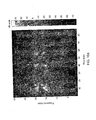
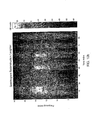
- Figure 10a shows a log scale spectrogram of laughter
- Figure 10b a spectrogram reconstruction. Both figures plot the time and frequency indices on the x- and y-axes respectively.
- a large sequence of alternative quantitative descriptors can be used to define classifiers that use special properties of a sound class, such as the harmonic envelope and fundamental frequency features that are often used for musical instrument classification.
- any descriptor based on a scalable series can be appended to spectral descriptors with the same sampling rate.
- a suitable basis can be computed for the entire set of extended features in the same manner as a basis based on the spectrum.
- Another application for the sound recognition features description scheme according to the invention is efficient spectrogram representation.
- the audio spectrum basis projection and the audio spectrum basis features can be used as a very efficient storage mechanism.
- Equation 2 constructs a two-dimensional spectrogram from the cross product of each basis function and its corresponding spectrogram basis projection, also as shown in Figure 8 as described above.
- the dynamic behavior of a sound class through the state space is represented by a k ⁇ k transition matrix that describes the probability of transition to a next state given a current state.
- a transition matrix T models the probability of transitioning from state i at time t-1 to state j at time t.
- An initial state distribution which is a k ⁇ 1 vector of probabilities, is also typically used in a finite-state model. The k th element in this vector is the probability of being in state k in the first observation frame.
- Gaussian distributions are parameterized by a 1 ⁇ n vector of means m , and an n ⁇ n covariance matrix, K , where n is the number of features in each observation vector.
- K an n ⁇ n covariance matrix
- a continuous hidden Markov model is a finite state model with a continuous probability distribution model for the state observation probabilities.
- the following DDL instantiation is an example of the use of probability model description schemes for representing a continuous hidden Markov model with Gaussian states.
- floating-point numbers have been rounded to two decimal places for display purposes only.
- ProbabilityModel is instantiated as a Gaussian distribution type, which is derived from the base probability model class.
- Sound segments can be indexed with a category label based on the output of a classifier.
- the probability model parameters can be used for indexing sound in a database. Indexing by model parameters, such as states, is necessary for query-by-example applications when the query category is unknown, or when a narrower match criterion than the scope of a category is required.
- a sound recognition model description scheme specifies a probability model of a sound class, such as a hidden Markov model or Gaussian mixture model.
- a probability model of a sound class such as a hidden Markov model or Gaussian mixture model.
- the following example is an instantiation of a hidden Markov model of the "Barks" sound category 611 of Figure 6.
- a probability model and associated basis functions for the sound class is defined in the same manner as for the previous examples.
- This descriptor refers to a finite-state probability model and describes the dynamic state path of a sound through the model.
- the sounds can be indexed in two ways, either by segmenting the sounds into model states, or by sampling of the state path at regular intervals.
- each audio segment contains a reference to a state, and the duration of the segment indicates the duration of activation for the state.
- the sound is described by a sampled series of indices that reference the model states. Sound categories with relatively long state-durations are efficiently described using the one-segment, one-state approach. Sounds with relatively short state durations are more efficiently described using the sampled series of state indices.
- Figure 11a shows a log spectrogram (frequency v. time) 1100 of the dog-bark sound 611 of Figure 6.
- Figure 11b shows a sound model state path sequence of states through a continuous hidden Markov model for the bark model of Figure 11a, over the same time interval.
- the x-axis is the time index, and the y-axis the state index.
- Figure 12 shows a sound recognition classifier that uses a single database 1200 for all the necessary components of the classifier.
- the sound recognition classifier describes relationships between a number of probability models thus defining an ontology of classifiers.
- a hierarchical recognizer can classify broad sound classes, such as animals, at the root nodes and finer classes, such as dogs:bark and cats:meow, at leaf nodes as described for Figures 6 and 7.
- This scheme defines mapping between an ontology of classifiers and a taxonomy of sound categories using the graph's descriptor scheme structure to enable hierarchical sound models to be used for extracting category descriptions for a given taxonomy.
- Figure 13 shows a system 1300 for building a database of models.
- the system shown in Figure 13 is an extension of the system shown in Figure 1.
- the input acoustic signal is windowed before filtering to extract the spectrum envelope.
- the system can take audio input 1301 in the form of, e.g., WAV format audio files.
- the system extracts audio features from the files, and trains a hidden Markov model with these features.
- the system also uses a directory of sound examples for each sound class.
- the hierarchical directory structure defines an ontology that corresponds to a desired taxonomy.
- One hidden Markov model is trained for each of the directories in the ontology.
- the system 1300 of Figure 13 shows a method for extracting audio spectrum basis functions and features from an acoustic signal as described above.
- An input acoustic signal 1301 can either be generated by a single source, e.g., a human, or an animal, or a musical instrument, or a many sources, e.g., a human and an animal and multiple instruments, or even synthetic sounds. In the later case, the acoustic signal is a mixture.
- the input acoustic signal is first windowed 1310 into 10 ms frames. Note, in Figure 1 the input signal is band-pass filtered before windowing.
- the acoustic signal is first windowed and than filtered 1320 to extract a short-time logarithmic-in-frequency spectrum.
- the filtering performs a time-frequency power spectrum analysis, such as a squared-magnitude short-time Fourier transform.
- the result is a matrix with M frames and N frequency bins.
- the spectral vectors x are the rows of this matrix.
- Step 1330 performs log-scale normalization.
- Step 1332 determined the L2-norm of the vector elements .
- the new unit-norm spectral vector is then determined the spectrum envelope by z / r , which divides each slice z by its power r , and the resulting normalized spectrum envelope 1340 is passed to the basis extraction process 1360.
- the spectrum envelope places each vector row-wise in the form of an observation matrix.
- the size of the resulting matrix is M ⁇ N where M is the number of time frames and N is the number of frequency bins.
- the matrix will have the following structure:
- Basis functions are extracted using the singular value decomposition SVD 130 of Figure 1.
- K is typically in the range of 3-10 basis functions for sound feature-based applications.
- To determine the proportion of information retained for K basis functions use the singular values contained in matrix S : where I(K) is the proportion of information retained for K basis functions, and N is the total number of basis functions which is also equal to the number of spectral bins.
- the SVD basis functions are stored in the columns of the matrix.
- Basis functions For maximum compatibility between applications, the basis functions have columns with unit L2-norm, and the functions maximize the information in k dimensions with respect to other possible basis functions.
- Basis functions can be orthogonal, as given by PCA extraction, or non-orthogonal as given by ICA extraction, see below.
- the spectral features are extracted from the m ⁇ k observation matrix of features, X is the m ⁇ n spectrum data matrix with spectral vectors organized row wise, and V is a n ⁇ k matrix of basis functions arranged in the columns.
- the first equation corresponds to feature extraction and the second equation corresponds to spectrum reconstruction, see Figure 8, where V + denotes the pseudo inverse of V for the non-orthogonal case.
- an optional step can perform a basis rotation to directions of maximal statistical independence.
- any one of the well-known, widely published independent component analysis (ICA) processes can be used, for example, JADE, or FastICA, see Cardoso, J.F. and Laheld, B.H. "Equivariant adaptive source separation,” IEEE Trans. On Signal Processing, 4:112-114, 1996, or Hyvarinen, A. "Fast and robust fixed-point algorithms for independent component analysis,” IEEE Trans. On Neural Networks, 10(3):626-634, 1999.
- ICA independent component analysis
- the ICA basis is the same size as the SVD basis and is stored in the columns of the basis matrix.
- the retained information ratio, I(K) is equivalent to the SVD when using the given extraction method.
- the basis functions V K 1361 can be stored in the data base 1200.
- the set of features produced by the SVD can be clustered into groups using any known clustering technique having a dimensionality equal to the dimensionality of the features. This puts like features into the same group.
- each group includes features for the acoustic signal generate by a single source.
- the number of groups to be used in the clustering can be set manually or automatically, depending on a desired level of discrimination desired.
- the spectrum envelope matrix X is multiplied by the basis vectors of the spectral features V .
- This step is the same for both for SVD and ICA basis functions, i.e., where Y is a matrix consisting of the reduced dimension features after projection of the spectrum against the basis V .
- X k X V k .
- One of the uses for these descriptors is to efficiently represent a spectrogram with much less data than a full spectrogram.
- individual spectrogram reconstructions e.g., as seen in Figure 8, generally correspond to source objects in the spectrogram.
- the range of sounds should reflect the scope of the sound category.
- dog barks can include individual barks, multiple barks in succession, or many dogs barking at once.
- the model extraction process adapts to the scope of the data, thus a narrower range of examples produces a more specialized classifier.
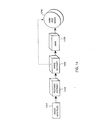
- Figure 14 show a process 1400 for extracting features 1410 and basis function 1420, as described above, from acoustic signals generated by known sources 1401. These are then used to train 1440 hidden Markov models.
- the trained models are stored in the database 1200 along with their corresponding features.
- an unsupervised clustering process is used to partition an n -dimensional feature space into k states.
- the feature space is populated by reduced-dimension observation vectors.
- the process determines an optimal number of states for the given data by pruning a transition matrix given an initial guess for k. Typically, between five and ten states are sufficient for good classifier performance.
- the hidden Markov models can be trained with a variant of the well-known Baum-Welch process, also known as Forward-Backward process. These processes are extended by use of an entropic prior and a deterministic annealing implementation of an expectation maximization (EM) process.
- EM expectation maximization
- the model is saved in permanent storage 1200, along with its basis functions, i.e., the set of sound features.
- the HMMs are collected together into a larger sound recognition classifier data structure thereby generating an ontology of models as shown in Figure 12.
- the ontology is used to index new sounds with qualitative and quantitative descriptors.
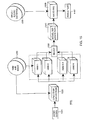
- Figure 15 shows an automatic extraction system 1500 for indexing sound in a database using pre-trained classifiers saved as DDL files.
- An unknown sound is read from a media source format, such as a WAV file 1501.
- the unknown sound is spectrum projected 1520 as described above.
- the projection that is, the set of features is then used to select 1530 one of the HMMs from the database 1200.
- a Viterbi decoder 1540 can be used to give both a best-fit model and a state path through the model for the unknown sound. That is, there is one model state for each windowed frame of the sound, see Figure 11b.
- Each sound is then indexed by its category, model reference and the model state path and the descriptors are written to a database in DDL format.
- the indexed database 1599 can then be searched to find matching sounds using any of the stored descriptors as described above, for example, all dog barkings.
- the substantially similar sounds can then be presented in a result list 1560.
- Figure 16 shows classification performance for ten sound classes 1601-1610, respectively: bird chirps, applause, dog barks, explosions, foot steps, glass breaking, gun shots, gym shoes, laughter, and telephones. Performance of the system was measured against a ground truth using the label of the source sound as specified by a professional sound-effect library. The results shown are for novel sounds not used during the training of the classifiers, and therefore demonstrate the generalization capabilities of the classifier. The average performance is about 95% correct.
- a sound query is presented to the system 1700 using the sound model state path description 1710 in DDL format.
- the system reads the query and populates internal data structures with the description information.
- This description is matched 1550 to descriptions taken from the sound database 1599 stored on disk.
- the sorted result list 1560 of closest matches is returned.
- the matching step 1550 can use the sum of square errors (SSE) between state-path histograms. This matching procedure requires little computation and can be computed directly from the stored state-path descriptors.
- SSE square errors
- State-path histograms are the total length of time a sound spends in each state divided by the total length of the sound, thus giving a discrete probability density function with the state index as the random variable.
- the SSE between the query sound histogram and that of each sound in the database is used as a distance metric. A distance of zero implies an identical match and increased non-zero distances are more dissimilar matches. This distance metric is used to rank the sounds in the database in order of similarity, then the desired number of matches is returned, with the closest match listed first.
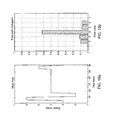
- Figure 18a shows a state path
- Figure 18b a state path histogram for a laughter sound query
- Figure 19a shows state paths and Figure 19b histograms for the five best matches to the query. All matches are from the same class as the query which indicates the success the correct performance of the system.
- the system can also perform a query with an audio signal as input.
- the input to the query-by-example application is an audio query instead of a DDL description-based query.
- the audio feature extraction process is first performed, namely spectrogram and envelope extraction is followed by projection against a stored set of basis functions for each model in the classifier.
- the resulting dimension-reduced features are passed to the Viterbi decoder for the given classifier, and the HMM with the maximum-likelihood score for the given features is selected.
- the Viterbi decoder essentially functions as a model-matching algorithm for the classification scheme.
- the model reference and state path are recorded and the results are matched against a pre-computed database as in the first example.
Landscapes
- Engineering & Computer Science (AREA)
- Physics & Mathematics (AREA)
- Multimedia (AREA)
- Acoustics & Sound (AREA)
- Health & Medical Sciences (AREA)
- Audiology, Speech & Language Pathology (AREA)
- Human Computer Interaction (AREA)
- Theoretical Computer Science (AREA)
- Library & Information Science (AREA)
- Computational Linguistics (AREA)
- Computer Vision & Pattern Recognition (AREA)
- Quality & Reliability (AREA)
- Data Mining & Analysis (AREA)
- Databases & Information Systems (AREA)
- General Engineering & Computer Science (AREA)
- General Physics & Mathematics (AREA)
- Signal Processing (AREA)
- Information Retrieval, Db Structures And Fs Structures Therefor (AREA)
Applications Claiming Priority (2)
| Application Number | Priority Date | Filing Date | Title |
|---|---|---|---|
| US861808 | 1997-05-22 | ||
| US09/861,808 US20010044719A1 (en) | 1999-07-02 | 2001-05-21 | Method and system for recognizing, indexing, and searching acoustic signals |
Publications (2)
| Publication Number | Publication Date |
|---|---|
| EP1260968A1 true EP1260968A1 (de) | 2002-11-27 |
| EP1260968B1 EP1260968B1 (de) | 2005-03-30 |
Family
ID=25336821
Family Applications (1)
| Application Number | Title | Priority Date | Filing Date |
|---|---|---|---|
| EP02010724A Expired - Lifetime EP1260968B1 (de) | 2001-05-21 | 2002-05-14 | Verfahren und System zum Erkennen, Indizieren und Suchen von akustischen Signalen |
Country Status (4)
| Country | Link |
|---|---|
| US (1) | US20010044719A1 (de) |
| EP (1) | EP1260968B1 (de) |
| JP (1) | JP2003015684A (de) |
| DE (1) | DE60203436T2 (de) |
Cited By (10)
| Publication number | Priority date | Publication date | Assignee | Title |
|---|---|---|---|---|
| WO2004059615A1 (en) * | 2002-12-24 | 2004-07-15 | Koninklijke Philips Electronics N.V. | Method and system to mark an audio signal with metadata |
| DE102004036154B3 (de) * | 2004-07-26 | 2005-12-22 | Fraunhofer-Gesellschaft zur Förderung der angewandten Forschung e.V. | Vorrichtung und Verfahren zur robusten Klassifizierung von Audiosignalen sowie Verfahren zu Einrichtung und Betrieb einer Audiosignal-Datenbank sowie Computer-Programm |
| WO2006056910A1 (en) * | 2004-11-23 | 2006-06-01 | Koninklijke Philips Electronics N.V. | A device and a method to process audio data, a computer program element and computer-readable medium |
| EP1671207A4 (de) * | 2003-09-23 | 2008-12-17 | Musicip Corp | Audio-fingerabdrucksystem und -verfahren |
| EP2136358A4 (de) * | 2007-03-16 | 2011-01-19 | Panasonic Corp | Sprachanalyseeinrichtung, sprachanalyseverfahren, sprachanalyseprogramm und systemintegrationsschaltung |
| CN101546555B (zh) * | 2009-04-14 | 2011-05-11 | 清华大学 | 用于语种识别的约束异方差线性鉴别分析方法 |
| US8311821B2 (en) | 2003-04-24 | 2012-11-13 | Koninklijke Philips Electronics N.V. | Parameterized temporal feature analysis |
| WO2013162411A1 (en) * | 2012-04-23 | 2013-10-31 | Tgt Oil And Gas Services Fze | Method and apparatus for spectral noise logging |
| RU2728121C1 (ru) * | 2019-12-20 | 2020-07-28 | Шлюмберже Текнолоджи Б.В. | Способ определения характеристик фильтрационного потока в околоскважинной зоне пласта |
| US12051439B2 (en) | 2020-07-29 | 2024-07-30 | Distributed Creation Inc. | Method and system for learning and using latent-space representations of audio signals for audio content-based retrieval |
Families Citing this family (119)
| Publication number | Priority date | Publication date | Assignee | Title |
|---|---|---|---|---|
| DE60137454D1 (de) | 2000-10-24 | 2009-03-05 | Aol Llc | Verfahren zur bemessung der seite einer eingebetteten medienabspielvorrichtung |
| US8122236B2 (en) | 2001-10-24 | 2012-02-21 | Aol Inc. | Method of disseminating advertisements using an embedded media player page |
| US20020103920A1 (en) | 2000-11-21 | 2002-08-01 | Berkun Ken Alan | Interpretive stream metadata extraction |
| KR20040024870A (ko) * | 2001-07-20 | 2004-03-22 | 그레이스노트 아이엔씨 | 음성 기록의 자동 확인 |
| EP1280298A1 (de) * | 2001-07-26 | 2003-01-29 | BRITISH TELECOMMUNICATIONS public limited company | Verfahren und Vorrichtung zum Detektieren von Netzwerkaktivitäten |
| US7343082B2 (en) * | 2001-09-12 | 2008-03-11 | Ryshco Media Inc. | Universal guide track |
| US7359550B2 (en) * | 2002-04-18 | 2008-04-15 | Mitsubishi Electric Research Laboratories, Inc. | Incremental singular value decomposition of incomplete data |
| PT1504445E (pt) * | 2002-04-25 | 2008-11-24 | Landmark Digital Services Llc | Emparelhamento de padrões áudio robusto e invariante |
| US20060010209A1 (en) * | 2002-08-07 | 2006-01-12 | Hodgson Paul W | Server for sending electronics messages |
| FR2844079B1 (fr) * | 2002-08-30 | 2005-08-26 | France Telecom | Systeme associatif flou de description d'objets multimedia |
| US7617104B2 (en) * | 2003-01-21 | 2009-11-10 | Microsoft Corporation | Method of speech recognition using hidden trajectory Hidden Markov Models |
| WO2004075093A2 (en) * | 2003-02-14 | 2004-09-02 | University Of Rochester | Music feature extraction using wavelet coefficient histograms |
| DE10313875B3 (de) * | 2003-03-21 | 2004-10-28 | Fraunhofer-Gesellschaft zur Förderung der angewandten Forschung e.V. | Vorrichtung und Verfahren zum Analysieren eines Informationssignals |
| US7424423B2 (en) * | 2003-04-01 | 2008-09-09 | Microsoft Corporation | Method and apparatus for formant tracking using a residual model |
| US7539617B2 (en) * | 2003-07-01 | 2009-05-26 | France Telecom | Method and system for analysis of vocal signals for a compressed representation of speakers using a probability density representing resemblances between a vocal representation of the speaker in a predetermined model and a predetermined set of vocal representations reference speakers |
| SG140445A1 (en) * | 2003-07-28 | 2008-03-28 | Sony Corp | Method and apparatus for automatically recognizing audio data |
| US8918316B2 (en) | 2003-07-29 | 2014-12-23 | Alcatel Lucent | Content identification system |
| US7454334B2 (en) * | 2003-08-28 | 2008-11-18 | Wildlife Acoustics, Inc. | Method and apparatus for automatically identifying animal species from their vocalizations |
| US20050049876A1 (en) * | 2003-08-28 | 2005-03-03 | Ian Agranat | Method and apparatus for automatically identifying animal species from their vocalizations |
| GB0326539D0 (en) * | 2003-11-14 | 2003-12-17 | Qinetiq Ltd | Dynamic blind signal separation |
| US7305132B2 (en) * | 2003-11-19 | 2007-12-04 | Mitsubishi Electric Research Laboratories, Inc. | Classification in likelihood spaces |
| US20070110089A1 (en) * | 2003-11-27 | 2007-05-17 | Advestigo | System for intercepting multimedia documents |
| WO2005062295A1 (ja) * | 2003-12-05 | 2005-07-07 | Kabushikikaisha Kenwood | 機器制御装置、音声認識装置、エージェント装置及び機器制御方法 |
| KR20070004891A (ko) * | 2004-04-29 | 2007-01-09 | 코닌클리케 필립스 일렉트로닉스 엔.브이. | 오디오 신호의 분류를 위한 방법 빛 시스템 |
| US7565213B2 (en) * | 2004-05-07 | 2009-07-21 | Gracenote, Inc. | Device and method for analyzing an information signal |
| US7505902B2 (en) * | 2004-07-28 | 2009-03-17 | University Of Maryland | Discrimination of components of audio signals based on multiscale spectro-temporal modulations |
| US10223934B2 (en) | 2004-09-16 | 2019-03-05 | Lena Foundation | Systems and methods for expressive language, developmental disorder, and emotion assessment, and contextual feedback |
| US9240188B2 (en) | 2004-09-16 | 2016-01-19 | Lena Foundation | System and method for expressive language, developmental disorder, and emotion assessment |
| US8938390B2 (en) * | 2007-01-23 | 2015-01-20 | Lena Foundation | System and method for expressive language and developmental disorder assessment |
| US20060116878A1 (en) * | 2004-11-30 | 2006-06-01 | Kenji Nagamine | Asthma diagnostic apparatus, asthma diagnostic method, and storage medium storing asthma diagnostic program |
| US7617188B2 (en) | 2005-03-24 | 2009-11-10 | The Mitre Corporation | System and method for audio hot spotting |
| US7475014B2 (en) * | 2005-07-25 | 2009-01-06 | Mitsubishi Electric Research Laboratories, Inc. | Method and system for tracking signal sources with wrapped-phase hidden markov models |
| US20070237342A1 (en) * | 2006-03-30 | 2007-10-11 | Wildlife Acoustics, Inc. | Method of listening to frequency shifted sound sources |
| US9020964B1 (en) | 2006-04-20 | 2015-04-28 | Pinehill Technology, Llc | Generation of fingerprints for multimedia content based on vectors and histograms |
| US7814070B1 (en) | 2006-04-20 | 2010-10-12 | Datascout, Inc. | Surrogate hashing |
| US7840540B2 (en) | 2006-04-20 | 2010-11-23 | Datascout, Inc. | Surrogate hashing |
| US7774385B1 (en) * | 2007-07-02 | 2010-08-10 | Datascout, Inc. | Techniques for providing a surrogate heuristic identification interface |
| US7991206B1 (en) | 2007-07-02 | 2011-08-02 | Datascout, Inc. | Surrogate heuristic identification |
| US8463000B1 (en) | 2007-07-02 | 2013-06-11 | Pinehill Technology, Llc | Content identification based on a search of a fingerprint database |
| US8156132B1 (en) | 2007-07-02 | 2012-04-10 | Pinehill Technology, Llc | Systems for comparing image fingerprints |
| US7801868B1 (en) | 2006-04-20 | 2010-09-21 | Datascout, Inc. | Surrogate hashing |
| US8549022B1 (en) | 2007-07-02 | 2013-10-01 | Datascout, Inc. | Fingerprint generation of multimedia content based on a trigger point with the multimedia content |
| US9633356B2 (en) | 2006-07-20 | 2017-04-25 | Aol Inc. | Targeted advertising for playlists based upon search queries |
| US7499858B2 (en) * | 2006-08-18 | 2009-03-03 | Talkhouse Llc | Methods of information retrieval |
| CN101226526A (zh) * | 2007-01-17 | 2008-07-23 | 上海怡得网络有限公司 | 一种基于音乐片段信息查询的音乐搜索方法 |
| WO2008090564A2 (en) * | 2007-01-24 | 2008-07-31 | P.E.S Institute Of Technology | Speech activity detection |
| JP4403436B2 (ja) * | 2007-02-21 | 2010-01-27 | ソニー株式会社 | 信号分離装置、および信号分離方法、並びにコンピュータ・プログラム |
| US8453170B2 (en) * | 2007-02-27 | 2013-05-28 | Landmark Digital Services Llc | System and method for monitoring and recognizing broadcast data |
| US8630853B2 (en) | 2007-03-26 | 2014-01-14 | Nec Corporation | Speech classification apparatus, speech classification method, and speech classification program |
| US8126262B2 (en) * | 2007-06-18 | 2012-02-28 | International Business Machines Corporation | Annotating video segments using feature rhythm models |
| US8140331B2 (en) * | 2007-07-06 | 2012-03-20 | Xia Lou | Feature extraction for identification and classification of audio signals |
| US8588427B2 (en) | 2007-09-26 | 2013-11-19 | Frauhnhofer-Gesellschaft Zur Foerderung Der Angewandten Forschung E.V. | Apparatus and method for extracting an ambient signal in an apparatus and method for obtaining weighting coefficients for extracting an ambient signal and computer program |
| JP5169760B2 (ja) * | 2008-01-28 | 2013-03-27 | 富士通株式会社 | 通信装置、受信データサイズチェック方法、倍数判定回路および倍数判定方法 |
| US7782195B2 (en) * | 2008-03-19 | 2010-08-24 | Wildlife Acoustics, Inc. | Apparatus for scheduled low power autonomous data recording |
| US20090235809A1 (en) * | 2008-03-24 | 2009-09-24 | University Of Central Florida Research Foundation, Inc. | System and Method for Evolving Music Tracks |
| DE102008021362B3 (de) * | 2008-04-29 | 2009-07-02 | Siemens Aktiengesellschaft | Verfahren und Vorrichtung zum Erkennen eines Zustandes einer zu untersuchenden geräuscherzeugenden Maschine |
| US8682660B1 (en) * | 2008-05-21 | 2014-03-25 | Resolvity, Inc. | Method and system for post-processing speech recognition results |
| WO2010019831A1 (en) * | 2008-08-14 | 2010-02-18 | 21Ct, Inc. | Hidden markov model for speech processing with training method |
| US20100057452A1 (en) * | 2008-08-28 | 2010-03-04 | Microsoft Corporation | Speech interfaces |
| US8954173B1 (en) * | 2008-09-03 | 2015-02-10 | Mark Fischer | Method and apparatus for profiling and identifying the source of a signal |
| JP5277887B2 (ja) * | 2008-11-14 | 2013-08-28 | ヤマハ株式会社 | 信号処理装置およびプログラム |
| US20100138010A1 (en) * | 2008-11-28 | 2010-06-03 | Audionamix | Automatic gathering strategy for unsupervised source separation algorithms |
| US9286911B2 (en) * | 2008-12-15 | 2016-03-15 | Audio Analytic Ltd | Sound identification systems |
| GB2466242B (en) | 2008-12-15 | 2013-01-02 | Audio Analytic Ltd | Sound identification systems |
| FI20086260L (fi) * | 2008-12-31 | 2010-09-02 | Teknillinen Korkeakoulu | Menetelmä hahmon löytämiseksi ja tunnistamiseksi |
| US20100174389A1 (en) * | 2009-01-06 | 2010-07-08 | Audionamix | Automatic audio source separation with joint spectral shape, expansion coefficients and musical state estimation |
| WO2010151183A1 (en) * | 2009-06-23 | 2010-12-29 | Telefonaktiebolaget L M Ericsson (Publ) | Method and an arrangement for a mobile telecommunications network |
| US8538035B2 (en) | 2010-04-29 | 2013-09-17 | Audience, Inc. | Multi-microphone robust noise suppression |
| US8473287B2 (en) | 2010-04-19 | 2013-06-25 | Audience, Inc. | Method for jointly optimizing noise reduction and voice quality in a mono or multi-microphone system |
| US8781137B1 (en) | 2010-04-27 | 2014-07-15 | Audience, Inc. | Wind noise detection and suppression |
| US20110276882A1 (en) | 2010-05-04 | 2011-11-10 | Kai Buehler | Automatic grouping for users experiencing a specific broadcast media |
| US9558755B1 (en) | 2010-05-20 | 2017-01-31 | Knowles Electronics, Llc | Noise suppression assisted automatic speech recognition |
| US8447596B2 (en) | 2010-07-12 | 2013-05-21 | Audience, Inc. | Monaural noise suppression based on computational auditory scene analysis |
| US8805697B2 (en) | 2010-10-25 | 2014-08-12 | Qualcomm Incorporated | Decomposition of music signals using basis functions with time-evolution information |
| US8959071B2 (en) | 2010-11-08 | 2015-02-17 | Sony Corporation | Videolens media system for feature selection |
| US8700400B2 (en) * | 2010-12-30 | 2014-04-15 | Microsoft Corporation | Subspace speech adaptation |
| US9928824B2 (en) | 2011-05-11 | 2018-03-27 | Silentium Ltd. | Apparatus, system and method of controlling noise within a noise-controlled volume |
| WO2012153294A2 (en) * | 2011-05-11 | 2012-11-15 | Silentium Ltd. | Device, system and method of noise control |
| US8938393B2 (en) * | 2011-06-28 | 2015-01-20 | Sony Corporation | Extended videolens media engine for audio recognition |
| WO2013012952A1 (en) | 2011-07-18 | 2013-01-24 | Viggle Inc | System and method for tracking and rewarding media and entertainment usage including substanitally real time rewards |
| US9098576B1 (en) * | 2011-10-17 | 2015-08-04 | Google Inc. | Ensemble interest point detection for audio matching |
| US8965766B1 (en) * | 2012-03-15 | 2015-02-24 | Google Inc. | Systems and methods for identifying music in a noisy environment |
| US9263060B2 (en) | 2012-08-21 | 2016-02-16 | Marian Mason Publishing Company, Llc | Artificial neural network based system for classification of the emotional content of digital music |
| US9640194B1 (en) | 2012-10-04 | 2017-05-02 | Knowles Electronics, Llc | Noise suppression for speech processing based on machine-learning mask estimation |
| US9159327B1 (en) | 2012-12-20 | 2015-10-13 | Google Inc. | System and method for adding pitch shift resistance to an audio fingerprint |
| US9489965B2 (en) * | 2013-03-15 | 2016-11-08 | Sri International | Method and apparatus for acoustic signal characterization |
| CN104078050A (zh) | 2013-03-26 | 2014-10-01 | 杜比实验室特许公司 | 用于音频分类和音频处理的设备和方法 |
| KR101756287B1 (ko) * | 2013-07-03 | 2017-07-26 | 한국전자통신연구원 | 음성인식을 위한 특징 추출 장치 및 방법 |
| DE102013111784B4 (de) | 2013-10-25 | 2019-11-14 | Intel IP Corporation | Audioverarbeitungsvorrichtungen und audioverarbeitungsverfahren |
| US9514753B2 (en) * | 2013-11-04 | 2016-12-06 | Google Inc. | Speaker identification using hash-based indexing |
| KR101473592B1 (ko) * | 2013-12-05 | 2014-12-16 | 한국항공우주연구원 | 교란 신호 검출 장치 및 방법 |
| WO2016033364A1 (en) | 2014-08-28 | 2016-03-03 | Audience, Inc. | Multi-sourced noise suppression |
| JP6814146B2 (ja) * | 2014-09-25 | 2021-01-13 | サンハウス・テクノロジーズ・インコーポレーテッド | オーディオをキャプチャーし、解釈するシステムと方法 |
| US20220199059A1 (en) * | 2014-09-25 | 2022-06-23 | Sunhouse Technologies, Inc. | Systems and methods for capturing and interpreting audio |
| US11308928B2 (en) * | 2014-09-25 | 2022-04-19 | Sunhouse Technologies, Inc. | Systems and methods for capturing and interpreting audio |
| EP3023884A1 (de) * | 2014-11-21 | 2016-05-25 | Thomson Licensing | Verfahren und Vorrichtung zur Erzeugung des Fingerabdrucks eines Audiosignals |
| US10134389B2 (en) * | 2015-09-04 | 2018-11-20 | Microsoft Technology Licensing, Llc | Clustering user utterance intents with semantic parsing |
| US10534994B1 (en) * | 2015-11-11 | 2020-01-14 | Cadence Design Systems, Inc. | System and method for hyper-parameter analysis for multi-layer computational structures |
| US9830931B2 (en) * | 2015-12-31 | 2017-11-28 | Harman International Industries, Incorporated | Crowdsourced database for sound identification |
| US10346405B2 (en) | 2016-10-17 | 2019-07-09 | International Business Machines Corporation | Lower-dimensional subspace approximation of a dataset |
| EP3529958B1 (de) * | 2016-11-16 | 2021-01-20 | Huawei Technologies Duesseldorf GmbH | Verfahren zur vor- und decodierung eines mehrträgersignals auf basis einer zuordnungsfunktion in bezug auf bandinterne und bandexterne unterträger |
| GB201718800D0 (en) * | 2017-11-14 | 2017-12-27 | Univ London Queen Mary | Sound effects synthesis |
| US10529357B2 (en) | 2017-12-07 | 2020-01-07 | Lena Foundation | Systems and methods for automatic determination of infant cry and discrimination of cry from fussiness |
| JP6722165B2 (ja) | 2017-12-18 | 2020-07-15 | 大黒 達也 | 音楽情報の特徴解析方法及びその装置 |
| US10249293B1 (en) | 2018-06-11 | 2019-04-02 | Capital One Services, Llc | Listening devices for obtaining metrics from ambient noise |
| US11069334B2 (en) | 2018-08-13 | 2021-07-20 | Carnegie Mellon University | System and method for acoustic activity recognition |
| CN112955954B (zh) | 2018-12-21 | 2024-04-12 | 华为技术有限公司 | 用于音频场景分类的音频处理装置及其方法 |
| US20220366245A1 (en) * | 2019-09-25 | 2022-11-17 | Deepmind Technologies Limited | Training action selection neural networks using hindsight modelling |
| CN110910479B (zh) * | 2019-11-19 | 2023-09-22 | 中国传媒大学 | 视频处理方法、装置、电子设备及可读存储介质 |
| US11295756B2 (en) * | 2019-12-27 | 2022-04-05 | Robert Bosch Gmbh | Ontology-aware sound classification |
| CN111626093B (zh) * | 2020-03-27 | 2023-12-26 | 国网江西省电力有限公司电力科学研究院 | 一种基于鸣声功率谱密度的输电线路相关鸟种识别方法 |
| CN112464777B (zh) * | 2020-11-20 | 2023-04-18 | 电子科技大学 | 一种光纤振动源垂直距离智能估算方法 |
| US11740122B2 (en) | 2021-10-20 | 2023-08-29 | Oracle International Corporation | Autonomous discrimination of operation vibration signals |
| CN115047262B (zh) * | 2022-04-26 | 2026-04-10 | 深圳供电局有限公司 | 基于电能质量数据的设备异常状态通用识别方法 |
| US12385777B2 (en) | 2022-05-03 | 2025-08-12 | Oracle International Corporation | Acoustic detection of cargo mass change |
| US12158548B2 (en) * | 2022-05-03 | 2024-12-03 | Oracle International Corporation | Acoustic fingerprinting |
| US12495989B2 (en) | 2022-12-21 | 2025-12-16 | Oracle International Corporation | Measuring gait to detect impairment |
| US20250069592A1 (en) * | 2023-08-24 | 2025-02-27 | Audio Technologies And Codecs, Inc. | Method and System for Low-Complexity Real-Time Multiclass Hierarchical Audio Classification |
| CN117314963B (zh) * | 2023-09-22 | 2025-10-10 | 哈尔滨工程大学 | 一种基于信号空间变换的线谱检测前跟踪方法及多目标分辨方法 |
Citations (1)
| Publication number | Priority date | Publication date | Assignee | Title |
|---|---|---|---|---|
| JP2001051689A (ja) * | 1999-07-02 | 2001-02-23 | Mitsubishi Electric Inf Technol Center America Inc | 信号の混合物からの特徴抽出方法およびその装置 |
Family Cites Families (17)
| Publication number | Priority date | Publication date | Assignee | Title |
|---|---|---|---|---|
| US5293448A (en) * | 1989-10-02 | 1994-03-08 | Nippon Telegraph And Telephone Corporation | Speech analysis-synthesis method and apparatus therefor |
| US5502789A (en) * | 1990-03-07 | 1996-03-26 | Sony Corporation | Apparatus for encoding digital data with reduction of perceptible noise |
| US5377305A (en) * | 1991-10-01 | 1994-12-27 | Lockheed Sanders, Inc. | Outer product neural network |
| JPH07146679A (ja) * | 1992-11-13 | 1995-06-06 | Internatl Business Mach Corp <Ibm> | 音声データを変換する方法及びシステム |
| DE4316297C1 (de) * | 1993-05-14 | 1994-04-07 | Fraunhofer Ges Forschung | Frequenzanalyseverfahren |
| US5383164A (en) * | 1993-06-10 | 1995-01-17 | The Salk Institute For Biological Studies | Adaptive system for broadband multisignal discrimination in a channel with reverberation |
| US5625749A (en) * | 1994-08-22 | 1997-04-29 | Massachusetts Institute Of Technology | Segment-based apparatus and method for speech recognition by analyzing multiple speech unit frames and modeling both temporal and spatial correlation |
| GB9419388D0 (en) * | 1994-09-26 | 1994-11-09 | Canon Kk | Speech analysis |
| US5812972A (en) * | 1994-12-30 | 1998-09-22 | Lucent Technologies Inc. | Adaptive decision directed speech recognition bias equalization method and apparatus |
| US5878389A (en) * | 1995-06-28 | 1999-03-02 | Oregon Graduate Institute Of Science & Technology | Method and system for generating an estimated clean speech signal from a noisy speech signal |
| JP3266819B2 (ja) * | 1996-07-30 | 2002-03-18 | 株式会社エイ・ティ・アール人間情報通信研究所 | 周期信号変換方法、音変換方法および信号分析方法 |
| US5865626A (en) * | 1996-08-30 | 1999-02-02 | Gte Internetworking Incorporated | Multi-dialect speech recognition method and apparatus |
| JP3707154B2 (ja) * | 1996-09-24 | 2005-10-19 | ソニー株式会社 | 音声符号化方法及び装置 |
| US5835912A (en) * | 1997-03-13 | 1998-11-10 | The United States Of America As Represented By The National Security Agency | Method of efficiency and flexibility storing, retrieving, and modifying data in any language representation |
| US5930753A (en) * | 1997-03-20 | 1999-07-27 | At&T Corp | Combining frequency warping and spectral shaping in HMM based speech recognition |
| US5946656A (en) * | 1997-11-17 | 1999-08-31 | At & T Corp. | Speech and speaker recognition using factor analysis to model covariance structure of mixture components |
| US6141644A (en) * | 1998-09-04 | 2000-10-31 | Matsushita Electric Industrial Co., Ltd. | Speaker verification and speaker identification based on eigenvoices |
-
2001
- 2001-05-21 US US09/861,808 patent/US20010044719A1/en not_active Abandoned
-
2002
- 2002-05-14 DE DE60203436T patent/DE60203436T2/de not_active Expired - Lifetime
- 2002-05-14 EP EP02010724A patent/EP1260968B1/de not_active Expired - Lifetime
- 2002-05-21 JP JP2002146685A patent/JP2003015684A/ja active Pending
Patent Citations (2)
| Publication number | Priority date | Publication date | Assignee | Title |
|---|---|---|---|---|
| JP2001051689A (ja) * | 1999-07-02 | 2001-02-23 | Mitsubishi Electric Inf Technol Center America Inc | 信号の混合物からの特徴抽出方法およびその装置 |
| US6321200B1 (en) * | 1999-07-02 | 2001-11-20 | Mitsubish Electric Research Laboratories, Inc | Method for extracting features from a mixture of signals |
Non-Patent Citations (2)
| Title |
|---|
| CASEY M: "MPEG-7 SOUND-RECOGNITION TOOLS", IEEE TRANSACTIONS ON CIRCUITS AND SYSTEMS FOR VIDEO TECHNOLOGY, IEEE INC. NEW YORK, US, vol. 11, no. 6, June 2001 (2001-06-01), pages 737 - 747, XP001059866, ISSN: 1051-8215 * |
| TONG ZHANG ET AL: "Hierarchical classification of audio data for archiving and retrieving", ACOUSTICS, SPEECH, AND SIGNAL PROCESSING, 1999. PROCEEDINGS., 1999 IEEE INTERNATIONAL CONFERENCE ON PHOENIX, AZ, USA 15-19 MARCH 1999, PISCATAWAY, NJ, USA,IEEE, US, 15 March 1999 (1999-03-15), pages 3001 - 3004, XP002901108, ISBN: 0-7803-5041-3 * |
Cited By (17)
| Publication number | Priority date | Publication date | Assignee | Title |
|---|---|---|---|---|
| WO2004059615A1 (en) * | 2002-12-24 | 2004-07-15 | Koninklijke Philips Electronics N.V. | Method and system to mark an audio signal with metadata |
| US7689422B2 (en) | 2002-12-24 | 2010-03-30 | Ambx Uk Limited | Method and system to mark an audio signal with metadata |
| US8311821B2 (en) | 2003-04-24 | 2012-11-13 | Koninklijke Philips Electronics N.V. | Parameterized temporal feature analysis |
| EP1671207A4 (de) * | 2003-09-23 | 2008-12-17 | Musicip Corp | Audio-fingerabdrucksystem und -verfahren |
| DE102004036154B3 (de) * | 2004-07-26 | 2005-12-22 | Fraunhofer-Gesellschaft zur Förderung der angewandten Forschung e.V. | Vorrichtung und Verfahren zur robusten Klassifizierung von Audiosignalen sowie Verfahren zu Einrichtung und Betrieb einer Audiosignal-Datenbank sowie Computer-Programm |
| US7580832B2 (en) | 2004-07-26 | 2009-08-25 | M2Any Gmbh | Apparatus and method for robust classification of audio signals, and method for establishing and operating an audio-signal database, as well as computer program |
| CN101002254B (zh) * | 2004-07-26 | 2010-12-22 | M2Any有限公司 | 音频信号的鲁棒分类设备和方法、建立并操作音频信号数据库的方法 |
| US7895138B2 (en) | 2004-11-23 | 2011-02-22 | Koninklijke Philips Electronics N.V. | Device and a method to process audio data, a computer program element and computer-readable medium |
| WO2006056910A1 (en) * | 2004-11-23 | 2006-06-01 | Koninklijke Philips Electronics N.V. | A device and a method to process audio data, a computer program element and computer-readable medium |
| EP2136358A4 (de) * | 2007-03-16 | 2011-01-19 | Panasonic Corp | Sprachanalyseeinrichtung, sprachanalyseverfahren, sprachanalyseprogramm und systemintegrationsschaltung |
| US8478587B2 (en) | 2007-03-16 | 2013-07-02 | Panasonic Corporation | Voice analysis device, voice analysis method, voice analysis program, and system integration circuit |
| CN101546555B (zh) * | 2009-04-14 | 2011-05-11 | 清华大学 | 用于语种识别的约束异方差线性鉴别分析方法 |
| WO2013162411A1 (en) * | 2012-04-23 | 2013-10-31 | Tgt Oil And Gas Services Fze | Method and apparatus for spectral noise logging |
| RU2499283C1 (ru) * | 2012-04-23 | 2013-11-20 | ТиДжиТи Ойл энд Гэс Сервисиз ФЗЕ | Способ и устройство для скважинной спектральной шумометрии |
| US9982526B2 (en) | 2012-04-23 | 2018-05-29 | Tgt Oil And Gas Services Fze | Method and apparatus for spectral noise logging |
| RU2728121C1 (ru) * | 2019-12-20 | 2020-07-28 | Шлюмберже Текнолоджи Б.В. | Способ определения характеристик фильтрационного потока в околоскважинной зоне пласта |
| US12051439B2 (en) | 2020-07-29 | 2024-07-30 | Distributed Creation Inc. | Method and system for learning and using latent-space representations of audio signals for audio content-based retrieval |
Also Published As
| Publication number | Publication date |
|---|---|
| EP1260968B1 (de) | 2005-03-30 |
| DE60203436T2 (de) | 2006-02-09 |
| JP2003015684A (ja) | 2003-01-17 |
| US20010044719A1 (en) | 2001-11-22 |
| DE60203436D1 (de) | 2005-05-04 |
Similar Documents
| Publication | Publication Date | Title |
|---|---|---|
| EP1260968B1 (de) | Verfahren und System zum Erkennen, Indizieren und Suchen von akustischen Signalen | |
| Casey | MPEG-7 sound-recognition tools | |
| Casey | General sound classification and similarity in MPEG-7 | |
| US6321200B1 (en) | Method for extracting features from a mixture of signals | |
| Dennis | Sound event recognition in unstructured environments using spectrogram image processing | |
| Massoudi et al. | Urban sound classification using CNN | |
| Kim et al. | Audio classification based on MPEG-7 spectral basis representations | |
| Soltau et al. | Recognition of music types | |
| Eronen | Musical instrument recognition using ICA-based transform of features and discriminatively trained HMMs | |
| US9558762B1 (en) | System and method for distinguishing source from unconstrained acoustic signals emitted thereby in context agnostic manner | |
| Radha | Video retrieval using speech and text in video | |
| Liu | Deep convolutional and LSTM neural networks for acoustic modelling in automatic speech recognition | |
| Ntalampiras et al. | Exploiting temporal feature integration for generalized sound recognition | |
| Huang et al. | Singing voice detection based on convolutional neural networks | |
| Kim et al. | How efficient is MPEG-7 for general sound recognition | |
| Bang et al. | Evaluation of various feature sets and feature selection towards automatic recognition of bird species | |
| Casey | Reduced-rank spectra and minimum-entropy priors as consistent and reliable cues for generalized sound recognition | |
| Casey | Sound• Classification and Similarity | |
| Ahmed et al. | Sound event classification using neural networks and feature selection based methods | |
| Bang et al. | Recognition of bird species from their sounds using data reduction techniques | |
| Kim et al. | Speaker recognition using MPEG-7 descriptors. | |
| Kim et al. | Study of mpeg-7 sound classification and retrieval | |
| Harb et al. | A general audio classifier based on human perception motivated model | |
| Tivarekar et al. | Species recognition using audio processing algorithm | |
| Tivarekar et al. | Audio based bird species recognition using naÏve bayes algorithm |
Legal Events
| Date | Code | Title | Description |
|---|---|---|---|
| PUAI | Public reference made under article 153(3) epc to a published international application that has entered the european phase |
Free format text: ORIGINAL CODE: 0009012 |
|
| AK | Designated contracting states |
Kind code of ref document: A1 Designated state(s): AT BE CH CY DE DK ES FI FR GB GR IE IT LI LU MC NL PT SE TR |
|
| AX | Request for extension of the european patent |
Free format text: AL;LT;LV;MK;RO;SI |
|
| 17P | Request for examination filed |
Effective date: 20021104 |
|
| AKX | Designation fees paid |
Designated state(s): DE FR GB |
|
| 17Q | First examination report despatched |
Effective date: 20031107 |
|
| GRAP | Despatch of communication of intention to grant a patent |
Free format text: ORIGINAL CODE: EPIDOSNIGR1 |
|
| GRAS | Grant fee paid |
Free format text: ORIGINAL CODE: EPIDOSNIGR3 |
|
| GRAA | (expected) grant |
Free format text: ORIGINAL CODE: 0009210 |
|
| AK | Designated contracting states |
Kind code of ref document: B1 Designated state(s): DE FR GB |
|
| REG | Reference to a national code |
Ref country code: GB Ref legal event code: FG4D |
|
| REF | Corresponds to: |
Ref document number: 60203436 Country of ref document: DE Date of ref document: 20050504 Kind code of ref document: P |
|
| REG | Reference to a national code |
Ref country code: IE Ref legal event code: FG4D |
|
| ET | Fr: translation filed | ||
| PLBE | No opposition filed within time limit |
Free format text: ORIGINAL CODE: 0009261 |
|
| STAA | Information on the status of an ep patent application or granted ep patent |
Free format text: STATUS: NO OPPOSITION FILED WITHIN TIME LIMIT |
|
| 26N | No opposition filed |
Effective date: 20060102 |
|
| REG | Reference to a national code |
Ref country code: GB Ref legal event code: 746 Effective date: 20100615 |
|
| PGFP | Annual fee paid to national office [announced via postgrant information from national office to epo] |
Ref country code: DE Payment date: 20120510 Year of fee payment: 11 |
|
| PGFP | Annual fee paid to national office [announced via postgrant information from national office to epo] |
Ref country code: FR Payment date: 20120608 Year of fee payment: 11 Ref country code: GB Payment date: 20120509 Year of fee payment: 11 |
|
| GBPC | Gb: european patent ceased through non-payment of renewal fee |
Effective date: 20130514 |
|
| PG25 | Lapsed in a contracting state [announced via postgrant information from national office to epo] |
Ref country code: DE Free format text: LAPSE BECAUSE OF NON-PAYMENT OF DUE FEES Effective date: 20131203 |
|
| REG | Reference to a national code |
Ref country code: DE Ref legal event code: R119 Ref document number: 60203436 Country of ref document: DE Effective date: 20131203 |
|
| REG | Reference to a national code |
Ref country code: FR Ref legal event code: ST Effective date: 20140131 |
|
| PG25 | Lapsed in a contracting state [announced via postgrant information from national office to epo] |
Ref country code: GB Free format text: LAPSE BECAUSE OF NON-PAYMENT OF DUE FEES Effective date: 20130514 |
|
| PG25 | Lapsed in a contracting state [announced via postgrant information from national office to epo] |
Ref country code: FR Free format text: LAPSE BECAUSE OF NON-PAYMENT OF DUE FEES Effective date: 20130531 |