EP1261027A2 - Dispositif électronique avec une structure pour empêcher l'humidification - Google Patents
Dispositif électronique avec une structure pour empêcher l'humidification Download PDFInfo
- Publication number
- EP1261027A2 EP1261027A2 EP02011492A EP02011492A EP1261027A2 EP 1261027 A2 EP1261027 A2 EP 1261027A2 EP 02011492 A EP02011492 A EP 02011492A EP 02011492 A EP02011492 A EP 02011492A EP 1261027 A2 EP1261027 A2 EP 1261027A2
- Authority
- EP
- European Patent Office
- Prior art keywords
- electronic device
- set forth
- flange member
- substrate
- adapter
- Prior art date
- Legal status (The legal status is an assumption and is not a legal conclusion. Google has not performed a legal analysis and makes no representation as to the accuracy of the status listed.)
- Withdrawn
Links
Images



Classifications
-
- H—ELECTRICITY
- H10—SEMICONDUCTOR DEVICES; ELECTRIC SOLID-STATE DEVICES NOT OTHERWISE PROVIDED FOR
- H10W—GENERIC PACKAGES, INTERCONNECTIONS, CONNECTORS OR OTHER CONSTRUCTIONAL DETAILS OF DEVICES COVERED BY CLASS H10
- H10W40/00—Arrangements for thermal protection or thermal control
- H10W40/20—Arrangements for cooling
- H10W40/22—Arrangements for cooling characterised by their shape, e.g. having conical or cylindrical projections
-
- H—ELECTRICITY
- H10—SEMICONDUCTOR DEVICES; ELECTRIC SOLID-STATE DEVICES NOT OTHERWISE PROVIDED FOR
- H10W—GENERIC PACKAGES, INTERCONNECTIONS, CONNECTORS OR OTHER CONSTRUCTIONAL DETAILS OF DEVICES COVERED BY CLASS H10
- H10W40/00—Arrangements for thermal protection or thermal control
- H10W40/10—Arrangements for heating
-
- H—ELECTRICITY
- H10—SEMICONDUCTOR DEVICES; ELECTRIC SOLID-STATE DEVICES NOT OTHERWISE PROVIDED FOR
- H10W—GENERIC PACKAGES, INTERCONNECTIONS, CONNECTORS OR OTHER CONSTRUCTIONAL DETAILS OF DEVICES COVERED BY CLASS H10
- H10W72/00—Interconnections or connectors in packages
- H10W72/851—Dispositions of multiple connectors or interconnections
- H10W72/874—On different surfaces
- H10W72/877—Bump connectors and die-attach connectors
-
- H—ELECTRICITY
- H10—SEMICONDUCTOR DEVICES; ELECTRIC SOLID-STATE DEVICES NOT OTHERWISE PROVIDED FOR
- H10W—GENERIC PACKAGES, INTERCONNECTIONS, CONNECTORS OR OTHER CONSTRUCTIONAL DETAILS OF DEVICES COVERED BY CLASS H10
- H10W90/00—Package configurations
- H10W90/701—Package configurations characterised by the relative positions of pads or connectors relative to package parts
- H10W90/721—Package configurations characterised by the relative positions of pads or connectors relative to package parts of bump connectors
- H10W90/724—Package configurations characterised by the relative positions of pads or connectors relative to package parts of bump connectors between a chip and a stacked insulating package substrate, interposer or RDL
Definitions
- the present invention relates to an electronic device such as a multi-chip module having a dewing prevention structure.
- a surface temperature of a cooling member or a part mounted in the vicinity of the same e.g. a substrate or a pin of a multi-chip module, or a packaging board on which a multi-chip module is mounted or the like
- the surface is dewed. Dewing occurring at a pin of a multi-chip module causes such trouble as power supply short circuit, while dewing occurring at a substrate will cause migration of a substrate wiring.
- dewing occurring at a packaging board invites corrosion and when it occurs at other places, water drop falling on a packaging board and on a feeder pad or a signal pad on a packaging board will be a cause of a failure.
- Japanese Patent Laying-Open (Kokai) No. 2000-101000 discloses a structure in which a pattern for heating is fabricated into the vicinity of a pin attachment surface of a multilayer wiring substrate in a multi-chip module. This structure is intended to increase a temperature of a pin to be higher than a dew point of the surrounding atmosphere in order to prevent dewing at the pin by sealing space above the multilayer wiring substrate by a module cap to which a cooler is attached, while sending an electric current to the heater in the multilayer wiring substrate.
- the pins at the central portion of the multilayer wiring substrate are set at an optimum temperature at which no dewing is caused, the pins at the peripheral portion of the multilayer wiring substrate will be in danger of dewing.
- the multilayer wiring substrate is heated while being directly cooled, power consumed for cooling and heating will be increased.
- An object of the present invention is to provide an electronic device having a dewing prevention structure for preventing temperatures of a substrate of an electronic device and a pin on the substrate, a packaging board on which the substrate is mounted and the like from falling below a dew point by evenly and efficiently heating the substrate, and a dewing prevention structure of an electronic device.
- Another object of the present invention is to provide an electronic device having a dewing prevention structure which enables reduction in power consumed for cooling and heating because it can achieve heating effects on a substrate with less power consumption, and a dewing prevention structure of an electronic device.
- a further object of the present invention is to enable an excessive temperature increase to be avoided, as well as enabling a decrease of temperatures of a substrate and a pin on the substrate, a packaging board on which the substrate is mounted and the like down below a dew point to be prevented without barely affecting an LSI junction temperature.
- an electronic device comprises a semiconductor device, a substrate on which the semiconductor device is mounted, a flange member for holding a peripheral portion of the substrate and a cooling member, a dewing prevention structure in which the semiconductor device and the cooling member are thermally connected by fixing the flange member to the cooling member, wherein the flange member has a heating function.
- the flange member has a surface on which a heater is disposed.
- the heater is disposed at an interface between the flange member and the cooling member and/or an interface between the flange member and the peripheral portion of the substrate.
- the flange member is a heating element.
- the flange member has a bottom surface portion in which an opening is formed at the central portion and a square cylinder portion standing upright at a peripheral portion of the bottom surface portion to hold the substrate at the bottom surface portion.
- the flange member is fixed to the cooling member at a top face of the square cylinder.
- the flange member is formed of metal.
- the surface of the flange member is coated with an insulating material.
- a heat insulating member is inserted between the cooling member and the flange member.
- the heat insulating member is formed of a plastic material having closed cells.
- an adapter for regulating movement of the heat insulating material is inserted.
- the heat insulating member is accommodated in the adapter.
- the adapter is made up of at least a hollow support piercing through the heat insulating member, or at least the hollow support piercing through the heat insulating member and a plate-shaped adapter plate.
- the adapter is formed of metal.
- the adapter functions also as a heater.
- At least the hollow support of the adapter is formed of ceramic or plastics.
- a heat insulating insulation layer is formed on the surface of the substrate.
- the heating function is provided with a temperature control function of controlling the temperature of the flange member.
- a dewing prevention structure of an electronic device having a semiconductor device, a substrate on which the semiconductor device is mounted, a flange member for holding a peripheral portion of the substrate and a cooling member, wherein the semiconductor device and the cooling member are thermally connected by fixing the flange member to the cooling member, and the flange member has a heating function.
- the flange member has a surface on which a heater is disposed.
- the heater is disposed at an interface between the flange member and the cooling member and/or an interface between the flange member and the peripheral portion of the substrate.
- the flange member has a bottom surface portion in which an opening is formed at the central portion and a square cylinder portion standing upright at a peripheral portion of the bottom surface portion to hold the substrate at the bottom surface portion.
- the flange member is formed of metal and the surface of the flange member is coated with an insulating material.
- a heat insulating member is inserted between the cooling member and the flange member.
- the heat insulating member is formed of a plastic material having closed cells.
- an adapter for regulating movement of the heat insulating material is inserted.
- the heat insulating member is accommodated in the adapter.
- the adapter is made up of at least a hollow support piercing through the heat insulating member, or at least the hollow support piercing through the heat insulating member and a plate-shaped adapter plate.
- the adapter functions also as a heater and at least the hollow support of the adapter is formed of ceramic or plastics.
- a heat insulating insulation layer is formed on the surface of the substrate.
- the heating function is provided with a temperature control function of controlling the temperature of the flange member.
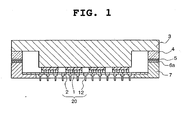
- FIG. 1 is a sectional side view showing a first embodiment of an electronic device according to the present invention.
- a multi-chip module 20 includes a substrate 2 in which a plurality of pins 12 as external terminals are implanted, and a plurality of LSIs 1 having a CMOS circuit which are mounted on the substrate 2.
- the LSI 1 as a component of the multi-chip module 20 is thermally connected to a cooling member 3. Between the surface of the LSI 1 on the cooling member side and the cooling member 3, a thermally conductive compound is filled in for absorbing variation in LSI packaging height and inclination.
- the substrate 2 is a multilayer wiring substrate in which, with a ceramic material such as alumina or mullite or a metal material such as aluminum used as a base substrate, a wiring layer as a conductor provided on the substrate and an interlayer insulation layer for the insulation between the wiring layers are multi-layered, or a multilayer wiring substrate in which wiring substrates formed of a copper-plated glass epoxy substrate are multi-layered, and which has excellent heat conductivity in the direction parallel to the surface of the substrate.
- a ceramic material such as alumina or mullite or a metal material such as aluminum used as a base substrate
- a wiring layer as a conductor provided on the substrate and an interlayer insulation layer for the insulation between the wiring layers are multi-layered
- a multilayer wiring substrate in which wiring substrates formed of a copper-plated glass epoxy substrate are multi-layered, and which has excellent heat conductivity in the direction parallel to the surface of the substrate.
- a thin film insulation layer on the surface of the substrate 2 on the side on which the LSI 1 is mounted for which polyimide is used whose heat conductivity is low as an insulation material.
- Polyimide is formed by spin-coating a precursor of polyimide and then heating the same.
- An insulation material for a thin film insulation layer is not limited to polyimide and any insulation material having low heat conductivity can be used.
- BCB benzocyclobutene
- the cooling member 3 is cooled down below a room temperature for the purpose of operating the LSI 1 as a CMOS at a high speed.
- cooling systems are a liquid-cooling system for circulating a cooling medium such as water or antifreeze solution within a cooling member, a system using a freezing cycle and a system using a Peltier element making the use of endothermic action, any of which may be employed.
- the multi-chip module 20 is held by a flange member 7.
- the substrate 2 is fixed to the bottom portion of the flange member 7 by screwing, it may be supported at the bottom portion of the flange member 7 in contact or may be fixed to the bottom surface of the flange member 7 by soldering or an adhesive.
- a heater 5 is disposed through an adapter 6.
- the adapter 6 is composed of two portions, an adapter plate 6a and a support 6b (see Fig. 2). Between the heater 5 and the cooling member 3, a heat insulating material 4 is inserted.
- the flange member 7 is formed of such a metal having excellent heat conductivity as aluminum and has its surface supporting the substrate 2 in contact with the same from the side of the pin 12. The surface of the flange member 7 is coated with an insulation material.
- Used as the heat insulating material 4 is a material having closed cells in order not to cause dewing within itself.
- a water absorption is desirably not more than a few percentages.
- closed cell sponge rubber for example, can be preferably used as a heat insulating material having such properties. The reason why the heat insulating material 4 is inserted between the heater 5 and the cooling member 3 is that heat of the heater 5 should be efficiently conducted to the flange member 7 without being absorbed by the cooling member 3.
- a popular heater such as a film heater can be used, for example.
- a main function of the adapter 6 is to prevent the heat insulating member 4 as an elastic body to expand or shrink due to endothermic action by the cooling member or heat generated by the heater at the time when the LSI is operated while cooling is conducted by the cooling member. This arrangement prevents a space between the cooling member 3 and the LSI 1 from changing.
- the substrate 2 has its surroundings supported by the heated flange member 7. As a result, heat transmitted from the flange member 7 to the substrate 2 will be transferred from the peripheral portion of the substrate toward the central portion of the same. This structure therefore enables even and efficient heating of the substrate.
- Fig. 2 shows an exploded perspective view of the heater portion.
- the adapter plate 6a is disposed along the upper surface of the flange member 7, on the upper surface of which plate the hollow support 6b is arranged.
- the adapter plate 6a and the hollow support 6b form the adapter 6.
- a material of the adapter plate 6a a material having high heat conductivity in order to make heat conduction between the heater 5 and the flange member 7 excellent.
- aluminum is used in the present embodiment, other metal material such as copper can be suitably used.
- the support 6b a material having low heat conductivity in order to prevent heat conduction between the flange member 7 and the cooling member 3.
- stainless steel is selected.
- the size of the support 6b it is desirable that the size should be approximately not more than half the width of the flange member in order to make heat conduction between the flange member 7 and the cooling member 3 small.
- the flange member 7 is strongly screwed to the cooling member 3 by means of the screw 13 with the adapter 6, the heater 5 and the heat insulating material 4 provided therebetween.
- a coefficient of thermal expansion of a metal is in general approximately 10-5/°C and accordingly assuming that the support 6b is a few centimeters in length and that a temperature change ranges within several tens °C, the length change of the support is as small as 0.01 mm.
- the cooling member 3 and the LSI 1 there exists a space of approximately 0.1 mm. Even the support 6b has a temperature change of several tens °C, the change in length is accordingly negligible as compared with the space between the LSI 1 and the cooling member 3.
- the heat insulating material 4 should be filled without any space between the cooling member 3 and the heater 5 in order to increase heat insulating effects between the cooling member 3 and the heater 5.
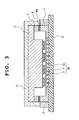
- Fig. 3 is a sectional view showing a state where the multi-chip module 20 is mounted on a packaging board 8 through the pin 12 of the substrate 2. Through a signal pad and a feeder pad provided in the packaging board 8, signal transmission and power feeding are conducted from the outside the module 20 to the LSI 1.
- a guide mechanism 9 for guiding the pin 12 so as to securely fit in a through hole of the packaging board 8 when the multi-chip module 20 is put on the packaging board 8.
- a heat insulating cover 10 for covering the whole outer surface of the cooling member 3 is attached with the multi-chip module 20 mounted on the packaging board 8. Since sufficient space exists in this part, such a heat insulating cover can be used as has a heat insulating material of, for example, not less than 10mm in thickness and not more than a few percentages in water absorption. When the heat insulating cover 10 should be thin, a surface temperature of the heat insulating cover 10 may be increased by covering the outer surface of the heat insulating cover 10 with the heater.
- Heat generated by feeding power to the heater 5 is passed through the adapter plate 6a and then is transmitted to the flange member 7. Since the adapter plate 6a is made of a material having excellent heat conductivity, the heat generated by feeding power to the heater 5 will be highly efficiently transferred to the flange member 7.
- the flange member 7 is maintained at a temperature not less than a dew point temperature.
- the flange member 7 since the flange member 7 has its surface being in contact with the substrate 2, the flange member 7 will heat the substrate 2.
- the substrate 2 is a multilayer wiring substrate in which, with a ceramic material such as alumina or mullite or a metal such as aluminum used as a base substrate, a wiring layer as a conductor provided on the substrate and an interlayer insulation layer for the insulation between the wiring layers are multi-layered, or a multilayer wiring substrate in which wiring substrates formed of a copper-plated glass epoxy plate are multi-layered, and which has excellent heat conductivity in the direction parallel to the surface of the substrate, making the temperature increase uniformly over the whole substrate.
- a ceramic material such as alumina or mullite or a metal such as aluminum used as a base substrate
- a wiring layer as a conductor provided on the substrate and an interlayer insulation layer for the insulation between the wiring layers are multi-layered
- a multilayer wiring substrate in which wiring substrates formed of a copper-plated glass epoxy plate are multi-layered, and which has excellent heat conductivity in the direction parallel to the surface of the substrate, making the temperature increase uniformly over the whole substrate.
- a thin film insulation layer of polyimide or the like having low heat conductivity is formed on the surface of the substrate 2 at the side on which the LSI 1 is mounted, the heat transferred to the substrate is very unlikely to conduct to each CMOS in the LSI 1 to warm these CMOSs. As a result, a junction temperature of the CMOS in the LSI 1 can be maintained at a low temperature at which high-speed operation is performed.
- the heat transmitted to the substrate 2 will be also transferred to the packaging board 8 through the pin 12 to increase temperatures of the pin 12 and the packaging board 8. It is therefore possible to maintain even the pin 12 or the packaging board 8 into which insertion of a heat insulating material having a sufficient thickness is hard to make due to structural difficulty at a temperature more than a dew point temperature, thereby preventing dewing.
- a spare space is generated because dewing can be prevented without a heat insulating material, which facilitates arrangement of the guide mechanism 9 for guiding the pin 12 to securely fit in the through hole of the packaging board 8.
- a further effect can be produced of preventing erroneous insertion of the pin 12 into the packaging board 8.
- the heat insulating cover 10 covering the whole outer surface of the cooling member 3 is intended to prevent dewing of the cooling member 3. It is also clearly understood that a temperature control unit for controlling a heater temperature can be attached to the heater 5 in order to set the temperature of the flange member 7 at an optimum temperature.
- the amount of heat generation of the heater 5 is determined by a material or a size of the substrate 2, the amount of heat generation of the LSI 1, a junction set temperature of a CMOS and the temperature of the cooling member 3, and when a cooling medium is used, it is determined by the temperature and cooling performance of the cooling medium, heat capacity of the multi-chip module 20 and the like.
- the substrate 2 is a mullite substrate of 100 mm in size and the entire amount of heat generation of the LSI 1 is 100W
- simply setting the amount of heat generation of the heater 5 to be a few watts obtains about 10 °C of a temperature increase at the pin 12.
- the amount of heat generation of the heater 5 is a few percents, considerably smaller than the amount of heat generation of the multi-chip module 20.
- the junction temperature of the CMOS in the LSI 1 is allowed to have a temperature increase not more than 1 °C substantially without being affected by the heat generation of the heater 5.
- the heat insulating material 4 being compressed is filled in between the cooling member 3 and the adapter plate 6a and the heater 5 without leaving a space in order to enhance heat insulation effects between the cooling member 3 and the heater 5. Since the heat insulating material 4 is formed of styrene foam, urethane foam or the like in order to enhance heat insulation, it shrinks or expands due to cooling by the cooling member 3 or heat generated by the heater 5. As a result, when the adapter 6 fails to exist, a gap between the cooling member 3 and the LSI 1 changes.
- the flange member 7 is firmly fixed to the cooling member 3 by means of the screw 13 with the adapter 6, the heater 5 and the heat insulating material 4 provided therebetween.
- a change of the support 6b caused by temperature is negligible as compared with a gap between the cooling member 3 and the LSI 1. This prevents such a problem that a gap between the cooling member 3 and the LSI 1 changes to exert an excessive load on the LSI 1 and a problem that conversely the LSI 1 and the cooling member 3 go physically apart from each other to reach a cooling-disabled level due to loss of heat conduction.
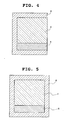
- Fig. 4 is a sectional view showing an adapter according to a second embodiment of the present invention.
- the adapter 6 of the second embodiment fails to have the hollow support (6b) of the first embodiment shown in Fig. 2 and has a U-shaped section.
- the frame-formed adapter 6 having a U-shaped section is disposed to cover the upper side surface of the flange member 7.
- the similarly frame-formed heater 5 is attached and in the remaining space, the heat insulating material 4 is filled.
- the heat insulating material 4, the heater 5 and the adapter 6 are fixed by screwing between the flange member 7 and the cooling member 3 similarly to the embodiment shown in Fig. 2.
- Fig. 5 is a sectional view showing an adapter according to a third embodiment of the present invention.
- the adapter 6 of the present embodiment also fails to have the hollow support (6b) of the first embodiment shown in Fig. 2 and is the same as the adapter shown in Fig. 4 with the only difference being that its section is formed to be a hollow-square.
- the second and the third embodiments may be modified to have the heater 5 arranged not within the adapter 6 but under the adapter (on the flange member).
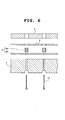
- Fig. 6 is a partly exploded sectional view showing a fourth embodiment of the present invention.
- the adapter 6 is composed of separate adapter plate 6c and support 6d. Designing the adapter plate 6c and the support 6d as separate bodies allows them to be made of a highly heat-conductive body and a material having high heat insulation, respectively. In other words, it is possible to form the adapter plate 6c out of a metal and the support 6d out of ceramic or plastics.
- Fig. 7 is a partly exploded sectional view showing a fifth embodiment of the present invention.
- the difference in the present embodiment from the first embodiment shown in Fig. 2 is that the adapter 6 is composed only of a support without having an adapter plate portion.
- the heater 5 directly comes into contact with the flange member 7.
- the adapter 6 because it is desirable that the adapter 6 should be an element having low heat conductivity, it is formed of ceramic or plastics.
- Fig. 8 is a partly exploded perspective view showing a sixth embodiment of the present invention.
- the difference in the present embodiment from the first embodiment shown in Fig. 2 is that the heater 5 is inserted between the adapter 6 and the flange member 7.
- the adapter 6 can be made of an element having low heat conductivity. In addition, since a hole formed in the heater 5 can be small, local heat increase occurring at the heater 5 can be suppressed.
- the heater is disposed on the upper surface of the flange member
- the arrangement of the heater is not necessarily limited thereto and any arrangement is allowed in which the heater can perform its function such as arrangement between the substrate 2 and the flange member 7 or on the side surface or the lower surface of the flange member 7.
- the heater can be also formed as a thick film or a thin film resistor on the flange member. It is also possible to provide the adapter 6 with a heater function. It is further possible to make the flange member 7 itself generate heat.
- the present invention is structured to have the surroundings of the substrate mounted with the semiconductor device supported by the heated flange member, the substrate can be evenly and efficiently heated.
- the present invention accordingly enables reduction of power consumed for cooling and heating to avoid an excessive temperature increase, as well as preventing a temperature of a substrate, a pin related to the substrate, a packaging board or the like from decreasing below a dew point temperature substantially without affecting a junction temperature of an LSI.
- the electronic device includes a semiconductor device (1), a substrate (2) on which the semiconductor device (1) is mounted, a flange member (7) for holding a peripheral portion of the substrate (2) and a cooling member (3), in which the flange member (7) for supporting the substrate (2) of the semiconductor device being thermally in contact with the cooling member (3) is arranged to come into contact with a heater (5) through an adapter (6) and between the heater (5) and the cooling member (3), a heat insulating material is filled.
Landscapes
- Cooling Or The Like Of Semiconductors Or Solid State Devices (AREA)
- Cooling Or The Like Of Electrical Apparatus (AREA)
Applications Claiming Priority (2)
| Application Number | Priority Date | Filing Date | Title |
|---|---|---|---|
| JP2001154794 | 2001-05-24 | ||
| JP2001154794A JP3476142B2 (ja) | 2001-05-24 | 2001-05-24 | 結露防止構造を備えた電子デバイス |
Publications (2)
| Publication Number | Publication Date |
|---|---|
| EP1261027A2 true EP1261027A2 (fr) | 2002-11-27 |
| EP1261027A3 EP1261027A3 (fr) | 2005-05-11 |
Family
ID=18999079
Family Applications (1)
| Application Number | Title | Priority Date | Filing Date |
|---|---|---|---|
| EP02011492A Withdrawn EP1261027A3 (fr) | 2001-05-24 | 2002-05-24 | Dispositif électronique avec une structure pour empêcher l'humidification |
Country Status (4)
| Country | Link |
|---|---|
| US (1) | US6853071B2 (fr) |
| EP (1) | EP1261027A3 (fr) |
| JP (1) | JP3476142B2 (fr) |
| CA (1) | CA2387252A1 (fr) |
Families Citing this family (13)
| Publication number | Priority date | Publication date | Assignee | Title |
|---|---|---|---|---|
| ES1050831Y (es) * | 2001-12-27 | 2002-09-16 | Lear Automotive Eeds Spain | Conector electronico integrado |
| US6946740B2 (en) * | 2002-07-15 | 2005-09-20 | International Rectifier Corporation | High power MCM package |
| US7372147B2 (en) * | 2003-07-02 | 2008-05-13 | Hewlett-Packard Development Company, L.P. | Supporting a circuit package including a substrate having a solder column array |
| US7133286B2 (en) * | 2004-05-10 | 2006-11-07 | International Business Machines Corporation | Method and apparatus for sealing a liquid cooled electronic device |
| JP4594689B2 (ja) * | 2004-09-27 | 2010-12-08 | エドワーズ株式会社 | 真空ポンプ |
| DE102006052619B4 (de) * | 2006-11-08 | 2009-07-30 | Semikron Elektronik Gmbh & Co. Kg | Schaltungsanordnung mit einem Leistungsmodul, das mit einer Leiterplatte kombiniert ist |
| DE102006052620B4 (de) * | 2006-11-08 | 2009-07-09 | Semikron Elektronik Gmbh & Co. Kg | Schaltungsanordnung mit einem Leistungsmodul, das mit einer Leiterplatte kombiniert ist. |
| JP5142690B2 (ja) * | 2007-12-10 | 2013-02-13 | 株式会社日立国際電気 | 電子部品の熱伝達構造 |
| US20110127254A1 (en) * | 2009-11-30 | 2011-06-02 | Cypress Technology Llc | Electric Heating Systems and Associated Methods |
| CN103154685A (zh) * | 2010-10-15 | 2013-06-12 | 丰田自动车株式会社 | 冷却液用温度检测装置 |
| US9105500B2 (en) * | 2012-07-13 | 2015-08-11 | International Business Machines Corporation | Non-hermetic sealed multi-chip module package |
| TWM541686U (zh) * | 2016-12-27 | 2017-05-11 | 微星科技股份有限公司 | 電子裝置 |
| KR102373969B1 (ko) * | 2020-04-10 | 2022-03-15 | 주식회사 뷰웍스 | 수냉식 모듈을 구비한 산업용 카메라의 냉각 구조 |
Family Cites Families (7)
| Publication number | Priority date | Publication date | Assignee | Title |
|---|---|---|---|---|
| KR920008251B1 (ko) * | 1988-09-26 | 1992-09-25 | 가부시기가이샤 히다찌세이사꾸쇼 | 전자디바이스의 냉각장치 |
| US5574627A (en) * | 1995-07-24 | 1996-11-12 | At&T Global Information Solutions Company | Apparatus for preventing the formation of condensation on sub-cooled integrated circuit devices |
| US6054676A (en) * | 1998-02-09 | 2000-04-25 | Kryotech, Inc. | Method and apparatus for cooling an integrated circuit device |
| JP3470612B2 (ja) | 1998-09-18 | 2003-11-25 | 株式会社日立製作所 | 電子機器 |
| US6144013A (en) * | 1999-07-01 | 2000-11-07 | International Business Machines Corporation | Local humidity control system for low temperature electronic module |
| US6246581B1 (en) * | 1999-10-12 | 2001-06-12 | International Business Machines Corporation | Heated PCB interconnect for cooled IC chip modules |
| US6243268B1 (en) * | 1999-10-12 | 2001-06-05 | International Business Machines Corporation | Cooled IC chip modules with an insulated circuit board |
-
2001
- 2001-05-24 JP JP2001154794A patent/JP3476142B2/ja not_active Expired - Fee Related
-
2002
- 2002-05-23 US US10/152,729 patent/US6853071B2/en not_active Expired - Fee Related
- 2002-05-23 CA CA002387252A patent/CA2387252A1/fr not_active Abandoned
- 2002-05-24 EP EP02011492A patent/EP1261027A3/fr not_active Withdrawn
Also Published As
| Publication number | Publication date |
|---|---|
| US6853071B2 (en) | 2005-02-08 |
| US20020175404A1 (en) | 2002-11-28 |
| JP3476142B2 (ja) | 2003-12-10 |
| JP2002353386A (ja) | 2002-12-06 |
| CA2387252A1 (fr) | 2002-11-24 |
| EP1261027A3 (fr) | 2005-05-11 |
Similar Documents
| Publication | Publication Date | Title |
|---|---|---|
| US10930579B2 (en) | Self-contained liquid cooled semiconductor packaging | |
| US6094919A (en) | Package with integrated thermoelectric module for cooling of integrated circuits | |
| US6853071B2 (en) | Electronic device having dewing prevention structure and dewing prevention structure of electronic device | |
| US5574627A (en) | Apparatus for preventing the formation of condensation on sub-cooled integrated circuit devices | |
| US8564957B2 (en) | Cooling structure for electronic equipment | |
| US5918469A (en) | Cooling system and method of cooling electronic devices | |
| US12591166B2 (en) | Thermal-control system for a security camera | |
| US5155661A (en) | Aluminum nitride multi-chip module | |
| US5587882A (en) | Thermal interface for a heat sink and a plurality of integrated circuits mounted on a substrate | |
| US6943293B1 (en) | High power electronic package with enhanced cooling characteristics | |
| US7654311B2 (en) | Thermal management of systems having localized regions of elevated heat flux | |
| US11664291B2 (en) | Semiconductor assemblies including vertically integrated circuits and methods of manufacturing the same | |
| US20090020272A1 (en) | Electronic apparatus | |
| US5343360A (en) | Containing and cooling apparatus for an integrated circuit device having a thermal insulator | |
| CN115151097A (zh) | 热电制冷模组、散热组件、芯片封装结构及电子设备 | |
| JP4034173B2 (ja) | 半導体集積回路装置及びその半導体集積回路チップ | |
| US20130093270A1 (en) | High temperature environment capable motor controller | |
| US20060086487A1 (en) | Thermal management of systems having localized regions of elevated heat flux | |
| US7705449B2 (en) | Cooling apparatus for memory module | |
| US9420720B2 (en) | Liquid cooling apparatus | |
| KR102820433B1 (ko) | 펠티어 장치를 이용한 fpga 냉각 장치 | |
| CN121218432A (zh) | 背侧供电系统的冷却模块 | |
| CN219892176U (zh) | 一种热能回收结构、芯片及电子设备 | |
| JPH0439781B2 (fr) | ||
| CN121194428A (zh) | 一种散热结构和电子设备 |
Legal Events
| Date | Code | Title | Description |
|---|---|---|---|
| PUAI | Public reference made under article 153(3) epc to a published international application that has entered the european phase |
Free format text: ORIGINAL CODE: 0009012 |
|
| AK | Designated contracting states |
Kind code of ref document: A2 Designated state(s): AT BE CH CY DE DK ES FI FR GB GR IE IT LI LU MC NL PT SE TR |
|
| AX | Request for extension of the european patent |
Free format text: AL;LT;LV;MK;RO;SI |
|
| PUAL | Search report despatched |
Free format text: ORIGINAL CODE: 0009013 |
|
| AK | Designated contracting states |
Kind code of ref document: A3 Designated state(s): AT BE CH CY DE DK ES FI FR GB GR IE IT LI LU MC NL PT SE TR |
|
| AX | Request for extension of the european patent |
Extension state: AL LT LV MK RO SI |
|
| 17P | Request for examination filed |
Effective date: 20051005 |
|
| AKX | Designation fees paid |
Designated state(s): DE FR GB NL |
|
| STAA | Information on the status of an ep patent application or granted ep patent |
Free format text: STATUS: THE APPLICATION HAS BEEN WITHDRAWN |
|
| 18W | Application withdrawn |
Effective date: 20070308 |