EP1262227A2 - Emulgatorgemisch für die Emulsionspolymerisation - Google Patents
Emulgatorgemisch für die Emulsionspolymerisation Download PDFInfo
- Publication number
- EP1262227A2 EP1262227A2 EP02007982A EP02007982A EP1262227A2 EP 1262227 A2 EP1262227 A2 EP 1262227A2 EP 02007982 A EP02007982 A EP 02007982A EP 02007982 A EP02007982 A EP 02007982A EP 1262227 A2 EP1262227 A2 EP 1262227A2
- Authority
- EP
- European Patent Office
- Prior art keywords
- emulsifier
- weight
- alkyl
- vinyl
- iii
- Prior art date
- Legal status (The legal status is an assumption and is not a legal conclusion. Google has not performed a legal analysis and makes no representation as to the accuracy of the status listed.)
- Withdrawn
Links
Classifications
-
- C—CHEMISTRY; METALLURGY
- C08—ORGANIC MACROMOLECULAR COMPOUNDS; THEIR PREPARATION OR CHEMICAL WORKING-UP; COMPOSITIONS BASED THEREON
- C08F—MACROMOLECULAR COMPOUNDS OBTAINED BY REACTIONS ONLY INVOLVING CARBON-TO-CARBON UNSATURATED BONDS
- C08F2/00—Processes of polymerisation
- C08F2/12—Polymerisation in non-solvents
- C08F2/16—Aqueous medium
- C08F2/22—Emulsion polymerisation
- C08F2/24—Emulsion polymerisation with the aid of emulsifying agents
-
- C—CHEMISTRY; METALLURGY
- C09—DYES; PAINTS; POLISHES; NATURAL RESINS; ADHESIVES; COMPOSITIONS NOT OTHERWISE PROVIDED FOR; APPLICATIONS OF MATERIALS NOT OTHERWISE PROVIDED FOR
- C09D—COATING COMPOSITIONS, e.g. PAINTS, VARNISHES OR LACQUERS; FILLING PASTES; CHEMICAL PAINT OR INK REMOVERS; INKS; CORRECTING FLUIDS; WOODSTAINS; PASTES OR SOLIDS FOR COLOURING OR PRINTING; USE OF MATERIALS THEREFOR
- C09D131/00—Coating compositions based on homopolymers or copolymers of compounds having one or more unsaturated aliphatic radicals, each having only one carbon-to-carbon double bond, and at least one being terminated by an acyloxy radical of a saturated carboxylic acid, of carbonic acid, or of a haloformic acid; Coating compositions based on derivatives of such polymers
- C09D131/02—Homopolymers or copolymers of esters of monocarboxylic acids
- C09D131/04—Homopolymers or copolymers of vinyl acetate
-
- C—CHEMISTRY; METALLURGY
- C09—DYES; PAINTS; POLISHES; NATURAL RESINS; ADHESIVES; COMPOSITIONS NOT OTHERWISE PROVIDED FOR; APPLICATIONS OF MATERIALS NOT OTHERWISE PROVIDED FOR
- C09D—COATING COMPOSITIONS, e.g. PAINTS, VARNISHES OR LACQUERS; FILLING PASTES; CHEMICAL PAINT OR INK REMOVERS; INKS; CORRECTING FLUIDS; WOODSTAINS; PASTES OR SOLIDS FOR COLOURING OR PRINTING; USE OF MATERIALS THEREFOR
- C09D133/00—Coating compositions based on homopolymers or copolymers of compounds having one or more unsaturated aliphatic radicals, each having only one carbon-to-carbon double bond, and at least one being terminated by only one carboxyl radical, or of salts, anhydrides, esters, amides, imides, or nitriles thereof; Coating compositions based on derivatives of such polymers
- C09D133/04—Homopolymers or copolymers of esters
- C09D133/06—Homopolymers or copolymers of esters of esters containing only carbon, hydrogen and oxygen, the oxygen atom being present only as part of the carboxyl radical
-
- C—CHEMISTRY; METALLURGY
- C09—DYES; PAINTS; POLISHES; NATURAL RESINS; ADHESIVES; COMPOSITIONS NOT OTHERWISE PROVIDED FOR; APPLICATIONS OF MATERIALS NOT OTHERWISE PROVIDED FOR
- C09D—COATING COMPOSITIONS, e.g. PAINTS, VARNISHES OR LACQUERS; FILLING PASTES; CHEMICAL PAINT OR INK REMOVERS; INKS; CORRECTING FLUIDS; WOODSTAINS; PASTES OR SOLIDS FOR COLOURING OR PRINTING; USE OF MATERIALS THEREFOR
- C09D135/00—Coating compositions based on homopolymers or copolymers of compounds having one or more unsaturated aliphatic radicals, each having only one carbon-to-carbon double bond, and at least one being terminated by a carboxyl radical, and containing at least another carboxyl radical in the molecule, or of salts, anhydrides, esters, amides, imides or nitriles thereof; Coating compositions based on derivatives of such polymers
- C09D135/06—Copolymers with vinyl aromatic monomers
-
- C—CHEMISTRY; METALLURGY
- C09—DYES; PAINTS; POLISHES; NATURAL RESINS; ADHESIVES; COMPOSITIONS NOT OTHERWISE PROVIDED FOR; APPLICATIONS OF MATERIALS NOT OTHERWISE PROVIDED FOR
- C09J—ADHESIVES; NON-MECHANICAL ASPECTS OF ADHESIVE PROCESSES IN GENERAL; ADHESIVE PROCESSES NOT PROVIDED FOR ELSEWHERE; USE OF MATERIALS AS ADHESIVES
- C09J131/00—Adhesives based on homopolymers or copolymers of compounds having one or more unsaturated aliphatic radicals, each having only one carbon-to-carbon double bond, and at least one being terminated by an acyloxy radical of a saturated carboxylic acid, of carbonic acid, or of a haloformic acid; Adhesives based on derivatives of such polymers
- C09J131/02—Homopolymers or copolymers of esters of monocarboxylic acids
- C09J131/04—Homopolymers or copolymers of vinyl acetate
-
- C—CHEMISTRY; METALLURGY
- C09—DYES; PAINTS; POLISHES; NATURAL RESINS; ADHESIVES; COMPOSITIONS NOT OTHERWISE PROVIDED FOR; APPLICATIONS OF MATERIALS NOT OTHERWISE PROVIDED FOR
- C09J—ADHESIVES; NON-MECHANICAL ASPECTS OF ADHESIVE PROCESSES IN GENERAL; ADHESIVE PROCESSES NOT PROVIDED FOR ELSEWHERE; USE OF MATERIALS AS ADHESIVES
- C09J133/00—Adhesives based on homopolymers or copolymers of compounds having one or more unsaturated aliphatic radicals, each having only one carbon-to-carbon double bond, and at least one being terminated by only one carboxyl radical, or of salts, anhydrides, esters, amides, imides, or nitriles thereof; Adhesives based on derivatives of such polymers
- C09J133/04—Homopolymers or copolymers of esters
- C09J133/06—Homopolymers or copolymers of esters of esters containing only carbon, hydrogen and oxygen, the oxygen atom being present only as part of the carboxyl radical
-
- C—CHEMISTRY; METALLURGY
- C09—DYES; PAINTS; POLISHES; NATURAL RESINS; ADHESIVES; COMPOSITIONS NOT OTHERWISE PROVIDED FOR; APPLICATIONS OF MATERIALS NOT OTHERWISE PROVIDED FOR
- C09J—ADHESIVES; NON-MECHANICAL ASPECTS OF ADHESIVE PROCESSES IN GENERAL; ADHESIVE PROCESSES NOT PROVIDED FOR ELSEWHERE; USE OF MATERIALS AS ADHESIVES
- C09J135/00—Adhesives based on homopolymers or copolymers of compounds having one or more unsaturated aliphatic radicals, each having only one carbon-to-carbon double bond, and at least one being terminated by a carboxyl radical, and containing at least another carboxyl radical in the molecule, or of salts, anhydrides, esters, amides, imides or nitriles thereof; Adhesives based on derivatives of such polymers
- C09J135/06—Copolymers with vinyl aromatic monomers
-
- C—CHEMISTRY; METALLURGY
- C09—DYES; PAINTS; POLISHES; NATURAL RESINS; ADHESIVES; COMPOSITIONS NOT OTHERWISE PROVIDED FOR; APPLICATIONS OF MATERIALS NOT OTHERWISE PROVIDED FOR
- C09K—MATERIALS FOR MISCELLANEOUS APPLICATIONS, NOT PROVIDED FOR ELSEWHERE
- C09K23/00—Use of substances as emulsifying, wetting, dispersing, or foam-producing agents
- C09K23/017—Mixtures of compounds
-
- Y—GENERAL TAGGING OF NEW TECHNOLOGICAL DEVELOPMENTS; GENERAL TAGGING OF CROSS-SECTIONAL TECHNOLOGIES SPANNING OVER SEVERAL SECTIONS OF THE IPC; TECHNICAL SUBJECTS COVERED BY FORMER USPC CROSS-REFERENCE ART COLLECTIONS [XRACs] AND DIGESTS
- Y10—TECHNICAL SUBJECTS COVERED BY FORMER USPC
- Y10S—TECHNICAL SUBJECTS COVERED BY FORMER USPC CROSS-REFERENCE ART COLLECTIONS [XRACs] AND DIGESTS
- Y10S516/00—Colloid systems and wetting agents; subcombinations thereof; processes of
- Y10S516/905—Agent composition per se for colloid system making or stabilizing, e.g. foaming, emulsifying, dispersing, or gelling
- Y10S516/909—The agent contains organic compound containing sulfoxy*
Definitions
- the invention further relates to aqueous polymer dispersions, which contain this emulsifier mixture and the use of this Polymer dispersions as pressure sensitive adhesives.
- monomer droplets are in water emulsified using an emulsifier.
- Type and amount of Emulsifiers decisively determine the stability of the monomer droplets and after the polymerization, the stability of the contained Polymer particles. Naturally, sufficient is desired Stabilization with the smallest possible amount of emulsifier to reach.
- the emulsifier In later use, e.g. for coating substrates, The emulsifier remains in the water after removal of the dispersion water Final product. The application properties are also therefore influenced by the emulsifier.
- cohesion For many applications, a high level of internal cohesion (cohesion) desired.
- Known emulsifiers reduce many times inner cohesion e.g. in a coating or an adhesive.
- an adhesive there is also sufficient adhesive force or stickiness desired. Is of particular importance hence that an adhesive has both high cohesion and has high adhesion.
- Binary emulsifier mixtures for emulsion polymerization are known from DE 19818393 and the use of the polymers as an adhesive known.
- the object of the present invention was therefore emulsifier systems, which bring about high stability of aqueous polymer dispersions and in the later use of the aqueous polymer dispersions the internal cohesion in the coating mass increase or at least not decrease.
- the Polymer dispersions can be well suited for pressure sensitive adhesives.
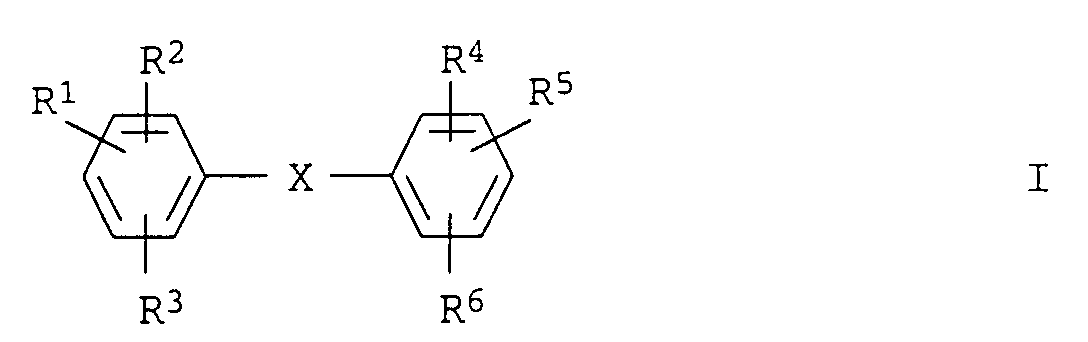
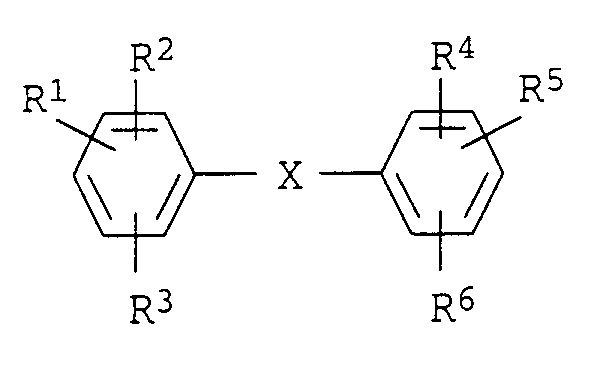
- the emulsifier mixture according to the invention contains an emulsifier I of the formula where X is 0, S, CH 2 , NH or NR 7 , one or two of the radicals R 1 to R 6 for a group SO 3 ⁇ K ⁇ and the remaining R 1 to R 6 for H or a C 1 -C 18 Alkyl group, R 7 for a C 1 -C 8 alkyl group and K for a counter cation.
- X is O.
- one or two of the radicals R 1 to R 6 represents a C 1 - C 18 alkyl group, in particular a C 6 -C 18 alkyl group and the remaining radicals R 1 - R 6 are hydrogen atoms and the sulfonate groups.
- K is a counter cation; preferably selected from the cations of H, the alkali metals, ammonium. Especially sodium is preferred.
- Compounds of formula I are usually also a mixture of compounds with different Degree of substitution (mono- or dialkylated) and different substitution position of the substituted (i.e. the sulfonate groups and one or two alkyl groups).
- Compounds with formula I are under the trademark Dowfax® 2A sold by Dow Chemical Company.
- Disponil® FES 77 distributed by Henkel.
- the emulsifier mixture according to the invention further contains an emulsifier III.
- This is a nonionic emulsifier.
- the emulsifying group of molecules is therefore not a group that dissociates in water in ions.
- the emulsifying group in emulsifier III is preferably an alkoxy group, in particular a C 1 -C 4 alkoxy group, e.g. B. an ethoxy or propoxy group.
- Emulsifier III is preferably a low molecular weight compound with a molecular weight of less than 1500 g / mol, in particular less than 1000 g / mol.
- Emulsifier III preferably contains no aromatic groups.
- the emulsifier is preferably at least 20% by weight, particularly preferably at least 40% by weight of alkoxy groups (-alkylene-O).
- the emulsifier III is particularly preferably one of the formula R 8 -O- (ZO) n -H in which R 8 , Z and n have the above meaning and also the above preferred meanings.
- Emulsifiers III are e.g. B. under the name Lutensol® from BASF available.
- the emulsifier mixture preferably contains at least 5% by weight. particularly preferably at least 10% by weight of each of the emulsifiers, in particular at least 10% by weight of the emulsifiers I and II and at least 20% by weight of emulsifier III on the total weight of the emulsifiers I + II + III.
- the emulsifier mixture preferably consists of 5 to 90% by weight, in particular 5 to 75% by weight of emulsifier I, 5 to 90% by weight, in particular 5 to 75% by weight, of emulsifier II and 5 to 90% by weight, in particular 20 to 90% by weight of the Emulsifier III.
- the weights are based on the emulsifier mixture.
- the emulsifier mixture according to the invention is preferably used as Emulsifier used in emulsion polymerization.
- the emulsifier or the emulsifier mixture is usually in Quantities from 0.1 to 15% by weight, preferably from 0.2 to 5.0, particularly preferably from 0.5 to 2.5% by weight, based on the polymerizing monomers used.
- the polymer dispersion obtained accordingly contains the amounts of emulsifier mentioned. It other emulsifiers can also be used, they can be used in emulsion polymerization or can be added later.
- the use of other emulsifiers is not necessary.
- the emulsifier mixture according to the invention is therefore preferred alone used.
- the weights are based on the polymer.
- the polymer particularly preferably contains 60 to 100% by weight, in particular 80 to 100% by weight of monomers a) 0 to 10% by weight, in particular 0 to 5% by weight of monomers b) and 0 to 30% by weight, in particular 0 to 15% by weight of monomers c).
- the main monomers to be mentioned are, for example, (meth) acrylic acid alkyl esters having a C 1 -C 10 -alkyl radical, such as methyl methacrylate, methyl acrylate, n-butyl acrylate, ethyl acrylate, 2-ethylhexyl acrylate, n-butyl methacrylate and iso-butyl methacrylate.
- mixtures of the (meth) acrylic acid alkyl esters suitable.
- Vinyl esters of carboxylic acids with 1 to 20 C atoms are e.g. Vinyl laurate, stearate, vinyl propionate, vinyl versatic acid and vinyl acetate.
- vinyl aromatic compounds come vinyl toluene ⁇ and p-methylstyrene, ⁇ -butylstyrene, 4-n-butylstyrene, 4-n-decylstyrene and preferably styrene.
- nitriles are Acrylonitrile and methacrylonitrile.
- the vinyl halides are substituted with chlorine, fluorine or bromine ethylenically unsaturated compounds, preferably vinyl chloride and Vinylidene chloride.
- vinyl ethers examples include Vinyl methyl ether or vinyl isobutyl ether. Vinyl ether of 1 to 4 carbon atoms is preferred containing alcohols.
- hydrocarbons with 2 to 8 carbon atoms and two olefinic Double bonds are butadiene, isoprene and chloroprene and with a double bond e.g. Called ethylene.
- Main monomers a) are preferably the following monomers or a mixture of the following monomers: styrene, C 1 -C 10 -alkyl (meth) acrylates, in particular n-butyl acrylate and (meth) acrylonitrile, in particular acrylonitrile.
- Vinyl esters help stabilize of the monomer droplets during the emulsion polymerization.
- Emulsifier mixture can be dispensed with.
- Preferred monomers b) are ethylenically unsaturated acids, e.g. Sulfonic acids or especially carboxylic acids. May be mentioned: (Meth) acrylic acid or itaconic acid, dicarboxylic acids and their Anhydrides or half esters, e.g. Maleic acid, fumaric acid and Maleic anhydride, acrylamidopropanesulfonic acid, vinyl sulfonic acid, Sulfoethyl or sulfopropyl (meth) acrylate or their Salts, especially ammonium or alkali salts and (meth) acrylamide, N-vinyl pyrrolidone, N-vinyl caprolactam, N-vinyl imidazole.
- (Meth) acrylic acid or itaconic acid, dicarboxylic acids and their Anhydrides or half esters e.g. Maleic acid, fumaric acid and Maleic anhydride, acrylamidopropanesulfonic acid,
- monomers c) which may be mentioned are, for example, glycidyl acrylate, glycidyl methacrylate, diallyldimethylammonium chloride and, in particular, monomers containing hydroxyl groups, for example C 1 -C 15 hydroxyalkyl (meth) acrylates.
- Emulsion polymerization in particular becomes water-soluble Initiators e.g. Ammonium and alkali metal salts
- Peroxidic sulfuric acid e.g. Sodium peroxodisulfate, hydrogen peroxide or organic peroxides, e.g. tert-butyl hydroperoxide, used.
- the Red-Ox initiator systems usually consist of at least one inorganic reducing agent and an inorganic or organic Oxidant.
- the oxidation component is e.g. to the already Above initiators for emulsion polymerization.
- the reduction components are e.g. around alkali metal salts sulfurous acid, e.g. sodium sulfite, Sodium hydrogen sulfite, alkali salts of disulfuric acid such as Sodium disulfite, bisulfite addition compounds more aliphatic Aldehydes and ketones such as acetone bisulfite or reducing agents such as Hydroxymethanesulfinic acid and its salts, or ascorbic acid.
- alkali metal salts sulfurous acid e.g. sodium sulfite, Sodium hydrogen sulfite, alkali salts of disulfuric acid such as Sodium disulfite, bisulfite addition compounds more aliphatic Aldehydes and ketones such as acetone bisulfite or reducing agents such as Hydroxymethanesulfinic acid and its salts, or ascorbic acid.
- the Red-Ox initiator systems can be more soluble when used Metal compounds, their metallic component in several valence levels can occur
- Common red-ox initiator systems are e.g. Ascorbic acid / iron (II) sulfate / sodium peroxidisulfate, tert-butyl hydroperoxide / sodium disulfite, tert-butyl hydroperoxide / Na hydroxymethanesulfinate.
- the individual components e.g. the reduction component, can also be mixtures e.g. a mixture of the sodium salt of hydroxymethanesulfinic acid and sodium disulfite.
- the compounds mentioned are mostly in the form of aqueous solutions used, the lower concentration by the in the dispersion acceptable amount of water and the upper concentration determines the solubility of the compound in question in water is.
- the concentration is generally 0.1 to 30% by weight, preferably 0.5 to 20% by weight, particularly preferably 1.0 to 10 wt .-%, based on the solution.
- the amount of initiators is generally 0.1 to 10 wt .-%, preferably 0.5 to 5 wt .-%, based on those to be polymerized Monomers. There can also be several different ones Initiators are used in emulsion polymerization.
- regulators can also be used in the polymerization through which the molecular weight is reduced.
- suitable e.g. Compounds with a thiol group such as tert-butyl mercaptan, Ethyl thioglycolic acid, mercaptoethanol, mercaptopropyltrimethoxysilane or tert-dodecyl mercaptan.
- the share of this Regulator can in particular 0 to 0.3 wt .-%, preferably 0.02 to 0.3% by weight based on the polymer.
- the emulsion polymerization usually takes place at 30 to 95 preferably 50 to 90 ° C.
- the polymerization medium can both only from water, as well as from mixtures of water and thus miscible liquids such as methanol exist. Preferably only water is used.
- the emulsion polymerization can be both Batch process as well as in the form of a feed process, including Step or gradient driving style can be carried out.
- the feed process is preferred, in which part of the Submit polymerization approach to the polymerization temperature heated, polymerized and then the rest of the Polymerization approach, usually over several spatially separate feeds, one or more of which contain the monomers in contained in pure or in emulsified form, continuously, gradually or with a concentration gradient superimposed while maintaining the polymerization of the polymerization zone supplies.
- the way in which the initiator over the course of the radical aqueous emulsion polymerization the polymerization vessel is added is known to those of ordinary skill in the art. It can both completely placed in the polymerization vessel, as also according to its consumption in the course of the radical aqueous emulsion polymerization continuously or in stages be used. In particular, this depends on the average specialist known way of both chemical nature the initiator system as well as the polymerization temperature from. A part is preferably submitted and the rest as specified of consumption fed to the polymerization zone.
- the removal of the residual monomers is usually carried out after End of the actual emulsion polymerization, i.e. after one Conversion of the monomers of at least 95%, initiator added.
- the individual components can the reactor in the feed process added from above, in the side or from below through the reactor floor become.
- aqueous dispersions of the Polymers usually with solids contents of 15 to 75% by weight, preferably from 40 to 75% by weight.
- dispersions preferred with the highest possible solids content.
- To solids To be able to achieve> 60% by weight, one should Set bi- or polymodal particle size, otherwise the viscosity becomes too high and the dispersion is no longer manageable.
- the generation of the first and also further particle generations can for example by adding seeds (EP 81083), by adding excess amounts of emulsifier or by adding mini emulsions respectively.
- Another advantage with the low Viscosity with high solids content is the better Coating behavior at high solids contents.
- the production a new / new generation of particles can be any Time. It depends on the one low viscosity aimed particle size distribution.
- the polymer dispersion obtained is stable. Coagulate is only in small quantities available.
- the polymer dispersion When using the polymer dispersion e.g. as a binder are good application properties, especially a high internal cohesion found.
- the polymer dispersion can be used as a binder in coating agents, impregnating agents or adhesives are used.
- the watery Dispersions can contain additives for the respective use, e.g. Pigments, fillers, leveling agents, defoamers, thickeners etc. can be added.
- the polymers or polymer dispersions obtained are particularly suitable as adhesives, particularly preferably as pressure sensitive adhesives.
- the aqueous polymer dispersions can do this without further additives Find use.
- tackifier When used as a pressure sensitive adhesive, the polymer or aqueous dispersions of the polymers a tackifier, i.e. a tackifying Resin can be added. Tackifiers are e.g. out Adhesive Age, July 1987, pages 19-23 or Polym. Mater. Sci. Closely. 61 (1989), pages 588-592.
- Tackifiers are e.g. Natural resins such as rosins and their by disproportionation or isomerization, polymerization, Dimerization, hydrogenation resulting derivatives. These can be in their salt form (e.g. with mono- or polyvalent counterions (Cations) or preferably in their esterified form. Alcohols used for the esterification can be one or be multivalued. Examples are methanol, ethanediol, diethylene glycol, Triethylene glycol, 1,2,3-propanethiol, pentaerythritol.
- hydrocarbon resins e.g. Coumarone-indene resins, Polyterpene resins, hydrocarbon based resins unsaturated CH compounds, such as butadiene, pentene, methylbutene, Isoprene, piperylene, divinyl methane, pentadiene, cyclopentene, cyclopentadiene, Cyclohexadiene, styrene, ⁇ -methylstyrene, vinyl toluene Use.
- CH compounds such as butadiene, pentene, methylbutene, Isoprene, piperylene, divinyl methane, pentadiene, cyclopentene, cyclopentadiene, Cyclohexadiene, styrene, ⁇ -methylstyrene, vinyl toluene Use.
- Polyacrylates which have a low molecular weight are also increasingly being used as tackifiers. These polyacrylates preferably have a weight-average molecular weight M w of less than 30,000.
- the polyacrylates preferably consist of at least 60, in particular at least 80,% by weight of C 1 -C 8 alkyl (meth) acrylates.
- Preferred tackifiers are natural or chemically modified Rosins. Rosin resins are predominant Part from abietic acid or abietic acid derivatives.
- the tackifiers can easily be the inventive Polymers, preferably the aqueous dispersions of the polymers be added.
- the tackifiers are preferably present itself in the form of an aqueous dispersion.
- the weight amount of the tackifier is preferably 5 to 100 parts by weight. particularly preferably 10 to 50 parts by weight. based per 100 parts by weight of polymer. (Solid / solid).
- Pressure sensitive adhesives therefore contain, in addition to the aqueous Polymer dispersion, if appropriate, also tackifier and / or the above Additives.
- the pressure sensitive adhesives are suitable for the production of self-adhesive Articles such as labels, foils or adhesive tapes.
- the pressure sensitive adhesive can be achieved by conventional methods, e.g. by rolling, knife coating, brushing etc. on substrates, e.g. Paper or polymer films, preferred Consisting of polyethylene, polypropylene, the biaxial or monoaxial can be stretched, polyethylene terephthalate, polyvinyl chloride, Polystyrene, polyamide or metal can be applied.
- the Water can preferably be removed by drying at 50 to 150 ° C become.
- the substrates can be applied before or after the application of the Adhesive cut into adhesive tapes, labels or foils become. For later use it can be coated with pressure sensitive adhesive Side of the substrates, with a release paper, e.g. With a siliconized paper.
- the self-adhesive articles according to the invention have very good ones Adhesive properties, in particular good adhesion to the substrates and high cohesion (internal strength in the adhesive layer).
- the polymer dispersions are stable, even at low levels Emulsifier content and especially without use of vinyl esters, e.g. B. Vinyl acetate (VAc).
- VAV Vinyl acetate
- the solids content of the dispersion is set at 55-60%.
- the dispersion is applied with a doctor knife in a thin layer on a siliconized paper and dried for 3 minutes at 90 ° C.
- the gap height of the doctor blade is chosen so that there is an application amount of 19-21 g / m 2 for the dried adhesives.
- Commercial PE film (thickness 100 ⁇ ) is pretreated on the dried adhesive, placed on top and rolled on firmly with a hand roller.
- the film laminate thus produced is cut into strips 0.5 inch or 1.0 inch and 2 cm wide. These strips are stored in the standard climate for at least 24 hours before the test.
- the foil test strip After peeling off the siliconized paper, the foil test strip is used so on the edge of a stainless steel test sheet glued that there is a bond area of 0.5 inch x 0.5 inch (film strip) results. 20 minutes after gluing is at the protruding end of both paper labels of the paper strip a 1000 g weight attached and the test plate vertical suspended. Ambient conditions: 23 ° C, 50% relative Humidity. The time until Failure of the bond under the influence of the weight as the mean from the results of three test specimens in hours specified.
- Experiments 2 and 5 are according to the invention.
- Experiments 3 and 6 show that achieves equally good results in the case of the invention as usual with 10% vinyl acetate as comonomers.
Landscapes
- Chemical & Material Sciences (AREA)
- Organic Chemistry (AREA)
- Engineering & Computer Science (AREA)
- Materials Engineering (AREA)
- Life Sciences & Earth Sciences (AREA)
- Wood Science & Technology (AREA)
- Health & Medical Sciences (AREA)
- Chemical Kinetics & Catalysis (AREA)
- Medicinal Chemistry (AREA)
- Polymers & Plastics (AREA)
- Adhesives Or Adhesive Processes (AREA)
- Polymerisation Methods In General (AREA)
- Addition Polymer Or Copolymer, Post-Treatments, Or Chemical Modifications (AREA)
- Emulsifying, Dispersing, Foam-Producing Or Wetting Agents (AREA)
Abstract

einen Emulgator II der Formel
- R8:
- C1-C18-Alkyl
Z: CH2―CH2 oder
- n:
- eine ganze Zahl von 1 bis 50
- K:
- ein Kation
Description
einen Emulgator II der Formel


- R8
- besonders bevorzugt für C10H21 bis C15H31, insbesondere für C13H27
- Z
- besonders bevorzugt für CH2-CH2
- n
- besonders bevorzugt für C6-C12, insbesondere C8-Alkyl.
- BA
- n-Butylacrylat
- EHA
- 2-Ethylhexylacrylat
- MMA
- Methylmetacrylat
- S
- Styrol
- MA
- Methylacrylat
- AS
- Acrylsäure
- VAc
- Vinylacetat
- Disponil FES77
- 30%ige wäßrige Lösung des Natriumsalzes des Sschwefelsäurehalbesters von mit 30 Ethyloxideinheiten ethoxiliertem C12-C14-Alkylrestes (Formel II)
- Dowfax 2A1
- 45%ige wäßrige Lösung des Natriumsalzes des mit einem C12-C14-Alkylrest und zwei Sulfonylresten derivatisierten Diphyenlethers (s. Formel I)
- Lutensol T082
- 20%ige wäßrige Lösung des mit 8 Ethyloxideinheiten ethoxilierten C12-C14-Alkylrestes (Formel III)
- NaPS
- Natriumperoxodisulfat
- Zulauf 1 = Emulsionszulauf
242 g Wasser
Gesamtmenge an Monomere: 560 g
Art der Monomere siehe Tabellen
Art und Menge der Emulgatoren siehe Tabellen, die Mengen sind dort in Gewichtsteilen angegeben. - Zulauf 2 = Initiatorzulauf:
Menge NaPS (7 Gew.-%ig in Wasser) siehe Tabellen
| Monomere: 56BA, 28EHA, 15MMA, 1AS; Emulgatoren: 1 Disponil FES77, 0,2 Dowfax 2A1 (Änderungen gegenüber dieser Zusammensetzung sind in der Tabelle angegeben) | |||||
| Nr. | zusätzlich 0.5 Emulgator Lutensol TO 82 | mit 10 VAc, dafür 5 BA und 5 MMA weniger | Schälfestigkeit 300 mm/min [N/2,5 cm] sofort Stahl | Kohäsion [h] Stahl | Emulsionsentmischung in [%] |
| 1 | nein | nein | 4.5 | 41 | 2 |
| 2 | ja | nein | 5.1 | 36 | 0 |
| 3 | nein | ja | 5.7 | 36 | 0 |
| Monomere: 60EHA, 22BA, 15MA, 2S,1AS; Emulgatoren: 1 Disponil FES77, 0,2 Dowfax 2A1 (Änderungen sind in der Tabelle angegeben) | |||||
| Nr. | zusätzlich Emulgator Lutensol TO 82 | mit 10 VAc, dafür 10 MA weniger | Schälfestigkeit 300 mm/min [N/2,5 cm] sofort Stahl | Kohäsion [h] Stahl | Emulsionsentmischung in [%] |
| 4 | nein | nein | 5.3 | 41 | 2 |
| 5 | ja | nein | 5.8 | 38 | 0 |
| 6 | nein | ja | 5.9 | 36 | 0 |
Claims (11)
- Emulgatorgemisch, enthaltend einen Emulgator I der Formelworin X für 0, S, CH2, NH oder NR7, ein oder zwei der Reste R1 bis R6 für eine Gruppe SO3 ⊖ K⊕ und die übrigen Reste R1 bis R6 für H oder eine C1-C18-Alkylgruppe, R7 für eine C1-C18-Alkylgruppe und K für ein Gegenkation stehen
einen Emulgator II der Formelund einen nichtionischen Emulgator III.R8: C1-C18-AlkylZ: CH2―CH2 oder n: eine ganze Zahl von 1 bis 50K: ein Kation
 - Emulgatorgemisch, gemäß Anspruch 1, dadurch gekennzeichnet, dass der nichtionische Emulgator zu mindestens 20 Gew.-% aus Alkoxygruppen besteht.
- Emulgatorgemisch gemäß Anspruch 1 oder 2, dadurch gekennzeichnet, dass der nichtionische Emulgator keine aromatischen Gruppen enthält.
- Emulgatorgemisch gemäß einem der Ansprüche 1 bis 3, dadurch gekennzeichnet, dass es sich beim nichtionischen Emulgator III um einen solchen der Formel
- Emulgatorgemisch gemäß einem der Ansprüche 1 bis 4, dadurch gekennzeichnet, dass der Gewichtsanteil der einzelnen Emulgatoren I, II und III mindestens 5 Gew.-%, bezogen auf die Gewichtssumme dieser drei Emulgatoren beträgt.
- Verwendung des Emulgatorgemisches gemäß einem der Ansprüche 1 bis 5 als Emulgator bei der Emulsionspolymerisation.
- Wäßrige Polymerdispersion, erhältlich unter Verwendung eines Emulgatorgemisches gemäß Anspruch 6.
- Wäßrige Polymerdispersion gemäß Anspruch 7, dadurch gekennzeichnet, dass das Polymer zu mindestens 40 Gew.-% aus sogenannten Hauptmonomeren, ausgewählt aus C1 bis C20 Alkyl(meth)acrylaten, Vinylestern von bis zu 20 C-Atome enthaltenden Carbonsäuren, Vinylaromaten mit bis zu 20 C-Atomen, ethylenisch ungesättigten Nitrilen, Vinylhalogeniden, Vinylethern von 1 bis 10 C-Atome enthaltenden Alkoholen, aliphatischen Kohlenwasserstoffen mit 2 bis 8 C-Atomen und ein oder zwei Doppelbindungen oder Mischungen dieser Monomeren aufgebaut ist.
- Wäßrige Polymerdispersionen gemäß einem der Ansprüche 7 oder 8, dadurch gekennzeichnet, daß das Polymer keine Vinylester enthält.
- Verwendung der Polymerdispersion gemäß einem der Ansprüche 7 bis 9 als Bindemittel in Klebstoffen, insbesondere Haftklebstoffen.
- Selbstklebende Artikel, erhältlich unter Verwendung einer Polymerdispersion gemäß einem der Ansprüche 7 bis 9 als Klebstoff.
Applications Claiming Priority (2)
| Application Number | Priority Date | Filing Date | Title |
|---|---|---|---|
| DE10126266A DE10126266A1 (de) | 2001-05-29 | 2001-05-29 | Emulgatorgemisch für die Emulsionspolymerisation |
| DE10126266 | 2001-05-29 |
Publications (2)
| Publication Number | Publication Date |
|---|---|
| EP1262227A2 true EP1262227A2 (de) | 2002-12-04 |
| EP1262227A3 EP1262227A3 (de) | 2004-03-24 |
Family
ID=7686602
Family Applications (1)
| Application Number | Title | Priority Date | Filing Date |
|---|---|---|---|
| EP02007982A Withdrawn EP1262227A3 (de) | 2001-05-29 | 2002-04-10 | Emulgatorgemisch für die Emulsionspolymerisation |
Country Status (3)
| Country | Link |
|---|---|
| US (1) | US6870001B2 (de) |
| EP (1) | EP1262227A3 (de) |
| DE (1) | DE10126266A1 (de) |
Families Citing this family (5)
| Publication number | Priority date | Publication date | Assignee | Title |
|---|---|---|---|---|
| BR0215421B1 (pt) * | 2002-01-10 | 2014-04-29 | Firmenich & Cie | Processo para a preparação de um sistema de distribuição de ingrediente ou composição hidrófoba granular |
| US20030233660A1 (en) * | 2002-06-18 | 2003-12-18 | Bellsouth Intellectual Property Corporation | Device interaction |
| JP3902545B2 (ja) * | 2002-12-25 | 2007-04-11 | 花王株式会社 | 水系インク |
| EP1702936A1 (de) * | 2005-03-18 | 2006-09-20 | VESTOLIT GmbH & Co. KG | Verfahren zur Herstellung von verpastbaren Polymeren |
| EP1860122A1 (de) * | 2006-05-24 | 2007-11-28 | Rhodia Recherches et Technologies | Herstellungsverfahren für wässerige Polymerdispersionen, Emulsionspolymere und deren Verwendung |
Family Cites Families (13)
| Publication number | Priority date | Publication date | Assignee | Title |
|---|---|---|---|---|
| DE3700248A1 (de) * | 1987-01-07 | 1988-07-21 | Basf Ag | Waessrige polyacrylat-dispersionen und deren verwendung zur herstellung selbstklebender gebilde mit guter tieftemperaturhaftung |
| DE4213968A1 (de) * | 1992-04-29 | 1993-11-04 | Basf Ag | Waessrige polymerisatdispersion |
| DE4213967A1 (de) * | 1992-04-29 | 1993-11-04 | Basf Ag | Waessrige polymerisatdispersion |
| US5417893A (en) * | 1993-08-27 | 1995-05-23 | The Procter & Gamble Company | Concentrated liquid or gel light duty dishwashing detergent compositions containing calcium ions and disulfonate surfactants |
| DE4435422A1 (de) * | 1994-10-04 | 1996-04-18 | Basf Ag | Verfahren zur Herstellung einer wäßrigen Polymerisatdispersion |
| DE19705753A1 (de) * | 1997-02-14 | 1998-08-20 | Basf Ag | Emulgatorsystem für die wässrige Emulsionspolymerisation |
| DE19749643A1 (de) * | 1997-11-10 | 1999-05-12 | Basf Ag | Dispersionsfarben, die als Bindemittel mit Carbonylgruppen funktionalisierte Polymere enthalten |
| DE19750618A1 (de) * | 1997-11-14 | 1999-05-20 | Basf Ag | Pigmenthaltige Zubereitungen auf der Basis wässriger Polymerisatdispersionen |
| DE19801442A1 (de) * | 1998-01-16 | 1999-07-22 | Basf Ag | Verfahren zur Verbesserung der Stabilität wässriger Polymerisatdispersionen |
| DE19818393A1 (de) * | 1998-04-24 | 1999-10-28 | Basf Ag | Emulgatorgemisch für die Emulsionspolymerisation |
| DE19818394A1 (de) * | 1998-04-24 | 1999-10-28 | Basf Ag | Haftklebestoffe |
| DE19942301A1 (de) * | 1999-09-04 | 2001-03-08 | Basf Ag | Zementzusammensetzungen, enthaltend redispergierbare Polymerisatpulver |
| DE10040407A1 (de) * | 2000-08-18 | 2002-02-28 | Basf Ag | Silanhaltige Polymerdispersionen für Fliesenklebstoffe |
-
2001
- 2001-05-29 DE DE10126266A patent/DE10126266A1/de not_active Withdrawn
-
2002
- 2002-04-10 EP EP02007982A patent/EP1262227A3/de not_active Withdrawn
- 2002-04-18 US US10/124,415 patent/US6870001B2/en not_active Expired - Fee Related
Also Published As
| Publication number | Publication date |
|---|---|
| US20030045589A1 (en) | 2003-03-06 |
| DE10126266A1 (de) | 2002-12-05 |
| US6870001B2 (en) | 2005-03-22 |
| EP1262227A3 (de) | 2004-03-24 |
Similar Documents
| Publication | Publication Date | Title |
|---|---|---|
| EP2274349B1 (de) | Wässrige polymerdispersionen für haftklebstoffe | |
| EP0952199B1 (de) | Wässrige Dispersion als Haftklebstoff | |
| EP0917545B1 (de) | Haftklebstoffe mit geringen mengen styrol | |
| EP0917546B1 (de) | Haftklebstoffe auf basis mehrstufig aufgebauter polymerisate | |
| EP2496655B1 (de) | Haftklebstoffpolymer aus n-butylacrylat, ethylacrylat, vinylacetat und säuremonomer | |
| DE10229733A1 (de) | Haftklebstoffe für Träger aus Weich-PVC | |
| DE19633967A1 (de) | Herstellung hochkonzentrierter Haftklebstoffdispersionen und deren Verwendung | |
| EP1169403B1 (de) | Haftklebstoffe | |
| EP2121782A1 (de) | Haftklebstoff für papieretiketten | |
| EP2084240B1 (de) | Haftklebstoff, enthaltend ein c10 alkylacrylat | |
| WO2011069950A1 (de) | Haftklebstoff für pvc-folien | |
| EP0900651B1 (de) | Verwendung wässriger Polyacrylatdispersionen als Kaschierklebstoffe | |
| EP2016153A1 (de) | Haftklebstoff, enthaltend n-butylacrylat und hydroxybutyl(meth)acrylat | |
| EP1262227A2 (de) | Emulgatorgemisch für die Emulsionspolymerisation | |
| EP0952161B1 (de) | Emulgatorgemisch für die Emulsionspolymerisation | |
| EP1740669A1 (de) | Haftklebstoff für pvc-folien | |
| EP2016152A1 (de) | Haftklebstoff, enthaltend 2-ethylhexylacrylat und hydroxybutyl(meth)acrylat | |
| DE102005004925A1 (de) | Haftklebstoffe für bedruckbare Papieretiketten | |
| EP1685164A1 (de) | Polymerdispersionen, enthaltend sulfobernsteins ureester | |
| WO2003072654A2 (de) | Wässrige dispersion, enthaltend polyethylen | |
| DE10311584A1 (de) | Verdicker für wässrige Klebstoffe | |
| WO2007144255A1 (de) | Haftklebstoff, enthaltend ein emulsionspolymerisat mit tertiär-butyl(meth)acrylat | |
| WO2005121269A1 (de) | Klebstoff, enthaltend adipinsäureester |
Legal Events
| Date | Code | Title | Description |
|---|---|---|---|
| PUAI | Public reference made under article 153(3) epc to a published international application that has entered the european phase |
Free format text: ORIGINAL CODE: 0009012 |
|
| AK | Designated contracting states |
Kind code of ref document: A2 Designated state(s): AT BE CH CY DE DK ES FI FR GB GR IE IT LI LU MC NL PT SE TR |
|
| AX | Request for extension of the european patent |
Free format text: AL;LT;LV;MK;RO;SI |
|
| PUAL | Search report despatched |
Free format text: ORIGINAL CODE: 0009013 |
|
| AK | Designated contracting states |
Kind code of ref document: A3 Designated state(s): AT BE CH CY DE DK ES FI FR GB GR IE IT LI LU MC NL PT SE TR |
|
| AX | Request for extension of the european patent |
Extension state: AL LT LV MK RO SI |
|
| RIC1 | Information provided on ipc code assigned before grant |
Ipc: 7C 09J 129/00 B Ipc: 7C 09J 127/00 B Ipc: 7C 09J 125/00 B Ipc: 7C 09J 123/00 B Ipc: 7C 09J 133/18 B Ipc: 7C 09J 133/10 B Ipc: 7C 09J 133/08 B Ipc: 7C 09J 7/02 B Ipc: 7C 08F 2/30 B Ipc: 7C 08F 2/24 B Ipc: 7B 01F 17/00 A |
|
| 17P | Request for examination filed |
Effective date: 20040924 |
|
| AKX | Designation fees paid |
Designated state(s): AT BE CH CY DE DK ES FI FR GB GR IE IT LI LU MC NL PT SE TR |
|
| 17Q | First examination report despatched |
Effective date: 20070710 |
|
| RAP1 | Party data changed (applicant data changed or rights of an application transferred) |
Owner name: BASF SE |
|
| STAA | Information on the status of an ep patent application or granted ep patent |
Free format text: STATUS: THE APPLICATION IS DEEMED TO BE WITHDRAWN |
|
| 18D | Application deemed to be withdrawn |
Effective date: 20071121 |