EP1262294A1 - Substitut du bois - Google Patents
Substitut du bois Download PDFInfo
- Publication number
- EP1262294A1 EP1262294A1 EP02010527A EP02010527A EP1262294A1 EP 1262294 A1 EP1262294 A1 EP 1262294A1 EP 02010527 A EP02010527 A EP 02010527A EP 02010527 A EP02010527 A EP 02010527A EP 1262294 A1 EP1262294 A1 EP 1262294A1
- Authority
- EP
- European Patent Office
- Prior art keywords
- substitute according
- wood substitute
- extrudate
- wood
- extruder
- Prior art date
- Legal status (The legal status is an assumption and is not a legal conclusion. Google has not performed a legal analysis and makes no representation as to the accuracy of the status listed.)
- Withdrawn
Links
- 239000002983 wood substitute Substances 0.000 title claims description 46
- 239000002245 particle Substances 0.000 claims abstract description 40
- 239000004035 construction material Substances 0.000 claims abstract description 6
- 238000001125 extrusion Methods 0.000 claims description 42
- CURLTUGMZLYLDI-UHFFFAOYSA-N Carbon dioxide Chemical compound O=C=O CURLTUGMZLYLDI-UHFFFAOYSA-N 0.000 claims description 28
- 229920003023 plastic Polymers 0.000 claims description 28
- 239000004033 plastic Substances 0.000 claims description 28
- 239000002023 wood Substances 0.000 claims description 26
- 239000004604 Blowing Agent Substances 0.000 claims description 21
- 239000008188 pellet Substances 0.000 claims description 20
- 239000000203 mixture Substances 0.000 claims description 16
- 239000001569 carbon dioxide Substances 0.000 claims description 13
- 229910002092 carbon dioxide Inorganic materials 0.000 claims description 13
- 238000007872 degassing Methods 0.000 claims description 11
- 230000002787 reinforcement Effects 0.000 claims description 11
- XLYOFNOQVPJJNP-UHFFFAOYSA-N water Substances O XLYOFNOQVPJJNP-UHFFFAOYSA-N 0.000 claims description 11
- 239000000446 fuel Substances 0.000 claims description 9
- 238000004519 manufacturing process Methods 0.000 claims description 9
- 239000000835 fiber Substances 0.000 claims description 8
- 229910052751 metal Inorganic materials 0.000 claims description 8
- 239000002184 metal Substances 0.000 claims description 8
- 229910000831 Steel Inorganic materials 0.000 claims description 7
- 239000002318 adhesion promoter Substances 0.000 claims description 7
- 239000010959 steel Substances 0.000 claims description 7
- 238000001035 drying Methods 0.000 claims description 6
- 239000006260 foam Substances 0.000 claims description 6
- 238000001746 injection moulding Methods 0.000 claims description 6
- 238000006243 chemical reaction Methods 0.000 claims description 5
- 229920005610 lignin Polymers 0.000 claims description 5
- 239000010902 straw Substances 0.000 claims description 5
- 238000005520 cutting process Methods 0.000 claims description 3
- 238000001704 evaporation Methods 0.000 claims description 3
- 230000008020 evaporation Effects 0.000 claims description 3
- 238000010438 heat treatment Methods 0.000 claims description 3
- 239000000463 material Substances 0.000 claims description 3
- 239000011230 binding agent Substances 0.000 claims description 2
- 239000002666 chemical blowing agent Substances 0.000 claims description 2
- 238000010276 construction Methods 0.000 claims description 2
- 239000000314 lubricant Substances 0.000 claims description 2
- 239000002667 nucleating agent Substances 0.000 claims description 2
- 239000004413 injection moulding compound Substances 0.000 claims 4
- 238000002347 injection Methods 0.000 claims 2
- 239000007924 injection Substances 0.000 claims 2
- 239000000853 adhesive Substances 0.000 claims 1
- 230000001070 adhesive effect Effects 0.000 claims 1
- 239000002657 fibrous material Substances 0.000 claims 1
- VUZPPFZMUPKLLV-UHFFFAOYSA-N methane;hydrate Chemical compound C.O VUZPPFZMUPKLLV-UHFFFAOYSA-N 0.000 claims 1
- 239000012778 molding material Substances 0.000 claims 1
- 238000007873 sieving Methods 0.000 claims 1
- 238000004804 winding Methods 0.000 claims 1
- 229920000642 polymer Polymers 0.000 abstract 1
- 239000005418 vegetable material Substances 0.000 abstract 1
- 241000196324 Embryophyta Species 0.000 description 33
- 239000000155 melt Substances 0.000 description 17
- 239000004743 Polypropylene Substances 0.000 description 9
- 230000008901 benefit Effects 0.000 description 9
- 229920001155 polypropylene Polymers 0.000 description 9
- 238000000034 method Methods 0.000 description 7
- 229910052782 aluminium Inorganic materials 0.000 description 5
- XAGFODPZIPBFFR-UHFFFAOYSA-N aluminium Chemical compound [Al] XAGFODPZIPBFFR-UHFFFAOYSA-N 0.000 description 5
- 238000013461 design Methods 0.000 description 5
- 230000000694 effects Effects 0.000 description 4
- 230000008569 process Effects 0.000 description 4
- 239000004698 Polyethylene Substances 0.000 description 3
- 238000001816 cooling Methods 0.000 description 3
- 229920001568 phenolic resin Polymers 0.000 description 3
- 229920000573 polyethylene Polymers 0.000 description 3
- 238000010792 warming Methods 0.000 description 3
- IJGRMHOSHXDMSA-UHFFFAOYSA-N Atomic nitrogen Chemical compound N#N IJGRMHOSHXDMSA-UHFFFAOYSA-N 0.000 description 2
- 241000237858 Gastropoda Species 0.000 description 2
- 239000004793 Polystyrene Substances 0.000 description 2
- UIIMBOGNXHQVGW-UHFFFAOYSA-M Sodium bicarbonate Chemical compound [Na+].OC([O-])=O UIIMBOGNXHQVGW-UHFFFAOYSA-M 0.000 description 2
- BZHJMEDXRYGGRV-UHFFFAOYSA-N Vinyl chloride Chemical compound ClC=C BZHJMEDXRYGGRV-UHFFFAOYSA-N 0.000 description 2
- 238000005187 foaming Methods 0.000 description 2
- SLGWESQGEUXWJQ-UHFFFAOYSA-N formaldehyde;phenol Chemical compound O=C.OC1=CC=CC=C1 SLGWESQGEUXWJQ-UHFFFAOYSA-N 0.000 description 2
- 239000008187 granular material Substances 0.000 description 2
- 238000000265 homogenisation Methods 0.000 description 2
- 239000007788 liquid Substances 0.000 description 2
- 239000002984 plastic foam Substances 0.000 description 2
- 229920001200 poly(ethylene-vinyl acetate) Polymers 0.000 description 2
- -1 polyethylene Polymers 0.000 description 2
- 238000012545 processing Methods 0.000 description 2
- 239000012744 reinforcing agent Substances 0.000 description 2
- 239000002699 waste material Substances 0.000 description 2
- 239000004925 Acrylic resin Substances 0.000 description 1
- 229920000178 Acrylic resin Polymers 0.000 description 1
- XKOANPBRKPFARA-UHFFFAOYSA-N C(C(=C)C)(=O)O.C(=C)C(C#N)=C Chemical compound C(C(=C)C)(=O)O.C(=C)C(C#N)=C XKOANPBRKPFARA-UHFFFAOYSA-N 0.000 description 1
- 229920002261 Corn starch Polymers 0.000 description 1
- 229920000426 Microplastic Polymers 0.000 description 1
- 244000061456 Solanum tuberosum Species 0.000 description 1
- 235000002595 Solanum tuberosum Nutrition 0.000 description 1
- 150000001298 alcohols Chemical class 0.000 description 1
- 230000009286 beneficial effect Effects 0.000 description 1
- 239000007767 bonding agent Substances 0.000 description 1
- 238000005253 cladding Methods 0.000 description 1
- 229920001577 copolymer Polymers 0.000 description 1
- 239000008120 corn starch Substances 0.000 description 1
- 230000004069 differentiation Effects 0.000 description 1
- 238000009792 diffusion process Methods 0.000 description 1
- 239000006185 dispersion Substances 0.000 description 1
- 238000009826 distribution Methods 0.000 description 1
- 229920001971 elastomer Polymers 0.000 description 1
- 238000005516 engineering process Methods 0.000 description 1
- 238000003912 environmental pollution Methods 0.000 description 1
- 239000005038 ethylene vinyl acetate Substances 0.000 description 1
- 238000002474 experimental method Methods 0.000 description 1
- 238000009778 extrusion testing Methods 0.000 description 1
- 239000004744 fabric Substances 0.000 description 1
- 230000002349 favourable effect Effects 0.000 description 1
- 239000000945 filler Substances 0.000 description 1
- 238000003958 fumigation Methods 0.000 description 1
- 239000007789 gas Substances 0.000 description 1
- 239000003365 glass fiber Substances 0.000 description 1
- 239000003292 glue Substances 0.000 description 1
- 229930195733 hydrocarbon Natural products 0.000 description 1
- 150000002430 hydrocarbons Chemical class 0.000 description 1
- 230000002209 hydrophobic effect Effects 0.000 description 1
- 238000009434 installation Methods 0.000 description 1
- COPLXRFZXQINJM-UHFFFAOYSA-N isocyanic acid;hydrate Chemical compound O.N=C=O COPLXRFZXQINJM-UHFFFAOYSA-N 0.000 description 1
- 235000012054 meals Nutrition 0.000 description 1
- 150000002739 metals Chemical class 0.000 description 1
- 229920003145 methacrylic acid copolymer Polymers 0.000 description 1
- 238000002156 mixing Methods 0.000 description 1
- 229910052757 nitrogen Inorganic materials 0.000 description 1
- 238000005453 pelletization Methods 0.000 description 1
- 239000005011 phenolic resin Substances 0.000 description 1
- 229920000647 polyepoxide Polymers 0.000 description 1
- 229920000728 polyester Polymers 0.000 description 1
- 229920002223 polystyrene Polymers 0.000 description 1
- 239000004814 polyurethane Substances 0.000 description 1
- 229920001592 potato starch Polymers 0.000 description 1
- 239000003380 propellant Substances 0.000 description 1
- 230000009467 reduction Effects 0.000 description 1
- 238000003303 reheating Methods 0.000 description 1
- 230000003014 reinforcing effect Effects 0.000 description 1
- 230000004044 response Effects 0.000 description 1
- 238000000926 separation method Methods 0.000 description 1
- 238000005549 size reduction Methods 0.000 description 1
- 229910000030 sodium bicarbonate Inorganic materials 0.000 description 1
- 235000017557 sodium bicarbonate Nutrition 0.000 description 1
- 239000007787 solid Substances 0.000 description 1
- 238000003860 storage Methods 0.000 description 1
- 239000000126 substance Substances 0.000 description 1
- 238000012360 testing method Methods 0.000 description 1
- 238000012546 transfer Methods 0.000 description 1
- 239000002916 wood waste Substances 0.000 description 1
Images
Classifications
-
- B—PERFORMING OPERATIONS; TRANSPORTING
- B27—WORKING OR PRESERVING WOOD OR SIMILAR MATERIAL; NAILING OR STAPLING MACHINES IN GENERAL
- B27N—MANUFACTURE BY DRY PROCESSES OF ARTICLES, WITH OR WITHOUT ORGANIC BINDING AGENTS, MADE FROM PARTICLES OR FIBRES CONSISTING OF WOOD OR OTHER LIGNOCELLULOSIC OR LIKE ORGANIC MATERIAL
- B27N3/00—Manufacture of substantially flat articles, e.g. boards, from particles or fibres
- B27N3/08—Moulding or pressing
- B27N3/28—Moulding or pressing characterised by using extrusion presses
-
- B—PERFORMING OPERATIONS; TRANSPORTING
- B29—WORKING OF PLASTICS; WORKING OF SUBSTANCES IN A PLASTIC STATE IN GENERAL
- B29B—PREPARATION OR PRETREATMENT OF THE MATERIAL TO BE SHAPED; MAKING GRANULES OR PREFORMS; RECOVERY OF PLASTICS OR OTHER CONSTITUENTS OF WASTE MATERIAL CONTAINING PLASTICS
- B29B7/00—Mixing; Kneading
- B29B7/80—Component parts, details or accessories; Auxiliary operations
- B29B7/88—Adding charges, i.e. additives
- B29B7/90—Fillers or reinforcements, e.g. fibres
-
- B—PERFORMING OPERATIONS; TRANSPORTING
- B29—WORKING OF PLASTICS; WORKING OF SUBSTANCES IN A PLASTIC STATE IN GENERAL
- B29B—PREPARATION OR PRETREATMENT OF THE MATERIAL TO BE SHAPED; MAKING GRANULES OR PREFORMS; RECOVERY OF PLASTICS OR OTHER CONSTITUENTS OF WASTE MATERIAL CONTAINING PLASTICS
- B29B7/00—Mixing; Kneading
- B29B7/80—Component parts, details or accessories; Auxiliary operations
- B29B7/88—Adding charges, i.e. additives
- B29B7/90—Fillers or reinforcements, e.g. fibres
- B29B7/92—Wood chips or wood fibres
-
- B—PERFORMING OPERATIONS; TRANSPORTING
- B29—WORKING OF PLASTICS; WORKING OF SUBSTANCES IN A PLASTIC STATE IN GENERAL
- B29B—PREPARATION OR PRETREATMENT OF THE MATERIAL TO BE SHAPED; MAKING GRANULES OR PREFORMS; RECOVERY OF PLASTICS OR OTHER CONSTITUENTS OF WASTE MATERIAL CONTAINING PLASTICS
- B29B9/00—Making granules
- B29B9/12—Making granules characterised by structure or composition
- B29B9/14—Making granules characterised by structure or composition fibre-reinforced
-
- B—PERFORMING OPERATIONS; TRANSPORTING
- B29—WORKING OF PLASTICS; WORKING OF SUBSTANCES IN A PLASTIC STATE IN GENERAL
- B29C—SHAPING OR JOINING OF PLASTICS; SHAPING OF MATERIAL IN A PLASTIC STATE, NOT OTHERWISE PROVIDED FOR; AFTER-TREATMENT OF THE SHAPED PRODUCTS, e.g. REPAIRING
- B29C48/00—Extrusion moulding, i.e. expressing the moulding material through a die or nozzle which imparts the desired form; Apparatus therefor
- B29C48/16—Articles comprising two or more components, e.g. co-extruded layers
-
- B—PERFORMING OPERATIONS; TRANSPORTING
- B29—WORKING OF PLASTICS; WORKING OF SUBSTANCES IN A PLASTIC STATE IN GENERAL
- B29C—SHAPING OR JOINING OF PLASTICS; SHAPING OF MATERIAL IN A PLASTIC STATE, NOT OTHERWISE PROVIDED FOR; AFTER-TREATMENT OF THE SHAPED PRODUCTS, e.g. REPAIRING
- B29C48/00—Extrusion moulding, i.e. expressing the moulding material through a die or nozzle which imparts the desired form; Apparatus therefor
- B29C48/25—Component parts, details or accessories; Auxiliary operations
- B29C48/36—Means for plasticising or homogenising the moulding material or forcing it through the nozzle or die
- B29C48/395—Means for plasticising or homogenising the moulding material or forcing it through the nozzle or die using screws surrounded by a cooperating barrel, e.g. single screw extruders
- B29C48/40—Means for plasticising or homogenising the moulding material or forcing it through the nozzle or die using screws surrounded by a cooperating barrel, e.g. single screw extruders using two or more parallel screws or at least two parallel non-intermeshing screws, e.g. twin screw extruders
-
- B—PERFORMING OPERATIONS; TRANSPORTING
- B29—WORKING OF PLASTICS; WORKING OF SUBSTANCES IN A PLASTIC STATE IN GENERAL
- B29C—SHAPING OR JOINING OF PLASTICS; SHAPING OF MATERIAL IN A PLASTIC STATE, NOT OTHERWISE PROVIDED FOR; AFTER-TREATMENT OF THE SHAPED PRODUCTS, e.g. REPAIRING
- B29C48/00—Extrusion moulding, i.e. expressing the moulding material through a die or nozzle which imparts the desired form; Apparatus therefor
- B29C48/25—Component parts, details or accessories; Auxiliary operations
- B29C48/36—Means for plasticising or homogenising the moulding material or forcing it through the nozzle or die
- B29C48/395—Means for plasticising or homogenising the moulding material or forcing it through the nozzle or die using screws surrounded by a cooperating barrel, e.g. single screw extruders
- B29C48/40—Means for plasticising or homogenising the moulding material or forcing it through the nozzle or die using screws surrounded by a cooperating barrel, e.g. single screw extruders using two or more parallel screws or at least two parallel non-intermeshing screws, e.g. twin screw extruders
- B29C48/435—Sub-screws
- B29C48/44—Planetary screws
-
- B—PERFORMING OPERATIONS; TRANSPORTING
- B29—WORKING OF PLASTICS; WORKING OF SUBSTANCES IN A PLASTIC STATE IN GENERAL
- B29C—SHAPING OR JOINING OF PLASTICS; SHAPING OF MATERIAL IN A PLASTIC STATE, NOT OTHERWISE PROVIDED FOR; AFTER-TREATMENT OF THE SHAPED PRODUCTS, e.g. REPAIRING
- B29C48/00—Extrusion moulding, i.e. expressing the moulding material through a die or nozzle which imparts the desired form; Apparatus therefor
- B29C48/25—Component parts, details or accessories; Auxiliary operations
- B29C48/36—Means for plasticising or homogenising the moulding material or forcing it through the nozzle or die
- B29C48/50—Details of extruders
- B29C48/76—Venting, drying means; Degassing means
-
- B—PERFORMING OPERATIONS; TRANSPORTING
- B29—WORKING OF PLASTICS; WORKING OF SUBSTANCES IN A PLASTIC STATE IN GENERAL
- B29C—SHAPING OR JOINING OF PLASTICS; SHAPING OF MATERIAL IN A PLASTIC STATE, NOT OTHERWISE PROVIDED FOR; AFTER-TREATMENT OF THE SHAPED PRODUCTS, e.g. REPAIRING
- B29C48/00—Extrusion moulding, i.e. expressing the moulding material through a die or nozzle which imparts the desired form; Apparatus therefor
- B29C48/25—Component parts, details or accessories; Auxiliary operations
- B29C48/94—Lubricating
-
- B—PERFORMING OPERATIONS; TRANSPORTING
- B29—WORKING OF PLASTICS; WORKING OF SUBSTANCES IN A PLASTIC STATE IN GENERAL
- B29B—PREPARATION OR PRETREATMENT OF THE MATERIAL TO BE SHAPED; MAKING GRANULES OR PREFORMS; RECOVERY OF PLASTICS OR OTHER CONSTITUENTS OF WASTE MATERIAL CONTAINING PLASTICS
- B29B7/00—Mixing; Kneading
- B29B7/30—Mixing; Kneading continuous, with mechanical mixing or kneading devices
- B29B7/34—Mixing; Kneading continuous, with mechanical mixing or kneading devices with movable mixing or kneading devices
- B29B7/38—Mixing; Kneading continuous, with mechanical mixing or kneading devices with movable mixing or kneading devices rotary
Definitions
- the invention relates to a wood substitute.
- Wood is used in various areas. This includes furniture, interior design, Exhibition stand construction, even automotive linings.
- upholstered furniture wood is mostly only used as a construction material.
- a frame also called frame.
- the frame In and on the frame there are optional seats, backrests and armrests and feet mounted.
- the frame also forms the Seat, backrests and armrests or vice versa.
- the material from which the Frame is made, is the construction material.
- frames for upholstered furniture are made of wood. Boards are used and rods. Wood has the advantage that the individual parts with each other as well as with the upholstery and the upholstery cover can be connected by so-called stapling. For tacking serve U-shaped brackets. The clip replaces the upholstery nails from earlier times.
- the PCT / DE98 / 02541 is an aluminum profile as a construction material proposed that shows different grooves.
- the grooves are suitable for the profiles at least to connect with each other. Serve as connecting elements of the known profiles Screws and nuts.
- the cost of the aluminum profile is unmistakably a multiple of the cost of a wooden frame.
- the invention is therefore based on the object of creating an advantageous wood substitute. If possible, a profile should be created that has the advantages of the described Connects metal profiles with the cost advantages of wood.
- this is foamed or extruded from plastic unfoamed, with a proportion of shredded plants, especially wood, based on wood, the proportion of plants is at least 40% by weight of the extrudate and wherein the tensile and / or compressive strength of other plant particles used is at most 50% less than the strength of comparable wood particles.
- Comparable plant particles can also be crushed grain, crushed hay and crushed straw.
- plastic parts of the extrudate of less than 50 wt%, preferably less than 40% by weight, and more preferably less than 30% by weight.
- the optimal one The proportion of plastic depends on whether the extrudate is foamed or not, which plastic and which tools are used.
- crushed plants are provided as an extrudate component can also Any wood remnants are used, in principle any wood waste. The leftover wood are offered extremely cheap. The same applies to hay, meal and in particular Measure of straw. As a rule, the straw hardly generates any proceeds that Balers and transportation covers. That is why in many rural areas Flaming of straw is common. At these costs for the plants and with usual costs for preferably provided plastics reduce the price of the extrudate according to the invention compared to the aluminum profiles described slightly by 75%.
- the comparison of wood particles with other plant particles can be done on single particles be made.
- the comparison is preferably carried out in the extrudate. That the shredded plants are subjected to an extrusion test and the extrudate compared.
- the extrudate is much easier to compare than the individual particles. at sufficient suitability of the plant remains can be found in further experiments with extrudate adjust optimal mixtures without further ado.
- mixture proportions of up to 95% by weight can be found for the plant particles Extrudate result.
- the mixture proportions for the plant particles in the extrudate are preferably 70 to 85 % By weight of the extrudate.
- the dimensions of the plant particles are determined by using conventional extruders Continuity of the particles in the extruder determined. The consistency of the play of the moving extruder parts in the extruder and the opening width of the Nozzle gap determined. The continuity can be based on the known machine data be determined. After that, the dimensions allowed for the respective extruder the plant particles are determined. For security reasons, the dimensions of the Plant particles chosen to be at least 10% smaller than the patency described above. The dimensions of the plant particles can be all the closer to those described Reach consistency, the more uniform the dimensions. Extreme the dimensions of fibers are uneven. When using fibers, the Fiber diameter chosen at least 30% smaller than that described above Consistency to prevent the fibers from clumping and crushing from the extruder become.
- a fiber length of 0.5 to 15 mm is preferably selected.
- the continuity of the extruders can be of the desired particle size be adjusted. This is done by building a new extruder or by exchanging Components, e.g. the exchange of the extruder screw, the nozzle or the bushing in the Extruder barrel.
- Contemporary extruders have a socket in the extruder housing in which the Run around snails.
- the ratio of the continuity through the rebuilt or newly built extruder too the plant dimensions can be the same as when using plant particles in conventional extruders.
- plastics are suitable as plastics, in particular polyethylene (PE), polystyrene (PS), polyurethane (PU) and polypropylene (PP). Finds particularly preferred PP application.
- PE polyethylene
- PS polystyrene
- PU polyurethane
- PP polypropylene
- PP it is advantageous for PP to include an adhesion promoter, which is responsible for the wood facilitated.
- PP can be of different types. The differences can be for the Processability of PP can be crucial.
- the differentiation criteria include the melt volume flow rate MVR and the melt mass flow rate MFR.
- MVR is defined as the volume of a melt, which in 10 min flows through a capillary at a given temperature and pressure.
- the MFR is determined under the same conditions, but stated in grams per 10 min. Both Methods are carried out according to ISO 1133.
- MFR is also called MFI (Melt flow Index) designated.
- the adhesion promoters can result in insufficient adhesion of plastic with plant particles compensate.
- Adhesion promoters form molecular bridges at the interfaces between those to be bonded Fabrics, here the plastic. So far other fillers or Reinforcing / reinforcing agents such as The adhesion promoter can use glass fibers also have the task of increasing liability for these other substances.
- bonding agent can be VC (vinyl chloride) copolymers, polymerizable polyesters or vinyl-acrylonitrile-methacrylic acid copolymers, Phenolic resins, rubber derivatives or acrylic resins without or with PF (phenol-formaldehyde) or EP (epoxy) resins.
- EVA ethylene-vinyl acetate copolymers
- plastics with better adhesion e.g. PE
- plastics weaker adhesion e.g. PP
- the plastic is in the form of granules with the plant particles and aggregates in the extruder given up.
- the granules already contain a mixture of plastic and Surcharges.
- the plant particles are preferably with a bulk density of at least 400 Grams per liter, preferably at least 500 grams per liter, and even more preferably added of at least 600 grams per liter. Due to the high bulk density it is easier to achieve a high proportion of plant particles.
- the plant particles inherently have a much lower bulk density.
- the bulk weight can be increased with the help of a tamping device.
- the tamping device can be a snail or a press.
- the known fuel pellets are preferably produced from waste wood. This will First of all, depending on the final nature of the fuel pellets, the waste wood crushed, evened, optionally dried and fed to a press. As Press, the pan mill press has proven itself. In a pan mill press the Wood particles pressed with a wheel or disc through holes in a die.
- the invention is not tied to compliance with the standard conditions. It can smaller and / or larger pellets are used, also in a mixture with standardized ones Fuel pellets. According to the invention, fuel pellets preferably have a Diameter from 4 to 14 mm and a length from 5 to 20 mm use.
- the dimensions can be optimized with regard to the feed behavior of the extruder become. This results in different extruder types
- extruders can be made of different elements of different designs be put together. Therefore it is possible to use one for the plastication zone there inexpensive element in the design of a twin-screw extruder and this Combining elements in other extruder zones with other designs gives them advantages to have.
- the moisture can be reduced to any desired level for the extrusion by drying become.
- a minimal moisture content is not always desired, but optional a certain moisture content, with the influence on the extrusion process and / or on the Texture of the extrudate is taken.
- the plastic melts under pressure and temperature. At the same time the pellets destroyed without reducing the bulk weight.
- the mixture becomes homogenized.
- extruder elements there that have a high mixing capacity. These are e.g. Elements with the design of a planetary roller extruder. This element also has one high cooling effect, with which the processing temperature can be controlled very precisely. ever the maximum processing temperature for the melt is based on the type of plant or type of wood preferably between 200 and 230 degrees Celsius with a maximum residence time (Heat load duration) of 15 min. With a shorter duration, the maximum temperature higher than with a longer duration.
- a certain moisture content may be desired in both extrusion processes.
- the residual moisture can serve as a lubricant.
- the residual moisture can also be used in chemical Reaction. For example, the moisture in response to the lignin Plant particles kick. Surprisingly, this can improve liability between Wood and plastic can be effected.
- the appropriate moisture / lignin content can be checked Test the variation of the moisture and the variation of the lignin content. Lignin is also in liquid form commercially available.
- This warming arises from the deformation work during plastification and optionally by adding heat.
- the supply of heat can e.g. over a Temperature control in the extruder housing.
- the degassing takes place immediately before the extrusion nozzle instead of.
- Degassing presupposes that the melt pressure is reduced.
- Degassing is popular when using two extruders arranged in tandem on the Transfer between the two extruders.
- Degassing can also take place in the extruder.
- the necessary pressure reduction of the Melt can be done with various measures, e.g. by changing the pitch the screw in the extruder.
- the melt can also be drawn off from the extruder and passed through a Degassing device performed and returned to the extruder.
- the pressure control by interposing a melt pump can be essential be relieved. This also applies to the pressure immediately before the extrusion die (Tool). Here, the pressure can also be evened out by the melt pump and thus the quality of the extrudate is improved.
- the feed mixture is used to produce a foam extrudate according to the invention Blowing agent added.
- the blowing agent should be finely distributed in the melt as a gas and as the extrudate exits the extruder, i.e. when leaving an atmosphere high Expand pressure into an atmosphere of low pressure in the melt and so the Effect foaming.
- the low pressure atmosphere is preferably the environment.
- the pressure in front of the extrusion nozzle depends on the processed plastic, the Propellants and others.
- the pressure when using PP is preferably immediate at least 100 bar in front of the nozzle.
- the blowing agent can be a chemical blowing agent that coexists with the Plastic granules is abandoned.
- a suitable blowing agent is e.g. Baking soda that under Pressure and temperature break down into carbon dioxide and nitrogen.
- the water / moisture functions as a blowing agent in foam extrusion.
- the moisture / water is also used as a physical blowing agent or as a nucleating agent used. Recent efforts to use carbon dioxide as a blowing agent can the moisture / water show considerable advantages. This applies especially to blowing agent mixtures of carbon dioxide with alcohols or other components that affect the distribution of the Serve carbon dioxide in the melt.
- the blowing agent is preferably liquid and / or gaseous at a suitable point in the Extruder pressed (direct gassing). Metering pumps are cheap for this.
- a suitable place for direct fumigation is e.g. the end of the homogenization zone.
- Suitable blowing agents are all blowing agents used in plastic extrusion including hydrocarbons and physical blowing agents.
- Carbon dioxide which is obtained from the atmosphere, is preferably used is released again by the extrusion and subsequent diffusion out of the foam.
- the carbon dioxide has further advantages in the extrusion according to the invention.
- the moisture in the plant particles is preferably determined by appropriate preceding ones Drying adjusted so that the steam generated in the extruder to the necessary extent is bound.
- the water contained in the plants is advantageously used as a result and there is no need for one complex drying or degassing.
- the blowing agent has a share of 2 to 10% by weight in the feed mixture in the extruder.
- the blowing agent can be wholly or partly formed by the carbon dioxide.
- the minimum proportion of carbon dioxide in the feed mixture in the extruder is 0.5% by weight, in other cases more, e.g. 5% by weight, preferably 1.5 to 2.5% by weight.
- the blowing agent is dispersed in the extruder; then one Cooling of the melt / mixture to the extrusion temperature and the exit from the Extruder through the extrusion nozzle.
- the melt / mixture can be in the desired shape to be brought.
- This is e.g. the profile cross section described above with a square Basic shape and a groove on each outer surface.
- the use of a calibrator is an advantage.
- the calibrator has areas that the Limit the expansion of the resulting foam.
- the calibrator preferably has metallic surfaces that are also cooled. This also becomes the foam cooled and defined areas are created.
- the calibrator can be a separate component, such as this is known from the production of plastic foam panels made of PS.
- the calibrator can but can also be combined with the extrusion die.
- the nozzle is under constant Extension to the profile dimension extended so that foaming of the plastic in the Nozzle is possible. To ensure a sufficient surface quality at the same time Treated the calibrator surfaces to reduce friction or with known plastics be non-stick coated.
- the calibrator can not only smooth surfaces, but also Create recesses, even undercut recesses in cross-section.
- a Interruption and the end of the extrusion process can be done with a complicated profile have the consequence that the calibrator for removing residues is not easy can be moved apart. But that can easily be done with a Disconnect the separation device such as a saw with which the extrudate is placed in front of and behind the Calibrator is cut. After removing the separated front extrudate end the rest of the calibrator is pulled out and the calibrator alone, for example or serviced, adjusted or adjusted together with the extruder or for a new one Extrusion process to be prepared.
- the extrudate obtained can cool down in the case of an endless extrusion strand after sufficient cooling long, still transportable rods can be cut to length or taken up with a reel become.
- the production of rods has the advantage that the rods are produced in a straight form and no longer need to be straightened for the manufacture of upholstered furniture frames.
- Any desired curvature and / or twist can also be made from a straight rod reheat the rod. In some cases there is also permanent deformation cause without warming.
- the possibility of deformation, especially after heating, allows after the Extrude to straighten coiled / wound extrudate strands, i.e. in a to bring desired straight and / or curved shape.
- For reheating the Extrudate is particularly suitable for an oven with temperature control.
- the desired parts for an upholstered furniture frame can be made from the bars and strands easily cut to length.
- connection of the cut individual parts to a frame and / or with the cushion can as with the aluminum profile described above, but advantageously also with Staples or upholstery nails, even with wood screws.
- connection technology of the aluminum profiles described above also belong Corner connectors.
- Corner connectors can also be made from the extrudate according to the invention produce.
- the particular advantage of extrusion is the rational production of a profile strand.
- the profile strand can have a simple cross section, for example a round or rectangular cross section.
- the rectangular cross section can also be flat, so that a board-shaped cross section is created. This allows the production of boards by cutting the profile strand to length as a wooden board substitute. If the cross-section is set even flatter, sheeting is created. In the same way, beams can be created as wooden beam substitutes.
- Contemporary extruders also allow the production of hollow profiles and complicated profile cross-sections, e.g. decorative strips for ceilings, windows, doors, furniture or baseboards.
- the profile can also have the same shape as in WO 99/11161.
- the profiles shown there have a square cross section, with a groove approximately T-shaped groove being provided in each side surface. Cap screws and fastening anchors can be inserted into the groove.
- webs are undercut at the ends of the grooves, so that they can get caught.
- This concept can also be used with other cross sections, angular and / or round cross sections with more grooves or fewer grooves on one side or on several sides.
- the profiles shown can be combined with a reinforcement profile in addition to the reinforcement / reinforcement fibers described above.
- the reinforcement profile can be a sheet metal or a steel bar. It can reach into a groove from the outside or be positioned inside a profile cavity.
- the reinforcement profile can be positioned after the profile described above has been produced. It can also be carried along during extrusion.
- the length of the reinforcement profile also has recesses or incisions into which the extruded profile hooks with the reinforcement profile.
- corner pieces / connectors can be used to connect profile sections. These parts can result from the deformation of profile pieces. Optionally, these parts can also be produced as molded parts by injection molding the melt. The same or a different mixture of plastic and plant particles as in the extrusion profiles is preferably used.
- straight profile pieces can in principle also be used as the shaped pieces described be made by injection molding.
- Injection molding can also be used to manufacture other molded parts.
- at Injection molding is usually more economical than large quantities Hot forming.
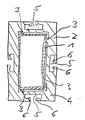
- a sheet profile made of steel is called. It is a hollow profile and has one rectangular cross-section. It is surrounded by an extrusion profile 2, which is also is designed as a hollow profile and has a rectangular cross section.
- Resilient knobs 3 are provided on the inner surface of the extrusion profile allow controlled clamping of the sheet profile in the extrusion profile; at the same time the installation of the sheet profile in the extrusion profile does not significantly hinder.
Landscapes
- Engineering & Computer Science (AREA)
- Mechanical Engineering (AREA)
- Life Sciences & Earth Sciences (AREA)
- Wood Science & Technology (AREA)
- Manufacturing & Machinery (AREA)
- Forests & Forestry (AREA)
- Extrusion Moulding Of Plastics Or The Like (AREA)
- Manufacture Of Porous Articles, And Recovery And Treatment Of Waste Products (AREA)
Applications Claiming Priority (2)
| Application Number | Priority Date | Filing Date | Title |
|---|---|---|---|
| DE10123085A DE10123085A1 (de) | 2001-05-12 | 2001-05-12 | Konstruktionsmaterial für Polstermöbel |
| DE10123085 | 2001-05-12 |
Publications (1)
| Publication Number | Publication Date |
|---|---|
| EP1262294A1 true EP1262294A1 (fr) | 2002-12-04 |
Family
ID=7684511
Family Applications (1)
| Application Number | Title | Priority Date | Filing Date |
|---|---|---|---|
| EP02010527A Withdrawn EP1262294A1 (fr) | 2001-05-12 | 2002-05-10 | Substitut du bois |
Country Status (2)
| Country | Link |
|---|---|
| EP (1) | EP1262294A1 (fr) |
| DE (1) | DE10123085A1 (fr) |
Cited By (6)
| Publication number | Priority date | Publication date | Assignee | Title |
|---|---|---|---|---|
| DE102004010461A1 (de) * | 2004-03-01 | 2005-09-29 | Oechsler Ag | Verfahren zum Herstellen von Strangformen aus kunststoffgebundenen Fasserwerkstoffen, Vorrichtungen zum Ausüben der Verfahren und Werkstoffe zur Verwendung bei den Verfahren |
| WO2008058609A3 (fr) * | 2006-11-15 | 2008-07-10 | Rust & Mitschke Entex | Mélange de matière plastique avec des particules de bois |
| DE102008058048A1 (de) | 2008-11-18 | 2010-08-05 | Entex Rust & Mitschke Gmbh | Mischung von Kunststoff mit Holzpartikeln |
| US9193106B2 (en) | 2006-11-15 | 2015-11-24 | Entex Rust & Mitschke Gmbh | Blend of plastics with wood particles |
| WO2020038598A1 (fr) | 2018-08-21 | 2020-02-27 | Entex Rust & Mitschke Gmbh | Mélange d'un plastique avec des particules de bois dans une extrudeuse |
| WO2023217755A3 (fr) * | 2022-05-09 | 2024-04-04 | Adolf Würth GmbH & Co. KG | Ferrure fonctionnelle ou demi-produit de ferrure fonctionnelle comportant un matériau biogène pour assurer une fonction de liaison et/ou fonction de mouvement |
Families Citing this family (1)
| Publication number | Priority date | Publication date | Assignee | Title |
|---|---|---|---|---|
| DE10310510A1 (de) * | 2003-03-09 | 2005-05-04 | Fagerdala Deutschland Gmbh | Wickelhülsen und Wickeldorne |
Citations (7)
| Publication number | Priority date | Publication date | Assignee | Title |
|---|---|---|---|---|
| EP0028775A1 (fr) * | 1979-11-12 | 1981-05-20 | Gebrüder Kömmerling Kunststoffwerke GmbH | Cadre de battant et/ou dormant pour fenêtres ou portes extérieures ainsi que profilé pour ce cadre |
| US5518677A (en) * | 1993-02-12 | 1996-05-21 | Andersen Corporation | Advanced polymer/wood composite pellet process |
| DE19737647A1 (de) * | 1997-08-29 | 1999-03-04 | Gerd Kruse | Verfahren zur Herstellung eines Polstermöbels |
| US5932334A (en) * | 1992-08-31 | 1999-08-03 | Andersen Corporation | Advanced polymer wood composite |
| US5985429A (en) * | 1992-08-31 | 1999-11-16 | Andersen Corporation | Polymer fiber composite with mechanical properties enhanced by particle size distribution |
| US5997784A (en) * | 1998-01-06 | 1999-12-07 | Karnoski; Wayne | Method of manufacture of wood substitute articles |
| US6003277A (en) * | 1997-04-15 | 1999-12-21 | Newell Industrial Corporation | Co-extruded integrally reinforced cellular PVC window sash |
-
2001
- 2001-05-12 DE DE10123085A patent/DE10123085A1/de not_active Withdrawn
-
2002
- 2002-05-10 EP EP02010527A patent/EP1262294A1/fr not_active Withdrawn
Patent Citations (8)
| Publication number | Priority date | Publication date | Assignee | Title |
|---|---|---|---|---|
| EP0028775A1 (fr) * | 1979-11-12 | 1981-05-20 | Gebrüder Kömmerling Kunststoffwerke GmbH | Cadre de battant et/ou dormant pour fenêtres ou portes extérieures ainsi que profilé pour ce cadre |
| US5932334A (en) * | 1992-08-31 | 1999-08-03 | Andersen Corporation | Advanced polymer wood composite |
| US5985429A (en) * | 1992-08-31 | 1999-11-16 | Andersen Corporation | Polymer fiber composite with mechanical properties enhanced by particle size distribution |
| US5518677A (en) * | 1993-02-12 | 1996-05-21 | Andersen Corporation | Advanced polymer/wood composite pellet process |
| US6003277A (en) * | 1997-04-15 | 1999-12-21 | Newell Industrial Corporation | Co-extruded integrally reinforced cellular PVC window sash |
| DE19737647A1 (de) * | 1997-08-29 | 1999-03-04 | Gerd Kruse | Verfahren zur Herstellung eines Polstermöbels |
| WO1999011161A1 (fr) | 1997-08-29 | 1999-03-11 | Gerd Kruse | Procede de fabrication d'un meuble a rembourrage |
| US5997784A (en) * | 1998-01-06 | 1999-12-07 | Karnoski; Wayne | Method of manufacture of wood substitute articles |
Cited By (8)
| Publication number | Priority date | Publication date | Assignee | Title |
|---|---|---|---|---|
| DE102004010461A1 (de) * | 2004-03-01 | 2005-09-29 | Oechsler Ag | Verfahren zum Herstellen von Strangformen aus kunststoffgebundenen Fasserwerkstoffen, Vorrichtungen zum Ausüben der Verfahren und Werkstoffe zur Verwendung bei den Verfahren |
| WO2008058609A3 (fr) * | 2006-11-15 | 2008-07-10 | Rust & Mitschke Entex | Mélange de matière plastique avec des particules de bois |
| US8293158B2 (en) | 2006-11-15 | 2012-10-23 | Entex Rust & Mitschke Gmbh | Blend of plastics with wood particles |
| US9193106B2 (en) | 2006-11-15 | 2015-11-24 | Entex Rust & Mitschke Gmbh | Blend of plastics with wood particles |
| EP2957412A1 (fr) * | 2006-11-15 | 2015-12-23 | Entex Rust & Mitschke GmbH | Mélange de matière synthétique et particules de bois |
| DE102008058048A1 (de) | 2008-11-18 | 2010-08-05 | Entex Rust & Mitschke Gmbh | Mischung von Kunststoff mit Holzpartikeln |
| WO2020038598A1 (fr) | 2018-08-21 | 2020-02-27 | Entex Rust & Mitschke Gmbh | Mélange d'un plastique avec des particules de bois dans une extrudeuse |
| WO2023217755A3 (fr) * | 2022-05-09 | 2024-04-04 | Adolf Würth GmbH & Co. KG | Ferrure fonctionnelle ou demi-produit de ferrure fonctionnelle comportant un matériau biogène pour assurer une fonction de liaison et/ou fonction de mouvement |
Also Published As
| Publication number | Publication date |
|---|---|
| DE10123085A1 (de) | 2002-11-14 |
Similar Documents
| Publication | Publication Date | Title |
|---|---|---|
| DE69704364T2 (de) | Kunstharz-und holzfaserverbundprofil-extrusionsverfahren | |
| DE69431589T2 (de) | Verfahren und vorrichtung zur herstellung von extrudierbaren synthetischen holz | |
| EP2957412B1 (fr) | Mélange de matière synthétique et particules de bois | |
| EP0447423B1 (fr) | Preforme en dechets de matiere synthetique files ou extrudes | |
| DE69718653T2 (de) | Polymerzusammensetzungen und verfahren zur herstellung von baumaterialien daraus | |
| DE69911762T2 (de) | Verfahren und vorrichtung zur kontinuierlichen herstellung von verbundwerkstoffen aus kunststoff und cellulose fasern | |
| DE69322948T2 (de) | Verfahren zum Extrudieren eines Granulats | |
| DE69210543T2 (de) | Herstellungsverfahren zum Formen eines Verbundproduktes | |
| DE3854646T2 (de) | Mit hanffasern verstärktes thermoplastisches kompositmaterial. | |
| EP0149195B1 (fr) | Mousse composite à peau integrée et son procédé de fabrication | |
| WO2003035373A2 (fr) | Corps moule contenant une matiere plastique et renforcee par des fibres naturelles | |
| EP2207662A1 (fr) | Procédé et dispositif de fabrication en continu d'un extrudé de matériau végétal en fines particules et d'un matériau thermoplastique | |
| EP2530113B1 (fr) | Mousse composite, élément d'isolation thermique en mousse composite et procédé de fabrication d'une mousse composite | |
| DE2514691C3 (de) | Verfahren zum Erzeugen von Zellhohlräumen in thermoplastischen Kunststoffen oder Kunststofformmassen | |
| EP1262294A1 (fr) | Substitut du bois | |
| DE102010011966A1 (de) | Kunststoffschaumplatten aus Polystyrol | |
| EP2033758B1 (fr) | Procédé et dispositif destinés à la fabrication de pièces de formage en matière synthétique renforcées par des fibres | |
| EP3746281B1 (fr) | Profilé extrudé en wpc et dispositif et procédé de fabrication dudit profilé | |
| DE60221272T2 (de) | Zusammensetzung zur herstellung von extrudatformen und verfahren zur herstellung einer derartigen zusammensetzung | |
| EP2060664A1 (fr) | Procédé de fabrication d'un matériau synthétique renforcé par des fibres naturelles | |
| DE102019000610A1 (de) | Mischung von Kunststoff mit Holzpartikeln | |
| WO2003008494A1 (fr) | Matiere de charge a base de fibres de bois destinee a la realisation de corps moules en matiere synthetique | |
| DE19934693A1 (de) | Verfahren und Vorrichtung zur Herstellung von Polymerschäumen | |
| DE60112722T2 (de) | Verfahren zum herstellen von aufprallschutzpaneelen und vorrichtung zum durchführen dieses verfahrens | |
| EP1483091B1 (fr) | Procede de fabrication d'un produit thermoplastique en fibres naturelles |
Legal Events
| Date | Code | Title | Description |
|---|---|---|---|
| PUAI | Public reference made under article 153(3) epc to a published international application that has entered the european phase |
Free format text: ORIGINAL CODE: 0009012 |
|
| 17P | Request for examination filed |
Effective date: 20020701 |
|
| AK | Designated contracting states |
Kind code of ref document: A1 Designated state(s): AT BE CH CY DE DK ES FI FR GB GR IE IT LI LU MC NL PT SE TR |
|
| AX | Request for extension of the european patent |
Free format text: AL;LT;LV;MK;RO;SI |
|
| AKX | Designation fees paid |
Designated state(s): AT BE CH CY DE DK ES FI FR GB GR IE IT LI LU MC NL PT SE TR |
|
| 17Q | First examination report despatched |
Effective date: 20040720 |
|
| STAA | Information on the status of an ep patent application or granted ep patent |
Free format text: STATUS: THE APPLICATION HAS BEEN WITHDRAWN |
|
| 18W | Application withdrawn |
Effective date: 20060125 |