EP1262514B1 - Verfahren zur Verminderung des Gehalts an cyclischen Oligomeren in Polyester - Google Patents
Verfahren zur Verminderung des Gehalts an cyclischen Oligomeren in Polyester Download PDFInfo
- Publication number
- EP1262514B1 EP1262514B1 EP20010112772 EP01112772A EP1262514B1 EP 1262514 B1 EP1262514 B1 EP 1262514B1 EP 20010112772 EP20010112772 EP 20010112772 EP 01112772 A EP01112772 A EP 01112772A EP 1262514 B1 EP1262514 B1 EP 1262514B1
- Authority
- EP
- European Patent Office
- Prior art keywords
- cyclic oligomer
- polyester
- decreasing
- manufacturing
- ppm
- Prior art date
- Legal status (The legal status is an assumption and is not a legal conclusion. Google has not performed a legal analysis and makes no representation as to the accuracy of the status listed.)
- Expired - Lifetime
Links
- 125000004122 cyclic group Chemical group 0.000 title claims description 59
- 229920000728 polyester Polymers 0.000 title claims description 24
- 238000004519 manufacturing process Methods 0.000 title claims description 20
- 230000003247 decreasing effect Effects 0.000 title claims description 10
- 229920000139 polyethylene terephthalate Polymers 0.000 claims description 42
- 239000005020 polyethylene terephthalate Substances 0.000 claims description 42
- 238000000034 method Methods 0.000 claims description 28
- 238000006116 polymerization reaction Methods 0.000 claims description 26
- 239000007787 solid Substances 0.000 claims description 19
- 239000003054 catalyst Substances 0.000 claims description 15
- YBMRDBCBODYGJE-UHFFFAOYSA-N germanium dioxide Chemical compound O=[Ge]=O YBMRDBCBODYGJE-UHFFFAOYSA-N 0.000 claims description 14
- 229910052732 germanium Inorganic materials 0.000 claims description 11
- GNPVGFCGXDBREM-UHFFFAOYSA-N germanium atom Chemical compound [Ge] GNPVGFCGXDBREM-UHFFFAOYSA-N 0.000 claims description 11
- -1 polyethylene terephthalate Polymers 0.000 claims description 11
- 150000001875 compounds Chemical class 0.000 claims description 9
- OAICVXFJPJFONN-UHFFFAOYSA-N Phosphorus Chemical compound [P] OAICVXFJPJFONN-UHFFFAOYSA-N 0.000 claims description 8
- 230000001965 increasing effect Effects 0.000 claims description 8
- 229910052698 phosphorus Inorganic materials 0.000 claims description 8
- 239000011574 phosphorus Substances 0.000 claims description 8
- JVLRYPRBKSMEBF-UHFFFAOYSA-K diacetyloxystibanyl acetate Chemical compound [Sb+3].CC([O-])=O.CC([O-])=O.CC([O-])=O JVLRYPRBKSMEBF-UHFFFAOYSA-K 0.000 claims description 6
- 229940119177 germanium dioxide Drugs 0.000 claims description 5
- RTAQQCXQSZGOHL-UHFFFAOYSA-N Titanium Chemical compound [Ti] RTAQQCXQSZGOHL-UHFFFAOYSA-N 0.000 claims description 4
- ADCOVFLJGNWWNZ-UHFFFAOYSA-N antimony trioxide Chemical compound O=[Sb]O[Sb]=O ADCOVFLJGNWWNZ-UHFFFAOYSA-N 0.000 claims description 4
- 238000010438 heat treatment Methods 0.000 claims description 4
- 238000010309 melting process Methods 0.000 claims description 4
- 239000010936 titanium Substances 0.000 claims description 4
- 229910052719 titanium Inorganic materials 0.000 claims description 4
- 229910052787 antimony Inorganic materials 0.000 claims description 3
- WATWJIUSRGPENY-UHFFFAOYSA-N antimony atom Chemical compound [Sb] WATWJIUSRGPENY-UHFFFAOYSA-N 0.000 claims description 3
- 210000002257 embryonic structure Anatomy 0.000 claims description 3
- 238000006068 polycondensation reaction Methods 0.000 claims description 3
- ZKISKMWPKAIYQL-UHFFFAOYSA-N CCCC[Ti](CCCC)(CCCC)CCCC.O Chemical compound CCCC[Ti](CCCC)(CCCC)CCCC.O ZKISKMWPKAIYQL-UHFFFAOYSA-N 0.000 claims description 2
- QQXSEZVCKAEYQJ-UHFFFAOYSA-N tetraethylgermanium Chemical compound CC[Ge](CC)(CC)CC QQXSEZVCKAEYQJ-UHFFFAOYSA-N 0.000 claims description 2
- LYCAIKOWRPUZTN-UHFFFAOYSA-N Ethylene glycol Chemical group OCCO LYCAIKOWRPUZTN-UHFFFAOYSA-N 0.000 description 30
- NBIIXXVUZAFLBC-UHFFFAOYSA-N Phosphoric acid Chemical compound OP(O)(O)=O NBIIXXVUZAFLBC-UHFFFAOYSA-N 0.000 description 24
- 239000000654 additive Substances 0.000 description 20
- 239000013638 trimer Substances 0.000 description 20
- KKEYFWRCBNTPAC-UHFFFAOYSA-N Terephthalic acid Chemical compound OC(=O)C1=CC=C(C(O)=O)C=C1 KKEYFWRCBNTPAC-UHFFFAOYSA-N 0.000 description 19
- 230000000996 additive effect Effects 0.000 description 19
- 229910000147 aluminium phosphate Inorganic materials 0.000 description 12
- 229920000642 polymer Polymers 0.000 description 12
- 230000032050 esterification Effects 0.000 description 10
- 238000005886 esterification reaction Methods 0.000 description 10
- 230000007423 decrease Effects 0.000 description 7
- 238000006243 chemical reaction Methods 0.000 description 6
- QQVIHTHCMHWDBS-UHFFFAOYSA-N isophthalic acid Chemical compound OC(=O)C1=CC=CC(C(O)=O)=C1 QQVIHTHCMHWDBS-UHFFFAOYSA-N 0.000 description 6
- 239000000843 powder Substances 0.000 description 6
- 239000002253 acid Substances 0.000 description 5
- 230000000052 comparative effect Effects 0.000 description 5
- 230000015572 biosynthetic process Effects 0.000 description 4
- MTHSVFCYNBDYFN-UHFFFAOYSA-N diethylene glycol Chemical compound OCCOCCO MTHSVFCYNBDYFN-UHFFFAOYSA-N 0.000 description 4
- 239000007788 liquid Substances 0.000 description 4
- 239000000047 product Substances 0.000 description 4
- 238000003786 synthesis reaction Methods 0.000 description 4
- QAHREYKOYSIQPH-UHFFFAOYSA-L cobalt(II) acetate Chemical compound [Co+2].CC([O-])=O.CC([O-])=O QAHREYKOYSIQPH-UHFFFAOYSA-L 0.000 description 3
- 229920001577 copolymer Polymers 0.000 description 3
- 238000002425 crystallisation Methods 0.000 description 3
- 230000008025 crystallization Effects 0.000 description 3
- 150000002148 esters Chemical class 0.000 description 3
- 210000001161 mammalian embryo Anatomy 0.000 description 3
- 239000000463 material Substances 0.000 description 3
- 238000002156 mixing Methods 0.000 description 3
- 239000002994 raw material Substances 0.000 description 3
- 238000007086 side reaction Methods 0.000 description 3
- WOZVHXUHUFLZGK-UHFFFAOYSA-N terephthalic acid dimethyl ester Natural products COC(=O)C1=CC=C(C(=O)OC)C=C1 WOZVHXUHUFLZGK-UHFFFAOYSA-N 0.000 description 3
- IKHGUXGNUITLKF-UHFFFAOYSA-N Acetaldehyde Chemical compound CC=O IKHGUXGNUITLKF-UHFFFAOYSA-N 0.000 description 2
- IJGRMHOSHXDMSA-UHFFFAOYSA-N Atomic nitrogen Chemical compound N#N IJGRMHOSHXDMSA-UHFFFAOYSA-N 0.000 description 2
- CURLTUGMZLYLDI-UHFFFAOYSA-N Carbon dioxide Chemical compound O=C=O CURLTUGMZLYLDI-UHFFFAOYSA-N 0.000 description 2
- 229910052784 alkaline earth metal Inorganic materials 0.000 description 2
- 150000001342 alkaline earth metals Chemical class 0.000 description 2
- FAWGZAFXDJGWBB-UHFFFAOYSA-N antimony(3+) Chemical compound [Sb+3] FAWGZAFXDJGWBB-UHFFFAOYSA-N 0.000 description 2
- 238000001816 cooling Methods 0.000 description 2
- 229910001873 dinitrogen Inorganic materials 0.000 description 2
- 239000000835 fiber Substances 0.000 description 2
- 238000002844 melting Methods 0.000 description 2
- 230000008018 melting Effects 0.000 description 2
- 229910052757 nitrogen Inorganic materials 0.000 description 2
- 238000004806 packaging method and process Methods 0.000 description 2
- 239000011347 resin Substances 0.000 description 2
- 229920005989 resin Polymers 0.000 description 2
- 238000003756 stirring Methods 0.000 description 2
- 238000001291 vacuum drying Methods 0.000 description 2
- BYEAHWXPCBROCE-UHFFFAOYSA-N 1,1,1,3,3,3-hexafluoropropan-2-ol Chemical compound FC(F)(F)C(O)C(F)(F)F BYEAHWXPCBROCE-UHFFFAOYSA-N 0.000 description 1
- RYHBNJHYFVUHQT-UHFFFAOYSA-N 1,4-Dioxane Chemical compound C1COCCO1 RYHBNJHYFVUHQT-UHFFFAOYSA-N 0.000 description 1
- 229930185605 Bisphenol Natural products 0.000 description 1
- 0 C*P(Cc(cc1*(C)C)cc(*(C)=C)c1O)(O)=O Chemical compound C*P(Cc(cc1*(C)C)cc(*(C)=C)c1O)(O)=O 0.000 description 1
- 241000580063 Ipomopsis rubra Species 0.000 description 1
- 239000004594 Masterbatch (MB) Substances 0.000 description 1
- 229910019142 PO4 Inorganic materials 0.000 description 1
- 239000004698 Polyethylene Substances 0.000 description 1
- 239000004743 Polypropylene Substances 0.000 description 1
- 229910006127 SO3X Inorganic materials 0.000 description 1
- HCHKCACWOHOZIP-UHFFFAOYSA-N Zinc Chemical compound [Zn] HCHKCACWOHOZIP-UHFFFAOYSA-N 0.000 description 1
- IKHGUXGNUITLKF-XPULMUKRSA-N acetaldehyde Chemical compound [14CH]([14CH3])=O IKHGUXGNUITLKF-XPULMUKRSA-N 0.000 description 1
- 229910052783 alkali metal Inorganic materials 0.000 description 1
- 150000001340 alkali metals Chemical class 0.000 description 1
- 125000002947 alkylene group Chemical group 0.000 description 1
- 235000013405 beer Nutrition 0.000 description 1
- 235000013361 beverage Nutrition 0.000 description 1
- IISBACLAFKSPIT-UHFFFAOYSA-N bisphenol A Chemical compound C=1C=C(O)C=CC=1C(C)(C)C1=CC=C(O)C=C1 IISBACLAFKSPIT-UHFFFAOYSA-N 0.000 description 1
- 238000000071 blow moulding Methods 0.000 description 1
- 238000009835 boiling Methods 0.000 description 1
- VSGNNIFQASZAOI-UHFFFAOYSA-L calcium acetate Chemical compound [Ca+2].CC([O-])=O.CC([O-])=O VSGNNIFQASZAOI-UHFFFAOYSA-L 0.000 description 1
- 239000001639 calcium acetate Substances 0.000 description 1
- 229960005147 calcium acetate Drugs 0.000 description 1
- 235000011092 calcium acetate Nutrition 0.000 description 1
- 239000001569 carbon dioxide Substances 0.000 description 1
- 229910002092 carbon dioxide Inorganic materials 0.000 description 1
- VEIOBOXBGYWJIT-UHFFFAOYSA-N cyclohexane;methanol Chemical compound OC.OC.C1CCCCC1 VEIOBOXBGYWJIT-UHFFFAOYSA-N 0.000 description 1
- 239000003599 detergent Substances 0.000 description 1
- BTVWZWFKMIUSGS-UHFFFAOYSA-N dimethylethyleneglycol Natural products CC(C)(O)CO BTVWZWFKMIUSGS-UHFFFAOYSA-N 0.000 description 1
- 230000000694 effects Effects 0.000 description 1
- 230000005611 electricity Effects 0.000 description 1
- 239000000706 filtrate Substances 0.000 description 1
- 239000012760 heat stabilizer Substances 0.000 description 1
- 239000011261 inert gas Substances 0.000 description 1
- 239000000314 lubricant Substances 0.000 description 1
- PJJZFXPJNUVBMR-UHFFFAOYSA-L magnesium benzoate Chemical compound [Mg+2].[O-]C(=O)C1=CC=CC=C1.[O-]C(=O)C1=CC=CC=C1 PJJZFXPJNUVBMR-UHFFFAOYSA-L 0.000 description 1
- 238000010128 melt processing Methods 0.000 description 1
- 229910052751 metal Inorganic materials 0.000 description 1
- 239000002184 metal Substances 0.000 description 1
- WSFSSNUMVMOOMR-NJFSPNSNSA-N methanone Chemical compound O=[14CH2] WSFSSNUMVMOOMR-NJFSPNSNSA-N 0.000 description 1
- 229920006280 packaging film Polymers 0.000 description 1
- 239000012785 packaging film Substances 0.000 description 1
- NBIIXXVUZAFLBC-UHFFFAOYSA-K phosphate Chemical compound [O-]P([O-])([O-])=O NBIIXXVUZAFLBC-UHFFFAOYSA-K 0.000 description 1
- 239000010452 phosphate Substances 0.000 description 1
- 229920001515 polyalkylene glycol Polymers 0.000 description 1
- 229920006267 polyester film Polymers 0.000 description 1
- 229920000573 polyethylene Polymers 0.000 description 1
- 229920001155 polypropylene Polymers 0.000 description 1
- 229920002635 polyurethane Polymers 0.000 description 1
- 239000004814 polyurethane Substances 0.000 description 1
- 230000035484 reaction time Effects 0.000 description 1
- 230000001172 regenerating effect Effects 0.000 description 1
- 230000008929 regeneration Effects 0.000 description 1
- 238000011069 regeneration method Methods 0.000 description 1
- 239000002904 solvent Substances 0.000 description 1
- 230000003068 static effect Effects 0.000 description 1
- 230000002194 synthesizing effect Effects 0.000 description 1
- ISIJQEHRDSCQIU-UHFFFAOYSA-N tert-butyl 2,7-diazaspiro[4.5]decane-7-carboxylate Chemical compound C1N(C(=O)OC(C)(C)C)CCCC11CNCC1 ISIJQEHRDSCQIU-UHFFFAOYSA-N 0.000 description 1
- 238000005809 transesterification reaction Methods 0.000 description 1
- XLYOFNOQVPJJNP-UHFFFAOYSA-N water Substances O XLYOFNOQVPJJNP-UHFFFAOYSA-N 0.000 description 1
Classifications
-
- C—CHEMISTRY; METALLURGY
- C08—ORGANIC MACROMOLECULAR COMPOUNDS; THEIR PREPARATION OR CHEMICAL WORKING-UP; COMPOSITIONS BASED THEREON
- C08G—MACROMOLECULAR COMPOUNDS OBTAINED OTHERWISE THAN BY REACTIONS ONLY INVOLVING UNSATURATED CARBON-TO-CARBON BONDS
- C08G63/00—Macromolecular compounds obtained by reactions forming a carboxylic ester link in the main chain of the macromolecule
- C08G63/78—Preparation processes
- C08G63/82—Preparation processes characterised by the catalyst used
- C08G63/85—Germanium, tin, lead, arsenic, antimony, bismuth, titanium, zirconium, hafnium, vanadium, niobium, tantalum, or compounds thereof
-
- C—CHEMISTRY; METALLURGY
- C08—ORGANIC MACROMOLECULAR COMPOUNDS; THEIR PREPARATION OR CHEMICAL WORKING-UP; COMPOSITIONS BASED THEREON
- C08K—Use of inorganic or non-macromolecular organic substances as compounding ingredients
- C08K5/00—Use of organic ingredients
- C08K5/49—Phosphorus-containing compounds
- C08K5/51—Phosphorus bound to oxygen
- C08K5/53—Phosphorus bound to oxygen bound to oxygen and to carbon only
- C08K5/5317—Phosphonic compounds, e.g. R—P(:O)(OR')2
Definitions
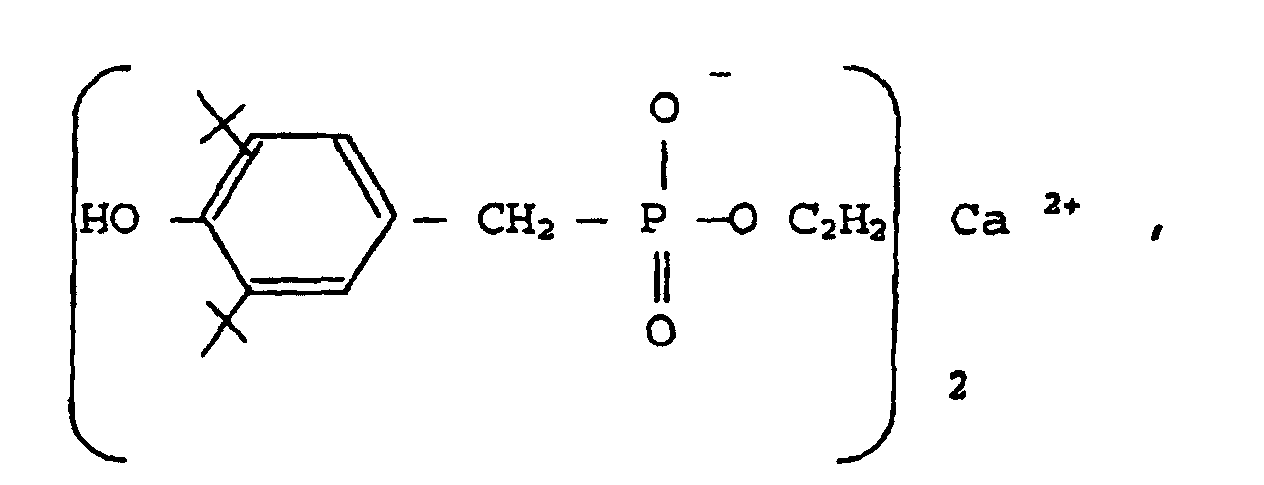
- the present invention relates to a manufacturing method which effectively restrains the production of the cyclic oligomer in ester chips and further decreases the amount of regenerated cyclic oligomer at the melt processing stage by adding the additive, during the process of manufacturing polyethylene terephthalate, with the following structure: ; the polymer of the present invention can be further processed to manufacture polyester products such as bottles, fibers, film, and laminates.
- polyester bottles mentioned in the present invention are given to illustrate but not to limit the invention.
- PET Polyethylene terephthalate
- PET Polyethylene terephthalate
- polyester bottles are massively used in packaging various kinds of food, beverage, and detergent, which contributes to the sky-rocket growth both in its consumption and in its production.
- the cyclic oligomer mainly cyclic trimer
- This sort of oligomer is white crystallized powder with a melting point of 319 .degree.C. so as to pollute the mold while processed; consequently, the production line needs to be shut down and cleaned.
- PET can be manufactured into various kinds of bottle while applied to food packaging such as the bottle for heat resistance, in which the temperature of the content is above 80 .degree.C., or into the bottom plate of packaging film which can be applied to a microwave oven or an oven, or into PET bottles used as beer containers which need to be pasteurized.
- the above said applications put PET high molecular compound in an environment of high temperature, which causes the residual oligomer, particularly cyclic oligomer ( mainly cyclic trimer ), in the high molecular compound to have a potential to transfer to the packaged content so as to hazard human health.
- the said oligomer is either produced from the side reaction of PET synthesis procedure or regenerated from processing procedure.
- the present invention adds a compound containing phosphorus which effectively restrains the production of the cyclic oligomer produced from the side reaction during PET synthesis procedure and further effectively restrains the regeneration of cyclic oligomer during processing procedure.
- Japan Publication No.12-219731 discloses that while the ratio of mole number of SO 3 X compound to that of metal such as antimony, or titanium, or germanium, or zink is higher than 0.01, the produced cyclic oligomer content in the melted state polymerized PET can be effectively restrained.
- Japan Publication No. 12-204229 discloses that to add 200 ⁇ 10,000 ppm of alkali metals or alkaline-earth metals such as calcium acetate or magnesium benzoate into the PET containing germanium catalyst can effectively restrain the production of cyclic oligomer.
- Japan Publication No.12-219729 discloses that while the antimony element is 0.5 X 10 -4 ⁇ 4 X 10 -4 moles relative to the acid component of PET, the phosphoric acid is added until the phosphorus element is 1 X 10 -4 ⁇ 5 X 10 -4 moles relative to the acid component of PET, wherein the mole ratio of antimony element to phosphorus element is 1 ⁇ 3, so as to effectively restrain the cyclic trimer down to 0.35 weight% or lower.
- Japan Publication No.12-198937 discloses that while the germanium element is 0.5 X 10 -4 ⁇ 3 X 10 -4 moles relative to the acid component of PET, the phosphoric acid is added until the phosphorus element is 1 X 10 -4 ⁇ 7 X 10 -4 moles relative to the acid component of PET, wherein the mole ratio of germanium element to phosphorus element is greater than 1.6, so as to effectively restrain the cyclic trimer down to below 0.4 weight%.
- Japan Publication No. 12-7767 discloses that the intrinsic viscosity of raw chips before solid state polymerization is between 0.45 - 0.65 dl/g. While the ethylene glycol end group content is between 90 ⁇ 140 equivalent/10 -6 gram and the pressure is below 200 Pa and the temperature is 230 .degree.C. and the solid state polymerization reaction time is 20 hours, the decreasing rate of cyclic trimer is bigger than 300 ppm/hour. While the ethylene glycol end group content is lower than 90 equivalent/10 -6 gram, the decreasing rate of cyclic trimer is lower; however, solid state polymerization rate is bigger. While the ethylene glycol end group content is higher than 140 equivalent/10 -6 gram, the effect is opposite.
- the control method on the ethylene glycol end group content is to adjust the conversion rate of esterification such as to adjust the mole ratio of ethylene glycol to terephthalic acid, esterification temperature, pressure, residence time, or to adjust polycondensation reaction temperature, time, vacuum intensity, quantity of added catalyst, or further to adjust the intrinsic viscosity of polyester raw chips.
- Japan Publication No. 12-80284 discloses that PET chips proceeds melt blending with heat plasticized resin masterbatch which contains one of the following three structural compounds: alkylene oxide, or polyalkylene glycol, or bisphenol.
- the obtained resin is melted at 280 .degree.C. for five minutes.
- the analyzed cyclic trimer content of the product is lower than 0.5 weight% which is lower than that of the PET obtained from the process without said structural compounds.
- Japan Publication No.11-181257 and Japan Publication No.9-151308 disclose that while the intrinsic viscosity is 0.7 ⁇ 0.9 dl/g, and the DEG content is 1 ⁇ 3 mole%, and the cyclic trimer content of ester chips is lower than 0.4 wt%, add a slight amount of one of the following three compounds: polyethylene, or polypropylene, or polyurethane to appropriately accelerate crystallization rate lest the constant heating temperature should be increased, due to the crystallization speed being too slow while blow-molded, consequently the cyclic trimer is produced so much as to pollute the mold.
- the melted ester chip is analyzed by a differential scan measuring instrument. The pollution of white powder is effectively restrained while the crystallization peak temperature for temperature increasing stage is between 155 ⁇ 168 .degree.C. and that for temperature decreasing stage is between 165 ⁇ 180 degree.C.
- Japan Publication No.11-80520 discloses that the situation of pollution on mold during blow-molding is improved while the amide compound, with a content of 1/300 ⁇ 1/2 of cyclic trimer wt%, is added into solid state polymerized PET.
- Japan Publication No.10-259245 discloses that in PET melt polymerization process, antimony acetate is added. While the intrinsic viscosity reaches 0.35 dl/g or higher, phosphoric acid or phosphoric acid monoester is added; the production of cyclic trimer decreases when melt molded.
- Japan Publication No.10-168168 discloses a process of producing the copolymer using terephthalic acid, ethylene glycol , and DEG with 2 ⁇ 4 wt% based on PET.
- the time point of the addition of amorphous state germanium dioxide catalyst is while the esterification ratio reaches above 90 percent so as to reduce the production of formaldehyde, acetaldehyde, and cyclic trimer while molded.
- Japan Publication No.9-221540 discloses that while the DEG content of PET chips is 1 ⁇ 4 mole%, and the intrinsic viscosity is 0.60 ⁇ 0.90 dl/g, and the phosphoric acid content relative to PET is 5 ⁇ 25 ppm, and germanium content of germanium calyst relative to PET is 20 ⁇ 60 ppm, and the mole ratio of germanium element content to phosphorus element content is between 0.4 ⁇ 1.5, the acetaldehyde content of solid state polymerized polyester chips is below 4 ppm and the cyclic trimer content is lower than 0.5 wt%.
- Japan Publication No.9-296029 and Japan Publication No 10-110026 disclose that while the intrinsic viscosity of PET is greater than 0.5 dl/g, and germanium element relative to acid component is 5 X 10 -6 ⁇ 1 X 10 -3 moles and 1 X 10 -5 ⁇ 2 X 10 -3 moles respectively, and the alkaline-earth metal atom content relative to PET is 1 X 10 -4 ⁇ 5 X 10 -3 moles, the cyclic trimer content is low and the regenerated cyclic trimer from melting process is little.
- Japan Publication No.59-25815, Japan Publication No.3-174441, Japan Publication No.6-234834, and Japan Publication No.3-47830 disclose a process that PET is treated by boiling water with 90 ⁇ 110 .degree.C. or higher to crystallize before solid state polymerization, by which the residule cyclic oligomer in PET chips and the regenerated cyclic oligomer during processing can be reduced.
- Japan Publication No. 53-101092 Japan Publication No. 55-89830, and Japan Publication No. 55-89831 disclose that to adjust the nitrogen gas flow and pressure of solid state polymerization can restrain the increasing rate of intrinsic viscosity, which reduces the content of cyclic oligomer.
- the PET of the present invention can be obtained from the synthesis of PTA process in which purified terephthalic acid and ethylene glycol proceed with direct esterification and then melted polymerization, or from the synthesis of DMT process in which dimethyl terephthalate and ethylene glycol proceed with transesterification and then melted polymerization.
- the viscosity of PET obtained from each of said processes is further increased to an appropriate level by solid state polymerization.
- the PTA process is preferable for the present invention.
- the present invention adds, during the melting reaction stage of synthesizing PET, a powder compound containing phosphorus ( hereinafter called PI ) with the following structure: , which is obviously different from said prior arts.
- PI powder compound containing phosphorus
- PI can be added into raw material blending tank of PTA process (i.e., into the thick liquid of purified terephthalic acid and ethylene glycol ) or into the esterification procedure of purified terephthalic acid and ethylene glycol or into the stage after esterification and before polymerization.
- the amount of PI addition is 50 ppm ⁇ 3000 ppm based on polymer weight, most preferably 500 ppm ⁇ 1000 ppm.
- PI can be added directly in powder form or can be blended with ethylene glycol truning out to be clear solution.
- concentration of the solution is 0.1 ⁇ 10 %, preferably 1 ⁇ 5 %, more preferably 2 ⁇ 4 %.
- the blending temperature is preferably lower than 100 .degree.C., more preferably normal temperature.
- the PET of the present invention is further added with heat stabilizer ( hereinafter called PII) such as phosphoric acid, phosphorous acid, or phosphate.
- PII heat stabilizer
- the amount of addition is 50 ⁇ 350 ppm, most preferably 100 ⁇ 200 ppm.
- the catalyst for PET of the present invention is antimony catalyst such as antimony trioxide, antimony acetate or germanium catalyst such as germanium dioxide, tetraethyl germanium oxide, n-tetrabutyl germanium oxide or titanium catalyst such as tetrabutyl titanium oxide.
- the needed amount of addition is 10 ⁇ 600 ppm, most preferably 50 ⁇ 500 ppm.
- the present invention is particularly valuable to germanium catalyst and titanium catalyst with higher activeness since they are apt to produce more cyclic oligomer.
- the PET of the present invention can be either homogeneous polymer or copolymer such as a copolymer of diethylene glycol ( DEG ), isophthalic acid (IPA ), and cyclohexane dimethanol.
- DEG diethylene glycol
- IPA isophthalic acid
- cyclohexane dimethanol a copolymer of cyclohexane dimethanol.
- the PET of the present invention can be added with additives such as toner, static electricity preventer, and lubricant.
- the PET of the present invention is first manufactured to chips with intrinsic viscosity of 0.45 ⁇ 0.65 by melted state polymerization; then, the intrinsic viscosity of which is increased to above 0.70 by solid state polymerization.
- the solid state polymerization can utilize stirring or tower tank through which an inert gas such as nitrogen gas or carbon dioxide is led, or can utilize revolving tank operated at vacuum environment.
- the present invention further improves disadvantages of prior arts which decrease the intrinsic viscosity of raw chips and lengthen the solid state polymerization time to reduce the residual of cyclic oligomer; however, the consequences are declining of productivity and product turning yellow color.
- the present invention decreases the cyclic oligomer without decreasing the intrinsic viscosity of raw chips and without lengthening the solid state polymerization.
- the present invention which uses PI as additive can effectively decrease cyclic oligomer even in higher intrinsic viscosity.
- the added PI can further increase the reaction rate of solid state polymerization.
- the PET of the present invention after solid state polymerization to the level of preset intrinsic viscosity, is analyzed the residual cyclic oligomer.
- the PET of the present invention is manufactured, by an ejector with model of ASB 50H, into bottle embryo which is then analyzed the cyclic oligomer regenerated from melting process.
- the method of analyzing cyclic oligomer for the present invention is as follows: Accurately weigh 1000 grams of sample. Dissolve the sample by hexafluoroisopropyl alcohol solvent. Filter the solution. The filtrate is then evaporated to obtain white crystallized powder of cyclic oligomer. The obtained white powder is dissolved by dioxane and then analyzed by a high efficient liquid chromatographer to measure the respective content of cyclic trimer, cyclic tetramer, cyclic pentamer, cyclic hexamer, cyclic heptamer, wherein mainly the cyclic trimer.
- the content of cyclic oligomer is the summation of said cyclic tri-, tetra-, penta-, hexa-, hepta-mers.
- Said raw chips are loaded in a twin-awl revolving vacuum drying tank.
- Vacuum intensity is 1 ⁇ 2 torr.
- the polyester chips are heated by the following steps: first, 100 .degree.C. for two hours, then raise the temperature to 180 .degree.C. and heat for four hours, then raise the heating temperature to 225 .degree.C. and while the material temperature reaches above 200 .degree.C., start to count the time. While the intrinsic viscosity increases to about 0.75 dl/g, stop heating and cool down immediately.
- Example 1 Example 2
- Example 3 Comparative example 1 PI additive ( ppm ) 500 300 100 Without addition
- Intrinsic viscosity ( dl/g ) 0.748 0.745 0.750 0.751
- Color ( Hunter ) L 88.5 88.1 88.1 88.3 a -1.3 -1.6 -1.2 -1.5 b -0.5 -0.1 +0.6 +0.6
- Solid state polymerization time (hr ) 18 19 20 20
- the added mole ratio ofEG/PTA is 1.5.
- the quantity of PTA is 10.38 kg.
- the isophthalic acid is not added.
- Said materials are blended into thick liquid.
- PI additive and phosphoric acid are blended with ethylene glycol previously.
- the blended concentration of PI is 2.5 wt%.
- the amount of added PI additive is 1000 ppm based on the weight of polymer.
- the amount of added phosphoric acid is 140 ppm based on the weight of polymer.
- the amount of added germanium dioxide is 130 ppm based on the weight of polymer. Proceed with the same polymerization procedures as those of Example 1. While the intrinsic viscosity reaches 0.60 dl/g, the polymer is unloaded to cooling tank and is cut into raw chips with column shape.
- Said raw chips are loaded in a twin-awl revolving vacuum drying tank. Heat the polyester chips with the same procedures as those of Example 1 until the intrinsic viscosity is increased to about 0.72 dl/g.
- Example 4 Example 5
- Example 6 Comparative example 2 PI additive ( ppm ) 1000 1500 3000 Without addition
- Intrinsic viscosity ( dl/g ) 0.718 0.723 0.725 0.721 Color ( Hunter ) L 97.1 96.5 96.1 97.5 a +0.3 +0.3 +0.2 +0.5 b +2.5 +1.5 +0.7 +3.1
- Solid state polymerization time (hr ) 24 21 18 28 Polyester chips Content of cyclic oligomer 0.753% 0.872% 0.917% 0.925% Content of cyclic trimer 0.541% 0.689% 0.669% 0.657% Bottle embryo Content of cyclic oligomer 0.772% N.
- adding PI additive can decrease the content of cyclic oligomer in polyester chips and can restrain the cyclic oligomer from regenerating while manufacturing embryo at processing stage.
- adding PI additive has an increasing effect on the solid state polymerization rate of polyester chips, and polyester chips which contain PI additive have lower cyclic oligomer though they have shorter solid state polymerization time.
Landscapes
- Chemical & Material Sciences (AREA)
- Health & Medical Sciences (AREA)
- Chemical Kinetics & Catalysis (AREA)
- Medicinal Chemistry (AREA)
- Polymers & Plastics (AREA)
- Organic Chemistry (AREA)
- Polyesters Or Polycarbonates (AREA)
Claims (5)
- Herstellungsverfahren zur Herabsetzung des zyklischen Oligomergehalts in Polyester, welches während des Schmelzprozesses des Polyethylenterephthalats die Zugabe einer Verbindung umfasst, welche Phosphor enthält, PI genannt wird, und folgende Struktur aufweist:wobei die Menge des zugegebenen PI 50 - 3000 ppm beträgt, bezogen auf das Gewicht des Polyethylenterephthalats, wobei die hergestellten Polyethylenterephthalat-Chips weniger zyklische Oligomerrückstände enthalten als jene, die mit einem Verfahren ohne Zusatz von PI hergestellt sind.
- Herstellungsverfahren zur Herabsetzung des zyklischen Oligomergehalts in Polyester gemäß Anspruch 1, wobei die intrinsische Viskosität der hergestellten Polyethylenterephthalat-Chips nach der Festphasenpolymerisation auf mehr als 0,70 dl/g erhöht werden kann.
- Herstellungsverfahren zur Herabsetzung des zyklischen Oligomergehalts in Polyester gemäß Anspruch 2, wobei die hergestellten Flaschenkeimlinge nach dem Schmelzerwärmen weniger regeneriertes zyklisches Oligomer aufweisen als jene, die von Chips ohne Zusatz von PI hergestellt worden sind.
- Herstellungsverfahren zur Herabsetzung des zyklischen Oligomergehalts in Polyester gemäß Anspruch 1, wobei der Polykondensationskatalysator, der für den Schmelzprozess des Polyethylenterephthalats verwendet wird, ausgewählt werden kann aus einem Antimonkatalysator, wie Antimontrioxid, Antimonacetat oder einem Germaniumkatalysator, wie Germaniumdioxid, Tetraethylgermaniumoxid, n-Tetrabutylgermaniumoxid oder einem Titankatalysator, wie Tetrabutyltitanoxid, wobei die zugegebene Menge 10 - 600 ppm beträgt.
- Herstellungsverfahren zur Herabsetzung des zyklischen Oligomergehalts in Polyester gemäß Anspruch 4, wobei die Menge des Polykondensationskatalysators besonders bevorzugt 50 - 50 ppm beträgt.
Priority Applications (3)
| Application Number | Priority Date | Filing Date | Title |
|---|---|---|---|
| ES01112772T ES2239078T3 (es) | 2001-05-26 | 2001-05-26 | Metodo para disminuir la concentracion de oligomeros ciclicos en los poliesteres. |
| EP20010112772 EP1262514B1 (de) | 2001-05-26 | 2001-05-26 | Verfahren zur Verminderung des Gehalts an cyclischen Oligomeren in Polyester |
| DE2001609755 DE60109755T2 (de) | 2001-05-26 | 2001-05-26 | Verfahren zur Verminderung des Gehalts an cyclischen Oligomeren in Polyester |
Applications Claiming Priority (1)
| Application Number | Priority Date | Filing Date | Title |
|---|---|---|---|
| EP20010112772 EP1262514B1 (de) | 2001-05-26 | 2001-05-26 | Verfahren zur Verminderung des Gehalts an cyclischen Oligomeren in Polyester |
Publications (2)
| Publication Number | Publication Date |
|---|---|
| EP1262514A1 EP1262514A1 (de) | 2002-12-04 |
| EP1262514B1 true EP1262514B1 (de) | 2005-03-30 |
Family
ID=8177553
Family Applications (1)
| Application Number | Title | Priority Date | Filing Date |
|---|---|---|---|
| EP20010112772 Expired - Lifetime EP1262514B1 (de) | 2001-05-26 | 2001-05-26 | Verfahren zur Verminderung des Gehalts an cyclischen Oligomeren in Polyester |
Country Status (3)
| Country | Link |
|---|---|
| EP (1) | EP1262514B1 (de) |
| DE (1) | DE60109755T2 (de) |
| ES (1) | ES2239078T3 (de) |
Families Citing this family (9)
| Publication number | Priority date | Publication date | Assignee | Title |
|---|---|---|---|---|
| CN114019073A (zh) * | 2021-10-13 | 2022-02-08 | 上海工程技术大学 | 用hplc定量检测含pet的产品中低聚物含量的方法 |
| WO2025110225A1 (ja) * | 2023-11-22 | 2025-05-30 | 東洋製罐グループホールディングス株式会社 | ポリエステル樹脂、成形体、プリフォーム、ポリエステルボトル、及びメカニカルリサイクルポリエステル樹脂 |
| JP2025084422A (ja) * | 2023-11-22 | 2025-06-03 | 東洋製罐グループホールディングス株式会社 | ポリエステル樹脂、成形体、プリフォーム、ポリエステルボトル、及びメカニカルリサイクルポリエステル樹脂 |
| JP2025084487A (ja) * | 2023-11-22 | 2025-06-03 | 東洋製罐グループホールディングス株式会社 | ポリエステル樹脂、成形体、プリフォーム、ポリエステルボトル、及びメカニカルリサイクルポリエステル樹脂 |
| JP2025084433A (ja) * | 2023-11-22 | 2025-06-03 | 東洋製罐グループホールディングス株式会社 | ポリエステル樹脂、成形体、プリフォーム、ポリエステルボトル、及びメカニカルリサイクルポリエステル樹脂 |
| JP2025084479A (ja) * | 2023-11-22 | 2025-06-03 | 東洋製罐グループホールディングス株式会社 | ポリエステル樹脂、成形体、プリフォーム、ポリエステルボトル、及びメカニカルリサイクルポリエステル樹脂 |
| JP2025084437A (ja) * | 2023-11-22 | 2025-06-03 | 東洋製罐グループホールディングス株式会社 | ポリエステル樹脂、成形体、プリフォーム、ポリエステルボトル、及びメカニカルリサイクルポリエステル樹脂 |
| JP2025084471A (ja) * | 2023-11-22 | 2025-06-03 | 東洋製罐グループホールディングス株式会社 | ポリエステル樹脂、成形体、プリフォーム、ポリエステルボトル、及びメカニカルリサイクルポリエステル樹脂 |
| WO2025110224A1 (ja) * | 2023-11-22 | 2025-05-30 | 東洋製罐グループホールディングス株式会社 | ポリエステル樹脂、成形体、プリフォーム、ポリエステルボトル、及びメカニカルリサイクルポリエステル樹脂 |
Family Cites Families (3)
| Publication number | Priority date | Publication date | Assignee | Title |
|---|---|---|---|---|
| NL125300C (de) * | 1961-04-14 | |||
| DE19631068B4 (de) * | 1996-08-01 | 2006-06-01 | Zimmer Ag | Verfahren zur Beschleunigung der Polykondensation von Polyester |
| MY119540A (en) * | 1998-04-24 | 2005-06-30 | Ciba Spacialty Chemicals Holding Inc | Increasing the molecular weight of polyesters |
-
2001
- 2001-05-26 DE DE2001609755 patent/DE60109755T2/de not_active Expired - Fee Related
- 2001-05-26 ES ES01112772T patent/ES2239078T3/es not_active Expired - Lifetime
- 2001-05-26 EP EP20010112772 patent/EP1262514B1/de not_active Expired - Lifetime
Also Published As
| Publication number | Publication date |
|---|---|
| EP1262514A1 (de) | 2002-12-04 |
| DE60109755D1 (de) | 2005-05-04 |
| ES2239078T3 (es) | 2005-09-16 |
| DE60109755T2 (de) | 2006-02-09 |
Similar Documents
| Publication | Publication Date | Title |
|---|---|---|
| US6392005B1 (en) | Manufacturing method for decreasing the cyclic oligomer content in polyester | |
| US6803082B2 (en) | Methods for the late introduction of additives into polyethylene terephthalate | |
| US6569991B2 (en) | Methods of post-polymerization extruder injection in polyethylene terephthalate production | |
| US6489434B2 (en) | Manufacturing method of copolyester for low acetaldehyde content of PET bottles | |
| US6590069B2 (en) | Methods of post-polymerization extruder injection in condensation polymer production | |
| KR100217955B1 (ko) | 공중합 폴리에스테르 및 이것으로 이루어진 중공 용기 및 연신필름 | |
| US20020077445A1 (en) | Methods of post-polymerization injection in condensation polymer production | |
| MXPA05002580A (es) | Polimero de poliester en fase fundida de alta iv catalizado con compuestos que contienen antimonio. | |
| KR950013878B1 (ko) | 성형용 폴리에틸렌 테레프탈레이트 및 그의 제조 및 처리방법 | |
| EP1262514B1 (de) | Verfahren zur Verminderung des Gehalts an cyclischen Oligomeren in Polyester | |
| US7759449B2 (en) | Methods for introducing additives into polyethylene terephthalate | |
| US20050261462A1 (en) | Methods of making titanium-catalyzed polyester resins | |
| KR102757241B1 (ko) | 폴리에스테르 수지 혼합물 | |
| US20040122206A1 (en) | Method for decreasing the cyclic oligomer content in polyester product | |
| WO2002051616A2 (en) | Methods of post-polymerisation extruder injection in condensation polymer production | |
| US6551675B2 (en) | Manufacturing method of a copolyester containing ethylene naphthalate unit (EN) and its application | |
| EP1433806A1 (de) | Methode zur Reduzierung des Gehaltes an zyklischen Oligomeren in Polyester-Produkten | |
| JP2000226445A (ja) | ポリエステル樹脂 | |
| JP3459431B2 (ja) | 共重合ポリエステルならびにそれにより成る中空容器および延伸フィルム | |
| JP4624590B2 (ja) | 金属化合物含有ポリエステル樹脂組成物の製造方法、ならびに中空成形体用プリフォームおよび中空成形体の製造方法 | |
| EP1262507B1 (de) | Herstellungsverfahren eines Copolyesters enthaltend Ethylennaphthalat Einheiten und dessen Verwendung | |
| KR101159840B1 (ko) | 저 함량의 올리고머를 갖는 1,4-사이클로헥산디메탄올이공중합된 폴리에스테르 수지 및 그 제조방법 | |
| KR100656737B1 (ko) | 저올리고머성 폴리에스테르 중합체의 제조방법 | |
| KR100535275B1 (ko) | 폴리에스테르물품 | |
| JP2004190004A (ja) | ポリエステル製品における環状オリゴマー含有量を低減する方法 |
Legal Events
| Date | Code | Title | Description |
|---|---|---|---|
| PUAI | Public reference made under article 153(3) epc to a published international application that has entered the european phase |
Free format text: ORIGINAL CODE: 0009012 |
|
| AK | Designated contracting states |
Kind code of ref document: A1 Designated state(s): AT BE CH CY DE DK ES FI FR GB GR IE IT LI LU MC NL PT SE TR |
|
| AX | Request for extension of the european patent |
Free format text: AL;LT;LV;MK;RO;SI |
|
| 17P | Request for examination filed |
Effective date: 20030528 |
|
| AKX | Designation fees paid |
Designated state(s): DE ES FR GB IT NL |
|
| GRAP | Despatch of communication of intention to grant a patent |
Free format text: ORIGINAL CODE: EPIDOSNIGR1 |
|
| GRAS | Grant fee paid |
Free format text: ORIGINAL CODE: EPIDOSNIGR3 |
|
| GRAA | (expected) grant |
Free format text: ORIGINAL CODE: 0009210 |
|
| AK | Designated contracting states |
Kind code of ref document: B1 Designated state(s): DE ES FR GB IT NL |
|
| REG | Reference to a national code |
Ref country code: GB Ref legal event code: FG4D |
|
| REF | Corresponds to: |
Ref document number: 60109755 Country of ref document: DE Date of ref document: 20050504 Kind code of ref document: P |
|
| REG | Reference to a national code |
Ref country code: IE Ref legal event code: FG4D |
|
| REG | Reference to a national code |
Ref country code: ES Ref legal event code: FG2A Ref document number: 2239078 Country of ref document: ES Kind code of ref document: T3 |
|
| PLBE | No opposition filed within time limit |
Free format text: ORIGINAL CODE: 0009261 |
|
| STAA | Information on the status of an ep patent application or granted ep patent |
Free format text: STATUS: NO OPPOSITION FILED WITHIN TIME LIMIT |
|
| ET | Fr: translation filed | ||
| 26N | No opposition filed |
Effective date: 20060102 |
|
| PGFP | Annual fee paid to national office [announced via postgrant information from national office to epo] |
Ref country code: IT Payment date: 20060531 Year of fee payment: 6 |
|
| PGFP | Annual fee paid to national office [announced via postgrant information from national office to epo] |
Ref country code: NL Payment date: 20060619 Year of fee payment: 6 |
|
| PGFP | Annual fee paid to national office [announced via postgrant information from national office to epo] |
Ref country code: FR Payment date: 20060621 Year of fee payment: 6 |
|
| PGFP | Annual fee paid to national office [announced via postgrant information from national office to epo] |
Ref country code: GB Payment date: 20060626 Year of fee payment: 6 |
|
| PGFP | Annual fee paid to national office [announced via postgrant information from national office to epo] |
Ref country code: ES Payment date: 20060628 Year of fee payment: 6 |
|
| GBPC | Gb: european patent ceased through non-payment of renewal fee |
Effective date: 20070526 |
|
| PG25 | Lapsed in a contracting state [announced via postgrant information from national office to epo] |
Ref country code: NL Free format text: LAPSE BECAUSE OF NON-PAYMENT OF DUE FEES Effective date: 20071201 |
|
| NLV4 | Nl: lapsed or anulled due to non-payment of the annual fee |
Effective date: 20071201 |
|
| REG | Reference to a national code |
Ref country code: FR Ref legal event code: ST Effective date: 20080131 |
|
| PG25 | Lapsed in a contracting state [announced via postgrant information from national office to epo] |
Ref country code: GB Free format text: LAPSE BECAUSE OF NON-PAYMENT OF DUE FEES Effective date: 20070526 |
|
| PG25 | Lapsed in a contracting state [announced via postgrant information from national office to epo] |
Ref country code: FR Free format text: LAPSE BECAUSE OF NON-PAYMENT OF DUE FEES Effective date: 20070531 |
|
| REG | Reference to a national code |
Ref country code: ES Ref legal event code: FD2A Effective date: 20070528 |
|
| PG25 | Lapsed in a contracting state [announced via postgrant information from national office to epo] |
Ref country code: ES Free format text: LAPSE BECAUSE OF NON-PAYMENT OF DUE FEES Effective date: 20070528 |
|
| PGFP | Annual fee paid to national office [announced via postgrant information from national office to epo] |
Ref country code: DE Payment date: 20090602 Year of fee payment: 9 |
|
| PG25 | Lapsed in a contracting state [announced via postgrant information from national office to epo] |
Ref country code: IT Free format text: LAPSE BECAUSE OF NON-PAYMENT OF DUE FEES Effective date: 20070526 |
|
| PG25 | Lapsed in a contracting state [announced via postgrant information from national office to epo] |
Ref country code: DE Free format text: LAPSE BECAUSE OF NON-PAYMENT OF DUE FEES Effective date: 20101201 |