EP1263228A2 - Datenmodulationsverfahren und Videosignalverarbeitungsvorrichtung - Google Patents
Datenmodulationsverfahren und Videosignalverarbeitungsvorrichtung Download PDFInfo
- Publication number
- EP1263228A2 EP1263228A2 EP02253311A EP02253311A EP1263228A2 EP 1263228 A2 EP1263228 A2 EP 1263228A2 EP 02253311 A EP02253311 A EP 02253311A EP 02253311 A EP02253311 A EP 02253311A EP 1263228 A2 EP1263228 A2 EP 1263228A2
- Authority
- EP
- European Patent Office
- Prior art keywords
- signal
- bit
- standard
- data
- video
- Prior art date
- Legal status (The legal status is an assumption and is not a legal conclusion. Google has not performed a legal analysis and makes no representation as to the accuracy of the status listed.)
- Ceased
Links
Images





Classifications
-
- H—ELECTRICITY
- H04—ELECTRIC COMMUNICATION TECHNIQUE
- H04N—PICTORIAL COMMUNICATION, e.g. TELEVISION
- H04N5/00—Details of television systems
- H04N5/76—Television signal recording
- H04N5/91—Television signal processing therefor
- H04N5/913—Television signal processing therefor for scrambling ; for copy protection
-
- H—ELECTRICITY
- H04—ELECTRIC COMMUNICATION TECHNIQUE
- H04N—PICTORIAL COMMUNICATION, e.g. TELEVISION
- H04N7/00—Television systems
- H04N7/007—Systems with supplementary picture signal insertion during a portion of the active part of a television signal, e.g. during top and bottom lines in a HDTV letter-box system
-
- H—ELECTRICITY
- H04—ELECTRIC COMMUNICATION TECHNIQUE
- H04N—PICTORIAL COMMUNICATION, e.g. TELEVISION
- H04N7/00—Television systems
- H04N7/025—Systems for the transmission of digital non-picture data, e.g. of text during the active part of a television frame
- H04N7/035—Circuits for the digital non-picture data signal, e.g. for slicing of the data signal, for regeneration of the data-clock signal, for error detection or correction of the data signal
-
- H—ELECTRICITY
- H04—ELECTRIC COMMUNICATION TECHNIQUE
- H04N—PICTORIAL COMMUNICATION, e.g. TELEVISION
- H04N7/00—Television systems
- H04N7/08—Systems for the simultaneous or sequential transmission of more than one television signal, e.g. additional information signals, the signals occupying wholly or partially the same frequency band, e.g. by time division
- H04N7/087—Systems for the simultaneous or sequential transmission of more than one television signal, e.g. additional information signals, the signals occupying wholly or partially the same frequency band, e.g. by time division with signal insertion during the vertical blanking interval only
- H04N7/088—Systems for the simultaneous or sequential transmission of more than one television signal, e.g. additional information signals, the signals occupying wholly or partially the same frequency band, e.g. by time division with signal insertion during the vertical blanking interval only the inserted signal being digital
-
- H—ELECTRICITY
- H04—ELECTRIC COMMUNICATION TECHNIQUE
- H04N—PICTORIAL COMMUNICATION, e.g. TELEVISION
- H04N5/00—Details of television systems
- H04N5/76—Television signal recording
- H04N5/91—Television signal processing therefor
- H04N5/913—Television signal processing therefor for scrambling ; for copy protection
- H04N2005/91307—Television signal processing therefor for scrambling ; for copy protection by adding a copy protection signal to the video signal
- H04N2005/91328—Television signal processing therefor for scrambling ; for copy protection by adding a copy protection signal to the video signal the copy protection signal being a copy management signal, e.g. a copy generation management signal [CGMS]
Definitions
- the present invention relates to data modulation methods and video-signal processing apparatuses, and more particularly, to a video modulation method and a video-signal processing apparatus in which an aspect ratio and copyright protection information, such as copy-generation management information, are superposed on a 625P (progressive) TV signal, which is a progressive-scan signal in a 625-scanning-line 50-frame system.
- an aspect ratio and copyright protection information such as copy-generation management information
- a method has been known for transferring a teletext signal, a closed caption signal, and others with the use of a vertical blanking interval data (VBID) signal during a vertical blanking period of a video signal in a conventional technology.
- VBID vertical blanking interval data
- Such a data signal includes a color burst component CB, a clock reference component CR for generating sampling clocks used for data sampling, and a data component DT having a predetermined number of bits, in that order, as shown in Fig. 10 of the accompanying drawings.
- such a data signal includes a color burst component CB, a reference pulse component RP for indicating the contents of data, and a data component DT having a predetermined number of bits.
- the 625P TV signal itself is not generally used although a VBID signal can be superposed on a video signal.
- embodiments of the present invention can provide a data modulation method and a video-signal processing apparatus in which an aspect ratio and copyright protection information, such as copy-generation management information, are superposed on a 625P TV signal.
- the present invention provides a data modulation method including the steps of placing a reference signal substantially having an amplitude 70% of a white peak level and a 20-bit digital signal having an amplitude 70% or 0% of the white peak level in a 625P TV signal, which is a progressive-scan signal in a 625-scanning-line 50-frame system; encoding an aspect ratio and copyright protection information, including copy-generation management information, in the 20-bit digital signal; and superposing the 20-bit digital signal on an effective video component in one or more lines in a vertical blanking period.
- the present invention also provides a data modulation method including the step of superposing an aspect ratio and copyright protection information, including copy-generation management information, on an effective video component in one or more lines in a vertical blanking period in a 625P TV signal, which is a progressive-scan signal in a 625-scanning-line 50-frame method, according to a signal form conforming to the ETSI EN300294: Wide Screen Signalling (WSS) standard.
- WSS Wide Screen Signalling
- the signal form may have the same structures of run-in, start-bit, and data-bit signal components as those specified in the standard; a clock frequency Fs of 5 MHz; a period Ts of 200 ns; and the same signal rising time, signal amplitude, modulation method, preamble, data structure, and parity as those specified in the standard.
- the signal form may have a pulse period of run-in, start-bit, and data-bit signal components, half that specified in the standard; the same structures of the run-in, start-bit, and data-bit signal components as those specified in the standard; a clock frequency Fs of 10 MHz; a period Ts of 100 ns; and the same signal rising time, signal amplitude, modulation method, preamble, data structure, and parity as those specified in the standard.
- the present invention also provides a video-signal processing apparatus for generating an image by progressive scanning with a 625P TV signal in a 625-scanning-line 50-frame method, including superposition means for placing a reference signal having an amplitude 70% of a white peak level and a 20-bit digital signal having an amplitude 70% or 0% of the white peak level, for encoding an aspect ratio and copyright protection information, including copy-generation management information, in the 20-bit digital signal; and for superposing the 20-bit digital signal on an effective video component in one or more lines in a vertical blanking period.
- the present invention also provides a video-signal processing apparatus for generating an image by progressive scanning with a 625P TV signal in a 625-scanning-line 50-frame method, including superposition means for superposing an aspect ratio and copyright protection information, such as copy-generation management information, on an effective video component in one or more lines in a vertical blanking period, according to a signal form conforming to the ETSI EN300294: Wide Screen Signalling (WSS) standard.
- WSS Wide Screen Signalling
- the signal form may have the same structures of run-in, start-bit, and data-bit signal components as those specified in the standard; a clock frequency Fs of 5 MHz; a period Ts of 200 ns; and the same signal rising time, signal amplitude, modulation, preamble, data structure, and parity as those specified in the standard.
- the signal form may have a pulse period of run-in, start-bit, and data-bit signal components, half that specified in the standard; the same structures of the run-in, start-bit, and data-bit signal components as those specified in the standard; a clock frequency Fs of 10 MHz; a period Ts of 100 ns; and the same signal rising time, signal amplitude, modulation method, preamble, data structure, and parity as those specified in the standard.
- the present invention also provides a video-signal processing apparatus for generating an image by progressive scanning with a 625P TV signal in a 625-scanning-line 50-frame method, and for placing a reference signal substantially having an amplitude 70% of a white peak level and a 20-bit digital signal substantially having an amplitude 70% or 0% of the white peak level, for encoding an aspect ratio and copyright protection information, including copy-generation management information, in the 20-bit digital signal, and for superposing the 20-bit digital signal on an effective video component in one or more lines in a vertical blanking period, including identification-signal demodulation means for demodulating an identification signal superposed on an effective video component in one or more lines in a vertical blanking period of the 625P TV signal, and for obtaining copyright protection information from the demodulated identification signal; and recording means for generating new copy-generation management information according to copy-generation management information included in the copyright protection information obtained by the identification-signal demodulation means, and for recording the new copy-generation management information in
- the present invention also provides a video-signal processing apparatus for generating an image by progressive scanning with a 625P TV signal in a 625-scanning-line 50-frame system, and for superposing an aspect ratio and copyright protection information, such as copy-generation management information, on an effective video component in one or more lines in a vertical blanking period, according to a signal form conforming to the ETSI EN300294: Wide Screen Signalling (WSS) standard, including signal demodulation means for demodulating a signal superposed on an effective video component in one or more lines in a vertical blanking period of the 625P TV signal, and for obtaining copyright protection information from the demodulated signal; and recording means for generating new copy-generation management information according to copy-generation management information included in the copyright protection information obtained by the signal demodulation means, and for recording the new copy-generation management information in a predetermined recording medium.
- WSS Wide Screen Signalling
- the signal form may have a clock frequency Fs of 5 MHz; a period Ts of 200 ns; and the same signal rising time, signal amplitude, modulation method, preamble, data structure, and parity as those specified in the standard.
- the signal form may have the same structures of run-in, start-bit, and data-bit signal components as those specified in the standard; a clock frequency Fs of 5 MHz; a period Ts of 200 ns; and the same signal rising time, signal amplitude, modulation method, preamble, data structure, and parity as those specified in the standard.
- the signal form may have a pulse period of run-in, start-bit, and data-bit signal components, half that specified in the standard; the same structures of the run-in, start-bit, and data-bit signal components as those specified in the standard; a clock frequency Fs of 10 MHz; a period Ts of 100 ns; and the same signal rising time, signal amplitude, modulation, preamble, data structure, and parity as those specified in the standard.
- WSS Wide Screen Signalling
- an aspect ratio can be automatically set and illegal duplication can be protected.
- an aspect ratio and copyright protection information are superposed on a 625P TV signal, which is a progressive-scan signal in a 625-scanning-line 50-frame method.
- a signal having an identification-signal form conforming to the EIAJ CPR-1204-1 standard is superposed at the 48th line in a vertical blanking period of a luminance signal.
- a signal is superposed at the 48th line.
- the present invention is not limited to this case.
- a signal may be superposed at another line, such as the 49th line or the 50th line, or at a plurality of lines.
- the EIAJ CPR-1204-1 specifies a video ID signal used for a TV signal in a 525-line 60-frame NTSC system for copy-generation management, in other words, for a case in which information duplication (copying) is restricted for units employing a digital recording method.
- a video ID signal for a TV signal is an identification signal indicating that the corresponding data is a video signal, and includes a reference component and 20-bit control data, as shown in Fig. 2.
- Fig. 3 shows the format of the control data.
- First and second bits constitute WORD0, which is used for aspect information.
- WORD1 is a flag for identifying information to be transferred by WORD2.
- WORD1 is set to (0, 0, 0, 0).
- WORD2 which is the body information of the control data.
- the seventh and eighth bits indicate copy-generation management information (hereinafter called CGMS), which shows a generation to which duplication is allowed, in other words, which shows the number of times duplication is allowed for the TV signal.
- CGMS copy-generation management information
- Fig. 4 shows a specific CGMS definition.
- CGMS has four states: (0, 0) indicates that duplication is allowed without any restrictions, (1, 0) indicates that duplication is allowed only once from the original, (1, 1) indicates that duplication is not allowed, and (0, 1) indicates that CGMS is not used.
- CRCC error-detection code
- the video ID signal having an identification-signal form has a reference component Ref having an amplitude 70% of a white peak level and 20-bit digital control data having an amplitude 70% or 0% of the white peak level.
- the 625P TV signal When a signal having a structure conforming to the EIAJ CPR-1204-1 standard is superposed on a 625P TV signal, the 625P TV signal has the same signal form as a 525P TV signal in an NTSC system. Therefore, only the clock frequency fc of a signal generation circuit and a signal detection circuit used for a 525P TV signal needs to be changed. Circuit developments can be shared and circuits can be shared in NTSC/PAL dual receivers. In addition, a circuit and an IC can also be made compact.
- an aspect ratio and copyright protection information are superposed in a signal form conforming to the ETSI EN300294: Wide Screen Signalling (WSS) standard, on an effective video component at one or more lines in a vertical blanking period of a 625P TV signal, which is a progressive-scan signal in a 625-scanning-line 50-frame method.
- WSS Wide Screen Signalling
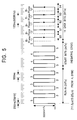
- a WWS signal conforming to the ETSI EN300294: Wide Screen Signalling (WSS) standard has a data transfer rate of 833 kHz (5 MHz/6) and is bi-phase modulated, as shown in Fig. 5.
- the signal has a run-in component and a start-bit component in addition to a data component.
- the data component has 14 bits, and includes the aspect ratio and the subtitle information of a main screen, surround information, and copyright information.
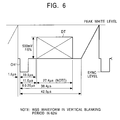
- Fig. 6 shows a waveform of a WSS signal used for a 625I PAL TV signal.
- transmission data occupies an area almost equal to half an effective screen area.
- the transmission data is adapted to a 625P TV signal as is.
- a clock frequency Fs is set to 5 MHz
- a period Ts is set to 200 ns
- a signal rising time, a signal amplitude, a modulation method, a preamble, the structure and contents of data, and a parity all conforming to the above-described standard are used.
- Fig. 7 shows a case in which the 625I TV signal form in a vertical blanking period shown in Fig. 6 is applied to a 625P TV signal.
- arrangement is made such that a data section DT fits in the horizontal scanning period of the 625P TV signal without changing the structure of the data section DT.
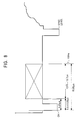
- Fig. 8 shows a modification in which a signal having a pulse period half that of a signal conforming to the ETSI EN300294: Wide Screen Signalling (WSS) standard is superposed at a scanning line specified in advance.
- WSS Wide Screen Signalling
- the same run-in component, start-bit component, and 14-bit data component as those specified in the above-described standard are used;
- the clock frequency Fs is set to 10 MHz;
- the period Ts is set to 100 ns; and a rising time, a signal amplitude, a modulation method, a preamble, a data structure, and a parity all conforming to the above-described standard are used.
- the circuit can be relatively easily developed, the circuit can be relatively easily shared in 625I/625P receivers, and the circuit and an IC can be made compact.
- a video-signal processing apparatus for processing control data, including copy-generation management information, for a 625P TV signal will be described next by referring to the drawings.
- the video-signal processing apparatus is formed of a VBID demodulator for demodulating a video VBID signal superposed on an effective video component in one or more lines in a vertical blanking period of a 625I or 625P TV signal; a microcomputer 2 for receiving the copy generation management information of the video component, demodulated by the VBID demodulator 1; a video-data storage apparatus 3 for storing the video component and the demodulated copy generation management information; a 625P encoder 4 for encoding the video component stored in the video-data storage apparatus 3 to generate a 625P video signal; a VBID generator 6 for generating copy-generation management information which indicates that the video component has been stored and reproduced once in this processing apparatus; and a mixer 5 for mixing the video signal encoded by the 625P encoder 4 with the copy-generation management information generated by the VBID generator 6.
- a VBID demodulator for demodulating a video VBID signal superposed on an effective video component in one or more lines in a vertical blanking period of a 625I or 625P TV signal is first demodulated by the VBID demodulator 1, and the copy-generation management information is input to the microcomputer 2.
- the video component is stored in the video-data storage apparatus 3.
- the copy-generation management information of the video component is also stored.
- a signal reproduced from the video-data storage apparatus 3 is input to the 625P encoder 4, and encoded to generate a 625P video signal.
- Copy-generation management information which indicates that the video component has been stored and reproduced once in this processing apparatus is generated by the VBID generator 6, and mixed with the output signal of the 625P encoder 4 by the mixer 5.
- a 625P video signal having the copy-generation management information is output.
Landscapes
- Engineering & Computer Science (AREA)
- Multimedia (AREA)
- Signal Processing (AREA)
- Television Signal Processing For Recording (AREA)
- Television Systems (AREA)
- Signal Processing For Digital Recording And Reproducing (AREA)
Applications Claiming Priority (2)
| Application Number | Priority Date | Filing Date | Title |
|---|---|---|---|
| JP2001143746A JP4251788B2 (ja) | 2001-05-14 | 2001-05-14 | データ変調方法及びビデオ信号処理装置 |
| JP2001143746 | 2001-05-14 |
Publications (2)
| Publication Number | Publication Date |
|---|---|
| EP1263228A2 true EP1263228A2 (de) | 2002-12-04 |
| EP1263228A3 EP1263228A3 (de) | 2010-03-24 |
Family
ID=18989836
Family Applications (1)
| Application Number | Title | Priority Date | Filing Date |
|---|---|---|---|
| EP02253311A Ceased EP1263228A3 (de) | 2001-05-14 | 2002-05-13 | Datenmodulationsverfahren und Videosignalverarbeitungsvorrichtung |
Country Status (2)
| Country | Link |
|---|---|
| EP (1) | EP1263228A3 (de) |
| JP (1) | JP4251788B2 (de) |
Citations (2)
| Publication number | Priority date | Publication date | Assignee | Title |
|---|---|---|---|---|
| US5822425A (en) | 1995-10-26 | 1998-10-13 | Sony Corporation | Methods of transmitting and recording television signals with copy generating restriction information and recording apparatus therefor |
| WO2001017245A1 (en) | 1999-08-27 | 2001-03-08 | Kabushiki Kaisha Toshiba | System for interconnecting devices through analog line |
-
2001
- 2001-05-14 JP JP2001143746A patent/JP4251788B2/ja not_active Expired - Fee Related
-
2002
- 2002-05-13 EP EP02253311A patent/EP1263228A3/de not_active Ceased
Patent Citations (2)
| Publication number | Priority date | Publication date | Assignee | Title |
|---|---|---|---|---|
| US5822425A (en) | 1995-10-26 | 1998-10-13 | Sony Corporation | Methods of transmitting and recording television signals with copy generating restriction information and recording apparatus therefor |
| WO2001017245A1 (en) | 1999-08-27 | 2001-03-08 | Kabushiki Kaisha Toshiba | System for interconnecting devices through analog line |
Non-Patent Citations (2)
| Title |
|---|
| "Television systems; 625-line television Wide Screen Signalling (WSS); EN 300 294", ETSI STANDARDS, vol. BC, no. V1.3.2, 1 April 1998 (1998-04-01) |
| INTERNATIONAL TELECOMMUNICATION UNION: "Recommendation ITU-R BT.653-3, Teletext Systems", 1 February 1998 (1998-02-01), GENEVA, pages 1 - 26, XP055072524, Retrieved from the Internet <URL:http://www.itu.int/dms_pubrec/itu-r/rec/bt/R-REC-BT.653-3-199802-I!!PDF-E.pdf> [retrieved on 20130722] * |
Also Published As
| Publication number | Publication date |
|---|---|
| JP4251788B2 (ja) | 2009-04-08 |
| JP2002344908A (ja) | 2002-11-29 |
| EP1263228A3 (de) | 2010-03-24 |
Similar Documents
| Publication | Publication Date | Title |
|---|---|---|
| US6473560B1 (en) | Copy protection schemes for copy protected digital material | |
| KR100323047B1 (ko) | 화상정보 전송방식, 화상정보 기록장치 및 화상정보재생장치 | |
| EP0994621B1 (de) | Signalumwandlungsanlage und -Verfahren | |
| JP3771954B2 (ja) | 画像表示制御装置および方法 | |
| KR100583896B1 (ko) | 비디오신호처리장치및비디오신호전송방법 | |
| EP1126708A1 (de) | Verafhren zur kopplung von geräten durch analoge leitungen | |
| JP2006518576A (ja) | コピー保護方法及びコピー保護システム | |
| JP3319141B2 (ja) | 画像信号処理装置 | |
| JPH09214845A (ja) | コピープロテクトシステム | |
| EP1263228A2 (de) | Datenmodulationsverfahren und Videosignalverarbeitungsvorrichtung | |
| KR100695654B1 (ko) | 전자 워터마크 정보의 중첩 방법 및 장치, 전자 워터마크정보의 전송 방법과, 오서링 장치 및 영상 신호 출력 장치 | |
| JP2002320207A (ja) | デジタル放送受信装置とその制御方法 | |
| JP3687094B2 (ja) | 再生装置および方法 | |
| CN1097391C (zh) | 具有记录保护的视频信号接收装置 | |
| JP3570403B2 (ja) | 映像信号記録方法及び映像信号記録装置 | |
| JP3570402B2 (ja) | 映像信号処理方法、映像信号再生方法、映像信号処理装置及び映像信号再生装置 | |
| JP3381164B2 (ja) | 映像信号伝送方法、映像信号記録方法、映像信号再生方法、映像信号記録装置及び映像信号再生装置 | |
| JP3381165B2 (ja) | 映像信号伝送方法、映像信号記録方法、映像信号再生方法、映像信号記録装置及び映像信号再生装置 | |
| JPH11234616A (ja) | 制御データ変調方式,制御データ復調方式およびビデオ信号処理装置 | |
| JP2005269655A (ja) | データ多重化装置および方法、プログラム記録媒体、並びにプログラム | |
| JP2003016729A (ja) | コピープロテクト装置 | |
| MXPA99010569A (en) | Copy protection schemes for copy protected digital material |
Legal Events
| Date | Code | Title | Description |
|---|---|---|---|
| PUAI | Public reference made under article 153(3) epc to a published international application that has entered the european phase |
Free format text: ORIGINAL CODE: 0009012 |
|
| AK | Designated contracting states |
Kind code of ref document: A2 Designated state(s): AT BE CH CY DE DK ES FI FR GB GR IE IT LI LU MC NL PT SE TR |
|
| AX | Request for extension of the european patent |
Free format text: AL;LT;LV;MK;RO;SI |
|
| PUAL | Search report despatched |
Free format text: ORIGINAL CODE: 0009013 |
|
| AK | Designated contracting states |
Kind code of ref document: A3 Designated state(s): AT BE CH CY DE DK ES FI FR GB GR IE IT LI LU MC NL PT SE TR |
|
| AX | Request for extension of the european patent |
Extension state: AL LT LV MK RO SI |
|
| 17P | Request for examination filed |
Effective date: 20100323 |
|
| AKX | Designation fees paid |
Designated state(s): DE FR GB |
|
| 17Q | First examination report despatched |
Effective date: 20110503 |
|
| STAA | Information on the status of an ep patent application or granted ep patent |
Free format text: STATUS: THE APPLICATION HAS BEEN REFUSED |
|
| 18R | Application refused |
Effective date: 20131121 |