EP1263246B1 - Méthode pour la programmation automatique et les composants correspondants - Google Patents
Méthode pour la programmation automatique et les composants correspondants Download PDFInfo
- Publication number
- EP1263246B1 EP1263246B1 EP02100449A EP02100449A EP1263246B1 EP 1263246 B1 EP1263246 B1 EP 1263246B1 EP 02100449 A EP02100449 A EP 02100449A EP 02100449 A EP02100449 A EP 02100449A EP 1263246 B1 EP1263246 B1 EP 1263246B1
- Authority
- EP
- European Patent Office
- Prior art keywords
- model
- programming
- program
- units
- function
- Prior art date
- Legal status (The legal status is an assumption and is not a legal conclusion. Google has not performed a legal analysis and makes no representation as to the accuracy of the status listed.)
- Expired - Lifetime
Links
- 238000000034 method Methods 0.000 title claims description 55
- 230000006870 function Effects 0.000 claims description 70
- 235000006719 Cassia obtusifolia Nutrition 0.000 claims description 21
- 235000014552 Cassia tora Nutrition 0.000 claims description 21
- 244000201986 Cassia tora Species 0.000 claims description 21
- 238000012545 processing Methods 0.000 claims description 10
- 230000008569 process Effects 0.000 claims description 3
- 238000010348 incorporation Methods 0.000 claims 2
- 238000009434 installation Methods 0.000 claims 2
- 238000011161 development Methods 0.000 description 21
- 230000018109 developmental process Effects 0.000 description 21
- 238000012360 testing method Methods 0.000 description 21
- 239000011800 void material Substances 0.000 description 8
- 230000008676 import Effects 0.000 description 6
- 235000010627 Phaseolus vulgaris Nutrition 0.000 description 5
- 244000046052 Phaseolus vulgaris Species 0.000 description 5
- 238000011960 computer-aided design Methods 0.000 description 3
- 238000004088 simulation Methods 0.000 description 3
- 238000007792 addition Methods 0.000 description 2
- 230000005540 biological transmission Effects 0.000 description 2
- 241001136792 Alle Species 0.000 description 1
- 230000009471 action Effects 0.000 description 1
- 230000003213 activating effect Effects 0.000 description 1
- 230000008901 benefit Effects 0.000 description 1
- 230000008859 change Effects 0.000 description 1
- 238000013461 design Methods 0.000 description 1
- 230000000694 effects Effects 0.000 description 1
- 238000011156 evaluation Methods 0.000 description 1
- 238000013519 translation Methods 0.000 description 1
- 230000001960 triggered effect Effects 0.000 description 1
Images

Classifications
-
- H—ELECTRICITY
- H04—ELECTRIC COMMUNICATION TECHNIQUE
- H04Q—SELECTING
- H04Q3/00—Selecting arrangements
- H04Q3/0016—Arrangements providing connection between exchanges
- H04Q3/0029—Provisions for intelligent networking
Definitions
- the invention relates to a method in which, for a target system with different functional units, model units are specified which respectively emulate the signal inputs and the signal outputs of a functional unit to be modeled.
- model units are used in developing services for so-called smart grids.
- the model units are called SIB (Service Independent Building Blocks) units in this case.
- Intelligent networks are inter alia in the book “Technology of networks”, Gerd Siegmund, Weghig Heidelberg, 4th edition, page 597 ff, explained.
- IN Intelligent network
- certain services of a telecommunication network which go beyond the pure transmission service and its supplementary service features, are concentrated in "intelligent network nodes".
- Examples of IN services are services with the service codes 0800, 0900 or 0130 etc. The service development is explained in more detail in Chapter 6.4.5 of the book by Gerd Siegmund.
- SIB units are reused as much as possible.
- the newly defined service may also be out of the service definition program also be tested in its logical sequence with a corresponding software module.
- the program code will be generated.
- the program code is loaded together with the associated data into a SCP computer (Service Control Point) or an SMP computer (Service Management Point).
- SCP computers and SMP computers are components of the intelligent telecommunications network.
- the program code has hitherto been generated by a software module that is independent of the model units.
- a separate software module for compiling is not considered a disadvantage. Namely, in the case of changes or additions, the service definition program must be changed considerably; in particular, for example, new graphic elements must be defined which make it possible to edit the service with the aid of a graphics program.
- the changes in the compiler program are less expensive than the changes to the service definition program.
- Model units can be described (in Java Bean technique), a model of these units can be assembled dynamically. Links of the model units serve to create sources (sources) and sinks (sink) that simulate the data flows. The editing takes place in a graphical user interface.
- an associated program, an associated data carrier and an associated data processing system are specified.
- the invention is based on the consideration that for simple editing when specifying the model units programming specifications are to be taken into account, which make it possible for the editing function to determine, at runtime, which signal inputs and outputs have a model unit.
- the model units are already separate program units with respect to editing. If the individual model units are given the parts of the programming function which concern them, e.g. of the compiler program, the method of automatic programming is greatly simplified.
- changes in the programming functions are limited to the model units to be changed.
- the commands for executing the programming function are directly assigned to the model units, so that assignment processes are eliminated when changes are made.
- the model units each have their own programming function which, due to the embedding of the model unit in the overall model, generates program instructions for the further processing of the overall model (80) with another program or for controlling a target system containing the functional units (52). Simply storing the entire model is not considered to generate programming commands for another program.
- An example of a JAVA programming language programming pattern is the language description for a method of receiving an event message: void ⁇ eventOccurenceMethodName>( ⁇ EventObjectType>evt);.
- a model unit automatically initiates the call of a programming function of another model unit whose signal input has been assigned to the signal output of the model unit causing the call.
- the model units cause the calling of programming functions until all programming functions of the overall model are called.
- this embodiment of the invention is based on the consideration that the programming instructions that must be met to provide the editing function, also allow a simple call of the programming functions.
- the model units simulate functions of the functional unit to be modeled.
- programming defaults are taken into account that allow the editing function to determine, at runtime, which parameters have been chosen to replicate the function.
- output signals of a functional unit must be forwarded to a downstream functional unit.
- there is also an event message for activating the programming function which is sent to a first model unit.
- the programming function of the first model unit executed.
- programming messages are sent to the model units connected downstream of the first model unit, where they also execute the respective programming functions. In this way, programming messages are passed through the entire model. In the end, the entire model is compiled.
- the functional units are part of an SCP computer (Service Control Point) or a switching device, e.g. Part of an exchange.
- SCP computers are particularly needed to provide services in an intelligent telecommunications network.
- predetermined programming patterns are taken into account by the programming language JAVA.
- the programming patterns of other languages may also be used, e.g. the programming language Perl.
- the programming language JAVA is widely used. Graphical functions for implementing the editing function no longer have to be programmed by each manufacturer of special applications. The manufacturer limits itself only to the modulation of its special functional units and to the compiling.
- model units are implemented as so-called JAVA beans or as so-called ActivX control elements.
- JAVA beans are reusable software components that can be connected to overall models using a graphical development tool.
- a graphical development tool For example, in the context of JAVA beans, reference is made to the book "Developing JAVA beans", Robert Englander, O'Reilly, Cologne, 1997.
- the assignment of Programming functions for individual JAVA beans also means that the programming functions also benefit from the strong modularization, namely clear, reusable and modular model units, which are also easy to maintain and maintain.
- the programming function allows a selection of different target systems.
- the programming function for example, a selection parameter is passed, which determines the target system.
- program code for an exchange of one or the other type is then generated, for example.
- the automatic programming function is a compilation function which, due to the embedding of the model unit in the overall model, generates a part of a program specific to the target system for controlling the functional unit modeled by the model unit. Compiling means that a complete translation of source code is executed.
- the automatic programming function generates commands for a simulation program with which the overall model is subsequently processed.
- the automatic programming function generates commands for a program for improved graphical representation of the overall model compared to the representation using the editing function.
- An application example are programs for presenting and checking the running times of program schedules.
- the invention also relates to a program and a data carrier with a program.
- the program contains a command sequence, when executed by a processor, the inventive method or one of its developments becomes.
- the program is a JAVA bean.
- the data carrier is a nonvolatile storage unit, eg a floppy disk, a compact disc (CD) or a hard disk, or a volatile storage unit, eg a random access memory (RAM).
- a data processing system is protected with such a program.
- the data processing system includes a processor and a memory unit. For the program, the data carrier and the data processing system, the technical effects mentioned above also apply.
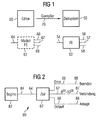
- FIG. 1 shows a target system 50, for example an SCP computer (Service Control Point), which is part of an IN (not shown) (intelligent network).
- the target system 50 performs its functions with the aid of functional units, of which FIG. 1 shows a functional unit 52.
- the functions of the functional units are provided by means of a program or by means of electronic circuits which do not contain a program.
- the functional unit 52 is, for example, a timing functional unit which determines the system time and compares it with predetermined time values.
- the functional unit 52 has a signal input 54 and three signal outputs 56, 57 and 58.
- the functional unit 52 realized for example by means of a timing circuit or with the aid of a software program. The exact function of the functional unit 52 will be explained below in connection with a model unit 62 for the functional unit 52.
- the editor program 60 is a graphical editor, with the aid of which model units can be linked, which emulate the functional units.
- a timing model unit 62 maps the functions of the timing functional unit 52.
- the timing model unit 62 is displayed on a screen for an operator as a rectangle, to which an input line 64 to emulate the signal input 54 and three output lines 66 to 68 to emulate the signal outputs 56 to 58.
- the model unit 62 can be placed on the screen and linked to other model units to form an overall model of an application. Subsequently, the entire model is tested, whereby functions of the model unit are called, which simulate the function of the functional unit 52.
- the overall model may change. If the test results are satisfactory, a program is generated from the overall model with the aid of a compilation function 70, which program can be executed by a processor of the target system 50.
- the compile function 70 will be explained in greater detail below with reference to FIGS. 3A and 3B.
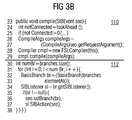
- FIG. 2 shows part of an overall model 80 that includes a startup model unit 82 and the timing model unit 62.
- the starting model unit 82 has an output line 84 leading to the input line 64 of the timing model unit 62. If the system time can not be determined, an error signal is sent to a subsequent functional unit on the signal output 56 or in the overall model 80 on the output line 66 88, which is shown by a dashed line. For example, to a functional unit, which rejects an incoming at a subscriber terminal of a telecommunications network call.
- a subsequent model unit 87 is caused via the output line 67 to forward the incoming call to a certain other terminal.
- a unit 86 is actuated via the output line 68 for importing an announcement.
- FIGS. 3A and 3B show the JAVA source code of the timing model unit 62.
- the left-hand edge shows the numbers of the source code lines 1 to 38, which are at the same time reference symbols.
- the source code lines 1 to 38 will be explained in detail below.
- a semicolon at the end of the line means that a program statement has ended.
- the program instructions are written in the programming language JAVA of the company Sun Microsystems.
- Source line 1 specifies that the JAVA bean unit specified in source code lines 1 through 38 belong to a package named IN.sibs.Test.
- IN is the abbreviation for "intelligent network”
- sibs is the abbreviation for "service independent building blocks”.
- Source line 3 specifies that the IN.sibs.Test package includes all classes that are contained in a package named IN.sibs.Compiler. The character "*" again serves as a placeholder.
- the package named "IN.sibs.Compiler” contains classes that implement those parts of the compiler that are independent of the individual function blocks, such as classes for specifying compiler arguments and classes for capturing the structure of a JAVA bean. The characteristics of the compiler classes are explained with reference to FIGS. 3A and 3B only insofar as they are necessary for the understanding of the exemplary embodiment.
- the instructions specified in source line 4 specify that a new class "TestSIB” be subsequently set.
- the class “TestSIB” is a public class, i. a class that can also be used by other classes, see instruction “public”.
- the class “TestSIB” extends the class “BasicSIB”, which is defined in the package "IN.sibs.Basic”, see instruction “extends”.
- the BasicSIB class contains so-called methods that are required to set the properties of a model unit. These methods or functions are explained, insofar as they are necessary for the understanding of the embodiment.
- Source line 5 specifies that the TestSIB class contains a string variable called newOperand.
- the variable "newOperand” is first filled with an empty string "”.
- the variable “newOperand” is only available within the class “TestSIB", see the statement “private”. It is also said that the variable "newOperand” is encapsulated.
- time is allocated for a variable "time” which has the structure specified in the class "TimeOperand”.
- the class “TimeOperand” goes back to the base class BasicSIBOperand.
- three parameters "time”, “time” and “true” must be specified.
- “Time” is the name of the output assigned to the new operand.
- “time” is the specification of the operand type.
- “true” means that the output must be connected to the input of a subsequent functional unit or model unit.
- the source code line 8 contains an instruction for creating or generating a branch variable ebr (error branch).
- the name of this branch is the name "Error”.
- dbr default branch
- Default The name for this branch is "Default”.
- a program section 104 the so-called constructor of the timing model unit 62 is set.
- the instructions given in program section 104 are executed when the model unit 62 is dragged into a working area of the editing program by means of the editor program and by means of a computer mouse. This method is also known as drag-and-drop method.
- the constructor of the class "TestSIB” is public, see keyword “public”, and thus can be called from other classes, especially from the classes of the editor.
- the instructions in source line 11 call the constructor of the parent class, that is, the constructor of the BasicSIB class. As arguments, the two parameters "test” and “test” are passed. "test” is an internal identifier. "Test” is a flag indicated by the editing program 60.
- the method "addOperand” is called, which inherits the class “TestSIB” from the class “BasicSIB". By specifying the parameter "time”, it is achieved that a time operand is added to the model unit 62.
- the model unit 62 is given the output line 67.
- source line 13 calls an addBranch method, which inherits the TestSIB class from the BasicSIB class.
- the name of the parameter "ebr" is given, which designates the variable specified in program line 8.
- the model unit 62 is given the output line 66.
- the method "addBranch” is called again, but with another parameter, namely the variable dbr.
- the model unit 62 is added to the output line 68.
- the instruction in the source code line 15 ensures that the operand "time" can be edited with the aid of the editor program 60. Thus, when simulating, a time span can be specified in which a specific action is then to be carried out.
- the branch associated with the variable dbr ie the branch with the name "Default” is selected, so that after clicking on the character for the model unit 62 this branch can be processed immediately.
- a curly brace open to the left indicates the end of the constructor in the source text line 167.
- Source line 17 specifies that the getNewOperand method is public and returns a string variable as the result. When calling the method "-getNewOperand” no parameters have to be specified. In the source line 18 it is indicated that when calling the method "getNewOperand” as argument the value of the variable "newOperand” is returned. In the source line 19, a curly brace open to the left indicates that the definition of the getNewOperand method is complete.
- the argument is a string whose value is assigned to a string variable lbl (label).
- points are indicated by dots, which are executed when the method "setNewOperand” is executed. These instructions are not necessary for the understanding of the embodiment and are therefore not explained in detail.
- the source code line 22 is through a curly brace open to the left indicates that the definition of the setNewOperand method has ended.
- the source code line 23 can be deduced that the method "compile” of the model unit 62 is public, see keyword “public”, and returns no parameter, see keyword “void”. Calling the method "compile” is triggered by an event message to this method.
- the event message is stored on the call in a local variable "seo" (sib event origin).
- the instructions in source code lines 26 and 27 read compiler arguments from the event message "seo" and assign them to the local variable "compileArgs”.
- the statement in source line 28 generates a variable named "cmpl” and of type compiler.
- the compiler is specified as an FSL compiler, ie Compiler for a flexible service logic used in Siemens-specific IN applications.
- the argument is given as "this”, ie the source code of the model unit 62.
- the compiler parses the structure of the model unit 62 and parses the source code lines 1 through 38. In particular, the compiler is able to capture the number of output branches from the source code lines 6 through 9. Depending on this structure, instructions are generated in the programming language FSL that can be executed directly by the target system 10. The file into which these commands are to be written is given in the compiler arguments.
- Execution of the method compile of the model unit 62 is initiated by the startup model unit 80. Namely, the start model unit 80 sends a compilation message to the timing model unit 62. When the compile message is edited, the compile function is executed.
- the instruction in the source code line 30 determines how many output branches the model unit 62 has.
- the model unit 62 has three output branches 66 to 68.
- the variable "numBr" is therefore assigned the value 3.
- the source code line 31 begins a so-called program loop, which is also referred to as a for loop and with the aid of which compile messages can be sent to the model units to which output branches of the model unit 62 lead.
- program loop which is also referred to as a for loop and with the aid of which compile messages can be sent to the model units to which output branches of the model unit 62 lead.
- the instructions in source code lines 32 through 37 are executed.
- the statement in the source code line 32 causes a local variable with the name "br" and of type "BasicBranch” to be assigned the output branch currently to be processed.
- the instruction in source line 34 determines the subsequent model unit, i. the model unit receives the event messages sent via the respective output branch. This model unit is assigned to a variable sl (SIB Listener).
- the statement in the source code line 35 checks whether the variable sl has a value that is different from zero. This is the case whenever a model unit connected to the output branch of the model unit 62 which has just been processed can be determined. If such a model unit could be determined, the source code lines 36 and 37 are executed.
- the JAVA beans for other model units in other embodiments are programmed in a similar way as the JAVA bean for the "TestSIB" class.
- the active start model unit 80 essentially generates only the event message for starting the compilation.
- the startup model unit 80 consists only of the class ButtonSIB. This class sends a SIBEvent to the connected model unit. This event message contains parameters that cause the call of the output method, i. the method "compile"
Landscapes
- Engineering & Computer Science (AREA)
- Computer Networks & Wireless Communication (AREA)
- Stored Programmes (AREA)
- Devices For Executing Special Programs (AREA)
- Programmable Controllers (AREA)
Claims (12)
- Méthode pour la programmation automatique (50) d'un programme de commande,
dans laquelle on désigne pour un système cible (50) comprenant différentes unités fonctionnelles (52) des unités modèles (62) qui reproduisent chacune les entrées du signal (54) et les sorties du signal (56 à 58) d'une unité fonctionnelle (52) à modéliser,
dans laquelle les entrées du signal et sorties du signal servent à l'émission ou à la réception ou au traitement de messages d'événements ou à l'appel direct de méthodes d'une autre unité modèle,
dans laquelle, au moment de désigner les unités modèles (62), des consignes de programmation sont prises en compte, qui permettent à une fonction d'édition (60) de déterminer pendant l'exécution quelles sont les entrées du signal (64) et sorties du signal (66 à 68) d'une unité modèle (62),
dans laquelle, à l'aide de la fonction d'édition (60) et en attribuant les sorties du signal (84) aux entrées du signal (64), les unités modèles (62) sont liées entre elles pour obtenir un modèle global (80),
dans laquelle les unités modèles (62) contiennent chacune une fonction de programmation automatique (23 à 29) qui en raison de l'intégration de l'unité modèle (62) dans le modèle global (80) génère des instructions de programme pour le traitement ultérieur du modèle global (80) avec un autre programme ou pour la commande d'un système cible contenant les unités fonctionnelles (52),
dans laquelle une unité modèle (82) provoque automatiquement l'appel d'une fonction de programmation (23) d'une autre unité modèle (62) dont l'entrée du signal (64) a été attribuée à la sortie du signal (84) de l'unité modèle (82) provoquant l'appel,
lesdites unités modèles (82, 62) provoquant l'appel de fonctions de programmation (23) jusqu'à ce que toutes les fonctions de programmation aient été appelées. - Méthode selon la revendication 1,
caractérisée en ce que
les unités modèles (82, 62) reproduisent la fonction de l'unité fonctionnelle (52) à modéliser et en ce qu'au moment de désigner les unités modèles (62), des consignes de programmation sont prises en compte, qui permettent à la fonction d'édition (60) de déterminer pendant l'exécution quels paramètres ont été choisis pour reproduire la fonction. - Méthode selon l'une des revendications précédentes,
caractérisée en ce que
les unités fonctionnelles (54) sont des éléments constitutifs d'un système de commutation ou des éléments constitutifs d'un calculateur SCP ou des éléments constitutifs d'un centre de commutation ou des éléments constitutifs d'une installation de télécommunications. - Méthode selon la revendication 3,
caractérisée en ce que
grâce aux unités fonctionnelles (52) des fonctions du service "réseau intelligent" sont réalisées. - Méthode selon l'une des revendications précédentes,
caractérisée en ce que
des modèles de programmation imposés par le langage de programmation JAVA sont pris en considération ou en ce que des modèles de programmation imposés par le langage de programmation Active X sont pris en considération. - Méthode selon la revendication 5,
caractérisée en ce que
les unités modèles (62) sont réalisées comme JAVA beans. - Méthode selon l'une des revendications précédentes,
caractérisée en ce que
la fonction de programmation (23) permet une sélection de différents systèmes cibles (50). - Méthode selon l'une des revendications précédentes,
caractérisée en ce que
la fonction de programmation automatique (23) est une fonction de compilation qui en raison de l'intégration de l'unité modèle (62) dans le modèle global (80) génère une partie d'un programme spécifique pour le système cible (50) en vue de la commande de l'unité fonctionnelle reproduite par ladite unité modèle. - Méthode selon l'une des revendications précédentes,
caractérisée en ce que
la fonction de programmation automatique (23) génère des instructions pour un programme de simulation avec lequel le modèle global (80) est traité par la suite. - Méthode selon l'une des revendications précédentes,
caractérisée en ce que
la fonction de programmation automatique (23) génère des instructions pour un programme permettant une représentation graphique améliorée du modèle global (80) par rapport à la représentation à l'aide de la fonction d'édition (60). - Support de données avec programme,
caractérisé en ce que
le programme contient une séquence d'instructions à l'exécution desquelles par un processeur une méthode selon les revendications précédentes est mise en oeuvre. - Equipement informatique de traitement de données, caractérisé par un programme selon la revendication 11.
Applications Claiming Priority (2)
| Application Number | Priority Date | Filing Date | Title |
|---|---|---|---|
| DE10126239A DE10126239A1 (de) | 2001-05-30 | 2001-05-30 | Verfahren zum automatischen Programmieren sowie zugehörige Komponenten |
| DE10126239 | 2001-05-30 |
Publications (3)
| Publication Number | Publication Date |
|---|---|
| EP1263246A2 EP1263246A2 (fr) | 2002-12-04 |
| EP1263246A3 EP1263246A3 (fr) | 2004-04-14 |
| EP1263246B1 true EP1263246B1 (fr) | 2006-08-09 |
Family
ID=7686588
Family Applications (1)
| Application Number | Title | Priority Date | Filing Date |
|---|---|---|---|
| EP02100449A Expired - Lifetime EP1263246B1 (fr) | 2001-05-30 | 2002-05-06 | Méthode pour la programmation automatique et les composants correspondants |
Country Status (3)
| Country | Link |
|---|---|
| US (1) | US6947799B2 (fr) |
| EP (1) | EP1263246B1 (fr) |
| DE (2) | DE10126239A1 (fr) |
Families Citing this family (2)
| Publication number | Priority date | Publication date | Assignee | Title |
|---|---|---|---|---|
| US20080228812A1 (en) * | 2007-03-15 | 2008-09-18 | Honeywell International Inc. | Method and System for Metamodeling Using Dynamic Ontology Objects |
| US9864991B2 (en) * | 2009-09-22 | 2018-01-09 | Murphy Oil Usa, Inc. | Method and apparatus for secure transaction management |
Family Cites Families (7)
| Publication number | Priority date | Publication date | Assignee | Title |
|---|---|---|---|---|
| US5269014A (en) * | 1988-05-24 | 1993-12-07 | Mitsubishi Denki Kabushiki Kaisha | Automatic programming system with design review capabilities |
| US5371851A (en) * | 1989-04-26 | 1994-12-06 | Credence Systems Corporation | Graphical data base editor |
| JP2820994B2 (ja) * | 1990-02-19 | 1998-11-05 | 三菱電機株式会社 | 動的シミュレーション方法 |
| JPH05233239A (ja) * | 1992-02-20 | 1993-09-10 | Fujitsu Ltd | プログラム自動生成装置 |
| US5353331A (en) * | 1992-03-05 | 1994-10-04 | Bell Atlantic Network Services, Inc. | Personal communications service using wireline/wireless integration |
| US6311149B1 (en) * | 1997-08-18 | 2001-10-30 | National Instruments Corporation | Reconfigurable test system |
| US7210117B2 (en) * | 1999-08-19 | 2007-04-24 | National Instruments Corporation | System and method for programmatically generating a graphical program in response to program information |
-
2001
- 2001-05-30 DE DE10126239A patent/DE10126239A1/de not_active Ceased
-
2002
- 2002-05-06 EP EP02100449A patent/EP1263246B1/fr not_active Expired - Lifetime
- 2002-05-06 DE DE50207763T patent/DE50207763D1/de not_active Expired - Fee Related
- 2002-05-30 US US10/158,729 patent/US6947799B2/en not_active Expired - Fee Related
Also Published As
| Publication number | Publication date |
|---|---|
| EP1263246A3 (fr) | 2004-04-14 |
| US20030009243A1 (en) | 2003-01-09 |
| DE10126239A1 (de) | 2002-12-12 |
| EP1263246A2 (fr) | 2002-12-04 |
| DE50207763D1 (de) | 2006-09-21 |
| US6947799B2 (en) | 2005-09-20 |
Similar Documents
| Publication | Publication Date | Title |
|---|---|---|
| DE69626127T2 (de) | Diensterzeugungsvorrichtung für ein Kommunikationsnetz und entsprechendes Verfahren | |
| DE60003457T2 (de) | Verfahren und system zur konfiguration von komponenten, ausgebbar in einem netzwerk | |
| DE69228230T2 (de) | Softwarestruktur für Fernmeldevermittlungssystem | |
| DE69900810T2 (de) | Verfahren und Vorrichtung zum Testen von ereignisgesteuerten Programmen | |
| DE69637436T2 (de) | Objektorientiertes Kommunikationssystem mit Unterstützung für mehrere entfernte Maschinentypen | |
| DE69625948T2 (de) | Kompiler mit generischem Front-End und dynamisch ladbaren Back-Ends | |
| EP1034475B1 (fr) | Procede pour tester les composantes d'un programme oriente objets | |
| EP3812885B1 (fr) | Génération intégrée du code de simulation et du code de production | |
| DE102014210854A1 (de) | Computerimplementiertes Verfahren und Signalfolge für ein Programm zur Wiederverwendung von ausführbaren Softwarekonfigurationen für Softwaresysteme sowie Rechneranlage und ein Computerprogramm mit Programmcode zur Durchführung des Verfahrens | |
| DE69206917T2 (de) | Hilfsverfahren für die Entwicklung einer miteinander kommunizierender Automatengruppe | |
| EP1184758A2 (fr) | Méthode de correction d'erreurs de programme pour contrôleurs industriels, en particulier des contrôleurs de déplacement, dans un contexte de programmation de diagramme de flux | |
| DE60102694T2 (de) | Modulares computersystem und -verfahren | |
| DE10206903A1 (de) | Softwareapplikation, Softwarearchitektur und Verfahren zur Erstellung von Softwareapplikationen, insbesondere für MES-Systeme | |
| EP3629151A1 (fr) | Procédé de changement de modèles pour la génération du code source | |
| EP1263246B1 (fr) | Méthode pour la programmation automatique et les composants correspondants | |
| EP4375869A1 (fr) | Procédé de création et de fourniture d'une simulation de construction fpga d'un modèle fpga | |
| DE69734352T2 (de) | Verteilte verarbeitung | |
| WO2021148187A1 (fr) | Procédé de configuration et de paramétrage d'abonnés de bus de terrain et système d'ingénierie | |
| DE202014006343U1 (de) | Rechneranlage, Datenträger sowie Signalfolge für ein Programm zur Wiederverwendung von ausführbaren Softwarekonfigurationen für Softwaresysteme | |
| DE4310615C2 (de) | Entwurf elektrischer Vorrichtungen mit mehreren Entwurfswerkzeugen, die zumindest teilweise untereinander inkompatibel sind | |
| DE102023106277A1 (de) | Verfahren zur Erzeugung von Quellcode | |
| EP3355186A1 (fr) | Génération et exécution de modules logiciels | |
| EP1235123A2 (fr) | Méchanisme rapporté pour un système de commande basé sur un champ de données de type | |
| EP1343078B1 (fr) | Dispositif pour la modélisation et génération des systèmes de génération de logiciel | |
| EP1184760B1 (fr) | Procédé de commande et/ou de régulation d'un processus technique |
Legal Events
| Date | Code | Title | Description |
|---|---|---|---|
| PUAI | Public reference made under article 153(3) epc to a published international application that has entered the european phase |
Free format text: ORIGINAL CODE: 0009012 |
|
| AK | Designated contracting states |
Kind code of ref document: A2 Designated state(s): AT BE CH CY DE DK ES FI FR GB GR IE IT LI LU MC NL PT SE TR |
|
| AX | Request for extension of the european patent |
Free format text: AL;LT;LV;MK;RO;SI |
|
| PUAL | Search report despatched |
Free format text: ORIGINAL CODE: 0009013 |
|
| AK | Designated contracting states |
Kind code of ref document: A3 Designated state(s): AT BE CH CY DE DK ES FI FR GB GR IE IT LI LU MC NL PT SE TR |
|
| AX | Request for extension of the european patent |
Extension state: AL LT LV MK RO SI |
|
| 17P | Request for examination filed |
Effective date: 20040322 |
|
| 17Q | First examination report despatched |
Effective date: 20040615 |
|
| AKX | Designation fees paid |
Designated state(s): DE FI FR GB |
|
| GRAP | Despatch of communication of intention to grant a patent |
Free format text: ORIGINAL CODE: EPIDOSNIGR1 |
|
| GRAS | Grant fee paid |
Free format text: ORIGINAL CODE: EPIDOSNIGR3 |
|
| GRAA | (expected) grant |
Free format text: ORIGINAL CODE: 0009210 |
|
| AK | Designated contracting states |
Kind code of ref document: B1 Designated state(s): DE FI FR GB |
|
| PG25 | Lapsed in a contracting state [announced via postgrant information from national office to epo] |
Ref country code: FI Free format text: LAPSE BECAUSE OF FAILURE TO SUBMIT A TRANSLATION OF THE DESCRIPTION OR TO PAY THE FEE WITHIN THE PRESCRIBED TIME-LIMIT Effective date: 20060809 |
|
| REG | Reference to a national code |
Ref country code: GB Ref legal event code: FG4D Free format text: NOT ENGLISH |
|
| REF | Corresponds to: |
Ref document number: 50207763 Country of ref document: DE Date of ref document: 20060921 Kind code of ref document: P |
|
| GBT | Gb: translation of ep patent filed (gb section 77(6)(a)/1977) |
Effective date: 20061024 |
|
| ET | Fr: translation filed | ||
| PGFP | Annual fee paid to national office [announced via postgrant information from national office to epo] |
Ref country code: DE Payment date: 20070531 Year of fee payment: 6 |
|
| PLBE | No opposition filed within time limit |
Free format text: ORIGINAL CODE: 0009261 |
|
| STAA | Information on the status of an ep patent application or granted ep patent |
Free format text: STATUS: NO OPPOSITION FILED WITHIN TIME LIMIT |
|
| 26N | No opposition filed |
Effective date: 20070510 |
|
| PGFP | Annual fee paid to national office [announced via postgrant information from national office to epo] |
Ref country code: GB Payment date: 20070522 Year of fee payment: 6 |
|
| REG | Reference to a national code |
Ref country code: GB Ref legal event code: 732E |
|
| PGFP | Annual fee paid to national office [announced via postgrant information from national office to epo] |
Ref country code: FR Payment date: 20070516 Year of fee payment: 6 |
|
| REG | Reference to a national code |
Ref country code: FR Ref legal event code: TP |
|
| GBPC | Gb: european patent ceased through non-payment of renewal fee |
Effective date: 20080506 |
|
| REG | Reference to a national code |
Ref country code: FR Ref legal event code: ST Effective date: 20090119 |
|
| PG25 | Lapsed in a contracting state [announced via postgrant information from national office to epo] |
Ref country code: FR Free format text: LAPSE BECAUSE OF NON-PAYMENT OF DUE FEES Effective date: 20080602 Ref country code: DE Free format text: LAPSE BECAUSE OF NON-PAYMENT OF DUE FEES Effective date: 20081202 |
|
| PG25 | Lapsed in a contracting state [announced via postgrant information from national office to epo] |
Ref country code: GB Free format text: LAPSE BECAUSE OF NON-PAYMENT OF DUE FEES Effective date: 20080506 |