EP1264147B1 - Chauffage et refroidissement dynamiques d'un immeuble a l'aide de mousse liquide - Google Patents
Chauffage et refroidissement dynamiques d'un immeuble a l'aide de mousse liquide Download PDFInfo
- Publication number
- EP1264147B1 EP1264147B1 EP01914891A EP01914891A EP1264147B1 EP 1264147 B1 EP1264147 B1 EP 1264147B1 EP 01914891 A EP01914891 A EP 01914891A EP 01914891 A EP01914891 A EP 01914891A EP 1264147 B1 EP1264147 B1 EP 1264147B1
- Authority
- EP
- European Patent Office
- Prior art keywords
- temperature
- liquid foam
- liquid
- roof
- reservoir
- Prior art date
- Legal status (The legal status is an assumption and is not a legal conclusion. Google has not performed a legal analysis and makes no representation as to the accuracy of the status listed.)
- Expired - Lifetime
Links
- 239000008258 liquid foam Substances 0.000 title claims abstract description 70
- 238000010438 heat treatment Methods 0.000 title claims abstract description 39
- 238000001816 cooling Methods 0.000 title claims abstract description 35
- 239000007788 liquid Substances 0.000 claims abstract description 49
- 238000000034 method Methods 0.000 claims abstract description 43
- 230000008859 change Effects 0.000 claims abstract description 7
- 239000000344 soap Substances 0.000 claims description 42
- XLYOFNOQVPJJNP-UHFFFAOYSA-N water Substances O XLYOFNOQVPJJNP-UHFFFAOYSA-N 0.000 claims description 16
- 230000008878 coupling Effects 0.000 claims description 4
- 238000010168 coupling process Methods 0.000 claims description 4
- 238000005859 coupling reaction Methods 0.000 claims description 4
- 238000001514 detection method Methods 0.000 claims description 3
- 239000012212 insulator Substances 0.000 claims description 2
- 238000005086 pumping Methods 0.000 claims description 2
- 230000001172 regenerating effect Effects 0.000 claims 2
- 239000002689 soil Substances 0.000 claims 1
- 230000001276 controlling effect Effects 0.000 abstract description 10
- 239000006260 foam Substances 0.000 abstract description 10
- 230000008929 regeneration Effects 0.000 abstract description 7
- 238000011069 regeneration method Methods 0.000 abstract description 7
- 230000001105 regulatory effect Effects 0.000 abstract description 3
- 230000001960 triggered effect Effects 0.000 abstract description 2
- 238000009413 insulation Methods 0.000 description 21
- 230000008569 process Effects 0.000 description 21
- 238000005516 engineering process Methods 0.000 description 11
- 238000012546 transfer Methods 0.000 description 7
- 238000013459 approach Methods 0.000 description 6
- 239000012530 fluid Substances 0.000 description 6
- 230000005855 radiation Effects 0.000 description 6
- 238000010276 construction Methods 0.000 description 5
- 238000004378 air conditioning Methods 0.000 description 4
- 238000013461 design Methods 0.000 description 4
- 230000006870 function Effects 0.000 description 4
- 239000000463 material Substances 0.000 description 4
- 230000007246 mechanism Effects 0.000 description 4
- 238000006243 chemical reaction Methods 0.000 description 3
- 230000005611 electricity Effects 0.000 description 3
- 239000012774 insulation material Substances 0.000 description 3
- 238000011160 research Methods 0.000 description 3
- 239000002918 waste heat Substances 0.000 description 3
- 230000009471 action Effects 0.000 description 2
- 238000009435 building construction Methods 0.000 description 2
- 238000002485 combustion reaction Methods 0.000 description 2
- 238000011161 development Methods 0.000 description 2
- 230000018109 developmental process Effects 0.000 description 2
- 230000000694 effects Effects 0.000 description 2
- 239000012528 membrane Substances 0.000 description 2
- 239000002699 waste material Substances 0.000 description 2
- CBENFWSGALASAD-UHFFFAOYSA-N Ozone Chemical compound [O-][O+]=O CBENFWSGALASAD-UHFFFAOYSA-N 0.000 description 1
- 239000006096 absorbing agent Substances 0.000 description 1
- 230000004888 barrier function Effects 0.000 description 1
- 230000008901 benefit Effects 0.000 description 1
- 239000003653 coastal water Substances 0.000 description 1
- 239000004020 conductor Substances 0.000 description 1
- 230000007812 deficiency Effects 0.000 description 1
- 230000001066 destructive effect Effects 0.000 description 1
- 238000004146 energy storage Methods 0.000 description 1
- 230000002708 enhancing effect Effects 0.000 description 1
- 230000007613 environmental effect Effects 0.000 description 1
- 238000011156 evaluation Methods 0.000 description 1
- 238000001704 evaporation Methods 0.000 description 1
- 230000008020 evaporation Effects 0.000 description 1
- 239000002803 fossil fuel Substances 0.000 description 1
- 239000000446 fuel Substances 0.000 description 1
- 239000007789 gas Substances 0.000 description 1
- 239000005431 greenhouse gas Substances 0.000 description 1
- 239000002440 industrial waste Substances 0.000 description 1
- 230000008595 infiltration Effects 0.000 description 1
- 238000001764 infiltration Methods 0.000 description 1
- 238000011835 investigation Methods 0.000 description 1
- 238000012423 maintenance Methods 0.000 description 1
- 238000005259 measurement Methods 0.000 description 1
- 238000010297 mechanical methods and process Methods 0.000 description 1
- 230000005226 mechanical processes and functions Effects 0.000 description 1
- 210000004779 membrane envelope Anatomy 0.000 description 1
- 238000013508 migration Methods 0.000 description 1
- 230000005012 migration Effects 0.000 description 1
- 238000013021 overheating Methods 0.000 description 1
- 238000010248 power generation Methods 0.000 description 1
- 238000001556 precipitation Methods 0.000 description 1
- 238000004886 process control Methods 0.000 description 1
- 238000011002 quantification Methods 0.000 description 1
- 230000004044 response Effects 0.000 description 1
- 238000012360 testing method Methods 0.000 description 1
- 238000009834 vaporization Methods 0.000 description 1
- 230000008016 vaporization Effects 0.000 description 1
- 239000011800 void material Substances 0.000 description 1
- 238000010792 warming Methods 0.000 description 1
- 239000002023 wood Substances 0.000 description 1
Images


Classifications
-
- F—MECHANICAL ENGINEERING; LIGHTING; HEATING; WEAPONS; BLASTING
- F24—HEATING; RANGES; VENTILATING
- F24D—DOMESTIC- OR SPACE-HEATING SYSTEMS, e.g. CENTRAL HEATING SYSTEMS; DOMESTIC HOT-WATER SUPPLY SYSTEMS; ELEMENTS OR COMPONENTS THEREFOR
- F24D7/00—Central heating systems employing heat-transfer fluids not covered by groups F24D1/00 - F24D5/00, e.g. oil, salt or gas
-
- F—MECHANICAL ENGINEERING; LIGHTING; HEATING; WEAPONS; BLASTING
- F24—HEATING; RANGES; VENTILATING
- F24D—DOMESTIC- OR SPACE-HEATING SYSTEMS, e.g. CENTRAL HEATING SYSTEMS; DOMESTIC HOT-WATER SUPPLY SYSTEMS; ELEMENTS OR COMPONENTS THEREFOR
- F24D11/00—Central heating systems using heat accumulated in storage masses
-
- Y—GENERAL TAGGING OF NEW TECHNOLOGICAL DEVELOPMENTS; GENERAL TAGGING OF CROSS-SECTIONAL TECHNOLOGIES SPANNING OVER SEVERAL SECTIONS OF THE IPC; TECHNICAL SUBJECTS COVERED BY FORMER USPC CROSS-REFERENCE ART COLLECTIONS [XRACs] AND DIGESTS
- Y02—TECHNOLOGIES OR APPLICATIONS FOR MITIGATION OR ADAPTATION AGAINST CLIMATE CHANGE
- Y02B—CLIMATE CHANGE MITIGATION TECHNOLOGIES RELATED TO BUILDINGS, e.g. HOUSING, HOUSE APPLIANCES OR RELATED END-USER APPLICATIONS
- Y02B10/00—Integration of renewable energy sources in buildings
- Y02B10/20—Solar thermal
Definitions
- the present invention relates to the creation and regulation of a comfortable environment within buildings and enclosures and the like, for the purpose of providing shelter from the outside climate.
- HVAC heating, ventilating, air-conditioning
- lighting account for approximately 40% of energy use, and they consume over 60% of the electricity produced.
- a substantial portion of all of the energy used in delivery of these conventional HVAC processes is derived from the combustion of fossil fuels, which results in the generation of CO 2 , a greenhouse gas that contributes to global warming.
- CO 2 a greenhouse gas that contributes to global warming.
- air-conditioning processes are destructive to the ozone layer resulting in a potentially dangerous increase in the UV radiation reaching the surface of the earth.
- the generation of electrical energy is also creating problems of excessive thermal pollution.
- Air-conditioning is similar to heating, in that the process uses a mechanical system powered by high-grade (electrical) or high temperature energy to generate cold temperatures at one or more heat exchangers. These cold thermal absorbers are a heat sink in relation to the building atmosphere, taking in heat by conduction and by precipitation of humidity from the air.
- a method of controlling the temperature within a building envelope having roof and wall cavities adapted to receive liquid foam comprises the steps of: a) providing liquid foam at a selected controlled supply temperature within the roof and wall cavities, and b) controlling the temperature of the liquid foam while in use in the roof and wall cavities so as to maintain the liquid foam temperature within a range of temperature determined as a function of a desired control environment temperature within the building envelope.
- a heating and cooling system for controlling the temperature within a building envelope having roof and wall cavities adapted to receive replaceable liquid foam insulator.
- the system comprises a liquid foam generating unit for providing liquid foam at a preselected temperature within the roof and wall cavities, a sensor for sensing the temperature of the liquid foam in the roof and wall cavities, and a control unit for actuating the liquid foam generating unit when the sensed temperature starts to fall outside of a predetermined range of temperature so that new liquid foam be generated within the roof and wall cavities at said preselected temperature in order to maintain the temperature of the liquid foam in the roof and wall cavities within the predetermined range.
- the innovative approach to solar energy utilization as provided in this invention can largely substitute solar for costly conventional energy.
- a cooling process that can utilize a chilled liquid, such as water.
- the cooling process can tap into cold water derived from ground, lake or ocean water heat sinks or from a chilled thermal mass. Both the heating and cooling processes use low-grade, low temperature energy dynamically distributed throughout a building envelope.
- a special type of building envelope is used, one characteristic of which is that the roof and/or wall construction may be transparent so that, whenever available, natural daylight may be used instead of artificial lighting, thereby providing a large saving on electrical power consumption.
- the present invention is generally directed to methods and devices for mechanical processes that control a building environment by utilizing available solar energy and ambient cooling resources that are integrated directly into the construction of the building. Therefore, the present invention is best used in conjunction with buildings that are specially built to generate low-grade thermal energy from the solar energy incident upon the building.
- the present approach can advantageously use large reserves of low-grade thermal energy collected in a water pool or reservoir called a thermal mass, which is an important component of such buildings.
- the means are provided herein to far exceed the primitive necessities of shelter from rain, snow, wind and hot sun.
- the objective is to provide comfortable, sunlit, warmed or cooled and humidity controlled environments so that in spite of extremes of climate and seasons.
- the occupants of such improved controlled environment buildings may enjoy bright, pleasant, garden-like surroundings, within which they may build self-sufficient solar communities, and develop a sustainable lifestyle.
- This invention is related to the utilization of low-grade energy. Such energy may be considered as free energy because it may present in large quantity in the ambient environment. Also, because low temperature energy is not generally useful or capable of producing any vapor pressure (except with special working fluids used in closed cycle gas turbines and in conjunction with a cold condenser temperature) nor of driving any conventional mechanical systems, it is usually assumed to have no value. Low-grade energy is almost always present and associated with high-grade energy processes that produce "waste energy" in the form of low-grade heat.
- the present invention provides an innovative method by means of which low-grade energy in a Thermal Mass can be utilized effectively to regulate and control the environment within a building of a type as disclosed in my United States Patent No. 4,452,230 issued on June 5, 1984 and my pending United States Provisional Patent No. 60/138,548 filed on June 10, 1999, which are herein incorporated by reference.
- Such building construction methods as disclosed in the aforesaid documents are appropriate for the optimum use of Replaceable Foam Insulation, which is a new technology for the insulation of buildings as described in my United States Patent No. 4,562,674, which is herein incorporated by reference.
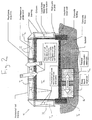
- Fig. 1 illustrates such a building structure 10 constructed with double or triple layers of transparent or translucent sheet materials 12 forming a building envelope wherein there are wall and roof cavities 14 formed between the sheet materials 12.
- the wall and roof cavities 14 are adapted to be selectively filled with a liquid foam insulation stored in a reservoir 16.
- a further aspect of this innovation involves the heating or cooling of the soap liquid so as to supply the Liquid Foam Insulation within a range of about 50 to about 70 degrees Fahrenheit (12°C and 22°C) when it is initially generated.
- the optimum range is comprised between 60 to 70 degrees Fahrenheit (17°C and 22°C).
- This approach to a determination of an overall R-Value requires the quantification of energy inputs for heating or cooling to maintain a steady temperature during a period of time. Then, the temperature difference across the insulated wall and roof cavity spaces are measured and recorded during the same period of time. With this data and the total area of the building envelope an average R-Value for the whole building envelope may be calculated.
- the average R-Value as determined by this means was very satisfactory but an even more surprising and unexpected result was obtained during these investigations.
- the unexpected result was that the conventional building heating and cooling systems were never needed to control the building environment.
- the building environment was actually controlled and regulated as a result.
- No energy inputs were recorded for the heating or cooling systems normally used to control the temperature of the building environment as long as the soap liquid temperature was maintained in the correct temperature range.
- the soap liquid reservoir 16 was equipped with an electric resistance element for heat input and with a cold water loop heat exchanger for cooling inputs.
- Various sizes of soap liquid tanks were also studied since larger reservoir capacity can be utilized to slow down the rate of temperature --change of the soap liquid reservoir.
- a large soap liquid reservoir will remain within the correct temperature range for a longer period of time because of its large thermal capacity. This is an energy storage mechanism and can be very important in achieving high efficiency. For instance, the larger reservoir can absorb a greater quantity of solar gain during the daytime and then release the energy slowly over a cold night. Industrial waste heat or district heating systems may be utilized to provide low temperature, low cost heat through a heat exchanger device located in the soap liquid reservoir. Also, a larger reservoir may use off-peak energy resources for the heating or cooling of the reservoir.
- a large soap reservoir could act as a thermal mass used to store heating or cooling energy that then is distributed at different times as needed to control the building envelope temperature and thereby control the building environment.
- the soap liquid can be coupled thermally to a separate reservoir forming a thermal mass having a temperature T m and thereby gain an apparent increase in thermal capacitance. Any large water body or aquifer internal to the building or external and reasonably accessible will serve to provide further capacitance for this new environmental control process. Therefore, low-grade energy resources may be tapped by coupling these resources to the soap liquid reservoir. Cold aquifers or cold coastal waters can be used through heat exchanger devices in order to provide virtually infinite heat sink capacity.
- the soap liquid that is used to make the replaceable liquid foam in cavity spaces of the building envelope can also be used as a working fluid in the Solar Roof Technology.
- the soap liquid can be used directly as a solar energy collector working fluid or as the working fluid circulated to the chiller cavity spaces as defined in my United States Patent No. 5,123,247.
- the soap liquid reservoir then would serve as the Thermal-Mass as specified in United States Patent No. 5,123,247.
- Other liquid or water bodies may be coupled thermally to form a larger virtual Thermal-Mass that is thereby indirectly chilled or warmed by the Solar Roof processes.
- the present invention provides a new building heating and cooling method that can be used in conjunction with these previous methods and provide thereby improved function and efficiency to these controlled environment buildings.
- a conventional building heating and cooling mechanisms can be eliminated or used only to backup the heating and cooling method provided herein.
- a further objective is to specify a process which is capable of being automated and controlled by a computer.
- the liquid foam physically delivers low-grade energy to the envelope of the building at a suitable temperature and rate.
- the quantity of energy and the rate of delivery are reduced due to the good insulating property of the liquid foam and due to the high heat capacitance of liquid foam, where the liquid component is largely composed of water.
- the liquid foam has the capacity, with evaporation of some of the water component, to remove a great deal of heat energy while it is within the building envelope and is exposed to solar energy.
- the soap liquid from which the liquid foam is generated has the advantage of good heat transfer with water-to-water type heat exchangers and may be used directly as a working fluid in related processes.
- the process of using the liquid foam is a thermodynamic system involving continuous, automated acquisition of temperature data that is then analyzed to determine what action is to be taken to regulate the building environment.
- the heating and cooling system functions under two modes, namely a heating mode and a cooling mode.
- the temperature of the soap liquid in the storage tank or reservoir is heated or cooled to a predetermined temperature.
- T 2 of the liquid foam (soap liquid) within the building envelope is continuously sensed by at least one thermocouple disposed within the roof and wall cavities of the building structure.
- the sensed data are computed by a control system which is operatively connected to a pump mechanism effective for pumping soap liquid into the roof and wall cavities of the building structure where it is blown into bubbles forming the liquid foam.
- a control system which is operatively connected to a pump mechanism effective for pumping soap liquid into the roof and wall cavities of the building structure where it is blown into bubbles forming the liquid foam.
- soap liquid is automatically pumped to roof and wall cavities upon detection by the control unit that the sensed temperatures T 2 become inferior to a threshold temperature T 3 which could be fixed at 60 degrees Fahrenheit (17°C).
- the soap liquid is automatically pumped from the storage tank to the roof and wall cavities when the control unit detects that the sensed temperatures T 2 become superior to the threshold temperature T 3 .
- the scope of this invention intends to cover variations in logic that are appropriate for different climates, as well as appropriate rules to operate a system efficiently throughout the different seasons experienced at any locality.
- the logical scheme should also encompass the dramatic variations in climate occurring from day to night.
- liquid foam cooling process it is usual for the liquid foam cooling process to be used during the daytime because there is almost always internal heat gain within the building. This is especially true of the transparent membrane envelope buildings. These buildings capture energy because of their "greenhouse effect”. Overnight, the temperature within the building is usually lower than the daytime temperature and the most efficient strategy for use of liquid foam (even during cold winter nights) is to match the liquid foam temperature, on average, to the nighttime setback temperature of the building environment. During moderately cool nights it is possible to avoid the use of liquid foam since the internal temperature may balance with the external environment.
Landscapes
- Engineering & Computer Science (AREA)
- Physics & Mathematics (AREA)
- Thermal Sciences (AREA)
- Chemical & Material Sciences (AREA)
- Combustion & Propulsion (AREA)
- Mechanical Engineering (AREA)
- General Engineering & Computer Science (AREA)
- Building Environments (AREA)
- Manufacture Of Porous Articles, And Recovery And Treatment Of Waste Products (AREA)
Claims (13)
- Procédé de commande de la température régnant à l'intérieur de l'enceinte d'un bâtiment dont la toiture et les parois présentent des cavités conçues pour recevoir une mousse liquide, le procédé comprenant les étapes consistant à : a) prévoir une mousse liquide à une température d'alimentation commandée et sélectionnée, à l'intérieur desdites cavités de la toiture et des parois ; et b) commander la température de ladite mousse liquide au cours de l'utilisation dans les cavités de la toiture et des parois, afin de maintenir ladite température dans une plage de température déterminée en fonction d'une température ambiante à commande souhaitée à l'intérieur de l'enceinte du bâtiment.
- Procédé selon la revendication 1, dans lequel l'étape b) englobe l'étape consistant à régénérer la mousse liquide lors d'un cycle de changement de température de ladite mousse liquide.
- Procédé selon la revendication 2, dans lequel l'étape de régénération de la mousse liquide, lors d'un cycle de changement de température, est exécutée en détectant la température de la mousse liquide à l'intérieur des cavités de la toiture et des parois ; et, lorsqu'il est détecté que la température de la mousse liquide commence à sortir de la plage de température prédéterminée, en délivrant une mousse liquide renouvelée aux cavités de la toiture et des parois, à la température d'alimentation commandée et sélectionnée, de manière à maintenir la température de la mousse liquide, dans lesdites cavités de la toiture et des parois, dans la plage prédéterminée.
- Procédé selon la revendication 1, dans lequel la mousse liquide est engendrée à partir d'un liquide savonneux renfermé par un réservoir isolé ; et dans lequel l'étape a) englobe l'étape consistant à commander la température dudit liquide savonneux à l'intérieur dudit réservoir.
- Procédé selon la revendication 4, dans lequel l'étape de commande de la température du liquide savonneux, dans le réservoir, englobe l'étape de couplage thermique dudit réservoir avec des ressources énergétiques de faible niveau.
- Procédé selon la revendication 4, comprenant en outre l'étape de stockage d'énergie thermique en utilisant le savon liquide renfermé par le réservoir, sous la forme d'une masse thermique enfouie dans le sol.
- Procédé selon la revendication 5, dans lequel l'étape de couplage thermique du réservoir avec des ressources énergétiques de faible niveau englobe l'étape de couplage thermique dudit réservoir avec une masse thermique.
- Procédé selon la revendication 1, dans lequel la mousse liquide est délivrée dans les limites d'une plage de température d'environ 10 à 21 degrés Celsius (50 à 70 degrés Fahrenheit).
- Système de chauffage et de refroidissement destiné à commander la température régnant à l'intérieur de l'enceinte d'un bâtiment dont la toiture et les parois présentent des cavités conçues pour recevoir un isolant en mousse liquide remplaçable, comprenant une unité de production de mousse liquide pour engendrer de la mousse liquide à une température présélectionnée, à l'intérieur desdites cavités de la toiture et des parois ; un capteur pour détecter la température de la mousse liquide dans les cavités de la toiture et des parois ; et une unité de commande pour actionner ladite unité de production de mousse liquide lorsque la température détectée commence à sortir d'une plage de température prédéterminée, de telle sorte qu'une mousse liquide renouvelée soit engendrée à ladite température présélectionnée, à l'intérieur desdites cavités de la toiture et des parois, en vue de maintenir la température de ladite mousse liquide, dans lesdites cavités de la toiture et des parois, dans ladite plage prédéterminée.
- Système selon la revendication 9, dans lequel ladite mousse liquide est engendrée à partir d'un liquide savonneux ; et dans lequel ladite unité de production comprend un réservoir isolé thermiquement, destiné à contenir le liquide savonneux, et des moyens pour commander la température dudit liquide savonneux à l'intérieur dudit réservoir.
- Système selon la revendication 10, dans lequel ledit réservoir est couplé thermiquement à une masse thermique utilisée pour stocker de l'énergie thermique.
- Système selon la revendication 10, dans lequel ladite masse thermique est un bassin d'eau.
- Système selon la revendication 10, dans lequel ledit système comporte une pompe destinée à pomper ledit liquide savonneux depuis ledit réservoir jusqu'auxdites cavités de la toiture et des parois, dans lesquelles ledit liquide savonneux est insufflé en des bulles pour former la mousse liquide.
Applications Claiming Priority (3)
| Application Number | Priority Date | Filing Date | Title |
|---|---|---|---|
| US19001400P | 2000-03-17 | 2000-03-17 | |
| US190014P | 2000-03-17 | ||
| PCT/CA2001/000348 WO2001069139A1 (fr) | 2000-03-17 | 2001-03-16 | Chauffage et refroidissement dynamiques d'un immeuble a l'aide de mousse liquide |
Publications (2)
| Publication Number | Publication Date |
|---|---|
| EP1264147A1 EP1264147A1 (fr) | 2002-12-11 |
| EP1264147B1 true EP1264147B1 (fr) | 2004-06-16 |
Family
ID=22699705
Family Applications (1)
| Application Number | Title | Priority Date | Filing Date |
|---|---|---|---|
| EP01914891A Expired - Lifetime EP1264147B1 (fr) | 2000-03-17 | 2001-03-16 | Chauffage et refroidissement dynamiques d'un immeuble a l'aide de mousse liquide |
Country Status (9)
| Country | Link |
|---|---|
| US (1) | US6575234B2 (fr) |
| EP (1) | EP1264147B1 (fr) |
| AT (1) | ATE269518T1 (fr) |
| AU (2) | AU4216101A (fr) |
| CA (1) | CA2391036C (fr) |
| DE (1) | DE60103860T2 (fr) |
| IL (1) | IL151783A0 (fr) |
| PL (1) | PL357828A1 (fr) |
| WO (1) | WO2001069139A1 (fr) |
Families Citing this family (26)
| Publication number | Priority date | Publication date | Assignee | Title |
|---|---|---|---|---|
| US7356997B2 (en) * | 2002-05-29 | 2008-04-15 | Gruber Duane A | Chilled water storage for milk cooling process |
| US20040003550A1 (en) * | 2002-07-03 | 2004-01-08 | Konopka Peter J. | Earth coupled geo-thermal energy free building |
| US6820439B1 (en) | 2003-11-12 | 2004-11-23 | Raymond G. Marek | Structure cooling system |
| US7130757B2 (en) * | 2003-12-03 | 2006-10-31 | Jeld-Wen, Inc. | Remote monitoring system |
| CA2559094C (fr) * | 2004-03-09 | 2012-10-30 | Sunarc Of Canada Inc. | Systeme d'isolation en mousse/protection solaire pour structures transparentes |
| US8327656B2 (en) | 2006-08-15 | 2012-12-11 | American Power Conversion Corporation | Method and apparatus for cooling |
| US8322155B2 (en) | 2006-08-15 | 2012-12-04 | American Power Conversion Corporation | Method and apparatus for cooling |
| US9568206B2 (en) | 2006-08-15 | 2017-02-14 | Schneider Electric It Corporation | Method and apparatus for cooling |
| US7681404B2 (en) * | 2006-12-18 | 2010-03-23 | American Power Conversion Corporation | Modular ice storage for uninterruptible chilled water |
| US8425287B2 (en) | 2007-01-23 | 2013-04-23 | Schneider Electric It Corporation | In-row air containment and cooling system and method |
| JP5559040B2 (ja) | 2007-05-15 | 2014-07-23 | シュナイダー エレクトリック アイティー コーポレーション | 設備の電力及び冷却を管理するための方法及びシステム |
| US8561407B2 (en) * | 2008-05-16 | 2013-10-22 | Eddie Sines | Hybrid solar collector and geo-thermal concept |
| US8689490B2 (en) * | 2008-09-08 | 2014-04-08 | Walton Sumner | Reflective energy management system |
| US8219362B2 (en) | 2009-05-08 | 2012-07-10 | American Power Conversion Corporation | System and method for arranging equipment in a data center |
| US8843416B2 (en) * | 2009-09-11 | 2014-09-23 | NetESCO LLC | Determining energy consumption in a structure |
| US9471045B2 (en) | 2009-09-11 | 2016-10-18 | NetESCO LLC | Controlling building systems |
| US9027634B2 (en) * | 2010-05-15 | 2015-05-12 | John R. Yatchak | Underground thermal battery storage system |
| US8996180B2 (en) | 2010-09-17 | 2015-03-31 | Schneider Electric It Corporation | System and method for predicting perforated tile airflow in a data center |
| US8621779B1 (en) | 2011-03-07 | 2014-01-07 | Barry Howard | Greenhouse utilizing waste heat source |
| AU2011384046A1 (en) | 2011-12-22 | 2014-07-17 | Schneider Electric It Corporation | Analysis of effect of transient events on temperature in a data center |
| EP2796025A4 (fr) | 2011-12-22 | 2016-06-29 | Schneider Electric It Corp | Système et procédé de prédiction de valeurs de température dans un système électronique |
| US10949923B1 (en) | 2013-09-16 | 2021-03-16 | Allstate Insurance Company | Home device sensing |
| US10430887B1 (en) | 2014-02-21 | 2019-10-01 | Allstate Insurance Company | Device sensing |
| US10380692B1 (en) * | 2014-02-21 | 2019-08-13 | Allstate Insurance Company | Home device sensing |
| US10467701B1 (en) | 2014-03-10 | 2019-11-05 | Allstate Insurance Company | Home event detection and processing |
| NL1041365B1 (en) * | 2015-06-16 | 2017-01-23 | Jacinto Env Solutions B V | Insulated greenhouse with climate installation, and method to control the internal climate. |
Family Cites Families (12)
| Publication number | Priority date | Publication date | Assignee | Title |
|---|---|---|---|---|
| US2228903A (en) * | 1937-11-04 | 1941-01-14 | Alvin C Birdsall | Heat insulation material |
| US3563305A (en) * | 1969-04-14 | 1971-02-16 | Harold R Hay | Process and apparatus for modulating temperatures within enclosures |
| US3672184A (en) * | 1969-12-10 | 1972-06-27 | Sten Olof Zeilon | Apparatus for thermally insulating a body |
| FR2147866B1 (fr) * | 1971-08-04 | 1974-04-26 | Caen Atel Constr Metal | |
| US4355682A (en) * | 1978-09-12 | 1982-10-26 | One Design, Inc. | Environmentally driven heating and cooling system |
| US4452230A (en) | 1980-05-23 | 1984-06-05 | Nelson Richard C | Canopy system for a building structure |
| DE3269798D1 (en) * | 1981-06-30 | 1986-04-17 | Alan Hilton Ridett | Building |
| US4662433A (en) * | 1982-02-11 | 1987-05-05 | Cahn Robert P | Individual comfort control device |
| US4562674A (en) | 1982-10-18 | 1986-01-07 | Nelson Richard C | Replaceable foam insulation system |
| US5123247A (en) | 1990-02-14 | 1992-06-23 | 116736 (Canada) Inc. | Solar roof collector |
| US5632327A (en) * | 1992-03-20 | 1997-05-27 | Energy Ceiling Company Limited | Temperature control |
| SE510842C2 (sv) * | 1995-09-18 | 1999-06-28 | Hans Arne Bertil Liljedahl | Förfarande för kylning av lokaler och anordning för genomförande därav |
-
2001
- 2001-03-16 CA CA002391036A patent/CA2391036C/fr not_active Expired - Fee Related
- 2001-03-16 WO PCT/CA2001/000348 patent/WO2001069139A1/fr not_active Ceased
- 2001-03-16 AU AU4216101A patent/AU4216101A/xx active Pending
- 2001-03-16 IL IL15178301A patent/IL151783A0/xx not_active IP Right Cessation
- 2001-03-16 PL PL01357828A patent/PL357828A1/xx not_active Application Discontinuation
- 2001-03-16 AT AT01914891T patent/ATE269518T1/de not_active IP Right Cessation
- 2001-03-16 DE DE60103860T patent/DE60103860T2/de not_active Expired - Lifetime
- 2001-03-16 AU AU2001242161A patent/AU2001242161B2/en not_active Expired - Fee Related
- 2001-03-16 EP EP01914891A patent/EP1264147B1/fr not_active Expired - Lifetime
-
2002
- 2002-05-13 US US10/142,881 patent/US6575234B2/en not_active Expired - Fee Related
Also Published As
| Publication number | Publication date |
|---|---|
| EP1264147A1 (fr) | 2002-12-11 |
| AU4216101A (en) | 2001-09-24 |
| CA2391036C (fr) | 2006-02-07 |
| DE60103860T2 (de) | 2006-07-20 |
| PL357828A1 (en) | 2004-07-26 |
| ATE269518T1 (de) | 2004-07-15 |
| US20020134541A1 (en) | 2002-09-26 |
| WO2001069139A1 (fr) | 2001-09-20 |
| DE60103860D1 (de) | 2004-07-22 |
| CA2391036A1 (fr) | 2001-09-20 |
| AU2001242161B2 (en) | 2004-09-23 |
| US6575234B2 (en) | 2003-06-10 |
| IL151783A0 (en) | 2003-04-10 |
Similar Documents
| Publication | Publication Date | Title |
|---|---|---|
| EP1264147B1 (fr) | Chauffage et refroidissement dynamiques d'un immeuble a l'aide de mousse liquide | |
| AU2001242161A1 (en) | Dynamic heating and cooling of a building using liquid foam | |
| Garg | Advances in Solar Energy Technology: Volume 2: Industrial Applications of Solar Energy | |
| RU2249125C1 (ru) | Система автономного электро- и теплоснабжения жилых и производственных помещений | |
| RU2459152C1 (ru) | Система комбинированного солнечного энергоснабжения | |
| Choudhury et al. | Solar air heater for residential space heating | |
| Agrawal | A review of passive systems for natural heating and cooling of buildings | |
| JP2011140827A (ja) | 地中蓄熱住宅 | |
| CN104294924A (zh) | 太阳能与相变蓄能材料集成应用的能源自维持建筑 | |
| Li et al. | Performance of double-circulation water-flow window system as solar collector and indoor heating terminal | |
| JP2008180473A (ja) | ハイブリッドエネルギー利用ヒートポンプ装置 | |
| Kutlu et al. | Thermal management of using crystallization-controllable supercooled PCM in space heating applications for different heating profiles in the UK | |
| CN205402901U (zh) | 一种利用太阳能的墙内壁蓄热采暖系统 | |
| CN105570973A (zh) | 一种利用太阳能的墙内壁蓄热采暖系统 | |
| CN217441871U (zh) | 一种蓄热块与烟囱效应耦合的被动式建筑通风系统 | |
| CN104025325B (zh) | 一种墙壁结构 | |
| Tanaka et al. | Feasibility study of a district energy system with seasonal water thermal storage | |
| CN109737486A (zh) | 一种集热蓄热墙和空气水集热器的组合供暖系统 | |
| Iskenderov et al. | Improving thermal comfort and energy saving in buildings using advanced optimal configuration approaches for heating structures and panels | |
| CN204693564U (zh) | 一种具有太阳能、低谷电加热蓄能的热水供热装置 | |
| CN1369669A (zh) | 一种带风口的相变蓄热电加热采暖地板 | |
| WO2024105075A1 (fr) | Système amélioré de stockage et de chauffage/refroidissement au sol à chaleur sensible à basse température | |
| Žandeckis et al. | Solutions for Energy Efficient and Sustainable Heating of Ventilation Air: A Review. | |
| Zeghıb et al. | Modeling and simulation of a solar thermal system for domestic space heating using radiators low temperature | |
| Springer et al. | The potential of sky radiation for humidity control |
Legal Events
| Date | Code | Title | Description |
|---|---|---|---|
| PUAI | Public reference made under article 153(3) epc to a published international application that has entered the european phase |
Free format text: ORIGINAL CODE: 0009012 |
|
| 17P | Request for examination filed |
Effective date: 20020916 |
|
| AK | Designated contracting states |
Kind code of ref document: A1 Designated state(s): AT BE CH CY DE DK ES FI FR GB GR IE IT LI LU MC NL PT SE TR |
|
| AX | Request for extension of the european patent |
Free format text: AL;LT;LV;MK;RO;SI |
|
| GRAP | Despatch of communication of intention to grant a patent |
Free format text: ORIGINAL CODE: EPIDOSNIGR1 |
|
| GRAS | Grant fee paid |
Free format text: ORIGINAL CODE: EPIDOSNIGR3 |
|
| GRAA | (expected) grant |
Free format text: ORIGINAL CODE: 0009210 |
|
| AK | Designated contracting states |
Kind code of ref document: B1 Designated state(s): AT BE CH CY DE DK ES FI FR GB GR IE IT LI LU MC NL PT SE TR |
|
| PG25 | Lapsed in a contracting state [announced via postgrant information from national office to epo] |
Ref country code: IT Free format text: LAPSE BECAUSE OF FAILURE TO SUBMIT A TRANSLATION OF THE DESCRIPTION OR TO PAY THE FEE WITHIN THE PRESCRIBED TIME-LIMIT;WARNING: LAPSES OF ITALIAN PATENTS WITH EFFECTIVE DATE BEFORE 2007 MAY HAVE OCCURRED AT ANY TIME BEFORE 2007. THE CORRECT EFFECTIVE DATE MAY BE DIFFERENT FROM THE ONE RECORDED. Effective date: 20040616 Ref country code: CH Free format text: LAPSE BECAUSE OF FAILURE TO SUBMIT A TRANSLATION OF THE DESCRIPTION OR TO PAY THE FEE WITHIN THE PRESCRIBED TIME-LIMIT Effective date: 20040616 Ref country code: BE Free format text: LAPSE BECAUSE OF FAILURE TO SUBMIT A TRANSLATION OF THE DESCRIPTION OR TO PAY THE FEE WITHIN THE PRESCRIBED TIME-LIMIT Effective date: 20040616 Ref country code: TR Free format text: LAPSE BECAUSE OF FAILURE TO SUBMIT A TRANSLATION OF THE DESCRIPTION OR TO PAY THE FEE WITHIN THE PRESCRIBED TIME-LIMIT Effective date: 20040616 Ref country code: LI Free format text: LAPSE BECAUSE OF FAILURE TO SUBMIT A TRANSLATION OF THE DESCRIPTION OR TO PAY THE FEE WITHIN THE PRESCRIBED TIME-LIMIT Effective date: 20040616 Ref country code: AT Free format text: LAPSE BECAUSE OF FAILURE TO SUBMIT A TRANSLATION OF THE DESCRIPTION OR TO PAY THE FEE WITHIN THE PRESCRIBED TIME-LIMIT Effective date: 20040616 Ref country code: FR Free format text: LAPSE BECAUSE OF FAILURE TO SUBMIT A TRANSLATION OF THE DESCRIPTION OR TO PAY THE FEE WITHIN THE PRESCRIBED TIME-LIMIT Effective date: 20040616 Ref country code: FI Free format text: LAPSE BECAUSE OF FAILURE TO SUBMIT A TRANSLATION OF THE DESCRIPTION OR TO PAY THE FEE WITHIN THE PRESCRIBED TIME-LIMIT Effective date: 20040616 Ref country code: NL Free format text: LAPSE BECAUSE OF FAILURE TO SUBMIT A TRANSLATION OF THE DESCRIPTION OR TO PAY THE FEE WITHIN THE PRESCRIBED TIME-LIMIT Effective date: 20040616 |
|
| REG | Reference to a national code |
Ref country code: GB Ref legal event code: FG4D |
|
| REG | Reference to a national code |
Ref country code: CH Ref legal event code: EP |
|
| REF | Corresponds to: |
Ref document number: 60103860 Country of ref document: DE Date of ref document: 20040722 Kind code of ref document: P |
|
| REG | Reference to a national code |
Ref country code: IE Ref legal event code: FG4D |
|
| PG25 | Lapsed in a contracting state [announced via postgrant information from national office to epo] |
Ref country code: GR Free format text: LAPSE BECAUSE OF FAILURE TO SUBMIT A TRANSLATION OF THE DESCRIPTION OR TO PAY THE FEE WITHIN THE PRESCRIBED TIME-LIMIT Effective date: 20040916 Ref country code: DK Free format text: LAPSE BECAUSE OF FAILURE TO SUBMIT A TRANSLATION OF THE DESCRIPTION OR TO PAY THE FEE WITHIN THE PRESCRIBED TIME-LIMIT Effective date: 20040916 Ref country code: SE Free format text: LAPSE BECAUSE OF FAILURE TO SUBMIT A TRANSLATION OF THE DESCRIPTION OR TO PAY THE FEE WITHIN THE PRESCRIBED TIME-LIMIT Effective date: 20040916 |
|
| PG25 | Lapsed in a contracting state [announced via postgrant information from national office to epo] |
Ref country code: ES Free format text: LAPSE BECAUSE OF FAILURE TO SUBMIT A TRANSLATION OF THE DESCRIPTION OR TO PAY THE FEE WITHIN THE PRESCRIBED TIME-LIMIT Effective date: 20040927 |
|
| LTIE | Lt: invalidation of european patent or patent extension |
Effective date: 20040616 |
|
| NLV1 | Nl: lapsed or annulled due to failure to fulfill the requirements of art. 29p and 29m of the patents act | ||
| REG | Reference to a national code |
Ref country code: CH Ref legal event code: PL |
|
| PG25 | Lapsed in a contracting state [announced via postgrant information from national office to epo] |
Ref country code: LU Free format text: LAPSE BECAUSE OF NON-PAYMENT OF DUE FEES Effective date: 20050316 Ref country code: CY Free format text: LAPSE BECAUSE OF FAILURE TO SUBMIT A TRANSLATION OF THE DESCRIPTION OR TO PAY THE FEE WITHIN THE PRESCRIBED TIME-LIMIT Effective date: 20050316 Ref country code: IE Free format text: LAPSE BECAUSE OF NON-PAYMENT OF DUE FEES Effective date: 20050316 |
|
| PG25 | Lapsed in a contracting state [announced via postgrant information from national office to epo] |
Ref country code: MC Free format text: LAPSE BECAUSE OF NON-PAYMENT OF DUE FEES Effective date: 20050331 |
|
| PLBE | No opposition filed within time limit |
Free format text: ORIGINAL CODE: 0009261 |
|
| STAA | Information on the status of an ep patent application or granted ep patent |
Free format text: STATUS: NO OPPOSITION FILED WITHIN TIME LIMIT |
|
| 26N | No opposition filed |
Effective date: 20050317 |
|
| EN | Fr: translation not filed | ||
| REG | Reference to a national code |
Ref country code: IE Ref legal event code: MM4A |
|
| PG25 | Lapsed in a contracting state [announced via postgrant information from national office to epo] |
Ref country code: PT Free format text: LAPSE BECAUSE OF NON-PAYMENT OF DUE FEES Effective date: 20041116 |
|
| PGFP | Annual fee paid to national office [announced via postgrant information from national office to epo] |
Ref country code: GB Payment date: 20090930 Year of fee payment: 9 |
|
| GBPC | Gb: european patent ceased through non-payment of renewal fee |
Effective date: 20100316 |
|
| PG25 | Lapsed in a contracting state [announced via postgrant information from national office to epo] |
Ref country code: GB Free format text: LAPSE BECAUSE OF NON-PAYMENT OF DUE FEES Effective date: 20100316 |
|
| PGFP | Annual fee paid to national office [announced via postgrant information from national office to epo] |
Ref country code: DE Payment date: 20110323 Year of fee payment: 11 |
|
| REG | Reference to a national code |
Ref country code: DE Ref legal event code: R119 Ref document number: 60103860 Country of ref document: DE Effective date: 20121002 |
|
| PG25 | Lapsed in a contracting state [announced via postgrant information from national office to epo] |
Ref country code: DE Free format text: LAPSE BECAUSE OF FAILURE TO SUBMIT A TRANSLATION OF THE DESCRIPTION OR TO PAY THE FEE WITHIN THE PRESCRIBED TIME-LIMIT Effective date: 20121002 |