EP1266460B1 - Methodes, systemes et dispositifs permettant de pre-compenser des interferences entre des signaux codes transmis - Google Patents
Methodes, systemes et dispositifs permettant de pre-compenser des interferences entre des signaux codes transmis Download PDFInfo
- Publication number
- EP1266460B1 EP1266460B1 EP01918470A EP01918470A EP1266460B1 EP 1266460 B1 EP1266460 B1 EP 1266460B1 EP 01918470 A EP01918470 A EP 01918470A EP 01918470 A EP01918470 A EP 01918470A EP 1266460 B1 EP1266460 B1 EP 1266460B1
- Authority
- EP
- European Patent Office
- Prior art keywords
- information symbol
- interference
- codes
- code
- group
- Prior art date
- Legal status (The legal status is an assumption and is not a legal conclusion. Google has not performed a legal analysis and makes no representation as to the accuracy of the status listed.)
- Expired - Lifetime
Links
Images





Classifications
-
- H—ELECTRICITY
- H04—ELECTRIC COMMUNICATION TECHNIQUE
- H04B—TRANSMISSION
- H04B1/00—Details of transmission systems, not covered by a single one of groups H04B3/00 - H04B13/00; Details of transmission systems not characterised by the medium used for transmission
- H04B1/69—Spread spectrum techniques
- H04B1/707—Spread spectrum techniques using direct sequence modulation
- H04B1/7097—Interference-related aspects
- H04B1/7103—Interference-related aspects the interference being multiple access interference
-
- H—ELECTRICITY
- H04—ELECTRIC COMMUNICATION TECHNIQUE
- H04B—TRANSMISSION
- H04B2201/00—Indexing scheme relating to details of transmission systems not covered by a single group of H04B3/00 - H04B13/00
- H04B2201/69—Orthogonal indexing scheme relating to spread spectrum techniques in general
- H04B2201/707—Orthogonal indexing scheme relating to spread spectrum techniques in general relating to direct sequence modulation
- H04B2201/7097—Direct sequence modulation interference
- H04B2201/709709—Methods of preventing interference
Definitions
- the present invention relates to communications systems and methods, and more particularly, to communications systems and methods in which signals are transmitted using codes.
- Wireless communications systems are commonly employed to provide voice and data communications to subscribers.
- analog cellular wireless communications systems such as those designated AMPS (Advanced Mobile Phone System), NMT(Nordic Mobile Telephone)-450 and NMT-900, have long been deployed successfully throughout the world.
- Digital cellular wireless communications systems such as those conforming to the North American standard IS-54 and the European standard GSM (Global Systems for Mobile Communications) have been in service since the early 1990's.
- PCS Personal Communications Services
- TIA/EIA-136 and IS-95 lower-power systems
- DECT Digital Enhanced Cordless Telephone
- CDPD Cellular Digital Packet Data
- FIG. 1 illustrates a typical terrestrial cellular wireless communication system 20.
- the cellular wireless communications system 20 may include one or more terminals 22, such as mobile terminals, radiotelephones or similar devices, communicating with a plurality of cells 24 served by base stations 26 and a mobile telephone switching office (MTSO) 28.
- MTSO mobile telephone switching office
- FIG. 1 illustrates a typical terrestrial cellular wireless communication system 20.
- the cellular wireless communications system 20 may include one or more terminals 22, such as mobile terminals, radiotelephones or similar devices, communicating with a plurality of cells 24 served by base stations 26 and a mobile telephone switching office (MTSO) 28.
- MTSO mobile telephone switching office
- the cells 24 generally serve as nodes in the communication system 20, from which links are established between terminals 22 and the MTSO 28, by way of the base stations 26 serving the cells 24.
- Each cell 24 typically has allocated to it one or more dedicated control channels and one or more traffic channels.
- a control channel is a dedicated channel used for transmitting cell identification and paging information.
- the traffic channels carry the voice and data information.
- a duplex radio communication link may be effected between two mobile terminals 22 or between a mobile terminal 22 and a landline telephone user 32 through a public switched telephone network (PSTN) 34.
- PSTN public switched telephone network
- the function of the base station 26 is to handle radio communication between a cell 24 and mobile terminals 22. In this capacity, the base station 26 functions as a relay station for data and voice signals.
- a satellite 42 may be employed to perform similar functions to those performed by a conventional terrestrial base station, for example, to serve areas in which population is sparsely distributed or which have rugged topography that tends to make conventional landline telephone or terrestrial cellular telephone infrastructure technically or economically impractical.
- a satellite wireless communications system 40 typically includes one or more satellites 42 (one shown) that serve as relays or transponders between one or more earth stations 44 (one shown) and terminals 23, which may be mobile terminals, radiotelephones or the like.
- the satellite 42 conveys information over duplex links 46 to the terminals 23 and an earth station 44.
- the earth station 44 may in turn be connected to a public switched telephone network 34, allowing communications between terminals 23, and communications between satellite terminals 23 and conventional terrestrial terminals or landline telephones.
- the satellite wireless communications system 40 may utilize a single antenna beam covering the entire area served by the system, or, as shown, the satellite may be designed such that it produces multiple minimally-overlapping beams 48, each serving distinct geographical coverage areas 50 in the system's service region.
- the coverage areas 50 serve a similar function to the cells 24 of the terrestrial cellular system 20 of FIG. 1.
- FDMA frequency division multiple access
- CDMA code division multiple access
- CDMA systems such as those conforming to the widely known IS-95 standard, achieve increased channel capacity by using "spread spectrum” techniques wherein a channel is defined by modulating a data-modulated carrier signal by a unique channelization or spreading code (sequence), i.e., a sequence that spreads an original data-modulated carrier over a wide portion of the frequency spectrum in which the communications system operates.
- a unique channelization or spreading code i.e., a sequence that spreads an original data-modulated carrier over a wide portion of the frequency spectrum in which the communications system operates.
- Conventional spread-spectrum CDMA communications systems commonly use "direct sequence” (DS) spread spectrum modulation.
- direct sequence modulation a data-modulated carrier is directly modulated by a spreading code or sequence before being amplified by a power amplifier and transmitted over a communications medium, e . g ., an air interface.
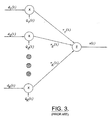
- FIG. 3 illustrates a conventional DS transmitting technique, wherein symbol streams d 1 ( t ), d 2 ( t ), ..., d K ( t ) are modulated according to respective spreading sequences (codes ) Q 1 ( t ), Q 2 ( t ),... , Q K ( t ), producing spread-spectrum signals r 1 ( t ), r 2 ( t ),..., r 3 ( t ) that are summed to form a composite signal that is transmitted in a wireless communications medium.
- CDMA systems currently in use typically use spreading codes selected from a set of orthogonal spreading codes.
- a base station serving a cell assigns forward link channelization codes to users from a set of 64 Walsh codes of length 64 chips. These codes are orthogonal when they are synchronous. Consequently, if there is little or no multipath in the propagation channel, the forward link channels from the same base station to all users in the cell generally remain orthogonal and users in the same cell cause little or no interference among one another.
- Proposed CDMA systems may have to serve much larger numbers of users with much higher information rate demands than existing systems and, accordingly, may require many more channels (and channelization codes) than existing systems.
- the proposed IS-2000 (cdma2000) standard is aimed at providing high data rate and multimedia applications. According to this standard, a user can simultaneously receive many data streams corresponding to many services such as voice, video, internet, fax, etc. To be able to provide all these data streams, the current proposed IS-2000 standard allows the cellular system to concurrently assign up to 3 codes, i.e., 3 channels, to the same user.
- One approach involves allowing the use of orthogonal codes in addition to the 64-bit Walsh codes used in current systems, for example, codes with lengths of 128, 256 and 512. This can significantly increase the number of available codes, even though the number of available codes may be constrained because simultaneous use of some codes of different lengths can destroy orthogonality.
- a second approach involves the use of "quasi-orthogonal" codes, i.e., codes that exhibit low correlation between one another, but that are not completely orthogonal.
- a set of Walsh codes of length N includes N orthogonal codes.
- W i ( t ) denote the i th Walsh code within a Walsh code set of length N chips
- T NT c is the period of Walsh code and T c is the chip duration.
- the cross-correlation C i,j for the Walsh code set meets the following constraint: Hence, different Walsh codes have zero cross-correlation and are orthogonal.
- Such a quasi-orthogonal coding scheme is described in TIA/EIA/IS-2000-2, Ballot Resolution Version (July, 1999).
- the present invention can meet this need by "precompensating" a transmitted signal based on knowledge of a signal that is to be concurrently transmitted therewith.
- compensation for interference in a second coded signal arising from a first, concurrently transmitted coded signal may be achieved by generating the second coded signal from an interference-compensated information symbol that is generated based on knowledge of the code and information symbol used to generate the first coded signal.
- this compensation can reduce interference in the second coded signal arising from lack of orthogonality of the codes from the first and second groups of codes.
- the amount of compensation can be adjusted to achieve a desired estimated signal quality, e.g., estimated signal to interference ratio, based on a scaling factor that can be determined based on the relative numbers of codes from each group of codes that are in use. In this manner, for example, signal-to-interference characteristics at a receiving station attempting to receive the second coded signal may be improved.
- the present invention can meet this need by "precompensating" a transmitted signal based on knowledge of a signal that is to be concurrently transmitted therewith.
- compensation for interference in a second coded signal arising from a first, concurrently transmitted coded signal may be achieved by generating the second coded signal from an interference-compensated information symbol that is generated from an information symbol and a signal derived from an information symbol and spreading code used to generate the first coded signal.
- this compensation can reduce interference in the second coded signal arising from lack of orthogonality of the codes from the first and second groups of spreading codes.
- the amount of compensation can be adjusted to achieve a desired estimated signal quality, e.g., estimated signal to interference ratio, based on a scaling factor that can be determined based on the relative numbers of codes from each group of codes that are in use. In this manner, for example, signal-to-interference characteristics at a receiving station attempting to receive the second coded signal may be improved. compensated information symbol encoded according to the code from the second group of codes are then concurrently transmitted.
- an interference-compensated information symbol is generated from a source information symbol based on knowledge of an information symbol and a code from the first group of codes used to generate a first coded signal.
- the first coded signal and a second coded signal representing the interference-compensated information symbol encoded according to a code from the second group of codes are concurrently transmitted.
- a communications system includes at least one transmitter that generates an interference-compensated information symbol from a source information symbol based on knowledge of an information symbol and a code used to generate a first coded signal. Then at least one transmitter concurrently transmits the first coded signal and a second coded signal representing the interference-compensated information symbol encoded according to a second code.
- the at least one transmitter may include a composite signal generating circuit that generates a composite signal from at least one first information symbol according to a corresponding at least one code from a first group of codes of a set of quasi-orthogonal codes.
- An interference-compensating coded signal generating circuit generates the interference-compensated information symbol from the source information symbol, the composite signal and a code from a second group of codes of the set of quasi-orthogonal codes, and generates the second coded signal from the interference-compensated information symbol according to the code from the second group of codes.
- a wireless communications base station includes an interference-compensating transmitter operative to transmit on respective channels defined by respective spreading codes selected from a set of quasi-orthogonal spreading codes, the set of quasi-orthogonal spreading codes including a first group of orthogonal spreading codes and a second group of orthogonal spreading codes.
- the transmitter is further operative to generate an interference-compensated information symbol from a source information symbol based on knowledge of an information symbol and a code from the first group of codes used to generate a first coded signal and to concurrently transmit a second coded signal representing the interference-compensated information symbol encoded according to a code from the second group of codes.
- the transmitter may include a composite signal generating circuit that encodes at least one information symbol according to at least one code from the first group of codes to generate a composite signal, and an interference-compensating coded signal generating circuit that integrates a product of the composite signal and the complex conjugate of the code from the second group of codes over a symbol interval, scales the integrated product by a scaling factor, and subtracts the scaled integrated product from the source information symbol to generate the interference-compensated information symbol.
- a composite signal generating circuit that encodes at least one information symbol according to at least one code from the first group of codes to generate a composite signal
- an interference-compensating coded signal generating circuit that integrates a product of the composite signal and the complex conjugate of the code from the second group of codes over a symbol interval, scales the integrated product by a scaling factor, and subtracts the scaled integrated product from the source information symbol to generate the interference-compensated information symbol.
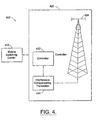
- FIG. 4 illustrates components of a wireless communications system 400 according to an embodiment of the present invention.
- the wireless communications system includes a base station 420 and a mobile switching center (MSC) 410 that is operatively associated with the base station 420 .
- MSC mobile switching center
- the base station 420 may comprise any of a number of different types of apparatus that perform base station functions but are referred to using different nomenclature, including, but not limited to, base transceiver stations (BTS), "cell sites", “radio heads” and the like.
- the base station 420 includes a controller 422 that communicates with the MSC 410, and that may provide a number of different monitoring and/or control functions at the base station 420.
- the base station 420 also includes an interference-compensating transmitter 424 that is operatively associated with the controller and that transmits coded signals in a wireless communications medium via an antenna 426.
- the coded signals transmitted by the interference-compensating transmitter 424 may represent information received from the MSC 410 , such as speech or other data for transmission to a terminal (e.g., a cellular telephone).
- the interference-compensating transmitter 424 may generate the coded signals using various techniques as described below.
- equation (4) multiplication with the pilot channel, fading and noise are ignored for purposes of illustration.
- the output of the receiver for the nth code of the second group is given by:
- the second term in the right hand side of equation (5) represents interference affecting the nth channel in the second group.
- this interference term may be compensated for at the transmitter to reduce the interference in the signal received at the receiver.
- a first case will now be described in which it is desired to compensate for interference arising from codes of a first group of a quasi-orthogonal code set on a channel using the n th code in a second group of codes of the quasi-orthogonal code set.
- FIG. 5 illustrates an interference-compensating transmitter 500 according to this aspect of the present invention.
- a composite signal generating circuit 510 generates a composite signal from a set of K 1 first information symbols d 1 / 1( t ), d 1 / 2( t ), ⁇ , d 1 / K 1 ( t ).
- Each of the first information symbols d 1 / 1( t ), d 1 / 2( t ), ⁇ , d 1 / K 1 ( t ) is modulated by respective spreading codes Q 1 / 1( t ), Q 1 / 2( t ), ⁇ , Q 1 / K 1 ( t ) from a first group of orthogonal spreading codes of a set of quasi-orthogonal spreading code using multiplier circuits 512 .
- the resulting signals are then combined by a summing circuit 514 to produce the composite signal
- the composite signal is applied to an interference-compensating coded signal generating circuit 520.
- the interference-compensating coded signal generator circuit 520 includes a multiplier circuit 521 that multiplies the composite signal by a complex conjugate of the n th spreading code Q 2 / n ( t ) of the second group produced by a complex conjugating circuit 522 .
- a scaling integrating circuit 523 integrates the resulting signal over a symbol interval T, normalized by the symbol duration T and scaled by a scaling factor ⁇ 2 .
- the scaled and integrated product V 1 / n ( t ) of the composite signal and the spreading code Q 2 / n ( t ) is then subtracted from an information symbol d 2 / n ( t ) in a subtraction circuit 524 to produce an interference-compensated information symbol d and 2 / n ( t ), which is then multiplied by the spreading code Q 2 / n ( t ) in a multiplier circuit 525 to produce a coded signal r 2 / n ( t ).
- the coded signal r 2 / n ( t ) is then combined with the composite signal in a summing circuit 530 to produce a combined signal r ( t ) for transmission in the wireless communications medium.
- V 1 / n ( t ) may be given by: where ⁇ 2 is a positive constant ⁇ 1. Over the symbol duration T , V 1 / n ( t ) is constant. Accordingly, the transmitted combined signal r ( t ) may be given by:
- the first term in the right hand side of equation (7) is the composite signal while the second term in the right hand side of equation (7) represents the interference-compensated signal for the signal generated according to the n th code from the second group.
- the output of a receiver attempting to receive the signal encoded according to the n th code may be given by:
- the output of a receiver receiving a channel encoded according to the n th code Q 1 / n ( t ) from the first group may be given by:
- Equation (10) may be manipulated to yield:
- the first term on the right hand side of equation (11) corresponds to the desired signal, while the second term is similar to the interference term in equation (7) and represents interference that would arise from signal encoded according to codes in the second group if these signals were not compensated.
- the third term in equation (11) is an additional interference term arising from the use of compensation in signals transmitted according to codes from the second group.
- the value of ⁇ 2 preferably is selected to produce desired signal to interference characteristics for the signals.
- One criteria for selecting the scaling factor ⁇ is to equalize estimated SIR for all active channels. Generally, the degree of improvement in estimated SIR over an uncompensated transmitter increases as the difference between the number K 1 of active channels using codes from the first set and the number K 2 of active channels using codes from the second group increases.
- FIG. 6 illustrates an interference-compensating transmitter 600 according to this aspect of the present invention.
- the interference-compensating transmitter 600 includes a first composite signal generating circuit 510a that generates a first composite signal from first information symbols d 1 / 1( t ), d 1 / 2( t ), ⁇ , d 1 / K 1( t ) and corresponding spreading codes Q 1 / 1( t ), Q 1 / 2( t ), ⁇ , Q 1 / K 1( t ) from a first orthogonal group of the quasi-orthogonal code set.
- a second composite signal generating circuit 510b generates a second composite signal from second information symbols d 2 / 1( t ), d 2 / 2( t ), ⁇ , d 2 / K 2( t ) and corresponding spreading codes Q 2 / 1( t ), Q 2 / 2( t ), ⁇ , Q 2 / K 2( t ) from a second orthogonal group of the quasi-orthogonal code set.
- Each of the first and second composite signal generating circuits 510a, 510b includes multiplier circuits 512 and a summing circuit 514, which function as described with reference to FIG. 5.
- the first and second composite signals produced by the first and second composite signal generating circuits 510a , 510b are applied to respective first and second sets of interference-compensating coded signal generating circuits 520a-1,..., 520a-K2, 520b-1, ..., 520b-K1 to produce interference-compensated coded signals r 1 / 1( t ), ⁇ r 1 / K 1( t ), r 2 / 1( t ), ⁇ , r 2 / K 2( t ) that are combined by a summing circuit 610 to produce a combined signal r ( t ) for transmission in the wireless communications medium.
- Each of the first and second interference-compensating coded signal generating circuits 520a-1,..., 520a-K2, and 520b-1,..., 520b-K1 include multiplier circuits 521, 525 and summing circuits 524 that function as described with reference to FIG. 5.
- the first interference-compensating coded signal generating circuits 520a-1, ..., 520a-K1 that produce coded signals r 1 / 1(It), ⁇ r 1 / K 1( t ) from the codes for the first group of codes each include a scaling integrating circuit 523a that employs a first scaling factor ⁇ 1 .
- the second interference-compensating coded signal generating circuits 520b-1,..., 520b-K2 that produce coded signals r 2 / 1( t ), ⁇ r 2 / K 1( t ) from the codes for the second group of codes each include a scaling integrating circuit 523b that employs a second scaling factor ⁇ 2 .
- ⁇ 1 and ⁇ 2 are chosen to equalize estimated SIR among the signals, improvement in SIR generally increases as the difference between K 1 and K 2 increases.
- the present invention is also applicable when more than two groups of codes are used.
- An exemplary interference-compensating coded signal generating circuit 520' for a channel encoded according to a j th code Q 1 / j ( t ) of a first group of codes using such an application is illustrated in FIG. 7.
- Composite signals for respective second, third and fourth groups of codes are each multiplied by the complex conjugate of the j th code Q 1 / j ( t ), and then integrated over a symbol period T and scaled by a scaling factor ⁇ 1 by respective scaling integrating circuits 532a', 532b', 523c'.
- the scaled and integrated signals produced are then subtracted from the information symbol d 1 / j ( t ) at a subtraction circuit 524' to produce an interference-compensated information symbol d and 1 / j ( t ).
- the interference-compensated information symbol d and 1 / j ( t ) is then multiplied by the j th code Q 1 / j ( t ) to produce a coded signal r 1 / j ( t ), which can be combined with other coded signals and transmitted as described with reference to FIGs. 5-7.
- FIGs. 8-10 are flowcharts illustrating exemplary operations for decoding variably encoded signals according to aspects of the present invention. It will be understood that blocks of the flowcharts of FIGs. 8-10, and combinations of blocks in the flowchart illustrations, may be implemented using electronic circuits included in a transmitting station, such as the transmitter components illustrated in FIGs. 4-7. It will also be appreciated that blocks of the flowchart illustrations of FIGs. 8-10, and combinations of blocks in the flowchart illustrations, may be implemented using components other than those illustrated in FIGs. 4-7, and that, in general, the blocks of the flowchart illustrations of FIGs.
- 8-10 may be implemented in special purpose hardware such as discrete analog and/or digital circuitry, combinations of integrated circuits or one or more application specific integrated circuits (ASICs), as well as by computer program instructions which may be loaded onto a computer or other programmable data processing apparatus to produce a machine such that the instructions which execute on the computer or other programmable data processing apparatus implement the functions specified in the flowchart block or blocks.
- the computer program instructions may also be loaded onto a computer or other programmable data processing apparatus to cause a series of operational steps to be performed on the computer or other programmable apparatus to produce a computer implemented process such that the instructions which execute on the computer or other programmable apparatus provide steps for implementing the functions specified in the flowchart block or blocks.
- blocks of the flowchart illustrations of FIGs. 8-10 support electronic circuits and other means for performing the specified functions, as well as combinations of steps for performing the specified functions. It will be understood that the circuits and other means supported by each block of the flowcharts of FIGs. 8-10, and combinations of blocks therein, can be implemented by special purpose hardware, software or firmware operating on special or general purpose data processors, or combinations thereof.
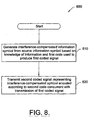
- FIG. 8 illustrates exemplary interference-compensated signal transmission operations 800 according to an embodiment of the present invention.
- An interference-compensated information symbol is generated from an information symbol based on knowledge of an information symbol and a first code used to produce a first coded signal (Block 810).
- a second coded signal representing the interference-compensated information symbol encoded according to a second code is transmitted concurrently with transmission of the first coded signal (Block 820 ).
- the operations 800 can be implemented in a number of different ways, including the ways described with reference to FIGs. 5-7.
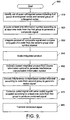
- a set of quasi-orthogonal codes including first and second orthogonal groups is identified (Block 910 ). At least one information symbol is encoded according to at least one code from the first group to generate a composite signal (Block 920 ). A product of the composite signal and the complex conjugate of one of the codes of the second group is integrated over a symbol period (Block 930 ), and the resulting integrated product scaled according to a scaling factor (Block 940 ). The scaled integrated product is then subtracted from a source information symbol to generate an interference-compensated information symbol (Block 950 ).
- the interference-compensated information symbol is then encoded (e.g., multiplied) according to the code from the second group to generate a coded signal (Block 960 ).
- the coded signal is then combined with other coded signals, e.g., other coded signals generated in a similar fashion or the composite signal itself, to generate a combined signal (Block 970 ) that is transmitted in the communications medium (Block 980 ).
- FIG. 10 illustrates exemplary operations 1000 according to yet another aspect of the present invention.
- Respective numbers K 1 , K 2 of channelization codes actively in use from first and second groups of a quasi-orthogonal code set are identified (Block 1010 ).
- One or more values for one or more scaling factors ⁇ are determined such that estimated SIRs for the channels coded according to the active codes are equalized based on the numbers K 1 , K 2 using, for example, the relations given in equations (14) and (15) (Block 1020 ).
- the selected values are then applied to generate one or more interference-compensated coded signals (Block 1030 ).
- the one or more interference-compensated coded signals are then transmitted (Block 1040 ).
- FIGs. 5-10 may be varied within the scope of the present invention. For example, it may be desirable to select scaling factors to provide estimated SIR for some channels (e.g., channels that are more vulnerable to transmission errors) that is greater than that applied in other channels, instead of equalizing SIR among all channels. Criteria other than SIR may also be used to determine appropriate scaling factors. In other variations, instead of determining scaling factors for each symbol period, a transmitter may simply toggle between interference-compensated and non-interference-compensated modes of operation based on a threshold evaluation of the relative number of codes from different groups that are actively in use.
Landscapes
- Engineering & Computer Science (AREA)
- Computer Networks & Wireless Communication (AREA)
- Signal Processing (AREA)
- Mobile Radio Communication Systems (AREA)
- Cable Transmission Systems, Equalization Of Radio And Reduction Of Echo (AREA)
- Reduction Or Emphasis Of Bandwidth Of Signals (AREA)
Claims (21)
- Procédé d'émission comprenant les étapes consistant à :produire un premier signal codé à partir d'un symbole d'information, selon un premier code d'étalement, choisi dans un premier ensemble de codes d'étalements orthogonaux ;produire (810) un symbole d'information avec compensation des interférences, à partir d'un symbole d'information de source et d'un signal dérivé du symbole d'information, du premier code d'étalement utilisé pour produire le premier signal codé et d'un second code d'étalement ;produire un second signal codé représentant le symbole d'information avec compensation des interférences, codé selon le second code d'étalement, choisi dans un second ensemble de codes d'étalements orthogonaux qui sont quasi-orthogonaux au premier ensemble de codes d'étalements ; etémettre parallèlement (820) les premier et second signaux codés.
- Procédé selon la revendication 1,
dans lequel l'étape de production d'un symbole d'information avec compensation des interférences est précédée des étapes consistant à :dans lequel le second signal codé représente le premier symbole d'information avec compensation des interférences, codé selon le code choisi dans le second groupe de codes d'étalements orthogonaux.produire un premier signal composite (920) à partir d'au moins un symbole d'information, selon au moins un code choisi dans le premier groupe de codes d'étalements orthogonaux de l'ensemble de codes d'étalements quasi-orthogonaux ; et comprend l'étape consistant à :produire un premier symbole d'information avec compensation des interférences à partir d'un premier symbole d'information, du premier signal composite et d'un code d'étalement choisi dans le second groupe de codes d'étalements orthogonaux dans l'ensemble de codes quasi-orthogonaux ; et - Procédé selon la revendication 2, dans lequel l'étape de production d'un premier symbole d'information avec compensation des interférences comprend les étapes consistant à :intégrer (930) un produit du premier signal composite et du conjugué complexe du code choisi dans le second groupe de codes d'étalements orthogonaux, sur un intervalle de symboles ;recadrer (940) le produit intégré en utilisant un facteur de cadrage ; etsoustraire (950) le produit intégré recadré du premier symbole d'information afin de produire le premier symbole d'information avec compensation des interférences.
- Procédé selon la revendication 3, dans lequel l'étape de recadrage du produit intégré en utilisant un facteur de cadrage est précédée des étapes consistant à :déterminer respectivement des premier et second numéros de codes à partir du premier groupe de codes d'étalements orthogonaux et du second groupe de codes d'étalements orthogonaux, à utiliser pour émettre des symboles d'information sur l'intervalle de symboles ; etdéterminer le facteur de cadrage sur la base des premier et second numéros déterminés.
- Procédé selon la revendication 4, dans lequel la détermination du facteur de cadrage sur la base des premier et second numéros déterminés consiste à déterminer le facteur de cadrage à partir des premier et second numéros déterminés en utilisant un critère de qualité du signal.
- Procédé selon la revendication 5, dans lequel la détermination du facteur de cadrage sur la base des premier et second numéros déterminés en utilisant un critère de qualité du signal consiste à sélectionner le facteur de cadrage de manière à ce qu'il produise des rapports signal/interférences estimés substantiellement égaux pour des signaux codés selon les premier et second codes d'étalements.
- Procédé selon la revendication 2,
dans lequel le premier signal codé est le premier signal composite ;
dans lequel l'étape consistant à émettre parallèlement les premier et second signaux codés est précédée des étapes consistant à :dans lequel l'émission parallèle des premier et second signaux codés est constituée de l'émission du signal combiné.coder (960) le premier symbole avec compensation des interférences selon le code choisi dans le second groupe de codes d'étalements orthogonaux pour produire le second signal codé ; etcombiner (970) le premier signal composite et le second signal codé pour produire un signal combiné ; et - Procédé selon la revendication 2,
dans lequel l'émission parallèle des premier et second signaux codés est précédée des étapes consistant à :identifier au moins un symbole d'information à émettre en utilisant au moins un code d'un second groupe de codes ;produire un second signal composite à partir du symbole d'information identifié, au nombre d'au moins un, selon le code choisi dans le second groupe de codes d'étalements orthogonaux, au nombre d'au moins un ; etproduire un second symbole d'information avec compensation des interférences codé selon le code choisi dans le premier groupe de codes d'étalements orthogonaux. - Procédé selon la revendication 8,
dans lequel l'émission parallèle des premier et second signaux codés est précédée des étapes consistant à :dans lequel l'émission parallèle des premier et second signaux codés est constituée de l'émission du signal combiné.coder le second symbole d'information avec compensation des interférences selon le code choisi dans le premier groupe de codes d'étalements orthogonaux pour produire le premier signal codé ; etcombiner les premier et second signaux codés pour produire un signal combiné ; et - Procédé selon la revendication 8, dans lequel la production d'un second symbole d'information avec compensation des interférences comprend les étapes consistant à :intégrer un produit du second signal composite et du conjugué complexe du code choisi dans le premier groupe de codes d'étalements orthogonaux, sur un intervalle de symboles ;recadrer le produit intégré en utilisant un facteur de cadrage ; etsoustraire le produit intégré recadré du second symbole d'information afin de produire le second symbole d'information avec compensation des interférences.
- Procédé selon la revendication 10, dans lequel l'étape de recadrage du produit intégré en utilisant un facteur de cadrage est précédée des étapes consistant à :déterminer respectivement des premier et second numéros de code à partir du premier groupe de codes d'étalements orthogonaux et du second groupe de codes d'étalements orthogonaux, à utiliser pour émettre des symboles d'information sur l'intervalle de symboles ; etdéterminer le facteur de cadrage sur la base des premier et second numéros déterminés.
- Procédé selon la revendication 11, dans lequel la détermination du facteur de cadrage sur la base des premier et second numéros déterminés consiste à déterminer le facteur de cadrage à partir des premier et second numéros déterminés en utilisant un critère de qualité du signal.
- Procédé selon la revendication 12, dans lequel la détermination du facteur de cadrage sur la base des premier et second numéros déterminés consiste à sélectionner le facteur de cadrage de manière à ce qu'il produise des rapports signal/interférences estimés substantiellement égaux pour des signaux modulés selon le premier et le second code d'étalement.
- Procédé selon la revendication 1, dans lequel l'émission parallèle des premier et second signaux codés consiste à émettre parallèlement les premier et second signaux codés dans un milieu de communication sans fil à partir d'au moins une station de base sans fil.
- Procédé selon la revendication 14, dans lequel l'émission parallèle des premier et second signaux codés consiste à émettre parallèlement les premier et second signaux codés à partir de la même station de base.
- Système de communications, comprenant :au moins un émetteur (500) qui produit un premier signal codé à partir d'un symbole d'information, selon un premier code d'étalement choisi dans un premier ensemble de codes orthogonaux, qui produit un symbole d'information avec compensation des interférences à partir d'un symbole d'information de source et un signal dérivé du symbole d'information, du premier code d'étalement utilisé pour produire le premier signal codé et d'un second code d'étalement, qui produit un second signal codé représentant le symbole d'information avec compensation des interférences codé selon le second code d'étalement, choisi dans un second ensemble de codes orthogonaux, qui est quasi-orthogonal au premier ensemble de codes d'étalements et qui émet parallèlement les premier et second signaux codés.
- Système selon la revendication 16, dans lequel ledit émetteur (500), au nombre d'au moins un, comprend :un circuit de production de signal composite (510) qui produit un signal composite à partir d'au moins un symbole d'information, selon au moins un code choisi dans le premier groupe de codes d'étalements orthogonaux de l'ensemble de codes d'étalements quasi-orthogonaux ; etun circuit de production de signal codé de compensation des interférences (520) qui produit le symbole d'information avec compensation des interférences à partir du symbole d'information de source, du signal composite et d'un code d'étalement choisi dans le second groupe de codes d'étalements orthogonaux dans l'ensemble de codes quasi-orthogonaux et qui produit le second signal codé à partir du symbole d'information avec compensation des interférences, selon le code choisi dans le second groupe de codes d'étalements orthogonaux.
- Système selon la revendication 17, dans lequel ledit circuit de production de signal codé de compensation des interférences (520) intègre un produit du signal composite et du conjugué complexe du code choisi dans le second groupe de codes d'étalements orthogonaux sur un intervalle de symboles, recadre le produit intégré en utilisant un facteur de cadrage et soustrait le produit intégré recadré du symbole d'information de source pour produire le symbole d'information avec compensation des interférences.
- Système selon la revendication 18, dans lequel ledit circuit de production de signal codé de compensation des interférences (520) détermine, respectivement, des premier et second numéros de codes à partir du premier groupe de codes d'étalements orthogonaux et du second groupe de codes d'étalements orthogonaux, à utiliser pour émettre des symboles d'information sur l'intervalle de symboles ; et détermine le facteur de cadrage sur la base des premier et second numéros déterminés.
- Système selon la revendication 16, dans lequel ledit émetteur, au nombre d'au moins un, comprend au moins un émetteur sans fil (424) implanté dans une station de base sans fil (420).
- Système selon la revendication 20, dans lequel ladite station de base sans fil, au nombre d'au moins une, est constituée d'une unique station de base sans fil qui émet parallèlement les premier et second signaux codés.
Applications Claiming Priority (3)
| Application Number | Priority Date | Filing Date | Title |
|---|---|---|---|
| US532357 | 2000-03-21 | ||
| US09/532,357 US6973063B1 (en) | 2000-03-21 | 2000-03-21 | Methods, systems and apparatus for precompensating for interference among transmitted coded signals |
| PCT/US2001/007523 WO2001071930A2 (fr) | 2000-03-21 | 2001-03-09 | Methodes, systemes et dispositifs permettant de pre-compenser des interferences entre des signaux codes transmis |
Publications (2)
| Publication Number | Publication Date |
|---|---|
| EP1266460A2 EP1266460A2 (fr) | 2002-12-18 |
| EP1266460B1 true EP1266460B1 (fr) | 2005-05-25 |
Family
ID=24121444
Family Applications (1)
| Application Number | Title | Priority Date | Filing Date |
|---|---|---|---|
| EP01918470A Expired - Lifetime EP1266460B1 (fr) | 2000-03-21 | 2001-03-09 | Methodes, systemes et dispositifs permettant de pre-compenser des interferences entre des signaux codes transmis |
Country Status (6)
| Country | Link |
|---|---|
| US (1) | US6973063B1 (fr) |
| EP (1) | EP1266460B1 (fr) |
| AT (1) | ATE296502T1 (fr) |
| AU (1) | AU2001245546A1 (fr) |
| DE (1) | DE60111031D1 (fr) |
| WO (1) | WO2001071930A2 (fr) |
Families Citing this family (3)
| Publication number | Priority date | Publication date | Assignee | Title |
|---|---|---|---|---|
| US7133353B2 (en) * | 2001-01-08 | 2006-11-07 | Telefonaktiebolaget Lm Ericsson (Publ) | CDMA system using quasi-orthogonal codes |
| KR100895183B1 (ko) * | 2006-02-03 | 2009-04-24 | 삼성전자주식회사 | 무선통신 시스템을 위한 주변 셀 간섭의 제거를 위한송수신 방법 및 장치 |
| US8320352B2 (en) * | 2007-03-02 | 2012-11-27 | Qualcomm Incorporated | Robust transmission scheme for wireless networks |
Family Cites Families (11)
| Publication number | Priority date | Publication date | Assignee | Title |
|---|---|---|---|---|
| JP3349861B2 (ja) * | 1995-03-17 | 2002-11-25 | 富士通株式会社 | ワイヤレスlanシステム |
| US5740165A (en) * | 1996-02-29 | 1998-04-14 | Lucent Technologies Inc. | Wireless TDMA transmitter with reduced interference |
| US5805567A (en) * | 1996-09-13 | 1998-09-08 | Lucent Technologies Inc. | Orthogonal modulation scheme |
| US6067291A (en) * | 1997-09-23 | 2000-05-23 | Lucent Technologies Inc. | Wireless local area network with enhanced carrier sense provision |
| DE69930239D1 (de) | 1998-03-26 | 2006-05-04 | Samsung Electronics Co Ltd | Gerät und Verfahren zur Leistungskontrolle Orthogonaler Kanäle und Quasi-Orthogonaler Kanäle in einem CDMA Kommunikationssystem |
| US7286590B1 (en) | 1998-04-24 | 2007-10-23 | Robert Bosch Gmbh | Method for the transmission of data, and apparatus for the transmission of data |
| US6332006B1 (en) * | 1998-11-18 | 2001-12-18 | Ericsson Inc. | Apparatus and methods for providing high-penetration messaging in wireless communications systems |
| US6501788B1 (en) * | 1999-01-22 | 2002-12-31 | Ericsson Inc. | Apparatus and methods for intereference cancellation in spread spectrum communications systems |
| US6067290A (en) * | 1999-07-30 | 2000-05-23 | Gigabit Wireless, Inc. | Spatial multiplexing in a cellular network |
| US6515980B1 (en) * | 1999-09-22 | 2003-02-04 | Ericsson Inc. | Methods and apparatus for interference cancellation using complex interference orthogonalization techniques |
| US6683924B1 (en) * | 1999-10-19 | 2004-01-27 | Ericsson Inc. | Apparatus and methods for selective correlation timing in rake receivers |
-
2000
- 2000-03-21 US US09/532,357 patent/US6973063B1/en not_active Expired - Fee Related
-
2001
- 2001-03-09 AT AT01918470T patent/ATE296502T1/de not_active IP Right Cessation
- 2001-03-09 EP EP01918470A patent/EP1266460B1/fr not_active Expired - Lifetime
- 2001-03-09 WO PCT/US2001/007523 patent/WO2001071930A2/fr not_active Ceased
- 2001-03-09 AU AU2001245546A patent/AU2001245546A1/en not_active Abandoned
- 2001-03-09 DE DE60111031T patent/DE60111031D1/de not_active Expired - Lifetime
Also Published As
| Publication number | Publication date |
|---|---|
| US6973063B1 (en) | 2005-12-06 |
| WO2001071930A2 (fr) | 2001-09-27 |
| ATE296502T1 (de) | 2005-06-15 |
| WO2001071930A3 (fr) | 2002-02-28 |
| EP1266460A2 (fr) | 2002-12-18 |
| DE60111031D1 (de) | 2005-06-30 |
| AU2001245546A1 (en) | 2001-10-03 |
Similar Documents
| Publication | Publication Date | Title |
|---|---|---|
| US6301289B1 (en) | To a telecommunication system using code division multiple access (CDMA) | |
| US6396804B2 (en) | High data rate CDMA wireless communication system | |
| US6728230B2 (en) | Receiver method and apparatus with complex pilot filter | |
| JP3889038B2 (ja) | 通信システムにおいて符号化レートを制御する方法および装置 | |
| US7421279B2 (en) | Method, system and apparatus for improving reception in multiple access communication systems | |
| AU716705B2 (en) | Subscriber unit for a CDMA wireless communication system | |
| EP0981914B1 (fr) | Unite d'abonne et procede utile dans un systeme de telecommunications sans fil | |
| US20020021683A1 (en) | Method and apparatus for reducing amplitude variations and interference in communication signals, such as in wireless communication signals employing inserted pilot symbols | |
| US20010007572A1 (en) | High data CDMA wireless comminication system using variable sized channel codes | |
| US7012977B2 (en) | System, method and apparatus for wireless channel parameter estimation in spread spectrum communication systems | |
| JP4681180B2 (ja) | Cdma信号成分の処理方法 | |
| EP1266460B1 (fr) | Methodes, systemes et dispositifs permettant de pre-compenser des interferences entre des signaux codes transmis | |
| EP0973283B1 (fr) | Méthode et appareil de détermination pour un système de communication à spectre étalé |
Legal Events
| Date | Code | Title | Description |
|---|---|---|---|
| PUAI | Public reference made under article 153(3) epc to a published international application that has entered the european phase |
Free format text: ORIGINAL CODE: 0009012 |
|
| 17P | Request for examination filed |
Effective date: 20020927 |
|
| AK | Designated contracting states |
Kind code of ref document: A2 Designated state(s): AT BE CH CY DE DK ES FI FR GB GR IE IT LI LU MC NL PT SE TR |
|
| AX | Request for extension of the european patent |
Free format text: AL;LT;LV;MK;RO;SI |
|
| 17Q | First examination report despatched |
Effective date: 20031028 |
|
| RAP1 | Party data changed (applicant data changed or rights of an application transferred) |
Owner name: ERICSSON INC. |
|
| GRAP | Despatch of communication of intention to grant a patent |
Free format text: ORIGINAL CODE: EPIDOSNIGR1 |
|
| GRAS | Grant fee paid |
Free format text: ORIGINAL CODE: EPIDOSNIGR3 |
|
| GRAA | (expected) grant |
Free format text: ORIGINAL CODE: 0009210 |
|
| AK | Designated contracting states |
Kind code of ref document: B1 Designated state(s): AT BE CH CY DE DK ES FI FR GB GR IE IT LI LU MC NL PT SE TR |
|
| PG25 | Lapsed in a contracting state [announced via postgrant information from national office to epo] |
Ref country code: LI Free format text: LAPSE BECAUSE OF FAILURE TO SUBMIT A TRANSLATION OF THE DESCRIPTION OR TO PAY THE FEE WITHIN THE PRESCRIBED TIME-LIMIT Effective date: 20050525 Ref country code: IT Free format text: LAPSE BECAUSE OF FAILURE TO SUBMIT A TRANSLATION OF THE DESCRIPTION OR TO PAY THE FEE WITHIN THE PRESCRIBED TIME-LIMIT;WARNING: LAPSES OF ITALIAN PATENTS WITH EFFECTIVE DATE BEFORE 2007 MAY HAVE OCCURRED AT ANY TIME BEFORE 2007. THE CORRECT EFFECTIVE DATE MAY BE DIFFERENT FROM THE ONE RECORDED. Effective date: 20050525 Ref country code: FI Free format text: LAPSE BECAUSE OF FAILURE TO SUBMIT A TRANSLATION OF THE DESCRIPTION OR TO PAY THE FEE WITHIN THE PRESCRIBED TIME-LIMIT Effective date: 20050525 Ref country code: BE Free format text: LAPSE BECAUSE OF FAILURE TO SUBMIT A TRANSLATION OF THE DESCRIPTION OR TO PAY THE FEE WITHIN THE PRESCRIBED TIME-LIMIT Effective date: 20050525 Ref country code: CH Free format text: LAPSE BECAUSE OF FAILURE TO SUBMIT A TRANSLATION OF THE DESCRIPTION OR TO PAY THE FEE WITHIN THE PRESCRIBED TIME-LIMIT Effective date: 20050525 Ref country code: AT Free format text: LAPSE BECAUSE OF FAILURE TO SUBMIT A TRANSLATION OF THE DESCRIPTION OR TO PAY THE FEE WITHIN THE PRESCRIBED TIME-LIMIT Effective date: 20050525 Ref country code: TR Free format text: LAPSE BECAUSE OF FAILURE TO SUBMIT A TRANSLATION OF THE DESCRIPTION OR TO PAY THE FEE WITHIN THE PRESCRIBED TIME-LIMIT Effective date: 20050525 Ref country code: NL Free format text: LAPSE BECAUSE OF FAILURE TO SUBMIT A TRANSLATION OF THE DESCRIPTION OR TO PAY THE FEE WITHIN THE PRESCRIBED TIME-LIMIT Effective date: 20050525 |
|
| REG | Reference to a national code |
Ref country code: GB Ref legal event code: FG4D |
|
| REG | Reference to a national code |
Ref country code: CH Ref legal event code: EP |
|
| REG | Reference to a national code |
Ref country code: IE Ref legal event code: FG4D |
|
| REF | Corresponds to: |
Ref document number: 60111031 Country of ref document: DE Date of ref document: 20050630 Kind code of ref document: P |
|
| PG25 | Lapsed in a contracting state [announced via postgrant information from national office to epo] |
Ref country code: DK Free format text: LAPSE BECAUSE OF FAILURE TO SUBMIT A TRANSLATION OF THE DESCRIPTION OR TO PAY THE FEE WITHIN THE PRESCRIBED TIME-LIMIT Effective date: 20050825 Ref country code: GR Free format text: LAPSE BECAUSE OF FAILURE TO SUBMIT A TRANSLATION OF THE DESCRIPTION OR TO PAY THE FEE WITHIN THE PRESCRIBED TIME-LIMIT Effective date: 20050825 Ref country code: SE Free format text: LAPSE BECAUSE OF FAILURE TO SUBMIT A TRANSLATION OF THE DESCRIPTION OR TO PAY THE FEE WITHIN THE PRESCRIBED TIME-LIMIT Effective date: 20050825 |
|
| PG25 | Lapsed in a contracting state [announced via postgrant information from national office to epo] |
Ref country code: DE Free format text: LAPSE BECAUSE OF FAILURE TO SUBMIT A TRANSLATION OF THE DESCRIPTION OR TO PAY THE FEE WITHIN THE PRESCRIBED TIME-LIMIT Effective date: 20050826 |
|
| PG25 | Lapsed in a contracting state [announced via postgrant information from national office to epo] |
Ref country code: ES Free format text: LAPSE BECAUSE OF FAILURE TO SUBMIT A TRANSLATION OF THE DESCRIPTION OR TO PAY THE FEE WITHIN THE PRESCRIBED TIME-LIMIT Effective date: 20050905 |
|
| PG25 | Lapsed in a contracting state [announced via postgrant information from national office to epo] |
Ref country code: PT Free format text: LAPSE BECAUSE OF FAILURE TO SUBMIT A TRANSLATION OF THE DESCRIPTION OR TO PAY THE FEE WITHIN THE PRESCRIBED TIME-LIMIT Effective date: 20051027 |
|
| REG | Reference to a national code |
Ref country code: CH Ref legal event code: PL |
|
| NLV1 | Nl: lapsed or annulled due to failure to fulfill the requirements of art. 29p and 29m of the patents act | ||
| PG25 | Lapsed in a contracting state [announced via postgrant information from national office to epo] |
Ref country code: IE Free format text: LAPSE BECAUSE OF NON-PAYMENT OF DUE FEES Effective date: 20060309 |
|
| PG25 | Lapsed in a contracting state [announced via postgrant information from national office to epo] |
Ref country code: LU Free format text: LAPSE BECAUSE OF NON-PAYMENT OF DUE FEES Effective date: 20060331 Ref country code: MC Free format text: LAPSE BECAUSE OF NON-PAYMENT OF DUE FEES Effective date: 20060331 |
|
| PLBE | No opposition filed within time limit |
Free format text: ORIGINAL CODE: 0009261 |
|
| STAA | Information on the status of an ep patent application or granted ep patent |
Free format text: STATUS: NO OPPOSITION FILED WITHIN TIME LIMIT |
|
| 26N | No opposition filed |
Effective date: 20060228 |
|
| EN | Fr: translation not filed | ||
| REG | Reference to a national code |
Ref country code: IE Ref legal event code: MM4A |
|
| PG25 | Lapsed in a contracting state [announced via postgrant information from national office to epo] |
Ref country code: FR Free format text: LAPSE BECAUSE OF FAILURE TO SUBMIT A TRANSLATION OF THE DESCRIPTION OR TO PAY THE FEE WITHIN THE PRESCRIBED TIME-LIMIT Effective date: 20050525 Ref country code: CY Free format text: LAPSE BECAUSE OF FAILURE TO SUBMIT A TRANSLATION OF THE DESCRIPTION OR TO PAY THE FEE WITHIN THE PRESCRIBED TIME-LIMIT Effective date: 20050525 |
|
| PGFP | Annual fee paid to national office [announced via postgrant information from national office to epo] |
Ref country code: GB Payment date: 20150327 Year of fee payment: 15 |
|
| GBPC | Gb: european patent ceased through non-payment of renewal fee |
Effective date: 20160309 |
|
| PG25 | Lapsed in a contracting state [announced via postgrant information from national office to epo] |
Ref country code: GB Free format text: LAPSE BECAUSE OF NON-PAYMENT OF DUE FEES Effective date: 20160309 |