EP1266875A2 - Agent de modification rheologique de boues - Google Patents
Agent de modification rheologique de boues Download PDFInfo
- Publication number
- EP1266875A2 EP1266875A2 EP02012491A EP02012491A EP1266875A2 EP 1266875 A2 EP1266875 A2 EP 1266875A2 EP 02012491 A EP02012491 A EP 02012491A EP 02012491 A EP02012491 A EP 02012491A EP 1266875 A2 EP1266875 A2 EP 1266875A2
- Authority
- EP
- European Patent Office
- Prior art keywords
- compound
- slurry
- water
- aqueous solution
- rheology modifier
- Prior art date
- Legal status (The legal status is an assumption and is not a legal conclusion. Google has not performed a legal analysis and makes no representation as to the accuracy of the status listed.)
- Withdrawn
Links
- 239000002002 slurry Substances 0.000 title claims abstract description 303
- 239000006254 rheological additive Substances 0.000 title claims abstract description 75
- 150000001875 compounds Chemical class 0.000 claims abstract description 310
- 239000007864 aqueous solution Substances 0.000 claims abstract description 97
- 238000002156 mixing Methods 0.000 claims abstract description 24
- XLYOFNOQVPJJNP-UHFFFAOYSA-N water Substances O XLYOFNOQVPJJNP-UHFFFAOYSA-N 0.000 claims description 118
- 239000000843 powder Substances 0.000 claims description 52
- 239000000203 mixture Substances 0.000 claims description 43
- 239000008346 aqueous phase Substances 0.000 claims description 28
- 239000003093 cationic surfactant Substances 0.000 claims description 26
- -1 anionic aromatic compounds Chemical class 0.000 claims description 20
- 238000000034 method Methods 0.000 claims description 18
- 238000003756 stirring Methods 0.000 claims description 16
- 238000003860 storage Methods 0.000 claims description 13
- 239000002270 dispersing agent Substances 0.000 claims description 12
- 239000004480 active ingredient Substances 0.000 claims description 11
- 125000000217 alkyl group Chemical group 0.000 claims description 9
- 239000002280 amphoteric surfactant Substances 0.000 claims description 8
- 239000003945 anionic surfactant Substances 0.000 claims description 8
- 230000008569 process Effects 0.000 claims description 8
- 239000011398 Portland cement Substances 0.000 claims description 7
- 239000007787 solid Substances 0.000 claims description 4
- OKTJSMMVPCPJKN-UHFFFAOYSA-N Carbon Chemical compound [C] OKTJSMMVPCPJKN-UHFFFAOYSA-N 0.000 claims description 2
- 229910052799 carbon Inorganic materials 0.000 claims description 2
- 230000000052 comparative effect Effects 0.000 description 60
- 239000012615 aggregate Substances 0.000 description 36
- 230000000740 bleeding effect Effects 0.000 description 24
- 230000008719 thickening Effects 0.000 description 24
- 239000000047 product Substances 0.000 description 23
- 238000005204 segregation Methods 0.000 description 23
- 238000004898 kneading Methods 0.000 description 20
- 239000004568 cement Substances 0.000 description 19
- 239000002562 thickening agent Substances 0.000 description 19
- 150000003839 salts Chemical class 0.000 description 18
- 230000000694 effects Effects 0.000 description 16
- 238000009472 formulation Methods 0.000 description 16
- 238000000926 separation method Methods 0.000 description 16
- 238000011156 evaluation Methods 0.000 description 13
- 239000004567 concrete Substances 0.000 description 11
- 238000006703 hydration reaction Methods 0.000 description 11
- 229920003171 Poly (ethylene oxide) Polymers 0.000 description 10
- 230000001105 regulatory effect Effects 0.000 description 10
- 239000003638 chemical reducing agent Substances 0.000 description 9
- 230000036571 hydration Effects 0.000 description 9
- 239000000243 solution Substances 0.000 description 9
- 239000003760 tallow Substances 0.000 description 9
- 239000000463 material Substances 0.000 description 8
- 239000000693 micelle Substances 0.000 description 8
- 239000002253 acid Substances 0.000 description 7
- 239000003795 chemical substances by application Substances 0.000 description 7
- 239000011259 mixed solution Substances 0.000 description 7
- 229920000642 polymer Polymers 0.000 description 7
- 238000002360 preparation method Methods 0.000 description 7
- 238000000518 rheometry Methods 0.000 description 7
- 229920003169 water-soluble polymer Polymers 0.000 description 7
- ILRSCQWREDREME-UHFFFAOYSA-N dodecanamide Chemical compound CCCCCCCCCCCC(N)=O ILRSCQWREDREME-UHFFFAOYSA-N 0.000 description 6
- 229910052736 halogen Inorganic materials 0.000 description 6
- 150000002367 halogens Chemical class 0.000 description 6
- 150000003242 quaternary ammonium salts Chemical class 0.000 description 6
- WURBVZBTWMNKQT-UHFFFAOYSA-N 1-(4-chlorophenoxy)-3,3-dimethyl-1-(1,2,4-triazol-1-yl)butan-2-one Chemical compound C1=NC=NN1C(C(=O)C(C)(C)C)OC1=CC=C(Cl)C=C1 WURBVZBTWMNKQT-UHFFFAOYSA-N 0.000 description 5
- UFWIBTONFRDIAS-UHFFFAOYSA-N Naphthalene Chemical compound C1=CC=CC2=CC=CC=C21 UFWIBTONFRDIAS-UHFFFAOYSA-N 0.000 description 5
- 239000004973 liquid crystal related substance Substances 0.000 description 5
- 239000004570 mortar (masonry) Substances 0.000 description 5
- 239000004094 surface-active agent Substances 0.000 description 5
- VTYYLEPIZMXCLO-UHFFFAOYSA-L Calcium carbonate Chemical compound [Ca+2].[O-]C([O-])=O VTYYLEPIZMXCLO-UHFFFAOYSA-L 0.000 description 4
- 125000003118 aryl group Chemical group 0.000 description 4
- WOWHHFRSBJGXCM-UHFFFAOYSA-M cetyltrimethylammonium chloride Chemical compound [Cl-].CCCCCCCCCCCCCCCC[N+](C)(C)C WOWHHFRSBJGXCM-UHFFFAOYSA-M 0.000 description 4
- 239000006185 dispersion Substances 0.000 description 4
- 239000000945 filler Substances 0.000 description 4
- 239000003607 modifier Substances 0.000 description 4
- HLERILKGMXJNBU-UHFFFAOYSA-N norvaline betaine Chemical compound CCCC(C([O-])=O)[N+](C)(C)C HLERILKGMXJNBU-UHFFFAOYSA-N 0.000 description 4
- 230000000704 physical effect Effects 0.000 description 4
- YGSDEFSMJLZEOE-UHFFFAOYSA-N salicylic acid Chemical compound OC(=O)C1=CC=CC=C1O YGSDEFSMJLZEOE-UHFFFAOYSA-N 0.000 description 4
- JOXIMZWYDAKGHI-UHFFFAOYSA-N toluene-4-sulfonic acid Chemical compound CC1=CC=C(S(O)(=O)=O)C=C1 JOXIMZWYDAKGHI-UHFFFAOYSA-N 0.000 description 4
- QLAJNZSPVITUCQ-UHFFFAOYSA-N 1,3,2-dioxathietane 2,2-dioxide Chemical compound O=S1(=O)OCO1 QLAJNZSPVITUCQ-UHFFFAOYSA-N 0.000 description 3
- ZPFAVCIQZKRBGF-UHFFFAOYSA-N 1,3,2-dioxathiolane 2,2-dioxide Chemical compound O=S1(=O)OCCO1 ZPFAVCIQZKRBGF-UHFFFAOYSA-N 0.000 description 3
- FKKAGFLIPSSCHT-UHFFFAOYSA-N 1-dodecoxydodecane;sulfuric acid Chemical compound OS(O)(=O)=O.CCCCCCCCCCCCOCCCCCCCCCCCC FKKAGFLIPSSCHT-UHFFFAOYSA-N 0.000 description 3
- ZAMOUSCENKQFHK-UHFFFAOYSA-N Chlorine atom Chemical compound [Cl] ZAMOUSCENKQFHK-UHFFFAOYSA-N 0.000 description 3
- RYGMFSIKBFXOCR-UHFFFAOYSA-N Copper Chemical compound [Cu] RYGMFSIKBFXOCR-UHFFFAOYSA-N 0.000 description 3
- VYPSYNLAJGMNEJ-UHFFFAOYSA-N Silicium dioxide Chemical compound O=[Si]=O VYPSYNLAJGMNEJ-UHFFFAOYSA-N 0.000 description 3
- HEMHJVSKTPXQMS-UHFFFAOYSA-M Sodium hydroxide Chemical compound [OH-].[Na+] HEMHJVSKTPXQMS-UHFFFAOYSA-M 0.000 description 3
- 238000010521 absorption reaction Methods 0.000 description 3
- 239000000460 chlorine Substances 0.000 description 3
- 229910052801 chlorine Inorganic materials 0.000 description 3
- 238000010276 construction Methods 0.000 description 3
- 230000001276 controlling effect Effects 0.000 description 3
- 229910052802 copper Inorganic materials 0.000 description 3
- 239000010949 copper Substances 0.000 description 3
- 229910052809 inorganic oxide Inorganic materials 0.000 description 3
- 239000002893 slag Substances 0.000 description 3
- BDHFUVZGWQCTTF-UHFFFAOYSA-M sulfonate Chemical compound [O-]S(=O)=O BDHFUVZGWQCTTF-UHFFFAOYSA-M 0.000 description 3
- GETQZCLCWQTVFV-UHFFFAOYSA-N trimethylamine Chemical class CN(C)C GETQZCLCWQTVFV-UHFFFAOYSA-N 0.000 description 3
- MPNXSZJPSVBLHP-UHFFFAOYSA-N 2-chloro-n-phenylpyridine-3-carboxamide Chemical compound ClC1=NC=CC=C1C(=O)NC1=CC=CC=C1 MPNXSZJPSVBLHP-UHFFFAOYSA-N 0.000 description 2
- AGBXYHCHUYARJY-UHFFFAOYSA-N 2-phenylethenesulfonic acid Chemical compound OS(=O)(=O)C=CC1=CC=CC=C1 AGBXYHCHUYARJY-UHFFFAOYSA-N 0.000 description 2
- CVLHGLWXLDOELD-UHFFFAOYSA-N 4-(Propan-2-yl)benzenesulfonic acid Chemical compound CC(C)C1=CC=C(S(O)(=O)=O)C=C1 CVLHGLWXLDOELD-UHFFFAOYSA-N 0.000 description 2
- IJGRMHOSHXDMSA-UHFFFAOYSA-N Atomic nitrogen Chemical compound N#N IJGRMHOSHXDMSA-UHFFFAOYSA-N 0.000 description 2
- KWIUHFFTVRNATP-UHFFFAOYSA-N Betaine Natural products C[N+](C)(C)CC([O-])=O KWIUHFFTVRNATP-UHFFFAOYSA-N 0.000 description 2
- LSNNMFCWUKXFEE-UHFFFAOYSA-M Bisulfite Chemical compound OS([O-])=O LSNNMFCWUKXFEE-UHFFFAOYSA-M 0.000 description 2
- LZZYPRNAOMGNLH-UHFFFAOYSA-M Cetrimonium bromide Chemical compound [Br-].CCCCCCCCCCCCCCCC[N+](C)(C)C LZZYPRNAOMGNLH-UHFFFAOYSA-M 0.000 description 2
- 235000008733 Citrus aurantifolia Nutrition 0.000 description 2
- 229910000863 Ferronickel Inorganic materials 0.000 description 2
- KWIUHFFTVRNATP-UHFFFAOYSA-O N,N,N-trimethylglycinium Chemical compound C[N+](C)(C)CC(O)=O KWIUHFFTVRNATP-UHFFFAOYSA-O 0.000 description 2
- VBIIFPGSPJYLRR-UHFFFAOYSA-M Stearyltrimethylammonium chloride Chemical compound [Cl-].CCCCCCCCCCCCCCCCCC[N+](C)(C)C VBIIFPGSPJYLRR-UHFFFAOYSA-M 0.000 description 2
- QAOWNCQODCNURD-UHFFFAOYSA-L Sulfate Chemical compound [O-]S([O-])(=O)=O QAOWNCQODCNURD-UHFFFAOYSA-L 0.000 description 2
- 235000011941 Tilia x europaea Nutrition 0.000 description 2
- 229910052782 aluminium Inorganic materials 0.000 description 2
- 239000002518 antifoaming agent Substances 0.000 description 2
- WPYMKLBDIGXBTP-UHFFFAOYSA-N benzoic acid Chemical compound OC(=O)C1=CC=CC=C1 WPYMKLBDIGXBTP-UHFFFAOYSA-N 0.000 description 2
- 229960003237 betaine Drugs 0.000 description 2
- 230000015572 biosynthetic process Effects 0.000 description 2
- 239000004566 building material Substances 0.000 description 2
- 229910000019 calcium carbonate Inorganic materials 0.000 description 2
- 125000004432 carbon atom Chemical group C* 0.000 description 2
- 239000001913 cellulose Substances 0.000 description 2
- 229920002678 cellulose Polymers 0.000 description 2
- YMKDRGPMQRFJGP-UHFFFAOYSA-M cetylpyridinium chloride Chemical compound [Cl-].CCCCCCCCCCCCCCCC[N+]1=CC=CC=C1 YMKDRGPMQRFJGP-UHFFFAOYSA-M 0.000 description 2
- 238000005345 coagulation Methods 0.000 description 2
- 230000015271 coagulation Effects 0.000 description 2
- 238000013329 compounding Methods 0.000 description 2
- 238000007906 compression Methods 0.000 description 2
- 230000006835 compression Effects 0.000 description 2
- 230000007797 corrosion Effects 0.000 description 2
- 238000005260 corrosion Methods 0.000 description 2
- 238000005336 cracking Methods 0.000 description 2
- 230000003111 delayed effect Effects 0.000 description 2
- 239000004088 foaming agent Substances 0.000 description 2
- 150000004676 glycans Chemical class 0.000 description 2
- 230000005484 gravity Effects 0.000 description 2
- MTNDZQHUAFNZQY-UHFFFAOYSA-N imidazoline Chemical class C1CN=CN1 MTNDZQHUAFNZQY-UHFFFAOYSA-N 0.000 description 2
- 239000004571 lime Substances 0.000 description 2
- 239000007788 liquid Substances 0.000 description 2
- 238000004519 manufacturing process Methods 0.000 description 2
- 235000013336 milk Nutrition 0.000 description 2
- 239000008267 milk Substances 0.000 description 2
- 210000004080 milk Anatomy 0.000 description 2
- FJKROLUGYXJWQN-UHFFFAOYSA-N papa-hydroxy-benzoic acid Natural products OC(=O)C1=CC=C(O)C=C1 FJKROLUGYXJWQN-UHFFFAOYSA-N 0.000 description 2
- 239000002245 particle Substances 0.000 description 2
- 239000006072 paste Substances 0.000 description 2
- 229920001282 polysaccharide Polymers 0.000 description 2
- 239000005017 polysaccharide Substances 0.000 description 2
- 230000009467 reduction Effects 0.000 description 2
- 229960004889 salicylic acid Drugs 0.000 description 2
- 239000004576 sand Substances 0.000 description 2
- 238000004513 sizing Methods 0.000 description 2
- JHJLBTNAGRQEKS-UHFFFAOYSA-M sodium bromide Chemical compound [Na+].[Br-] JHJLBTNAGRQEKS-UHFFFAOYSA-M 0.000 description 2
- KVCGISUBCHHTDD-UHFFFAOYSA-M sodium;4-methylbenzenesulfonate Chemical compound [Na+].CC1=CC=C(S([O-])(=O)=O)C=C1 KVCGISUBCHHTDD-UHFFFAOYSA-M 0.000 description 2
- 239000002689 soil Substances 0.000 description 2
- 239000008399 tap water Substances 0.000 description 2
- 235000020679 tap water Nutrition 0.000 description 2
- AISMNBXOJRHCIA-UHFFFAOYSA-N trimethylazanium;bromide Chemical compound Br.CN(C)C AISMNBXOJRHCIA-UHFFFAOYSA-N 0.000 description 2
- JIRHAGAOHOYLNO-UHFFFAOYSA-N (3-cyclopentyloxy-4-methoxyphenyl)methanol Chemical compound COC1=CC=C(CO)C=C1OC1CCCC1 JIRHAGAOHOYLNO-UHFFFAOYSA-N 0.000 description 1
- DWLUNFAUNAHQIY-UHFFFAOYSA-N 2-(dimethylamino)ethanol;propanoic acid Chemical compound CCC([O-])=O.C[NH+](C)CCO DWLUNFAUNAHQIY-UHFFFAOYSA-N 0.000 description 1
- DIZBQMTZXOUFTD-UHFFFAOYSA-N 2-(furan-2-yl)-3h-benzimidazole-5-carboxylic acid Chemical compound N1C2=CC(C(=O)O)=CC=C2N=C1C1=CC=CO1 DIZBQMTZXOUFTD-UHFFFAOYSA-N 0.000 description 1
- LBLYYCQCTBFVLH-UHFFFAOYSA-N 2-Methylbenzenesulfonic acid Chemical compound CC1=CC=CC=C1S(O)(=O)=O LBLYYCQCTBFVLH-UHFFFAOYSA-N 0.000 description 1
- WXHLLJAMBQLULT-UHFFFAOYSA-N 2-[[6-[4-(2-hydroxyethyl)piperazin-1-yl]-2-methylpyrimidin-4-yl]amino]-n-(2-methyl-6-sulfanylphenyl)-1,3-thiazole-5-carboxamide;hydrate Chemical compound O.C=1C(N2CCN(CCO)CC2)=NC(C)=NC=1NC(S1)=NC=C1C(=O)NC1=C(C)C=CC=C1S WXHLLJAMBQLULT-UHFFFAOYSA-N 0.000 description 1
- GWEBEJYKXBMRJL-UHFFFAOYSA-N 2-[bis(2-hydroxyethyl)amino]ethanol;1-dodecoxydodecane;sulfuric acid Chemical compound OS(O)(=O)=O.OCCN(CCO)CCO.CCCCCCCCCCCCOCCCCCCCCCCCC GWEBEJYKXBMRJL-UHFFFAOYSA-N 0.000 description 1
- IKCLCGXPQILATA-UHFFFAOYSA-N 2-chlorobenzoic acid Chemical compound OC(=O)C1=CC=CC=C1Cl IKCLCGXPQILATA-UHFFFAOYSA-N 0.000 description 1
- WYWKHZBFIMWXNX-UHFFFAOYSA-N 2-hexadecyl-1,1-dimethyl-4,5-dihydroimidazol-1-ium Chemical compound CCCCCCCCCCCCCCCCC1=NCC[N+]1(C)C WYWKHZBFIMWXNX-UHFFFAOYSA-N 0.000 description 1
- ZFFCFMWYHWWBPY-UHFFFAOYSA-M 2-hexadecyl-1,1-dimethyl-4,5-dihydroimidazol-1-ium;chloride Chemical compound [Cl-].CCCCCCCCCCCCCCCCC1=NCC[N+]1(C)C ZFFCFMWYHWWBPY-UHFFFAOYSA-M 0.000 description 1
- JDEQRDDCHXJLLU-UHFFFAOYSA-M 2-hydroxyethyl-dimethyl-octadecylazanium;acetate Chemical compound CC([O-])=O.CCCCCCCCCCCCCCCCCC[N+](C)(C)CCO JDEQRDDCHXJLLU-UHFFFAOYSA-M 0.000 description 1
- WHGYFDWBPFLDQN-UHFFFAOYSA-M 2-hydroxyethyl-dimethyl-octadecylazanium;propanoate Chemical compound CCC([O-])=O.CCCCCCCCCCCCCCCCCC[N+](C)(C)CCO WHGYFDWBPFLDQN-UHFFFAOYSA-M 0.000 description 1
- QMWGSOMVXSRXQX-UHFFFAOYSA-N 3-sulfobenzoic acid Chemical compound OC(=O)C1=CC=CC(S(O)(=O)=O)=C1 QMWGSOMVXSRXQX-UHFFFAOYSA-N 0.000 description 1
- HWAQOZGATRIYQG-UHFFFAOYSA-N 4-sulfobenzoic acid Chemical compound OC(=O)C1=CC=C(S(O)(=O)=O)C=C1 HWAQOZGATRIYQG-UHFFFAOYSA-N 0.000 description 1
- WNKQDGLSQUASME-UHFFFAOYSA-N 4-sulfophthalic acid Chemical compound OC(=O)C1=CC=C(S(O)(=O)=O)C=C1C(O)=O WNKQDGLSQUASME-UHFFFAOYSA-N 0.000 description 1
- CARJPEPCULYFFP-UHFFFAOYSA-N 5-Sulfo-1,3-benzenedicarboxylic acid Chemical compound OC(=O)C1=CC(C(O)=O)=CC(S(O)(=O)=O)=C1 CARJPEPCULYFFP-UHFFFAOYSA-N 0.000 description 1
- HCJMNOSIAGSZBM-UHFFFAOYSA-N 6-methylsalicylic acid Chemical compound CC1=CC=CC(O)=C1C(O)=O HCJMNOSIAGSZBM-UHFFFAOYSA-N 0.000 description 1
- RZVAJINKPMORJF-UHFFFAOYSA-N Acetaminophen Chemical compound CC(=O)NC1=CC=C(O)C=C1 RZVAJINKPMORJF-UHFFFAOYSA-N 0.000 description 1
- 239000005711 Benzoic acid Substances 0.000 description 1
- ZOXJGFHDIHLPTG-UHFFFAOYSA-N Boron Chemical compound [B] ZOXJGFHDIHLPTG-UHFFFAOYSA-N 0.000 description 1
- VEXZGXHMUGYJMC-UHFFFAOYSA-M Chloride anion Chemical compound [Cl-] VEXZGXHMUGYJMC-UHFFFAOYSA-M 0.000 description 1
- VGGSQFUCUMXWEO-UHFFFAOYSA-N Ethene Chemical compound C=C VGGSQFUCUMXWEO-UHFFFAOYSA-N 0.000 description 1
- 239000005977 Ethylene Substances 0.000 description 1
- IAYPIBMASNFSPL-UHFFFAOYSA-N Ethylene oxide Chemical compound C1CO1 IAYPIBMASNFSPL-UHFFFAOYSA-N 0.000 description 1
- 239000004354 Hydroxyethyl cellulose Substances 0.000 description 1
- 229920001479 Hydroxyethyl methyl cellulose Polymers 0.000 description 1
- 229920001732 Lignosulfonate Polymers 0.000 description 1
- 229920000877 Melamine resin Polymers 0.000 description 1
- ABLZXFCXXLZCGV-UHFFFAOYSA-N Phosphorous acid Chemical compound OP(O)=O ABLZXFCXXLZCGV-UHFFFAOYSA-N 0.000 description 1
- 239000004721 Polyphenylene oxide Substances 0.000 description 1
- 239000004372 Polyvinyl alcohol Substances 0.000 description 1
- NPYPAHLBTDXSSS-UHFFFAOYSA-N Potassium ion Chemical compound [K+] NPYPAHLBTDXSSS-UHFFFAOYSA-N 0.000 description 1
- JUJWROOIHBZHMG-UHFFFAOYSA-N Pyridine Chemical class C1=CC=NC=C1 JUJWROOIHBZHMG-UHFFFAOYSA-N 0.000 description 1
- PMZURENOXWZQFD-UHFFFAOYSA-L Sodium Sulfate Chemical compound [Na+].[Na+].[O-]S([O-])(=O)=O PMZURENOXWZQFD-UHFFFAOYSA-L 0.000 description 1
- FKNQFGJONOIPTF-UHFFFAOYSA-N Sodium cation Chemical compound [Na+] FKNQFGJONOIPTF-UHFFFAOYSA-N 0.000 description 1
- ABBQHOQBGMUPJH-UHFFFAOYSA-M Sodium salicylate Chemical compound [Na+].OC1=CC=CC=C1C([O-])=O ABBQHOQBGMUPJH-UHFFFAOYSA-M 0.000 description 1
- GWEVSGVZZGPLCZ-UHFFFAOYSA-N Titan oxide Chemical compound O=[Ti]=O GWEVSGVZZGPLCZ-UHFFFAOYSA-N 0.000 description 1
- GSEJCLTVZPLZKY-UHFFFAOYSA-N Triethanolamine Chemical class OCCN(CCO)CCO GSEJCLTVZPLZKY-UHFFFAOYSA-N 0.000 description 1
- YKTSYUJCYHOUJP-UHFFFAOYSA-N [O--].[Al+3].[Al+3].[O-][Si]([O-])([O-])[O-] Chemical compound [O--].[Al+3].[Al+3].[O-][Si]([O-])([O-])[O-] YKTSYUJCYHOUJP-UHFFFAOYSA-N 0.000 description 1
- VCCSTJCSIICGSB-UHFFFAOYSA-N acetic acid;2-(dimethylamino)ethanol Chemical compound CC([O-])=O.C[NH+](C)CCO VCCSTJCSIICGSB-UHFFFAOYSA-N 0.000 description 1
- 150000007513 acids Chemical class 0.000 description 1
- 230000009471 action Effects 0.000 description 1
- 229910052783 alkali metal Inorganic materials 0.000 description 1
- 229910052936 alkali metal sulfate Inorganic materials 0.000 description 1
- 150000008051 alkyl sulfates Chemical class 0.000 description 1
- XAGFODPZIPBFFR-UHFFFAOYSA-N aluminium Chemical compound [Al] XAGFODPZIPBFFR-UHFFFAOYSA-N 0.000 description 1
- 150000003863 ammonium salts Chemical class 0.000 description 1
- 125000000129 anionic group Chemical group 0.000 description 1
- 150000001450 anions Chemical class 0.000 description 1
- 239000003429 antifungal agent Substances 0.000 description 1
- 150000001491 aromatic compounds Chemical class 0.000 description 1
- 239000000440 bentonite Substances 0.000 description 1
- 229910000278 bentonite Inorganic materials 0.000 description 1
- SVPXDRXYRYOSEX-UHFFFAOYSA-N bentoquatam Chemical compound O.O=[Si]=O.O=[Al]O[Al]=O SVPXDRXYRYOSEX-UHFFFAOYSA-N 0.000 description 1
- 235000010233 benzoic acid Nutrition 0.000 description 1
- 229910021538 borax Inorganic materials 0.000 description 1
- 229910052796 boron Inorganic materials 0.000 description 1
- 150000001732 carboxylic acid derivatives Chemical class 0.000 description 1
- 150000001768 cations Chemical class 0.000 description 1
- 229920003086 cellulose ether Polymers 0.000 description 1
- SXPWTBGAZSPLHA-UHFFFAOYSA-M cetalkonium chloride Chemical compound [Cl-].CCCCCCCCCCCCCCCC[N+](C)(C)CC1=CC=CC=C1 SXPWTBGAZSPLHA-UHFFFAOYSA-M 0.000 description 1
- 229960000228 cetalkonium chloride Drugs 0.000 description 1
- 239000004927 clay Substances 0.000 description 1
- 229910052570 clay Inorganic materials 0.000 description 1
- 239000000084 colloidal system Substances 0.000 description 1
- 239000003086 colorant Substances 0.000 description 1
- 239000013065 commercial product Substances 0.000 description 1
- 239000000470 constituent Substances 0.000 description 1
- 229920001577 copolymer Polymers 0.000 description 1
- 230000003247 decreasing effect Effects 0.000 description 1
- 230000006866 deterioration Effects 0.000 description 1
- DENRZWYUOJLTMF-UHFFFAOYSA-N diethyl sulfate Chemical compound CCOS(=O)(=O)OCC DENRZWYUOJLTMF-UHFFFAOYSA-N 0.000 description 1
- VAYGXNSJCAHWJZ-UHFFFAOYSA-N dimethyl sulfate Chemical compound COS(=O)(=O)OC VAYGXNSJCAHWJZ-UHFFFAOYSA-N 0.000 description 1
- XXBDWLFCJWSEKW-UHFFFAOYSA-N dimethylbenzylamine Chemical class CN(C)CC1=CC=CC=C1 XXBDWLFCJWSEKW-UHFFFAOYSA-N 0.000 description 1
- SMVRDGHCVNAOIN-UHFFFAOYSA-L disodium;1-dodecoxydodecane;sulfate Chemical compound [Na+].[Na+].[O-]S([O-])(=O)=O.CCCCCCCCCCCCOCCCCCCCCCCCC SMVRDGHCVNAOIN-UHFFFAOYSA-L 0.000 description 1
- BHCBQALBZYVPNR-UHFFFAOYSA-N dodecyl 2-amino-2-methylpropanoate Chemical compound CCCCCCCCCCCCOC(=O)C(C)(C)N BHCBQALBZYVPNR-UHFFFAOYSA-N 0.000 description 1
- 239000000975 dye Substances 0.000 description 1
- 230000005684 electric field Effects 0.000 description 1
- 239000003792 electrolyte Substances 0.000 description 1
- WUUOYCPDGWDPRO-UHFFFAOYSA-N ethyl-dimethyl-octadecylazanium Chemical compound CCCCCCCCCCCCCCCCCC[N+](C)(C)CC WUUOYCPDGWDPRO-UHFFFAOYSA-N 0.000 description 1
- RXHDXDIEHWVFOC-UHFFFAOYSA-M ethyl-dimethyl-octadecylazanium;chloride Chemical compound [Cl-].CCCCCCCCCCCCCCCCCC[N+](C)(C)CC RXHDXDIEHWVFOC-UHFFFAOYSA-M 0.000 description 1
- VCAVAURZPNANDQ-UHFFFAOYSA-N ethyl-hexadecyl-dimethylazanium Chemical compound CCCCCCCCCCCCCCCC[N+](C)(C)CC VCAVAURZPNANDQ-UHFFFAOYSA-N 0.000 description 1
- KSCHLNBLIAOANF-UHFFFAOYSA-M ethyl-hexadecyl-dimethylazanium;chloride Chemical compound [Cl-].CCCCCCCCCCCCCCCC[N+](C)(C)CC KSCHLNBLIAOANF-UHFFFAOYSA-M 0.000 description 1
- 230000001747 exhibiting effect Effects 0.000 description 1
- 239000000835 fiber Substances 0.000 description 1
- 238000000445 field-emission scanning electron microscopy Methods 0.000 description 1
- 239000010881 fly ash Substances 0.000 description 1
- 238000005187 foaming Methods 0.000 description 1
- 239000011888 foil Substances 0.000 description 1
- 229910021485 fumed silica Inorganic materials 0.000 description 1
- 239000003673 groundwater Substances 0.000 description 1
- 239000011440 grout Substances 0.000 description 1
- 229920000591 gum Polymers 0.000 description 1
- 239000010440 gypsum Substances 0.000 description 1
- 229910052602 gypsum Inorganic materials 0.000 description 1
- OEWKLERKHURFTB-UHFFFAOYSA-M hexadecyl(trimethyl)azanium;methyl sulfate Chemical compound COS([O-])(=O)=O.CCCCCCCCCCCCCCCC[N+](C)(C)C OEWKLERKHURFTB-UHFFFAOYSA-M 0.000 description 1
- IMYRYGXLPYYLNO-UHFFFAOYSA-M hexadecyl-(2-hydroxyethyl)-dimethylazanium;acetate Chemical compound CC([O-])=O.CCCCCCCCCCCCCCCC[N+](C)(C)CCO IMYRYGXLPYYLNO-UHFFFAOYSA-M 0.000 description 1
- ZQIKNMGBQIGYAE-UHFFFAOYSA-M hexadecyl-(2-hydroxyethyl)-dimethylazanium;propanoate Chemical compound CCC([O-])=O.CCCCCCCCCCCCCCCC[N+](C)(C)CCO ZQIKNMGBQIGYAE-UHFFFAOYSA-M 0.000 description 1
- WCMZEVKEHSGWJB-UHFFFAOYSA-M hexadecyl-dimethyl-propylazanium;chloride Chemical compound [Cl-].CCCCCCCCCCCCCCCC[N+](C)(C)CCC WCMZEVKEHSGWJB-UHFFFAOYSA-M 0.000 description 1
- XLYOFNOQVPJJNP-UHFFFAOYSA-M hydroxide Chemical compound [OH-] XLYOFNOQVPJJNP-UHFFFAOYSA-M 0.000 description 1
- 235000019447 hydroxyethyl cellulose Nutrition 0.000 description 1
- 239000004615 ingredient Substances 0.000 description 1
- 150000002484 inorganic compounds Chemical class 0.000 description 1
- 229910010272 inorganic material Inorganic materials 0.000 description 1
- 229910052500 inorganic mineral Inorganic materials 0.000 description 1
- 229910017053 inorganic salt Inorganic materials 0.000 description 1
- 150000002500 ions Chemical class 0.000 description 1
- XEEYBQQBJWHFJM-UHFFFAOYSA-N iron Substances [Fe] XEEYBQQBJWHFJM-UHFFFAOYSA-N 0.000 description 1
- 229910052742 iron Inorganic materials 0.000 description 1
- CYPPCCJJKNISFK-UHFFFAOYSA-J kaolinite Chemical compound [OH-].[OH-].[OH-].[OH-].[Al+3].[Al+3].[O-][Si](=O)O[Si]([O-])=O CYPPCCJJKNISFK-UHFFFAOYSA-J 0.000 description 1
- 229910052622 kaolinite Inorganic materials 0.000 description 1
- 229920005610 lignin Polymers 0.000 description 1
- 238000005259 measurement Methods 0.000 description 1
- JDSHMPZPIAZGSV-UHFFFAOYSA-N melamine Chemical compound NC1=NC(N)=NC(N)=N1 JDSHMPZPIAZGSV-UHFFFAOYSA-N 0.000 description 1
- 229910052751 metal Inorganic materials 0.000 description 1
- 239000002184 metal Substances 0.000 description 1
- 229920000609 methyl cellulose Polymers 0.000 description 1
- 239000001923 methylcellulose Substances 0.000 description 1
- 235000010981 methylcellulose Nutrition 0.000 description 1
- 244000005700 microbiome Species 0.000 description 1
- 239000011707 mineral Substances 0.000 description 1
- 239000011268 mixed slurry Substances 0.000 description 1
- DAZXVJBJRMWXJP-UHFFFAOYSA-N n,n-dimethylethylamine Chemical compound CCN(C)C DAZXVJBJRMWXJP-UHFFFAOYSA-N 0.000 description 1
- WRDZMZGYHVUYRU-UHFFFAOYSA-N n-[(4-methoxyphenyl)methyl]aniline Chemical compound C1=CC(OC)=CC=C1CNC1=CC=CC=C1 WRDZMZGYHVUYRU-UHFFFAOYSA-N 0.000 description 1
- 229910052757 nitrogen Inorganic materials 0.000 description 1
- LYRFLYHAGKPMFH-UHFFFAOYSA-N octadecanamide Chemical compound CCCCCCCCCCCCCCCCCC(N)=O LYRFLYHAGKPMFH-UHFFFAOYSA-N 0.000 description 1
- 239000003002 pH adjusting agent Substances 0.000 description 1
- 230000035515 penetration Effects 0.000 description 1
- 239000012071 phase Substances 0.000 description 1
- 239000000049 pigment Substances 0.000 description 1
- 229920000570 polyether Polymers 0.000 description 1
- 229920005862 polyol Polymers 0.000 description 1
- 150000003077 polyols Chemical class 0.000 description 1
- 229920002451 polyvinyl alcohol Polymers 0.000 description 1
- 229910001414 potassium ion Inorganic materials 0.000 description 1
- 230000002265 prevention Effects 0.000 description 1
- 230000003449 preventive effect Effects 0.000 description 1
- 230000005855 radiation Effects 0.000 description 1
- 239000011150 reinforced concrete Substances 0.000 description 1
- 229920006395 saturated elastomer Polymers 0.000 description 1
- 239000011376 self-consolidating concrete Substances 0.000 description 1
- 239000005368 silicate glass Substances 0.000 description 1
- 229910001415 sodium ion Inorganic materials 0.000 description 1
- 229960004025 sodium salicylate Drugs 0.000 description 1
- 229910052938 sodium sulfate Inorganic materials 0.000 description 1
- 235000011152 sodium sulphate Nutrition 0.000 description 1
- 239000004328 sodium tetraborate Substances 0.000 description 1
- 235000010339 sodium tetraborate Nutrition 0.000 description 1
- 239000000126 substance Substances 0.000 description 1
- 150000003467 sulfuric acid derivatives Chemical class 0.000 description 1
- 150000003512 tertiary amines Chemical class 0.000 description 1
- OGIDPMRJRNCKJF-UHFFFAOYSA-N titanium oxide Inorganic materials [Ti]=O OGIDPMRJRNCKJF-UHFFFAOYSA-N 0.000 description 1
- PDSVZUAJOIQXRK-UHFFFAOYSA-N trimethyl(octadecyl)azanium Chemical compound CCCCCCCCCCCCCCCCCC[N+](C)(C)C PDSVZUAJOIQXRK-UHFFFAOYSA-N 0.000 description 1
- SZEMGTQCPRNXEG-UHFFFAOYSA-M trimethyl(octadecyl)azanium;bromide Chemical compound [Br-].CCCCCCCCCCCCCCCCCC[N+](C)(C)C SZEMGTQCPRNXEG-UHFFFAOYSA-M 0.000 description 1
Images

Classifications
-
- C—CHEMISTRY; METALLURGY
- C04—CEMENTS; CONCRETE; ARTIFICIAL STONE; CERAMICS; REFRACTORIES
- C04B—LIME, MAGNESIA; SLAG; CEMENTS; COMPOSITIONS THEREOF, e.g. MORTARS, CONCRETE OR LIKE BUILDING MATERIALS; ARTIFICIAL STONE; CERAMICS; REFRACTORIES; TREATMENT OF NATURAL STONE
- C04B40/00—Processes, in general, for influencing or modifying the properties of mortars, concrete or artificial stone compositions, e.g. their setting or hardening ability
- C04B40/0028—Aspects relating to the mixing step of the mortar preparation
-
- C—CHEMISTRY; METALLURGY
- C04—CEMENTS; CONCRETE; ARTIFICIAL STONE; CERAMICS; REFRACTORIES
- C04B—LIME, MAGNESIA; SLAG; CEMENTS; COMPOSITIONS THEREOF, e.g. MORTARS, CONCRETE OR LIKE BUILDING MATERIALS; ARTIFICIAL STONE; CERAMICS; REFRACTORIES; TREATMENT OF NATURAL STONE
- C04B24/00—Use of organic materials as active ingredients for mortars, concrete or artificial stone, e.g. plasticisers
-
- C—CHEMISTRY; METALLURGY
- C04—CEMENTS; CONCRETE; ARTIFICIAL STONE; CERAMICS; REFRACTORIES
- C04B—LIME, MAGNESIA; SLAG; CEMENTS; COMPOSITIONS THEREOF, e.g. MORTARS, CONCRETE OR LIKE BUILDING MATERIALS; ARTIFICIAL STONE; CERAMICS; REFRACTORIES; TREATMENT OF NATURAL STONE
- C04B2103/00—Function or property of ingredients for mortars, concrete or artificial stone
- C04B2103/0068—Ingredients with a function or property not provided for elsewhere in C04B2103/00
- C04B2103/0079—Rheology influencing agents
Definitions
- This invention relates to a rheology modifier for regulating the viscosity of slurry and in particular to a rheology modifier capable of conferring properties excellent in viscosity and segregation resistance on water-powder slurry comprising powder used as a civil engineering / building material, a concrete product material and a repairing material, a process for producing slurry by adding the modifier, and slurry comprising the modifier.
- rheological physical properties e.g. viscosity
- the techniques of regulating the water/powder ratio, changing the dispersed state of particles by a pH adjusting agent, or controlling the amount of excess water by adding a water-absorbing polymer have generally been used.
- the technique of adding water-soluble polymeric compounds to slurry to utilize a thickening action resulting from tangling of the polymeric compounds achieves a high thickening effect at lower costs, and is thus practically utilized in a wide variety of uses mainly in the field of civil engineering and construction.
- cellulose derivatives such as methyl cellulose and hydroxyethyl cellulose [JP-B No. 5-39901] and water-soluble polymeric compounds such as poly(ethylene oxide) [JP-A No. 11-189452] are used in paste, mortar, concrete under water, and self-compacting concrete, to improve segregation resistance.
- the compounds having molecular weights higher than a certain level should be designed, and almost all compounds actually used have molecular weights of hundred thousands.
- These water- soluble polymers having high molecular weights hardly bring about sufficient viscosity without adding them together with water and powder and kneading the mixture for a long time, so there is a problem when a quick-working effect is desired.
- use of such compounds as an aqueous solution is not practical because the viscosity of the aqueous solution is increased to make the addition operation and operativeness problematic.
- the water-soluble polymeric compounds are used in hydraulic powder, there is the problem of curing retardation.
- water-soluble polymeric compounds when used in paste, mortar and concrete, many compositions have a low ratio of powder (water/powder ratio, 30 % or more) , and as the water/powder ratio is increased in the composition, the stability of viscosity is deteriorated with time, and bleeding water appears and the material is separated.
- JP-A No. 7-166150 As the technique of using a surfactant to improve fluidity, there is a combination of thickeners for building materials in JP-A No. 7-166150. This is a combination of polymeric nonionic cellulose ethers, which can increase viscosity itself, but cannot attain improvements in bleeding water and segregation resistance under water.
- the object of this invention is to provide a slurry rheology modifier whose solution prepared previously as an aqueous solution has low viscosity thus not causing any problem in operation, shows sufficient viscosity upon kneading in a short time in producing slurry, and gives slurry having a stable segregation resistance, having stable properties or a stable composition even in a high water/powder ratio or upon contacting with an aqueous phase, and being excellent in curing physical properties without delaying coagulation for hydraulic powder.
- the present inventors found that the problem described above can be solved by using a slurry rheology modifier comprising two different water-soluble low-molecular compounds satisfying specific properties.
- This invention relates to a slurry rheology modifier comprising a first water-soluble low-molecular compound [referred to hereinafter as compound (A)] and a second water-soluble low-molecular compound [referred to hereinafter as compound (B)] different from compound (A), wherein the viscosity of an aqueous solution at 20°C prepared by mixing an aqueous solution S A (with a viscosity at 20°C of 100 mPa ⁇ s or less) of compound (A) with an aqueous solution S B (with a viscosity at 20°C of 100 mPa ⁇ s or less) of compound (B) in the ratio of 50/50 by weight can be at least twice as high as the viscosity of either aqueous solution before mixed.
- the invention further provides a slurry rheology modifier comprising the compound (A) and the compound (B), defined above, in which the compound (A) and the compound (B) can form an association product in the form of network in the aqueous solution thereof when the aqueous solution S A and the aqueous solution S B , defined above, are mixed with each other.
- the association product in network includes a trimensional network, a net or network, a sponge structure, fiber structure and a branched structure.
- the association product network is determined with a scanning type electron microscope. It is network formed by strandlike association product entangling one another as shown in Fig. 4.
- the length between intersections of the strandlike association product forming network is preferably 0.01 to 100 ⁇ m, more preferably 0.05 to 10 ⁇ m.
- the diameter of the strandlike association product forming network is preferably 0.01 to 2 ⁇ m, more preferably 0.05 to 0.5 ⁇ m.
- the an instantaneously frozen product of the aqueous solution including (A) and (B) is observed.
- the content of the compounds (A) and (B) to form the association product network is preferably 0.01 to 50 percent by weight, more preferably 0.01 to 30 percent by weight.
- the compounds (A) and (B) can be used as above shown.
- a magnification of the scanning typ electron microscope is that to observe an object sizing in 0.01 to 100 ⁇ m, preferably 100 to 10, 000 magnification.
- the length between intersections and the diameter can be determined by taking a picture of an observed image or a hard copy thereof and measuring the length between intersections in strands of the association product network of the picture with a standard scale.
- the diameter can be determined by measuring the length (width) in the perpendicular direction to the longitudinal direction of strand with a standard scale.
- the SS concentration is preferably not more than 1000 mg/L, more preferably not more than 500 mg/L, particularly preferably not more than 350 mg/L.
- the tested slurry is prepared within 2 minutes. Details of the determination of the SS concentration are shown in Example coded by V and IV.
- the vane stirrer equipped in the beaker is shown in Fig. 2, in which the numerical reference to 1 is a stirring vane, 2 is a 500 mL beaker and the distance between the lower end 1' of the stirring vanes and the inner bottom surface 2' of the beaker is 15 mm.
- the water taken above has preferably a turbidity of 30 percent or less, more preferably 6 percent or less.
- the turbidity can be determined with a colorimeter, Model ND-1001DP, available from Nihon Denshoku Kogyo Co., Ltd., having the length of light-absorbing cell of 10mm and 12V50W halogen lamp, within 1 minute after taking of the sample.
- the turbidity may be an index for dispersion together with the SS concentration.
- the weight ratio of (A) / (B) as the effective components may be chosen within 5/95 to 95/5. That is, each of them occupies at least 5 percent by weight in the total of (A) and (B).
- G'min/G'max 0.4 ⁇ 1 in which G'min is the minimum value of modulus of storage elasticity and G'max is the minimum value of modulus of storage elasticity, obtained when the angular velocity ⁇ is in the range of 1 ⁇ 10 rad/s in a cone plate having a diameter of 50 mm, an angle of 0.0398 rad and GAP of 0.0508 mm.
- G'min/G'max is more preferably 0.5 to 1, particulary 0.7 to 1.
- G'min is preferably 1 to 1,000, more preferably 2 to 500, particularly 4 to 100.
- G'max preferably 2 to 1000, 000, more preferably 5 to 500, particularly 10 to 100.
- the weight ratio of (A)/(B) as the effective components may be chosen within 5/95 to 95/5. That is, each of them occupies at least 5 percent by weight in the total of (A) and (B).
- the compounds (A) and (B) can be used as above shown.
- the aqueous solution prepared by mixing aqueous solution S A with aqueous solution S B in the ratio of 50/50 by weight has an electrical conductance of 0.1 to 80 mS/cm at 20°C.
- compound (A) is at least two cationic surfactants having different carbon numbers in the alkyl group from one another.
- the invention provides a slurry comprising the slurry rheology modifier described above and a hydraulic slurry comprising the slurry rheology modifier described above, hydraulic powder and water, optionally further including another dispersant.
- the invention provides a hydraulic composition comprising the slurry described above and aggregates.
- the water-soluble low-molecular compound is a compound free of separation from an aqueous phase at room temperature in the state of molecules or structures such as aggregates, micelles, liquid crystals etc. in water or in a mixed state thereof.
- the phase is referred to as a region having macroscopic dimension whose statistical physical quantities such as temperature, pressure etc. can be clearly defined (Colloid Chemistry, Vol. 1, First Edition, pp. 89-90, published on October 12, 1995 by Tokyo Kagaku Dojin).
- the compounds (A) and (B) meet the essential requirements as above shown and then preferably meet at least one of the above shown preferable requirements.
- the aqueous solution of compound (A) and the aqueous solution of compound (B) encompass not only materials containing these compounds dissolved therein, but also materials having compound (A) or (B) in the state of structures such as aggregates, micelles, liquid crystals etc. or in a mixed state thereof, which satisfy a viscosity of 100 mPa ⁇ s or less. That is, the present invention relates to an aqueous composition comprising compound (A) or (B) such that the viscosity thereof at 20°C is 100 mPa ⁇ s or less.
- this invention relates to a process for producing slurry, which comprises adding the slurry rheology modifier of this invention to slurry.
- the combination of compounds (A) and (B) in the slurry rheology modifier of this invention is selected from (1) combination of compound (A) selected from amphoteric surfactants and compound (B) selected from anionic surfactants, (2) combination of compound (A) selected from cationic surfactants and compound (B) selected from anionic aromatic compounds and (3) combination of compound (A) selected from cationic surfactants and compound (B) selected from brominated compounds, there is provided a process for producing slurry, which comprises adding the slurry rheology modifier to slurry such that the molar ratio of compound (A) to compound (B) as active ingredients, that is, compound (A)/compound (B), is in the range of 1/20 to 20/1, or the sum of compounds (A) and (B) as active ingredients, in terms of the actual concentration thereof in the aqueous phase of slurry, is in the range of 0.01 to 20 % by weight.
- this invention relates to a process for producing slurry, which comprises preparing slurry containing one compound (A) or (B) for the slurry rheology modifier of this invention, powder and water, and then adding the other compound (A) or (B) to the slurry.
- this invention relates to slurry comprising the slurry rheology modifier of this invention and in particular to hydraulic slurry comprising the slurry rheology modifier of this invention, hydraulic powder and water.
- the slurry rheology modifier of this invention is characterized in that the viscosity of an aqueous solution of either compound (A) or (B) alone is low in the state of molecules or structures such as aggregates, micelles, liquid crystals etc. or in a mixed state thereof, while a mixture prepared by mixing an aqueous solution of compound (A) with an aqueous solution of compound (B) can have significantly increased viscosity.
- the requirement of the slurry rheology modifier of this invention is that specific viscosity can be exhibited upon combination of compounds (A) and (B), and the slurry rheology modifier cannot be specified by either compound (A) or (B) alone, but can be specified by only the feature "viscosity is exhibited by mixing compounds (A) and (B)".
- the combination of compounds (A) and (B) is specified, either compound can be regarded as compound (A).
- compound (A) when one of the two compounds is referred to as compound (A), the other compound is regarded as compound (B) for convenience' sake.
- aqueous solution of compound (A) or (B) as an essential ingredient in the slurry rheology modifier of this invention has lower viscosity than that of a mixture of aqueous solutions of the two compounds, and the slurry rheology modifier comprising these compounds can be used for significantly improving the operativeness of slurry.
- the slurry rheology modifier of this invention when added to slurry, the rheology of the slurry is improved, and the aqueous phase of the slurry can be thickened in a short time, resulting in a rapid increase in the viscosity of the slurry as a whole.
- Compounds (A) and (B) used in the slurry rheology modifier of this invention should have the property that when an aqueous solution of compound (A) having a viscosity of 100 mPa ⁇ s or less is mixed with an aqueous solution of compound (B) having a viscosity of 100 mPa ⁇ s or less, the viscosity thereof can be at least twice as high as the viscosity of either aqueous solution before mixed, and in some cases, the viscosity can be preferably at least 5 times, more preferably 10 times, further preferably at least 100 times and particularly preferably at least 500 times. This viscosity is determined at 20°C by a Brookfield viscometer (C rotor (No.
- the viscosity is determined under this condition unless otherwise specified.
- the respective aqueous solutions are mixed in the ratio of 50/50 by weight.
- the viscosity of each of the aqueous solutions of compounds (A) and (B) at 20°C is preferably 50 mPa ⁇ s or less, more preferably 10 mPa ⁇ s or less, and when both the solutions are mixed, the same thickening effect is desirably expressed.
- the aqueous solution prepared by mixing the aqueous solutions of compounds (A) and (B) is preferably in the state of molecules or structures such as aggregates, micelles, liquid crystals etc. or in a mixed state thereof at room temperature.
- the concentrations of compounds (A) and (B) can be determined in such a range that the viscosity of each of the aqueous solutions of compound (A) and (B) at 20°C and the viscosity of a mixture thereof satisfy the requirements described above.
- a preferable range can be also determined when compounds (A) and (B) are specified. Taking it into consideration that the concentrations of compounds (A) and (B) at the time of addition to slurry can be selected in a broad range, it is preferable to select compounds (A) and (B) whose concentrations can be determined in the range of 0.01 to 50 % by weight, more preferably 0.1 to 30 % by weight.
- the aqueous solution prepared by mixing the above shown aqueous solution S A with the above shown aqueous solution S B in the ratio of 50/50 by weight shows the above-described viscosity even at an electrical conductance at 20°C of 0.1 to 80 mS/cm, preferably 0.1 to 60 mS/cm and particularly preferably 1 to 40 mS/cm.
- the mixture of aqueous solutions S A and S B contains at least one compound different from compounds (A) and (B), and shows the above-described viscosity even at an electrical conductance at 20°C of 0.1 to 80 mS/cm, preferably 0.1 to 60 mS/cm and particularly preferably 1 to 40 mS/cm.
- Such compounds include electrolytes, and the dissociable ions include e.g. cations such as potassium ion, sodium ion, iron ion, aluminum ion etc. and anions such as hydroxy ion, sulfate ion, chlorine ion etc.
- Compounds (A) and (B) may be any combinations whose aqueous solutions satisfy the viscosity defined in this invention, but from the viewpoint of operativeness and dispersion stability of slurry, a combination of compounds (A) and (B) having high molecular weights are not preferable, and compounds (A) and (B) are desirably those having molecular weights of 1000 or less, preferably 700 or less and more preferably 500 or less, or polymers having weight average molecular weights of less than 500, preferably 400 or less and more preferably 300 or less. With this regard the molecular weight of an inorganic compound can be calculated from its chemical formula.
- That of a polymer can be calcuated for example by gel permeation chlomatography/calculation as polyethylene oxide.
- the mixture of aqueous solutions of compounds (A) and (B) at room temperature is free of separation from an aqueous phase in the state of molecules or structures such as aggregates, micelles, liquid crystals etc. or in a mixed state thereof.
- the slurry rheology modifier of this invention may make use of any combinations insofar as the aqueous solutions of compounds (A) and (B) satisfy the viscosity defined in this invention, and in a preferable embodiment, the combination of compounds (A) and (B) is selected from (1) combination of a compound selected from amphoteric surfactants and a compound selected from anionic surfactants, (2) combination of a compound selected from cationic surfactants and a compound selected from anionic aromatic compounds and (3) combination of a compound selected from cationic surfactants and a compound selected from brominated compounds.
- the compound selected from amphoteric surfactants is preferably a betaine amphoteric surfactant such as dodecanoic acid amide propyl betaine / octadecanoic acid amide propyl betaine / dodecyl dimethyl aminoacetic acid betaine etc., and from the viewpoint of expressing viscosity, dodecanoic acid amide propyl betaine is preferable.
- the compound selected from anionic surfactants is preferably an ethylene oxide-added alkyl sulfate surfactant such as POE (3) dodecyl ether sulfate, POE (2) dodecyl ether sulfate, POE (4) dodecyl ether sulfate etc.
- the sulfate include e.g. metal sulfates such as sodium sulfate and alkanolamine salts such as triethanolamine salt.
- dodecanoic acid amide propyl betaine and POE (3) dodecyl ether sulfate triethanolamine or POE (3) dodecyl ether sodium sulfate is preferable.
- POE is an abbreviation of polyoxyethylene, and the number in the parentheses is indicative of the average number of ethylene oxide molecules added (hereinafter, this definition applies to numbers in parentheses).
- the compound selected from cationic surfactants is preferably a quaternary salt type cationic surfactant, and the quaternary salt type cationic surfactant is preferably the one having at least one saturated or unsaturated, linear or branched alkyl group containing 10 to 26 carbon atoms in the structure.
- the quaternary salt type cationic surfactant includes alkyl (C 10-26 ) trimethyl ammonium salt, alkyl (C 10-26 ) pyridinium salt, alkyl (C 10-26 ) imidazolinium salt, alkyl (C 10-26 ) dimethyl benzyl ammonium salt etc., and specific examples thereof include hexadecyl trimethyl ammonium chloride, hexadecyl trimethyl ammonium bromide, octadecyl trimethyl ammonium chloride, octadecyl trimethyl ammonium bromide, tallow trimethyl ammonium chloride, tallow trimethyl ammonium bromide, hydrogenated tallow trimethyl ammonium chloride, hydrogenated tallow trimethyl ammonium bromide, hexadecyl ethyl dimethyl ammonium chloride, octadecyl ethyl dimethyl ammonium chloride, hexa
- one of compounds (A) and (B) is preferably a combination of two or more cationic surfactants different in the number of carbon atoms in the alkyl group.
- a quaternary ammonium salt free of halogen such as chlorine is used preferably from the viewpoint of preventing corrosion of reinforced concrete and deterioration of concrete caused by salt damage.
- the quaternary salt free of halogen such as chlorine includes ammonium salts, imidazolinium salts etc., and specific examples include hexadecyl trimethyl ammonium methosulfate, hexadecyl dimethyl ethyl ammonium ethosulfate, octadecyl trimethyl ammonium methosulfate, octadecyl dimethyl ethyl ammonium ethosulfate, tallow trimethyl ammonium methosulfate, tallow dimethyl ethyl ammonium ethosulfate, 1,1-dimethyl-2-hexadecyl imidazolinium methosulfate, hexadecyl dimethyl hydroxyethyl ammonium acetate, octadecyl dimethyl hydroxyethyl ammonium acetate, hexadecyl dimethyl hydroxyethyl ammonium propionat
- the compound selected from anionic aromatic compounds includes aromatic ring-containing carboxylic acid or salts thereof, phosphonic acid and salts thereof, and sulfonic acid or salts thereof, and specific examples include salicylic acid, p-toluenesulfonic acid, sulfosalicylic acid, benzoic acid, m-sulfobenzoic acid, p-sulfobenzoic acid, 4-sulfophthalic acid, 5-sulfoisophthalic acid, p-phenol sulfonic acid, m-xylene-4-sulfonic acid, cumene sulfonic acid, methyl salicylic acid, styrene sulfonic acid, chlorobenzoic acid etc., and these acids may have formed salts, and these may be used in combination thereof.
- the weight average molecular weight thereof is preferably less than 500.
- the compound selected from brominated compounds is preferably an inorganic salt, and includes NaBr, KBr, HBr etc.
- compounds (A) and (B) are preferably those easily forming an aggregate because their aqueous thick solution has low viscosity, they show an excellent effect of modifying slurry rheology even at a low concentration of the active ingredients in the rheology modifier in the aqueous phase of slurry, their aqueous thick solution has low viscosity, and operativeness during addition thereof is good.
- compound (A) is selected from quaternary ammonium salt type cationic surfactants while compound (B) is selected from anionic aromatic compounds or brominated compounds, so that thickening of slurry can be achieved by the active ingredients at a very low concentration of 10 % by weight or less, the same effect can be brought about even in slurry having high ionic strength, and a certain slurry, particularly upon contacting with an aqueous phase, can achieve very stable segregation resistance, whereby rheological characters which cannot be achieved by conventional thickening agents can be brought about. This is particularly useful for slurry containing hydraulic powder.
- compound (A) is an alkyl (C 10-26 ) trimethyl ammonium salt and compound (B) is a sulfonate having an aromatic ring is particularly preferable, and the effect is exhibited by the active ingredients even at a concentration of 5 % by weight or less in the aqueous phase of slurry.
- compound (B) is preferably toluene sulfonic acid, xylene sulfonic acid, cumene sulfonic acid, styrene sulfonic acid or a salt thereof, particularly preferably p-toluene sulfonic acid or a salt thereof, from the viewpoint of prevention of curing retardation.
- the slurry rheology modifier of this invention can achieve distinctive slurry rheology characters by using compound (A) in combination with compound (B), which would be attributable to the following reason.
- the so-called threadlike micelle aggregates are considered to be formed in an aqueous phase of slurry ["Hyomen" (Surface), Vol. 29, No. 5 (1991), page 61], to increase the viscosity of the aqueous phase.
- the threadlike micelle aggregate is characterized in that when the aqueous phase of slurry undergoes strong internal stress, the structure of the aggregate is destroyed thereby controlling an excess of internal stress, and when the internal stress is thus decreased, the aggregate is formed again to give suitable viscosity to the slurry.
- slurry can be produced or transported while preventing generation of an excess of internal friction, whereby the slurry after production or transportation can be endowed with suitable viscosity.
- the aqueous solution of each compound even in a thick state has low viscosity, and the actual concentration of the aqueous solution before added to slurry can be made preferably 10 % by weight or more, more preferably 20 % by weight or more, further preferably 30 % by weight or more, and most preferably 40 % by weight or more, whereby productivity can be improved for example by down-sizing storage tanks.
- this modifier can contain other components such as dispersants, AE agents, retardants, rapid-hardening agents, promoters, frothers, foaming agents, anti-foaming agents, corrosion preventives, coloring agents, anti-fungus agents, cracking reducers, expanding agents, dyes, pigments etc.
- slurry having modified rheology can be obtained by adding compounds (A) and (B) to slurry
- the method of adding the slurry rheology modifier of this invention is not particularly limited, but a preferable method of using the slurry rheology modifier of this invention is described below.
- each solution is used preferably in the form of an aqueous solution having a viscosity of 100 mPa ⁇ s or less, preferably 50 mPa ⁇ s or less and more preferably 10 mPa ⁇ s or less at the temperature used.
- two compounds whose aqueous solutions having 100 mPa ⁇ s or less at 20°C are mixed in the ratio of 50/50 by weight to give an aqueous solution whose viscosity can be at least twice as high as that of each aqueous solution before mixed are used as the rheology modifier in slurry.
- a method of modifying the rheology of slurry which comprises adding compounds (A) and (B) to slurry. It is possible in this case that one compound (A) or (B) is first added to slurry, and the other compound is then added to the slurry.
- compounds (A) and (B) can be mixed in an arbitrary order with slurry, and thus one of the compounds is added to slurry at a suitable stage, and the other compound is added to the slurry at a stage where viscosity is required. Further, compound (A) or (B) may be in the form of liquid or powder.
- the slurry rheology modifier of this invention comprising a combination of a compound selected from cationic surfactants and a compound selected from anionic aromatic compounds or brominated compounds is used in slurry using hydraulic powder such as cement, the anionic aromatic compound or bromated compound is first added to the slurry and the cationic surfactant is then added thereto.
- the slurry rheology modifier of this invention can be specified in terms of viscosity brought about by mixing aqueous solutions of compounds (A) and (B) in the ratio of 50/50 by weight, but when each of compounds (A) and (B) is not a mixture of natural origin (for example, a mixture of compounds derived from tallow) but a single compound, it is preferable from the viewpoint of efficient formation of aggregates between compounds (A) and (B) that compounds (A) and (B) are mixed by specifying the molar ratio thereof.
- the molar ratio of compounds (A) and (B) (molar ratio of the active ingredients) in the slurry rheology modifier of this invention for exhibiting a high thickening effect is varied depending the combination of compounds (A) and (B), and may be determined suitably depending on the intended degree of thickening, but particularly when the combination of compounds (A) and (B) is selected from (1) combination of compound (A) selected from amphoteric surfactants and compound (B) selected from anionic surfactants, (2) combination of compound (A) selected from cationic surfactants and compound (B) selected from anionic aromatic compounds and (3) combination of compound (A) selected from cationic surfactants and compound (B) selected from brominated compounds, then the ratio of compounds (A) and (B), i.e.
- compound (A)/compound (B) is in the range of 1/20 to 20/1, preferably 1/20 to 4/1, more preferably 1/3 to 2/1, particularly preferably 1/1 to 2/3, from the viewpoint of the resultant viscosity and the properties of aggregates.
- the slurry rheology modifier of this invention can give good rheology characters to slurry having high ionic strength, and thus it is used preferably in slurry with an aqueous phase having an electrical conductance in the range of 0.01 to 80 mS/cm, preferably 0.1 to 60 mS/cm, particularly preferably 1 to 40 mS/cm.
- the slurry rheology modifier of this invention is applied preferably to slurry containing a hydraulic composition such as cement with an aqueous phase having high electrical conductance.
- a slurry including the compounds (A) and (B), powder and water is not dispersed out, nor diluted, in water when it has been dropped in water.
- the dispersion degree can be determined in the following way.
- a mechanical mixer being of vane type and anchor type having the width and the height of 68 mm x 68 mm, HEIDON BL600 of Shinto Kagaku Co., Ltd., the stirring vanes being fixed at a distance of 1.5 cm above the inner bottom surface of the beaker, allowing it to stand for 10 seconds, taking a portion thereof at the depth of 4.5 cm from the water surface as a sample for determining an SS(suspended solid) concentration.
- the SS concentration is preferably not more than 1000 mg/L, more preferably not more than 500 mg/L, particularly preferably not more than 350 mg/L.
- the tested slurry is prepared within 2 minutes. Details of the determination of the SS concentration are shown in Example coded by V and IV.
- the vane stirrer is shown in Fig. 2, in which the numerical reference to 1 is a stirring vane, 2 is a 500 mL beaker and the distance between the lower end 1' of the stirring vanes and the inner bottom surface 2' of the beaker is 15 mm.
- the content of the compounds (A) and (B) in total in the aqueous phase of the slurry, including the compounds (A) and (B) and water, is preferably 0.001 to 30 percent by weight, based on the amount of the fed water, more preferably 0.01 to 15 percent by weight, particularly 0.1 to 10 percent by weight.
- the weight ratio of (A)/(B) is preferably 5/95 to 95/5, more preferably 20/80 to 80/20.
- the compounds are used as shown above.
- the amount of powder is preferably 0.01 to 80 percent by weight, more preferably 25 to 70 percent by weight, in the slurry.
- the water taken above meets the above shown SS concentration and then a turbidity of 30 percent or less, more preferably 6 percent or less.
- the turbidity can be determined with a colorimeter, Model ND-1001DP, available from Nihon Denshoku Kogyo Co., Ltd., having the length of light-absorbing cell of 10mm and 12 V 50 W halogen lamp, within 1 minute after taking of the sample.
- the turbidity may be an index for dispersion together with the SS concentration.
- G'min/G'max is more preferably 0.6 to 1, particulary 0.65 to 1.
- G'min is preferably 4 to 100, 000, more preferably 40 to 50,000, particularly 400 to 10,000.
- G'max preferably 10 to 100, 000, more preferably 100 to 50,000, particularly 1000 to 10,000.
- the content of the compounds (A) and (B) in total in the aqueous phase of the slurry, including the compounds (A) and (B) and water is preferably 0.001 to 30 percent by weight, based on the amount of the fed water, more preferably 0.01 to 15 percent by weight, particularly 0.1 to 10 percent by weight.
- the weight ratio of (A)/(B) is preferably 5/95 to 95/5, more preferably 20/80 to 80/20.
- the compounds are used as shown above.
- the amount of powder is preferably 0.01 to 80 percent by weight, more preferably 25 to 70 percent by weight, in the slurry.
- Compounds (A) and (B) in this invention may be used in the form of either an aqueous solution or powder, and in particular, the slurry rheology modifier of this invention in either form can give good slurry rheological characters.
- the slurry rheology modifier of this invention in either form can give good slurry rheological characters.
- compounds (A) and (B) are used in the form of powder, operativeness for use in premixing is improved.
- slurry constituent powders such as fillers are not previously surface-treated with compounds (A) and (B).
- the slurry rheology modifier of this invention can be applied to slurry having a water/powder ratio of 30 to 300 %.
- the powder used for production of this slurry may be hydraulic powder having physical properties of hardening by hydration reaction.
- cement and gypsum can be mentioned.
- fillers can also be used, and examples of fillers include calcium carbonate, fly ash, blast furnace slag, fumed silica, bentonite, clay (natural minerals based on hydrous aluminum silicate: for example kaolinite, halocite etc.). These powders can be used alone or in combination thereof. Further, sand, ballast and mixtures thereof may be added if necessary as aggregate to these powders. Further, the slurry rheology modifier of this invention can also be applied to slurry containing inorganic oxide powders such as titanium oxide other than those described above.
- a hydraulic powder composition comprising the slurry rheology modifier of this invention can be prepared by premixing compound (A) and/or compound (B) in this invention with hydraulic powder.
- the actual concentration, in slurry, of compounds (A) and (B) in the slurry rheology modifier of this invention may be determined suitably depending on the intended degree of thickening, and slurry containing the slurry rheology modifier of this invention can be obtained by a method of adding the modifier of this invention to previously prepared slurry or adding it at the time of preparing slurry.
- the effective concentrations in total in the aqueous phase of the slurry of the effective components of the compounds (A) and (B) may be preferably 0.01 to 30 % by weight, more preferably 0.1 to 15 % by weight.
- a method of adding one compound (A) or (B), powder such as cement, and water to slurry and then adding the other compound (A) or (B) to the slurry is preferable for operativeness.
- the combination of compounds (A) and (B) is selected from (1) combination of compound (A) selected from amphoteric surfactants and compound (B) selected from anionic surfactants, (2) combination of compound (A) selected from cationic surfactants and compound (B) selected from anionic aromatic compounds and (3) combination of compound (A) selected from cationic surfactants and compound (B) selected from brominated compounds
- the compounds (A) and (B) are used at an actual concentration of preferably 0.01 to 20 % by weight, more preferably 0.1 to 15 % by weight, further preferably 0.1 to 10 % by weight and most preferably 0.3 to 10 % by weight in the aqueous phase of slurry.
- the hydraulic slurry of this invention may contain a dispersant.
- the dispersant includes water-reducing agents such as lignin sulfonates and derivatives thereof, oxycarboxylates and polyol derivatives, high-performance water-reducing agents and high-performance AE water-reducing agents such as naphthalene type (Mighty 150 produced by Kao Corporation), melamine type (Mighty 150V-2 produced by Kao Corporation), polycarboxylic acid type (Mighty 3000 produced by Kao Corporation, Reobuild SP produced by NMB Co., Ltd., and Aquarock FC600 and Aquarock FC900 produced by Nippon Shokubai Co., Ltd.), and anionic surfactants such as polycarboxylic acid type surfactants (Poise series produced by Kao Corporation).
- the polycarboxylic acid type high-performance water-reducing agents and polycarboxylic acid type surfactants are preferably used because they can achieve both the fluidity and viscosity of slurry.
- the content of the dispersant in the hydraulic slurry of this invention in terms of the content of the active ingredient thereof in hydraulic powder, is generally 0.01 to 5 % by weight, preferably 0.05 to 3 % by weight.
- Compounds (A) and (B) in this invention can be used in combination with other existing thickening agents.
- the other existing thickening agents include e.g. cellulose derivatives, polyacrylic polymers, polyethylene oxide, polyvinyl alcohol, gum type polysaccharides, polysaccharides fermented by microorganisms, etc.
- this slurry rheology modifier may contain other components such as AE agents, retardants, rapid-hardening agents, promoters, frothers, foaming agents, anti-foaming agents, cracking reducers, expanding agents etc.
- the hydraulic slurry of this invention can be mixed with aggregate to prepare a hydraulic composition.
- a cured composition formed by curing this hydraulic composition is excellent in initial curing physical properties, and can be used preferably in fillers and structures.
- small aggregate and coarse aggregate can be used, and are not particularly limited, but high-strength aggregate having low water absorption is preferable.
- the coarse aggregate includes ballast from river, land, mountain or sea, lime ballast, rubble thereof, blast furnace slug coarse aggregate, ferronickel slug coarse aggregate, (artificial and natural) light-weight coarse aggregate, and regenerated aggregate.
- the fine aggregate includes ballast from river, land, mountain or sea, lime ballast, borax, rubble thereof, blast furnace slug fine aggregate, ferronickel slug fine aggregate, (artificial and natural) light-weight coarse aggregate, and regenerated aggregate.
- the slurry rheology modifier of this invention exhibits sufficient viscosity upon kneading in a short time to endow slurry with viscosity, and even if it is prepared previously as an aqueous solution, the viscosity of the aqueous solution is low and the operativeness is good. Further, slurry comprising this slurry rheology modifier is highly resistant to water and hardly undergoes segregation of material under water.
- Example 3 The same measurement as in Example 1 was conducted except that a solution prepared by dissolving sodium hydroxide at a concentration of 0.6 % by weight in aqueous solution B as shown in Table 3 was used. The results are shown in Table 3.
- the electrical conductance of the mixed solution (A + B) at 20°C was 32 to 38 mS/cm in Examples 2-1, 2-2, 2-3, 2-5, 2-6, 2-7, 2-8, 2-9, 2-10, 2-12, 2-13 and 2-14, 56 to 70 mS/cm in Examples 2-4 and 2-11, and 30 to 34 mS/cm in Comparative Examples 2-1 to 2-5.
- Formulation I was kneaded using a homomixer, and the other formulations were kneaded using a mortar mixer. Preparation of slurry was conducted at 20°C.
- Slurry thus prepared was evaluated for 5 items, that is, kneading time, slurry flow value, slurry viscosity, segregation resistance under water, and amount of bleeding water shown below.
- hydration rate was also measured.
- Slurry consisting of fine powder such as cement and water only lost fluidity upon addition of compound (A) or a comparative kneading agent, and the time when the fluidity became constant with stirring thereafter was judged visually (with naked eyes).
- the evaluation criteria are shown below. o ⁇ 5 seconds or less ⁇ 5 to 10 seconds ⁇ 10 to 30 seconds ⁇ 30 seconds to 2 minutes
- the prepared slurry was charged into a sample container under the conditions of an external tube ⁇ 27 mm, an internal tube ⁇ 14 mm and sample height 65 mm, and an internal cylindrical rotary rheometer (RM260 Rheometer, produced by Mettler) (external tube diameter 27 mm; internal tube diameter 25 mm; sample height 65 mm) was used to increase the shear rate of the slurry in the internal tube exponentially to 30 sec -1 in 30 seconds, and the viscosity at 20°C was determined by Bingham approximation at a shear rate of 0.5 to 3.0 sec -1 .
- RM260 Rheometer internal cylindrical rotary rheometer
- Tables 5 to 15 The addition amounts in Tables 5 to 15 are indicative of the total concentration (weight %) of compounds (A) and (B) in the aqueous phase of slurry in formulations in Table 4.
- the electrical conductance at 20°C of the slurry to which each compound was added was 2 to 10 mS/cm in all the Examples and Comparative Examples.
- the electrical conductance at 20°C of the slurry to which each compound was added was 25 to 33 mS/cm in all the Examples and Comparative Examples.
- Comparative Examples 5-1, 5-5 and 5-6 did not show thickening properties, the slurry had a high slurry value without segregation resistance.
- the electrical conductance at 20°C of the slurry to which each compound was added was 35 to 40 mS/cm in all the Examples and Comparative Examples.
- the electrical conductance at 20°C of the slurry to which each compound was added was 2.5 to 3.5 mS/cm in all the Examples.
- the electrical conductance at 20°C of the slurry to which each compound was added was 3.8 to 4.5 mS/cm in all the Examples.
- the electrical conductance at 20°C of the slurry to which each compound was added was 0.1 to 0.2 mS/cm in all the Examples.
- the electrical conductance at 20°C of the slurry to which each compound was added was 4.5 to 5 mS/cm in all the Examples.
- Comparative Examples 10-1, 10-5 and 10-6 did not show thickening properties, the slurry had a high slurry value without segregation resistance.
- the electrical conductance at 20°C of the slurry to which each compound was added was 1 to 2 mS/cm in all the Examples and Comparative Examples.
- the electrical conductance at 20°C of the slurry to which each compound was added was 0.5 to 2 mS/cm in all the Examples.
- the electrical conductance at 20°C of the slurry to which each compound was added was 0.5 to 2 mS/cm in all the Examples.
- Comparative Examples 13-1, 13-5 and 13-6 did not show thickening properties, the slurry had a high slurry value without segregation resistance.
- the electrical conductance at 20°C of the slurry to which each compound was added was 6 to 8 mS/cm in all the Examples and Comparative Examples.
- the viscosity of a mixture of aqueous solutions of compounds (A) and (B) in this invention is 10 to 100 times or more as high as the viscosity of each aqueous solution before mixing.
- the viscosity of the mixed solution is at least 500 times as high as the viscosity of each aqueous solution before mixing, even having a low viscosity of 10 mPa ⁇ s or less at a low concentration of 10 % by weight or less.
- the viscosity in this invention is not significantly lowered in a system even at high salt concentration, and in particular, when compound (A) is a quaternary salt type cationic surfactant while compound (B) is an anionic aromatic compound or a brominated compound, the rheology modifier hardly changes thickening properties, and is superior in the conventional thickening agents in Comparative Example 2.
- Example 3 when the rheology modifiers of this invention are used in slurry, they are superior to the conventional thickening agents in Comparative Example 3 in respect of the kneading time, slurry viscosity, segregation resistance under water and amount of bleeding water.
- Dispersant D1 Polycarboxylic acid polyether type high-performance water-reducing agent (Trade name:Mighty 3000S" ,produced by Kao Corporation)
- D2 Polycarboxylic acid type surfactant (Trade name : "Poise 530",produced by Kao Corporation)
- D3 Naphthalene sulfonate-formalin condensate type high-performance water-reducing agent (Trade name:"Mighty 1505",produced by Kao Corporation)
- D4 Mlamine sulfonate-formaline condensate type high-performance water-reducing agent (Trade name: "Mighty 150V2",produced by Kao corporation)
- D5 Lignin sulfonic acid (Trade name:"No. 70",produced by NMB)
- the addition amount in Table 17 is indicative of the total concentration (weight %) of compounds (A) and (B) in the aqueous phase of slurry.
- cement (C), small aggregate (S), and coarse aggregate (G) were introduced into a bread-type forced kneading mixer (55 L) of gravity type and kneaded for 10 seconds, and the dispersant shown in Table 16 and kneading water (W) containing compound (B) were added and stirred for 2 minutes, and compound (A) was added thereto, and 40 L concrete was kneaded for 1 minute.
- the produced concrete was discharged into a kneading plate and measured for slump, resistance to vibration separation, curing time and strength on Day 3.
- the amount of the dispersant added was regulated such that the slump value according to a method mentioned below became 18 cm.
- the weight % in Table 19 is indicative of the concentration of the active ingredients relative to the weight of cement.
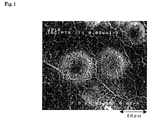
- Fig. 1 shows network association product formed in the slurry of Example V2 - 1 - 7.
- Fig. 2 shows a beaker and stirring vanes contained therein to use for determining the SS concentration in the third embodiment of the invention.
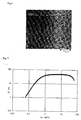
- Fig. 3 is a graph showing the relation between the angular ⁇ and the modulus of storage elasticity G' in determination of viscoelasticity of Example V2 - 3 - 9.
- Fig. 4 shows network association product formed in the slurry of Example IV16.
- Fig. 5 is a graph showing the relation between the angular ⁇ and the modulus of storage elasticity G' in determination of viscoelasticity of Example IV18.
- the aqueous solutions (A), the aqueous solutions (B) and the mixed solutions (A+B) shown in Table V2 were prepared in the same way as Example 1. It is specified that the electrical conductance of the mixed solution (A + B) at 20°C was 26 to 40 mS/cm in Examples V1 - 1 - 5 and V1- 1 - 61-1 and 2 to 8 mS/cm in the other V Examples.
- Example V4 The compounds (A) and (B) shown in Table V4 were used to prepare slurries.
- the slurry of Example V2 - 1 - 7 was prepared in the below described manner.
- the other slurries of Example and Comparative Example were prepared in the same way as this.
- the sample was observed with an electron microscope of electric field radiation type, named by FE-SEM, S-4000 (tradename of Hitachi Ltd.), equipped with cryounit, at scanning of 7.5kV.
- the electron microscopic picture was shown in Fig. 1, where white circular objects are powder and the formed association product in network including strands the association is observed around the powder.
- the strands of association forming network were marked in view of the length between intersecting points and the diameter based on the below shown standards: (length) ⁇ : 0.01 ⁇ 100 ⁇ m ⁇ : less than 0.01 ⁇ m or more than 100 ⁇ m (diameter) o ⁇ : not less than 0.05 ⁇ m and less than 2.0 ⁇ m ⁇ : not less than 0.01 ⁇ m and less than 0.05 ⁇ m ⁇ : less than 0.01 ⁇ m
- Slurries including compounds (A) and (B) in combination shown in Table V5 100 g of water and 100 g of normal Portland cement, obtained from Taiheiyou Cement Co., Ltd., were observed in view of SS in the below shown manner, also in view of turbidity.
- the slurries were prepared by mixing and kneading water, normal Portland cement and the compound (B) with a hand mixer, MK - H3 of Matsushita Electric Industries Ltd., for 30 seconds, then adding the compound (A) and mixing them further for 60 seconds.
- the mole ration of (A) to (B) are shown in Table V5. Results are shown in Table V5.
- Turbidity (%) diffusibility (%) ⁇ 100 / total through-passing light efficiency (%) ⁇ : not more than 6.0 % ⁇ : more than 6.0 % and not less than 30 % ⁇ : more than 30 %
- the modulus of storage elasticity G' was determined with an ARES viscoelasticity meter, made by Rheometric Scientific Co., Ltd., using a cone plate having a diameter of 50 mm, an angle of 0.0398 rad and GAP of 0.0508 mm, at the strain of 1.0%, in the range of 0.0628 ⁇ 62.8 rad/s, at 20°C.
- G'min/G'max was calculated from the results at the angular velocity ⁇ of 1 ⁇ 10 rad/s and evaluated in the below shown manner.
- G' max was also evaluated in the below shown manner.
- Formulation I was kneaded using a homomixer, and the other formulations were kneaded using a mortar mixer. Preparation of slurry was conducted at 20°C.
- the electric conductivity at 2 0 °C of slurry including each compound was 2 ⁇ 10mS/cm all in Examples and Comparative Examples.
- the electric conductivity at 20 °C of slurry including each compound was 25 ⁇ 33 mS/cm all in Examples and Comparative Examples.
- the electric conductivity at 2 0°C of slurry including each compound was 35 ⁇ 40 mS/cm all in Examples and Comparative Examples.
- the electric conductivity at 20°C of slurry including each compound was 2.5 ⁇ 3.50mS/cm all in Examples and Comparative Examples.
- the electric conductivity at 20°C of slurry including each compound was 3.8 ⁇ 4.5 mS/cm all in Examples and Comparative Examples.
- the electric conductivity at 20°C of slurry including each compound was 0.1 ⁇ 0.2 mS/cm all in Examples and Comparative Examples.
- the electric conductivity at 20 °C of slurry including each compound was 4.5 ⁇ 5 mS/cm all in Examples and Comparative Examples.
- the electric conductivity at 20°C of slurry including each compound was 1 ⁇ 2 mS/cm all in Examples and Comparative Examples.
- the electric conductivity at 20°C of slurry including each compound was 0.5 ⁇ 2 mS/cm all in Examples and Comparative Examples.
- the electric conductivity at 20°C of slurry including each compound was 0.5 ⁇ 2 mS/cm all in Examples and Comparative Examples.
- the electric conductivity at 20°C of slurry including each compound was 6 ⁇ 8 mS/cm all in Examples and Comparative Examples.
- the viscosity of a mixture of aqueous solutions of compounds (A) and (B) in this invention is 10 to 100 times or more as high as the viscosity of each aqueous solution before mixing.
- the viscosity of the mixed solution is at least 500 times as high as the viscosity of each aqueous solution before mixing, even having a low viscosity of 10 mPa's or less at a low concentration of 10 % by weight or less.
- Example V1 - 2 It is noted from Example V1 - 2 that the viscosity of the slurry mixed with the compounds (A) and (B) increases up to 3 to more than 1000 times as much a viscosity as the aqueous solution or slurry including each before mixing.
- Example V2 - 1 including the compounds (A) and (B), an association product in network was observed in the slurry, but it was not observed in Comparative Example.
- Example V2 - 2 the slurry including the compounds (A) and (B) of the invention, powder and water had an SS concentration of not more than 500mg/L and a turbidity of not more than 6 %, but the slurry of Comparative Example had an SS concentration of more than 1000 mg/L and a turbidity of more than 30 %,
- Example V2-3 the slurry including the compounds (A) and (B) of the invention, powder and water had G' max of 1000 ⁇ 10000Pa and a deviation of G' (G' min /G' max ) of not less than 0. 4 and less than 1. 0, but that of Comparative Example had G' max of 10 ⁇ 100000Pa and a deviation of G' (G' min /G' max ) of less than 0. 4.
- Example V1-2 the viscosity in this invention is not significantly lowered in a system even at high salt concentration, and in particular, when compound (A) is a quaternary salt type cationic surfactant while compound (B) is an anionic aromatic compound or a brominated compound, the rheology modifier hardly changes thickening properties, and is superior in the conventional thickening agents in Comparative Example 2.
- Example V1-3 when the rheology modifiers of this invention are used in slurry, they are superior to the conventional thickening agents in Comparative Example V3 in respect of the kneading time, slurry viscosity, resistance to separation in water and amount of bleeding water.
- Table V20 The addition amount in Table V20 is indicative of the total concentration (weight %) of compounds (A) and (B) in the aqueous phase of slurry.
- the weight % in Table V22 is indicative of the concentration of the active ingredients relative to the weight of cement.
- Example IV16, IV17 and IV18 are below described with results of Table IV1, IV2 and IV3.
- aqueous solution including the compounds (A) and (B) in combination shown in Table IV1 was observed in view of association product in network.
- a sample of the aqueous solution was pressed on a copper plate, having been cooled with liquid nitrogen, to freeze it rapidly.
- the observation of association product in network was effected in the same way as Example V2-1. Results are shown in Table IV1.
- the length and the diameter are those of a strand association product forming network.
- ком ⁇ онент (A) 1.6 parts by weight of hexadecyltrimethylammonium chloride (compound (A)), 0.97 part by weight of sodium p-toluenesulfonate (compound (B)) and 97.43 parts by weight of water were uniformly mixed to prepare a slurry.
- One drop of the slurry was pressed on a copper plate and rapidly frozen to obtain the sample of Example V16-1. It was observed.
- the other examples were observed in the same way as above.
- Fig. 4 shows a photo picture of association product in network formed in the aqueous solution. White association product in network is seen widely over the picture.
- Example V2-2 A slurry was obtained and observed in view of SS and turbidity in the same was as Example V2-2 except that 1 part by weight of the compounds (A) and (B), shown in Table IV2, having a ration of (A)/(B) shown in Table IV2, 100 parts by weight of normal Portland cement and 100 parts by weight of water were mixed.
- G' max (evaluation of G' max ) o ⁇ ; G' max of 10 ⁇ 100 Pa ⁇ : G' max of 5 ⁇ 500 Pa, except for o ⁇ ⁇ : G' max of 2 ⁇ 1000 Pa, except for o ⁇ and ⁇ ⁇ : G' max of less than 2 Pa or more than 1000 Pa
Landscapes
- Chemical & Material Sciences (AREA)
- Engineering & Computer Science (AREA)
- Ceramic Engineering (AREA)
- Materials Engineering (AREA)
- Structural Engineering (AREA)
- Organic Chemistry (AREA)
- Curing Cements, Concrete, And Artificial Stone (AREA)
- Compositions Of Macromolecular Compounds (AREA)
- Detergent Compositions (AREA)
Applications Claiming Priority (6)
| Application Number | Priority Date | Filing Date | Title |
|---|---|---|---|
| JP2001182308 | 2001-06-15 | ||
| JP2001182308 | 2001-06-15 | ||
| JP2001232147 | 2001-07-31 | ||
| JP2001232147 | 2001-07-31 | ||
| JP2002041852 | 2002-02-19 | ||
| JP2002041852 | 2002-02-19 |
Publications (2)
| Publication Number | Publication Date |
|---|---|
| EP1266875A2 true EP1266875A2 (fr) | 2002-12-18 |
| EP1266875A3 EP1266875A3 (fr) | 2009-10-21 |
Family
ID=27346956
Family Applications (1)
| Application Number | Title | Priority Date | Filing Date |
|---|---|---|---|
| EP02012491A Withdrawn EP1266875A3 (fr) | 2001-06-15 | 2002-06-12 | Agent de modification rheologique de boues |
Country Status (3)
| Country | Link |
|---|---|
| US (2) | US7374699B2 (fr) |
| EP (1) | EP1266875A3 (fr) |
| CN (1) | CN1268573C (fr) |
Cited By (5)
| Publication number | Priority date | Publication date | Assignee | Title |
|---|---|---|---|---|
| US7846876B2 (en) * | 2003-10-07 | 2010-12-07 | Kao Corporation | Surfactant composition |
| WO2010143312A1 (fr) * | 2009-06-11 | 2010-12-16 | Kao Corporation | Composition d'une boue de ciment |
| US8648120B2 (en) * | 2006-09-06 | 2014-02-11 | Kao Corporation | Liquid rheology modifier |
| EP1862438A3 (fr) * | 2006-06-01 | 2016-12-28 | Kao Corporation | Modificateur de rhéologie |
| CN114853399A (zh) * | 2022-03-30 | 2022-08-05 | 石家庄市长安育才建材有限公司 | 一种基于建筑垃圾的再生混凝土制备方法 |
Families Citing this family (5)
| Publication number | Priority date | Publication date | Assignee | Title |
|---|---|---|---|---|
| US6971262B1 (en) * | 2004-06-25 | 2005-12-06 | Waters Investment Limited | System and method for rheological characterization of granular materials |
| US20070204764A1 (en) * | 2006-01-23 | 2007-09-06 | Jianhua Mao | Compounds and methods for reducing water content in cementitious mixtures |
| CN101802911B (zh) * | 2007-09-14 | 2013-01-02 | 花王株式会社 | 用于垂直磁记录方式硬盘用基板的水系洗涤剂组合物 |
| EP2986581A4 (fr) * | 2013-04-17 | 2016-12-14 | Stepan Co | Composition de tensioactif destinée à une utilisation dans la fabrication de panneaux muraux en gypse |
| CN105018055B (zh) * | 2015-07-29 | 2018-11-02 | 天津中油渤星工程科技有限公司 | 一种油井水泥触变剂及其制备方法 |
Citations (5)
| Publication number | Priority date | Publication date | Assignee | Title |
|---|---|---|---|---|
| US4375421A (en) | 1981-10-19 | 1983-03-01 | Lever Brothers Company | Viscous compositions containing amido betaines and salts |
| US4842771A (en) | 1986-09-29 | 1989-06-27 | Akzo N.V. | Thickened aqueous cleaning compositions |
| DE4320508A1 (de) | 1993-06-21 | 1994-12-22 | Hoechst Ag | Verdickerkombinationen aus Makrotensiden und organischen Additiven für wäßrige Anwendungssysteme |
| EP0835983A2 (fr) | 1996-10-09 | 1998-04-15 | Sofitech N.V. | Méthodes pour fracturer des formations souterraines |
| WO1998056497A1 (fr) | 1997-06-10 | 1998-12-17 | Rhodia Inc. | Fluides contenant des tensioactifs viscoelastiques et leurs methodes d'utilisation |
Family Cites Families (21)
| Publication number | Priority date | Publication date | Assignee | Title |
|---|---|---|---|---|
| US3954660A (en) * | 1974-07-23 | 1976-05-04 | Continental Oil Company | Anionic surfactant slurry having increased viscosity and method of providing said slurry |
| US4008165A (en) * | 1975-03-14 | 1977-02-15 | Texaco Inc. | Surfactant oil recovery process usable in high temperature formations having high concentrations of polyvalent ions |
| US4418755A (en) * | 1979-02-14 | 1983-12-06 | Conoco Inc. | Methods of inhibiting the flow of water in subterranean formations |
| US4412018A (en) * | 1980-11-17 | 1983-10-25 | Nl Industries, Inc. | Organophilic clay complexes, their preparation and compositions comprising said complexes |
| AU554574B2 (en) * | 1982-03-19 | 1986-08-28 | Colgate-Palmolive Pty. Ltd. | Shampoo |
| JPS59131547A (ja) * | 1983-01-19 | 1984-07-28 | ダイセル化学工業株式会社 | 水中打設用セメント組成物 |
| US4800036A (en) * | 1985-05-06 | 1989-01-24 | The Dow Chemical Company | Aqueous bleach compositions thickened with a viscoelastic surfactant |
| US5055219A (en) * | 1987-11-17 | 1991-10-08 | The Clorox Company | Viscoelastic cleaning compositions and methods of use therefor |
| JPH0338224A (ja) | 1989-07-05 | 1991-02-19 | Mitsui Eng & Shipbuild Co Ltd | 高分子膜の劣化防止方法 |
| JP3038224B2 (ja) | 1990-04-05 | 2000-05-08 | 株式会社東芝 | 移動構造物の保持装置 |
| JPH0539901A (ja) | 1991-08-07 | 1993-02-19 | Hitachi Ltd | ボイラ自動制御方法および装置 |
| US5529722A (en) * | 1992-03-10 | 1996-06-25 | The Procter & Gamble Company | High active detergent pastes |
| US5387675A (en) * | 1993-03-10 | 1995-02-07 | Rhone-Poulenc Specialty Chemicals Co. | Modified hydrophobic cationic thickening compositions |
| TW446563B (en) * | 1996-01-16 | 2001-07-21 | Colgate Palmolive Co | Low static conditioning shampoo |
| JP3523009B2 (ja) * | 1996-03-15 | 2004-04-26 | 株式会社資生堂 | 水性増粘ゲル状組成物および液状水中油型乳化組成物 |
| US6172033B1 (en) * | 1996-07-04 | 2001-01-09 | The Procter & Gamble Company | Process for conditioning of surfactant pastes to form high active surfactant agglomerates |
| TW460508B (en) * | 1997-05-02 | 2001-10-21 | Rohm & Haas | Aqueous composition comprising a mixed surfactant/associative thickener, its use in a formulated composition, and method for enhancing thickening efficiency of aqueous composition |
| JPH11189452A (ja) | 1997-12-24 | 1999-07-13 | Takeda Chem Ind Ltd | 分離抵抗性を有する高流動コンクリート |
| US6372037B1 (en) * | 2000-05-12 | 2002-04-16 | Lignotech Usa, Inc. | Set retarders for foamed cements |
| DE10045289A1 (de) * | 2000-09-13 | 2002-03-28 | Henkel Kgaa | Schnell trocknendes Wasch- und Reinigungsmittel, insbesondere Handgeschirrspülmittel |
| US7125825B2 (en) * | 2003-04-25 | 2006-10-24 | Tomah Products, Inc. | Amidoamine salt-based viscosifying agents and methods of use |
-
2002
- 2002-06-12 EP EP02012491A patent/EP1266875A3/fr not_active Withdrawn
- 2002-06-14 CN CNB021233551A patent/CN1268573C/zh not_active Expired - Lifetime
- 2002-06-14 US US10/170,341 patent/US7374699B2/en not_active Expired - Lifetime
-
2008
- 2008-04-30 US US12/113,111 patent/US8105500B2/en not_active Expired - Fee Related
Patent Citations (5)
| Publication number | Priority date | Publication date | Assignee | Title |
|---|---|---|---|---|
| US4375421A (en) | 1981-10-19 | 1983-03-01 | Lever Brothers Company | Viscous compositions containing amido betaines and salts |
| US4842771A (en) | 1986-09-29 | 1989-06-27 | Akzo N.V. | Thickened aqueous cleaning compositions |
| DE4320508A1 (de) | 1993-06-21 | 1994-12-22 | Hoechst Ag | Verdickerkombinationen aus Makrotensiden und organischen Additiven für wäßrige Anwendungssysteme |
| EP0835983A2 (fr) | 1996-10-09 | 1998-04-15 | Sofitech N.V. | Méthodes pour fracturer des formations souterraines |
| WO1998056497A1 (fr) | 1997-06-10 | 1998-12-17 | Rhodia Inc. | Fluides contenant des tensioactifs viscoelastiques et leurs methodes d'utilisation |
Non-Patent Citations (1)
| Title |
|---|
| SURFACE, vol. 29, no. 5, 1991, pages 61 |
Cited By (8)
| Publication number | Priority date | Publication date | Assignee | Title |
|---|---|---|---|---|
| US7846876B2 (en) * | 2003-10-07 | 2010-12-07 | Kao Corporation | Surfactant composition |
| EP1862438A3 (fr) * | 2006-06-01 | 2016-12-28 | Kao Corporation | Modificateur de rhéologie |
| US8648120B2 (en) * | 2006-09-06 | 2014-02-11 | Kao Corporation | Liquid rheology modifier |
| EP1897927A3 (fr) * | 2006-09-06 | 2015-08-12 | Kao Corporation | Modificateur de rhéologie liquide |
| WO2010143312A1 (fr) * | 2009-06-11 | 2010-12-16 | Kao Corporation | Composition d'une boue de ciment |
| US8728229B2 (en) | 2009-06-11 | 2014-05-20 | Kao Corporation | Cement slurry composition |
| CN114853399A (zh) * | 2022-03-30 | 2022-08-05 | 石家庄市长安育才建材有限公司 | 一种基于建筑垃圾的再生混凝土制备方法 |
| CN114853399B (zh) * | 2022-03-30 | 2023-11-03 | 石家庄市长安育才建材有限公司 | 一种基于建筑垃圾的再生混凝土制备方法 |
Also Published As
| Publication number | Publication date |
|---|---|
| CN1268573C (zh) | 2006-08-09 |
| US20030200901A1 (en) | 2003-10-30 |
| US7374699B2 (en) | 2008-05-20 |
| US8105500B2 (en) | 2012-01-31 |
| EP1266875A3 (fr) | 2009-10-21 |
| US20080300341A1 (en) | 2008-12-04 |
| CN1392111A (zh) | 2003-01-22 |
Similar Documents
| Publication | Publication Date | Title |
|---|---|---|
| US8105500B2 (en) | Slurry rheology modifier | |
| JP3875137B2 (ja) | スラリーレオロジー改質剤 | |
| JP4197102B2 (ja) | スラリー | |
| JP4197122B2 (ja) | レオロジー改質剤 | |
| EP1693352B1 (fr) | Composition de tensioactif | |
| JP5362200B2 (ja) | 液状レオロジー改質剤 | |
| US20190330109A1 (en) | Preparation of water-reducing composition, water-reducing composition and hydraulic composition | |
| JP4056828B2 (ja) | 水硬性組成物 | |
| US20200157004A1 (en) | Water-reducing composition, hydraulic composition, and method for producing the same | |
| JP4549667B2 (ja) | レオロジー改質剤 | |
| JP5335230B2 (ja) | 1液型液状レオロジー改質剤 | |
| JP4216061B2 (ja) | レオロジー改質剤キット | |
| JP4056868B2 (ja) | エアーグラウト材 | |
| JP4832845B2 (ja) | スラリーの製造方法 | |
| JP4094417B2 (ja) | 透水性コンクリート用添加剤 | |
| JP4407941B2 (ja) | 水硬性組成物 | |
| JP5335231B2 (ja) | 1液型液状レオロジー改質剤 | |
| JP4627153B2 (ja) | 懸濁型地盤改良材及びその製造方法 | |
| RU2852050C1 (ru) | Тампонажный раствор | |
| JP7481898B2 (ja) | スラリーレオロジー改質剤 | |
| JP5476082B2 (ja) | 液状レオロジー改質剤 | |
| JP2022184203A (ja) | グラウト製造用添加剤組成物 | |
| Rai et al. | Adsorption of comb-type superplasticizers on calcium carbonate in alkaline medium in presence of electrolytes and rheological properties | |
| JP2023046000A (ja) | 粉末状増粘剤組成物 | |
| JP2024037207A (ja) | 水硬性組成物用増粘剤組成物 |
Legal Events
| Date | Code | Title | Description |
|---|---|---|---|
| PUAI | Public reference made under article 153(3) epc to a published international application that has entered the european phase |
Free format text: ORIGINAL CODE: 0009012 |
|
| AK | Designated contracting states |
Kind code of ref document: A2 Designated state(s): AT BE CH CY DE DK ES FI FR GB GR IE IT LI LU MC NL PT SE TR |
|
| AX | Request for extension of the european patent |
Free format text: AL;LT;LV;MK;RO;SI |
|
| PUAL | Search report despatched |
Free format text: ORIGINAL CODE: 0009013 |
|
| AK | Designated contracting states |
Kind code of ref document: A3 Designated state(s): AT BE CH CY DE DK ES FI FR GB GR IE IT LI LU MC NL PT SE TR |
|
| AX | Request for extension of the european patent |
Extension state: AL LT LV MK RO SI |
|
| 17P | Request for examination filed |
Effective date: 20100421 |
|
| AKX | Designation fees paid |
Designated state(s): DE FR GB NL |
|
| 17Q | First examination report despatched |
Effective date: 20101214 |
|
| STAA | Information on the status of an ep patent application or granted ep patent |
Free format text: STATUS: THE APPLICATION IS DEEMED TO BE WITHDRAWN |
|
| 18D | Application deemed to be withdrawn |
Effective date: 20180425 |