EP1267324A2 - Wiederverwertbares, Luftschall absorbierendes Formteil und Verfahren zu seiner Herstellung - Google Patents
Wiederverwertbares, Luftschall absorbierendes Formteil und Verfahren zu seiner Herstellung Download PDFInfo
- Publication number
- EP1267324A2 EP1267324A2 EP02012833A EP02012833A EP1267324A2 EP 1267324 A2 EP1267324 A2 EP 1267324A2 EP 02012833 A EP02012833 A EP 02012833A EP 02012833 A EP02012833 A EP 02012833A EP 1267324 A2 EP1267324 A2 EP 1267324A2
- Authority
- EP
- European Patent Office
- Prior art keywords
- film
- plastic film
- molding according
- air
- plastic
- Prior art date
- Legal status (The legal status is an assumption and is not a legal conclusion. Google has not performed a legal analysis and makes no representation as to the accuracy of the status listed.)
- Withdrawn
Links
Images


Classifications
-
- B—PERFORMING OPERATIONS; TRANSPORTING
- B32—LAYERED PRODUCTS
- B32B—LAYERED PRODUCTS, i.e. PRODUCTS BUILT-UP OF STRATA OF FLAT OR NON-FLAT, e.g. CELLULAR OR HONEYCOMB, FORM
- B32B5/00—Layered products characterised by the non- homogeneity or physical structure, i.e. comprising a fibrous, filamentary, particulate or foam layer; Layered products characterised by having a layer differing constitutionally or physically in different parts
- B32B5/02—Layered products characterised by the non- homogeneity or physical structure, i.e. comprising a fibrous, filamentary, particulate or foam layer; Layered products characterised by having a layer differing constitutionally or physically in different parts characterised by structural features of a fibrous or filamentary layer
- B32B5/022—Non-woven fabric
-
- B—PERFORMING OPERATIONS; TRANSPORTING
- B32—LAYERED PRODUCTS
- B32B—LAYERED PRODUCTS, i.e. PRODUCTS BUILT-UP OF STRATA OF FLAT OR NON-FLAT, e.g. CELLULAR OR HONEYCOMB, FORM
- B32B5/00—Layered products characterised by the non- homogeneity or physical structure, i.e. comprising a fibrous, filamentary, particulate or foam layer; Layered products characterised by having a layer differing constitutionally or physically in different parts
- B32B5/18—Layered products characterised by the non- homogeneity or physical structure, i.e. comprising a fibrous, filamentary, particulate or foam layer; Layered products characterised by having a layer differing constitutionally or physically in different parts characterised by features of a layer of foamed material
-
- B—PERFORMING OPERATIONS; TRANSPORTING
- B32—LAYERED PRODUCTS
- B32B—LAYERED PRODUCTS, i.e. PRODUCTS BUILT-UP OF STRATA OF FLAT OR NON-FLAT, e.g. CELLULAR OR HONEYCOMB, FORM
- B32B5/00—Layered products characterised by the non- homogeneity or physical structure, i.e. comprising a fibrous, filamentary, particulate or foam layer; Layered products characterised by having a layer differing constitutionally or physically in different parts
- B32B5/22—Layered products characterised by the non- homogeneity or physical structure, i.e. comprising a fibrous, filamentary, particulate or foam layer; Layered products characterised by having a layer differing constitutionally or physically in different parts characterised by the presence of two or more layers which are next to each other and are fibrous, filamentary, formed of particles or foamed
- B32B5/24—Layered products characterised by the non- homogeneity or physical structure, i.e. comprising a fibrous, filamentary, particulate or foam layer; Layered products characterised by having a layer differing constitutionally or physically in different parts characterised by the presence of two or more layers which are next to each other and are fibrous, filamentary, formed of particles or foamed one layer being a fibrous or filamentary layer
- B32B5/245—Layered products characterised by the non- homogeneity or physical structure, i.e. comprising a fibrous, filamentary, particulate or foam layer; Layered products characterised by having a layer differing constitutionally or physically in different parts characterised by the presence of two or more layers which are next to each other and are fibrous, filamentary, formed of particles or foamed one layer being a fibrous or filamentary layer another layer next to it being a foam layer
-
- B—PERFORMING OPERATIONS; TRANSPORTING
- B32—LAYERED PRODUCTS
- B32B—LAYERED PRODUCTS, i.e. PRODUCTS BUILT-UP OF STRATA OF FLAT OR NON-FLAT, e.g. CELLULAR OR HONEYCOMB, FORM
- B32B5/00—Layered products characterised by the non- homogeneity or physical structure, i.e. comprising a fibrous, filamentary, particulate or foam layer; Layered products characterised by having a layer differing constitutionally or physically in different parts
- B32B5/22—Layered products characterised by the non- homogeneity or physical structure, i.e. comprising a fibrous, filamentary, particulate or foam layer; Layered products characterised by having a layer differing constitutionally or physically in different parts characterised by the presence of two or more layers which are next to each other and are fibrous, filamentary, formed of particles or foamed
- B32B5/32—Layered products characterised by the non- homogeneity or physical structure, i.e. comprising a fibrous, filamentary, particulate or foam layer; Layered products characterised by having a layer differing constitutionally or physically in different parts characterised by the presence of two or more layers which are next to each other and are fibrous, filamentary, formed of particles or foamed at least two layers being foamed and next to each other
-
- G—PHYSICS
- G10—MUSICAL INSTRUMENTS; ACOUSTICS
- G10K—SOUND-PRODUCING DEVICES; METHODS OR DEVICES FOR PROTECTING AGAINST, OR FOR DAMPING, NOISE OR OTHER ACOUSTIC WAVES IN GENERAL; ACOUSTICS NOT OTHERWISE PROVIDED FOR
- G10K11/00—Methods or devices for transmitting, conducting or directing sound in general; Methods or devices for protecting against, or for damping, noise or other acoustic waves in general
- G10K11/16—Methods or devices for protecting against, or for damping, noise or other acoustic waves in general
- G10K11/162—Selection of materials
-
- G—PHYSICS
- G10—MUSICAL INSTRUMENTS; ACOUSTICS
- G10K—SOUND-PRODUCING DEVICES; METHODS OR DEVICES FOR PROTECTING AGAINST, OR FOR DAMPING, NOISE OR OTHER ACOUSTIC WAVES IN GENERAL; ACOUSTICS NOT OTHERWISE PROVIDED FOR
- G10K11/00—Methods or devices for transmitting, conducting or directing sound in general; Methods or devices for protecting against, or for damping, noise or other acoustic waves in general
- G10K11/16—Methods or devices for protecting against, or for damping, noise or other acoustic waves in general
- G10K11/162—Selection of materials
- G10K11/168—Plural layers of different materials, e.g. sandwiches
-
- G—PHYSICS
- G10—MUSICAL INSTRUMENTS; ACOUSTICS
- G10K—SOUND-PRODUCING DEVICES; METHODS OR DEVICES FOR PROTECTING AGAINST, OR FOR DAMPING, NOISE OR OTHER ACOUSTIC WAVES IN GENERAL; ACOUSTICS NOT OTHERWISE PROVIDED FOR
- G10K11/00—Methods or devices for transmitting, conducting or directing sound in general; Methods or devices for protecting against, or for damping, noise or other acoustic waves in general
- G10K11/16—Methods or devices for protecting against, or for damping, noise or other acoustic waves in general
- G10K11/172—Methods or devices for protecting against, or for damping, noise or other acoustic waves in general using resonance effects
-
- B—PERFORMING OPERATIONS; TRANSPORTING
- B32—LAYERED PRODUCTS
- B32B—LAYERED PRODUCTS, i.e. PRODUCTS BUILT-UP OF STRATA OF FLAT OR NON-FLAT, e.g. CELLULAR OR HONEYCOMB, FORM
- B32B2262/00—Composition or structural features of fibres which form a fibrous or filamentary layer or are present as additives
- B32B2262/02—Synthetic macromolecular fibres
-
- B—PERFORMING OPERATIONS; TRANSPORTING
- B32—LAYERED PRODUCTS
- B32B—LAYERED PRODUCTS, i.e. PRODUCTS BUILT-UP OF STRATA OF FLAT OR NON-FLAT, e.g. CELLULAR OR HONEYCOMB, FORM
- B32B2262/00—Composition or structural features of fibres which form a fibrous or filamentary layer or are present as additives
- B32B2262/06—Vegetal fibres
-
- B—PERFORMING OPERATIONS; TRANSPORTING
- B32—LAYERED PRODUCTS
- B32B—LAYERED PRODUCTS, i.e. PRODUCTS BUILT-UP OF STRATA OF FLAT OR NON-FLAT, e.g. CELLULAR OR HONEYCOMB, FORM
- B32B2266/00—Composition of foam
- B32B2266/02—Organic
- B32B2266/0214—Materials belonging to B32B27/00
- B32B2266/025—Polyolefin
-
- B—PERFORMING OPERATIONS; TRANSPORTING
- B32—LAYERED PRODUCTS
- B32B—LAYERED PRODUCTS, i.e. PRODUCTS BUILT-UP OF STRATA OF FLAT OR NON-FLAT, e.g. CELLULAR OR HONEYCOMB, FORM
- B32B2266/00—Composition of foam
- B32B2266/08—Closed cell foam
-
- B—PERFORMING OPERATIONS; TRANSPORTING
- B32—LAYERED PRODUCTS
- B32B—LAYERED PRODUCTS, i.e. PRODUCTS BUILT-UP OF STRATA OF FLAT OR NON-FLAT, e.g. CELLULAR OR HONEYCOMB, FORM
- B32B2307/00—Properties of the layers or laminate
- B32B2307/10—Properties of the layers or laminate having particular acoustical properties
-
- B—PERFORMING OPERATIONS; TRANSPORTING
- B32—LAYERED PRODUCTS
- B32B—LAYERED PRODUCTS, i.e. PRODUCTS BUILT-UP OF STRATA OF FLAT OR NON-FLAT, e.g. CELLULAR OR HONEYCOMB, FORM
- B32B2307/00—Properties of the layers or laminate
- B32B2307/70—Other properties
- B32B2307/724—Permeability to gases, adsorption
-
- B—PERFORMING OPERATIONS; TRANSPORTING
- B32—LAYERED PRODUCTS
- B32B—LAYERED PRODUCTS, i.e. PRODUCTS BUILT-UP OF STRATA OF FLAT OR NON-FLAT, e.g. CELLULAR OR HONEYCOMB, FORM
- B32B2307/00—Properties of the layers or laminate
- B32B2307/70—Other properties
- B32B2307/724—Permeability to gases, adsorption
- B32B2307/7242—Non-permeable
-
- B—PERFORMING OPERATIONS; TRANSPORTING
- B32—LAYERED PRODUCTS
- B32B—LAYERED PRODUCTS, i.e. PRODUCTS BUILT-UP OF STRATA OF FLAT OR NON-FLAT, e.g. CELLULAR OR HONEYCOMB, FORM
- B32B2323/00—Polyalkenes
- B32B2323/10—Polypropylene
-
- B—PERFORMING OPERATIONS; TRANSPORTING
- B32—LAYERED PRODUCTS
- B32B—LAYERED PRODUCTS, i.e. PRODUCTS BUILT-UP OF STRATA OF FLAT OR NON-FLAT, e.g. CELLULAR OR HONEYCOMB, FORM
- B32B2605/00—Vehicles
Definitions
- the invention relates to a molded part that absorbs airborne sound, which is used for sound insulation for engines and machines, but especially in automobiles as an inner door seal, as Engine capsule absorbers and hood absorbers are used can.
- the invention is therefore based on the problem of being versatile usable airborne sound absorbing molded part available to have a structure that is simple Recycling and which with the help of a simple, only two process steps can be.
- the invention thus relates to an airborne sound absorber Molding (1), which is an airtight molded Plastic film (2) made of a thermoplastic and an air permeable sheet material (3) which welded to the plastic film (2) without an adhesive layer is.
- the invention also relates to a method for the production this molded part that absorbs airborne sound is characterized in that a composite of an airtight Plastic film (2) made of a thermoplastic Plastic and one without interposing an adhesive layer air-permeable film material (3) is formed by lamination and under the influence of heat is deep-drawn, the plastic film (2) in one Form is deformed with several chambers and webs.
- the air-impermeable plastic film (2) present in the molded part according to the invention is preferably resistant to chemicals and can be formed from a foamed or unfoamed thermoplastic polymer.
- Suitable materials are polyolefins, polyesters, polyurethanes or PVC, for example polyethylene, polypropylene or their mixtures, polyethylene terephthalate, polystyrene.
- Polyolefins are polyethylene homo- or copolymers or polypropylene homo- or copolymers or mixtures of these with other polymers, for example EVA.
- a preferred material for the plastic film (2) is a cross-linked closed-cell foam, for example made of polypropylene.
- the air-permeable film material (3) can be a textile material, in particular a fleece or felt made of natural or synthetic fibers or an open-cell foam, such as be a polyurethane or melamine foam, which is preferred is laminated with a fleece made of polypropylene fibers.
- Suitable natural fibers are e.g. Cotton, sisal, jute or linen and suitable synthetic fibers those made of polyethylene, polypropylene, polyesters, such as Polyethylene terephthalate, polyamides, polyacrylonitrile, Vinyl copolymers, viscose or mixtures of these. Farther Mixtures of natural and synthetic are also suitable Fibers.
- the recycling of the molded part according to the invention becomes special simplified if the air-impermeable plastic film (2) and the air-permeable sheet material (3) from the same Polymer exist.
- a particularly preferred combination is Polypropylene / polypropylene.
- Molded part (1) is carried out with the aid of a process which laminating and deep drawing the composite material.
- the lamination takes place without adhesive, but by means of heat, such as gas flame, infrared radiation or hot air; this enables both the second process step, the deep-drawing process, and recycling.
- the composite is deep-drawn under the influence of heat, so that the plastic film (2) is deformed in a mold with many chambers and webs, the nonwoven material (3) being deformed at the same time due to the special laminating conditions without deformation in the area Separates chambers (4) from the deep-drawn film (2) and the formation of hollow chambers is effected. Both process steps are preferably carried out continuously.
- the lamination and deep drawing simultaneously in a single process step be done with heating.
- the resulting hollow chambers (4) can be adjusted to the desired sound absorption values by appropriate geometry, which can be additionally improved and controlled by the properties and properties of the air-permeable film material (3) which forms the chamber closure.
- the insulation is of course improved by enlarging the air space in the chambers, but there is a limitation due to the space available for the insulation material.
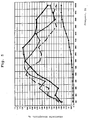
- By varying the chamber size it is also possible to adapt the insulating material to the frequency to be absorbed, as can be seen from Example 3.
- the sound insulation by means of these recyclable molded parts that absorb airborne sound can be explained as follows: The sound propagation on the plastic or foam film, with the function of a closed skin of the composite, is dampened by the resonance effect.
- the acoustic waves excite the upper membrane of the chamber, causing this membrane to vibrate and convert the sound energy into heat through internal friction.
- the air cushion between membrane and fleece allows the membrane to swing freely. This acts like a spring and also converts the sound energy into heat due to the viscous friction of the vibrating air particles in the chamber.
- the sound absorption depends on the flow resistance of the material. The sound absorption is achieved by viscous friction of the vibrating air particles in the framework of the porous fleece.
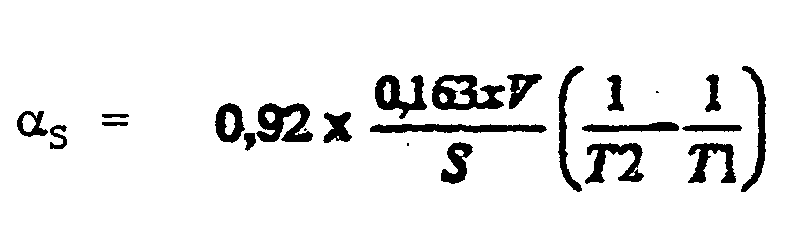
- the measurement of the sound absorption coefficient ⁇ S was measured in the so-called alpha cabin (reduced reverberation room).
- the alpha cabin is a common device for measuring the noise level in the automotive industry.
- the material to be tested is laid out on the floor of the Alpha cabin as a coherent area of 1.2 m 2 .
- a constant noise is generated in the cabin with third-octave band noise and then suddenly switched off. The noise subsides with an audible delay. This process is called reverberation.
- the duration of the reverberation is defined as the time that elapses before the noise level has dropped from its initial value by 60 dB (reverberation time).
- the reverberation times per third octave band are measured at 4 microphone positions for the states with and without test material. Measured variables: Reverberation time in the alpha cabin without test material T 1 (s) Reverberation time in the alpha cabin with test material T 2 (s) Volume of the alpha cabin V (m 3 ) test area S (m 2 )
- the available absorption is inferred from the measured reverberation times.
- A is the equivalent absorption area. It is frequency dependent.
- the coefficient 0.92 compensates for the excessive influence of the thickness of the sample in the Alpha-Cabin method.
- the sound absorption coefficient ⁇ S is determined for each third octave band.
- the sound absorption capacity of a material is better the greater the sound absorption level ⁇ S. With the alpha cabin method, absorption levels greater than 1 can occur. It is therefore important to clearly distinguish this size, which is marked with the index s, from other sizes, which are obtained from reflection measurements (e.g. in Kundt's tube) and become 1 at most.
- the sound absorption coefficient ⁇ S is a specific quantity and is required for room acoustic calculations.
- a composite material according to the invention made of cross-linked polyethylene foam, density 67 kg / m 3 , thickness 2.5 mm, with chambers having a size of 20 x 20 x 15 mm (L x W x H) and a polyester fleece of 200 g / m 2 , thickness 15 mm , was produced. The measurement was carried out by placing the foam against the microphone.
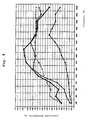
- the acoustic absorption ⁇ S of the composite material according to the invention was measured in comparison with two different non-woven cotton fibers.
- the indication chambers B1 means chambers of 20 x 20 x 15 mm (L x W x H).
- composite materials made of polyethylene foam and polyester fleece with 3 different chamber sizes are compared with a flat film made of cross-linked polyethylene foam.
Landscapes
- Engineering & Computer Science (AREA)
- Physics & Mathematics (AREA)
- Acoustics & Sound (AREA)
- Multimedia (AREA)
- Textile Engineering (AREA)
- Laminated Bodies (AREA)
Abstract
Description
Als Polyolefine kommen Polyethylenhomo- oder copolymere oder Polypropylenhomo- oder copolymere oder Gemische dieser mit anderen Polymeren, beispielsweise EVA in Frage.
Ein bevorzugtes Material für die Kunststoff-Folie (2) ist ein vernetzter geschlossenzelliger Schaumstoff, beispielsweise aus Polypropylen.
Im zweiten Verfahrensschritt wird der Verbund unter Einwirkung von Wärme tiefgezogen, so daß die Kunststoff-Folie (2) in einer Form mit vielen Kammern und Stegen verformt wird, wobei sich gleichzeitig das Vliesmaterial (3) bedingt durch die speziellen Kaschierbedingungen ohne Verformung im Bereich der Kammern (4) von der tiefgezogenen Folie (2) trennt und die Bildung von Hohlkammern bewirkt wird.
Beide Verfahrensschritte werden vorzugsweise kontinuierlich durchgeführt.
Die Dämmung wird natürlich durch Vergrößerung des Luftraums in den Kammern verbessert, allerdings gibt es eine Begrenzung durch den zur Verfügung stehenden Platz für das Dämmaterial. Durch Variation der Kammergröße ist es auch möglich, das Dämmaterial an die zu absorbierende Frequenz anzupassen, wie aus Beispiel 3 ersichtlich ist.
Die Schalldämmung mittels diesen wiederverwertbaren, Luftschall absorbierenden Formteilen kann wie folgt erklärt werden:
An der Kunststoff- respektive Schaumstoff-Folie, mit der Funktion einer geschlossenen Haut des Verbundes, wird die Schallausbreitung durch den Resonanzeffekt gedämpft. Die akustischen Wellen regen die obere Membrane der Kammer an, dadurch schwingt diese Membrane und wandelt die Schallenergie durch innere Reibung in Wärme um. Das Luftkissen zwischen Membrane und Vlies erlaubt der Membrane frei zu schwingen. Dies wirkt wie eine Feder und wandelt ebenfalls die Schallenergie, bedingt durch viskose Reibung der schwingenden Luftpartikel in der Kammer, in Wärme um.
Auf der Vlies-Seite ist die Schallabsorption vom Strömungswiderstand des Materials abhängig. Die Schalldämpfung erfolgt hier durch viskose Reibung der schwingenden Luftpartikel im Gerüst des porösen Vlieses.
Die Alpha-Kabine ist eine gängige Vorrichtung zur Messung des Geräuschpegels in der Automobilindustrie.
| Messgrößen: | |
| Nachhallzeit in der Alpha-Kabine ohne Prüfmaterial | T1(s) |
| Nachhallzeit in der Alpha-Kabine mit Prüfmaterial | T2(s) |
| Volumen der Alpha-Kabine | V(m3) |
| Prüffläche | S(m2) |
Der Schallabsorptionsgrad αS wird für jedes Terzband bestimmt.
Der Schallabsorptionsgrad αS ist eine spezifische Größe und wird für raumakustische Berechnungen benötigt.
-
- Verbund vernetzter PE-Schaumstoff, Dichte 67 kg/m3, Dicke 2,5 mm, mit Kammern B1 + Polyestervlies 200 g/m2, Dicke 15 mm, Schaumstoff gegen Mikrophon
- ◆
- Baumwollfaservlies 800 g/m2, Dicke 11 mm
- Δ
- Baumwollfaservlies 1200 g/m2, Dicke 18 mm
Die Ergebnisse sind in Fig. 4 gezeigt.
In dieser Figur bedeuten:
-
- Verbund vernetzter PE-Schaumstoff, Dichte 67 kg/m3, Dicke 2,5 mm, Kammern B1 + Polyestervlies 200 g/m2, Dicke 15 mm, Schaumstoff gegen Mikrofon
- ×
- Verbund vernetzter PE-Schaumstoff, Dichte 67 kg/m3, Dicke 2,5 mm, Kammern B1 + Polyestervlies 200g/m2, Dicke 15 mm, Vlies gegen Mikrofon
- ◆
- Verbund vernetzter PE-Schaumstoff, Dichte 150 kg/m3, Dicke 2 mm + PUR-Schaumstoff, Dichte 40 kg/m3, Dicke 4 mm
- Δ
- Offenzelliger PUR-Schaumstoff, Dicke 12 mm + PUR-Folie (Schutzfolie)
Die Kammergrößen waren wie folgt:
- •
- Verbund vernetzter PE-Schaumstoff, Dichte 67 kg/m3, Dicke 2,5 mm, mit Kammern B1 + Polyestervlies 200 g/m2 Dicke 15 mm, Schaumstoff gegen Mikrofon
- Δ
- Verbund vernetzter PE-Schaumstoff, Dichte 67 kg/m3, Dicke 4 mm, mit Kammern B3 + Polyestervlies 200 g/m2 Dicke 15 mm, Schaumstoff gegen Mikrofon
- x
- Verbund vernetzter PE-Schaumstoff, Dichte 67 kg/m3, Dicke 4 mm, mit Kammern B4 + Polyestervlies 200 g/m2 Dicke 15 mm, Schaumstoff gegen Mikrofon
- ◆
- Vernetzter PE-Schaumstoff, Dichte 67 kg/m3, Dicke 2,5 mm, flach, ohne Verformung, ohne Vlies
Claims (12)
- Luftschall absorbierendes Formteil (1), das eine luftundurchlässige geformte Kunststoff-Folie (2) aus einem thermoplastischen Kunststoff und ein luftdurchlässiges Folienmaterial (3) umfaßt, welches ohne Klebstoffschicht mit der Kunststoff-Folie (2) verschweißt ist.
- Formteil nach Anspruch 1, wobei die Kunststoff-Folie (2) aus einem Olefin-Polymeren oder -Copolymeren gebildet ist.
- Formteil nach Anspruch 1 oder 2, wobei die Kunststoff-Folie (2) eine geschäumte Folie mit geschlossenen Zellen ist.
- Formteil nach Anspruch 3, wobei die Kunststoff-Folie (2) eine vernetzte geschäumte Folie mit geschlossenen Zellen ist.
- Formteil nach Anspruch 4, wobei die Kunststoff-Folie (2) aus einem vernetzten geschlossenzelligen Polypropylen-Schaumstoff gebildet ist.
- Formteil nach einem der Ansprüche 1 bis 5, wobei das luftdurchlässige Folienmaterial (3) ein Textilmaterial aus natürlichen oder synthetischen Fasern ist.
- Formteil nach Anspruch 6, wobei das Textilmaterial ein Vlies oder Filz ist.
- Formteil nach einem der Ansprüche 1 bis 5, wobei das luftdurchlässige Folienmaterial (3) aus einem offenzellig geschäumten Kunststoff besteht.
- Formteil nach Anspruch 6 oder 7, wobei das Folienmaterial (3) aus einem synthetischen Filz aus Olefin-Polymeren oder -Copolymeren besteht.
- Formteil nach Anspruch 9, wobei das Folienmaterial (3) aus einem Propylen-Homopolymeren oder -Copolymeren besteht.
- Formteil nach einem der Ansprüche 1 bis 10, dadurch gekennzeichnet, daß die Kunststoff-Folie (2) und das Folienmaterial (3) aus dem gleichen Kunststoff bestehen.
- Verfahren zur Herstellung eines Luftschall absorbierenden Formteils nach einem der Ansprüche 1 bis 11, dadurch gekennzeichnet, daß ein Verbund aus einer luftundurchlässigen Kunststoff-Folie (2) aus einem thermoplastischen Kunststoff und einem ohne Zwischenschalten einer Klebstoffschicht aufgelegten luftdurchlässigen Folienmaterial (3) durch Kaschieren gebildet wird und unter Einwirkung von Wärme tiefgezogen wird, wobei die Kunststoff-Folie (2) in einer Form mit mehreren Kammern und Stegen verformt wird.
Applications Claiming Priority (2)
| Application Number | Priority Date | Filing Date | Title |
|---|---|---|---|
| DE10128207A DE10128207A1 (de) | 2001-06-11 | 2001-06-11 | Wiederverwertbares, Luftschall absorbierendes Formteil und Verfahren zu seiner Herstellung |
| DE10128207 | 2001-06-11 |
Publications (2)
| Publication Number | Publication Date |
|---|---|
| EP1267324A2 true EP1267324A2 (de) | 2002-12-18 |
| EP1267324A3 EP1267324A3 (de) | 2009-04-29 |
Family
ID=7687864
Family Applications (1)
| Application Number | Title | Priority Date | Filing Date |
|---|---|---|---|
| EP02012833A Withdrawn EP1267324A3 (de) | 2001-06-11 | 2002-06-10 | Wiederverwertbares, Luftschall absorbierendes Formteil und Verfahren zu seiner Herstellung |
Country Status (2)
| Country | Link |
|---|---|
| EP (1) | EP1267324A3 (de) |
| DE (1) | DE10128207A1 (de) |
Cited By (11)
| Publication number | Priority date | Publication date | Assignee | Title |
|---|---|---|---|---|
| WO2007135699A1 (en) * | 2006-05-24 | 2007-11-29 | Sa.M.E. Srl | Prefabricated insulating panel |
| EP2163433A3 (de) * | 2008-08-18 | 2010-11-24 | friedola TECH GmbH | Ladeboden |
| CN103696131A (zh) * | 2013-11-25 | 2014-04-02 | 芜湖跃飞新型吸音材料股份有限公司 | 一种阻燃吸音棉及其制备方法 |
| US8827645B2 (en) | 2009-04-23 | 2014-09-09 | Vestas Wind Systems A/S | Composite structures |
| CN104064175A (zh) * | 2014-07-10 | 2014-09-24 | 中国科学院电子学研究所 | 仿生降噪膜片 |
| US9234499B2 (en) | 2009-04-23 | 2016-01-12 | Qinetiq Limited | Composite structures |
| DE102005003994B4 (de) * | 2005-01-28 | 2019-10-31 | Volkswagen Ag | Verfahren zur Herstellung eines akustischen Absorbers |
| DE102020110433B3 (de) | 2020-04-16 | 2021-07-22 | Adler Pelzer Holding Gmbh | Vollumschließende Motor- oder Aggregate-Kapsel eines Kraftfahrzeugs mit einer Luftpolsterfolie |
| IT202000016345A1 (it) * | 2020-07-07 | 2022-01-07 | Leva S P A | Pannello multistrato termoplastico, in particolare per componenti interni di autoveicoli, e processo di produzione. |
| WO2022214234A1 (de) * | 2021-04-07 | 2022-10-13 | Adler Pelzer Holding Gmbh | Schallisolation mit integrierter luftpolsterfolien-schicht |
| EP4201749A1 (de) * | 2021-12-21 | 2023-06-28 | Autoneum Management AG | Unterbodenverkleidungsteil für ein strassenfahrzeug |
Families Citing this family (4)
| Publication number | Priority date | Publication date | Assignee | Title |
|---|---|---|---|---|
| DE20317241U1 (de) * | 2003-11-08 | 2005-03-24 | Quadrant Plastic Composites Ag | Verbundwerkstoff für Automobilinnenteile |
| JP6636471B2 (ja) | 2017-02-16 | 2020-01-29 | 株式会社ニフコ | 吸音体、および、吸音構造 |
| US10902834B2 (en) * | 2018-02-09 | 2021-01-26 | The Boeing Company | Thermoplastic bonding process for acoustically treated linear facesheets |
| CN113270084A (zh) * | 2021-05-12 | 2021-08-17 | 中国航空工业集团公司沈阳空气动力研究所 | 一种基于吸声材料的飞行器空腔降噪装置及方法 |
Family Cites Families (9)
| Publication number | Priority date | Publication date | Assignee | Title |
|---|---|---|---|---|
| DE1940838C3 (de) * | 1969-08-11 | 1978-04-20 | Teroson Gmbh, 6900 Heidelberg | Verwendung einer selbsttragenden thermoplastischen, gegebenenfalls kaschierten Kunststoffschwerfolie für die Schalldämmung |
| DE2735153A1 (de) * | 1977-08-04 | 1979-02-15 | Helmut Pelzer | Spezifisch leichtes feder-masse- system in bekannter weise als doppelmatte ausgebildet |
| FR2414771A1 (fr) * | 1978-01-17 | 1979-08-10 | Matec Holding | Perfectionnements aux ecrans acoustiques |
| DE3513662A1 (de) * | 1985-04-16 | 1986-10-30 | Cellofoam Deutschland Gmbh, 7950 Biberach | Schalldaempfeinrichtung |
| DE4237513A1 (de) * | 1992-11-07 | 1994-05-11 | Helmut Pelzer | Luftschall absorbierendes Formteil |
| FR2736459B1 (fr) * | 1995-07-07 | 1997-08-14 | Renault | Procede de fabrication d'un matelas attenuateur de bruit |
| DE19616340C2 (de) * | 1996-04-24 | 1999-12-30 | Freudenberg Carl Fa | Schallschutzelement sowie ein Verfahren zu dessen Herstellung |
| DE29617845U1 (de) * | 1996-10-14 | 1998-02-12 | M. Faist GmbH & Co. KG, 86381 Krumbach | Einrichtung zum Absorbieren und/oder Dämpfen von Schallwellen |
| DE29803675U1 (de) * | 1998-03-03 | 1999-07-15 | M. Faist GmbH & Co KG, 86381 Krumbach | Schallschutzabschirmung |
-
2001
- 2001-06-11 DE DE10128207A patent/DE10128207A1/de not_active Withdrawn
-
2002
- 2002-06-10 EP EP02012833A patent/EP1267324A3/de not_active Withdrawn
Cited By (13)
| Publication number | Priority date | Publication date | Assignee | Title |
|---|---|---|---|---|
| DE102005003994B4 (de) * | 2005-01-28 | 2019-10-31 | Volkswagen Ag | Verfahren zur Herstellung eines akustischen Absorbers |
| WO2007135699A1 (en) * | 2006-05-24 | 2007-11-29 | Sa.M.E. Srl | Prefabricated insulating panel |
| EP2163433A3 (de) * | 2008-08-18 | 2010-11-24 | friedola TECH GmbH | Ladeboden |
| US8827645B2 (en) | 2009-04-23 | 2014-09-09 | Vestas Wind Systems A/S | Composite structures |
| US9234499B2 (en) | 2009-04-23 | 2016-01-12 | Qinetiq Limited | Composite structures |
| CN103696131A (zh) * | 2013-11-25 | 2014-04-02 | 芜湖跃飞新型吸音材料股份有限公司 | 一种阻燃吸音棉及其制备方法 |
| CN104064175B (zh) * | 2014-07-10 | 2017-05-10 | 中国科学院电子学研究所 | 仿生降噪膜片 |
| CN104064175A (zh) * | 2014-07-10 | 2014-09-24 | 中国科学院电子学研究所 | 仿生降噪膜片 |
| DE102020110433B3 (de) | 2020-04-16 | 2021-07-22 | Adler Pelzer Holding Gmbh | Vollumschließende Motor- oder Aggregate-Kapsel eines Kraftfahrzeugs mit einer Luftpolsterfolie |
| IT202000016345A1 (it) * | 2020-07-07 | 2022-01-07 | Leva S P A | Pannello multistrato termoplastico, in particolare per componenti interni di autoveicoli, e processo di produzione. |
| WO2022214234A1 (de) * | 2021-04-07 | 2022-10-13 | Adler Pelzer Holding Gmbh | Schallisolation mit integrierter luftpolsterfolien-schicht |
| EP4201749A1 (de) * | 2021-12-21 | 2023-06-28 | Autoneum Management AG | Unterbodenverkleidungsteil für ein strassenfahrzeug |
| WO2023117254A1 (en) * | 2021-12-21 | 2023-06-29 | Autoneum Management Ag | Underbody trim part for road vehicle |
Also Published As
| Publication number | Publication date |
|---|---|
| EP1267324A3 (de) | 2009-04-29 |
| DE10128207A1 (de) | 2002-12-12 |
Similar Documents
| Publication | Publication Date | Title |
|---|---|---|
| EP1267324A2 (de) | Wiederverwertbares, Luftschall absorbierendes Formteil und Verfahren zu seiner Herstellung | |
| DE68926283T2 (de) | Dachverkleidungen mit verbesserten Schalldämmungseigenschaften | |
| EP1058618B1 (de) | Schallabsorbierendes dünnschichtlaminat | |
| DE69400923T2 (de) | Schalldämmstoff | |
| EP2609586B1 (de) | Breitbandiger schallabsorber | |
| EP0781445B1 (de) | Schichtenabsorber zum absorbieren von akustischen schallwellen | |
| DE102013209080B4 (de) | Fahrzeugbauteil | |
| DE19742198A1 (de) | Schalldämmende Struktur | |
| DE102015212719A1 (de) | Mehrlagiges, geräuschabsorbierendes, geräuschdämmendes und luftdurchlässiges Material | |
| RU2744359C2 (ru) | Способ получения поглощающего звукоизоляционного элемента, а также поглощающий звукоизоляционный элемент автомобильной облицовки | |
| Kalebek | Sound absorbing polyester recycled nonwovens for the automotive industry | |
| DE112016001741T5 (de) | Schalldämmmatte mit flüssig aufgebrachter, sprühbarer Beschichtung und Verfahren zu deren Herstellung | |
| DE3002775A1 (de) | Verfahren zur herstellung eines schalldaemmenden werkstoffes sowie durch das verfahren hergestellter werkstoff | |
| DE2732483A1 (de) | Verfahren zur schalldaemmung und -daempfung von schallabstrahlenden flaechen sowie dafuer geeignete verkleidung | |
| CN111512361A (zh) | 隔音用纤维聚集体、吸音隔音材料以及车辆用吸音隔音材料 | |
| DE112014003852T5 (de) | Akustisches Material und Verkabelung mit einem akustischen Material | |
| DE102010017321A1 (de) | Verkleidungsbauteil für den Innenraum eines Kraftfahrzeuges | |
| DE3780599T2 (de) | Verfahren zur herstellung von formteilen und die nach diesem verfahren hergestellte formteile enthaltende verbundbauteile. | |
| Thirumurugan et al. | Design of an instrument to determine the acoustic characteristics of non wovens made from recycled polyester, jute and flax | |
| DE102005053482A1 (de) | Schalldämmvorrichtung mit gesteuertem Luftflusswiderstand und Verfahren zu deren Herstellung | |
| DE2064445B2 (de) | Selbsttragende thermoplastische Kunststoffschwerfolie, die mit Schaumstoff beschichtet ist | |
| DE10360427A1 (de) | Schallreduzierendes Flächenelement | |
| DE10163576B4 (de) | Isolations-Material | |
| DE102005003994B4 (de) | Verfahren zur Herstellung eines akustischen Absorbers | |
| DE2835329A1 (de) | Polyurethanschaumstoff fuer die anwendung zur geraeuschminderung |
Legal Events
| Date | Code | Title | Description |
|---|---|---|---|
| PUAI | Public reference made under article 153(3) epc to a published international application that has entered the european phase |
Free format text: ORIGINAL CODE: 0009012 |
|
| AK | Designated contracting states |
Kind code of ref document: A2 Designated state(s): AT BE CH CY DE DK ES FI FR GB GR IE IT LI LU MC NL PT SE TR |
|
| AX | Request for extension of the european patent |
Free format text: AL;LT;LV;MK;RO;SI |
|
| RAP1 | Party data changed (applicant data changed or rights of an application transferred) |
Owner name: ALVEO AG |
|
| PUAL | Search report despatched |
Free format text: ORIGINAL CODE: 0009013 |
|
| AK | Designated contracting states |
Kind code of ref document: A3 Designated state(s): AT BE CH CY DE DK ES FI FR GB GR IE IT LI LU MC NL PT SE TR |
|
| AX | Request for extension of the european patent |
Extension state: AL LT LV MK RO SI |
|
| AKX | Designation fees paid | ||
| STAA | Information on the status of an ep patent application or granted ep patent |
Free format text: STATUS: THE APPLICATION IS DEEMED TO BE WITHDRAWN |
|
| 18D | Application deemed to be withdrawn |
Effective date: 20091030 |
|
| REG | Reference to a national code |
Ref country code: DE Ref legal event code: 8566 |