EP1267517A2 - Système d'horodatage distribué - Google Patents
Système d'horodatage distribué Download PDFInfo
- Publication number
- EP1267517A2 EP1267517A2 EP02019031A EP02019031A EP1267517A2 EP 1267517 A2 EP1267517 A2 EP 1267517A2 EP 02019031 A EP02019031 A EP 02019031A EP 02019031 A EP02019031 A EP 02019031A EP 1267517 A2 EP1267517 A2 EP 1267517A2
- Authority
- EP
- European Patent Office
- Prior art keywords
- time
- digital
- digital signature
- units
- unit
- Prior art date
- Legal status (The legal status is an assumption and is not a legal conclusion. Google has not performed a legal analysis and makes no representation as to the accuracy of the status listed.)
- Granted
Links
Images





Classifications
-
- H—ELECTRICITY
- H04—ELECTRIC COMMUNICATION TECHNIQUE
- H04L—TRANSMISSION OF DIGITAL INFORMATION, e.g. TELEGRAPHIC COMMUNICATION
- H04L9/00—Cryptographic mechanisms or cryptographic arrangements for secret or secure communications; Network security protocols
- H04L9/32—Cryptographic mechanisms or cryptographic arrangements for secret or secure communications; Network security protocols including means for verifying the identity or authority of a user of the system or for message authentication, e.g. authorization, entity authentication, data integrity or data verification, non-repudiation, key authentication or verification of credentials
- H04L9/3297—Cryptographic mechanisms or cryptographic arrangements for secret or secure communications; Network security protocols including means for verifying the identity or authority of a user of the system or for message authentication, e.g. authorization, entity authentication, data integrity or data verification, non-repudiation, key authentication or verification of credentials involving time stamps, e.g. generation of time stamps
Definitions
- the present invention relates to a folder type time stamping system and a distributed time stamping system that enable to prove that digital documents are not altered since a time of the time stamp and definitely existed at a time of the time stamp in a service for time stamping digital documents.
- the certificates issued up to that point will be necessary. Namely, it is impossible to prove the time stamp certificate as authentic unless either all the time stamp certificates issued by the external agency or those time stamp certificates that are necessary in tracing back to the value of the time stamp certificate at a time of the periodic public disclosure are stored. For this reason, the system requires an enormous memory capacity and an enormous amount of time in proving the authenticity.
- Japanese Patent Application No. 11-35761 (1999) discloses a time-stamping device in which a single time stamping agency has partial secret keys that are equivalent to subdivided secret keys of the public key cryptosystem, and each partial signing agency which is a third party agency generates a partial signature independently, rather than generating a digital signature at a single time stamping agency, such that the forgery of the time stamp certificate by the time stamping agency is prevented.
- this time stamping device it is possible to prove the existence of a digital document at high reliability by regularly producing a document creation log at a client side who wishes to utilize the time stamping agency, and producing a time stamp certificate regarding that document creation log at the time stamping agency.
- the secret key of the time stamping device is distributed in division among a plurality of digital signature units and each digital signature unit generates a digital signature independently, in order to eliminate a possibility of having the secret key stolen that is present in the case where the external time stamping agency generates a digital signature using a single secret key, and a possibility of forging the time stamp of the past time by the conspiracy of the digital document author and the external time stamping agency.
- a time stamping system comprising a client device and a server device; the client device including: a digest generation unit for generating a plurality of digests for a plurality of digital documents; a digest combining unit for combining the plurality of digests generated by the digest generation unit; a unified digest generation unit for generating a unified digest from the plurality of digests as combined by the digest combining unit; a transmission unit for transmitting a time stamping request containing the unified digest generated by the unified digest generation unit, to the server device; and a reception unit for receiving a time stamp token for the plurality of digital documents from the server device; and wherein the server device generates the time stamp token containing a time stamped digital document obtained by combining the unified digest and a time information acquired in response to the time stamping request and a digital signature for the time stamped digital document.
- a client device of a time stamping system comprising: a digest generation unit for generating a plurality of digests for a plurality of digital documents; a digest combining unit for combining the plurality of digests generated by the digest generation unit; a unified digest generation unit for generating a unified digest from the plurality of digests as combined by the digest combining unit; a transmission unit for transmitting a time stamping request containing the unified digest generated by the unified digest generation unit, to a server device of the time stamping system; and a reception unit for receiving a time stamp token for the plurality of digital documents from the server device.
- a server device of a time stamping system comprising: a plurality of time acquisition units, each time acquisition unit sequentially acquiring the time information given in a prescribed constant incremental time unit, in response to a received digital document, independently from other time acquisition units; a plurality of combining units, provided in correspondence to the plurality of time acquisition units, each combining unit generating a plurality of time stamped digital documents by sequentially combining the received digital document with the time information sequentially acquired by a corresponding one of the time acquisition units, independently from other combining units; a plurality of digital signature units, provided in correspondence to the plurality of combining units, each digital signature unit generating a digital signature for each time stamped digital document generated by a corresponding one of the combining units, independently from other digital signature units; a unified digital signature generation unit for selecting a plurality of digital signatures, one digital signature per each digital signature unit, which are generated by the plurality of digital signature units for one time stamped digital document of an identical time, from
- a time stamping method in a time stamping system formed by a client device and a server device comprising the steps of; (a) generating a plurality of digests for a plurality of digital documents at the client device; (b) combining the plurality of digests generated by the step (a), at the client device; (c) generating a unified digest from the plurality of digests as combined by the step (b), at the client device; (d) transmitting a time stamping request containing the unified digest generated by the step (c), from the client device to the server device; (e) generating at the server device a time stamp token containing a time stamped digital document obtained by combining the unified digest and a time information acquired in response to the time stamping request, and a digital signature for the time stamped digital document; and (f) receiving the time stamp token for the plurality of digital documents from the server device, at the client device.
- a method of receiving a time stamping service at a client device of a time stamping system comprising the steps of: (a) generating a plurality of digests for a plurality of digital. documents; (b) combining the plurality of digests generated by the step (b); (c) generating a unified digest from the plurality of digests as combined by the step (b); (d) transmitting a time stamping request containing the unified digest generated by the step (c), to a server device of the time stamping system; and (e) receiving a time stamp token for the plurality of digital documents from the server device.
- a method of providing a time stamping service at a server device of a time stamping system comprising the steps of: (a) sequentially acquiring a time information given in a prescribed constant incremental time unit, in response to a received digital document, at each one of a plurality of time acquisition units in the server device, independently from other time acquisition units; (b) generating a plurality of time stamped digital documents at each one of a plurality of combining units, provided in correspondence to the plurality of time acquisition units in the server device, by sequentially combining the received digital document with the time information sequentially acquired by a corresponding one of the time acquisition units, independently from other combining units; (c) generating a digital signature at each one of a plurality of digital signature units, provided in correspondence to the plurality of combining units in the server device, for each time stamped digital document generated by a corresponding one of the combining units, independently from other digital signature units; (d) selecting a plurality of digital signatures, one digital signature
- a computer usable medium having computer readable program codes embodied therein for causing a computer to function as a client device of a time stamping system
- the computer readable program codes including; a first computer readable program code for causing said computer to generate a plurality of digests for a plurality of digital documents; a second computer readable program code for causing said computer to combine the plurality of digests generated by the first computer readable program code; a third computer readable program code for causing said computer to generate a unified digest from the plurality of digests as combined by the second computer readable program code; a fourth computer readable program code for causing said computer to transmit a time stamping request containing the unified digest generated by the third computer readable program code, to a server device of the time stamping system; and a fifth computer readable program code for causing said computer to receive a time stamp token for the plurality of digital documents from the server device,
- a computer usable medium having computer readable program codes embodied therein for causing at least one computer to function as a server device of a time stamping system
- the computer readable program codes including: a first computer readable program code for causing said at least one computer to realize a plurality of time acquisition units, each time acquisition unit sequentially acquiring the time information given in a prescribed constant incremental time unit, in response to a received digital document, independently from other time acquisition units; a second computer readable program code for causing said at least one computer to realize a plurality of combining units, provided in correspondence to the plurality of time acquisition units, each combining unit generating a plurality of time stamped digital documents by sequentially combining the received digital document with the time information sequentially acquired by a corresponding one of the time acquisition units, independently from other combining units; a third computer readable program code for causing said at least one computer to realize a plurality of digital signature units, provided in correspondence to the plurality of combining units, each digital signature unit
- Fig. 1 is a block diagram showing an exemplary configuration of a folder type time stamping system according to the first embodiment of the present invention.
- Fig. 2 is a block diagram showing an exemplary configuration of a folder type time stamping system according to the second embodiment of the present invention.
- Fig. 3 is a block diagram showing an exemplary configuration of a distributed time stamping system according to the third embodiment of the present invention.
- Fig. 4 is a block diagram showing an exemplary configuration of a distributed time stamping system according to the fourth embodiment of the present invention.
- Fig. 5 is a diagram showing one example of acquired time information in the distributed time stamping system of Fig. 3 and Fig. 4.
- Fig. 6 is a diagram showing another example of acquired time information in the distributed time stamping system of Fig. 3 and Fig. 4.
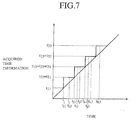
- Fig. 7 is a diagram showing another example of acquired time information in the distributed time stamping system of Fig. 3 and Fig. 4.
- Fig. 8 is a diagram showing a relationship between potential digital document arrival time intervals for two different combining units in the distributed time stamping system of Fig. 3 and Fig. 4.
- Fig. 9 is a diagram showing an example of potential digital document arrival time intervals and actual digital document arrival time for two different combining units in the distributed time stamping system of Fig. 3 and Fig. 4.
- Fig. 10 is a block diagram showing an exemplary configuration of a folder type distributed time stamping system according to the fifth embodiment of the present invention.
- Fig. 11 is a block diagram showing an exemplary configuration of a client unit In the folder type distributed time stamping system of Fig. 10.
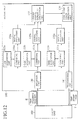
- Fig. 12 is a block diagram showing one exemplary configuration of a server unit in the folder type distributed time stamping system of Fig. 10.
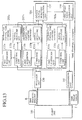
- Fig. 13 is a block diagram showing another exemplary configuration of a server unit in the folder type distributed time stamping system of Fig. 10.
- Fig. 1 and Fig. 2 the first and second embodiments directed to a folder type time stamping system according to the present invention will be described in detail.
- Fig. 1 shows a configuration of the folder type time stamping system according to the first embodiment of the present invention.
- the folder type time stamping system 1 comprises: a digest generation unit 11 for generating digests of target digital documents G among digital documents that may contain any of text data, image data and speech data; a digest combining unit 13 for combining a plurality of digests generated by the digest generation unit 11; a unified digest generation unit 15 for generating a unified digest for a result obtained by combining a plurality of digests at the digest combining unit 13; a transmission unit 17 for transmitting data containing the unified digest generated by the unified digest generation unit 15, to a digital signature generation unit 19 through a time stamping unit 21; a digital signature generation unit 19 for combining a time acquired from a time acquisition unit 23 to the data containing the unified digest that is received from the unified digest generation unit 15 through the transmission unit 17, and generating a digital signature for the obtained combination as a whole; a time stamping unit 21 for sending a time stamp token (certificate) containing the unified digest, the time, and the digital signature generated or acquired above, to
- the digest generation unit 11, the digest combining unit 13, the unified digest generation unit 15, the transmission unit 17, and the reception unit 25 constitute a client unit 100
- the digital signature generation unit 19, the time stamping unit 21, and the time acquisition unit 23 constitute a server unit 200.
- the target digital documents G produced by an author may contain any of text data, image data, speech data, and binary data or their combination.
- the digests are generated by the digest generation unit 11 in the folder type time stamping system 1, using the hash function (such as MDS or SHA-1, for example) for each digital document, such that the processing becomes faster, the original document will not be sent to the server unit 200, and different values can be obtained for different documents at very high probabilities.
- the digest generation unit 11 denoting the hash function as h, and a plurality of digital documents that constitute the target digital documents G as g 1 , g 2 , ⁇ , g n , the digest generation unit 11 generates digests h(g 1 ), h(g 2 ), ⁇ , h(g n ).
- the digest combining unit 13 obtains h(g 1 ) ⁇ h(g 2 ) ⁇ h(g n ) as a result of combining the digests h(g 1 ), h(g 2 ), ⁇ , h(g n ) by concatenation, for example.
- the unified digest generation unit 15 generates the unified digest from this result of combining.
- the unified digest generation unit 15 denoting the hash function used by the unified digest generation unit 15 as i, the unified digest generation unit 15 generates the unified digest i(h(g 1 ) ⁇ h(g 2 ) ⁇ h(g n )).
- the transmission unit 17 then transmits this unified digest i(h(g 1 ) ⁇ h(g 2 ) ⁇ h(g n )) to the digital signature generation unit 19 through the time stamping unit 21.
- the digital signature generation unit 19 generates the digital signature s for a digital data containing the unified digest i(h(g 1 ) ⁇ h(g 2 ) ⁇ h(g n )) and the time t acquired from the time acquisition unit 23, and sends this digital signature s to the time stamping unit 21.
- the time stamping unit 21 issues the time stamp token containing the digital signature s, the unified digest i(h(g 1 ) ⁇ h(g 2 ) ⁇ h(g n )), and the time t, and sends this time stamp token to the reception unit 25.
- the first embodiment it becomes possible to acquire the time stamp token for digital documents on a PC in which a coherent system of documents are often formed by a combination of related documents, figures and tables, etc., in relation to these related documents or the other digital documents on the PC from which these related documents are produced, by regularly acquiring the time stamp token issued for the digital documents from a reliable third party agency for the purpose of the existence proof.
- Fig. 2 shows a configuration of the folder type time stamping system according to the second embodiment of the present invention.
- the folder type time stamping system 3 comprises: a digest generation unit 31 for generating digests of target digital documents G among digital documents F that may contain any of text data, image data and speech data; a digest combining unit 33 for combining a plurality of digests generated by the digest generation unit 31; a unified digest generation unit 35 for generating a unified digest for a result obtained by combining a plurality of digests at the digest combining unit 33; a transmission unit 37 for transmitting data containing the unified digest generated by the unified digest generation unit 35, to a digital signature generation unit 39 through a time stamping unit 41; a digital signature generation unit 39 for combining a time acquired from a time acquisition unit 43a to the data containing the unified digest that is received from the unified digest generation unit 35 through the transmission unit 37, and generating a digital signature for the obtained combination as a whole a time stamping unit 41 for sending a time stamp token (certificate) containing the unified digest, the time, and the digital signature generated or acquired
- the digest generation unit 31, the digest combining unit 33, the unified digest generation unit 35, the transmission unit 37, the reception unit 45, the verification unit 47, the time specifying unit 49, the digital document specifying unit 51, and the time acquisition unit 43b constitute a client unit 100
- the digital signature generation unit 39, the time stamping unit 41, and the time acquisition unit 43a constitute a server unit 200.
- the digital document specifying unit 51 specifies the target digital documents G in units of files or folders, from the digital documents D that may contain any of text data, image data, speech data, and binary data or their combination that are located on a network or inside a PC which is accessible from a PC.
- the digest generation unit 31 When the digest generation unit 31 detects that it is now the time specified from the time specifying unit 49, according to the time acquired from the time acquisition unit 43b, the digest generation unit 31 generates digests for these target digital documents G, using the hash function (such as MD5 or SHA-1. for example) for each digital document.
- the hash function such as MD5 or SHA-1. for example
- the digest generation unit 31 denoting the hash function as h, and a plurality of digital documents that constitute the target digital documents G as g 1 , g 2 , ⁇ , g n , the digest generation unit 31 generates digests h(g 1 ), h(g 2 ), ⁇ , h(g n ).
- the digest combining unit 33 obtains h(g 1 ) ⁇ h(g 2 ) ⁇ h(g n ) as a result of combining the digests h(g 1 ), h(g 2 ), ⁇ , h(g n ) by concatenation, for example.
- the unified digest generation unit 35 generates the unified digest from this result of combining.
- the unified digest generation unit 35 denoting the hash function used by the unified digest generation unit 35 as i, the unified digest generation unit 35 generates the unified digest i(h(g 1 ) ⁇ h(g 2 ) ⁇ h(g n )).
- the transmission unit 37 then transmits this unified digest i(h(g 1 ) ⁇ h(g 2 ) ⁇ h(g n )) to the digital signature generation unit 39 through the time stamping unit 41.
- the digital signature generation unit 39 generates the digital signature s for a digital data containing the unified digest i(h(g 1 ) ⁇ h(g 2 ) ⁇ h(g n )) and the time t acquired from the time acquisition unit 43a, and sends this digital signature s to the time stamping unit 41.
- the time stamping unit 41 issues the time stamp token containing the digital signature s, the unified digest i(h(g 1 ) ⁇ h(g 2 ) ⁇ h(g n )), and the time t, and sends this time stamp token to the reception unit 45.
- the verification unit 47 verifies that the digital signature attached to the time stamp token received at the reception unit 45 is an authentic digital signature generated by the digital signature generation unit 39.
- the verification unit 47 also verifies that the time attached to the time stamp token is after the time of transmission from the transmission unit 37 to the digital signature generation unit 39 and before the time of reception at the reception unit 45.
- the second embodiment in addition to the effects described above for the first embodiment, it is possible to acquire the time stamp token regularly for files on the PC that are specified in units of files or folders, and record the file creation and modification log for files on the PC including relations with the related files, so that it becomes possible to use a sequence of the time stamp tokens acquired over a extended period of time as a proof for the file creation and modification log of files on the PC by a third person.
- This sequence of the time stamp tokens is more difficult to forge than the research notebook or the housekeeping book so that it becomes possible to provide a highly reliable time stamping service for digital documents.
- Fig. 3 shows a configuration of the distributed time stamping system according to the third embodiment of the present invention.
- the distributed time stamping system 101 comprises: a plurality of time acquisition units 113a, 113b, ⁇ , 113s for acquiring time information ⁇ , having a constant incremental time unit, independently for n times where n is an integer greater than or equal to one, at a constant acquisition interval; a plurality of combining units 111a, 111b, ⁇ , 111s provided respectively in correspondence to the time acquisition units 113a, 113b, , 113s, for independently and successively producing a time stamped digital document Mt i j by combining a the respective time information t ij with a digital document M; a plurality of digital signature units 115a, 115b, ⁇ , 115s provided respectively in correspondence to the combining units 111a, 111b, ⁇ , 111s, for independently generating a digital signature for each respective time stamped digital document Mt ij ; a unified digital signature generation unit 117 for receiving a plurality of digital signatures generated independently by the
- the digital document M produced by an author may contain any of text data, image data, speech data, and binary data or their combination.
- This digital document M is combined with a time acquired from the time acquisition unit 113a to produce a time stamped digital document Mt at the combining unit 111a in the distributed time stamping system 101. Then, a digital signature for this time stamped digital document Mt is generated at the digital signature unit 115a.
- the digital signatures generated by the digital signature units 115a, 115b, ⁇ , 115s in this manner are collected to the unified digital signature generation unit 117.
- the unified digital signature generation unit 117 generates the unified digital signature from the digital signatures for the time stamped digital document Mt of the identical time, whenever it is possible to select one time stamped digital document Mt of the identical time for each digital signature unit 115.
- the time stamp token generation unit 119 generates a time stamp token T containing the unified digital signature itself and the time stamped digital document Mt used in generating the unified digital signature.
- the digital signature generation will be described for an exemplary case.
- the RSA public key cryptosystem will be used as an exemplary public key cryptosystem.
- the time stamp token T is obtained as a digital document containing (Mt, c).
- Fig. 4 shows a configuration of the distributed time stamping system according to the fourth embodiment of the present invention.
- the distributed time stamping system 103 comprises: a reception unit 130 for receiving a digital document M by communications; a plurality of time acquisition units 133a, 133b, ⁇ , 133s for acquiring time information ⁇ , ; having a constant incremental time unit, independently for n times where n is an integer at least greater than or equal to one, at a constant acquisition interval; a plurality of combining units 131a, 131b, ⁇ , 131s provided respectively in correspondence to the time acquisition units 133a, 133b, ⁇ , 133s, for independently and successively producing a time stamped digital document Mt ij , by combining a the respective time information t ij with the digital document M received by the reception unit 130; a plurality of digital signature units 135a, 135b, ⁇ , 135s provided respectively in correspondence to the combining units 131a, 131b, , 131s, for independently generating a digital signature for each respective time stamped digital document Mt ij
- Fig. 5 and Fig. 6 show relationships among the acquired time information in the third and fourth embodiments.
- the relationships among the acquired time information are shown for an exemplary case of using three digital signature units.
- Fig. 5 and Fig. 6 respectively represent times acquired by the three time acquisition units in the first attempt, while respectively represent times acquired by the three time acquisition units in the second attempt.
- Fig. 7 shows a relationship between the acquired time information and the accurate time of the time acquisition in the case where the incremental time unit of the time information is set to be a half of that used in Fig. 6.
- Fig. 7 respectively represent times acquired by the three time acquisition units in the first attempt, respectively represent times acquired by the three time acquisition units in the second attempt, and respectively represent times acquired by the three time acquisition units in the third attempt.
- respectively represent accurate times at which the first attempt of the time acquisition is made by the three time acquisition units respectively represent accurate times at which the second attempt of the time acquisition is made by the three time acquisition units
- t k1 , t k2 , t k3 respectively represent accurate times at which the third attempt of the time acquisition is made by the three time acquisition units.
- the incremental time unit is a half
- the constant acquisition interval by which the time acquisition is to be carried out by each time acquisition unit can be set to an arbitrary length, but it should preferably be set equal to the constant incremental time unit of the time to be acquired by each time acquisition unit.
- the constant incremental time unit of the time to be acquired by each time acquisition unit can be set to an arbitrary length, but when the incremental time unit is made shorter, even though an accuracy of the acquired time can be improved, the number of the digital signatures that are required to be generated by each digital signature unit until it becomes possible to select the time stamped digital document Mt of the identical time for each one of the digital signature units will be increased.
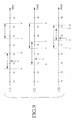
- Fig. 8 shows a relationship between time intervals in which the digital document may arrive at two different combining units.
- a part (1) of Fig. 8 represents a case where the latest possible arrival time for one combining unit is earlier than the earliest possible arrival time for another combining unit
- a part (2) of Fig. 8 represents a case where the latest possible arrival time for one combining unit is contained in the potential arrival time interval for another combining unit and the earliest possible arrival time for the former combining unit is earlier than the earliest possible arrive time for the latter combining unit
- a part (3) of Fig. 8 represents a case where the potential arrival time interval for one combining unit is completely contained within the potential arrival time interval for another combining unit. All conceivable relationships between the potential arrival time intervals for arbitrary two combining units are covered by these three cases.
- Fig. 9 shows a timing relationship in the case where the potential arrival time interval for the combining unit to which the digital document can arrive latest lies between a time "c" and a time "d", and the potential arrival time interval for another arbitrary combining unit lies between a time "a” and a time "b".
- Parts (1), (2) and (3) of Fig. 9 are cases corresponding to those of parts (1), (2) and (3) of Fig. 8.
- the combining unit to which the digital document can arrive latest will be denoted as C1
- another arbitrary combining unit will be denoted as C2.
- the incremental time unit i.e., an interval between and , will be denoted as u.
- each combining unit can be controlled to generate the time stamped digital documents by setting a generation start timing at a time obtained by adding a prescribed time not less than zero that is defined in order to eliminate times that will never be used for the unified digital signature generation, to a predetermined time that is closest to but not earlier than the current time, and combining the digital document sequentially with the time information given by up to a specified number of prescribed incremental time units starting from the generation start timing.
- the prescribed time not less than zero is used such that, when there is a fixed displacement between digital document arrival times at different combining units, the combining unit that would have otherwise started to generate the time stamped digital documents earlier will delay a start of the time stamped digital document generation to account for that displacement.
- the specified number is used such that, even when there is a variation in the potential digital document arrival time interval for the combining unit. it is still possible to obtain the time stamped digital document of the identical time for each one of the digital signature units so that the unified digital signature can be generated without a failure.
- the digital document arrives to C2 at a time "e" between t 5 and t 6 , the current time is "e"
- the predetermined time not earlier than the current time can be set to t 8 and the prescribed time not less than zero can be set to 0.
- the prescribed incremental time unit is u
- the specified number can be set to a number obtained by adding 1 to a smallest integer m greater than or equal to (d-a)/u. in this case, the specified number will be 3 so that only three time stamped digital documents for t 6 , t 7 and t 8 will be generated.
- the digital signature units that constitute the system maintains parts of the secret key of the public key cryptosystem distributedly, so that a possibility of having the secret key stolen or a possibility of having the time stamp token forged can be reduced, but a possibility for the times independently acquired by the time acquisition units to coincide is very small as already mentioned above so that there arises a problem that the unified digital signature cannot be generated.
- the time is acquired at a constant incremental time unit as described above, so that it is possible to increase a possibility for the independently acquired times to coincide.
- Fig. 5 and Fig. 6 it is possible to obtain the time stamped digital document of the identical time for every combining unit without a failure, when each time acquisition unit carries out the time acquisition at least twice at a constant acquisition interval, because of the relationship between the incremental time unit and the time difference between the time acquisition execution times among the time acquisition units.
- the present invention is not limited to this case and it is possible to generate the digital signatures and the unified digital signature similarly by using the other public key cryptosystems in which the digital signature that can be generated by using a single secret key can also be generated by using a plurality of divided secret keys obtained by dividing the secret key of the elliptic curve public key cryptosystem, DSA (Digital Signature Algorithm), etc,
- One time stamped digital document Mt may be set in correspondence to one time information, or in correspondence to a plurality of time information. In the former case one digital signature will be generated from one time stamped digital document Mt, whereas in the latter case a plurality of digital signatures will be generated from one time stamped digital document Mt.
- Fig. 10 shows a configuration of the folder type distributed time stamping system according to the fifth embodiment of the present invention.
- This fifth embodiment is a combination of the folder type time stamping system of the first and second embodiments and the distributed time stamping system of the third and fourth embodiments.
- the folder type distributed time stamping system 300 generally comprises a client unit 100 and a server unit 200.
- the client unit 100 generates a time stamping request R from a plurality of digital documents G that are the target of time stamping, and gives it to the server unit 200.
- the server unit 200 generates a time stamping token (certificate) T according to the received time stamping request R, and returns it to the client unit 100.
- Fig. 11 shows an exemplary configuration of the client unit 100 in the folder type distributed time stamping system 300 of Fig. 10.
- the client unit 100 of Fig. 11. corresponds to the client unit 100 of Fig. 2 in the second embodiment described above, so that the same elements are given the same reference numerals in the figure.
- the digital document specifying unit 51 selects the digital documents G that are the target of time stamping from the digital documents F.
- the digest generation unit 31 generates digests of the selected digital documents.
- the digest generation unit 31 generates digests of the selected digital documents.
- the digest combining unit 33 generates a new digital document by combining the digests of the target digital documents G generated by the digest generation unit 31.
- the unified digest generation unit 36 generates the unified digest from this new digital document.
- the time stamping request R containing the unified digest is transmitted from the transmission unit 37 to the server unit 200.
- the time stamp token T is generated as described below, and returned to the reception unit 45 of the client unit 100.
- the verification unit 47 compares the transmission time by the transmission unit 37, the reception time by the reception unit 45, and the stamped time recorded in the received time stamp token T, verifies using a public key corresponding to the secret key used by the server unit 200 that the digital signature contained in the time stamp token T is the authentic digital signature generated by the server unit 200, and verifies that the digests time stamped by the time stamp token T are those transmitted from the transmission unit 37.
- Fig. 12 shows an exemplary configuration of the server unit 200 in the folder type distributed time stamping system 300 of Fig. 10.
- the server unit 200 of Fig. 12 corresponds to the distributed time stamping system of Fig. 4 in the fourth embodiment described above, so that the same elements are given the same reference numerals in the figure.
- the reception unit 130 receives the time stamping request R, its copy is sent to each combining unit 131.
- each combining unit 131 generates the time stamped digital document Mt by combining the digital document M contained in the time stamping request R with the time acquired by the corresponding time acquisition unit 133.
- the corresponding digital signature unit 135 generates the digital signature for this time stamped digital document Mt using the partial secret key acquired in advance.
- the digital signatures generated by the digital signature units 135 in this manner are collected to the unified digital signature generation unit 137.
- the unified digital signature generation unit 137 selects digital signatures having the identical time information among the collected digital signatures, one digital signature for each digital signature unit 135, and generates the unified digital signature.
- the time stamp token generation unit 139 generates the time stamp token T using the unified digital signature, and transmits it from the transmission unit 141 to the client unit 100.
- Fig. 13 shows another exemplary configuration of the server unit 200 in the folder type distributed time stamping system 300 of Fig. 10.
- the server unit 200 of Fig. 13 adopts a distributed configuration in which the functions of the server unit 200 are to be operated by independent third party authories, where the same elements as in the server unit 200 of Fig. 12 are given the same reference numerals in the figure.
- Fig. 13 differs from Fig. 12 in that a set of one combining unit 131, one time acquisition unit 133 and one digital signature unit 135 constitute one distributed partial time stamping authority 205, and the reception unit 130, the unified digital signature generation unit 137, the time stamp token generation unit 139 and the transmission unit 141 constitute one time stamping authority 204, but the operation of each unit is the same as in the case of Fig. 12.
- the client unit or the server unit of each of the above described embodiments can be conveniently implemented in a form of a software package.
- Such a software package can be a computer program product which employs a storage medium including stored computer code which is used to program a computer to perform the disclosed function and process of the present invention.
- the storage medium may include, but is not limited to, any type of conventional floppy disks, optical disks, CD-ROMs, magneto-optical disks, ROMs, RAMs, EPROMs. EEPROMs, magnetic or optical cards, or any other suitable media for storing electronic instructions.
Landscapes
- Engineering & Computer Science (AREA)
- Computer Security & Cryptography (AREA)
- Computer Networks & Wireless Communication (AREA)
- Signal Processing (AREA)
- Storage Device Security (AREA)
- Computer And Data Communications (AREA)
- Data Exchanges In Wide-Area Networks (AREA)
- Document Processing Apparatus (AREA)
Applications Claiming Priority (5)
| Application Number | Priority Date | Filing Date | Title |
|---|---|---|---|
| JP24799499 | 1999-09-01 | ||
| JP24799399 | 1999-09-01 | ||
| JP24799399 | 1999-09-01 | ||
| JP24799499 | 1999-09-01 | ||
| EP00118221A EP1081890B1 (fr) | 1999-09-01 | 2000-09-01 | Système d'horodatage du type classeur et système d'horodatage distribué |
Related Parent Applications (1)
| Application Number | Title | Priority Date | Filing Date |
|---|---|---|---|
| EP00118221A Division EP1081890B1 (fr) | 1999-09-01 | 2000-09-01 | Système d'horodatage du type classeur et système d'horodatage distribué |
Publications (3)
| Publication Number | Publication Date |
|---|---|
| EP1267517A2 true EP1267517A2 (fr) | 2002-12-18 |
| EP1267517A3 EP1267517A3 (fr) | 2003-04-16 |
| EP1267517B1 EP1267517B1 (fr) | 2006-03-29 |
Family
ID=26538525
Family Applications (2)
| Application Number | Title | Priority Date | Filing Date |
|---|---|---|---|
| EP00118221A Expired - Lifetime EP1081890B1 (fr) | 1999-09-01 | 2000-09-01 | Système d'horodatage du type classeur et système d'horodatage distribué |
| EP02019031A Expired - Lifetime EP1267517B1 (fr) | 1999-09-01 | 2000-09-01 | Système d'horodatage distribué |
Family Applications Before (1)
| Application Number | Title | Priority Date | Filing Date |
|---|---|---|---|
| EP00118221A Expired - Lifetime EP1081890B1 (fr) | 1999-09-01 | 2000-09-01 | Système d'horodatage du type classeur et système d'horodatage distribué |
Country Status (4)
| Country | Link |
|---|---|
| US (1) | US6931537B1 (fr) |
| EP (2) | EP1081890B1 (fr) |
| CA (1) | CA2317139C (fr) |
| DE (2) | DE60027054T2 (fr) |
Cited By (2)
| Publication number | Priority date | Publication date | Assignee | Title |
|---|---|---|---|---|
| DE102004006806A1 (de) * | 2003-08-16 | 2005-03-17 | Secunet Security Networks Ag | Verfahren zur Zeitstempelung digitaler Daten und Vorrichtung zur Durchführung des Verfahrens |
| EP1452934A3 (fr) * | 2003-02-25 | 2008-01-02 | Francotyp-Postalia GmbH | Méthode pour obtenir l' information de temps |
Families Citing this family (28)
| Publication number | Priority date | Publication date | Assignee | Title |
|---|---|---|---|---|
| US20050160272A1 (en) * | 1999-10-28 | 2005-07-21 | Timecertain, Llc | System and method for providing trusted time in content of digital data files |
| DE10106083A1 (de) * | 2001-02-08 | 2002-08-29 | Jan Wendenburg | Verfahren zur Zuordnung von digitalen Zeitstempeln |
| DE10118527C2 (de) * | 2001-04-14 | 2003-02-20 | Recognitec Ges Fuer Digitale B | Verfahren zur Integritätsprüfung binärer Daten |
| GB2376323B (en) * | 2001-06-09 | 2006-03-15 | Hewlett Packard Co | Trusted and verifiable data storage system |
| GB0120134D0 (en) * | 2001-08-17 | 2001-10-10 | Nokia Corp | Improvements in or relating to communication networks and methods of distributing information around the network |
| GB0123453D0 (en) * | 2001-09-28 | 2001-11-21 | Ncipher Corp Ltd | Time stamping device |
| EP1343098A1 (fr) * | 2002-03-07 | 2003-09-10 | Hewlett-Packard Company | Améliorations concernant des environnements de réseau et la localisation des ressources là-dedans |
| JP2003323357A (ja) * | 2002-05-08 | 2003-11-14 | Hitachi Ltd | タイムスタンプ生成システム |
| US20030233455A1 (en) * | 2002-06-14 | 2003-12-18 | Mike Leber | Distributed file sharing system |
| GB2400463B (en) | 2003-04-11 | 2005-05-25 | Nextenders | Data processing apparatus and method for distributing and authenticating electronic documents |
| US7715034B2 (en) * | 2003-10-17 | 2010-05-11 | Canon Kabushiki Kaisha | Data processing device and data storage device for performing time certification of digital data |
| ES2363517T3 (es) * | 2004-04-02 | 2011-08-08 | Panasonic Corporation | Sistema de detección de contenido no autorizado. |
| KR101103098B1 (ko) * | 2004-05-18 | 2012-01-04 | 실버브룩 리서치 피티와이 리미티드 | 다수의 데이터 부분들내에서 부호화된 서명을 사용한대상의 인증 |
| US7340610B1 (en) * | 2004-08-31 | 2008-03-04 | Hitachi, Ltd. | Trusted time stamping storage system |
| JP4455474B2 (ja) * | 2005-11-04 | 2010-04-21 | 株式会社東芝 | タイムスタンプ更新装置及びタイムスタンプ更新プログラム |
| US20070220260A1 (en) * | 2006-03-14 | 2007-09-20 | Adobe Systems Incorporated | Protecting the integrity of electronically derivative works |
| FR2907934B1 (fr) * | 2006-10-27 | 2009-02-06 | Inst Nat Rech Inf Automat | Outil informatique de gestion de documents numeriques |
| JP2008129857A (ja) * | 2006-11-21 | 2008-06-05 | Konica Minolta Business Technologies Inc | ファイル管理装置、ファイル管理方法、およびプログラム |
| WO2008061389A1 (fr) * | 2006-11-24 | 2008-05-29 | Uptime Products Ag | Dispositif et procédé de gestion de documents |
| DE102007005638B4 (de) * | 2007-02-05 | 2014-10-09 | Siemens Aktiengesellschaft | Verfahren zur Autorisierung des Zugriffs auf mindestens eine Automatisierungskompente einer technischen Anlage |
| US20090189441A1 (en) * | 2008-01-29 | 2009-07-30 | Paul Degoul | Distributed electrical/electronic architectures for brake-by-wire brake systems |
| JP2010238102A (ja) * | 2009-03-31 | 2010-10-21 | Fujitsu Ltd | 情報処理装置、認証システム、認証方法、認証装置及びプログラム |
| SE537697C2 (sv) | 2013-08-08 | 2015-09-29 | Enigio Time Ab | Förfarande för att skapa signaler för tidsstämpling av dokument och förfarande för tidsstämpling av dokument |
| US11552806B2 (en) * | 2018-08-01 | 2023-01-10 | Cable Television Laboratories, Inc. | Systems and methods for enhanced public key infrastructure |
| US12567981B2 (en) * | 2018-08-01 | 2026-03-03 | Cable Television Laboratories, Inc. | Systems and methods for data authentication using composite keys and signatures |
| EP3920069A1 (fr) * | 2020-06-02 | 2021-12-08 | Penneo A/S | Procédé mis en uvre par ordinateur permettant de fournir au moins une signature électronique pour une pluralité de documents électroniques et dispositif ou système de traitement de données l'utilisant |
| US12200122B1 (en) | 2020-08-06 | 2025-01-14 | Cable Television Laboratories, Inc. | Systems and methods for advanced quantum-safe PKI credentials for authentications |
| CN115373950B (zh) * | 2022-10-26 | 2023-01-24 | 北京芯可鉴科技有限公司 | 工控机与数据监测系统 |
Family Cites Families (19)
| Publication number | Priority date | Publication date | Assignee | Title |
|---|---|---|---|---|
| US5001752A (en) | 1989-10-13 | 1991-03-19 | Fischer Addison M | Public/key date-time notary facility |
| US5136643A (en) | 1989-10-13 | 1992-08-04 | Fischer Addison M | Public/key date-time notary facility |
| US5022080A (en) | 1990-04-16 | 1991-06-04 | Durst Robert T | Electronic notary |
| US5136646A (en) | 1991-03-08 | 1992-08-04 | Bell Communications Research, Inc. | Digital document time-stamping with catenate certificate |
| US5136647A (en) | 1990-08-02 | 1992-08-04 | Bell Communications Research, Inc. | Method for secure time-stamping of digital documents |
| WO1992003000A1 (fr) | 1990-08-02 | 1992-02-20 | Bell Communications Research, Inc. | Procede d'horodatage sur de documents numeriques |
| US5422953A (en) | 1993-05-05 | 1995-06-06 | Fischer; Addison M. | Personal date/time notary device |
| CA2203779C (fr) | 1994-10-28 | 2001-11-20 | Stuart A. Haber | Systeme numerique d'authentification de document servant a produire un certificat qui authentifie et identifie uniquement un document |
| NZ306846A (en) | 1995-06-05 | 2000-01-28 | Certco Llc | Digital signing method using partial signatures |
| US5768389A (en) * | 1995-06-21 | 1998-06-16 | Nippon Telegraph And Telephone Corporation | Method and system for generation and management of secret key of public key cryptosystem |
| US5768382A (en) * | 1995-11-22 | 1998-06-16 | Walker Asset Management Limited Partnership | Remote-auditing of computer generated outcomes and authenticated biling and access control system using cryptographic and other protocols |
| US5625693A (en) * | 1995-07-07 | 1997-04-29 | Thomson Consumer Electronics, Inc. | Apparatus and method for authenticating transmitting applications in an interactive TV system |
| JPH1039753A (ja) | 1996-07-23 | 1998-02-13 | Teruhito Oota | 電子情報への確定日付付与法 |
| JPH10105057A (ja) | 1996-09-25 | 1998-04-24 | Hitachi Software Eng Co Ltd | タイムスタンプサーバシステム |
| US5958051A (en) | 1996-11-27 | 1999-09-28 | Sun Microsystems, Inc. | Implementing digital signatures for data streams and data archives |
| JP3484030B2 (ja) | 1997-01-24 | 2004-01-06 | 日本電信電話株式会社 | 電子文書の存在証明方法 |
| AU6759998A (en) * | 1997-03-06 | 1998-09-22 | Skylight Software, Inc. | Cryptographic digital identity method |
| US6601172B1 (en) * | 1997-12-31 | 2003-07-29 | Philips Electronics North America Corp. | Transmitting revisions with digital signatures |
| JP3515408B2 (ja) | 1999-02-15 | 2004-04-05 | 日本電信電話株式会社 | 時刻認証装置 |
-
2000
- 2000-08-30 CA CA002317139A patent/CA2317139C/fr not_active Expired - Fee Related
- 2000-09-01 EP EP00118221A patent/EP1081890B1/fr not_active Expired - Lifetime
- 2000-09-01 DE DE60027054T patent/DE60027054T2/de not_active Expired - Lifetime
- 2000-09-01 US US09/654,436 patent/US6931537B1/en not_active Expired - Fee Related
- 2000-09-01 DE DE60019216T patent/DE60019216T2/de not_active Expired - Lifetime
- 2000-09-01 EP EP02019031A patent/EP1267517B1/fr not_active Expired - Lifetime
Cited By (3)
| Publication number | Priority date | Publication date | Assignee | Title |
|---|---|---|---|---|
| EP1452934A3 (fr) * | 2003-02-25 | 2008-01-02 | Francotyp-Postalia GmbH | Méthode pour obtenir l' information de temps |
| DE102004006806A1 (de) * | 2003-08-16 | 2005-03-17 | Secunet Security Networks Ag | Verfahren zur Zeitstempelung digitaler Daten und Vorrichtung zur Durchführung des Verfahrens |
| DE102004006806B4 (de) * | 2003-08-16 | 2005-10-20 | Secunet Security Networks Ag | Verfahren zur Zeitstempelung digitaler Daten und Vorrichtung zur Durchführung des Verfahrens |
Also Published As
| Publication number | Publication date |
|---|---|
| EP1081890A2 (fr) | 2001-03-07 |
| DE60019216D1 (de) | 2005-05-12 |
| EP1081890A3 (fr) | 2002-09-25 |
| DE60027054T2 (de) | 2006-11-09 |
| EP1267517B1 (fr) | 2006-03-29 |
| CA2317139C (fr) | 2006-08-08 |
| US6931537B1 (en) | 2005-08-16 |
| EP1267517A3 (fr) | 2003-04-16 |
| EP1081890B1 (fr) | 2005-04-06 |
| DE60027054D1 (de) | 2006-05-18 |
| DE60019216T2 (de) | 2006-03-09 |
| CA2317139A1 (fr) | 2001-03-01 |
Similar Documents
| Publication | Publication Date | Title |
|---|---|---|
| EP1081890B1 (fr) | Système d'horodatage du type classeur et système d'horodatage distribué | |
| JP3635017B2 (ja) | 時刻認証システム、サーバ装置、時刻認証方法及び記録媒体 | |
| AU670166B2 (en) | Method of extending the validity of a cryptographic certificate | |
| US7519824B1 (en) | Time stamping method employing multiple receipts linked by a nonce | |
| US5136646A (en) | Digital document time-stamping with catenate certificate | |
| EP0940945A2 (fr) | Procédé et dispositif de certification et de sauvegarde sécurisée de documents électroniques | |
| AU714220B2 (en) | Document authentication system and method | |
| US7698557B2 (en) | System and method for generating a digital certificate | |
| US7487359B2 (en) | Time stamping method employing a separate ticket and stub | |
| US20020004800A1 (en) | Electronic notary method and system | |
| AU3741099A (en) | System and method for electronic transmission, storage and retrieval of authenticated documents | |
| US20040123107A1 (en) | Method for verifying a digital signature | |
| US8631235B2 (en) | System and method for storing data using a virtual worm file system | |
| Maniatis et al. | Enabling the archival storage of signed documents | |
| US6742119B1 (en) | Time stamping method using time delta in key certificate | |
| JP3515408B2 (ja) | 時刻認証装置 | |
| KR20010040248A (ko) | 과도 키 디지탈 시간 스탬프 방법 및 시스템 | |
| US6993656B1 (en) | Time stamping method using aged time stamp receipts | |
| US7490241B1 (en) | Time stamping method employing user specified time | |
| US6965998B1 (en) | Time stamping method using time-based signature key | |
| EP4167520B1 (fr) | Certification numérique de documents scannés | |
| WO2004068264A2 (fr) | Systeme et procede de creation de signatures electroniques | |
| Van Rompay et al. | The digital timestamping problem | |
| CN118468312A (zh) | 一种证据链的生成与固定方法 | |
| Nakahara | Electronic Notary System and its Certification Mechanism |
Legal Events
| Date | Code | Title | Description |
|---|---|---|---|
| PUAI | Public reference made under article 153(3) epc to a published international application that has entered the european phase |
Free format text: ORIGINAL CODE: 0009012 |
|
| 17P | Request for examination filed |
Effective date: 20020827 |
|
| AC | Divisional application: reference to earlier application |
Ref document number: 1081890 Country of ref document: EP |
|
| AK | Designated contracting states |
Kind code of ref document: A2 Designated state(s): AT BE CH CY DE DK ES FI FR GB GR IE IT LI LU MC NL PT SE |
|
| AX | Request for extension of the european patent |
Free format text: AL;LT;LV;MK;RO;SI |
|
| PUAL | Search report despatched |
Free format text: ORIGINAL CODE: 0009013 |
|
| AK | Designated contracting states |
Designated state(s): AT BE CH CY DE DK ES FI FR GB GR IE IT LI LU MC NL PT SE |
|
| AX | Request for extension of the european patent |
Extension state: AL LT LV MK RO SI |
|
| AKX | Designation fees paid |
Designated state(s): DE FR GB |
|
| 17Q | First examination report despatched |
Effective date: 20050215 |
|
| GRAP | Despatch of communication of intention to grant a patent |
Free format text: ORIGINAL CODE: EPIDOSNIGR1 |
|
| GRAS | Grant fee paid |
Free format text: ORIGINAL CODE: EPIDOSNIGR3 |
|
| GRAA | (expected) grant |
Free format text: ORIGINAL CODE: 0009210 |
|
| AC | Divisional application: reference to earlier application |
Ref document number: 1081890 Country of ref document: EP Kind code of ref document: P |
|
| AK | Designated contracting states |
Kind code of ref document: B1 Designated state(s): DE FR GB |
|
| REG | Reference to a national code |
Ref country code: GB Ref legal event code: FG4D |
|
| REF | Corresponds to: |
Ref document number: 60027054 Country of ref document: DE Date of ref document: 20060518 Kind code of ref document: P |
|
| ET | Fr: translation filed | ||
| PLBE | No opposition filed within time limit |
Free format text: ORIGINAL CODE: 0009261 |
|
| STAA | Information on the status of an ep patent application or granted ep patent |
Free format text: STATUS: NO OPPOSITION FILED WITHIN TIME LIMIT |
|
| 26N | No opposition filed |
Effective date: 20070102 |
|
| PGFP | Annual fee paid to national office [announced via postgrant information from national office to epo] |
Ref country code: GB Payment date: 20120808 Year of fee payment: 13 |
|
| PGFP | Annual fee paid to national office [announced via postgrant information from national office to epo] |
Ref country code: DE Payment date: 20120917 Year of fee payment: 13 Ref country code: FR Payment date: 20121004 Year of fee payment: 13 |
|
| GBPC | Gb: european patent ceased through non-payment of renewal fee |
Effective date: 20130901 |
|
| REG | Reference to a national code |
Ref country code: FR Ref legal event code: ST Effective date: 20140530 |
|
| REG | Reference to a national code |
Ref country code: DE Ref legal event code: R119 Ref document number: 60027054 Country of ref document: DE Effective date: 20140401 |
|
| PG25 | Lapsed in a contracting state [announced via postgrant information from national office to epo] |
Ref country code: GB Free format text: LAPSE BECAUSE OF NON-PAYMENT OF DUE FEES Effective date: 20130901 |
|
| PG25 | Lapsed in a contracting state [announced via postgrant information from national office to epo] |
Ref country code: DE Free format text: LAPSE BECAUSE OF NON-PAYMENT OF DUE FEES Effective date: 20140401 Ref country code: FR Free format text: LAPSE BECAUSE OF NON-PAYMENT OF DUE FEES Effective date: 20130930 |