EP1268663B1 - Polymer-masse - Google Patents
Polymer-masseInfo
- Publication number
- EP1268663B1 EP1268663B1 EP01911724A EP01911724A EP1268663B1 EP 1268663 B1 EP1268663 B1 EP 1268663B1 EP 01911724 A EP01911724 A EP 01911724A EP 01911724 A EP01911724 A EP 01911724A EP 1268663 B1 EP1268663 B1 EP 1268663B1
- Authority
- EP
- European Patent Office
- Prior art keywords
- polymer
- polymer composition
- monomer
- range
- obtainable
- Prior art date
- Legal status (The legal status is an assumption and is not a legal conclusion. Google has not performed a legal analysis and makes no representation as to the accuracy of the status listed.)
- Expired - Lifetime
Links
- 229920000642 polymer Polymers 0.000 title claims abstract description 121
- 239000000203 mixture Substances 0.000 title claims abstract description 74
- 239000000178 monomer Substances 0.000 claims abstract description 38
- 239000000945 filler Substances 0.000 claims abstract description 14
- 239000013013 elastic material Substances 0.000 claims description 27
- 239000002131 composite material Substances 0.000 claims description 20
- WKBOTKDWSSQWDR-UHFFFAOYSA-N Bromine atom Chemical compound [Br] WKBOTKDWSSQWDR-UHFFFAOYSA-N 0.000 claims description 6
- GDTBXPJZTBHREO-UHFFFAOYSA-N bromine Substances BrBr GDTBXPJZTBHREO-UHFFFAOYSA-N 0.000 claims description 6
- 229910052794 bromium Inorganic materials 0.000 claims description 6
- 238000000034 method Methods 0.000 claims description 4
- 229920001400 block copolymer Polymers 0.000 claims description 2
- OBNDGIHQAIXEAO-UHFFFAOYSA-N [O].[Si] Chemical compound [O].[Si] OBNDGIHQAIXEAO-UHFFFAOYSA-N 0.000 claims 1
- 230000035939 shock Effects 0.000 abstract description 5
- 229910052736 halogen Inorganic materials 0.000 abstract description 4
- 150000002367 halogens Chemical class 0.000 abstract description 4
- 239000000463 material Substances 0.000 description 33
- 239000010410 layer Substances 0.000 description 19
- PPBRXRYQALVLMV-UHFFFAOYSA-N Styrene Chemical compound C=CC1=CC=CC=C1 PPBRXRYQALVLMV-UHFFFAOYSA-N 0.000 description 12
- 239000003795 chemical substances by application Substances 0.000 description 10
- 238000010586 diagram Methods 0.000 description 10
- 239000011345 viscous material Substances 0.000 description 9
- RRHGJUQNOFWUDK-UHFFFAOYSA-N Isoprene Chemical compound CC(=C)C=C RRHGJUQNOFWUDK-UHFFFAOYSA-N 0.000 description 8
- 229920001577 copolymer Polymers 0.000 description 7
- KAKZBPTYRLMSJV-UHFFFAOYSA-N Butadiene Chemical compound C=CC=C KAKZBPTYRLMSJV-UHFFFAOYSA-N 0.000 description 6
- VYPSYNLAJGMNEJ-UHFFFAOYSA-N Silicium dioxide Chemical compound O=[Si]=O VYPSYNLAJGMNEJ-UHFFFAOYSA-N 0.000 description 6
- 238000000418 atomic force spectrum Methods 0.000 description 6
- 239000005038 ethylene vinyl acetate Substances 0.000 description 6
- 229920001200 poly(ethylene-vinyl acetate) Polymers 0.000 description 6
- 239000012190 activator Substances 0.000 description 5
- 230000037396 body weight Effects 0.000 description 5
- XLOMVQKBTHCTTD-UHFFFAOYSA-N Zinc monoxide Chemical compound [Zn]=O XLOMVQKBTHCTTD-UHFFFAOYSA-N 0.000 description 4
- 239000002253 acid Substances 0.000 description 4
- 229920001971 elastomer Polymers 0.000 description 4
- 239000000049 pigment Substances 0.000 description 4
- 239000005060 rubber Substances 0.000 description 4
- 229920003048 styrene butadiene rubber Polymers 0.000 description 4
- 238000012360 testing method Methods 0.000 description 4
- 229920002554 vinyl polymer Polymers 0.000 description 4
- LKNKAEWGISYACD-UHFFFAOYSA-N 1-bromobuta-1,3-diene Chemical compound BrC=CC=C LKNKAEWGISYACD-UHFFFAOYSA-N 0.000 description 3
- PNEYBMLMFCGWSK-UHFFFAOYSA-N Alumina Chemical compound [O-2].[O-2].[O-2].[Al+3].[Al+3] PNEYBMLMFCGWSK-UHFFFAOYSA-N 0.000 description 3
- 239000004604 Blowing Agent Substances 0.000 description 3
- 239000005062 Polybutadiene Substances 0.000 description 3
- XTXRWKRVRITETP-UHFFFAOYSA-N Vinyl acetate Chemical compound CC(=O)OC=C XTXRWKRVRITETP-UHFFFAOYSA-N 0.000 description 3
- 239000007859 condensation product Substances 0.000 description 3
- 229920002857 polybutadiene Polymers 0.000 description 3
- 239000000047 product Substances 0.000 description 3
- 229940117958 vinyl acetate Drugs 0.000 description 3
- ZGEGCLOFRBLKSE-UHFFFAOYSA-N 1-Heptene Chemical compound CCCCCC=C ZGEGCLOFRBLKSE-UHFFFAOYSA-N 0.000 description 2
- LIKMAJRDDDTEIG-UHFFFAOYSA-N 1-hexene Chemical compound CCCCC=C LIKMAJRDDDTEIG-UHFFFAOYSA-N 0.000 description 2
- JRZJOMJEPLMPRA-UHFFFAOYSA-N 1-nonene Chemical compound CCCCCCCC=C JRZJOMJEPLMPRA-UHFFFAOYSA-N 0.000 description 2
- KWKAKUADMBZCLK-UHFFFAOYSA-N 1-octene Chemical compound CCCCCCC=C KWKAKUADMBZCLK-UHFFFAOYSA-N 0.000 description 2
- UQSXHKLRYXJYBZ-UHFFFAOYSA-N Iron oxide Chemical compound [Fe]=O UQSXHKLRYXJYBZ-UHFFFAOYSA-N 0.000 description 2
- VQTUBCCKSQIDNK-UHFFFAOYSA-N Isobutene Chemical compound CC(C)=C VQTUBCCKSQIDNK-UHFFFAOYSA-N 0.000 description 2
- 238000005299 abrasion Methods 0.000 description 2
- 206010000269 abscess Diseases 0.000 description 2
- 235000012211 aluminium silicate Nutrition 0.000 description 2
- 210000003484 anatomy Anatomy 0.000 description 2
- 238000006243 chemical reaction Methods 0.000 description 2
- 150000001875 compounds Chemical class 0.000 description 2
- 230000006378 damage Effects 0.000 description 2
- 229920000359 diblock copolymer Polymers 0.000 description 2
- 235000014113 dietary fatty acids Nutrition 0.000 description 2
- 230000000694 effects Effects 0.000 description 2
- 239000000194 fatty acid Substances 0.000 description 2
- 229930195729 fatty acid Natural products 0.000 description 2
- 150000004665 fatty acids Chemical class 0.000 description 2
- 239000000835 fiber Substances 0.000 description 2
- 239000006260 foam Substances 0.000 description 2
- 239000011256 inorganic filler Substances 0.000 description 2
- 239000001023 inorganic pigment Substances 0.000 description 2
- 230000009191 jumping Effects 0.000 description 2
- 239000002346 layers by function Substances 0.000 description 2
- 239000007788 liquid Substances 0.000 description 2
- 239000012860 organic pigment Substances 0.000 description 2
- YWAKXRMUMFPDSH-UHFFFAOYSA-N pentene Chemical compound CCCC=C YWAKXRMUMFPDSH-UHFFFAOYSA-N 0.000 description 2
- 125000005498 phthalate group Chemical class 0.000 description 2
- 239000004014 plasticizer Substances 0.000 description 2
- 239000000377 silicon dioxide Substances 0.000 description 2
- 229920000468 styrene butadiene styrene block copolymer Polymers 0.000 description 2
- 230000001629 suppression Effects 0.000 description 2
- 229910052723 transition metal Inorganic materials 0.000 description 2
- 150000003624 transition metals Chemical class 0.000 description 2
- 125000000391 vinyl group Chemical group [H]C([*])=C([H])[H] 0.000 description 2
- 239000011787 zinc oxide Substances 0.000 description 2
- PCTMTFRHKVHKIS-BMFZQQSSSA-N (1s,3r,4e,6e,8e,10e,12e,14e,16e,18s,19r,20r,21s,25r,27r,30r,31r,33s,35r,37s,38r)-3-[(2r,3s,4s,5s,6r)-4-amino-3,5-dihydroxy-6-methyloxan-2-yl]oxy-19,25,27,30,31,33,35,37-octahydroxy-18,20,21-trimethyl-23-oxo-22,39-dioxabicyclo[33.3.1]nonatriaconta-4,6,8,10 Chemical compound C1C=C2C[C@@H](OS(O)(=O)=O)CC[C@]2(C)[C@@H]2[C@@H]1[C@@H]1CC[C@H]([C@H](C)CCCC(C)C)[C@@]1(C)CC2.O[C@H]1[C@@H](N)[C@H](O)[C@@H](C)O[C@H]1O[C@H]1/C=C/C=C/C=C/C=C/C=C/C=C/C=C/[C@H](C)[C@@H](O)[C@@H](C)[C@H](C)OC(=O)C[C@H](O)C[C@H](O)CC[C@@H](O)[C@H](O)C[C@H](O)C[C@](O)(C[C@H](O)[C@H]2C(O)=O)O[C@H]2C1 PCTMTFRHKVHKIS-BMFZQQSSSA-N 0.000 description 1
- 239000005995 Aluminium silicate Substances 0.000 description 1
- OYPRJOBELJOOCE-UHFFFAOYSA-N Calcium Chemical compound [Ca] OYPRJOBELJOOCE-UHFFFAOYSA-N 0.000 description 1
- ZAMOUSCENKQFHK-UHFFFAOYSA-N Chlorine atom Chemical compound [Cl] ZAMOUSCENKQFHK-UHFFFAOYSA-N 0.000 description 1
- 239000004971 Cross linker Substances 0.000 description 1
- MQIUGAXCHLFZKX-UHFFFAOYSA-N Di-n-octyl phthalate Chemical compound CCCCCCCCOC(=O)C1=CC=CC=C1C(=O)OCCCCCCCC MQIUGAXCHLFZKX-UHFFFAOYSA-N 0.000 description 1
- 229920003345 Elvax® Polymers 0.000 description 1
- 241000196324 Embryophyta Species 0.000 description 1
- VGGSQFUCUMXWEO-UHFFFAOYSA-N Ethene Chemical compound C=C VGGSQFUCUMXWEO-UHFFFAOYSA-N 0.000 description 1
- IMROMDMJAWUWLK-UHFFFAOYSA-N Ethenol Chemical compound OC=C IMROMDMJAWUWLK-UHFFFAOYSA-N 0.000 description 1
- 239000005977 Ethylene Substances 0.000 description 1
- PXGOKWXKJXAPGV-UHFFFAOYSA-N Fluorine Chemical compound FF PXGOKWXKJXAPGV-UHFFFAOYSA-N 0.000 description 1
- 244000043261 Hevea brasiliensis Species 0.000 description 1
- 241000282412 Homo Species 0.000 description 1
- 239000004793 Polystyrene Substances 0.000 description 1
- GWEVSGVZZGPLCZ-UHFFFAOYSA-N Titan oxide Chemical compound O=[Ti]=O GWEVSGVZZGPLCZ-UHFFFAOYSA-N 0.000 description 1
- WGLPBDUCMAPZCE-UHFFFAOYSA-N Trioxochromium Chemical compound O=[Cr](=O)=O WGLPBDUCMAPZCE-UHFFFAOYSA-N 0.000 description 1
- 239000005083 Zinc sulfide Substances 0.000 description 1
- 230000002745 absorbent Effects 0.000 description 1
- 239000002250 absorbent Substances 0.000 description 1
- 239000006096 absorbing agent Substances 0.000 description 1
- 238000010521 absorption reaction Methods 0.000 description 1
- 230000006978 adaptation Effects 0.000 description 1
- 239000000956 alloy Substances 0.000 description 1
- 229910045601 alloy Inorganic materials 0.000 description 1
- XYLMUPLGERFSHI-UHFFFAOYSA-N alpha-Methylstyrene Chemical compound CC(=C)C1=CC=CC=C1 XYLMUPLGERFSHI-UHFFFAOYSA-N 0.000 description 1
- 229910000323 aluminium silicate Inorganic materials 0.000 description 1
- 150000001408 amides Chemical class 0.000 description 1
- 230000000712 assembly Effects 0.000 description 1
- 238000000429 assembly Methods 0.000 description 1
- 238000005452 bending Methods 0.000 description 1
- 125000001246 bromo group Chemical group Br* 0.000 description 1
- DQXBYHZEEUGOBF-UHFFFAOYSA-N but-3-enoic acid;ethene Chemical compound C=C.OC(=O)CC=C DQXBYHZEEUGOBF-UHFFFAOYSA-N 0.000 description 1
- 229910052793 cadmium Inorganic materials 0.000 description 1
- BDOSMKKIYDKNTQ-UHFFFAOYSA-N cadmium atom Chemical compound [Cd] BDOSMKKIYDKNTQ-UHFFFAOYSA-N 0.000 description 1
- 229910052791 calcium Inorganic materials 0.000 description 1
- 239000011575 calcium Substances 0.000 description 1
- 235000012241 calcium silicate Nutrition 0.000 description 1
- 125000004432 carbon atom Chemical group C* 0.000 description 1
- 150000004649 carbonic acid derivatives Chemical class 0.000 description 1
- 150000001732 carboxylic acid derivatives Chemical class 0.000 description 1
- 238000012512 characterization method Methods 0.000 description 1
- 229910052801 chlorine Inorganic materials 0.000 description 1
- 239000000460 chlorine Substances 0.000 description 1
- ZCDOYSPFYFSLEW-UHFFFAOYSA-N chromate(2-) Chemical compound [O-][Cr]([O-])(=O)=O ZCDOYSPFYFSLEW-UHFFFAOYSA-N 0.000 description 1
- 229910000423 chromium oxide Inorganic materials 0.000 description 1
- 230000001684 chronic effect Effects 0.000 description 1
- 238000000576 coating method Methods 0.000 description 1
- 238000010276 construction Methods 0.000 description 1
- 230000003412 degenerative effect Effects 0.000 description 1
- 230000001419 dependent effect Effects 0.000 description 1
- 125000000664 diazo group Chemical group [N-]=[N+]=[*] 0.000 description 1
- 150000001993 dienes Chemical class 0.000 description 1
- PPSZHCXTGRHULJ-UHFFFAOYSA-N dioxazine Chemical compound O1ON=CC=C1 PPSZHCXTGRHULJ-UHFFFAOYSA-N 0.000 description 1
- 239000006185 dispersion Substances 0.000 description 1
- 150000002148 esters Chemical class 0.000 description 1
- -1 ethylene, propylene, 1-butene Chemical class 0.000 description 1
- 230000001747 exhibiting effect Effects 0.000 description 1
- 238000002474 experimental method Methods 0.000 description 1
- 230000002349 favourable effect Effects 0.000 description 1
- 239000010408 film Substances 0.000 description 1
- 229910052731 fluorine Inorganic materials 0.000 description 1
- 239000011737 fluorine Substances 0.000 description 1
- 239000011888 foil Substances 0.000 description 1
- 230000001295 genetical effect Effects 0.000 description 1
- 230000009477 glass transition Effects 0.000 description 1
- 238000013007 heat curing Methods 0.000 description 1
- 239000004615 ingredient Substances 0.000 description 1
- 239000003112 inhibitor Substances 0.000 description 1
- 238000001746 injection moulding Methods 0.000 description 1
- 150000002484 inorganic compounds Chemical class 0.000 description 1
- 229910003475 inorganic filler Inorganic materials 0.000 description 1
- 230000003993 interaction Effects 0.000 description 1
- NLYAJNPCOHFWQQ-UHFFFAOYSA-N kaolin Chemical compound O.O.O=[Al]O[Si](=O)O[Si](=O)O[Al]=O NLYAJNPCOHFWQQ-UHFFFAOYSA-N 0.000 description 1
- 230000005923 long-lasting effect Effects 0.000 description 1
- 239000011159 matrix material Substances 0.000 description 1
- 238000005259 measurement Methods 0.000 description 1
- 238000002844 melting Methods 0.000 description 1
- 230000008018 melting Effects 0.000 description 1
- 229910052751 metal Inorganic materials 0.000 description 1
- 239000002184 metal Substances 0.000 description 1
- 229910044991 metal oxide Inorganic materials 0.000 description 1
- 150000004706 metal oxides Chemical class 0.000 description 1
- 238000002156 mixing Methods 0.000 description 1
- TVMXDCGIABBOFY-UHFFFAOYSA-N n-Octanol Natural products CCCCCCCC TVMXDCGIABBOFY-UHFFFAOYSA-N 0.000 description 1
- MZYHMUONCNKCHE-UHFFFAOYSA-N naphthalene-1,2,3,4-tetracarboxylic acid Chemical class C1=CC=CC2=C(C(O)=O)C(C(=O)O)=C(C(O)=O)C(C(O)=O)=C21 MZYHMUONCNKCHE-UHFFFAOYSA-N 0.000 description 1
- 229920003052 natural elastomer Polymers 0.000 description 1
- 229920001194 natural rubber Polymers 0.000 description 1
- 150000002894 organic compounds Chemical class 0.000 description 1
- 239000012766 organic filler Substances 0.000 description 1
- 229920000728 polyester Polymers 0.000 description 1
- 238000006116 polymerization reaction Methods 0.000 description 1
- 229920001296 polysiloxane Polymers 0.000 description 1
- 229920002223 polystyrene Polymers 0.000 description 1
- 238000002360 preparation method Methods 0.000 description 1
- 238000012545 processing Methods 0.000 description 1
- 230000001012 protector Effects 0.000 description 1
- 238000005096 rolling process Methods 0.000 description 1
- 150000003839 salts Chemical class 0.000 description 1
- 239000011359 shock absorbing material Substances 0.000 description 1
- 229910002027 silica gel Inorganic materials 0.000 description 1
- 239000000741 silica gel Substances 0.000 description 1
- 229910052814 silicon oxide Inorganic materials 0.000 description 1
- 239000002356 single layer Substances 0.000 description 1
- 239000000243 solution Substances 0.000 description 1
- 239000004071 soot Substances 0.000 description 1
- 239000000126 substance Substances 0.000 description 1
- 230000007704 transition Effects 0.000 description 1
- 229920000428 triblock copolymer Polymers 0.000 description 1
- KNXVOGGZOFOROK-UHFFFAOYSA-N trimagnesium;dioxido(oxo)silane;hydroxy-oxido-oxosilane Chemical compound [Mg+2].[Mg+2].[Mg+2].O[Si]([O-])=O.O[Si]([O-])=O.[O-][Si]([O-])=O.[O-][Si]([O-])=O KNXVOGGZOFOROK-UHFFFAOYSA-N 0.000 description 1
- XOOUIPVCVHRTMJ-UHFFFAOYSA-L zinc stearate Chemical compound [Zn+2].CCCCCCCCCCCCCCCCCC([O-])=O.CCCCCCCCCCCCCCCCCC([O-])=O XOOUIPVCVHRTMJ-UHFFFAOYSA-L 0.000 description 1
- 229910052984 zinc sulfide Inorganic materials 0.000 description 1
- DRDVZXDWVBGGMH-UHFFFAOYSA-N zinc;sulfide Chemical compound [S-2].[Zn+2] DRDVZXDWVBGGMH-UHFFFAOYSA-N 0.000 description 1
- 239000004711 α-olefin Substances 0.000 description 1
Images




Classifications
-
- C—CHEMISTRY; METALLURGY
- C08—ORGANIC MACROMOLECULAR COMPOUNDS; THEIR PREPARATION OR CHEMICAL WORKING-UP; COMPOSITIONS BASED THEREON
- C08L—COMPOSITIONS OF MACROMOLECULAR COMPOUNDS
- C08L25/00—Compositions of, homopolymers or copolymers of compounds having one or more unsaturated aliphatic radicals, each having only one carbon-to-carbon double bond, and at least one being terminated by an aromatic carbocyclic ring; Compositions of derivatives of such polymers
- C08L25/02—Homopolymers or copolymers of hydrocarbons
- C08L25/04—Homopolymers or copolymers of styrene
- C08L25/06—Polystyrene
-
- A—HUMAN NECESSITIES
- A43—FOOTWEAR
- A43B—CHARACTERISTIC FEATURES OF FOOTWEAR; PARTS OF FOOTWEAR
- A43B13/00—Soles; Sole-and-heel integral units
- A43B13/02—Soles; Sole-and-heel integral units characterised by the material
- A43B13/04—Plastics, rubber or vulcanised fibre
-
- A—HUMAN NECESSITIES
- A43—FOOTWEAR
- A43B—CHARACTERISTIC FEATURES OF FOOTWEAR; PARTS OF FOOTWEAR
- A43B13/00—Soles; Sole-and-heel integral units
- A43B13/14—Soles; Sole-and-heel integral units characterised by the constructive form
- A43B13/18—Resilient soles
- A43B13/187—Resiliency achieved by the features of the material, e.g. foam, non liquid materials
-
- C—CHEMISTRY; METALLURGY
- C08—ORGANIC MACROMOLECULAR COMPOUNDS; THEIR PREPARATION OR CHEMICAL WORKING-UP; COMPOSITIONS BASED THEREON
- C08L—COMPOSITIONS OF MACROMOLECULAR COMPOUNDS
- C08L53/00—Compositions of block copolymers containing at least one sequence of a polymer obtained by reactions only involving carbon-to-carbon unsaturated bonds; Compositions of derivatives of such polymers
- C08L53/02—Compositions of block copolymers containing at least one sequence of a polymer obtained by reactions only involving carbon-to-carbon unsaturated bonds; Compositions of derivatives of such polymers of vinyl-aromatic monomers and conjugated dienes
Definitions
- the invention is related to a viscous polymer composition, a process for producing said viscous polymer composition, a composite comprising said viscous polymer composition, shoe soles comprising said viscous polymer composition or said composite, respectively, as well as the use of the viscous polymer composition or of the composite, respectively, for producing bodies, in particular shoe soles.
- GRF ground reaction forces
- Figure 1b shows the subsequent pushing with the middle and front foot.
- the resulting vertical component of the GRF is depicted in Figure 1c.
- the curve shows two significant force maximum.
- the first maximum appears after 20 - 30 milliseconds (ms) caused by the hit of the heel.
- said force maximum is usually referred as "impact-force-maximum” since the human body does not react and adapt during said short interval.
- the second force maximum appears after 60 ms to 80 ms and is caused by the push.
- Said force-maximum is usually referred as "active-force-maximum” or "push-force-maximum”.
- Impact-forces do nothing to the forces of the athlete. Impact-forces have been considered to be relevant with respect to chronic and degenerative injures of several sports, in particular when the heel is involved. It is therefore one object, to reduce impact-forces by employing suitable constructions for shoe soles. Systems are intended, which easily deform under force and also disperse the energy.
- the amount and the duration of the active forces determine the performance of the athlete, i.e. the running force and the jump heights. This means that a certain provision of active forces has to be saved, when the athlete intends to run a certain speed. It is therefore intended to support such forces. A shoe sole can influence this, which minimizes the energy dispersion as much an possible and generates the necessary suppression at the same time.
- a sole unit consisting in a running sole and a intermediate sole, being fixed thereon.
- the intermediate sole is defined by a relatively small, frame-like circulating strip, which defines a unit, which is closed on its lower end by the running sole.
- Said unit carries two sole parts. One of those sole parts starts at the front foot area and ends at the beginning of the heel, where the second sole part is located.
- the first sole part consists in a polymer support inlet which has a relative high elasticity when pressure is Applied, in a way that during walking with said shoe a foot bed can result on the sole part, which guarantees a certain comfort.
- the sole part which is located in the heel area builds a shock absorber and consists in shock absorbent, viscous material like silicone.
- US-A-4,316,335 discloses the use of a viscous shock absorbing material in the front part of a sole as well as in the heel part, wherein the shock absorbing properties in the heel part should be better.
- a shoe sole wherein in a layer composition the viscous material which is a polymer composition is implied as one possible layer.
- Said polymer composition consists in a cross-linked ethylenevinylacetate copolymer (referred as EVA) and for increasing the tensile strength and other material properties, for example styrene-butadiene-rubber.
- EVA cross-linked ethylenevinylacetate copolymer
- silica gel is implied as a filler and furthermore the usual aids for cross-linked rubber are used.
- the US 4,616,065 discloses a rubbery high trans-high vinyl diblock copolymers, blends of rubbery high trans copolymers and rubbery high vinyl polymers, and mixtures (alloys or blends) of said diblock copolymers, high trans copolymers and high vinyl polymers are useful in producing tire treads exhibiting good processibility, good rolling resistance, skid resistance and abrasion resistance.
- the high trans block or copolymer comprises a copolymer of butadiene-1,3 and styrene and/or isoprene and the high vinyl block or polymer comprises polybutadiene or copolymers of butadiene and styrene and/or isoprene.
- the US 4,546,127 discloses the preparation of a soft, low-resilience, cured rubber composition by mixing (a) 100 parts by weight of a polymeric material comprising a styrene-butadiene copolymer or styrene-butadiene copolymer mixture having a styrene content of 53 to 75% by weight, and 0 to 40% by weight of the polymeric material of another rubber ingredient, (b) 30 to 300 parts by weight of a filler, and (c) 5 to 100 parts by weight of a plasticizer, adding effective amounts of a vulcanizing agent and a vulcanizing accelerator to the mixture, and then heat curing the mixture.
- the object of the present invention is to provide a viscous material, in particular suitable for the passive and active force maximum occurring during the natural movement and which optimally uses a natural movement dynamic and thus provides a safe and efficient forward movement of the runner.
- the viscous material can be used without bigger adaptations in known plants for producing shoe soles in a efficient and cheap manner.
- a viscous polymer composition which comprises and in particular contains:
- the polymer composition according to the invention can contain the usual aids and additional compounds as for example to simplify removing the polymer composition from a mould.
- component A All possible combinations of the component A with the components B - E are preferred according to the present invention.
- component B can be combined with the components C to E.
- preferred combinations of the components are given by the following letter combinations: AB, AC, AD, AE, AEC, ABCD, BC, ABC, ABCDEF and ABCDE.
- viscous polymer composition which contains components:
- the amount of component F if present is up to 15 wt-%, preferred from 0.5 to 5 wt-% in relation to the remaining polymer composition.
- C 4 -C 8 - and in particular preferred C 4 -C 6 - and moreover preferred C 4 -C 5 -dienes are employed as monomer A1.
- C 4- C 5 -dienes are preferably butadiene and isoprene, wherein butadiene is in particular preferred.
- C 8 -C 15 - and particularly preferred C 8 -C 10 -monomers are employed as monomer A2.
- ⁇ -methylstyrene and styrene are preferred and styrene is in particular preferred.
- Polymer A is a block polymer, which comprises at least one block of monomer A1 and one block of monomer A2. It is a three block copolymer with on block of monomer A2 followed from one block of monomer A1 again followed by one block of monomer A2.
- a poly-(styrene-butadiene-styrene)-block copolymer as for example available under the trade name Styroflex® by BASF AG is in particular preferred.
- Such poly-(styrene-butadiene-styrene)-blockcopolymers consist of "islands" of polystyrene as a hard fiber which are bedded in a matrix of rubber-like statistical styrene-butadiene-copolymer which makes the material flexible.
- these materials have a shore A-hardness (3s)15s, according to DIN 53505 in a range of (85 to 90) or 80 to 85 respectively.
- the shore D-hardness (3s)15s, measured according to DIN 53505 is in a range of (30 to 35) or 27 to 32 respectively.
- Such materials have a low glass transition temperature in the range around -40°C and a breaking temperature (according to DIN 53372) in a range of approximately -35°C. Further information about this material is given in the data sheets concerning Styroflex®, obtainable from BASF AG, Ludwigshafen.
- Polymer B is a copolymer at least formed from the monomers B1 and B2.
- the monomer B1 is preferably a C 2 - to C 20 - more preferably a C 2 - to C 15 - and in particular preferable C 2 - to C 10 -olefin. It is moreover preferred that monomer B1 is an alpha-olefin.
- monomer B1 is an alpha-olefin.
- ethylene, propylene, 1-butene, 1-pentene, 1-hexene, 1-heptene, 1-octene and 1-nonene are preferred and ethylene as in particular preferred.
- Monomer B2 being further employed in polymer B, is the product that is for example obtainable from a vinyl alcohol, in particular with 2 to 8 and more particular with 2 to 5 and even more particular with 2 carbons and a carboxylic acid with particular 2 to 8 and more particular 2 to 5 and even more particular 2 carbon atoms.
- Polymer B can contain polymer B2 in a range from 5 to 25 and particular from 15 to 23 wt-%.
- polymer B is EVA(ethylene-vinylacetate)-polymer with a vinyl acetate content of 18 to 21 wt-%, based on the total polymer B in the viscous polymer composition according to the present invention.
- This EVA-polymer is supplied for example by Leuna Polymer GmbH, DuPont or Exxon.
- the content of vinylacetate as well as the melting index of the copolymerisation determine amongst others the mechanical and thermal properties of the polymer.
- elongation, tension-tear stability, flexibility, cold resistance, rebound elasticity, tolerance and stickyness increase whereas hardness, stiffness, elasticity, vica temperature, bending stress and resistance towards chemicals decrease.
- Polymer C is a polymer, obtainable from at least one vinylaromatic monomer, like for example styrene. Generally, such polymers are liquid in a temperature range from -10 to 100°C. Preferably, polymer C is liquid in a range from 0 to 70°C, especially preferred from 10 to 50°C. Regarding a C 4 to C 10 -diene, reference is made to the explanation concerning monomer A1.
- the halogens in polymer D are preferably fluorine, chlorine and bromine and in particular preferred bromine.
- conjugated dienes employed in polymer D reference is made to monomer B1.
- bromo butadiene bromo ispoprene are preferred and bromo butadiene is in particular preferred.
- poly bromo butadiene rubber is in particular preferred as polymer D.
- filler E all fillers know by the person skilled in the art can be used.
- fillers can be divided in inorganic and organic fillers.
- inorganic fillers are preferred.
- Said fillers particularly base on Si wherein silicon oxide are more preferred and silica is mostly preferred.
- the use of fillers also increases the abrasion resistance of the viscous polymer composition.
- fillers to be mentioned are for example: soot, calcium and aluminium silicates, aluminium oxide, kaolin, silica, french chalk, chalk and metal oxides, like for example zinc oxide and metal carbonates.
- inorganic and organic pigments can be used as fillers, wherein pigments of titan oxide, zinc sulfide, iron oxide, chromium oxide, cadmium and chromate are preferred as inorganic pigments, and as organic pigments are especially preferred: diarylic- and pyrazolon-diazopigments, pigments of the ⁇ -naphtholcarboxylic acid or ⁇ -naphtholcarboxylic acid-arylits, derivatives of naphthalenetetracarboxylic acid or derivatives of peryleneteracarboxylic acid, pigments of dioxazine as well as pigments of chinacridon condensation products, thioindigo-isoindolinone condensation products and diazo condensation products.
- Aids are in particular activators, inhibitors, plasticizers, cross-linkers, separating agents, softeners and blowing agents in the case that the viscous polymer composition is a foam.
- Activators can be inorganic or organic compounds. According to the present invention it is preferred that the viscous polymer composition contains a organic and an inorganic activator. Fatty acids are preferred organic activators, wherein sterenic acid is in particular preferred. Inorganic activators are in particular oxides of transition metals, wherein zinc oxide is in particular preferred.
- separating agents to the viscous polymer composition.
- the separating agents known to the person skilled in the art can be employed.
- suitable are separating agents which are a salt of a fatty acid and a transition metal, wherein zinc stearate is in particular preferred.
- softeners in the viscous polymer composition according to the present invention.
- Suitable softeners are known by the skilled person. Phthalates, adapenic acid ester and polyesters with rather low degree of polymerization are preferred. From these phthalates are in particular preferred, wherein di-octyl phthalate is in particular preferred in the viscous polymer composition according to the present invention.
- blowing agents can be used which are known to the person skilled in the art.
- Preferred blowing agents are halogen free carboxylic amides as for example the product ADC/K from Fa. Bayer AG or AC3000H.
- the viscous polymer composition according to the present invention can be produced by a process, wherein the above mentioned components are brought into contact. Injection moulding is a preferred method for processing the polymer composition.
- the viscous polymer composition according to the present invention is obtainable by bringing the above defined components into contact.
- the viscous polymer composition according to the present invention comprises at least one of the following material properties:
- the polymer composition according to the present invention can have all possible combinations of the single properties a) to e).
- Preferred property combinations of the viscous polymer composition according to the present invention are given in the following letter combinations: ab, abc, abcd, abcde, bc, de, ac, ad, ae, ace, be, bd, and ce.
- a viscous polymer composition with all properties a) to e).
- the invention is related to a composite, comprising or preferably consisting in a viscous polymer composition according to the present invention and an elastic material.
- the elastic material of the composite has at least one of the following properties:
- the elastic material of the composite can have the above defined properties ⁇ ) to ⁇ ) in all possible combinations.
- the following combinations are more preferred:
- the viscous polymer composition V1 and the elastic material V2 are directly adjacent to each other. This is in particular preferred when the composite only consists in the viscous polymer composition according to the present invention and the elastic material.
- the viscous polymer composition V1 and the elastic material V2 are separated at least in one part by at least one further material V3.
- Said composite preferably consists in the viscous polymer composition V1, the elastic material V2 and a further material V3.
- the elastic material V2 can be made of all suitable materials, in particular elastic polymers, known by the skilled person.
- the further material V3 differs from the viscous polymer composition V1 and the elastic material V2 in at least one material property, wherein the further material V3 preferably also differs with respect to its composition from the viscous polymer composition V1 and the elastic material V2.
- the invention is related to a body, in particular a shoe sole, inlays for shoes, protectors, especially for elbow and shin, and shoulderpads, comprising, preferably consisting a viscous polymer composition or a composite according to the present invention.
- the invention is rated to the use of a viscous polymer composition or a composite according to the present invention for producing of bodies, in particular shoe soles.
- the viscous polymer composition according to the invention can be used to produce bodies in the whole area of healthcare and medical applications like for example health-shoes, orthopaedic shoes, orthopaedic inlays or elbow-pads.
- body generally means forms, foils, fibers, films and coatings. Bodies are preferred in which the properties of the viscous polymer composition or the composite according to the invention or both are favorably applicable.
- Figure 1 depicts a human foot with a shoe 10 which essentially consists in a shaft 20 and a sole unit 50.
- the sole 50 preferably consists in a plurality in layers which is further referred to as layer assembly.
- the GRF-curve has a first sharp maximum after 25 ms which results from a fast increasing force, which is equivalent to 2.5 times weight force as shown in the example of Figure 1c. As already addressed in the introduction, this maximum is also referred to as vertical force impact peak-value (VFIP-value).
- VFIP-value vertical force impact peak-value
- the GRF-diagram After the passive phase of moving the so-called active phase follows in the GRF-diagram.
- the second force increase in the active phase results from the push of the foot from the ground (reference is made to Figure 1b).
- the stroke on the moving apparatus resulting from the active phase is much lower since a force appears slower compared to the active phase (approximately 60 to 70 ms).
- the GRF-diagram is strongly dependent from each single case and the conditions involved (running speed, anatomy of the foot, hardness of the ground, etc.).
- the load of the front foot area is lower. Furthermore, said front foot area has a bigger surface and an anatomic form, which allows a better absorption.
- the sole has the property, wherein the component of the moving energy directing in the running direction is released as schematical energy in running direction and/or from the ground. Again, reference is made to Figure 1b in this respect. If during the contact of the front foot with a ground genetical energy is again transferred to the foot, this yields in a reflection of the foot from the ground and thus, supporting the forward movement.
- the present invention is thus based on the result that in the heel area and in the front foot area of a sole unit materials with different properties should be used:
- In the front foot area it is preferred to use an elastic material.
- Said device consists in a platform 5, with the material to be measured thereon.
- Said material can be a single material layer (preferred) or - as shown - a sports shoe. In each case, it is preferred that the investigated material is used with the same thickness and in particular in one of the same form, in which it is used in the shoe later on.
- a defined force field is applied by the stamp device 7 via a stamp 8(as to be described bellow) (compare Figure 2c).
- a (schematically depicted) measuring device 6 for measuring the deformation of the test materials (mm).
- stamp device 7 The build up of the stamp device 7 and the measuring device 6 is well-known to the person skilled in the art. Besides the stamp 8 being described below such a device is commercially available under the name INSTRON UNIVERSALL 8502 of the company INSTRON Wolpert GmbH, Ulm.
- stamp 8a is used for the test of the elastic and viscous materials to simulate reality as much as possible. Accordingly, for the testing of suitable viscous polymer a force field is applied, which is called “heel” in Figure 2a. To be as close to reality as possible, furthermore, stamp 8a is used.
- the geometry of said stamp is equivalent to the human heel. Stamp 8a has a circular cross-section with a diameter of 5 cm and a cross-sectional area at the lower end of 19.63 cm 2 (which is slightly curved).
- front foot is used for measuring elastic materials.
- the stamp 8b is in said measurements as adapted to the geometry of the human front foot.
- Stamp 8b has a lengthy form with a length of a 8.5 cm and is 5 cm broad. It is also (slightly curved). The lower side has a cross-sectional area of 42.50 cm 2 . Finally, the materials are examined with a thickness which usually occurs in shoes (10 mm in the front foot area; 20 mm in the heel area).
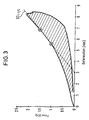
- FIG. 3 the deformation behavior of a viscous polymer composition is shown. Said deformation behavior is obtained with the device of Figure 2b and with a force profile "heel" in Figure 2a, wherein the abscesses shows the deformation measured with device 6 depending on the force field applied with stamp 7. Said Figure shows that the viscous polymer composition according to the present invention which is preferably used in the heel area shows a strong hysterese behavior.
- the force according to the force profile "heel” as shown in Figure 2a a deformation is obtained which relaxes slowly and with a significant lower counter force on stamp 8a.
- Said energy loss can be obtained graphical or numerical and is shown by the hatched area in the diagram.
- the diagram shows a significant part of the energy applied to the viscous polymer composition according to the present invention is changed into heat and is not available any more in the material when this relaxes to its original form.
- the diagram from Figure 3 shows besides the energy loss a further parameter which is important for the present invention, i.e. the dynamic stiffness (DS) of the tested materials.
- the dynamic stiffens is defined as the ratio between the applied force F (N) and the resulting movement d (mm).
- F (N) the applied force
- d the resulting movement
- the dynamic stiffness is according to the present invention of interest of a sole unit which is a layer assemble (i.e. a plurality of layers from different materials).
- a layer assemble i.e. a plurality of layers from different materials.
- Said assemblies show the above described effect according to the present invention only if the stiffness of the function layer is not higher than the stiffness of the materials of which the layers are made.
- Figure 4 shows the behavior of a preferred elastic material.
- the elastic material only shows a weak histerese behavior and thus only a very small energy loss. The material relaxes almost simultaneously when the force is reduced, wherein almost all the energy provided by force stamp 8b is released.
- the value for a dynamic stiffness between 1500 N and 1000 N is shown (the corresponding value for the dynamic stiffness between 400 N and 200 N is again not shown).
- the dynamic stiffness of the elastic material between 1000 N and 1500 N should be less than 450 N/mm and the dynamic stiffness for the viscous polymer composition should be less than 200 N/mm.
- the dynamic stiffness of the elastic materials between 1000 N and 1500 N should be less than 600 N/mm and between 200 N and 400 N less than 300 N/mm.
- the dynamical stiffness of the viscous polymer composition between 1000 N and 1500 N should be less than 250 N/mm and between 200N and 400N less than 130 N/mm.
- Figures 5 and 6 show preferred embodiments of soles according to the present invention.
- Figure 5 is a horizontal cut through a sole according to the present invention.
- a running sole 50 of a shoe 10 shown which is divided in a front foot area 60 and a heel area 80.
- the sole 50 itself can be a plurality of single layers as it is usually the case for sport shoes.
- the sole can consist in an outer sole 55 and a middle sole 59 and not shown in a sole (compare Figure 6a).
- a function layer 57 there is between the outer sole 55 and the middle sole 59 a function layer 57.
- Said function layer 57 can be divided in two horizontal areas, i.e. the front foot area 60 with elastic material and the heel area 80 with the viscous polymer composition. Between said two horizontal areas there can be a transition area 70. The front foot area 60 and the heel area 80 can also be in contact.
- first function layer in the front foot area comprises the elastic material and the second function layer in the heel layer comprises the viscous polymer composition.
- the functional layer 57 can extend a little bit or a lot towards middle sole 59 (Figure 6a). This depends on the application of the sport shoes. In cases, where the probability of the laterally hitting the ground is high (sports with jumps) the embodiment according to Figure 6b is preferred. However, the embodiment according to Figure 6a is for example applied to running shoes.
Landscapes
- Chemical & Material Sciences (AREA)
- Health & Medical Sciences (AREA)
- Chemical Kinetics & Catalysis (AREA)
- Medicinal Chemistry (AREA)
- Polymers & Plastics (AREA)
- Organic Chemistry (AREA)
- Engineering & Computer Science (AREA)
- Materials Engineering (AREA)
- Compositions Of Macromolecular Compounds (AREA)
- Footwear And Its Accessory, Manufacturing Method And Apparatuses (AREA)
- Addition Polymer Or Copolymer, Post-Treatments, Or Chemical Modifications (AREA)
- Polyoxymethylene Polymers And Polymers With Carbon-To-Carbon Bonds (AREA)
Claims (9)
- Viskosekunststoffzusammensetzung, aufweisend eine KomponenteD) eines Bromin aufweisenden Polymers D, erhältlich aus zumindest einem C4 - bis C10-Dien; und zumindest einem Bromin; und zumindest eine der Komponenten:A) ein Polymer A, erhältlich aus zumindest einemA1) C4- bis C10-Dien als Monomer A1 undA2) vinylaromatisches C8 - bis C20-Monomer als ein Monomer A2;wobei das Polymer A ein Block-Copolymer ist, und wobei im Polymer A ein Block, erhältlich aus dem Monomer A1, umgeben ist von den Blöcken von Polymer A2;
oderB) ein Polymer B, erhältlich aus zumindestB1) C2 - bis C20-Olefin als ein Monomer B 1 undB2) ein Monomer aus einem C2 - bis C10-Vinylalkohol and C2 - bis C10-Karbonsäure als Monomer B2;wahlweiseC) ein Polymer C, erhältlich aus zumindest einem vinylaromatischen Monomer; undE) ein Füller. - Kunststoffzusammensetzung nach Anspruch 1, aufweisend als Komponente:A) 0 bis 99.9 Gew.-% Polymer A,B) 0 bis 99.9 Gew.-% Polymer B,C) 0 bis 99.9 Gew.-% Polymer C,D) 5 bis 50 Gew.-% Polymer D,E) 0 bis 40 Gew.-% Füller als Komponente E,wobei die Summe von Komponente A bis E 100 Gew.-% ergibt, wobei die Kunststoffzusammensetzung immer mindestens eine der zwei Komponenten A and B enthält und falls sie A oder B enthält, enthält sie mindestens eine weitere Komponente C bis E.
- Kunststoffzusammensetzung nach einem der Ansprüche 1 bis 2, wobei E eine Silizium-Sauerstoff-Mischung ist.
- Verfahren zum Herstellen einer Kunststoffzusammensetzung, wobei die Komponenten, die in einem der Ansprüche 1 bis 3 definiert sind, miteinander in Kontakt gebracht werden.
- Kunststoffzusammensetzung, erhältlich durch zueinander in Kontakt bringen der Komponenten, die in einem der Ansprüche 1 bis 3 definiert sind.
- Kunststoffzusammensetzung nach einem der Ansprüche 1 bis 3 und 5, mit mindestens einer der folgenden Eigenschaften:a) Energieverlust im Bereich von 50 bis 80%,b) Steifigkeit bei 200 N bis 400 N im Bereich von 80 bis 150 N/mm,c) Steifigkeit bei 1000 N to 1500 N im Bereich von 100 bis 400 N/mm,d) spezifisches Gewicht im Bereich von 0.3 bis 0.8 g/cm3,e) Elastizität im Bereich von 1 bis 30%.
- Verbundwerkstoff, aufweisend:V1) eine Kunststoffzusammensetzung nach einem der Ansprüche 1 bis 3, 5 und 6;
undV2) ein elastisches Material mit zumindest einer der folgenden Eigenschaften:α) Energieverlust < 50%,β) Steifigkeit bei 200 N bis 400 N im Bereich von > 150 bis 300 N/mm,γ) Steifigkeit bei 1000 N bis 1500 N im Bereich von > 400 bis 700 N/mm,δ) spezifisches Gewicht im Bereich von 0.1 bis <0.3 g/cm3,ε) Elastizität im Bereich von > 30 bis 75 %. - Körper, insbesondere Schuhsohlen, aufweisend eine Kunststoffzusammensetzung nach einem der Ansprüche 1 bis 3, 5 und 6 oder einem Verbundwerkstoff entsprechend Anspruch 7.
- Verwendung einer Kunststoffzusammensetzung nach einem der Ansprüche 1 bis 3, 5 und 6 oder eines Verbundwerkstoffs nach Anspruch 7 zum Herstellen von Körpern, insbesondere Schuhsohlen.
Applications Claiming Priority (3)
| Application Number | Priority Date | Filing Date | Title |
|---|---|---|---|
| DE10010182A DE10010182B4 (de) | 2000-03-02 | 2000-03-02 | Verwendung von viskosen Kunststoffzusammensetzungen, insbesondere zur Herstellung von Schuhsolen |
| DE10010182 | 2000-03-02 | ||
| PCT/EP2001/002403 WO2001064787A1 (en) | 2000-03-02 | 2001-03-02 | Polymer composition |
Publications (2)
| Publication Number | Publication Date |
|---|---|
| EP1268663A1 EP1268663A1 (de) | 2003-01-02 |
| EP1268663B1 true EP1268663B1 (de) | 2006-08-16 |
Family
ID=7633243
Family Applications (1)
| Application Number | Title | Priority Date | Filing Date |
|---|---|---|---|
| EP01911724A Expired - Lifetime EP1268663B1 (de) | 2000-03-02 | 2001-03-02 | Polymer-masse |
Country Status (6)
| Country | Link |
|---|---|
| US (1) | US20050065270A1 (de) |
| EP (1) | EP1268663B1 (de) |
| JP (1) | JP2003525334A (de) |
| AT (1) | ATE336549T1 (de) |
| DE (2) | DE10010182B4 (de) |
| WO (1) | WO2001064787A1 (de) |
Cited By (1)
| Publication number | Priority date | Publication date | Assignee | Title |
|---|---|---|---|---|
| DE102012013335A1 (de) | 2012-07-06 | 2014-01-23 | Swissies AG | Schuh mit erhöhtem Tragekomfort und dreidimensionaler Bewegungfreiheit |
Families Citing this family (22)
| Publication number | Priority date | Publication date | Assignee | Title |
|---|---|---|---|---|
| DE102012206094B4 (de) * | 2012-04-13 | 2019-12-05 | Adidas Ag | Sohlen für Sportschuhe, Schuhe und Verfahren zur Herstellung einer Schuhsohle |
| DE102013202306B4 (de) | 2013-02-13 | 2014-12-18 | Adidas Ag | Sohle für einen Schuh |
| US9930928B2 (en) | 2013-02-13 | 2018-04-03 | Adidas Ag | Sole for a shoe |
| DE102013202291C5 (de) | 2013-02-13 | 2026-01-15 | Adidas Ag | Dämpfungselement für Sportbekleidung und Schuh mit einem solchen Dämpfungselement |
| US9610746B2 (en) | 2013-02-13 | 2017-04-04 | Adidas Ag | Methods for manufacturing cushioning elements for sports apparel |
| DE102013002519B4 (de) | 2013-02-13 | 2016-08-18 | Adidas Ag | Herstellungsverfahren für Dämpfungselemente für Sportbekleidung |
| USD740004S1 (en) | 2013-04-12 | 2015-10-06 | Adidas Ag | Shoe |
| USD776410S1 (en) | 2013-04-12 | 2017-01-17 | Adidas Ag | Shoe |
| DE102014215897B4 (de) | 2014-08-11 | 2016-12-22 | Adidas Ag | adistar boost |
| DE102014216115B4 (de) | 2014-08-13 | 2022-03-31 | Adidas Ag | Gemeinsam gegossene 3D Elemente |
| DE102015206486B4 (de) | 2015-04-10 | 2023-06-01 | Adidas Ag | Schuh, insbesondere Sportschuh, und Verfahren zur Herstellung desselben |
| DE102015206900B4 (de) | 2015-04-16 | 2023-07-27 | Adidas Ag | Sportschuh |
| DE102015209795B4 (de) | 2015-05-28 | 2024-03-21 | Adidas Ag | Ball und Verfahren zu dessen Herstellung |
| USD783264S1 (en) | 2015-09-15 | 2017-04-11 | Adidas Ag | Shoe |
| US10206453B2 (en) | 2016-02-12 | 2019-02-19 | Wolverine Outdoors, Inc. | Footwear including a support cage |
| USD840137S1 (en) | 2016-08-03 | 2019-02-12 | Adidas Ag | Shoe midsole |
| USD840136S1 (en) | 2016-08-03 | 2019-02-12 | Adidas Ag | Shoe midsole |
| USD852475S1 (en) | 2016-08-17 | 2019-07-02 | Adidas Ag | Shoe |
| JP1582717S (de) | 2016-09-02 | 2017-07-31 | ||
| USD899061S1 (en) | 2017-10-05 | 2020-10-20 | Adidas Ag | Shoe |
| US10834998B2 (en) | 2018-04-13 | 2020-11-17 | Wolverine Outdoors, Inc. | Footwear including a holding cage |
| DE102019204579B4 (de) | 2019-04-01 | 2022-10-06 | Adidas Ag | Recycling eines Schuhs |
Citations (2)
| Publication number | Priority date | Publication date | Assignee | Title |
|---|---|---|---|---|
| US4546127A (en) * | 1982-04-13 | 1985-10-08 | Bridgestone Tire Co., Ltd. | Low-resilience rubber compositions and foams |
| US4616065A (en) * | 1985-04-15 | 1986-10-07 | Gencorp Inc. | High trans butadiene based elastomeric block copolymers and blends |
Family Cites Families (39)
| Publication number | Priority date | Publication date | Assignee | Title |
|---|---|---|---|---|
| US3576911A (en) * | 1969-03-27 | 1971-04-27 | Goodyear Tire & Rubber | Shoe sole compound |
| JPS53137242A (en) * | 1977-05-09 | 1978-11-30 | Denki Kagaku Kogyo Kk | Sealing film |
| US4238383A (en) * | 1978-10-05 | 1980-12-09 | The Goodyear Tire & Rubber Company | Vulcanizable shoe soling composition |
| US4208315A (en) * | 1979-02-01 | 1980-06-17 | Shell Oil Company | Footwear composition of a blend of ethylene-vinyl acetate copolymer, poly(vinyl chloride) and a block copolymer |
| US4316335A (en) * | 1979-04-05 | 1982-02-23 | Comfort Products, Inc. | Athletic shoe construction |
| US4216131A (en) * | 1979-05-04 | 1980-08-05 | Shell Oil Company | Smooth-look footwear composition |
| US4316334A (en) * | 1980-03-27 | 1982-02-23 | Hunt Helen M | Athletic shoe including stiffening means for supporting the rear portion of the first metatarsal bone |
| JPS57119942A (en) * | 1981-01-17 | 1982-07-26 | Idemitsu Kosan Co Ltd | Resilient polymer composition |
| US4418483A (en) * | 1981-03-31 | 1983-12-06 | Rinzai Co., Ltd. | Method of manufacturing shoe sole material and shoes products made by the same |
| JPS57212249A (en) * | 1981-06-23 | 1982-12-27 | Japan Synthetic Rubber Co Ltd | Thermoplastic elastomeric composition |
| US4506462A (en) * | 1982-06-11 | 1985-03-26 | Puma-Sportschuhfabriken Rudolf Dassler Kg | Running shoe sole with pronation limiting heel |
| US4476180A (en) * | 1983-02-01 | 1984-10-09 | The Procter & Gamble Company | Nonblocking elastomeric polymer blends of ABA block copolymer and ethylene-vinyl acetate copolymer |
| US4910886B1 (en) * | 1983-02-28 | 1995-05-09 | Atlantic Thermoplastics Co Inc | Shock-absorbing innersole |
| US4551930A (en) * | 1983-09-23 | 1985-11-12 | New Balance Athletic Shoe, Inc. | Sole construction for footwear |
| JPS60150701A (ja) * | 1984-01-17 | 1985-08-08 | 株式会社アシックス | 運動シユ−ズ用ミツドソ−ル |
| DE3564756D1 (en) * | 1984-04-04 | 1988-10-13 | Hi Tec Sports Ltd | Improvements in or relating to running shoes |
| US4597195A (en) * | 1984-04-11 | 1986-07-01 | Dananberg Howard J | Human shoe sole |
| US4882378A (en) * | 1984-11-30 | 1989-11-21 | Shell Oil Company | High performance rubber compositions |
| US4642911A (en) * | 1985-02-28 | 1987-02-17 | Talarico Ii Louis C | Dual-compression forefoot compensated footwear |
| US4694591A (en) * | 1985-04-15 | 1987-09-22 | Wolverine World Wide, Inc. | Toe off athletic shoe |
| US4731939A (en) * | 1985-04-24 | 1988-03-22 | Converse Inc. | Athletic shoe with external counter and cushion assembly |
| US4640797A (en) * | 1985-06-11 | 1987-02-03 | Jones And Vining, Incorporated | Phosphorescent polymer-containing compositions and articles made therefrom |
| JPH072889B2 (ja) * | 1986-06-20 | 1995-01-18 | 日本エラストマ−株式会社 | 熱可塑性弾性体組成物 |
| JPS638450A (ja) * | 1986-06-27 | 1988-01-14 | Japan Synthetic Rubber Co Ltd | 熱可塑性エラストマ−組成物 |
| US4759136A (en) * | 1987-02-06 | 1988-07-26 | Reebok International Ltd. | Athletic shoe with dynamic cradle |
| US5053438A (en) * | 1987-05-15 | 1991-10-01 | Packaging Industries Group, Inc. | Foam material |
| EP0593441B1 (de) * | 1989-10-03 | 2001-01-03 | Anatomic Research, Inc. | Korrigierende schuhsohlenstrukturen mit die theoretisch ideale stabilitätsfläche übersteigendem umriss |
| US5467536A (en) * | 1991-05-24 | 1995-11-21 | Ramer; John | Shoe construction |
| US5276094A (en) * | 1992-11-12 | 1994-01-04 | Polysar Rubber Corp. | Compositions of butyl elastomers and block copolymers of polyisobutylene |
| US5695850A (en) * | 1993-01-29 | 1997-12-09 | Crow; William R. | Performance enhancing athletic shoe components and methods |
| DE4446896A1 (de) * | 1994-12-27 | 1996-07-04 | Basf Ag | Schlagzähne, thermoplastisch verarbeitbare Mischung aus Elastomeren und Thermoplasten |
| KR100394129B1 (ko) * | 1995-03-17 | 2003-10-22 | 제온 코포레이션 | 고무조성물 |
| EP0818478B1 (de) * | 1995-03-30 | 2004-08-11 | Zeon Corporation | Styrol-isopren-butadien-copolymer-kautschuk und verfahren zu dessen herstellung |
| JP3622803B2 (ja) * | 1995-11-28 | 2005-02-23 | 日本ゼオン株式会社 | ゴム組成物 |
| GB2318757B (en) * | 1996-11-01 | 2000-07-12 | Univ Brunel | Moulding process and article produced by the process |
| JP3567661B2 (ja) * | 1996-12-27 | 2004-09-22 | Jsr株式会社 | 動的架橋組成物および熱可塑性エラストマー組成物 |
| EP0904706A1 (de) * | 1997-09-29 | 1999-03-31 | William R. Crow | Leistungsverbessernde Athletikschuhelemente und Methoden |
| ATE214241T1 (de) * | 1998-04-03 | 2002-03-15 | Adidas Int Bv | Schuhsohle mit doppelsystem zur energiebeeinflussung |
| JP4382935B2 (ja) * | 1999-11-02 | 2009-12-16 | アキレス株式会社 | 射出成形発泡靴底用組成物 |
-
2000
- 2000-03-02 DE DE10010182A patent/DE10010182B4/de not_active Expired - Lifetime
-
2001
- 2001-03-02 EP EP01911724A patent/EP1268663B1/de not_active Expired - Lifetime
- 2001-03-02 DE DE60122302T patent/DE60122302T2/de not_active Expired - Lifetime
- 2001-03-02 AT AT01911724T patent/ATE336549T1/de not_active IP Right Cessation
- 2001-03-02 US US10/204,800 patent/US20050065270A1/en not_active Abandoned
- 2001-03-02 WO PCT/EP2001/002403 patent/WO2001064787A1/en not_active Ceased
- 2001-03-02 JP JP2001564278A patent/JP2003525334A/ja active Pending
Patent Citations (2)
| Publication number | Priority date | Publication date | Assignee | Title |
|---|---|---|---|---|
| US4546127A (en) * | 1982-04-13 | 1985-10-08 | Bridgestone Tire Co., Ltd. | Low-resilience rubber compositions and foams |
| US4616065A (en) * | 1985-04-15 | 1986-10-07 | Gencorp Inc. | High trans butadiene based elastomeric block copolymers and blends |
Cited By (1)
| Publication number | Priority date | Publication date | Assignee | Title |
|---|---|---|---|---|
| DE102012013335A1 (de) | 2012-07-06 | 2014-01-23 | Swissies AG | Schuh mit erhöhtem Tragekomfort und dreidimensionaler Bewegungfreiheit |
Also Published As
| Publication number | Publication date |
|---|---|
| EP1268663A1 (de) | 2003-01-02 |
| DE10010182B4 (de) | 2010-01-14 |
| DE10010182A1 (de) | 2001-09-13 |
| WO2001064787A1 (en) | 2001-09-07 |
| JP2003525334A (ja) | 2003-08-26 |
| US20050065270A1 (en) | 2005-03-24 |
| DE60122302T2 (de) | 2007-08-30 |
| ATE336549T1 (de) | 2006-09-15 |
| DE60122302D1 (de) | 2006-09-28 |
Similar Documents
| Publication | Publication Date | Title |
|---|---|---|
| EP1268663B1 (de) | Polymer-masse | |
| EP0934009B1 (de) | Bodenkontaktsystem mit sich 3d-verformbaren elementen zur anwendung in schuhwerk | |
| US6335392B1 (en) | Outsole of shoes | |
| EP0947145B1 (de) | Schuhsohle mit Doppelsystem zur Energiebeeinflussung | |
| CN105167320A (zh) | 具有轻重量鞋底部件的鞋制品 | |
| EP1188789B8 (de) | Mit öl gestreckter kautschuk, verfahren zu seiner herstellung, kautschukzusammensetzung und vernetzter gegenstand | |
| EP1975199A4 (de) | Kautschukzusammensetzung und damit hergestellte luftreifen | |
| WO2008083451A1 (en) | Polymer composition, microporous rubber-like foamed vulcanizate, and microporous rubber-like foamed shoe sole | |
| Auroy et al. | Hardness and shock absorption of silicone rubber for mouth guards | |
| EP1852447A4 (de) | Nitrilcopolymerkautschuk und vulkanisierbare nitrilcopolymerkautschukzusammensetzung | |
| WO2017160876A1 (en) | Foam compositions and uses thereof | |
| JP3100592B2 (ja) | 靴のアウトソール | |
| US20240052143A1 (en) | Polychloroprene latex composition | |
| JP2957480B2 (ja) | 靴のアウトソール | |
| Wang | Effects of Running Shoes with Abrasion Resistant Rubber Sole on the Exercise Capacity of the Human Body. | |
| JP3333432B2 (ja) | 靴用緩衝部材及び該靴用緩衝部材を用いた靴 | |
| JP3262661B2 (ja) | 靴 | |
| JPS6395213A (ja) | 低硬度高強度で低反撥弾性のゴム組成物 | |
| Wang | Djelovanje tenisica s abrazivno otpornim gumenim potplatima na vježbanje | |
| JPH07177901A (ja) | シューズ | |
| KR100508983B1 (ko) | 충격흡수량 조절이 가능한 충격흡수재 | |
| JPH11318508A (ja) | 改善された二重エネルギ―処理システムを有する靴底 | |
| KR100390049B1 (ko) | 신발 밑창의 고무 스파이크 핀용 고무 조성물 | |
| KR19990061307A (ko) | 충격흡수재 및 그 제조방법 | |
| JPH05311005A (ja) | 改良エラストマーとそれを利用した中底および履物 |
Legal Events
| Date | Code | Title | Description |
|---|---|---|---|
| PUAI | Public reference made under article 153(3) epc to a published international application that has entered the european phase |
Free format text: ORIGINAL CODE: 0009012 |
|
| 17P | Request for examination filed |
Effective date: 20020927 |
|
| AK | Designated contracting states |
Kind code of ref document: A1 Designated state(s): AT BE CH CY DE DK ES FI FR GB GR IE IT LI LU MC NL PT SE TR |
|
| AX | Request for extension of the european patent |
Free format text: AL;LT;LV;MK;RO;SI |
|
| RAP1 | Party data changed (applicant data changed or rights of an application transferred) |
Owner name: ADIDAS INTERNATIONAL MARKETING B.V. |
|
| 17Q | First examination report despatched |
Effective date: 20040922 |
|
| GRAP | Despatch of communication of intention to grant a patent |
Free format text: ORIGINAL CODE: EPIDOSNIGR1 |
|
| GRAJ | Information related to disapproval of communication of intention to grant by the applicant or resumption of examination proceedings by the epo deleted |
Free format text: ORIGINAL CODE: EPIDOSDIGR1 |
|
| GRAP | Despatch of communication of intention to grant a patent |
Free format text: ORIGINAL CODE: EPIDOSNIGR1 |
|
| GRAS | Grant fee paid |
Free format text: ORIGINAL CODE: EPIDOSNIGR3 |
|
| GRAJ | Information related to disapproval of communication of intention to grant by the applicant or resumption of examination proceedings by the epo deleted |
Free format text: ORIGINAL CODE: EPIDOSDIGR1 |
|
| GRAP | Despatch of communication of intention to grant a patent |
Free format text: ORIGINAL CODE: EPIDOSNIGR1 |
|
| GRAS | Grant fee paid |
Free format text: ORIGINAL CODE: EPIDOSNIGR3 |
|
| GRAA | (expected) grant |
Free format text: ORIGINAL CODE: 0009210 |
|
| AK | Designated contracting states |
Kind code of ref document: B1 Designated state(s): AT BE CH CY DE DK ES FI FR GB GR IE IT LI LU MC NL PT SE TR |
|
| PG25 | Lapsed in a contracting state [announced via postgrant information from national office to epo] |
Ref country code: IT Free format text: LAPSE BECAUSE OF FAILURE TO SUBMIT A TRANSLATION OF THE DESCRIPTION OR TO PAY THE FEE WITHIN THE PRE;WARNING: LAPSES OF ITALIAN PATENTS WITH EFFECTIVE DATE BEFORE 2007 MAY HAVE OCCURRED AT ANY TIME BEFORE 2007. THE CORRECT EFFECTIVE DATE MAY BE DIFFERENT FROM THE ONE RECORDED.SCRIBED TIME-LIMIT Effective date: 20060816 Ref country code: BE Free format text: LAPSE BECAUSE OF FAILURE TO SUBMIT A TRANSLATION OF THE DESCRIPTION OR TO PAY THE FEE WITHIN THE PRESCRIBED TIME-LIMIT Effective date: 20060816 Ref country code: LI Free format text: LAPSE BECAUSE OF FAILURE TO SUBMIT A TRANSLATION OF THE DESCRIPTION OR TO PAY THE FEE WITHIN THE PRESCRIBED TIME-LIMIT Effective date: 20060816 Ref country code: AT Free format text: LAPSE BECAUSE OF FAILURE TO SUBMIT A TRANSLATION OF THE DESCRIPTION OR TO PAY THE FEE WITHIN THE PRESCRIBED TIME-LIMIT Effective date: 20060816 Ref country code: NL Free format text: LAPSE BECAUSE OF FAILURE TO SUBMIT A TRANSLATION OF THE DESCRIPTION OR TO PAY THE FEE WITHIN THE PRESCRIBED TIME-LIMIT Effective date: 20060816 Ref country code: CH Free format text: LAPSE BECAUSE OF FAILURE TO SUBMIT A TRANSLATION OF THE DESCRIPTION OR TO PAY THE FEE WITHIN THE PRESCRIBED TIME-LIMIT Effective date: 20060816 Ref country code: FI Free format text: LAPSE BECAUSE OF FAILURE TO SUBMIT A TRANSLATION OF THE DESCRIPTION OR TO PAY THE FEE WITHIN THE PRESCRIBED TIME-LIMIT Effective date: 20060816 |
|
| REG | Reference to a national code |
Ref country code: GB Ref legal event code: FG4D |
|
| REG | Reference to a national code |
Ref country code: CH Ref legal event code: EP |
|
| REG | Reference to a national code |
Ref country code: IE Ref legal event code: FG4D |
|
| REF | Corresponds to: |
Ref document number: 60122302 Country of ref document: DE Date of ref document: 20060928 Kind code of ref document: P |
|
| PG25 | Lapsed in a contracting state [announced via postgrant information from national office to epo] |
Ref country code: SE Free format text: LAPSE BECAUSE OF FAILURE TO SUBMIT A TRANSLATION OF THE DESCRIPTION OR TO PAY THE FEE WITHIN THE PRESCRIBED TIME-LIMIT Effective date: 20061116 Ref country code: DK Free format text: LAPSE BECAUSE OF FAILURE TO SUBMIT A TRANSLATION OF THE DESCRIPTION OR TO PAY THE FEE WITHIN THE PRESCRIBED TIME-LIMIT Effective date: 20061116 |
|
| PG25 | Lapsed in a contracting state [announced via postgrant information from national office to epo] |
Ref country code: ES Free format text: LAPSE BECAUSE OF FAILURE TO SUBMIT A TRANSLATION OF THE DESCRIPTION OR TO PAY THE FEE WITHIN THE PRESCRIBED TIME-LIMIT Effective date: 20061127 |
|
| PG25 | Lapsed in a contracting state [announced via postgrant information from national office to epo] |
Ref country code: PT Free format text: LAPSE BECAUSE OF FAILURE TO SUBMIT A TRANSLATION OF THE DESCRIPTION OR TO PAY THE FEE WITHIN THE PRESCRIBED TIME-LIMIT Effective date: 20070116 |
|
| NLV1 | Nl: lapsed or annulled due to failure to fulfill the requirements of art. 29p and 29m of the patents act | ||
| REG | Reference to a national code |
Ref country code: CH Ref legal event code: PL |
|
| ET | Fr: translation filed | ||
| PLBE | No opposition filed within time limit |
Free format text: ORIGINAL CODE: 0009261 |
|
| STAA | Information on the status of an ep patent application or granted ep patent |
Free format text: STATUS: NO OPPOSITION FILED WITHIN TIME LIMIT |
|
| 26N | No opposition filed |
Effective date: 20070518 |
|
| PG25 | Lapsed in a contracting state [announced via postgrant information from national office to epo] |
Ref country code: MC Free format text: LAPSE BECAUSE OF NON-PAYMENT OF DUE FEES Effective date: 20070331 Ref country code: IE Free format text: LAPSE BECAUSE OF NON-PAYMENT OF DUE FEES Effective date: 20070302 |
|
| PG25 | Lapsed in a contracting state [announced via postgrant information from national office to epo] |
Ref country code: GR Free format text: LAPSE BECAUSE OF FAILURE TO SUBMIT A TRANSLATION OF THE DESCRIPTION OR TO PAY THE FEE WITHIN THE PRESCRIBED TIME-LIMIT Effective date: 20061117 |
|
| PG25 | Lapsed in a contracting state [announced via postgrant information from national office to epo] |
Ref country code: LU Free format text: LAPSE BECAUSE OF NON-PAYMENT OF DUE FEES Effective date: 20070302 Ref country code: CY Free format text: LAPSE BECAUSE OF FAILURE TO SUBMIT A TRANSLATION OF THE DESCRIPTION OR TO PAY THE FEE WITHIN THE PRESCRIBED TIME-LIMIT Effective date: 20060816 |
|
| PG25 | Lapsed in a contracting state [announced via postgrant information from national office to epo] |
Ref country code: TR Free format text: LAPSE BECAUSE OF FAILURE TO SUBMIT A TRANSLATION OF THE DESCRIPTION OR TO PAY THE FEE WITHIN THE PRESCRIBED TIME-LIMIT Effective date: 20060816 |
|
| REG | Reference to a national code |
Ref country code: FR Ref legal event code: PLFP Year of fee payment: 16 |
|
| REG | Reference to a national code |
Ref country code: FR Ref legal event code: PLFP Year of fee payment: 17 |
|
| REG | Reference to a national code |
Ref country code: FR Ref legal event code: PLFP Year of fee payment: 18 |
|
| PGFP | Annual fee paid to national office [announced via postgrant information from national office to epo] |
Ref country code: GB Payment date: 20190313 Year of fee payment: 19 Ref country code: FR Payment date: 20190313 Year of fee payment: 19 Ref country code: DE Payment date: 20190314 Year of fee payment: 19 |
|
| REG | Reference to a national code |
Ref country code: DE Ref legal event code: R119 Ref document number: 60122302 Country of ref document: DE |
|
| PG25 | Lapsed in a contracting state [announced via postgrant information from national office to epo] |
Ref country code: DE Free format text: LAPSE BECAUSE OF NON-PAYMENT OF DUE FEES Effective date: 20201001 |
|
| GBPC | Gb: european patent ceased through non-payment of renewal fee |
Effective date: 20200302 |
|
| PG25 | Lapsed in a contracting state [announced via postgrant information from national office to epo] |
Ref country code: GB Free format text: LAPSE BECAUSE OF NON-PAYMENT OF DUE FEES Effective date: 20200302 |
|
| PG25 | Lapsed in a contracting state [announced via postgrant information from national office to epo] |
Ref country code: FR Free format text: LAPSE BECAUSE OF NON-PAYMENT OF DUE FEES Effective date: 20200331 |