EP1270128A2 - Vorrichtung und Verfahren zum Funkenerosiven Bearbeiten - Google Patents
Vorrichtung und Verfahren zum Funkenerosiven Bearbeiten Download PDFInfo
- Publication number
- EP1270128A2 EP1270128A2 EP20020253336 EP02253336A EP1270128A2 EP 1270128 A2 EP1270128 A2 EP 1270128A2 EP 20020253336 EP20020253336 EP 20020253336 EP 02253336 A EP02253336 A EP 02253336A EP 1270128 A2 EP1270128 A2 EP 1270128A2
- Authority
- EP
- European Patent Office
- Prior art keywords
- electrode
- electrical discharge
- discharge machining
- workpiece
- work stations
- Prior art date
- Legal status (The legal status is an assumption and is not a legal conclusion. Google has not performed a legal analysis and makes no representation as to the accuracy of the status listed.)
- Granted
Links
- 238000009760 electrical discharge machining Methods 0.000 title claims abstract description 109
- 238000000034 method Methods 0.000 title claims description 8
- 238000003754 machining Methods 0.000 claims description 67
- 239000012530 fluid Substances 0.000 description 13
- 239000000463 material Substances 0.000 description 5
- 238000001914 filtration Methods 0.000 description 4
- 230000001960 triggered effect Effects 0.000 description 4
- 238000006073 displacement reaction Methods 0.000 description 3
- 238000011068 loading method Methods 0.000 description 3
- 230000002028 premature Effects 0.000 description 3
- 238000005266 casting Methods 0.000 description 2
- 238000004519 manufacturing process Methods 0.000 description 2
- 238000005259 measurement Methods 0.000 description 2
- 229910001369 Brass Inorganic materials 0.000 description 1
- OKTJSMMVPCPJKN-UHFFFAOYSA-N Carbon Chemical compound [C] OKTJSMMVPCPJKN-UHFFFAOYSA-N 0.000 description 1
- RYGMFSIKBFXOCR-UHFFFAOYSA-N Copper Chemical compound [Cu] RYGMFSIKBFXOCR-UHFFFAOYSA-N 0.000 description 1
- 239000010951 brass Substances 0.000 description 1
- 239000000567 combustion gas Substances 0.000 description 1
- 238000001816 cooling Methods 0.000 description 1
- 239000010949 copper Substances 0.000 description 1
- 229910052802 copper Inorganic materials 0.000 description 1
- SBYXRAKIOMOBFF-UHFFFAOYSA-N copper tungsten Chemical compound [Cu].[W] SBYXRAKIOMOBFF-UHFFFAOYSA-N 0.000 description 1
- 238000005520 cutting process Methods 0.000 description 1
- 239000007772 electrode material Substances 0.000 description 1
- 238000011010 flushing procedure Methods 0.000 description 1
- 229910002804 graphite Inorganic materials 0.000 description 1
- 239000010439 graphite Substances 0.000 description 1
- 230000005484 gravity Effects 0.000 description 1
- 238000009413 insulation Methods 0.000 description 1
- 238000002955 isolation Methods 0.000 description 1
- 239000000155 melt Substances 0.000 description 1
- 239000002245 particle Substances 0.000 description 1
- 230000001681 protective effect Effects 0.000 description 1
- 238000013024 troubleshooting Methods 0.000 description 1
- 238000007514 turning Methods 0.000 description 1
Images


Classifications
-
- B—PERFORMING OPERATIONS; TRANSPORTING
- B23—MACHINE TOOLS; METAL-WORKING NOT OTHERWISE PROVIDED FOR
- B23H—WORKING OF METAL BY THE ACTION OF A HIGH CONCENTRATION OF ELECTRIC CURRENT ON A WORKPIECE USING AN ELECTRODE WHICH TAKES THE PLACE OF A TOOL; SUCH WORKING COMBINED WITH OTHER FORMS OF WORKING OF METAL
- B23H1/00—Electrical discharge machining, i.e. removing metal with a series of rapidly recurring electrical discharges between an electrode and a workpiece in the presence of a fluid dielectric
-
- B—PERFORMING OPERATIONS; TRANSPORTING
- B23—MACHINE TOOLS; METAL-WORKING NOT OTHERWISE PROVIDED FOR
- B23H—WORKING OF METAL BY THE ACTION OF A HIGH CONCENTRATION OF ELECTRIC CURRENT ON A WORKPIECE USING AN ELECTRODE WHICH TAKES THE PLACE OF A TOOL; SUCH WORKING COMBINED WITH OTHER FORMS OF WORKING OF METAL
- B23H1/00—Electrical discharge machining, i.e. removing metal with a series of rapidly recurring electrical discharges between an electrode and a workpiece in the presence of a fluid dielectric
- B23H1/02—Electric circuits specially adapted therefor, e.g. power supply, control, preventing short circuits or other abnormal discharges
- B23H1/028—Electric circuits specially adapted therefor, e.g. power supply, control, preventing short circuits or other abnormal discharges for multiple gap machining
Definitions
- This invention relates generally to electrical discharge machining and more particularly to electrical discharge machining workpieces, such as aircraft engine parts, which have several features machined therein.
- EDM Electrical discharge machining
- CNC computer numerically controlled
- One drawback to electrical discharge machining is that it is a relatively slow process, especially when several distinct features need to be machined into a workpiece. This is particularly so in the aircraft engine industry where electrical discharge machining is widely used for machining various features into aircraft engine parts.
- an EDM apparatus that machines a number of parts at one time.
- Such an apparatus has a plurality of work stations, each of which has a workpiece fixture located in a single dielectric tank. The work stations are all typically connected to a common power supply.
- machining takes place in series one part at a time. That is, a spark will be created in the first work station and then the next work station and so on until each station has a spark supplied. This sequence is repeated until the machining operation is completed for each workpiece.
- a problem with this type of apparatus is that is whenever one station gets hung up (i.e., fails to discharge for some reason such as electrode misalignment or a EDM particle remaining in the electrode-workpiece gap) all of the stations will become hung up. And since all stations are stopped, it is not evident which station is causing the stoppage. Furthermore, each station must use the same electrode material and polarity because of the series power connection. Thus, each station machines the same feature into the parts. Parts requiring additional features must then be moved to another machine. This means that multiple machines, fixtures and part handling are required before a part is completed. Another inefficiency with these conventional EDM apparatuses is that the dielectric tank must be drained and refilled between each cycle to load and unload the parts because the workpiece fixtures are all located and submerged in the tank.
- the above-mentioned need is met by the present invention, which provides an electrical discharge machining apparatus having a plurality of work stations, where each work station includes at least one electrode.
- the apparatus further includes one or more power supplies and a power transfer switch for alternately supplying power to various sets of the electrodes.
- the power transfer switch has a first state wherein each power supply is connected to a corresponding first electrode in one of the work stations and a second state wherein each power supply is connected to a corresponding second electrode in another work station.
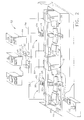
- FIG. 1 shows an electrical discharge machining (EDM) apparatus 10.
- the EDM apparatus 10 includes six individual work stations 12-17 disposed in a tank 18. Although six work stations are shown in Figure 1 for purposes of illustration, it should be noted that virtually any number of such stations could be employed in the EDM apparatus 10 of the present invention.
- Each work station 12-17 operates independently to machine a separate workpiece.
- the tank 18 is filled with a suitable dielectric fluid, such as a dielectric oil, so that each workpiece is immersed in the fluid.
- the dielectric fluid insulates against premature spark discharge, cools the machined area, and flushes away machining debris.
- a filtering system 20 is connected to the tank 18 for filtering the dielectric fluid, preferably down to one micron absolute.
- the apparatus 10 also includes three standard EDM control systems 22-24.
- each EDM control system 22-24 includes a power supply or spark generator and a controller, such as a computer numerical control (CNC).
- the power supply of each EDM control system 22-24 provides energy to a selected one of the work stations via power cables 26 and a power transfer switch 28.
- the power supply of each EDM control system 22-24 is connected to the power transfer switch 28.
- the power transfer switch 28 When the power transfer switch 28 is in a first state, power from the first EDM control system 22 is delivered to the first work station 12, power from the second EDM control system 23 is delivered to the second work station 13, and power from the third EDM control system 24 is delivered to the third work station 14.
- the power transfer switch 28 When the power transfer switch 28 is in a second state, power from the first EDM control system 22 is delivered to the fourth work station 15, power from the second EDM control system 23 is delivered to the fifth work station 16, and power from the third EDM control system 24 is delivered to the sixth work station 17.
- the work stations 12-14 operate together as a first group
- the work stations 15-17 operate together as a second group. Operation of the two groups will alternate depending on the state of the power transfer switch 28.
- the controllers are connected to corresponding work stations via servo cables (not shown) to control workpiece positioning while a particular work station is operating.
- the first EDM control system 22 is connected to the first and fourth work stations 12 and 15
- the second EDM control system 23 is connected to the second and fifth work stations 13 and 16
- the third EDM control system 24 is connected to the third and sixth work stations 14 and 17.
- Each work station 12-17 has a two-part base structure comprising a lower base 30 and an upper base 32 that is supported above the lower base 30.
- An electrode 34 is disposed in the upper surface of each lower base 30.
- the electrodes 34 can be any type of electrode used in electrical discharge machining. Electrical energy is selectively delivered to the electrodes 34 through the electrically conductive lower bases 30, which are electrically connected to the respective power cables 26.
- Each electrode shares a power supply with one other one of the electrodes. Accordingly, there are twice as many electrodes as power supplies.
- a linear servomotor 36 is mounted on the upper base 32 of each work station. It should be noted that while linear servomotors are shown in Figure 1 to facilitate disclosure of the present invention, rotary servomotors could alternatively be used. However, linear motors are generally preferred because of their better speed, faster frequency response and positional accuracy.
- the servomotor 36 comprises a linear motor stator 38, which is fixedly attached to the upper base 32, and a linear motor slider 40, which is slidingly mounted on the stator 38.
- the linear servomotor 36 operates in a conventional manner in that when the motor is energized, the slider 40 is caused to move linearly with respect to the stator 38.
- the servomotor 36 is arranged vertically on the upper base 32 so that the slider 40 will move vertically, toward or away from the electrode 34.
- the displacement of the slider 40 is dictated by signals sent from the CNC in the corresponding EDM control system 22-24 that is coupled to the respective servomotors 36.
- a workpiece fixture 42 is affixed to each slider 40 for movement therewith.
- Each fixture 42 holds a workpiece 44 in position for machining. That is, as each slider 40 is moved toward or away from the corresponding electrode 34, its workpiece 44 is moved into or out of machining engagement with the electrode 34.
- the example workpieces 44 shown in Figure 1 are shrouds for use in an aircraft engine.
- a typical aircraft engine employs a plurality of such shrouds arranged in an annular array around the engine's turbine rotor. The shrouds thus define an outer boundary for hot combustion gases flowing through the turbine.
- Shrouds are ordinarily made by a process in which a casting of the shroud is made, and various features are then machined into the casting.
- the shrouds 44 of Figure 1 have an anti-rotation notch machined into one side thereof and a seal slot machined into each end thereof.
- Each group of work stations is thus able to machine all of the features. That is, the first and fourth work stations 12 and 15 machine one seal slot, the second and fifth work stations 13 and 16 machine the opposite seal slot, and the third and sixth work stations 14 and 17 machine the anti-rotation notch.
- a shroud is only an illustrative example of one workpiece that is suitable for use with the EDM apparatus 10. The present invention is not limited to such workpieces and is applicable to virtually any workpiece in which multiple features are machined.
- Each work station further includes a retract sensor 46 for detecting when the slider 40, and hence the fixture 42 and workpiece 44, are in the retracted position away from the electrode 34.
- the retract sensors 46 can be any conventional device such as a mechanical limit switch or a proximity sensor disposed on the upper base 32 or stator 38 in an appropriate location so as to be triggered when the workpiece 44 is retracted. When triggered, the retract sensors 46 output a signal to the power transfer switch 28. Electrical energy is delivered to the workpieces 44 through the electrically conductive fixtures 42, which are electrically connected to the respective power cables 26.
- a linear measuring scale (not shown) is mounted adjacent to each servomotor 36.
- the linear measuring scale is a conventional device that precisely measures the position and velocity of the slider 40 and provides feedback of these measurements to the servocontrols in the EDM control systems 22-24.
- the power transfer switch 28 comprises a multiplexer or a series of relay switches and utilizes standard control circuitry having an AND gate to cause switching between the first and second states in response to input from the various retract switches 46.
- the power transfer switch 28 includes an acknowledge button 48 connected to the control circuitry.
- the control circuitry includes means such that the power transfer switch 28 will not be able to switch between its first and second states unless the acknowledge button 48 has been pressed. That is, the acknowledge button 48 overrides the means for preventing switch over.
- the acknowledge button 48 resets whenever the power transfer switch 28 switches between its first and second states.
- a stop button 50 is provided for emergency cut-off of power to all of the work stations 12-17.
- the first group of work stations 12-14 alternate with the second group of work stations 15-17. While one group of work stations is operating, the other group is retracted and available for workpiece loading.
- Figure 1 shows work stations 12-14 in operation while work stations 15-17 are in their retracted positions.
- the linear servomotors 36 of work stations 12-14 advance their workpieces 44 toward the corresponding electrodes 34 under the control of the EDM control systems 22-24.
- the electrodes 34 are energized by the power supply in the corresponding EDM control systems 22-24 for providing electrical energy to produce electrical discharges or sparks between the electrodes 34 and the workpieces 44 when the workpieces 44 are positioned adjacent to the corresponding electrodes 34.
- the servomotors 36 continue to advance the workpieces 44 as dictated by the EDM control systems 22-24 until the desired feature is finished.
- the servomotors 36 retract the workpiece fixtures 42 and workpieces 44 out of the dielectric fluid, causing the retract sensors 46 to be tripped.
- the power transfer switch 28 switches states (provided that the acknowledge button 48 has been pressed since the last switch over). This removes all power from the first group of work stations 12-14 and activates the second group of work stations 15-17 so that the newly loaded work pieces 44 are machined. This alternating work cycle repeats continuously.
- each work station can operate independently because each station has its own EDM control system 22-24 while it is operating, which includes a power supply and a servocontrol.
- the work stations within each group can perform different operations; that is, each station can work on a different type of part and/or machine a different feature.
- each work station can have a different type of electrode 34 (e.g., one station can have a graphite electrode, while other stations may use brass, copper or copper tungsten electrodes) and use different electrode polarities.
- Figure 1 shows the same type of workpiece 44 in each of the six work stations 12-17, it is possible to have the first and second groups machining different types of workpieces. In this case, the power transfer switch 28 could switch to different burn parameters as the power is being switched
- the workpieces 44 are supported above the electrodes 34 by the retractable workpiece fixtures 42, they can be removed without the need of draining the dielectric fluid from the tank 14. This is particularly advantageous when the work stations are performing different machining operations because if one station finishes before another, then the completed part can be removed and a new workpiece loaded while the other stations are still operating. Positioning the workpieces 44 above the electrodes 34 also aids removal of machining debris. Since the workpiece is moved above the electrode, debris is vibrated loose and exits the work area to the bottom under the force of gravity. This reduces the likelihood that one of the stations will get hung up. But if such a problem does occur, only the affected work station will be stopped.
- the EDM apparatus 52 includes two work stations 54, 56 disposed in a tank 58, which is shown in partial cut-away to reveal the work stations 54, 56 therein. Although two work stations are shown in Figure 2 for purposes of illustration, it should be noted that additional such stations, operating independently, could be disposed in the tank 58.
- the tank 58 is filled with a suitable dielectric fluid, such as a dielectric oil, for insulating against premature spark discharge, cooling the machined area, and flushing away machining debris.
- a float switch 60 is provided in the tank 58 for detecting when the dielectric fluid reaches a sufficient depth.
- the float switch 60 is located such that the level of dielectric fluid is just high enough to immerse workpieces installed in the work stations 54, 56.
- a filtering system 62 is connected to the tank 58 for filtering the dielectric fluid, preferably down to one micron absolute.
- Each work station 54, 56 includes a workpiece fixture 64 (shown in Figure 3) supported in the tank 58 for holding a workpiece 66.
- the example workpieces 66 shown in Figure 2 are shrouds for use in an aircraft engine.
- a shroud is only an illustrative example of one workpiece that is suitable for use with the EDM apparatus 52. This embodiment is not limited to such workpieces and is applicable to virtually any workpiece in which multiple features are machined.
- the first work station 54 includes first, second and third machining heads 68, 70 and 72, wherein each machining head machines a different feature into the workpiece 66.
- the first machining head 68 is mounted above the workpiece 66 for machining the anti-rotation slot.
- the second machining head 70 is mounted adjacent one end of the workpiece 66 for machining the first seal slot, and the third machining head 72 is mounted adjacent the other end of the workpiece 66 for machining the second seal slot.
- the second work station 56 includes fourth, fifth and sixth machining heads 74, 76 and 78.
- the fourth machining head 74 is mounted above the workpiece 66 of the second work station 56 for machining the anti-rotation slot.
- the fifth machining head 76 is mounted adjacent one end of the workpiece 66 for machining the first seal slot
- the sixth machining head 78 is mounted adjacent the other end of the workpiece 66 for machining the second seal slot.
- the apparatus 52 also includes three standard EDM control systems 80-82.
- Each EDM control system 80-82 includes a power supply or spark generator and a controller, such as a computer numerical control (CNC).
- the power supply of each EDM control system 80-82 provides energy to a selected one of the work stations via power cables 84 and a power transfer switch 86.
- the power supply of each EDM control system 80-82 is connected to the power transfer switch 86 so that power can be alternated between the first and second work stations 54, 56.
- the power transfer switch 86 when the power transfer switch 86 is in a first state, power from the first EDM control system 80 is delivered to the second machining head 70, power from the second EDM control system 81 is delivered to the first machining head 68, and power from the third EDM control system 82 is delivered to the third machining head 72.
- the power transfer switch 86 When the power transfer switch 86 is in a second state, power from the first EDM control system 80 is delivered to the fifth machining head 76, power from the second EDM control system 81 is delivered to the fourth machining head 74, and power from the third EDM control system 82 is delivered to the sixth machining head 78.
- the controllers of the EDM control systems 80-82 are connected to corresponding machining heads via servo cables (not shown) to control electrode positioning while a particular work station is operating.
- the first EDM control system 80 is connected to the second and fifth machining heads 70, 76
- the second EDM control system 81 is connected to the first and fourth machining heads 68, 74
- the third EDM control system 82 is connected to the third and sixth machining heads 72, 78.
- Each of the first and fourth machining heads 68, 74 has a linear servomotor 88 mounted on a column 90 located adjacent to the corresponding workpiece fixture 64.
- Each servomotor 88 comprises a linear motor stator 92, which is fixedly attached to the column 90, and a linear motor slider 94, which is slidingly mounted on the stator 92.
- An electrode holder 96 is mounted on the slider 94 and supports an electrode 98 below the workpiece 66.
- the servomotor 88 is arranged vertically on the column 90 so that the slider 94 will move vertically, thereby moving the electrode 98 into or out of machining engagement with the workpiece 66.
- the displacement of the slider 94 is dictated by signals sent from the CNC in the EDM control system 80.
- This embodiment differs from the embodiment of Figure 1 in that it operates on two workpieces instead of six. However, three EDM control systems operate on one workpiece at the same time. Since all electrodes work on a workpiece in parallel, each workpiece is inserted into a fixture only once. This reduces part handling with respect to the Figure 1 embodiment.
- the second machining head 70 includes a linear servomotor 100 disposed adjacent to a first end of the workpiece 66.
- the servomotor 100 comprises a linear motor stator rod 102 mounted over the workpiece 66 by a frame 104.
- a linear motor slider 106 is slidingly mounted on the stator rod 102.
- a bracket 108 is attached to the underside of the slider 106, and a slide block 110 is connected to the bracket 108 via a flexible connector 111.
- the slide block 110 is slidingly supported above the base of the tank 58 by a stationary block 112 and a pair of support rods 114.
- An electrode holder 116 is mounted on the slide block 110 and supports an electrode 118.
- the slider 106 When the servomotor 100 is energized, the slider 106 is caused to move linearly with respect to the stator rod 102. The movement of the slider 106 causes the slide block 110 to slide along the support rods 114, so that the electrode 118 moves into or out of machining engagement with the first end of the workpiece 66.
- the support rods 114 are arranged at an angle with respect to the base of the tank 58 to accommodate the workpiece curvature.
- the slider 106 moves horizontally, whereas the slide block 110 moves at an incline. The divergence between the two lines of motion is accommodated by the flexible connector 111.
- the flexible connector 111 can also provide electrical isolation between the servo power of the servomotor 100 and the power supplies of the EDM control systems 80-82.
- the displacement of the slider 106 is dictated by signals sent from the CNC of the EDM control system 82.
- the third machining head 72 is essentially the same as the second machining head 70, except that it is disposed adjacent the opposite end of the workpiece 66.
- the sliders of both the second and third machining heads share the same stator rod 102, which spans the width of the first work station 54.
- the fifth and sixth machining heads 76, 78 of the second work station 56 are substantially similar to the second and third machining heads 70, 72.
- each work station 54, 56 has three electrodes. Since each electrode shares a power supply with one other one of the electrodes, there are twice as many electrodes as power supplies.
- the fifth and sixth machining heads 76, 78 would each include a slider, which share a common stator rod spanning the width of the second work station 56.
- the power transfer switch 86 is similar to that described above in connection with the first embodiment.
- the power transfer switch 86 includes an acknowledge button 120 connected to the switch control circuitry such that the power transfer switch 86 will not be able to switch between its first and second states unless the acknowledge button 120 has been pressed.
- the acknowledge button 120 resets whenever the power transfer switch 86 switches between its first and second states.
- a stop button 122 is provided for emergency cut-off of power to both work stations 54, 56.
- a linear measuring scale (not shown) is mounted adjacent to the servomotor in each machining head.
- Each linear measuring scale precisely measures the position and velocity of the corresponding slider and provides feedback of these measurements to the servocontrols in the EDM control systems 80-82.
- Each machining head further includes a retract sensor 124 for detecting when its slider, and hence its electrode, are in a retracted position away from the workpiece 66.
- the retract sensors 124 can be any conventional device such as a mechanical limit switch or a proximity sensor and are disposed on the machining head so as to be triggered when the electrode is retracted. When triggered, the retract sensors 124 output a signal to the power transfer switch 86.
- the first work station 54 alternates with the second work station 56. While one work station is operating, the other group is inactive and available for workpiece loading.
- the servomotor 88 of the first machining head 68 moves the slider 94 upward under control of the first EDM control system 80. This causes the electrode 98 to advance upward toward the workpiece 66.
- the electrode 98 is energized by the power supply in the first EDM control system 80 for providing electrical energy to produce electrical discharges or sparks between the electrode 98 and the workpiece 66.
- the servomotor 88 continues to advance the electrode 98 until the desired feature (the anti-rotation notch in the illustrated example) is finished. At this point, the servomotor 88 retracts the electrode 98, causing the retract sensor 124 to be tripped.
- the servomotor 100 In each of the second and third machining heads 70, 72, the servomotor 100 the slider 106 and the electrode 118 toward the workpiece under the control of the respective EDM control system 81, 82.
- the electrodes 118 are energized by the power supplies in the EDM control systems 81, 82 for providing electrical energy to produce electrical discharges or sparks between the electrodes 118 and the workpiece 66.
- the servomotor 100 continues to advance the electrodes 118 until the desired features (the two seal slots in the illustrated example) are finished. At this point, the servomotors 100 retract the electrodes 118, causing the retract sensors 124 to be tripped.
- the power transfer switch 86 switches states (provided that the acknowledge button 120 has been pressed since the last switch over). This removes all power from the first work station 54 and activates the second work station 56 so that the newly loaded workpiece 66 is machined. This alternating work cycle repeats continuously.
Landscapes
- Engineering & Computer Science (AREA)
- Mechanical Engineering (AREA)
- Electrical Discharge Machining, Electrochemical Machining, And Combined Machining (AREA)
- Multi-Process Working Machines And Systems (AREA)
Applications Claiming Priority (2)
| Application Number | Priority Date | Filing Date | Title |
|---|---|---|---|
| US09/855,443 US6563071B2 (en) | 2001-05-15 | 2001-05-15 | Method and apparatus for electrical discharge machining with multiple workstations |
| US855443 | 2001-05-15 |
Publications (3)
| Publication Number | Publication Date |
|---|---|
| EP1270128A2 true EP1270128A2 (de) | 2003-01-02 |
| EP1270128A3 EP1270128A3 (de) | 2005-11-02 |
| EP1270128B1 EP1270128B1 (de) | 2012-07-11 |
Family
ID=25321281
Family Applications (1)
| Application Number | Title | Priority Date | Filing Date |
|---|---|---|---|
| EP20020253336 Expired - Lifetime EP1270128B1 (de) | 2001-05-15 | 2002-05-14 | Vorrichtung und Verfahren zum Funkenerosiven Bearbeiten |
Country Status (3)
| Country | Link |
|---|---|
| US (1) | US6563071B2 (de) |
| EP (1) | EP1270128B1 (de) |
| JP (1) | JP2003039242A (de) |
Cited By (1)
| Publication number | Priority date | Publication date | Assignee | Title |
|---|---|---|---|---|
| CN102216014B (zh) * | 2008-11-20 | 2014-01-29 | 罗伯特·博世有限公司 | 用于对工件进行电化学加工的装置 |
Families Citing this family (13)
| Publication number | Priority date | Publication date | Assignee | Title |
|---|---|---|---|---|
| US6833524B2 (en) * | 2002-11-01 | 2004-12-21 | General Electric Corporation | Multi-station electrical discharge machining with manufacturing interrupt reduction |
| US20090134126A1 (en) * | 2004-01-29 | 2009-05-28 | Mitsubishi Electric Corporation | Electric-discharge machining apparatus and electric-discharge machining method |
| US7378611B2 (en) * | 2004-03-19 | 2008-05-27 | General Electric Company | Apparatus and method for electrical discharge machining |
| US7394040B2 (en) * | 2006-03-31 | 2008-07-01 | General Electric Company | Electromachining process and apparatus |
| IL184021A (en) * | 2006-07-18 | 2012-07-31 | Erowa Ag | System for the exchange of information between machining apparatus and a transfer device |
| US7967555B2 (en) * | 2006-12-14 | 2011-06-28 | United Technologies Corporation | Process to cast seal slots in turbine vane shrouds |
| US8525064B2 (en) * | 2009-11-12 | 2013-09-03 | Denso Corporation | Electric discharge machine and method of producing nozzle body using the same |
| US9141955B2 (en) | 2010-06-23 | 2015-09-22 | The Western Union Company | Biometrically secured user input for forms |
| US9754132B2 (en) | 2010-06-23 | 2017-09-05 | The Western Union Company | Multi-user device with information capture capabilities |
| JP5543522B2 (ja) * | 2012-04-24 | 2014-07-09 | ファナック株式会社 | 極間印加電圧を可変とするワイヤ放電加工機の接触検出装置 |
| US9857780B1 (en) * | 2013-03-15 | 2018-01-02 | Daniel Reed | Positioning work stop |
| CN107088688A (zh) * | 2017-05-16 | 2017-08-25 | 盐城市国蕾科技有限公司 | 一种线切割机床 |
| EP3720650B1 (de) * | 2017-12-05 | 2024-04-03 | Sew-Eurodrive GmbH & Co. KG | Anlage, aufweisend ein gebäude mit hallenboden |
Citations (1)
| Publication number | Priority date | Publication date | Assignee | Title |
|---|---|---|---|---|
| JPS6215015A (ja) | 1985-07-09 | 1987-01-23 | Mitsubishi Electric Corp | 放電加工方法 |
Family Cites Families (12)
| Publication number | Priority date | Publication date | Assignee | Title |
|---|---|---|---|---|
| US3391268A (en) * | 1964-05-25 | 1968-07-02 | Gen Electric | Welding apparatus control |
| US3519785A (en) * | 1967-12-21 | 1970-07-07 | Warren Fastener Corp | Multiple gun welder and control apparatus |
| US4320278A (en) * | 1979-03-26 | 1982-03-16 | Colt Industries Operating Corp | Servo feed system for electrical discharge machining apparatus |
| JPS5856738A (ja) * | 1981-09-30 | 1983-04-04 | Nippon Kokan Kk <Nkk> | ロ−ル状被加工物の放電加工方法 |
| JPH01216726A (ja) * | 1988-02-23 | 1989-08-30 | Merudasu Syst Eng Kk | 画面同時放電加工機 |
| JPH01216725A (ja) * | 1988-02-25 | 1989-08-30 | Komatsu Ltd | ワイヤ放電加工機の制御方法 |
| JPH02224928A (ja) * | 1988-11-14 | 1990-09-06 | Mitsubishi Electric Corp | 複合加工装置及びその加工方法 |
| DE9013255U1 (de) * | 1990-09-19 | 1991-02-14 | Shan Iu Industries Inc., Taipet/T'ai-pei | Maschine zur Elektroentladungsbearbeitung von Werkstücken |
| JP3008713B2 (ja) * | 1993-02-03 | 2000-02-14 | 三菱電機株式会社 | 分割加工用放電加工装置 |
| JPH08309620A (ja) * | 1995-05-16 | 1996-11-26 | Fanuc Ltd | 形彫り放電加工機 |
| US5917250A (en) * | 1997-10-07 | 1999-06-29 | Lucent Technologies Inc. | Isolation circuit and verification controller for a power supply and power plant employing the same |
| ATE367880T1 (de) * | 1998-11-17 | 2007-08-15 | Sodick Co Ltd | Vorrichtung zum funkenerosiven bearbeiten |
-
2001
- 2001-05-15 US US09/855,443 patent/US6563071B2/en not_active Expired - Fee Related
-
2002
- 2002-05-14 EP EP20020253336 patent/EP1270128B1/de not_active Expired - Lifetime
- 2002-05-15 JP JP2002139364A patent/JP2003039242A/ja not_active Withdrawn
Patent Citations (1)
| Publication number | Priority date | Publication date | Assignee | Title |
|---|---|---|---|---|
| JPS6215015A (ja) | 1985-07-09 | 1987-01-23 | Mitsubishi Electric Corp | 放電加工方法 |
Non-Patent Citations (1)
| Title |
|---|
| PATENT ABSTRACTS OF JAPAN vol. 011, (1 - 188)<188> 17 June 1987 (1987-06-17) |
Cited By (1)
| Publication number | Priority date | Publication date | Assignee | Title |
|---|---|---|---|---|
| CN102216014B (zh) * | 2008-11-20 | 2014-01-29 | 罗伯特·博世有限公司 | 用于对工件进行电化学加工的装置 |
Also Published As
| Publication number | Publication date |
|---|---|
| US20020170885A1 (en) | 2002-11-21 |
| EP1270128A3 (de) | 2005-11-02 |
| EP1270128B1 (de) | 2012-07-11 |
| US6563071B2 (en) | 2003-05-13 |
| JP2003039242A (ja) | 2003-02-12 |
Similar Documents
| Publication | Publication Date | Title |
|---|---|---|
| EP1270128B1 (de) | Vorrichtung und Verfahren zum Funkenerosiven Bearbeiten | |
| GB2080176A (en) | Electrical discharge machining methods and apparatus | |
| US6369343B1 (en) | Method and apparatus for electrical discharge machining | |
| US5321874A (en) | Multi-positioner machining system | |
| US8710392B2 (en) | Electric discharge machining hole drilling | |
| EP1808253A2 (de) | Elektroerosive Duplexbearbeitung | |
| US20120187092A1 (en) | Electric discharge machining die sinking device | |
| US20190143431A1 (en) | Tool electrode for and methods of electrical discharge machining | |
| US6326576B1 (en) | Method and apparatus for electrical discharge machining | |
| EP1470885B1 (de) | Mehrstationenfunkenerosionsbearbeitung mit einer gemeinsamen Geschwindigkeitsregelung | |
| US4439660A (en) | Electroerosive contour-machining method and apparatus with a rotary tool electrode | |
| EP2246139A1 (de) | Elektrodenerosive Bearbeitungsvorrichtung und Verfahren zur Bearbeitung eines Werkstücks | |
| JP2017056550A (ja) | 独立電極を有する放電加工システム | |
| EP1415747B1 (de) | Mehrstationen Funkenerosionsbearbeitungsmaschine mit Verminderung der Bearbeitungsunterbrechungen | |
| US4543460A (en) | Generic electrode EDM method and apparatus, and assembly for maintaining chip concentration in the gap at an enhanced level | |
| EP1147842A1 (de) | Vorrichtung zum funkenerosiven bearbeiten | |
| JP6948773B2 (ja) | 独立電極を有する放電加工システム、関連制御システムおよび方法 | |
| JP4895517B2 (ja) | 放電加工装置及び方法 | |
| JP3252542U (ja) | 放電加工装置 | |
| JP2599392B2 (ja) | 二頭別制御のnc放電加工機 | |
| JPH01205918A (ja) | 電解加工による仕上げ加工方法 | |
| GB2220162A (en) | Electrical discharge machining apparatus | |
| JP2001170821A (ja) | 放電輪郭加工方法 | |
| JPS6059099B2 (ja) | 放電加工方法及びその装置 | |
| Langdon | ECM in Aero Engine Component Machining |
Legal Events
| Date | Code | Title | Description |
|---|---|---|---|
| PUAI | Public reference made under article 153(3) epc to a published international application that has entered the european phase |
Free format text: ORIGINAL CODE: 0009012 |
|
| AK | Designated contracting states |
Kind code of ref document: A2 Designated state(s): AT BE CH CY DE DK ES FI FR GB GR IE IT LI LU MC NL PT SE TR |
|
| AX | Request for extension of the european patent |
Free format text: AL;LT;LV;MK;RO;SI |
|
| PUAL | Search report despatched |
Free format text: ORIGINAL CODE: 0009013 |
|
| AK | Designated contracting states |
Kind code of ref document: A3 Designated state(s): AT BE CH CY DE DK ES FI FR GB GR IE IT LI LU MC NL PT SE TR |
|
| AX | Request for extension of the european patent |
Extension state: AL LT LV MK RO SI |
|
| 17P | Request for examination filed |
Effective date: 20060502 |
|
| AKX | Designation fees paid |
Designated state(s): DE FR GB IT |
|
| 17Q | First examination report despatched |
Effective date: 20061113 |
|
| GRAP | Despatch of communication of intention to grant a patent |
Free format text: ORIGINAL CODE: EPIDOSNIGR1 |
|
| GRAS | Grant fee paid |
Free format text: ORIGINAL CODE: EPIDOSNIGR3 |
|
| GRAA | (expected) grant |
Free format text: ORIGINAL CODE: 0009210 |
|
| AK | Designated contracting states |
Kind code of ref document: B1 Designated state(s): DE FR GB IT |
|
| REG | Reference to a national code |
Ref country code: GB Ref legal event code: FG4D |
|
| REG | Reference to a national code |
Ref country code: DE Ref legal event code: R096 Ref document number: 60243281 Country of ref document: DE Effective date: 20120906 |
|
| PLBE | No opposition filed within time limit |
Free format text: ORIGINAL CODE: 0009261 |
|
| STAA | Information on the status of an ep patent application or granted ep patent |
Free format text: STATUS: NO OPPOSITION FILED WITHIN TIME LIMIT |
|
| 26N | No opposition filed |
Effective date: 20130412 |
|
| PGFP | Annual fee paid to national office [announced via postgrant information from national office to epo] |
Ref country code: DE Payment date: 20130530 Year of fee payment: 12 Ref country code: GB Payment date: 20130528 Year of fee payment: 12 |
|
| REG | Reference to a national code |
Ref country code: DE Ref legal event code: R097 Ref document number: 60243281 Country of ref document: DE Effective date: 20130412 |
|
| PGFP | Annual fee paid to national office [announced via postgrant information from national office to epo] |
Ref country code: FR Payment date: 20130606 Year of fee payment: 12 Ref country code: IT Payment date: 20130523 Year of fee payment: 12 |
|
| REG | Reference to a national code |
Ref country code: DE Ref legal event code: R119 Ref document number: 60243281 Country of ref document: DE |
|
| GBPC | Gb: european patent ceased through non-payment of renewal fee |
Effective date: 20140514 |
|
| REG | Reference to a national code |
Ref country code: FR Ref legal event code: ST Effective date: 20150130 |
|
| REG | Reference to a national code |
Ref country code: DE Ref legal event code: R119 Ref document number: 60243281 Country of ref document: DE Effective date: 20141202 |
|
| PG25 | Lapsed in a contracting state [announced via postgrant information from national office to epo] |
Ref country code: DE Free format text: LAPSE BECAUSE OF NON-PAYMENT OF DUE FEES Effective date: 20141202 Ref country code: IT Free format text: LAPSE BECAUSE OF NON-PAYMENT OF DUE FEES Effective date: 20140514 |
|
| PG25 | Lapsed in a contracting state [announced via postgrant information from national office to epo] |
Ref country code: GB Free format text: LAPSE BECAUSE OF NON-PAYMENT OF DUE FEES Effective date: 20140514 Ref country code: FR Free format text: LAPSE BECAUSE OF NON-PAYMENT OF DUE FEES Effective date: 20140602 |