EP1270645B1 - Résine pour matériau optique - Google Patents
Résine pour matériau optique Download PDFInfo
- Publication number
- EP1270645B1 EP1270645B1 EP02021523A EP02021523A EP1270645B1 EP 1270645 B1 EP1270645 B1 EP 1270645B1 EP 02021523 A EP02021523 A EP 02021523A EP 02021523 A EP02021523 A EP 02021523A EP 1270645 B1 EP1270645 B1 EP 1270645B1
- Authority
- EP
- European Patent Office
- Prior art keywords
- compound
- group
- bis
- compounds
- weight
- Prior art date
- Legal status (The legal status is an assumption and is not a legal conclusion. Google has not performed a legal analysis and makes no representation as to the accuracy of the status listed.)
- Expired - Lifetime
Links
Classifications
-
- C—CHEMISTRY; METALLURGY
- C08—ORGANIC MACROMOLECULAR COMPOUNDS; THEIR PREPARATION OR CHEMICAL WORKING-UP; COMPOSITIONS BASED THEREON
- C08L—COMPOSITIONS OF MACROMOLECULAR COMPOUNDS
- C08L81/00—Compositions of macromolecular compounds obtained by reactions forming in the main chain of the macromolecule a linkage containing sulfur with or without nitrogen, oxygen or carbon only; Compositions of polysulfones; Compositions of derivatives of such polymers
-
- C—CHEMISTRY; METALLURGY
- C08—ORGANIC MACROMOLECULAR COMPOUNDS; THEIR PREPARATION OR CHEMICAL WORKING-UP; COMPOSITIONS BASED THEREON
- C08G—MACROMOLECULAR COMPOUNDS OBTAINED OTHERWISE THAN BY REACTIONS ONLY INVOLVING UNSATURATED CARBON-TO-CARBON BONDS
- C08G59/00—Polycondensates containing more than one epoxy group per molecule; Macromolecules obtained by polymerising compounds containing more than one epoxy group per molecule using curing agents or catalysts which react with the epoxy groups
- C08G59/18—Macromolecules obtained by polymerising compounds containing more than one epoxy group per molecule using curing agents or catalysts which react with the epoxy groups ; e.g. general methods of curing
- C08G59/20—Macromolecules obtained by polymerising compounds containing more than one epoxy group per molecule using curing agents or catalysts which react with the epoxy groups ; e.g. general methods of curing characterised by the epoxy compounds used
- C08G59/22—Di-epoxy compounds
- C08G59/30—Di-epoxy compounds containing atoms other than carbon, hydrogen, oxygen and nitrogen
- C08G59/302—Di-epoxy compounds containing atoms other than carbon, hydrogen, oxygen and nitrogen containing sulfur
-
- C—CHEMISTRY; METALLURGY
- C08—ORGANIC MACROMOLECULAR COMPOUNDS; THEIR PREPARATION OR CHEMICAL WORKING-UP; COMPOSITIONS BASED THEREON
- C08G—MACROMOLECULAR COMPOUNDS OBTAINED OTHERWISE THAN BY REACTIONS ONLY INVOLVING UNSATURATED CARBON-TO-CARBON BONDS
- C08G59/00—Polycondensates containing more than one epoxy group per molecule; Macromolecules obtained by polymerising compounds containing more than one epoxy group per molecule using curing agents or catalysts which react with the epoxy groups
- C08G59/18—Macromolecules obtained by polymerising compounds containing more than one epoxy group per molecule using curing agents or catalysts which react with the epoxy groups ; e.g. general methods of curing
- C08G59/40—Macromolecules obtained by polymerising compounds containing more than one epoxy group per molecule using curing agents or catalysts which react with the epoxy groups ; e.g. general methods of curing characterised by the curing agents used
- C08G59/66—Mercaptans
-
- C—CHEMISTRY; METALLURGY
- C08—ORGANIC MACROMOLECULAR COMPOUNDS; THEIR PREPARATION OR CHEMICAL WORKING-UP; COMPOSITIONS BASED THEREON
- C08G—MACROMOLECULAR COMPOUNDS OBTAINED OTHERWISE THAN BY REACTIONS ONLY INVOLVING UNSATURATED CARBON-TO-CARBON BONDS
- C08G75/00—Macromolecular compounds obtained by reactions forming a linkage containing sulfur with or without nitrogen, oxygen, or carbon in the main chain of the macromolecule
- C08G75/02—Polythioethers
- C08G75/06—Polythioethers from cyclic thioethers
- C08G75/08—Polythioethers from cyclic thioethers from thiiranes
-
- G—PHYSICS
- G02—OPTICS
- G02B—OPTICAL ELEMENTS, SYSTEMS OR APPARATUS
- G02B1/00—Optical elements characterised by the material of which they are made; Optical coatings for optical elements
- G02B1/04—Optical elements characterised by the material of which they are made; Optical coatings for optical elements made of organic materials, e.g. plastics
Definitions
- the present invention relates to a novel resin which can suitably be used as any of optical materials such as plastic lenses, prisms, optical fibers, information recording substrates and filters, among others, as a material for plastic lenses of spectacles.
- optical materials particularly as spectacle lenses
- the optical materials, particularly the spectacle lenses are required to possess a low specific gravity as well as a high refractive index and a high Abbe's number as optical performances, and a high heat resistance and a high strength as physical performances.
- the high refractive index permits the decrease in a lens thickness, and the high Abbe's number can reduce a chromatic aberation of the lenses.
- the high heat resistance and the high strength facilitate the fabrication of the lenses, and they are important from the viewpoint of safety.
- thermosetting optical materials having thiourethane structures obtained by reactions of polythiol compounds with polyisocyanate compounds
- Japanese Patent Publication No. 58489/1992 and Japanese Patent Application Laid-open No. 148340/1993 Japanese Patent Application Laid-open No. 148340/1993
- other techniques, by which an epoxy resin or an episulfide resin is polymerized with a compound having two or more functional groups to obtain lenses have also been suggested in Japanese Patent Application Laid-open Nos. 98615/1989 and 81320/1991 as well as WO 8910575.
- the further high refractive index should be desirable.
- another important performance required for the optical material is that a chromatic aberration is low.
- the material having the high Abbe's number is desired. That is to say, the simultaneous realization of the high refractive index and the high Abbe's number is also desired.
- the Abbe's number usually tends to lower with the increase in the refractive index, and in a plastic material obtained from a conventional compound as a starting material, the Abbe's number is in the range of about 50 to 55 in the case that the refractive index is in the range of 1.50 to 1.55; it is 40 in the case of a refractive index of 1.60; it is about 31 which is a limit value in the case of a refractive index of 1.66; and it is about 30 or less in the case that it is forcedly attempted to achieve a refractive index of 1.7, and the material having such a low Abbe's number is not practical any more.
- novel sulfur-containing compounds having an episulfide structure which permits the production of optical materials having a small thickness and a low chromatic aberration, and there have already been filed patent applications regarding the novel compounds (Japanese Patent Application Nos. 214631/1996 and 5797/1997).
- the optical materials obtained by polymerizing the sulfur-containing compounds cannot have a sufficiently satisfactory oxidation resistance, so that they tend to easily color during a long-term storage and in a process requiring a heat treatment.
- Episulfide group containing alkyl sulfide compounds have been described in EP -A- 0 761 665.
- the compounds are described to be suitable for the preparation of optical material such as lens material for spectacles by polymerizing or curing the compounds.
- compounds which are suitable for the curing/polymerization process there are mentioned compounds with two or more functional groups which can react with an episulfide group and compounds with one or more functional groups which can react with an episulfide group and one or more of other homopolymerizable functional groups.
- epoxy compounds examples include epoxy compounds, sulfur-containing epoxy compounds, known episulfide compounds, polyvalent carboxylic acids, polyvalent carboxylic anhydrides, mercaptocarboxylic acids, polymercaptans, mercaptoalcohols, mercaptophenols, polyphenols, amines and amides.
- Examples of the compounds with one or more functional groups which can react with an episulfide group and one or more of other homopolymerizable functional groups are for instance episulfide compounds or epoxy compounds having unsaturated groups such as vinyl, aromatic vinyl, methacryl, acryl and allyl as well as sulfur-containing epoxy compounds, carboxylic acids, carboxylic anhydrides, mercaptocarboxylic acids, mercaptans, phenols, amines and amides. No preference to any of these potential curing or polymerizing compounds is expressed and no specific example is provided.
- An object of the present invention is to improve the oxidation resistance of a resin obtained by polymerizing a novel sulfur-containing compound having an episulfide structure which have already been found by the present inventors.
- the present inventors have intensively investigated on a technique for overcoming the above-mentioned drawbacks, and as a result, it has been found that a resin having an excellent oxidation resistance can be obtained by polymerizing a resinous composition which comprises
- a molar ratio of the total of the SH group in the compound (b) to the total of the episulfide group and/or the epoxy group in the compound (a) is usually in the range of 0.001 to 0.5, preferably 0.001 to 0.3, more preferably 0.001 to 0.2, most preferably 0.01 to 0.1.
- the heat resistance of an optical material obtained by polymerizing the composition is so poor that the obtained optical material is not practical, and on the other hand, if it is less than 0.001, a high oxidation resistance which is intended by the present invention cannot be satisfied.
- Typical examples of these preferable organic compounds include chain organic compounds such as bis( ⁇ -epithiopropylthio)methane, 1,2-bis( ⁇ -epithiopropylthio)-ethane, 1,3-bis( ⁇ -epithiopropylthio)propane, 1,2-bis( ⁇ -epithiopropylthio)propane, 1-( ⁇ -epithiopropylthio)-2-( ⁇ -epithiopropylthiomethyl)propane, 1,4-bis( ⁇ -epithiopropylthio)butane, 1,3-bis( ⁇ -epithiopropylthio)butane, 1-( ⁇ -epithiopropylthio)-3-( ⁇ -epithiopropylthiomethyl)butane, 1,5-bis( ⁇ -epithiopropylthio)pentane, 1-( ⁇ -epithiopropylthio)-4-
- these compounds are not restrictive, and they may be used singly or in the state of a mixture two or more thereof.
- the most preferable compound is bis( ⁇ -epithiopropyl) sulfide.
- Examples of the compound (b) having one or more SH groups of the present invention include mercaptans and thiophenols as well as mercaptans and thiophenols having unsaturated groups such as a vinyl group, an aromatic vinyl group, a methacrylic group, an acrylic group and an allyl group.
- Typical examples of the mercaptans include mono-mercaptans such as methyl mercaptan, ethyl mercaptan, n-propyl mercaptan, n-butyl mercaptan, allyl mercaptan, n-hexyl mercaptan, n-octyl mercaptan, n-decyl mercaptan, n-dodecyl mercaptan, n-tetradecyl mercaptan, n-hexadecyl mercaptan, n-octadecyl mercaptan, cyclohexyl mercaptan, isopropyl mercaptan, tert-butyl mercaptan, tert-nonyl mercaptan, tert-dodecyl mercaptan, benzyl mercaptan, 4-chlor
- Examples of the mercaptans having the unsaturated group include allyl mercaptan, 2-vinylbenzyl mercaptan, 3-vinylbenzyl mercaptan and 4-vinylbenzyl mercaptan.
- Examples of the thiophenols having the unsaturated group include 2-vinylthiophenol, 3-vinylthiophenol and 4-vinylthiophenol.
- the preferable compounds are the mercaptans and the thiophenols. They can be used singly or in the state of a mixture of two or more thereof.
- composition of the present invention can be heated and polymerized in the presence or absence of a polymerizing catalyst to prepare a resin.
- a polymerizing catalyst examples include amines, phosphines, mineral acids, Lewis acids, organic acids, silicic acids and fluoroboric acid.
- Typical examples of the polymerizing catalyst include
- the preferable compounds which scarcely color the polymerized products are the primary monoamines, the secondary monoamines, the tertiary monoamines, the tertiary polyamines, the imidazoles, the amidines, the quaternary ammonium salts and the phosphines. More preferable compounds are the secondary monoamines, the tertiary monoamines, the tertiary polyamines, the imidazoles, the amidines, the quaternary ammonium salts and the phosphines which have at most one group capable of reacting with an episulfide group. These compounds may be used singly or in the state of a mixture of two or more thereof.
- the above-mentioned polymerizing catalyst can usually be used in an amount of 0.0001 mol to 1.0 mol, preferably 0.0001 to 0.5 mol, more preferably 0.0001 to less than 0.1 mol, most preferably 0.0001 to 0.05, per mol of the compound having one or more of the structures represented by the formula (1) in one molecule. If the amount of the polymerizing catalyst is more than this range, the refractive index and the heat resistance of the polymerized product deteriorate, and coloring occurs. On the other hand, if it is less than the above-mentioned range, the polymerization does not sufficiently proceed and the heat resistance is insufficient.
- composition of the present invention can be prepared by polymerizing a compound having two or more functional groups capable of reacting with an episulfide group and/or an epoxy group in the compound (a), or a compound having one or more groups of these functional groups and one or more other homopolymerizable functional groups, a compound having one or more of these homopolymerizable functional groups and a compound having one homopolymerizable functional group which can react with the episulfide group and/or the epoxy group.
- Examples of the compound having two or more functional groups capable of reacting with the episulfide group and/or the epoxy group in the compound (a) include epoxy compounds, known episulfide compounds and polyvalent carboxylic anhydrides.
- examples of the compound having one or more functional groups capable of reacting with the episulfide group and/or the epoxy group and one or more of the other homopolymerizable functional groups include epoxy compounds, episulfide compounds and carboxylic anhydrides having unsaturated groups such as a methacrylic group, an acrylic group, a vinyl group and an aromatic vinyl group.
- Examples of the compound having one or more homopolymerizable functional groups include compounds having unsaturated groups such as a methacrylic group, an acrylic group, an allyl group, a vinyl group and an aromatic vinyl group.
- Examples of the compound having two or more functional groups capable of reacting with the episulfide group are as follows.
- the epoxy compound include phenolic epoxy compounds prepared by the condensation of an epihalohydrin and polyvalent phenolic compounds such as hydroquinone, catechol, resorcin, bisphenol A, bisphenol F, bisphenol sulfone, bisphenol ether, bisphenol sulfide, halogenated bisphenol A and novolak resins; alcoholic epoxy compounds prepared by the condensation of an epihalohydrin and polyvalent alcoholic compounds such as ethylene glycol, diethylene glycol, triethylene glycol, polyethylene glycol, propylene glycol, dipropylene glycol, polypropylene glycol, 1,3-propanediol, 1,4-butanediol, 1,6-hexanediol, neopentyl glycol, glycerin, trimethylolpropane trimethacrylate, pentaerythritol, 1,3- and 1,4-cyclohexanediol, 1,3- and 1,4-cyclohexane
- Typical examples of the episulfide compound include episulfide compounds obtained by converting part or all of the epoxy groups of the above-mentioned epoxy compounds into episulfide groups.
- Typical examples of the polyvalent carboxylic anhydride include compounds mentioned above as the materials which are partners of the reaction with the epihalohydrin described in the paragraph regarding the above-mentioned epoxy compounds.
- the typical examples of the compound having one or more functional groups capable of reacting with the an episulfide group and/or an epoxy group and one or more other homopolymerizable functional groups are as follows.
- Examples of the epoxy compound having an unsaturated group include vinyl phenylglycidyl ether, vinyl benzylglycidyl ether, glycidyl methacrylate, glycidyl acrylate and alllyglycidyl ether.
- Examples of the episulfide compound having an unsaturated group include compounds in which the epoxy groups of the above-mentioned epoxy compounds having the unsaturated group are replaced with episulfide groups, for examples, vinyl phenylthioglycidyl ether, vinyl benzylthioglycidyl ether, thioglycidyl methacrylate, thioglycidyl acrylate and allyl thioglycidyl ether.
- Typical examples of the compound having one or more homopolymerizable functional groups include compounds having an ester structure of acrylic acid or methacrylic acid with an alcohol having one or more valences such as methyl acrylate, methyl methacrylate, ethyl acrylate, ethyl methacrylate, ethylene glycol diacrylate, ethylene glycol dimethacrylate, diethylene glycol diacrylate, diethylene glycol dimethacrylate, triethylene glycol diacrylate, triethylene glycol dimethacrylate, polyethylene glycol diacrylate, polyethylene glycol dimethacrylate, 1,3-butylene glycol diacrylate, 1,3-butylene glycol dimethacrylate, 1,6-hexanediol diacrylate, 1,6-hexanediol dimethacrylate, neopentyl glycol diacrylate, neopentyl glycol dimethacrylate, propylene glycol diacrylate, polypropylene glycol dime
- typical preferable examples of the compound having one homopolymerizable functional group which is capable of reacting with the episulfide group and/or the epoxy group include compounds having one epoxy group or one episulfide group.
- Typical examples thereof include monoepoxy compounds such as ethylene oxide, propylene oxide and glycidol, glycidyl esters of monocarboxylic acids such as acetic acid, propionic acid and benzoic acid, glycidyl ethers such as methyl glycidyl ether, ethyl glycidyl ether, propyl glycidyl ether and butyl glycidyl ether, monoepisulfide compounds such as ethylene sulfide and propylene sulfide, thioglycidyl esters having a structure derived from the above-mentioned monocarboxylic acids and thioglycidol(1,2-epithio-3-hydroxypropane
- the compound having two or more functional groups capable of reacting with the episulfide group and/or the epoxy group, or the compound having one or more of these functional groups and one or more other homopolymerizable functional groups can be prepared by polymerizing in the presence of a polymerizing catalyst.
- a polymerizing catalyst the above-mentioned amines, phosphines and acids can be used. Typical usable examples thereof include the above-mentioned compounds.
- radical polymerization initiator any compound can be used, so long as it can produce radicals by heating, ultraviolet radiation or electron radiation.
- radical polymerization initiator examples include known heat polymerization catalysts, for example, peroxides such as cumyl peroxyneodecanoate, diisopropyl peroxydicarbonate, diallyl peroxydicarbonate, di-n-propylperoxydicarbonate, dimyristyl peroxydicarbonate, cumyl peroxyneohexanoate, tert-hexyl peroxyneodecanoate, tert-butyl peroxyneodecanoate, tert-hexyl peroxyneohexanoate, tert-butyl peroxyneohexanoate, 2,4-dichlorobenzoyl peroxide, benzoyl peroxide, dicumyl peroxide and di-tert-butyl peroxide; hydroperoxides such as cumene hydroperoxide and tert-butylhydroperoxide; azo compounds such as 2,2'
- the peroxides, the hydroperoxides and the azo compounds are preferable, and the peroxides and the azo compounds are more preferable.
- the compounds which are most preferable are azo compounds such as 2,2'-azobis(4-methoxy-2,4-dimethylvaleronitrile), 2,2'-azobis(2-cyclopropylpropionitrile), 2,2'-azobis(2,4-dimethylvaleronitrile), 2,2'-azobisisobutylonitrile, 2,2'-azobis(2-methylbutylonitrile), 1,1'-azobis(cyclohexane-1-carbonitrile), 1-[(1-cyano-1-methylethyl)azo]formamide, 2-phenylazo-4-methoxy-2,4-dimethyl-valeronitrile, 2,2'-azobis(2-methylpropane) and 2,2'-azobis(2,4,4-trimethylpentane). They can be used in the state of a mixture thereof.
- the amount of the radical polymerization initiator to be blended depends on the components of the composition and a polymerizing process, and it cannot sweepingly be decided. Nevertheless, the amount of the radical polymerization initiator is usually in the range of 0.01 to 5.0% by weight, preferably 0.1 to 2.0% by weight based on the total weight of the composition.
- composition of the present invention when the composition of the present invention is polymerized to obtain the optical material, known additives such as an antioxidant and an ultraviolet absorber can be added to the composition so as to improve the practicality of the obtained material. Moreover, the composition of the present invention tends to peel from a mold during the polymerization, and as the case may be, it is necessary that a known external and/or an internal adhesive properties improver should be used or added so as to control and improve the adhesive properties between the polymerized material and the mold.
- the internal adhesive properties improver referred to herein is a silane compound such as 3-methacryloxypropyl trimethoxy silane, 3-glycidoxypropyl trimethoxy silane or 3-mercaptopropyl trimethoxy silane, and the internal adhesive properties improver can be used in an amount of 0.0001 to 5 parts by weight with respect to 100 parts by weight of the composition of the present invention.
- a compound having a hydroxyl group it is possible to use as a dyeing properties improving component.
- this compound having the hydroxyl group examples include 3-phenoxy-2-hydroxypropyl acrylate, 2-hydroxyethyl isocyanurate bisacrylate, 2-hydroxyethyl acrylate and glycidol.
- This kind of compound can be used in an amount of 0.001 to 40 parts by weight with respect to 100 parts by weight of the composition of the present invention.
- An optical material for lenses and the like can be obtained by polymerizing the composition of the present invention as follows.
- the starting compound (a) and the other starting compound (b) are mixed with each other, if necessary, together with additives such as the above-mentioned polymerizing catalyst, the compound having the unsaturated group and capable of reacting with the episulfide group and/or the epoxy group, for example, glycidyl methacrylate or thioglycidyl methacrylate (in which the epoxy group of the glycidyl methacrylate is replaced with the episulfide group), the radical polymerization initiator, a radically polymerizable monomer, the adhesive properties improver, the antioxidant other than the above-mentioned compound (b) and the ultraviolet absorber.
- the resultant mixture is poured into a glass mold or a metallic mold, and then heated to advance a polymerization reaction. Afterward, the desired optical material is released from the mold.
- the starting compound (a) and the other starting compound (b) as well as the secondary material, i.e., the compound having two or more functional groups capable of reacting with the episulfide group and/or the epoxy group of the compound (a), the compound having one or more of these functional groups and one or more other homopolymerizable functional groups, the compound having one or more of these homopolymerizable functional groups, or the compound having one homopolymerizable functional group capable of reacting with the episulfide group and/or the epoxy group, and a reaction can then suitably preliminarily be carried out.
- the secondary material i.e., the compound having two or more functional groups capable of reacting with the episulfide group and/or the epoxy group of the compound (a), the compound having one or more of these functional groups and one or more other homopolymerizable functional groups, the compound having one or more of these homopolymerizable functional groups, or the compound having one homopolymerizable functional group capable of reacting with the epis
- a combination of the singly reactable material and/or the singly reactable other material and/or the secondary material is possible.
- a combination of the other reactable material and/or the secondary material is possible.
- a part or all of these materials Prior to casting, a part or all of these materials can preliminarily be reacted at a temperature of -100 to 160°C for a period of 0.1 to 48 hours in the presence or the absence of a catalyst with stirring or without stirring, and the remaining materials can then be added to the reaction system to regulate the composition, followed by the casting.
- the singly reactable case referred to herein means a case where the starting material or the secondary material comprises a singly unreactable compound alone, or a case where the starting material or the secondary material comprises a plurality of the singly unreactable and mutually unreactable compounds.
- the polymerizing time is usually in the range of 0.1 to 100 hours, preferably 1 to 48 hours, and the polymerizing temperature is usually in the range of -10 to 160°C, preferably -10 to 140°C.
- the polymerization can be carried out at a predetermined temperature within the above-mentioned polymerization temperature range for a predetermined time within the above-mentioned polymerization time range at a temperature rise rate of 0.1 to 100°C/hr and at a temperature drop rate of 1 to 100°C/hr.
- the obtained optical material of the present invention is preferably subjected to an annealing treatment at a temperature of 50 to 150°C for a period of 10 minutes to about 5 hours to remove the strain of the optical material.
- surface treatments such as dyeing, hard coating, the prevention of reflection and the impartment of fog resistance can be performed.
- the polymerized resin optical material can be prepared by mixing the main starting materials and the secondary materials, pouring the mixture into the mold, and then polymerizing the same therein.
- the compound (a) and the compound (b) which are the main starting materials, the compound having two or more functional groups capable of reacting with the episulfide group and/or the epoxy group, the compound having one or more of these functional groups and one or more other homopolymerizable functional groups, the compound having one or more homopolymerizable functional groups, or the compound having one homopolymerizable functional group capable of reacting with the episulfide group and/or the epoxy group which can be used as needed, and the polymerizing catalyst, the radical polymerization initiator, the adhesive properties improver, the stabilizer and the like which can be used as needed may all simultaneously be mixed in one container, or the respective materials may stepwise be added and mixed, or some materials may separately be mixed and the resulting mixtures may then be mixed again in one container.
- a temperature and a time required in the mixing step are fundamentally such that the respective components are sufficiently mixed. If the temperature and the time of the mixing are excessive, some unpreferable reactions take place among the starting materials and the additives, and the viscosity of the mixture tends to increase, so that the pouring operation of the mixture is difficult.
- the starting materials and the secondary materials may be mixed in any order.
- the mixing temperature is usually in the range of -20 to about 100°C, preferably -10 to 50°C, more preferably -5 to 30°C.
- the mixing time is usually in the range of 1 minute to 5 hours, preferably 5 minutes to 2 hours, more preferably 5 minutes to 30 minutes, most preferably 5 minutes to 15 minutes.
- a degassing operation may preferably be carried out under reduced pressure in order to prevent the generation of bubbles during the subsequent polymerization in the mold.
- a vacuum degree is usually within the range of about 0.013 to 93.325 kPa (0.1 to 700 mmHg), preferably 1.333 to 39.997 kPa (10 to 300 mmHg).
- impurities can preferably be removed from the mixture through a microfilter or the like prior to pouring the mixture into the mold in order to enhance the quality of the optical material of the present invention.
- a polymerized resin optical material By polymerizing a composition of the present invention, a polymerized resin optical material can be obtained, and the thus obtained optical material can possess a good balance between a refractive index and an Abbe's number which can scarcely be acquired by the use of a conventional material. Moreover, a high oxidation resistance can be imparted to the optical material of the present invention without impairing heat resistance.
- Heat resistance It was evaluated on the basis of a temperature at which modulus of elasticity was 0.5 GPa by a flexural dynamic viscoelasticity measurement. With regard to measurement conditions, a frequency was 10 Hz, a temperature was in the range of 30 to 130°, and a temperature rise is 2°C/min.
- Refractive index (nD) and Abbe's number (yD) were measured at 25°C by the use of an Abbe refractometer.
- Example 2 The same procedure as in Example 1 was repeated except that each composition shown in Tables 1 and 2 was employed and 0.5 part by weight of 2-diethylaminoethanol with respect to 100 parts by weight of the composition was used as a catalyst.
- the obtained lens had a good oxidation resistance and heat resistance as well as excellent optical properties and physical properties.
- the surface state of the lens was good, and striae and surface deformation were scarcely observed.
- Table 1 The various characteristics of the lenses obtained in Examples 2 to 13 are shown in Table 1, and those of the lenses obtained in Examples 14 to 16 are shown in Table 2.
- a molar ratio of an SH group in the compound (b) to the total of an episulfide group in the compound (a) was 0.061.
- the resultant composition was poured into a mold for a lens, and then heated from 10°C to 120°C over 22 hours in an oven to polymerize the same, thereby preparing a lens.
- the thus obtained lens had a good oxidation resistance and heat resistance as well as excellent optical properties and physical properties.
- the surface state of the lens was good, and striae and surface deformation were scarcely observed.
- the various characteristics of the obtained lens are shown in Table 2.
- Example 17 The same procedure as in Example 17 was repeated except that 0.5 part by weight of 2-diethylaminoethanol as a catalyst, 0.2 part by weight of 2,6-di-tert-butyl-4-methylphenol as an antioxidant and 0.1 part by weight of 2-(2-hydroxy-5-tert-octylphenyl)benzotriazole as an ultraviolet light absorber were mixed with 100 parts by weight of the total of 93 parts by weight of bis( ⁇ -epithiopropyl) sulfide as a compound (a) and 7 parts by weight of n-butyl thioglycolate as a compound (b).
- Example 17 The same procedure as in Example 17 was repeated except that 0.5 part by weight of 2-diethylaminoethanol as a catalyst, 0.2 part by weight of 2,6-di-tert-butyl-4-methylphenol as an antioxidant and 0.1 part by weight of 2-(2-hydroxy-5-tert-octylphenyl)benzotriazole as an ultraviolet light absorber were mixed with 100 parts by weight of the total of 95 parts by weight of bis( ⁇ -epithiopropyl) sulfide as a compound (a) and 5 parts by weight of bis(2-mercaptoethyl) sulfide as a compound (b).
- 0.05 part by weight of 3-glycidoxypropyl trimethoxy silane as an adhesive properties improver and 0.5 part by weight of 2-diethylaminoethanol as a catalyst were mixed with 100 parts by weight of the total of 93 parts by weight of bis( ⁇ -epithiopropyl) sulfide as a compound (a) and 7 parts by weight of thiophenol as a compound (b), followed by stirring at room temperature to obtain a uniform solution.
- a molar ratio of an SH group in the compound (b) to the total of an episulfide group in the compound (a) was 0.061.
- the resultant composition was poured into a mold for a lens, and then heated from 10°C to 120°C over 22 hours in an oven to polymerize the same, thereby preparing a lens.
- the resultant polymer was not peeled from the mold.
- the thus obtained lens had a good oxidation resistance and heat resistance as well as excellent optical properties and physical properties.
- the adhesive properties improver the surface state of the lens was better than in the case that any adhesive properties improver was not used, and striae and surface deformation were scarcely observed.
- the various characteristics of the obtained lens are shown in Table 2.
- Example 20 The same procedure as in Example 20 was repeated except that 0.05 part by weight of 3-glycidoxypropyl trimethoxy silane as an adhesive properties improver and 0.5 part by weight of 2-diethylaminoethanol as a catalyst were mixed with 100 parts by weight of the total of 93 parts by weight of bis( ⁇ -epithiopropyl) sulfide as a compound (a) and 7 parts by weight of n-butyl thioglycolate as a compound (b). At this time, a molar ratio of an SH group in the compound (b) to the total of an episulfide group in the compound (a) was 0.045. During the polymerization, the resultant polymer was not peeled from the mold.
- the thus obtained lens had a good oxidation resistance and heat resistance as well as excellent optical properties and physical properties.
- the surface state of the lens was better than in the case that any adhesive properties improver was not used, and striae and surface deformation were scarcely observed.
- the various characteristics of the obtained lens are shown in Table 2.
- Example 20 The same procedure as in Example 20 was repeated except that 0.05 part by weight of 3-glycidoxypropyl trimethoxy silane as an adhesive properties improver and 0.5 part by weight of 2-diethylaminoethanol as a catalyst were mixed with 100 parts by weight of the total of 95 parts by weight of bis( ⁇ -epithiopropyl) sulfide as a compound (a) and 5 parts by weight of bis(2-mercaptoethyl) sulfide as a compound (b). At this time, a molar ratio of an SH group in the compound (b) to the total of an episulfide group in the compound (a) was 0.061. During the polymerization, the resultant polymer was not peeled from the mold.
- the thus obtained lens had a good oxidation resistance and heat resistance as well as excellent optical properties and physical properties.
- the surface state of the lens was better than in the case that any adhesive properties improver was not used, and striae and surface deformation were scarcely observed.
- the various characteristics of the obtained lens are shown in Table 2.
- the resultant composition was poured into a mold for a lens, and then heated from 10°C to 120°C over 22 hours in an oven to polymerize the same, thereby preparing a lens.
- the thus obtained lens had a good oxidation resistance and heat resistance as well as excellent optical properties and physical properties, and owing to the addition of the dyeing properties improver, the dyeing properties of the lens were improved.
- the surface state of the lens was good, and striae and surface deformation were scarcely observed.
- the various characteristics of the obtained lens are shown in Table 2.
- Example 23 The same procedure as in Example 23 was repeated except that 5 parts by weight of glycidol as a dyeing properties improver and 0.5 part by weight of 2-diethylaminoethanol as a catalyst were mixed with 100 parts by weight of the total of 93 parts by weight of bis( ⁇ -epithiopropyl) sulfide as a compound (a) and 7 parts by weight of n-butyl thioglycolate as a compound (b). At this time, a molar ratio of an SH group in the compound (b) to the total of an episulfide group in the compound (a) was 0.045.
- the resultant lens had a good oxidation resistance and heat resistance as well as excellent optical properties and physical properties, and owing to the addition of the dyeing properties improver, the dyeing properties of the lens were improved. In addition, the surface state of the lens was good, and striae and surface deformation were scarcely observed.
- Table 2 The various characteristics of the obtained lens are shown in Table 2.
- Example 23 The same procedure as in Example 23 was repeated except that 5 parts by weight of 3-phenoxy-2-hydroxypropyl acrylate as a dyeing properties improver and 0.5 part by weight of 2-diethylaminoethanol as a catalyst were mixed with 100 parts by weight of the total of 95 parts by weight of bis( ⁇ -epithiopropyl) sulfide as a compound (a) and 5 parts by weight of bis(2-mercaptoethyl) sulfide as a compound (b). At this time, a molar ratio of an SH group in the compound (b) to the total of an episulfide group in the compound (a) was 0.061.
- the resultant lens had a good oxidation resistance and heat resistance as well as excellent optical properties and physical properties, and owing to the addition of the dyeing properties improver, the dyeing properties of the lens were improved. In addition, the surface state of the lens was good, and striae and surface deformation were scarcely observed.
- Table 2 The various characteristics of the obtained lens are shown in Table 2.
- Example 2 The same procedure as in Example 1 was conducted except that 100 parts by weight of bis( ⁇ -epithiopropyl) sulfide as a compound (a) and 0.5 part by weight of 2-diethylaminoethanol as a catalyst were used and a compound (b) was not used. The results are shown in Table 3. Since the compound (b) was not used, heat resistance was not satisfactory.
- Example 3 The same procedure as in Example 1 was conducted except that each composition shown in Table 3 was used and 2-diethylaminoethanol was used as a catalyst in an amount of 0.5 part by weight with respect to 100 parts by weight of the composition.
- the results are shown in Table 3.
- the heat resistance of an obtained lens was poor.
- Example 3 The same procedure as in Example 1 was conducted except that a composition shown in Table 3 was used and 2-diethylaminoethanol was used as a catalyst in an amount of 0.5 part by weight with respect to 100 parts by weight of the composition.
- the results are shown in Table 3. Since an episulfide compound which was outside the scope of the present invention was used, the oxidation resistance of an obtained lens was not satisfactory.
Landscapes
- Chemical & Material Sciences (AREA)
- Health & Medical Sciences (AREA)
- Chemical Kinetics & Catalysis (AREA)
- Medicinal Chemistry (AREA)
- Polymers & Plastics (AREA)
- Organic Chemistry (AREA)
- Physics & Mathematics (AREA)
- General Physics & Mathematics (AREA)
- Optics & Photonics (AREA)
- Polymers With Sulfur, Phosphorus Or Metals In The Main Chain (AREA)
- Epoxy Resins (AREA)
- Polyurethanes Or Polyureas (AREA)
Claims (5)
- Composition résineuse qui comprendle rapport du nombre total en mol du groupe SH dans le composé (b) sur le nombre total en mol du groupe épisulfure ou du groupe époxy dans le composé (a) étant dans la plage de 0,001 à 0,5.(a) un composé représenté par la formule (2) suivantedans laquelle R5 à R10 sont chacun un atome d'hydrogène ou un groupe hydrocarboné ayant 1 à 10 atomes de carbone ; et

X est S ou O, et un rapport existant de S est de 50 % ou plus en moyenne par rapport au total de S et de O constituant un cycle à trois chaínons ;
m vaut 1 à 6, et
n vaut 0 à 4 ; et(b) un composé ayant un ou plusieurs groupes SH dans une molécule, - Composition résineuse qui comprendle rapport du nombre total en mol du groupe SH dans le composé (b) sur le nombre total en mol du groupe épisulfure et du groupe époxy dans le composé (a) étant dans la plage de 0,001 à 0,5.(a) un composé représenté par la formule (2) suivantedans laquelle R5 à R10 sont chacun un atome d'hydrogène ou un groupe hydrocarboné ayant 1 à 10 atomes de carbone ; et
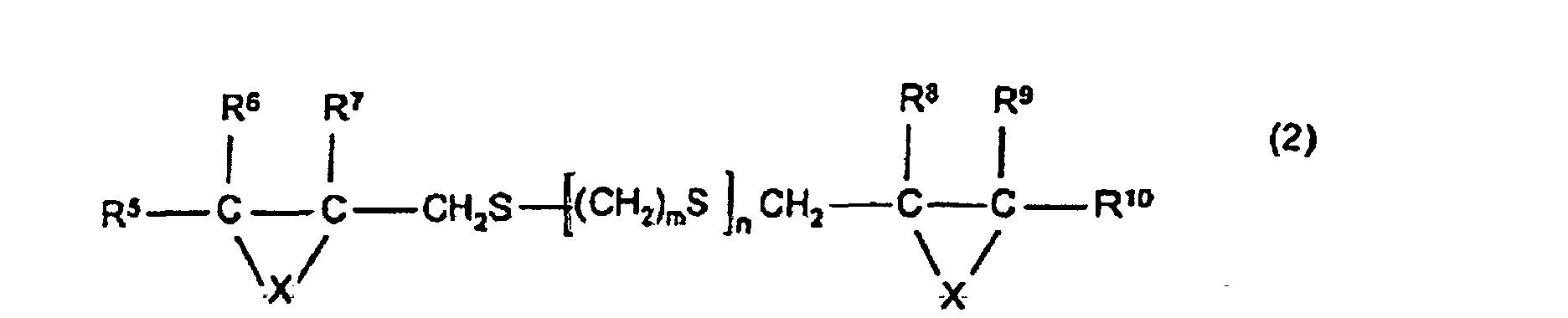
X est S ou O, et un rapport existant de S est de 50 % ou plus en moyenne par rapport au total de S et de O constituant un cycle à trois chaínons ;
m vaut 1 à 6, et
n vaut 0 à 4 ; et(b) un composé ayant un ou plusieurs groupes SH dans une molécule, - Résine qui peut être obtenue en polymérisant une composition telle que décrite dans la revendication 1 ou 2.
- Matériau optique qui peut être obtenu en polymérisant une composition décrite dans la revendication 1 ou 2.
- Procédé de préparation d'une résine, qui comprend l'étape de polymérisation d'une composition décrite dans la revendication 1 ou 2.
Applications Claiming Priority (3)
| Application Number | Priority Date | Filing Date | Title |
|---|---|---|---|
| JP10472497A JP3465528B2 (ja) | 1997-04-22 | 1997-04-22 | 新規な光学材料用樹脂 |
| JP10472497 | 1997-04-22 | ||
| EP98107185A EP0874016B1 (fr) | 1997-04-22 | 1998-04-21 | Résine pour matériau optique |
Related Parent Applications (1)
| Application Number | Title | Priority Date | Filing Date |
|---|---|---|---|
| EP98107185.5 Division | 1998-04-21 |
Publications (2)
| Publication Number | Publication Date |
|---|---|
| EP1270645A1 EP1270645A1 (fr) | 2003-01-02 |
| EP1270645B1 true EP1270645B1 (fr) | 2005-12-14 |
Family
ID=14388452
Family Applications (2)
| Application Number | Title | Priority Date | Filing Date |
|---|---|---|---|
| EP98107185A Expired - Lifetime EP0874016B1 (fr) | 1997-04-22 | 1998-04-21 | Résine pour matériau optique |
| EP02021523A Expired - Lifetime EP1270645B1 (fr) | 1997-04-22 | 1998-04-21 | Résine pour matériau optique |
Family Applications Before (1)
| Application Number | Title | Priority Date | Filing Date |
|---|---|---|---|
| EP98107185A Expired - Lifetime EP0874016B1 (fr) | 1997-04-22 | 1998-04-21 | Résine pour matériau optique |
Country Status (4)
| Country | Link |
|---|---|
| US (1) | US6117923A (fr) |
| EP (2) | EP0874016B1 (fr) |
| JP (1) | JP3465528B2 (fr) |
| DE (2) | DE69817247T2 (fr) |
Families Citing this family (95)
| Publication number | Priority date | Publication date | Assignee | Title |
|---|---|---|---|---|
| US6204311B1 (en) | 1998-03-13 | 2001-03-20 | Mitsui Chemicals, Inc. | Polymerizable composition |
| EP0950905A3 (fr) * | 1998-03-26 | 2002-02-13 | Mitsubishi Gas Chemical Company, Inc. | Procédé pour la préparation d'une nouvelle résine utilisable comme matériau optique représentant une tonalité de couleurs et une transparence excellente |
| DE69903234T2 (de) * | 1998-08-07 | 2003-09-11 | Mitsubishi Gas Chemical Co., Inc. | Etherverbindung und dieses verwendendes gehärtetes Harz |
| JP4920126B2 (ja) * | 1998-08-17 | 2012-04-18 | 三菱瓦斯化学株式会社 | エピチオ構造を有する化合物の処理方法 |
| WO2000026272A1 (fr) * | 1998-10-29 | 2000-05-11 | Essilor International Compagnie Generale D'optique | Compositions polymerisables pour produire des resines a groupement thio contenant un catalyseur au sel, ainsi que procede pour fabriquer des articles en resines a groupement thio |
| EP1006374B1 (fr) * | 1998-12-01 | 2009-01-07 | Mitsubishi Gas Chemical Company, Inc. | Procédé pour la production d'une résine à indice de réfraction élevée |
| DE69921991T2 (de) * | 1999-02-08 | 2005-11-03 | The Yokohama Rubber Co., Ltd. | Harzzusammensetzungen |
| JP4682391B2 (ja) * | 1999-03-16 | 2011-05-11 | 三菱瓦斯化学株式会社 | エピスルフィド化合物の保存方法 |
| JP4682392B2 (ja) * | 1999-03-19 | 2011-05-11 | 三菱瓦斯化学株式会社 | エピスルフィド化合物の精製方法 |
| JP3676138B2 (ja) * | 1999-09-20 | 2005-07-27 | Hoya株式会社 | 紫外線吸収性に優れたプラスチック眼鏡レンズ及びその製造方法 |
| JP4837158B2 (ja) * | 1999-11-22 | 2011-12-14 | 新日鐵化学株式会社 | 光学材料用樹脂組成物 |
| JP2001131257A (ja) | 1999-11-09 | 2001-05-15 | Mitsubishi Gas Chem Co Inc | 樹脂用組成物 |
| WO2001034676A1 (fr) * | 1999-11-09 | 2001-05-17 | Nippon Steel Chemical Co., Ltd. | Composition de resine contenant un episulfure aromatique et un materiau optique |
| JP4651768B2 (ja) * | 1999-12-27 | 2011-03-16 | 新日鐵化学株式会社 | 新規な芳香族エピスルフィド化合物、これを含有する組成物及び硬化物 |
| US6631021B2 (en) * | 2000-03-20 | 2003-10-07 | Ppg Industries Ohio, Inc. | Polyfunctional thiirane compounds |
| DE60110967T2 (de) | 2000-03-27 | 2005-10-27 | Mitsui Chemicals, Inc. | Polythiol, polymerisierbare Zusammensetzung, Harz und Linse und Verfahren zur Herstellung der Thiolverbindung |
| US6417322B1 (en) * | 2000-09-25 | 2002-07-09 | Essilor International Compagnie General D'optique | Episulfide based polymerizable composition catalyzed by an (alkoxyphenyl)phosphine, articles made therefrom and process for making same |
| JP3562579B2 (ja) * | 2000-10-13 | 2004-09-08 | 三菱瓦斯化学株式会社 | 光学材料用組成物 |
| JP2004209968A (ja) * | 2002-12-18 | 2004-07-29 | Seiko Epson Corp | プラスチックレンズの製造方法及び原料貯蔵供給装置 |
| WO2005010114A1 (fr) | 2003-07-24 | 2005-02-03 | Mitsubishi Gas Chemical Company, Inc. | Composition de revetement, film de revetement fabrique au moyen de cette composition, et article optique |
| JP4929595B2 (ja) * | 2005-01-18 | 2012-05-09 | 三菱瓦斯化学株式会社 | 封止樹脂用組成物 |
| EP1944329A4 (fr) * | 2005-10-31 | 2009-12-23 | Ube Industries | Poly(thio)epoxide de polythiocarbonate |
| EP1953182A4 (fr) * | 2005-10-31 | 2009-12-23 | Ube Industries | Composition polymerisable et polythioether de polythiocarbonate |
| US8466953B2 (en) * | 2006-06-02 | 2013-06-18 | Nokia Corporation | Stereoscopic exit pupil expander display |
| WO2007141587A1 (fr) | 2006-06-02 | 2007-12-13 | Nokia Corporation | Distribution de couleurs dans des expanseurs de pupilles de sortie |
| WO2007141588A1 (fr) * | 2006-06-02 | 2007-12-13 | Nokia Corporation | Expanseur de pupille de sortie à substrat séparé |
| TWI482814B (zh) | 2007-03-16 | 2015-05-01 | Mitsubishi Gas Chemical Co | 光學材料用樹脂組成物及由該組成物得到之光學材料 |
| WO2009014112A1 (fr) * | 2007-07-26 | 2009-01-29 | Nippon Steel Chemical Co., Ltd. | Matériau d'enregistrement d'hologramme de phase volumique et support d'enregistrement d'informations optique l'utilisant |
| JP5130940B2 (ja) * | 2007-10-12 | 2013-01-30 | 三菱瓦斯化学株式会社 | 光学材料用樹脂組成物 |
| JP5037393B2 (ja) | 2008-03-12 | 2012-09-26 | 富士フイルム株式会社 | 金属酸化物微粒子分散液及び成形体 |
| JP5412760B2 (ja) * | 2008-08-07 | 2014-02-12 | 三菱瓦斯化学株式会社 | 新規な含金属化合物 |
| TW201016778A (en) | 2008-08-28 | 2010-05-01 | Fujifilm Corp | Thermoplastic resin, organic-inorganic hybrid composition and optical parts |
| JP2010138372A (ja) * | 2008-11-13 | 2010-06-24 | Seiko Epson Corp | 樹脂組成物 |
| JP2010195636A (ja) | 2009-02-25 | 2010-09-09 | Fujifilm Corp | 金属酸化物微粒子、金属酸化物微粒子分散液、及び成形体 |
| JPWO2011102286A1 (ja) * | 2010-02-16 | 2013-06-17 | 株式会社ダイセル | 硬化性組成物及び硬化物 |
| CN102762637B (zh) | 2010-02-25 | 2015-04-01 | 三菱瓦斯化学株式会社 | 光学材料用组合物和其制造方法以及由光学材料用组合物得到的光学材料 |
| WO2012066744A1 (fr) | 2010-11-17 | 2012-05-24 | 三菱瓦斯化学株式会社 | Composition pour matériau optique |
| US9334345B2 (en) * | 2011-09-08 | 2016-05-10 | Ppg Industries Ohio, Inc. | Polymerizable compositions containing (meth)acrylate monomers having sulfide linkages |
| US9051426B2 (en) * | 2011-09-08 | 2015-06-09 | Ppg Industries Ohio, Inc. | Polymerizable compositions containing ethylenically unsaturated monomers having episulfide functional groups and related methods |
| US9518153B2 (en) | 2012-03-01 | 2016-12-13 | Mitsubishi Gas Chemical Company, Inc. | Polymerizable composition for optical materials |
| US9279907B2 (en) * | 2012-12-05 | 2016-03-08 | Ppg Industries Ohio, Inc. | Epoxide and thioepoxide functional, polymerizable compositions and methods of preparing optical articles therefrom |
| TWI601720B (zh) | 2013-03-14 | 2017-10-11 | 三菱瓦斯化學股份有限公司 | Novel episulfide and optical material compositions |
| BR112016006703A2 (pt) | 2013-09-30 | 2017-08-01 | Hoya Lens Thailand Ltd | substrato de plástico transparente e lente de plástico |
| WO2015056665A1 (fr) | 2013-10-15 | 2015-04-23 | 三菱瓦斯化学株式会社 | Composition de matériau optique et matériau optique l'utilisant |
| KR102279400B1 (ko) | 2013-11-01 | 2021-07-21 | 미쯔비시 가스 케미칼 컴파니, 인코포레이티드 | 폴리티올 화합물 및 그 제조방법 |
| TWI619707B (zh) | 2013-12-11 | 2018-04-01 | Mitsubishi Gas Chemical Co | Novel thiol compound and composition for optical material using the same |
| TWI697516B (zh) | 2014-04-23 | 2020-07-01 | 日商三菱瓦斯化學股份有限公司 | 環硫系樹脂硬化物之製造方法 |
| TWI699389B (zh) | 2014-07-18 | 2020-07-21 | 日商三菱瓦斯化學股份有限公司 | 聚硫醇組成物及其製造方法 |
| JP6565160B2 (ja) * | 2014-10-23 | 2019-08-28 | 三菱瓦斯化学株式会社 | 硬化性組成物および光学接着剤 |
| EP3229061B1 (fr) * | 2014-12-04 | 2020-11-04 | Mitsubishi Gas Chemical Company, Inc. | Lentille avec une feuille fonctionnelle comprenant une résine polyester |
| EP3062142B1 (fr) | 2015-02-26 | 2018-10-03 | Nokia Technologies OY | Appareil pour un dispositif d'affichage proche |
| CN107250124B (zh) | 2015-03-24 | 2018-07-13 | 三菱瓦斯化学株式会社 | 新型的硫化合物及包含其的光学材料用组合物 |
| US9902708B2 (en) | 2015-03-27 | 2018-02-27 | Mitsubishi Gas Chemical Company, Inc. | Cyclic compound and optical material composition including same |
| CN107207728B (zh) | 2015-03-31 | 2018-06-12 | 三菱瓦斯化学株式会社 | 新型环硫化合物以及包含其的光学材料组合物 |
| WO2016111385A1 (fr) | 2015-03-31 | 2016-07-14 | 三菱瓦斯化学株式会社 | Composition de matériau optique et son application |
| EP3208268B1 (fr) | 2015-03-31 | 2018-06-27 | Mitsubishi Gas Chemical Company, Inc. | Nouveau composé épisulfure et composition de matériau optique le contenant |
| EP3745167A1 (fr) * | 2015-04-07 | 2020-12-02 | Magic Leap, Inc. | Réseau de diffraction et procédé de fabrication |
| WO2017163794A1 (fr) * | 2016-03-24 | 2017-09-28 | 三菱瓦斯化学株式会社 | Nouvelle composition de composé thiol pour matériau optique |
| US10650552B2 (en) | 2016-12-29 | 2020-05-12 | Magic Leap, Inc. | Systems and methods for augmented reality |
| EP4300160A3 (fr) | 2016-12-30 | 2024-05-29 | Magic Leap, Inc. | Appareil de découplage de lumière polychromatique, affichages proches de l' il le comprenant, et procédé de découplage de lumière polychromatique |
| JP7014188B2 (ja) | 2017-02-17 | 2022-02-01 | 三菱瓦斯化学株式会社 | 光学材料用組成物 |
| US10578870B2 (en) | 2017-07-26 | 2020-03-03 | Magic Leap, Inc. | Exit pupil expander |
| KR20250138816A (ko) | 2017-12-10 | 2025-09-22 | 매직 립, 인코포레이티드 | 광학 도파관들 상의 반사―방지 코팅들 |
| KR102761610B1 (ko) | 2017-12-20 | 2025-01-31 | 매직 립, 인코포레이티드 | 증강 현실 뷰잉 디바이스용 인서트 |
| US10755676B2 (en) | 2018-03-15 | 2020-08-25 | Magic Leap, Inc. | Image correction due to deformation of components of a viewing device |
| EP3803488A4 (fr) | 2018-05-30 | 2021-07-28 | Magic Leap, Inc. | Configurations de focales variables compactes |
| US11885871B2 (en) | 2018-05-31 | 2024-01-30 | Magic Leap, Inc. | Radar head pose localization |
| EP3804306B1 (fr) | 2018-06-05 | 2023-12-27 | Magic Leap, Inc. | Étalonnage de température basé sur des matrices de transformation homographique d'un système de visualisation |
| EP3803545B1 (fr) | 2018-06-08 | 2025-02-26 | Magic Leap, Inc. | Visionneuse de réalité augmentée avec placement de sélection de surface automatisé et placement d'orientation de contenu |
| WO2020010097A1 (fr) | 2018-07-02 | 2020-01-09 | Magic Leap, Inc. | Modulation d'intensité de pixel en utilisant la modification de valeurs de gain |
| US11856479B2 (en) | 2018-07-03 | 2023-12-26 | Magic Leap, Inc. | Systems and methods for virtual and augmented reality along a route with markers |
| WO2020010226A1 (fr) | 2018-07-03 | 2020-01-09 | Magic Leap, Inc. | Systèmes et procédés pour des applications de réalité virtuelle et de réalité augmentée |
| JP7374981B2 (ja) | 2018-07-10 | 2023-11-07 | マジック リープ, インコーポレイテッド | クロス命令セットアーキテクチャプロシージャ呼出のためのスレッドウィービング |
| US11598651B2 (en) | 2018-07-24 | 2023-03-07 | Magic Leap, Inc. | Temperature dependent calibration of movement detection devices |
| TWI799606B (zh) | 2018-07-24 | 2023-04-21 | 日商三菱瓦斯化學股份有限公司 | 環硫化合物及光學材料用組成物 |
| US11624929B2 (en) | 2018-07-24 | 2023-04-11 | Magic Leap, Inc. | Viewing device with dust seal integration |
| EP4650919A3 (fr) | 2018-08-02 | 2026-01-21 | Magic Leap, Inc. | Système de visualisation avec compensation de distance interpupillaire sur la base du mouvement de la tête |
| EP3830631A4 (fr) | 2018-08-03 | 2021-10-27 | Magic Leap, Inc. | Correction de dérive basée sur une pose non fusionnée d'une pose fusionnée d'un totem dans un système d'interaction d'utilisateur |
| CN112955073B (zh) | 2018-08-22 | 2025-01-28 | 奇跃公司 | 患者观察系统 |
| WO2020076822A1 (fr) | 2018-10-12 | 2020-04-16 | Magic Leap, Inc. | Système de détermination de stade pour vérifier la précision d'un système de suivi de mouvement |
| CN113196138B (zh) | 2018-11-16 | 2023-08-25 | 奇跃公司 | 用于保持图像清晰度的图像尺寸触发的澄清 |
| CN113454507B (zh) | 2018-12-21 | 2024-05-07 | 奇跃公司 | 用于促进波导内的全内反射的气穴结构 |
| JP7515489B2 (ja) | 2019-02-06 | 2024-07-12 | マジック リープ, インコーポレイテッド | 複数のプロセッサによって発生される総熱を限定するための標的意図ベースのクロック速度の決定および調節 |
| EP3939030B1 (fr) | 2019-03-12 | 2025-10-29 | Magic Leap, Inc. | Enregistrement d'un contenu local entre des premier et second visualiseurs de réalité augmentée |
| WO2020223636A1 (fr) | 2019-05-01 | 2020-11-05 | Magic Leap, Inc. | Système et procédé de fourniture de contenu |
| WO2021021670A1 (fr) | 2019-07-26 | 2021-02-04 | Magic Leap, Inc. | Systèmes et procédés de réalité augmentée |
| WO2021029693A1 (fr) | 2019-08-14 | 2021-02-18 | 주식회사 엘지화학 | Plaque de guidage de lumière à diffraction et son procédé de fabrication |
| WO2021097318A1 (fr) | 2019-11-14 | 2021-05-20 | Magic Leap, Inc. | Systèmes et procédés pour réalité virtuelle et augmentée |
| EP4058979A4 (fr) | 2019-11-15 | 2023-01-11 | Magic Leap, Inc. | Système de visualisation à utiliser dans un environnement chirurgical |
| CN113278149A (zh) | 2020-02-19 | 2021-08-20 | 株式会社大赛璐 | 聚硫醚化合物的制造方法 |
| EP4160279A4 (fr) | 2020-05-27 | 2023-12-13 | Mitsubishi Gas Chemical Company, Inc. | Composition pour matériau optique |
| KR20240044468A (ko) | 2021-09-30 | 2024-04-04 | 호야 렌즈 타일랜드 리미티드 | 광학 부재용 모노머, 광학 부재용 중합성 조성물, 경화물, 안경 렌즈 및 광학 부재용 모노머의 제조 방법 |
| KR20240039003A (ko) | 2021-09-30 | 2024-03-26 | 호야 렌즈 타일랜드 리미티드 | 광학 부재용 모노머, 광학 부재용 중합성 조성물, 경화물, 및 안경 렌즈 |
| KR20260011679A (ko) | 2023-05-18 | 2026-01-23 | 미쯔비시 가스 케미칼 컴파니, 인코포레이티드 | 에피설파이드 수지를 출발원료로 한 4관능 티올의 제조방법 |
| WO2025258697A1 (fr) * | 2024-06-14 | 2025-12-18 | ホヤ レンズ タイランド リミテッド | Procédé de production d'un substrat de résine |
Family Cites Families (8)
| Publication number | Priority date | Publication date | Assignee | Title |
|---|---|---|---|---|
| GB1105603A (en) | 1964-04-23 | 1968-03-06 | Dunlop Co Ltd | Process for the polymerization of episulphides |
| CA992105A (en) * | 1970-03-26 | 1976-06-29 | Exxon Research And Engineering Company | Polythioethers formed by anionic ring opening of episulfides |
| CN1040810A (zh) * | 1988-04-30 | 1990-03-28 | 三井东圧化学株式会社 | 多硫化合物基树脂透镜及其制备方法 |
| WO1991019674A1 (fr) * | 1990-06-13 | 1991-12-26 | Ppg Industries, Inc. | Polymeres ayant un indice de refraction et une temperature de deformation a chaud eleves |
| US5182340A (en) | 1990-10-09 | 1993-01-26 | The Dow Chemical Company | Blends of mesogenic polythiiranes, epoxy resin and curing agent |
| CA2173219C (fr) * | 1993-11-03 | 2000-05-30 | Steven Andrew Jorissen | Compositions de resine epoxy thermodurcissables renforcees |
| US5807975A (en) * | 1995-08-16 | 1998-09-15 | Mitsubishi Gas Chemical Company,Inc. | Alkyl sulfide type episulfide compound |
| JP3864998B2 (ja) * | 1995-09-08 | 2007-01-10 | 三菱瓦斯化学株式会社 | 新規な分岐アルキルスルフィド型エピスルフィド化合物 |
-
1997
- 1997-04-22 JP JP10472497A patent/JP3465528B2/ja not_active Expired - Lifetime
-
1998
- 1998-04-20 US US09/063,258 patent/US6117923A/en not_active Expired - Lifetime
- 1998-04-21 DE DE69817247T patent/DE69817247T2/de not_active Expired - Lifetime
- 1998-04-21 EP EP98107185A patent/EP0874016B1/fr not_active Expired - Lifetime
- 1998-04-21 EP EP02021523A patent/EP1270645B1/fr not_active Expired - Lifetime
- 1998-04-21 DE DE69832829T patent/DE69832829T2/de not_active Expired - Lifetime
Also Published As
| Publication number | Publication date |
|---|---|
| DE69832829T2 (de) | 2006-07-13 |
| DE69817247D1 (de) | 2003-09-25 |
| JP3465528B2 (ja) | 2003-11-10 |
| EP0874016A3 (fr) | 2000-12-06 |
| DE69832829D1 (de) | 2006-01-19 |
| EP0874016B1 (fr) | 2003-08-20 |
| DE69817247T2 (de) | 2004-06-17 |
| JPH10298287A (ja) | 1998-11-10 |
| EP1270645A1 (fr) | 2003-01-02 |
| EP0874016A2 (fr) | 1998-10-28 |
| US6117923A (en) | 2000-09-12 |
Similar Documents
| Publication | Publication Date | Title |
|---|---|---|
| EP0874016B1 (fr) | Résine pour matériau optique | |
| EP0785194B1 (fr) | Composé d'épisulfide | |
| US6130307A (en) | Composition for a resin | |
| EP1099721B1 (fr) | Composition pour la production de résines | |
| EP0761665B1 (fr) | Composés de sulfide alcoyle contenant des groupes épisulfide | |
| EP0921417B1 (fr) | Compositions de résine epoxy/episulfure pour materiaux optiques | |
| EP0978513B1 (fr) | Composés éthers et résines durcies les utilisant | |
| EP1046931A2 (fr) | Composition pour matériau optique | |
| US6201061B1 (en) | Process for producing a novel resin for optical materials having excellent color tone and transparency | |
| JPH11180977A (ja) | 新規なエピスルフィド化合物 | |
| JP3541707B2 (ja) | 樹脂用組成物 | |
| JP3772544B2 (ja) | 光学用樹脂組成物、光学用樹脂及びプラスチックレンズ | |
| JP2000109478A (ja) | 新規なエ―テル化合物およびそれを用いた硬化樹脂 | |
| JP2003176358A (ja) | 新規な光学材料用樹脂 | |
| JP3871062B2 (ja) | 新規な光学材料用樹脂 | |
| JPH11335560A (ja) | 色調および透明性に優れた光学材料用樹脂の製造方法 | |
| JP4186904B2 (ja) | 新規な樹脂用組成物 | |
| JP3736114B2 (ja) | 光学用樹脂組成物、光学用樹脂硬化物及びプラスチックレンズ | |
| JP2004115816A (ja) | 新規な光学材料用樹脂 | |
| JP2004269897A (ja) | 新規な光学材料用樹脂 | |
| JP2004238635A (ja) | 新規な光学材料用樹脂 | |
| JP2002363178A (ja) | 新規な光学材料用樹脂 | |
| JP2005281703A (ja) | 新規な光学材料用樹脂 | |
| JP2006257421A (ja) | 新規なエピスルフィド化合物 |
Legal Events
| Date | Code | Title | Description |
|---|---|---|---|
| PUAI | Public reference made under article 153(3) epc to a published international application that has entered the european phase |
Free format text: ORIGINAL CODE: 0009012 |
|
| AC | Divisional application: reference to earlier application |
Ref document number: 874016 Country of ref document: EP |
|
| AK | Designated contracting states |
Kind code of ref document: A1 Designated state(s): DE FR GB IT |
|
| 17P | Request for examination filed |
Effective date: 20030604 |
|
| AKX | Designation fees paid |
Designated state(s): DE FR GB IT |
|
| 17Q | First examination report despatched |
Effective date: 20040127 |
|
| GRAP | Despatch of communication of intention to grant a patent |
Free format text: ORIGINAL CODE: EPIDOSNIGR1 |
|
| GRAS | Grant fee paid |
Free format text: ORIGINAL CODE: EPIDOSNIGR3 |
|
| GRAA | (expected) grant |
Free format text: ORIGINAL CODE: 0009210 |
|
| AC | Divisional application: reference to earlier application |
Ref document number: 0874016 Country of ref document: EP Kind code of ref document: P |
|
| AK | Designated contracting states |
Kind code of ref document: B1 Designated state(s): DE FR GB IT |
|
| REG | Reference to a national code |
Ref country code: GB Ref legal event code: FG4D |
|
| REF | Corresponds to: |
Ref document number: 69832829 Country of ref document: DE Date of ref document: 20060119 Kind code of ref document: P |
|
| ET | Fr: translation filed | ||
| PLBE | No opposition filed within time limit |
Free format text: ORIGINAL CODE: 0009261 |
|
| 26N | No opposition filed |
Effective date: 20060915 |
|
| REG | Reference to a national code |
Ref country code: FR Ref legal event code: PLFP Year of fee payment: 19 |
|
| REG | Reference to a national code |
Ref country code: FR Ref legal event code: PLFP Year of fee payment: 20 |
|
| PGFP | Annual fee paid to national office [announced via postgrant information from national office to epo] |
Ref country code: FR Payment date: 20170313 Year of fee payment: 20 |
|
| PGFP | Annual fee paid to national office [announced via postgrant information from national office to epo] |
Ref country code: DE Payment date: 20170420 Year of fee payment: 20 Ref country code: GB Payment date: 20170419 Year of fee payment: 20 |
|
| PGFP | Annual fee paid to national office [announced via postgrant information from national office to epo] |
Ref country code: IT Payment date: 20170420 Year of fee payment: 20 |
|
| REG | Reference to a national code |
Ref country code: DE Ref legal event code: R071 Ref document number: 69832829 Country of ref document: DE |
|
| REG | Reference to a national code |
Ref country code: GB Ref legal event code: PE20 Expiry date: 20180420 |
|
| PG25 | Lapsed in a contracting state [announced via postgrant information from national office to epo] |
Ref country code: GB Free format text: LAPSE BECAUSE OF EXPIRATION OF PROTECTION Effective date: 20180420 |