EP1271631A1 - Procédé de fabrication de dispositifs semi-conducteurs utilisant un polissage mécano-chimique - Google Patents
Procédé de fabrication de dispositifs semi-conducteurs utilisant un polissage mécano-chimique Download PDFInfo
- Publication number
- EP1271631A1 EP1271631A1 EP01870148A EP01870148A EP1271631A1 EP 1271631 A1 EP1271631 A1 EP 1271631A1 EP 01870148 A EP01870148 A EP 01870148A EP 01870148 A EP01870148 A EP 01870148A EP 1271631 A1 EP1271631 A1 EP 1271631A1
- Authority
- EP
- European Patent Office
- Prior art keywords
- layer
- cmp
- areas
- resistant
- dielectric
- Prior art date
- Legal status (The legal status is an assumption and is not a legal conclusion. Google has not performed a legal analysis and makes no representation as to the accuracy of the status listed.)
- Ceased
Links
Images
Classifications
-
- H—ELECTRICITY
- H10—SEMICONDUCTOR DEVICES; ELECTRIC SOLID-STATE DEVICES NOT OTHERWISE PROVIDED FOR
- H10W—GENERIC PACKAGES, INTERCONNECTIONS, CONNECTORS OR OTHER CONSTRUCTIONAL DETAILS OF DEVICES COVERED BY CLASS H10
- H10W10/00—Isolation regions in semiconductor bodies between components of integrated devices
- H10W10/10—Isolation regions comprising dielectric materials
- H10W10/17—Isolation regions comprising dielectric materials formed using trench refilling with dielectric materials, e.g. shallow trench isolations
-
- H—ELECTRICITY
- H10—SEMICONDUCTOR DEVICES; ELECTRIC SOLID-STATE DEVICES NOT OTHERWISE PROVIDED FOR
- H10P—GENERIC PROCESSES OR APPARATUS FOR THE MANUFACTURE OR TREATMENT OF DEVICES COVERED BY CLASS H10
- H10P95/00—Generic processes or apparatus for manufacture or treatments not covered by the other groups of this subclass
- H10P95/06—Planarisation of inorganic insulating materials
- H10P95/062—Planarisation of inorganic insulating materials involving a dielectric removal step
-
- H—ELECTRICITY
- H10—SEMICONDUCTOR DEVICES; ELECTRIC SOLID-STATE DEVICES NOT OTHERWISE PROVIDED FOR
- H10W—GENERIC PACKAGES, INTERCONNECTIONS, CONNECTORS OR OTHER CONSTRUCTIONAL DETAILS OF DEVICES COVERED BY CLASS H10
- H10W10/00—Isolation regions in semiconductor bodies between components of integrated devices
- H10W10/01—Manufacture or treatment
- H10W10/011—Manufacture or treatment of isolation regions comprising dielectric materials
- H10W10/014—Manufacture or treatment of isolation regions comprising dielectric materials using trench refilling with dielectric materials, e.g. shallow trench isolations
- H10W10/0143—Manufacture or treatment of isolation regions comprising dielectric materials using trench refilling with dielectric materials, e.g. shallow trench isolations comprising concurrently refilling multiple trenches having different shapes or dimensions
Definitions
- the present invention is related to methods for producing semiconductor devices, comprising at least one production step wherein the technique of chemical mechanical polishing (CMP) is used, and to devices obtained by said methods.
- CMP chemical mechanical polishing
- CMOS processing electrical isolation of adjacent devices, for example transistors, is crucial. This isolation is commonly obtained in the first stages of the production process by forming a buried dielectric between devices, for which several techniques have been documented. Now that the scaling of semiconductor technologies is being taken into the deep submicron dimensions, many of the older methods (such as LOCOS based techniques) are no longer usable. Shallow trench isolation in combination with chemical mechanical polishing (STI-CMP) is now widely accepted as the isolation technique of choice for sub-0.25 ⁇ m technologies.
- STI-CMP chemical mechanical polishing
- CMP forms a crucial step. This is the case for example in replacement gate techniques, wherein the polishing of the pre-metal dielectric (PMD) layer on top of the dummy gate stacks of the transistors on the device is of great importance.
- PMD pre-metal dielectric
- a nitride or other CMP resistant layer is deposited onto a semiconductor (in many cases a silicon) wafer, after which shallow trenches are etched into the wafer, leaving islands of nitride, which are later to become the locations of active areas (transistors, etc.).
- the trenches are then filled with oxide, for example by a chemical vapour deposition (CVD) technique, to form the dielectric areas, also called 'field regions' in between the active areas.
- CVD chemical vapour deposition
- One of the main problems is the difficulty of implementing a CMP process with good overall uniformity, without excessive oxide loss in the field regions ('dishing') and without eroding the nitride layer that covers small and especially isolated active areas, which is due to a difference in polish rate between said field regions and said active areas.
- a known solution to this problem is the introduction of 'dummy' active areas, in order to obtain a more uniform density of nitride-covered areas over the wafer's surface, thus avoiding the dishing phenomenon.
- HDP-CVD High Density Plasma-CVD
- a conformal layer on the other hand, such as obtained by Low Pressure CVD or conventional Plasma Enhanced CVD techniques, covers the whole of the substrate surface, including dense regions with an even layer of near constant thickness.
- HDP-CVD is preferred in current STI processing, since it is the method with the best gap filling capability.
- the surface topology after trench filling by HDP-CVD is however very uneven, which causes difficulties when applying CMP : the small volumes of HDP-oxide with triangular cross section on top of small active areas tend to be polished too quickly in comparison with the larger volumes on top of large active areas. This brings about the risk of nitride erosion on top of small active areas and dishing of field regions if polishing times are too long. Reduction of polishing times may solve this problem, but will increase the danger of an insufficient oxide removal on large active areas.
- a second nitride layer is deposited above the trench filling oxide layer, prior to CMP. This second nitride layer acts as a CMP resistant layer above the large field regions, that way reducing the dishing effect.
- an additional patterning step is done after the deposition of the second nitride layer.
- the pattern obtained is such that a layer of nitride is left intact only on the large field regions. This effectively reduces the dishing effect, but the uneven topology prior to CMP remains a problem.
- the nitride layers on small active areas are in danger of being attacked by the polishing before all the oxide on larger active areas is removed.
- the present invention aims to propose a process wherein a combination of actions is taken in order to prevent dishing of large field regions and/or excessive polishing on the active areas, during a CMP step.
- the invention aims to propose a new CMP resistant layer which allows a better selectivity of the polishing process.
- the process of the invention aims to provide a solution to the specific problem of the HDP oxide deposition on dense structures and/or small isolated active areas.
- the present invention is related to a method for producing semiconductor devices from a semiconductor substrate, comprising the following steps :
- At least one of said elevated areas has a rectangular top surface and said dimension is the width of said rectangular top surface.
- said predefined minimum is 1.8 ⁇ m.
- the surface, parallel to the substrate, of said parts that are removed, is not larger than the surface of said elevated areas above which said parts are situated.
- said first and/or said second CMP resistant layers may be silicon nitride layers.
- One or both of these layers may alternatively be silicon carbide layers.
- the forming of said first and/or second layer of CMP resistant material comprises the following steps :
- Said Si x O y N z layer may deposited on top of a Silicon nitride layer, or on top of a silicon carbide layer, or directly on top of said layer of a dielectric material.
- said thermal anneal takes place at a temperature which is lying between 1050°C and 1100°C and during a period of time between 10 minutes and 40 minutes.
- said Si x O y N z layer has a thickness, before the anneal step, of at least 60nm.
- said dielectric layer is formed by a high density plasma technique.
- said elevated areas and said areas at a lower level are created using the technique of Shallow Trench Isolation.
- said elevated areas consist of dummy gate stacks in a replacement gate technique.
- the invention is equally related to a device obtained by the method according to the invention.
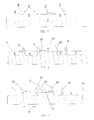
- Fig. 1 represents a stage in the process according to the invention, prior to the deposition of the trench filling oxide.
- Fig. 2 represents a stage in the process according to the invention after the deposition of a second CMP resistant layer.
- Fig. 3 represents a stage in the process according to the invention after the 'clear-out' operation.
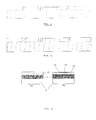
- Fig. 4 represents a stage in the process according to the invention after the CMP-step.
- Fig. 5 represents the wafer's surface after removal of both CMP resistant layers.
- Fig. 6 illustrates the process according to the invention of obtaining a CMP resistant layer, using silicon-oxy-nitride.
- the invention is related to a method for producing semiconductor devices, starting from a semiconductor substrate, such as a silicon wafer.
- the characteristic part of the invention relates only to a number of steps in the production process, namely a number of steps up to and including the Chemical Mechanical Polishing step.
- the main characteristic steps of the method of the invention can be summarised as follows, with reference to the figures 1 to 5 :
- the steps can be found in different stages of a production process.
- the steps are applicable for performing STI-CMP in the beginning of the production process, leading to a very good polishing quality when HDP oxide is used as the trench filling oxide.
- the elevated areas 2 are the active areas, having preferably a nitride layer 4 on top, and the lower level areas 5 are the trenches formed by STI.
- the step sequence described above might be used in other parts of the CMOS process, even though not all of the advantages relevant to the use of the steps in STI-CMP may be retained.
- the method of the invention is applicable as such.
- the elevated areas 2 are the dummy gate stacks themselves.
- the lower level areas 5 then include the field regions consisting of field oxide and the parts of the active areas surrounding the gate stacks. It is to be noted that a level difference exists between the field oxide and the parts surrounding the gate stacks.
- the 'elevated areas' mentioned in the previous method steps refer only to the dummy gate stacks, in this particular case.
- FIGS 1 to 5 illustrate this process.
- a semiconductor substrate 1, preferably a silicon wafer is provided, upon which an silicon oxide layer 3 and a CMP resistant layer 4, preferably a silicon nitride layer (Si 3 N 4 ), are consecutively deposited, after which trenches 5 are patterned (by a litho and etch step), leaving islands 2, or so-called 'active areas'.
- Figure 1 shows the condition after these first steps.
- a layer 6 of HDP oxide is deposited, and on top of that, a second layer 7 of a CMP resistant material, see figure 2.
- a 'clear-out' is done above the large active areas, i.e. a litho step and an etch step to remove part of the second CMP resistant layer 7 and part of the HDP oxide layer 6 in a well defined region 8 above each of said large active areas, see figure 3.
- the minimum size of what is called a 'large' active area is to be defined on the basis of the process parameters.
- an oxide body with a flat top 15 and slanted sides 20 is formed on active areas larger than a given size, while a triangular-shaped oxide body is formed on anything smaller than this predefined size.
- a flat top 15 is formed on areas with a rectangular top surface, and with a width larger than 1.2 ⁇ m.
- the 'clear-out' is done above active areas with a width larger than 1.8 ⁇ m.
- the surface area of the region 8 is preferably smaller than the horizontal projection of the whole HDP oxide body on top of the active area concerned, including the slanted edges 20.
- the region 8, as seen in the cross section of figure 3, should preferably not go beyond the edges (points 21) of the flat top 15 of the oxide on top of the active area 2. This is to avoid damaging the edges of the actual active area 2 when the HDP oxide is, at least partially, removed during the 'clear-out' step, by an oxide-etching process. If this oxide-etching process is not selective to the CMP resistant layer 4, this layer 4 will be at least partially etched at the edges of the active area, which will result in a lower CMP stopping power at these edges. If too much oxide is removed at the edges, this also brings about the risk of damaging the active areas during the polishing step.
- I-line lithography is used for the patterning of regions 8.
- the area 8 is patterned as being 0.6 ⁇ m smaller than the active areas 2. This relatively simple lithography step allows the use of a mask derived from the active area mask and is therefore easy to implement and at low cost.
- the above mentioned restrictions on size are not limitative to the invention. If other HDP parameters are used and/or a more expensive lithography step, and/or a nitride selective etch step for the 'clear-out', smaller active areas may come into focus for this clear out. Under these conditions, the region 8 may be chosen to be larger than described above. With respect to the uniformity of the CMP process, described after this, it is however highly recommended to leave areas 23 at the edges of large active areas.
- the CMP is done next. As seen in figure 3, only small volumes 22 and 23 remain above the surface level 10.
- the volumes 22 above small active areas have pointed edges at the top : without the layer 7, they would be removed much too quickly by CMP, due to a large local pad pressure on these pointed edges. Now, the layer 7 reduces the polishing speed on these places sufficiently to avoid this phenomenon.
- the volumes 23 at the edges of the active areas are partially covered by the layer 7, which will likewise produce the effect of slowing down the removal speed of these volumes by CMP. These volumes should be sufficiently small to avoid a significant difference in polishing speed between volumes 22 and 23. On the other hand, as already mentioned, these volumes 23 should have a minimum size in order to ensure the protection of the edges of the active areas 2.
- the height of the volumes 23 is in most cases higher than that of the volumes 22, due to the specifics of the HDP process (deposition/etch ratio), in conjunction with the size of the active areas.
- the size of all features 22 and 23 remaining after the clear-out step are of the same order of magnitude.
- all the features (22, 23) protruding above the surface level 10 are polished at a similar reduced polishing speed, due to their similar volume and the fact that they are all at least partially covered by the layer 7 : the resistance to CMP is essentially equal in every part.
- this layer protects the field regions in their totality (for example region 24 in figure 3), and independently of their size. This is contrary to the dual nitride technique, wherein only the central parts of large field regions are protected by a CMP resistant layer. In the method of the invention therefore, the dishing effect is eliminated. Furthermore, differences in polish speed between different parts of the substrate are minimised, so that within one given polish time, all the oxide on the large active areas 2 is efficiently removed, without any of the nitride layer 4 on top of small active areas being eroded, and without any field oxide 6 in any of the field regions (trenches) being removed.
- the polishing step is stopped when the layers 4 and 7 are reached.
- the top surfaces of these layers are at exactly the same height, and polishing is stopped when reaching said height.
- a height difference of maximum 30nm can be allowed. This small difference can be eliminated in the last stages of the CMP process, leaving a completely even surface, as shown in figure 4.
- Figure 5 shows the wafer after removal of the CMP resistant materials.
- both layers 4 and 7 may consist of silicon nitride.
- a semiconductor e.g. a silicon wafer
- both layers 4 and 7 may consist of silicon nitride.
- SiC silicon carbide
- One preferred embodiment uses nitride for the first CMP resistant layer 4 and SiC for the second layer 7.
- the CMP resistant layers may be formed as follows (see figure 6a and 6b), for example in the case of the second CMP resistant layer 7.
- a silicon-oxy-nitride layer (Si x O y N z ) layer 11 is deposited.
- Si x O y N z silicon-oxy-nitride layer
- the atomic percentages (x,y,z) of silicon, oxygen and nitrogen in this layer 11 are variable within limits, as long as a detectable amount of every one of the components Si, O, N is present in the layer 11.
- SiON is used primarily as an anti-reflective coating on the first CMP resistant layer 4.
- the present invention reveals however another useful aspect of a Si x O y N z layer.
- the wafer is subjected to a thermal anneal, preferably between 1050°C and 1100°C, during a period of time, preferably between 10 and 40 minutes.
- a thermal anneal preferably between 1050°C and 1100°C
- Such an anneal step of 27 minutes at 1075°C causes part of the 65nm thick Si x O y N z layer to oxidise leaving a Si x O y N z layer 12 of 45nm, plus on top of that a thin oxide (SiO 2 ) layer 13, approximately 8nm thick, see fig. 6b.
- a chemical reaction has taken place during the anneal step, and created at said interface, a thin layer 14 with an extremely high resistance to CMP.
- This particular CMP resistant layer 14 is not known in the art. According to a preferred embodiment, the layer 14 is formed on top of a silicon nitride layer 7, by the steps described above. The CMP resistant layer 14 may however be obtained by the same process steps on any other layer besides a nitride layer. It may be obtained directly on the field dielectric 6 by said process steps.
- the removal of the thin CMP resistant layer 14 is done by a dry etching technique.
- This may be a known dry etching technique normally used for the removal of nitride layers.
- the difference in height between the field-protecting layers and the active area-protecting layers needs to be controlled and kept within given limits, as was already mentioned.
- the thickness of the second CMP resistant layer 7 is adapted to the thickness of the first layer 4 and of the trench filling oxide, so that the difference in height between the top of layers 4 and 7 does not exceed 30nm.
- a first preferred embodiment of the invention relates to the method of the invention for performing STI-CMP on a silicon wafer, using a SiC layer as the second CMP resistant layer 7.
- What follows is the complete sequence of production steps to obtain the surface as depicted in figure 5, starting from a flat substrate. Only those steps that were described above form characteristic features of the invention.
- the numeric values of layer thicknesses and temperatures are non-restrictive to the patent's scope.
- the following sequence of steps is an example of the method, enabling a person skilled in the art, to perform the method. Any know process step may be performed after this sequence, in order to obtain semiconductor devices, which fall within the scope of the present invention.
- the second embodiment is related to performing STI-CMP, but using a Si x O y N z layer with composition 52% Si, 5% N, 43% O, and thermal treatment to obtain the second CMP resistant layer 7.
- This sequence comprises the exact same steps 1 to 9 as the previous one. After that, the steps are :
Landscapes
- Element Separation (AREA)
Priority Applications (2)
| Application Number | Priority Date | Filing Date | Title |
|---|---|---|---|
| EP01870148A EP1271631A1 (fr) | 2001-06-29 | 2001-06-29 | Procédé de fabrication de dispositifs semi-conducteurs utilisant un polissage mécano-chimique |
| US10/187,382 US7033941B2 (en) | 2001-06-29 | 2002-06-27 | Method of producing semiconductor devices using chemical mechanical polishing |
Applications Claiming Priority (1)
| Application Number | Priority Date | Filing Date | Title |
|---|---|---|---|
| EP01870148A EP1271631A1 (fr) | 2001-06-29 | 2001-06-29 | Procédé de fabrication de dispositifs semi-conducteurs utilisant un polissage mécano-chimique |
Publications (1)
| Publication Number | Publication Date |
|---|---|
| EP1271631A1 true EP1271631A1 (fr) | 2003-01-02 |
Family
ID=8184995
Family Applications (1)
| Application Number | Title | Priority Date | Filing Date |
|---|---|---|---|
| EP01870148A Ceased EP1271631A1 (fr) | 2001-06-29 | 2001-06-29 | Procédé de fabrication de dispositifs semi-conducteurs utilisant un polissage mécano-chimique |
Country Status (2)
| Country | Link |
|---|---|
| US (1) | US7033941B2 (fr) |
| EP (1) | EP1271631A1 (fr) |
Families Citing this family (4)
| Publication number | Priority date | Publication date | Assignee | Title |
|---|---|---|---|---|
| JP4114552B2 (ja) * | 2003-06-10 | 2008-07-09 | ソニー株式会社 | マイクロマシンの製造方法 |
| KR100619394B1 (ko) * | 2004-12-22 | 2006-09-08 | 동부일렉트로닉스 주식회사 | 반도체 소자의 디싱 방지 방법 |
| US8580690B2 (en) | 2011-04-06 | 2013-11-12 | Nanya Technology Corp. | Process of planarizing a wafer with a large step height and/or surface area features |
| US9177815B2 (en) * | 2012-05-04 | 2015-11-03 | Applied Materials, Inc. | Methods for chemical mechanical planarization of patterned wafers |
Citations (12)
| Publication number | Priority date | Publication date | Assignee | Title |
|---|---|---|---|---|
| EP0545263A2 (fr) * | 1991-11-29 | 1993-06-09 | Sony Corporation | Procédé pour former une rainure d'isolation comportant une étape de plissage et procédé pour fabriquer un dispositif semi-conducteur |
| US5362669A (en) * | 1993-06-24 | 1994-11-08 | Northern Telecom Limited | Method of making integrated circuits |
| EP0825645A1 (fr) * | 1996-08-08 | 1998-02-25 | Siemens Aktiengesellschaft | Procédé de bouchage de vides et de planarisation pour une isolation du type à sillon peu profond |
| US5863828A (en) * | 1996-09-25 | 1999-01-26 | National Semiconductor Corporation | Trench planarization technique |
| EP0926715A2 (fr) * | 1997-12-23 | 1999-06-30 | Texas Instruments Incorporated | Polissage mécano-chimique pour la planarisation de couches diélectriques isolantes |
| JPH11214496A (ja) * | 1998-01-22 | 1999-08-06 | Mitsubishi Electric Corp | 半導体装置の製造方法 |
| US5968842A (en) * | 1997-09-12 | 1999-10-19 | United Semiconductor Corp. | Techniques for reduced dishing in chemical mechanical polishing |
| WO2000019509A2 (fr) * | 1998-09-28 | 2000-04-06 | Koninklijke Philips Electronics N.V. | Procede de fabrication d'un dispositif a semiconducteur avec transistor a effet de champ |
| US6048771A (en) * | 1998-04-27 | 2000-04-11 | United Microelectronics Corp. | Shallow trench isolation technique |
| US6159822A (en) * | 1999-06-02 | 2000-12-12 | Vanguard International Semiconductor Corporation | Self-planarized shallow trench isolation |
| US6214695B1 (en) * | 1998-11-25 | 2001-04-10 | Mitsubishi Denki Kabushiki Kaisha | Method of manufacturing semiconductor device |
| US6265295B1 (en) * | 1999-09-03 | 2001-07-24 | Taiwan Semiconductor Manufacturing Company | Method of preventing tilting over |
Family Cites Families (12)
| Publication number | Priority date | Publication date | Assignee | Title |
|---|---|---|---|---|
| US5773871A (en) | 1993-06-24 | 1998-06-30 | Northern Telecom Limited | Integrated circuit structure and method of fabrication thereof |
| US6555476B1 (en) * | 1997-12-23 | 2003-04-29 | Texas Instruments Incorporated | Silicon carbide as a stop layer in chemical mechanical polishing for isolation dielectric |
| US6114249A (en) * | 1998-03-10 | 2000-09-05 | International Business Machines Corporation | Chemical mechanical polishing of multiple material substrates and slurry having improved selectivity |
| US6146975A (en) * | 1998-07-10 | 2000-11-14 | Lucent Technologies Inc. | Shallow trench isolation |
| US6528389B1 (en) * | 1998-12-17 | 2003-03-04 | Lsi Logic Corporation | Substrate planarization with a chemical mechanical polishing stop layer |
| US6261923B1 (en) * | 1999-01-04 | 2001-07-17 | Vanguard International Semiconductor Corporation | Method to solve the dishing issue in CMP planarization by using a nitride hard mask for local inverse etchback and CMP |
| US6290736B1 (en) * | 1999-02-09 | 2001-09-18 | Sharp Laboratories Of America, Inc. | Chemically active slurry for the polishing of noble metals and method for same |
| US6303956B1 (en) * | 1999-02-26 | 2001-10-16 | Micron Technology, Inc. | Conductive container structures having a dielectric cap |
| US6180489B1 (en) * | 1999-04-12 | 2001-01-30 | Vanguard International Semiconductor Corporation | Formation of finely controlled shallow trench isolation for ULSI process |
| US6096656A (en) * | 1999-06-24 | 2000-08-01 | Sandia Corporation | Formation of microchannels from low-temperature plasma-deposited silicon oxynitride |
| US6342432B1 (en) * | 1999-08-11 | 2002-01-29 | Advanced Micro Devices, Inc. | Shallow trench isolation formation without planarization mask |
| US6423628B1 (en) * | 1999-10-22 | 2002-07-23 | Lsi Logic Corporation | Method of forming integrated circuit structure having low dielectric constant material and having silicon oxynitride caps over closely spaced apart metal lines |
-
2001
- 2001-06-29 EP EP01870148A patent/EP1271631A1/fr not_active Ceased
-
2002
- 2002-06-27 US US10/187,382 patent/US7033941B2/en not_active Expired - Lifetime
Patent Citations (12)
| Publication number | Priority date | Publication date | Assignee | Title |
|---|---|---|---|---|
| EP0545263A2 (fr) * | 1991-11-29 | 1993-06-09 | Sony Corporation | Procédé pour former une rainure d'isolation comportant une étape de plissage et procédé pour fabriquer un dispositif semi-conducteur |
| US5362669A (en) * | 1993-06-24 | 1994-11-08 | Northern Telecom Limited | Method of making integrated circuits |
| EP0825645A1 (fr) * | 1996-08-08 | 1998-02-25 | Siemens Aktiengesellschaft | Procédé de bouchage de vides et de planarisation pour une isolation du type à sillon peu profond |
| US5863828A (en) * | 1996-09-25 | 1999-01-26 | National Semiconductor Corporation | Trench planarization technique |
| US5968842A (en) * | 1997-09-12 | 1999-10-19 | United Semiconductor Corp. | Techniques for reduced dishing in chemical mechanical polishing |
| EP0926715A2 (fr) * | 1997-12-23 | 1999-06-30 | Texas Instruments Incorporated | Polissage mécano-chimique pour la planarisation de couches diélectriques isolantes |
| JPH11214496A (ja) * | 1998-01-22 | 1999-08-06 | Mitsubishi Electric Corp | 半導体装置の製造方法 |
| US6048771A (en) * | 1998-04-27 | 2000-04-11 | United Microelectronics Corp. | Shallow trench isolation technique |
| WO2000019509A2 (fr) * | 1998-09-28 | 2000-04-06 | Koninklijke Philips Electronics N.V. | Procede de fabrication d'un dispositif a semiconducteur avec transistor a effet de champ |
| US6214695B1 (en) * | 1998-11-25 | 2001-04-10 | Mitsubishi Denki Kabushiki Kaisha | Method of manufacturing semiconductor device |
| US6159822A (en) * | 1999-06-02 | 2000-12-12 | Vanguard International Semiconductor Corporation | Self-planarized shallow trench isolation |
| US6265295B1 (en) * | 1999-09-03 | 2001-07-24 | Taiwan Semiconductor Manufacturing Company | Method of preventing tilting over |
Non-Patent Citations (1)
| Title |
|---|
| PATENT ABSTRACTS OF JAPAN vol. 1999, no. 13 30 November 1999 (1999-11-30) * |
Also Published As
| Publication number | Publication date |
|---|---|
| US20030017705A1 (en) | 2003-01-23 |
| US7033941B2 (en) | 2006-04-25 |
Similar Documents
| Publication | Publication Date | Title |
|---|---|---|
| US5316965A (en) | Method of decreasing the field oxide etch rate in isolation technology | |
| US5786262A (en) | Self-planarized gapfilling for shallow trench isolation | |
| US6207534B1 (en) | Method to form narrow and wide shallow trench isolations with different trench depths to eliminate isolation oxide dishing | |
| US5930646A (en) | Method of shallow trench isolation | |
| US7651922B2 (en) | Semiconductor device fabrication method | |
| US11854821B2 (en) | Hard mask removal method | |
| US5811345A (en) | Planarization of shallow- trench- isolation without chemical mechanical polishing | |
| US6015757A (en) | Method of oxide etching with high selectivity to silicon nitride by using polysilicon layer | |
| EP1135800A1 (fr) | Fabrication de structures isolantes pour ci | |
| US6555442B1 (en) | Method of forming shallow trench isolation with rounded corner and divot-free by using disposable spacer | |
| US6197691B1 (en) | Shallow trench isolation process | |
| CN1103120C (zh) | 避免碟形凹陷的浅沟槽隔离方法 | |
| US6248641B1 (en) | Method of fabricating shallow trench isolation | |
| JP4039504B2 (ja) | 半導体装置の製造方法 | |
| JP2001517873A (ja) | シリコン基板内にトレンチ構造部を形成するための方法 | |
| EP1271631A1 (fr) | Procédé de fabrication de dispositifs semi-conducteurs utilisant un polissage mécano-chimique | |
| US6653202B1 (en) | Method of shallow trench isolation (STI) formation using amorphous carbon | |
| US6627492B2 (en) | Methods of forming polished material and methods of forming isolation regions | |
| US6444539B1 (en) | Method for producing a shallow trench isolation filled with thermal oxide | |
| US6303467B1 (en) | Method for manufacturing trench isolation | |
| TWI220058B (en) | Method of removing HDP oxide deposition | |
| JPH07302791A (ja) | 半導体素子のフィールド酸化膜の形成方法 | |
| US6133118A (en) | Edge polysilicon buffer LOCOS isolation | |
| KR100451499B1 (ko) | 반도체소자의소자분리막형성방법 | |
| KR100545186B1 (ko) | 실리콘 산화막 및 실리콘 질화막의 적층 구조를 형성하는방법 |
Legal Events
| Date | Code | Title | Description |
|---|---|---|---|
| PUAI | Public reference made under article 153(3) epc to a published international application that has entered the european phase |
Free format text: ORIGINAL CODE: 0009012 |
|
| AK | Designated contracting states |
Kind code of ref document: A1 Designated state(s): AT BE CH CY DE DK ES FI FR GB GR IE IT LI LU MC NL PT SE TR |
|
| AX | Request for extension of the european patent |
Free format text: AL;LT;LV;MK;RO;SI |
|
| 17P | Request for examination filed |
Effective date: 20030512 |
|
| AKX | Designation fees paid |
Designated state(s): AT BE CH CY DE DK ES FI FR GB GR IE IT LI LU MC NL PT SE TR |
|
| 17Q | First examination report despatched |
Effective date: 20080213 |
|
| RAP1 | Party data changed (applicant data changed or rights of an application transferred) |
Owner name: IMEC |
|
| STAA | Information on the status of an ep patent application or granted ep patent |
Free format text: STATUS: THE APPLICATION HAS BEEN REFUSED |
|
| 18R | Application refused |
Effective date: 20150613 |