EP1271954A2 - Verfahren zur Übertragung von schichtkodierten Videodaten - Google Patents
Verfahren zur Übertragung von schichtkodierten Videodaten Download PDFInfo
- Publication number
- EP1271954A2 EP1271954A2 EP02012434A EP02012434A EP1271954A2 EP 1271954 A2 EP1271954 A2 EP 1271954A2 EP 02012434 A EP02012434 A EP 02012434A EP 02012434 A EP02012434 A EP 02012434A EP 1271954 A2 EP1271954 A2 EP 1271954A2
- Authority
- EP
- European Patent Office
- Prior art keywords
- network
- high priority
- frame
- video
- frames
- Prior art date
- Legal status (The legal status is an assumption and is not a legal conclusion. Google has not performed a legal analysis and makes no representation as to the accuracy of the status listed.)
- Withdrawn
Links
- 238000000034 method Methods 0.000 title claims description 43
- 230000004044 response Effects 0.000 claims abstract description 23
- 230000005540 biological transmission Effects 0.000 claims description 18
- 230000003139 buffering effect Effects 0.000 claims description 8
- 238000010586 diagram Methods 0.000 description 10
- 230000015556 catabolic process Effects 0.000 description 3
- 238000006731 degradation reaction Methods 0.000 description 3
- 230000001934 delay Effects 0.000 description 3
- 230000015654 memory Effects 0.000 description 3
- 230000008901 benefit Effects 0.000 description 1
- 230000006835 compression Effects 0.000 description 1
- 238000007906 compression Methods 0.000 description 1
- 230000008878 coupling Effects 0.000 description 1
- 238000010168 coupling process Methods 0.000 description 1
- 238000005859 coupling reaction Methods 0.000 description 1
- 238000013500 data storage Methods 0.000 description 1
- 230000003111 delayed effect Effects 0.000 description 1
- 230000000670 limiting effect Effects 0.000 description 1
- 238000012986 modification Methods 0.000 description 1
- 230000004048 modification Effects 0.000 description 1
- 230000000737 periodic effect Effects 0.000 description 1
- 230000009467 reduction Effects 0.000 description 1
Images


Classifications
-
- H—ELECTRICITY
- H04—ELECTRIC COMMUNICATION TECHNIQUE
- H04N—PICTORIAL COMMUNICATION, e.g. TELEVISION
- H04N21/00—Selective content distribution, e.g. interactive television or video on demand [VOD]
- H04N21/60—Network structure or processes for video distribution between server and client or between remote clients; Control signalling between clients, server and network components; Transmission of management data between server and client, e.g. sending from server to client commands for recording incoming content stream; Communication details between server and client
- H04N21/63—Control signaling related to video distribution between client, server and network components; Network processes for video distribution between server and clients or between remote clients, e.g. transmitting basic layer and enhancement layers over different transmission paths, setting up a peer-to-peer communication via Internet between remote STB's; Communication protocols; Addressing
- H04N21/631—Multimode Transmission, e.g. transmitting basic layers and enhancement layers of the content over different transmission paths or transmitting with different error corrections, different keys or with different transmission protocols
-
- H—ELECTRICITY
- H04—ELECTRIC COMMUNICATION TECHNIQUE
- H04N—PICTORIAL COMMUNICATION, e.g. TELEVISION
- H04N21/00—Selective content distribution, e.g. interactive television or video on demand [VOD]
- H04N21/20—Servers specifically adapted for the distribution of content, e.g. VOD servers; Operations thereof
- H04N21/23—Processing of content or additional data; Elementary server operations; Server middleware
- H04N21/234—Processing of video elementary streams, e.g. splicing of video streams or manipulating encoded video stream scene graphs
- H04N21/2343—Processing of video elementary streams, e.g. splicing of video streams or manipulating encoded video stream scene graphs involving reformatting operations of video signals for distribution or compliance with end-user requests or end-user device requirements
- H04N21/234327—Processing of video elementary streams, e.g. splicing of video streams or manipulating encoded video stream scene graphs involving reformatting operations of video signals for distribution or compliance with end-user requests or end-user device requirements by decomposing into layers, e.g. base layer and one or more enhancement layers
-
- H—ELECTRICITY
- H04—ELECTRIC COMMUNICATION TECHNIQUE
- H04N—PICTORIAL COMMUNICATION, e.g. TELEVISION
- H04N21/00—Selective content distribution, e.g. interactive television or video on demand [VOD]
- H04N21/20—Servers specifically adapted for the distribution of content, e.g. VOD servers; Operations thereof
- H04N21/25—Management operations performed by the server for facilitating the content distribution or administrating data related to end-users or client devices, e.g. end-user or client device authentication, learning user preferences for recommending movies
- H04N21/266—Channel or content management, e.g. generation and management of keys and entitlement messages in a conditional access system, merging a VOD unicast channel into a multicast channel
- H04N21/2662—Controlling the complexity of the video stream, e.g. by scaling the resolution or bitrate of the video stream based on the client capabilities
-
- H—ELECTRICITY
- H04—ELECTRIC COMMUNICATION TECHNIQUE
- H04N—PICTORIAL COMMUNICATION, e.g. TELEVISION
- H04N21/00—Selective content distribution, e.g. interactive television or video on demand [VOD]
- H04N21/60—Network structure or processes for video distribution between server and client or between remote clients; Control signalling between clients, server and network components; Transmission of management data between server and client, e.g. sending from server to client commands for recording incoming content stream; Communication details between server and client
- H04N21/63—Control signaling related to video distribution between client, server and network components; Network processes for video distribution between server and clients or between remote clients, e.g. transmitting basic layer and enhancement layers over different transmission paths, setting up a peer-to-peer communication via Internet between remote STB's; Communication protocols; Addressing
- H04N21/647—Control signaling between network components and server or clients; Network processes for video distribution between server and clients, e.g. controlling the quality of the video stream, by dropping packets, protecting content from unauthorised alteration within the network, monitoring of network load, bridging between two different networks, e.g. between IP and wireless
- H04N21/64723—Monitoring of network processes or resources, e.g. monitoring of network load
- H04N21/64738—Monitoring network characteristics, e.g. bandwidth, congestion level
-
- H—ELECTRICITY
- H04—ELECTRIC COMMUNICATION TECHNIQUE
- H04N—PICTORIAL COMMUNICATION, e.g. TELEVISION
- H04N21/00—Selective content distribution, e.g. interactive television or video on demand [VOD]
- H04N21/60—Network structure or processes for video distribution between server and client or between remote clients; Control signalling between clients, server and network components; Transmission of management data between server and client, e.g. sending from server to client commands for recording incoming content stream; Communication details between server and client
- H04N21/63—Control signaling related to video distribution between client, server and network components; Network processes for video distribution between server and clients or between remote clients, e.g. transmitting basic layer and enhancement layers over different transmission paths, setting up a peer-to-peer communication via Internet between remote STB's; Communication protocols; Addressing
- H04N21/643—Communication protocols
- H04N21/6437—Real-time Transport Protocol [RTP]
Definitions
- Embodiments of the present invention relate to transmitting video information over a network.
- embodiments of the present invention relate to methods for setting a transmission priority for layered video-coded information that is to be transmitted over a network.
- Video information is typically encoded at one location, transferred over a network to a destination, and decoded at the destination.
- a video encoder may be used to, among other things, receive video signals and other data, convert these to digitized form (if the data is not already in digitized form), and compress the data using an encoding algorithm.
- video encoding algorithms are the MPEG-1, MPEG-2, and MPEG-4 digital video-coding standards of the Motion Picture Expert Group and the H.261 and H.264 standards from the ITU-T (International Telecommunications Union-Telecommunications sector).
- the video information may be first obtained from a video camera that generates video signals which contain a series of video frames that each depict images.
- the video-coded information may also include other components such as, for example, animations, text, and/or audio information.
- a video decoder may be used at the destination to decode the received video-coded frames into a format that may be displayed by a video monitor or other device.
- the networks over which video-coded information is transmitted generally have limited bandwidth.
- the amount of bandwidth available at any given time depends upon factors such as the amount of traffic and the operability of network components.
- the amount of available bandwidth is a major parameter for the quality of the video presented by the video decoder, with an increase in bandwidth increasing the quality of the video.
- the unavailability of bandwidth may cause video-coded frames to be lost or delayed while being sent across the network due to network congestion or buffer overflow. Such losses and delays may cause severe degradation in perceived quality of the video displayed by the video decoder and may result in error propagation, especially where the video is sent in real-time or streamed or where the video contains objects in motion.
- Layered video-coding schemes divide a stream of video-coded frames into layers.
- the video-coded information signal is divided into a base layer and an enhancement layer.
- the enhancement layer typically provides refinement information that is added to the base layer to provide higher quality.
- the base layer may typically be decoded and displayed without any data from the enhancement layer, although this would probably result in reduced picture quality.
- packets may be dropped from the enhancement layer, but valid video at a slightly lower quality may still be produced by decoding packets from the base layer.
- Traffic that is sent over a network is often classified by a priority level.
- the priority level will be used if the network needs to drop some of the packets being transported. For example, if network congestion occurs and the network has to drop packets, the network will typically drop the lower level packets.
- a video encoder may take advantage of these classifications by designating some video-coded frames as high priority and the rest as low priority. For example, every fifth frame may be sent as high priority, with the rest being sent as low priority.
- a typical layered video-coding scheme is to transmit enhancement layer traffic over the network with a lower priority than the base layer. Another scheme, which is referred to as using multiple threads, codes the base layer frames independently, using only previous base layer frames for motion compensation, and codes the enhancement layer frames normally, using both base and enhancement layer frames for motion compensation.
- a problem may occur when using a layered video-coding scheme if there are simultaneous attempts to transmit high priority base layer frames. If this occurs, the network may become overloaded with high priority data. In this case, either base layer frames may be lost, causing drastic quality reduction, or the network may be forced to buffer some of the base layer frames, causing excessive delays.
- Embodiments of the present invention alleviate degradation in a layered video-coded system by using feedback from the network indicating whether or not capacity is available for sending the high priority frames.
- the feedback may include a response to a request for information on whether the network currently has the available capacity to transmit additional high priority traffic.
- a candidate base layer frame is transmitted over the network as a base layer frame if permission to send high priority data was granted and is transmitted over the network as an enhancement layer frame if permission to send high priority data was denied.
- a candidate base layer frame is deleted if permission to send high priority data was denied.
- the present invention provides an improved method of transmitting layered video-coded data by using network feedback which indicates whether bandwidth is available to send high priority frames (e.g., base layer frames).
- the encoder does not decide a priori which frames are to be transmitted as base layer frames, but rather requests permission from the network to transmit high priority data before encoding a candidate base layer frame.
- the candidate-base layer frame may either be encoded and transmitted as a base layer frame if permission to send high priority data is granted or may be transmitted as a low priority frame, or deleted from transmission, if permission to send high priority data was denied. This and other embodiments are described in more detail below.
- the likelihood of network overload is minimized because the arrival of high priority data into the network is randomized.
- embodiments of the invention avoid buffering large amounts of data and thus avoid the delay that such buffering may cause. Use of the present invention may therefore alleviate degradation of perceived picture quality due to loss of frames or buffering delays.
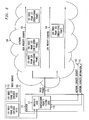
- FIG. 1 is a block diagram of a system including a video encoder and decoder according to an embodiment of the present invention.
- FIG. 1 shows a video encoder 110 and a video decoder 120 both of which are coupled to a network 130.
- the term “coupled” is intended to encompass and be broader than the term “directly connected.”
- encoder 110 or another device may transmit video-coded data (such as video-coded frames 113) to decoder 120 across network 130 at a priority level that is determined using information about the network's available capacity (such as network capacity information 116). This information may be provided in response to a request for such information (such as network capacity request 115).
- the present invention is not limited to the system shown in FIG. 1.
- video-coded data may be sent by an encoder such as encoder 110 to devices other than a decoder.
- encoder 110 may send video-coded data to a data storage facility for later use by a decoder.
- video-coded data may be sent from encoder 111 to a transmission device which transmits the data across the network.
- stored video-coded data that had been previously encoded may be transmitted to a decoder such as decoder 120 by a device other than an encoder.
- Network 130 may be any information systems network across which information can be sent. Examples of network 130 include the Internet, an intranet, a wireline telephone network, a wireless telephone network, a virtual private network, or any combination of these networks.
- Encoder 110 may be used to encode video data, such as video signals 112, for transmission across a network as video-coded frames. Encoder 110 may output video-coded data that complies with a video-coding standard or algorithm such as MPEG-1, MPEG-2, MPEG-4, H.261, and H.264.
- encoder 110 is shown coupled to a video camera 111. In an embodiment, video camera 111 outputs video signals 112 to encoder 110.
- encoder 110 may encode prerecorded video signals or may receive other types of input such as animation, text, or audio data.
- Decoder 120 may be used to receive and decode video-coded frames for display as video images. Decoder 120 is shown coupled to monitor 121 and may output decoded video data, such as video signals 122, for display as video images on monitor 121.
- network 130 includes a network access server 131 that connects encoder 110 to network 130 and a network access server 132 that connects decoder 120 to network 130.
- Network access server 131 and network access server 132 may permit connections to network 130 from outside the network and may be operated by a third-party such as AT&T Corp.® or America Online, Inc.®
- Network 130 includes a network administrator 133 which administers operation of network 130.
- network 130 may be decentralized and may contain multiple network administrators.
- Fig. 1 shows a high priority channel 134 and a low priority channel 136 coupling network access server 131 to network access server 132.
- high priority channel 134 and a low priority channel 136 are logical paths across network 130, and data may be transmitted across each logical path using various physical paths.
- network 130 contains a plurality of virtual circuits that may be used to transmit high priority traffic and a plurality of virtual circuits that may be used to transmit low priority traffic.
- network 130 contains a plurality of nodes, such as router or switches, and many of these nodes may be used to transmit data for both high priority channel 134 and low priority channel 136.
- network 130 may experience congestion and may be unable to provide bandwidth for transmitting additional data.
- network 130 may take appropriate actions such as dropping data or buffering data. For example, if a data packet XYZ is sent from network access server 131 to be forwarded across network 130 to network access server 132, but network 130 does not have the bandwidth to transmit data packet XYZ, then data packet XYZ may be dropped and a message indicating this dropping may be transmitted back to encoder 110.
- network 130 will drop low priority packets before dropping a high priority packet.
- Network 130 may impose an additional charge for the transmission of data on a high priority channel.
- network administrator 133 maintains information about the amount of currently available network bandwidth and may provide information about current network capacity and expected future network capacity as feedback to encoder 110.
- encoder 110 may send a network capacity request 115 through network access server 131 to network administrator 133, and in response network administrator 133 may send network capacity information 116 through network access server 131 to encoder 110.
- Network capacity request 115 may be a request for information about the availability of capacity to send a type of data (e.g., a high priority frame or base layer frame), and network capacity information 116 may be a response to such a request.
- a request for information sent from encoder 110 does not specify the type of data to be transmitted (e.g., that the data is video-coded frames) and may be, for example, a request for a specified amount of bandwidth. In this example, the priority of the bandwidth, the size of the data, and/or the duration may be specified.
- a request is not required for the sending of network capacity information 116, and network capacity information may be sent, for example, on a periodic basis or during conditions determined by network administrator 133.
- network capacity request 115 and network capacity information 116 may be transmitted between encoder 110 and network access server 131 using the same connection as the video-coded frames 113. Embodiments of the present invention that make use of this network capacity information when transmitting video-coded information are further described below.
- FIG. 2 is a block diagram of a video encoder according to an embodiment of the present invention.
- FIG. 2 shows an encoder 110 such as in FIG. 1 above.
- FIG. 2 shows a stream of video signals 112 that is coded by encoder 110 and transmitted as a stream of video-coded frames 113 across network 130 over two logical channels (high priority channel 134 and low priority channel 136).
- FIG. 2 shows six video frames that may be part of the same stream of video data.
- the first four frames in the stream (i.e., 1 st video frame 221, 2 nd video frame 222, 3rd video frame 223, and 4th video frame 224) have already been encoded and are being transmitted over network 130, while the other two frames (5 th video frame 225 and 6 th video frame 226) consist of uncoded data that is being transmitted for coding to encoder 110 by, for example, video camera 111 of FIG. 1.
- each of the video-coded frames may comprise multiple frames of uncoded video data.
- the video-coded frames may also include non-video information such as animations, text, control information, and/or audio information.
- each of the video-coded frames 113 transmitted across network 130 contain a priority level field.
- a frame that has a low priority level such as 2 nd video frame 222 is transmitted on low priority channel 136.
- the priority level is built into the video-coded frame when it is encoded.
- the priority level may be added to a video-coded frame after the frame is encoded or may be transmitted to network 130 as a data element separate from the video-coded frame.
- encoder 110 contains encoding logic 117 and transmission priority setting logic 118.
- Encoding logic 117 may be used to encode the video data.
- Transmission priority setting logic 118 may send network capacity requests 115 and may receive network capacity information 116 in response to these requests.
- Transmission priority setting logic 118 may use the network capacity information to select a transmission priority for each of the video-coded frames 113 according to an embodiment of the present invention such as the method discussed below.
- encoder 110 may contain additional components such as logic to control the transmission of data to network 130.
- encoder 110 may also contain an analog-to-digital converter, transform logic, quantizer logic, and prediction logic.
- Encoder 110 may be embodied in software, hardware, firmware, or some combination.
- Encoder 110 may include one or more central processing units (CPUs), random access memories (RAMs), and Read Only Memories (ROMs), and memories in encoder 130 may store instructions to be executed by a processor to carry out embodiments of the invention as described herein.
- the logic in encoder 110 may be embodied in a special purpose processing unit such an application specific integrated circuit (ASIC).
- ASIC application specific integrated circuit
- encoder 110 is a personal computer (PC) that contains software to carry out an embodiment of the present invention.
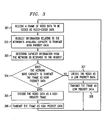
- FIG. 3 is a flow diagram of a method of transmitting video information according to an embodiment of the present invention. The description below is explained with reference to the systems shown in FIGS. 1 and 2, but of course these methods may be used with other systems.
- a frame of video data to be coded as video-coded data is received (301).
- a frame of video data may be received at encoder 110 from video camera 111 or may be received from a buffer in another part of encoder 110.
- the frames of video data may already be stored at the encoder (e.g., buffered at the encoder) prior to coding.
- the encoder may send a request for information relating to the network's available capacity to transmit high priority data (302), and capacity information may be received in response to the request (303). Examples of the request and response are shown in FIG. 1 as network capacity requests 115 and network capacity information 116.
- network administrator 133 will determine if the capacity to send high priority data is available and will send a response to encoder 110. If the response indicates that the network has the capacity to transmit the frame as high priority data (304), then the frame is encoded as a high priority frame (e.g., a base layer frame) (305) and is transmitted as high priority data (306).
- a high priority frame e.g., a base layer frame
- the frame is encoded as a low priority frame (e.g., an enhancement layer frame) (307) and is transmitted as low priority data (308).
- a low priority frame e.g., an enhancement layer frame
- Frames that are transmitted as high priority data may use a high priority channel across network 130 and frames that are transmitted as low priority data may use a low priority channel across network 130.
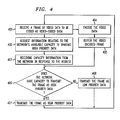
- FIG. 4 is a flow diagram of a method of transmitting video information according to another embodiment of the present invention.
- the encoder may receive a frame of video data to be coded as video-coded data (401), may send a request for information relating to the network's available capacity to transmit high priority data (402), and may receive capacity information in response to the request (403).
- the data is video-coded (404) and the video-encoded frame is buffered (405) at substantially the same time as the request is sent and/or the response to the request is received. If the network has the capacity to transmit the frame as high priority data (406), then the request is transmitted as high priority data (407).
- the video frame is transmitted as low priority data (408).
- the frame has to be recoded as a high priority frame.
- the frame may have been coded at both priorities (high and low) in parallel, and the frame with the desired priority may be chosen at a later time.
- FIG. 5 is a flow diagram of a method of transmitting video information according to another embodiment of the present invention.
- FIG. 5 contains steps 401 to 407 as in FIG. 4.
- the encoded frame is deleted from transmission (500) if the network does not have the capacity to transmit high priority data.
- the video data may be lost, but such a loss may not greatly impact perceived picture quality as long as the encoder 110 is aware of the loss.
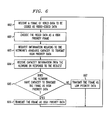
- FIG. 6 is a flow diagram of a method of transmitting video information according to another embodiment of the present invention.
- a frame of video data to be coded as video-coded data may be received (601).
- the frame is then encoded as a high priority frame (602).
- all frames may be encoded as high priority frames prior to requesting and/or receiving any information about available network capacity.
- a request for information relating to the network's available capacity to transmitting high priority data is sent (603), and capacity information is received in response to the request (604). If the network has the capacity to transmit the frame as high priority data (605), then the request is transmitted as high priority data (606). If the network does not have the capacity to transmit high priority data (605), then the video frame is transmitted as low priority data (607).
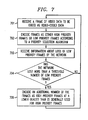
- FIG. 7 is a flow diagram of a method of transmitting video information according to another embodiment of the present invention.
- a frame of video data to be coded as video-coded data may be received (701).
- frames are encoded as either high priority frames or low priority frames based on a priority selection algorithm (702).
- the algorithm may use information about how much bandwidth is allocated for the transmission of high priority frames.
- the encoder then obtains information relating to the network's available capacity to transmit high priority data (703). This information may be obtained by network feedback or other means such as the Real Time Control Protocol (RTCP) from the Internet Engineering Task Force (IETF).
- RTCP Real Time Control Protocol
- IETF Internet Engineering Task Force
- an additional number of the frames may be encoded as high priority frames than is dictated by the transmission priority algorithm discussed above. These additional high priority frames may be encoded at a lower quality than is generally used for high priority frames.
- the present invention improves the transmission of video information by using network feedback on available bandwidth. Through the use of feedback the present invention allows for the randomization of the arrival of high priority data into the network and, therefore, minimizes the likelihood of network overload. The present invention may also avoid the buffering of large amounts of data and the ensuing delay that such buffering may cause.
- Several embodiments of the present invention are specifically illustrated and/or described herein. However, it will be appreciated that modifications and variations of the present invention are covered by the above teachings and within the purview of the appended claims without departing from the spirit and intended scope of the invention. For example, unless otherwise specified, the order of the steps performed may be varied. Where technical features mentioned in any claim are followed by reference signs, those reference signs have been included for the sole purpose of increasing the intelligibility of the claims and accordingly, such reference signs do not have any limiting effect on the scope of each element identified by way of example by such reference signs.
Landscapes
- Engineering & Computer Science (AREA)
- Multimedia (AREA)
- Signal Processing (AREA)
- Computer Networks & Wireless Communication (AREA)
- Computer Security & Cryptography (AREA)
- Databases & Information Systems (AREA)
- Compression Or Coding Systems Of Tv Signals (AREA)
- Data Exchanges In Wide-Area Networks (AREA)
- Two-Way Televisions, Distribution Of Moving Picture Or The Like (AREA)
Applications Claiming Priority (2)
| Application Number | Priority Date | Filing Date | Title |
|---|---|---|---|
| US882036 | 2001-06-18 | ||
| US09/882,036 US7958532B2 (en) | 2001-06-18 | 2001-06-18 | Method of transmitting layered video-coded information |
Publications (2)
| Publication Number | Publication Date |
|---|---|
| EP1271954A2 true EP1271954A2 (de) | 2003-01-02 |
| EP1271954A3 EP1271954A3 (de) | 2003-12-03 |
Family
ID=25379753
Family Applications (1)
| Application Number | Title | Priority Date | Filing Date |
|---|---|---|---|
| EP02012434A Withdrawn EP1271954A3 (de) | 2001-06-18 | 2002-06-10 | Verfahren zur Übertragung von schichtkodierten Videodaten |
Country Status (4)
| Country | Link |
|---|---|
| US (2) | US7958532B2 (de) |
| EP (1) | EP1271954A3 (de) |
| JP (1) | JP4309098B2 (de) |
| CA (1) | CA2390715C (de) |
Cited By (5)
| Publication number | Priority date | Publication date | Assignee | Title |
|---|---|---|---|---|
| EP1650973A1 (de) * | 2004-10-25 | 2006-04-26 | Alcatel USA Sourcing, L.P. | Verfahren zum Kodierung von Multimedia-Inhalten |
| EP1514378A4 (de) * | 2002-06-11 | 2010-08-04 | Thomson Licensing | Multimedia-server mit einfacher anpassung an dynamische netzwerkverlustbedingungen |
| US7958532B2 (en) * | 2001-06-18 | 2011-06-07 | At&T Intellectual Property Ii, L.P. | Method of transmitting layered video-coded information |
| CN102823239A (zh) * | 2011-03-11 | 2012-12-12 | 松下电器产业株式会社 | 无线视频发送设备、无线视频接收设备和使用它们的无线视频通信系统 |
| GB2623547A (en) * | 2022-10-19 | 2024-04-24 | Sony Interactive Entertainment Europe Ltd | Progressive refinement video enhancement |
Families Citing this family (81)
| Publication number | Priority date | Publication date | Assignee | Title |
|---|---|---|---|---|
| US20060274828A1 (en) * | 2001-11-01 | 2006-12-07 | A4S Security, Inc. | High capacity surveillance system with fast search capability |
| US20060274829A1 (en) * | 2001-11-01 | 2006-12-07 | A4S Security, Inc. | Mobile surveillance system with redundant media |
| JPWO2003041341A1 (ja) * | 2001-11-05 | 2005-03-03 | 松下電器産業株式会社 | 映像伝送システムにおいて利用されるサーバ装置及び端末装置 |
| DE60212192T2 (de) * | 2001-12-28 | 2007-04-19 | Matsushita Electric Industrial Co., Ltd., Kadoma | Gerät zum wiedergeben von daten und verfahren zum wiedergeben von daten |
| US7480252B2 (en) * | 2002-10-04 | 2009-01-20 | Koniklijke Philips Electronics N.V. | Method and system for improving transmission efficiency using multiple-description layered encoding |
| US7395346B2 (en) * | 2003-04-22 | 2008-07-01 | Scientific-Atlanta, Inc. | Information frame modifier |
| EP1661392B1 (de) | 2003-08-11 | 2021-03-24 | Warner Bros. Entertainment Inc. | Verteilereinrichtung für digitale medien |
| EP1673944B1 (de) * | 2003-10-14 | 2019-09-04 | InterDigital VC Holdings, Inc. | Verfahren zur simulation von filmrauschen |
| US8150206B2 (en) | 2004-03-30 | 2012-04-03 | Thomson Licensing | Method and apparatus for representing image granularity by one or more parameters |
| US8600217B2 (en) | 2004-07-14 | 2013-12-03 | Arturo A. Rodriguez | System and method for improving quality of displayed picture during trick modes |
| CN101044510B (zh) * | 2004-10-18 | 2012-01-04 | 汤姆森特许公司 | 胶片颗粒模拟方法 |
| CA2803789C (en) * | 2004-11-12 | 2014-04-15 | Thomson Licensing | Film grain simulation for normal play and trick mode play for video playback systems |
| RU2371769C2 (ru) | 2004-11-16 | 2009-10-27 | Томсон Лайсенсинг | Способ имитации зернистости фотопленки на основе предварительно вычисленных коэффициентов преобразования |
| MX2007005651A (es) * | 2004-11-17 | 2007-06-05 | Thomson Licensing | Metodo de simulacion de grano de pelicula exacto de bits con base en coeficientes transformados pre-computados. |
| KR101208158B1 (ko) | 2004-11-22 | 2012-12-05 | 톰슨 라이센싱 | 필름 그레인 시뮬레이션을 위한 필름 그레인 캐시 분할방법, 장치 및 시스템 |
| ZA200704141B (en) | 2004-11-23 | 2008-08-27 | Thomson Licensing | Low-complexity film grain simulation technique |
| US8909807B2 (en) * | 2005-04-07 | 2014-12-09 | Opanga Networks, Inc. | System and method for progressive download using surplus network capacity |
| US8949452B2 (en) * | 2005-04-07 | 2015-02-03 | Opanga Networks, Inc. | System and method for progressive download with minimal play latency |
| US8055783B2 (en) * | 2005-08-22 | 2011-11-08 | Utc Fire & Security Americas Corporation, Inc. | Systems and methods for media stream processing |
| US7852853B1 (en) * | 2006-02-07 | 2010-12-14 | Nextel Communications Inc. | System and method for transmitting video information |
| JP5307545B2 (ja) * | 2006-09-11 | 2013-10-02 | パナソニック株式会社 | 画像復号化装置、画像復号化方法、画像復号化システム、及びシステムlsi |
| US8910223B2 (en) * | 2006-10-25 | 2014-12-09 | Nokia Coporation | Layered coded streaming control for unicast/MBMS interaction |
| KR100799592B1 (ko) | 2006-11-30 | 2008-01-30 | 한국전자통신연구원 | 스케일러블 비디오 비트스트림의 계층 변조 송수신을 위한장치 및 그 방법 |
| KR100905723B1 (ko) * | 2006-12-08 | 2009-07-01 | 한국전자통신연구원 | 비실시간 기반의 디지털 실감방송 송수신 시스템 및 그방법 |
| US20080247468A1 (en) * | 2007-04-05 | 2008-10-09 | Interuniversitair Microelektronica Centrum Vzw (Imec) | Method and system for performing rate control adapted to channel conditions |
| US10715834B2 (en) | 2007-05-10 | 2020-07-14 | Interdigital Vc Holdings, Inc. | Film grain simulation based on pre-computed transform coefficients |
| KR20090008529A (ko) * | 2007-07-18 | 2009-01-22 | 삼성전자주식회사 | 이동통신 시스템에서 서비스 품질을 선택하기 위한 장치 및방법 |
| US20090028127A1 (en) * | 2007-07-26 | 2009-01-29 | Gordon Kent Walker | Methods and apparatus for providing computational load allocation in a network environment |
| EP2077637B1 (de) * | 2007-12-12 | 2020-03-11 | Alcatel Lucent | System und Verfahren zum Schützen von Nutzlastinformation bei der Funkübertragung |
| US8938766B2 (en) * | 2007-12-19 | 2015-01-20 | General Instrument Corporation | Method and apparatus for deferring transmission of an SDV program to conserve network resources |
| US8855211B2 (en) * | 2008-01-22 | 2014-10-07 | At&T Intellectual Property I, Lp | Method and apparatus for managing video transport |
| US20090217338A1 (en) * | 2008-02-25 | 2009-08-27 | Broadcom Corporation | Reception verification/non-reception verification of base/enhancement video layers |
| TWI383684B (zh) * | 2008-11-18 | 2013-01-21 | Univ Nat Taiwan | 多媒體串流之動態視訊編碼系統與方法 |
| KR20100131365A (ko) | 2009-06-05 | 2010-12-15 | 한국전자통신연구원 | 채널 변경 지연을 줄이기 위한 스트리밍 서버, 이동 단말기 및 그 방법 |
| WO2010140867A2 (ko) * | 2009-06-05 | 2010-12-09 | 한국전자통신연구원 | 채널 변경 지연을 줄이기 위한 스트리밍 서버, 이동 단말기 및 그 방법 |
| US8473998B1 (en) * | 2009-07-29 | 2013-06-25 | Massachusetts Institute Of Technology | Network coding for multi-resolution multicast |
| US10063812B2 (en) * | 2009-10-07 | 2018-08-28 | DISH Technologies L.L.C. | Systems and methods for media format transcoding |
| US20110235709A1 (en) * | 2010-03-25 | 2011-09-29 | Apple Inc. | Frame dropping algorithm for fast adaptation of buffered compressed video to network condition changes |
| JP5718322B2 (ja) * | 2010-04-30 | 2015-05-13 | パナソニック インテレクチュアル プロパティ コーポレーション オブアメリカPanasonic Intellectual Property Corporation of America | 通信装置、ネットワークノード並びに通信サーバ |
| JP2013526795A (ja) * | 2010-05-10 | 2013-06-24 | サムスン エレクトロニクス カンパニー リミテッド | レイヤーコーディングビデオを送受信する方法及び装置 |
| US8904445B2 (en) * | 2011-01-24 | 2014-12-02 | At&T Intellectual Property I, L.P. | Methods and apparatus to manage bandwidth allocations in media delivery networks |
| CN103828384B (zh) * | 2011-09-30 | 2018-02-27 | 英特尔公司 | 基于软件的无线信道感知自适应视频比特率编码 |
| KR20130076650A (ko) * | 2011-12-28 | 2013-07-08 | 삼성전자주식회사 | 영상처리장치 및 그 제어 방법 |
| US9848217B2 (en) * | 2012-01-20 | 2017-12-19 | Korea Electronics Technology Institute | Method for transmitting and receiving program configuration information for scalable ultra high definition video service in hybrid transmission environment, and method and apparatus for effectively transmitting scalar layer information |
| US10191954B1 (en) | 2012-05-07 | 2019-01-29 | Amazon Technologies, Inc. | Prioritized transcoding of media content |
| US9483785B1 (en) | 2012-05-07 | 2016-11-01 | Amazon Technologies, Inc. | Utilizing excess resource capacity for transcoding media |
| US9710307B1 (en) | 2012-05-07 | 2017-07-18 | Amazon Technologies, Inc. | Extensible workflows for processing content |
| US9497496B1 (en) | 2012-05-07 | 2016-11-15 | Amazon Technologies, Inc. | Personalized content insertion into media assets at the network edge |
| US9380326B1 (en) | 2012-05-07 | 2016-06-28 | Amazon Technologies, Inc. | Systems and methods for media processing |
| US9510033B1 (en) | 2012-05-07 | 2016-11-29 | Amazon Technologies, Inc. | Controlling dynamic media transcoding |
| US9264749B2 (en) | 2012-12-13 | 2016-02-16 | Microsoft Technology Licensing, Llc | Server GPU assistance for mobile GPU applications |
| US9998750B2 (en) | 2013-03-15 | 2018-06-12 | Cisco Technology, Inc. | Systems and methods for guided conversion of video from a first to a second compression format |
| US9516080B2 (en) | 2013-05-31 | 2016-12-06 | Western Digital Technologies, Inc. | Methods and apparatuses for streaming content |
| US10009628B2 (en) | 2013-06-07 | 2018-06-26 | Apple Inc. | Tuning video compression for high frame rate and variable frame rate capture |
| US20150146012A1 (en) * | 2013-11-27 | 2015-05-28 | Sprint Communications Company L.P. | Video presentation quality display in a wireless communication device |
| US9516356B2 (en) | 2013-12-06 | 2016-12-06 | Cable Television Laboratories, Inc. | Parallel scheduling of multilayered media |
| SG10201912804TA (en) * | 2013-12-26 | 2020-02-27 | Univ Singapore Technology & Design | A method and apparatus for reducing data bandwidth between a cloud server and a thin client |
| EP3179729B1 (de) * | 2014-08-07 | 2021-08-25 | Sony Group Corporation | Sendevorrichtung, sendeverfahren und empfangsvorrichtung |
| US9948618B2 (en) | 2015-02-05 | 2018-04-17 | Western Digital Technologies, Inc. | Secure stream buffer on network attached storage |
| JP6543585B2 (ja) * | 2016-02-25 | 2019-07-10 | 日本電信電話株式会社 | 通信制御システム及び方法 |
| WO2017164595A1 (ko) * | 2016-03-21 | 2017-09-28 | 엘지전자(주) | 방송 신호 송수신 장치 및 방법 |
| JP6677061B2 (ja) * | 2016-04-22 | 2020-04-08 | 株式会社リコー | 通信装置、通信システム、及びプログラム |
| US10219014B2 (en) | 2016-06-02 | 2019-02-26 | Biamp Systems, LLC | Systems and methods for bandwidth-limited video transport |
| CN106791892B (zh) * | 2016-11-10 | 2020-05-12 | 广州华多网络科技有限公司 | 一种轮麦直播的方法、装置和系统 |
| US9883141B1 (en) | 2016-12-12 | 2018-01-30 | International Business Machines Corporation | Dynamic video image management |
| FR3070566B1 (fr) * | 2017-08-30 | 2020-09-04 | Sagemcom Broadband Sas | Procede de recuperation d'un fichier cible d'un logiciel d'exploitation et dispositif d'utilisation |
| US11606528B2 (en) * | 2018-01-03 | 2023-03-14 | Saturn Licensing Llc | Advanced television systems committee (ATSC) 3.0 latency-free display of content attribute |
| US11463747B2 (en) * | 2018-04-05 | 2022-10-04 | Tvu Networks Corporation | Systems and methods for real time control of a remote video production with multiple streams |
| US10966001B2 (en) | 2018-04-05 | 2021-03-30 | Tvu Networks Corporation | Remote cloud-based video production system in an environment where there is network delay |
| US11032345B2 (en) | 2018-05-10 | 2021-06-08 | Microsoft Technology Licensing, Llc | Client side data stream processing |
| US10924525B2 (en) | 2018-10-01 | 2021-02-16 | Microsoft Technology Licensing, Llc | Inducing higher input latency in multiplayer programs |
| US10958975B2 (en) | 2019-03-27 | 2021-03-23 | Rovi Guides, Inc. | Method and apparatus for identifying a single user requesting conflicting content and resolving said conflict |
| US10897648B2 (en) * | 2019-03-27 | 2021-01-19 | Rovi Guides, Inc. | Method and apparatus for identifying a single user requesting conflicting content and resolving said conflict |
| US11711571B2 (en) * | 2020-03-06 | 2023-07-25 | Advanced Micro Devices, Inc. | Client-side offload of graphics effects processing |
| GB2598701B (en) * | 2020-05-25 | 2023-01-25 | V Nova Int Ltd | Wireless data communication system and method |
| WO2022151493A1 (zh) * | 2021-01-18 | 2022-07-21 | 华为技术有限公司 | 一种调度传输方法及装置 |
| US11765428B2 (en) * | 2021-04-07 | 2023-09-19 | Idomoo Ltd | System and method to adapting video size |
| CN113709510A (zh) * | 2021-08-06 | 2021-11-26 | 联想(北京)有限公司 | 高速率数据实时传输方法及装置、设备、存储介质 |
| KR20240028174A (ko) * | 2022-08-24 | 2024-03-05 | 삼성전자주식회사 | 전자 장치 및 그 제어 방법 |
| CN116193134A (zh) * | 2022-11-30 | 2023-05-30 | 华能信息技术有限公司 | 一种视频编码的时域分层方法 |
| CN118803351A (zh) * | 2023-04-14 | 2024-10-18 | 纬联电子科技(中山)有限公司 | 视频传输方法及显示器 |
Family Cites Families (40)
| Publication number | Priority date | Publication date | Assignee | Title |
|---|---|---|---|---|
| US5111292A (en) * | 1991-02-27 | 1992-05-05 | General Electric Company | Priority selection apparatus as for a video signal processor |
| US5122875A (en) * | 1991-02-27 | 1992-06-16 | General Electric Company | An HDTV compression system |
| US5144425A (en) * | 1991-08-26 | 1992-09-01 | General Electric Company | Apparatus for hierarchically dividing video signals |
| US5231486A (en) * | 1992-07-27 | 1993-07-27 | General Electric Company | Data separation processing in a dual channel digital high definition television system |
| US5576902A (en) * | 1993-01-13 | 1996-11-19 | Hitachi America, Ltd. | Method and apparatus directed to processing trick play video data to compensate for intentionally omitted data |
| US5515377A (en) | 1993-09-02 | 1996-05-07 | At&T Corp. | Adaptive video encoder for two-layer encoding of video signals on ATM (asynchronous transfer mode) networks |
| JP3170193B2 (ja) * | 1995-03-16 | 2001-05-28 | 松下電器産業株式会社 | 画像信号の符号化装置及び復号装置 |
| US5852706A (en) * | 1995-06-08 | 1998-12-22 | Sony Corporation | Apparatus for recording and reproducing intra-frame and inter-frame encoded video data arranged into recording frames |
| EP1357758A3 (de) * | 1995-08-02 | 2004-10-27 | Matsushita Electric Industrial Co., Ltd. | Videokodierungsgerät und -system mit Quantizierungskontrollverfahren und Durchschnittsdurchsatzberechnungsverfahren |
| US6075768A (en) | 1995-11-09 | 2000-06-13 | At&T Corporation | Fair bandwidth sharing for video traffic sources using distributed feedback control |
| US5764235A (en) * | 1996-03-25 | 1998-06-09 | Insight Development Corporation | Computer implemented method and system for transmitting graphical images from server to client at user selectable resolution |
| DE69726110T2 (de) | 1996-08-30 | 2004-08-26 | Koninklijke Philips Electronics N.V. | Videoübertragungssystem |
| US5995148A (en) | 1997-02-14 | 1999-11-30 | At&T Corp | Video coder having scalar dependent variable length coder |
| KR20050052484A (ko) * | 1997-03-17 | 2005-06-02 | 마츠시타 덴끼 산교 가부시키가이샤 | 데이터 처리방법 |
| US6057884A (en) * | 1997-06-05 | 2000-05-02 | General Instrument Corporation | Temporal and spatial scaleable coding for video object planes |
| US6148005A (en) * | 1997-10-09 | 2000-11-14 | Lucent Technologies Inc | Layered video multicast transmission system with retransmission-based error recovery |
| EP0952709A1 (de) | 1998-04-20 | 1999-10-27 | BRITISH TELECOMMUNICATIONS public limited company | Datenspeicherung- und übertragung |
| US6104757A (en) * | 1998-05-15 | 2000-08-15 | North Carolina State University | System and method of error control for interactive low-bit rate video transmission |
| US6233283B1 (en) * | 1998-06-23 | 2001-05-15 | Lucent Technologies Inc. | Layered video coding using perceptual coding criteria for error resilience in packet networks |
| US6584509B2 (en) * | 1998-06-23 | 2003-06-24 | Intel Corporation | Recognizing audio and video streams over PPP links in the absence of an announcement protocol |
| US6292512B1 (en) * | 1998-07-06 | 2001-09-18 | U.S. Philips Corporation | Scalable video coding system |
| US6275531B1 (en) * | 1998-07-23 | 2001-08-14 | Optivision, Inc. | Scalable video coding method and apparatus |
| US6490705B1 (en) * | 1998-10-22 | 2002-12-03 | Lucent Technologies Inc. | Method and apparatus for receiving MPEG video over the internet |
| EP1006689B1 (de) * | 1998-11-30 | 2008-02-06 | Matsushita Electric Industries Co., Ltd. | Paketwiederübertragungskontrolle mit Prioritätsinformationen |
| US6496980B1 (en) * | 1998-12-07 | 2002-12-17 | Intel Corporation | Method of providing replay on demand for streaming digital multimedia |
| JP3209210B2 (ja) * | 1999-02-10 | 2001-09-17 | 日本電気株式会社 | 動画像圧縮方法、動画像圧縮装置及び動画像圧縮プログラムを記憶した記憶媒体 |
| US6499060B1 (en) * | 1999-03-12 | 2002-12-24 | Microsoft Corporation | Media coding for loss recovery with remotely predicted data units |
| US6470378B1 (en) * | 1999-03-31 | 2002-10-22 | Intel Corporation | Dynamic content customization in a clientserver environment |
| JP2000350197A (ja) | 1999-06-02 | 2000-12-15 | Hitachi Ltd | 映像伝送方法とそれを用いた監視システム |
| US6263022B1 (en) * | 1999-07-06 | 2001-07-17 | Philips Electronics North America Corp. | System and method for fine granular scalable video with selective quality enhancement |
| US6501797B1 (en) * | 1999-07-06 | 2002-12-31 | Koninklijke Phillips Electronics N.V. | System and method for improved fine granular scalable video using base layer coding information |
| US6614936B1 (en) * | 1999-12-03 | 2003-09-02 | Microsoft Corporation | System and method for robust video coding using progressive fine-granularity scalable (PFGS) coding |
| US6588176B1 (en) * | 1999-12-17 | 2003-07-08 | Reynolds Consumer Products, Inc. | Methods of manufacturing reclosable packages using transverse closure and slider applicator |
| US7095782B1 (en) * | 2000-03-01 | 2006-08-22 | Koninklijke Philips Electronics N.V. | Method and apparatus for streaming scalable video |
| US6798838B1 (en) * | 2000-03-02 | 2004-09-28 | Koninklijke Philips Electronics N.V. | System and method for improving video transmission over a wireless network |
| EP1130839B1 (de) * | 2000-03-02 | 2005-06-08 | Matsushita Electric Industrial Co., Ltd. | Verfahren und Vorrichtung zur Wiederholung der Videodatenrahmen mit Prioritätsstufen |
| US6816194B2 (en) * | 2000-07-11 | 2004-11-09 | Microsoft Corporation | Systems and methods with error resilience in enhancement layer bitstream of scalable video coding |
| US6496217B1 (en) * | 2001-06-12 | 2002-12-17 | Koninklijke Philips Electronics N.V. | Video communication system using model-based coding and prioritzation techniques |
| US7958532B2 (en) * | 2001-06-18 | 2011-06-07 | At&T Intellectual Property Ii, L.P. | Method of transmitting layered video-coded information |
| US6788553B1 (en) * | 2001-12-28 | 2004-09-07 | Broadband Telcom Power, Inc. | Switching-mode power converter with complementary synchronous rectification |
-
2001
- 2001-06-18 US US09/882,036 patent/US7958532B2/en not_active Expired - Fee Related
-
2002
- 2002-06-10 EP EP02012434A patent/EP1271954A3/de not_active Withdrawn
- 2002-06-14 CA CA002390715A patent/CA2390715C/en not_active Expired - Fee Related
- 2002-06-18 JP JP2002176549A patent/JP4309098B2/ja not_active Expired - Fee Related
-
2006
- 2006-05-23 US US11/419,844 patent/US8621532B2/en not_active Expired - Fee Related
Non-Patent Citations (2)
| Title |
|---|
| COHEN R ET AL: "STREAMING FINE-GRAINED SCALABLE VIDEO OVER PACKET-BASED NETWORKS", GLOBECOM'00. 2000 IEEE GLOBAL TELECOMMUNICATIONS CONFERENCE. SAN FRANCISCO, CA, NOV. 27 - DEC. 1, 2000; [IEEE GLOBAL TELECOMMUNICATIONS CONFERENCE], NEW YORK, NY : IEEE, US, vol. 1, 27 November 2000 (2000-11-27), pages 288 - 292, XP001195579, ISBN: 978-0-7803-6452-3 * |
| GUERRI J C ET AL: "A feedback packet-level error control for real-time applications in wireless networks", VEHICULAR TECHNOLOGY CONFERENCE, 1999. VTC 1999 - FALL. IEEE VTS 50TH AMSTERDAM, NETHERLANDS 19-22 SEPT. 1999, PISCATAWAY, NJ, USA,IEEE, US, vol. 2, 19 September 1999 (1999-09-19), pages 879 - 883, XP010353105, ISBN: 978-0-7803-5435-7 * |
Cited By (8)
| Publication number | Priority date | Publication date | Assignee | Title |
|---|---|---|---|---|
| US7958532B2 (en) * | 2001-06-18 | 2011-06-07 | At&T Intellectual Property Ii, L.P. | Method of transmitting layered video-coded information |
| EP1514378A4 (de) * | 2002-06-11 | 2010-08-04 | Thomson Licensing | Multimedia-server mit einfacher anpassung an dynamische netzwerkverlustbedingungen |
| EP1650973A1 (de) * | 2004-10-25 | 2006-04-26 | Alcatel USA Sourcing, L.P. | Verfahren zum Kodierung von Multimedia-Inhalten |
| CN102823239A (zh) * | 2011-03-11 | 2012-12-12 | 松下电器产业株式会社 | 无线视频发送设备、无线视频接收设备和使用它们的无线视频通信系统 |
| EP2685771A4 (de) * | 2011-03-11 | 2014-08-27 | Panasonic Corp | Drahtlose videoübertragungsvorrichtung, drahtlose videoempfangsvorrichtung und drahtloses videoübertragungssystem damit |
| GB2623547A (en) * | 2022-10-19 | 2024-04-24 | Sony Interactive Entertainment Europe Ltd | Progressive refinement video enhancement |
| GB2623547B (en) * | 2022-10-19 | 2025-09-10 | Sony Interactive Entertainment Europe Ltd | Progressive Refinement Video Enhancement |
| US12561761B2 (en) | 2022-10-19 | 2026-02-24 | Sony Interactive Entertainment Europe Limited | Progressive refinement video enhancement |
Also Published As
| Publication number | Publication date |
|---|---|
| JP4309098B2 (ja) | 2009-08-05 |
| CA2390715A1 (en) | 2002-12-18 |
| US7958532B2 (en) | 2011-06-07 |
| US20060200848A1 (en) | 2006-09-07 |
| US8621532B2 (en) | 2013-12-31 |
| CA2390715C (en) | 2007-11-06 |
| US20040261113A1 (en) | 2004-12-23 |
| JP2003102008A (ja) | 2003-04-04 |
| EP1271954A3 (de) | 2003-12-03 |
Similar Documents
| Publication | Publication Date | Title |
|---|---|---|
| US8621532B2 (en) | Method of transmitting layered video-coded information | |
| US9918085B2 (en) | Media coding for loss recovery with remotely predicted data units | |
| EP1638333A1 (de) | Ratenadaptive Videocodierung | |
| JP4087852B2 (ja) | ビデオの伝送方法 | |
| US8254441B2 (en) | Video streaming based upon wireless quality | |
| JPH07107096A (ja) | Atmネットワーク用ビデオ信号の二層符号化方法とその装置 | |
| JP2003525547A (ja) | スケーラブルビデオをストリーミングするための方法及び装置 | |
| EP1371225B1 (de) | Videocodierungs- und transportverfahren zum verbergen der effekte von paketverlusten in paketvermittelten mehrkanalnetzwerken | |
| Luo et al. | Quality control for VBR video over ATM networks | |
| KR20010018573A (ko) | 네트워크 대역폭에 적응적인 영상 압축 장치 | |
| JP2002077260A (ja) | 画像伝送のためのシステムおよび方法 | |
| EP2308215B1 (de) | Verdünnung von paketvermittelten videodaten | |
| Chen et al. | A robust coding scheme for packet video | |
| EP1725038A2 (de) | Verzögerungsarmes Videocodierungsverfahren zum Verbergen der Effekte von Paketverlusten in Paketvermittelten Mehrkanalnetzwerken | |
| TWI683572B (zh) | 基於畫面動態資訊的視訊位元率傳輸控制方法 | |
| Safaaldin et al. | Design and implementation of a teleconferencing system using improved HEVC coding | |
| Danmusa | Methods of Transmission of High Audio and Video Information on the Network | |
| Ali et al. | Distortion‐Based Slice Level Prioritization for Real‐Time Video over QoS‐Enabled Wireless Networks | |
| CN116233024A (zh) | 数据包确定方法、装置及存储介质 | |
| Albanese et al. | Robust transmission of MPEG video streams over lossy packet-switching networks by using PET | |
| Ashibani et al. | Efficient Video Streaming Scheme for Next Generations of Mobile Networks | |
| HK1093647A (en) | A low-delay video encoding method for concealing the effects of packet loss in multi-channel packet switched networks |
Legal Events
| Date | Code | Title | Description |
|---|---|---|---|
| PUAI | Public reference made under article 153(3) epc to a published international application that has entered the european phase |
Free format text: ORIGINAL CODE: 0009012 |
|
| AK | Designated contracting states |
Kind code of ref document: A2 Designated state(s): AT BE CH CY DE DK ES FI FR GB GR IE IT LI LU MC NL PT SE TR |
|
| AX | Request for extension of the european patent |
Free format text: AL;LT;LV;MK;RO;SI |
|
| PUAL | Search report despatched |
Free format text: ORIGINAL CODE: 0009013 |
|
| AK | Designated contracting states |
Kind code of ref document: A3 Designated state(s): AT BE CH CY DE DK ES FI FR GB GR IE IT LI LU MC NL PT SE TR |
|
| AX | Request for extension of the european patent |
Extension state: AL LT LV MK RO SI |
|
| 17P | Request for examination filed |
Effective date: 20040414 |
|
| AKX | Designation fees paid |
Designated state(s): DE FI FR GB NL |
|
| RBV | Designated contracting states (corrected) |
Designated state(s): DE FI FR GB NL |
|
| 17Q | First examination report despatched |
Effective date: 20071221 |
|
| STAA | Information on the status of an ep patent application or granted ep patent |
Free format text: STATUS: THE APPLICATION IS DEEMED TO BE WITHDRAWN |
|
| 18D | Application deemed to be withdrawn |
Effective date: 20170523 |