EP1273191B1 - Téléphone mobile a mode reception seulement - Google Patents
Téléphone mobile a mode reception seulement Download PDFInfo
- Publication number
- EP1273191B1 EP1273191B1 EP01914052A EP01914052A EP1273191B1 EP 1273191 B1 EP1273191 B1 EP 1273191B1 EP 01914052 A EP01914052 A EP 01914052A EP 01914052 A EP01914052 A EP 01914052A EP 1273191 B1 EP1273191 B1 EP 1273191B1
- Authority
- EP
- European Patent Office
- Prior art keywords
- terminal
- broadcast
- data
- channel
- cellular
- Prior art date
- Legal status (The legal status is an assumption and is not a legal conclusion. Google has not performed a legal analysis and makes no representation as to the accuracy of the status listed.)
- Expired - Lifetime
Links
- 230000001413 cellular effect Effects 0.000 claims description 35
- 238000004891 communication Methods 0.000 claims description 10
- 230000003213 activating effect Effects 0.000 claims description 5
- 238000000034 method Methods 0.000 claims description 5
- 208000001613 Gambling Diseases 0.000 claims description 3
- 230000005236 sound signal Effects 0.000 claims description 3
- 230000001419 dependent effect Effects 0.000 claims description 2
- 230000005540 biological transmission Effects 0.000 description 5
- 230000004048 modification Effects 0.000 description 3
- 238000012986 modification Methods 0.000 description 3
- 238000010586 diagram Methods 0.000 description 2
- 102100024442 60S ribosomal protein L13 Human genes 0.000 description 1
- 101001118201 Homo sapiens 60S ribosomal protein L13 Proteins 0.000 description 1
- 230000010267 cellular communication Effects 0.000 description 1
- 230000000694 effects Effects 0.000 description 1
- 238000005516 engineering process Methods 0.000 description 1
- 230000006870 function Effects 0.000 description 1
- 230000001788 irregular Effects 0.000 description 1
- 238000004519 manufacturing process Methods 0.000 description 1
- 238000010295 mobile communication Methods 0.000 description 1
- 238000012544 monitoring process Methods 0.000 description 1
- 230000000737 periodic effect Effects 0.000 description 1
- 230000001105 regulatory effect Effects 0.000 description 1
- 230000003252 repetitive effect Effects 0.000 description 1
- 230000001960 triggered effect Effects 0.000 description 1
Images
Classifications
-
- H—ELECTRICITY
- H04—ELECTRIC COMMUNICATION TECHNIQUE
- H04W—WIRELESS COMMUNICATION NETWORKS
- H04W76/00—Connection management
- H04W76/40—Connection management for selective distribution or broadcast
-
- H—ELECTRICITY
- H04—ELECTRIC COMMUNICATION TECHNIQUE
- H04M—TELEPHONIC COMMUNICATION
- H04M1/00—Substation equipment, e.g. for use by subscribers
- H04M1/72—Mobile telephones; Cordless telephones, i.e. devices for establishing wireless links to base stations without route selection
- H04M1/724—User interfaces specially adapted for cordless or mobile telephones
- H04M1/72403—User interfaces specially adapted for cordless or mobile telephones with means for local support of applications that increase the functionality
-
- H—ELECTRICITY
- H04—ELECTRIC COMMUNICATION TECHNIQUE
- H04W—WIRELESS COMMUNICATION NETWORKS
- H04W52/00—Power management, e.g. Transmission Power Control [TPC] or power classes
- H04W52/02—Power saving arrangements
- H04W52/0209—Power saving arrangements in terminal devices
- H04W52/0212—Power saving arrangements in terminal devices managed by the network, e.g. network or access point is leader and terminal is follower
- H04W52/0219—Power saving arrangements in terminal devices managed by the network, e.g. network or access point is leader and terminal is follower where the power saving management affects multiple terminals
-
- H—ELECTRICITY
- H04—ELECTRIC COMMUNICATION TECHNIQUE
- H04W—WIRELESS COMMUNICATION NETWORKS
- H04W52/00—Power management, e.g. Transmission Power Control [TPC] or power classes
- H04W52/02—Power saving arrangements
- H04W52/0209—Power saving arrangements in terminal devices
- H04W52/0225—Power saving arrangements in terminal devices using monitoring of external events, e.g. the presence of a signal
- H04W52/0248—Power saving arrangements in terminal devices using monitoring of external events, e.g. the presence of a signal dependent on the time of the day, e.g. according to expected transmission activity
-
- H—ELECTRICITY
- H04—ELECTRIC COMMUNICATION TECHNIQUE
- H04W—WIRELESS COMMUNICATION NETWORKS
- H04W84/00—Network topologies
- H04W84/02—Hierarchically pre-organised networks, e.g. paging networks, cellular networks, WLAN [Wireless Local Area Network] or WLL [Wireless Local Loop]
- H04W84/04—Large scale networks; Deep hierarchical networks
- H04W84/042—Public Land Mobile systems, e.g. cellular systems
-
- Y—GENERAL TAGGING OF NEW TECHNOLOGICAL DEVELOPMENTS; GENERAL TAGGING OF CROSS-SECTIONAL TECHNOLOGIES SPANNING OVER SEVERAL SECTIONS OF THE IPC; TECHNICAL SUBJECTS COVERED BY FORMER USPC CROSS-REFERENCE ART COLLECTIONS [XRACs] AND DIGESTS
- Y02—TECHNOLOGIES OR APPLICATIONS FOR MITIGATION OR ADAPTATION AGAINST CLIMATE CHANGE
- Y02D—CLIMATE CHANGE MITIGATION TECHNOLOGIES IN INFORMATION AND COMMUNICATION TECHNOLOGIES [ICT], I.E. INFORMATION AND COMMUNICATION TECHNOLOGIES AIMING AT THE REDUCTION OF THEIR OWN ENERGY USE
- Y02D30/00—Reducing energy consumption in communication networks
- Y02D30/70—Reducing energy consumption in communication networks in wireless communication networks
Definitions
- the present invention relates to a communications network, a method of operating that network and apparatus for receiving information transmitted by that network.
- Digital cellular telephone services are well established in many countries of the world and coverage, both of the geographical area and the population of those countries is generally very good.
- WAP Wireless Application Protocol
- This access must be specifically requested by the user and then the requested information transmitted specifically to that user's telephone. This consumes the user's time, money (in call charges) and the limited energy stored in the battery of the user's phone as well as tying up network capacity that could be devoted to other services.
- WO 96/26614 shows a device with a pager used as a low power system to wake up a cellular system in the device; when the cellular system wakes up and registers with a cellular basestation, the location of the device can be determined.
- GB 2320860 shows a cellular network based device which, in addition to a normal cellular transceiver, also has a one-way wide area network receiver
- a mobile terminal comprising a cellular telephony communications receiver, the terminal being adapted such that the cellular telephony communications receiver can be activated without also activating any cellular telephony transmitter in the terminal, in order to receive data simultaneously broadcast to multiple mobile terminals over a cellular telephone network.
- the present inventors have realised that a very large proportion of the information that users of digital mobile telephones require is going to be of interest to a great many of the users of the telephone network. For example, television schedules, share and currency prices and gambling odds for sporting events. It is particularly this dynamic information that users will want to access "on the move”.
- a different or further mode of operation is provided in which only the receiver of the mobile telephone is active to receive the broadcasts; no transmit function is necessary since the terminal does not have to register with the network to receive the broadcasts.
- This may usefully be referred to as the "eavesdropping" mode. Because receiver circuitry operates at a very much lower power than transmit circuitry battery life in this mode can be ten times longer than that in the "on” mode. It is possible, of course, to receive the broadcast signals in the "on" mode as well.
- the network operators also have the opportunity of providing another class of service in which the subscriber is provided with a receiver only to access the "broadcast" information without having access to "normal” use of the network. Because of the much-reduced battery power required, the subscriber unit can be made very small and very cheap.
- the receiver comprises a transceiver whose transmit circuitry has been disabled. This allows the huge economies of scale available to mobile telephone manufacturers to be exploited.
- the modification may usually be made in hardware or software, or, where required, both.
- a method of broadcasting and receiving data using a cellular telephone network to multiple cellular telephony mobile terminals comprising the steps of:
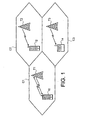
- Figure 1 shows three cells C1, C2, C3 of a cellular transceiver system each having a respective transceiving station T1, T2, T3.
- the cells are illustrated as hexagonal areas (as is traditional) but, of course, in practice the areas served will be irregular in shape and generally overlap somewhat.
- the network may operate under GSM, GPRS, EDGE, UMTS, CDMA-One, 1-Mode, IS-136, CDMA-2000 or any other suitable standards. While the invention can readily be implemented on packet-mode systems it may equally be implemented in circuit-mode systems.
- a regular digital mobile telephone 10 is shown in cell C1 and this telephone is "on" and so is registered with that cell of the network.
- This telephone can make calls, receive calls, request information using the Wireless Application Protocol (W AP) and so on.
- W AP Wireless Application Protocol
- the telephone is arranged to monitor a particular channel amongst those transmitted in cell C1.
- This is preferably a paging control channel but it may be a logical or physical channel as desired.
- This channel comprises the Broadcast information channel in accordance with one aspect of the invention. Where a channel is constantly allocated then those subscribers who want to access the broadcast information can activate their phones to monitor that channel. Alternatively, the phones may do this automatically and store the latest transmission pertaining to each type of information.
- the data may be encoded to ensure that only those subscribers that pay for the service may access it.
- the phone can download it without having to log onto the network (with all of the power consumption and bandwidth consumption issues that that entails).
- the data will be stored in the on-board memory of the telephone and retrieved at the user's convenience by operation of the buttons on the phone to navigate through the various pieces of information stored.
- the information may be a broadcast WML deck over WAP or any other suitable format.
- cell C2 there is a modified mobile telephone 12 which is provided with another mode of operation in addition to those two normally provided on digital mobile telephones.
- a further mode is provided which can best be described as "eavesdropping".
- the transmit circuitry of the phone is powered down and the phone no longer registers with the network. The removal of the necessity of having to register periodically can extend battery life by ten times that of "on” or “standby” mode, even if no calls are made.
- a receive-only unit 14 which may pick up the Broadcast massages but, having no transmitter, cannot log onto the network for making calls.
- Such a unit may be made very compact because only enough battery power to receive need be provided.
- a receiver may be provided as an accessory (or plug-in card) for a personal computer, especially a portable computer, to allow cheap and up-to the minute downloading of share information and the like.
- the network operator may modify their transceiving stations and transmission network technology to allow transmission of messages to "virtual" network users in broadcast mode, where the transmission of non-terminated messages is not covered in the cellular specification.
- the information transmitted over the cellular network may comprise or include identification details for suitably-equipped mobile telephones to obtain information over other, parallel broadcast links - for example the use of Eureka-147 data channel to broadcast WML, stacks to phones equipped with suitable radio frequency circuitry and demodulation.
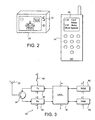
- Figure 2 shows a mobile telephone modified in accordance with an aspect of the invention being used in conjunction with a broadcast receiver, in this case a television receiver, 20.
- a channel indicator 22 on the television shows that the television is tuned to channel 5 and a news program is showing at 1:50 p.m.
- the viewer also has a mobile telephone 24 equipped to receive broadcast data comprising television schedules. These are provided to the operator of the communication network regularly by the broadcaster or schedule provision service. Preferably this happens frequently so that late changes to the schedule may be advised to the user.
- the schedule for channel 5 is displayed to the user on the LCD 26 of the telephone. The user can then see that the news continues until 2 p.m. and that a Motor Show Special follows. Of course the user can equally check the schedule for other channels, different times and so on.
- FIG. 2 shows television schedule information many different classes of information may beneficially be broadcast in accordance with the invention.
- Some particular examples are odds for horse-race betting, share prices and travel information.
- broadcasting the information in a number of geographically dispersed cells then rather than have a number of users in each cell of the network accessing this information personally, their phone can automatically download the latest information regardless of their location, so it will be immediately available when required.
- Geographically-dependent information such as weather conditions may be transmitted only in those cells for which it is appropriate.
- the received information can be stored by the telephone, or receiver, for later use.
- a menu system may provide for ease of access, and stored information may be updated automatically when re-broadcast.
- the system is particularly suitable for transmitting information relating to current events, as described in WO 99/04568, the contents of which are incorporated herein by reference.
- information on price or availability of products being displayed in a TV program may be transmitted, and displayed at the appropriate time on the telephone display.
- the telephone may be adapted to receive an access telephone number incorporated in the transmitted information. If the user wishes to purchase an item shown on the TV, details of which are being transmitted via the cellular network, he can immediately call the number to place an order.
- Means may be provided to seamlessly switch the telephone or receiver to a transmit mode, to establish a voice or data connection. This could be provided by a one button user operation and/or by software in the receiver and/or code in the received signal. The user is thus enabled to respond easily to any suggestion to purchase an item. Equally, the telephone/receiver may be triggered to transmit information regarding past or current usage etc., without disturbing the user.
- FIG. 3 shows a block schematic diagram of a mobile telephone transceiver 30 in accordance with an embodiment of the invention.
- An antenna 32 is connected to a circulator whose purpose is to route signals from a transmitter 36 to the antenna and received signals to a receiver 38.
- the transmitter and receiver are both connected to a controller 40 which will usually comprise a programmed microprocessor together with the necessary interfaces and so on.
- Connected to the controller are a read only memory (ROM) 42 and a random access memory (RAM) 44.
- the ROM stores the operating software for the controller 40 while the RAM stores, among other things, the information received via the broadcast channel from the mobile telephone network.
- Each element of the transceiver is shown as having a power supply depicted by short lead lines and +/- symbols.
- the positive lead line is provided with a switch 46.
- a switch 46 This is really intended to symbolise this aspect of the invention because the telephone will usually be provided with a means of powering-down the transmitter under software control.
- the battery life may be extended by ten times or more.
- the power may be removed from the receive circuitry and even the controller to further enhance battery life.
- a low-power timer circuit may, as is well known, be used to "wake up" the circuitry at appropriate intervals.
- the channel or channels to be monitored may change over time or be in different cells of the network.
- the network is therefore preferably provided with the means to transmit control information to the telephones within the cell to instruct them to commence monitoring, for example, a different channel or at a different listening period.
- Information may be transmitted intermittently and/or repetitively and may be transmitted over a variety of channels, for example as those channels become available from 'normal' use- so that only 'spare' network capacity is made use of. Packets of information may be identified to avoid repetitive loading of the same information. Where a number of channels are transmitted on simultaneously, identifiers or a menu may be transmitted to enable the receiver to locate automatically the appropriate channel for information requested by the user or to follow when channels are being switched. Thus the user may need to lock on to an information stream relevant to a program being broadcast on BBC1 if that stream carries a high information content to suit the program.
- this connection is broken permanently - for example by programming the ROM of the unit never to activate the transmitter 36.
- this connection is broken in the further mode. The break is temporary so that the transmitter can again be used when the phone is again switched "on".
- the payload of the system may be, for example, an audio signal transmitted in MP3 format or other digital signals.
- a blind person can use their mobile phone to receive news, weather reports and so on that are read out to them.
Landscapes
- Engineering & Computer Science (AREA)
- Computer Networks & Wireless Communication (AREA)
- Signal Processing (AREA)
- Human Computer Interaction (AREA)
- Mobile Radio Communication Systems (AREA)
- Telephone Function (AREA)
- Input Circuits Of Receivers And Coupling Of Receivers And Audio Equipment (AREA)
- Transceivers (AREA)
- Small-Scale Networks (AREA)
- Exchange Systems With Centralized Control (AREA)
Claims (15)
- Terminal mobile comportant un récepteur de communications pour téléphonie cellulaire (38), le terminal étant adapté de telle manière que le récepteur de communications pour téléphonie cellulaire (38) peut être activé sans par ailleurs activer un émetteur pour téléphonie cellulaire quelconque (36) dans le terminal, le terminal étant par ailleurs adapté pour recevoir des données diffusées simultanément à plusieurs terminaux mobiles sur un réseau de téléphones cellulaires.
- Terminal selon la revendication 1 adapté pour surveiller un canal ou des canaux du réseau de téléphones cellulaires pour les données diffusées.
- Terminal selon la revendication 2 adapté pour recevoir des signaux de commande qui définissent le canal ou les canaux devant être surveillés ou la période pendant laquelle un canal donné doit être surveillé.
- Terminal selon la revendication 2 dans lequel le canal est un canal de commande de téléavertissement, un canal logique ou un canal physique.
- Terminal selon la revendication 1 dans lequel les données diffusées comportent des messages qui ne sont pas adressés à un terminal spécifique.
- Terminal selon la revendication 1 dans lequel la circuiterie de l'émetteur est désactivée de manière permanente dans le matériel.
- Terminal selon la revendication 1 dans lequel la circuiterie de l'émetteur est désactivée de manière transitoire.
- Terminal selon la revendication 1 adapté pour être capable de s'enregistrer au sein du réseau de téléphones cellulaires afin de transmettre des données, en réponse à un utilisateur qui sélectionne des éléments parmi les données diffusées affichées sur le terminal.
- Terminal selon la revendication 8 dans lequel les éléments sélectionnés par l'utilisateur comportent un numéro de téléphone faisant partie des données diffusées et dans lequel le terminal est programmé pour transmettre des données qui permettre de passer un appel vocal en provenance du terminal mobile au numéro de téléphone.
- Terminal selon la revendication 1 dans lequel les éléments des données diffusées sont un ou plusieurs des éléments suivants :(a) informations de voyage ;(b) horaires de programmes télévisés ;(c) cotes de paris ;(d) prix d'actions et de devises étrangères ;(e) prix ou disponibilité de produits affichés dans un programme télévisé ;(f) informations météorologiques ;(g) charge utile de signaux audio.
- Terminal selon la revendication 10 dans lequel les données diffusées qui sont géographiquement dépendantes sont diffusées uniquement dans des cellules applicables du réseau de téléphones cellulaires.
- Terminal selon la revendication 1 étant un téléphone mobile ou un accessoire de type carte enfichable pour un ordinateur portable.
- Procédé de diffusion et de réception de données par le biais d'un réseau de téléphones cellulaires auprès de plusieurs terminaux mobiles pour téléphonie cellulaire, comportant les étapes consistant à :(a) diffuser des données sur le réseau de téléphones cellulaires à des fins de réception par des terminaux mobiles ;(b) recevoir la diffusion au niveau de terminaux qui sont adaptés de telle manière qu'un récepteur de communications pour téléphonie cellulaire (38) dans chaque terminal peut être activé sans par ailleurs activer un émetteur pour téléphonie cellulaire quelconque (36) dans le terminal, afin de recevoir les données diffusées simultanément.
- Procédé selon la revendication 13 dans lequel les données diffusées sont une ou plusieurs des données suivantes :(a) informations de voyage ;(b) horaires de programmes télévisés ;(c) cotes de paris ;(d) prix d'actions et de devises étrangères ;(e) prix ou disponibilité de produits affichés dans un programme télévisé ;(f) informations météorologiques ;(g) charge utile de signaux audio.
- Procédé selon la revendication 13 quand utilisé pour diffuser des données à des fins de réception par un terminal mobile selon la revendication 1.
Applications Claiming Priority (3)
| Application Number | Priority Date | Filing Date | Title |
|---|---|---|---|
| GBGB0007875.8A GB0007875D0 (en) | 2000-03-31 | 2000-03-31 | Communications network |
| GB0007875 | 2000-03-31 | ||
| PCT/GB2001/001304 WO2001076292A1 (fr) | 2000-03-31 | 2001-03-23 | Telephone mobile a mode reception seulement |
Publications (2)
| Publication Number | Publication Date |
|---|---|
| EP1273191A1 EP1273191A1 (fr) | 2003-01-08 |
| EP1273191B1 true EP1273191B1 (fr) | 2006-06-07 |
Family
ID=9888878
Family Applications (1)
| Application Number | Title | Priority Date | Filing Date |
|---|---|---|---|
| EP01914052A Expired - Lifetime EP1273191B1 (fr) | 2000-03-31 | 2001-03-23 | Téléphone mobile a mode reception seulement |
Country Status (7)
| Country | Link |
|---|---|
| US (2) | US20030104832A1 (fr) |
| EP (1) | EP1273191B1 (fr) |
| AT (1) | ATE329465T1 (fr) |
| AU (1) | AU2001239438A1 (fr) |
| DE (1) | DE60120388T2 (fr) |
| GB (1) | GB0007875D0 (fr) |
| WO (1) | WO2001076292A1 (fr) |
Families Citing this family (18)
| Publication number | Priority date | Publication date | Assignee | Title |
|---|---|---|---|---|
| GB0007875D0 (en) * | 2000-03-31 | 2000-05-17 | Tvcompass Com Ltd | Communications network |
| US20060253330A1 (en) * | 2000-10-12 | 2006-11-09 | Maggio Frank S | Method and system for automatically substituting media content |
| US20060129458A1 (en) * | 2000-10-12 | 2006-06-15 | Maggio Frank S | Method and system for interacting with on-demand video content |
| US20060282319A1 (en) * | 2000-10-12 | 2006-12-14 | Maggio Frank S | Method and system for substituting media content |
| EP1347959A1 (fr) | 2000-12-27 | 2003-10-01 | Bayer Aktiengesellschaft | Derives de l'indole utilises comme ligands de recepteurs de la thyroide |
| US7277694B2 (en) * | 2002-10-22 | 2007-10-02 | Qualcomm Incorporated | Method and apparatus for commencing shared or individual transmission of broadcast content in a wireless telephone network |
| US7062272B2 (en) | 2003-02-18 | 2006-06-13 | Qualcomm Incorporated | Method and apparatus to track count of broadcast content recipients in a wireless telephone network |
| US7773548B2 (en) * | 2003-07-14 | 2010-08-10 | Sony Corporation | System and associated method of service provision based upon broadcast state information |
| GB2407738A (en) * | 2003-10-27 | 2005-05-04 | Nokia Corp | Accessing broadcast services through a service portal |
| US8128474B2 (en) | 2004-03-05 | 2012-03-06 | Cantor Index, Llc | Computer graphics processing methods and systems for presentation of graphics objects or text in a wagering environment |
| US7711628B2 (en) * | 2004-03-05 | 2010-05-04 | Cantor Index Llc | System and method for offering intraday wagering in a financial market environment |
| US20060271437A1 (en) * | 2005-05-26 | 2006-11-30 | Maggio Frank S | System and method for home product delivery |
| US7155213B1 (en) * | 2005-09-16 | 2006-12-26 | James R. Almeda | Remote control system |
| US20070290878A1 (en) * | 2006-04-07 | 2007-12-20 | Media Ip Holdings, Llc | System and method for interacting with automobile race and advertising content |
| US20080032277A1 (en) * | 2006-04-08 | 2008-02-07 | Media Ip Holdings, Llc | Dynamic multiple choice answers |
| US8185129B2 (en) | 2006-07-07 | 2012-05-22 | Skyhook Wireless, Inc. | System and method of passive and active scanning of WLAN-enabled access points to estimate position of a WLAN positioning device |
| US8355667B2 (en) * | 2006-12-01 | 2013-01-15 | Verizon Patent And Licensing Inc. | Apparatus, method, and computer program product for obtaining broadcast content |
| US9405010B2 (en) | 2012-05-02 | 2016-08-02 | Raven Industries, Inc. | Geospatial positioning using correction information provided over cellular control channels |
Family Cites Families (9)
| Publication number | Priority date | Publication date | Assignee | Title |
|---|---|---|---|---|
| WO1996026614A1 (fr) * | 1995-02-24 | 1996-08-29 | Global Locating Systems, Inc. | Dispositif de localisation et systeme utilisant des technologies cellulaires |
| US6118996A (en) * | 1996-12-11 | 2000-09-12 | Nec Corporation | Mobile communications system |
| GB2321824B (en) * | 1997-02-21 | 2001-12-12 | Nokia Mobile Phones Ltd | Phone number database for a phone |
| WO1999031828A1 (fr) * | 1997-12-18 | 1999-06-24 | Motorola Inc. | Procede et appareil de transmission de messages dans un systeme de telecommunications |
| US6690931B2 (en) * | 1998-03-25 | 2004-02-10 | Lg Information & Communications, Ltd. | Method of doing a broadcast service of a short message in a communication system |
| JP3080076B2 (ja) * | 1998-07-30 | 2000-08-21 | 日本電気株式会社 | 一斉呼出信号送出システム及びそれに用いる送出方法並びにその制御プログラムを記録した記録媒体 |
| GB2349546A (en) * | 1999-04-26 | 2000-11-01 | Nokia Mobile Phones Ltd | A terminal for providing an application using a browser |
| US20030181201A1 (en) * | 1999-07-09 | 2003-09-25 | Daniel S. Bomze | Mobile communication device for electronic commerce |
| GB0007875D0 (en) * | 2000-03-31 | 2000-05-17 | Tvcompass Com Ltd | Communications network |
-
2000
- 2000-03-31 GB GBGB0007875.8A patent/GB0007875D0/en not_active Ceased
-
2001
- 2001-03-23 DE DE60120388T patent/DE60120388T2/de not_active Expired - Fee Related
- 2001-03-23 AT AT01914052T patent/ATE329465T1/de not_active IP Right Cessation
- 2001-03-23 EP EP01914052A patent/EP1273191B1/fr not_active Expired - Lifetime
- 2001-03-23 WO PCT/GB2001/001304 patent/WO2001076292A1/fr not_active Ceased
- 2001-03-23 US US10/240,461 patent/US20030104832A1/en not_active Abandoned
- 2001-03-23 AU AU2001239438A patent/AU2001239438A1/en not_active Abandoned
-
2006
- 2006-03-13 US US11/374,495 patent/US8483667B2/en not_active Expired - Fee Related
Also Published As
| Publication number | Publication date |
|---|---|
| DE60120388D1 (de) | 2006-07-20 |
| EP1273191A1 (fr) | 2003-01-08 |
| WO2001076292A1 (fr) | 2001-10-11 |
| US20060154600A1 (en) | 2006-07-13 |
| US20030104832A1 (en) | 2003-06-05 |
| DE60120388T2 (de) | 2007-06-06 |
| AU2001239438A1 (en) | 2001-10-15 |
| ATE329465T1 (de) | 2006-06-15 |
| GB0007875D0 (en) | 2000-05-17 |
| US8483667B2 (en) | 2013-07-09 |
Similar Documents
| Publication | Publication Date | Title |
|---|---|---|
| EP1273191B1 (fr) | Téléphone mobile a mode reception seulement | |
| EP0846388B1 (fr) | Systeme et procede de gestion des informations sur l'emplacement d'une unite d'abonne dans un reseau de communications integre | |
| EP0731621B1 (fr) | Méthode de calcul du temps local actuel dans un réseau radio mobile cellulaire | |
| JP2555054B2 (ja) | 移動通信用複合端末 | |
| US7899490B2 (en) | Call control method for dual-mode mobile terminals and a dual-mode mobile terminal using the same | |
| US6119024A (en) | Mobile radio system | |
| WO1997044974A2 (fr) | Systeme d'exploitation de communications et procede afferent | |
| CA2299444A1 (fr) | Systeme et procede de radiodiffusion par canaux partages | |
| RU2006129314A (ru) | Способ и устройство, оптимизирующие прием сообщений оповещения о вызове/широковещании устройствами беспроводной связи с автономным питанием | |
| WO1996027993A1 (fr) | Unite d'abonne pourvue d'un mode sommeil et d'un mode latent | |
| US6711418B1 (en) | Wireless personal mobile data terminal receiving a wide-area broadcast and capable of two-way communication in a local area | |
| US7043262B2 (en) | Two-way pager and method for communicating preset messages over the global system for mobile communications (GSM/GPRS) network | |
| US7761117B2 (en) | Apparatus and method for indicating the kind of current communication service of dual mode mobile terminal | |
| CA2066574C (fr) | Radiotelephone a recepteur de radiomessagerie | |
| US20020002051A1 (en) | Mobile radio communication apparatus | |
| WO1997012452A1 (fr) | Dispositif de reception et d'emission radio et procede de reception et d'emission de signaux radio | |
| US20040223479A1 (en) | Method of interference control and radio terminal equipment arrangement | |
| JPH11308674A (ja) | 無線伝送システム | |
| JPS6062743A (ja) | 移動無線通信方式 | |
| JP2519645B2 (ja) | 無線通信方法および移動無線局 | |
| JP2890967B2 (ja) | ページング携帯無線機の位置登録方法 | |
| KR19990041241A (ko) | 이동단말기의 전원 절약방법 | |
| JP2820771B2 (ja) | 移動無線端末 | |
| KR970008668B1 (ko) | 수신기 | |
| JPH07274226A (ja) | 受信器 |
Legal Events
| Date | Code | Title | Description |
|---|---|---|---|
| PUAI | Public reference made under article 153(3) epc to a published international application that has entered the european phase |
Free format text: ORIGINAL CODE: 0009012 |
|
| 17P | Request for examination filed |
Effective date: 20021031 |
|
| AK | Designated contracting states |
Kind code of ref document: A1 Designated state(s): AT BE CH CY DE DK ES FI FR GB GR IE IT LI LU MC NL PT SE TR |
|
| AX | Request for extension of the european patent |
Free format text: AL;LT;LV;MK;RO;SI |
|
| 17Q | First examination report despatched |
Effective date: 20030411 |
|
| GRAP | Despatch of communication of intention to grant a patent |
Free format text: ORIGINAL CODE: EPIDOSNIGR1 |
|
| RTI1 | Title (correction) |
Free format text: MOBILE TELEPHONE WITH RECEIVE ONLY MODE |
|
| RAP1 | Party data changed (applicant data changed or rights of an application transferred) |
Owner name: TV COMPASS, INC. |
|
| RAP1 | Party data changed (applicant data changed or rights of an application transferred) |
Owner name: TV COMPASS, INC. |
|
| GRAS | Grant fee paid |
Free format text: ORIGINAL CODE: EPIDOSNIGR3 |
|
| GRAA | (expected) grant |
Free format text: ORIGINAL CODE: 0009210 |
|
| AK | Designated contracting states |
Kind code of ref document: B1 Designated state(s): AT BE CH CY DE DK ES FI FR GB GR IE IT LI LU MC NL PT SE TR |
|
| PG25 | Lapsed in a contracting state [announced via postgrant information from national office to epo] |
Ref country code: IT Free format text: LAPSE BECAUSE OF FAILURE TO SUBMIT A TRANSLATION OF THE DESCRIPTION OR TO PAY THE FEE WITHIN THE PRESCRIBED TIME-LIMIT;WARNING: LAPSES OF ITALIAN PATENTS WITH EFFECTIVE DATE BEFORE 2007 MAY HAVE OCCURRED AT ANY TIME BEFORE 2007. THE CORRECT EFFECTIVE DATE MAY BE DIFFERENT FROM THE ONE RECORDED. Effective date: 20060607 Ref country code: CH Free format text: LAPSE BECAUSE OF FAILURE TO SUBMIT A TRANSLATION OF THE DESCRIPTION OR TO PAY THE FEE WITHIN THE PRESCRIBED TIME-LIMIT Effective date: 20060607 Ref country code: AT Free format text: LAPSE BECAUSE OF FAILURE TO SUBMIT A TRANSLATION OF THE DESCRIPTION OR TO PAY THE FEE WITHIN THE PRESCRIBED TIME-LIMIT Effective date: 20060607 Ref country code: NL Free format text: LAPSE BECAUSE OF FAILURE TO SUBMIT A TRANSLATION OF THE DESCRIPTION OR TO PAY THE FEE WITHIN THE PRESCRIBED TIME-LIMIT Effective date: 20060607 Ref country code: FI Free format text: LAPSE BECAUSE OF FAILURE TO SUBMIT A TRANSLATION OF THE DESCRIPTION OR TO PAY THE FEE WITHIN THE PRESCRIBED TIME-LIMIT Effective date: 20060607 Ref country code: BE Free format text: LAPSE BECAUSE OF FAILURE TO SUBMIT A TRANSLATION OF THE DESCRIPTION OR TO PAY THE FEE WITHIN THE PRESCRIBED TIME-LIMIT Effective date: 20060607 Ref country code: LI Free format text: LAPSE BECAUSE OF FAILURE TO SUBMIT A TRANSLATION OF THE DESCRIPTION OR TO PAY THE FEE WITHIN THE PRESCRIBED TIME-LIMIT Effective date: 20060607 |
|
| REG | Reference to a national code |
Ref country code: GB Ref legal event code: FG4D |
|
| REG | Reference to a national code |
Ref country code: CH Ref legal event code: EP |
|
| REG | Reference to a national code |
Ref country code: IE Ref legal event code: FG4D |
|
| REF | Corresponds to: |
Ref document number: 60120388 Country of ref document: DE Date of ref document: 20060720 Kind code of ref document: P |
|
| PG25 | Lapsed in a contracting state [announced via postgrant information from national office to epo] |
Ref country code: SE Free format text: LAPSE BECAUSE OF FAILURE TO SUBMIT A TRANSLATION OF THE DESCRIPTION OR TO PAY THE FEE WITHIN THE PRESCRIBED TIME-LIMIT Effective date: 20060907 Ref country code: DK Free format text: LAPSE BECAUSE OF FAILURE TO SUBMIT A TRANSLATION OF THE DESCRIPTION OR TO PAY THE FEE WITHIN THE PRESCRIBED TIME-LIMIT Effective date: 20060907 |
|
| PG25 | Lapsed in a contracting state [announced via postgrant information from national office to epo] |
Ref country code: ES Free format text: LAPSE BECAUSE OF FAILURE TO SUBMIT A TRANSLATION OF THE DESCRIPTION OR TO PAY THE FEE WITHIN THE PRESCRIBED TIME-LIMIT Effective date: 20060918 |
|
| PG25 | Lapsed in a contracting state [announced via postgrant information from national office to epo] |
Ref country code: PT Free format text: LAPSE BECAUSE OF FAILURE TO SUBMIT A TRANSLATION OF THE DESCRIPTION OR TO PAY THE FEE WITHIN THE PRESCRIBED TIME-LIMIT Effective date: 20061107 |
|
| NLV1 | Nl: lapsed or annulled due to failure to fulfill the requirements of art. 29p and 29m of the patents act | ||
| REG | Reference to a national code |
Ref country code: CH Ref legal event code: PL |
|
| ET | Fr: translation filed | ||
| PLBE | No opposition filed within time limit |
Free format text: ORIGINAL CODE: 0009261 |
|
| STAA | Information on the status of an ep patent application or granted ep patent |
Free format text: STATUS: NO OPPOSITION FILED WITHIN TIME LIMIT |
|
| 26N | No opposition filed |
Effective date: 20070308 |
|
| PG25 | Lapsed in a contracting state [announced via postgrant information from national office to epo] |
Ref country code: IE Free format text: LAPSE BECAUSE OF NON-PAYMENT OF DUE FEES Effective date: 20070323 Ref country code: MC Free format text: LAPSE BECAUSE OF NON-PAYMENT OF DUE FEES Effective date: 20070331 |
|
| PG25 | Lapsed in a contracting state [announced via postgrant information from national office to epo] |
Ref country code: GR Free format text: LAPSE BECAUSE OF FAILURE TO SUBMIT A TRANSLATION OF THE DESCRIPTION OR TO PAY THE FEE WITHIN THE PRESCRIBED TIME-LIMIT Effective date: 20060908 |
|
| PGFP | Annual fee paid to national office [announced via postgrant information from national office to epo] |
Ref country code: GB Payment date: 20090318 Year of fee payment: 9 |
|
| PG25 | Lapsed in a contracting state [announced via postgrant information from national office to epo] |
Ref country code: CY Free format text: LAPSE BECAUSE OF FAILURE TO SUBMIT A TRANSLATION OF THE DESCRIPTION OR TO PAY THE FEE WITHIN THE PRESCRIBED TIME-LIMIT Effective date: 20060607 Ref country code: LU Free format text: LAPSE BECAUSE OF NON-PAYMENT OF DUE FEES Effective date: 20070323 |
|
| PGFP | Annual fee paid to national office [announced via postgrant information from national office to epo] |
Ref country code: DE Payment date: 20090319 Year of fee payment: 9 Ref country code: IT Payment date: 20090317 Year of fee payment: 9 |
|
| PG25 | Lapsed in a contracting state [announced via postgrant information from national office to epo] |
Ref country code: TR Free format text: LAPSE BECAUSE OF FAILURE TO SUBMIT A TRANSLATION OF THE DESCRIPTION OR TO PAY THE FEE WITHIN THE PRESCRIBED TIME-LIMIT Effective date: 20060607 |
|
| PGFP | Annual fee paid to national office [announced via postgrant information from national office to epo] |
Ref country code: FR Payment date: 20090316 Year of fee payment: 9 |
|
| GBPC | Gb: european patent ceased through non-payment of renewal fee |
Effective date: 20100323 |
|
| REG | Reference to a national code |
Ref country code: FR Ref legal event code: ST Effective date: 20101130 |
|
| PG25 | Lapsed in a contracting state [announced via postgrant information from national office to epo] |
Ref country code: FR Free format text: LAPSE BECAUSE OF NON-PAYMENT OF DUE FEES Effective date: 20100331 |
|
| PG25 | Lapsed in a contracting state [announced via postgrant information from national office to epo] |
Ref country code: DE Free format text: LAPSE BECAUSE OF NON-PAYMENT OF DUE FEES Effective date: 20101001 |
|
| PG25 | Lapsed in a contracting state [announced via postgrant information from national office to epo] |
Ref country code: GB Free format text: LAPSE BECAUSE OF NON-PAYMENT OF DUE FEES Effective date: 20100323 Ref country code: IT Free format text: LAPSE BECAUSE OF NON-PAYMENT OF DUE FEES Effective date: 20100323 |