EP1274176A1 - Mehrbenutzerdetektor in einem MC-CDMA Telekommunikationssystem - Google Patents
Mehrbenutzerdetektor in einem MC-CDMA Telekommunikationssystem Download PDFInfo
- Publication number
- EP1274176A1 EP1274176A1 EP01401809A EP01401809A EP1274176A1 EP 1274176 A1 EP1274176 A1 EP 1274176A1 EP 01401809 A EP01401809 A EP 01401809A EP 01401809 A EP01401809 A EP 01401809A EP 1274176 A1 EP1274176 A1 EP 1274176A1
- Authority
- EP
- European Patent Office
- Prior art keywords
- matrix
- filtering
- users
- user
- detection method
- Prior art date
- Legal status (The legal status is an assumption and is not a legal conclusion. Google has not performed a legal analysis and makes no representation as to the accuracy of the status listed.)
- Granted
Links
Images


Classifications
-
- H—ELECTRICITY
- H04—ELECTRIC COMMUNICATION TECHNIQUE
- H04L—TRANSMISSION OF DIGITAL INFORMATION, e.g. TELEGRAPHIC COMMUNICATION
- H04L27/00—Modulated-carrier systems
- H04L27/26—Systems using multi-frequency codes
- H04L27/2601—Multicarrier modulation systems
- H04L27/2647—Arrangements specific to the receiver only
- H04L27/2649—Demodulators
- H04L27/2653—Demodulators with direct demodulation of individual subcarriers
-
- H—ELECTRICITY
- H04—ELECTRIC COMMUNICATION TECHNIQUE
- H04B—TRANSMISSION
- H04B1/00—Details of transmission systems, not covered by a single one of groups H04B3/00 - H04B13/00; Details of transmission systems not characterised by the medium used for transmission
- H04B1/69—Spread spectrum techniques
- H04B1/707—Spread spectrum techniques using direct sequence modulation
- H04B1/7097—Interference-related aspects
- H04B1/7103—Interference-related aspects the interference being multiple access interference
- H04B1/7105—Joint detection techniques, e.g. linear detectors
-
- H—ELECTRICITY
- H04—ELECTRIC COMMUNICATION TECHNIQUE
- H04L—TRANSMISSION OF DIGITAL INFORMATION, e.g. TELEGRAPHIC COMMUNICATION
- H04L25/00—Baseband systems
- H04L25/02—Details ; arrangements for supplying electrical power along data transmission lines
- H04L25/0202—Channel estimation
- H04L25/021—Estimation of channel covariance
-
- H—ELECTRICITY
- H04—ELECTRIC COMMUNICATION TECHNIQUE
- H04L—TRANSMISSION OF DIGITAL INFORMATION, e.g. TELEGRAPHIC COMMUNICATION
- H04L25/00—Baseband systems
- H04L25/02—Details ; arrangements for supplying electrical power along data transmission lines
- H04L25/0202—Channel estimation
- H04L25/022—Channel estimation of frequency response
-
- H—ELECTRICITY
- H04—ELECTRIC COMMUNICATION TECHNIQUE
- H04L—TRANSMISSION OF DIGITAL INFORMATION, e.g. TELEGRAPHIC COMMUNICATION
- H04L25/00—Baseband systems
- H04L25/02—Details ; arrangements for supplying electrical power along data transmission lines
- H04L25/0202—Channel estimation
- H04L25/024—Channel estimation channel estimation algorithms
- H04L25/0242—Channel estimation channel estimation algorithms using matrix methods
- H04L25/0246—Channel estimation channel estimation algorithms using matrix methods with factorisation
-
- H—ELECTRICITY
- H04—ELECTRIC COMMUNICATION TECHNIQUE
- H04L—TRANSMISSION OF DIGITAL INFORMATION, e.g. TELEGRAPHIC COMMUNICATION
- H04L25/00—Baseband systems
- H04L25/02—Details ; arrangements for supplying electrical power along data transmission lines
- H04L25/0202—Channel estimation
- H04L25/024—Channel estimation channel estimation algorithms
- H04L25/0256—Channel estimation using minimum mean square error criteria
-
- H—ELECTRICITY
- H04—ELECTRIC COMMUNICATION TECHNIQUE
- H04L—TRANSMISSION OF DIGITAL INFORMATION, e.g. TELEGRAPHIC COMMUNICATION
- H04L27/00—Modulated-carrier systems
- H04L27/18—Phase-modulated carrier systems, i.e. using phase-shift keying
- H04L27/20—Modulator circuits; Transmitter circuits
- H04L27/2032—Modulator circuits; Transmitter circuits for discrete phase modulation, e.g. in which the phase of the carrier is modulated in a nominally instantaneous manner
- H04L27/2053—Modulator circuits; Transmitter circuits for discrete phase modulation, e.g. in which the phase of the carrier is modulated in a nominally instantaneous manner using more than one carrier, e.g. carriers with different phases
- H04L27/206—Modulator circuits; Transmitter circuits for discrete phase modulation, e.g. in which the phase of the carrier is modulated in a nominally instantaneous manner using more than one carrier, e.g. carriers with different phases using a pair of orthogonal carriers, e.g. quadrature carriers
-
- H—ELECTRICITY
- H04—ELECTRIC COMMUNICATION TECHNIQUE
- H04L—TRANSMISSION OF DIGITAL INFORMATION, e.g. TELEGRAPHIC COMMUNICATION
- H04L27/00—Modulated-carrier systems
- H04L27/26—Systems using multi-frequency codes
- H04L27/2601—Multicarrier modulation systems
- H04L27/2647—Arrangements specific to the receiver only
- H04L27/2649—Demodulators
-
- H—ELECTRICITY
- H04—ELECTRIC COMMUNICATION TECHNIQUE
- H04L—TRANSMISSION OF DIGITAL INFORMATION, e.g. TELEGRAPHIC COMMUNICATION
- H04L27/00—Modulated-carrier systems
- H04L27/26—Systems using multi-frequency codes
- H04L27/2601—Multicarrier modulation systems
- H04L27/2647—Arrangements specific to the receiver only
- H04L27/2649—Demodulators
- H04L27/26524—Fast Fourier transform [FFT] or discrete Fourier transform [DFT] demodulators in combination with other circuits for demodulation
-
- H—ELECTRICITY
- H04—ELECTRIC COMMUNICATION TECHNIQUE
- H04L—TRANSMISSION OF DIGITAL INFORMATION, e.g. TELEGRAPHIC COMMUNICATION
- H04L25/00—Baseband systems
- H04L25/02—Details ; arrangements for supplying electrical power along data transmission lines
- H04L25/03—Shaping networks in transmitter or receiver, e.g. adaptive shaping networks
- H04L25/03006—Arrangements for removing intersymbol interference
- H04L2025/0335—Arrangements for removing intersymbol interference characterised by the type of transmission
- H04L2025/03375—Passband transmission
- H04L2025/03414—Multicarrier
-
- H—ELECTRICITY
- H04—ELECTRIC COMMUNICATION TECHNIQUE
- H04L—TRANSMISSION OF DIGITAL INFORMATION, e.g. TELEGRAPHIC COMMUNICATION
- H04L25/00—Baseband systems
- H04L25/02—Details ; arrangements for supplying electrical power along data transmission lines
- H04L25/03—Shaping networks in transmitter or receiver, e.g. adaptive shaping networks
- H04L25/03006—Arrangements for removing intersymbol interference
- H04L25/03159—Arrangements for removing intersymbol interference operating in the frequency domain
-
- H—ELECTRICITY
- H04—ELECTRIC COMMUNICATION TECHNIQUE
- H04L—TRANSMISSION OF DIGITAL INFORMATION, e.g. TELEGRAPHIC COMMUNICATION
- H04L25/00—Baseband systems
- H04L25/02—Details ; arrangements for supplying electrical power along data transmission lines
- H04L25/03—Shaping networks in transmitter or receiver, e.g. adaptive shaping networks
- H04L25/03006—Arrangements for removing intersymbol interference
- H04L25/03178—Arrangements involving sequence estimation techniques
- H04L25/03331—Arrangements for the joint estimation of multiple sequences
-
- H—ELECTRICITY
- H04—ELECTRIC COMMUNICATION TECHNIQUE
- H04L—TRANSMISSION OF DIGITAL INFORMATION, e.g. TELEGRAPHIC COMMUNICATION
- H04L5/00—Arrangements affording multiple use of the transmission path
- H04L5/0001—Arrangements for dividing the transmission path
- H04L5/0014—Three-dimensional division
- H04L5/0016—Time-frequency-code
- H04L5/0021—Time-frequency-code in which codes are applied as a frequency-domain sequences, e.g. MC-CDMA
Definitions
- the present invention relates to a multi-user detection method for a receiver in a multi-carrier code division multiple access system and more specifically to a multi-user detection method with multiple access interference cancellation.
- the present invention concerns also a MC-CDMA receiver implementing such a multi-user detection method.
- Multi-Carrier Code Division Multiple Access combines OFDM (Orthogonal Frequency Division Multiplex) modulation and the CDMA multiple access technique.
- This multiple access technique was proposed for the first time by N. Yee et al. in the article entitled “Multicarrier CDMA in indoor wireless radio networks” which appeared in Proceedings of PIMRC'93, Vol. 1, pages 109-113, 1993. The developments of this technique were reviewed by S. Hara et al. in the article entitled “Overview of Multicarrier CDMA” published in IEEE Communication Magazine, pages 126-133, December 1997.
- the signature Unlike the DS-CDMA (Direct Sequence Code Division Multiple Access) method, in which the signal of each user is multiplied in the time domain in order to spread its frequency spectrum, the signature here multiplies the signal in the frequency domain, each element of the signature multiplying the signal of a different sub-carrier.
- DS-CDMA Direct Sequence Code Division Multiple Access
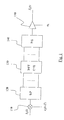
- Fig. 1 shows the structure of an MC-CDMA transmitter for a given user k .
- b k ( i ) be the i th symbol to be transmitted from the user k , where b k ( i ) belongs to the modulation alphabet.
- the symbol b k ( i ) is first of all multiplied at 110 by a spreading sequence or signature of the user, denoted c k ( t ), consisting of N "chips", each "chip” being of duration T c , the total duration of the spreading sequence corresponding to a symbol period T .
- the block of L symbols is then subjected to an inverse fast Fourier transformation (IFFT) in the module 130.
- IFFT inverse fast Fourier transformation
- a guard interval with a length greater than the duration of the pulse-type response of the transmission channel, is added to the MC-CDMA symbol. This interval is obtained by appending a suffix (denoted ⁇ ) identical to the start of the said symbol.
- the symbols thus obtained are amplified at 150 in order to be transmitted over the user channel. It can therefore be seen that the MC-CDMA method can be analysed into a spreading in the spectral domain (before IFFT) followed by an OFDM modulation.
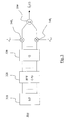
- MC-CDMA receiver for a given user k has been illustrated schematically in Fig. 2.
- This receiver is known as single-user detection receiver (or SUD receiver) because the detection takes only into account the symbols transmitted to (or from) the user in question.
- the demodulated received signal is sampled at the "chip" frequency.
- the samples obtained by sampling at the "chip” frequency are put in parallel in a serial to parallel converter 210 and stripped from the suffix ( ⁇ ) before undergoing an FFT in the module 220.
- the equalisation can therefore be performed by a single tap, i.e. by a multiplication by a complex coefficient.
- the equalisation is performed carrier-by-carrier i.e. by applying one of the known equalisation methods: MRC (Maximum Ratio Combining), EGC (Equal Gain Combining), ZF (Zero Forcing) or MMSE (Minimum Mean Square Error) independently on each carrier.
- the equalising coefficients thus obtained are denoted q k ,1 ,.., q k,L on Fig. 2.
- the samples in the frequency domain, output from 220, are multiplied by the equalising coefficients and the signature of the user k in 240 0 ,..,240 L -1 (for despreading) before being added in 250.
- the result is an estimation b and k ( i ) of the transmitted symbol b k ( i ).
- the multiuser detection techniques are known notably in CDMA telecommunications systems. They have the common characteristic of taking account of the interference generated by the other users.
- MC-CDMA receiver with GMMSE equalisation for a user k has been shown in Fig. 3. Its structure differs from that of Fig. 2 in that the equalisation is effected by means of a multiplication 330 by a matrix Q of the signals of the different carriers.
- the despread signal obtained at the output of the adder 350 gives the estimated symbol b and k ( i ).
- MUD MC-CDMA receivers using either a parallel interference cancellation (PIC) scheme or a serial interference cancellation scheme (SIC) have been proposed in the article by J-Y. Beaudais et al.
- Parallel interference cancellation consists in iteratively cancelling the multiple access interference (MAI) by subtracting for a given user the contributions due to the other users, these contributions being obtained, for a given step, by respreading the symbols estimated at the previous step and filtering them with filters modelling their respective transmission channels.
- serial interference cancellation consists in successively eliminating the contributions of the users in a cascade of stages, each stage eliminating the contribution of a particular user, commencing by the contribution of highest power.
- Fig. 4 illustrates the structure of a MC-CDMA receiver with parallel interference cancellation. For the sake of clarity, only the part related to a user k has been represented.
- r ( i ) denotes the output of the FFT, i.e. the vector of frequency components supplied by stage 320 in Fig. 3 at time i.T .
- K -1 matrices are involved, each matrix corresponding to a transmission channel of a user. These K -1 matrices are represented by the tensor , where the index (1) stands for the first cancellation stage.
- the detected symbols are then respread by said signatures in 440 and the MC-CDMA symbols thus obtained are filtered by K -1 filters modelling the transmission channels of the users k '.
- Each filter can be represented by an L x L diagonal matrix and the K -1 matrices are represented by the tensor .
- the K -1 outputs of 450 give the respective contributions of the users k ' to the MAI. They are subtracted from r ( i ) (delayed so as to compensate for the processing time in 410-450) in 460 1 ,.., 460 K -1 .
- the output of 460 K -1 is a version of r ( i ) freed of a first estimation of MAI.
- the process can be repeated so as to refine the estimation of the MAI and jointly improve the detection of the symbols.
- the last stage is followed by a classical single-user equalisation in 470, despreading in 480 and symbol detection in 490 as in Fig. 2.
- the object of the present invention is to propose a MC-CDMA receiver with multi-user detection and MAI removal which is simpler than those known from the prior art.
- the object of the invention is to propose a MC-CDMA receiver of said type which is simpler when the number of users is low.
- C ( i ) H ( i ) C D
- C D is the L x K matrix containing the codes of the active users:
- the maximum likelihood detection of the transmitted signal consists in finding the symbol b which minimises the quadratic distance d 2 / Emin ( b ) between the received signal and the signal expected to be received if b was transmitted.
- the vector y ( i ) represents a sufficient statistic for the maximum likelihood detection of the transmitted vector b ( i ).
- the basic idea underlying the invention is to propose a decision-feedback detector cancelling the interference corresponding to the already detected symbols of the other users. As further explained, this interference cancellation is made at the symbol level and not at the carrier level.
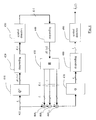
- the structure of the decision-feedback detector according to the invention is illustrated in Fig 5.
- the detector comprises a filter 510 matched to the signatures of the users and to the response(s) of the propagation channel(s) (the plural stands for the uplink).
- the filter 510 multiplies the vector r ( i ) of the frequency components by the matrix D ⁇ C H ( i ) in order to output the observation vector y ( i ) according to equation (11).
- the detector comprises also a forward filter 520 and a backward filter 550.
- the forward filter performs a multiplication of the observation vector y ( i ) by a matrix F ( i ) while the backward filter performs a multiplication of the vector b and ( i ) of the estimated symbols by a matrix B ( i ).
- the backward filter is causal within the meaning of multi-user detection (only the contribution of the already detected symbols of the other users are cancelled), i.e . the matrix B ( i ) is strictly lower triangular.
- the symbols for the different users are estimated from the observation vector z ( i ) in estimating means 540.
- the vector b and ( i ) of the estimated symbols is supplied to the backward filter 550.
- the matrices F ( i ) and B ( i ) are chosen to meet a zero-forcing (ZF) criterion.
- the matrices F ( i ) and B ( i ) are chosen to meet a MMSE criterion.
- ⁇ ( i ) z ( i ) - b (i) be the error between the observation vector and the vector of the transmitted symbols.
- the purpose of the MMSE criterion is to minimise the mean square of this error:
- N 0 I K + R( i ) L H N 0 L N 0 where L N 0 is lower triangular. If we replace (30) into (29), we obtain: where is lower triangular. Hence, since B ( i ) is assumed strictly lower triangular. If we choose: where the notation stands for we obtain: and, consequently, which is indeed the minimum of according to (32).
- F ( i ) and B ( i ) can be chosen proportional to the expressions given in (36).
- the first and second embodiments of the invention both achieve MAI cancellation at the symbol level instead of operating at the carrier level. This significantly reduces the complexity of implementation, especially when the number of active users is less than the number of carriers in the OFDM multiplex.
- Both embodiments apply equally to downlink and uplink receivers, the filter 510 having a simpler structure for the downlink.
- multi-user detection device for an MC-CDMA receiver has been described in terms of functional modules e.g. filters or estimating means, it goes without saying that all or part of this device can be implemented by means of a single processor either dedicated for fulfilling all the functions depicted or in the form of a plurality of processors either dedicated or programmed for each fulfilling one or some of said functions.
Landscapes
- Engineering & Computer Science (AREA)
- Signal Processing (AREA)
- Computer Networks & Wireless Communication (AREA)
- Power Engineering (AREA)
- Mathematical Physics (AREA)
- Physics & Mathematics (AREA)
- General Physics & Mathematics (AREA)
- Discrete Mathematics (AREA)
- Mobile Radio Communication Systems (AREA)
- Noise Elimination (AREA)
- Digital Transmission Methods That Use Modulated Carrier Waves (AREA)
- Telephonic Communication Services (AREA)
- Measuring Pulse, Heart Rate, Blood Pressure Or Blood Flow (AREA)
Priority Applications (5)
| Application Number | Priority Date | Filing Date | Title |
|---|---|---|---|
| AT01401809T ATE283580T1 (de) | 2001-07-05 | 2001-07-05 | Mehrbenutzerdetektion in einem mc-cdma telekommunikationssystem |
| EP01401809A EP1274176B1 (de) | 2001-07-05 | 2001-07-05 | Mehrbenutzerdetektion in einem MC-CDMA Telekommunikationssystem |
| DE60107407T DE60107407T2 (de) | 2001-07-05 | 2001-07-05 | Mehrbenutzerdetektion in einem MC-CDMA Telekommunikationssystem |
| JP2002194595A JP2003101513A (ja) | 2001-07-05 | 2002-07-03 | マルチユーザ検出方法およびマルチユーザ受信機 |
| US10/189,003 US7277470B2 (en) | 2001-07-05 | 2002-07-05 | Multi-user detection in an MC-CDMA telecommunication system |
Applications Claiming Priority (1)
| Application Number | Priority Date | Filing Date | Title |
|---|---|---|---|
| EP01401809A EP1274176B1 (de) | 2001-07-05 | 2001-07-05 | Mehrbenutzerdetektion in einem MC-CDMA Telekommunikationssystem |
Publications (2)
| Publication Number | Publication Date |
|---|---|
| EP1274176A1 true EP1274176A1 (de) | 2003-01-08 |
| EP1274176B1 EP1274176B1 (de) | 2004-11-24 |
Family
ID=8182798
Family Applications (1)
| Application Number | Title | Priority Date | Filing Date |
|---|---|---|---|
| EP01401809A Expired - Lifetime EP1274176B1 (de) | 2001-07-05 | 2001-07-05 | Mehrbenutzerdetektion in einem MC-CDMA Telekommunikationssystem |
Country Status (5)
| Country | Link |
|---|---|
| US (1) | US7277470B2 (de) |
| EP (1) | EP1274176B1 (de) |
| JP (1) | JP2003101513A (de) |
| AT (1) | ATE283580T1 (de) |
| DE (1) | DE60107407T2 (de) |
Cited By (2)
| Publication number | Priority date | Publication date | Assignee | Title |
|---|---|---|---|---|
| US7400692B2 (en) | 2004-01-14 | 2008-07-15 | Interdigital Technology Corporation | Telescoping window based equalization |
| US7437135B2 (en) | 2003-10-30 | 2008-10-14 | Interdigital Technology Corporation | Joint channel equalizer interference canceller advanced receiver |
Families Citing this family (6)
| Publication number | Priority date | Publication date | Assignee | Title |
|---|---|---|---|---|
| EP1300977A1 (de) * | 2001-10-04 | 2003-04-09 | Mitsubishi Electric Information Technology Centre Europe B.V. | Parallel Interferenzunterdrückung in einem MC-CDMA-Telekommunikationssystem |
| US7342952B2 (en) * | 2003-06-24 | 2008-03-11 | Qualcomm Incorporated | Slicer input and feedback filter contents for block coded digital communications |
| US20080253389A1 (en) * | 2004-10-15 | 2008-10-16 | Peter Larsson | Method and System of Radio Communications With Various Resolution Levels of Signal Modulation Depending on Propagation Conditions |
| US7593473B2 (en) * | 2004-12-01 | 2009-09-22 | Bae Systems Information And Electronic Systems Integration Inc. | Tree structured multicarrier multiple access systems |
| US20110255467A1 (en) * | 2008-02-07 | 2011-10-20 | Peter Larsson | Method and system of radio communications with various resolution levels of signal modulation depending on propagation conditions |
| US8385387B2 (en) * | 2010-05-20 | 2013-02-26 | Harris Corporation | Time dependent equalization of frequency domain spread orthogonal frequency division multiplexing using decision feedback equalization |
Family Cites Families (18)
| Publication number | Priority date | Publication date | Assignee | Title |
|---|---|---|---|---|
| US5377225A (en) * | 1993-10-19 | 1994-12-27 | Hughes Aircraft Company | Multiple-access noise rejection filter for a DS-CDMA system |
| EP0744101B1 (de) * | 1994-02-10 | 1998-08-05 | International Business Machines Corporation | Verfahren und gerät für mehrbenutzer interferenz verminderung |
| US6201799B1 (en) * | 1997-05-01 | 2001-03-13 | Lucent Technologies, Inc | Partial decorrelation for a coherent multicode code division multiple access receiver |
| US6075792A (en) * | 1997-06-16 | 2000-06-13 | Interdigital Technology Corporation | CDMA communication system which selectively allocates bandwidth upon demand |
| SG77607A1 (en) * | 1997-08-26 | 2001-01-16 | Univ Singapore | A multi-user code division multiple access receiver |
| US6175588B1 (en) * | 1997-12-30 | 2001-01-16 | Motorola, Inc. | Communication device and method for interference suppression using adaptive equalization in a spread spectrum communication system |
| US6301293B1 (en) * | 1998-08-04 | 2001-10-09 | Agere Systems Guardian Corp. | Detectors for CDMA systems |
| JP2000082982A (ja) * | 1998-09-03 | 2000-03-21 | Nec Corp | アレーアンテナ受信装置 |
| AU2273099A (en) * | 1998-12-15 | 2000-07-03 | Nokia Networks Oy | A receiver |
| US6151358A (en) * | 1999-08-11 | 2000-11-21 | Motorola, Inc. | Method and apparatus, and computer program for producing filter coefficients for equalizers |
| US6714527B2 (en) * | 1999-09-21 | 2004-03-30 | Interdigital Techology Corporation | Multiuser detector for variable spreading factors |
| US6614836B1 (en) * | 2000-01-28 | 2003-09-02 | Intersil Americas Inc. | Biased-corrected rake receiver for direct sequence spread spectrum waveform |
| US6654408B1 (en) * | 2000-10-27 | 2003-11-25 | Wisconsin Alumni Research Foundation | Method and system for multi-carrier multiple access reception in the presence of imperfections |
| JP3639206B2 (ja) * | 2000-11-24 | 2005-04-20 | 富士通株式会社 | 共有メモリ型スカラ並列計算機における並列行列処理方法、及び記録媒体 |
| US6711219B2 (en) * | 2000-12-04 | 2004-03-23 | Tensorcomm, Incorporated | Interference cancellation in a signal |
| FR2822568B1 (fr) | 2001-03-22 | 2003-06-06 | Mitsubishi Electric Inf Tech | Methode et dispositif d'egalisation de type gmmse |
| US6785341B2 (en) * | 2001-05-11 | 2004-08-31 | Qualcomm Incorporated | Method and apparatus for processing data in a multiple-input multiple-output (MIMO) communication system utilizing channel state information |
| EP1300977A1 (de) * | 2001-10-04 | 2003-04-09 | Mitsubishi Electric Information Technology Centre Europe B.V. | Parallel Interferenzunterdrückung in einem MC-CDMA-Telekommunikationssystem |
-
2001
- 2001-07-05 DE DE60107407T patent/DE60107407T2/de not_active Expired - Lifetime
- 2001-07-05 EP EP01401809A patent/EP1274176B1/de not_active Expired - Lifetime
- 2001-07-05 AT AT01401809T patent/ATE283580T1/de not_active IP Right Cessation
-
2002
- 2002-07-03 JP JP2002194595A patent/JP2003101513A/ja active Pending
- 2002-07-05 US US10/189,003 patent/US7277470B2/en not_active Expired - Fee Related
Non-Patent Citations (3)
| Title |
|---|
| HÉLARD J-F ET AL: "Linear MMSE detection technique for MC-CDMA", ELECTRONICS LETTERS, IEE STEVENAGE, GB, vol. 36, no. 7, 30 March 2000 (2000-03-30), pages 665 - 666, XP006015082, ISSN: 0013-5194 * |
| JUNG P ET AL: "A GENERALIZED VIEW ON MULTICARRIER CDMA MOBILE RADIO SYSTEMS WITH JOINT DETECTION (PART I)", FREQUENZ, SCHIELE UND SCHON GMBH. BERLIN, DE, vol. 51, no. 7/8, 1 July 1997 (1997-07-01), pages 174 - 185, XP000735799, ISSN: 0016-1136 * |
| JUNG P ET AL: "A GENERALIZED VIEW ON MULTICARRIER CDMA MOBILE RADIO SYSTEMS WITH JOINT DETECTION (PART II). EINE VERALLGEMEINERTE DARSTELLUNG VON MOBILFUNKKONZEPTEN MIT MULTITRAEGER-CDMA UND GEMEINSAMER DETEKTION (TEIL II)", FREQUENZ, SCHIELE UND SCHON GMBH. BERLIN, DE, vol. 51, no. 11/12, 1 November 1997 (1997-11-01), pages 270 - 275, XP000765910, ISSN: 0016-1136 * |
Cited By (2)
| Publication number | Priority date | Publication date | Assignee | Title |
|---|---|---|---|---|
| US7437135B2 (en) | 2003-10-30 | 2008-10-14 | Interdigital Technology Corporation | Joint channel equalizer interference canceller advanced receiver |
| US7400692B2 (en) | 2004-01-14 | 2008-07-15 | Interdigital Technology Corporation | Telescoping window based equalization |
Also Published As
| Publication number | Publication date |
|---|---|
| DE60107407D1 (de) | 2004-12-30 |
| JP2003101513A (ja) | 2003-04-04 |
| EP1274176B1 (de) | 2004-11-24 |
| ATE283580T1 (de) | 2004-12-15 |
| US7277470B2 (en) | 2007-10-02 |
| US20030053527A1 (en) | 2003-03-20 |
| DE60107407T2 (de) | 2005-05-19 |
Similar Documents
| Publication | Publication Date | Title |
|---|---|---|
| KR100765873B1 (ko) | 수신 다이버시티를 갖는 블록 전송을 위한 그룹형 직렬간섭 제거 | |
| US8462899B2 (en) | Multi-user detecting method and device of OFDM transmission signal | |
| US7286517B2 (en) | Multi-user detection method for a receiver in a MC-CDMA telecommunication system | |
| JP4585732B2 (ja) | 多重搬送波と符号分割多元接続との変調技術の組合せを使用した受信機における等化方法 | |
| US8331505B2 (en) | Method and system for symbol detection using sub-constellations | |
| US7130353B2 (en) | Multiuser detection method and device | |
| US20020041644A1 (en) | Multi-user detection method | |
| US20100278218A1 (en) | Method and system for multi-user interference cancellation | |
| EP1274176B1 (de) | Mehrbenutzerdetektion in einem MC-CDMA Telekommunikationssystem | |
| EP1359700A1 (de) | MC-CDMA-Empfänger mit einer Entzerrung je Unterträger | |
| US7058115B2 (en) | Equalization method and device of the GMMSE type | |
| JP4014084B2 (ja) | Gmmseタイプの等化方法 | |
| EP1276268B1 (de) | Mehrbenutzerdetektion in einem MC-CDMA Nachrichtensystem | |
| JP4451046B2 (ja) | Gmmseタイプの等化方法および装置ならびに受信機 | |
| US20100278219A1 (en) | Method and system for multi-user detection in the presence of multiple spreading factors | |
| US8494098B2 (en) | Method and system for inter-cell interference cancellation | |
| US8615030B2 (en) | Method and system for multi-user detection using two-stage processing | |
| US20100278167A1 (en) | Method and system for data-aided channel estimation | |
| US20100278035A1 (en) | Method and system for multi-user detection using two-stage processing | |
| KR100843252B1 (ko) | 반복 수신 방법 및 반복 수신기 | |
| Al-kamali et al. | Efficient implementation of downlink CDMA equalization using frequency domain approximation | |
| Al-Kamali et al. | An efficient receiver scheme for downlink ZP-CDMA | |
| Li et al. | Channel identification and signal separation for long-code CDMA systems using multistep linear prediction method |
Legal Events
| Date | Code | Title | Description |
|---|---|---|---|
| PUAI | Public reference made under article 153(3) epc to a published international application that has entered the european phase |
Free format text: ORIGINAL CODE: 0009012 |
|
| AK | Designated contracting states |
Kind code of ref document: A1 Designated state(s): AT BE CH CY DE DK ES FI FR GB GR IE IT LI LU MC NL PT SE TR |
|
| AX | Request for extension of the european patent |
Free format text: AL;LT;LV;MK;RO;SI |
|
| RAP1 | Party data changed (applicant data changed or rights of an application transferred) |
Owner name: MITSUBISHI ELECTRIC INFORMATION TECHNOLOGY CENTRE |
|
| 17P | Request for examination filed |
Effective date: 20030201 |
|
| AKX | Designation fees paid |
Designated state(s): AT BE CH CY DE DK ES FI FR GB GR IE IT LI LU MC NL PT SE TR |
|
| 17Q | First examination report despatched |
Effective date: 20030813 |
|
| GRAP | Despatch of communication of intention to grant a patent |
Free format text: ORIGINAL CODE: EPIDOSNIGR1 |
|
| GRAS | Grant fee paid |
Free format text: ORIGINAL CODE: EPIDOSNIGR3 |
|
| GRAA | (expected) grant |
Free format text: ORIGINAL CODE: 0009210 |
|
| AK | Designated contracting states |
Kind code of ref document: B1 Designated state(s): AT BE CH CY DE DK ES FI FR GB GR IE IT LI LU MC NL PT SE TR |
|
| PG25 | Lapsed in a contracting state [announced via postgrant information from national office to epo] |
Ref country code: IT Free format text: LAPSE BECAUSE OF FAILURE TO SUBMIT A TRANSLATION OF THE DESCRIPTION OR TO PAY THE FEE WITHIN THE PRESCRIBED TIME-LIMIT;WARNING: LAPSES OF ITALIAN PATENTS WITH EFFECTIVE DATE BEFORE 2007 MAY HAVE OCCURRED AT ANY TIME BEFORE 2007. THE CORRECT EFFECTIVE DATE MAY BE DIFFERENT FROM THE ONE RECORDED. Effective date: 20041124 Ref country code: TR Free format text: LAPSE BECAUSE OF FAILURE TO SUBMIT A TRANSLATION OF THE DESCRIPTION OR TO PAY THE FEE WITHIN THE PRESCRIBED TIME-LIMIT Effective date: 20041124 Ref country code: NL Free format text: LAPSE BECAUSE OF FAILURE TO SUBMIT A TRANSLATION OF THE DESCRIPTION OR TO PAY THE FEE WITHIN THE PRESCRIBED TIME-LIMIT Effective date: 20041124 Ref country code: CH Free format text: LAPSE BECAUSE OF FAILURE TO SUBMIT A TRANSLATION OF THE DESCRIPTION OR TO PAY THE FEE WITHIN THE PRESCRIBED TIME-LIMIT Effective date: 20041124 Ref country code: BE Free format text: LAPSE BECAUSE OF FAILURE TO SUBMIT A TRANSLATION OF THE DESCRIPTION OR TO PAY THE FEE WITHIN THE PRESCRIBED TIME-LIMIT Effective date: 20041124 Ref country code: LI Free format text: LAPSE BECAUSE OF FAILURE TO SUBMIT A TRANSLATION OF THE DESCRIPTION OR TO PAY THE FEE WITHIN THE PRESCRIBED TIME-LIMIT Effective date: 20041124 Ref country code: FI Free format text: LAPSE BECAUSE OF FAILURE TO SUBMIT A TRANSLATION OF THE DESCRIPTION OR TO PAY THE FEE WITHIN THE PRESCRIBED TIME-LIMIT Effective date: 20041124 Ref country code: AT Free format text: LAPSE BECAUSE OF FAILURE TO SUBMIT A TRANSLATION OF THE DESCRIPTION OR TO PAY THE FEE WITHIN THE PRESCRIBED TIME-LIMIT Effective date: 20041124 |
|
| REG | Reference to a national code |
Ref country code: GB Ref legal event code: FG4D |
|
| REG | Reference to a national code |
Ref country code: CH Ref legal event code: EP |
|
| REF | Corresponds to: |
Ref document number: 60107407 Country of ref document: DE Date of ref document: 20041230 Kind code of ref document: P |
|
| REG | Reference to a national code |
Ref country code: IE Ref legal event code: FG4D |
|
| PG25 | Lapsed in a contracting state [announced via postgrant information from national office to epo] |
Ref country code: SE Free format text: LAPSE BECAUSE OF FAILURE TO SUBMIT A TRANSLATION OF THE DESCRIPTION OR TO PAY THE FEE WITHIN THE PRESCRIBED TIME-LIMIT Effective date: 20050224 Ref country code: DK Free format text: LAPSE BECAUSE OF FAILURE TO SUBMIT A TRANSLATION OF THE DESCRIPTION OR TO PAY THE FEE WITHIN THE PRESCRIBED TIME-LIMIT Effective date: 20050224 Ref country code: GR Free format text: LAPSE BECAUSE OF FAILURE TO SUBMIT A TRANSLATION OF THE DESCRIPTION OR TO PAY THE FEE WITHIN THE PRESCRIBED TIME-LIMIT Effective date: 20050224 |
|
| PG25 | Lapsed in a contracting state [announced via postgrant information from national office to epo] |
Ref country code: ES Free format text: LAPSE BECAUSE OF FAILURE TO SUBMIT A TRANSLATION OF THE DESCRIPTION OR TO PAY THE FEE WITHIN THE PRESCRIBED TIME-LIMIT Effective date: 20050306 |
|
| NLV1 | Nl: lapsed or annulled due to failure to fulfill the requirements of art. 29p and 29m of the patents act | ||
| REG | Reference to a national code |
Ref country code: CH Ref legal event code: PL |
|
| ET | Fr: translation filed | ||
| PG25 | Lapsed in a contracting state [announced via postgrant information from national office to epo] |
Ref country code: LU Free format text: LAPSE BECAUSE OF NON-PAYMENT OF DUE FEES Effective date: 20050705 Ref country code: CY Free format text: LAPSE BECAUSE OF FAILURE TO SUBMIT A TRANSLATION OF THE DESCRIPTION OR TO PAY THE FEE WITHIN THE PRESCRIBED TIME-LIMIT Effective date: 20050705 Ref country code: IE Free format text: LAPSE BECAUSE OF NON-PAYMENT OF DUE FEES Effective date: 20050705 |
|
| PG25 | Lapsed in a contracting state [announced via postgrant information from national office to epo] |
Ref country code: MC Free format text: LAPSE BECAUSE OF NON-PAYMENT OF DUE FEES Effective date: 20050731 |
|
| PLBE | No opposition filed within time limit |
Free format text: ORIGINAL CODE: 0009261 |
|
| STAA | Information on the status of an ep patent application or granted ep patent |
Free format text: STATUS: NO OPPOSITION FILED WITHIN TIME LIMIT |
|
| 26N | No opposition filed |
Effective date: 20050825 |
|
| REG | Reference to a national code |
Ref country code: IE Ref legal event code: MM4A |
|
| PG25 | Lapsed in a contracting state [announced via postgrant information from national office to epo] |
Ref country code: PT Free format text: LAPSE BECAUSE OF NON-PAYMENT OF DUE FEES Effective date: 20050424 |
|
| PGFP | Annual fee paid to national office [announced via postgrant information from national office to epo] |
Ref country code: GB Payment date: 20110610 Year of fee payment: 11 |
|
| PGFP | Annual fee paid to national office [announced via postgrant information from national office to epo] |
Ref country code: DE Payment date: 20110714 Year of fee payment: 11 Ref country code: FR Payment date: 20110810 Year of fee payment: 11 |
|
| GBPC | Gb: european patent ceased through non-payment of renewal fee |
Effective date: 20120705 |
|
| REG | Reference to a national code |
Ref country code: FR Ref legal event code: ST Effective date: 20130329 |
|
| PG25 | Lapsed in a contracting state [announced via postgrant information from national office to epo] |
Ref country code: FR Free format text: LAPSE BECAUSE OF NON-PAYMENT OF DUE FEES Effective date: 20120731 Ref country code: GB Free format text: LAPSE BECAUSE OF NON-PAYMENT OF DUE FEES Effective date: 20120705 Ref country code: DE Free format text: LAPSE BECAUSE OF NON-PAYMENT OF DUE FEES Effective date: 20130201 |
|
| REG | Reference to a national code |
Ref country code: DE Ref legal event code: R119 Ref document number: 60107407 Country of ref document: DE Effective date: 20130201 |