EP1274665B1 - CORPS MOULES MICROCRISTALLINS A BASE DE ALPHA Al2O3, PROCEDE PERMETTANT DE LES PRODUIRE ET LEUR UTILISATION - Google Patents
CORPS MOULES MICROCRISTALLINS A BASE DE ALPHA Al2O3, PROCEDE PERMETTANT DE LES PRODUIRE ET LEUR UTILISATION Download PDFInfo
- Publication number
- EP1274665B1 EP1274665B1 EP01913789A EP01913789A EP1274665B1 EP 1274665 B1 EP1274665 B1 EP 1274665B1 EP 01913789 A EP01913789 A EP 01913789A EP 01913789 A EP01913789 A EP 01913789A EP 1274665 B1 EP1274665 B1 EP 1274665B1
- Authority
- EP
- European Patent Office
- Prior art keywords
- abrasive grain
- grain
- abrasive
- sintered
- grinding
- Prior art date
- Legal status (The legal status is an assumption and is not a legal conclusion. Google has not performed a legal analysis and makes no representation as to the accuracy of the status listed.)
- Expired - Lifetime
Links
- 238000000034 method Methods 0.000 title claims abstract description 48
- 238000004519 manufacturing process Methods 0.000 title claims abstract description 10
- 229910052593 corundum Inorganic materials 0.000 title claims description 27
- PNEYBMLMFCGWSK-UHFFFAOYSA-N aluminium oxide Inorganic materials [O-2].[O-2].[O-2].[Al+3].[Al+3] PNEYBMLMFCGWSK-UHFFFAOYSA-N 0.000 title claims description 10
- 229910001845 yogo sapphire Inorganic materials 0.000 title claims 4
- 239000000463 material Substances 0.000 claims abstract description 23
- 239000011230 binding agent Substances 0.000 claims abstract description 22
- 239000002245 particle Substances 0.000 claims abstract description 15
- 239000000843 powder Substances 0.000 claims abstract description 11
- 239000007858 starting material Substances 0.000 claims abstract description 9
- 239000002904 solvent Substances 0.000 claims abstract description 8
- 239000006061 abrasive grain Substances 0.000 claims description 74
- 239000000203 mixture Substances 0.000 claims description 19
- 238000001125 extrusion Methods 0.000 claims description 16
- 239000003082 abrasive agent Substances 0.000 claims description 14
- 238000005520 cutting process Methods 0.000 claims description 11
- 239000000126 substance Substances 0.000 claims description 11
- 239000013078 crystal Substances 0.000 claims description 10
- 239000007787 solid Substances 0.000 claims description 7
- LYCAIKOWRPUZTN-UHFFFAOYSA-N Ethylene glycol Chemical compound OCCO LYCAIKOWRPUZTN-UHFFFAOYSA-N 0.000 claims description 6
- PEDCQBHIVMGVHV-UHFFFAOYSA-N Glycerine Chemical compound OCC(O)CO PEDCQBHIVMGVHV-UHFFFAOYSA-N 0.000 claims description 5
- 229920000058 polyacrylate Polymers 0.000 claims description 5
- XLYOFNOQVPJJNP-UHFFFAOYSA-N water Substances O XLYOFNOQVPJJNP-UHFFFAOYSA-N 0.000 claims description 5
- WRIDQFICGBMAFQ-UHFFFAOYSA-N (E)-8-Octadecenoic acid Natural products CCCCCCCCCC=CCCCCCCC(O)=O WRIDQFICGBMAFQ-UHFFFAOYSA-N 0.000 claims description 4
- LQJBNNIYVWPHFW-UHFFFAOYSA-N 20:1omega9c fatty acid Natural products CCCCCCCCCCC=CCCCCCCCC(O)=O LQJBNNIYVWPHFW-UHFFFAOYSA-N 0.000 claims description 4
- QSBYPNXLFMSGKH-UHFFFAOYSA-N 9-Heptadecensaeure Natural products CCCCCCCC=CCCCCCCCC(O)=O QSBYPNXLFMSGKH-UHFFFAOYSA-N 0.000 claims description 4
- 239000005642 Oleic acid Substances 0.000 claims description 4
- ZQPPMHVWECSIRJ-UHFFFAOYSA-N Oleic acid Natural products CCCCCCCCC=CCCCCCCCC(O)=O ZQPPMHVWECSIRJ-UHFFFAOYSA-N 0.000 claims description 4
- POULHZVOKOAJMA-UHFFFAOYSA-N dodecanoic acid Chemical compound CCCCCCCCCCCC(O)=O POULHZVOKOAJMA-UHFFFAOYSA-N 0.000 claims description 4
- 235000021323 fish oil Nutrition 0.000 claims description 4
- IPCSVZSSVZVIGE-UHFFFAOYSA-N hexadecanoic acid Chemical compound CCCCCCCCCCCCCCCC(O)=O IPCSVZSSVZVIGE-UHFFFAOYSA-N 0.000 claims description 4
- QXJSBBXBKPUZAA-UHFFFAOYSA-N isooleic acid Natural products CCCCCCCC=CCCCCCCCCC(O)=O QXJSBBXBKPUZAA-UHFFFAOYSA-N 0.000 claims description 4
- ZQPPMHVWECSIRJ-KTKRTIGZSA-N oleic acid Chemical compound CCCCCCCC\C=C/CCCCCCCC(O)=O ZQPPMHVWECSIRJ-KTKRTIGZSA-N 0.000 claims description 4
- 239000004014 plasticizer Substances 0.000 claims description 4
- 239000002202 Polyethylene glycol Substances 0.000 claims description 3
- 239000002270 dispersing agent Substances 0.000 claims description 3
- 239000008187 granular material Substances 0.000 claims description 3
- 229920000609 methyl cellulose Polymers 0.000 claims description 3
- 239000001923 methylcellulose Substances 0.000 claims description 3
- 229920001223 polyethylene glycol Polymers 0.000 claims description 3
- OYHQOLUKZRVURQ-NTGFUMLPSA-N (9Z,12Z)-9,10,12,13-tetratritiooctadeca-9,12-dienoic acid Chemical compound C(CCCCCCC\C(=C(/C\C(=C(/CCCCC)\[3H])\[3H])\[3H])\[3H])(=O)O OYHQOLUKZRVURQ-NTGFUMLPSA-N 0.000 claims description 2
- QGZKDVFQNNGYKY-UHFFFAOYSA-O Ammonium Chemical compound [NH4+] QGZKDVFQNNGYKY-UHFFFAOYSA-O 0.000 claims description 2
- MQIUGAXCHLFZKX-UHFFFAOYSA-N Di-n-octyl phthalate Natural products CCCCCCCCOC(=O)C1=CC=CC=C1C(=O)OCCCCCCCC MQIUGAXCHLFZKX-UHFFFAOYSA-N 0.000 claims description 2
- 239000005639 Lauric acid Substances 0.000 claims description 2
- 229920001732 Lignosulfonate Polymers 0.000 claims description 2
- 239000004117 Lignosulphonate Substances 0.000 claims description 2
- BPQQTUXANYXVAA-UHFFFAOYSA-N Orthosilicate Chemical compound [O-][Si]([O-])([O-])[O-] BPQQTUXANYXVAA-UHFFFAOYSA-N 0.000 claims description 2
- 235000021314 Palmitic acid Nutrition 0.000 claims description 2
- 229920002873 Polyethylenimine Polymers 0.000 claims description 2
- 229920002472 Starch Polymers 0.000 claims description 2
- 235000021355 Stearic acid Nutrition 0.000 claims description 2
- 235000010443 alginic acid Nutrition 0.000 claims description 2
- 229920000615 alginic acid Polymers 0.000 claims description 2
- JPNZKPRONVOMLL-UHFFFAOYSA-N azane;octadecanoic acid Chemical compound [NH4+].CCCCCCCCCCCCCCCCCC([O-])=O JPNZKPRONVOMLL-UHFFFAOYSA-N 0.000 claims description 2
- BJQHLKABXJIVAM-UHFFFAOYSA-N bis(2-ethylhexyl) phthalate Chemical compound CCCCC(CC)COC(=O)C1=CC=CC=C1C(=O)OCC(CC)CCCC BJQHLKABXJIVAM-UHFFFAOYSA-N 0.000 claims description 2
- 239000000839 emulsion Substances 0.000 claims description 2
- 229930195733 hydrocarbon Natural products 0.000 claims description 2
- 150000002430 hydrocarbons Chemical class 0.000 claims description 2
- 239000003049 inorganic solvent Substances 0.000 claims description 2
- 235000019357 lignosulphonate Nutrition 0.000 claims description 2
- WQEPLUUGTLDZJY-UHFFFAOYSA-N n-Pentadecanoic acid Natural products CCCCCCCCCCCCCCC(O)=O WQEPLUUGTLDZJY-UHFFFAOYSA-N 0.000 claims description 2
- QIQXTHQIDYTFRH-UHFFFAOYSA-N octadecanoic acid Chemical compound CCCCCCCCCCCCCCCCCC(O)=O QIQXTHQIDYTFRH-UHFFFAOYSA-N 0.000 claims description 2
- OQCDKBAXFALNLD-UHFFFAOYSA-N octadecanoic acid Natural products CCCCCCCC(C)CCCCCCCCC(O)=O OQCDKBAXFALNLD-UHFFFAOYSA-N 0.000 claims description 2
- 239000003960 organic solvent Substances 0.000 claims description 2
- 229920002037 poly(vinyl butyral) polymer Polymers 0.000 claims description 2
- 229920002451 polyvinyl alcohol Polymers 0.000 claims description 2
- NTHWMYGWWRZVTN-UHFFFAOYSA-N sodium silicate Chemical compound [Na+].[Na+].[O-][Si]([O-])=O NTHWMYGWWRZVTN-UHFFFAOYSA-N 0.000 claims description 2
- 239000008107 starch Substances 0.000 claims description 2
- 235000019698 starch Nutrition 0.000 claims description 2
- 239000008117 stearic acid Substances 0.000 claims description 2
- CSCPPACGZOOCGX-UHFFFAOYSA-N Acetone Chemical compound CC(C)=O CSCPPACGZOOCGX-UHFFFAOYSA-N 0.000 claims 3
- UHOVQNZJYSORNB-UHFFFAOYSA-N Benzene Chemical compound C1=CC=CC=C1 UHOVQNZJYSORNB-UHFFFAOYSA-N 0.000 claims 3
- YMWUJEATGCHHMB-UHFFFAOYSA-N Dichloromethane Chemical compound ClCCl YMWUJEATGCHHMB-UHFFFAOYSA-N 0.000 claims 3
- LFQSCWFLJHTTHZ-UHFFFAOYSA-N Ethanol Chemical compound CCO LFQSCWFLJHTTHZ-UHFFFAOYSA-N 0.000 claims 3
- YXFVVABEGXRONW-UHFFFAOYSA-N Toluene Chemical compound CC1=CC=CC=C1 YXFVVABEGXRONW-UHFFFAOYSA-N 0.000 claims 3
- VLKZOEOYAKHREP-UHFFFAOYSA-N n-Hexane Chemical compound CCCCCC VLKZOEOYAKHREP-UHFFFAOYSA-N 0.000 claims 3
- 229910052594 sapphire Inorganic materials 0.000 claims 3
- KFZMGEQAYNKOFK-UHFFFAOYSA-N Isopropanol Chemical compound CC(C)O KFZMGEQAYNKOFK-UHFFFAOYSA-N 0.000 claims 2
- IMNFDUFMRHMDMM-UHFFFAOYSA-N N-Heptane Chemical compound CCCCCCC IMNFDUFMRHMDMM-UHFFFAOYSA-N 0.000 claims 2
- 239000003795 chemical substances by application Substances 0.000 claims 2
- BKIMMITUMNQMOS-UHFFFAOYSA-N nonane Chemical compound CCCCCCCCC BKIMMITUMNQMOS-UHFFFAOYSA-N 0.000 claims 2
- VZGDMQKNWNREIO-UHFFFAOYSA-N tetrachloromethane Chemical compound ClC(Cl)(Cl)Cl VZGDMQKNWNREIO-UHFFFAOYSA-N 0.000 claims 2
- UOCLXMDMGBRAIB-UHFFFAOYSA-N 1,1,1-trichloroethane Chemical compound CC(Cl)(Cl)Cl UOCLXMDMGBRAIB-UHFFFAOYSA-N 0.000 claims 1
- TWJNQYPJQDRXPH-UHFFFAOYSA-N 2-cyanobenzohydrazide Chemical compound NNC(=O)C1=CC=CC=C1C#N TWJNQYPJQDRXPH-UHFFFAOYSA-N 0.000 claims 1
- FHVDTGUDJYJELY-UHFFFAOYSA-N 6-{[2-carboxy-4,5-dihydroxy-6-(phosphanyloxy)oxan-3-yl]oxy}-4,5-dihydroxy-3-phosphanyloxane-2-carboxylic acid Chemical compound O1C(C(O)=O)C(P)C(O)C(O)C1OC1C(C(O)=O)OC(OP)C(O)C1O FHVDTGUDJYJELY-UHFFFAOYSA-N 0.000 claims 1
- NIXOWILDQLNWCW-UHFFFAOYSA-M Acrylate Chemical compound [O-]C(=O)C=C NIXOWILDQLNWCW-UHFFFAOYSA-M 0.000 claims 1
- HEDRZPFGACZZDS-UHFFFAOYSA-N Chloroform Chemical compound ClC(Cl)Cl HEDRZPFGACZZDS-UHFFFAOYSA-N 0.000 claims 1
- 235000021360 Myristic acid Nutrition 0.000 claims 1
- TUNFSRHWOTWDNC-UHFFFAOYSA-N Myristic acid Natural products CCCCCCCCCCCCCC(O)=O TUNFSRHWOTWDNC-UHFFFAOYSA-N 0.000 claims 1
- CTQNGGLPUBDAKN-UHFFFAOYSA-N O-Xylene Chemical compound CC1=CC=CC=C1C CTQNGGLPUBDAKN-UHFFFAOYSA-N 0.000 claims 1
- 239000004372 Polyvinyl alcohol Substances 0.000 claims 1
- 239000004115 Sodium Silicate Substances 0.000 claims 1
- 229940072056 alginate Drugs 0.000 claims 1
- 229940088990 ammonium stearate Drugs 0.000 claims 1
- 150000008280 chlorinated hydrocarbons Chemical class 0.000 claims 1
- 229960001701 chloroform Drugs 0.000 claims 1
- 235000011187 glycerol Nutrition 0.000 claims 1
- 235000010981 methylcellulose Nutrition 0.000 claims 1
- TVMXDCGIABBOFY-UHFFFAOYSA-N octane Chemical compound CCCCCCCC TVMXDCGIABBOFY-UHFFFAOYSA-N 0.000 claims 1
- 229920006316 polyvinylpyrrolidine Polymers 0.000 claims 1
- 229920005552 sodium lignosulfonate Polymers 0.000 claims 1
- 229910052911 sodium silicate Inorganic materials 0.000 claims 1
- 239000008096 xylene Substances 0.000 claims 1
- 238000000227 grinding Methods 0.000 description 55
- 238000005245 sintering Methods 0.000 description 25
- 239000010431 corundum Substances 0.000 description 23
- 229910018072 Al 2 O 3 Inorganic materials 0.000 description 15
- 238000000465 moulding Methods 0.000 description 15
- 238000002360 preparation method Methods 0.000 description 10
- 239000000919 ceramic Substances 0.000 description 7
- 230000000694 effects Effects 0.000 description 7
- 238000005516 engineering process Methods 0.000 description 7
- 238000001035 drying Methods 0.000 description 6
- 229910001570 bauxite Inorganic materials 0.000 description 5
- 238000012360 testing method Methods 0.000 description 5
- 238000001238 wet grinding Methods 0.000 description 5
- MCMNRKCIXSYSNV-UHFFFAOYSA-N Zirconium dioxide Chemical compound O=[Zr]=O MCMNRKCIXSYSNV-UHFFFAOYSA-N 0.000 description 4
- 230000008901 benefit Effects 0.000 description 4
- 239000000049 pigment Substances 0.000 description 4
- 229910004298 SiO 2 Inorganic materials 0.000 description 3
- 229910000831 Steel Inorganic materials 0.000 description 3
- 239000000654 additive Substances 0.000 description 3
- 238000001354 calcination Methods 0.000 description 3
- 230000000052 comparative effect Effects 0.000 description 3
- 150000001875 compounds Chemical group 0.000 description 3
- 230000010354 integration Effects 0.000 description 3
- 238000002156 mixing Methods 0.000 description 3
- 238000012545 processing Methods 0.000 description 3
- 239000010959 steel Substances 0.000 description 3
- VYPSYNLAJGMNEJ-UHFFFAOYSA-N Silicium dioxide Chemical compound O=[Si]=O VYPSYNLAJGMNEJ-UHFFFAOYSA-N 0.000 description 2
- 230000006978 adaptation Effects 0.000 description 2
- 238000007796 conventional method Methods 0.000 description 2
- 230000002349 favourable effect Effects 0.000 description 2
- 239000011521 glass Substances 0.000 description 2
- 239000001034 iron oxide pigment Substances 0.000 description 2
- 238000004898 kneading Methods 0.000 description 2
- 239000007788 liquid Substances 0.000 description 2
- 239000000314 lubricant Substances 0.000 description 2
- 238000007493 shaping process Methods 0.000 description 2
- 238000003980 solgel method Methods 0.000 description 2
- 238000004381 surface treatment Methods 0.000 description 2
- 229920003002 synthetic resin Polymers 0.000 description 2
- 239000000057 synthetic resin Substances 0.000 description 2
- 238000013022 venting Methods 0.000 description 2
- 229910052726 zirconium Inorganic materials 0.000 description 2
- 229910000975 Carbon steel Inorganic materials 0.000 description 1
- 229910001018 Cast iron Inorganic materials 0.000 description 1
- 229910000669 Chrome steel Inorganic materials 0.000 description 1
- 229910000760 Hardened steel Inorganic materials 0.000 description 1
- 229910019142 PO4 Inorganic materials 0.000 description 1
- 206010041662 Splinter Diseases 0.000 description 1
- 229910010413 TiO 2 Inorganic materials 0.000 description 1
- QCWXUUIWCKQGHC-UHFFFAOYSA-N Zirconium Chemical compound [Zr] QCWXUUIWCKQGHC-UHFFFAOYSA-N 0.000 description 1
- 150000001252 acrylic acid derivatives Chemical class 0.000 description 1
- 230000002411 adverse Effects 0.000 description 1
- 150000001298 alcohols Chemical class 0.000 description 1
- 229910045601 alloy Inorganic materials 0.000 description 1
- 239000000956 alloy Substances 0.000 description 1
- DTOSIQBPPRVQHS-PDBXOOCHSA-N alpha-linolenic acid Chemical compound CC\C=C/C\C=C/C\C=C/CCCCCCCC(O)=O DTOSIQBPPRVQHS-PDBXOOCHSA-N 0.000 description 1
- 235000020661 alpha-linolenic acid Nutrition 0.000 description 1
- 238000004873 anchoring Methods 0.000 description 1
- 230000015572 biosynthetic process Effects 0.000 description 1
- 229910001593 boehmite Inorganic materials 0.000 description 1
- 229910052796 boron Inorganic materials 0.000 description 1
- ODINCKMPIJJUCX-UHFFFAOYSA-N calcium oxide Inorganic materials [Ca]=O ODINCKMPIJJUCX-UHFFFAOYSA-N 0.000 description 1
- 239000006229 carbon black Substances 0.000 description 1
- 239000010962 carbon steel Substances 0.000 description 1
- 229910010293 ceramic material Inorganic materials 0.000 description 1
- 150000004770 chalcogenides Chemical class 0.000 description 1
- 238000006243 chemical reaction Methods 0.000 description 1
- 238000005253 cladding Methods 0.000 description 1
- 239000004927 clay Substances 0.000 description 1
- 239000011248 coating agent Substances 0.000 description 1
- 238000000576 coating method Methods 0.000 description 1
- 239000002131 composite material Substances 0.000 description 1
- 239000012297 crystallization seed Substances 0.000 description 1
- 238000000280 densification Methods 0.000 description 1
- 238000011161 development Methods 0.000 description 1
- KZHJGOXRZJKJNY-UHFFFAOYSA-N dioxosilane;oxo(oxoalumanyloxy)alumane Chemical compound O=[Si]=O.O=[Si]=O.O=[Al]O[Al]=O.O=[Al]O[Al]=O.O=[Al]O[Al]=O KZHJGOXRZJKJNY-UHFFFAOYSA-N 0.000 description 1
- 238000009826 distribution Methods 0.000 description 1
- 238000010891 electric arc Methods 0.000 description 1
- 238000000635 electron micrograph Methods 0.000 description 1
- 238000005265 energy consumption Methods 0.000 description 1
- 230000003628 erosive effect Effects 0.000 description 1
- 238000011156 evaluation Methods 0.000 description 1
- 239000010419 fine particle Substances 0.000 description 1
- 238000010304 firing Methods 0.000 description 1
- -1 for example Substances 0.000 description 1
- 239000003966 growth inhibitor Substances 0.000 description 1
- 229910052735 hafnium Inorganic materials 0.000 description 1
- 150000004820 halides Chemical class 0.000 description 1
- 238000010438 heat treatment Methods 0.000 description 1
- 238000000265 homogenisation Methods 0.000 description 1
- 238000007731 hot pressing Methods 0.000 description 1
- FAHBNUUHRFUEAI-UHFFFAOYSA-M hydroxidooxidoaluminium Chemical compound O[Al]=O FAHBNUUHRFUEAI-UHFFFAOYSA-M 0.000 description 1
- 238000010348 incorporation Methods 0.000 description 1
- 239000004615 ingredient Substances 0.000 description 1
- 239000001023 inorganic pigment Substances 0.000 description 1
- XEEYBQQBJWHFJM-UHFFFAOYSA-N iron Substances [Fe] XEEYBQQBJWHFJM-UHFFFAOYSA-N 0.000 description 1
- 150000002576 ketones Chemical class 0.000 description 1
- 238000011031 large-scale manufacturing process Methods 0.000 description 1
- 229920005610 lignin Polymers 0.000 description 1
- 229960004488 linolenic acid Drugs 0.000 description 1
- KQQKGWQCNNTQJW-UHFFFAOYSA-N linolenic acid Natural products CC=CCCC=CCC=CCCCCCCCC(O)=O KQQKGWQCNNTQJW-UHFFFAOYSA-N 0.000 description 1
- 238000003754 machining Methods 0.000 description 1
- CPLXHLVBOLITMK-UHFFFAOYSA-N magnesium oxide Inorganic materials [Mg]=O CPLXHLVBOLITMK-UHFFFAOYSA-N 0.000 description 1
- 229910052751 metal Inorganic materials 0.000 description 1
- 239000002184 metal Substances 0.000 description 1
- 150000002739 metals Chemical class 0.000 description 1
- 238000010327 methods by industry Methods 0.000 description 1
- 229910052863 mullite Inorganic materials 0.000 description 1
- 229910052759 nickel Inorganic materials 0.000 description 1
- 229910052758 niobium Inorganic materials 0.000 description 1
- 238000005457 optimization Methods 0.000 description 1
- 239000003973 paint Substances 0.000 description 1
- 235000021317 phosphate Nutrition 0.000 description 1
- 150000003013 phosphoric acid derivatives Chemical class 0.000 description 1
- 230000000704 physical effect Effects 0.000 description 1
- 229920003023 plastic Polymers 0.000 description 1
- 239000004033 plastic Substances 0.000 description 1
- 235000019422 polyvinyl alcohol Nutrition 0.000 description 1
- 229920000036 polyvinylpyrrolidone Polymers 0.000 description 1
- 235000013855 polyvinylpyrrolidone Nutrition 0.000 description 1
- 239000011148 porous material Substances 0.000 description 1
- 235000019353 potassium silicate Nutrition 0.000 description 1
- 239000002243 precursor Substances 0.000 description 1
- 238000004886 process control Methods 0.000 description 1
- 239000002994 raw material Substances 0.000 description 1
- 239000013557 residual solvent Substances 0.000 description 1
- 239000011435 rock Substances 0.000 description 1
- 238000004904 shortening Methods 0.000 description 1
- 150000004760 silicates Chemical class 0.000 description 1
- 229910052710 silicon Inorganic materials 0.000 description 1
- 239000000377 silicon dioxide Substances 0.000 description 1
- 239000002002 slurry Substances 0.000 description 1
- 239000007921 spray Substances 0.000 description 1
- 238000001694 spray drying Methods 0.000 description 1
- 229910052712 strontium Inorganic materials 0.000 description 1
- 239000000758 substrate Substances 0.000 description 1
- 125000001273 sulfonato group Chemical group [O-]S(*)(=O)=O 0.000 description 1
- TUNFSRHWOTWDNC-HKGQFRNVSA-N tetradecanoic acid Chemical compound CCCCCCCCCCCCC[14C](O)=O TUNFSRHWOTWDNC-HKGQFRNVSA-N 0.000 description 1
- 239000002699 waste material Substances 0.000 description 1
- 239000002023 wood Substances 0.000 description 1
- 229910052725 zinc Inorganic materials 0.000 description 1
- 229910052845 zircon Inorganic materials 0.000 description 1
- GFQYVLUOOAAOGM-UHFFFAOYSA-N zirconium(iv) silicate Chemical compound [Zr+4].[O-][Si]([O-])([O-])[O-] GFQYVLUOOAAOGM-UHFFFAOYSA-N 0.000 description 1
Images
Classifications
-
- C—CHEMISTRY; METALLURGY
- C04—CEMENTS; CONCRETE; ARTIFICIAL STONE; CERAMICS; REFRACTORIES
- C04B—LIME, MAGNESIA; SLAG; CEMENTS; COMPOSITIONS THEREOF, e.g. MORTARS, CONCRETE OR LIKE BUILDING MATERIALS; ARTIFICIAL STONE; CERAMICS; REFRACTORIES; TREATMENT OF NATURAL STONE
- C04B35/00—Shaped ceramic products characterised by their composition; Ceramics compositions; Processing powders of inorganic compounds preparatory to the manufacturing of ceramic products
- C04B35/01—Shaped ceramic products characterised by their composition; Ceramics compositions; Processing powders of inorganic compounds preparatory to the manufacturing of ceramic products based on oxide ceramics
- C04B35/10—Shaped ceramic products characterised by their composition; Ceramics compositions; Processing powders of inorganic compounds preparatory to the manufacturing of ceramic products based on oxide ceramics based on aluminium oxide
- C04B35/111—Fine ceramics
Definitions
- the present invention relates to microcrystalline ⁇ -Al 2 O 3 shaped bodies according to the preamble of claim 18, a process for their preparation and their use as abrasive grains for abrasives.
- abrasive grains based on Al 2 O 3 are industrially processed in large quantities into abrasives.
- sintered corundum which are produced via a ceramic or chemical route, are used for certain fields of application.
- Sintered corundum whose grinding technology advantages for certain grinding operations are due to their microcrystalline structure, have been known for about 50 years.
- US Pat. No. 3,909,991 describes polycrystalline Al 2 O 3 bodies whose crystallite size is in the submicron range and whose density is above 95% of the theoretical density.
- the preparation is carried out by hot pressing of a mixture of carbon black and granulated Al 2 O 3 -Kärpern, which are obtained according to US-A-3 079 243 by crushing cold-pressed Al 2 O 3 shaped body.
- the process is relatively expensive and not very suitable for large-scale production.
- EP-B-0 152 768 describes an abrasive grain produced by sol-gel technology at relatively low sintering temperatures. As a sintering aid while crystallization seeds are added, which accelerate the sintering process and prevent uncontrolled crystal growth.
- microcrystalline abrasive grains produced in this way have a submicron structure and are preferably used in ceramic-bonded grinding wheels for precision grinding. Also using the sol-gel technique, finer structured corundum abrasive grains having an average crystallite size of 0.2 ⁇ m are obtained according to EP-B-0 408 771.
- EP-B-0 725 045 describes a process for producing sintered ⁇ -Al 2 O 3 bodies, according to which microcrystalline abrasive grains can also be produced without the relatively complicated sol-gel process via a conventional ceramic technology.
- All of the above-mentioned methods include, as a method step, comminution and preparation of the green or sintered body for abrasive grit, which is carried out by conventional methods (crushers, roll mills or the like).
- crushing is usually obtained no preferred grain shape, but there is then a grain belt with a variety of grain shapes and grain sizes, and it is only possible to enrich certain grain shapes and grain sizes to a limited extent by a suitable choice of the crushing units.
- the abrasive grain itself plays a crucial role in the grinding process.
- aggressive, sharp-edged and splinter-shaped abrasive grains are preferred for certain applications in which not too great forces acting on the abrasive grain, while for other applications where, for example, the abrasive grain is exposed to high pressures, compact cubic grains have proven.
- the grain shape itself can be influenced in the usual processing by jaw crushers, rollers and mills, however, only to a certain limited extent and the yield of grain with a certain grain shape in a defined grain size is in proportion to the entire grain attack usually relatively low.
- US-A-3,387,957 discloses a bauxite-based microcrystalline abrasive grain which is in the form of a rod and which comprises extruding a mixture of finely ground bauxite, a liquid which is preferably water, and a liquid Binder is made. Not only has it been possible to produce a defined grain size in a targeted manner, but it has also been found that the rods produced, as a preferred geometric shape for certain grinding operations, such as rough grinding, showed particularly good grinding results.
- the grinding performance of this material may be adversely affected by only about 85-88% by weight of alumina while the other ingredients such as Fe 2 O 3 , SiO 2 , TiO 2 , CaO and MgO are not possess the necessary physical properties to become effective in terms of grinding technology.
- the content of ⁇ -Al 2 O 3 is even further reduced by the fact that mullite (3 Al 2 O 3 ⁇ 2 SiO 2 ) forms from alumina and SiO 2 under the given sintering conditions, which is a significantly lower Has hardness as corundum.
- An abrasive grain based on corundum with such inclusions is therefore less suitable for the machining of materials such as hardened steel, chrome steel, cast iron or similar materials, which make high demands on the performance of the abrasive grain.
- US-A-4,252,544 describes an abrasive grain having a density greater than 3.75 g / cm 3 ( ⁇ 90% of theoretical) and a Knoop hardness greater than 1,900 kg / mm 2 98% is made of alumina and the structure of which is composed of a mixture of coarse crystals in a range of 3 - 10 microns and fine crystals whose average particle size is less than 2 microns.
- the abrasive grain is obtained by mixing, preferably 20 to 50% by weight, electrograin having a particle size of 3 to 10 ⁇ m and a calcined Bayer clay (preferably 80 to 50%) whose particle size is between 0.2 and 1 ⁇ m , Adding and kneading the mixture with water and a binder, extruding the mixture and then sintering the crushed extrudate.
- the sintering temperatures are between 1550 ° C and 1650 ° C.
- the toughness and strength of an abrasive grain has different effects on the grinding process.
- a high toughness and strength is needed, so that the abrasive grain does not wear too quickly during grinding, but on the other hand, for an efficient grinding process sharp cutting edges needed.
- sharp cutting edges can arise because the worn and rounded grain breaks out of the bond and thus fresh grains with sharp edges from an underlying layer are used, or - in the more favorable case - smaller areas due to the forces generated during the grinding process the abrasive grain act, break out of the abrasive grain itself and thus also fresh cutting edges are formed without the grain is lost.
- the tougher and firmer an abrasive grain is, the greater its performance potential, but this can only be used if it is possible to ensure the above-described self-sharpening of the abrasive grain.
- the forces acting on the grain must be large enough to achieve re-sharpening, while at the same time avoiding outbreak of the grain if possible.
- the higher the forces that act on the individual abrasive grain or effect in order to achieve a re-sharpening effect the better and harder the grain must be incorporated in the abrasive.
- abrasive grain is subjected to high pressures is, for example, rough grinding or rough grinding of slabs and billets in foundry or steel mills, where sintered corundums are often used in so-called hot pressed slices.
- the basis for binding the grain is synthetic resin.
- the discs themselves are highly compressed and almost pore-free.
- the grain first wears, getting blunter and eventually breaking completely out of the bond.
- the microcrystalline corundum now have the advantage that, after the primary edges are worn and rounded, smaller areas can break out of the grain itself and thus new cutting edges are formed, which again engage in the grinding process. This process is repeated and the abrasive grain itself breaks much later out of bond. In other words, the grinding wheel wears less quickly and thus shows a greater removal rate. The more finely crystalline and dense a sintered corundum is built up, the tougher the material and the smaller the areas that break out of the grain.
- EP-B-0 395 091 describes sintered, fibrous sol-gel abrasive grains whose crystallite size is preferably less than 1 ⁇ m and which are produced by extruding a boehmite gel which preferably has a solids content of 45-64% by weight , Similar to the previously described rod-shaped corundum, it is also possible to drastically increase the yield of salable granules for submicron sol-gel corundums. In addition, due to its grain shape, the material exhibits even better removal rates in certain grinding operations than a comparable sol-gel corundum which was comminuted by conventional methods and has no preferential form.
- abrasive grain As an abrasive grain depending on the application, the most diverse requirements, including, for example depend on which material is to be processed with which target (surface quality, removal, etc.). In practice, nearly all types of steel, metals, alloys, the most diverse types of wood, rock, glass, plastics, paints and many more are processed by grinding technology as materials.
- an abrasive grain which has the relevant properties for the grinding process, such as high hardness, toughness, chemical and thermal resistance and much more universally applicable, but there are always shifts in the evaluation of the individual types of abrasive grain with each other, depending on Field of application certain properties of a grain such as toughness, hardness, brittleness, thermal resistance and / or chemical resistance in the foreground. Added to this is the economic aspect. For example, it makes little sense to process a material that is relatively easy to work with particularly expensive materials that have a high performance potential, if their performance in the specific case does not come at all and a much cheaper grain a similar Grinding result shows.
- EP-B-0 395 091 For example, despite the possibly very high general performance potential, there are several reasons against the use of fibrous, microcrystalline corundums according to EP-B-0 395 091 in hot-pressed disks.
- the abrasive grain described in EP-B-0 395 091 has an extremely fine microstructure and is very dense, so that re-sharpening requires extraordinarily high forces, which under certain circumstances can no longer be compensated by a bond adaptation, so that one can expect a relatively high Wear of the disc must be due to erupting grain.
- the invention was therefore based on the object of providing an improved abrasive grain for a series of grinding operations, for which the above-mentioned coarse grinding with hot-pressed wheels was only mentioned as an example in view of its high market volume, which due to its microstructure and density has a high Performance potential and due to its grain shape and / or surface has a high bond strength and can be produced at the same time cost. This not only affects the area of bonded abrasives, but also applies to the range of coated abrasives.
- this object is achieved by the provision of an abrasive grain according to the features of claim 18, a process for its preparation with the features of claim 1 and its expedient use according to the features of claim 25.
- Advantageous embodiments of the invention are specified in the subclaims.
- the starting material is in principle any ⁇ -Al 2 O 3 or each precursor for ⁇ -Al 2 O 3 .
- ⁇ -Al 2 O 3 powder are used, whose average particle size is between 1 and 10 microns, which are then processed via a wet grinding to a slurry having an average particle size ⁇ 2 microns.
- cost considerations are not the least important.
- the above-mentioned materials are relatively inexpensive available on the market and can be ground with a reasonable energy consumption to the desired product fineness. From a technical point of view, however, there is nothing against using any finer or coarser materials that are then more expensive or require more energy for the treatment. It is of course also conceivable that powders are used whose particle size is within a range that they can be used directly without additional grinding.
- the product properties depend substantially on the degree of fineness of the starting material.
- Suitable grinding units are vibrating mills, attritors or ball mills.
- the grinding time depends on the starting material used and the type of mill used. In order to advance into the desired fineness range, it makes sense from a technical point of view to carry out wet grinding. According to the invention, however, any other method which provides ⁇ -Al 2 O 3 in the desired product fineness can also be used.
- the slip obtained during wet milling is then dried, for which purpose all dry processes known in the art are suitable. For economic reasons, preferably a spray dryer can be used.
- the powder thus obtained is then mixed with a solvent and a binder to form an extrudable mass or kneaded.
- dispersants, lubricants and plasticizers can be used in the mixture, which not least also depends on which type of extruder one wants to use for shaping. It is also possible to add sintering additives (sintering aids, crystal growth inhibitors, etc.) prior to extrusion, but preferably already during wet grinding, which can additionally influence the microstructure in the abrasive grain.
- sintering additives are, for example, the oxides of the elements Mg, Co, Ni, Zn, Hf, Ti, Ce, Zr, Cu, Li, Sr, Ba, K, Nb, Si, B and / or rare earths.
- Suitable binders are all binders which are customarily used for ceramic compositions, such as, for example, methylcellulose, polyvinyl butyrals, emulsified acrylates, polyvinyl alcohols, polyvinylpyrrolidones, polyacrylates, starch, silicate binders and lignosulphonates.
- the solvent used is preferably water. However, it is also possible to use the usual inorganic and organic solvents, such as, for example, alcohols, ketones, aromatics and hydrocarbons, as required.
- dispersing agents for example, polyacrylates, silicates, Manhattan fish oil, polyethyleneimine, lignin sulphonates and alginates are used.
- Common lubricants that can be used in the blend for the abrasive grain of the present invention include, for example, ammonium stearates, wax emulsions, oleic acid, Manhattan fish oil, stearic acid, wax, palmitic acid, linoleic acid, linolenic acid, myristic acid, and lauric acid.
- polyethylene glycol, octyl phthalate and ethylene glycol can be used as the plasticizer.
- the aim of the mixing process is to obtain as homogeneous a mass as possible.
- All the kneaders or mixers customary in ceramic technology can be used for the homogenization.
- the extrusion itself can be carried out in any piston which can be hydraulically compressed and provided with a superior pinhole (mouthpiece).
- kneaders with discharge screw, single-screw extruder, compounder, expansion extruder, twin-screw extruder, planetary extruder and / or piston presses are advantageously used.
- the working conditions themselves do not differ from those usual for extrusion and depend essentially on the choice of extruder and the consistency of the mass used. In general, it has been found that the product quality is relatively independent of the selected extrusion process and, after appropriate adaptation of the composition and the extrusion conditions, each of the abovementioned processes can be used as desired.
- the shortening or comminution of the extrudates can be directly after the extrusion, z. B. by a Granulierech with rotating knives, or after an intermediate step in which the extruded green body is first to a moisture content of ⁇ 20 wt .-%, based on the amount of alumina used, carried out.
- the drying step itself no special requirements must be considered and it can be used in the conventional ceramic industry drying units. From a process engineering point of view, the use of a belt dryer or a microwave dryer is particularly advantageous.
- Granuliermaschine can be used after drying high-speed cutting machines, such as transverse, strand or Lssensstschneider.
- the choice of diameter, shape and length of extrudates will depend substantially on the desired field of use for the resulting abrasive grain.
- moldings with a diameter to length ratio of ⁇ 1 are preferred, while moldings having a diameter / length ratio of ⁇ 1 are preferred for coated abrasive articles.
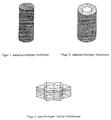
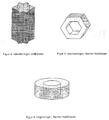
- the surface of the molded body depends essentially on the intended application. While smooth, rod-shaped solid bodies can easily be used for applications in which the grain is exposed to relatively low contact pressures, the adhesion in the bond should be improved by increasing the surface area of the molding for applications with higher contact pressures. ever according to the intended use of the molded body, a wide variety of options are available.
- an enlargement of the surface is achieved by subjecting the shaped body to a surface treatment, for example by enlarging the surface by applying very fine particles, for example pigments, and thus offering the binder more surface, in order to ensure the adhesion of the grain in the abrasive to effect.
- This cladding of the grain is a known and practiced method for improving the incorporation of an abrasive grain for years.
- all the surface treatment processes described and described in the literature can be used for the molding according to the invention.
- Silica binders or phosphates are preferably used as binders; however, it is also possible to use organic or other inorganic binders.
- abrasive substances such as halides or chalcogenides, which can favorably influence the grinding process, for example by chemical reactions, can be incorporated into the sheath.
- the entire cavity is filled with the binder, so that after curing of the binder, the molding is anchored in the abrasive downright.
- the wall thickness, the diameter and the length of the hollow body and the relationships of the dimensions with each other depend very much on the intended use. Since the shaped body according to the invention is to be used as abrasive grain, the dimensions are also in the range of the usual abrasive grains. That is, the maximum diameter for a solid body is about 6 mm and for a hollow body at about 12 mm, wherein the ratio wall thickness to diameter in a hollow body between 0.1 / 1 and 0.4 / 1, preferably between 0.2 / 1 and 0.3 / 1 , lies.
- the ratio length / diameter varies depending on the application between 0.1 / 1 and 20 / 1.
- abrasive on pad predominantly molded body with a ratio length / diameter ⁇ 1, preferably between 0.2 / 1 and 1/1, used since - Is much easier to place a flat abrasive grain uniformly on a substrate compared to an elongated, rod-shaped body.
- moldings with a length / diameter ratio ⁇ 1, preferably between 1/1 and 10/1 are predominantly used.
- the advantages for the elongated moldings are also procedurally justified, since it is much easier to divide a strand obtained in an extrusion into elongated shapes or crush.
- an excellent anchoring of the respective abrasive grains in the binder is possible, especially in elongated hollow bodies.
- the strands produced during the extrusion can be cut or processed directly in the desired ratio without the need for an additional drying step.
- a drying step is before Further processing recommended.
- the preferred range for the residual moisture is below 10 wt .-%.
- the sintering is usually carried out directly after the treatment step at temperatures between 1300 and 1750 ° C.
- all known types of furnaces come into consideration, which are usually used for firing of ceramic materials and cover the range between 1300 ° C and 1750 ° C.
- the calcination is carried out in a temperature range between 150 ° and 800 ° C. Also for this step, all known types of furnaces that are used in the ceramic industry in question.
- sintering temperature, sintering time and possible sintering programs depends on what properties the desired product should have and is variable over a wide range. Economic considerations also play a role in the selection of conditions, in addition to product quality. By a suitable choice of the sintering temperature and time, the product properties such as hardness, density and primary crystal size can be selectively influenced. This consideration plays a role especially in grinding operations both in the area of coated abrasives and in the bonded abrasives, in which no such extremely high pressures are used and re-sharpening of the abrasive grain should already take place under "milder" conditions.
- the mouthpiece of the extruder consisted of a perforated disc with a hole diameter of about 1.3 mm.
- the extruded strands were cut immediately behind the exit opening with a rotating knife in the length desired for the shaped body.
- the sintering of the green bodies was carried out in a push-through oven at 1480 ° C. under air. The sintering time was about 1 hour.
- the sintered microcrystalline molded bodies thus obtained had a hardness of HV 0.2 of 19 GPa, an average crystallite size of 0.6 ⁇ m and the density was 97.5% of the theoretical density.
- the mean diameter of the rod was about 1 mm and the diameter / length ratio was between 1/2 and 1/4.
- the production of the moldings was carried out analogously to Example 1. Instead of the oleic acid was used as binder component ammonium polyacrylate.
- the sintering was carried out in a rotary kiln at 1475 ° C instead of in the push-through furnace. The Sintering time was about 30 minutes. The comminution of the extrudate took place without an intermediate step in a cutting mill.
- the sintered microcrystalline molded bodies thus obtained had a hardness of 0.2HP of 20.2 GPa, an average crystallite size of 0.5 ⁇ m, and the density reached 98.6% of the theoretical density.
- the moldings were produced analogously to Example 1.
- the rod-like shaped bodies produced during the manufacturing process were thoroughly mixed with a mixture of water glass, glass powder and iron oxide pigment until the surface was provided with a uniform coating of the pigment. Subsequently, the thus coated abrasive grain was fired at 900 ° C in a rotary kiln to solidify the bonding of the pigment to the surface of the abrasive grain rod.
- Example 2 The preparation of an extrudable mass and the extrusion was carried out as described in detail in Example 1. Instead of the simple perforated disc, a mouthpiece with annular openings was used. The outer diameter of the ring was 5.2 mm, the inner diameter of the ring 3.4 mm.
- the extruded hollow strands were placed after the exit opening on a conveyor belt and cut with a cross cutter to the desired length.
- the tubular green bodies produced in this way were heated at a heating rate of about 100 ° C per hour to 800 ° C to remove the binder components and the solvent.
- the on this Way dried green bodies were then sintered in a push-through oven at 1480 ° C.
- the sintered microcrystalline molded bodies thus obtained had a hardness HV 0.2 of 20.4 GPa, an average crystallite size of 0.6 ⁇ m and a density value of 98% of the theoretical density.
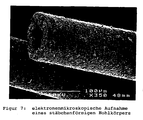
- the outer diameter of the sintered, microcrystalline molding was about 4 mm and the wall thickness of the tube was about 0.75 mm, so that an inner diameter of about 2.5 mm resulted.
- the ratio of length to outer diameter was between 1/1 and 2/1.
- the green body was produced in the manner described in Example 4.
- the hollow strands were cut to give flatter moldings having a length to diameter ratio of 1/4.
- the moldings thus obtained were immediately sintered at 1440 ° C for 1 hour following the cutting operation.
- the sintered, microcrystalline shaped bodies had a hardness HV 0.2 of 16.7 GPa, an average crystallite size of 0.5 ⁇ m and 96.4% of the theoretical density.
- the preparation of the extrudable mass and its extrusion corresponded to the procedure described in Example 1.
- a mouthpiece was used with an opening in the form of a star-shaped ring.
- the mean outer diameter of the ring was 5 mm and the inner diameter was 3 mm.
- the hollow strands thus produced were cut to a length / outside diameter ratio of 1/4 with a sheeter and sintered immediately thereafter in the push-through oven at 1480 ° C.
- the sintered, microcrystalline molded bodies had a hardness HV 0.2 of 20.2 GPa, an average crystallite size of 0.6 ⁇ m and a density of 97.8% of the theoretical density.
- Example 1 The moldings of Examples 1-4 were used in resin-bonded carbon steel wheel grinding wheels and compared to the grinding properties of commercially available 25% zirconia corundum and bauxite-based sintered corundum. The grinding time was 15 minutes. The Ve Eisenskörnungen were used in the grain size F20. Table 1: Grinding results wheel test (HP disks) grain type Total removal (kg) G-factor Power (%) example 1 89 111.3 133 Example 2 86 107.5 128 Example 3 96 137.1 143 Example 4 107 178.3 159 Comparative Example 1 (zirconium corundum 25%) 67 75.6 100 Comparative Example 2 (bauxite-based sintered corundum) 44 36.6 66
- Example 5 For the tape test, the moldings produced according to Example 5 and 6 were used. Commercially available zircon corundum and sol-gel corundum were used as the reference grain. The abrasive grains of Examples 5 and 6 were mechanically applied to the belt while the control grains were electrostatically scattered. The comparative materials were used in the particle size P24, which had an average particle diameter of about 0.75 mm, a size comparable to the diameter of the outer ring of the shaped body. Turbine steel was processed. The grinding time was 30 minutes. The grinding results are summarized in Table 2, wherein it should be noted that in addition to the improved removal rate with the abrasive grains of the invention, a significantly better grinding pattern (surface quality) could be achieved. Table 2: Grinding tests (belt grinding) grain type Erosion (g) Power (%) Example 5 1438 168% Example 6 1535 179% Sol-gel corundum 856 100% zirconia 472 55%
Landscapes
- Engineering & Computer Science (AREA)
- Chemical & Material Sciences (AREA)
- Ceramic Engineering (AREA)
- Manufacturing & Machinery (AREA)
- Materials Engineering (AREA)
- Structural Engineering (AREA)
- Organic Chemistry (AREA)
- Polishing Bodies And Polishing Tools (AREA)
- Compositions Of Oxide Ceramics (AREA)
- Press-Shaping Or Shaping Using Conveyers (AREA)
- External Artificial Organs (AREA)
- Catalysts (AREA)
Claims (30)
- Procédé de fabrication de grains abrasifs microcristallins frittés à base de Al2O3-α d'une dureté HV0.2 ≥ 15 GPa, d'une densité ≥ 95 % de la densité théorique, d'une taille moyenne de cristaux primaires < 2 µm et d'une teneur en Al2O3 d'au moins 98 % en poids,
caractérisé en ce qu'
on utilise comme matière de départ une poudre de Al2O3-α ayant un diamètre moyen de particule < 2 µm, on mélange la matière de départ à au moins un liant et un solvant pour former un mélange, on transforme le mélange en une masse extrudable que l'on extrude en un extrudat transformé en corps moulés, et on fritte les corps moulés dans une plage de température comprise entre 1300°C et 1750°C. - Procédé selon la revendication 1,
caractérisé en ce que
la matière de départ est fabriquée par broyage humide à partir d'une matière première plus grossière à base d'Al2O3. - Procédé selon la revendication 2.
caractérisé en ce que
pour le broyage humide, on utilise des attriteurs, des broyeurs à galets ou des broyeurs à vibrations. - Procédé selon l'une quelconque ou plusieurs des revendications 1 à 3,
caractérisé en ce que
comme liant pour la masse extrudable, on utilise de la méthylcellulose, du butyral polyvinylique, un acrylate émulsifié, de l'alcool polyvinylique. de la polyvinylpyrrolidone, de l'amidon polyacrylate, des liants silicatiques et/ou du sulfonate de lignine. - Procédé selon l'une quelconque ou plusieurs des revendications 1 à 4.
caractérisé en ce qu'
on ajoute au mélange constitué de liant, de matière de départ et de solvant, un ou plusieurs auxiliaires supplémentaires du groupe constitué d'auxiliaires de dispersion, d'agents de glissement et/ou de plastiflants. - Procédé selon la revendication 5.
caractérisé en ce que
comme auxiliaire de dispersion, on choisit une ou plusieurs substances du groupe constitué de polyacrylate d'ammonium, de silicate de sodium, d'huile de poisson de Manhattan, de polyéthylèneimine, de sulfonate de lignine sodique et d'alginate. - Procédé selon l'une quelconque des revendications 5 ou 6.
caractérisé en ce que
comme agent de glissement, on choisit une ou plusieurs des substances du groupe constitué de stéarate d'ammonium, d'émulsion de cire, d'acide oléique, d'huile de poisson de Manhattan, d'acide stéarique, d'acide palmitique, d'acide linolique, d'acide myristique et/ou d'acide laurique. - Procédé selon l'une quelconque des revendications 5 à 7,
caractérisé en ce que
comme plastifiant, on choisit une ou plusieurs substances du groupe constitué de glycérol, de polyéthylène glycol, de phtalate d'octyle et d'éthylène glycol. - Procédé selon l'une quelconque ou plusieurs des revendications 1 à 8,
caractérisé en ce que
comme solvant, on utilise un solvant inorganique ou organique du groupe constitué d'eau, d'éthanol, de toluène, de benzène, d'isopropanol, d'acétone, de xylène, d'hydrocarbures comme l'hexane, l'heptane, l'octane, le nonane et les hydrocarbures chlorés, comme le trichloréthane, le tétrachlorocarbone, le trichlorométhane et le chlorure de méthylène. - Procédé selon l'une quelconque ou plusieurs des revendications 1 à 9.
caractérisé en ce qu'
on extrude la masse extrudable dans un malaxeur comportant une vis de décharge, une extrudeuse à une vis, un compounder, une extrudeuse à expansion, une extrudeuse à deux vis, une presse à pistons ou une extrudeuse planétaire. - Procédé selon l'une quelconque ou plusieurs des revendications 1 à 10,
caractérisé en ce qu'
on désaère la masse à extruder avant l'extrusion. - Procédé selon l'une quelconque ou plusieurs des revendications 1 à 11,
caractérisé en ce qu'
on sèche les extrudats à une teneur en humidité < 20 % en poids pour obtenir des corps crus. - Procédé selon l'une quelconque ou plusieurs des revendications 1 à 12,
caractérisé en ce qu'
on calcine les corps crus, avant le broyage, dans une plage de température comprise entre 150 et 800°C. - Procédé selon l'une quelconque ou plusieurs des revendications 1 à 13,
caractérisé en ce qu'
on broie les extrudats ou les corps crus à l'aide d'une unité de granulation à la longueur prédéfinie pour former un granulat. - Procédé selon la revendication 14,
caractérisé en ce que
comme unité de granulation, on utilise des couteaux rotatifs, des découpeurs transversaux, en boudins ou longitudinaux. - Procédé selon l'une quelconque 1 à 15.
caractérisé en ce qu'
on broie les extrudats, les corps crus ou le granulat en corps moulés à l'aide d'un appareil de broyage. - Procédé selon la revendication 16,
caractérisé en ce que
comme appareil de broyage, on utilise des appareils de broyage conventionnels faisant partie du groupe constitué des broyeurs à couteaux, des broyeurs à marteaux et des cylindres. - Procédé selon l'une quelconque ou plusieurs des revendications 1 à 17,
caractérisé en ce qu'
on fritte les corps moulés à des températures inférieures à 1500°C. - Grain abrasif microcristallin fritté à base de α-Al2O3 d'une dureté HV0.2 ≥ 15 GPa, d'une densité ≥ 95 % de la densité théorique, d'une taille moyenne de cristaux primaires < 2 µm et d'une teneur en Al2O3 d'au moins 98 % en poids, fabriqué d'après un procédé selon l'une quelconque ou plusieurs des revendications 1 à 17,
caractérisé en ce que
le grain abrasif est un corps plein ou un corps creux en forme de bâtonnet, de cylindre, de polygone, d'étoile, de bâtonnet ayant une surface ondulée. - Grain abrasif selon la revendication 19,
caractérisé en ce que
la taille moyenne des cristaux primaires est inférieure à 1 µm. - Grain abrasif selon l'une quelconque ou plusieurs des revendications 19 ou 20,
caractérisé en ce que
le diamètre du corps moulé ne dépasse pas 6 mm lorsqu'il s'agit d'un corps plein. - Grain abrasif selon l'une quelconque ou plusieurs des revendications 19 ou 20.
caractérisé en ce que
le diamètre du corps moulé ne dépasse pas 12 mm lorsqu'il s'agit d'un corps creux. - Grain abrasif selon la revendication 22,
caractérisé en ce que
la paroi du corps creux a une épaisseur comprise entre 0.01 et 2 mm. - Grain abrasif selon l'une quelconque ou plusieurs des revendications 19 à 23,
caractérisé en ce que
le rapport entre le diamètre et la longueur est compris entre 0,1 / 1 et 20/1. - Grain abrasif selon l'une quelconque des revendications 19 à 23.
caractérisé en ce que
le rapport entre le diamètre et la longueur est compris entre 0.2/1 et 1/1. - Grain abrasif selon l'une quelconque des revendications 19 à 23,
caractérisé en ce que
le rapport entre le diamètre et la longueur est compris entre 1/1 et 10/1. - Utilisation du grain abrasif selon l'une quelconque ou plusieurs des revendications 18 à 26, en tant que grain abrasif pour produits abrasifs.
- Utilisation du grain abrasif selon la revendication 24 ou 25, en tant que grain abrasif pour produits abrasifs sur un support.
- Utilisation du grain abrasif selon la revendication 24 ou 26, en tant que grain abrasif dans des produits abrasifs liés.
- Utilisation du grain abrasif selon l'une quelconque des revendications 27 à 29,
caractérisée en ce que
la surface du corps moulé a été traitée en complément pour améliorer l'intégration du corps moulé dans le produit abrasif.
Applications Claiming Priority (3)
| Application Number | Priority Date | Filing Date | Title |
|---|---|---|---|
| DE10019184 | 2000-04-17 | ||
| DE10019184A DE10019184A1 (de) | 2000-04-17 | 2000-04-17 | Formkörper |
| PCT/EP2001/001336 WO2001079135A1 (fr) | 2000-04-17 | 2001-02-08 | CORPS MOULES MICROCRISTALLINS A BASE DE α-A12O3, PROCEDE PERMETTANT DE LES PRODUIRE ET LEUR UTILISATION |
Publications (2)
| Publication Number | Publication Date |
|---|---|
| EP1274665A1 EP1274665A1 (fr) | 2003-01-15 |
| EP1274665B1 true EP1274665B1 (fr) | 2006-05-03 |
Family
ID=7639175
Family Applications (1)
| Application Number | Title | Priority Date | Filing Date |
|---|---|---|---|
| EP01913789A Expired - Lifetime EP1274665B1 (fr) | 2000-04-17 | 2001-02-08 | CORPS MOULES MICROCRISTALLINS A BASE DE ALPHA Al2O3, PROCEDE PERMETTANT DE LES PRODUIRE ET LEUR UTILISATION |
Country Status (6)
| Country | Link |
|---|---|
| US (1) | US7169198B2 (fr) |
| EP (1) | EP1274665B1 (fr) |
| JP (1) | JP2003531089A (fr) |
| AT (1) | ATE325085T1 (fr) |
| DE (2) | DE10019184A1 (fr) |
| WO (1) | WO2001079135A1 (fr) |
Families Citing this family (60)
| Publication number | Priority date | Publication date | Assignee | Title |
|---|---|---|---|---|
| DE102005045180B4 (de) | 2005-09-21 | 2007-11-15 | Center For Abrasives And Refractories Research & Development C.A.R.R.D. Gmbh | Kugelförmige Korundkörner auf Basis von geschmolzenem Aluminiumoxid sowie ein Verfahren zu ihrer Herstellung |
| US20080066910A1 (en) * | 2006-09-01 | 2008-03-20 | Jean Andre Alary | Rod-shaped proppant and anti-flowback additive, method of manufacture, and method of use |
| US8562900B2 (en) | 2006-09-01 | 2013-10-22 | Imerys | Method of manufacturing and using rod-shaped proppants and anti-flowback additives |
| KR101157528B1 (ko) * | 2007-07-31 | 2012-06-22 | 도쿄엘렉트론가부시키가이샤 | 노즐 부재 및 그의 제조 방법 |
| BR112013016948A2 (pt) * | 2010-12-30 | 2019-09-24 | Saint Gobain Abrasives Inc | método para produzir partículas abrasivas e grãos abrasivos |
| WO2012092590A2 (fr) | 2010-12-31 | 2012-07-05 | Saint-Gobain Ceramics & Plastics, Inc. | Particules abrasives ayant des formes particulières et procédés de formation de telles particules |
| WO2012143559A1 (fr) * | 2011-04-21 | 2012-10-26 | Ceramtec Gmbh | Oxyde d'aluminium poreux |
| CN108262695A (zh) | 2011-06-30 | 2018-07-10 | 圣戈本陶瓷及塑料股份有限公司 | 包括氮化硅磨粒的磨料制品 |
| CN103764349B (zh) | 2011-06-30 | 2017-06-09 | 圣戈本陶瓷及塑料股份有限公司 | 液相烧结碳化硅研磨颗粒 |
| EP2760639B1 (fr) | 2011-09-26 | 2021-01-13 | Saint-Gobain Ceramics & Plastics, Inc. | Articles abrasifs contenant des particules abrasives, abrasifs enrobés utilisant les particules abrasives et procédés de formation associés |
| AU2012340659A1 (en) | 2011-11-23 | 2014-07-03 | Saint-Gobain Abrasifs | Abrasive article for ultra high material removal rate grinding operations |
| KR20140121406A (ko) * | 2011-12-30 | 2014-10-15 | 생-고뱅 어브레이시브즈, 인코포레이티드 | 결합 연마물품 및 성형방법 |
| EP2797716B1 (fr) | 2011-12-30 | 2021-02-17 | Saint-Gobain Ceramics & Plastics, Inc. | Particules abrasives de forme composite et procédé de formation de celles-ci |
| BR112014016159A8 (pt) | 2011-12-30 | 2017-07-04 | Saint Gobain Ceramics | formação de partículas abrasivas moldadas |
| KR102074138B1 (ko) | 2011-12-30 | 2020-02-07 | 생-고뱅 세라믹스 앤드 플라스틱스, 인코포레이티드 | 형상화 연마입자 및 이의 형성방법 |
| WO2013106602A1 (fr) | 2012-01-10 | 2013-07-18 | Saint-Gobain Ceramics & Plastics, Inc. | Particules abrasives ayant des formes particulières et procédés de mise en forme de telles particules |
| EP3705177A1 (fr) | 2012-01-10 | 2020-09-09 | Saint-Gobain Ceramics & Plastics Inc. | Particules abrasives dotées de formes complexes et méthodes pour former les mêmes |
| WO2013149209A1 (fr) | 2012-03-30 | 2013-10-03 | Saint-Gobain Abrasives, Inc. | Produits abrasifs ayant des fibres fibrillées |
| KR102534897B1 (ko) | 2012-05-23 | 2023-05-30 | 생-고뱅 세라믹스 앤드 플라스틱스, 인코포레이티드 | 형상화 연마입자들 및 이의 형성방법 |
| US10106714B2 (en) | 2012-06-29 | 2018-10-23 | Saint-Gobain Ceramics & Plastics, Inc. | Abrasive particles having particular shapes and methods of forming such particles |
| EP2692820A1 (fr) * | 2012-08-02 | 2014-02-05 | Robert Bosch Gmbh | Grain abrasif avec corps de base, soulèvement et ouverture |
| EP2692815A1 (fr) * | 2012-08-02 | 2014-02-05 | Robert Bosch Gmbh | Grain abrasif avec une section concave |
| CN104520401A (zh) * | 2012-08-02 | 2015-04-15 | 罗伯特·博世有限公司 | 具有最多三个面和一个角的磨粒 |
| KR101736085B1 (ko) | 2012-10-15 | 2017-05-16 | 생-고뱅 어브레이시브즈, 인코포레이티드 | 특정한 형태들을 가진 연마 입자들 및 이러한 입자들을 형성하는 방법들 |
| US9074119B2 (en) | 2012-12-31 | 2015-07-07 | Saint-Gobain Ceramics & Plastics, Inc. | Particulate materials and methods of forming same |
| CN105073343B (zh) | 2013-03-29 | 2017-11-03 | 圣戈班磨料磨具有限公司 | 具有特定形状的磨粒、形成这种粒子的方法及其用途 |
| TW201502263A (zh) | 2013-06-28 | 2015-01-16 | Saint Gobain Ceramics | 包含成形研磨粒子之研磨物品 |
| CN105764653B (zh) | 2013-09-30 | 2020-09-11 | 圣戈本陶瓷及塑料股份有限公司 | 成形磨粒及其形成方法 |
| EP3089851B1 (fr) | 2013-12-31 | 2019-02-06 | Saint-Gobain Abrasives, Inc. | Article abrasif comprenant des particules abrasives façonnées |
| US9771507B2 (en) | 2014-01-31 | 2017-09-26 | Saint-Gobain Ceramics & Plastics, Inc. | Shaped abrasive particle including dopant material and method of forming same |
| MX394114B (es) | 2014-04-14 | 2025-03-24 | Saint Gobain Ceramics | Articulo abrasivo que incluye particulas abrasivas conformadas. |
| WO2015160855A1 (fr) | 2014-04-14 | 2015-10-22 | Saint-Gobain Ceramics & Plastics, Inc. | Article abrasif comprenant des particules abrasives mises en forme |
| US9902045B2 (en) | 2014-05-30 | 2018-02-27 | Saint-Gobain Abrasives, Inc. | Method of using an abrasive article including shaped abrasive particles |
| EP3155064A4 (fr) * | 2014-06-13 | 2018-03-07 | Imerys Oilfield Minerals, Inc. | Procédé de fabrication d'agents de soutènement et d'additifs anti-reflux au moyen de granulateurs à engrenage |
| US9707529B2 (en) | 2014-12-23 | 2017-07-18 | Saint-Gobain Ceramics & Plastics, Inc. | Composite shaped abrasive particles and method of forming same |
| US9914864B2 (en) | 2014-12-23 | 2018-03-13 | Saint-Gobain Ceramics & Plastics, Inc. | Shaped abrasive particles and method of forming same |
| US9676981B2 (en) | 2014-12-24 | 2017-06-13 | Saint-Gobain Ceramics & Plastics, Inc. | Shaped abrasive particle fractions and method of forming same |
| TWI634200B (zh) | 2015-03-31 | 2018-09-01 | 聖高拜磨料有限公司 | 固定磨料物品及其形成方法 |
| CN116967949A (zh) | 2015-03-31 | 2023-10-31 | 圣戈班磨料磨具有限公司 | 固定磨料制品和其形成方法 |
| US10711171B2 (en) | 2015-06-11 | 2020-07-14 | Saint-Gobain Ceramics & Plastics, Inc. | Abrasive article including shaped abrasive particles |
| US10422242B2 (en) | 2016-04-29 | 2019-09-24 | United Technologies Corporation | Abrasive blade tips with additive resistant to clogging by organic matrix abradable |
| US10233938B2 (en) | 2016-04-29 | 2019-03-19 | United Technologies Corporation | Organic matrix abradable coating resistant to clogging of abrasive blade tips |
| US10655492B2 (en) | 2016-04-29 | 2020-05-19 | United Technologies Corporation | Abrasive blade tips with additive resistant to clogging by organic matrix abradable |
| US10670045B2 (en) | 2016-04-29 | 2020-06-02 | Raytheon Technologies Corporation | Abrasive blade tips with additive layer resistant to clogging |
| US11718774B2 (en) | 2016-05-10 | 2023-08-08 | Saint-Gobain Ceramics & Plastics, Inc. | Abrasive particles and methods of forming same |
| CN121249321A (zh) | 2016-05-10 | 2026-01-02 | 圣戈本陶瓷及塑料股份有限公司 | 磨料颗粒及其形成方法 |
| FR3052993B1 (fr) | 2016-06-22 | 2019-01-25 | Imerys Fused Minerals Beyrede Sas | Particule abrasive frittee a base d'oxydes presents dans la bauxite |
| US11230653B2 (en) | 2016-09-29 | 2022-01-25 | Saint-Gobain Abrasives, Inc. | Fixed abrasive articles and methods of forming same |
| AT519483B1 (de) * | 2016-12-20 | 2018-12-15 | Tyrolit Schleifmittelwerke Swarovski Kg | Verfahren zur herstellung von schleifmittelteilchen |
| US10563105B2 (en) | 2017-01-31 | 2020-02-18 | Saint-Gobain Ceramics & Plastics, Inc. | Abrasive article including shaped abrasive particles |
| US10759024B2 (en) | 2017-01-31 | 2020-09-01 | Saint-Gobain Ceramics & Plastics, Inc. | Abrasive article including shaped abrasive particles |
| WO2018236989A1 (fr) | 2017-06-21 | 2018-12-27 | Saint-Gobain Ceramics & Plastics, Inc. | Matériaux particulaires et leurs procédés de formation |
| WO2021133876A1 (fr) | 2019-12-27 | 2021-07-01 | Saint-Gobain Ceramics & Plastics, Inc. | Articles abrasifs et leurs procédés de formation |
| WO2021133888A1 (fr) | 2019-12-27 | 2021-07-01 | Saint-Gobain Ceramics & Plastics, Inc. | Articles abrasifs et leurs procédés de formation |
| US11926019B2 (en) | 2019-12-27 | 2024-03-12 | Saint-Gobain Ceramics & Plastics, Inc. | Abrasive articles and methods of forming same |
| CN114057505B (zh) * | 2021-12-13 | 2023-02-28 | 西安邮电大学 | 一种多孔片状氧化铝框架的制备方法 |
| US12508688B2 (en) | 2021-12-30 | 2025-12-30 | Saint-Gobain Abrasives, Inc. | Abrasive articles and methods of forming same |
| KR20240148817A (ko) | 2021-12-30 | 2024-10-11 | 세인트-고바인 아브라시브즈 인크. | 연마 물품 및 이의 형성 방법 |
| CN118541241A (zh) | 2021-12-30 | 2024-08-23 | 圣戈班磨料磨具有限公司 | 磨料制品及其形成方法 |
| CN114752352B (zh) * | 2022-04-13 | 2023-04-14 | 河南天马新材料股份有限公司 | 一种高自锐性氧化铝磨料粉体及制备方法 |
Family Cites Families (19)
| Publication number | Priority date | Publication date | Assignee | Title |
|---|---|---|---|---|
| US3079243A (en) * | 1959-10-19 | 1963-02-26 | Norton Co | Abrasive grain |
| US3387957A (en) * | 1966-04-04 | 1968-06-11 | Carborundum Co | Microcrystalline sintered bauxite abrasive grain |
| US3909991A (en) * | 1970-09-22 | 1975-10-07 | Norton Co | Process for making sintered abrasive grains |
| JPS5214993A (en) * | 1975-07-28 | 1977-02-04 | Showa Denko Kk | Improved alumina sintered grain |
| JPS5524813A (en) * | 1978-08-03 | 1980-02-22 | Showa Denko Kk | Alumina grinding grain |
| US4285732A (en) * | 1980-03-11 | 1981-08-25 | General Electric Company | Alumina ceramic |
| NZ210805A (en) * | 1984-01-19 | 1988-04-29 | Norton Co | Aluminous abrasive grits or shaped bodies |
| AT389884B (de) * | 1986-10-03 | 1990-02-12 | Treibacher Chemische Werke Ag | Verfahren zur herstellung eines gesinterten schleifmaterials auf der basis von alpha-al2o3 |
| WO1990008744A1 (fr) * | 1989-02-01 | 1990-08-09 | Showa Denko Kabushiki Kaisha | Ceramique d'oxyde d'aluminium, matiere abrasive et leur production |
| US4952536A (en) * | 1989-02-23 | 1990-08-28 | W. R. Grace & Co.-Conn. | High strength Al2 O3 |
| ATE81334T1 (de) * | 1989-04-17 | 1992-10-15 | Starck H C Gmbh Co Kg | Verfahren zur herstellung von alpha-a1203sinterk¯rpern. |
| DE58903831D1 (de) * | 1989-04-17 | 1993-04-22 | Starck H C Gmbh Co Kg | Verfahren zur herstellung von alpha-a1203-sinterkoerpern. |
| US5103598A (en) * | 1989-04-28 | 1992-04-14 | Norton Company | Coated abrasive material containing abrasive filaments |
| US5009676A (en) * | 1989-04-28 | 1991-04-23 | Norton Company | Sintered sol gel alumina abrasive filaments |
| JPH09505101A (ja) * | 1993-11-12 | 1997-05-20 | ミネソタ マイニング アンド マニュファクチャリング カンパニー | 砥粒及びその製造方法 |
| DE19503854C2 (de) * | 1995-02-06 | 1997-02-20 | Starck H C Gmbh Co Kg | Verfahren zur Herstellung gesinterter alpha-Al¶2¶O¶3¶-Körper sowie deren Verwendung |
| DE19602525A1 (de) * | 1996-01-25 | 1997-08-07 | Starck H C Gmbh Co Kg | Sphärische Keramikformkörper, Verfahren zu ihrer Herstellung sowie deren Verwendung |
| DE19618129A1 (de) * | 1996-05-06 | 1997-11-13 | Basf Ag | Katalysatorträger und Katalysatoren für Dehydrocyanisierungsreaktionen und deren Herstellungsverfahren |
| DE19629690C2 (de) * | 1996-07-23 | 1999-08-05 | Korund Laufenburg Gmbh | Verfahren zur Herstellung gesinterter alpha-AL¶2¶0¶3¶-Körper sowie deren Verwendung |
-
2000
- 2000-04-17 DE DE10019184A patent/DE10019184A1/de not_active Ceased
-
2001
- 2001-02-08 AT AT01913789T patent/ATE325085T1/de active
- 2001-02-08 US US10/221,705 patent/US7169198B2/en not_active Expired - Lifetime
- 2001-02-08 DE DE50109696T patent/DE50109696D1/de not_active Expired - Lifetime
- 2001-02-08 EP EP01913789A patent/EP1274665B1/fr not_active Expired - Lifetime
- 2001-02-08 JP JP2001576739A patent/JP2003531089A/ja active Pending
- 2001-02-08 WO PCT/EP2001/001336 patent/WO2001079135A1/fr not_active Ceased
Also Published As
| Publication number | Publication date |
|---|---|
| ATE325085T1 (de) | 2006-06-15 |
| DE10019184A1 (de) | 2001-10-25 |
| WO2001079135A1 (fr) | 2001-10-25 |
| US20030029094A1 (en) | 2003-02-13 |
| DE50109696D1 (de) | 2006-06-08 |
| EP1274665A1 (fr) | 2003-01-15 |
| JP2003531089A (ja) | 2003-10-21 |
| US7169198B2 (en) | 2007-01-30 |
Similar Documents
| Publication | Publication Date | Title |
|---|---|---|
| EP1274665B1 (fr) | CORPS MOULES MICROCRISTALLINS A BASE DE ALPHA Al2O3, PROCEDE PERMETTANT DE LES PRODUIRE ET LEUR UTILISATION | |
| US4786292A (en) | Microcrystalline abrasive material and method of manufacture | |
| EP0725045B1 (fr) | Procédé pour la préparation de corps frittés alpha-alumine et leur utilisation | |
| DE2923213C3 (de) | Verfahren zur Herstellung einer keramischen Schneidplatte | |
| DE3428252C3 (de) | Verfahren zur Herstellung eines feuerfesten Zirkoniumdioxid-Körpers | |
| DE2916084A1 (de) | Aluminiumoxid-schleifkoerner und verfahren zu ihrer herstellung | |
| EP2523906B1 (fr) | Solides d'al2o3 polycristallins à base d'oxyde d'aluminium fondu | |
| EP2013307B1 (fr) | Grain abrasif à base de corindon sphérique fondu | |
| EP0042130A1 (fr) | Corps façonné en céramique contenant des constituants de structure eutectique et procédé pour sa préparation | |
| DE2752752C2 (de) | Verfahren zur Herstellung von Körpern mit Bienenwabenstruktur aus Keramikstoffen der Bariumtitanatgruppe mit positiven Temperatur-Widerstands-Koeffizienten des elektrischen Widerstandes | |
| EP2540445B1 (fr) | Procédé de fabrication d'un outil à l'aide d'un agent abrasif lié | |
| EP0107768B1 (fr) | Produit poreux céramique, en particulier réfractaire, ainsi que procédé pour sa préparation | |
| DE69808418T2 (de) | Verfahren zur Herstellung von whiskerverstärkten Keramiken | |
| DE69631093T2 (de) | Anorganischer, poröser träger für eine filtrationsmembran und herstellungsverfahren | |
| AT394857B (de) | Schleifkorn auf basis von gesintertem aluminiumoxid und metallhaltigen zusaetzen und verfahren zu seiner herstellung | |
| EP3277461B1 (fr) | Outil abrasif de céramique aggloméré de porosité ouverte, procédé de formation de l'outil abrasif et composition porogène utilisee pour la formation de l'outil abrasif | |
| DE69422554T2 (de) | Verfahren und Vorrichtung zur Herstellung eines keramischen Sinterkörpers | |
| EP0947485B1 (fr) | Procédé de préparation d'abrasif céramique fritté | |
| EP0573029B1 (fr) | Utilisation d'une poudre d'oxydes réfractaires, finement olivisée pour la préparation de masses céramiques et de corps moulés | |
| DE2519568C3 (de) | Verfahren und Vorrichtung zur Herstellung von Schleifmitteln | |
| DE60025430T2 (de) | Keramik-Schneidwerkzeug basierend auf dicht gesinterem Nanokomposit-Aluminiumoxid | |
| DD300288A7 (de) | Abriebfeste keramische mahlkugeln und verfahren zu ihrer herstellung | |
| DE19629690C2 (de) | Verfahren zur Herstellung gesinterter alpha-AL¶2¶0¶3¶-Körper sowie deren Verwendung | |
| DE939377C (de) | Verfahren zur Herstellung von Schleifkoerpern mit poroesem Korn | |
| DE2400046C3 (de) | Verfahren zur Herstellung von polykristallinen Diamanten |
Legal Events
| Date | Code | Title | Description |
|---|---|---|---|
| PUAI | Public reference made under article 153(3) epc to a published international application that has entered the european phase |
Free format text: ORIGINAL CODE: 0009012 |
|
| 17P | Request for examination filed |
Effective date: 20020823 |
|
| AK | Designated contracting states |
Kind code of ref document: A1 Designated state(s): AT BE CH CY DE DK ES FI FR GB GR IE IT LI LU MC NL PT SE TR |
|
| RIN1 | Information on inventor provided before grant (corrected) |
Inventor name: PIRMIN, WILHELM Inventor name: MOELTGEN, PAUL Inventor name: CLEMENS, FRANK J. |
|
| RBV | Designated contracting states (corrected) |
Designated state(s): AT BE CH CY DE FR GB IT LI |
|
| RTI1 | Title (correction) |
Free format text: MICROCRYSTALLINE ALPHA AL2O3 SHAPED BODY, METHOD FOR THE PRODUCTION AND USE THEREOF |
|
| GRAP | Despatch of communication of intention to grant a patent |
Free format text: ORIGINAL CODE: EPIDOSNIGR1 |
|
| GRAS | Grant fee paid |
Free format text: ORIGINAL CODE: EPIDOSNIGR3 |
|
| RBV | Designated contracting states (corrected) |
Designated state(s): AT DE FR GB IT |
|
| GRAA | (expected) grant |
Free format text: ORIGINAL CODE: 0009210 |
|
| RBV | Designated contracting states (corrected) |
Designated state(s): AT DE FR GB IT |
|
| AK | Designated contracting states |
Kind code of ref document: B1 Designated state(s): AT DE FR GB IT |
|
| PG25 | Lapsed in a contracting state [announced via postgrant information from national office to epo] |
Ref country code: IT Free format text: LAPSE BECAUSE OF FAILURE TO SUBMIT A TRANSLATION OF THE DESCRIPTION OR TO PAY THE FEE WITHIN THE PRESCRIBED TIME-LIMIT;WARNING: LAPSES OF ITALIAN PATENTS WITH EFFECTIVE DATE BEFORE 2007 MAY HAVE OCCURRED AT ANY TIME BEFORE 2007. THE CORRECT EFFECTIVE DATE MAY BE DIFFERENT FROM THE ONE RECORDED. Effective date: 20060503 Ref country code: GB Free format text: LAPSE BECAUSE OF FAILURE TO SUBMIT A TRANSLATION OF THE DESCRIPTION OR TO PAY THE FEE WITHIN THE PRESCRIBED TIME-LIMIT Effective date: 20060503 |
|
| REG | Reference to a national code |
Ref country code: GB Ref legal event code: FG4D Free format text: NOT ENGLISH |
|
| REF | Corresponds to: |
Ref document number: 50109696 Country of ref document: DE Date of ref document: 20060608 Kind code of ref document: P |
|
| ET | Fr: translation filed | ||
| GBV | Gb: ep patent (uk) treated as always having been void in accordance with gb section 77(7)/1977 [no translation filed] |
Effective date: 20060503 |
|
| PLBE | No opposition filed within time limit |
Free format text: ORIGINAL CODE: 0009261 |
|
| STAA | Information on the status of an ep patent application or granted ep patent |
Free format text: STATUS: NO OPPOSITION FILED WITHIN TIME LIMIT |
|
| 26N | No opposition filed |
Effective date: 20070206 |
|
| REG | Reference to a national code |
Ref country code: DE Ref legal event code: R082 Ref document number: 50109696 Country of ref document: DE Representative=s name: MOELTGEN, PAUL, DIPL.-CHEM. DR. RER. NAT, DE Ref country code: DE Ref legal event code: R082 Ref document number: 50109696 Country of ref document: DE Representative=s name: PAUL MOELTGEN, DE |
|
| REG | Reference to a national code |
Ref country code: FR Ref legal event code: PLFP Year of fee payment: 16 |
|
| REG | Reference to a national code |
Ref country code: FR Ref legal event code: PLFP Year of fee payment: 17 |
|
| REG | Reference to a national code |
Ref country code: FR Ref legal event code: PLFP Year of fee payment: 18 |
|
| PGFP | Annual fee paid to national office [announced via postgrant information from national office to epo] |
Ref country code: IT Payment date: 20190222 Year of fee payment: 19 Ref country code: DE Payment date: 20190227 Year of fee payment: 19 |
|
| PGFP | Annual fee paid to national office [announced via postgrant information from national office to epo] |
Ref country code: AT Payment date: 20190122 Year of fee payment: 19 Ref country code: FR Payment date: 20190225 Year of fee payment: 19 |
|
| REG | Reference to a national code |
Ref country code: DE Ref legal event code: R082 Ref document number: 50109696 Country of ref document: DE Representative=s name: MOELTGEN, PAUL, DIPL.-CHEM. DR. RER. NAT, DE Ref country code: DE Ref legal event code: R081 Ref document number: 50109696 Country of ref document: DE Owner name: IMERTECH SAS, FR Free format text: FORMER OWNER: TREIBACHER SCHLEIFMITTEL GMBH, 79725 LAUFENBURG, DE |
|
| REG | Reference to a national code |
Ref country code: DE Ref legal event code: R119 Ref document number: 50109696 Country of ref document: DE |
|
| REG | Reference to a national code |
Ref country code: AT Ref legal event code: MM01 Ref document number: 325085 Country of ref document: AT Kind code of ref document: T Effective date: 20200208 |
|
| PG25 | Lapsed in a contracting state [announced via postgrant information from national office to epo] |
Ref country code: AT Free format text: LAPSE BECAUSE OF NON-PAYMENT OF DUE FEES Effective date: 20200208 |
|
| PG25 | Lapsed in a contracting state [announced via postgrant information from national office to epo] |
Ref country code: FR Free format text: LAPSE BECAUSE OF NON-PAYMENT OF DUE FEES Effective date: 20200229 Ref country code: DE Free format text: LAPSE BECAUSE OF NON-PAYMENT OF DUE FEES Effective date: 20200901 |
|
| PG25 | Lapsed in a contracting state [announced via postgrant information from national office to epo] |
Ref country code: IT Free format text: LAPSE BECAUSE OF NON-PAYMENT OF DUE FEES Effective date: 20200208 |