EP1274803B1 - Farbstoffmischung von wasserlöslichen faserreaktiven azofarbstoffen, verfahren zu ihrer herstellung und ihre verwendung - Google Patents
Farbstoffmischung von wasserlöslichen faserreaktiven azofarbstoffen, verfahren zu ihrer herstellung und ihre verwendung Download PDFInfo
- Publication number
- EP1274803B1 EP1274803B1 EP01929485A EP01929485A EP1274803B1 EP 1274803 B1 EP1274803 B1 EP 1274803B1 EP 01929485 A EP01929485 A EP 01929485A EP 01929485 A EP01929485 A EP 01929485A EP 1274803 B1 EP1274803 B1 EP 1274803B1
- Authority
- EP
- European Patent Office
- Prior art keywords
- general formula
- azo dyes
- dye mixture
- dye
- alkyl
- Prior art date
- Legal status (The legal status is an assumption and is not a legal conclusion. Google has not performed a legal analysis and makes no representation as to the accuracy of the status listed.)
- Expired - Lifetime
Links
- 0 CCOc1nc(Nc2cc(*)cc(C=C(*)[C@]3N=Nc4ccc(*)cc4)c2C3O)nc(Nc2cc(*)cc(cc3*)c2c([O+])c3N=Nc2cc(*C=C)ccc2*)n1 Chemical compound CCOc1nc(Nc2cc(*)cc(C=C(*)[C@]3N=Nc4ccc(*)cc4)c2C3O)nc(Nc2cc(*)cc(cc3*)c2c([O+])c3N=Nc2cc(*C=C)ccc2*)n1 0.000 description 2
- OHFCESMDWOXSLH-ONEGZZNKSA-N CN/C=C/N1CCN(C)CC1 Chemical compound CN/C=C/N1CCN(C)CC1 OHFCESMDWOXSLH-ONEGZZNKSA-N 0.000 description 1
Classifications
-
- C—CHEMISTRY; METALLURGY
- C09—DYES; PAINTS; POLISHES; NATURAL RESINS; ADHESIVES; COMPOSITIONS NOT OTHERWISE PROVIDED FOR; APPLICATIONS OF MATERIALS NOT OTHERWISE PROVIDED FOR
- C09B—ORGANIC DYES OR CLOSELY-RELATED COMPOUNDS FOR PRODUCING DYES, e.g. PIGMENTS; MORDANTS; LAKES
- C09B67/00—Influencing the physical, e.g. the dyeing or printing properties of dyestuffs without chemical reactions, e.g. by treating with solvents grinding or grinding assistants, coating of pigments or dyes; Process features in the making of dyestuff preparations; Dyestuff preparations of a special physical nature, e.g. tablets, films
- C09B67/0033—Blends of pigments; Mixtured crystals; Solid solutions
- C09B67/0046—Mixtures of two or more azo dyes
-
- C—CHEMISTRY; METALLURGY
- C09—DYES; PAINTS; POLISHES; NATURAL RESINS; ADHESIVES; COMPOSITIONS NOT OTHERWISE PROVIDED FOR; APPLICATIONS OF MATERIALS NOT OTHERWISE PROVIDED FOR
- C09B—ORGANIC DYES OR CLOSELY-RELATED COMPOUNDS FOR PRODUCING DYES, e.g. PIGMENTS; MORDANTS; LAKES
- C09B67/00—Influencing the physical, e.g. the dyeing or printing properties of dyestuffs without chemical reactions, e.g. by treating with solvents grinding or grinding assistants, coating of pigments or dyes; Process features in the making of dyestuff preparations; Dyestuff preparations of a special physical nature, e.g. tablets, films
- C09B67/0033—Blends of pigments; Mixtured crystals; Solid solutions
-
- C—CHEMISTRY; METALLURGY
- C09—DYES; PAINTS; POLISHES; NATURAL RESINS; ADHESIVES; COMPOSITIONS NOT OTHERWISE PROVIDED FOR; APPLICATIONS OF MATERIALS NOT OTHERWISE PROVIDED FOR
- C09B—ORGANIC DYES OR CLOSELY-RELATED COMPOUNDS FOR PRODUCING DYES, e.g. PIGMENTS; MORDANTS; LAKES
- C09B62/00—Reactive dyes, i.e. dyes which form covalent bonds with the substrates or which polymerise with themselves
- C09B62/44—Reactive dyes, i.e. dyes which form covalent bonds with the substrates or which polymerise with themselves with the reactive group not directly attached to a heterocyclic ring
- C09B62/4401—Reactive dyes, i.e. dyes which form covalent bonds with the substrates or which polymerise with themselves with the reactive group not directly attached to a heterocyclic ring with two or more reactive groups at least one of them being directly attached to a heterocyclic system and at least one of them being directly attached to a non-heterocyclic system
- C09B62/4403—Reactive dyes, i.e. dyes which form covalent bonds with the substrates or which polymerise with themselves with the reactive group not directly attached to a heterocyclic ring with two or more reactive groups at least one of them being directly attached to a heterocyclic system and at least one of them being directly attached to a non-heterocyclic system the heterocyclic system being a triazine ring
- C09B62/4411—Azo dyes
Definitions
- the invention is in the technical field of fiber-reactive azo dyes.
- Dyes of the general formulas 1 and 2 are known from EP-A 775732 and EP-A 94055 known.
- these have certain application defects, such as For example, the color yield is too dependent on changing ones Dyeing parameters in the dyeing process, or an insufficient or uneven Color build-up on cotton (a good color build-up results from the ability of one Dye, when using increased dye concentrations in the dye bath to deliver correspondingly stronger coloring).
- Can follow these shortcomings poor reproducibility of the available colors.
- the azo dye of the general formula (1) and Azo dye of the general formula (2) in the mixture in one Mixing ratio of 90:10 wt .-% to 10:90 wt .-%, preferably in the ratio from 70:30% to 30:70% by weight. They are particularly preferred in the mixture in a ratio of 65:35 to 35:65 wt .-%
- substituents on the phenyl are alkyl, alkoxy, sulfo, hydroxy, cyano, chloro, bromo or SO 2 Y
- preferred substituents are -SO 2 Y, OCH 2 CH 2 SO 2 Y and -NHCH 2 CH 2 SO 3 M, wherein M and Y have the meanings given above.
- a group representing Z, which can be eliminated by the action of alkali, is in particular sulfato of the formula -OSO 3 M, thiosulfato of the formula -SSO 3 M, acetyloxy of the formula -OCOCH 3 , phosphato of the formula OPO (OM) 2 and chloro where M is as defined above.
- the -SO 2 Y group is preferably in the meta or para position to the azo group.
- the dye mixtures according to the invention can be present as a preparation in solid or in liquid (dissolved) form.
- they generally contain the electrolyte salts customary in water-soluble and in particular fiber-reactive dyes, such as sodium chloride, potassium chloride and sodium sulfate, and can furthermore contain the auxiliaries customary in commercial dyes, such as buffer substances, which have a pH in aqueous solution between 3 and 7 such as sodium acetate, sodium borate, sodium hydrogen carbonate, sodium dihydrogen phosphate, sodium tricitrate and disodium hydrogen phosphate, small amounts of siccatives or, if they are in liquid, aqueous solution (including the content of thickeners, as is common with printing pastes), substances that increase the shelf life ensure these preparations, such as mold-preventing agents.
- the dye mixtures according to the invention are as Dye powder with a content of 10 to 80 wt .-%, based on the Dye powder or the preparation, on an electrolyte salt, which also as Actuator is referred to.
- These dye powders can also be the ones mentioned Buffer substances in a total amount of up to 10 wt .-%, based on the Dye powder included.
- the total dye content in these is aqueous solutions up to about 50% by weight, such as between 5 and 50 Wt .-%.
- the electrolyte salt content preferred in these aqueous solutions below 10% by weight, based on the aqueous solution;
- the watery Solutions liquid preparations can use the buffer substances mentioned in the Usually contained in an amount of up to 10 wt .-%, preferably up to 2 wt .-%.
- the dye mixtures according to the invention can be prepared in a conventional manner be so by mechanically mixing the individual from the above EP-As known dyes in solid or liquid form in the required proportions or by synthesis using the usual diazotization and Coupling reactions and reaction reactions with the halotriazine component using appropriate mixtures of such components in one in a manner familiar to the person skilled in the art and with the proportions required for this.
- a 2,4,6-trihalotriazine in particular 2,4,6-trichloro- or 2,4,6-trifluorotriazine
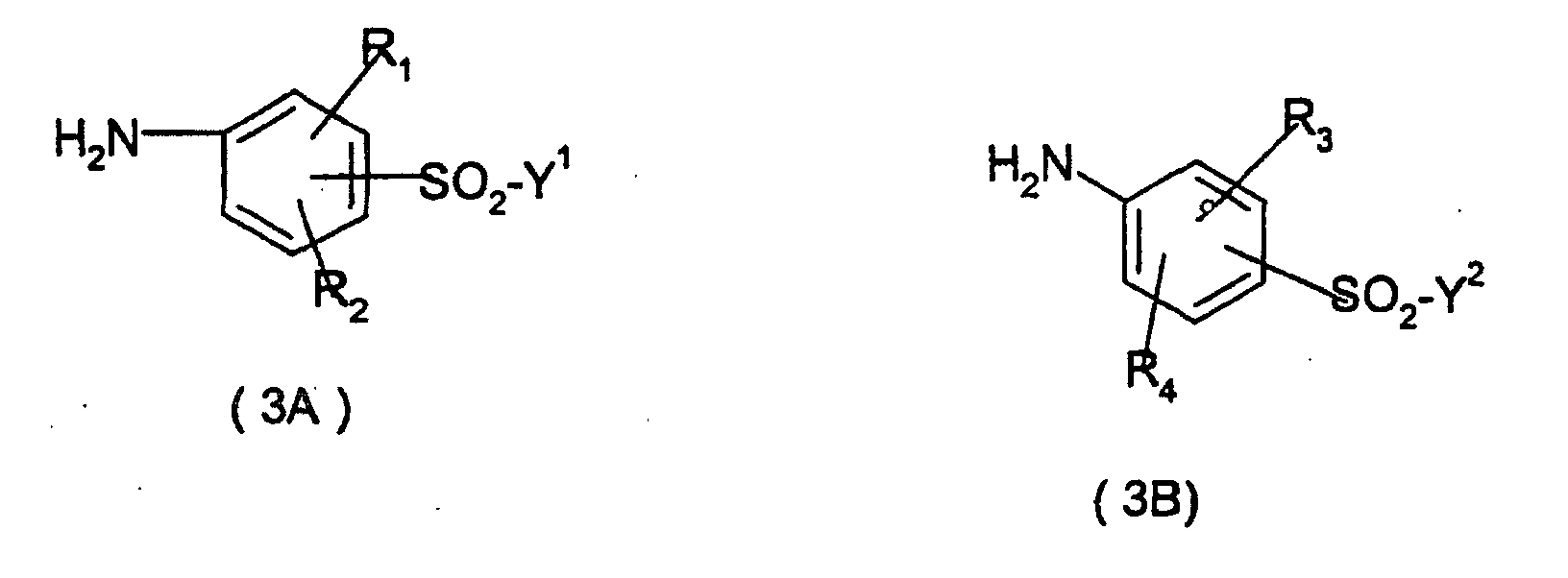
- a diazonium salt which consists of an amine of the general formula (3A) or (3B) with R 1 , R 2 .
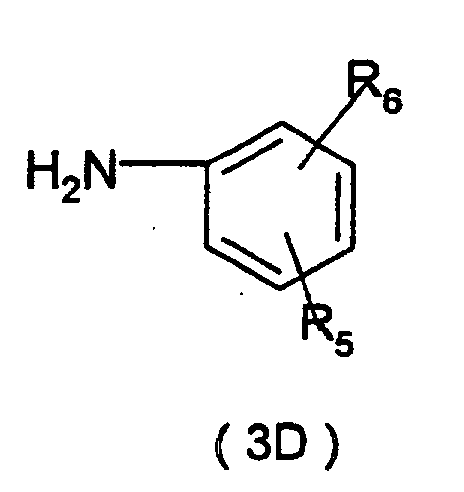
- R 3 , R 4 and Y 1 and Y 2 of the meaning given above were prepared in a known manner, then the reaction product from the reaction with a diazotized amine of the formula (3A) by reaction with one or more amino compounds of the general formula A-NH -B with A and B in the abovementioned meaning, can react or to produce the component of the general formula (2) in a known manner in the reaction product from the reaction with a diazotized amino compound of the formula (3B) the fragment DT, then this reaction product with an amine of the general formula (3C) in a manner known per se, reacted and coupled in a known manner to the bisazo dye with the diazonium salt of the amines of the general formula (3D).
- Dyes of the general formulas (1) and (2) in which X 1 and X 2 are not halogen are converted in a manner known per se by reacting the mixture with the compounds HOR 3 or HNR 3 R 4 , for example at a temperature between 10 and 100 ° C, preferably between 40 and 80 ° C, and at a pH between 3 and 7, preferably between 4 and 5, implemented.
- Dye mixtures from their synthesis solution can be made according to generally known Methods are done, for example, either by failures from the Reaction medium using electrolytes, such as sodium chloride or Potassium chloride, or by evaporation or spray drying of the reaction solution, a buffer substance can be added to this reaction solution.
- electrolytes such as sodium chloride or Potassium chloride
- the dye mixtures according to the invention have valuable ones application properties. They are used for dyeing or printing of materials containing hydroxyl and / or carbonamide groups, for example in Form of sheets, such as paper and leather, or of foils, such as for example made of polyamide, or in bulk, such as polyamide and polyurethane, but especially of these materials used in fiber form.
- the solutions of the resulting in the synthesis of the azo compounds Dye mixtures according to the invention, optionally after adding a Buffer substance, if necessary also after concentration or dilution, directly as Liquid preparation can be used for staining.
- the present invention thus also relates to the use of Dye mixtures according to the invention for dyeing or printing them Materials or processes for dyeing or printing such materials in and conventional procedures, in which one of the invention Dye mixture used as a colorant.
- the materials preferably come in Form of fiber materials for use, especially in the form of textile fibers, such as fabrics or yarns, such as in the form of strands or packages.
- Materials containing hydroxyl groups are natural or synthetic Origin, such as cellulose fiber materials or their Regenerate products and polyvinyl alcohols.
- cellulose fiber materials preferably cotton, but also other plant fibers, such as linen, hemp, jute and Ramiefasem; Regenerated cellulose fibers are, for example, cellulose and Viscose.
- Materials containing carbonamide groups are, for example, synthetic and natural polyamides and polyurethanes, in particular in the form of fibers, for example wool and other animal hair, silk, leather, polyamide-6,6, polyamide-6, Polyamide-11 and polyamide-4.
- the dye mixtures according to the invention can be applied and fixed on the substrates mentioned, in particular on the fiber materials mentioned, by the application techniques known for water-soluble, in particular for the fiber-reactive dyes. They are used to obtain dyeings on cellulose fibers using the exhaust process from a long liquor using a wide variety of acid-binding agents and, if appropriate, neutral salts, such as sodium chloride or sodium sulfate, with very good color yields which are improved compared to the individual dyes. Dyeing is preferably carried out in an aqueous bath at temperatures between 40 and 105 ° C., if appropriate at a temperature up to 130 ° C. under pressure, and if appropriate in the presence of customary dyeing auxiliaries.
- the neutral salts which accelerate the removal of the dyes can also be added to the bath only after the actual dyeing temperature has been reached.
- cellulose fibers are also distinguished Obtain color yields and a very good color build-up, while staying with Room temperature or elevated temperature, for example up to about 60 ° C Steaming or can be fixed with dry heat in the usual way.
- cellulose fibers which are single-phase - for example by printing with a sodium bicarbonate or another printing paste containing acid-binding agent and subsequent steaming 100 to 103 ° C, or two-phase - for example by printing with neutral or weakly acidic printing ink and then fixing either by Pass through a hot electrolytic alkaline bath or through Padding with an alkaline electrolyte-containing padding liquor and then Linger or steam or treat with dry heat of the alkaline clogged material, - can be carried out, you get strong colored prints with good shape of the contours and a clear white background. The failure of the prints is only slightly dependent on changing fixing conditions.
- Dye mixtures on the cellulose fibers are agents for example water-soluble basic salts of the alkali metals and likewise Alkaline earth metals of inorganic or organic acids or compounds, which release alkali in the heat.
- the alkali metal hydroxides and Alkali metal salts of weak to moderate inorganic or organic To name acids, of which the alkali compounds are preferably sodium and Potassium compounds are meant.
- Such acid-binding agents are for example sodium hydroxide, potassium hydroxide, sodium carbonate, Sodium bicarbonate, potassium carbonate, sodium formate, sodium dihydrogen phosphate, Disodium hydrogen phosphate, sodium trichloroacetate, water glass or Trisodium phosphate.
- the dye mixtures according to the invention are characterized by the Cellulose fiber materials when used in dyeing and printing processes a high fixation yield.
- the cellulose stains show the usual Post-treatment by rinsing to remove unfixed dye excellent wet fastness properties, especially since non-fixed dye components easily wash out because of their good cold water solubility.
- the dyeings and dyes obtainable with the dye mixtures according to the invention Prints have clear nuances; in particular, the colors and prints have good lightfastness and very good wetfastness on cellulose fiber materials, such as washing, walking, water, seawater, overdyeing and acidic as well as alkaline Fastness to perspiration, furthermore good pleating fastness, ironing fastness and Fastness to rubbing.
- the dye mixtures according to the invention can also be used for the fiber-reactive dyeing of wool are used. Also can be felt-free or wool with a low-felt finish (see, for example, H. Rath, textbook on textile chemistry, Springer-Verlag, 3rd edition (1972), pp. 295-299, especially the equipment according to the so-called Hercosett process (p. 298); J. Soc. Dyers and Coloirists 1972, 93-99, and 1975, 33-44) with very good fastness properties.
- the process of dyeing on wool is carried out in the usual and known manner Stain proof from an acidic environment. So you can, for example, the dye bath Acetic acid and / or ammonium sulfate or acetic acid and ammonium acetate or Add sodium acetate to get the desired pH. To one To achieve useful levelness of coloration, it is advisable to add conventional ones Leveling aids, such as based on a reaction product from Cyanuric chloride with 3 times the molar amount of an aminobenzenesulfonic acid and / or an aminonaphthalenesulfonic acid or based on a Reaction product of, for example, stearylamine with ethylene oxide.
- Leveling aids such as based on a reaction product from Cyanuric chloride with 3 times the molar amount of an aminobenzenesulfonic acid and / or an aminonaphthalenesulfonic acid or based on a Reaction product of, for example, stearylamine with ethylene oxide
- the dye mixture according to the invention preferably first of all acidic dye bath with a pH of about 3.5 to 5.5 under control of the pH subjected to the pull-out process and then the pH, towards the end of the Dyeing time, in the neutral and possibly weakly alkaline range up to a pH of 8.5 shifted to achieve particularly high Color depths the full reactive bond between the dyes of the bring about dye mixtures according to the invention and the fiber.
- the non-reactive dye component is removed.
- the procedure described here also applies to the production of dyeings Fiber materials made from other natural polyamides or synthetic Polyamides and polyurethanes.
- the material to be colored is used for a Brought a temperature of about 40 ° C into the bath, agitated there for some time, the dye bath then to the desired weakly acidic, preferably weakly acetic acids, pH adjusted and the actual color at one temperature performed between 60 and 98 ° C.
- the colors can also Boiling temperature or in closed dyeing machines at temperatures up to 106 ° C. Since the water solubility of the invention Dye mixtures are very good, they can also be used with advantage in conventional use continuous dyeing process. The color strength of the invention Dye mixtures are very high.
- the dye mixtures according to the invention deliver on the materials mentioned, prefers fiber materials, clear red to bluish red dyeings.
- the following examples serve to illustrate the invention.
- the parts are Parts by weight, the percentages are percentages by weight, if not otherwise noted. Parts by weight refer to parts by volume such as kilograms Liter.
- the compounds described by formula in the examples are in the form of free acids; generally they are in the form of their salts, preferably sodium or potassium salts, prepared and isolated and in the form of them Salts used for coloring.
- Components C and D are mixed as described in Example 1.
- example Mixed component C Mixed component D 6 100 100 7 70 50 8th 70 100 9 100 70 10 60 40
- Example 11 The mixture from Example 11 is dissolved in 500 parts of water at pH 7 and 50 parts of morpholine are added, the pH being maintained at 20% with soda solution. 100 parts of table salt are added and the precipitated dye is filtered off with suction. A mixture of: and
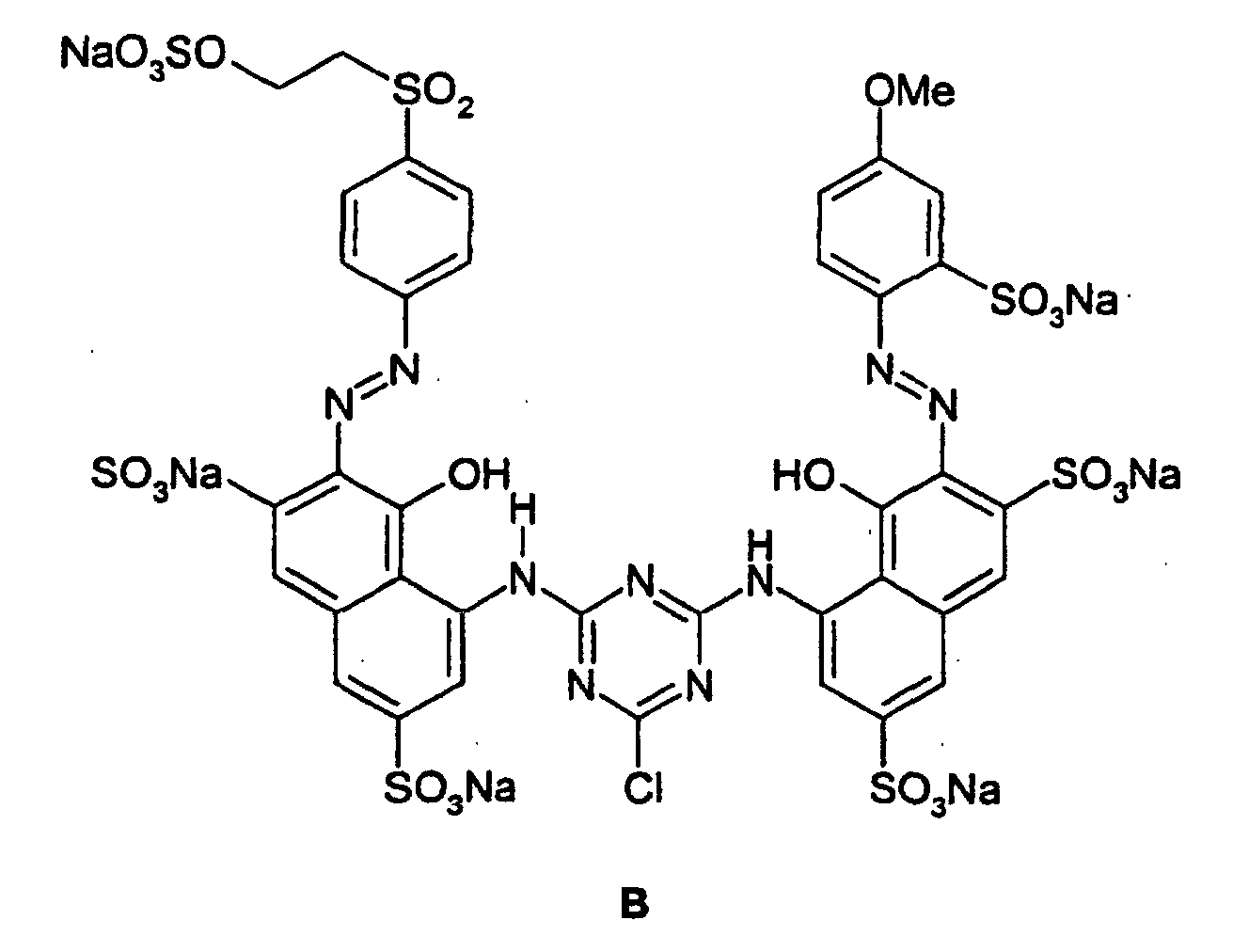
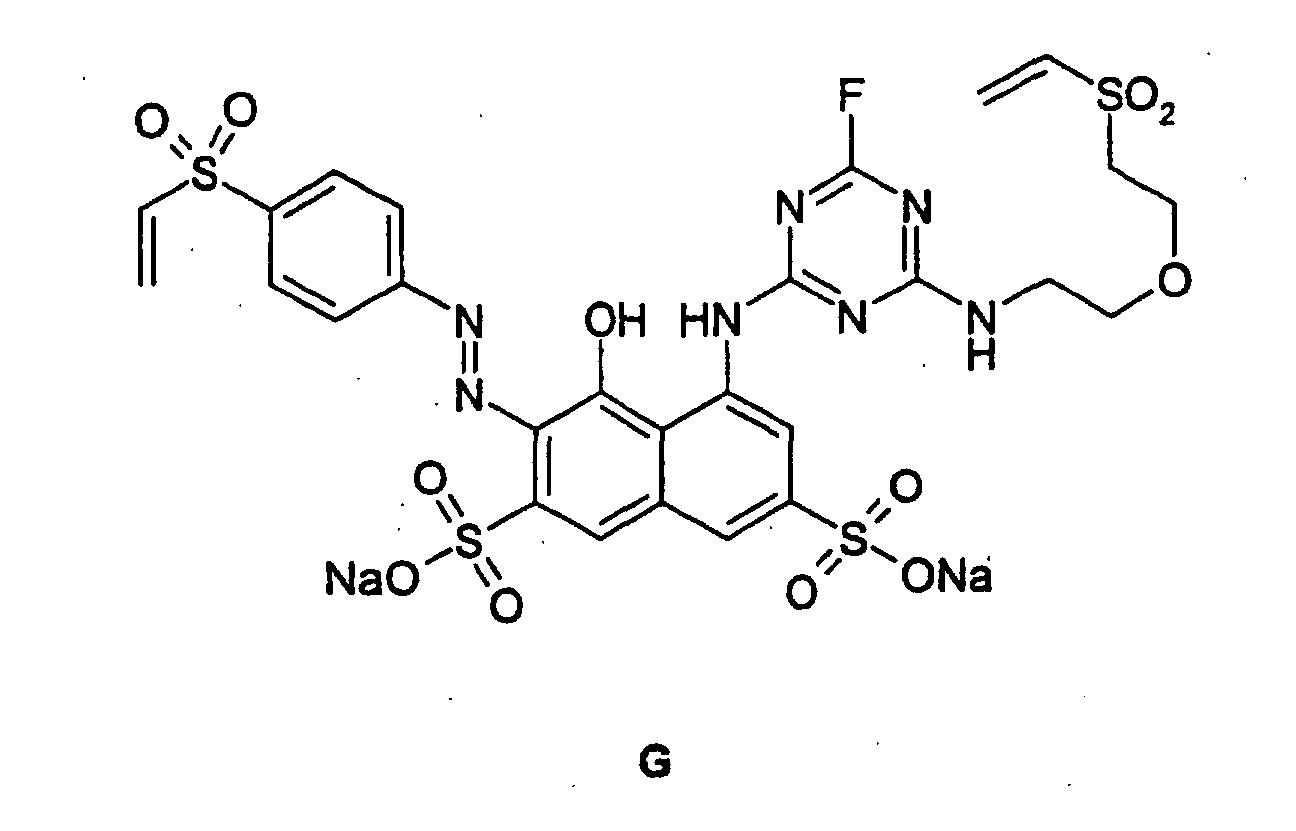
- Dyes of the general formula 2 of the mixture according to the invention are, for example:
Landscapes
- Chemical & Material Sciences (AREA)
- Organic Chemistry (AREA)
- Chemical Kinetics & Catalysis (AREA)
- Coloring (AREA)
- Medicinal Preparation (AREA)
Description


- M
- für ein Wasserstoffatom, ein Ammonium lon oder das Äquivalent eines Alkali- oder Erdalkalimetalls steht
- X1
- Fluoro, Chloro, Alkoxy, Hydroxy, Cyanamido, Amino, Anilino, Anilinsulfosäure, Anilindisulfosäure, Toluidin, Anisol , oder ein gegebenenfalls mit Hydroxy, Sulfo oder Sulfato substituiertes Alkylamino sein kann
- X2
- hat eine Bedeutung von X1
- Y1 und Y2
- für Ethenyl oder eine Gruppierung der Formel CH2CH2Z steht, worin
- Z
- für eine Gruppierung steht, die durch Einwirkung von Alkali eliminiert werden kann
- R1, R2, R3, R4, R5 und R6
- unabhängig voneinander für Wasserstoff, Alkyl, Alkoxy, Sulfo, Hydroxy, Cyano, Chloro, Bromo stehen
- A
- für Wasserstoff steht, oder für C1-C6-Alkyl, welches durch Sulfo-, Hydroxy-, oder Sulfato-Gruppen substituiert sein kann, oder Anilin welches durch Sulfo oder Halogen substituiert sein kann,
- B
- steht für Wasserstoff, Alkyl, CH2CH2SO2Y, oder gegebenenfalls durch SO2Y, -OCH2CH2SO2Y oder -SO3M substituiertes Alkyl, oder Phenyl welches bis zu dreifach beispielsweise durch Alkyl, Alkoxy, Sulfo, Hydroxy, Cyano, Chloro, Bromo oder SO2Y substituiert sein kann, worin M und Y die oben genannten Bedeutungen haben
- A-N-B
- steht alternativ für cyclische Amine, beispielsweise Morpholin oder Piperazin,
- D-T
- eine direkte Bindung bedeuten oder aber
- T
- steht für ein sym-Triazin welches in 2-Stellung mit X3 substituiert ist, wobei X3 eine Bedeutung von X1 hat und
- D
- steht für eine Alkylendiamino Brücke der allgemeinen Formeln 3, 4, 5 und 6:

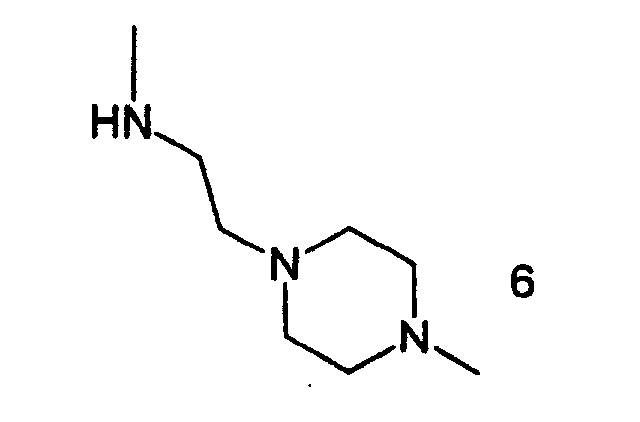
- n, m, o, p
- für 1-8 stehen
- q
- steht für null und eins
- R7, R8, R9
- stehen unabhängig voneinander für C1-C4 Alkyl
- R10
- steht für Wasserstoff oder SO3M.


So erhält man mit ihnen auf Cellulosefasern nach den Ausziehverfahren aus langer Flotte unter Verwendung von verschiedensten säurebindenden Mitteln und gegebenenfalls neutralen Salzen, wie Natriumchlorid oder Natriumsulfat, Färbungen mit sehr guten, gegenüber den Einzelfarbstoffen verbesserten Farbausbeuten. Man färbt bevorzugt in wässrigem Bad bei Temperaturen zwischen 40 und 105°C, gegebenenfalls bei einer Temperatur bis zu 130°C unter Druck, und gegebenenfalls in Gegenwart von üblichen Färbereihilfsmitteln.
Man kann dabei so vorgehen, dass man das Material in das warme Bad einbringt und dieses allmählich auf die gewünschte Färbetemperatur erwärmt und den Färbeprozess bei dieser Temperatur zu Ende führt. Die das Ausziehen der Farbstoffe beschleunigenden Neutralsalze können dem Bade gewünschtenfalls auch erst nach Erreichen der eigentlichen Färbetemperatur zugesetzt werden.
Überschüssiges Nitrit wird mit Amidoschwefelsäure zersetzt.

| Beispiel | Anteile A | Anteile B |
| 1 | 100 | 100 |
| 2 | 70 | 50 |
| 3 | 70 | 100 |
| 4 | 100 | 70 |
| 5 | 60 | 40 |


| Beispiel | Mischkomponente C | Mischkomponente D |
| 6 | 100 | 100 |
| 7 | 70 | 50 |
| 8 | 70 | 100 |
| 9 | 100 | 70 |
| 10 | 60 | 40 |


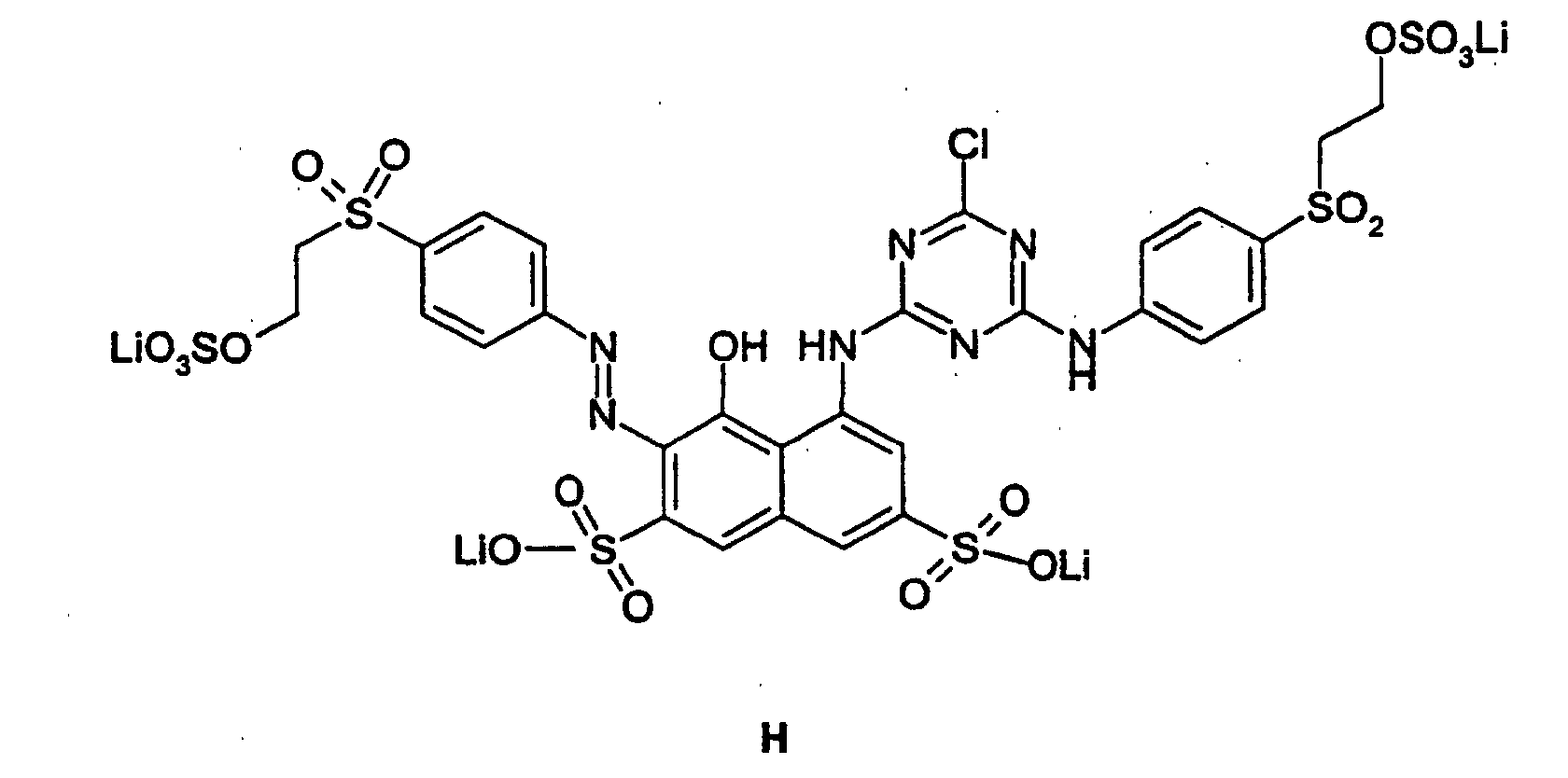

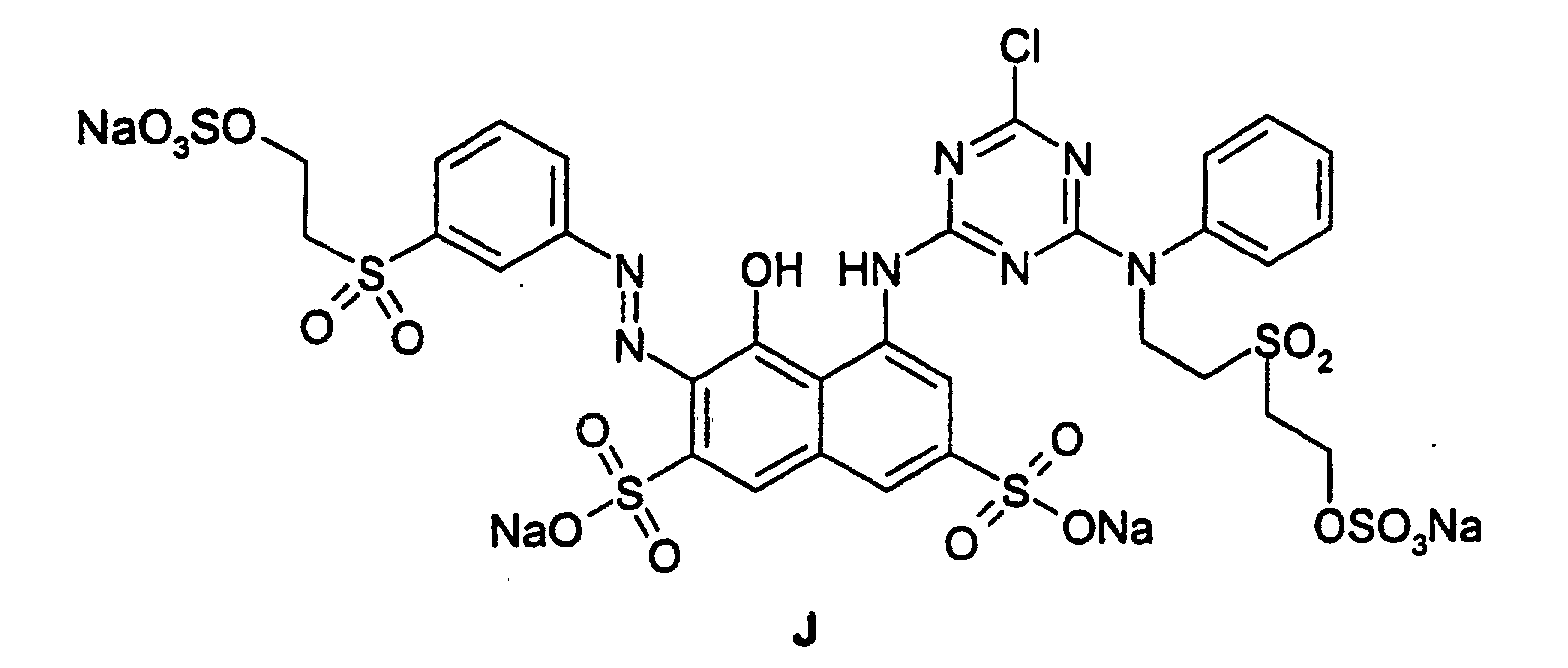


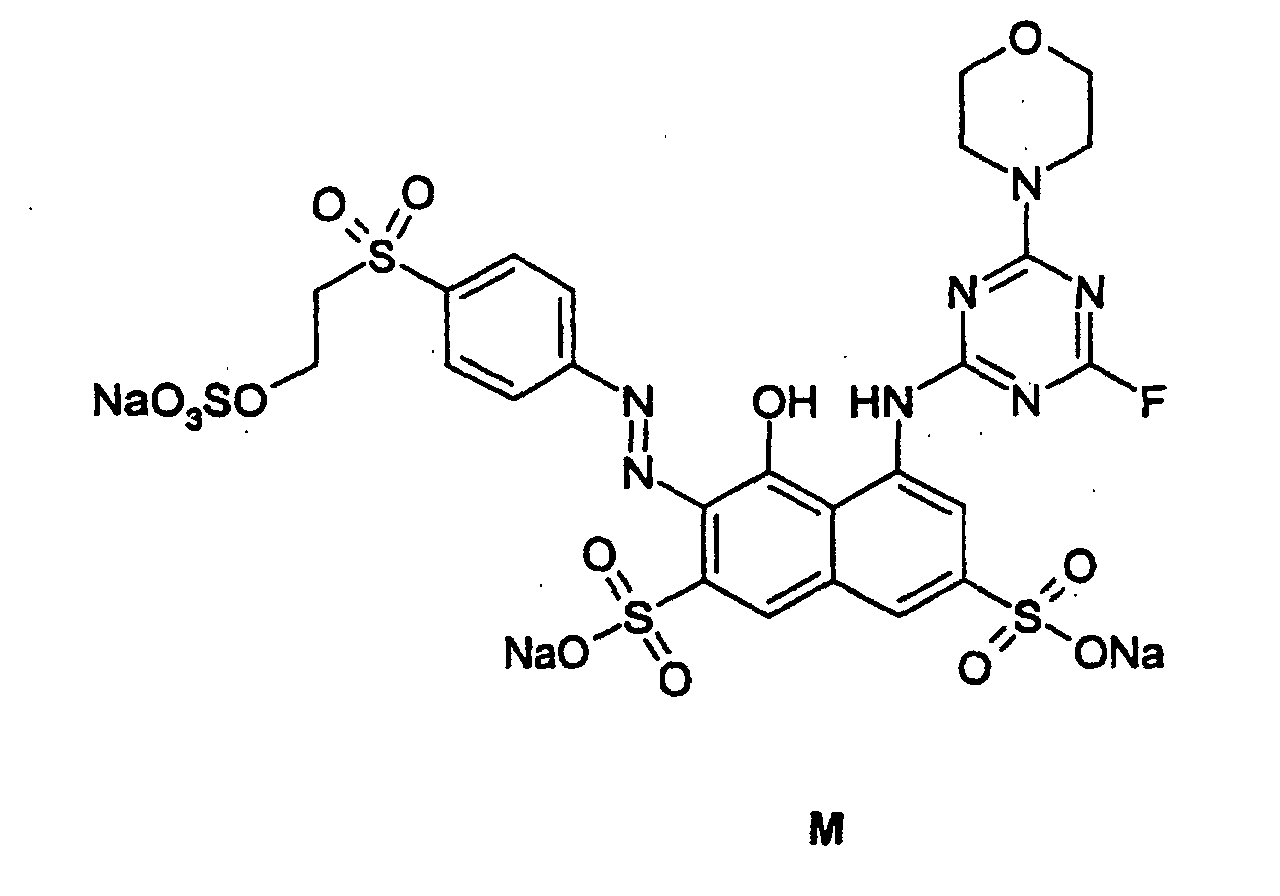

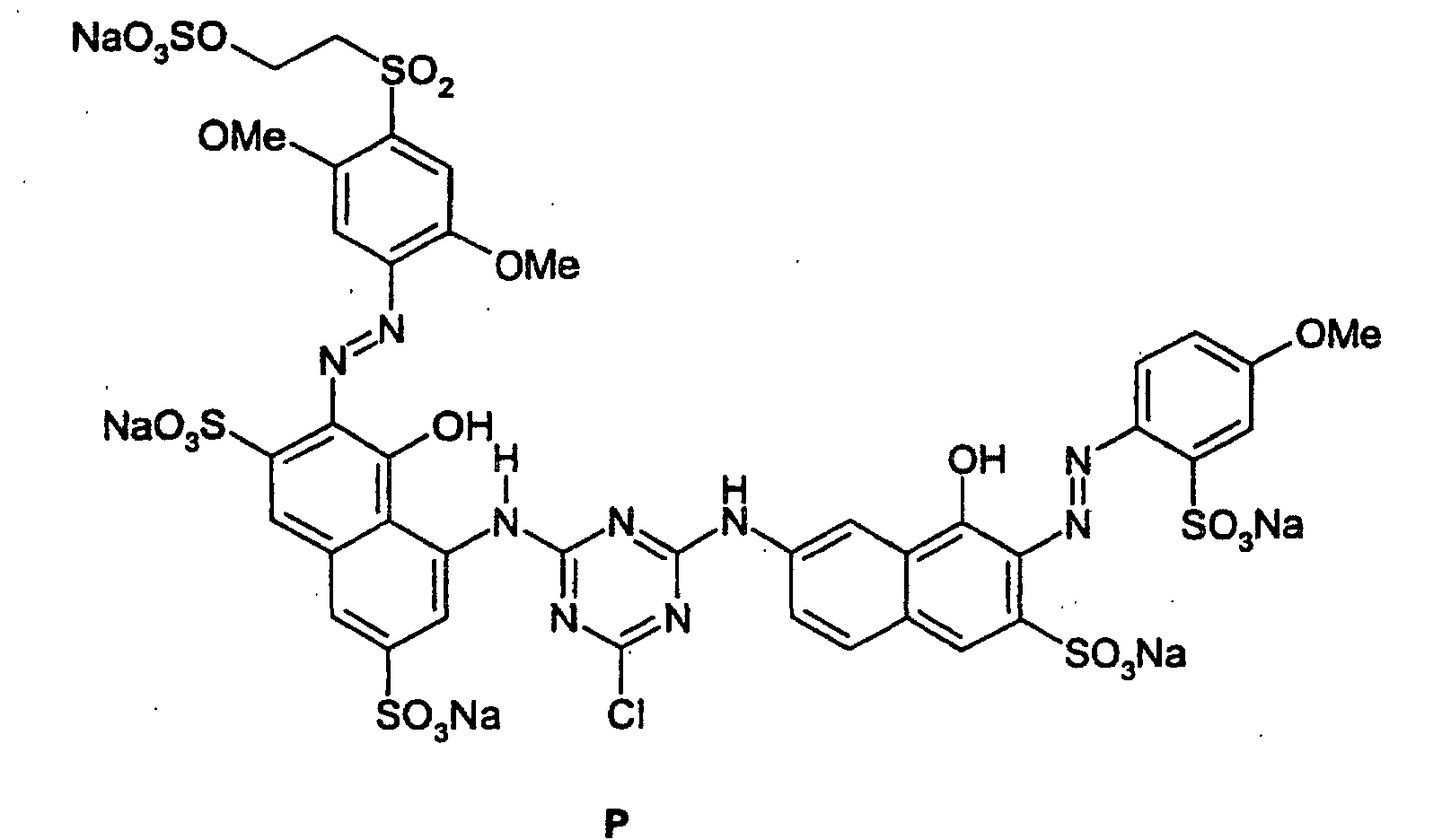
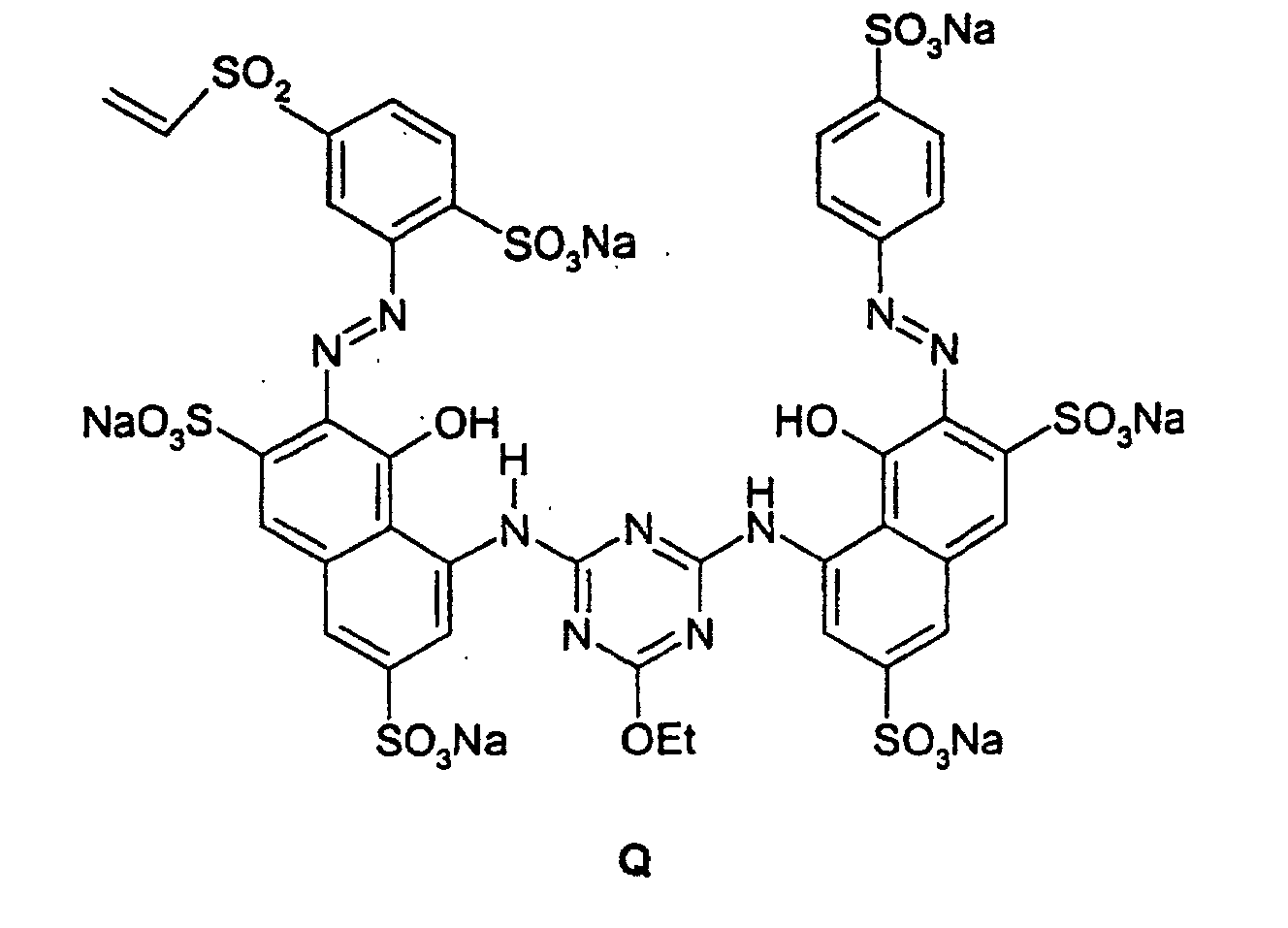
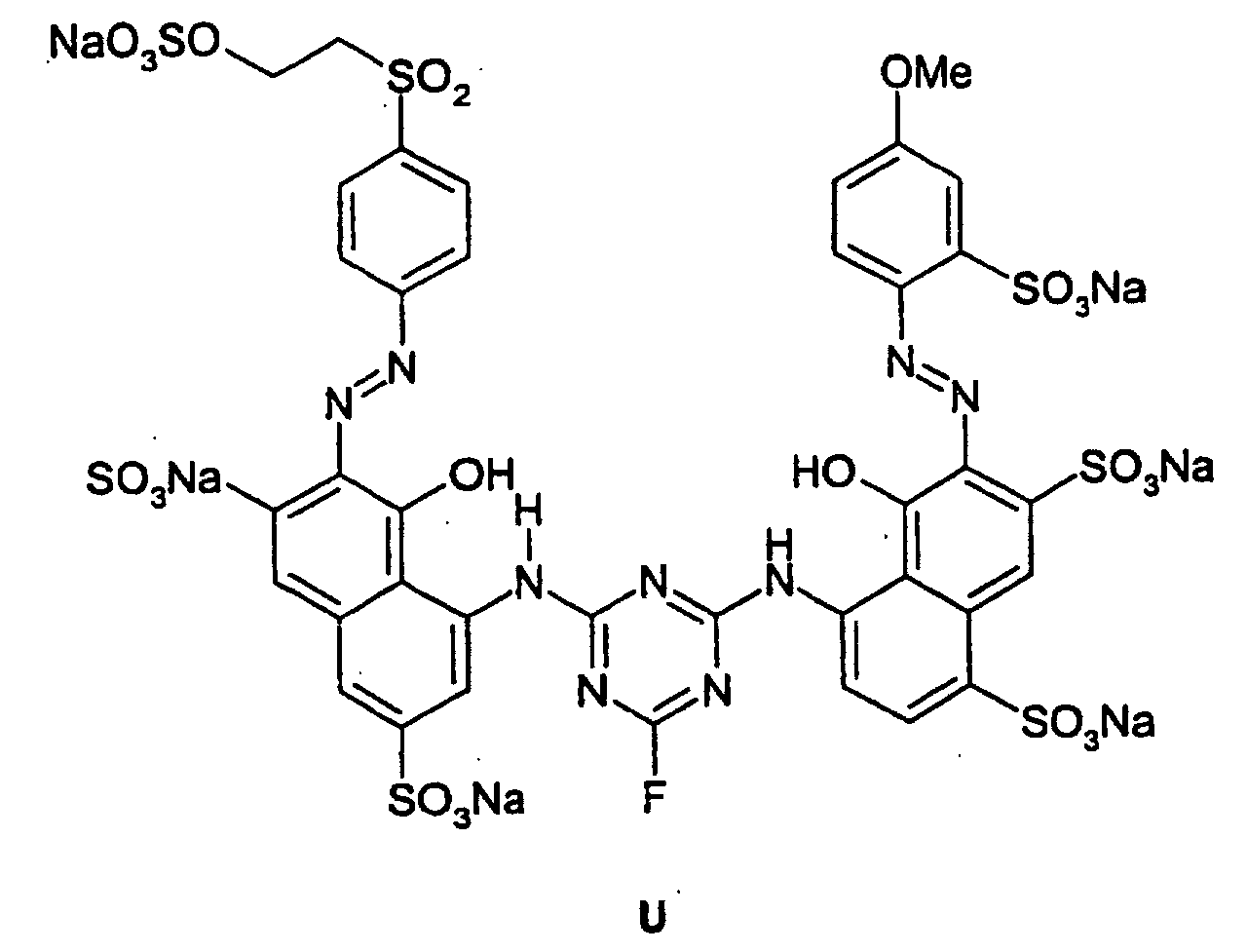

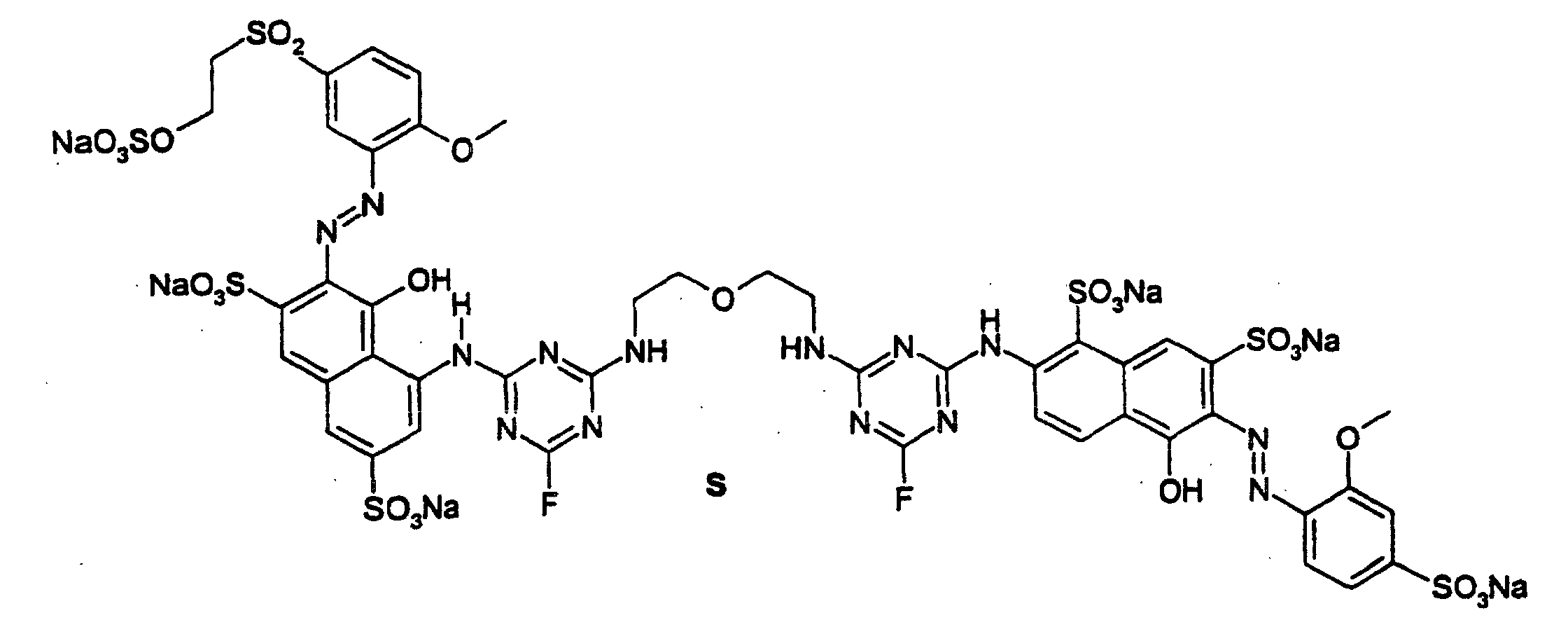


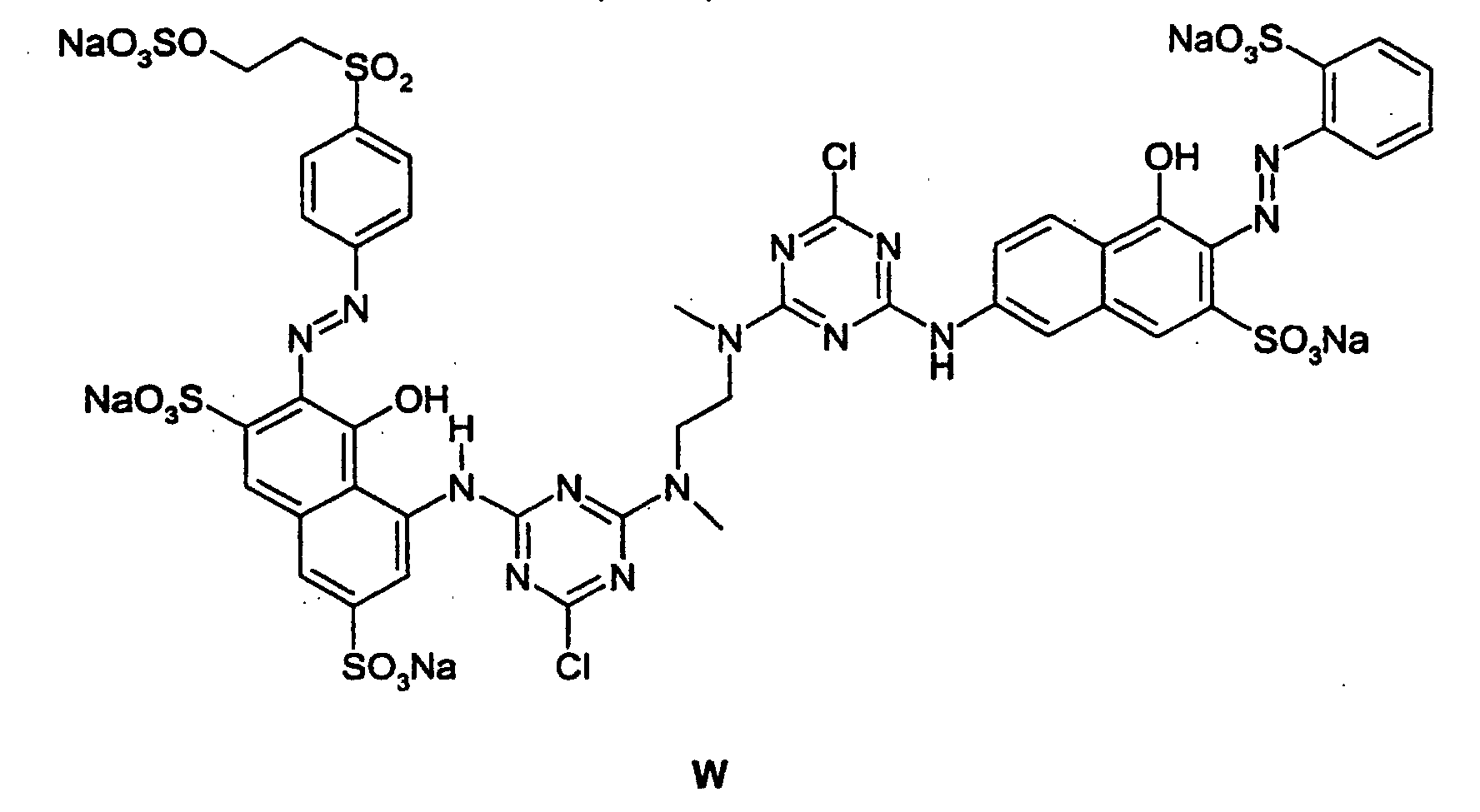
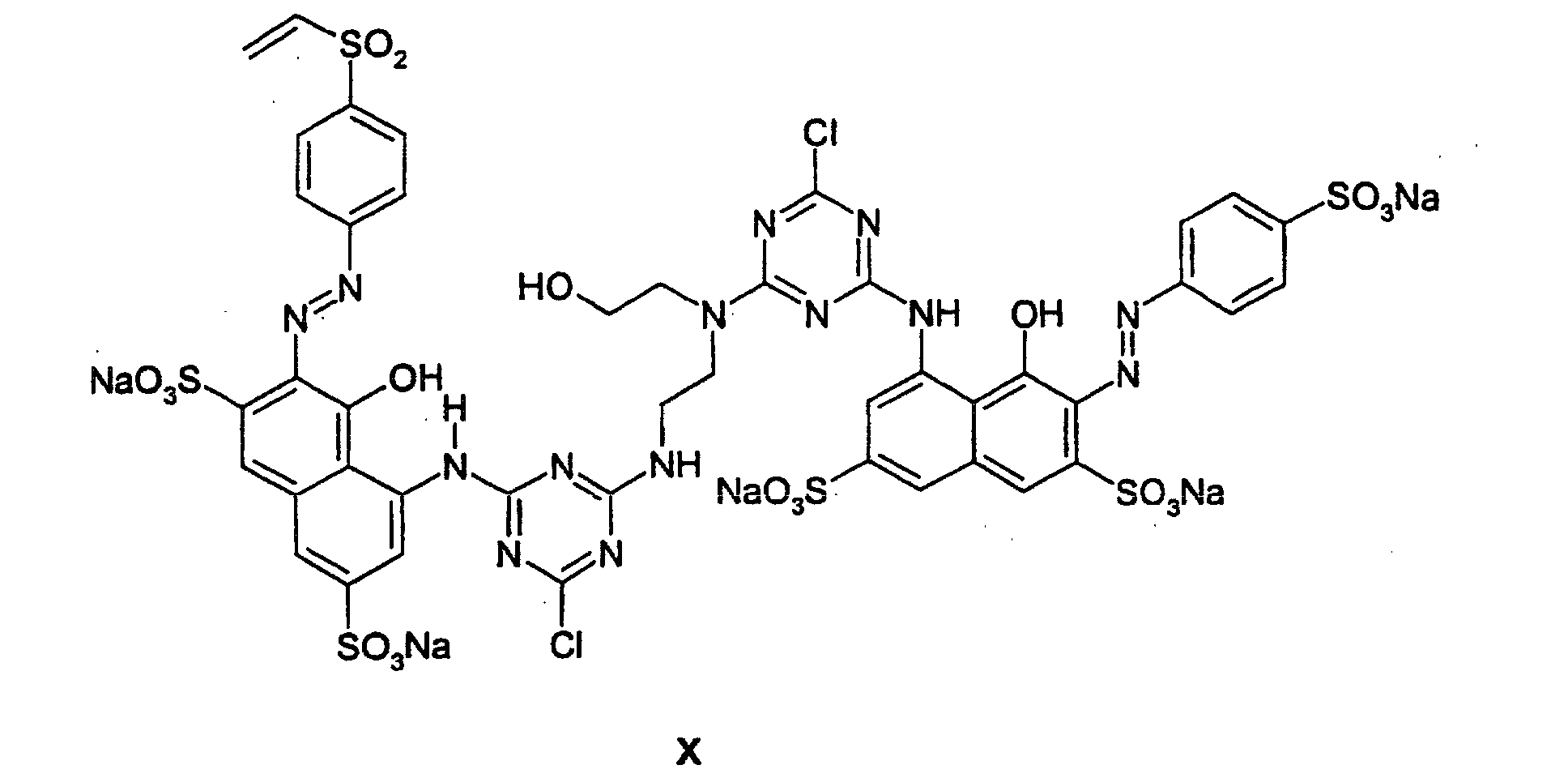
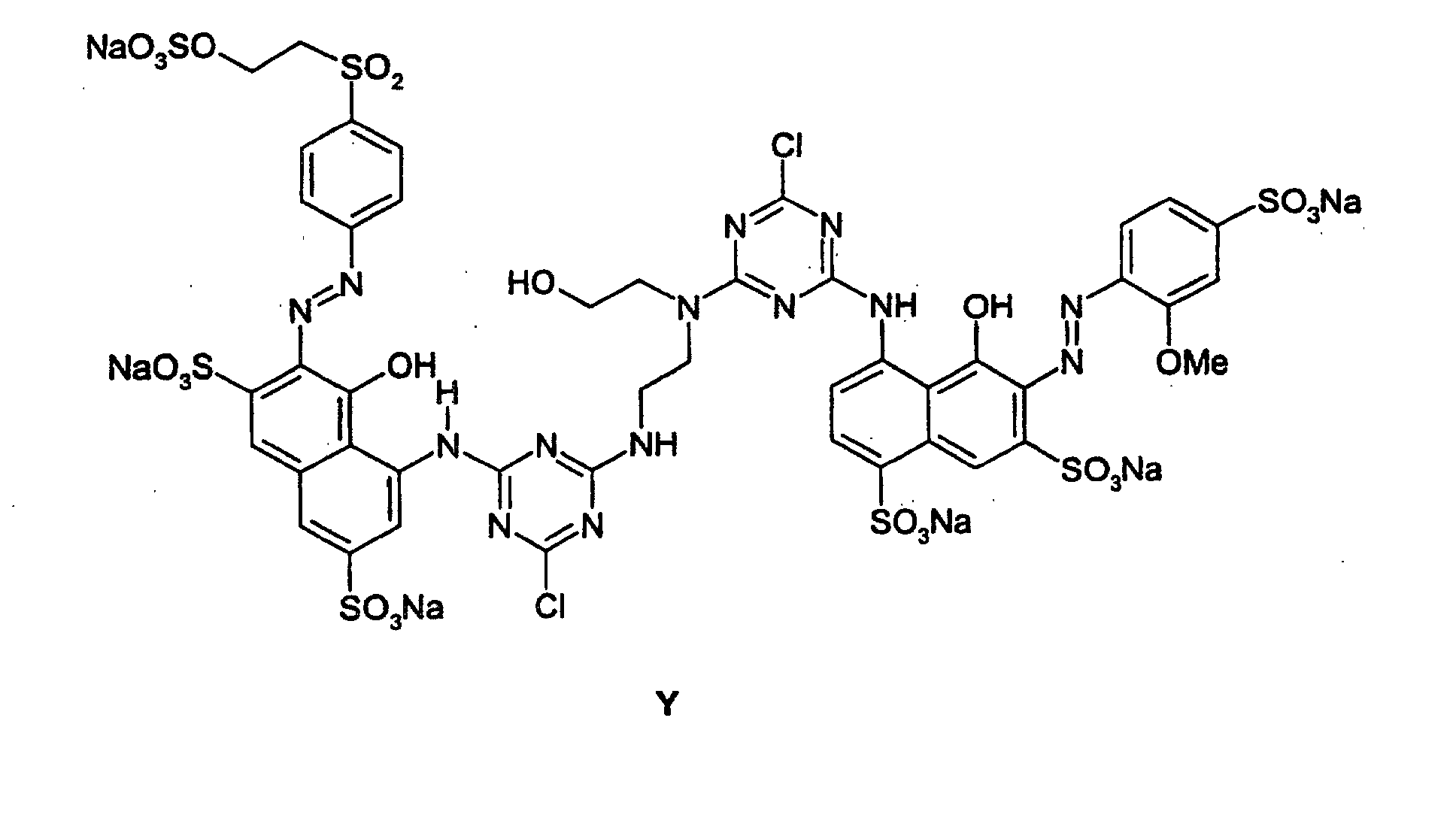
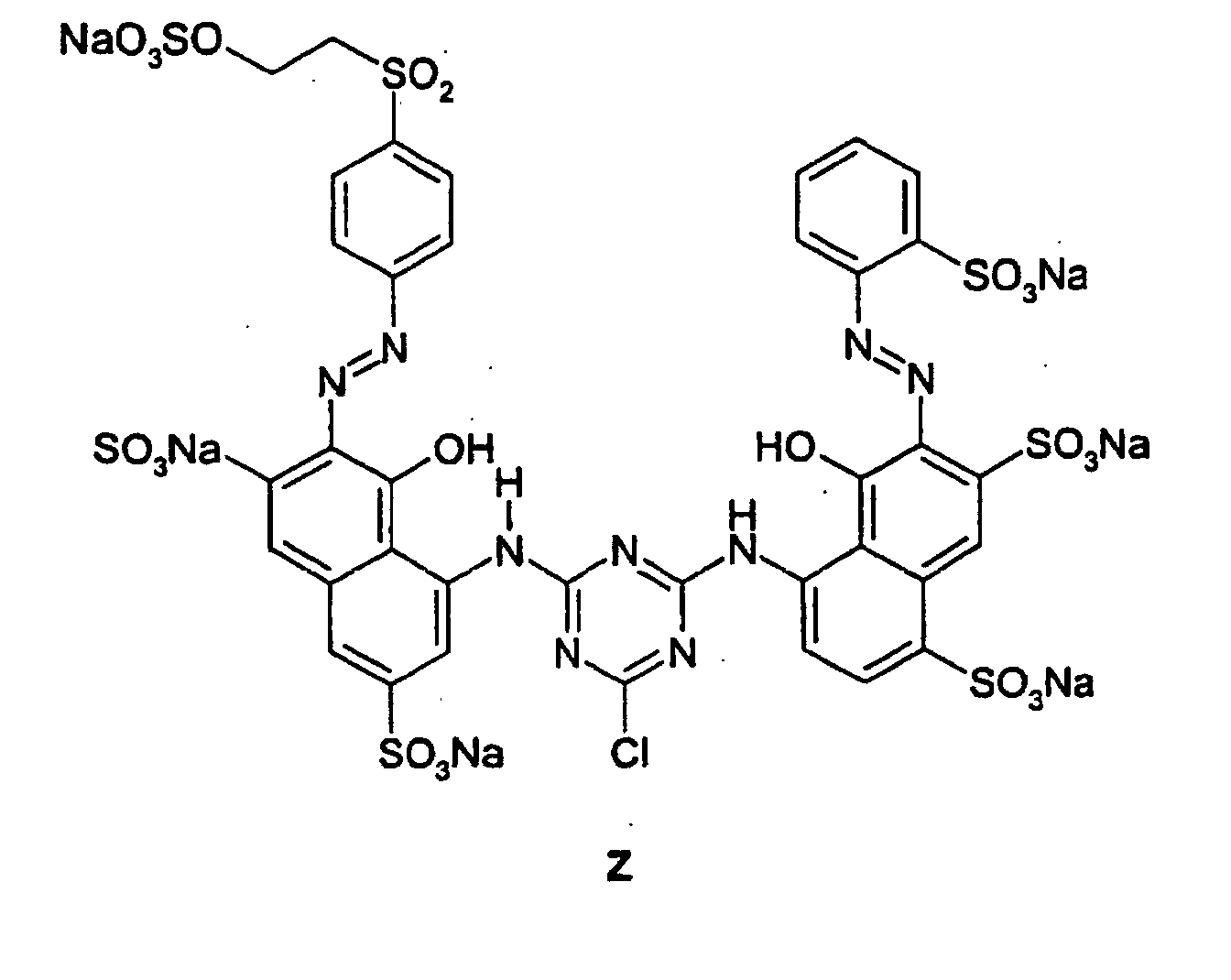
| Beispiel | Komponente 1 | Komponente 2 | Verhältnis |
| 13 | A | N | 1:1 |
| 14 | A | N | 2 : 1 |
| 15 | A | O | 1: 2 |
| 16 | A | O | 1:1 |
| 17 | A | P | 2:1 |
| 18 | A | P | 1:2 |
| 19 | A | Q | 1:1 |
| 20 | A | Q | 1,5:2 |
| 21 | A | U | 1:1 |
| 22 | A | U | 2:1 |
| 23 | A | R | 2:3 |
| 24 | A | R | 4:3 |
| 25 | A | S | 1:1 |
| 26 | A | S | 2:1 |
| 27 | A | T | 1:1 |
| 28 | A | T | 2:1 |
| 29 | A | T | 1:2 |
| 30 | A | V | 1:1 |
| 31 | A | V | 60 : 40 |
| 32 | A | W | 1:1 |
| 33 | A | W | 1:2 |
| 34 | A | X | 1:1 |
| 35 | A | X | 2:1 |
| 36 | C | B | 1:1 |
| 37 | C | D | 1:1 |
| 38 | C | F | 1:1 |
| 39 | C | N | 1:1 |
| 40 | C | O | 1:1 |
| 41 | C | P | 1:1 |
| 42 | C | Q | 1:1 |
| 43 | C | R | 1:1 |
| 44 | C | S | 1:1 |
| 45 | C | T | 1:1 |
| 46 | C | U | 1:1 |
| 47 | C | V | 1:1 |
| 48 | C | W | 1:1 |
| 49 | C | X | 1:1 |
| 50 | E | B | 1:1 |
| 51 | E | D | 1:1 |
| 52 | E | F | 1:1 |
| 53 | E | N | 1:1 |
| 54 | E | O | 1:1 |
| 55 | E | P | 1:1 |
| 56 | E | Q | 1:1 |
| 57 | E | R | 1:1 |
| 58 | E | S | 1:1 |
| 59 | E | T | 1:1 |
| 60 | E | U | 1:1 |
| 61 | E | V | 1:1 |
| 62 | E | W | 1:1 |
| 63 | E | X | 1:1 |
| 64 | G | B | 1:1 |
| 65 | G | D | 1:1 |
| 66 | G | F | 1:1 |
| 67 | G | N | 1:1 |
| 68 | G | O | 1:1 |
| 69 | G | P | 1:1 |
| 70 | G | Q | 1:1 |
| 71 | G | R | 1:1 |
| 72 | G | S | 1:1 |
| 73 | G | T | 1:1 |
| 74 | G | U | 1:1 |
| 75 | G | V | 1:1 |
| 76 | G | W | 1:1 |
| 77 | G | X | 1:1 |
| 78 | H | B | 1:1 |
| 79 | H | D | 1:1 |
| 80 | H | F | 1:1 |
| 81 | H | N | 1:1 |
| 82 | H | O | 1:1 |
| 83 | H | P | 1:1 |
| 84 | H | Q | 1:1 |
| 85 | H | R | 1:1 |
| 86 | H | S | 1:1 |
| 87 | H | T | 1:1 |
| 88 | H | U | 1:1 |
| 89 | H | V | 1:1 |
| 90 | H | W | 1:1 |
| 91 | H | X | 1:1 |
| 92 | I | B | 1:1 |
| 93 | I | D | 1:1 |
| 94 | I | F | 1:1 |
| 95 | I | N | 1:1 |
| 96 | I | O | 1:1 |
| 97 | I | P | 1:1 |
| 98 | I | Q | 1:1 |
| 99 | I | R | 1:1 |
| 100 | I | S | 1:1 |
| 101 | I | T | 1:1 |
| 102 | I | U | 1:1 |
| 103 | I | V | 1:1 |
| 104 | I | W | 1:1 |
| 105 | I | X | 1:1 |
| 106 | J | B | 1:1 |
| 107 | J | D | 1:1 |
| 108 | J | F | 1:1 |
| 109 | J | N | 1:1 |
| 110 | J | O | 1:1 |
| 111 | J | P | 1:1 |
| 112 | J | Q | 1:1 |
| 113 | J | R | 1:1 |
| 114 | J | S | 1:1 |
| 115 | J | T | 1:1 |
| 116 | J | U | 1:1 |
| 118 | J | V | 1:1 |
| 119 | J | W | 1:1 |
| 120 | J | X | 1:1 |
| 121 | K | B | 1:1 |
| 122 | K | D | 1:1 |
| 123 | K | F | 1:1 |
| 124 | K | N | 1:1 |
| 125 | K | O | 1:1 |
| 126 | K | P | 1:1 |
| 127 | K | Q | 1:1 |
| 128 | K | R | 1:1 |
| 129 | K | S | 1:1 |
| 130 | K | T | 1:1 |
| 131 | K | U | 1:1 |
| 132 | K | V | 1:1 |
| 133 | K | W | 1:1 |
| 134 | K | X | 1:1 |
| 135 | L | B | 1:1 |
| 136 | L | D | 1:1 |
| 137 | L | F | 1:1 |
| 138 | L | N | 1:1 |
| 139 | L | O | 1:1 |
| 140 | L | P | 1:1 |
| 141 | L | Q | 1:1 |
| 142 | L | R | 1:1 |
| 143 | L | S | 1:1 |
| 144 | L | T | 1:1 |
| 145 | L | U | 1:1 |
| 146 | L | V | 1:1 |
| 147 | L | W | 1:1 |
| 148 | L | X | 1:1 |
| 149 | M | B | 1:1 |
| 150 | M | D | 1:1 |
| 151 | M | F | 1:1 |
| 152 | M | N | 1:1 |
| 153 | M | O | 1:1 |
| 154 | M | P | 1:1 |
| 155 | M | Q | 1:1 |
| 156 | M | R | 1:1 |
| 157 | M | S | 1:1 |
| 158 | M | T | 1:1 |
| 159 | M | U | 1:1 |
| 160 | M | V | 1:1 |
| 161 | M | W | 1:1 |
| 162 | M | X | 1:1 |
| 163 | A | Y | 1:1 |
| 164 | C | Y | 1:1 |
| 165 | E | Y | 1:1 |
| 166 | G | Y | 1:1 |
| 167 | H | Y | 1:1 |
| 168 | I | Y | 1:1 |
| 169 | J | Y | 1:1 |
| 170 | K | Y | 1:1 |
| 171 | L | Y | 1:1 |
| 172 | M | Y | 1:1 |
| 173 | N | Y | 1:1 |
| 174 | A | Z | 1:1 |
| 175 | C | Z | 1:1 |
| 176 | E | Z | 1:1 |
| 177 | G | Z | 1:1 |
| 178 | H | Z | 1:1 |
| 179 | I | Z | 1:1 |
| 180 | J | Z | 1:1 |
| 181 | K | Z | 1:1 |
| 182 | L | Z | 1:1 |
| 183 | M | Z | 1:1 |
Claims (8)
- Farbstoffmischungen, enthaltend einen oder mehrere Azofarbstoffe der allgemeinen Formel (1) und einen oder mehrere Azofarbstoffe der allgemeinen Formel (2)
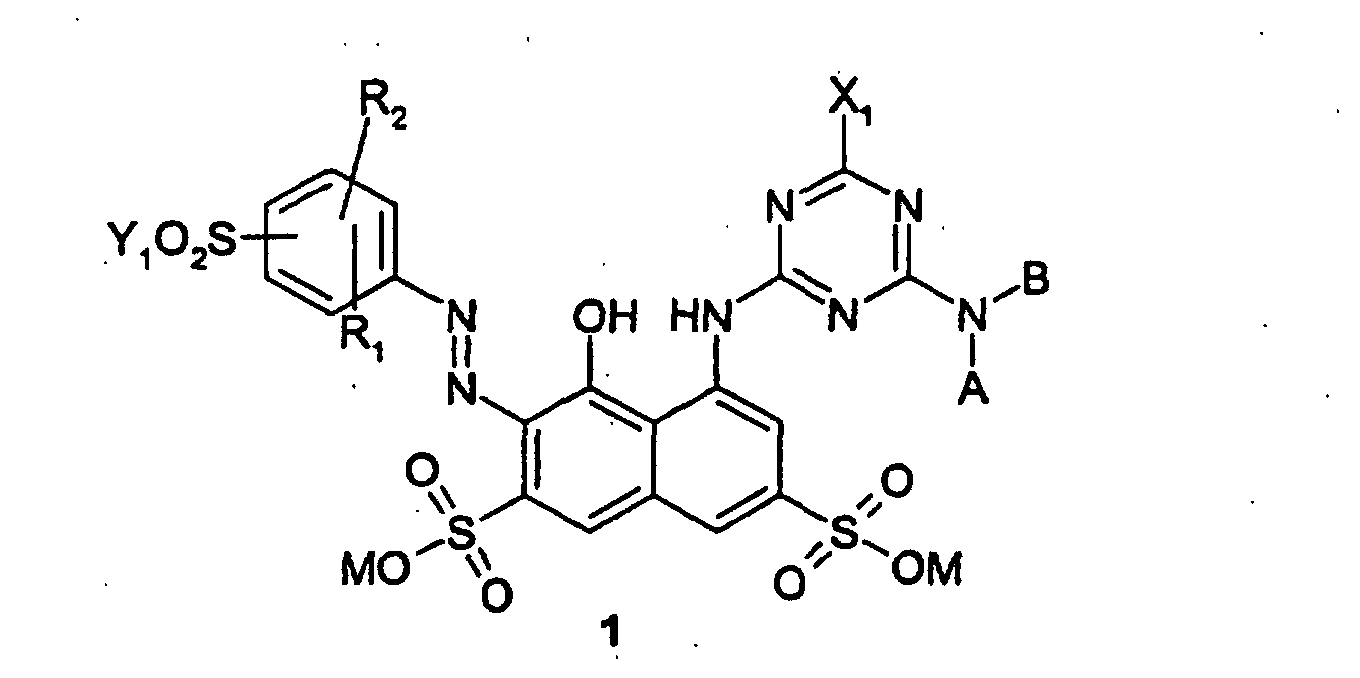 worin
worin
- M
- für ein Wasserstoffatom, ein Ammonium lon oder das Äquivalent eines Alkali- oder Erdalkalimetalls steht
- X1
- Fluoro, Chloro, Alkoxy, Hydroxy, Cyanamido, Amino, Anilino, Anilinsulfosäure, Anilindisulfosäure, Toluidin, Anisol, oder ein gegebenenfalls mit Hydroxy, Sulfo oder Sulfato substituiertes Alkylamino sein kann
- X2
- hat eine Bedeutung von X1
- Y1 und Y2
- für Ethenyl oder eine Gruppierung der Formel CH2CH2Z steht, worin
- Z
- für eine Gruppierung steht, die durch Einwirkung von Alkali eliminiert werden kann
- R1, R2, R3, R4, R5 und R6
- unabhängig voneinander für Wasserstoff, Alkyl, Alkoxy, Sulfo, Hydroxy, Cyano, Chloro, Bromo stehen
- A
- für Wasserstoff steht, oder für C1-C6-Alkyl, welches durch Sulfo-, Hydroxy-, oder Sulfato-Gruppen substituiert sein kann, oder Anilin welches durch Sulfo oder Halogen substituiert sein kann,
- B
- steht für Wasserstoff, Alkyl, CH2CH2SO2Y, oder gegebenenfalls durch SO2Y, -OCH2CH2SO2Y oder -SO3M substituiertes Alkyl, oder Phenyl welches bis zu dreifach beispielsweise durch Alkyl, Alkoxy, Sulfo, Hydroxy, Cyano, Chloro, Bromo oder SO2Y substituiert sein kann, worin M und Y die oben genannten Bedeutungen haben
- A-N-B
- steht alternativ für cyclische Amine, beispielsweise Morpholin oder Piperazin,
- D-T
- eine direkte Bindung bedeuten oder aber
- T
- steht für ein sym-Triazin welches in 2-Stellung mit X3 substituiert ist, wobei X3 eine Bedeutung von X, hat und
- D
- steht für eine Alkylendiamino Brücke der allgemeinen Formeln 3, 4, 5 und 6:
 worin
worin
- n, m, o, p
- für 1-8 stehen
- q
- steht für null und eins
- R7, R8, R9
- stehen unabhängig voneinander für C1-C4 Alkyl
- R10
- steht für Wasserstoff oder SO3M.
- Farbstoffmischung nach Anspruch 1, enthaltend einen oder mehrere Azofarbstoffe entsprechend der allgemeinen Formel (1) und einen oder mehrere Azofarbstoffe entsprechend der allgemeinen Formel (2) im Mischungsverhältnis von 90:10 Gew.-% bis 10:90 Gew.-%.
- Farbstoffmischung nach Anspruch 1, enthaltend einen oder mehrere Azofarbstoffe entsprechend der allgemeinen Formel (1) und einen oder mehrere Azofarbstoffe entsprechend der allgemeinen Formel (2) im Mischungsverhältnis von 70:30 Gew.-% bis 30:70 Gew.-%.
- Farbstoffmischung nach Anspruch 1, enthaltend einen oder mehrere Azofarbstoffe entsprechend der allgemeinen Formel (1) und einen oder mehrere Azofarbstoffe entsprechend der allgemeinen Formel (2) im Mischungsverhältnis von 65:35 Gew.-% bis 45:55 Gew.-%.
- Verfahren zur Herstellung der erfindungsgemäßen Farbstoffmischungen durch mechanisches Mischen der einzelnen Komponenten in fester oder in flüssiger Form in den erforderlichen Anteilen;
- Verfahren zur Herstellung der erfindungsgemäßen Farbstoffmischungen, wobei ein 2,4,6-Trihalogentriazin, insbesondere 2,4,6-Trichlor- oder 2,4,6-Trifluortriazin, zunächst in an und für sich bekannter Verfahrensweise mit 1 - Amino-8-naphthol-3,6-disulfonsäure, dann mit einem Diazoniumsalz, das aus einem Amin der allgemeinen Formel (3A) oder (3B)mit R1, R2. R3, R4 und Y1 und Y2 der obengenannten Bedeutung in wohlbekannter Weise hergestellt wurde, umsetzt, anschließend das Reaktionsprodukt aus der Umsetzung mit einem diazotierten Amin der Formel (3A) durch Reaktion mit einer oder mehreren Aminoverbindungen der allgemeinen Formel A-NH-B mit A und B in der obengenannten Bedeutung, reagieren läßt oder zur Herstellung der Komponente der allgemeinen Formel (2) in bekannter Weise bei dem Reaktionsprodukt aus der Umsetzung mit einer diazotierten Aminoverbindung der Formel (3B) das Fragment D-T einführt, dieses Reaktionsprodukt anschließend mit einem Amin der allgemeinen Formel (3C)
 in an und für sich bekannter Verfahrensweise, umsetzt und in bekannter Weise mit dem Diazoniumsalz der Amine der allgemeinen Formel (3D) zum Bisazofarbstoff kuppelt.

- Verwendung einer Farbstoffmischung nach mindestens einem der Ansprüche 1 bis 4 zum Färben oder Bedrucken von hydroxy- und/oder carbonamidgruppenhaltigem Material, vorzugsweise Fasermaterial.
- Verfahren zum Färben oder Bedrucken von hydroxy- und/oder carbonamidgruppenhaltigem Material, vorzugsweise Fasermaterial, bei welchem man einen oder mehrere Farbstoffe in gelöster Form auf das Material aufbringt und den oder die Farbstoffe auf dem Material mittels Wärme oder mit Hilfe eines alkalisch wirkenden Mittels oder mittels beider Maßnahmen fixiert, dadurch gekennzeichnet, dass man als Farbstoffe eine Farbstoffmischung von mindestens einem der Ansprüche 1 bis 4 einsetzt.
Applications Claiming Priority (3)
| Application Number | Priority Date | Filing Date | Title |
|---|---|---|---|
| DE10017555 | 2000-04-08 | ||
| DE10017555A DE10017555A1 (de) | 2000-04-08 | 2000-04-08 | Farbstoffmischung von wasserlöslichen faserreaktiven Azofarbstoffen, Verfahren zu ihrer Herstellung und ihre Verwendung |
| PCT/EP2001/003700 WO2001077232A1 (de) | 2000-04-08 | 2001-03-31 | Farbstoffmischung von wasserlöslichen faserreaktiven azofarbstoffen, verfahren zu ihrer herstellung und ihre verwendung |
Publications (2)
| Publication Number | Publication Date |
|---|---|
| EP1274803A1 EP1274803A1 (de) | 2003-01-15 |
| EP1274803B1 true EP1274803B1 (de) | 2004-06-16 |
Family
ID=7638074
Family Applications (1)
| Application Number | Title | Priority Date | Filing Date |
|---|---|---|---|
| EP01929485A Expired - Lifetime EP1274803B1 (de) | 2000-04-08 | 2001-03-31 | Farbstoffmischung von wasserlöslichen faserreaktiven azofarbstoffen, verfahren zu ihrer herstellung und ihre verwendung |
Country Status (14)
| Country | Link |
|---|---|
| US (1) | US6916350B2 (de) |
| EP (1) | EP1274803B1 (de) |
| JP (1) | JP2004500475A (de) |
| KR (1) | KR20030010596A (de) |
| CN (1) | CN1425045A (de) |
| AT (1) | ATE269379T1 (de) |
| BR (1) | BR0107543A (de) |
| CA (1) | CA2405421A1 (de) |
| DE (2) | DE10017555A1 (de) |
| ES (1) | ES2222369T3 (de) |
| MX (1) | MXPA02009937A (de) |
| PT (1) | PT1274803E (de) |
| TR (1) | TR200402337T4 (de) |
| WO (1) | WO2001077232A1 (de) |
Families Citing this family (5)
| Publication number | Priority date | Publication date | Assignee | Title |
|---|---|---|---|---|
| WO2005040285A1 (en) * | 2003-10-20 | 2005-05-06 | Ciba Specialty Chemicals Holding Inc. | Mixtures of reactive dyes and their use |
| GB0711964D0 (en) * | 2007-06-21 | 2007-08-01 | Fujifilm Imaging Colorants Ltd | Composition suitable for use in ink jet printing |
| EP2307511A2 (de) * | 2008-07-31 | 2011-04-13 | DyStar Colours Deutschland GmbH | Faserreaktive azo-farbstoffe, ihre herstellung und verwendung |
| CN102277011A (zh) * | 2011-06-17 | 2011-12-14 | 上海雅运纺织化工有限公司 | 红色活性染料组合物及其在纤维上的染色应用 |
| WO2013018071A2 (en) * | 2011-08-04 | 2013-02-07 | Colourtex Industries Limited | Fibre reactive azo reactive colorants containing two reactive groups of the vinylsulfone type, production and use thereof |
Citations (1)
| Publication number | Priority date | Publication date | Assignee | Title |
|---|---|---|---|---|
| WO2001062856A1 (en) * | 2000-02-23 | 2001-08-30 | Dystar Textilfarben Gmbh & Co. Deutschland Kg | Dye mixture comprising water-soluble fiber-reactive dyes, preparation thereof and use thereof |
Family Cites Families (10)
| Publication number | Priority date | Publication date | Assignee | Title |
|---|---|---|---|---|
| DE3217812A1 (de) | 1982-05-12 | 1983-11-17 | Hoechst Ag, 6230 Frankfurt | Monoazoverbindungen, verfahren zu ihrer herstellung und ihre verwendung als farbstoffe |
| EP0735107B1 (de) * | 1990-09-25 | 2000-08-30 | Ciba Specialty Chemicals Holding Inc. | Faserreaktive Farbstoffe und deren Verwendung |
| DE4113838A1 (de) * | 1991-04-27 | 1992-10-29 | Basf Ag | Azofarbstoffe mit mehreren reaktiven ankergruppen |
| DE4140117C1 (de) * | 1991-12-05 | 1993-01-28 | Bayer Ag, 5090 Leverkusen, De | |
| EP0545219A1 (de) | 1991-12-05 | 1993-06-09 | Bayer Ag | Reaktivfarbstoffe, deren Herstellung und Verwendung |
| DE4415313A1 (de) | 1994-05-02 | 1995-11-09 | Hoechst Ag | Mischungen von faserreaktiven Farbstoffen und deren Verwendung zum Färben von Fasermaterialien |
| DE4447276C2 (de) | 1994-12-30 | 1998-08-27 | Dystar Textilfarben Gmbh & Co | Farbstoffmischung von wasserlöslichen faserreaktiven Azofarbstoffen, Verfahren zu ihrer Herstellung und ihre Verwendung |
| TW526246B (en) | 1995-11-16 | 2003-04-01 | Ciba Sc Holding Ag | Fiber-reactive dyes, their preparation and their use |
| ES2146856T3 (es) | 1995-11-16 | 2000-08-16 | Ciba Sc Holding Ag | Colorantes reactivos con las fibras, su obtencion y uso. |
| DE19821573A1 (de) * | 1998-05-14 | 2000-02-10 | Dystar Textilfarben Gmbh & Co | Farbstoffmischung von wasserlöslichen faserreaktiven Azofarbstoffen, Verfahren zu ihrer Herstellung und ihre Verwendung |
-
2000
- 2000-04-08 DE DE10017555A patent/DE10017555A1/de not_active Withdrawn
-
2001
- 2001-03-31 KR KR1020027013461A patent/KR20030010596A/ko not_active Abandoned
- 2001-03-31 WO PCT/EP2001/003700 patent/WO2001077232A1/de not_active Ceased
- 2001-03-31 MX MXPA02009937A patent/MXPA02009937A/es active IP Right Grant
- 2001-03-31 CA CA002405421A patent/CA2405421A1/en not_active Abandoned
- 2001-03-31 AT AT01929485T patent/ATE269379T1/de active
- 2001-03-31 EP EP01929485A patent/EP1274803B1/de not_active Expired - Lifetime
- 2001-03-31 ES ES01929485T patent/ES2222369T3/es not_active Expired - Lifetime
- 2001-03-31 JP JP2001575096A patent/JP2004500475A/ja not_active Withdrawn
- 2001-03-31 PT PT01929485T patent/PT1274803E/pt unknown
- 2001-03-31 US US10/240,362 patent/US6916350B2/en not_active Expired - Lifetime
- 2001-03-31 DE DE50102603T patent/DE50102603D1/de not_active Expired - Lifetime
- 2001-03-31 BR BR0107543-8A patent/BR0107543A/pt not_active Application Discontinuation
- 2001-03-31 TR TR2004/02337T patent/TR200402337T4/xx unknown
- 2001-03-31 CN CN01808338A patent/CN1425045A/zh active Pending
Patent Citations (1)
| Publication number | Priority date | Publication date | Assignee | Title |
|---|---|---|---|---|
| WO2001062856A1 (en) * | 2000-02-23 | 2001-08-30 | Dystar Textilfarben Gmbh & Co. Deutschland Kg | Dye mixture comprising water-soluble fiber-reactive dyes, preparation thereof and use thereof |
Also Published As
| Publication number | Publication date |
|---|---|
| JP2004500475A (ja) | 2004-01-08 |
| DE50102603D1 (de) | 2004-07-22 |
| US20030145396A1 (en) | 2003-08-07 |
| ES2222369T3 (es) | 2005-02-01 |
| CA2405421A1 (en) | 2002-10-07 |
| DE10017555A1 (de) | 2001-10-11 |
| EP1274803A1 (de) | 2003-01-15 |
| ATE269379T1 (de) | 2004-07-15 |
| CN1425045A (zh) | 2003-06-18 |
| PT1274803E (pt) | 2004-09-30 |
| MXPA02009937A (es) | 2003-02-12 |
| KR20030010596A (ko) | 2003-02-05 |
| BR0107543A (pt) | 2003-01-14 |
| TR200402337T4 (tr) | 2004-12-21 |
| WO2001077232A1 (de) | 2001-10-18 |
| US6916350B2 (en) | 2005-07-12 |
Similar Documents
| Publication | Publication Date | Title |
|---|---|---|
| EP0094055B1 (de) | Monoazoverbindungen, Verfahren zu ihrer Herstellung und ihre Verwendung als Farbstoffe | |
| EP0681008B1 (de) | Schwarze Farbstoffmischungen von faserreaktiven Azofarbstoffen und ihre Verwendung zum Färben von hydroxy- und/oder carbonamidgruppenhaltigem Fasermaterial | |
| EP0679697A2 (de) | Schwarze Farbstoffmischungen von faserreaktiven Azofarbstoffen und ihre Verwendung zum Färben von hydroxy- und/oder carbonamidgruppenhaltigem Fasermaterial | |
| EP0979849B1 (de) | Farbstoffmischung von wasserlöslichen faserreaktiven Azofarbstoffen, Verfahren zu ihrer Herstellung und ihre Verwendung | |
| EP0719841B1 (de) | Farbstoffmischung von wasserlöslichen faserreaktiven Azofarbstoffen, Verfahren zu ihrer Herstellung und ihre Verwendung | |
| EP0957137B1 (de) | Farbstoffmischung von wasserlöslichen faserreaktiven Azofarbstoffen, Verfahren zu ihrer Herstellung und ihre Verwendung | |
| DE69912227T2 (de) | Rotfärbende Farbstoffmischungen von faserreaktiven Azofarbstoffen und deren Verwendung | |
| DE69901275T2 (de) | Orange Farbstoffmischungen von faserreaktiven Azofarbstoffen und ihre Verwendung zum Färben von hydroxy- und/oder carbonamidgruppenhaltigem Material | |
| EP0629666B1 (de) | Wasserlösliche Azoverbindungen, Verfahren zu ihrer Herstellung und ihre Verwendung als Farbstoffe | |
| EP0169457A1 (de) | Wasserlösliche Pyridon-Monoazoverbindungen, Verfahren zu ihrer Herstellung und ihre Verwendung als Farbstoffe | |
| DE10017555A1 (de) | Farbstoffmischung von wasserlöslichen faserreaktiven Azofarbstoffen, Verfahren zu ihrer Herstellung und ihre Verwendung | |
| EP0974622B1 (de) | Farbstoffmischung von wasserlöslichen faserreaktiven Azofarbstoffen, Verfahren zu ihrer Herstellung und ihre Verwendung | |
| EP0071985B1 (de) | Wasserlösliche Monoazoverbindungen, Verfahren zu ihrer Herstellung und ihre Verwendung als Farbstoffe | |
| DE10217477A1 (de) | Faserreaktive Azofarbstoffe, deren Herstellung und ihre Verwendung | |
| EP0992546B1 (de) | Farbstoffmischungen von wasserlöslichen faserreaktiven Azofarbstoffen, Verfahren zu ihrer Herstellung und ihre Verwendung | |
| EP0072557B1 (de) | Wasserlösliche Azoverbindungen, Verfahren zu ihrer Herstellung und ihre Verwendung als Farbstoffe | |
| WO2002098989A1 (de) | Farbstoffmischungen von faserrektiven azofarbstoffen und ihre verwendung | |
| EP1516019A1 (de) | Wasserl sliche faserreaktive disazofarbstoffe, verfahren zu ihrer herstellung und ihre verwndung | |
| EP1316587B1 (de) | Mischungen von faserreaktiven Bisazofarbstoffen und ihre Verwendung | |
| EP0360003B1 (de) | Wasserlösliche Azoverbindungen, Verfahren zu ihrer Herstellung und ihre Verwendung als Farbstoffe | |
| DE10037075A1 (de) | Farbstoffmischung von wasserlöslichen faserreaktiven Farbstoffen Verfahren zu ihrer Herstellung und ihre Verwendung | |
| EP0326011B1 (de) | Wasserlösliche Disazoverbindungen, Verfahren zu ihrer Herstellung und ihre Verwendung als Farbstoffe | |
| DE10212770A1 (de) | Farbstoffmischungen von faserreaktiven Azofarbstoffen und ihre Verwendung | |
| DE10217478A1 (de) | Farbstoffmischungen von faserreaktiven Azofarbstoffen, ihre Herstellung und ihre Verwendung | |
| DE19958213A1 (de) | Wasserlösliche faserreaktive Azofarbstoffe, Verfahren zu ihrer Herstellung und ihre Verwendung |
Legal Events
| Date | Code | Title | Description |
|---|---|---|---|
| PUAI | Public reference made under article 153(3) epc to a published international application that has entered the european phase |
Free format text: ORIGINAL CODE: 0009012 |
|
| 17P | Request for examination filed |
Effective date: 20021108 |
|
| AK | Designated contracting states |
Kind code of ref document: A1 Designated state(s): AT BE CH CY DE DK ES FI FR GB GR IE IT LI LU MC NL PT SE TR |
|
| 17Q | First examination report despatched |
Effective date: 20030523 |
|
| GRAP | Despatch of communication of intention to grant a patent |
Free format text: ORIGINAL CODE: EPIDOSNIGR1 |
|
| GRAS | Grant fee paid |
Free format text: ORIGINAL CODE: EPIDOSNIGR3 |
|
| GRAA | (expected) grant |
Free format text: ORIGINAL CODE: 0009210 |
|
| AK | Designated contracting states |
Kind code of ref document: B1 Designated state(s): AT BE CH CY DE DK ES FI FR GB GR IE IT LI LU MC NL PT SE TR |
|
| PG25 | Lapsed in a contracting state [announced via postgrant information from national office to epo] |
Ref country code: FI Free format text: LAPSE BECAUSE OF FAILURE TO SUBMIT A TRANSLATION OF THE DESCRIPTION OR TO PAY THE FEE WITHIN THE PRESCRIBED TIME-LIMIT Effective date: 20040616 Ref country code: NL Free format text: LAPSE BECAUSE OF FAILURE TO SUBMIT A TRANSLATION OF THE DESCRIPTION OR TO PAY THE FEE WITHIN THE PRESCRIBED TIME-LIMIT Effective date: 20040616 |
|
| REG | Reference to a national code |
Ref country code: GB Ref legal event code: FG4D Free format text: NOT ENGLISH |
|
| REG | Reference to a national code |
Ref country code: CH Ref legal event code: EP |
|
| RAP2 | Party data changed (patent owner data changed or rights of a patent transferred) |
Owner name: DYSTAR TEXTILFARBEN GMBH & CO. DEUTSCHLAND KG |
|
| REF | Corresponds to: |
Ref document number: 50102603 Country of ref document: DE Date of ref document: 20040722 Kind code of ref document: P |
|
| REG | Reference to a national code |
Ref country code: IE Ref legal event code: FG4D Free format text: GERMAN |
|
| NLT2 | Nl: modifications (of names), taken from the european patent patent bulletin |
Owner name: DYSTAR TEXTILFARBEN GMBH & CO. DEUTSCHLAND KG |
|
| GBT | Gb: translation of ep patent filed (gb section 77(6)(a)/1977) |
Effective date: 20040817 |
|
| PG25 | Lapsed in a contracting state [announced via postgrant information from national office to epo] |
Ref country code: SE Free format text: LAPSE BECAUSE OF FAILURE TO SUBMIT A TRANSLATION OF THE DESCRIPTION OR TO PAY THE FEE WITHIN THE PRESCRIBED TIME-LIMIT Effective date: 20040916 Ref country code: DK Free format text: LAPSE BECAUSE OF FAILURE TO SUBMIT A TRANSLATION OF THE DESCRIPTION OR TO PAY THE FEE WITHIN THE PRESCRIBED TIME-LIMIT Effective date: 20040916 Ref country code: GR Free format text: LAPSE BECAUSE OF FAILURE TO SUBMIT A TRANSLATION OF THE DESCRIPTION OR TO PAY THE FEE WITHIN THE PRESCRIBED TIME-LIMIT Effective date: 20040916 |
|
| REG | Reference to a national code |
Ref country code: PT Ref legal event code: SC4A Free format text: AVAILABILITY OF NATIONAL TRANSLATION Effective date: 20040803 |
|
| NLV1 | Nl: lapsed or annulled due to failure to fulfill the requirements of art. 29p and 29m of the patents act | ||
| REG | Reference to a national code |
Ref country code: ES Ref legal event code: FG2A Ref document number: 2222369 Country of ref document: ES Kind code of ref document: T3 |
|
| ET | Fr: translation filed | ||
| PG25 | Lapsed in a contracting state [announced via postgrant information from national office to epo] |
Ref country code: CY Free format text: LAPSE BECAUSE OF FAILURE TO SUBMIT A TRANSLATION OF THE DESCRIPTION OR TO PAY THE FEE WITHIN THE PRESCRIBED TIME-LIMIT Effective date: 20050331 Ref country code: BE Free format text: LAPSE BECAUSE OF NON-PAYMENT OF DUE FEES Effective date: 20050331 Ref country code: MC Free format text: LAPSE BECAUSE OF NON-PAYMENT OF DUE FEES Effective date: 20050331 Ref country code: LU Free format text: LAPSE BECAUSE OF NON-PAYMENT OF DUE FEES Effective date: 20050331 |
|
| PLBE | No opposition filed within time limit |
Free format text: ORIGINAL CODE: 0009261 |
|
| STAA | Information on the status of an ep patent application or granted ep patent |
Free format text: STATUS: NO OPPOSITION FILED WITHIN TIME LIMIT |
|
| 26N | No opposition filed |
Effective date: 20050317 |
|
| BERE | Be: lapsed |
Owner name: *DYSTAR TEXTILFARBEN G.M.B.H. & CO. DEUTSCHLAND K. Effective date: 20050331 |
|
| PGFP | Annual fee paid to national office [announced via postgrant information from national office to epo] |
Ref country code: IE Payment date: 20070313 Year of fee payment: 7 |
|
| BERE | Be: lapsed |
Owner name: *DYSTAR TEXTILFARBEN G.M.B.H. & CO. DEUTSCHLAND K. Effective date: 20050331 |
|
| REG | Reference to a national code |
Ref country code: IE Ref legal event code: MM4A |
|
| PG25 | Lapsed in a contracting state [announced via postgrant information from national office to epo] |
Ref country code: IE Free format text: LAPSE BECAUSE OF NON-PAYMENT OF DUE FEES Effective date: 20080331 |
|
| REG | Reference to a national code |
Ref country code: GB Ref legal event code: 732E Free format text: REGISTERED BETWEEN 20110303 AND 20110309 |
|
| PG25 | Lapsed in a contracting state [announced via postgrant information from national office to epo] |
Ref country code: IT Free format text: LAPSE BECAUSE OF NON-PAYMENT OF DUE FEES Effective date: 20100331 |
|
| PGFP | Annual fee paid to national office [announced via postgrant information from national office to epo] |
Ref country code: FR Payment date: 20110317 Year of fee payment: 11 Ref country code: PT Payment date: 20110324 Year of fee payment: 11 Ref country code: CH Payment date: 20110314 Year of fee payment: 11 Ref country code: AT Payment date: 20110310 Year of fee payment: 11 Ref country code: TR Payment date: 20110311 Year of fee payment: 11 |
|
| PGFP | Annual fee paid to national office [announced via postgrant information from national office to epo] |
Ref country code: DE Payment date: 20110317 Year of fee payment: 11 Ref country code: IT Payment date: 20110324 Year of fee payment: 11 Ref country code: ES Payment date: 20110414 Year of fee payment: 11 Ref country code: GB Payment date: 20110330 Year of fee payment: 11 |
|
| PGRI | Patent reinstated in contracting state [announced from national office to epo] |
Ref country code: IT Effective date: 20110616 |
|
| REG | Reference to a national code |
Ref country code: FR Ref legal event code: TP |
|
| REG | Reference to a national code |
Ref country code: PT Ref legal event code: MM4A Free format text: LAPSE DUE TO NON-PAYMENT OF FEES Effective date: 20121001 |
|
| REG | Reference to a national code |
Ref country code: CH Ref legal event code: PL |
|
| GBPC | Gb: european patent ceased through non-payment of renewal fee |
Effective date: 20120331 |
|
| REG | Reference to a national code |
Ref country code: AT Ref legal event code: MM01 Ref document number: 269379 Country of ref document: AT Kind code of ref document: T Effective date: 20120331 |
|
| REG | Reference to a national code |
Ref country code: FR Ref legal event code: ST Effective date: 20121130 |
|
| PG25 | Lapsed in a contracting state [announced via postgrant information from national office to epo] |
Ref country code: FR Free format text: LAPSE BECAUSE OF NON-PAYMENT OF DUE FEES Effective date: 20120402 Ref country code: AT Free format text: LAPSE BECAUSE OF NON-PAYMENT OF DUE FEES Effective date: 20120331 Ref country code: CH Free format text: LAPSE BECAUSE OF NON-PAYMENT OF DUE FEES Effective date: 20120331 Ref country code: LI Free format text: LAPSE BECAUSE OF NON-PAYMENT OF DUE FEES Effective date: 20120331 Ref country code: GB Free format text: LAPSE BECAUSE OF NON-PAYMENT OF DUE FEES Effective date: 20120331 |
|
| REG | Reference to a national code |
Ref country code: DE Ref legal event code: R119 Ref document number: 50102603 Country of ref document: DE Effective date: 20121002 |
|
| PG25 | Lapsed in a contracting state [announced via postgrant information from national office to epo] |
Ref country code: PT Free format text: LAPSE BECAUSE OF NON-PAYMENT OF DUE FEES Effective date: 20121001 Ref country code: IT Free format text: LAPSE BECAUSE OF NON-PAYMENT OF DUE FEES Effective date: 20120331 |
|
| REG | Reference to a national code |
Ref country code: ES Ref legal event code: FD2A Effective date: 20130823 |
|
| PG25 | Lapsed in a contracting state [announced via postgrant information from national office to epo] |
Ref country code: ES Free format text: LAPSE BECAUSE OF NON-PAYMENT OF DUE FEES Effective date: 20120401 |
|
| PG25 | Lapsed in a contracting state [announced via postgrant information from national office to epo] |
Ref country code: TR Free format text: LAPSE BECAUSE OF NON-PAYMENT OF DUE FEES Effective date: 20120331 |
|
| PG25 | Lapsed in a contracting state [announced via postgrant information from national office to epo] |
Ref country code: DE Free format text: LAPSE BECAUSE OF NON-PAYMENT OF DUE FEES Effective date: 20121002 |