EP1275112B1 - Method for secure transmission of data - Google Patents
Method for secure transmission of data Download PDFInfo
- Publication number
- EP1275112B1 EP1275112B1 EP01922483A EP01922483A EP1275112B1 EP 1275112 B1 EP1275112 B1 EP 1275112B1 EP 01922483 A EP01922483 A EP 01922483A EP 01922483 A EP01922483 A EP 01922483A EP 1275112 B1 EP1275112 B1 EP 1275112B1
- Authority
- EP
- European Patent Office
- Prior art keywords
- receiver
- sender
- key
- payload message
- authenticating
- Prior art date
- Legal status (The legal status is an assumption and is not a legal conclusion. Google has not performed a legal analysis and makes no representation as to the accuracy of the status listed.)
- Expired - Lifetime
Links
Images


Classifications
-
- H—ELECTRICITY
- H04—ELECTRIC COMMUNICATION TECHNIQUE
- H04L—TRANSMISSION OF DIGITAL INFORMATION, e.g. TELEGRAPHIC COMMUNICATION
- H04L9/00—Cryptographic mechanisms or cryptographic arrangements for secret or secure communications; Network security protocols
- H04L9/08—Key distribution or management, e.g. generation, sharing or updating, of cryptographic keys or passwords
-
- H—ELECTRICITY
- H04—ELECTRIC COMMUNICATION TECHNIQUE
- H04N—PICTORIAL COMMUNICATION, e.g. TELEVISION
- H04N21/00—Selective content distribution, e.g. interactive television or video on demand [VOD]
- H04N21/60—Network structure or processes for video distribution between server and client or between remote clients; Control signalling between clients, server and network components; Transmission of management data between server and client, e.g. sending from server to client commands for recording incoming content stream; Communication details between server and client
- H04N21/63—Control signaling related to video distribution between client, server and network components; Network processes for video distribution between server and clients or between remote clients, e.g. transmitting basic layer and enhancement layers over different transmission paths, setting up a peer-to-peer communication via Internet between remote STB's; Communication protocols; Addressing
- H04N21/637—Control signals issued by the client directed to the server or network components
- H04N21/6377—Control signals issued by the client directed to the server or network components directed to server
- H04N21/63775—Control signals issued by the client directed to the server or network components directed to server for uploading keys, e.g. for a client to communicate its public key to the server
-
- G—PHYSICS
- G11—INFORMATION STORAGE
- G11B—INFORMATION STORAGE BASED ON RELATIVE MOVEMENT BETWEEN RECORD CARRIER AND TRANSDUCER
- G11B31/00—Arrangements for the associated working of recording or reproducing apparatus with related apparatus
- G11B31/006—Arrangements for the associated working of recording or reproducing apparatus with related apparatus with video camera or receiver
-
- H—ELECTRICITY
- H04—ELECTRIC COMMUNICATION TECHNIQUE
- H04N—PICTORIAL COMMUNICATION, e.g. TELEVISION
- H04N21/00—Selective content distribution, e.g. interactive television or video on demand [VOD]
- H04N21/20—Servers specifically adapted for the distribution of content, e.g. VOD servers; Operations thereof
- H04N21/25—Management operations performed by the server for facilitating the content distribution or administrating data related to end-users or client devices, e.g. end-user or client device authentication, learning user preferences for recommending movies
- H04N21/258—Client or end-user data management, e.g. managing client capabilities, user preferences or demographics, processing of multiple end-users preferences to derive collaborative data
- H04N21/25808—Management of client data
- H04N21/25816—Management of client data involving client authentication
-
- H—ELECTRICITY
- H04—ELECTRIC COMMUNICATION TECHNIQUE
- H04N—PICTORIAL COMMUNICATION, e.g. TELEVISION
- H04N21/00—Selective content distribution, e.g. interactive television or video on demand [VOD]
- H04N21/60—Network structure or processes for video distribution between server and client or between remote clients; Control signalling between clients, server and network components; Transmission of management data between server and client, e.g. sending from server to client commands for recording incoming content stream; Communication details between server and client
- H04N21/63—Control signaling related to video distribution between client, server and network components; Network processes for video distribution between server and clients or between remote clients, e.g. transmitting basic layer and enhancement layers over different transmission paths, setting up a peer-to-peer communication via Internet between remote STB's; Communication protocols; Addressing
- H04N21/633—Control signals issued by server directed to the network components or client
- H04N21/6332—Control signals issued by server directed to the network components or client directed to client
- H04N21/6334—Control signals issued by server directed to the network components or client directed to client for authorisation, e.g. by transmitting a key
- H04N21/63345—Control signals issued by server directed to the network components or client directed to client for authorisation, e.g. by transmitting a key by transmitting keys
-
- H—ELECTRICITY
- H04—ELECTRIC COMMUNICATION TECHNIQUE
- H04N—PICTORIAL COMMUNICATION, e.g. TELEVISION
- H04N7/00—Television systems
- H04N7/16—Analogue secrecy systems; Analogue subscription systems
- H04N7/167—Systems rendering the television signal unintelligible and subsequently intelligible
- H04N7/1675—Providing digital key or authorisation information for generation or regeneration of the scrambling sequence
-
- G—PHYSICS
- G11—INFORMATION STORAGE
- G11B—INFORMATION STORAGE BASED ON RELATIVE MOVEMENT BETWEEN RECORD CARRIER AND TRANSDUCER
- G11B20/00—Signal processing not specific to the method of recording or reproducing; Circuits therefor
- G11B20/00086—Circuits for prevention of unauthorised reproduction or copying, e.g. piracy
Definitions
- This invention relates generally to the secure transmission of data. More specifically, the invention relates to a system for establishing a secure exchange of information between a sending unit and a receiving unit.
- a sending unit will need to send administrative information to the receiving unit.
- This administrative information may not need to be encrypted. However, it will likely need to be authenticated.
- An attacker wishing to corrupt the transmitted message could stage a "man in the middle" attack on the transmission in order to corrupt the data.
- there is a need for a system that prevents such corruption there is a need for a system that prevents such corruption.
- the present invention provides a method and apparatus for transmitting data across an interface between a sending unit and a receiving unit.
- the system is capable of providing the sender with a shared key; providing the receiver with the shared key; providing the receiver with a receiver_key; conveying the receiver_key to the sender; providing the sender with a sender_key; conveying the sender_key to the receiver; providing a payload message; generating an authenticating payload message utilizing at least the shared key, receiver_key, and sender_key; generating a confirmatory authenticating payload message; and utilizing the authenticating payload message and confirmatory authenticating payload message to authenticate the payload message.
- a transaction identifier can also be used with the shared key, receiver_key, and sender_key, to generate the authenticating payload message and confirmatory authenticating payload message.
- the method for transmitting data across an interface can generally be stated as establishing an interface between a sender and a receiver, and providing the sender and the receiver with a shared key.
- the receiver is also provided with a receiver_key and the sender is also provided with a sender_key.
- the receiver and sender exchange their respective keys; thus, the sender obtains the receiver_key and the receiver obtains the sender_key.
- a payload message namely, the message for which authentication is required, is then provided.
- An authenticating payload message is generated utilizing at least the shared key, the receiver_key, and the sender_key.
- a confirmatory authenticating payload message is also generated. Finally, the authenticating payload message and the confirmatory authenticating payload message are utilized to authenticate the original payload message.
- a sender is provided with a shared key.
- a "sender” is considered to be a sending unit, such as a transmitter, that broadcasts or sends signals, such as a binary stream of data, across a communication channel.
- the shared key will often be a secret key.
- a "shared key” is a key possessed by both the sender and receiver for use in establishing an authenticated transaction; however, it is not necessarily limited to such a use. For example, it could be a key exchanged between the sender and receiver as part of another process, such as the encryption/decryption process.
- a "receiver” is considered to be a receiving unit that is capable of receiving signals sent by the sending unit across the communication channel.
- a receiver_key is generated.
- a "receiver_key” is a key generated on the receiver side of the interface.
- One example of a receiver_key would be a "nonce".
- a nonce is a generated number e.g., a randomly generated number, that is utilized only once in a system. Nonces are useful in that they can be used to prevent a "replay" attack.
- the receiver_key is stored, for example, in a memory at the receiver. If nonces are used for the receiver_key and sender key, they can be referred to as the receiver_nonce and sender_nonce, respectively. Furthermore, if the nonce is necessarily randomly generated, such a receiver_key could be referred to as a receiver_random_number_nonce.
- a transaction identifier is generated.
- the transaction identifier identifies the exchange of information process between the sender and the receiver.
- the sender and receiver couple the transaction identifier with information exchanged between the sender and receiver to identify the purpose of the information being exchanged.
- the transaction identifier will identify the ongoing authentication transaction.
- the previously generated receiver_key is conveyed to the sender. Preferably, this conveyance occurs by transmitting the receiver_key along with the transaction identifier across the interface to the sender, as illustrated by blocks 128 and 132. In this fashion, the transaction identifier can be coupled with the receiver_key data such that the sender will recognize the purpose of the transmission.
- block 136 the receiver_key which has been sent or conveyed to the sender is stored at the sender.
- block 140 the transaction identifier generated at the receiver is stored at the sender, as well.
- a "sender_key" is a key generated on the sender side of the interface.
- a sender_key is generated as shown in 144.
- the sender_key can be a random number nonce in order to prevent a replay attack in the exchange of the sender_key.
- the sender key is stored at the sender.
- the sender_key can be conveyed to the receiver as shown in 152.
- the exchange of information between the sender and receiver can be accomplished through the use of a transaction identifier which is attached to the information being exchanged between the sender and receiver. This is shown by block 156.
- the value of the transaction identifier conveyed with the sender_key is compared to the stored value of the transaction identifier that was sent with the receiver_key. If the comparison confirms that the transaction identifier is the same as the stored value, then the process continues. However, if the transaction identifier has changed, then the data is disregarded as part of the authentication procedure. This is illustrated by block 164. As illustrated in block 168, the sender_key can then be stored at the receiver in the memory of the receiver if the transaction identifier is recognized.
- Block 172 demonstrates the formation of the payload message.
- the payload message is the information of interest which is to be sent by the sender and authenticated. Thus, it is the information which necessitates the authentication process.
- An example of a payload message is a two bit packet of information that indicates four different levels of copy protection for an MPEG encoded data stream.
- Authentication refers to the process whereby a user or information source proves that it is who it claims to be. Thus, authentication allows information such as the payload message to be confirmed as to its origin.
- an authenticating payload message is formed.
- the authenticating payload message is a message which is used e.g., by the receiver, to authenticate the payload message sent by the sender.
- the authenticating payload message is formed utilizing data values possessed by both the sender and receiver.
- the authenticating payload message can be formed by utilizing the shared key, the sender_key, and the receiver_key.
- the transaction identifier and/or additional data values can also be utilized to generate the authenticating payload message.
- a unique authenticating payload message is derived. It is not critical to utilize any particular algorithm to hash the fields of data. It is envisioned that any algorithm which creates a unique result based on a unique input of data could be utilized.
- the payload message is conveyed to the receiver from the sender across the interface as illustrated in block 180.
- An "interface" is considered to be the physical point of demarcation between two devices. Thus, there is a receiver side of the interface and a sender side of the interface.
- This payload message is stored at the receiver in block 182.
- the authenticating payload message is conveyed to the receiver.
- the authenticating payload message is then stored at the receiver as shown in block 186.
- the transaction identifier can be conveyed along with the authenticating payload message as shown in block 188.
- a confirmatory authenticating payload message is generated.
- the confirmatory authenticating payload message is generated on the receiver side of the interface utilizing the same information or data values that were utilized in the generation of the authenticating payload message.
- the confirmatory authenticating payload message is generated by the receiver utilizing the shared key, receiver_key, and sender_key.
- the transaction identifier was used in generation of the authenticating payload message, it too would be utilized to generate the confirmatory. authenticating payload message.
- the same algorithm would be utilized to generate the confirmatory authenticating payload message as was used to generate the authenticating payload message.
- the confirmatory authenticating payload message which utilize the same information as the authenticating payload message should be equivalent to the authenticating payload message.
- the confirmatory authenticating payload message is compared to the authenticating payload message, as shown in block 196. Such a test is made in block 197 to determine the equivalency of the two values. If the two values are not equivalent, then the process is aborted as shown in block 198. However, if the confirmatory authenticating payload message is equivalent to the authenticating payload message, then authentication is complete or is achieved and the payload information can be utilized, as shown in block 199.
- Fig. 2 demonstrates a practical example of the method demonstrated in Figs. 1a, 1b, and 1c.
- set top boxes have been utilized that contain both the set top components and the cable system conditional access system components integrated into stand alone chips.
- the 1996 Cable Act and 1998 FCC Rule and Order require that navigation devices be open to competition through the separation of security functions into a separate module.
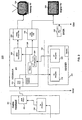
- Fig. 2 shows an implementation that can utilize the method described in Figs. 1a, 1b, and 1c.
- the cable headend 201 obtains an incoming signal which the cable access encryption system 208 encrypts.
- the encrypted signal is then sent to a quadrature amplitude modulation output 204.
- the QAM output signal is transmitted to a QAM input 212 at the set top box receiver 210. Once received, the signal is transmitted across the interface 222 to the sender 214.
- the conditional access information is decrypted in block 216.
- Sender, 214 is also comprised of a copy protection encryption unit 220 and memory 222.
- One aspect of the conditional access information is copy protection information.
- a cable headend can indicate the level of copying allowed for a particular cable program.
- the program may have copy protection that indicates that it is not allowed to be copied at the set top box.
- the copy protection information could indicate that the set top box is free to make multiple copies of the program.
- the copy protection information may indicate that one additional copy is allowed to be produced by the set top box.
- the copy protection information also known as CCI information
- CCI information needs to be conveyed across the interface 222 to the set top box.
- the interface between the sender 214 and receiver 210 is exposed, thus a level of authentication is required in sending the CCI information.
- An attacker might try to alter the CCI information so as to allow the set top box to produce multiple copies of a valuable program.
- the CCI information should be authenticated to ensure that an attacker does not corrupt the CCI information into a lower level of protection.
- the method in flowchart 100 described above can be utilized to accomplish this task. Namely, the sender and receiver will share an encryption/decryption key from an earlier transaction in which such a key was stored at both the receiver and the sender. Thus, they each have a copy of the shared key.
- the CCI information can be utilized as the payload message and a hash algorithm can be implemented utilizing the shared key, the receiver_key, and the sender_key.
- the copy protection information is decrypted at the receiver 210 in block 224.
- the program signal can be distributed to the end user devices.
- the decompression of the MPEG signal can be accomplished and output to the various transducer chips. For example, to produce a signal compatible with an analog TV, an analog output chip 230 could be utilized for end user device 234. Alternatively, if a digital TV 238 is the end user device, the MPEG signal could be sent to a 1394 firewire chip 232. Such would be the case as well for a digital VCR 242, shown in Fig. 2.
- embodiments of the invention could be accomplished as computer signals embodied in a carrier wave, as well as signals (e.g., electrical and optical) propagated through a transmission medium.
- signals e.g., electrical and optical
- the various information discussed above could be formatted in a structure, such as a data structure, and transmitted as an electrical signal through a transmission medium or stored on a computer readable medium.
Landscapes
- Engineering & Computer Science (AREA)
- Multimedia (AREA)
- Signal Processing (AREA)
- Computer Security & Cryptography (AREA)
- Databases & Information Systems (AREA)
- Computer Networks & Wireless Communication (AREA)
- Computer Graphics (AREA)
- Data Exchanges In Wide-Area Networks (AREA)
- Mobile Radio Communication Systems (AREA)
- Communication Control (AREA)
- Storage Device Security (AREA)
Abstract
Description
- This invention relates generally to the secure transmission of data. More specifically, the invention relates to a system for establishing a secure exchange of information between a sending unit and a receiving unit.
- In the transmission of data between a sender and a receiver, there is a need for a system that allows a secure transaction to take place when the sending unit and the receiving unit have not established a secure channel through which data can be transmitted. It is often difficult for a separate secure channel to exist. Hence, there is a need for a system that permits a secure exchange of information between the sending unit and the receiving unit when such a separate secure channel does not exist.
- In one situation, for example, a sending unit will need to send administrative information to the receiving unit. This administrative information may not need to be encrypted. However, it will likely need to be authenticated. Thus, there is a need to ensure that the administrative information that was sent was not corrupted during its transmission through the transmission channel, for example, by an attacker. An attacker wishing to corrupt the transmitted message could stage a "man in the middle" attack on the transmission in order to corrupt the data. Thus, there is a need for a system that prevents such corruption.
- The present invention is defined in the claims to which attention in here directed. The invention provides a method and apparatus for transmitting data across an interface between a sending unit and a receiving unit. The system is capable of providing the sender with a shared key; providing the receiver with the shared key; providing the receiver with a receiver_key; conveying the receiver_key to the sender; providing the sender with a sender_key; conveying the sender_key to the receiver; providing a payload message; generating an authenticating payload message utilizing at least the shared key, receiver_key, and sender_key; generating a confirmatory authenticating payload message; and utilizing the authenticating payload message and confirmatory authenticating payload message to authenticate the payload message. A transaction identifier can also be used with the shared key, receiver_key, and sender_key, to generate the authenticating payload message and confirmatory authenticating payload message.
- Other and further features of the invention will be apparent to those skilled in the art from a consideration of this specification taken in conjunction with the accompanying drawings wherein certain methods and apparatuses for practicing the invention are illustrated. It should be understood that the invention is not limited to the details disclosed but includes all variations and modifications that fall within the scope of the appended claims.
-
- Figs. 1a, 1b, and 1c illustrate a flow diagram for implementing one embodiment of the invention.
- Fig. 2 illustrates a circuit for implementing one embodiment of the invention.
-
- The method for transmitting data across an interface can generally be stated as establishing an interface between a sender and a receiver, and providing the sender and the receiver with a shared key. The receiver is also provided with a receiver_key and the sender is also provided with a sender_key. The receiver and sender exchange their respective keys; thus, the sender obtains the receiver_key and the receiver obtains the sender_key. A payload message, namely, the message for which authentication is required, is then provided. An authenticating payload message is generated utilizing at least the shared key, the receiver_key, and the sender_key. A confirmatory authenticating payload message is also generated. Finally, the authenticating payload message and the confirmatory authenticating payload message are utilized to authenticate the original payload message.
- Referring now to the
flowchart 100 in Figs. 1a, 1b, and 1c, a method for implementing one embodiment of the invention can be seen. Inblock 104, a sender is provided with a shared key. A "sender" is considered to be a sending unit, such as a transmitter, that broadcasts or sends signals, such as a binary stream of data, across a communication channel. The shared key will often be a secret key. Namely, a "shared key" is a key possessed by both the sender and receiver for use in establishing an authenticated transaction; however, it is not necessarily limited to such a use. For example, it could be a key exchanged between the sender and receiver as part of another process, such as the encryption/decryption process. Thus, the sender and receiver will each have a copy of the shared key. The receiver having the shared key is reflected inblock 108. A "receiver" is considered to be a receiving unit that is capable of receiving signals sent by the sending unit across the communication channel. Inblock 112, a receiver_key is generated. A "receiver_key" is a key generated on the receiver side of the interface. One example of a receiver_key would be a "nonce". A nonce is a generated number e.g., a randomly generated number, that is utilized only once in a system. Nonces are useful in that they can be used to prevent a "replay" attack. Thus, if a nonce is used once between a receiver and a sender, the receiver and sender will recognize a replay attack if that same number used for the nonce is used again. Inblock 116, the receiver_key is stored, for example, in a memory at the receiver. If nonces are used for the receiver_key and sender key, they can be referred to as the receiver_nonce and sender_nonce, respectively. Furthermore, if the nonce is necessarily randomly generated, such a receiver_key could be referred to as a receiver_random_number_nonce. - In
block 120, a transaction identifier is generated. The transaction identifier identifies the exchange of information process between the sender and the receiver. Thus, the sender and receiver couple the transaction identifier with information exchanged between the sender and receiver to identify the purpose of the information being exchanged. In the particular process of interest, the transaction identifier will identify the ongoing authentication transaction. Thus, inblock 124, after the transaction identifier is generated, it can be stored, for example, at the receiver. Inblock 128, the previously generated receiver_key is conveyed to the sender. Preferably, this conveyance occurs by transmitting the receiver_key along with the transaction identifier across the interface to the sender, as illustrated byblocks - In Fig. 1b,
block 136, the receiver_key which has been sent or conveyed to the sender is stored at the sender. Inblock 140, the transaction identifier generated at the receiver is stored at the sender, as well. - The process is generally repeated in the generation of a sender_key as shown by
blocks block 148, the sender key is stored at the sender. Then, the sender_key can be conveyed to the receiver as shown in 152. As mentioned earlier, the exchange of information between the sender and receiver can be accomplished through the use of a transaction identifier which is attached to the information being exchanged between the sender and receiver. This is shown byblock 156. - In
block 160, the value of the transaction identifier conveyed with the sender_key is compared to the stored value of the transaction identifier that was sent with the receiver_key. If the comparison confirms that the transaction identifier is the same as the stored value, then the process continues. However, if the transaction identifier has changed, then the data is disregarded as part of the authentication procedure. This is illustrated byblock 164. As illustrated inblock 168, the sender_key can then be stored at the receiver in the memory of the receiver if the transaction identifier is recognized. -
Block 172 demonstrates the formation of the payload message. The payload message is the information of interest which is to be sent by the sender and authenticated. Thus, it is the information which necessitates the authentication process. An example of a payload message is a two bit packet of information that indicates four different levels of copy protection for an MPEG encoded data stream. Authentication refers to the process whereby a user or information source proves that it is who it claims to be. Thus, authentication allows information such as the payload message to be confirmed as to its origin. - In
block 176, an authenticating payload message is formed. The authenticating payload message is a message which is used e.g., by the receiver, to authenticate the payload message sent by the sender. The authenticating payload message is formed utilizing data values possessed by both the sender and receiver. For example, the authenticating payload message can be formed by utilizing the shared key, the sender_key, and the receiver_key. Alternatively, the transaction identifier and/or additional data values can also be utilized to generate the authenticating payload message. By appending these various keys and/or identifiers and performing a hash algorithm on the appended set of data, a unique authenticating payload message is derived. It is not critical to utilize any particular algorithm to hash the fields of data. It is envisioned that any algorithm which creates a unique result based on a unique input of data could be utilized. - The payload message is conveyed to the receiver from the sender across the interface as illustrated in
block 180. An "interface" is considered to be the physical point of demarcation between two devices. Thus, there is a receiver side of the interface and a sender side of the interface. This payload message is stored at the receiver inblock 182. In Fig. 1c, block 184, the authenticating payload message is conveyed to the receiver. The authenticating payload message is then stored at the receiver as shown inblock 186. In addition, the transaction identifier can be conveyed along with the authenticating payload message as shown inblock 188. Once again, a comparison is made between the value of the transaction identifier which was stored by the receiver and the value of the transaction identifier conveyed with the authenticating payload message as shown inblock 190. If the transaction identifier does not match the value that was sent earlier, the authenticating payload message is disregarded as shown inblock 192. - In
block 194, a confirmatory authenticating payload message is generated. The confirmatory authenticating payload message is generated on the receiver side of the interface utilizing the same information or data values that were utilized in the generation of the authenticating payload message. Thus, for example, the confirmatory authenticating payload message is generated by the receiver utilizing the shared key, receiver_key, and sender_key. Or, if the transaction identifier was used in generation of the authenticating payload message, it too would be utilized to generate the confirmatory. authenticating payload message. The same algorithm would be utilized to generate the confirmatory authenticating payload message as was used to generate the authenticating payload message. Thus, the confirmatory authenticating payload message which utilize the same information as the authenticating payload message should be equivalent to the authenticating payload message. In order to determine whether they are equivalent, the confirmatory authenticating payload message is compared to the authenticating payload message, as shown inblock 196. Such a test is made inblock 197 to determine the equivalency of the two values. If the two values are not equivalent, then the process is aborted as shown inblock 198. However, if the confirmatory authenticating payload message is equivalent to the authenticating payload message, then authentication is complete or is achieved and the payload information can be utilized, as shown inblock 199. - Fig. 2 demonstrates a practical example of the method demonstrated in Figs. 1a, 1b, and 1c. In the cable television industry, set top boxes have been utilized that contain both the set top components and the cable system conditional access system components integrated into stand alone chips. However, the 1996 Cable Act and 1998 FCC Rule and Order require that navigation devices be open to competition through the separation of security functions into a separate module. Thus, there is now a channel between the conditional access system of the set top box and the remainder of the set top box which is open to attack by those desiring to obtain the content of the cable transmission. Fig. 2 shows an implementation that can utilize the method described in Figs. 1a, 1b, and 1c. In
circuit 200, thecable headend 201 obtains an incoming signal which the cableaccess encryption system 208 encrypts. The encrypted signal is then sent to a quadratureamplitude modulation output 204. The QAM output signal is transmitted to aQAM input 212 at the settop box receiver 210. Once received, the signal is transmitted across theinterface 222 to thesender 214. At the sender, the conditional access information is decrypted inblock 216. Sender, 214 is also comprised of a copyprotection encryption unit 220 andmemory 222. One aspect of the conditional access information is copy protection information. For example, a cable headend can indicate the level of copying allowed for a particular cable program. Thus, if the program is highly valuable, it may have copy protection that indicates that it is not allowed to be copied at the set top box. Alternatively, if the program is not valuable, the copy protection information could indicate that the set top box is free to make multiple copies of the program. As yet another alternative, the copy protection information may indicate that one additional copy is allowed to be produced by the set top box. Thus, this facilitates distributing the program to more than one device from the set top box. Therefore, the copy protection information for a program could be embodied in as few as one or two bits. - The copy protection information, also known as CCI information, needs to be conveyed across the
interface 222 to the set top box. The interface between thesender 214 andreceiver 210 is exposed, thus a level of authentication is required in sending the CCI information. An attacker might try to alter the CCI information so as to allow the set top box to produce multiple copies of a valuable program. Thus, the CCI information should be authenticated to ensure that an attacker does not corrupt the CCI information into a lower level of protection. The method inflowchart 100 described above can be utilized to accomplish this task. Namely, the sender and receiver will share an encryption/decryption key from an earlier transaction in which such a key was stored at both the receiver and the sender. Thus, they each have a copy of the shared key. In addition, as described above, they can exchange nonces so as to prevent a replay attack. Then, the CCI information can be utilized as the payload message and a hash algorithm can be implemented utilizing the shared key, the receiver_key, and the sender_key. Once the payload data is authenticated, the copy protection information is decrypted at thereceiver 210 inblock 224. With the copy protection information decrypted, the program signal can be distributed to the end user devices. Thus, inblock 228, the decompression of the MPEG signal can be accomplished and output to the various transducer chips. For example, to produce a signal compatible with an analog TV, ananalog output chip 230 could be utilized forend user device 234. Alternatively, if adigital TV 238 is the end user device, the MPEG signal could be sent to a 1394firewire chip 232. Such would be the case as well for adigital VCR 242, shown in Fig. 2. - While various embodiments of the invention have been described as methods or apparatus for implementing the invention. It should be understood that the invention can be implemented through code coupled to a computer, e.g., code resident on a computer or accessible by the computer. For example, software could be utilized to implement many of the methods discussed above. Thus, in addition to embodiments where the invention is accomplished by hardware, it is also noted that these embodiments can be accomplished through the use of an article of manufacture comprised of a computer usable medium having a computer readable program code embodied therein, which causes the enablement of the functions disclosed in this description. Therefore, it is desired that the embodiments expressed above also be considered protected by this patent in their program code means as well.
- It is also envisioned that embodiments of the invention could be accomplished as computer signals embodied in a carrier wave, as well as signals (e.g., electrical and optical) propagated through a transmission medium. Thus, the various information discussed above could be formatted in a structure, such as a data structure, and transmitted as an electrical signal through a transmission medium or stored on a computer readable medium.
- It is also noted that many of the structures and acts recited herein can be recited as means for performing a function or steps for performing a function, respectively. Therefore, it should be understood that such language is entitled to cover all such structures or acts disclosed within this specification and their equivalents, including the matter incorporated by reference.
- It is thought that the apparatuses and methods of the embodiments of the present invention and many of its attendant advantages will be understood from this specification and it will be apparent that various changes may be made in the form, construction and arrangement of the parts thereof without departing from the scope of the invention or sacrificing all of its material advantages, the form herein before described being merely exemplary embodiments thereof.
Claims (17)
- A method for transmitting data across an interface between a sender (214) and a receiver (210) wherein the sender and receiver communicate across the interface, comprising:providing said sender (214) with a shared key;providing said receiver (210) with said shared key;providing said receiver (210) with a receiver_key;conveying said receiver_key to said sender (214) from said receiver (210);providing said sender (214) with a sender_key;conveying said sender_key to said receiver (210) from said sender (214);providing a payload message to said sender (214); characterized by:generating at said sender (214) an authenticating payload message utilizing at least said payload message, said shared key, said receiver_key and said sender_key;transmitting said authenticating payload message from said sender (214) to said receiver (210) across said interface (222);obtaining said payload message from said authenticating payload message received at said receiver (214);generating a confirmatory authenticating payload message at said receiver (214) by utilizing at least said payload message obtained from said authenticating message, said shared_key, said receiver_key, and said sender_key;utilizing said authenticating payload message and said confirmatory authenticating payload message to authenticate said payload message obtained by said receiver (214) from said authenticating payload message by comparing said confirmatory authenticating payload message to said authenticating payload message so as to determine whether said authenticating payload message is equivalent to said confirmatory authenticating payload message.
- The method as described in claim 1 wherein said providing said receiver with said receiver_key comprises generating said receiver_key at said receiver.
- The method as described in claim 2 wherein said generating said receiver_key comprises utilizing a nonce for said receiver_key.
- The method as described in daim 2 or 3 wherein said conveying said receiver_key to said sender comprises transmitting said receiver_key across said interface.
- The method as described in any one of the preceding claims wherein said providing said sender with said sender_key comprises generating said sender_key at said sender.
- The method as described in daim 5 wherein said generating said sender_key comprises utilizing a nonce for said sender_key.
- The method as described in daim 5 or 6 wherein said conveying said sender_key to said receiver comprises transmitting said sender_key across said interface.
- The method as described in any one of the preceding claims and further comprising conveying a transaction identifier from said receiver to said sender along with said receiver_key.
- The method as described in claim 8 wherein said generating an authenticating payload message comprises utilizing said transaction identifier.
- The method as described in any one of the preceding daims and further comprising conveying a transaction identifier from said sender to said receiver along with said sender_key.
- The method as described in any one of the preceding claims and further comprising confirming a transaction identifier when exchanging said sender_key and said receiver_key.
- The method as described in any one of the preceding claims and further comprising conveying said authenticating payload message from said sender across said interface to said receiver.
- The method as described in any one of the preceding daims wherein said generating said authenticating payload message comprises generating said authenticating payload message on the sender side of said interface.
- The method as described in one of the daims 8 to 11 and further comprising utilizing said transaction identifier to generate said authenticating payload message.
- The method as described in any one of the preceding claims wherein said generating a confirmatory authenticating payload message comprises generating said confirmatory authenticating payload message on the receiver side of said interface.
- The method as described in any one of the preceding claims wherein said generating said confirmatory authenticating payload message comprises utilizing at least said shared key, said sender_key, and said receiver_key.
- The method as described in claim 16 and further comprising utilizing at least said transaction identifier to generate said authenticating payload message.
Applications Claiming Priority (5)
| Application Number | Priority Date | Filing Date | Title |
|---|---|---|---|
| US19600900P | 2000-04-07 | 2000-04-07 | |
| US196009P | 2000-04-07 | ||
| US09/697,656 US6959089B1 (en) | 2000-04-07 | 2000-10-26 | Method and apparatus for secure transmission of data |
| US697656 | 2000-10-26 | ||
| PCT/US2001/008832 WO2001078075A1 (en) | 2000-04-07 | 2001-03-20 | Method and apparatus for secure transmission of data |
Publications (2)
| Publication Number | Publication Date |
|---|---|
| EP1275112A1 EP1275112A1 (en) | 2003-01-15 |
| EP1275112B1 true EP1275112B1 (en) | 2004-01-21 |
Family
ID=26891571
Family Applications (1)
| Application Number | Title | Priority Date | Filing Date |
|---|---|---|---|
| EP01922483A Expired - Lifetime EP1275112B1 (en) | 2000-04-07 | 2001-03-20 | Method for secure transmission of data |
Country Status (11)
| Country | Link |
|---|---|
| US (1) | US6959089B1 (en) |
| EP (1) | EP1275112B1 (en) |
| JP (2) | JP4976633B2 (en) |
| KR (1) | KR20030019340A (en) |
| CN (1) | CN1257629C (en) |
| AT (1) | ATE258333T1 (en) |
| AU (1) | AU2001249280A1 (en) |
| CA (1) | CA2405022C (en) |
| DE (1) | DE60101843T2 (en) |
| TW (1) | TW509905B (en) |
| WO (1) | WO2001078075A1 (en) |
Families Citing this family (16)
| Publication number | Priority date | Publication date | Assignee | Title |
|---|---|---|---|---|
| JP4086782B2 (en) * | 2001-12-10 | 2008-05-14 | インターナショナル・ビジネス・マシーンズ・コーポレーション | Access to broadcast content |
| WO2003088566A1 (en) * | 2002-04-09 | 2003-10-23 | Telefonaktiebolaget L M Ericsson (Publ) | Secure file transfer |
| US7234063B1 (en) * | 2002-08-27 | 2007-06-19 | Cisco Technology, Inc. | Method and apparatus for generating pairwise cryptographic transforms based on group keys |
| JP2004294474A (en) * | 2003-03-25 | 2004-10-21 | Pioneer Electronic Corp | System, method and program for providing contents |
| US7664966B2 (en) | 2004-05-17 | 2010-02-16 | Microsoft Corporation | Secure storage on recordable medium in a content protection system |
| US8285988B2 (en) | 2006-05-09 | 2012-10-09 | Broadcom Corporation | Method and system for command authentication to achieve a secure interface |
| US8560829B2 (en) * | 2006-05-09 | 2013-10-15 | Broadcom Corporation | Method and system for command interface protection to achieve a secure interface |
| US8411868B2 (en) * | 2007-03-30 | 2013-04-02 | Intel Corporation | Intruder traceability for shared security associations |
| US8392702B2 (en) * | 2007-07-27 | 2013-03-05 | General Instrument Corporation | Token-based management system for PKI personalization process |
| CN101350060B (en) * | 2008-07-23 | 2011-06-01 | 西安西电捷通无线网络通信股份有限公司 | Data safety access method being suitable for electronic label |
| KR101014341B1 (en) * | 2008-10-31 | 2011-02-15 | 미루데이타시스템 주식회사 | Certification information scanning device |
| CN101790074B (en) * | 2009-12-29 | 2012-12-05 | 深圳市龙视传媒有限公司 | Method for downloading application of digital television receiving terminal, gateway server and system |
| KR101425320B1 (en) * | 2013-04-24 | 2014-08-01 | 에스케이씨앤씨 주식회사 | Trusted Message Operation Method and System using the same |
| GB2544109A (en) | 2015-11-06 | 2017-05-10 | Visa Europe Ltd | Transaction authorisation |
| US11636478B2 (en) * | 2017-07-27 | 2023-04-25 | Nanyang Technological University | Method of performing authentication for a transaction and a system thereof |
| CN110011958B (en) * | 2018-12-13 | 2023-04-07 | 平安科技(深圳)有限公司 | Information encryption method and device, computer equipment and storage medium |
Family Cites Families (3)
| Publication number | Priority date | Publication date | Assignee | Title |
|---|---|---|---|---|
| JP3078841B2 (en) * | 1993-07-27 | 2000-08-21 | インターナシヨナル・ビジネス・マシーンズ・コーポレーシヨン | Method and system for providing secure key distribution in a communication system |
| US6424717B1 (en) * | 1995-04-03 | 2002-07-23 | Scientific-Atlanta, Inc. | Encryption devices for use in a conditional access system |
| HRP970160A2 (en) * | 1996-04-03 | 1998-02-28 | Digco B V | Method for providing a secure communication between two devices and application of this method |
-
2000
- 2000-10-26 US US09/697,656 patent/US6959089B1/en not_active Expired - Lifetime
-
2001
- 2001-03-20 WO PCT/US2001/008832 patent/WO2001078075A1/en not_active Ceased
- 2001-03-20 CA CA2405022A patent/CA2405022C/en not_active Expired - Lifetime
- 2001-03-20 AU AU2001249280A patent/AU2001249280A1/en not_active Abandoned
- 2001-03-20 JP JP2001575436A patent/JP4976633B2/en not_active Expired - Lifetime
- 2001-03-20 DE DE60101843T patent/DE60101843T2/en not_active Expired - Lifetime
- 2001-03-20 AT AT01922483T patent/ATE258333T1/en not_active IP Right Cessation
- 2001-03-20 EP EP01922483A patent/EP1275112B1/en not_active Expired - Lifetime
- 2001-03-20 KR KR1020027013299A patent/KR20030019340A/en not_active Withdrawn
- 2001-03-20 CN CNB018105165A patent/CN1257629C/en not_active Expired - Lifetime
- 2001-04-03 TW TW090107996A patent/TW509905B/en not_active IP Right Cessation
-
2011
- 2011-11-25 JP JP2011258060A patent/JP2012044716A/en not_active Withdrawn
Also Published As
| Publication number | Publication date |
|---|---|
| US6959089B1 (en) | 2005-10-25 |
| JP4976633B2 (en) | 2012-07-18 |
| ATE258333T1 (en) | 2004-02-15 |
| CA2405022C (en) | 2013-04-23 |
| AU2001249280A1 (en) | 2001-10-23 |
| DE60101843T2 (en) | 2004-11-04 |
| CN1257629C (en) | 2006-05-24 |
| DE60101843D1 (en) | 2004-02-26 |
| JP2012044716A (en) | 2012-03-01 |
| CN1432180A (en) | 2003-07-23 |
| TW509905B (en) | 2002-11-11 |
| CA2405022A1 (en) | 2001-10-18 |
| KR20030019340A (en) | 2003-03-06 |
| EP1275112A1 (en) | 2003-01-15 |
| JP2003530773A (en) | 2003-10-14 |
| WO2001078075A1 (en) | 2001-10-18 |
Similar Documents
| Publication | Publication Date | Title |
|---|---|---|
| JP2012044716A (en) | Method and apparatus for secure transmission of data | |
| JP4478456B2 (en) | How to update revocation lists for non-compliant keys, devices, or modules in a secure system for broadcasting content | |
| CN1134161C (en) | Method for providing secure communication between two devices and device using the method | |
| US7725720B2 (en) | Method for generating and managing a local area network | |
| KR100451012B1 (en) | Information equipment used by selecting one of several cryptographic technology-enabled protocols for copyright protection of digital works | |
| US20080240433A1 (en) | Lightweight secure authentication channel | |
| CA2487057A1 (en) | Apparatus for entitling remote client devices | |
| US6516414B1 (en) | Secure communication over a link | |
| EP1686757B1 (en) | Method for managing consumption of digital contents within a client domain and devices implementing this method | |
| JPH118618A (en) | Device authentication method and device, and authentication system | |
| KR100772372B1 (en) | Method and Apparatus for receiving a broadcast contents | |
| US8176331B2 (en) | Method to secure data exchange between a multimedia processing unit and a security module | |
| CN100385941C (en) | Method for processing first domain encoded data received in a network belonging to a second domain | |
| JP4447908B2 (en) | Local digital network and method for introducing new apparatus, and data broadcasting and receiving method in the network | |
| US6940977B1 (en) | Digital video and audio data encryption, decryption and system authentication | |
| US8312166B2 (en) | Proximity detection method | |
| WO2007043014A1 (en) | Method of encrypted communication using a keystream | |
| KR20110028784A (en) | Digital content processing method and system | |
| WO2006054844A1 (en) | Method and apparatus for receiving broadcast content | |
| KR20070017426A (en) | How to create a link | |
| WO2002013454A1 (en) | A method and apparatus for encrypting and decrypting data |
Legal Events
| Date | Code | Title | Description |
|---|---|---|---|
| PUAI | Public reference made under article 153(3) epc to a published international application that has entered the european phase |
Free format text: ORIGINAL CODE: 0009012 |
|
| 17P | Request for examination filed |
Effective date: 20021107 |
|
| AK | Designated contracting states |
Kind code of ref document: A1 Designated state(s): AT BE CH CY DE DK ES FI FR GB GR IE IT LI LU MC NL PT SE TR |
|
| AX | Request for extension of the european patent |
Free format text: AL;LT;LV;MK;RO;SI |
|
| RTI1 | Title (correction) |
Free format text: METHOD FOR SECURE TRANSMISSION OF DATA |
|
| GRAP | Despatch of communication of intention to grant a patent |
Free format text: ORIGINAL CODE: EPIDOSNIGR1 |
|
| RTI1 | Title (correction) |
Free format text: METHOD FOR SECURE TRANSMISSION OF DATA |
|
| GRAS | Grant fee paid |
Free format text: ORIGINAL CODE: EPIDOSNIGR3 |
|
| GRAA | (expected) grant |
Free format text: ORIGINAL CODE: 0009210 |
|
| AK | Designated contracting states |
Kind code of ref document: B1 Designated state(s): AT BE CH CY DE DK ES FI FR GB GR IE IT LI LU MC NL PT SE TR |
|
| PG25 | Lapsed in a contracting state [announced via postgrant information from national office to epo] |
Ref country code: IT Free format text: LAPSE BECAUSE OF FAILURE TO SUBMIT A TRANSLATION OF THE DESCRIPTION OR TO PAY THE FEE WITHIN THE PRESCRIBED TIME-LIMIT;WARNING: LAPSES OF ITALIAN PATENTS WITH EFFECTIVE DATE BEFORE 2007 MAY HAVE OCCURRED AT ANY TIME BEFORE 2007. THE CORRECT EFFECTIVE DATE MAY BE DIFFERENT FROM THE ONE RECORDED. Effective date: 20040121 Ref country code: CH Free format text: LAPSE BECAUSE OF FAILURE TO SUBMIT A TRANSLATION OF THE DESCRIPTION OR TO PAY THE FEE WITHIN THE PRESCRIBED TIME-LIMIT Effective date: 20040121 Ref country code: FI Free format text: LAPSE BECAUSE OF FAILURE TO SUBMIT A TRANSLATION OF THE DESCRIPTION OR TO PAY THE FEE WITHIN THE PRESCRIBED TIME-LIMIT Effective date: 20040121 Ref country code: ES Free format text: LAPSE BECAUSE OF FAILURE TO SUBMIT A TRANSLATION OF THE DESCRIPTION OR TO PAY THE FEE WITHIN THE PRESCRIBED TIME-LIMIT Effective date: 20040121 Ref country code: AT Free format text: LAPSE BECAUSE OF FAILURE TO SUBMIT A TRANSLATION OF THE DESCRIPTION OR TO PAY THE FEE WITHIN THE PRESCRIBED TIME-LIMIT Effective date: 20040121 Ref country code: CY Free format text: LAPSE BECAUSE OF FAILURE TO SUBMIT A TRANSLATION OF THE DESCRIPTION OR TO PAY THE FEE WITHIN THE PRESCRIBED TIME-LIMIT Effective date: 20040121 Ref country code: LI Free format text: LAPSE BECAUSE OF FAILURE TO SUBMIT A TRANSLATION OF THE DESCRIPTION OR TO PAY THE FEE WITHIN THE PRESCRIBED TIME-LIMIT Effective date: 20040121 Ref country code: BE Free format text: LAPSE BECAUSE OF FAILURE TO SUBMIT A TRANSLATION OF THE DESCRIPTION OR TO PAY THE FEE WITHIN THE PRESCRIBED TIME-LIMIT Effective date: 20040121 Ref country code: TR Free format text: LAPSE BECAUSE OF FAILURE TO SUBMIT A TRANSLATION OF THE DESCRIPTION OR TO PAY THE FEE WITHIN THE PRESCRIBED TIME-LIMIT Effective date: 20040121 |
|
| REG | Reference to a national code |
Ref country code: GB Ref legal event code: FG4D |
|
| REG | Reference to a national code |
Ref country code: CH Ref legal event code: EP |
|
| REG | Reference to a national code |
Ref country code: IE Ref legal event code: FG4D |
|
| REF | Corresponds to: |
Ref document number: 60101843 Country of ref document: DE Date of ref document: 20040226 Kind code of ref document: P |
|
| REG | Reference to a national code |
Ref country code: DE Ref legal event code: R096 Ref document number: 60101843 Country of ref document: DE Effective date: 20040226 |
|
| PG25 | Lapsed in a contracting state [announced via postgrant information from national office to epo] |
Ref country code: LU Free format text: LAPSE BECAUSE OF NON-PAYMENT OF DUE FEES Effective date: 20040320 |
|
| PG25 | Lapsed in a contracting state [announced via postgrant information from national office to epo] |
Ref country code: IE Free format text: LAPSE BECAUSE OF NON-PAYMENT OF DUE FEES Effective date: 20040322 |
|
| PG25 | Lapsed in a contracting state [announced via postgrant information from national office to epo] |
Ref country code: MC Free format text: LAPSE BECAUSE OF NON-PAYMENT OF DUE FEES Effective date: 20040331 |
|
| PG25 | Lapsed in a contracting state [announced via postgrant information from national office to epo] |
Ref country code: SE Free format text: LAPSE BECAUSE OF FAILURE TO SUBMIT A TRANSLATION OF THE DESCRIPTION OR TO PAY THE FEE WITHIN THE PRESCRIBED TIME-LIMIT Effective date: 20040421 Ref country code: DK Free format text: LAPSE BECAUSE OF FAILURE TO SUBMIT A TRANSLATION OF THE DESCRIPTION OR TO PAY THE FEE WITHIN THE PRESCRIBED TIME-LIMIT Effective date: 20040421 Ref country code: GR Free format text: LAPSE BECAUSE OF FAILURE TO SUBMIT A TRANSLATION OF THE DESCRIPTION OR TO PAY THE FEE WITHIN THE PRESCRIBED TIME-LIMIT Effective date: 20040421 |
|
| LTIE | Lt: invalidation of european patent or patent extension |
Effective date: 20040121 |
|
| REG | Reference to a national code |
Ref country code: CH Ref legal event code: PL |
|
| ET | Fr: translation filed | ||
| PLBE | No opposition filed within time limit |
Free format text: ORIGINAL CODE: 0009261 |
|
| STAA | Information on the status of an ep patent application or granted ep patent |
Free format text: STATUS: NO OPPOSITION FILED WITHIN TIME LIMIT |
|
| 26N | No opposition filed |
Effective date: 20041022 |
|
| REG | Reference to a national code |
Ref country code: IE Ref legal event code: MM4A |
|
| REG | Reference to a national code |
Ref country code: DE Ref legal event code: R097 Ref document number: 60101843 Country of ref document: DE Effective date: 20041022 |
|
| PG25 | Lapsed in a contracting state [announced via postgrant information from national office to epo] |
Ref country code: PT Free format text: LAPSE BECAUSE OF NON-PAYMENT OF DUE FEES Effective date: 20040621 |
|
| REG | Reference to a national code |
Ref country code: DE Ref legal event code: R082 Ref document number: 60101843 Country of ref document: DE Representative=s name: MEISSNER, BOLTE & PARTNER GBR, DE |
|
| REG | Reference to a national code |
Ref country code: NL Ref legal event code: SD Effective date: 20130828 |
|
| REG | Reference to a national code |
Ref country code: DE Ref legal event code: R082 Ref document number: 60101843 Country of ref document: DE Representative=s name: MEISSNER, BOLTE & PARTNER GBR, DE Effective date: 20130816 Ref country code: DE Ref legal event code: R081 Ref document number: 60101843 Country of ref document: DE Owner name: MOTOROLA MOBILITY LLC (N.D.GES.D. STAATES DELA, US Free format text: FORMER OWNER: GENERAL INSTRUMENT CORPORATION, HORSHAM, US Effective date: 20130816 Ref country code: DE Ref legal event code: R081 Ref document number: 60101843 Country of ref document: DE Owner name: MOTOROLA MOBILITY LLC (N.D.GES.D. STAATES DELA, US Free format text: FORMER OWNER: GENERAL INSTRUMENT CORPORATION, HORSHAM, PA., US Effective date: 20130816 Ref country code: DE Ref legal event code: R081 Ref document number: 60101843 Country of ref document: DE Owner name: GOOGLE TECHNOLOGY HOLDINGS LLC, MOUNTAIN VIEW, US Free format text: FORMER OWNER: GENERAL INSTRUMENT CORPORATION, HORSHAM, PA., US Effective date: 20130816 Ref country code: DE Ref legal event code: R082 Ref document number: 60101843 Country of ref document: DE Representative=s name: BETTEN & RESCH PATENT- UND RECHTSANWAELTE PART, DE Effective date: 20130816 Ref country code: DE Ref legal event code: R082 Ref document number: 60101843 Country of ref document: DE Representative=s name: MEISSNER BOLTE PATENTANWAELTE RECHTSANWAELTE P, DE Effective date: 20130816 |
|
| REG | Reference to a national code |
Ref country code: GB Ref legal event code: 732E Free format text: REGISTERED BETWEEN 20130919 AND 20130925 |
|
| REG | Reference to a national code |
Ref country code: FR Ref legal event code: TP Owner name: MOTOROLA MOBILITY LLC, US Effective date: 20131230 |
|
| REG | Reference to a national code |
Ref country code: FR Ref legal event code: PLFP Year of fee payment: 16 |
|
| REG | Reference to a national code |
Ref country code: FR Ref legal event code: PLFP Year of fee payment: 17 |
|
| REG | Reference to a national code |
Ref country code: NL Ref legal event code: PD Owner name: GOOGLE TECHNOLOGY HOLDINGS LLC; US Free format text: DETAILS ASSIGNMENT: CHANGE OF OWNER(S), ASSIGNMENT; FORMER OWNER NAME: MOTOROLA MOBILITY LLC Effective date: 20170626 |
|
| REG | Reference to a national code |
Ref country code: GB Ref legal event code: 732E Free format text: REGISTERED BETWEEN 20170831 AND 20170906 |
|
| REG | Reference to a national code |
Ref country code: FR Ref legal event code: TP Owner name: GOOGLE TECHNOLOGY HOLDINGS LLC, US Effective date: 20171214 |
|
| REG | Reference to a national code |
Ref country code: FR Ref legal event code: PLFP Year of fee payment: 18 |
|
| REG | Reference to a national code |
Ref country code: DE Ref legal event code: R082 Ref document number: 60101843 Country of ref document: DE Representative=s name: BETTEN & RESCH PATENT- UND RECHTSANWAELTE PART, DE Ref country code: DE Ref legal event code: R081 Ref document number: 60101843 Country of ref document: DE Owner name: GOOGLE TECHNOLOGY HOLDINGS LLC, MOUNTAIN VIEW, US Free format text: FORMER OWNER: MOTOROLA MOBILITY LLC (N.D.GES.D. STAATES DELAWARE), LIBERTYVILLE, ILL., US |
|
| PGFP | Annual fee paid to national office [announced via postgrant information from national office to epo] |
Ref country code: NL Payment date: 20200326 Year of fee payment: 20 Ref country code: GB Payment date: 20200327 Year of fee payment: 20 Ref country code: DE Payment date: 20200327 Year of fee payment: 20 |
|
| PGFP | Annual fee paid to national office [announced via postgrant information from national office to epo] |
Ref country code: FR Payment date: 20200325 Year of fee payment: 20 |
|
| REG | Reference to a national code |
Ref country code: DE Ref legal event code: R071 Ref document number: 60101843 Country of ref document: DE |
|
| REG | Reference to a national code |
Ref country code: NL Ref legal event code: MK Effective date: 20210319 |
|
| REG | Reference to a national code |
Ref country code: GB Ref legal event code: PE20 Expiry date: 20210319 |
|
| PG25 | Lapsed in a contracting state [announced via postgrant information from national office to epo] |
Ref country code: GB Free format text: LAPSE BECAUSE OF EXPIRATION OF PROTECTION Effective date: 20210319 |
|
| P01 | Opt-out of the competence of the unified patent court (upc) registered |
Effective date: 20230516 |