EP1276277B1 - Procédé et dispositif pour rendre compte de la distribution temporelle d'une succession d'événements - Google Patents
Procédé et dispositif pour rendre compte de la distribution temporelle d'une succession d'événements Download PDFInfo
- Publication number
- EP1276277B1 EP1276277B1 EP02291203A EP02291203A EP1276277B1 EP 1276277 B1 EP1276277 B1 EP 1276277B1 EP 02291203 A EP02291203 A EP 02291203A EP 02291203 A EP02291203 A EP 02291203A EP 1276277 B1 EP1276277 B1 EP 1276277B1
- Authority
- EP
- European Patent Office
- Prior art keywords
- sampling
- time
- sampling time
- value
- interval
- Prior art date
- Legal status (The legal status is an assumption and is not a legal conclusion. Google has not performed a legal analysis and makes no representation as to the accuracy of the status listed.)
- Expired - Lifetime
Links
- 238000000034 method Methods 0.000 title claims description 60
- 238000009826 distribution Methods 0.000 title claims description 7
- 238000005070 sampling Methods 0.000 claims description 90
- 230000006870 function Effects 0.000 claims description 13
- 238000004590 computer program Methods 0.000 claims 1
- 238000012360 testing method Methods 0.000 description 15
- 230000008569 process Effects 0.000 description 12
- 238000011002 quantification Methods 0.000 description 6
- 238000012545 processing Methods 0.000 description 5
- 238000004364 calculation method Methods 0.000 description 4
- 238000010586 diagram Methods 0.000 description 4
- 238000004519 manufacturing process Methods 0.000 description 4
- 230000003044 adaptive effect Effects 0.000 description 3
- 238000004458 analytical method Methods 0.000 description 3
- 230000001186 cumulative effect Effects 0.000 description 3
- 230000035945 sensitivity Effects 0.000 description 3
- 230000006399 behavior Effects 0.000 description 2
- 230000007423 decrease Effects 0.000 description 2
- 238000001514 detection method Methods 0.000 description 2
- 238000012423 maintenance Methods 0.000 description 2
- 238000012544 monitoring process Methods 0.000 description 2
- 238000013139 quantization Methods 0.000 description 2
- 230000011664 signaling Effects 0.000 description 2
- 230000002123 temporal effect Effects 0.000 description 2
- 230000005540 biological transmission Effects 0.000 description 1
- 230000001413 cellular effect Effects 0.000 description 1
- 230000004064 dysfunction Effects 0.000 description 1
- 230000006698 induction Effects 0.000 description 1
- 230000007246 mechanism Effects 0.000 description 1
- 210000000056 organ Anatomy 0.000 description 1
- 238000011084 recovery Methods 0.000 description 1
- 230000004044 response Effects 0.000 description 1
- 230000000717 retained effect Effects 0.000 description 1
- 238000003860 storage Methods 0.000 description 1
- 238000012546 transfer Methods 0.000 description 1
Images
Classifications
-
- H—ELECTRICITY
- H04—ELECTRIC COMMUNICATION TECHNIQUE
- H04L—TRANSMISSION OF DIGITAL INFORMATION, e.g. TELEGRAPHIC COMMUNICATION
- H04L43/00—Arrangements for monitoring or testing data switching networks
- H04L43/02—Capturing of monitoring data
- H04L43/022—Capturing of monitoring data by sampling
- H04L43/024—Capturing of monitoring data by sampling by adaptive sampling
-
- H—ELECTRICITY
- H04—ELECTRIC COMMUNICATION TECHNIQUE
- H04L—TRANSMISSION OF DIGITAL INFORMATION, e.g. TELEGRAPHIC COMMUNICATION
- H04L43/00—Arrangements for monitoring or testing data switching networks
- H04L43/04—Processing captured monitoring data, e.g. for logfile generation
- H04L43/045—Processing captured monitoring data, e.g. for logfile generation for graphical visualisation of monitoring data
-
- H—ELECTRICITY
- H04—ELECTRIC COMMUNICATION TECHNIQUE
- H04L—TRANSMISSION OF DIGITAL INFORMATION, e.g. TELEGRAPHIC COMMUNICATION
- H04L43/00—Arrangements for monitoring or testing data switching networks
- H04L43/18—Protocol analysers
Definitions
- the present invention relates to detection techniques and sampling of repeatedly occurring events.
- OAM operating, administration and maintenance
- Telecommunication networks circulate large numbers data elements. Analysis of occurrences of data elements from determined types is useful for operators to improve or optimize the functioning of their networks and to detect possible dysfunctions.
- the data elements whose occurrences are analyzed may be ATM cells transmitted over a virtual connection specified, which makes it possible to analyze the flow behavior of the source of cells and / or the network response to this source.
- protocol analyzers As another example of application of the invention, mention may be made of protocol analyzers.
- the data elements considered can then correspond to messages of the specified type of a signaling protocol.
- a sampling method which consists in recording the number k i of events occurring during a unit given time. For example, a byte is used every milliseconds to record the number of events detected during the previous millisecond. The time unit retained is fixed before the start of the observation period, as well as the number of bits adopted for recording each number of events.
- a disadvantage of this method is that zeros are unnecessarily recorded when the traffic observed has ranges of silence.
- This method prevents sampling from generating data in the silence ranges. It generally involves an approximation when the times recorded are represented as integers.
- the data elements considered are typically handled by a processor or by logic circuits supervised by a processor.
- the counting of their occurrences and the coding of the data k i or T i are provided by this processor. Coding data being relatively abundant, they are often stored in a local memory before being transmitted for analysis.
- the processor is then called upon to write the data progressively on disk then to read them and transmit them to a remote OAM server.
- the coding data produced therefore mobilize considerable resources of the processor (CPU time) to be written then read on disk and / or transmitted.
- the resources of the processor are relatively precious, particularly in the case where the events taken into account are very frequent since the performance constraints of the processor are then more severe.
- An object of the present invention is to remedy the above difficulties by proposing an efficient sampling method allowing control the amount of data generated to report on observations.
- the invention thus provides a method as set out in claim 1.
- the OAM server which analyzes the coding data, is capable of initializing the sampling quantity k 1 in the same way as the transmitting unit which has detected the events. It associates with it the quantized value t 1 of the first sampling time T 1 , recovered according to the coding data, and it deduces therefrom the sampling quantity k 2 by the same update relationship which was used by the transmitting unit.
- the i-th coding data define a quantized value t i of the sampling time T i and make it possible to calculate k i + 1 .
- the successive reading of the coding data thus allows the OAM server to determine the totality of the pairs (k i , t i ) which, according to the needs, can be reprocessed to produce traffic histograms (with a constant time step) with small approximations, or to calculate all kinds of statistical quantities (mean, variance, minima, maxima, ).
- a rate of events is explicitly estimated at each iteration of the process.
- the updating the sampling quantity then includes the calculation of a rate of events estimated according to parameters including the previous sample size and quantized time value sampling.
- the updated sample size is then deducted from the estimated rate.
- the updated sample size is typically an integer roughly proportional to the estimated rate of events. This whole can in particular be ⁇ Z. ⁇ .n / S ⁇ , where Z is a total duration of observation predefined, ⁇ is the estimated event rate, n is a number of bits used to form coding data representing a quantized value of time, S is a predefined data size expressed in number of bits.
- Z is a total duration of observation predefined
- ⁇ is the estimated event rate
- n is a number of bits used to form coding data representing a quantized value of time
- S is a predefined data size expressed in number of bits.
- ⁇ y ⁇ represents the whole number or immediately greater than y.
- the estimated rate of events is advantageously calculated under the form (1-x) . ⁇ + x.K / t, where x is a weighting coefficient between 0 and 1, ⁇ is here the estimated rate of events in force before the iteration current, K is the previous sampling quantity and t is the value quantified sampling time of the current iteration.
- the number x makes it possible to select the sensitivity of the estimator of the rate. A value close to zero restricts variations in ⁇ and therefore the adaptive nature of the process, while a value close to 1 can cause sudden variations in the estimator.
- the prediction time interval initially determined is typically positioned relative to a prediction value equal to the ratio between the sample size and the estimated rate of events.
- a parameter can be used offset initialized to zero then updated with each iteration of the process in function of the difference between the measured sampling time and the value quantified of this sampling time. In at least some of the iterations (preferably all), this offset parameter is taken into account in the sampling time countdown.
- Another aspect of the invention relates to equipment for telecommunications, comprising means of transmission and / or reception of traffic including successive data elements, means to detect occurrences of a specified type of data element in said traffic and coding means for delivering coding data accounting for the time distribution of the occurrences detected, these coding means being arranged to implement a method such as defined above.
- a third aspect of the invention relates to a program computer, loadable in a memory associated with a processor, and comprising portions of code for implementing a method such as defined above during the execution of said program by the processor.
- the invention is illustrated in its application to the organs of OAM of a cellular radio network of third UMTS (Universal Mobile Telecommunications System) type generation.
- a network includes switches 10, of the MSC type. (“Mobile Switching Center”) for circuit or GSN mode ("GPRS Support Node ”) for packet mode, and a radio access network (RAN,” Radio Access Network ”).
- the RAN includes radio network controllers 11 (RNC, “Radio Network Controller”) each connected to an MSC, and 12 units called “node B” each connected to an RNC.
- Each node B 12 has one or more base stations providing radio links to the radio terminals 13.
- Each unit 10-12 of the network is associated with an operation server and maintenance 15-17 (OMC, “Operation and Maintenance Center”) having especially for the role of configuring it.
- OMC Operaation and Maintenance Center
- these servers 15-17 are called OMC-s for MSC 10, OMC-R for RNC 11 and OMC-B for B nodes 12.
- OMCs 15-17 are connected with a server 18 called PM server ("Performance Monitoring ”) which processes the data collected with a view to their exploitation by network administrator.
- OAM architectures and interfaces corresponding in UMTS networks are known and described in technical specifications 3G TS 32.102, v3.2.0 ("3G Telecom Management Architecture, Release 1999) ", 3G TS 32.104, v3.4.0 (" Telecommunication Management; 3G Performance Management, Release 1999) ", and 3G TS 32.106-1, v3.1.0 ("Telecommunication Management; Configuration Management; Part 1: 3G Configuration Management: Concept and Requirements Release 1999) ", published by 3GPP (" Third Generation Partnership Project ”).
- Network elements including MSC 10, RNC 11 and node B 12, each include processors (CPU) 20 responsible inter alia for network operations system (OSF) functions. These processors 20 are configurable by servers 15-17 to operate the detection of a certain number of specified events, which can for example be occurrences protocol data units (PDUs) or signaling messages particular types, issued or received by the network element 10-12.
- processors CPU
- OSF network operations system
- processors 20 can be associated with storage units room 21 used in particular for the temporary recording of data from coding generated during the observation of the specified events, so report later on the time distribution of these events to OAM servers 15-18.
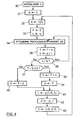
- This procedure uses an estimate ⁇ of the rate of events, from which the sampling quantities k i are calculated. If the user (network administrator) has an idea of the overall average rate of events to be detected, this value can be assigned to the parameter ⁇ during initialization 30. Otherwise, the estimated rate ⁇ is initialized to a low arbitrary value (but not zero) so that the estimation model adapts fairly quickly.
- the procedure in Figure 4 also uses a parameter of offset ⁇ used to refine the precision of the measured sampling times.
- This offset parameter ⁇ is initialized to zero in step 31.
- this quantity K is proportional to the estimated rate ⁇ , to the nearest rounding errors.
- the parameter Z is a total duration of observation of the events by the processor 20.
- Each iteration leads to recalculate an estimated rate of events ⁇ , from which the next sampling quantity k i + 1 will be updated by re-applying the function f in step 32.
- the variables T (sampling time) and k (event counter) are initialized to zero in step 33.
- the processor 20 then waits for the next event to be detected (step 34) .
- the variable T is increased by this duration d and the integer k is incremented by one at step 35.
- the quantized value t of time sampling T is calculated by applying a function g to the three variables T, K and ⁇ .
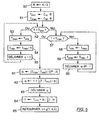
- An example will be described below with reference to the figure. 5.
- the quantification step 41 includes the production of coding data which characterize the quantified value t.
- the shift parameter ⁇ is set up to date by subtracting the quantized value t from the sampling time recorded T to the provisional value of this parameter ⁇ determined in step 39 or 40.
- the rate of events ⁇ is re-estimated in step 43 using a function h of three variables constituted by the previous value of the cadence estimated ⁇ , the current sampling quantity K and the quantized value t of the sampling time which has just been calculated in step 41.
- the processor updates the sampling quantity K in step 32 after this re-estimate 43 of the rate of events ⁇ .
- h ( ⁇ , K, t) (1-x) . ⁇ + xK / t
- the weighting coefficient x is such that 0 ⁇ x ⁇ 1.
- step 43 other methods of estimating the rate of events ⁇ can be used in step 43.
- the estimator (3) is however preferable because it allows better tracking variations of the model while allowing to adjust its sensitivity.
- a simple method but not very economical in memory space consists in delivering, as coding data, a number expressed in floating point and representing a quantized value t equal to the recorded sampling time T. In this case, it is not necessary to take into account an offset parameter ⁇ .
- sampling time T falls between T min and T max , it is quantified by an index of n bits representing a number q between 1 and 2 n -2, representative of the position of time T in the prediction interval .
- This number q is given by: where, for a number y, ⁇ y ⁇ represents the integer equal to or immediately less than y.
- T min c m . ⁇
- T max c M . ⁇ (step 51).
- T ⁇ T min in test 52 another test 57 is performed to compare the sampling time T to the upper limit T max of the prediction interval.
- the index q 2 n -1 is then delivered in step 60 before carrying out the test 57 again.
- the number ⁇ is for example equal to 5.
- the file of the coding data is composed of a succession of values on n bits representing the series of indices q.
- k 1 f ( ⁇ 1 )
- the recovery of this information is typically carried out by the PM 18 server to which the file containing the sequence of indices q is addressed.
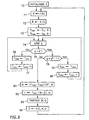
- the the corresponding procedure is illustrated in figure 6.
- This couple (K, t) makes l subject to treatment in step 83.
- step 84 the rate of estimated events ⁇ is recalculated in the same way as in step 43 of FIG. 4, then the process of FIG. 6 returns to the abovementioned step 71. This process stops when the index file q is exhausted.
- the treatment of a couple (K, t) in step 83 can consist simply to memorize this couple for later calculations. It can also consist of calculate cumulative values allowing, at the end of the decoding of the file, obtain statistical indicators such as means, variances, ...
- This processing can also consist in restoring a traffic histogram with a uniform time step T '.
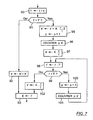
- Figure 7 illustrates the operations corresponding to the interior of step 83 of FIG. 6.
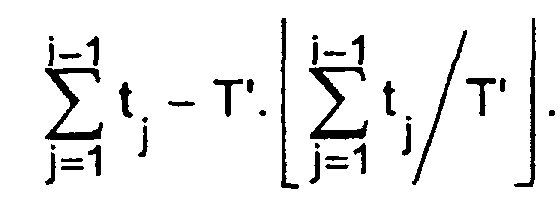
- This processing essentially consists in performing linear interpolations of the sampling quantities k i when the successive intervals of duration t i are not aligned with the regular intervals of duration T '. It uses an interpolation variable ⁇ ⁇ 0 which, during the i-th iteration of the procedure of figure 6, represents the time shift
- the regular time intervals of duration T ' are numbered by an index p.
- the event counter is noted k ′ in the procedure of FIG. 7.
- the quantities ⁇ , p and k ′ are set to zero in the initialization step 70 of the procedure of FIG. 6.
- a corrected time t ' t + ⁇ .
- This corrected time t ' is compared to the pitch T' during the test 91. If t ' ⁇ T', the processing 83 simply consists in increasing the counter by K k '(step 92), then assign the value of time t' to the variable ⁇ (step 93).
- the counter k ' is increased by a fraction of the sampling quantity K, i.e. K. (T'- ⁇ ) / t, and the index p is incremented by one in step 95.
- the p-th value of the histogram is delivered as being the current value of the counter k '.
- This counter k 'then receives the value K.T' / t in step 97.
- the step of the histogram T ' is subtracted from the corrected time t'.
Landscapes
- Engineering & Computer Science (AREA)
- Computer Networks & Wireless Communication (AREA)
- Signal Processing (AREA)
- Compression, Expansion, Code Conversion, And Decoders (AREA)
- Data Exchanges In Wide-Area Networks (AREA)
- Telephonic Communication Services (AREA)
- Transmission Systems Not Characterized By The Medium Used For Transmission (AREA)
Description
- déterminer d'un intervalle de temps de prédiction ;
- si le temps d'échantillonnage est au-dessous de l'intervalle de prédiction, délivrer un index ayant une première valeur et remplacer l'intervalle de prédiction par un nouvel intervalle de temps situé immédiatement au-dessous de l'intervalle précédent ;
- si le temps d'échantillonnage est au-dessus de l'intervalle de prédiction, délivrer un index ayant une seconde valeur et remplacer l'intervalle de prédiction par un nouvel intervalle de temps situé immédiatement au-dessus de l'intervalle précédent ; et
- si le temps d'échantillonnage est dans l'intervalle de prédiction, délivrer un index ayant une valeur distincte des première et seconde valeurs et représentative de la position du temps d'échantillonnage dans l'intervalle de prédiction.
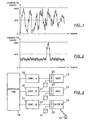
- les figures 1 et 2, précédemment commentées, sont des graphiques illustrant deux exemples de profils de trafic ;
- la figure 3 est un schéma synoptique d'un exemple d'infrastructure de télécommunication à laquelle l'invention est applicable ;
- la figure 4 est un organigramme d'opérations effectuées dans un exemple de procédé conforme à l'invention ;
- la figure 5 est un organigramme d'une procédure de quantification des temps d'échantillonnage utilisable dans le procédé selon la figure 4 ;
- la figure 6 est un organigramme d'une procédure de décodage des données générées par un procédé selon les figures 4 et 5 ; et
- la figure 7 est un organigramme d'une procédure utilisable en liaison avec celle de la figure 6 pour restituer des histogrammes de trafic avec un pas de temps constant.

Claims (12)
- Procédé executable par un proceseur (20) pour rendre compte de la distribution temporelle d'une succession d'événements déterminés, comprenant une initialisation d'une grandeur d'échantillonnage (K) consistant en un entier positif et plusieurs itérations successives d'un processus comportant une première étape de :détection d'un nombre d'événements égal à la grandeur d'échantillonnage et relevé d'un temps d'échantillonnage (T) mis pour détecter ledit nombre d'événements ; et caractérisé en ce qu'il comporte les étapes supplémentaires de:quantification du temps d'échantillonnage relevé à l'étape précédente pour délivrer des données de codage (q) représentant une valeur quantifiée (t) dudit temps d'échantillonnage ; etmise à jour de la grandeur d'échantillonnage en fonction de paramètres incluant ladite valeur quantifiée du temps d'échantillonnage.
- Procédé selon la revendication 1, dans lequel la mise à jour de la grandeur d'échantillonnage (K) comprend le calcul d'une cadence d'événements estimée (λ) en fonction de paramètres incluant la précédente grandeur d'échantillonnage et la valeur quantifiée (t) du temps d'échantillonnage, la grandeur d'échantillonnage mise à jour étant déduite de la cadence estimée.
- Procédé selon la revendication 2, dans lequel la cadence d'événements estimée est calculée sous la forme (1-x).λ + x.K/t, où x est un coefficient pondérateur compris entre 0 et 1, λ est la cadence d'événements estimée en vigueur avant l'itération courante, K est la grandeur d'échantillonnage précédente et t est la valeur quantifiée du temps d'échantillonnage.
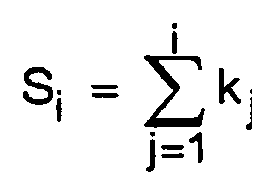
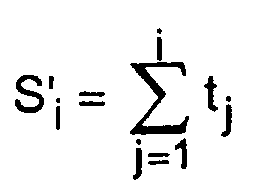
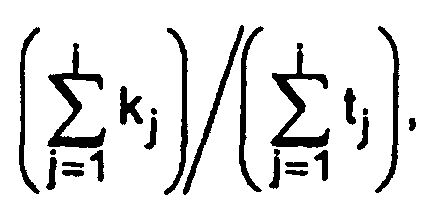
- Procédé selon la revendication 2, dans lequel la cadence d'événements estimée au cours de la i-ième itération du processus (i ≥ 1) est calculée sous la formeoù kj est la grandeur d'échantillonnage utilisée au cours de la j-ième itération et tj est la valeur quantifiée du temps d'échantillonnage relevé au cours de la j-ième itération (1 ≤ j ≤ i).
- Procédé selon l'une quelconque des revendications 2 à 4, dans lequel la grandeur d'échantillonnage mise à jour est un entier sensiblement proportionnel à la cadence d'événements estimée (λ).
- Procédé selon la revendication 5, dans lequel la grandeur d'échantillonnage mise à jour est égale à ┌Z.λ.n / S┐, où Z est une durée totale d'observation prédéfinie, λ est la cadence d'événements estimée, n est un nombre de bits utilisé pour former les données de codage représentant une valeur quantifiée du temps, S est une taille de données prédéfinie exprimée en nombre de bits, et ┌y┐ représente l'entier égal ou immédiatement supérieur à un nombre y.
- Procédé selon l'une quelconque des revendications précédentes, dans lequel la quantification du temps d'échantillonnage (T) comporte la production de données de codage incluant au moins un index de n bits (q), n étant un entier prédéfini plus grand que 3, la production desdites données de codage comprenant les étapes suivantes :déterminer d'un intervalle de temps de prédiction ;si le temps d'échantillonnage est au-dessous de l'intervalle de prédiction, délivrer un index ayant une première valeur et remplacer l'intervalle de prédiction par un nouvel intervalle de temps situé immédiatement au-dessous de l'intervalle précédent ;si le temps d'échantillonnage est au-dessus de l'intervalle de prédiction, délivrer un index ayant une seconde valeur distincte de la première valeur et remplacer l'intervalle de prédiction par un nouvel intervalle de temps situé immédiatement au-dessus de l'intervalle précédent ; etsi le temps d'échantillonnage est dans l'intervalle de prédiction, délivrer un index ayant une valeur distincte des première et seconde valeurs et représentative de la position du temps d'échantillonnage dans l'intervalle de prédiction.
- Procédé selon chacune des revendications 2 et 7, dans lequel un intervalle de temps de prédiction initialement déterminé est positionné par rapport à une valeur de prédiction () égale au rapport entre la grandeur d'échantillonnage (K) et la cadence d'événements estimée (λ).
- Procédé selon l'une quelconque des revendications précédentes, dans lequel on initialise à zéro un paramètre de décalage (Δ), et à chaque itération dudit processus le paramètre de décalage est mis à jour en fonction de la différence entre le temps d'échantillonnage relevé et la valeur quantifiée dudit temps d'échantillonnage, et dans lequel le paramètre de décalage intervient dans le décompte du temps d'échantillonnage dans certaines au moins des itérations.
- Procédé selon l'une quelconque des revendications 1 à 6, dans lequel la quantification du temps d'échantillonnage (T) consiste à délivrer, comme données de codage, un nombre exprimé en virgule flottante représentant une valeur quantifiée égale au temps d'échantillonnage relevé.
- Equipement de télécommunication, comprenant des moyens (10-12) de transmission et/ou de réception d'un trafic incluant des éléments de données successifs, des moyens (20) de détection des occurrences d'un type spécifié d'éléments de données dans ledit trafic et des moyens (20) de codage pour délivrer des données de codage rendant compte de la distribution temporelle des occurrences détectées, caractérisé en ce que les moyens de codage sont agencés pour mettre en oeuvre un procédé selon l'une quelconque des revendications précédentes.
- Programme d'ordinateur, chargeable dans une mémoire associée à un processeur (20), caractérisé en ce qu'il comprend des portions de code pour la mise en oeuvre d'un procédé selon l'une quelconque des revendications 1 à 10 lors de l'exécution dudit programme par le processeur.
Applications Claiming Priority (3)
| Application Number | Priority Date | Filing Date | Title |
|---|---|---|---|
| FR0106453 | 2001-05-16 | ||
| FR0106456 | 2001-05-16 | ||
| FR0106453A FR2824976B1 (fr) | 2001-05-16 | 2001-05-16 | Procede pour rendre compte de la distribution temporelle d'une succession d'evenements |
Publications (3)
| Publication Number | Publication Date |
|---|---|
| EP1276277A2 EP1276277A2 (fr) | 2003-01-15 |
| EP1276277A3 EP1276277A3 (fr) | 2003-04-09 |
| EP1276277B1 true EP1276277B1 (fr) | 2004-09-15 |
Family
ID=8863348
Family Applications (1)
| Application Number | Title | Priority Date | Filing Date |
|---|---|---|---|
| EP02291203A Expired - Lifetime EP1276277B1 (fr) | 2001-05-16 | 2002-05-15 | Procédé et dispositif pour rendre compte de la distribution temporelle d'une succession d'événements |
Country Status (4)
| Country | Link |
|---|---|
| US (1) | US6745141B2 (fr) |
| EP (1) | EP1276277B1 (fr) |
| DE (1) | DE60201227D1 (fr) |
| FR (1) | FR2824976B1 (fr) |
Families Citing this family (1)
| Publication number | Priority date | Publication date | Assignee | Title |
|---|---|---|---|---|
| EP2961089B1 (fr) * | 2014-06-26 | 2017-08-09 | ADVA Optical Networking SE | Procédé et appareil pour estimer une erreur d'intervalle de temps maximum dans un réseau de transmission de données |
Family Cites Families (11)
| Publication number | Priority date | Publication date | Assignee | Title |
|---|---|---|---|---|
| US4678345A (en) * | 1986-05-01 | 1987-07-07 | Tektronix, Inc. | Equivalent time pseudorandom sampling system |
| US4837705A (en) * | 1987-02-25 | 1989-06-06 | Westinghouse Electric Corp. | Method for calculating the rate of frequency of random events |
| US4979118A (en) * | 1989-03-10 | 1990-12-18 | Gte Laboratories Incorporated | Predictive access-control and routing system for integrated services telecommunication networks |
| US5243343A (en) * | 1990-12-03 | 1993-09-07 | Zeelan Technology, Inc. | Signal acquisition system utilizing ultra-wide time range time base |
| US5247297A (en) * | 1991-12-20 | 1993-09-21 | Detector Systems, Inc. | Vehicle detector method for multiple vehicle counting |
| US5541835A (en) * | 1992-12-29 | 1996-07-30 | Jean-Guy Bessette | Monitoring and forecasting customer traffic |
| JP3435623B2 (ja) * | 1996-05-15 | 2003-08-11 | 株式会社日立製作所 | 交通流監視装置 |
| JP3315588B2 (ja) * | 1996-05-16 | 2002-08-19 | 株式会社日立製作所 | トラヒック流量制御を行うatm交換機 |
| US6173207B1 (en) * | 1997-09-22 | 2001-01-09 | Agilent Technologies, Inc. | Real-time control system with non-deterministic communication |
| US6563796B1 (en) * | 1998-03-18 | 2003-05-13 | Nippon Telegraph And Telephone Corporation | Apparatus for quality of service evaluation and traffic measurement |
| JP3471694B2 (ja) * | 2000-01-31 | 2003-12-02 | 日本電気株式会社 | 網管理システムにおけるトラヒック収集方式 |
-
2001
- 2001-05-16 FR FR0106453A patent/FR2824976B1/fr not_active Expired - Fee Related
-
2002
- 2002-05-03 US US10/138,596 patent/US6745141B2/en not_active Expired - Fee Related
- 2002-05-15 DE DE60201227T patent/DE60201227D1/de not_active Expired - Lifetime
- 2002-05-15 EP EP02291203A patent/EP1276277B1/fr not_active Expired - Lifetime
Also Published As
| Publication number | Publication date |
|---|---|
| FR2824976A1 (fr) | 2002-11-22 |
| US6745141B2 (en) | 2004-06-01 |
| EP1276277A3 (fr) | 2003-04-09 |
| US20020188420A1 (en) | 2002-12-12 |
| FR2824976B1 (fr) | 2003-08-15 |
| EP1276277A2 (fr) | 2003-01-15 |
| DE60201227D1 (de) | 2004-10-21 |
Similar Documents
| Publication | Publication Date | Title |
|---|---|---|
| EP3957045B1 (fr) | Procédé et dispositif de traitement d'un message d'alerte notifiant une anomalie détectée dans un trafic émis via un réseau | |
| US7519705B1 (en) | Method for computing aggregate traffic between adjacent points of presence in an internet protocol backbone network | |
| CN119155715B (zh) | 一种基站网络侧传输路径的通信性能测试方法及系统 | |
| FR3012895A1 (fr) | Procede et programme d'ordinateur pour l'execution deportee de taches informatiques d'un equipement sans fil | |
| US9559911B1 (en) | Forecasting link utilization between points of presence in an IP network | |
| FR2964223A1 (fr) | Procede de configuration d'un dispositif de detection a capteur, programme d'ordinateur et dispositif adaptatif correspondants | |
| US10169132B2 (en) | Predicting a likelihood of a critical storage problem | |
| US7522071B2 (en) | Metric sampling method | |
| EP1276277B1 (fr) | Procédé et dispositif pour rendre compte de la distribution temporelle d'une succession d'événements | |
| WO2022023670A1 (fr) | PROCÉDÉ DE FOURNITURE DE DONNÉES RELATIVES À AU MOINS UN ÉQUIPEMENT D'UN UTILISATEUR D'UN RÉSEAU, PROCÉDÉ D'OBTENTION DE DONNÉES, ET ENTITÉS METTANT EN œUVRE CES PROCÉDÉS | |
| EP0515277B1 (fr) | Analyseur modulaire de trafic de signaux numériques | |
| US20160191334A1 (en) | Monitoring Network Use of Resources | |
| EP3539259B1 (fr) | Procédé et dispositif d'actualisation d'un modèle prédictif d'une variable relative à un terminal mobile | |
| EP1842332B1 (fr) | Procede et dispositif permettant de calculer des besoins en largeurs de bande | |
| US11645043B2 (en) | Method and system for calculating minwise hash signatures from weighted sets | |
| CN116566696B (zh) | 一种基于云计算的安全性评估系统及方法 | |
| CN118734222A (zh) | 性能指标的异常检测方法、装置及相关设备 | |
| WO2015173274A1 (fr) | Architecture de correlation d'evenements pour la surveillance de supercalculateur | |
| WO2020128246A1 (fr) | Procédé de détermination d'un chemin de transmission de données, et dispositif correspondant | |
| EP4451636A1 (fr) | Apprentissage pour la qualité d'expérience avec un retour d'informations de qualité d'expérience réduite | |
| WO2024079408A1 (fr) | Procédé de détection d'anomalie dans une série temporelle observée de valeurs d'une grandeur physique représentative des performances d'un système | |
| CN115514646B (zh) | 一种基于流量分析的网络切片配置方法及相关装置 | |
| FR3140958A1 (fr) | Procédé de détection d’anomalie dans une série temporelle observée de valeurs d’une grandeur physique représentative des performances d’un système. | |
| CN121486158A (zh) | 一种通过模型生成页面接口连接器的方法及系统 | |
| FR3150672A1 (fr) | Procédés de transmission de données, dispositifs de communication et système associé. |
Legal Events
| Date | Code | Title | Description |
|---|---|---|---|
| PUAI | Public reference made under article 153(3) epc to a published international application that has entered the european phase |
Free format text: ORIGINAL CODE: 0009012 |
|
| AK | Designated contracting states |
Kind code of ref document: A2 Designated state(s): AT BE CH CY DE DK ES FI FR GB GR IE IT LI LU MC NL PT SE TR |
|
| AX | Request for extension of the european patent |
Free format text: AL;LT;LV;MK;RO;SI |
|
| PUAL | Search report despatched |
Free format text: ORIGINAL CODE: 0009013 |
|
| AK | Designated contracting states |
Kind code of ref document: A3 Designated state(s): AT BE CH CY DE DK ES FI FR GB GR IE IT LI LU MC NL PT SE TR |
|
| AX | Request for extension of the european patent |
Extension state: AL LT LV MK RO SI |
|
| 17P | Request for examination filed |
Effective date: 20030711 |
|
| 17Q | First examination report despatched |
Effective date: 20030821 |
|
| AKX | Designation fees paid |
Designated state(s): DE FR GB |
|
| GRAP | Despatch of communication of intention to grant a patent |
Free format text: ORIGINAL CODE: EPIDOSNIGR1 |
|
| RIC1 | Information provided on ipc code assigned before grant |
Ipc: 7H 04L 12/26 B Ipc: 7H 04L 12/24 A |
|
| RIN1 | Information on inventor provided before grant (corrected) |
Inventor name: PISON, LAURENT Inventor name: ISNARD, OLIVIER Inventor name: CALMEL, JEAN-MARIE |
|
| RTI1 | Title (correction) |
Free format text: METHOD AND APPARATUS FOR REPORTING THE TEMPORARY DISTRIBUTION OF A SEQUENCE OF EVENTS |
|
| GRAS | Grant fee paid |
Free format text: ORIGINAL CODE: EPIDOSNIGR3 |
|
| GRAA | (expected) grant |
Free format text: ORIGINAL CODE: 0009210 |
|
| AK | Designated contracting states |
Kind code of ref document: B1 Designated state(s): DE FR GB |
|
| REG | Reference to a national code |
Ref country code: GB Ref legal event code: FG4D Free format text: NOT ENGLISH |
|
| REF | Corresponds to: |
Ref document number: 60201227 Country of ref document: DE Date of ref document: 20041021 Kind code of ref document: P |
|
| PG25 | Lapsed in a contracting state [announced via postgrant information from national office to epo] |
Ref country code: DE Free format text: LAPSE BECAUSE OF FAILURE TO SUBMIT A TRANSLATION OF THE DESCRIPTION OR TO PAY THE FEE WITHIN THE PRESCRIBED TIME-LIMIT Effective date: 20041216 |
|
| GBT | Gb: translation of ep patent filed (gb section 77(6)(a)/1977) |
Effective date: 20041201 |
|
| PLBE | No opposition filed within time limit |
Free format text: ORIGINAL CODE: 0009261 |
|
| STAA | Information on the status of an ep patent application or granted ep patent |
Free format text: STATUS: NO OPPOSITION FILED WITHIN TIME LIMIT |
|
| 26N | No opposition filed |
Effective date: 20050616 |
|
| PGFP | Annual fee paid to national office [announced via postgrant information from national office to epo] |
Ref country code: GB Payment date: 20070418 Year of fee payment: 6 |
|
| PGFP | Annual fee paid to national office [announced via postgrant information from national office to epo] |
Ref country code: FR Payment date: 20070503 Year of fee payment: 6 |
|
| GBPC | Gb: european patent ceased through non-payment of renewal fee |
Effective date: 20080515 |
|
| REG | Reference to a national code |
Ref country code: FR Ref legal event code: ST Effective date: 20090119 |
|
| PG25 | Lapsed in a contracting state [announced via postgrant information from national office to epo] |
Ref country code: FR Free format text: LAPSE BECAUSE OF NON-PAYMENT OF DUE FEES Effective date: 20080602 |
|
| PG25 | Lapsed in a contracting state [announced via postgrant information from national office to epo] |
Ref country code: GB Free format text: LAPSE BECAUSE OF NON-PAYMENT OF DUE FEES Effective date: 20080515 |