EP1278182A2 - Verfahren und Vorrichtung zur Musiknotenerkennung - Google Patents
Verfahren und Vorrichtung zur Musiknotenerkennung Download PDFInfo
- Publication number
- EP1278182A2 EP1278182A2 EP02252025A EP02252025A EP1278182A2 EP 1278182 A2 EP1278182 A2 EP 1278182A2 EP 02252025 A EP02252025 A EP 02252025A EP 02252025 A EP02252025 A EP 02252025A EP 1278182 A2 EP1278182 A2 EP 1278182A2
- Authority
- EP
- European Patent Office
- Prior art keywords
- musical
- frequency
- audio signal
- musical scale
- calculating
- Prior art date
- Legal status (The legal status is an assumption and is not a legal conclusion. Google has not performed a legal analysis and makes no representation as to the accuracy of the status listed.)
- Granted
Links
Images





Classifications
-
- G—PHYSICS
- G10—MUSICAL INSTRUMENTS; ACOUSTICS
- G10H—ELECTROPHONIC MUSICAL INSTRUMENTS; INSTRUMENTS IN WHICH THE TONES ARE GENERATED BY ELECTROMECHANICAL MEANS OR ELECTRONIC GENERATORS, OR IN WHICH THE TONES ARE SYNTHESISED FROM A DATA STORE
- G10H3/00—Instruments in which the tones are generated by electromechanical means
- G10H3/12—Instruments in which the tones are generated by electromechanical means using mechanical resonant generators, e.g. strings or percussive instruments, the tones of which are picked up by electromechanical transducers, the electrical signals being further manipulated or amplified and subsequently converted to sound by a loudspeaker or equivalent instrument
- G10H3/125—Extracting or recognising the pitch or fundamental frequency of the picked up signal
-
- G—PHYSICS
- G10—MUSICAL INSTRUMENTS; ACOUSTICS
- G10L—SPEECH ANALYSIS TECHNIQUES OR SPEECH SYNTHESIS; SPEECH RECOGNITION; SPEECH OR VOICE PROCESSING TECHNIQUES; SPEECH OR AUDIO CODING OR DECODING
- G10L15/00—Speech recognition
- G10L15/28—Constructional details of speech recognition systems
-
- G—PHYSICS
- G10—MUSICAL INSTRUMENTS; ACOUSTICS
- G10H—ELECTROPHONIC MUSICAL INSTRUMENTS; INSTRUMENTS IN WHICH THE TONES ARE GENERATED BY ELECTROMECHANICAL MEANS OR ELECTRONIC GENERATORS, OR IN WHICH THE TONES ARE SYNTHESISED FROM A DATA STORE
- G10H1/00—Details of electrophonic musical instruments
- G10H1/36—Accompaniment arrangements
- G10H1/361—Recording/reproducing of accompaniment for use with an external source, e.g. karaoke systems
-
- G—PHYSICS
- G10—MUSICAL INSTRUMENTS; ACOUSTICS
- G10H—ELECTROPHONIC MUSICAL INSTRUMENTS; INSTRUMENTS IN WHICH THE TONES ARE GENERATED BY ELECTROMECHANICAL MEANS OR ELECTRONIC GENERATORS, OR IN WHICH THE TONES ARE SYNTHESISED FROM A DATA STORE
- G10H2210/00—Aspects or methods of musical processing having intrinsic musical character, i.e. involving musical theory or musical parameters or relying on musical knowledge, as applied in electrophonic musical tools or instruments
- G10H2210/031—Musical analysis, i.e. isolation, extraction or identification of musical elements or musical parameters from a raw acoustic signal or from an encoded audio signal
- G10H2210/066—Musical analysis, i.e. isolation, extraction or identification of musical elements or musical parameters from a raw acoustic signal or from an encoded audio signal for pitch analysis as part of wider processing for musical purposes, e.g. transcription, musical performance evaluation; Pitch recognition, e.g. in polyphonic sounds; Estimation or use of missing fundamental
-
- G—PHYSICS
- G10—MUSICAL INSTRUMENTS; ACOUSTICS
- G10H—ELECTROPHONIC MUSICAL INSTRUMENTS; INSTRUMENTS IN WHICH THE TONES ARE GENERATED BY ELECTROMECHANICAL MEANS OR ELECTRONIC GENERATORS, OR IN WHICH THE TONES ARE SYNTHESISED FROM A DATA STORE
- G10H2210/00—Aspects or methods of musical processing having intrinsic musical character, i.e. involving musical theory or musical parameters or relying on musical knowledge, as applied in electrophonic musical tools or instruments
- G10H2210/031—Musical analysis, i.e. isolation, extraction or identification of musical elements or musical parameters from a raw acoustic signal or from an encoded audio signal
- G10H2210/091—Musical analysis, i.e. isolation, extraction or identification of musical elements or musical parameters from a raw acoustic signal or from an encoded audio signal for performance evaluation, i.e. judging, grading or scoring the musical qualities or faithfulness of a performance, e.g. with respect to pitch, tempo or other timings of a reference performance
-
- G—PHYSICS
- G10—MUSICAL INSTRUMENTS; ACOUSTICS
- G10H—ELECTROPHONIC MUSICAL INSTRUMENTS; INSTRUMENTS IN WHICH THE TONES ARE GENERATED BY ELECTROMECHANICAL MEANS OR ELECTRONIC GENERATORS, OR IN WHICH THE TONES ARE SYNTHESISED FROM A DATA STORE
- G10H2220/00—Input/output interfacing specifically adapted for electrophonic musical tools or instruments
- G10H2220/005—Non-interactive screen display of musical or status data
- G10H2220/011—Lyrics displays, e.g. for karaoke applications
-
- G—PHYSICS
- G10—MUSICAL INSTRUMENTS; ACOUSTICS
- G10H—ELECTROPHONIC MUSICAL INSTRUMENTS; INSTRUMENTS IN WHICH THE TONES ARE GENERATED BY ELECTROMECHANICAL MEANS OR ELECTRONIC GENERATORS, OR IN WHICH THE TONES ARE SYNTHESISED FROM A DATA STORE
- G10H2250/00—Aspects of algorithms or signal processing methods without intrinsic musical character, yet specifically adapted for or used in electrophonic musical processing
- G10H2250/131—Mathematical functions for musical analysis, processing, synthesis or composition
- G10H2250/215—Transforms, i.e. mathematical transforms into domains appropriate for musical signal processing, coding or compression
- G10H2250/235—Fourier transform; Discrete Fourier Transform [DFT]; Fast Fourier Transform [FFT]
Definitions
- the present invention relates to a musical scale recognition method and an apparatus thereof, and more specifically, to a musical scale recognition method and an apparatus thereof for comparing an input audio signal with a predetermined musical note.
- Such a kind of a conventional musical scale recognition apparatus made measurements of a frequency component employing a Fast Fourier Transformation (FFT) in regard to an input audio signal, and carried out a musical scale recognition on the basis of the measurement result thereof.
- FFT Fast Fourier Transformation
- a primary object of the present invention is to provide a musical scale recognition method and an apparatus thereof that even a microprocessor with a low processing capability can perform a musical scale recognition in real time.
- a first musical scale recognition method comprises following steps of (a) converting an input analog audio signal into digital data D by sampling the audio signal at constant intervals C; (b) deriving sin ⁇ t and cos ⁇ t ( ⁇ is an angular velocity in correspondence to an observed frequency f) based upon the observed frequency f and a time t; (c) calculating a cumulative value As to find a coefficient of a Fourier sine series by performing an operation of an equation (1); (d) calculating a cumulative value Ac to find a coefficient of a Fourier cosine series by performing an operation of an equation (2); (e) calculating a frequency power spectrum effective value A by performing an operation of an equation (3); (f) evaluating a component of the frequency f included in an analog audio signal on the basis of the numeric value A; and (g) renewing the time t by performing an operation of an equation (4).
- a second musical recognition method comprises following steps of (a) converting an input analog audio signal into digital data D by sampling the audio signal at constant intervals C; (b) deriving sin ⁇ t and cos ⁇ t ( ⁇ is an angular velocity in correspondence to an observed frequency f) based upon the observed frequency f and a time t; (c) a calculating a cumulative value As to find a coefficient of a Fourier sine series by performing an operation of the above equation (1); (d) calculating a cumulative value Ac to find a coefficient of a Fourier cosine series by performing an operation of the above equation (2); (e) calculating a frequency power spectrum effective value A by performing an operation of a below equation (5); (f) evaluating a component of the frequency f included in the analog audio signal on the basis of the numeric value A; and (g) renewing the time t by performing an operation of the above equation (4).
- a first musical recognition apparatus comprises an analog/digital converting means which converts an input analog audio signal into a digital data D by sampling the audio signal at constant intervals C; a deriving means which derives sin ⁇ t and cos ⁇ t ( ⁇ is an angular velocity in correspondence to an observed frequency f) based upon the observed frequency f and a time t; a first operating means which calculates a cumulative value As to find a coefficient of a Fourier sine series by performing an operation of an equation (1); a second operating means which calculates a cumulative value Ac to find a coefficient of a Fourier cosine series by performing an operation of an equation (2); a third operating means which calculates a frequency power spectrum effective value A by performing an operation of an equation (3); an evaluating means which evaluates a component of the frequency f included in the analog audio signal on the basis of the numeric value A; and a renewing means which renews the time t by performing an operation of above equation (4).
- a second musical recognition apparatus comprises an analog/digital converting means which converts an input analog audio signal into a digital data D by sampling the audio signal at constant intervals C; a deriving means which derives sin ⁇ t and cos ⁇ t ( ⁇ is an angular velocity in correspondence to an observed frequency f) based upon the observed frequency f and a time t; a first operating means which calculates a cumulative value As to find a coefficient of a Fourier sine series by performing an operation of the above equation (1); a second operating means which calculates a cumulative value Ac to find a coefficient of a Fourier cosine series by performing an operation of the above equation (2); a third operating means which calculates a frequency power spectrum effective value A by performing an operation of the above equation (5); an evaluating means which evaluates a component of the frequency f included in the analog audio signal on the basis of the numeric value A; and a renewing means which renews the time t by performing an operation of the above equation (4).
- a third musical scale recognition apparatus comprises a BGM reproducing means which reproduces a karaoke BGM on the basis of musical score data; musical score data storing means which stores musical score data and musical scale data having an exemplary melody for singing included in synchronous with the musical score data; a reading means which reads the musical scale data from the musical score data storing means at a time t; a setting means which sets a frequency of the musical scale data read by the reading means to an observed frequency f; a musical scale recognition means which performs a musical scale recognition by using any one of the above musical scale recognition methods; and an outputting means which outputs an evaluation result by the evaluating means.
- a fourth musical scale recognition apparatus comprises, a BGM reproducing means which reproduces a karaoke BGM on the basis of musical score data; a musical score data storing means which stores musical score data and musical scale data having an exemplary melody for singing included in synchronous with the musical score data; a reading means which reads musical scale data from the musical score data storing means at a time t; a setting means which sets a frequency of the musical scale data read by the reading means to an observed frequency f 0 , a frequency of a musical scale one octave below the musical scale data read by the reading means to an observed frequency f 1 , and a frequency of a musical scale one octave above the musical scale data read by the reading means to an observed frequency f 2 ; a musical scale recognition means which carries out a musical scale recognition by using the above described musical scale recognition methods; and an outputting means which outputs an evaluation result by the evaluation means.
- a fifth musical scale recognition apparatus comprises a musical scale recognition means which sequentially carries out a musical scale recognition of an analog audio signal by using any one of the above musical scale recognition methods; a comparing means which compares a changing pattern of the musical scale recognized by the musical scale recognition means with a predetermined musical phrase; and a first operating means which performs a predetermined operation brought into correspondence with this relevant musical phrase when the changing pattern of the musical scale recognized by the musical scale recognition means becomes coincident with the predetermined musical phrase as a result of a comparison by the comparing means.
- a sixth musical scale recognition apparatus comprises a musical note data storing means which stores musical scale data of each musical note of a musical phrase; a pointer which points one of musical note data included in the musical note data storing means; a musical note data reading means which reads the musical scale data of the musical note pointed by the pointer from the musical note data storing means; a setting means which sets a frequency of the musical scale data read by the musical note data reading means to an observed frequency f; a musical scale recognition means which sequentially performs a musical scale recognition of an analog audio signal by using any one of the above described musical scale recognition methods; a comparing means which compares a degree of a frequency component of the frequency f included in the analog audio signal with a predetermined threshold value; a pointer manipulating means which, as a result of a comparison by the comparing means, increments the pointer when the degree of the frequency component of the frequency f included in the analog audio signal is larger than the predetermined threshold value and points at the musical scale data of the musical note at the forefront
- digital data having the input analog audio signal converted by an analog/digital converter is D
- a frequency (musical scale) of a musical sound to be recognized is f
- a current time is t
- calculations are made as to a cumulative value As to find a coefficient of a Fourier sine series of the audio signal on the basis of the frequency f and the digital data D
- a cumulative value Ac to find a coefficient of a Fourier cosine series of the audio signal on the basis of the frequency f and the digital data D
- a frequency power spectrum effective value of the audio signal on the basis of the cumulative value As and the cumulative value Ac.
- the numeric value A is evaluated after the input analog audio signal is corrected in correspondence to a level of an amplitude of the input analog audio signal.
- N indicates the number of units of the frequencies to be simultaneously observed
- a level of consistency between the singing voices and an exemplary melody is evaluated in such a manner that singing voices sung along a karaoke BGM are subjected to a musical scale recognition on the basis of the exemplary melody for a singing.
- the BGM is reproduced on the basis of the musical score data, and the voices in tune with the BGM are input.
- the musical score data includes the musical scale data, i.e. the exemplary melody for singing in synchronous with the musical score data.
- the musical scale data at the time t is read from the musical score data.
- a musical scale recognition is applied to the singing voices at the time t on the basis of the frequency f of the read-out musical scale data, and evaluations are applied to an extent of the component of the frequency f included in the singing voices, i.e. an extent of consistency between the singing voices and the melody. It is possible to appropriately make a music scale recognition even though a reproduction pitch of the karaoke BGM is changed because the musical scale data is in synchronous with the musical score data.
- the musical scale recognition is applied to the singing voices sung along the BGM on the basis of a melody one octave below and above the exemplary melody for singing.
- the musical scale recognition method is adopted as claimed in any of claims 1 to 4.
- the musical scale recognition of the analog audio signal is successively applied in order to determine whether or not the analog audio signal is coincident with a predetermined musical phrase. Upon being coincident, a predetermined operation previously brought into correspondence to the relevant musical phrase is performed.
- a musical scale recognition method is adopted as claimed in any of claims 1 to 4.
- the musical scale recognition is once again performed to determine whether or not the first sound is included in the analog audio signal. Subsequently, in a musical phrase including musical notes in N units, it is determined that the analog audio signal is coincident with the relevant musical phrase if and when it is determined that an N-th sound is included in the analog audio signal.
- a code previously brought into correspondence to the relevant musical phrase is transmitted by blinking an infrared light-emitting element, for example.
- a device which has received the transmitted code causes a light-emitting element, e.g. LED to blink in a pattern previously brought into correspondence to the code, and output from the speaker an audio signal having a content brought into correspondence to the code, and so forth on.
- a light-emitting element e.g. LED to blink in a pattern previously brought into correspondence to the code, and output from the speaker an audio signal having a content brought into correspondence to the code, and so forth on.
- a musical scale recognition of the input voices is performed by a simple processing, i.e. comparing a specific frequency component expected to be input with the input voices.
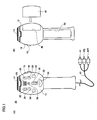
- a karaoke device with built-in microphone 10 as a musical scale recognition apparatus in this embodiment includes a body 12 having an egg-shaped upper portion and a cylindrical lower portion, and a microphone 14 is mounted at an upper end of the egg-shaped portion of the body 12.
- a power switch 16 and a reset switch 18 are provided on an upper portion of the body 12, i.e. the egg-shaped portion.
- the power switch 16 is a switch for turning on/off a power
- the reset switch 18 is for resetting a whole process including selected music numbers.
- a display 20 formed of a two-digit-seven-segment LED is provided on the egg-shaped portion, and on a left side that sandwiches the display 20 tempo control keys 22 and 24 are provided in an aligned fashion in a vertical direction, and on a right side BGM volume control keys 26 and 28 are provided in an aligned fashion in a vertical direction.
- the display 20 is utilized to show a music number selected by a user.
- the tempo control keys 22 and 24 are keys for increasing or decreasing a reproduction speed (tempo) of a karaoke or BGM.
- the BGM volume control keys 26 and 28 are keys to increase or decrease a reproduced sound magnitude (volume) of the karaoke or BGM.
- Music selection/pitch control keys 30 and 32 are provided at a center, slightly lower portion of the egg-shaped portion of the body 12.
- the music selection/pitch control keys 30 and 32 are utilized to increment or to decrement the music number, and also utilized to raise or lower a karaoke pitch frequency, i.e. a musical key in tune in accordance with the user's tone one key by one key, for example.
- An echo mode selection key 34 is provided at a left of the music selection/pitch control keys 30 and 32 and below the tempo control keys 22 and 24 on the egg-shaped portion of the body 12.
- the echo mode selection key 34 is utilized to selectively set an echo time (delay time) in an echo mode.
- it is possible to set echo mode 1, echo mode 2 and echo mode 3 and the echo time is set as "small", “medium” and “large”, respectively.
- a voice effect mode selection key 36 is provided at a right of the music selection/pitch control keys 30 and 32 and below the BGM volume control keys 26 and 28 on the egg-shaped portion of the body 12.
- the voice effect mode selection key 36 can set voice effect mode 1, voice effect mode 2 and voice effect mode 3 in this embodiment.
- the voice effect mode 1 is a mode for processing voices so as to raise a frequency of output voices with respect to a frequency of the input voices
- the voice effect mode 2 is a mode for processing voices so as to lower a frequency of output voices with respect to a frequency of input voices.
- the voice effect mode 3 is a mode for processing voices so as to repeatedly change (sweep) a frequency of output voices continuously upward and downward.
- a cancellation key 38 is provided between the display 20 and the music selection/pitch control keys 30 and 32.
- the cancellation key 38 is a key for canceling the tempo set by the tempo control keys 22 and 24, the BGM volume set by the volume control keys 26 and 28, the music number and the pitch set by the music selection/pitch control keys 30 and 32, the echo mode set by the echo mode selection key 34, and the voice effect mode set by the voice effect mode selection key 36.
- the cancellation key 38 is also used to suspend a music being played.
- a determination key 39 is provided below the music selection/pitch control keys 30 and 32.
- the determination key 39 is a key for determining and validating the tempo set by the tempo control keys 22 and 24, the BGM volume set by the volume control keys 26 and 28, the music number and the pitch set by the music selection/the pitch control keys 30 and 32, the echo mode set by the echo mode selection key 34, and the voice effect mode set by the voice effect mode selection key 36.
- An AV cable 40 is withdrawn from a lower portion of the body 12, i.e. from a lower end of the cylindrical portion, and the AV cable 40 includes two audio output terminals 42L and 42R and one video output terminal 44.
- the audio output terminals 42L and 42R and the video output terminal 44 are connected to an AV terminal of a home television (not shown). Therefore, the images or videos and the voices of the karaoke device with built-in microphone 10 in this embodiment are output on the home televisions. It is noted that when an audio circuit of the home television is not used, the audio output terminal 42L and 42R are connected to other audio devices such as a stereo amplifier or the like.
- a cartridge connector 46 is provided on a rear surface of the body 12 as shown in Figure 1(B), and a memory cartridge 48 is removably attached to the cartridge connector 46. It is possible to change a karaoke music and its images by changing the memory cartridge 48.
- the karaoke device with built-in microphone 10 in this embodiment is driven by batteries. Due to this, a battery box 50 is provided at the lower cylindrical portion of the body 12 as shown in Figure 1(B).
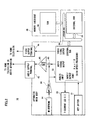
- the karaoke device with built-in microphone 10 in this embodiment includes a processor 52 accommodated inside the body 12.
- An arbitrary kind of processor can be utilized as the processor 52; however, in this embodiment a high-speed processor (trademark "XaviX”) developed by the applicant of the present invention and already filed as a patent application is used.
- This high-speed processor is disclosed in detail in Japanese Patent Laying-open No.10-307790 [G06F 13/36,15/78] and US Patent Application No. 09/019,277 corresponding thereto.
- the processor 52 includes various processors such as a CPU, a graphics processor, a sound processor, and a DMA processor and etc., and also includes an A/D converter used in fetching an analog signal and an input/output control circuit receiving an input signal such as a key operation signal and an infrared signal and giving an output signal to external devices.
- the CPU executes a required operation in response to the input signal, and gives results to the graphics processor and the sound processor. Therefore, the graphic processor and the sound processor execute an image processing and an audio processing according to the operation result.
- a system bus 54 is connected to the processor 52, and an internal ROM 56 mounted on a circuit board (not shown) which is accommodated within the body 12 together with the processor 52 and an external ROM 58 included in the memory cartridge 48 are connected to the system bus 54. Therefore, the processor 52 can access to the ROMs 56 and the 58 through the system bus 54, and can retrieve a video or image data and music data (score data for playing musical instruments) and so on.
- the audio signal from the microphone 14 is supplied to an analog input of the processor 52 through an amplifier 60.
- An analog audio signal which is a result of the processing on the sound processor portion (not shown) of the processor 52 is output to the audio output terminals 42 (42L, 42R) shown in Figure 1 through the mixer 62 and the amplifier 66. It is noted that a plurality of sound channels is formed in the sound processor portion.
- an analog image signal which is a result of the processing on the graphic processor (not shown) of the processor 52 is output to the video output terminal 44 shown in Figure 1.
- display data is applied from an output port of the processor 52 to the display 20 shown in Figure 1, and all switches and keys shown in Figure 1 (herein shown generally by reference number 21) are connected to the input port of the processor 52.
- the musical score data means data for playing a karaoke (BGM)
- the musical scale data is data showing a musical scale of a melody of a lyrics and in synchronous with the musical score data. Because the musical score data and the musical scale data are in synchronous with each other, a tempo of the musical scale recognition is also changed if and when the reproduction temp of the musical score data is changed.
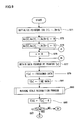
- a routine shown in Figure 3 is a routine executed constantly
- routines shown in Figure 4 and Figure 5 are a routine executed regularly due to a generation of a timer interrupt.
- step S1 a display screen of a home television to which the karaoke device with built-in microphone 10 is connected is renewed in a step S3.
- step S3 a title screen and the like of the karaoke device with built-in microphone 10 are displayed.
- a step S5 it is determined whether or not a key is operated. If and when it is determined that the key is operated, in a step S7 a state of the karaoke device with built-in microphone 10 is changed in response to a key operation.
- a state is a music selection as a result of the state change in the step S7, that is, if and when the music selection keys 30 and 32 are operated, it is determined that the state is the music selection state in a step S9, and a music selection process is carried out in a step S11.
- the state is music playing and scoring
- a determination key 39 is operated after the music selection
- it is determined that the state is a playing and scoring state in a step S13 and a playing process is first carried out in a step S15.
- a scoring process is carried out in steps S17 and S19, and a process for displaying the scoring result on a home television screen is carried out in a step S21.
- Descriptions regarding the steps S17 and S19 are made after descriptions of a timer interrupt routine because A[0], A[1] and A[2] in the steps S17 and S19 are values calculated by the timer interrupt routine.
- the state is a final scoring point displaying state
- a process for displaying the final scoring point on a home television screen is carried out in a step S29. It is noted that upon completion of a karaoke playing, the state becomes the final scoring point displaying state.
- Descriptions regarding the steps S25 and S27 are made after descriptions of a timer interrupt routine because A[0], A[1] and A[2] in steps S25 and S27 are values calculated by the timer interrupt routine.
- the state there are a tempo changing state, a reproduction volume changing state and the like are present in addition to the music selection state, the playing and scoring state and the final scoring point displaying state.
- the descriptions in regard thereto are omitted because these are not a primary part of the present invention.
- the musical scale recognition in the step S33 is executed in accordance with a flowchart shown in Figure 5.
- an amplitude of audio data is first substituted into a work area D in a step S41. It is noted that a value stored in the work area D is represented by a character D hereinafter. The same applies to other work areas.
- "0" is substituted into a counter x in a step S43. Then, it is determined whether or not the value of the counter x is three (3) in a step S45. It is noted that the value of the counter x represented by a character x hereinafter. The same applies to other counters afterward.
- a current time t is obtained in a step S47.
- the time t is a time from a start of the playing (start of loading of the musical score data).
- a musical scale of a musical note at the time t i.e., a frequency which is a pitch of a sound, is obtained from the musical scale data included in the musical score data, and stored in a work area f [x].
- the frequency f [0] shows an unprocessed frequency of the musical note obtained from the musical score data
- the frequency f [1] shows a frequency one octave below the frequency f [0] of the musical note obtained from the musical score data
- the frequency f [2] shows a frequency one octave above the frequency f [0] of the musical note obtained from the musical score data.
- a scoring is carried out by using three kinds of musical scales (frequencies) because it is thinkable that a song is sung on a musical scale one octave higher or lower depending on a singer.
- ⁇ is an angular velocity corresponding to the frequency f [x].
- an equation (6) is assigned to an array As [x], that is, a work area
- an equation (7) is assigned to an array Ac [x], that is, a work area.
- the array As[x] and the array Ac[x] have been initialized by assigning zero (0) to all elements at a time of a start of the karaoke playing. Furthermore, these arrays are initialized after a scoring evaluation in the step S19 shown in Figure 3.
- an equation (8) is assigned to an array A [x], that is, a work area.
- A[x] ⁇ As [ x ] 2 + Ac [ x ] 2
- A[x] indicates a level of consistency of the frequency (pitch or musical scale) of the input audio signal (singing voices) and the frequency (musical scale) f [x], and the larger the value, the higher the level of consistency. It is noted that “pitch”, “musical scale” and “frequency” of sound (singing voices or music) are used as synonyms below.
- the process returns to the step S45 after incrementing the counter x in a step S59, and the above described processes are repeated until the counter x becomes "3", i.e. a process of the musical scale one octave below and one octave above is completed.
- the process returns to the routine in Figure 4 by completing a subroutine shown in Figure 5.
- a predetermined echo process is applied to an output audio signal in a step S35, and a BGM (musical score data) reproduction process is carried out in a step S37.
- the timer interrupt routine is terminated. It is noted that in the echo process, an output of the voices is included.
- each value of A[0], A[1], and A[2] is corrected by a sum of input levels of the audio signal in a step S17, and in a step S19 a current scoring point is determined on the basis of each value of the corrected A[0], A[1], and A[2].
- a method of determination of the scoring point it is conceivable a method wherein the largest value A [x] out of A[0], A[1], and A[2] is first determined, and then, the scoring point is determined on the basis of a ratio of the determined value of the A[x] and the value of A [x] at a time of full marks, or a method wherein weights are first assigned to A[0], A[1], and A[2], and then the scoring point is determined on the basis of a sum thereof.
- each value of A[0], A[1], and A[2] is corrected by a sum of input levels of the audio signal.
- the current scoring point is determined on the basis of each value of the corrected A[0], A[1], and A[2].
- the musical scale recognition is not carried out by applying FFT to the input voices as in a conventional manner but the musical scale recognition is carried out by comparing a specific frequency component (musical scale) expected to be input and the input voices. Therefore, it is possible to implement an apparatus capable of carrying out a musical scale recognition in real time by using a microprocessor with a low processing capability because a required processing is exceedingly simple, and in addition, a required amount of memory may be also extremely small.
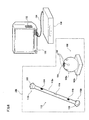
- a toy 100 as a musical scale recognition apparatus in this embodiment includes a code transmission apparatus 102 and a code receiving apparatus 112.
- the code transmission apparatus 102 includes an upper housing 102a having a spherical shape and a lower housing 102b having a box shape, and a microphone 104 is attached on an upper end of the upper housing 102a.
- a microphone 104 is attached on an upper end of the upper housing 102a.
- four (4) infrared light-emitting diodes 106 are provided at a position which equally divides the surface circumference into four parts. It is noted that only three (3) infrared light-emitting diodes 106 are illustrated in this drawing.
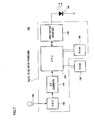
- the code transmission apparatus 102 is formed, more specifically, as shown in Figure 7.
- the microphone 104 is connected to a CPU 140 via an AGC 142 and an A/D converter 144.
- the infrared light-emitting diodes 106 are connected to the CPU 140 via an input /output interface 146.
- the CPU 140 is connected to a RAM 148 and a ROM 150, and capable of writing and reading data to and from the RAM 148 and the ROM 150. It is noted that as to the CPU 142, the AGC 142, the A/D converter 144, the input/output interface 146 and the RAM 148, the above mentioned XaviX (trademark) may be applied.
- the code receiving apparatus 112 includes a middle portion 112a of a stick shape and end portions 112b which are almost like diamond or lozenge shape provided at both ends of the middle portion 112a.
- LEDs 120 are provided at an end side of each end portion 112b.
- a key switch 116 is provided in the vicinity of the center of the middle portion 112a .
- an infrared light receiving module 114 is provided on a side of one end portion 112b from the key switch 116 a speaker 118 is provided.
- the code receiving apparatus 112 is formed, more specifically, as shown in Figure 8.
- the infrared light-receiving module 114, the LEDs 120 and the key switch 116 are connected to the CPU 160 via an input/output interface 162.
- the speaker 118 is connected to the CPU 160 via a voice processing circuit 168.
- the ROM 164 and the RAM 166 are connected to the CPU 160, and a data transfer to or from the ROM 164 and the RAM 166 is made possible. It is noted that a single-chip MCU (micro controller unit) may be used for the input/output interface 162, the ROM 164, the RAM 166 and the voice processing circuit 168.
- a musical scale of voices on a television program output from a speaker 132 of a home television 130 is recognized by the code transmission apparatus 102, and it is determined with which plurality of phrases previously prepared the recognized voices are coincident. Subsequently, the code corresponding to the coincident phrase is transmitted by blinking the infrared light-emitting diode 106.
- the infrared light-receiving module 114 receives the infrared code transmitted from the code transmission apparatus 102, and the LED 120s are blinked and the voices from the speaker 118 are output on the basis of the received code. It is noted that the voices output from the speaker 132 are not necessarily voices of a television program.
- a video deck 136 is connected to an AV terminal of the home television 130 by using a cable 134, and a video software is then reproduced by the video deck 136 and the voices recorded in the video software are output from the speaker 132.
- pointers [0], [1], ⁇ , [N - 1] are initialized.
- phrases in N unit are prepared in advance, and each pointer [0], [1], ⁇ , [N - 1] is a pointer pointing each of N phrases.
- each pointer points a head musical note of each phrase.
- a next musical note within the phrase is pointed.
- an initialization is carried out by assigning "0" to work areas As [0], As [1], ⁇ , As [N - 1], and in a step S74 an initialization is carried out by assigning "0" to work areas Ac [0], Ac [1], ⁇ , Ac [N - 1].
- the work area As [0], As [1], ⁇ , As [N - 1] are work areas for storing cumulative values to find a coefficient of a Fourier sine series. As [0] stores a value regarding a recognition of a relevant musical note of the first phrase, As [N - 1] stores a value regarding a recognition of a relevant musical note of the N-th phrase.
- the work areas Ac [0], Ac [1], ⁇ , Ac [N - 1] are work areas for storing cumulative values to find a coefficient of a Fourier cosine series.
- Ac [0] stores a value regarding a recognition of a relevant musical note of the first phrase
- Ac [N - 1] stores a value regarding a recognition of a relevant musical note of the N-th phrase.
- an initialization is carried out by assigning "0" to the counter x.
- a step S77 data pointed by the pointer [x] is obtained.
- the frequency data obtained is assigned to the work area f [x]
- the obtained time data is assigned to the work area T [x].
- a musical scale recognition processing is carried out in a step S83.
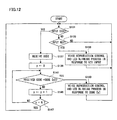
- the musical scale recognition processing is executed according to a flowchart shown in Figure 11.
- a current time t is obtained in a step S113, and sin ⁇ t and cos ⁇ t are evaluated from the time t and the frequency f [x] in a step S115.
- the ⁇ is an angular velocity in corresponce to the frequency f [x]. It is noted that it may be also possible to find sin ⁇ t and cos ⁇ t by referring to a table being prepared in advance.
- a step S117 the above equation (6) is assigned to As [x], and the above equation (7) is assigned to Ac [x] in a step S119. Furthermore, the above equation (8) is assigned to A [x] in a step S121.
- a [x] shows a degree of coincidence between a pitch of the input audio signal (singing voices) and the frequency f [x], and the larger the value, the higher the degree.
- a level or degree of consistency of the audio signals using A [x] and the frequency f [x] is evaluated by assigning logarithmic weights instead of in a linear manner, it may assign the equation (9) instead of the equation (8) to the A [x] in the step S121.
- a predetermined time C is subtracted from T [x] in a step S85. It is noted that the time C is a time coincident with a time interval of the A/D conversion process of the input voices.
- T [x] it is determined whether or not T [x] is negative, i.e. whether or not a time equal to a length of the musical note has lapsed. Subsequently, if it is determined that the time t [x] has not lapsed, the process proceeds to a step S105 to increment the counter x. In other words, the musical note of the next phrase is recognized by reserving the recognition of the relevant musical note of the relevant phrase.
- a value of A [x] is corrected in accordance with the amplitude level of the input voices in a step S88 shown in Figure 10. Then, it is determined whether or not A [x] is larger than a given threshold value in a step S89. If and when it is determined that the value of A [x] is smaller than the threshold value, the process proceeds to a step S101 to initialize the pointer [x]. In other words, the pointer of the relevant phrase is returned to the head musical note on ground of not being coincident with the relevant phrase.
- an initialization is carried out by assigning "0" to As [x] in a step S103, and an initialization is carried out by assigning "0" to Ac [x] in a step S104. Furthermore, the counter x is incremented in a step S105, and the process proceeds to a processing of the next phrase.
- a step S99 the code corresponding to the relevant phrase is transmitted by blinking the infrared light-emitting diode 120.
- the pointer [x] is initialized.
- an initialization is carried out by assigning "0" to As [x] in a step S103, and an initialization is carried out by assigning "0" to Ac [x] in a step S104.
- the counter x is incremented in a step S105, and the process proceeds to a processing of the next phrase.
- step S95 In case it is determined the data is not the end code in the step S95, this means that the input voices are coincident with the relevant phrase on its way to a certain relevant musical note, and the next phrase is processed by proceeding to a step S103 or the following steps because it is still not certain whether or not the input voices are coincident with the relevant phrase up to the end.
- step S103 an initialization is carried out by assigning "0" to As [x]
- a step S104 an initialization is carried out by assigning "0" to Ac [x].
- the counter x is incremented in the step S105.
- a step S107 it is determined whether or not a value of the counter x is N, that is, a confirmation of the musical note included in the N-th phrase is completed. If and when it is determined that the value of the counter x is not N, the process returns to the step S77 in order to confirm the musical tone is included in the (x + 1)th phrase.
- step S109 a predetermined time period is put on hold, and thereafter, the process returns to the step S75.
- step S75 an initialization is carried out by making the value of the counter x "0". That is, a recognition process of the musical note included in the first phrase is once again performed.
- the CPU 140 of the code transmission apparatus 102 confirms with which phrases in N units previously prepared the input audio signal is coincident. At this time, it is confirmed that a musical scale of every one of notes included in the audio signal is coincident with which every one of musical tones included in phrases in N units. This process is carried out in order to confirm the first musical tone of the first phrase, the second musical tone of the second phrase, ⁇ , the N-th musical tone of the N-th phrase, the second musical tone of the first phrase, the second musical tone of the second phrase, and so on. In addition, if and when the input audio signal is coincident with a certain phrase, the code corresponding to the phrase is transmitted as an infrared signal.
- a step S139 an initialization is carried out by assigning "0" to a counter y. Then, in a step S141 it is determined whether or not a received code is coincident with a code [y].
- the code [y] in N units equal to the number N of the phrase is prepared, and it is determined whether or not the received code is coincident with code [y]. If and when it is determined that the received code and the code [y] with each other are coincident in a step S143, voices corresponding to the code [y] are output from the speaker 118, and at the same time the LEDs 120 are caused to blink with a rhythm corresponding to the code [y].
- the counter y is incremented in a step S145, and it is determined whether or not the value of the counter y is N in a step S147. If and when the value of the counter y is not N, the process returns to the step S141 and determines whether or not the received code is coincident with a next code [y]. On the other hand, if and when it is determined that the value of the counter y is N in the step S147, the process returns to the step S131 because there is no code [y] coincident with the received code.
- step S133 if and when the key switch 116 is pressed by a user, it is determined that there is a key input in a step S133, and in a step S135 voices corresponding to the key input are output from the speaker 118, and at the same time the LEDs 120 are caused to blink with a rhythm corresponding to the key input.
- the phrase output from the speaker 132 of the television 130 is recognized by the code transmission apparatus 102, and the code corresponding to the recognized phrase is transmitted.
- the transmitted code is received by the code receiving apparatus 112, and the sound corresponding to the received code is output from the speaker 118, and at the same time the LEDs 120 are caused to blink with a rhythm corresponding to the received code. Therefore, the sound is output from the code receiving apparatus and the LEDs blink in accordance with the phrase output from the speaker 132 of the home television 130.
- the toy 100 in this embodiment does not carry out a musical scale recognition by specifying a primary frequency component by applying FTT to input voices, but the musical scale recognition is carried out by comparing a specific frequency component (musical scale) expected to be input and input voices. Therefore, a required processing is considerably simple, and a required amount of memory can be greatly reduced. Due to this, it is possible to implement an apparatus capable of carrying out a musical scale recognition in real time by a microprocessor with a low processing capability.
Landscapes
- Engineering & Computer Science (AREA)
- Physics & Mathematics (AREA)
- Acoustics & Sound (AREA)
- Multimedia (AREA)
- Audiology, Speech & Language Pathology (AREA)
- Health & Medical Sciences (AREA)
- Computational Linguistics (AREA)
- Human Computer Interaction (AREA)
- Auxiliary Devices For Music (AREA)
- Measurement Of Mechanical Vibrations Or Ultrasonic Waves (AREA)
- Reverberation, Karaoke And Other Acoustics (AREA)
- Character Discrimination (AREA)
- Indexing, Searching, Synchronizing, And The Amount Of Synchronization Travel Of Record Carriers (AREA)
Applications Claiming Priority (2)
| Application Number | Priority Date | Filing Date | Title |
|---|---|---|---|
| JP2001147448A JP4771323B2 (ja) | 2001-05-17 | 2001-05-17 | 音階認識方法、音階認識装置、及び、記録媒体 |
| JP2001147448 | 2001-05-17 |
Publications (3)
| Publication Number | Publication Date |
|---|---|
| EP1278182A2 true EP1278182A2 (de) | 2003-01-22 |
| EP1278182A3 EP1278182A3 (de) | 2003-10-08 |
| EP1278182B1 EP1278182B1 (de) | 2007-07-18 |
Family
ID=18992936
Family Applications (1)
| Application Number | Title | Priority Date | Filing Date |
|---|---|---|---|
| EP02252025A Expired - Lifetime EP1278182B1 (de) | 2001-05-17 | 2002-03-21 | Verfahren und Vorrichtung zur Musiknotenerkennung |
Country Status (5)
| Country | Link |
|---|---|
| EP (1) | EP1278182B1 (de) |
| JP (1) | JP4771323B2 (de) |
| KR (1) | KR100803894B1 (de) |
| AT (1) | ATE367635T1 (de) |
| DE (1) | DE60221196D1 (de) |
Cited By (3)
| Publication number | Priority date | Publication date | Assignee | Title |
|---|---|---|---|---|
| DE102004028719A1 (de) * | 2004-06-14 | 2006-01-05 | Fraunhofer-Gesellschaft zur Förderung der angewandten Forschung e.V. | Vorrichtung und Verfahren zum Bestimmen eines einem Audiosignal zugrunde liegenden Frequenzrasters |
| US7653534B2 (en) | 2004-06-14 | 2010-01-26 | Fraunhofer-Gesellschaft Zur Foerderung Der Angewandten Forschung E.V. | Apparatus and method for determining a type of chord underlying a test signal |
| US8017855B2 (en) | 2004-06-14 | 2011-09-13 | Fraunhofer-Gesellschaft Zur Foerderung Der Angewandten Forschung E.V. | Apparatus and method for converting an information signal to a spectral representation with variable resolution |
Families Citing this family (5)
| Publication number | Priority date | Publication date | Assignee | Title |
|---|---|---|---|---|
| KR101446903B1 (ko) * | 2013-05-30 | 2014-10-22 | 코이안(주) | 인터랙티브 악보 연주 시스템 |
| JP6113231B2 (ja) * | 2015-07-15 | 2017-04-12 | 株式会社バンダイ | 歌唱力評価装置及び記憶装置 |
| KR102689087B1 (ko) * | 2017-01-26 | 2024-07-29 | 삼성전자주식회사 | 전자 장치 및 그 제어 방법 |
| KR102077642B1 (ko) * | 2017-07-03 | 2020-02-14 | (주)주스 | 시창평가 시스템 및 그것을 이용한 시창평가방법 |
| CN114385977B (zh) * | 2021-12-13 | 2024-05-28 | 广州方硅信息技术有限公司 | 信号的有效频率检测方法、终端设备及存储介质 |
Family Cites Families (28)
| Publication number | Priority date | Publication date | Assignee | Title |
|---|---|---|---|---|
| JPS4981082A (de) * | 1972-12-06 | 1974-08-05 | ||
| JPS58202478A (ja) * | 1982-05-19 | 1983-11-25 | シャープ株式会社 | 歌唱能力などの評価装置 |
| JPH0331358Y2 (de) * | 1984-12-27 | 1991-07-03 | ||
| JPS62182800A (ja) * | 1986-02-06 | 1987-08-11 | セイコーインスツルメンツ株式会社 | 音響信号解析合成装置 |
| AT390580B (de) * | 1988-08-04 | 1990-05-25 | Andritz Ag Maschf | Verfahren zur bandsteuerung bzw. -regelung von materialbaendern und steuerrollensatz fuer die durchfuehrung dieses verfahrens |
| JPH03126095A (ja) * | 1989-10-11 | 1991-05-29 | Casio Comput Co Ltd | パスメロディ機能付電子装置 |
| JP3273472B2 (ja) * | 1992-09-24 | 2002-04-08 | ヤマハ株式会社 | カラオケシステム |
| JPH06110945A (ja) * | 1992-09-29 | 1994-04-22 | Fujitsu Ltd | 音楽データベース作成装置及びその検索装置 |
| KR960007127B1 (ko) * | 1993-06-30 | 1996-05-27 | 대우전자주식회사 | 영상반주 기기의 채점장치 |
| KR950009596A (ko) * | 1993-09-23 | 1995-04-24 | 배순훈 | 노래반주용 비디오 기록재생장치 및 방법 |
| JPH07121556A (ja) * | 1993-10-21 | 1995-05-12 | Nippon Telegr & Teleph Corp <Ntt> | 音楽情報検索装置 |
| JP3319211B2 (ja) * | 1995-03-23 | 2002-08-26 | ヤマハ株式会社 | 音声変換機能付カラオケ装置 |
| US5719344A (en) * | 1995-04-18 | 1998-02-17 | Texas Instruments Incorporated | Method and system for karaoke scoring |
| JP3390590B2 (ja) * | 1995-09-06 | 2003-03-24 | 株式会社河合楽器製作所 | Midiデータの送信装置 |
| JP3552837B2 (ja) * | 1996-03-14 | 2004-08-11 | パイオニア株式会社 | 周波数分析方法及び装置並びにこれを用いた複数ピッチ周波数検出方法及び装置 |
| JPH09297588A (ja) * | 1996-05-08 | 1997-11-18 | Ekushingu:Kk | リモコン装置 |
| JPH1026995A (ja) * | 1996-07-10 | 1998-01-27 | Victor Co Of Japan Ltd | カラオケ採点装置 |
| JPH10124054A (ja) * | 1996-10-21 | 1998-05-15 | Sony Corp | 音楽再生装置および方法 |
| JP2000009768A (ja) * | 1998-06-19 | 2000-01-14 | Neucore Technol Inc | 周波数解析装置 |
| JP3136286B2 (ja) * | 1998-08-04 | 2001-02-19 | 株式会社第一興商 | 歌唱ゲーム得点機能付きカラオケ装置 |
| EP1102240A4 (de) * | 1999-05-21 | 2001-10-10 | Matsushita Electric Industrial Co Ltd | Vorrichtung zur intervallnormalisierung eines eingangssignals für die spracherkennung |
| JP2001005490A (ja) * | 1999-06-17 | 2001-01-12 | Nec Corp | 音声認識装置 |
| JP2001067090A (ja) * | 1999-08-30 | 2001-03-16 | Mitsubishi Electric Corp | 音響信号符号化装置 |
| JP2001078276A (ja) * | 1999-09-07 | 2001-03-23 | Mitsubishi Electric Corp | 遠隔制御装置 |
| EP1233509A1 (de) * | 2001-02-14 | 2002-08-21 | Thomson Licensing S.A. | Digitaler Audioprozessor |
| KR100412196B1 (ko) * | 2001-05-21 | 2003-12-24 | 어뮤즈텍(주) | 악보 추적 방법 및 그 장치 |
| JP2007090000A (ja) * | 2005-09-30 | 2007-04-12 | Nippon Koden Corp | 心電図データの圧縮方法および心電図テレメータ装置 |
| JP4875413B2 (ja) * | 2006-06-22 | 2012-02-15 | グンゼ株式会社 | 衣類 |
-
2001
- 2001-05-17 JP JP2001147448A patent/JP4771323B2/ja not_active Expired - Fee Related
-
2002
- 2002-03-21 AT AT02252025T patent/ATE367635T1/de not_active IP Right Cessation
- 2002-03-21 EP EP02252025A patent/EP1278182B1/de not_active Expired - Lifetime
- 2002-03-21 DE DE60221196T patent/DE60221196D1/de not_active Expired - Lifetime
- 2002-03-30 KR KR1020020017592A patent/KR100803894B1/ko not_active Expired - Fee Related
Cited By (3)
| Publication number | Priority date | Publication date | Assignee | Title |
|---|---|---|---|---|
| DE102004028719A1 (de) * | 2004-06-14 | 2006-01-05 | Fraunhofer-Gesellschaft zur Förderung der angewandten Forschung e.V. | Vorrichtung und Verfahren zum Bestimmen eines einem Audiosignal zugrunde liegenden Frequenzrasters |
| US7653534B2 (en) | 2004-06-14 | 2010-01-26 | Fraunhofer-Gesellschaft Zur Foerderung Der Angewandten Forschung E.V. | Apparatus and method for determining a type of chord underlying a test signal |
| US8017855B2 (en) | 2004-06-14 | 2011-09-13 | Fraunhofer-Gesellschaft Zur Foerderung Der Angewandten Forschung E.V. | Apparatus and method for converting an information signal to a spectral representation with variable resolution |
Also Published As
| Publication number | Publication date |
|---|---|
| HK1050585A1 (en) | 2003-06-27 |
| ATE367635T1 (de) | 2007-08-15 |
| JP2002341886A (ja) | 2002-11-29 |
| JP4771323B2 (ja) | 2011-09-14 |
| DE60221196D1 (de) | 2007-08-30 |
| EP1278182A3 (de) | 2003-10-08 |
| KR100803894B1 (ko) | 2008-02-15 |
| KR20020089138A (ko) | 2002-11-29 |
| EP1278182B1 (de) | 2007-07-18 |
Similar Documents
| Publication | Publication Date | Title |
|---|---|---|
| US7829777B2 (en) | Music displaying apparatus and computer-readable storage medium storing music displaying program | |
| EP1197948B1 (de) | Karaokevorrichtung mit integriertem Mikrofon und Mikrofon dafür | |
| JP3317686B2 (ja) | 歌唱伴奏システム | |
| JP2004086067A (ja) | 音声発生装置および音声発生プログラム | |
| US5585584A (en) | Automatic performance control apparatus | |
| US5005459A (en) | Musical tone visualizing apparatus which displays an image of an animated object in accordance with a musical performance | |
| JP2004037575A (ja) | 演奏処理装置、演奏処理プログラムおよびファイル生成装置 | |
| EP1278182B1 (de) | Verfahren und Vorrichtung zur Musiknotenerkennung | |
| EP2022549A1 (de) | Datenrecheneinheit für ein musikspiel, datenrechenprogramm für ein musikspiel und datenrechenverfahren für ein musikspiel | |
| US6703551B2 (en) | Musical scale recognition method and apparatus thereof | |
| US4962688A (en) | Musical tone generation control apparatus | |
| US20060142082A1 (en) | Motion analyzing apparatus and method for a portable device | |
| HK1050585B (en) | Musical note recognition method and apparatus | |
| USRE43379E1 (en) | Music selecting apparatus and method | |
| JP3074693B2 (ja) | 音楽評価装置 | |
| JP2001324987A (ja) | カラオケ装置 | |
| KR20010112729A (ko) | 악보출력기능을 갖는 노래반주 시스템 및 악보출력기능구현방법 | |
| EP2048653A1 (de) | Speichermedium mit darauf gespeichertem Musikabspielprogramm und Musikabspielgerät | |
| US7385130B2 (en) | Music selecting apparatus and method | |
| JP4108850B2 (ja) | 歌唱による標準的なカロリー消費量を試算する方法およびカラオケ装置 | |
| US5606145A (en) | Code changing method for electronic music instrument with automatic accompaniment function and slur processing | |
| JP2689438B2 (ja) | 楽音映像化装置 | |
| KR100432419B1 (ko) | 전자악보를 이용한 전자악기용 음악연주게임장치 및 방법 | |
| JP2007271739A (ja) | 合奏パラメータ表示装置 | |
| WO2009002195A2 (en) | Integrated television karaoke device |
Legal Events
| Date | Code | Title | Description |
|---|---|---|---|
| PUAI | Public reference made under article 153(3) epc to a published international application that has entered the european phase |
Free format text: ORIGINAL CODE: 0009012 |
|
| AK | Designated contracting states |
Kind code of ref document: A2 Designated state(s): AT BE CH CY DE DK ES FI FR GB GR IE IT LI LU MC NL PT SE TR |
|
| AX | Request for extension of the european patent |
Free format text: AL;LT;LV;MK;RO;SI |
|
| PUAL | Search report despatched |
Free format text: ORIGINAL CODE: 0009013 |
|
| AK | Designated contracting states |
Kind code of ref document: A3 Designated state(s): AT BE CH CY DE DK ES FI FR GB GR IE IT LI LU MC NL PT SE TR |
|
| AX | Request for extension of the european patent |
Extension state: AL LT LV MK RO SI |
|
| RIC1 | Information provided on ipc code assigned before grant |
Ipc: 7G 10H 3/12 B Ipc: 7G 10H 1/36 A |
|
| 17P | Request for examination filed |
Effective date: 20031129 |
|
| AKX | Designation fees paid |
Designated state(s): AT BE CH CY DE DK ES FI FR GB GR IE IT LI LU MC NL PT SE TR |
|
| GRAP | Despatch of communication of intention to grant a patent |
Free format text: ORIGINAL CODE: EPIDOSNIGR1 |
|
| GRAS | Grant fee paid |
Free format text: ORIGINAL CODE: EPIDOSNIGR3 |
|
| GRAA | (expected) grant |
Free format text: ORIGINAL CODE: 0009210 |
|
| AK | Designated contracting states |
Kind code of ref document: B1 Designated state(s): AT BE CH CY DE DK ES FI FR GB GR IE IT LI LU MC NL PT SE TR |
|
| RAP1 | Party data changed (applicant data changed or rights of an application transferred) |
Owner name: SSD COMPANY LIMITED |
|
| REG | Reference to a national code |
Ref country code: GB Ref legal event code: FG4D |
|
| REG | Reference to a national code |
Ref country code: CH Ref legal event code: EP |
|
| REF | Corresponds to: |
Ref document number: 60221196 Country of ref document: DE Date of ref document: 20070830 Kind code of ref document: P |
|
| REG | Reference to a national code |
Ref country code: IE Ref legal event code: FG4D |
|
| REG | Reference to a national code |
Ref country code: HK Ref legal event code: GR Ref document number: 1050585 Country of ref document: HK |
|
| PG25 | Lapsed in a contracting state [announced via postgrant information from national office to epo] |
Ref country code: ES Free format text: LAPSE BECAUSE OF FAILURE TO SUBMIT A TRANSLATION OF THE DESCRIPTION OR TO PAY THE FEE WITHIN THE PRESCRIBED TIME-LIMIT Effective date: 20071029 Ref country code: FI Free format text: LAPSE BECAUSE OF FAILURE TO SUBMIT A TRANSLATION OF THE DESCRIPTION OR TO PAY THE FEE WITHIN THE PRESCRIBED TIME-LIMIT Effective date: 20070718 Ref country code: NL Free format text: LAPSE BECAUSE OF FAILURE TO SUBMIT A TRANSLATION OF THE DESCRIPTION OR TO PAY THE FEE WITHIN THE PRESCRIBED TIME-LIMIT Effective date: 20070718 Ref country code: PT Free format text: LAPSE BECAUSE OF FAILURE TO SUBMIT A TRANSLATION OF THE DESCRIPTION OR TO PAY THE FEE WITHIN THE PRESCRIBED TIME-LIMIT Effective date: 20071218 |
|
| REG | Reference to a national code |
Ref country code: CH Ref legal event code: PL |
|
| NLV1 | Nl: lapsed or annulled due to failure to fulfill the requirements of art. 29p and 29m of the patents act | ||
| PG25 | Lapsed in a contracting state [announced via postgrant information from national office to epo] |
Ref country code: LI Free format text: LAPSE BECAUSE OF FAILURE TO SUBMIT A TRANSLATION OF THE DESCRIPTION OR TO PAY THE FEE WITHIN THE PRESCRIBED TIME-LIMIT Effective date: 20070718 Ref country code: CH Free format text: LAPSE BECAUSE OF FAILURE TO SUBMIT A TRANSLATION OF THE DESCRIPTION OR TO PAY THE FEE WITHIN THE PRESCRIBED TIME-LIMIT Effective date: 20070718 Ref country code: AT Free format text: LAPSE BECAUSE OF FAILURE TO SUBMIT A TRANSLATION OF THE DESCRIPTION OR TO PAY THE FEE WITHIN THE PRESCRIBED TIME-LIMIT Effective date: 20070718 |
|
| EN | Fr: translation not filed | ||
| PG25 | Lapsed in a contracting state [announced via postgrant information from national office to epo] |
Ref country code: BE Free format text: LAPSE BECAUSE OF FAILURE TO SUBMIT A TRANSLATION OF THE DESCRIPTION OR TO PAY THE FEE WITHIN THE PRESCRIBED TIME-LIMIT Effective date: 20070718 |
|
| PG25 | Lapsed in a contracting state [announced via postgrant information from national office to epo] |
Ref country code: DK Free format text: LAPSE BECAUSE OF FAILURE TO SUBMIT A TRANSLATION OF THE DESCRIPTION OR TO PAY THE FEE WITHIN THE PRESCRIBED TIME-LIMIT Effective date: 20070718 Ref country code: GR Free format text: LAPSE BECAUSE OF FAILURE TO SUBMIT A TRANSLATION OF THE DESCRIPTION OR TO PAY THE FEE WITHIN THE PRESCRIBED TIME-LIMIT Effective date: 20071019 |
|
| PLBE | No opposition filed within time limit |
Free format text: ORIGINAL CODE: 0009261 |
|
| STAA | Information on the status of an ep patent application or granted ep patent |
Free format text: STATUS: NO OPPOSITION FILED WITHIN TIME LIMIT |
|
| 26N | No opposition filed |
Effective date: 20080421 |
|
| PG25 | Lapsed in a contracting state [announced via postgrant information from national office to epo] |
Ref country code: SE Free format text: LAPSE BECAUSE OF FAILURE TO SUBMIT A TRANSLATION OF THE DESCRIPTION OR TO PAY THE FEE WITHIN THE PRESCRIBED TIME-LIMIT Effective date: 20071018 |
|
| PG25 | Lapsed in a contracting state [announced via postgrant information from national office to epo] |
Ref country code: FR Free format text: LAPSE BECAUSE OF FAILURE TO SUBMIT A TRANSLATION OF THE DESCRIPTION OR TO PAY THE FEE WITHIN THE PRESCRIBED TIME-LIMIT Effective date: 20080314 Ref country code: DE Free format text: LAPSE BECAUSE OF FAILURE TO SUBMIT A TRANSLATION OF THE DESCRIPTION OR TO PAY THE FEE WITHIN THE PRESCRIBED TIME-LIMIT Effective date: 20071019 |
|
| PG25 | Lapsed in a contracting state [announced via postgrant information from national office to epo] |
Ref country code: MC Free format text: LAPSE BECAUSE OF NON-PAYMENT OF DUE FEES Effective date: 20080331 |
|
| PG25 | Lapsed in a contracting state [announced via postgrant information from national office to epo] |
Ref country code: IE Free format text: LAPSE BECAUSE OF NON-PAYMENT OF DUE FEES Effective date: 20080321 |
|
| PG25 | Lapsed in a contracting state [announced via postgrant information from national office to epo] |
Ref country code: CY Free format text: LAPSE BECAUSE OF FAILURE TO SUBMIT A TRANSLATION OF THE DESCRIPTION OR TO PAY THE FEE WITHIN THE PRESCRIBED TIME-LIMIT Effective date: 20070718 |
|
| PG25 | Lapsed in a contracting state [announced via postgrant information from national office to epo] |
Ref country code: LU Free format text: LAPSE BECAUSE OF NON-PAYMENT OF DUE FEES Effective date: 20080321 |
|
| PG25 | Lapsed in a contracting state [announced via postgrant information from national office to epo] |
Ref country code: TR Free format text: LAPSE BECAUSE OF FAILURE TO SUBMIT A TRANSLATION OF THE DESCRIPTION OR TO PAY THE FEE WITHIN THE PRESCRIBED TIME-LIMIT Effective date: 20070718 |
|
| PG25 | Lapsed in a contracting state [announced via postgrant information from national office to epo] |
Ref country code: IT Free format text: LAPSE BECAUSE OF NON-PAYMENT OF DUE FEES Effective date: 20080331 |
|
| PGFP | Annual fee paid to national office [announced via postgrant information from national office to epo] |
Ref country code: GB Payment date: 20110316 Year of fee payment: 10 |
|
| GBPC | Gb: european patent ceased through non-payment of renewal fee |
Effective date: 20120321 |
|
| PG25 | Lapsed in a contracting state [announced via postgrant information from national office to epo] |
Ref country code: GB Free format text: LAPSE BECAUSE OF NON-PAYMENT OF DUE FEES Effective date: 20120321 |