EP1278332B1 - Procédé et dispositif d'enregistrement en temps réel avec module de sécurité - Google Patents
Procédé et dispositif d'enregistrement en temps réel avec module de sécurité Download PDFInfo
- Publication number
- EP1278332B1 EP1278332B1 EP02090250A EP02090250A EP1278332B1 EP 1278332 B1 EP1278332 B1 EP 1278332B1 EP 02090250 A EP02090250 A EP 02090250A EP 02090250 A EP02090250 A EP 02090250A EP 1278332 B1 EP1278332 B1 EP 1278332B1
- Authority
- EP
- European Patent Office
- Prior art keywords
- real
- time
- security
- security module
- logfile
- Prior art date
- Legal status (The legal status is an assumption and is not a legal conclusion. Google has not performed a legal analysis and makes no representation as to the accuracy of the status listed.)
- Expired - Lifetime
Links
- 238000000034 method Methods 0.000 title claims description 38
- 238000004891 communication Methods 0.000 claims description 57
- 238000004422 calculation algorithm Methods 0.000 claims description 41
- 238000007620 mathematical function Methods 0.000 claims description 32
- 238000012795 verification Methods 0.000 claims description 24
- 230000006870 function Effects 0.000 claims description 17
- 230000005540 biological transmission Effects 0.000 claims description 8
- 238000013479 data entry Methods 0.000 claims description 5
- 230000015572 biosynthetic process Effects 0.000 claims description 4
- 238000009795 derivation Methods 0.000 claims description 4
- 230000000052 comparative effect Effects 0.000 claims 1
- 230000008901 benefit Effects 0.000 description 5
- 238000012545 processing Methods 0.000 description 5
- 238000004364 calculation method Methods 0.000 description 4
- 238000005516 engineering process Methods 0.000 description 4
- 238000011156 evaluation Methods 0.000 description 4
- 238000010586 diagram Methods 0.000 description 3
- 230000010365 information processing Effects 0.000 description 3
- 238000013478 data encryption standard Methods 0.000 description 2
- 238000011161 development Methods 0.000 description 2
- 230000018109 developmental process Effects 0.000 description 2
- 238000007689 inspection Methods 0.000 description 2
- 239000003550 marker Substances 0.000 description 2
- 230000007246 mechanism Effects 0.000 description 2
- 238000007639 printing Methods 0.000 description 2
- 230000008569 process Effects 0.000 description 2
- 108090000623 proteins and genes Proteins 0.000 description 2
- 238000012546 transfer Methods 0.000 description 2
- 230000021917 activation of membrane attack complex Effects 0.000 description 1
- 238000004458 analytical method Methods 0.000 description 1
- 238000013459 approach Methods 0.000 description 1
- 238000012550 audit Methods 0.000 description 1
- 238000013475 authorization Methods 0.000 description 1
- 230000008859 change Effects 0.000 description 1
- 239000003795 chemical substances by application Substances 0.000 description 1
- 238000013461 design Methods 0.000 description 1
- 238000001514 detection method Methods 0.000 description 1
- 230000000694 effects Effects 0.000 description 1
- 230000005923 long-lasting effect Effects 0.000 description 1
- 238000012805 post-processing Methods 0.000 description 1
- 230000002441 reversible effect Effects 0.000 description 1
- 238000001228 spectrum Methods 0.000 description 1
- 230000000007 visual effect Effects 0.000 description 1
Images
Classifications
-
- H—ELECTRICITY
- H04—ELECTRIC COMMUNICATION TECHNIQUE
- H04L—TRANSMISSION OF DIGITAL INFORMATION, e.g. TELEGRAPHIC COMMUNICATION
- H04L9/00—Cryptographic mechanisms or cryptographic arrangements for secret or secure communications; Network security protocols
- H04L9/32—Cryptographic mechanisms or cryptographic arrangements for secret or secure communications; Network security protocols including means for verifying the identity or authority of a user of the system or for message authentication, e.g. authorization, entity authentication, data integrity or data verification, non-repudiation, key authentication or verification of credentials
- H04L9/3226—Cryptographic mechanisms or cryptographic arrangements for secret or secure communications; Network security protocols including means for verifying the identity or authority of a user of the system or for message authentication, e.g. authorization, entity authentication, data integrity or data verification, non-repudiation, key authentication or verification of credentials using a predetermined code, e.g. password, passphrase or PIN
-
- H—ELECTRICITY
- H04—ELECTRIC COMMUNICATION TECHNIQUE
- H04L—TRANSMISSION OF DIGITAL INFORMATION, e.g. TELEGRAPHIC COMMUNICATION
- H04L9/00—Cryptographic mechanisms or cryptographic arrangements for secret or secure communications; Network security protocols
- H04L9/32—Cryptographic mechanisms or cryptographic arrangements for secret or secure communications; Network security protocols including means for verifying the identity or authority of a user of the system or for message authentication, e.g. authorization, entity authentication, data integrity or data verification, non-repudiation, key authentication or verification of credentials
- H04L9/3247—Cryptographic mechanisms or cryptographic arrangements for secret or secure communications; Network security protocols including means for verifying the identity or authority of a user of the system or for message authentication, e.g. authorization, entity authentication, data integrity or data verification, non-repudiation, key authentication or verification of credentials involving digital signatures
-
- H—ELECTRICITY
- H04—ELECTRIC COMMUNICATION TECHNIQUE
- H04L—TRANSMISSION OF DIGITAL INFORMATION, e.g. TELEGRAPHIC COMMUNICATION
- H04L2209/00—Additional information or applications relating to cryptographic mechanisms or cryptographic arrangements for secret or secure communication H04L9/00
- H04L2209/56—Financial cryptography, e.g. electronic payment or e-cash
Definitions
- the invention relates to a method for real-time recording with high Anti-counterfeiting, according to the preamble of claim 1 specified type and a system with a security module, according to the type specified in the preamble of claim 10.
- Such Security module works in a potentially not by the operator controlled environment, e.g. in servers, in ATMs, ticket machines, Franking machines, cash registers, electronic purses, Computers for personal use (palmtops, notebooks, Organizers), cell phones and devices that have several of these features combine. It can take the form of a postal security module be realized, which in particular for use in servers, in Franking machines or mail processing machines, PC franking or computers is suitable.
- the latter is the best-known symmetric crypto-algorithm and is also described in FIPS PUB111 (Federal Information Processing Standards Publication).
- the symbols of the marker symbol series are numbers or letters or special characters.
- the technically printed information and the DAC in the OCR-readable section of the print image are thus visual (human) and machine-readable.
- a symmetric crypto algorithm data of the above-mentioned DAC or messages can be used to generate a message authentication code (MAC), such codes being used for the authentication check, similar to a digital signature.
- MAC message authentication code
- the advantage of the symmetric crypto algorithm is the relatively short length of the MAC and the high speed of its computation. This advantage is offset by the disadvantage that sender and receiver use a single secret key.
- the advantage of an asymmetric crypto algorithm is justified by a public key.
- RSA asymmetric crypto-algorithm
- the recipient decrypts an encrypted message with a private secret key which has been encrypted at the sender with the associated public key.
- the recipient keeps his private key secret, but sends the associated public key to potential senders.
- RSA is an asymmetric technique that is useful for both keyring and digital signatures.
- the private key can be used to generate digital signatures, where the public keys are used to verify the signature.
- Each digital signature algorithm uses two keys, one of which is public.
- An implementation of the RSA-based signature algorithm in a computer results in a comparatively slow processing and provides a long signature.
- DSS Digital Signature Algorithm
- DSA Digital Signature Algorithm
- This development took place on the basis of the identification and signature according to the Schnorr patent US 4,995,085 and based on the key exchange according to Diffie-Hellman US 4,200,770 and the ElGamal method (El Gamal, Taher, "A Public Key Cryptosystem and a Signature Scheme Based on Discrete Logarithms ", IEEE Transactions and Information Theory, vol. 31, No. 4, Jul.1985).
- El Gamal, Taher "A Public Key Cryptosystem and a Signature Scheme Based on Discrete Logarithms ", IEEE Transactions and Information Theory, vol. 31, No. 4, Jul.1985).
- the advantage of using a public key is the disadvantage of a relatively long digital signature. It has been proposed in US Pat. No.
- Such a security area is created in devices by a security module.
- a security module In the state of 26 April 2000 communicated by Deutsche Post AG in the document "Requirements for the introduction of systems for PC franking", it is assumed that every device in the system has a security module. Only an asymmetric key pair according to RSA is used for asymmetric encryption as well as for the digital signature. The key length is 1024 bits according to RSA and it is encrypted with the public key of the receiver security module.
- a hash value according to SHA-1 for broadcast-specific data and a random number is generated and encrypted with the security module's own private key.
- only two security modules can communicate with each other.
- the SHA-1 was developed by the NIST with the participation of the NSA and published in 1994.
- the SHA-1 is part of the DSA. From US 4,812,965 a system for remote inspection has already become known, which reduces the need for a local inspection.
- Each forgery is recorded by a postage meter and transmitted to a central station by printing and sending information or via modem to the central station.
- a log file containing a historical record of all transaction data is hereafter called a translog file.
- the computing capacity and computing speed of franking machines is usually limited to a solution for generating a translogfile in coarse granularity, whereby not the data of each individual transaction but only those of a group of transaction data are backed up with a digital signature. If every entry of the translog file were backed up with a digital signature, the required franking speed would be difficult to realize.
- a trade off between feasibility and granularity can be found if the size of the transaction data is suitably limited. It is known from US Pat. No. 6,061,671 to store a cryptographically protected copy of billing data in a memory externally from the security module ("secure value metering unit").
- the accounting data logged in this way are limited to a few selected register data.
- the computing speed of franking machines can be sufficient when using a symmetric crypto-algorithm.
- Each message with transaction data could therefore be appended with a Message Authentication Code (MAC).
- MAC Message Authentication Code
- this path is only passable for transmission to a single institution which carries out the authenticity check. If two institutions do not trust each other, both can not be equipped with the same secret key. With several institutions, the potential danger of espionage of the secret key grows when they are equipped with the same secret key that is unique to each security module. It has already been proposed to generate two encryption keys for a security printout (US 5,390,251).
- the key idea is to use one-time keys to authenticate the logfile entries in the first computer, which will be overwritten immediately after they are used.
- the problem remains of information tracks possibly remaining in memory blocks, which an attacker can evaluate even after overwriting the original values (data remanence).
- the method uses the concatenation of authentication of successive log file entries to ensure the generation of log files in real time. The longer these links become, the longer it takes on average to verify the authenticity of selected log file entries. The result is a trade-off between speed when generating and when selectively verifying log file entries.
- the method provides a solution for maximum speed in generating the log files.
- One drawback is that no tamper-resistant secure memory processor is used in the first computer. Therefore, the authentication keys can no longer be stored in memory.
- Another disadvantage is that too long an average verification time is needed for selective logfile entries.
- the Translogfile is cryptographically secured in fine granularity and in Real time generated.
- Each message contains transaction data which is stored at least as an entry in the translogfile by the customer system.
- the storage can be done externally from the security module in a separate memory of the customer system.
- Entries from non-real-time transactions are used, for example, to transmit encrypted keys, security values, inter alia, values in preparation for possibly subsequent entries of real-time transactions (real-time entries) to at least one translog file analyzer.
- Providing at least one encrypted initial security value includes recording a non-real-time entry that includes at least one encrypted initial security value for at least one translog file analyzer.
- the latter is an institution that participates in communication with a security module of a customer system in order to carry out an evaluation of the transmitted message.
- the initial security value is a random number or based on one. It is, for example, an initial hash value that is subsequently used and, after a first mathematical function, allows a subsequent hash value to be generated for a backup of a subsequent entry in real time.
- the non-real-time entry may be stored in the form of a first record and in the form of a first message for the intended purpose Translogfileanalysator be transmitted.
- Translogfileanalysator For other Translogfileanalysatoren Further non-real-time entries or sub-entries are provided. Several such subentries may take the form of additional first records or in the form of sub-records within a first record be stored or transmitted.
- Non-real-time entries can be secured by a digital signature unfalsible.
- a faster procedure is used to authenticate real-time entries than digital signing.
- Real-time entries are flagged and indexed by a sequence counter in the translog file.
- the translog file is a secure but mostly unencrypted individual record of transactional data entries and / or the status of the device. It can be transmitted in any accumulated portions and evaluated by Translogfileanalysatoren. At one end of the spectrum is the transmission entry for entry in real time and at the other end is the transmission of the entire translogfile in batch mode.
- An initial or a current security value is formed by a security module according to the first mathematical function and processed together with a real-time entry to an authentication code.
- the securing of a real-time entry is preferably carried out by an authentication code based on the data of the real-time entry and on a hash value, the latter advantageously allowing the generation of a subsequent hash value for the derivation of a future authentication code.
- a real-time entry in the translog file is constructed so that first the sequential index is written, then the name of the type of real-time entries, then the transaction data and finally the authentication code.
- the authentication code is calculated with a second mathematical function, preferably by applying a hash function to the sequence number, the transaction data and a hash value which was calculated according to the first mathematical function specifically for this entry. With the authentication code succeeds a sufficient backup of the entry in real time.
- Translogfiles thus takes place in fine Ganular relieve secured cryptographically.
- Real-time and non-real-time entries can be viewed in the Frame of real-time recording in any order and number be generated and recorded and / or transmitted.
- an authentication code allows just one Analysis of the real-time message also by several independent Institutions.
- the prerequisite for this is the same for all institutions initial hash value, each time by a non-real-time entry is transmitted.
- each communication user has a communication interface, a communication buffer and a security module or a security box.
- a secure real-time record can from a variety of authorized Translogfileanalysatoren with Safety box to be evaluated.
- a microprocessor of the security module is programmed to work as an authentication machine.
- in the Security module is a public encryption key everyone Security box and a private signing key of the security module stored non-volatile.
- a microprocessor of each security box is programmed to work as a verification engine and a hash value to update.
- In each security box are a private decryption key the security box, a public verification key of the security module as well as a current hash value non-volatile stored.
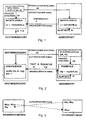
- An encryption key ek is public and a decryption key dk is private.
- the public encryption key ek is transmitted to the subscriber at the sender of a message.
- an authentic channel ensures that the public encryption key is not exchanged between the destination and the place of despatch and is misused as part of a "man in the middle attack".
- the ciphertext c can now be transmitted via an unsecured channel to the destination.
- decrypt the ciphertext c an operation of the kind is provided: m ⁇ decrypt (dk, c)
- the second participant decrypts at the destination with the private one Decryption key dk the ciphertext c to the message m ', which matches the original message m if ek and dk the previously generated key pair.
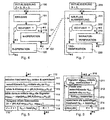
- FIG. 2 explains the flowchart of a signing method.
- the application of digital signature mechanisms also requires the generation of a key pair.
- a public verification key vk is transmitted, for example, via an authentic channel to the second subscriber at the destination.
- the message m and the signature sig can now be transmitted via an unsecured channel to the second participant at the destination.
- the generation of a signature sig takes place at the sending location of a first subscriber by the security module.
- a public verification key vk For verifying a signature sig at the destination, a public verification key vk, the message m and a mathematical operation of the kind are provided: acc ⁇ verify (vk, m, sig). where the result acc can be true (valid) or false (invalid).
- step 100 an initialization is performed in step 100, wherein the counts of a counter Z for N-operations and a counter K for R-operations are set to zero in each case.
- R is real-time
- N is non-real-time.
- a transaction executed by the customer system is detected as an event of a certain type in subsequent step 101.
- step 102 If it is determined in query step 102 that a non-real-time transaction exists , then branching is made to the N-operation step 110, at the end of which a record D1 containing a non-real-time entry is generated, and at the same time the counter Z is incremented and the counter K is (re) initialized to 1. It is necessary to that the very first logged transaction is always a low frequency transaction. If it is determined in query step 102 that there is a real-time transaction, then branching is made to step 120 for R operations, at the end of which a data record D2 containing a real-time entry is generated. At the same time, the sequence counter K is incremented. After generating the record D1 or D2, branch back to the step 101 of event detection and the security module is ready for the next transaction.
- FIG. 5 shows a flowchart for generating a non-real-time entry in the context of the N-operation 110.
- the variable Z or K is assigned a value zero, ie Z ⁇ 0, K ⁇ 0.
- Z is the counter of the N-operations and K is the numerator of the R operations, where K starts counting from zero each time an N operation is executed.
- a random number X is generated in the security module and from this an initial hash value h Z, 0 is formed and stored (sub-step 111).
- an encryption of the initial hash value h Z, 0 according to an asymmetric method with the supplied by the recipient public encryption key ek B the security box.
- the variable H Z, 0 contains the encrypted hash value.
- the data record D1 can be stored in real time or transmitted to the receiver at the destination for the purpose of evaluation.
- the security module increments in sub-step 116 the loop counter Z for N-operations, ie Z ⁇ Z + 1.
- a hash value is prepared: H Z, K ⁇ hash (h Z, 0 )
- sub-step 118 the aforementioned sequence counter is set to the value one, ie K ⁇ 1.
- the aforementioned future hash value h Z, 1 is now current for a subsequent operation. From the thus executed step 110 of the flow chart shown in Figure 4 is branched back to step 101. In query step 102, the type of transaction is checked again. As a result of an N-operation, an exchange of a (randomly chosen by the security module) initial hash value h z, 0 is thus enabled by known cryptographic mechanisms between a security module and the security boxes of a Translogfileanalysators.
- FIG. 6 shows a flow chart for generating a real-time entry in the context of the R operation 120.
- the variable Z or K is assigned a value zero, ie Z ⁇ 0, K ⁇ 0.
- An R-operation 120 is performed when a high-frequency transaction has expired, which is detected in subsequent step 101 as an event of a certain type "R".
- an authentication code T Z, K is generated for each real-time entry # K, R, Entry Z, K by means of the security module 11, by inserting the real-time entry # K, R, Entry Z, K and the current security value h Z, K in an algorithm also used by the Translogfileanalysator with a second mathematical function for the authentication code T Z, K.
- the calculation of the authentication code T Z, K is preferably carried out by forming the hash value via the data record HASHINPUT: T Z, K ⁇ hash (HASHINPUT)
- the resulting authentication code T Z, K is added to the real-time entry.
- the current hash value h Z, K that enters the hash function does not appear in the real-time entry. Otherwise someone who listens to the translog file could derive the subsequent hash values, so that the translog file would no longer be authenticated from this entry.
- the current hash value h Z, K is changed for a future recording after each output of the data record D2 carried out in step 123, resulting in a high security against forgery.
- the sequence counter K ⁇ K + 1 is incremented and the new hash value is taken over into a memory for the current hash value. Subsequently, the method branches back to step 101. In query step 102, the type of transaction is then rechecked. At the next real-time event, the first step 121 may be performed again for a subsequent real-time entry and tracked hash values. In this case, the initial hash value h Z, 0 or the current hash value h Z, K is used which results from the mathematical operation from the previously performed step 124.
- a subsequent current safety value h Z, 1 is formed from the initial safety value h Z, 0 according to a first mathematical function also used by the translog filter analyzer, which provides a derivation of subsequent safety values h Z, 1 , h Z, 2 ,. .., h Z, K ,..., h Z, V for securing and verifying the following real-time entries # K, R, Entry Z, K , which are identifiable as such by an R flag and corresponding to a sequence count #K can be found in the translogfile.
- different candidates can be chosen, eg SHA-1.
- FIG. 7 shows a flow chart for controlling a security box in the translog file analyzer, by means of which the verification of a translog file according to the invention is explained.
- an initialization takes place in step 200, wherein the count of the counter K for the sequence number of the first entry of a translog file is set to zero in each case.
- the N / R flag of the data record is evaluated in a step 201.
- the query step 202 it is determined that the record contains, for example, an N flag and, consequently, it branches to step 210 to verify the non-real-time entry by its signature (Equation 5).
- step 202 If it is determined in query step 202 that a real-time entry is present because the data record contains an R flag, then the process branches to step 220 in order to verify the real-time entry based on its authentication code. As a result of each check of the entries of the records D1 or D2 in steps 210 and 220, the sequence count K is also incremented. If the entry has been successfully verified, the variable h Z, K is updated to prepare for the next operation. After passing through steps 210 or 220, the program returns to step 201 for N / R flag evaluation.
- FIG. 8 shows a flowchart for signature verification for a more detailed illustration of sub-steps of step 210.
- the encrypted value H z, 0 contained in the transmitted non-real-time entry must also be true. If the verifiability of the signature of the first data record D1 is determined in the sub-step 211, then the process branches to the sub-step 212, in which the value H Z, 0 is decrypted using the secret key dk B of the security box of the translog file analyzer. In the optional sub-step 213, the transaction data Entry Z, 0 can then be evaluated. In the subsequent step 214, the result h Z, 0 prepares the hash value for a possible subsequent real-time entry h Z, 1 ⁇ hash (h Z, 0 ) derived and stored. In step 215, the sequence counter is set to the value one: K ⁇ 1
- FIG. 9 shows a flowchart for verifying a real-time entry for a more detailed illustration of sub-steps of step 220.
- the security box of the translog file analyzer separates the authentication code T Z, K.
- the remaining data of the real-time entry and the stored hash value h Z, K are combined into the string HASHINPUT *.
- Sub-step 224 is for verification. If the comparison code formed in the aforementioned manner and the received authentication code match, the real-time entry is assumed to be authentic. Of course, the code formation must be performed on the transmitter and receiver sides in the same way.
- a new current hash value is formed for the following operation: h Z, (K + 1) * ⁇ nash (h Z, K *)
- sub-step 227 the acquisition then takes place with the update K ⁇ K + 1 of the newly formed hash value in the memory for the current one Hash. If the verification in sub-step 224 gave an error, then this will be noted in the verification report. This is also step 220 and it goes to step 201 for evaluating the N / R flag branches back.
- the table has four columns from left to right. The first column shows the sequence number #, the second column shows the remaining data of the message including the transaction data, the third column shows the signature (generated in step 114) and the authentication code (in step 122), and the fourth column shows how the encrypted hash value H Z, 0 (step 112) or the consecutive hash values h Z, 1 , h Z, 2 , ... (step 124) are generated. It should be noted that the hash values h Z, 1 , h Z, 2 , ...
- a major advantage of the method described is its ability to be extensively expanded so that a security module can authenticate a translog file in such a way that it can also be evaluated by several independent and even mutually suspicious translog file analyzers.
- Mutually distrusting Translogfileanalysatoren can not get involved in exchanging with each other of security modules created records (Translogfiles) on customer systems and secret (asymmetric) encryption key ek B. Instead, non-real-time entries of a translog file are used to realize this key exchange.
- a security module can service multiple translog file analyzers. However, this assumes that sub-steps 112-115 of step 110 are modified for the N-operation in the security module. Instead of encrypting the hash value h Z, 0 only once using the encryption key ek B , the hash value h Z, 0 for each participating translog file analyzer is encoded using the encryption key ... ek Bu , ek Bu + 1 , ... of the respective security box of each participating party u-th or u + 1-th translog file analyzer encrypted. As a result of sub-step 112, the security module forms a corresponding number of encrypted hash values H u, Z, 0 , H u + 1, Z, 0 , ...
- the security module In order not to diversify the transflog file, the security module now writes all the calculated values ... H u , Z, 0 , H u + 1, Z, 0 , ... into the non-real-time entry (step 113), sign it in step 114, and add the signature (step 115).
- step 110 for the N-operation in Security module are repeated several times in order to separate records D1 with one non-real-time entry for each to generate one of the Translogfileanalysatoren.
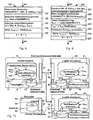
- FIG. 10 is a block diagram of one operating in real time Security module 11 of a customer system 10 in communication with two independent Translogfileanalysatoren 20 and 30 shown.
- the Transaction data arrive via a bus 12 in a communication buffer 13 and via communication interfaces 17, 27 and 37 to Communication buffer 23 or 33 of the Translogfileanalysators 20 and 30th for evaluation and possibly via communication interface 97 for recording into a remotely located recorder 90.
- the customer system 10 via a communication link 28 with at least one Translogfileanalysator 20, 30th is connected, that the latter a communication interface 27, 37 and a suitable electrical connection 24, 34 to the communication buffer 23, 33 of the Translogfileanalysators 20, 30, that the safety box 21, 31 via a bus 22, 32 at the communication buffer 23, 33rd connected.
- the translogfile generated by the customer system 10 in the Translogfileanalysator 20, 30 evaluate, its validity checked and a verification report 25 was created about it 21, 31 possibly via a bus 26, 36 outputs.
- the security box 21, 31 is over a bus 22, 32 connected to the communication buffer 23, 33.
- One Security module 11, for example, constructed so hardware side be as in EP 1,035,513 A2, EP 1,035,516 A2, EP 1,035,517 A2, EP 1,035,518 A2 already for use in franking machines has been described.
- the microprocessor by a faster type - for example, S3C44AOX - replaced and possibly will the storage capacity is extended by additional SRAMs.
- the previous software is now an asymmetric crypto algorithm and a hash algorithm, possibly next to a symmetric crypto algorithm, used to create a real-time record of events safe and fast to produce.
- the security module 11 is connected via a bus 12 to the communication buffer 13 and the latter via a suitable electrical connection 14 to the communication interface 17 of the customer system 10.
- the communication interface 17 of the customer system 10 is connected via the communication link 28 to at least one communication interface 27, 37 of the at least one Translogfileanalysators 20, 30.
- the latter has a suitable electrical connection 24, 34 from the communication interface 27, 37 to the communication buffer 23, 33 of the Translogfileanalysators 20, 30.
- the security box 21, 31 is connected to the communication buffer 23, 33 via a bus 22, 32.
- the security box 21, 31 is advantageously constructed in the same way with respect to the hardware and software as the security module 11.
- the security module 11 and the security box 21, 31 form a special security area and contain non-volatile memory for the non-volatile storage of intermediate results and keys, which are not allowed to go outside.
- In the communication buffer 23, 33 is only a temporary storage of a few transaction data.
- the main storage of the recording of all transaction data of the Translogfile done externally from the security module or security box in the memory 93.
- the memory 93 in the customer system 10 or in the Translogfileanalysator 20 or 30 are arranged and the shown separate recorder 90 can be omitted.
- a public encryption key ek B20 or ek B30 of the security box of the translog file analyzer 20 or 30 and a private signature key sk SM of the security module 11 are located in the security module 11 stored non-volatile.
- a microprocessor of the security module 11 is programmed by a stored in the internal program memory program to work as an authentication machine.
- the security box 21 or 31 of the Translogfileanalysators 20 and 30 has a private decryption key dk B20 or dk B30 and a public Verifizierêtl vk SM of the security module 11 is stored in the Translogfileanalysator 20 or 30 before non-volatile stored.
- a microprocessor of the Translogfileanalysators 20, 30 or the safety box 21, 31 programmed to work as a verification machine and output a verification report 25. How the Translogfile authenticated by the security module 11 is analyzed by the Translogfileanalysator 20, 30, depends on the appropriate application and should not be considered here.
- each security box 21, 31 not only a private decryption key dk B20 , dk B30 of the security box, a current hash value h Z, K and an algorithm of the first and second mathematical functions are non-volatile stored, but the security box 21, 31 is also equipped with means to update the non-volatile stored hash value h Z, K and generate a comparison code in order to verify the authenticity of the corresponding real-time record and with the aid of the authentication code and to output a verification report 25 thereon.
- the security module 11 of a customer system 10 provides non-realtime entries with all information and distributes them to all translog file analyzers 20, 30, so that the security box of each of the translog file analyzers 20, 30 searches out the appropriate part.
- the sender ID of a customer system 10 is included in each transmitted piece of a translog file.
- the security module 11 of a customer system 10 provides the non-real-time entries individually for each log file analyzer together.
- each with a security module 11 are equipped, via a communication network 28 with a Variety of authorized Translogfileanalysatoren 20, 30 is connected.
- a customer system 10 is for example a franking machine with Security module 11.
- the described method uses hash functions for two purposes: on the one hand for generating the hash chains h Z, 1 , h Z, 2 ,... In steps 117, 214, 124 and 226, according to which it is provided that a subsequent current safety value h Z, 1 is formed from the initial safety value h Z, 0 by means of a first mathematical function also used by the Translogfileanalysator, wherein the current safety value h Z, K is a hash value and that the first mathematical function is a hash function.
- a hash function with a key or a dedicated message authentication code can be used for the first task.
- HMAC can be used here.
- MAC message authentication code
- different hashing functions may be selected.
- a subsequent current security value h Z, 1 is formed from the initial security value h Z, 0 by means of a first mathematical function likewise used by the translog file analyzer by appending the initial security value h Z, 0 to the real-time entry # K, R, Entry Z, K and in that the first mathematical function is a hash function applied to the real-time entry with the attached initial safety value (h Z, 0 ).
- the system may include a computer that operates in conjunction with mail handling services and is part of, in particular, a service center having a database 90 '(not shown) in a manner known per se, the latter having a memory 93 (not shown) contains for the registration of real-time and non-real-time transactions, on which only a security module 11 and authorized Translogfileanalysatoren can access.
- a server 10 ' Replacing the customer system 10 by a server 10 ', then results in a similar block diagram, as already explained in detail with reference to FIG.
- the server can be connected in a manner known per se with franking machines, scales or similar devices (not shown).
- the system has a security module 11 which is part of a (not shown) server 10 'of the service center and via a (not shown) communication link 28' with a plurality of authorized Translogfileanalysatoren 20, 30 is connected.
- the latter and the service center form different parties that belong to different companies or institutions.
- the security module 11 has a memory for storing the public encryption key ek B20 , ek B30 of the Translogfileanalysatoren 20, 30, with which an initial hash value h Z, K is encrypted.
- the security module 11 is programmed to transmit, as a result of at least one non-real-time operation, a non-real-time entry in the form of a data record D1 to the participating translog file analyzers 20, 30, wherein the non-real-time entry respectively contains the initial hash value h Z, 0 contains in encrypted form.
Landscapes
- Engineering & Computer Science (AREA)
- Computer Security & Cryptography (AREA)
- Computer Networks & Wireless Communication (AREA)
- Signal Processing (AREA)
- Storage Device Security (AREA)
Claims (20)
- Dispositif de sauvegarde en temps réel haute sécurité antifalsification grâce à un module de sécurité caractérisé par les étapes suivantes :Alimentation (110, 120) d'un transfichier journal accessible pour un module de sécurité (11), le module de sécurité (11) communiquant avec au moins un analyseur de transfichier journal (20),Mise à disposition (112) d'au moins une valeur de sécurité initiale codée sous forme de texte chiffré HZ,0 par le module de sécurité (11) et formation subséquente (117) d'une valeur de sécurité actuelle hZ,1 à partir de la valeur de sécurité initiale hZ,0 selon une première fonction mathématique également utilisée par l'analyseur de transfichier journal, ladite fonction permettant une déduction d'une pluralité de valeurs de sécurité subséquentes hZ,1 hZ,2, ..., hZ,K, .... hZ,V dans le but de sécuriser et de vérifier les enregistrements en temps réel survenant ultérieurement {#K,R,EntryZ,K},Listage desdits enregistrements en temps réel {#K,R,EntryZ,K} pour des transactions étant chacune listée dans le transfichier journal correspondant à un relevé de compteur séquentiel #K, reconnaissable en tant qu'enregistrement en temps réel par un indicateur R et caractérisée par les données de transaction EntryZ,K, une valeur de sécurité subséquente pour une transaction survenant ultérieurement étant ainsi formée (117),Création (122) d'un code d'authentification TZ,K pour chaque enregistrement en temps réel {#K,R,EntryZ,K} grâce au module de sécurité (11), par l'utilisation de l'enregistrement en temps réel {#K,R, EntryZ,K} et de la valeur de sécurité actuelle (hZ,K) dans un algorithme également utilisé par l'analyseur de transfichier journal avec une deuxième fonction mathématique pour le code d'authentification TZ,K,Protection (123) de chaque enregistrement en temps réel {#K,R, EntryZ,K} par attachement du code d'authentification TZ,K etSauvegarde de chaque enregistrement en temps réel non-codé protégé par le code d'authentification sous la forme d'un jeu de données D2.
- Dispositif selon la revendication 1 caractérisé en ce que la mise à disposition d'au moins une des valeurs de sécurité initiales codées sous forme de texte chiffré (HZ,0) comporte une sauvegarde d'un enregistrement en non-temps-réel incluant au moins l'un des textes chiffrés (HZ,0) pour au moins l'un des analyseurs de transfichier journal (20).
- Dispositif selon la revendication 2 caractérisé en ce que ladite mise à disposition inclut une transmission de l'enregistrement en non-temps-réel sous la forme d'un premier jeu de données (D1) vers l'analyseur de transfichier journal (20).
- Dispositif selon la revendication 2 caractérisé en ce qu'un enregistrement en non-temps-réel prédéterminé sous la forme d'un premier jeu de données (D1) est enregistré au niveau de l'analyseur de transfichier journal (20) conforme aux dispositions.
- Dispositif selon la revendication 1 caractérisé en ce que, lors de la sauvegarde, ledit enregistrement en temps réel protégé par le code d'authentification est enregistré sous forme d'un deuxième jeu de données (D2) pour un analyseur de transfichier journal (20) de manière lisible et en temps réel, et en ce que ledit enregistrement en temps réel est transmis sous forme du deuxième jeu de données (D2) à l'analyseur de transfichier journal (20).
- Dispositif selon la revendication 1 caractérisé en ce que la mise à disposition d'au moins une des valeurs de sécurité initiales codées sous forme de texte chiffré (HZ,0) comporte, lors de l'encodage de la valeur initiale de sécurité (hZ,0), une première opération (N-OPERATION) avec un dispositif de cryptage asymétrique, en liaison avec la formation d'un enregistrement en non-temps-réel.
- Dispositif selon la revendication 1 caractérisé en ce que la création d'un code d'authentification pour chaque enregistrement en temps réel se réalise dans une deuxième opération (R-OPERATION) du module de sécurité (11) et en ce que la deuxième fonction mathématique constitue une fonction de hash qui est appliquée à l'enregistrement en temps réel avec la valeur de sécurité actuelle attachée (hZ,K), formant ainsi un code d'authentification (TZ,K).
- Dispositif selon la revendication 1 caractérisé en ce que la valeur de sécurité actuelle (hZ,K) constitue une valeur de hash, et en ce que la première fonction mathématique est une fonction de hash.
- Dispositif selon la revendication 1 caractérisé en ce qu'une valeur de sécurité actuelle subséquente (hz,1) est formée à partir de la valeur de sécurité initiale (hZ,0) au moyen d'une première fonction mathématique également utilisée par l'analyseur de transfichier journal, la valeur de sécurité initiale (hZ,0) étant attachée à l'enregistrement en temps réel (#K,R,Entryz,K) et la première fonction mathématique étant une fonction de hash qui est appliquée à l'enregistrement en temps réel avec la valeur de sécurité initiale attachée (hZ,0).
- Système muni d'un module de sécurité pour la sauvegarde en temps réel haute sécurité anti-falsification, dans un transfichier journal servant à effectuer des sauvegardes historiques de toutes les données de transactions, caractérisé en ce que le module de sécurité (11) comporte une mémoire pour la mémorisation non-volatile de résultats intermédiaires et de codes, et comporte un moyen permettant de réaliser une opération en non-temps-réel avec la création d'un premier jeu de données (D1) et pour la réalisation d'au moins une opération en temps réel avec création d'au moins un deuxième jeu de données (D2), ladite mémoire étant prévue pour la mise en mémoire non-volatile d'une valeur de sécurité actuelle (hZ,K) et d'un algorithme également utilisé dans au moins un analyseur de transfichier journal (20, 30) avec une première et une deuxième fonction mathématique, ledit moyen étant programmé pour générer chaque valeur de sécurité actuelle (hZ,K) à partir d'une valeur de sécurité initiale ou précédente selon l'algorithme avec la première fonction mathématique, et pour créer un code d'authentification (TZ,K) à partir de l'enregistrement en temps réel et chaque valeur de sécurité actuelle (hZ,K) correspondant à un enregistrement en temps réel, selon l'algorithme avec la deuxième fonction mathématique, et en ce que le module de sécurité (11) comporte un moyen de mise à disposition des jeux de données (D1, D2) pour une transmission à au moins un des analyseurs de transfichier journal (20, 30).
- Système selon la revendication 10 caractérisé en ce que le module de sécurité (11) constitue un élément d'un système-client (10), ledit système étant relié à une pluralité d'analyseurs de transfichier journal autorisés (20, 30) via une liaison de communication (28), le module de sécurité (11) étant pourvu des clés de cryptage publiques (ekB20, ekB30) des analyseurs de transfichier journal (20, 30), avec lesquelles une valeur de hash initiale (hZ,K) est codée, et en ce que le module de sécurité (11) est programmé dans le but de transmettre finalement au moins un enregistrement en non-temps-réel sous la forme d'un jeu de données (D1) de chaque opération en non-temps-réel aux analyseurs de transfichier journal concernés, l'enregistrement en non-temps-réel comportant chaque fois la valeur de hash initiale (hZ,0) sous forme codée.
- Système selon les revendications 10 à 11 caractérisé en ce que le module de sécurité (11) est relié à une interface de communication (17) d'un système-client (10) via un tampon de communication (13), en ce que le module de sécurité (11) comporte une mémoire, pour au moins la mémorisation d'une clé de cryptage publique (ekB20, ekB30) mise à disposition par au moins un analyseur de transfichier journal à distance (20, 30), d'une clé de signature privée (skSM) du module de sécurité (11) et d'une valeur de hash actuelle (hZ,K) et pour la mémorisation de l'algorithme avec la première et la deuxième fonction mathématique, en ce que le module de sécurité (11) comprend des moyens programmables, afin de générer un nombre aléatoire ou la valeur de hash initiale (hZ,0) et coder ce dernier avec au moins une clé de cryptage publique (ekB20, ekB30) en au moins un texte chiffré, former au moins un enregistrement en non-temps-réel incluant le texte chiffré, créer une signature digitale (sig) correspondant à au moins un enregistrement en non-temps-réel et créer un code d'authentification (TZ,K) correspondant à un enregistrement en temps réel, la valeur de hash actuelle (hZ,K) étant chaque fois générée à partir de la valeur de hash initiale (hZ,K) ou de la valeur de hash précédente (hZ,K-1) selon l'algorithme avec la première fonction mathématique, et le code d'authentification (TZ,K) étant créé à partir de l'enregistrement en temps réel et de chacune des valeurs de hash actuelles (hZ,K) selon l'algorithme avec la deuxième fonction mathématique, en ce que le module de sécurité (11) est programmé pour entrer en temps réel dans une communication avec au moins l'un des analyseurs de transfichier journal à distance (20, 30), lors d'une sauvegarde d'enregistrements en temps réel protégés par chacun des codes d'authentification (TZ,K) actuels dans une granularité fine, toutes les données de transaction sous forme de jeux de données (D1, D2) à sauvegarder étant transmises dans le tampon de communication (13) et de là, via une liaison électrique appropriée (14), jusqu'à l'interface de communication (17) et de là, via une interface de communication à distance (27, 37) jusqu'au tampon de communication (23, 33) de l'analyseur de transfichier journal à distance (20, 30).
- Système selon les revendications 10 à 11 caractérisé en ce que le module de sécurité (11) est programmé dans le but de,répéter l'opération en non-temps-réel correspondant à la pluralité d'analyseurs de transfichier journal autorisés, le nombre aléatoire ou la valeur de hash initiale (h0) étant codé(e) par différentes clés de cryptage publiques (ekB20, ekB30), afin de mettre à disposition à chaque fois une valeur de sécurité initiale codée en texte chiffré pour les analyseurs de transfichier journal (20, 30), dans les enregistrements en non-temps-réel d'un jeu de données (D1),protéger l'enregistrement en non-temps-réel d'un jeu de données (D1) avec la signature digitale (sig), créée par la clé de signature privée (skSM) du module de sécurité (11) et par les enregistrements en non-temps-réel d'un jeu de données (D1), de telle manière que chaque enregistrement en non-temps-réel peut être vérifié grâce à une clé de vérification publique (vkSM) du module de sécurité (11) par des analyseurs de transfichier journal (20, 30), et que la valeur de sécurité initiale protégée reçue sous forme de texte chiffré peut être décodée par les analyseurs de transfichier journal à distance (20, 30) grâce à une clé de décryptage privée (dkB20, dkB30) en valeur de hash initiale (hZ,0) ou en nombre aléatoire,créer la valeur de hash actuelle (hZ,K) selon un algorithme avec la première fonction mathématique etprotéger un enregistrement en temps réel d'un jeu de données (D2) dans le cadre d'une opération en temps réel avec un code d'authentification, dans lequel la valeur de hash actuelle (hZ,K) intervient, de telle manière qu'une seule et même sauvegarde en temps réel protégée peut être exploitée par la pluralité d'analyseurs de transfichier journal autorisés (20, 30).
- Système selon les revendications 10 à 12 caractérisé en ce que le module de sécurité (11) est relié, via un bus (12), au tampon de communication (13), ce dernier étant relié à l'interface de communication (17) du système-client (10) via une liaison électrique appropriée (14), en ce que l'interface de communication (17) du système-client (10) est reliée, via la liaison de communication (28), avec au moins une interface de communication (27, 37) d'au moins un des analyseurs de transfichier journal (20, 30), en ce que ce dernier comporte une liaison électrique appropriée (24, 34) allant de l'interface de communication (27, 37) au tampon de communication (23, 33) de l'analyseur de transfichier journal (20, 30), en ce qu'une boíte de sécurité (21, 31) est reliée au tampon de communication (23, 33) via un bus (22, 32), en ce que, dans la boíte de sécurité (21, 31), une clé de décryptage privée (dkB20, dkB30) de la boíte de sécurité (21, 31), une clé de vérification publique (vkSM) du module de sécurité, une valeur de hash actuelle (hZ,K) et un algorithme de la première et deuxième fonction mathématique sont enregistrés de manière non-volatile, en ce que la boíte de sécurité (21, 31) est pourvue de moyens servant à mettre à jour la valeur de hash enregistrée de manière non-volatile (hZ,K) et à créer un code de comparaison, afin de pouvoir ainsi et au moyen du code d'authentification contrôler l'authenticité de la sauvegarde en temps réel correspondante et d'en éditer un rapport de vérification (25).
- Système selon les revendications 10 à 14 caractérisé en ce qu'une pluralité de systèmes-clients (10), chacun étant pourvu d'un module de sécurité (11), est reliée via un réseau de communication (28) à une pluralité d'analyseurs de transfichier journal autorisés (20, 30).
- Système selon les revendications 10 à 15, caractérisé en ce qu'un système-client (10) constitue une machine à affranchir munie du module de sécurité (11).
- Système selon les revendications 10 à 16, caractérisé en ce que le module de sécurité (11) d'un système-client (10) dote les enregistrements en non-temps-réel avant leur répartition à tous les analyseurs de transfichier journal (20, 30), de toutes les informations, ces dernières étant adaptées de manière à ce que la boíte de sécurité de chacun des analyseurs de transfichier journal (20, 30) recherche l'élément qui lui est approprié, et l'identification d'envoi du systéme-client (10) étant contenue dans chaque partie transmise d'un transfichier journal.
- Système selon la revendication 17 caractérisé en ce que, dans le cas d'une transmission successive, enregistrement en non-temps-réel par enregistrement en non-temps-réel, dans le premier jeu de données (D1), l'identification de l'émetteur se trouve dans le champ d'entrée de chaque enregistrement en non-temps-réel.
- Système selon les revendications 10 à 11 caractérisé en ce que le module de sécurité (11) d'un système-client (10) regroupe les enregistrements en non-temps-réel individuellement pour chaque analyseur de fichier journal.
- Système selon la revendication 10 caractérisé en ce que le module de sécurité (11) fait partie d'un serveur (10'), ledit serveur étant relié via une liaison de communication (28') à une pluralité d'analyseurs de transfichier journal autorisés (20, 30), en ce que le module de sécurité (11) comporte une mémoire pour la mémorisation des clés de cryptage publiques (ekB20, ekB30) des analyseurs de transfichier journal (20, 30), avec lesquels une valeur de hash initiale (hZ,K) est codée, et en ce que le module de sécurité (11) est programmé dans le but de transmettre finalement au moins un enregistrement en non-temps-réel sous forme d'un jeu de données (D1) de chaque opération en non-temps-réel aux analyseurs de transfichier journal concernés (20, 30), l'enregistrement en non-temps-réel comprenant à chaque fois la valeur de hash initiale (hZ,0) sous forme codée.
Applications Claiming Priority (2)
| Application Number | Priority Date | Filing Date | Title |
|---|---|---|---|
| DE10136608A DE10136608B4 (de) | 2001-07-16 | 2001-07-16 | Verfahren und System zur Echtzeitaufzeichnung mit Sicherheitsmodul |
| DE10136608 | 2001-07-16 |
Publications (4)
| Publication Number | Publication Date |
|---|---|
| EP1278332A2 EP1278332A2 (fr) | 2003-01-22 |
| EP1278332A3 EP1278332A3 (fr) | 2003-12-03 |
| EP1278332B1 true EP1278332B1 (fr) | 2005-11-23 |
| EP1278332B8 EP1278332B8 (fr) | 2006-02-01 |
Family
ID=7693288
Family Applications (1)
| Application Number | Title | Priority Date | Filing Date |
|---|---|---|---|
| EP02090250A Expired - Lifetime EP1278332B8 (fr) | 2001-07-16 | 2002-07-12 | Procédé et dispositif d'enregistrement en temps réel avec module de sécurité |
Country Status (3)
| Country | Link |
|---|---|
| US (1) | US7222238B2 (fr) |
| EP (1) | EP1278332B8 (fr) |
| DE (2) | DE10136608B4 (fr) |
Families Citing this family (20)
| Publication number | Priority date | Publication date | Assignee | Title |
|---|---|---|---|---|
| US7162035B1 (en) | 2000-05-24 | 2007-01-09 | Tracer Detection Technology Corp. | Authentication method and system |
| US7515713B2 (en) * | 2001-12-17 | 2009-04-07 | Qualcomm Incorporated | Secure generation of temporary mobile station identifiers |
| US8171567B1 (en) | 2002-09-04 | 2012-05-01 | Tracer Detection Technology Corp. | Authentication method and system |
| DE10260406B4 (de) * | 2002-12-16 | 2007-03-08 | Francotyp-Postalia Gmbh | Verfahren und Anordnung zur unterschiedlichen Erzeugung kryptographischer Sicherungen von Mitteilungen in einem Hostgerät |
| GB2400463B (en) | 2003-04-11 | 2005-05-25 | Nextenders | Data processing apparatus and method for distributing and authenticating electronic documents |
| US7464266B2 (en) * | 2004-02-13 | 2008-12-09 | Microsoft Corporation | Cheap signatures for synchronous broadcast communication |
| US8817981B2 (en) * | 2004-11-18 | 2014-08-26 | Biogy, Inc. | Generation of registration codes, keys and passcodes using non-determinism |
| AU2005318933B2 (en) * | 2004-12-21 | 2011-04-14 | Emue Holdings Pty Ltd | Authentication device and/or method |
| DE102007011309B4 (de) * | 2007-03-06 | 2008-11-20 | Francotyp-Postalia Gmbh | Verfahren zur authentisierten Übermittlung eines personalisierten Datensatzes oder Programms an ein Hardware-Sicherheitsmodul, insbesondere einer Frankiermaschine |
| CA2698086C (fr) * | 2007-08-31 | 2017-05-23 | Homeatm Epayment Solutions | Appareil et procede permettant d'effectuer des transactions financieres securisees |
| US7995196B1 (en) | 2008-04-23 | 2011-08-09 | Tracer Detection Technology Corp. | Authentication method and system |
| US7904450B2 (en) * | 2008-04-25 | 2011-03-08 | Wilson Kelce S | Public electronic document dating list |
| JP5519646B2 (ja) * | 2008-06-02 | 2014-06-11 | ポリバロー リミテッド パートナーシップ | ファイルの存在検出とモニタリング |
| KR20100042457A (ko) * | 2008-10-16 | 2010-04-26 | 삼성전자주식회사 | 데이터 암호화 방법 및 장치와 데이터 복호화 방법 및 장치 |
| US10268843B2 (en) | 2011-12-06 | 2019-04-23 | AEMEA Inc. | Non-deterministic secure active element machine |
| US20130085944A1 (en) * | 2011-09-29 | 2013-04-04 | Pacid Technologies, Llc | System and method for application security |
| WO2013134306A1 (fr) | 2012-03-05 | 2013-09-12 | Michael Fiske | Mots de passe à usage unique à clés asymétriques |
| KR101838511B1 (ko) * | 2016-05-17 | 2018-03-14 | 현대자동차주식회사 | 암호화를 적용한 제어기 보안 방법 및 그 장치 |
| US10256981B2 (en) | 2016-09-27 | 2019-04-09 | International Business Machines Corporation | Secure logging for host security module |
| US11194934B2 (en) * | 2017-06-21 | 2021-12-07 | AEMEA Inc. | Clock and periodic computing machines |
Family Cites Families (24)
| Publication number | Priority date | Publication date | Assignee | Title |
|---|---|---|---|---|
| US3962539A (en) * | 1975-02-24 | 1976-06-08 | International Business Machines Corporation | Product block cipher system for data security |
| US4200770A (en) * | 1977-09-06 | 1980-04-29 | Stanford University | Cryptographic apparatus and method |
| US4405829A (en) * | 1977-12-14 | 1983-09-20 | Massachusetts Institute Of Technology | Cryptographic communications system and method |
| US4812965A (en) * | 1985-08-06 | 1989-03-14 | Pitney Bowes Inc. | Remote postage meter insepction system |
| US5231668A (en) * | 1991-07-26 | 1993-07-27 | The United States Of America, As Represented By The Secretary Of Commerce | Digital signature algorithm |
| US5390251A (en) * | 1993-10-08 | 1995-02-14 | Pitney Bowes Inc. | Mail processing system including data center verification for mailpieces |
| DE4344476A1 (de) * | 1993-12-21 | 1995-06-22 | Francotyp Postalia Gmbh | Verfahren zur Verbesserung der Sicherheit von Frankiermaschinen |
| US5805711A (en) * | 1993-12-21 | 1998-09-08 | Francotyp-Postalia Ag & Co. | Method of improving the security of postage meter machines |
| CA2158290A1 (fr) | 1994-09-29 | 1996-03-30 | Leon A. Pintsov | Dispositif totalisant les depenses d'affranchissement postal et produisant des comptes rendus selectifs |
| EP0762337A3 (fr) * | 1995-09-08 | 2000-01-19 | Francotyp-Postalia Aktiengesellschaft & Co. | Procédé et dispositif pour augmenter la protection contre la manipulation de données critiques |
| US5793867A (en) * | 1995-12-19 | 1998-08-11 | Pitney Bowes Inc. | System and method for disaster recovery in an open metering system |
| US5956404A (en) * | 1996-09-30 | 1999-09-21 | Schneier; Bruce | Digital signature with auditing bits |
| EP0947072A1 (fr) * | 1996-12-12 | 1999-10-06 | Ascom Systec AG | Procede pour la memorisation protegee electroniquement de donnees dans une banque de donnees |
| US5953426A (en) * | 1997-02-11 | 1999-09-14 | Francotyp-Postalia Ag & Co. | Method and arrangement for generating and checking a security imprint |
| DE19748954A1 (de) * | 1997-10-29 | 1999-05-06 | Francotyp Postalia Gmbh | Verfahren für eine digital druckende Frankiermaschine zur Erzeugung und Überprüfung eines Sicherheitsabdruckes |
| DE29905219U1 (de) * | 1999-03-12 | 1999-06-17 | Francotyp-Postalia AG & Co., 16547 Birkenwerder | Sicherheitsmodul mit Statussignalisierung |
| DE50015220D1 (de) * | 1999-03-12 | 2008-08-07 | Francotyp Postalia Gmbh | Anordnung zum Schutz eines Sicherheitsmoduls |
| DE19928057B4 (de) | 1999-06-15 | 2005-11-10 | Francotyp-Postalia Ag & Co. Kg | Sicherheitsmodul und Verfahren zur Sicherung der Postregister vor Manipulation |
| DE19912780A1 (de) * | 1999-03-12 | 2000-09-14 | Francotyp Postalia Gmbh | Anordnung für ein Sicherheitsmodul |
| DE19912781A1 (de) * | 1999-03-12 | 2000-11-23 | Francotyp Postalia Gmbh | Verfahren zum Schutz eines Sicherheitsmoduls und Anordnung zur Durchführung des Verfahrens |
| DE19948319A1 (de) * | 1999-10-07 | 2000-05-11 | Juergen K Lang | Verfahren und System zur Erstellung fälschungssicherer Dokumente |
| NZ518162A (en) | 1999-10-07 | 2003-09-26 | Deutsche Post Ag | Method for producing and checking forge-proof documents |
| US7386728B1 (en) | 1999-10-07 | 2008-06-10 | Deutsche Post Ag | Security module and method for production of forge-proof documents |
| US6868406B1 (en) * | 1999-10-18 | 2005-03-15 | Stamps.Com | Auditing method and system for an on-line value-bearing item printing system |
-
2001
- 2001-07-16 DE DE10136608A patent/DE10136608B4/de not_active Expired - Fee Related
-
2002
- 2002-07-11 US US10/193,596 patent/US7222238B2/en not_active Expired - Fee Related
- 2002-07-12 EP EP02090250A patent/EP1278332B8/fr not_active Expired - Lifetime
- 2002-07-12 DE DE50205004T patent/DE50205004D1/de not_active Expired - Lifetime
Also Published As
| Publication number | Publication date |
|---|---|
| DE10136608B4 (de) | 2005-12-08 |
| EP1278332B8 (fr) | 2006-02-01 |
| DE50205004D1 (de) | 2005-12-29 |
| EP1278332A3 (fr) | 2003-12-03 |
| US20030028775A1 (en) | 2003-02-06 |
| EP1278332A2 (fr) | 2003-01-22 |
| US7222238B2 (en) | 2007-05-22 |
| DE10136608A1 (de) | 2003-03-20 |
Similar Documents
| Publication | Publication Date | Title |
|---|---|---|
| DE10136608B4 (de) | Verfahren und System zur Echtzeitaufzeichnung mit Sicherheitsmodul | |
| DE69810394T2 (de) | Verfahren und Vorrichtung yur langfristigen Überprüfung von digitalen Unterschriften | |
| EP2484047B1 (fr) | Procédé de protection contre des manipulations de données de capteur et capteur correspondant | |
| DE3303846C2 (fr) | ||
| DE69022424T2 (de) | Nichtablehnung in Rechnernetzwerken. | |
| DE69128981T2 (de) | Geheimübertragungsverfahren und Geheimübertragungseinrichtung | |
| DE3841393C2 (de) | Zuverlässiges System zur Feststellung der Dokumentenechtheit | |
| DE69725659T2 (de) | Verfahren und Einrichtung zur Ablage eines in einem RSA-Kryptosystem benutzten Geheimschlüssels | |
| EP0635181B1 (fr) | Dispositif permettant la detection de la reinjection non autorise de donnees quelconques transmises depuis un emetteur vers un recepteur | |
| DE69706867T2 (de) | Vorrichtung zur wiedergewinnung eines geheimschlüssels | |
| EP3474172B1 (fr) | Contrôle d'accès à l'aide d'une chaîne de blocs | |
| DE102012206341B4 (de) | Gemeinsame Verschlüsselung von Daten | |
| DE602005002652T2 (de) | System und Verfahren für das Erneuern von Schlüsseln, welche in Public-Key Kryptographie genutzt werden | |
| DE102005018676B4 (de) | Verfahren zur Schlüsselverwaltung für Kryptographiemodule | |
| DE102013206185A1 (de) | Verfahren zur Erkennung einer Manipulation eines Sensors und/oder von Sensordaten des Sensors | |
| DE102009002396A1 (de) | Verfahren zum Manipulationsschutz eines Sensors und von Sensordaten des Sensors und einen Sensor hierzu | |
| EP1615173A2 (fr) | Procédé et dispositif pour la géneration d'une clé de session secrète | |
| DE102016221699A1 (de) | Verfahren zum Ausstellen einer virtuellen Version eines Dokuments | |
| EP4440036A1 (fr) | Procédé de sécurisation de signatures numériques basée sur une chaîne de blocs | |
| EP1368929A2 (fr) | Procede d'authentification | |
| DE112012000971B4 (de) | Datenverschlüsselung | |
| EP2863610A2 (fr) | Procédé et système inviolables de mise à disposition de plusieurs certificats numériques pour plusieurs clés publiques d'un appareil | |
| EP1180276A1 (fr) | Procede de verification de l'integrite et de l'auteur de textes et de codage et decodage de ces textes | |
| DE69720971T2 (de) | Computersystem und Verfahren zum Schutz von Software | |
| EP1455311A2 (fr) | Procédé pour un échange de données sécurisé |
Legal Events
| Date | Code | Title | Description |
|---|---|---|---|
| PUAI | Public reference made under article 153(3) epc to a published international application that has entered the european phase |
Free format text: ORIGINAL CODE: 0009012 |
|
| AK | Designated contracting states |
Kind code of ref document: A2 Designated state(s): AT BE BG CH CY CZ DE DK EE ES FI FR GB GR IE IT LI LU MC NL PT SE SK TR |
|
| AX | Request for extension of the european patent |
Free format text: AL;LT;LV;MK;RO;SI |
|
| PUAL | Search report despatched |
Free format text: ORIGINAL CODE: 0009013 |
|
| AK | Designated contracting states |
Kind code of ref document: A3 Designated state(s): AT BE BG CH CY CZ DE DK EE ES FI FR GB GR IE IT LI LU MC NL PT SE SK TR |
|
| AX | Request for extension of the european patent |
Extension state: AL LT LV MK RO SI |
|
| RIC1 | Information provided on ipc code assigned before grant |
Ipc: 7H 04L 9/32 A Ipc: 7G 07B 17/00 B |
|
| 17P | Request for examination filed |
Effective date: 20031218 |
|
| 17Q | First examination report despatched |
Effective date: 20040628 |
|
| AKX | Designation fees paid |
Designated state(s): CH DE FR GB IT LI |
|
| GRAP | Despatch of communication of intention to grant a patent |
Free format text: ORIGINAL CODE: EPIDOSNIGR1 |
|
| GRAS | Grant fee paid |
Free format text: ORIGINAL CODE: EPIDOSNIGR3 |
|
| RIN1 | Information on inventor provided before grant (corrected) |
Inventor name: BLEUMER, GERRIT Inventor name: HEINRICH, CLEMENS |
|
| GRAA | (expected) grant |
Free format text: ORIGINAL CODE: 0009210 |
|
| AK | Designated contracting states |
Kind code of ref document: B1 Designated state(s): CH DE FR GB IT LI |
|
| REG | Reference to a national code |
Ref country code: GB Ref legal event code: FG4D Free format text: NOT ENGLISH |
|
| REG | Reference to a national code |
Ref country code: CH Ref legal event code: EP |
|
| REF | Corresponds to: |
Ref document number: 50205004 Country of ref document: DE Date of ref document: 20051229 Kind code of ref document: P |
|
| REG | Reference to a national code |
Ref country code: CH Ref legal event code: NV Representative=s name: ROTTMANN, ZIMMERMANN + PARTNER AG |
|
| RAP2 | Party data changed (patent owner data changed or rights of a patent transferred) |
Owner name: FRANCOTYP-POSTALIA GMBH |
|
| GBT | Gb: translation of ep patent filed (gb section 77(6)(a)/1977) |
Effective date: 20060209 |
|
| ET | Fr: translation filed | ||
| PLBE | No opposition filed within time limit |
Free format text: ORIGINAL CODE: 0009261 |
|
| STAA | Information on the status of an ep patent application or granted ep patent |
Free format text: STATUS: NO OPPOSITION FILED WITHIN TIME LIMIT |
|
| 26N | No opposition filed |
Effective date: 20060824 |
|
| REG | Reference to a national code |
Ref country code: CH Ref legal event code: PFA Owner name: FRANCOTYP-POSTALIA GMBH Free format text: FRANCOTYP-POSTALIA GMBH#TRIFTWEG 21-26#16547 BIRKENWERDER (DE) -TRANSFER TO- FRANCOTYP-POSTALIA GMBH#TRIFTWEG 21-26#16547 BIRKENWERDER (DE) |
|
| PGFP | Annual fee paid to national office [announced via postgrant information from national office to epo] |
Ref country code: CH Payment date: 20110725 Year of fee payment: 10 |
|
| PGFP | Annual fee paid to national office [announced via postgrant information from national office to epo] |
Ref country code: GB Payment date: 20120719 Year of fee payment: 11 |
|
| PGFP | Annual fee paid to national office [announced via postgrant information from national office to epo] |
Ref country code: DE Payment date: 20120509 Year of fee payment: 11 Ref country code: FR Payment date: 20120806 Year of fee payment: 11 Ref country code: IT Payment date: 20120723 Year of fee payment: 11 |
|
| REG | Reference to a national code |
Ref country code: CH Ref legal event code: PL |
|
| GBPC | Gb: european patent ceased through non-payment of renewal fee |
Effective date: 20130712 |
|
| REG | Reference to a national code |
Ref country code: DE Ref legal event code: R119 Ref document number: 50205004 Country of ref document: DE Effective date: 20140201 |
|
| REG | Reference to a national code |
Ref country code: FR Ref legal event code: ST Effective date: 20140331 |
|
| PG25 | Lapsed in a contracting state [announced via postgrant information from national office to epo] |
Ref country code: CH Free format text: LAPSE BECAUSE OF NON-PAYMENT OF DUE FEES Effective date: 20130731 Ref country code: DE Free format text: LAPSE BECAUSE OF NON-PAYMENT OF DUE FEES Effective date: 20140201 Ref country code: LI Free format text: LAPSE BECAUSE OF NON-PAYMENT OF DUE FEES Effective date: 20130731 Ref country code: GB Free format text: LAPSE BECAUSE OF NON-PAYMENT OF DUE FEES Effective date: 20130712 |
|
| PG25 | Lapsed in a contracting state [announced via postgrant information from national office to epo] |
Ref country code: IT Free format text: LAPSE BECAUSE OF NON-PAYMENT OF DUE FEES Effective date: 20130712 Ref country code: FR Free format text: LAPSE BECAUSE OF NON-PAYMENT OF DUE FEES Effective date: 20130731 |