EP1278802B1 - Formmassen aus holzpartikeln und duroplast-prepolymeren - Google Patents
Formmassen aus holzpartikeln und duroplast-prepolymeren Download PDFInfo
- Publication number
- EP1278802B1 EP1278802B1 EP20010943000 EP01943000A EP1278802B1 EP 1278802 B1 EP1278802 B1 EP 1278802B1 EP 20010943000 EP20010943000 EP 20010943000 EP 01943000 A EP01943000 A EP 01943000A EP 1278802 B1 EP1278802 B1 EP 1278802B1
- Authority
- EP
- European Patent Office
- Prior art keywords
- water
- prepolymers
- wood particles
- mass
- resins
- Prior art date
- Legal status (The legal status is an assumption and is not a legal conclusion. Google has not performed a legal analysis and makes no representation as to the accuracy of the status listed.)
- Expired - Lifetime
Links
Images
Classifications
-
- B—PERFORMING OPERATIONS; TRANSPORTING
- B29—WORKING OF PLASTICS; WORKING OF SUBSTANCES IN A PLASTIC STATE IN GENERAL
- B29B—PREPARATION OR PRETREATMENT OF THE MATERIAL TO BE SHAPED; MAKING GRANULES OR PREFORMS; RECOVERY OF PLASTICS OR OTHER CONSTITUENTS OF WASTE MATERIAL CONTAINING PLASTICS
- B29B7/00—Mixing; Kneading
- B29B7/80—Component parts, details or accessories; Auxiliary operations
- B29B7/88—Adding charges, i.e. additives
- B29B7/90—Fillers or reinforcements, e.g. fibres
- B29B7/92—Wood chips or wood fibres
-
- B—PERFORMING OPERATIONS; TRANSPORTING
- B27—WORKING OR PRESERVING WOOD OR SIMILAR MATERIAL; NAILING OR STAPLING MACHINES IN GENERAL
- B27N—MANUFACTURE BY DRY PROCESSES OF ARTICLES, WITH OR WITHOUT ORGANIC BINDING AGENTS, MADE FROM PARTICLES OR FIBRES CONSISTING OF WOOD OR OTHER LIGNOCELLULOSIC OR LIKE ORGANIC MATERIAL
- B27N1/00—Pretreatment of moulding material
- B27N1/02—Mixing the material with binding agent
-
- B—PERFORMING OPERATIONS; TRANSPORTING
- B29—WORKING OF PLASTICS; WORKING OF SUBSTANCES IN A PLASTIC STATE IN GENERAL
- B29B—PREPARATION OR PRETREATMENT OF THE MATERIAL TO BE SHAPED; MAKING GRANULES OR PREFORMS; RECOVERY OF PLASTICS OR OTHER CONSTITUENTS OF WASTE MATERIAL CONTAINING PLASTICS
- B29B7/00—Mixing; Kneading
- B29B7/002—Methods
- B29B7/007—Methods for continuous mixing
-
- B—PERFORMING OPERATIONS; TRANSPORTING
- B29—WORKING OF PLASTICS; WORKING OF SUBSTANCES IN A PLASTIC STATE IN GENERAL
- B29B—PREPARATION OR PRETREATMENT OF THE MATERIAL TO BE SHAPED; MAKING GRANULES OR PREFORMS; RECOVERY OF PLASTICS OR OTHER CONSTITUENTS OF WASTE MATERIAL CONTAINING PLASTICS
- B29B7/00—Mixing; Kneading
- B29B7/30—Mixing; Kneading continuous, with mechanical mixing or kneading devices
- B29B7/34—Mixing; Kneading continuous, with mechanical mixing or kneading devices with movable mixing or kneading devices
- B29B7/38—Mixing; Kneading continuous, with mechanical mixing or kneading devices with movable mixing or kneading devices rotary
- B29B7/46—Mixing; Kneading continuous, with mechanical mixing or kneading devices with movable mixing or kneading devices rotary with more than one shaft
-
- B—PERFORMING OPERATIONS; TRANSPORTING
- B29—WORKING OF PLASTICS; WORKING OF SUBSTANCES IN A PLASTIC STATE IN GENERAL
- B29B—PREPARATION OR PRETREATMENT OF THE MATERIAL TO BE SHAPED; MAKING GRANULES OR PREFORMS; RECOVERY OF PLASTICS OR OTHER CONSTITUENTS OF WASTE MATERIAL CONTAINING PLASTICS
- B29B7/00—Mixing; Kneading
- B29B7/30—Mixing; Kneading continuous, with mechanical mixing or kneading devices
- B29B7/58—Component parts, details or accessories; Auxiliary operations
- B29B7/60—Component parts, details or accessories; Auxiliary operations for feeding, e.g. end guides for the incoming material
- B29B7/603—Component parts, details or accessories; Auxiliary operations for feeding, e.g. end guides for the incoming material in measured doses, e.g. proportioning of several materials
-
- B—PERFORMING OPERATIONS; TRANSPORTING
- B29—WORKING OF PLASTICS; WORKING OF SUBSTANCES IN A PLASTIC STATE IN GENERAL
- B29C—SHAPING OR JOINING OF PLASTICS; SHAPING OF MATERIAL IN A PLASTIC STATE, NOT OTHERWISE PROVIDED FOR; AFTER-TREATMENT OF THE SHAPED PRODUCTS, e.g. REPAIRING
- B29C48/00—Extrusion moulding, i.e. expressing the moulding material through a die or nozzle which imparts the desired form; Apparatus therefor
- B29C48/25—Component parts, details or accessories; Auxiliary operations
- B29C48/36—Means for plasticising or homogenising the moulding material or forcing it through the nozzle or die
- B29C48/375—Plasticisers, homogenisers or feeders comprising two or more stages
- B29C48/385—Plasticisers, homogenisers or feeders comprising two or more stages using two or more serially arranged screws in separate barrels
-
- B—PERFORMING OPERATIONS; TRANSPORTING
- B29—WORKING OF PLASTICS; WORKING OF SUBSTANCES IN A PLASTIC STATE IN GENERAL
- B29C—SHAPING OR JOINING OF PLASTICS; SHAPING OF MATERIAL IN A PLASTIC STATE, NOT OTHERWISE PROVIDED FOR; AFTER-TREATMENT OF THE SHAPED PRODUCTS, e.g. REPAIRING
- B29C48/00—Extrusion moulding, i.e. expressing the moulding material through a die or nozzle which imparts the desired form; Apparatus therefor
- B29C48/25—Component parts, details or accessories; Auxiliary operations
- B29C48/36—Means for plasticising or homogenising the moulding material or forcing it through the nozzle or die
- B29C48/395—Means for plasticising or homogenising the moulding material or forcing it through the nozzle or die using screws surrounded by a cooperating barrel, e.g. single screw extruders
- B29C48/40—Means for plasticising or homogenising the moulding material or forcing it through the nozzle or die using screws surrounded by a cooperating barrel, e.g. single screw extruders using two or more parallel screws or at least two parallel non-intermeshing screws, e.g. twin screw extruders
-
- B—PERFORMING OPERATIONS; TRANSPORTING
- B29—WORKING OF PLASTICS; WORKING OF SUBSTANCES IN A PLASTIC STATE IN GENERAL
- B29C—SHAPING OR JOINING OF PLASTICS; SHAPING OF MATERIAL IN A PLASTIC STATE, NOT OTHERWISE PROVIDED FOR; AFTER-TREATMENT OF THE SHAPED PRODUCTS, e.g. REPAIRING
- B29C48/00—Extrusion moulding, i.e. expressing the moulding material through a die or nozzle which imparts the desired form; Apparatus therefor
- B29C48/25—Component parts, details or accessories; Auxiliary operations
- B29C48/36—Means for plasticising or homogenising the moulding material or forcing it through the nozzle or die
- B29C48/50—Details of extruders
- B29C48/505—Screws
- B29C48/625—Screws characterised by the ratio of the threaded length of the screw to its outside diameter [L/D ratio]
-
- C—CHEMISTRY; METALLURGY
- C08—ORGANIC MACROMOLECULAR COMPOUNDS; THEIR PREPARATION OR CHEMICAL WORKING-UP; COMPOSITIONS BASED THEREON
- C08L—COMPOSITIONS OF MACROMOLECULAR COMPOUNDS
- C08L97/00—Compositions of lignin-containing materials
- C08L97/02—Lignocellulosic material, e.g. wood, straw or bagasse
Definitions
- the invention relates to molding compositions made from wood particles and small proportions of thermoset prepolymers.
- thermoset prepolymers made from wood particles and high proportions of thermoset prepolymers such as wood flour-filled ones Phenolic resin molding compounds or wood flour-filled melamine resin molding compounds known. If the untreated wood flour only serves as a filler, the Molding mass production over 40% by mass of thermoset prepolymers can be used to ensure thermoplastic processability. The high proportion of thermosets is cost-intensive and leads to molding compositions of high density [D. Brooks, Brit. Plastics 30 (1957), 480].
- the object of the present invention was to be by injection molding or extrusion Processable molding compounds based on modified wood particles, also from wood waste forestry, with the lowest possible proportion of thermoset prepolymers and one to develop technologically simple processes for their production.
- the wood particles preferably consist of coniferous or hardwood waste, also from forestry Wastes that are particles with an average diameter of 0.2 to 8 mm or as chips or fibers with a maximum length of up to 12 mm. To achieve of these particle dimensions is a further shredding of the waste in planer mills and a Sifting required.
- the prepolymers of melamine resins and / or urea resins are preferably prepolymers of melamine-formaldehyde resins, melamine-phenol-formaldehyde resins, urea-formaldehyde resins and / or melamine-urea-formaldehyde resins.
- the prepolymers of melamine-formaldehyde resins, melamine-phenol-formaldehyde resins and / or melamine-urea-formaldehyde resins can also, as a melamine component, 0.1 to 80% by mass of melamine derivatives and / or triazine derivatives such as 2- (2-hydroxyethyl amino) -4,6-diamino-1,3,5-triazine, 2- (5-hydroxy-3-oxapentylamino) -4,6-diamino-1,3,5-triazine, 2,4,6 -Tris- (6-aminohexylamino) -1,3,5-triazine, 2,4- (di-5-hydroxy-3-oxapentytamine) -6-methyl-1,3,5-triazine, ammeline and / or hydrophobized Melamine-formaldehyde alcoholates of C 1 -C 8 alcohols contain.
- prepolymers of urea resins can also be used Mixed condensates with phenols, acid amides or sulfonic acid amides are used.
- 0.5 to 50 mol% of the methylol groups in the prepolymer can optionally be reacted with C 1 to C 4 aliphatic alcohols such as methanol, ethanol or isobutanol, polyalkylene oxides such as polyethylene oxide or polypropylene oxide with molecular weights from 500 to 2500 and / or C 5 -C 12 - (meth) acrylic acid hydroxyalkyl esters such as hydroxybutyl acrylate or hydroxyethyl methacrylate, etherified by reaction with unsaturated acids of the type acrylic acid, maleic anhydride and / or C 12 -C 18 carboxylic acids such as lauric acid, stearic acid or oleic acid and / or by reaction with unsaturated acid amides of the acrylamide or methacrylamide type.
- C 1 to C 4 aliphatic alcohols such as methanol, ethanol or isobutanol
- polyalkylene oxides such as polyethylene oxide or polypropy
- thermoset prepolymers are also Prepolymers of melamine resins and / or urea resins preferred, the 5 to 50 mass%, based on the thermoset prepolymers, coupled blocks on polyacrylates, unmodified and / or modified maleic anhydride copolymers, polyester and / or Contain alkyd resins.
- the coupling of the blocks to polyacrylates, unmodified and / or modified maleic anhydride copolymers, polyesters and / or alkyd resins the prepolymers of melamine resins and / or urea resins can be obtained by polymer analogs Implementation of the maleic anhydride copolymers in the polyacrylates, unmodified and / or modified, Functional groups containing polyesters and / or alkyd resins with the functional groups of the thermoset prepolymers, by radical polymerization the basis of the polyacrylates or maleic anhydride copolymers Monomers in the presence of the thermoset prepolymers or by producing the thermoset prepolymers in the presence of the polyacrylates, unmodified and / or modified Maleic anhydride copolymers, polyester and / or alkyd resins.
- thermoset prepolymers examples include methyl methacrylate / ethyl acrylate / 2-hydroxyethyl methacrylate / methacrylic acid copolymers, Styrene / methyl methacrylate / hydroxyethyl methacrylate / 2-ethylhexyl acrylate copolymers or butyl acrylate / butyl methacrylate / ethylhexyl methacrylate / hydroxyethyl methacrylate / methacrylic acid / methyl methacrylate / styrene copolymers.
- maleic anhydride copolymers used as blocks in the thermoset prepolymers are built are maleic anhydride-styrene copolymers, which, if appropriate are modified with polyalkylene oxides or long-chain amines.
- polyesters that are incorporated as blocks in the thermoset prepolymers are, are based on adipic acid, isophthalic acid, trimethylolpropane and polyester Neopentyl glycol, which have been reacted with tetrachlorophthalic acid, or polyester Base of phthalic anhydride, succinic anhydride, 1,3-butanediol and ethylene glycol.
- alkyd resins which are incorporated as blocks in the thermoset prepolymers are alkyd resins made from isophthalic acid, phthalic acid, neopentyl glycol, trimethylolethane and coconut oil or alkyd resins based on linear and branched fatty acid glycide esters, coconut oil fatty acids, trimethiol propane, ethylene glycol, phthalic anhydride and adipic anhydride.
- water-soluble polymers in the molding compounds made of wood particles and thermoset prepolymers are preferably polyvinyl alcohol, polyacrylamide, polyvinylpyrrolidone, Polyethylene oxide, methyl cellulose, ethyl cellulose, hydroxyethyl cellulose and / or Carboxymethyl cellulose suitable.
- the water contained in the molding compounds made of wood particles and thermoset prepolymers Dispersible or water-emulsifiable polymers are thermoplastics. elastomers and / or waxes.
- modified maleic anhydride copolymers are copolymers in which the anhydride group by amidation and / or Imidation with hydrophobic hydrocarbon substituents or by esterification with hydrophilic polyethylene oxide substituents are modified.
- Preferred water-dispersible or water-emulsifiable elastomers are styrene-butadiene rubbers, Acrylate rubbers, polyurethanes and / or fluoroelastomers.
- Preferred waxes are polyolefin oxidate waxes such as polyethylene wax oxidates or Waxes based on ethylene-vinyl acetate copolymers.
- Polymers are preferably used for emulsions for impregnating the wood particles, which have formaldehyde-reactive groups such as hydroxyl groups or amino groups.
- the water-soluble, water-dispersible and / or water-emulsifiable polymers can also be formed in situ during the impregnation process in the first process stage by adding mixtures of ethylenically unsaturated monomers and thermally decomposing radical formers, from which the water-soluble, water-dispersible and / or water-emulsifiable polymers are formed.
- suitable ethylenically unsaturated monomers are acrylamide, vinyl pyrrolidone, C 4 -C 18 - (meth) acrylic acid ester and / or vinyl acetate.
- fillers optionally present in the molding compositions according to the invention are Al 2 O 3 , Al (OH) 3 , barium sulfate, calcium carbonate, glass spheres, silica, hollow microspheres, carbon black, talc, layered silicates such as bentonite and / or wollastonite.
- Examples of the reinforcing substances which may be present in the molding compositions according to the invention are cellulose fibers, flax, jute, kenaf and / or glass fibers.
- Processing aids are calcium stearate, magnesium stearate and / or waxes.
- Prepolymers of melamine resins and / or urea resins are preferably added exclusively in the third stage of the process.
- the solids content of solutions, dispersions or emulsions of water-soluble, in Water-dispersible and / or water-emulsifiable polymers in the first Process stage used is preferably in the range of 20 to 60 mass%.
- the Residence time in the continuous continuous dryer is determined by the solids content of the Solutions, dispersions or emulsions to be applied to the wood particles Concentration of water-soluble, water-dispersible and / or water emulsifiable polymers and the jacket temperature of the continuous continuous dryer certainly. Long residence times in the continuous dryer are necessary if high polymer concentrations on the wood particles with a low solids content of the solutions, Dispersions or emulsions and at a low jacket temperature of the continuous Continuous dryer can be applied.
- the continuous continuous dryer with inert gases such as nitrogen or Flushed argon.
- Examples of the optionally used in the second process stage phosphorylating agent of the type C 1 -C 4 -Dialkylphosphite, phosphoric acid di-C 1 -C 4 alkyl-esterchloride, di-C 1 -C 4 alkyl phosphates and / or mono-C 1 -C 4- alkyl phosphates are dimethyl phosphite, diethyl phosphite, phosphoric acid diethyl ester chloride, thiophosphoric acid diethyl ester chloride and di-2- (ethylhexyl) hydrogen phosphate.
- Treatment of the wood particles loaded with emulsifiable thermoplastics with ammonia gas in the second process stage it is preferably carried out at 0.3 to 1.5 MPa at the outlet pressure of the ammonia pressure tank. It is beneficial to remove the ammonia from the Recover ammonia-water mixture from vacuum degassing sorptively.
- the required Residence time or ammonia absorption is determined by the mass ratio of wood particles / thermoset prepolymers certainly. Low levels of thermoset prepolymers require one high ammonia uptake and vice versa.
- the continuous kneaders used in the third process stage are preferred Twin screw extruder with L / D 32 to 48 or single screw extruder with plunger screw.
- thermoset prepolymer in the first stage after adding the water-soluble, water-dispersible and / or water-emulsifiable polymers and / or in the second process stage before degassing and / or in the third Process stage preferably takes place from a storage container, which is a thermoset prepolymer synthesis station is upstream.
- the melamine resin prepolymers used are by polycondensation of melamine with formaldehyde and / or mixtures of 20 to 99.9 mass% melamine and 0.1 to 80 %
- mass of melamine derivatives and / or triazine derivatives optionally with the addition of 0.1 up to 10% by mass, based on the sum of melamine, melamine derivatives and triazine derivatives, on phenols, with 30% to 40% aqueous formaldehyde in condensation stirred tanks prepared at 60 to 100 ° C, the molar ratio of melamine / formaldehyde or melamine + melamine derivative or triazine derivative / formaldehyde preferably 1: 2.5 to 1: 5.5 is.
- the preferred molar ratio for the preparation of urea-formaldehyde prepolymers is Urea to formaldehyde at 1: 1.4 to 1: 1.6.
- the molding compositions according to the invention are in particular for the production of injection molded parts or of semi-finished products or molded materials produced by extrusion.
- preferred Melt temperatures in the extrusion processing range from 145 to 190 ° C and in injection molding processing in the range of 160 to 210 ° C. Processing machines are cheap with vacuum degassing.
- the semi-finished products and molding materials in the form of sheets, Profiles, hollow profiles and pipes are particularly suitable for use in the construction industry such as covers or parts of ventilation systems and / or in the furniture industry.
- the molding compounds Before processing by extrusion or injection molding, the molding compounds can be hardening accelerators can be added by tumbling.
- Suitable hardening accelerators are p-toluenesulfonic acid, oxalic acid, methyl pyrophosphate, phthalic acid and / or maleic acid.
- the shaping into plates, profiles, hollow profiles and tubes can also follow immediately the third stage of the process take place by the molding compound from the continuous Kneader extruded through a mold and withdrawn as a semi-finished product.
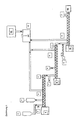
- the dried pine wood impregnated with the polyacrylate are over a Cell rotary valve in a heated continuous mixer (8) with Dosing nozzle for gaseous media and degassing nozzle, jacket temperature 60/100/125 ° C, transferred.
- Ammonia gas with 0.7 MPa dosed into the continuous flow mixer.
- the desorbed water and that Excess ammonia gas is separated through the nozzle (11) by vacuum degassing and sorptively recovered ammonia.
- One from the vacuum degassing nozzle (11) analysis sample showed an ammonia content of the modified pine wood particles of 12 mass%.
- thermoset prepolymers 16
- vacuum degassing 17
- temperature profile 120/135/155/170 / 170/180/170/190/180 ° C transferred.
- the melamine-phenol-formaldehyde prepolymer had been prepared in the thermoset prepolymer synthesis station by condensation of melamine / phenol / formaldehyde (30%) in a molar ratio of 0.8: 0.2: 3.2 at 80 ° C./2.5 hours.
- the reaction mixture is degassed, discharged and granulated through the degassing nozzle (17).
- Test specimens produced by injection molding have the following properties: Tensile strength: 40 MPa Flexural strength: 62 MPa Flexural modulus: 3400 MPa
- the dried spruce wood particles impregnated with polyvinyl alcohol are removed via a Cell wheel lock after dosing of isopropenyl acetate at 0.85 kg / h in one Continuous continuous mixer (8) with dosing nozzle for gaseous media (9) and Degassing nozzle, jacket temperature 80/110/130 ° C, transferred. Via the dosing nozzle with Pressure regulator (9), ammonia gas at 0.7 MPa is metered into the extruder. The desorbed Water and the unreacted reactants and volatile reaction products separated through the nozzle (11) by vacuum degassing and ammonia sorptive recovered. An analysis sample taken from the vacuum degassing nozzle (11) gave an ammonia content of 16% by weight of the modified spruce wood particles.
- 10% by mass, based on the wood particles, glass fibers and 1% by mass, based on the wood particles, of calcium stearate are metered into the extruder via the metering device (12).
- the urea-metamine-formaldehyde prepolymer had been prepared in the thermoset prepolymer synthesis station by condensation of urea / melamine / formaldehyde (25%) in a molar ratio of 0.3: 0.8: 2.8 at 85 ° C./2.5 hours.
- the reaction mixture is degassed, discharged and granulated through the degassing nozzle (17).
- test rods have the following properties: Tensile strength: 65 MPa Flexural strength: 80 MPa Flexural modulus: 7200 MPa
Landscapes
- Engineering & Computer Science (AREA)
- Mechanical Engineering (AREA)
- Life Sciences & Earth Sciences (AREA)
- Chemical & Material Sciences (AREA)
- Wood Science & Technology (AREA)
- Health & Medical Sciences (AREA)
- Forests & Forestry (AREA)
- Materials Engineering (AREA)
- Manufacturing & Machinery (AREA)
- Chemical Kinetics & Catalysis (AREA)
- Medicinal Chemistry (AREA)
- Polymers & Plastics (AREA)
- Organic Chemistry (AREA)
- Compositions Of Macromolecular Compounds (AREA)
- Polyurethanes Or Polyureas (AREA)
- Dry Formation Of Fiberboard And The Like (AREA)
- Phenolic Resins Or Amino Resins (AREA)
Description
- in der ersten Verfahrensstufe Holzpartikel mit wasserlöslichen, in Wasser dispergierbaren und/oder in Wasser emulgierbaren Polymeren, und gegebenenfalls Prepolymeren von Melaminharzen und/oder Harnstoffharzen, durch Imprägnierung und nachfolgende Trocknung auf einen Restwassergehalt von 0,5 bis 5 Masse% modifiziert wurden,
- in der zweiten Verfahrensstufe die in der ersten Verfahrensstufe modifizierten Holzpartikel, gegebenenfalls unter Zusatz von 1 bis 30 Masse%, bezogen auf die modifizierten Holzpartikel, Alkenylacetaten der Formel R-C(=CH2)-O-CO-CH3, wobei R=H oder R=C1-C4-Alkyl bedeuten, und/oder Phosphorylierungsmittel vom Typ C1-C4-Dialkylphosphite, Phosphorsäuredi-C1-C4-alkyl-esterchloride, Di-C1-C4-alkylphosphate und/oder Mono-C1-C4-alkylphosphate, in einem Durchlaufmischer einer Behandlung mit Ammoniakgas bis zu einer Ammoniakaufnahme von 5 bis 20 Masse%, bezogen auf die modifizierten Holzpartikel, gegebenenfalls nachfolgend einer Imprägnierung mit Prepolymeren von Melaminharzen und/oder Harnstoffharzen, unter Abtrennung eines Wasser und Ammoniak enthaltenden Gemischs durch Entgasung unterzogen wurden,
- in der dritten Verfahrensstufe die in der zweiten Verfahrensstufe modifizierten Holzpartikel, gegebenenfalls unter Zusatz von Füll- und Verstärkerstoffen sowie Verarbeitungshilfsmitteln, in einem kontinuierlichen Kneter mit den Prepolymeren von Melaminharzen und/oder Harnstoffharzen homogenisiert, umgesetzt, vacuumentgast, und das Reaktionsprodukt ausgetragen und granuliert wurde,
gelöst.
- in der ersten Verfahrensstufe Holzpartikel über eine Zellenradschleuse in einen kontinuierlichen Durchlauftrockner dosiert werden, in dem bei 80 bis 180°C und einer Verweilzeit von 2 bis 35 min die Holzpartikel durch Besprühen mit einer Lösung, Dispersion, oder Emulsion mit 0,5 bis 10 Masse% wasserlöslichen, in Wasser dispergierbaren und/oder in Wasser emulgierbaren Polymeren, und gegebenenfalls Prepolymeren von Melaminharzen und/oder Harnstoffharzen, durch Imprägnierung und Trocknung auf einen Restwassergehalt von 0,5 bis 5 Masse% unter Inertgasatmosphäre modifiziert werden,
- in der zweiten Verfahrensstufe die in der ersten Verfahrensstufe modifizierten Holzpartikel über eine Zellenradschleuse, gegebenenfalls unter Zusatz von 1 bis 30 Masse%, bezogen auf die modifizierten Holzpartikel, Alkenylacetaten der Formel R-C(=CH2)-O-CO-CH3, wobei R=H oder R=C1-C4-Alkyl bedeuten, und/oder Phosphorylierungsmittel vom Typ C1-C4-Dialkylphosphite, Phosphorsäuredi-C1-C4-alkyl-esterchloride, Di-C1-C4-alkylphosphate und/oder Mono-C1-C4-alkylphosphate, in einem beheizbaren Durchlaufmischer mit Dosierstutzen für Ammoniakgas, Dosierstutzen für Prepolymere von Melaminharzen und/oder Hamstoffharzen und Stutzen für Vacuumentgasung, bei 15 bis 140°C und nach einer Verweilzeit von 0,5 bis 10 min einer Behandlung mit Ammoniakgas bei einem Druck von 0,3 bis 1,5 MPa bis zu einer Ammoniakaufnahme von 5 bis 20 Masse%, bezogen auf die modifizierten Holzpartikel, unter Abtrennung eines Wasser und Ammoniak enthaltenden Gemischs durch Entgasung unterzogen werden, wobei die Gesamtverweilzeit in der zweiten Verfahrensstufe 3 bis 20 min beträgt,
- in der dritten Verfahrensstufe die in der zweiten Verfahrensstufe modifizierten Holzpartikel, gegebenenfalls unter Zusatz von Füll- und Verstärkerstoffen sowie Verarbeitungshilfsmitteln, über eine Zellenradschleuse in einen kontinuierlichen Kneter mit Dosiereinrichtung für Duroplast-Prepolymere dosiert und bei einer Verweilzeit von 3 bis 12 min mit den Prepolymeren von Melaminharzen und/oder Hamstoffharzen homogenisiert werden, die Reaktionsmischung bei Temperaturen im Bereich von 120 bis 200°C umgesetzt, und das Reaktionsprodukt vacuumentgast, ausgetragen und granuliert wird,
Zugfestigkeit: 40 MPa Biegefestigkeit: 62 MPa Biege-E-Modul: 3400 MPa
Zugfestigkeit: 65 MPa Biegefestigkeit: 80 MPa Biege-E-Modul: 7200 MPa
Claims (10)
- Formmassen aus Holzpartikeln und Duroplast-Prepolymeren, dadurch gekennzeichnet, dass die Formmassen ausdurch eine mehrstufige reaktive Compoundierung hergestellt worden sind, wobeia) 65 bis 95 Masse% modifizierten Holzpartikeln,b) 5 bis 34,5 Masse% Prepolymeren von Melaminharzen und/oder Harnstoffharzen mit Molmassen-Zahlenmitteln von 200 bis 5000,c) 0,5 bis 10 Masse% wasserlöslichen, in Wasser dispergierbaren und/oder in Wasser emulgierbaren Polymeren,d) gegebenenfalls 0,5 bis 15 Masse% Füll- und/oder Verstärkungsstoffen und 0,1 bis 1 Masse% Verarbeitungshilfsmitteln,wobei Prepolymere von Melaminharzen und/oder Harnstoffharzen in der ersten Verfahrensstufe nach Zusatz der wasserlöslichen, in Wasser dispergierbaren und/oder in Wasser emulgierbaren Polymeren und/oder in der zweiten Verfahrensstufe vor der Entgasung und/oder in der dritten Verfahrensstufe zugesetzt worden sind.in der ersten Verfahrensstufe Holzpartikel mit wasserlöslichen, in Wasser dispergierbaren und/oder in Wasser emulgierbaren Polymeren, und gegebenenfalls Prepolymeren von Melaminharzen und/oder Harnstoffharzen, durch Imprägnierung und nachfolgende Trocknung auf einen Restwassergehalt von 0,5 bis 5 Masse% modifiziert wurden,in der zweiten Verfahrensstufe die in der ersten Verfahrensstufe modifizierten Holzpartikel, gegebenenfalls unter Zusatz von 1 bis 30 Masse%, bezogen auf die modifizierten Holzpartikel, Alkenylacetaten der Formel R-C(=CH2)-O-CO-CH3, wobei R=H oder R=C1-C4-Alkyl bedeuten, und/oder Phosphorylierungsmittel vom Typ C1-C4-Dialkylphosphite, Phosphorsäuredi-C1-C4-alkyl-esterchloride, Di-C1-C4-alkylphosphate und/oder Mono-C1-C4-alkylphosphate, in einem Durchlaufmischer einer Behandlung mit Ammoniakgas bis zu einer Ammoniakaufnahme von 5 bis 20 Masse%, bezogen auf die modifizierten Holzpartikel, gegebenenfalls nachfolgend einer Imprägnierung mit Prepolymeren von Melaminharzen und/oder Harnstoffharzen, unter Abtrennung eines Wasser und Ammoniak enthaltenden Gemischs durch Entgasung unterzogen wurden,in der dritten Verfahrensstufe die in der zweiten Verfahrensstufe modifizierten Holzpartikel, gegebenenfalls unter Zusatz von Füll- und Verstärkerstoffen sowie Verarbeitungshilfsmitteln, in einem kontinuierlichen Kneter mit den Prepolymeren von Melaminharzen und/oder Harnstoffharzen homogenisiert, umgesetzt, vacuumentgast, und das Reaktionsprodukt ausgetragen und granuliert wurde,
- Formmassen aus Holzpartikeln und Duroplast-Prepolymeren nach Anspruch 1, dadurch gekennzeichnet, dass die Holzpartikel aus Nadel- oder Laubholzabfällen bestehen, die als Partikel mit einem mittleren Durchmesservon 0,2 bis 8 mm oder als Schnitzel oder Fasern einer Maximallänge bis 12 mm vorliegen.
- Formmassen aus Holzpartikeln und Duroplast-Prepolymeren nach Anspruch 1 und 2, dadurch gekennzeichnet, dass die Prepolymere von Melaminharzen und/oder Harnstoffharzen Prepolymere von Melamin-Formaldehyd-Harzen, Melamin-Phenol-Formaldehyd-Harzen, Harnstoff-Formaldehyd-Harzen und/oder Melamin-Harnstoff-Formaldehyd-Harzen sind, bei denen gegebenenfalls 0,5 bis 50 mol% der Methylolgruppen im Prepolymer durch Umsetzung mit C1- bis C4-aliphatischen Alkoholen, Polyalkylenoxiden mit Molmassen von 500 bis 2500 und/oder C5-C12-(Meth)acrylsäurehydroxyalkylestern veräthert durch Umsetzung mit ungesättigten Säuren vom Typ Acrylsäure, Maleinsäureanhydrid und/oder C12-C18-Carbonsäuren verestert und/oder durch Umsetzung mit ungesättigten Säureamiden vom Typ Acrylamid oder Methacrylamid modifiziert worden sind.
- Formmassen aus Holzpartikeln und Duroplast-Prepolymeren nach Anspruch 1 bis 3, dadurch gekennzeichnet, dass die Prepolymere von Melaminharzen und/oder Harnstoffharzen Prepolymere sind, die 5 bis 50 Masse%, bezogen auf die Duroplast-Prepolymere, gekoppelte Blöcke an Polyacrylaten, nichtmodifizierten und/oder modifizierten Maleinsäureanhydridcopolymeren, Polyestern und/oder Alkydharzen enthalten.
- Formmassen aus Holzpartikeln und Duroplast-Prepolymeren nach einem oder mehreren der Ansprüche 1 bis 4, dadurch gekennzeichnet, dass die wasserlöslichen Polymere Polyvinylalkohol, Polyacrylamid, Polyvinylpyrrolidon, Polyethylenoxid, Methylcellulose, Ethylcellulose, Hydroxyethylcellulose und/oder Carboxymethylcellulose sind.
- Formmassen aus Hoizpartikeln und Duroplast-Prepolymeren nach einem oder mehreren der Ansprüche 1 bis 5, dadurch gekennzeichnet, dass die in Wasser dispergierbaren bzw. in Wasser emulgierbaren Polymere Thermoplaste, bevorzugt Celluloseester, Celluloseether, Polyvinylacetat, Polyvinylpropionat, Polyacrylate, modifizierte Maleinsäureanhydrid-Copolymere, Polypropylenoxid und/oder Ethylen-Vinylacetat-Copolymere, Elaste, bevorzugt Styren-Butadien-Kautschuke, Acrylatkautschuke, Polyurethane und/oder Fluorelastomere und/oder Wachse, bevorzugt Polyolefinoxidatwachse oder Wachse auf Basis von Ethylen-Vinylacetat-Copolymeren oder teilverseiften Ethylen-Vinylacetat-Copolymeren sind.
- Verfahren zur Herstellung von Formmassen aus Holzpartikeln und Duroplast-Prepolymeren, dadurch gekennzeichnet, dass die Formmassen ausdurch eine mehrstufige reaktive Compoundierung hergestellt werden; wobeia) 65 bis 95 Masse% modifizierten Holzpartikeln,b) 5 bis 34,5 Masse% Prepolymeren von Melaminharzen und/oder Harnstoffharzen mit Molmassen-Zahlenmitteln von 200 bis 5000,c) 0,5 bis 10 Masse% wasserlösliche, in Wasser dispergierbare und/oder in Wasser emulgierbare Polymered) gegebenenfatls 0,5 bis 15 Masse% Füll- und/oder Verstärkungsstoffen und 0,1 bis 1 Masse% Verarbeitungshilfsmitteln,wobei Prepolymere von Melaminharzen und/oder Harnstoffharzen in der ersten Verfahrensstufe nach Zusatz der wasserlöslichen, in Wasser dispergierbaren und/oder in Wasser emulgierbaren Polymeren und/oder in der zweiten Verfahrensstufe vor der Entgasung und/oder in der dritten Verfahrensstufe zugesetzt werden.in der ersten Verfahrensstufe Holzpartikel über eine Zellenradschleuse in einen kontinuierlichen Durchlauftrockner dosiert werden, in dem bei 80 bis 180°C und einer Verweilzeit von 2 bis 35 min die Holzpartikel durch Besprühen mit einer Lösung, Dispersion, oder Emulsion mit 0,5 bis 10 Masse% wasserlöslichen, in Wasser dispergierbaren und/oder in Wasser emulgierbaren Polymeren, und gegebenenfalls Prepolymeren von Melaminharzen und/oder Hamstoffharzen, durch Imprägnierung und Trocknung auf einen Restwassergehalt von 0,5 bis 5 Masse% unter Inertgasatmosphäre modifiziert werden,in der zweiten Verfahrensstufe die in der ersten Verfahrensstufe modifizierten Holzpartikel über eine Zellenradschleuse, gegebenenfalls unter Zusatz von 1 bis 30 Masse%, bezogen auf die modifizierten Holzpartikel, Alkenylacetaten der Formel R-C(=CH2)-O-CO-CH3, wobei R=H oder R=C1-C4-Alkyl bedeuten, und/oder Phosphorylierungsmittel vom Typ C1-C4-Dialkylphosphite, Phosphorsäuredi-C1-C4-alkyl-esterchloride, Di-C1-C4-alkylphosphate und/oder Mono-C1-C4-alkylphosphate, in einem beheizbaren Durchlaufmischer mit Dosierstutzen für Ammoniakgas, Dosierstutzen für Prepolymere von Melaminharzen und/oder Harnstoffharzen und Stutzen für Vacuumentgasung, bei 15 bis 140°C und nach einer Verweilzeit von 0,5 bis 10 min einer Behandlung mit Ammoniakgas bei einem Druck von 0,3 bis 1,5 MPa bis zu einer Ammoniakaufnahme von 5 bis 20 Masse%, bezogen auf die modifizierten Holzpartikel, unter Abtrennung eines Wasser und Ammoniak enthaltenden Gemischs durch Entgasung unterzogen werden, wobei die Gesamtverweilzeit in der zweiten Verfahrensstufe 3 bis 20 min beträgt,in der dritten Verfahrensstufe die in der zweiten Verfahrensstufe modifizierten Holzpartikel, gegebenenfalls unter Zusatz von Füll- und Verstärkerstoffen sowie Verarbeitungshilfsmitteln, über eine Zellenradschleuse in einen kontinuierlichen Kneter mit Dosiereinrichtung für Duroplast-Prepolymere dosiert und bei einer Verweilzeit von 3 bis 12 min mit den Prepolymeren von Melaminharzen und/oder Harnstoffharzen homogenisiert werden, die Reaktionsmischung bei Temperaturen im Bereich von 120 bis 200°C umgesetzt, und das Reaktionsprodukt vacuumentgast, ausgetragen und granuliert wird,
- Verfahren zur Herstellung von Formmassen aus Holzpartikeln und Duroplast-Prepolymeren nach Anspruch 7, dadurch gekennzeichnet, dass der Zusatz von Prepolymeren von Melaminharzen und/oder Harnstoffharzen ausschliesslich in der dritten Verfahrensstufe erfolgt.
- Verfahren zur Herstellung von Formmassen aus Holzpartikeln und Duroplast-Prepolymeren nach Anspruch 7 und 8, dadurch gekennzeichnet, dass die Dosierung des Duroplast-Prepolymers in der ersten Verfahrensstufe nach Zusatz der wassertösüchen, in Wasser dispergierbaren und/oder in Wasser emulgierbaren Polymeren und/oder in der zweiten Verfahrensstufe vor der Entgasung und/oder in der dritten Verfahrensstufe bevorzugt aus einem Vorratsbehälter, dem eine Duroplastprepolymersynthesestation vorgelagert ist, erfolgt.
- Verwendung von Formmassen nach einem oder mehreren der Ansprüche 1 bis 6 zur Herstellung von Spritzgussteilen oder von durch Extrusion hergestellten Halbzeugen oder Formstoffen, bevorzugt in Form von Platten, Profilen, Hohlprofilen und Rohren für einen Einsatz in der Bauindustrie und/oder Möbelindustrie.
Applications Claiming Priority (3)
| Application Number | Priority Date | Filing Date | Title |
|---|---|---|---|
| DE10022008 | 2000-05-05 | ||
| DE10022008A DE10022008B4 (de) | 2000-05-05 | 2000-05-05 | Formmassen aus Holzpartikeln und Duroplast-Prepolymeren sowie ein Verfahren zu deren Herstellung |
| PCT/DE2001/001659 WO2001085847A1 (de) | 2000-05-05 | 2001-05-03 | Formmasen aus holzpartikeln und duroplast-prepolymeren |
Publications (2)
| Publication Number | Publication Date |
|---|---|
| EP1278802A1 EP1278802A1 (de) | 2003-01-29 |
| EP1278802B1 true EP1278802B1 (de) | 2004-10-27 |
Family
ID=7640950
Family Applications (1)
| Application Number | Title | Priority Date | Filing Date |
|---|---|---|---|
| EP20010943000 Expired - Lifetime EP1278802B1 (de) | 2000-05-05 | 2001-05-03 | Formmassen aus holzpartikeln und duroplast-prepolymeren |
Country Status (8)
| Country | Link |
|---|---|
| EP (1) | EP1278802B1 (de) |
| AT (1) | ATE280807T1 (de) |
| AU (1) | AU2001265763A1 (de) |
| DE (2) | DE10022008B4 (de) |
| DK (1) | DK1278802T3 (de) |
| ES (1) | ES2231506T3 (de) |
| PT (1) | PT1278802E (de) |
| WO (1) | WO2001085847A1 (de) |
Families Citing this family (12)
| Publication number | Priority date | Publication date | Assignee | Title |
|---|---|---|---|---|
| SE0102043L (sv) * | 2001-06-08 | 2002-12-09 | Ivf Industriforskning Och Utve | Träkompositmaterial och framställning därav |
| DE10226817C1 (de) * | 2002-06-15 | 2003-11-13 | Eichenauer Gmbh & Co Kg F | Giessform und Verfahren zu deren Herstellung |
| WO2004101240A1 (en) * | 2003-05-14 | 2004-11-25 | Eco New Technology Llc | Method and machine for manufacturing a panel element and element so carried out |
| DE10333893A1 (de) * | 2003-07-22 | 2005-02-10 | Kompetenzzentrum Holz Gmbh | Kunststoffe und Holz enthaltende Verbundwerkstoffe |
| DE10361878A1 (de) | 2003-12-19 | 2005-07-14 | Ami-Agrolinz Melamine International Gmbh | Flammschutzmischung für lignocellulosische Verbundstoffe |
| DE102004011931B4 (de) | 2004-03-11 | 2006-09-14 | Kronotec Ag | Dämmstoffplatte aus einem Holzwerkstoff-Bindemittelfaser-Gemisch |
| DE102005029685A1 (de) * | 2005-06-20 | 2006-12-21 | Ami-Agrolinz Melamine International Gmbh | Verbundwerkstoff |
| DE102007041438A1 (de) * | 2007-08-28 | 2009-03-05 | Ami Agrolinz Melamine International Gmbh | Verbundwerkstoff, Verwendung eines Verbundwerkstoffes und Verfahren zur Herstellung eines Verbundwerkstoffes |
| CN101704264B (zh) * | 2009-11-06 | 2011-11-16 | 南京林业大学 | 真空——冷等离子体处理降低人造板甲醛释放量的方法 |
| DE102017118881A1 (de) * | 2017-08-18 | 2019-02-21 | Kafform UG (haftungsbeschränkt) | Verfahren zur Herstellung von Gebrauchsgegenständen |
| EP3656524B1 (de) * | 2018-11-21 | 2021-01-06 | Biofibre GmbH | Verfahren zur herstellung von bioverbundmaterialien enthaltend zellulose |
| CN112358586B (zh) * | 2020-11-10 | 2023-09-15 | 中钢集团马鞍山矿山研究总院股份有限公司 | 一种碳气凝胶前驱体的低成本制备方法 |
Family Cites Families (2)
| Publication number | Priority date | Publication date | Assignee | Title |
|---|---|---|---|---|
| US3305499A (en) * | 1965-06-04 | 1967-02-21 | American Radiator & Standard | Article of pressed wood and process for making same |
| US5071682A (en) * | 1989-07-28 | 1991-12-10 | Melamine Chemicals, Inc. | Method of using non-resinous melamine to safen urea-formaldehyde-wood composite products and product produced thereby |
-
2000
- 2000-05-05 DE DE10022008A patent/DE10022008B4/de not_active Expired - Fee Related
-
2001
- 2001-05-03 EP EP20010943000 patent/EP1278802B1/de not_active Expired - Lifetime
- 2001-05-03 DE DE50104615T patent/DE50104615D1/de not_active Expired - Fee Related
- 2001-05-03 WO PCT/DE2001/001659 patent/WO2001085847A1/de not_active Ceased
- 2001-05-03 ES ES01943000T patent/ES2231506T3/es not_active Expired - Lifetime
- 2001-05-03 DK DK01943000T patent/DK1278802T3/da active
- 2001-05-03 PT PT01943000T patent/PT1278802E/pt unknown
- 2001-05-03 AT AT01943000T patent/ATE280807T1/de not_active IP Right Cessation
- 2001-05-03 AU AU2001265763A patent/AU2001265763A1/en not_active Abandoned
Also Published As
| Publication number | Publication date |
|---|---|
| ATE280807T1 (de) | 2004-11-15 |
| ES2231506T3 (es) | 2005-05-16 |
| AU2001265763A1 (en) | 2001-11-20 |
| DE10022008A1 (de) | 2001-11-15 |
| DE10022008B4 (de) | 2004-12-09 |
| PT1278802E (pt) | 2005-03-31 |
| DK1278802T3 (da) | 2005-03-14 |
| WO2001085847A1 (de) | 2001-11-15 |
| EP1278802A1 (de) | 2003-01-29 |
| DE50104615D1 (de) | 2004-12-30 |
Similar Documents
| Publication | Publication Date | Title |
|---|---|---|
| EP1294561B1 (de) | Faserverbunde hoher dimensionsstabilität, bewitterungsresistenz und flammfestigkeit | |
| EP1278802B1 (de) | Formmassen aus holzpartikeln und duroplast-prepolymeren | |
| EP1648963B1 (de) | Kunststofferzeugnisse hoher festigkeit und flexibilität | |
| EP1353994B1 (de) | Modifizierte anorganische partikel | |
| EP1654322A2 (de) | Kunststoffe und holz enthaltende verbundwerkstoffe | |
| Ayrilmis et al. | Flat-pressed wood plastic composite as an alternative to conventional wood-based panels | |
| EP1858677A1 (de) | Herstellung von formkörpern aus feinteiligen materialien auf basis von lignocellulose | |
| EP1448671A1 (de) | Erzeugnisse, insbesondere formmassen aus triazinsegmente enthaltenden polymeren, verfahren zu deren herstellung und verwendungen | |
| EP2044135A1 (de) | Thermoplastisch verarbeitbare duroplastformmassen mit verbessertem eigenschaftsspektrum | |
| EP1005411B1 (de) | Kontinuierliches verfahren zur herstellung von amino- und/oder phenoplasten | |
| DE10261804B4 (de) | Direktsyntheseverfahren zur Herstellung von veretherten Melaminharzkondensaten, Melaminharzkondensate und deren Verwendung | |
| EP1720922B1 (de) | Flammfest ausgerüstetes aminoplastharzsystem | |
| EP1232211A1 (de) | Bindemittel zur herstellung von formkörpern und unter verwendung dieses bindemittels hergestellte formkörper | |
| EP1341856B1 (de) | Polymermodifizierte anorganische partikel | |
| DE1136483B (de) | Verfahren zur Herstellung fuellstoffhaltiger, Polymere enthaltender Massen | |
| NL9200507A (nl) | Recyclingwerkwijze voor niet met vezels versterkte duroplastische kunststoffen. | |
| DE102004043213A1 (de) | Modifiziertes Aminotriazinharz und ein Verfahren zu deren Herstellung |
Legal Events
| Date | Code | Title | Description |
|---|---|---|---|
| PUAI | Public reference made under article 153(3) epc to a published international application that has entered the european phase |
Free format text: ORIGINAL CODE: 0009012 |
|
| 17P | Request for examination filed |
Effective date: 20021014 |
|
| AK | Designated contracting states |
Designated state(s): AT BE CH CY DK ES FI FR GB GR IE IT LI LU MC NL PT SE TR |
|
| AX | Request for extension of the european patent |
Extension state: AL LT LV MK RO SI |
|
| RIN1 | Information on inventor provided before grant (corrected) |
Inventor name: RAETZSCH, MANFRED Inventor name: BUCKA, HARTMUT |
|
| RAP1 | Party data changed (applicant data changed or rights of an application transferred) |
Owner name: AMI AGROLINZ MELAMINE INTERNATIONAL GMBH |
|
| GRAP | Despatch of communication of intention to grant a patent |
Free format text: ORIGINAL CODE: EPIDOSNIGR1 |
|
| GRAS | Grant fee paid |
Free format text: ORIGINAL CODE: EPIDOSNIGR3 |
|
| GRAA | (expected) grant |
Free format text: ORIGINAL CODE: 0009210 |
|
| AK | Designated contracting states |
Kind code of ref document: B1 Designated state(s): AT BE CH CY DK ES FI FR GB GR IE IT LI LU MC NL PT SE TR |
|
| PG25 | Lapsed in a contracting state [announced via postgrant information from national office to epo] |
Ref country code: IE Free format text: LAPSE BECAUSE OF FAILURE TO SUBMIT A TRANSLATION OF THE DESCRIPTION OR TO PAY THE FEE WITHIN THE PRESCRIBED TIME-LIMIT Effective date: 20041027 |
|
| REG | Reference to a national code |
Ref country code: GB Ref legal event code: FG4D Free format text: NOT ENGLISH |
|
| REG | Reference to a national code |
Ref country code: CH Ref legal event code: EP |
|
| RBV | Designated contracting states (corrected) |
Designated state(s): AT BE CH CY DE DK ES FI FR GB GR IE IT LI LU MC NL PT SE TR |
|
| REG | Reference to a national code |
Ref country code: IE Ref legal event code: FG4D Free format text: GERMAN |
|
| REF | Corresponds to: |
Ref document number: 50104615 Country of ref document: DE Date of ref document: 20041230 Kind code of ref document: P |
|
| REG | Reference to a national code |
Ref country code: CH Ref legal event code: NV Representative=s name: E. BLUM & CO. PATENTANWAELTE |
|
| GBT | Gb: translation of ep patent filed (gb section 77(6)(a)/1977) |
Effective date: 20050126 |
|
| REG | Reference to a national code |
Ref country code: GR Ref legal event code: EP Ref document number: 20050400255 Country of ref document: GR |
|
| REG | Reference to a national code |
Ref country code: SE Ref legal event code: TRGR |
|
| REG | Reference to a national code |
Ref country code: DK Ref legal event code: T3 |
|
| REG | Reference to a national code |
Ref country code: PT Ref legal event code: SC4A Free format text: AVAILABILITY OF NATIONAL TRANSLATION Effective date: 20050117 |
|
| LTIE | Lt: invalidation of european patent or patent extension |
Effective date: 20041027 |
|
| PGFP | Annual fee paid to national office [announced via postgrant information from national office to epo] |
Ref country code: GB Payment date: 20050425 Year of fee payment: 5 Ref country code: TR Payment date: 20050425 Year of fee payment: 5 |
|
| PGFP | Annual fee paid to national office [announced via postgrant information from national office to epo] |
Ref country code: PT Payment date: 20050427 Year of fee payment: 5 |
|
| PG25 | Lapsed in a contracting state [announced via postgrant information from national office to epo] |
Ref country code: CY Free format text: LAPSE BECAUSE OF FAILURE TO SUBMIT A TRANSLATION OF THE DESCRIPTION OR TO PAY THE FEE WITHIN THE PRESCRIBED TIME-LIMIT Effective date: 20050503 Ref country code: LU Free format text: LAPSE BECAUSE OF NON-PAYMENT OF DUE FEES Effective date: 20050503 |
|
| PGFP | Annual fee paid to national office [announced via postgrant information from national office to epo] |
Ref country code: CH Payment date: 20050512 Year of fee payment: 5 Ref country code: NL Payment date: 20050512 Year of fee payment: 5 |
|
| REG | Reference to a national code |
Ref country code: ES Ref legal event code: FG2A Ref document number: 2231506 Country of ref document: ES Kind code of ref document: T3 |
|
| PGFP | Annual fee paid to national office [announced via postgrant information from national office to epo] |
Ref country code: ES Payment date: 20050517 Year of fee payment: 5 |
|
| REG | Reference to a national code |
Ref country code: IE Ref legal event code: FD4D |
|
| PGFP | Annual fee paid to national office [announced via postgrant information from national office to epo] |
Ref country code: GR Payment date: 20050524 Year of fee payment: 5 |
|
| PG25 | Lapsed in a contracting state [announced via postgrant information from national office to epo] |
Ref country code: MC Free format text: LAPSE BECAUSE OF NON-PAYMENT OF DUE FEES Effective date: 20050531 |
|
| PGFP | Annual fee paid to national office [announced via postgrant information from national office to epo] |
Ref country code: BE Payment date: 20050606 Year of fee payment: 5 |
|
| PLBE | No opposition filed within time limit |
Free format text: ORIGINAL CODE: 0009261 |
|
| STAA | Information on the status of an ep patent application or granted ep patent |
Free format text: STATUS: NO OPPOSITION FILED WITHIN TIME LIMIT |
|
| ET | Fr: translation filed | ||
| 26N | No opposition filed |
Effective date: 20050728 |
|
| PG25 | Lapsed in a contracting state [announced via postgrant information from national office to epo] |
Ref country code: GB Free format text: LAPSE BECAUSE OF NON-PAYMENT OF DUE FEES Effective date: 20060503 |
|
| PG25 | Lapsed in a contracting state [announced via postgrant information from national office to epo] |
Ref country code: ES Free format text: LAPSE BECAUSE OF NON-PAYMENT OF DUE FEES Effective date: 20060504 |
|
| PG25 | Lapsed in a contracting state [announced via postgrant information from national office to epo] |
Ref country code: CH Free format text: LAPSE BECAUSE OF NON-PAYMENT OF DUE FEES Effective date: 20060531 Ref country code: BE Free format text: LAPSE BECAUSE OF NON-PAYMENT OF DUE FEES Effective date: 20060531 Ref country code: LI Free format text: LAPSE BECAUSE OF NON-PAYMENT OF DUE FEES Effective date: 20060531 |
|
| PGFP | Annual fee paid to national office [announced via postgrant information from national office to epo] |
Ref country code: IT Payment date: 20060531 Year of fee payment: 6 |
|
| PG25 | Lapsed in a contracting state [announced via postgrant information from national office to epo] |
Ref country code: PT Free format text: LAPSE BECAUSE OF NON-PAYMENT OF DUE FEES Effective date: 20061103 |
|
| PG25 | Lapsed in a contracting state [announced via postgrant information from national office to epo] |
Ref country code: NL Free format text: LAPSE BECAUSE OF NON-PAYMENT OF DUE FEES Effective date: 20061201 |
|
| REG | Reference to a national code |
Ref country code: PT Ref legal event code: MM4A Free format text: LAPSE DUE TO NON-PAYMENT OF FEES Effective date: 20061103 |
|
| REG | Reference to a national code |
Ref country code: CH Ref legal event code: PL |
|
| GBPC | Gb: european patent ceased through non-payment of renewal fee |
Effective date: 20060503 |
|
| NLV4 | Nl: lapsed or anulled due to non-payment of the annual fee |
Effective date: 20061201 |
|
| REG | Reference to a national code |
Ref country code: ES Ref legal event code: FD2A Effective date: 20060504 |
|
| BERE | Be: lapsed |
Owner name: AGROLINZ MELAMINE INTERNATIONAL G.M.B.H. *AMI Effective date: 20060531 |
|
| PGFP | Annual fee paid to national office [announced via postgrant information from national office to epo] |
Ref country code: DE Payment date: 20080502 Year of fee payment: 8 Ref country code: DK Payment date: 20080509 Year of fee payment: 8 |
|
| PGFP | Annual fee paid to national office [announced via postgrant information from national office to epo] |
Ref country code: AT Payment date: 20080515 Year of fee payment: 8 |
|
| PGFP | Annual fee paid to national office [announced via postgrant information from national office to epo] |
Ref country code: FI Payment date: 20080514 Year of fee payment: 8 |
|
| PG25 | Lapsed in a contracting state [announced via postgrant information from national office to epo] |
Ref country code: GR Free format text: LAPSE BECAUSE OF NON-PAYMENT OF DUE FEES Effective date: 20061205 |
|
| PGFP | Annual fee paid to national office [announced via postgrant information from national office to epo] |
Ref country code: SE Payment date: 20080513 Year of fee payment: 8 |
|
| PG25 | Lapsed in a contracting state [announced via postgrant information from national office to epo] |
Ref country code: TR Free format text: LAPSE BECAUSE OF FAILURE TO SUBMIT A TRANSLATION OF THE DESCRIPTION OR TO PAY THE FEE WITHIN THE PRESCRIBED TIME-LIMIT Effective date: 20041027 Ref country code: IT Free format text: LAPSE BECAUSE OF NON-PAYMENT OF DUE FEES Effective date: 20070503 |
|
| REG | Reference to a national code |
Ref country code: DK Ref legal event code: EBP |
|
| PG25 | Lapsed in a contracting state [announced via postgrant information from national office to epo] |
Ref country code: FI Free format text: LAPSE BECAUSE OF NON-PAYMENT OF DUE FEES Effective date: 20090503 Ref country code: AT Free format text: LAPSE BECAUSE OF NON-PAYMENT OF DUE FEES Effective date: 20090503 |
|
| REG | Reference to a national code |
Ref country code: FR Ref legal event code: ST Effective date: 20100129 |
|
| PG25 | Lapsed in a contracting state [announced via postgrant information from national office to epo] |
Ref country code: FR Free format text: LAPSE BECAUSE OF NON-PAYMENT OF DUE FEES Effective date: 20090602 Ref country code: DK Free format text: LAPSE BECAUSE OF NON-PAYMENT OF DUE FEES Effective date: 20090531 |
|
| PGFP | Annual fee paid to national office [announced via postgrant information from national office to epo] |
Ref country code: FR Payment date: 20080526 Year of fee payment: 8 |
|
| PG25 | Lapsed in a contracting state [announced via postgrant information from national office to epo] |
Ref country code: DE Free format text: LAPSE BECAUSE OF NON-PAYMENT OF DUE FEES Effective date: 20091201 |
|
| PG25 | Lapsed in a contracting state [announced via postgrant information from national office to epo] |
Ref country code: SE Free format text: LAPSE BECAUSE OF NON-PAYMENT OF DUE FEES Effective date: 20090504 |