EP1279165B1 - Reconnaissance vocale - Google Patents
Reconnaissance vocale Download PDFInfo
- Publication number
- EP1279165B1 EP1279165B1 EP01926416A EP01926416A EP1279165B1 EP 1279165 B1 EP1279165 B1 EP 1279165B1 EP 01926416 A EP01926416 A EP 01926416A EP 01926416 A EP01926416 A EP 01926416A EP 1279165 B1 EP1279165 B1 EP 1279165B1
- Authority
- EP
- European Patent Office
- Prior art keywords
- novelty
- time
- output
- coincidence
- parameters
- Prior art date
- Legal status (The legal status is an assumption and is not a legal conclusion. Google has not performed a legal analysis and makes no representation as to the accuracy of the status listed.)
- Expired - Lifetime
Links
Images












Classifications
-
- G—PHYSICS
- G06—COMPUTING OR CALCULATING; COUNTING
- G06Q—INFORMATION AND COMMUNICATION TECHNOLOGY [ICT] SPECIALLY ADAPTED FOR ADMINISTRATIVE, COMMERCIAL, FINANCIAL, MANAGERIAL OR SUPERVISORY PURPOSES; SYSTEMS OR METHODS SPECIALLY ADAPTED FOR ADMINISTRATIVE, COMMERCIAL, FINANCIAL, MANAGERIAL OR SUPERVISORY PURPOSES, NOT OTHERWISE PROVIDED FOR
- G06Q30/00—Commerce
- G06Q30/02—Marketing; Price estimation or determination; Fundraising
-
- G—PHYSICS
- G06—COMPUTING OR CALCULATING; COUNTING
- G06F—ELECTRIC DIGITAL DATA PROCESSING
- G06F40/00—Handling natural language data
- G06F40/20—Natural language analysis
- G06F40/205—Parsing
- G06F40/211—Syntactic parsing, e.g. based on context-free grammar [CFG] or unification grammars
-
- G—PHYSICS
- G06—COMPUTING OR CALCULATING; COUNTING
- G06F—ELECTRIC DIGITAL DATA PROCESSING
- G06F40/00—Handling natural language data
- G06F40/20—Natural language analysis
- G06F40/253—Grammatical analysis; Style critique
-
- G—PHYSICS
- G06—COMPUTING OR CALCULATING; COUNTING
- G06F—ELECTRIC DIGITAL DATA PROCESSING
- G06F40/00—Handling natural language data
- G06F40/30—Semantic analysis
-
- G—PHYSICS
- G10—MUSICAL INSTRUMENTS; ACOUSTICS
- G10L—SPEECH ANALYSIS TECHNIQUES OR SPEECH SYNTHESIS; SPEECH RECOGNITION; SPEECH OR VOICE PROCESSING TECHNIQUES; SPEECH OR AUDIO CODING OR DECODING
- G10L15/00—Speech recognition
- G10L15/02—Feature extraction for speech recognition; Selection of recognition unit
-
- G—PHYSICS
- G10—MUSICAL INSTRUMENTS; ACOUSTICS
- G10L—SPEECH ANALYSIS TECHNIQUES OR SPEECH SYNTHESIS; SPEECH RECOGNITION; SPEECH OR VOICE PROCESSING TECHNIQUES; SPEECH OR AUDIO CODING OR DECODING
- G10L15/00—Speech recognition
- G10L15/08—Speech classification or search
- G10L15/18—Speech classification or search using natural language modelling
- G10L15/1822—Parsing for meaning understanding
-
- G—PHYSICS
- G10—MUSICAL INSTRUMENTS; ACOUSTICS
- G10L—SPEECH ANALYSIS TECHNIQUES OR SPEECH SYNTHESIS; SPEECH RECOGNITION; SPEECH OR VOICE PROCESSING TECHNIQUES; SPEECH OR AUDIO CODING OR DECODING
- G10L15/00—Speech recognition
- G10L15/28—Constructional details of speech recognition systems
- G10L15/30—Distributed recognition, e.g. in client-server systems, for mobile phones or network applications
-
- G—PHYSICS
- G10—MUSICAL INSTRUMENTS; ACOUSTICS
- G10L—SPEECH ANALYSIS TECHNIQUES OR SPEECH SYNTHESIS; SPEECH RECOGNITION; SPEECH OR VOICE PROCESSING TECHNIQUES; SPEECH OR AUDIO CODING OR DECODING
- G10L15/00—Speech recognition
- G10L15/08—Speech classification or search
- G10L15/14—Speech classification or search using statistical models, e.g. Hidden Markov Models [HMMs]
-
- G—PHYSICS
- G10—MUSICAL INSTRUMENTS; ACOUSTICS
- G10L—SPEECH ANALYSIS TECHNIQUES OR SPEECH SYNTHESIS; SPEECH RECOGNITION; SPEECH OR VOICE PROCESSING TECHNIQUES; SPEECH OR AUDIO CODING OR DECODING
- G10L15/00—Speech recognition
- G10L15/08—Speech classification or search
- G10L15/18—Speech classification or search using natural language modelling
- G10L15/1815—Semantic context, e.g. disambiguation of the recognition hypotheses based on word meaning
-
- G—PHYSICS
- G10—MUSICAL INSTRUMENTS; ACOUSTICS
- G10L—SPEECH ANALYSIS TECHNIQUES OR SPEECH SYNTHESIS; SPEECH RECOGNITION; SPEECH OR VOICE PROCESSING TECHNIQUES; SPEECH OR AUDIO CODING OR DECODING
- G10L15/00—Speech recognition
- G10L15/08—Speech classification or search
- G10L15/18—Speech classification or search using natural language modelling
- G10L15/183—Speech classification or search using natural language modelling using context dependencies, e.g. language models
- G10L15/19—Grammatical context, e.g. disambiguation of the recognition hypotheses based on word sequence rules
- G10L15/193—Formal grammars, e.g. finite state automata, context free grammars or word networks
-
- G—PHYSICS
- G10—MUSICAL INSTRUMENTS; ACOUSTICS
- G10L—SPEECH ANALYSIS TECHNIQUES OR SPEECH SYNTHESIS; SPEECH RECOGNITION; SPEECH OR VOICE PROCESSING TECHNIQUES; SPEECH OR AUDIO CODING OR DECODING
- G10L15/00—Speech recognition
- G10L15/02—Feature extraction for speech recognition; Selection of recognition unit
- G10L2015/025—Phonemes, fenemes or fenones being the recognition units
Definitions
- the present invention relates to speech recognition, and more particularly, to systems for and methods of transforming an acoustical speech signal into a linguistic stream of phonetics, words and other speech components.
- speech recognition is a multi-layered process.
- a speech recognition system analyzes a raw acoustic waveform over time, and applies some complex algorithm to extract a stream of linguistic units (e.g., the phonetics, words, etc.).
- the term “stream” may also be referred to herein as a “sequence” or a “series,” and the term “linguistic units” may also be referred to herein as “phonetic estimates.”
- the term “acoustic waveform” may also be referred to herein as "acoustic signal,” “audio signal,” or “audio waveform.”
- a speech recognition system may further apply various sources of linguistic constraints, so that the utterance may be finally interpreted within a practical context.
- HMM Hidden Markov Modeling
- This approach is based on the idea that the study of linguistics has accumulated a vast body of knowledge about the acoustic features that correspond to the phonetics of human language. Once these features are characterized and estimated, a system can integrate them statistically to derive the best guess as to the underlying spoken utterance.
- the preprocessors may be used to modify the raw acoustic signal to form a modified signal.
- the preprocessors may then provide the modified signal into standard pattern recognizers. This approach has yielded some limited success, primarily with regard to noise immunity.
- ANNs Artificial Neural Nets
- HMM Hidden Markov Modeling
- Speech comprises a collection of phrases, each phrase includes a series of words, and each word includes components called phonemes, which are the consonants and vowels.
- a hierarchy of states may be used to describe speech. At the lowest level, for the smallest linguistic unit chosen, the sub-states are the actual acoustic data.
- an HMM system builds up the most likely representation of the speech from bottom to top, each sub-part or super-part helping to improve the probabilities of the others, the system should be able to just read off the word and phrase content at the top level.
- VQ Vector Quantization
- Continuous Density HMM is now the most widely used algorithm. There are many choices for how to implement this algorithm, and a particular implementation may utilize any number of preprocessors, and may be embedded into a complex system.
- HMM HMM
- phonetics or words as the base level. Words are less flexible, require more training data, and are context dependent, but they can be much more accurate. Phonetics allows either a large vocabulary or sets of small and dynamic vocabularies.
- speaker-dependent i.e., speaker-adaptive
- speaker-independent speaker-independent systems
- a disadvantage to prior art systems that use HMM is a fundamental trade-off between functionality for (1) many words or (2) many people.
- a publicly accessible recognition system must maintain its accuracy for a high percentage of the user population. "Human adaptation to different speakers, speaking styles, speaking rates, etc., is almost momentarily [i.e. instantaneous]. However, most so-called adaptive speech recognizers need sizable chunks of speech to adapt.” ( Pols, Louis C.W., Flexible, robust, and efficient human speech recognition, Institute of Phonetic Sciences, University of Amsterdam, Proceedings 21 (1997), 1-10 ) Variation in users includes age, gender, accent, dialect, behavior, motivation, and conversational strategy.
- a publicly accessible speech recognition system must also be robust with respect to variations in the acoustical environment.
- One definition of environmental robustness of speech recognition is maintaining a high level of recognition accuracy in difficult and dynamically-varying acoustical environments.
- variations in the acoustical environment may be caused by variations in the telephone itself, the transmission of the voice over the physical media, and the background acoustical environment of the user.
- ASR automatic speech recognition
- a machine recognition system's accuracy should degrade in the presence of acoustic interference in the same way a human listener's would: gradually, gracefully and predictably. This is not true in practice.
- Tests on different state-of-the-art ASR systems carried out over a broad range of different vocabularies and acoustic conditions show that automatic recognizers typically commit at least ten times more errors than human listeners.”
- Brian E. D. Kingsbury, Perceptually-inspired signal processing strategies for robust speech recognition in reverberant environments, PhD thesis, UC Berkeley, 1998 . "While a lot of progress has been made during the last years in the field of Automatic Speech recognition (ASR), one of the main remaining problems is that of robustness.
- the present invention is based on the concept that speech is an acoustical signal encoded with information, and the human brain applies a set of rules to the encoded signal to decode the information. Once those rules are determined, an artificial system can utilize the rules to similarly decode the signal and extract the information.
- HMM uses a web of phonetic hypotheses that depend critically on context.
- the phonetic front end of the present invention produces definite phonetic signals. This provides a context independence that is critical to performing well in real-world applications where the acoustic context and linguistic context are extremely variable.
- the phonetic recognizer provides a feed-forward, context-independent stream of phonetic estimates. This allows simplification of follow-on processing steps.
- the system includes a frequency analyzer for receiving the acoustic signal and producing as an output a short-time frequency representation of the acoustic signal.
- the system further includes a novelty processor that receives the short-time frequency representation of the acoustic signal, and separates one or more background components of the representation from one or more region of interest components of the representation.
- the novelty processor produces a novelty output that includes the region of interest components of the representation according to one or more novelty parameters.
- the system also includes an attention processor that receives the novelty output and produces a gating signal as predetermined function of the novelty output according to one or more attention parameters.
- the system further includes a coincidence processor that receives the novelty output and the gating signal, and produces a coincidence output.
- the coincidence output includes information regarding co-occurrences between samples of the novelty output over time and frequency.
- the coincidence output is selectively gated as a predetermined function of the gating signal, so as to produce a gated coincidence output according to one or more coincidence parameters.
- the system also includes a vector pattern recognizer and a probability processor for receiving the gated coincidence output and producing a phonetic estimate stream representative of acoustic signal.
- the short-time frequency representation of the audio signal includes a series of consecutive time instances. Each consecutive pair is separated by a sampling interval, and each of the time instances further includes a series of discrete Fourier transform (DFT) points, such that the short-time frequency representation of the audio signal includes a series of DFT points.
- DFT discrete Fourier transform
- the novelty processor calculates a first average value across a first predetermined frequency range and a first predetermined time span, calculates a second average value across a second predetermined frequency range and a second predetermined time span, and subtracts the second average value from the first average value so as to produce the novelty output point.
- the first frequency range, the first time span, the second frequency range and the second time span are each a function of one or more of the novelty parameters.
- the first predetermined frequency range is substantially centered about a frequency corresponding to DFT point
- the first predetermined time span is substantially centered about an instant in time corresponding to the DFT point.
- the first predetermined frequency range is substantially smaller than the second predetermined frequency range.
- the first predetermined time span is substantially smaller than the second predetermined time span. In another embodiment of the invention, the first predetermined time span is large relative to the second predetermined frequency range. In another embodiment of the invention, the second predetermined frequency range is large relative to the second predetermined time span.
- the novelty processor for each DFT point, the novelty processor further calculates one or more additional novelty outputs. Each additional novelty output is defined by characteristics including a distinct first frequency range, first time span, second frequency range and second time span, each characteristic being a function of one or more of the novelty parameters. In another embodiment of the invention, the coincidence output includes a sum of products of novelty output points over two sets of novelty output points.
- the two sets of novelty output points includes a first set of novelty output points corresponding to a first instant in time and a second set of novelty output points corresponding to a second time instance.
- the two sets of novelty output points all correspond to a single time instance.
- the coincidence processor performs the sum of products of novelty output points over two sets of novelty output points according to one or more selectably variable coincidence parameters including (but not limited to) time duration, frequency extent, base time, base frequency, delta time, delta frequency, and combinations thereof.
- each of the time instances further includes an energy value in addition to the series of novelty output points.
- the attention processor compares the energy value to a predetermined threshold value according to a comparison criterion, so as to produce an energy threshold determination.
- the attention processor then produces the gating signal as a predetermined function of the threshold determination.
- the one or more attention parameters include the predetermined threshold value, the comparison criterion and the predetermined function of the threshold determination.
- the novelty parameters, the attention parameters and the coincidence parameters are selected via a genetic algorithm.
- the invention comprises a method of transforming an acoustic signal into a stream of phonetic estimates. The method includes receiving the acoustic signal and producing a short-time frequency representation of the acoustic signal.
- the method further includes separating one or more background components of the representation from one or more region of interest components of the representation, and producing a novelty output including the region of interest components of the representation according to one or more novelty parameters.
- the method also includes producing a gating signal as a predetermined function of the novelty output according to one or more attention parameters.
- the method further includes producing a coincidence output that includes correlations between samples of the novelty output over time and frequency. The coincidence output is selectively gated as a predetermined function of the gating signal, so as to produce a gated coincidence output according to one or more coincidence parameters.
- the method also includes producing a phonetic estimate stream representative of acoustic signal as a function of the gated coincidence output.
- the method further includes calculating, for each of a plurality of DFT points from the a short-time frequency representation of the acoustic signal, one or more additional novelty outputs.
- Each additional novelty output is defined by characteristics including a distinct first frequency range, first time span, second frequency range and second time span, each characteristic being a function of one or more of the novelty parameters
- the method further includes performing a sum of products of novelty outputs over two sets of novelty outputs according to one or more selectably variable coincidence parameters.
- the parameters include (but are not limited to) time duration, frequency extent, base time, base frequency, delta time, delta frequency, and combinations thereof.
- the method further includes calculating a first average value across a first predetermined frequency range and a first predetermined time span.
- the method further includes calculating a second average value across a second predetermined frequency range and a second predetermined time span, subtracting the second average value from the first average value so as to produce the novelty output.
- the method further includes comparing the energy value to a predetermined threshold value according to a comparison criterion, so as to produce an energy threshold determination, and (ii) producing the gating signal as as predetermined function of the threshold determination.
- the method further includes selecting the novelty parameters, the attention parameters and the coincidence parameters via a genetic algorithm.
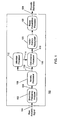
- Fig. 1 provides an overview, in block diagram form, of the complete phonetic recognition system according to the present invention
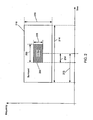
- Fig. 2 shows the center-surround receptive field novelty processing performed by the novelty processor of the system shown in FIG. 1 ;
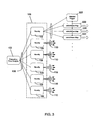
- FIG. 3 shows the data flow from the short-time frequency analyzer through the novelty processor for one preferred embodiment of the invention shown in FIG. 1 ;
- FIG. 4 shows the novelty parameters produced by the GA for fricatives
- FIG. 5 shows the coincidence processing parameters and modules produced by the GA for fricatives
- FIG. 6 shows the novelty parameters produced by the GA for vowels
- FIG. 7 shows the coincidence processing parameters and modules produced by the GA for vowels
- FIG. 8 shows the novelty parameters produced by the GA for non-fricatives
- FIG. 9 shows the coincidence processing parameters and modules produced by the GA for non-fricatives
- FIG. 10 shows the specific data flow used in a preferred embodiment of the invention shown in FIG.1 ;
- FIGs. 11A and 11B together show the high-level object-flow specification of the complete processing flow of the one preferred embodiment of the system
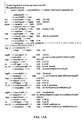
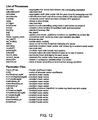
- FIG. 12 shows a list of explanations for the modules, functions and parameters referred to in the object flow of FIGs. 11A and 11B ;
- FIGs. 13A and 13B together show the ScaleMean software module used in the NoveltyRT software module from one preferred embodiment of the present invention
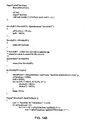
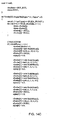
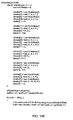
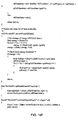
- FIGs. 14A , 14B , 14C , 14D , 14E , 14F and 14G together show the NoveltyRT software module from one preferred embodiment of the present invention.
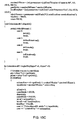
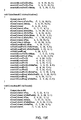
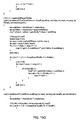
- FIGs. 15A , 15B , 15C , 15D , 15E , 15F , 15G , 15H and 15I together show the coincidenceRT and eTrigger software modules from one preferred embodiment of the present invention.
- FIG. 1 provides an overview, in block diagram form, of the complete phonetic recognition system 100 according to the present invention.
- a short-time frequency analyzer 102 receives a raw acoustic signal 104 and produces a short-time representation 106 of the acoustic signal.
- a novelty processor 108 receives the short-time representation 106 of the acoustic signal and produces a novelty output 110.
- An attention processor 112 receives the novelty output 110 and produces an attention gate 114.
- a coincidence processor 116 receives the novelty output 110 and the attention gate 114 and produces a gated coincidence output 118.
- a vector pattern recognizer 120 and a Bayes probabilities processor 122 further process the gated coincidence output 118, so as to produce stream of phonetic estimates 124 corresponding to the acoustic signal 104.
- the Short-time Frequency Analyzer 102, the Vector Pattern Recognizer 120 and the Bayes Probabilities processor 122 are described in detail in U.S. Patents 5,027,408 , 5,168,524 , and 5,369,726 .
- the description herein is primarily concerned with the novelty processor 108, the attention processor 112, and the coincidence processor 116, and how these components operate within the phonetic recognition system 100 as shown in FIG. 1
- the phonetic recognition system 100 produces a context-independent, feed-forward phonetic stream corresponding to the acoustic signal 104.
- context independent means that the data produced from any one component of the phonetic recognition system 100 can be interpreted correctly in any context, i.e., there is no need to ever go back and "re-work” the data.
- feed forward means that the data flow within the phonetic recognition system 100 is in the forward direction only.
- the context-independent phonetic stream simplifies and generalizes the functions of follow-on language search and understanding functions.
- This capability also provides structural and system advantages, such as the ability to separate and encapsulate modular high-level functions. In addition, these functions are separate from the system. This, in turn, provides the capability to use different implementations, technologies, hardware and system configurations, all within the same system architecture.
- the high-level functions remain independent of the implementation details associated with specific sub-functions and algorithms. This independence provides a fast and proven development environment, such as:
- the short-time frequency analyzer 102 processes the acoustic signal 104 to produce a short-time frequency representation.
- the details are essentially the same as is described in U.S. Patents 5,027,408 , 5,168,524 , and 5,369,726 .
- the time interval used is 12 msec
- the input sampling rate is 8000 Hz
- the length of the discrete Fourier transform (hereinafter "DFT") is 128.
- the 64 point DFT is averaged in bins to reduce its resolution to 40 points. Adding band-limited energy yields a stream of 41 point vectors every 12 msec.
- This frequency-time data stream is referred to herein in vector notation as x, or equivalently in functional notation as x(t, f).
- the acoustic signal 104 is the sound produced by the speaker.
- the speech channel is the medium, or media, through which the sound passes before it reaches the ear of the listener.
- the speech signal is the result of, and the speech channel consists of, a cascade of time-varying linear or near-linear systems.
- the various mouthparts of the speaker can be manipulated differently, each shaping the varying exciting signal with frequency shaping effects such as resonances and anti-resonances. At any given point in time, these effects can all be approximately modeled by a cascade of linear systems, followed by a linear channel.
- each of these linear systems is characterized by a Transfer Function, represented as a frequency spectrum.
- a Transfer Function represented as a frequency spectrum.
- the speech systems are cascaded, one simply multiplies the source spectrum (glottal pulses or fricated noise) by all these spectra to infer the resulting spectrum. If one considers the log of the spectrum (i.e., power spectrum), then the various speech components may simply be added to infer the resulting spectrum. Next, the resultant log power spectrum may be decomposed into additive components, which will provide all there is to know about the speech signal. However, this is true only for a single point in time.
- Each of the additive components is varying, the mouthparts are interacting in a coupled visco-elastic system, the speaker's head is moving, thus projecting the sound through a constantly changing channel, and the speaker's brain is listening and adapting and controlling all this in an unknown way.
- the problem of perceiving a visual figure against a visual background is known as the figure-ground problem.
- a particular phoneme results from a particular set of muscular actions by the speaker, so for speech recognition, the object is to perceive the resulting time-varying spectrum and infer which phoneme was spoken.
- the figure-ground problem is that the time-varying spectrum of interest is riding on an another unknown time-varying spectrum: one of similar or possibly larger amplitude.
- This background consists of all the phonemes and actions taking place around the time of the phoneme of interest, as well as the changing transmission channel.
- Novelty ... newness ... surprise are words that colloquially describe new information.
- An information processor that maximizes novelty necessarily maximizes information.
- solving the figure-ground problem in the speech domain requires separating a time varying signal of interest from a background time varying signal that has been added to it.
- the confusing signal e.g., effect resulting from the head motion of the speaker
- the confusing signal is slower that phonetic signal of interest.
- this is also an information-maximizing operation, in that the slow-moving signal is known, but the faster signal is relatively new.
- the novelty processor 108 performs a differential operation, i.e., it compares two regions of the incoming short-time representation 106 of the acoustic signal. The result of the comparison is a novelty output value for each input signal sample.
- the basic operation of subtracting a local background component from the signal region of interest component of the signal at a given time is referred to herein as "novelty processing," and is performed by the novelty processor 108.
- the novelty processor 108 performs novelty processing for each frequency (i.e., for each DFT point), at each time, so that a "novelty-processed" version of the spectral stream is the resulting novelty output.
- the novelty processor 108 produces a "novelty point" for each input DFT point.
- the novelty processor 108 processes many different averaging intervals in parallel, via a software module referred to herein as "noveltyRT.” This novelty processing is similar to processing known to occur in the brain, in both the visual and auditory systems, known as the center-surround receptive field by physiologists.
- the noveltyRT module processes the frequency-time data stream x(t, f) as described in the following description, and as shown in FIG. 2 . At each time t, and frequency f,
- FIG. 3 shows the data flow from the short-time frequency analyzer 102 through the novelty processor 108 for one preferred embodiment of the invention.
- the novelty processor 108 may produce multiple novelty outputs 110; one preferred embodiment produces six outputs 110.
- each set of novelty outputs 110 is shown being generated by a separate novelty instance 109 within the novelty processor.
- Each novelty instance 109 is characterized by a different set of novelty parameters.
- Each of the novelty outputs 110 is subsequently processed by several coincidence maps 220 (shown only for the first novelty instance 109).
- the coincidence maps 220 are processed within the coincidence processor 116, and are described in more detail herein.
- several attention triggers 222 (also described herein) operate on each of the coincidence maps. In one preferred embodiment, there are 7 different attention triggers 222, and each coincidence map 220 may use one of these attention triggers 222.
- the novelty processor 108 provides multiple novelty-processed versions of the original spectrum. Because each of these versions includes different and nonlinear follow-on processing, the multiple versions will result in very different and complementary views of the original signal. This redundancy contributes to robustness and generality of speech recognition.
- the edges of the regions being compared may be weighted so that the edges tail off gradually, rather than the hard-edged regions described herein.
- the regions being compared may have shapes other than rectangular as described herein.
- Some embodiments of the invention may utilize some other operation to produce the novelty output rather than the summing or averaging described herein. Such other operations may include variance of the regions, sum of the products of points in the regions, or other mathematical operations known to those in the art.
- coincidence processing because it is sensitive to the coincidence, or co-occurrence of events.
- the sums of products have the following 6 basic degrees of freedom, or coincidence parameters, that may be varied:
- each predetermined set of novelty input samples are defined by a corresponding set of coincidence parameters as described herein.
- the key to effective processing is in the selection and implementation of these sets, which have an enormous combinatorial potential.
- a distinct instance of coincidence processing i.e., using a particular set of coincidence parameters is referred to herein as a "coincidence map.”
- the embodiment of the coincidence processor described herein sums the products of novelty points over particular regions, other embodiments may use other methods of comparing and/or combining novelty points. For example, one embodiment may use the logical "OR" of products of novelty points, while other embodiments may use the logical "AND" of pairs of novelty points. Another embodiment of the coincidence processor could simply produce a stream of novelty point combinations (e.g., products) that may be subsequently combined in different ways. Thus, the coincidence processor generally combines novelty points to detect coinciding or co-occurring events within the novelty output data stream.
- the performance of the basic coincidence processing is enhanced when an appropriate "attention" gate 114 is used judiciously.
- the attention gate 114 forces the coincidence processor to process only those frequency samples that exist when salient events occur, such as times that coincide with an energy peak.
- An attention gate 114 may be expressed as a function of time a(t), which has value of "1" when a salient event occurs, and has a value of "0" otherwise.
- One preferred embodiment of the attention processor 112 generates seven different attention triggers as follows:
- the novelty, coincidence and attention parameters and particular software modules for the novelty-coincidence processing may be determined via manual trial and error.
- manual trial and error is a tedious and labor-intensive task.
- One preferred embodiment of the present invention applies the Genetic Algorithm (hereinafter referred to as "GA") to automatically determine an optimal set of parameters and modules.
- GA Genetic Algorithm
- the GA is a very general method for optimization, well known to those in the art. It works by generating random variations and combinations from existing solutions, evaluating each variation in terms of some fitness function that is to be maximized, keeping the best solutions in a population, and applying recombination variation in a recursive procedure.
- the fitness function, for speech recognition is some measure of accuracy of the entire algorithm, evaluated on a known and controlled set of speech.
- Each of these three processors (the novelty processor 102, the attention processor 112 and the coincidence processor 116) produces a vector of data values.
- the final output is a concatenation of all three vectors generated by these three processes.
- FIG. 10 shows the specific data flow used in a preferred embodiment of the invention shown in FIG.1 .
- FIG. 10 illustrates three similar processing units that run in parallel.
- a vowel processing unit 240 is optimized for detecting vowel phonics
- a fricative processing unit 242 is optimized for fricatives
- a non-fricative processing unit 244 is optimized for non-fricative consonants.
- the outputs of the three processing units are collected (concatenated) into one large vector for the subsequent processing in the vector pattern recognizer 120.
- the used in the blocks of FIG. 10 correspond to the actual software module names in a preferred embodiment.
- FIG. 10 also denotes the details of data normalization and time-window formation.
- the complete processing flow of the one preferred embodiment of the system 100 is specified by the high-level object-flow specification shown in FIGs. 11A and 11B .
- the terms used regarding the major steps in the object-flow specification are defined as follows:
- FIG. 12 shows a list of explanations for the modules, functions and parameters referred to in processing flow of FIGs. 11A and 11B .
- FIGs. 13A and 13B together show the ScaleMean software module used in the NoveltyRT software module from one preferred embodiment of the present invention.
- FIG. 14A , 14B , 14C , 14D , 14E , 14F and 14G together show the NoveltyRT software module from one preferred embodiment of the present invention.
- FIG. 15A , 15B , 15C , 15D , 15E , 15F , 15G , 15H and 15I together show the coincidenceRT and eTrigger software modules from one preferred embodiment of the present invention.
Landscapes
- Engineering & Computer Science (AREA)
- Theoretical Computer Science (AREA)
- Physics & Mathematics (AREA)
- Computational Linguistics (AREA)
- Health & Medical Sciences (AREA)
- Audiology, Speech & Language Pathology (AREA)
- Artificial Intelligence (AREA)
- General Physics & Mathematics (AREA)
- Multimedia (AREA)
- Acoustics & Sound (AREA)
- General Health & Medical Sciences (AREA)
- General Engineering & Computer Science (AREA)
- Human Computer Interaction (AREA)
- Business, Economics & Management (AREA)
- Accounting & Taxation (AREA)
- Development Economics (AREA)
- Strategic Management (AREA)
- Finance (AREA)
- Game Theory and Decision Science (AREA)
- Economics (AREA)
- Marketing (AREA)
- General Business, Economics & Management (AREA)
- Computer Vision & Pattern Recognition (AREA)
- Entrepreneurship & Innovation (AREA)
- Machine Translation (AREA)
- Telephonic Communication Services (AREA)
- Complex Calculations (AREA)
- Information Transfer Between Computers (AREA)
- Fittings On The Vehicle Exterior For Carrying Loads, And Devices For Holding Or Mounting Articles (AREA)
- Toys (AREA)
- Measuring Fluid Pressure (AREA)
- Computer And Data Communications (AREA)
- Information Retrieval, Db Structures And Fs Structures Therefor (AREA)
- Hardware Redundancy (AREA)
- Multi Processors (AREA)
- Communication Control (AREA)
- Navigation (AREA)
- Telephone Function (AREA)
- Traffic Control Systems (AREA)
Claims (19)
- Système de reconnaissance vocale, destiné à transformer un signal acoustique en un flux d'estimations phonétiques, le système comprenant :(a) un analyseur de fréquence (102) destiné à recevoir le signal acoustique (104) et à créer en tant que sortie une représentation de fréquence de courte durée (106) du signal acoustique (104), dans lequel la représentation de fréquence de courte durée (106) du signal audio (104) comprend une série d'instances de temps consécutives , chaque paire consécutive étant séparée par un intervalle d'échantillonnage, et chacune des instances de temps comprend en outre une série de points de transformée de Fourier discrète (DFT), de telle sorte que la représentation de fréquence de courte durée (106) du signal audio comprend une série de points DFT,(b) un dispositif de traitement de nouveauté (108) destiné à recevoir la représentation de fréquence de courte durée (106) du signal acoustique (104), à séparer une ou plusieurs composantes de fond de la représentation (106) à partir d'une ou plusieurs composantes de région d'intérêt de la représentation, et à créer une sortie de nouveauté (110) comprenant les composantes de région d'intérêt de la représentation (106) conformément à un ou plusieurs paramètres de nouveautés, dans lequel pour chaque point DFT, le dispositif de traitement de nouveauté (108) (i) calcule une première valeur moyenne sur une première plage de fréquences prédéterminée et un premier intervalle de temps prédéterminé, (ii) calcule une deuxième valeur moyenne sur une deuxième plage de fréquences prédéterminée et un deuxième intervalle de temps prédéterminé, et (iii) soustrait la deuxième valeur moyenne de la première valeur moyenne de façon à créer le point de sortie de nouveauté, et dans lequel la première plage de fréquences, le premier intervalle de temps, la deuxième plage de fréquences et le deuxième intervalle de temps constituent chacun une fonction de l'un ou plusieurs des paramètres de nouveautés,(c) un dispositif de traitement d'attention (112) destiné à recevoir la sortie de nouveauté (110) et à créer un signal de déclenchement (114) en tant que fonction prédéterminée de la sortie de nouveauté (110) conformément à un ou plusieurs paramètres d'attentions,(d) un dispositif de traitement de coïncidence (118) destiné à recevoir la sortie de nouveauté (110) et le signal de déclenchement (114), et à créer une sortie de coïncidence (118) qui comprend des co-occurrences entre les échantillons de la sortie de nouveauté (110) sur le temps et la fréquence, dans lequel le processeur de coïncidence (116) combine des points de sortie de nouveautés pour détecter des événements coïncidents dans le flux de sortie de nouveautés et dans lequel la sortie de coïncidence (118) est sélectivement déclenchée en tant que fonction prédéterminée du signal de déclenchement (114), de façon à créer une sortie de coïncidence déclenchée (118) conformément à un ou plusieurs paramètres de coïncidences, et(e) un dispositif de reconnaissance de modèle de vecteur (120) et un dispositif de traitement de probabilité (122) destinés à recevoir la sortie de coïncidence déclenchée (118) et à créer un flux d'estimations phonétiques (124) représentatif du signal acoustique (104).
- Système de reconnaissance vocale selon la revendication 1, dans lequel la première plage de fréquences prédéterminée est sensiblement centrée autour d'une fréquence correspondant à un point DFT et le premier intervalle de temps prédéterminé est sensiblement centré autour d'un instant dans le temps correspondant au point DFT.
- Système de reconnaissance vocale selon la revendication 1 ou 2, dans lequel la première plage de fréquences prédéterminée est sensiblement inférieure à la deuxième plage de fréquences prédéterminée.
- Système de reconnaissance vocale selon l'une quelconque des revendications 1 à 3, dans lequel le premier intervalle de temps prédéterminé est sensiblement inférieur au deuxième intervalle de temps prédéterminé.
- Système de reconnaissance vocale selon l'une quelconque des revendications 1 à 4, dans lequel le deuxième intervalle de temps prédéterminé est important par rapport à la deuxième plage de fréquences prédéterminée.
- Système de reconnaissance vocale selon l'une quelconque des revendications 1 à 5, dans lequel la deuxième plage de fréquences prédéterminée est importante par rapport au deuxième intervalle de temps prédéterminé.
- Système de reconnaissance vocale selon l'une quelconque des revendications précédentes, dans lequel pour chaque point DFT, le dispositif de traitement de nouveauté (108) calcule en outre une ou plusieurs sorties de nouveautés supplémentaires et chaque sortie de nouveauté supplémentaire est définie par des caractéristiques comprenant une première plage de fréquences, un premier intervalle de temps, une deuxième plage de fréquences et un deuxième intervalle de temps distincts, chaque caractéristique étant une fonction d'un ou plusieurs des paramètres de nouveautés.
- Système de reconnaissance vocale selon l'une quelconque des revendications précédentes, dans lequel la sortie de coïncidence (118) comprend une somme de produits de points de sortie de nouveautés sur deux ensembles de points de sortie de nouveautés.
- Système de reconnaissance vocale selon la revendication 8, dans lequel les deux ensembles de points DFT comprennent un premier ensemble de points de sortie de nouveautés correspondant à un premier instant dans le temps et un deuxième ensemble de points de sortie de nouveautés correspondant à une deuxième instance de temps.
- Système de reconnaissance vocale selon la revendication 8, dans lequel les deux ensembles de points de sortie de nouveautés correspondent tous à une seule instance de temps.
- Système de reconnaissance vocale selon la revendication 8, dans lequel le dispositif de traitement de coïncidence (116) réalise la somme des produits de points de sortie de nouveautés sur deux ensembles de points de sortie de nouveautés conformément à un ou plusieurs paramètres de coïncidences variables par sélection comprenant une durée dans le temps, une étendue de fréquence, un temps de base, une fréquence de base, un temps delta, une fréquence delta et des combinaisons de ces éléments.
- Système de reconnaissance vocale selon l'une quelconque des revendications précédentes, dans lequel chacune des instances de temps comprend en outre une valeur d'énergie en plus de la série des points DFT.
- Système de reconnaissance vocale selon la revendication 12, dans lequel le dispositif de traitement d'attention (112) (i) compare la valeur d'énergie à une valeur de seuil prédéterminée conformément à un critère de comparaison, de façon à créer une détermination de seuil d'énergie et (ii) crée le signal de déclenchement (114) en tant que fonction prédéterminée de la détermination de seuil.
- Système de reconnaissance vocale selon la revendication 13, dans lequel les un ou plusieurs paramètres d'attentions comprennent la valeur de seuil prédéterminée, le critère de comparaison et la fonction prédéterminée de la détermination de seuil.
- Système de reconnaissance vocale selon l'une quelconque des revendications précédentes, dans lequel les paramètres de nouveautés, les paramètres d'attentions et les paramètres de coïncidences sont sélectionnés par l'intermédiaire d'un algorithme génétique.
- Procédé de transformation d'un signal acoustique en un flux d'estimations phonétiques, le procédé comprenant :(a) la réception du signal acoustique (104) et la création d'une représentation de fréquence de courte durée (106) du signal acoustique (104), dans lequel la représentation de fréquence de courte durée (106) du signal audio (104) comprend une série d'instances de temps consécutives , chaque paire constitutive étant séparée par un intervalle d'échantillonnage, et chacune des instances de temps comprend en outre une série de points de transformée de Fourier discrète (DFT), de telle sorte que la représentation de fréquence de courte durée (106) du signal audio comprend une série de points DFT,(b) la séparation d'une ou plusieurs composantes de fond de la représentation (106) à partir d'une ou plusieurs composantes de région d'intérêt de la représentation, par (i) le calcul, pour chaque point DFT, d'une première valeur moyenne sur une première plage de fréquences prédéterminée et d'un premier intervalle de temps prédéterminé, (ii) le calcul d'une deuxième valeur moyenne sur une deuxième plage de fréquences prédéterminée et un deuxième intervalle de temps prédéterminé, et (iii) la soustraction de la deuxième valeur moyenne de la première valeur moyenne de façon à créer un point de sortie de nouveauté, dans lequel la première plage de fréquences, le premier intervalle de temps, la deuxième plage de fréquences et le deuxième intervalle de temps constituent chacun une fonction d'un ou plusieurs des paramètres de nouveautés, et la création d'une sortie de nouveauté (110) comprenant les composantes de région d'intérêt de la représentation (106) conformément à un ou plusieurs paramètres de nouveautés,(c) la création d'un signal de déclenchement (140) en tant que fonction prédéterminée de la sortie de nouveauté (110) conformément à un ou plusieurs paramètres d'attentions,(d) la création d'une sortie de coïncidence (118) qui comprend des co-occurrences entre des échantillons de la sortie de nouveauté (110) sur le temps et la fréquence par la combinaison de points de sortie de nouveautés pour détecter des événements coïncidents dans le flux de sortie de nouveautés, et dans lequel la sortie de coïncidence (118) est sélectivement déclenchée en tant que fonction prédéterminée du signal de déclenchement (114), de façon à créer une sortie de coïncidence déclenchée (118) conformément à un ou plusieurs paramètres de coïncidences,(e) la création d'un flux d'estimations phonétiques (124) représentatif d'un signal acoustique (104) en fonction de la sortie de coïncidence déclenchée (110).
- Procédé selon la revendication 16, comprenant en outre la réalisation d'une somme de produits de sorties de nouveautés sur deux ensembles de sorties de nouveautés (110) conformément à un ou plusieurs paramètres de coïncidences variables par sélection comprenant une durée dans le temps, une étendue de fréquence, un temps de base, une fréquence de base, un temps delta, une fréquence delta, et des combinaisons de ces éléments.
- Procédé selon la revendication 16 ou 17, comprenant en outre la comparaison de la valeur d'énergie à une valeur de seuil prédéterminée conformément à un critère de comparaison, de façon à créer une détermination de seuil d'énergie, et (ii) la création du signal de déclenchement (114) en tant que fonction prédéterminée de la détermination de seuil.
- Procédé selon l'une quelconque des revendications 16 à 19, comprenant en outre la sélection des paramètres de nouveautés, des paramètres d'attentions et des paramètres de coïncidences par l'intermédiaire d'un algorithme génétique.
Applications Claiming Priority (9)
| Application Number | Priority Date | Filing Date | Title |
|---|---|---|---|
| US19209000P | 2000-03-24 | 2000-03-24 | |
| US19207600P | 2000-03-24 | 2000-03-24 | |
| US19191500P | 2000-03-24 | 2000-03-24 | |
| US19209100P | 2000-03-24 | 2000-03-24 | |
| US191915P | 2000-03-24 | ||
| US192090P | 2000-03-24 | ||
| US192091P | 2000-03-24 | ||
| US192076P | 2000-03-24 | ||
| PCT/US2001/009370 WO2001073753A1 (fr) | 2000-03-24 | 2001-03-23 | Nouvelle approche relative a la reconnaissance vocale |
Publications (3)
| Publication Number | Publication Date |
|---|---|
| EP1279165A1 EP1279165A1 (fr) | 2003-01-29 |
| EP1279165A4 EP1279165A4 (fr) | 2005-10-05 |
| EP1279165B1 true EP1279165B1 (fr) | 2011-01-05 |
Family
ID=27497914
Family Applications (2)
| Application Number | Title | Priority Date | Filing Date |
|---|---|---|---|
| EP01920678A Expired - Lifetime EP1277201B1 (fr) | 2000-03-24 | 2001-03-23 | Reconnaissance vocale par le web faisant intervenir des objets du type script et des objets semantiques |
| EP01926416A Expired - Lifetime EP1279165B1 (fr) | 2000-03-24 | 2001-03-23 | Reconnaissance vocale |
Family Applications Before (1)
| Application Number | Title | Priority Date | Filing Date |
|---|---|---|---|
| EP01920678A Expired - Lifetime EP1277201B1 (fr) | 2000-03-24 | 2001-03-23 | Reconnaissance vocale par le web faisant intervenir des objets du type script et des objets semantiques |
Country Status (6)
| Country | Link |
|---|---|
| US (2) | US6895377B2 (fr) |
| EP (2) | EP1277201B1 (fr) |
| AT (2) | ATE494610T1 (fr) |
| AU (4) | AU2001250975A1 (fr) |
| DE (2) | DE60130880T2 (fr) |
| WO (4) | WO2001073753A1 (fr) |
Families Citing this family (72)
| Publication number | Priority date | Publication date | Assignee | Title |
|---|---|---|---|---|
| US20030191625A1 (en) * | 1999-11-05 | 2003-10-09 | Gorin Allen Louis | Method and system for creating a named entity language model |
| US7286984B1 (en) * | 1999-11-05 | 2007-10-23 | At&T Corp. | Method and system for automatically detecting morphemes in a task classification system using lattices |
| US8392188B1 (en) | 1999-11-05 | 2013-03-05 | At&T Intellectual Property Ii, L.P. | Method and system for building a phonotactic model for domain independent speech recognition |
| US7263484B1 (en) | 2000-03-04 | 2007-08-28 | Georgia Tech Research Corporation | Phonetic searching |
| JP2002057930A (ja) * | 2000-05-30 | 2002-02-22 | Fuji Photo Film Co Ltd | ディジタル・スチル・カメラおよびその動作制御方法 |
| US6970185B2 (en) * | 2001-01-31 | 2005-11-29 | International Business Machines Corporation | Method and apparatus for enhancing digital images with textual explanations |
| US7392191B2 (en) * | 2001-03-29 | 2008-06-24 | Intellisist, Inc. | Method and device to distinguish between voice conversation and automated speech recognition |
| US8301503B2 (en) * | 2001-07-17 | 2012-10-30 | Incucomm, Inc. | System and method for providing requested information to thin clients |
| US20090157483A1 (en) * | 2001-11-14 | 2009-06-18 | Retaildna, Llc | Method and system for using artificial intelligence to generate or modify an employee prompt or a customer survey |
| US7336602B2 (en) * | 2002-01-29 | 2008-02-26 | Intel Corporation | Apparatus and method for wireless/wired communications interface |
| US7369532B2 (en) * | 2002-02-26 | 2008-05-06 | Intel Corporation | Apparatus and method for an audio channel switching wireless device |
| US7254708B2 (en) * | 2002-03-05 | 2007-08-07 | Intel Corporation | Apparatus and method for wireless device set-up and authentication using audio authentication—information |
| WO2004048513A2 (fr) * | 2002-05-03 | 2004-06-10 | University Of Southern California | Systemes neuronaux artificiels munis de synapses dynamiques |
| US7398209B2 (en) | 2002-06-03 | 2008-07-08 | Voicebox Technologies, Inc. | Systems and methods for responding to natural language speech utterance |
| US7693720B2 (en) | 2002-07-15 | 2010-04-06 | Voicebox Technologies, Inc. | Mobile systems and methods for responding to natural language speech utterance |
| US7133828B2 (en) * | 2002-10-18 | 2006-11-07 | Ser Solutions, Inc. | Methods and apparatus for audio data analysis and data mining using speech recognition |
| US8055503B2 (en) * | 2002-10-18 | 2011-11-08 | Siemens Enterprise Communications, Inc. | Methods and apparatus for audio data analysis and data mining using speech recognition |
| US7076427B2 (en) * | 2002-10-18 | 2006-07-11 | Ser Solutions, Inc. | Methods and apparatus for audio data monitoring and evaluation using speech recognition |
| US20040111272A1 (en) * | 2002-12-10 | 2004-06-10 | International Business Machines Corporation | Multimodal speech-to-speech language translation and display |
| EP1656662B1 (fr) | 2003-08-22 | 2016-06-01 | Unify Inc. | Systeme et methode pour une surveillance de qualite automatisee |
| US20060095628A1 (en) * | 2003-12-19 | 2006-05-04 | Microsoft Corporation | External-Network Data Content Exposure to Network-Connected Devices |
| US7555543B2 (en) * | 2003-12-19 | 2009-06-30 | Microsoft Corporation | Server architecture for network resource information routing |
| US7668939B2 (en) * | 2003-12-19 | 2010-02-23 | Microsoft Corporation | Routing of resource information in a network |
| US20050138137A1 (en) * | 2003-12-19 | 2005-06-23 | Microsoft Corporation | Using parameterized URLs for retrieving resource content items |
| US7647385B2 (en) * | 2003-12-19 | 2010-01-12 | Microsoft Corporation | Techniques for limiting network access |
| US7570746B2 (en) * | 2004-03-18 | 2009-08-04 | Sony Corporation | Method and apparatus for voice interactive messaging |
| KR100695127B1 (ko) * | 2004-10-08 | 2007-03-14 | 삼성전자주식회사 | 다 단계 음성 인식 장치 및 방법 |
| JP4802489B2 (ja) * | 2004-12-07 | 2011-10-26 | 日本電気株式会社 | 音データ提供システムおよびその方法 |
| US20070027808A1 (en) * | 2005-07-29 | 2007-02-01 | Microsoft Corporation | Strategies for queuing events for subsequent processing |
| US7640160B2 (en) | 2005-08-05 | 2009-12-29 | Voicebox Technologies, Inc. | Systems and methods for responding to natural language speech utterance |
| US7620549B2 (en) | 2005-08-10 | 2009-11-17 | Voicebox Technologies, Inc. | System and method of supporting adaptive misrecognition in conversational speech |
| US7949529B2 (en) | 2005-08-29 | 2011-05-24 | Voicebox Technologies, Inc. | Mobile systems and methods of supporting natural language human-machine interactions |
| WO2007027989A2 (fr) | 2005-08-31 | 2007-03-08 | Voicebox Technologies, Inc. | Amelioration de precision de parole dynamique |
| US7909760B2 (en) * | 2005-10-14 | 2011-03-22 | Applied Medical Resources Corporation | Split hoop wound retractor with gel pad |
| US20070143307A1 (en) * | 2005-12-15 | 2007-06-21 | Bowers Matthew N | Communication system employing a context engine |
| US8117246B2 (en) | 2006-04-17 | 2012-02-14 | Microsoft Corporation | Registering, transfering, and acting on event metadata |
| WO2008043582A1 (fr) * | 2006-10-13 | 2008-04-17 | International Business Machines Corporation | Systèmes et procédés pour construire un dictionnaire électronique de noms composés de mots multiples et pour faire des recherches floues dans ledit dictionnaire |
| US8073681B2 (en) | 2006-10-16 | 2011-12-06 | Voicebox Technologies, Inc. | System and method for a cooperative conversational voice user interface |
| US7742922B2 (en) * | 2006-11-09 | 2010-06-22 | Goller Michael D | Speech interface for search engines |
| US20080148284A1 (en) * | 2006-12-15 | 2008-06-19 | Maui Media Lab Llc | Apparatus and method for developing and executing applications with declarative objects |
| US7818176B2 (en) | 2007-02-06 | 2010-10-19 | Voicebox Technologies, Inc. | System and method for selecting and presenting advertisements based on natural language processing of voice-based input |
| US8140335B2 (en) | 2007-12-11 | 2012-03-20 | Voicebox Technologies, Inc. | System and method for providing a natural language voice user interface in an integrated voice navigation services environment |
| US8131714B2 (en) * | 2008-01-02 | 2012-03-06 | Think Village-OIP, LLC | Linguistic assistance systems and methods |
| US20090171663A1 (en) * | 2008-01-02 | 2009-07-02 | International Business Machines Corporation | Reducing a size of a compiled speech recognition grammar |
| US8589161B2 (en) | 2008-05-27 | 2013-11-19 | Voicebox Technologies, Inc. | System and method for an integrated, multi-modal, multi-device natural language voice services environment |
| US9305548B2 (en) | 2008-05-27 | 2016-04-05 | Voicebox Technologies Corporation | System and method for an integrated, multi-modal, multi-device natural language voice services environment |
| US8326637B2 (en) | 2009-02-20 | 2012-12-04 | Voicebox Technologies, Inc. | System and method for processing multi-modal device interactions in a natural language voice services environment |
| US20110044447A1 (en) * | 2009-08-21 | 2011-02-24 | Nexidia Inc. | Trend discovery in audio signals |
| KR20110036385A (ko) * | 2009-10-01 | 2011-04-07 | 삼성전자주식회사 | 사용자 의도 분석 장치 및 방법 |
| WO2011059997A1 (fr) | 2009-11-10 | 2011-05-19 | Voicebox Technologies, Inc. | Système et procédé destinés à fournir un service d'affectation de contenu de langage naturel |
| US9171541B2 (en) | 2009-11-10 | 2015-10-27 | Voicebox Technologies Corporation | System and method for hybrid processing in a natural language voice services environment |
| US9378202B2 (en) | 2010-03-26 | 2016-06-28 | Virtuoz Sa | Semantic clustering |
| US9524291B2 (en) * | 2010-10-06 | 2016-12-20 | Virtuoz Sa | Visual display of semantic information |
| US10957310B1 (en) | 2012-07-23 | 2021-03-23 | Soundhound, Inc. | Integrated programming framework for speech and text understanding with meaning parsing |
| US9390708B1 (en) * | 2013-05-28 | 2016-07-12 | Amazon Technologies, Inc. | Low latency and memory efficient keywork spotting |
| US11295730B1 (en) | 2014-02-27 | 2022-04-05 | Soundhound, Inc. | Using phonetic variants in a local context to improve natural language understanding |
| US9898459B2 (en) | 2014-09-16 | 2018-02-20 | Voicebox Technologies Corporation | Integration of domain information into state transitions of a finite state transducer for natural language processing |
| WO2016044290A1 (fr) | 2014-09-16 | 2016-03-24 | Kennewick Michael R | Commerce vocal |
| EP3207467A4 (fr) | 2014-10-15 | 2018-05-23 | VoiceBox Technologies Corporation | Système et procédé pour fournir des réponses de suivi à des entrées préalables en langage naturel d'un utilisateur |
| US10431214B2 (en) | 2014-11-26 | 2019-10-01 | Voicebox Technologies Corporation | System and method of determining a domain and/or an action related to a natural language input |
| US10614799B2 (en) | 2014-11-26 | 2020-04-07 | Voicebox Technologies Corporation | System and method of providing intent predictions for an utterance prior to a system detection of an end of the utterance |
| US10515150B2 (en) * | 2015-07-14 | 2019-12-24 | Genesys Telecommunications Laboratories, Inc. | Data driven speech enabled self-help systems and methods of operating thereof |
| US10382623B2 (en) | 2015-10-21 | 2019-08-13 | Genesys Telecommunications Laboratories, Inc. | Data-driven dialogue enabled self-help systems |
| US10455088B2 (en) | 2015-10-21 | 2019-10-22 | Genesys Telecommunications Laboratories, Inc. | Dialogue flow optimization and personalization |
| US10204146B2 (en) * | 2016-02-09 | 2019-02-12 | Ca, Inc. | Automatic natural language processing based data extraction |
| US20170242886A1 (en) * | 2016-02-19 | 2017-08-24 | Jack Mobile Inc. | User intent and context based search results |
| US10515086B2 (en) | 2016-02-19 | 2019-12-24 | Facebook, Inc. | Intelligent agent and interface to provide enhanced search |
| US10331784B2 (en) | 2016-07-29 | 2019-06-25 | Voicebox Technologies Corporation | System and method of disambiguating natural language processing requests |
| WO2018174443A1 (fr) * | 2017-03-23 | 2018-09-27 | Samsung Electronics Co., Ltd. | Appareil électronique, procédé de commande associé et support d'enregistrement lisible par ordinateur non transitoire |
| CN109979464A (zh) * | 2017-12-28 | 2019-07-05 | 南昌弘为企业管理有限公司 | 基于智能免流app的语音语义识别的方法及系统 |
| KR102725793B1 (ko) | 2018-11-07 | 2024-11-05 | 삼성전자주식회사 | 사용자 발화를 처리하는 전자 장치, 및 그 전자 장치의 제어 방법 |
| CN112102840B (zh) * | 2020-09-09 | 2024-05-03 | 中移(杭州)信息技术有限公司 | 语义识别方法、装置、终端及存储介质 |
Family Cites Families (52)
| Publication number | Priority date | Publication date | Assignee | Title |
|---|---|---|---|---|
| US4688195A (en) * | 1983-01-28 | 1987-08-18 | Texas Instruments Incorporated | Natural-language interface generating system |
| US4829423A (en) * | 1983-01-28 | 1989-05-09 | Texas Instruments Incorporated | Menu-based natural language understanding system |
| US5083268A (en) * | 1986-10-15 | 1992-01-21 | Texas Instruments Incorporated | System and method for parsing natural language by unifying lexical features of words |
| US5027408A (en) | 1987-04-09 | 1991-06-25 | Kroeker John P | Speech-recognition circuitry employing phoneme estimation |
| US5168524A (en) | 1989-08-17 | 1992-12-01 | Eliza Corporation | Speech-recognition circuitry employing nonlinear processing, speech element modeling and phoneme estimation |
| ATE121208T1 (de) * | 1990-01-30 | 1995-04-15 | Johnson Service Co | Vernetztes betriebsmittelverwaltungssystem. |
| US5297257A (en) * | 1991-04-15 | 1994-03-22 | Allen-Bradley Company, Inc. | Distributing a real-time control program to a plurality of input/output nodes |
| JPH05197389A (ja) * | 1991-08-13 | 1993-08-06 | Toshiba Corp | 音声認識装置 |
| US5864614A (en) * | 1992-04-17 | 1999-01-26 | Bell Atlantic Network Services, Inc. | Intelligent peripheral and network control |
| US5615296A (en) * | 1993-11-12 | 1997-03-25 | International Business Machines Corporation | Continuous speech recognition and voice response system and method to enable conversational dialogues with microprocessors |
| US5687212A (en) * | 1995-07-25 | 1997-11-11 | Bell Atlantic Network Services, Inc. | System for reactively maintaining telephone network facilities in a public switched telephone network |
| JP3476237B2 (ja) | 1993-12-28 | 2003-12-10 | 富士通株式会社 | 構文解析装置 |
| US5748841A (en) * | 1994-02-25 | 1998-05-05 | Morin; Philippe | Supervised contextual language acquisition system |
| US5729656A (en) * | 1994-11-30 | 1998-03-17 | International Business Machines Corporation | Reduction of search space in speech recognition using phone boundaries and phone ranking |
| US5659542A (en) | 1995-03-03 | 1997-08-19 | Intecom, Inc. | System and method for signalling and call processing for private and hybrid communications systems including multimedia systems |
| US5675723A (en) * | 1995-05-19 | 1997-10-07 | Compaq Computer Corporation | Multi-server fault tolerance using in-band signalling |
| JP3385146B2 (ja) | 1995-06-13 | 2003-03-10 | シャープ株式会社 | 会話文翻訳装置 |
| US5974409A (en) * | 1995-08-23 | 1999-10-26 | Microsoft Corporation | System and method for locating information in an on-line network |
| US5647002A (en) * | 1995-09-01 | 1997-07-08 | Lucent Technologies Inc. | Synchronization of mailboxes of different types |
| US5822728A (en) * | 1995-09-08 | 1998-10-13 | Matsushita Electric Industrial Co., Ltd. | Multistage word recognizer based on reliably detected phoneme similarity regions |
| US5825977A (en) | 1995-09-08 | 1998-10-20 | Morin; Philippe R. | Word hypothesizer based on reliably detected phoneme similarity regions |
| US6173261B1 (en) * | 1998-09-30 | 2001-01-09 | At&T Corp | Grammar fragment acquisition using syntactic and semantic clustering |
| US5799276A (en) | 1995-11-07 | 1998-08-25 | Accent Incorporated | Knowledge-based speech recognition system and methods having frame length computed based upon estimated pitch period of vocalic intervals |
| US6343313B1 (en) * | 1996-03-26 | 2002-01-29 | Pixion, Inc. | Computer conferencing system with real-time multipoint, multi-speed, multi-stream scalability |
| US5822729A (en) | 1996-06-05 | 1998-10-13 | Massachusetts Institute Of Technology | Feature-based speech recognizer having probabilistic linguistic processor providing word matching based on the entire space of feature vectors |
| US5881230A (en) * | 1996-06-24 | 1999-03-09 | Microsoft Corporation | Method and system for remote automation of object oriented applications |
| US5966686A (en) * | 1996-06-28 | 1999-10-12 | Microsoft Corporation | Method and system for computing semantic logical forms from syntax trees |
| US5835890A (en) | 1996-08-02 | 1998-11-10 | Nippon Telegraph And Telephone Corporation | Method for speaker adaptation of speech models recognition scheme using the method and recording medium having the speech recognition method recorded thereon |
| US5960399A (en) * | 1996-12-24 | 1999-09-28 | Gte Internetworking Incorporated | Client/server speech processor/recognizer |
| US6456974B1 (en) * | 1997-01-06 | 2002-09-24 | Texas Instruments Incorporated | System and method for adding speech recognition capabilities to java |
| US6078886A (en) * | 1997-04-14 | 2000-06-20 | At&T Corporation | System and method for providing remote automatic speech recognition services via a packet network |
| US6052682A (en) | 1997-05-02 | 2000-04-18 | Bbn Corporation | Method of and apparatus for recognizing and labeling instances of name classes in textual environments |
| US6112176A (en) * | 1997-05-16 | 2000-08-29 | Compaq Computer Corporation | Speech data collection over the world wide web |
| US5897616A (en) * | 1997-06-11 | 1999-04-27 | International Business Machines Corporation | Apparatus and methods for speaker verification/identification/classification employing non-acoustic and/or acoustic models and databases |
| US5953700A (en) * | 1997-06-11 | 1999-09-14 | International Business Machines Corporation | Portable acoustic interface for remote access to automatic speech/speaker recognition server |
| EP0993730B1 (fr) * | 1997-06-20 | 2003-10-22 | Swisscom Fixnet AG | Systeme et procede de codage et de diffusion d'informations vocales |
| US5941996A (en) * | 1997-07-25 | 1999-08-24 | Merrill Lynch & Company, Incorporated | Distributed network agents |
| US6192338B1 (en) * | 1997-08-12 | 2001-02-20 | At&T Corp. | Natural language knowledge servers as network resources |
| US6138249A (en) * | 1997-12-11 | 2000-10-24 | Emc Corporation | Method and apparatus for monitoring computer systems during manufacturing, testing and in the field |
| US6397179B2 (en) * | 1997-12-24 | 2002-05-28 | Nortel Networks Limited | Search optimization system and method for continuous speech recognition |
| US6163765A (en) * | 1998-03-30 | 2000-12-19 | Motorola, Inc. | Subband normalization, transformation, and voiceness to recognize phonemes for text messaging in a radio communication system |
| US6173279B1 (en) * | 1998-04-09 | 2001-01-09 | At&T Corp. | Method of using a natural language interface to retrieve information from one or more data resources |
| US6243670B1 (en) * | 1998-09-02 | 2001-06-05 | Nippon Telegraph And Telephone Corporation | Method, apparatus, and computer readable medium for performing semantic analysis and generating a semantic structure having linked frames |
| US6230190B1 (en) * | 1998-10-09 | 2001-05-08 | Openwave Systems Inc. | Shared-everything file storage for clustered system |
| US6247057B1 (en) * | 1998-10-22 | 2001-06-12 | Microsoft Corporation | Network server supporting multiple instance of services to operate concurrently by having endpoint mapping subsystem for mapping virtual network names to virtual endpoint IDs |
| US6134548A (en) | 1998-11-19 | 2000-10-17 | Ac Properties B.V. | System, method and article of manufacture for advanced mobile bargain shopping |
| GB9904663D0 (en) * | 1999-03-01 | 1999-04-21 | Canon Kk | Apparatus and method for generating processor usable data from natural langage input data |
| US6233561B1 (en) | 1999-04-12 | 2001-05-15 | Matsushita Electric Industrial Co., Ltd. | Method for goal-oriented speech translation in hand-held devices using meaning extraction and dialogue |
| EP1059782A3 (fr) * | 1999-06-10 | 2004-02-04 | Lucent Technologies Inc. | Procédé et dispositif pour l' allocation dynamique de l' utilisation de bande dans un réseau téléphonique par paquets |
| US6615172B1 (en) * | 1999-11-12 | 2003-09-02 | Phoenix Solutions, Inc. | Intelligent query engine for processing voice based queries |
| US20020097692A1 (en) * | 2000-12-29 | 2002-07-25 | Nokia Mobile Phones Ltd. | User interface for a mobile station |
| US20020152292A1 (en) * | 2001-01-09 | 2002-10-17 | Ricoh Company Limited | Method and system of remote support of device using e-mail |
-
2001
- 2001-03-23 AU AU2001250975A patent/AU2001250975A1/en not_active Abandoned
- 2001-03-23 AU AU2001250050A patent/AU2001250050A1/en not_active Abandoned
- 2001-03-23 AT AT01926416T patent/ATE494610T1/de not_active IP Right Cessation
- 2001-03-23 DE DE60130880T patent/DE60130880T2/de not_active Expired - Lifetime
- 2001-03-23 AU AU2001247708A patent/AU2001247708A1/en not_active Abandoned
- 2001-03-23 US US09/815,769 patent/US6895377B2/en not_active Expired - Lifetime
- 2001-03-23 US US09/815,808 patent/US7120585B2/en not_active Expired - Lifetime
- 2001-03-23 DE DE60143797T patent/DE60143797D1/de not_active Expired - Lifetime
- 2001-03-23 WO PCT/US2001/009370 patent/WO2001073753A1/fr not_active Ceased
- 2001-03-23 WO PCT/US2001/009549 patent/WO2001073593A1/fr not_active Ceased
- 2001-03-23 EP EP01920678A patent/EP1277201B1/fr not_active Expired - Lifetime
- 2001-03-23 AU AU2001252951A patent/AU2001252951A1/en not_active Abandoned
- 2001-03-23 WO PCT/US2001/040354 patent/WO2001073757A1/fr not_active Ceased
- 2001-03-23 WO PCT/US2001/009300 patent/WO2001073755A1/fr not_active Ceased
- 2001-03-23 EP EP01926416A patent/EP1279165B1/fr not_active Expired - Lifetime
- 2001-03-23 AT AT01920678T patent/ATE375589T1/de not_active IP Right Cessation
Also Published As
| Publication number | Publication date |
|---|---|
| AU2001247708A1 (en) | 2001-10-08 |
| DE60143797D1 (de) | 2011-02-17 |
| WO2001073757A1 (fr) | 2001-10-04 |
| US7120585B2 (en) | 2006-10-10 |
| EP1277201A4 (fr) | 2005-09-21 |
| DE60130880T2 (de) | 2008-07-17 |
| AU2001250975A1 (en) | 2001-10-08 |
| ATE375589T1 (de) | 2007-10-15 |
| WO2001073593A1 (fr) | 2001-10-04 |
| ATE494610T1 (de) | 2011-01-15 |
| WO2001073753A1 (fr) | 2001-10-04 |
| US20010037197A1 (en) | 2001-11-01 |
| WO2001073755A1 (fr) | 2001-10-04 |
| US6895377B2 (en) | 2005-05-17 |
| EP1277201B1 (fr) | 2007-10-10 |
| US20010049601A1 (en) | 2001-12-06 |
| AU2001252951A1 (en) | 2001-10-08 |
| EP1279165A4 (fr) | 2005-10-05 |
| EP1277201A1 (fr) | 2003-01-22 |
| DE60130880D1 (de) | 2007-11-22 |
| AU2001250050A1 (en) | 2001-10-08 |
| EP1279165A1 (fr) | 2003-01-29 |
Similar Documents
| Publication | Publication Date | Title |
|---|---|---|
| EP1279165B1 (fr) | Reconnaissance vocale | |
| US6868380B2 (en) | Speech recognition system and method for generating phonotic estimates | |
| Malik et al. | Automatic speech recognition: a survey | |
| Cutajar et al. | Comparative study of automatic speech recognition techniques | |
| O’Shaughnessy | Automatic speech recognition: History, methods and challenges | |
| Morgan et al. | Pushing the envelope-aside [speech recognition] | |
| Rabiner et al. | An overview of automatic speech recognition | |
| Biswas et al. | Admissible wavelet packet features based on human inner ear frequency response for Hindi consonant recognition | |
| KR100908121B1 (ko) | 음성 특징 벡터 변환 방법 및 장치 | |
| US6990447B2 (en) | Method and apparatus for denoising and deverberation using variational inference and strong speech models | |
| O'Shaughnessy | Automatic speech recognition | |
| Mistry et al. | Overview: Speech recognition technology, mel-frequency cepstral coefficients (mfcc), artificial neural network (ann) | |
| Shanthamallappa | Robust speech enhancement using dabauchies wavelet based adaptive wavelet thresholding for the development of robust automatic speech recognition: A comprehensive review | |
| Chavan et al. | Speech recognition in noisy environment, issues and challenges: A review | |
| Shanthamallappa et al. | Enhanced perceptual wavelet packet features for spontaneous Kannada sentence recognition under uncontrolled conditions | |
| Shahnawazuddin et al. | Enhancing robustness of zero resource children's speech recognition system through bispectrum based front-end acoustic features | |
| Bawa et al. | Developing sequentially trained robust Punjabi speech recognition system under matched and mismatched conditions | |
| CN120164454B (zh) | 一种低延迟语音合成方法、装置、设备和介质 | |
| Gaudani et al. | Comparative study of robust feature extraction techniques for ASR for limited resource Hindi language | |
| Thalengala et al. | Study of sub-word acoustical models for Kannada isolated word recognition system | |
| Sakti et al. | Incorporating knowledge sources into statistical speech recognition | |
| Sodanil et al. | Thai word recognition using hybrid MLP-HMM | |
| Iswarya et al. | Speech Query Recognition for Tamil Language Using Wavelet and Wavelet Packets. | |
| Agrawal et al. | Robust raw waveform speech recognition using relevance weighted representations | |
| Muller et al. | A connectionist approach to speech understanding |
Legal Events
| Date | Code | Title | Description |
|---|---|---|---|
| PUAI | Public reference made under article 153(3) epc to a published international application that has entered the european phase |
Free format text: ORIGINAL CODE: 0009012 |
|
| 17P | Request for examination filed |
Effective date: 20021024 |
|
| AK | Designated contracting states |
Designated state(s): AT BE CH CY DE DK ES FI FR GB GR IE IT LI LU MC NL PT SE TR |
|
| AX | Request for extension of the european patent |
Extension state: AL LT LV MK RO SI |
|
| A4 | Supplementary search report drawn up and despatched |
Effective date: 20050819 |
|
| 17Q | First examination report despatched |
Effective date: 20090120 |
|
| GRAP | Despatch of communication of intention to grant a patent |
Free format text: ORIGINAL CODE: EPIDOSNIGR1 |
|
| RIC1 | Information provided on ipc code assigned before grant |
Ipc: G10L 15/02 20060101AFI20100416BHEP Ipc: G10L 15/28 20060101ALI20100416BHEP |
|
| RTI1 | Title (correction) |
Free format text: SPEECH RECOGNITION |
|
| GRAS | Grant fee paid |
Free format text: ORIGINAL CODE: EPIDOSNIGR3 |
|
| GRAA | (expected) grant |
Free format text: ORIGINAL CODE: 0009210 |
|
| AK | Designated contracting states |
Kind code of ref document: B1 Designated state(s): AT BE CH CY DE DK ES FI FR GB GR IE IT LI LU MC NL PT SE TR |
|
| REG | Reference to a national code |
Ref country code: GB Ref legal event code: FG4D |
|
| REG | Reference to a national code |
Ref country code: CH Ref legal event code: EP |
|
| REG | Reference to a national code |
Ref country code: IE Ref legal event code: FG4D |
|
| REF | Corresponds to: |
Ref document number: 60143797 Country of ref document: DE Date of ref document: 20110217 Kind code of ref document: P |
|
| REG | Reference to a national code |
Ref country code: DE Ref legal event code: R096 Ref document number: 60143797 Country of ref document: DE Effective date: 20110217 |
|
| REG | Reference to a national code |
Ref country code: NL Ref legal event code: VDEP Effective date: 20110105 |
|
| PG25 | Lapsed in a contracting state [announced via postgrant information from national office to epo] |
Ref country code: GR Free format text: LAPSE BECAUSE OF FAILURE TO SUBMIT A TRANSLATION OF THE DESCRIPTION OR TO PAY THE FEE WITHIN THE PRESCRIBED TIME-LIMIT Effective date: 20110406 Ref country code: PT Free format text: LAPSE BECAUSE OF FAILURE TO SUBMIT A TRANSLATION OF THE DESCRIPTION OR TO PAY THE FEE WITHIN THE PRESCRIBED TIME-LIMIT Effective date: 20110505 Ref country code: SE Free format text: LAPSE BECAUSE OF FAILURE TO SUBMIT A TRANSLATION OF THE DESCRIPTION OR TO PAY THE FEE WITHIN THE PRESCRIBED TIME-LIMIT Effective date: 20110105 Ref country code: ES Free format text: LAPSE BECAUSE OF FAILURE TO SUBMIT A TRANSLATION OF THE DESCRIPTION OR TO PAY THE FEE WITHIN THE PRESCRIBED TIME-LIMIT Effective date: 20110416 |
|
| PG25 | Lapsed in a contracting state [announced via postgrant information from national office to epo] |
Ref country code: AT Free format text: LAPSE BECAUSE OF FAILURE TO SUBMIT A TRANSLATION OF THE DESCRIPTION OR TO PAY THE FEE WITHIN THE PRESCRIBED TIME-LIMIT Effective date: 20110105 Ref country code: NL Free format text: LAPSE BECAUSE OF FAILURE TO SUBMIT A TRANSLATION OF THE DESCRIPTION OR TO PAY THE FEE WITHIN THE PRESCRIBED TIME-LIMIT Effective date: 20110105 Ref country code: BE Free format text: LAPSE BECAUSE OF FAILURE TO SUBMIT A TRANSLATION OF THE DESCRIPTION OR TO PAY THE FEE WITHIN THE PRESCRIBED TIME-LIMIT Effective date: 20110105 Ref country code: FI Free format text: LAPSE BECAUSE OF FAILURE TO SUBMIT A TRANSLATION OF THE DESCRIPTION OR TO PAY THE FEE WITHIN THE PRESCRIBED TIME-LIMIT Effective date: 20110105 Ref country code: CY Free format text: LAPSE BECAUSE OF FAILURE TO SUBMIT A TRANSLATION OF THE DESCRIPTION OR TO PAY THE FEE WITHIN THE PRESCRIBED TIME-LIMIT Effective date: 20110105 |
|
| PG25 | Lapsed in a contracting state [announced via postgrant information from national office to epo] |
Ref country code: MC Free format text: LAPSE BECAUSE OF NON-PAYMENT OF DUE FEES Effective date: 20110331 Ref country code: DK Free format text: LAPSE BECAUSE OF FAILURE TO SUBMIT A TRANSLATION OF THE DESCRIPTION OR TO PAY THE FEE WITHIN THE PRESCRIBED TIME-LIMIT Effective date: 20110105 |
|
| REG | Reference to a national code |
Ref country code: CH Ref legal event code: PL |
|
| PLBE | No opposition filed within time limit |
Free format text: ORIGINAL CODE: 0009261 |
|
| STAA | Information on the status of an ep patent application or granted ep patent |
Free format text: STATUS: NO OPPOSITION FILED WITHIN TIME LIMIT |
|
| 26N | No opposition filed |
Effective date: 20111006 |
|
| REG | Reference to a national code |
Ref country code: IE Ref legal event code: MM4A |
|
| PG25 | Lapsed in a contracting state [announced via postgrant information from national office to epo] |
Ref country code: CH Free format text: LAPSE BECAUSE OF NON-PAYMENT OF DUE FEES Effective date: 20110331 Ref country code: IE Free format text: LAPSE BECAUSE OF NON-PAYMENT OF DUE FEES Effective date: 20110323 Ref country code: LI Free format text: LAPSE BECAUSE OF NON-PAYMENT OF DUE FEES Effective date: 20110331 |
|
| REG | Reference to a national code |
Ref country code: DE Ref legal event code: R097 Ref document number: 60143797 Country of ref document: DE Effective date: 20111006 |
|
| PG25 | Lapsed in a contracting state [announced via postgrant information from national office to epo] |
Ref country code: LU Free format text: LAPSE BECAUSE OF NON-PAYMENT OF DUE FEES Effective date: 20110323 |
|
| PG25 | Lapsed in a contracting state [announced via postgrant information from national office to epo] |
Ref country code: TR Free format text: LAPSE BECAUSE OF FAILURE TO SUBMIT A TRANSLATION OF THE DESCRIPTION OR TO PAY THE FEE WITHIN THE PRESCRIBED TIME-LIMIT Effective date: 20110105 |
|
| REG | Reference to a national code |
Ref country code: FR Ref legal event code: PLFP Year of fee payment: 16 |
|
| REG | Reference to a national code |
Ref country code: FR Ref legal event code: PLFP Year of fee payment: 17 |
|
| REG | Reference to a national code |
Ref country code: FR Ref legal event code: PLFP Year of fee payment: 18 |
|
| PGFP | Annual fee paid to national office [announced via postgrant information from national office to epo] |
Ref country code: GB Payment date: 20200311 Year of fee payment: 20 Ref country code: DE Payment date: 20200310 Year of fee payment: 20 Ref country code: IT Payment date: 20200221 Year of fee payment: 20 |
|
| PGFP | Annual fee paid to national office [announced via postgrant information from national office to epo] |
Ref country code: FR Payment date: 20200214 Year of fee payment: 20 |
|
| REG | Reference to a national code |
Ref country code: DE Ref legal event code: R071 Ref document number: 60143797 Country of ref document: DE |
|
| REG | Reference to a national code |
Ref country code: GB Ref legal event code: PE20 Expiry date: 20210322 |
|
| PG25 | Lapsed in a contracting state [announced via postgrant information from national office to epo] |
Ref country code: GB Free format text: LAPSE BECAUSE OF EXPIRATION OF PROTECTION Effective date: 20210322 |