EP1280228A2 - Grande membrane pour structure d'espace et procédé pour déploiement et expansion - Google Patents
Grande membrane pour structure d'espace et procédé pour déploiement et expansion Download PDFInfo
- Publication number
- EP1280228A2 EP1280228A2 EP01129966A EP01129966A EP1280228A2 EP 1280228 A2 EP1280228 A2 EP 1280228A2 EP 01129966 A EP01129966 A EP 01129966A EP 01129966 A EP01129966 A EP 01129966A EP 1280228 A2 EP1280228 A2 EP 1280228A2
- Authority
- EP
- European Patent Office
- Prior art keywords
- space structure
- structure according
- abb
- petal
- large membrane
- Prior art date
- Legal status (The legal status is an assumption and is not a legal conclusion. Google has not performed a legal analysis and makes no representation as to the accuracy of the status listed.)
- Withdrawn
Links
Images


Classifications
-
- H—ELECTRICITY
- H01—ELECTRIC ELEMENTS
- H01Q—ANTENNAS, i.e. RADIO AERIALS
- H01Q1/00—Details of, or arrangements associated with, antennas
- H01Q1/27—Adaptation for use in or on movable bodies
- H01Q1/28—Adaptation for use in or on aircraft, missiles, satellites, or balloons
- H01Q1/288—Satellite antennas
-
- H—ELECTRICITY
- H01—ELECTRIC ELEMENTS
- H01Q—ANTENNAS, i.e. RADIO AERIALS
- H01Q15/00—Devices for reflection, refraction, diffraction or polarisation of waves radiated from an antenna, e.g. quasi-optical devices
- H01Q15/14—Reflecting surfaces; Equivalent structures
- H01Q15/16—Reflecting surfaces; Equivalent structures curved in two dimensions [2D], e.g. paraboloidal
- H01Q15/161—Collapsible reflectors
Definitions
- the present invention relates to a large membrane space structure mounted on a spacecraft or space vehicle, and a method for its deployment and expansion.
- a large membrane space structure means a large membrane structure for use in space, such as a large solar cell module used for obtaining power in space, or a solar sail or photon sail used as a propulsion system in space.
- the large membrane space structure includes a sail to which a membrane is adhered. Aluminum is sputtered onto the membrane and made specula. The sail is deployed and spanned by the centrifugal force owing to a spacecraft or an artificial satellite spin motion. As shown in FIG. 5, the sail 14 reflects solar radiation on the membrane and provides thrust F to a spacecraft or an artificial satellite by means of the reaction caused by light reflection.
- Some of the large membrane space structures of a practical scale have a rectilinear shape, each side of which may be as long as several tens of meters to a few hundred meters or longer. Accordingly, the membrane is also as large as the structure.
- the large membrane space structure travels in space where solar gravity acts. Since the light pressure acceleration that acts on the sail 14 is much smaller than the gravity of the sun or the earth, it moves mainly governed by the gravity rather than the thrust F due to the light pressure. More specifically, as shown in FIG. 6, in the solar system, even the large membrane space structure orbits like a planet around the sun. Near the earth, it may orbit around the earth as an artificial satellite.
- the thrust F generated by the sail 14 has the function of accelerating or decelerating the orbital motion, or applying acceleration to the space structure in order to change the orbit.
- the large membrane space structure starts orbital motion in space, since the acceleration and deceleration are very small, the space structure is gradually accelerated and decelerated.
- the light pressure P of the solar radiation is very low, i.e., P ⁇ 4.6 ⁇ 10 -6 N/m 2 .
- a conventional type of large membrane space structure is rectilinear.
- the large membrane space structure comprises four spars 32 to spread a sail 30.
- One end of each spar 32 is supported by a center hub 34.
- the hub 34 includes a payload and a mechanism for expanding the spars 32 (both are not shown).
- the attitude of the large membrane space structure may be controlled by the torque generated by tip vanes 36 attached to the tips of the spars 32.
- the torque may be generated by shifting the center of the pressure of the solar radiation from the mass center of the structure.
- the membrane When the sail 30 is transported into space, the membrane is folded suitably and may be wrapped around a core material such as a cylindrical pipe, so that it can be packed compactly.
- the membranes may be thought folded and wrapped after the huge sail is produced.
- the membrane itself is folded and creased, residual stress and strain may be generated and left in the membrane. To smooth out such a fold, a certain spreading force is required. Therefore, the fold is the most crucial factor that prevents the sail from being deployed in space. Otherwise, since a number of complex structures are required to deploy the sail, the deployment may even be unsuccessful.
- the sail of the large membrane space structure may require an outer frame.
- framework members such as expandable spars, are used to spread the sail. Since the framework members must be very large and stiff, the mass thereof cannot be reduced easily. Therefore, this may result in the considerably large vehicle required to transport the large membrane space structure into space.
- the present invention was devised to solve the above problems, and an object thereof is to provide a large membrane space structure and a method for its deployment and expansion.
- a large membrane space structure mounted on a spacecraft comprising:
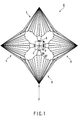
- a large membrane space structure includes a hub 2 mounted on a spacecraft and a sail 4 having, for example, four petals 6.
- the hub 2 includes supports 8, which serve as connecting members to connect the hub 2 with the respective petals 6.
- Each support 8 includes a first support member 8a having stiffness, and a second support member 8b, which has a cord or beam structure hinged on at least a midpoint P. In this embodiment, it is assumed that the second support member 8b is beamed only at the midpoint P.
- the ends B 9 and B 9 ' of the first support member 8a are respectively connected to the ends B 8 and B 8 ' of the second support member 8b by first rigging (B 9 B 8 and B 9 'B 8 ').
- the first rigging is, for example, a long, durable hard-to-cut cord.
- Each support 8 is deflectable relative to an imaginary center line OX to be described later. It includes control means 9 for controlling the angle of deflection to a desired angle within a predetermined range.
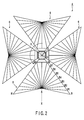
- the petals 6, having the same rectilinear shape OBAB', are spread symmetrically with respect to the center of the hub 2, as shown in FIG. 2.
- One of the apexes of the rectilinear part OBAB' that coincides with the center of hub 2 is referred to as a first fulcrum O.
- Each of the petals 6 has a shape symmetric with respect to the imaginary center line OX to be described later.
- a line passing through the first fulcrum O and the midpoint P of the second support member 8b is called an imaginary center line segment.
- a second fulcrum A is located at an end of the imaginary center line segment opposite to the first fulcrum O.
- a semi-infinite line passing through the first fulcrum O and the second fulcrum A is referred to as an imaginary center line OX.
- the petal 6 is symmetric with respect to the imaginary center line OX and comprises, for example, two triangular parts OAB and OAB'.
- the triangular parts OAB and OAB' are referred to as first regions.
- the line segments OA on the imaginary center line OX and the sides AB and AB' are, for example, 50m long.
- the triangular part ABO of the first region is divided into nine triangular parts ABB 1 , AB 1 B 2 , ⁇ AB 7 B 8 and AB 8 O by the split lines AB 1 to AB 8 .
- the parts ABB 1 , AB 1 B 2 , ⁇ and AB 7 B 8 are referred to as second regions.
- Membranes ABB 1 , AB 1 B 2 , ⁇ and AB 7 B 8 having the shapes corresponding to the triangular parts ABB 1 , AB 1 B 2 , ⁇ and AB 7 B 8 are connected to the respective second regions.
- the membranes ABB 1 , AB 1 B 2 , ⁇ and AB 7 B 8 are preferably formed of a polymeric material resistant to space environment, such as polyimide material. It is preferable that a membrane AB 8 P, formed of the polymeric material resistant to space environment and having the shape corresponding to a triangular part AB 8 P within the triangle AB 8 O, be adhered to the triangular part AB 8 P defined by the line segment OA on the imaginary center line OX, the split line AB 8 nearest to the imaginary center line and the second support member 8b. Thus, one of the apexes of each membrane is supported by the second fulcrum A. Second rigging may be extended along a side B 8 B.
- the membranes ABB 1 , AB 1 B 2 , ⁇ and AB 7 B 8 are connected to one another at the ends B 7 , B 6 , ⁇ and B 1 by bridge belts 10.
- the areal density of the membranes ABB 1 , AB 1 B 2 , ⁇ AB 7 B 8 and AB 8 P is, for example, about 30 g/m 2 or less.
- aluminum is sputtered on the membranes ABB 1 , AB 1 B 2 , ⁇ AB 7 B 8 and AB 8 P and makes them speculate. Therefore, the membranes ABB 1 , AB 1 B 2 , ⁇ AB 7 B 8 and AB 8 P reflect the solar radiation at high reflectivity.
- the mass increase due to sputtering of the membranes ABB 1 , AB 1 B 2 , ⁇ AB 7 B 8 and AB 8 P is negligible.
- the intersection between the membrane AB 7 B 8 and the second support member 8b, i.e., the point B 8 is referred to as the third fulcrum.
- the third fulcrum For example, six imaginary lines B 8 A 1 , B 8 A 2 , ⁇ and B 8 A 6 are drawn from the third fulcrum B 8 to the opposite side AB at suitable intervals.
- bridge belts 10 are arranged at the intersections between the imaginary lines B 8 A 1 , B 8 A 2 , ⁇ and B 8 A 6 and membranes ABB 1 , AB 1 B 2 , ⁇ and AB 7 B 8 , so that the adjacent members are discretely welded or adhered to each another. It is preferable that the bridge belts 10 as well as the membranes are formed of a polymeric material resistant to space environment, such as polyimide material.
- the large membrane space structure of this embodiment is very light, since it comprises almost only the membranes as described above.
- a plurality of peripheral weights can be attached to an outer side AB of the membrane ABB 1 and/or the second rigging B 8 B (peripheral portion) at suitable intervals.
- peripheral weights are attached to the outer side AB only. Details of the peripheral weights will be described later.
- membranes having the shapes corresponding to the triangular parts ABB 1 , AB 1 B 2 , ⁇ AB 7 B 8 and AB 8 P are prepared. Then, the triangle membranes are overlaid one on another so that they can be in a packing state. In this state, the membrane surfaces face each other.
- the bridge belts 10 are arranged at the predetermined positions as mentioned above and the membranes are welded and/or adhered by using the bridge belts 10.
- the bridge belts 10 are arranged such that the folds can be as small as possible. It is preferable that the bridge belts 10 have a width of several centimeters to several tens of centimeters and the length of several tens of centimeters to about one meter.
- the bridge belts 10 are sufficiently smaller than the membranes ABB 1 , AB 1 B 2 , ⁇ AB 7 B 8 and AB 8 P.
- the apexes B 8 , B 7 , ⁇ and B 1 of the membranes are connected by the bridge belts 10.
- the second rigging may be extended along the side B 8 B.
- the petal 6 is attached to the support 8.
- the apexes B, B 1 , ⁇ and B 8 of the membranes ABB 1 , AB 1 B 2 ⁇ and AB 7 B 8 are temporarily connected together.
- the connected membranes are wrapped around the hub 2 (spacecraft) and packed compactly.
- the adjacent membranes are connected by the bridge belts 10 between the membranes ABB 1 , AB 1 B 2 , ⁇ AB 7 B 8 and AB 8 P, only the belts 10 are folded and no folds are formed in the membranes themselves.
- the petal 6 can be packed upon completion of welding and/or adhesion of the bridge belts 10 to the adjacent membranes. Therefore, a small space that can contain one or two membranes is sufficient to produce and pack one petal 6.
- the petal 6 can be produced and packed more efficiently as compared to the case where all membranes are arranged at predetermined positions and adhered to one another by bridge belts 10 at predetermined positions, and the petal 6 is folded at split lines AB 1 to AB 8 and AB 1 ' to AB 8 '. Moreover, the folded petal 6 can be spread with much smaller force as compared to the case where the membranes themselves are folded and the petal 6 is spread by releasing the residual stress and strain of the folded portions of the membranes. In other words, the residual stress and strain involved in spreading the large membrane structure are limited to the width of the bridge belt 10. Therefore, the above structure is easily spread.
- the packed large membrane space structure is transported into space.
- the structure is rotated about the hub 2 at a suitable rotation speed in a direction (circumferential direction of rotation) in which the petals 6 are wrapped around the hub 2, thereby generating centrifugal force in a direction perpendicular to the circumferential direction of rotation by virtue of the function of peripheral weights.
- the petals 6 are gradually unwrapped from the hub 2 by the tension of the membranes generated in the directions of centrifugal force of the respective petals 6, and extended radially outward from the hub 2.
- the membranes ABB 1 , AB 1 B 2 , ⁇ and AB 7 B 8 are wrapped around the spacecraft, they may suffer from some warping in the longitudinal direction due to a core set. Since the core set of the membranes in the direction perpendicular to the longitudinal direction is negligible, it need not be taken into consideration.
- the support 8 mounted on the hub 2 is controlled to rotate the petal 6 about the imaginary center line OX at an arbitrary angle, preferably between 45° and 60°. If the four petals 6 are spread simultaneously on the same plane as shown in FIG. 1, the adjacent petals 6 will be brought into contact with each other. To avoid this, the supports 8 are controlled by the control means 9 to rotate the petals 6, preferably at the same angle, so that the petals 6 can be substantially parallel to one another.
- the sail 4 is rotated about the first fulcrum around the hub 2 in the direction of the arrow shown in FIGS. 1, 2 and 3 at the speed of, for example, 4 rpm.
- the peripheral weights mentioned above generate centrifugal force in the radial directions perpendicular to the circumferential direction of rotation.
- the point B 8 ' symmetric to the third fulcrum B 8 with respect to the imaginary center line OX is referred to as the fourth fulcrum.
- Weak compression force which acts in the direction of closing the petal 6, may be applied across the second support members B 8 P and PB 8 '.
- the centrifugal force acting on the center of the hub 2 is virtually offset by the force acting on the third and fourth fulcrums B 8 and B 8 '.
- the peripheral weights are provided on the outer side AB.
- the weight necessary to provide force equivalent to the membrane's own weight on the earth to exert on the points A, A 1 , ⁇ , A 6 and B on the outer side AB is about 0.1 kg per meter.
- the peripheral weights of about 40 kg must be attached to the end sides. In this state, the force for spreading the petal 6 is equivalent to the force generated by suspending the petal 6 under the gravity 1G on the earth.
- the peripheral weights are not limited to the weights as described above, but can be varied in accordance with the design of the large membrane space structure.
- the bridge belts 10 connecting the membranes are located on the imaginary lines extending from the third and fourth fulcrums B 8 and B 8 ' at arbitrary angles smaller than the angle AOB. They can provide deployment force not only in the radial directions in which the centrifugal force acts but also in the circumferential direction of rotation. In other words, since imaginary angles AB 8 A 1 , A 1 B 8 A 2 , ⁇ and A 6 B 8 B are smaller than the angle AOB, deploying force for the petal 6 is exerted on the bridge belts 10 on the imaginary lines B 8 A 1 , B 8 A 2 , ⁇ and B 8 A 6 .
- the force necessary to deploy the petal 6 is the smallest at the end side AB. Therefore, if the outermost membrane ABB 1 is deployed, it is ensured that all the membranes of the petal 6 can be deployed.
- the centrifugal force by the rotation can be supplemented by the peripheral weights, and the membranes and bridge belts 10 receive not only the centrifugal force but also the deployment force in the direction perpendicular to the direction of the centrifugal force. Therefore, the force sufficient to deploy the petal 6 can be given to the petal 6.
- the peripheral weights are attached to the end side AB to deploy the large membrane space structure.
- the peripheral weights may be provided on the peripheral portion B 8 B, or no weights may be provided on the end side AB or the peripheral portion B 8 B.
- the attitude of the large membrane space structure is changed by setting its center of mass off the center of the light pressure of solar radiation.
- the large membrane space structure is rotated at a high speed, the membranes can be deployed more easily, but the amount of offset of the center of gravity, which is determined by request for change of the attitude, is increased. Therefore, it is necessary to avoid excessively high-speed rotation.
- the peripheral weights of the large membrane space structure can be lightened by increasing the rotation speed. In this case, however, a larger amount of chemical propellant is required to rotate the structure. Therefore, it is necessary to determine whether the rotation speed should be increased by using the fuel of the large membrane space structure.
- the amount of fuel required for rotation is increased in proportion to the rotation speed, while the peripheral weights can be reduced in proportion to the reciprocal of the square of the rotation speed.
- the fuel of about 40 kg is required.
- the off-center quantity necessary to change the attitude of the spacecraft by 3° a day is about 60 cm.
- the membrane density is smaller, the weight of the spacecraft in its entirety and the required amount of fuel can be less.
- the supports 8 are controlled again using the control means 9 to deflect the four petals 6 at arbitrary angles.
- a desired amount of torque is generated in accordance with the rotation angles of the petals 6 with respect to the light pressure, thereby performing attitude control and adjusting the torque of the component of the light pressure applied to the sail 4 in the circumferential direction of the rotation.
- the sides BA and AB' and the imaginary center line segment OA are about 50 m long.
- the lengths are not limited to 50 m but may be within the range of several tens to several hundreds of meters.
- the petal 6 is quadrilateral.
- the petal 6 is not limited to this shape but can be of any shape so long as it is symmetric with respect to the imaginary center line OX.
- it can be a triangle, a pentagon, or a polygon a side of which is arc-shaped (see FIG. 4).
- the petal 6 may be designed such that a point C shown in FIG. 4 is located on the imaginary center line OX. In this case, the petal 6 can be further expanded.
- the shape of the membrane is a triangle.
- it may be, for example, a rectangle or a polygon a side of which is arc-shaped (see FIG. 4).
- the petal is constituted by two polygonal parts symmetric with respect to the imaginary center line OX, as the petal 6 described above.
- One of the polygonal parts OACB has three sides CA, AO and OB and an arc BC.
- Split lines AB 8 to AB 1 , AB, and AC 6 to AC 1 are imaginarily drawn from the second fulcrum A to opposite side OB and arc BC at suitable intervals.
- Membranes are adhered to the regions defined by the side OB, the arc BC and the split lines AB 8 to AB 1 , AB, and AC 6 to AC 1 .
- imaginary lines B 8 A 1 , B 8 A 2 , B 8 C 1 to B 8 C 6 are drawn from the third fulcrum B 8 to the opposite side CA and arc BC at suitable intervals.
- Bridge belts 10 are arranged at the intersections between the imaginary lines B 8 A 1 , B 8 A 2 , B 8 C 1 to B 8 C 6 and the membranes.
- Peripheral weights (not shown) can be provided on the marginal portions AC and CB of the membranes ACC 1 , AC 1 C 2 , ⁇ AC 6 B.
- the number of petals 6 is not limited to four, so long as the petals 6 can be arranged around the hub 2 on the same plane as shown in FIGS. 1 to 3.
- first rigging B 9 B 8 and the second rigging B 8 B are separate members.
- first and second rigging B 9 B 8 and B 8 B may be formed of single rigging B 9 B as a unitary member. If a unitary member is used in place of the first and second rigging, the sides B 9 B 8 and B 8 B form a straight line. It is assumed that the intersection between the extensions of the lines BB 8 and B'B 8 is O' (not shown) in the case where the first rigging B 9 B 8 and second rigging and B 8 B are separate members. In this case, when the petal 6 is entirely deployed, the angle B 8 O'B 8 ' will be the same as or smaller than the angle B 8 OB 8 '.
- the lengths of the sides AB, AB 8 and AC shown in FIGS. 2 to 4 may be the same or different from one another.
- the petals 6 are deployed in space by rotating the sail 4 at the speed of 4 rpm.
- the rotation speed is not limited thereto. It is preferable that a rotation speed be chosen in accordance with the design of the sail 4.
- the petals 6 are not connected to one another.
- the petals may be connected to one another by, for example, rigging at some points.
- the present invention is applied to a large membrane space structure as a propulsive system.
- a solar cell module panel
- the present invention can be applied to a large solar cell membrane structure.
- the large solar cell membrane structure can be spread in the same manner as in the embodiment described above.
Landscapes
- Physics & Mathematics (AREA)
- Engineering & Computer Science (AREA)
- Astronomy & Astrophysics (AREA)
- General Physics & Mathematics (AREA)
- Remote Sensing (AREA)
- Aviation & Aerospace Engineering (AREA)
- Electromagnetism (AREA)
- Tents Or Canopies (AREA)
- Details Of Aerials (AREA)
- Photovoltaic Devices (AREA)
- Separation Using Semi-Permeable Membranes (AREA)
Applications Claiming Priority (2)
| Application Number | Priority Date | Filing Date | Title |
|---|---|---|---|
| JP2001215823A JP3541225B2 (ja) | 2001-07-16 | 2001-07-16 | 大型膜宇宙構造物およびその展開方法 |
| JP2001215823 | 2001-07-16 |
Publications (2)
| Publication Number | Publication Date |
|---|---|
| EP1280228A2 true EP1280228A2 (fr) | 2003-01-29 |
| EP1280228A3 EP1280228A3 (fr) | 2003-09-17 |
Family
ID=19050388
Family Applications (1)
| Application Number | Title | Priority Date | Filing Date |
|---|---|---|---|
| EP01129966A Withdrawn EP1280228A3 (fr) | 2001-07-16 | 2001-12-17 | Grande membrane pour structure d'espace et procédé pour déploiement et expansion |
Country Status (5)
| Country | Link |
|---|---|
| US (1) | US6689952B2 (fr) |
| EP (1) | EP1280228A3 (fr) |
| JP (1) | JP3541225B2 (fr) |
| CA (1) | CA2367979C (fr) |
| RU (1) | RU2232111C2 (fr) |
Cited By (3)
| Publication number | Priority date | Publication date | Assignee | Title |
|---|---|---|---|---|
| GB2434345A (en) * | 2005-12-28 | 2007-07-25 | Frank Ellinghaus | Solar sail arrangement |
| CN105539879A (zh) * | 2015-12-02 | 2016-05-04 | 上海宇航系统工程研究所 | 空间盒型舱体结构 |
| CN111591471A (zh) * | 2020-04-30 | 2020-08-28 | 南京理工大学 | 一种应用于立卫星的制动帆离轨装置 |
Families Citing this family (46)
| Publication number | Priority date | Publication date | Assignee | Title |
|---|---|---|---|---|
| WO2004098994A2 (fr) * | 2002-12-13 | 2004-11-18 | Arizona Board Of Regents | Systeme de determination et de controle d'assiette de faible masse, faible encombrement, faible puissance et bon marche (l4adcs) destine a un microvaisseau spatial a voile solaire |
| US20040216770A1 (en) * | 2003-04-29 | 2004-11-04 | Taiwan Semiconductor Manufacturing Co., Ltd. | Process for rinsing and drying substrates |
| JP2005268664A (ja) * | 2004-03-19 | 2005-09-29 | Fujimi Inc | 研磨用組成物 |
| US20050274849A1 (en) * | 2004-06-10 | 2005-12-15 | Klosner Mark A | Highly-integrated low-mass solar sail |
| WO2006020044A1 (fr) * | 2004-07-21 | 2006-02-23 | Cook Incorporated | Gaine d’introduction et procede de fabrication de celle-ci |
| US7469864B2 (en) * | 2006-02-28 | 2008-12-30 | Bigelow Aerospace | Method for assemblying and landing a habitable structure on an extraterrestrial body |
| US7641151B2 (en) * | 2006-03-02 | 2010-01-05 | Pekka Janhunen | Electric sail for producing spacecraft propulsion |
| RU2336544C1 (ru) * | 2007-02-09 | 2008-10-20 | Открытое акционерное общество "Консорциум "Космическая регата" | Развертываемый зеркальный отражатель |
| US9352853B2 (en) | 2007-11-21 | 2016-05-31 | Orbital Atk, Inc. | Solar arrays, deployment mechanisms therefor, and related methods |
| US9214892B2 (en) * | 2007-11-21 | 2015-12-15 | Orbital Atk, Inc. | Solar arrays |
| US8356774B1 (en) | 2008-04-21 | 2013-01-22 | The United States Of America As Represented By The Secretary Of The Air Force | Structure for storing and unfurling a flexible material |
| US8122646B1 (en) | 2009-03-12 | 2012-02-28 | The United States Of America As Represented By The Administrator Of The National Aeronautics And Space Administration | Method and apparatus for an inflatable shell |
| US8905357B1 (en) * | 2009-10-02 | 2014-12-09 | MMA Design, LLC | Thin membrane structure |
| US9550584B1 (en) * | 2010-09-30 | 2017-01-24 | MMA Design, LLC | Deployable thin membrane apparatus |
| RU2463221C1 (ru) * | 2011-02-21 | 2012-10-10 | Открытое акционерное общество "Военно-промышленная корпорация "Научно-производственное объединение машиностроения" | Способ активно-пассивного успокоения, ориентации и стабилизации космического аппарата |
| US8646747B1 (en) | 2011-07-11 | 2014-02-11 | Intellectual Ventures Fund 79 Llc | Methods, devices, and mediums associated with optical lift mechanism |
| WO2015179213A2 (fr) | 2014-05-14 | 2015-11-26 | California Institute Of Technology | Centrale solaire spatiale de grande échelle : puissance spatiale modulaire multi-échelle |
| JP6693889B2 (ja) | 2014-05-14 | 2020-05-13 | カリフォルニア インスティチュート オブ テクノロジー | 大規模宇宙太陽光発電所:誘導可能ビームを用いる送電 |
| EP3149777B1 (fr) | 2014-06-02 | 2024-02-14 | California Institute of Technology | Centrale électrique solaire à base spatiale à grande échelle : tuiles de génération de puissance efficaces |
| US12021162B2 (en) | 2014-06-02 | 2024-06-25 | California Institute Of Technology | Ultralight photovoltaic power generation tiles |
| JP6337673B2 (ja) * | 2014-07-28 | 2018-06-06 | 日本電気株式会社 | ソーラセイル及びそれを用いたソーラセイル宇宙機 |
| JP6715317B2 (ja) | 2015-07-22 | 2020-07-01 | カリフォルニア インスティチュート オブ テクノロジー | コンパクトパッケージング用の大面積構造体 |
| US10454565B2 (en) | 2015-08-10 | 2019-10-22 | California Institute Of Technology | Systems and methods for performing shape estimation using sun sensors in large-scale space-based solar power stations |
| US10992253B2 (en) | 2015-08-10 | 2021-04-27 | California Institute Of Technology | Compactable power generation arrays |
| CN109071041B (zh) | 2016-02-29 | 2022-08-23 | 乐加德公司 | 紧凑型rf薄膜天线 |
| EP3950512B1 (fr) * | 2016-05-05 | 2025-02-19 | L'garde, Inc. | Voile solaire pour manoeuvres orbitales |
| WO2017192200A1 (fr) * | 2016-05-05 | 2017-11-09 | The Research Foundation For The State Unversity Of New York | Compositions pour le traitement de la parodontite et de l'accumulation de calculs dentaires |
| CN106428635B (zh) * | 2016-10-14 | 2019-05-07 | 南京理工大学 | 一种太阳帆航天器三轴姿态控制执行机构 |
| CN107416232B (zh) * | 2017-07-19 | 2023-05-16 | 浙江理工大学 | 一种抛物面花瓣式折展装置 |
| WO2019161298A1 (fr) | 2018-02-15 | 2019-08-22 | L'garde, Inc. | Système de mise en prise et de désorbitation de débris spatiaux |
| WO2019210286A1 (fr) * | 2018-04-27 | 2019-10-31 | Roccor, Llc | Dispositifs, systèmes et procédés pour voile pouvant être ferlée |
| US11634240B2 (en) | 2018-07-17 | 2023-04-25 | California Institute Of Technology | Coilable thin-walled longerons and coilable structures implementing longerons and methods for their manufacture and coiling |
| US11772826B2 (en) | 2018-10-31 | 2023-10-03 | California Institute Of Technology | Actively controlled spacecraft deployment mechanism |
| CN109782787B (zh) * | 2019-03-08 | 2020-10-30 | 北京航空航天大学 | 一种太阳光压辅助下欠驱动航天器姿态的双模mpc控制方法 |
| WO2020223733A1 (fr) * | 2019-05-02 | 2020-11-05 | L'garde, Inc. | Fixation de voile solaire et procédés de déploiement |
| EP4022713B1 (fr) | 2019-08-30 | 2026-06-17 | L'garde, Inc. | Antenne compactable pour communications par satellite |
| CN110615124B (zh) * | 2019-09-29 | 2022-05-03 | 南京航空航天大学 | 一种缠绕式空间捕获装置 |
| EP4110698A4 (fr) | 2020-02-24 | 2024-02-14 | L'garde, Inc. | Ensemble de raccordement |
| JP7773539B2 (ja) | 2020-10-14 | 2025-11-19 | ルギャルド,インク. | 宇宙での展開のためのコンパクト化可能構造 |
| CN112977896B (zh) * | 2021-02-03 | 2022-04-08 | 南京航空航天大学 | 一种面向非合作目标在轨服务的多微纳卫星快速部署结构 |
| USD947761S1 (en) | 2021-03-13 | 2022-04-05 | Leala Nakagawa | Retractable structural template |
| US12549126B2 (en) | 2021-11-12 | 2026-02-10 | L'garde, Inc. | Lightweight, low stow volume, deployable solar concentrator for space applications |
| CN114162351A (zh) * | 2021-12-31 | 2022-03-11 | 中国航天空气动力技术研究院 | 一种豆荚形支撑杆装置 |
| US12155347B1 (en) * | 2022-02-18 | 2024-11-26 | Lockheed Martin Corporation | Self-deploying flexible solar array |
| JP7819139B2 (ja) * | 2023-03-17 | 2026-02-24 | 株式会社日立製作所 | 宇宙構造物制御システムおよび宇宙構造物制御方法 |
| US12612189B2 (en) | 2023-09-26 | 2026-04-28 | The Aerospace Corporation | Independently moving space vehicles configured to deploy and position a space structure |
Family Cites Families (10)
| Publication number | Priority date | Publication date | Assignee | Title |
|---|---|---|---|---|
| US4614319A (en) * | 1980-05-05 | 1986-09-30 | Drexler Kim E | Solar sail |
| JPH01275300A (ja) * | 1988-04-28 | 1989-11-02 | Nec Corp | 太陽輻射圧による宇宙飛翔体の姿勢制御法 |
| JPH03503270A (ja) * | 1988-12-02 | 1991-07-25 | インスティテュト コスミチェスキヒ イススレドバニ アカデミイ ナウク エスエスエスエル | 宇宙船 |
| RU1758988C (ru) | 1989-11-16 | 1995-08-20 | Головное конструкторское бюро Научно-производственного объединения "Энергия" | Космический аппарат с солнечным парусом |
| SU1815925A1 (ru) * | 1991-06-18 | 1995-04-30 | Долгопрудненское конструкторское бюро автоматики | Развертываемая пленочная конструкция космического аппарата |
| US5642122A (en) * | 1991-11-08 | 1997-06-24 | Teledesic Corporation | Spacecraft antennas and beam steering methods for satellite communciation system |
| US5296044A (en) * | 1992-03-06 | 1994-03-22 | Aec-Able Engineering Company, Inc. | Lightweight stowable and deployable solar cell array |
| RU2053941C1 (ru) | 1993-04-12 | 1996-02-10 | Александр Владимирович Лукьянов | Космический аппарат с солнечным парусом |
| US5527001A (en) * | 1993-06-11 | 1996-06-18 | Teledesic Corporation | Modular communication satellite |
| US6194790B1 (en) * | 1999-11-22 | 2001-02-27 | The United States Of America As Represented By The Secretary Of The Air Force | Solar sail for power generation |
-
2001
- 2001-07-16 JP JP2001215823A patent/JP3541225B2/ja not_active Expired - Lifetime
- 2001-12-14 US US10/014,346 patent/US6689952B2/en not_active Expired - Fee Related
- 2001-12-17 EP EP01129966A patent/EP1280228A3/fr not_active Withdrawn
-
2002
- 2002-01-09 RU RU2002101323/11A patent/RU2232111C2/ru not_active IP Right Cessation
- 2002-01-14 CA CA002367979A patent/CA2367979C/fr not_active Expired - Fee Related
Cited By (4)
| Publication number | Priority date | Publication date | Assignee | Title |
|---|---|---|---|---|
| GB2434345A (en) * | 2005-12-28 | 2007-07-25 | Frank Ellinghaus | Solar sail arrangement |
| GB2434345B (en) * | 2005-12-28 | 2008-04-09 | Frank Ellinghaus | Solar-sail-launch-system, comprising a launch vehicle and a solar sail mothership spacecraft with "roller-reefing"-ACS and solar electric propulsion. |
| CN105539879A (zh) * | 2015-12-02 | 2016-05-04 | 上海宇航系统工程研究所 | 空间盒型舱体结构 |
| CN111591471A (zh) * | 2020-04-30 | 2020-08-28 | 南京理工大学 | 一种应用于立卫星的制动帆离轨装置 |
Also Published As
| Publication number | Publication date |
|---|---|
| US6689952B2 (en) | 2004-02-10 |
| CA2367979C (fr) | 2005-09-27 |
| US20030010869A1 (en) | 2003-01-16 |
| RU2232111C2 (ru) | 2004-07-10 |
| CA2367979A1 (fr) | 2003-01-16 |
| JP2003026100A (ja) | 2003-01-29 |
| JP3541225B2 (ja) | 2004-07-07 |
| EP1280228A3 (fr) | 2003-09-17 |
Similar Documents
| Publication | Publication Date | Title |
|---|---|---|
| US6689952B2 (en) | Large membrane space structure and method for its deployment and expansion | |
| US8132762B2 (en) | Space based rotating film solar battery array | |
| US4380013A (en) | Expandable panel and truss system/antenna/solar panel | |
| US9676501B1 (en) | Space solar array architecture for ultra-high power applications | |
| Mori et al. | First solar power sail demonstration by IKAROS | |
| EP0892460B1 (fr) | Réflecteur d'antenne attaché par son bord et à faible volume de stockage | |
| Fernandez et al. | Completely stripped solar sail concept using bi-stable reeled composite booms | |
| JP2018525265A (ja) | コンパクトパッケージング用の大面積構造体 | |
| US20030010870A1 (en) | Space craft and methods for space travel | |
| MacNeal | The heliogyro-an interplanetary flying machine | |
| EP0629314A4 (fr) | Etalage leger, repliable et deployable de piles solaires. | |
| CN106394933B (zh) | 一种分布式卫星牵引太阳帆航天器构型 | |
| JP2022553508A (ja) | アンテナ用展開式アセンブリ | |
| Murphy et al. | Scalable solar sail subsystem design considerations | |
| US8939588B2 (en) | Device for protection of a multibeam optical instrument | |
| Arya | Packaging and deployment of large planar spacecraft structures | |
| Fang et al. | In-space deployable reflectarray antenna: Current and future | |
| Choi | Flexible dynamics and attitude control of a square solar sail | |
| Garner et al. | A solar sail design for a mission to the near-interstellar medium | |
| EP4234416A1 (fr) | Modules structuraux extensibles pour structures de stations spatiales toroïdales, sous-structures de stations spatiales, structures de stations spatiales toroïdales et procédés de construction de structures de stations spatiales toroïdales | |
| RU2309093C2 (ru) | Солнечная батарея космического аппарата большой площади | |
| RU2735448C1 (ru) | Бинарный космический аппарат с реконфигурируемой антенной, совмещенной со свертываемой в рулон солнечной батареей, развертываемой мультивекторными матричными ракетными двигателями | |
| Garner | Large area sail design concepts | |
| Melnikov et al. | Design of frameless SA deployed by centrifugal for... | |
| Rukhaiyar et al. | Design and assembly of a prototype 6U solar sail CubeSat for debris capture operations in LEO |
Legal Events
| Date | Code | Title | Description |
|---|---|---|---|
| PUAI | Public reference made under article 153(3) epc to a published international application that has entered the european phase |
Free format text: ORIGINAL CODE: 0009012 |
|
| 17P | Request for examination filed |
Effective date: 20011217 |
|
| AK | Designated contracting states |
Designated state(s): AT BE CH CY DE DK ES FI FR GB GR IE IT LI LU MC NL PT SE TR |
|
| AX | Request for extension of the european patent |
Extension state: AL LT LV MK RO SI |
|
| PUAL | Search report despatched |
Free format text: ORIGINAL CODE: 0009013 |
|
| AK | Designated contracting states |
Kind code of ref document: A3 Designated state(s): AT BE CH CY DE DK ES FI FR GB GR IE IT LI LU MC NL PT SE TR |
|
| AX | Request for extension of the european patent |
Extension state: AL LT LV MK RO SI |
|
| AKX | Designation fees paid |
Designated state(s): DE FR IT |
|
| 17Q | First examination report despatched |
Effective date: 20090313 |
|
| GRAP | Despatch of communication of intention to grant a patent |
Free format text: ORIGINAL CODE: EPIDOSNIGR1 |
|
| INTG | Intention to grant announced |
Effective date: 20150921 |
|
| STAA | Information on the status of an ep patent application or granted ep patent |
Free format text: STATUS: THE APPLICATION IS DEEMED TO BE WITHDRAWN |
|
| 18D | Application deemed to be withdrawn |
Effective date: 20160131 |