EP1280253A2 - Spannungsregler vom externen Typ für einen Fahrzeuggenerator - Google Patents
Spannungsregler vom externen Typ für einen Fahrzeuggenerator Download PDFInfo
- Publication number
- EP1280253A2 EP1280253A2 EP02011835A EP02011835A EP1280253A2 EP 1280253 A2 EP1280253 A2 EP 1280253A2 EP 02011835 A EP02011835 A EP 02011835A EP 02011835 A EP02011835 A EP 02011835A EP 1280253 A2 EP1280253 A2 EP 1280253A2
- Authority
- EP
- European Patent Office
- Prior art keywords
- alternator
- transistor
- turned
- terminal
- voltage
- Prior art date
- Legal status (The legal status is an assumption and is not a legal conclusion. Google has not performed a legal analysis and makes no representation as to the accuracy of the status listed.)
- Withdrawn
Links
Images


Classifications
-
- H—ELECTRICITY
- H02—GENERATION; CONVERSION OR DISTRIBUTION OF ELECTRIC POWER
- H02P—CONTROL OR REGULATION OF ELECTRIC MOTORS, ELECTRIC GENERATORS OR DYNAMO-ELECTRIC CONVERTERS; CONTROLLING TRANSFORMERS, REACTORS OR CHOKE COILS
- H02P9/00—Arrangements for controlling electric generators for the purpose of obtaining a desired output
- H02P9/48—Arrangements for obtaining a constant output value at varying speed of the generator, e.g. on vehicle
-
- H—ELECTRICITY
- H02—GENERATION; CONVERSION OR DISTRIBUTION OF ELECTRIC POWER
- H02J—ELECTRIC POWER NETWORKS; CIRCUIT ARRANGEMENTS OR SYSTEMS FOR SUPPLYING OR DISTRIBUTING ELECTRIC POWER; SYSTEMS FOR STORING ELECTRIC ENERGY
- H02J7/00—Circuit arrangements for charging or discharging batteries or for supplying loads from batteries
- H02J7/60—Circuit arrangements for charging or discharging batteries or for supplying loads from batteries including safety or protection arrangements
- H02J7/64—Circuit arrangements for charging or discharging batteries or for supplying loads from batteries including safety or protection arrangements against overvoltage
-
- H—ELECTRICITY
- H02—GENERATION; CONVERSION OR DISTRIBUTION OF ELECTRIC POWER
- H02J—ELECTRIC POWER NETWORKS; CIRCUIT ARRANGEMENTS OR SYSTEMS FOR SUPPLYING OR DISTRIBUTING ELECTRIC POWER; SYSTEMS FOR STORING ELECTRIC ENERGY
- H02J7/00—Circuit arrangements for charging or discharging batteries or for supplying loads from batteries
- H02J7/14—Circuit arrangements for charging or discharging batteries or for supplying loads from batteries for charging batteries from dynamo-electric generators driven at varying speed, e.g. on vehicle
-
- H—ELECTRICITY
- H02—GENERATION; CONVERSION OR DISTRIBUTION OF ELECTRIC POWER
- H02J—ELECTRIC POWER NETWORKS; CIRCUIT ARRANGEMENTS OR SYSTEMS FOR SUPPLYING OR DISTRIBUTING ELECTRIC POWER; SYSTEMS FOR STORING ELECTRIC ENERGY
- H02J7/00—Circuit arrangements for charging or discharging batteries or for supplying loads from batteries
- H02J7/60—Circuit arrangements for charging or discharging batteries or for supplying loads from batteries including safety or protection arrangements
- H02J7/65—Circuit arrangements for charging or discharging batteries or for supplying loads from batteries including safety or protection arrangements against overtemperature
-
- H—ELECTRICITY
- H02—GENERATION; CONVERSION OR DISTRIBUTION OF ELECTRIC POWER
- H02J—ELECTRIC POWER NETWORKS; CIRCUIT ARRANGEMENTS OR SYSTEMS FOR SUPPLYING OR DISTRIBUTING ELECTRIC POWER; SYSTEMS FOR STORING ELECTRIC ENERGY
- H02J7/00—Circuit arrangements for charging or discharging batteries or for supplying loads from batteries
- H02J7/60—Circuit arrangements for charging or discharging batteries or for supplying loads from batteries including safety or protection arrangements
- H02J7/61—Circuit arrangements for charging or discharging batteries or for supplying loads from batteries including safety or protection arrangements against overcharge
Definitions
- the present invention relates to an external type regulator for a vehicle alternator, and in particular to an external type regulator for a vehicle alternator which is capable of preventing a damage of electric parts and a battery by stopping a power generation by disconnecting a field current flowing in a field coil through a relay in the case that an over charge occurs in an alternator due to a damage of a regulator.
- a vehicle includes various electric apparatuses such as lamps, air conditioner, etc. including an electric part such as a starting apparatus or ignition apparatus of an engine.
- a battery and alternator supply a power to the above parts.
- the alternator is connected with an engine by a certain belt.
- the generated power is determined based on the revolution of the engine.
- the generated power of the alternator is smaller than the load of various electric parts, namely, the load generated by load elements
- the battery temporarily charges as a power source, so that the power charged in the battery is supplied to various load elements.
- the generated power of the alternator is larger than the load generated in various load elements, only the alternator supplies the power to all load elements, and the battery is charged by the alternator.
- a regulator is used together with the alternator for supplying a power proper to various loads and charging a battery by a certain amount by controlling the output voltage of the alternator by controlling the field current flowing in the field coil of the alternator.
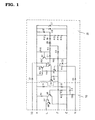
- FIG. 1 is a view illustrating a regulator for a conventional vehicle alternator.
- the above regulator includes a charge lamp controller 10 for controlling in order for a charge lamp to be turned on when a vehicle is in a key-switch on state and in order for the charge lamp to be turned off when the engine starts, and the alternator generates the power, and a voltage adjusting unit 20 for controlling in order for the output voltage of the alternator to be constantly maintained as an adjusted voltage.
- the charge controller 10 when the key switch of the vehicle is turned on, the current of the battery(not shown) is inputted into a terminal L connected with the charge lamp(not shown) through an ignition key(not shown).
- the current flowing from the terminal A connected with an output voltage terminal of the alternator(not shown) through a resistor R1 is inputted into a base terminal of a transistor Q7, the transistor Q7 is turned on, and a transistor Q8 is turned on, so that the current of the battery inputted into the terminal L flows to the earth terminal E through the transistor Q8, whereby the charge lamp is turned on.
- the alternator when the alternator generates power as the engine starts, the current flowing from the terminal A through the resistor R1 is inputted into a collector terminal of a transistor Q6.
- the,transistor Q6 When the current flowing from a terminal N connected with the center point of the alternator through a diode D3 and the resistor R2 is inputted into a base terminal of the transistor Q6, the,transistor Q6 is turned on, and the transistors Q7 and Q8 are turned off, so that the current of the battery does not flow to the charge lamp connected with the terminal L. Namely, the current directly flows to the terminal E for thereby turning off the charge lamp.
- the current of the battery is inputted into the IG terminal connected with the ignition key and is inputted into the collector terminal of the transistor Q2 through the diode D7 and a resistor R9.
- a resistor R11 and a condenser C1 is inputted into a base terminal of the transistor Q2
- the transistor Q2 is turned on, and the current flowing in an emitter terminal is inputted into a base terminal of the power transistor Q4 directly connected with the terminal A.
- the power transistor Q4 is turned on, and the current of an emitter terminal flows to the field, coil through the terminal F for thereby first exciting the field coil.
- the output voltage of the alternator becomes constant as described in the following operation.
- the transistor Q1 directly connected with the terminal A is turned on. Therefore, the current directly flows to the terminal E through a resistor R8.
- the transistor Q1 is turned on, when the output voltage of a resistor R11 is higher than the conducting voltage of a zenor diode D5, the zenor diode D5 is turned on, and the current flows to the terminal E through the transistor Q1, the resistor R11, the zenor diode D5, the diode D6 and the resistors R13, R14 and R15.
- the current is not inputted into a base terminal of the transistor Q2, and the power transistor Q4 is turned off. So, the current does not flow to the field coil connected with the terminal F, so that it is impossible to generate power, whereby the generating voltage is decreased.
- the above described operation is repeatedly performed at a very high speed for thereby maintaining the voltage generation of the alternator as a uniform adjusting voltage.
- the heat sink which is a kind of heat radiating plate is used for preventing an over heating phenomenon of the power transistor Q4 in the voltage adjusting unit 20.
- the regulator does not normally perform the regulation function.
- the over heating problem of the power transistor Q4 is prevented using the heat sink in the above described manner.
- the heat sink is simply fixed using screws at a certain portion of a substrate on which the power transistor Q4 is mounted, if the screws are not properly fixed, a non-contact problem may occur, so that the heat sink may not normally operate.
- the over heating problem of the power transistor Q4 may occur, so that the power transistor Q4 may be critically damaged.
- the regulator may be damaged, so that the over change problem may occur in the alternator. Therefore, the electric parts of the vehicle may be critically damaged due to the over charge of the alternator.
- the battery may be damaged for thereby decreasing the life span of the battery.
- an external type regulator for a vehicle alternator which includes an over charge disconnector which includes a dividing resistor for dividing a voltage inputted through an IG terminal, a zenor diode which is turned off in the case that the voltage divided by the dividing resistor is higher than a zenor voltage, for thereby detecting an over charge of an alternator which occurs in an IG terminal, first and second transistors which are turned on when the zenor diode detects an over charge and is turned on and outputs a relay driving signal, a relay which has a contact point terminal connected between a power transistor and a field coil of the voltage adjusting unit and being switch-driven in response to a relay driving signal when the first transistor is turned on, for thereby disconnecting a field current flowing between the power transistor and the field coil, and a plurality of resistors, condensers and diodes, whereby the over charge disconnector stops a power generation of the alternator by detecting an over charge of the alternator and disconnecting
- FIG. 2 is a view illustrating an external type regulator for a vehicle alternator according to the present invention.
- a charge lamp When a key switch of a vehicle is turned on, a charge lamp is turned on. In this state, when an engine starts, and an alternator generates power.
- a charge lamp controller 10 controls in order for a charge lamp to be turned off.
- a voltage adjusting unit 20 controls in order for an output voltage of an alternator to be uniform as an adjusting voltage.
- An over charge disconnector 30 disconnects a field current flowing in a field coil by detecting an over charge of an alternator and controls in order for the alternator not to generate power.
- the charge lamp controller 10 includes a plurality of resistors R1, R2 and R3, transistors Q6, Q7 and Q8, diodes D1, D2 and D3, and a condenser C4 which are connected to each terminal.
- the voltage adjusting unit 20 includes a plurality of resistors R4 through R15, transistors Q1 through Q3, a power transistor Q4, diodes D4. D6 and D7, a zenor diode D5 and condensers C1, C2 and C3 which are connected to each terminal.
- the above construction is the same as the conventional construction except for the following inventive construction.
- the over charge disconnector 30 includes dividing resistors R17 and R18 for dividing a voltage inputted through the IG terminal, a zenor diode D10 which is turned on when the voltage divided by the dividing resistors R17 and R18, is higher than the zenor voltage for thereby detecting an over charge of the alternator in the IG terminal, transistors Q9 and Q10 which are turned on and output a relay driving signal when the zenor diode D10 detects the over charge and is turned on, and a relay REL which includes a contact point terminal connected between the power transistor Q4 and the field coil FC in the voltage adjusting unit 20 and disconnects the field current between the power transistor Q4 and the field coil FC as the contact terminal switch-operates based on a relay driving signal when the transistor Q9 is turned on.
- resistors R16, R18 and R19 there are provided a plurality of resistors R16, R18 and R19, condensers C8 and C9, and diodes D8, D9 and D11.
- the transistor Q9 is a PNP type transistor
- the transistor Q10 is a NPN type transistor.
- the transistor Q9 and the transistor Q10 are connected in series.
- the first terminal of the relay REL is connected with an emitter terminal of the power transistor Q4, and the second terminal is connected with a collector terminal of the transistor Q9, and the fourth terminal is connected with the field coil FC, and the fifth terminal is connected with the resistor R16.
- the contact point terminal is connected with the first terminal and the fourth terminal until the over charge of the alternator is detected, so that the field current is not disconnected between the power transistor Q4 and the field coil FC.
- the terminals INI-1 and INI-2 connected with the first and fourth terminals of the relay REL are connected with the terminals INI-1 and INI-2 terminals in the J1 connected with the terminal F, and the first terminal is connected with an emitter terminal of the power transistor Q4, and the fourth terminal is connected with the field coil FC.
- the regulator may be damaged, so that an over charge problem occurs.
- the over charge disconnector 30 divides the voltage of the current flowing from the IG terminal through the diode D8 using the dividing resistors R17 and R18, so that the voltage of the dividing resistor R18 is inputted into the zenor diode D10.
- the zenor diode D10 detects an over charge of the alternator using a zenor vltage.
- the zenor diode D10 is turned on, and the current is inputted into a base terminal of the transistor Q10.
- the NPN type transistor Q10 is turned on, and the series-connected PNP type transistor Q9 is turned on, and the current flows in the coil of the relay REL connected between the transistor Q9 and the resistor R16, so that the contact point terminal connected with the first terminal of the relay REL is switched to the third terminal for thereby changing the contact point.
- the relay when the over charge occurs, the relay is quickly operated and maintains a turned-on state until the power is disconnected.
- the relay REL since two transistors are used for driving the relay REL, it is possible to prevent a short-circuit problem due to the heat and over current because a turning on/off contact time of the relay REL is fast compared to when using one transistor.
- an alarm indication light is installed in a lower portion of a display panel in a driving seat of a vehicle, so that an error information of a regulator occurring when a regulator is damaged is indicated based on a light turning on/off operation, whereby a driver easily recognizes the error state of the regulator. Therefore, in the present invention, it is possible to accurately recognize other abnormal parts and product and check the error position.
- the present invention is basically directed to an external type regulator and is capable of decreasing a cost by changing only damaged regulator compared to the conventional internal type regulator which is installed together with the alternator.
- the over charge of the alternator is detected through the zenor diode.
- the field current flowing between the power transistor and the field coil through the relay driven by two transistors is disconnected, and the alternator stops the power generation. Therefore, it is possible to prevent the electric parts and battery of a vehicle from being damaged by an over charge.
Landscapes
- Engineering & Computer Science (AREA)
- Power Engineering (AREA)
- Control Of Eletrric Generators (AREA)
- Control Of Charge By Means Of Generators (AREA)
Applications Claiming Priority (2)
| Application Number | Priority Date | Filing Date | Title |
|---|---|---|---|
| KR10-2001-0045329A KR100421094B1 (ko) | 2001-07-27 | 2001-07-27 | 차량용 발전기의 외장형 레귤레이터 |
| KR2001045329 | 2001-07-27 |
Publications (2)
| Publication Number | Publication Date |
|---|---|
| EP1280253A2 true EP1280253A2 (de) | 2003-01-29 |
| EP1280253A3 EP1280253A3 (de) | 2005-06-01 |
Family
ID=19712596
Family Applications (1)
| Application Number | Title | Priority Date | Filing Date |
|---|---|---|---|
| EP02011835A Withdrawn EP1280253A3 (de) | 2001-07-27 | 2002-05-28 | Spannungsregler vom externen Typ für einen Fahrzeuggenerator |
Country Status (5)
| Country | Link |
|---|---|
| US (1) | US6590367B2 (de) |
| EP (1) | EP1280253A3 (de) |
| JP (1) | JP2003111496A (de) |
| KR (1) | KR100421094B1 (de) |
| CN (1) | CN1400718A (de) |
Families Citing this family (11)
| Publication number | Priority date | Publication date | Assignee | Title |
|---|---|---|---|---|
| JP4192427B2 (ja) * | 2001-01-09 | 2008-12-10 | 株式会社デンソー | 車両用発電制御装置 |
| KR20030018871A (ko) * | 2001-08-31 | 2003-03-06 | 현대자동차주식회사 | 차량 충전 시스템의 과전압 방지회로 |
| KR20030018879A (ko) * | 2001-08-31 | 2003-03-06 | 현대자동차주식회사 | 차량 충전 시스템의 과전압 방지회로 |
| KR20040003138A (ko) * | 2002-06-29 | 2004-01-13 | 현대자동차주식회사 | 자동차의 알터네이터용 전압 레귤레이터 |
| KR20040038489A (ko) * | 2002-11-01 | 2004-05-08 | 기아자동차주식회사 | 자동차용 발전기의 과전압 차단장치 |
| WO2005050332A2 (en) * | 2003-11-17 | 2005-06-02 | Ballard Commercial Industries, Inc. | Improved regulator system for alternator |
| JP5793672B2 (ja) * | 2011-08-31 | 2015-10-14 | パナソニックIpマネジメント株式会社 | 電気車両用充電装置及び電気車両用充電システム |
| CN102785579A (zh) * | 2012-08-21 | 2012-11-21 | 江苏云意电气股份有限公司 | 一种数据融合的自诊断汽车调节器 |
| US9728359B1 (en) * | 2016-06-20 | 2017-08-08 | Lg Chem, Ltd. | Diagnostic system for a voltage regulator |
| KR102155876B1 (ko) | 2019-11-04 | 2020-09-16 | 주식회사 서강에프엠비 | 건축 및 자동차 내장재용 난연 시이트의 제조방법 및 그 난연 시이트 |
| KR102155878B1 (ko) | 2019-11-05 | 2020-09-16 | 주식회사 서강에프엠비 | 건축 및 자동차 내장재용 난연 시이트의 제조방법 및 그 난연 시이트 |
Family Cites Families (12)
| Publication number | Priority date | Publication date | Assignee | Title |
|---|---|---|---|---|
| US3522482A (en) * | 1967-12-26 | 1970-08-04 | Motorola Inc | Temperature compensated voltage regulation |
| US3622858A (en) * | 1970-10-29 | 1971-11-23 | Clair Emerson Mitchell | Electrical generating system for an automotive vehicle |
| GB1425223A (en) * | 1972-02-04 | 1976-02-18 | Lucas Tvs Ltd | Battery charging systems for road vehicles |
| GB1465527A (en) * | 1974-02-27 | 1977-02-23 | Azuma K | Power source system for vehicles |
| US3938005A (en) * | 1974-11-25 | 1976-02-10 | General Motors Corporation | Electrical generating system overvoltage protection circuit |
| US4791349A (en) * | 1982-03-15 | 1988-12-13 | Minks Floyd D | Electric power system |
| US4503365A (en) * | 1982-10-08 | 1985-03-05 | General Motors Corporation | Power supply system for low cold resistance loads |
| US4459631A (en) * | 1982-10-28 | 1984-07-10 | General Motors Corporation | Transient over-voltage protection circuit |
| JPH05137294A (ja) * | 1991-11-15 | 1993-06-01 | Mitsubishi Motors Corp | オルタネータの発電負荷制御装置 |
| KR19990029126U (ko) * | 1997-12-29 | 1999-07-15 | 오상수 | 발전기의 과전압보호회로 |
| US5982158A (en) * | 1999-04-19 | 1999-11-09 | Delco Electronics Corporaiton | Smart IC power control |
| EP1184954A1 (de) * | 2000-08-31 | 2002-03-06 | STMicroelectronics S.r.l. | Selbsgespeister und Integrierter Spannungsregler und dazugehöriges Regelungsverfahren |
-
2001
- 2001-07-27 KR KR10-2001-0045329A patent/KR100421094B1/ko not_active Expired - Fee Related
-
2002
- 2002-05-27 JP JP2002151782A patent/JP2003111496A/ja active Pending
- 2002-05-28 EP EP02011835A patent/EP1280253A3/de not_active Withdrawn
- 2002-05-29 US US10/159,947 patent/US6590367B2/en not_active Expired - Lifetime
- 2002-07-24 CN CN02140792A patent/CN1400718A/zh active Pending
Also Published As
| Publication number | Publication date |
|---|---|
| KR100421094B1 (ko) | 2004-03-04 |
| KR20030010782A (ko) | 2003-02-06 |
| CN1400718A (zh) | 2003-03-05 |
| EP1280253A3 (de) | 2005-06-01 |
| US6590367B2 (en) | 2003-07-08 |
| JP2003111496A (ja) | 2003-04-11 |
| US20030020438A1 (en) | 2003-01-30 |
Similar Documents
| Publication | Publication Date | Title |
|---|---|---|
| EP0621148B1 (de) | Klimaanlage für ein elektrisches Fahrzeug | |
| EP1280253A2 (de) | Spannungsregler vom externen Typ für einen Fahrzeuggenerator | |
| KR100376920B1 (ko) | 차량용 교류발전기의 제어장치 | |
| JP3513085B2 (ja) | 車両用発電機の電圧制御装置 | |
| JP2005333686A (ja) | 車両用発電システム | |
| US4354182A (en) | Monitoring equipment for the electrical supply system in a motor vehicle | |
| US4295087A (en) | Charge indicator circuit for a battery charging system | |
| US4297631A (en) | Battery charging systems for road vehicles | |
| US7782023B2 (en) | Multipower voltage regulator | |
| EP1253697B1 (de) | Gemeinsamer Pin-Spannungsregel | |
| KR100445860B1 (ko) | 보조 배터리가 구비된 자동차의 전원공급장치 | |
| US4470004A (en) | Charge indicating system | |
| JP3587121B2 (ja) | 電気自動車用空調装置 | |
| US20020047690A1 (en) | Power generation control unit for vehicles | |
| KR100221193B1 (ko) | 전압조정기의 안정화 회로 | |
| JPH0715886A (ja) | 車両用発電機の出力電圧制御装置 | |
| JP3133867B2 (ja) | 車両用電源装置 | |
| KR200289720Y1 (ko) | 보조 배터리가 구비된 자동차의 전원공급장치 | |
| JPH049024B2 (de) | ||
| KR960006004Y1 (ko) | 차량용 전압조정기회로 | |
| KR200295193Y1 (ko) | 축전지경고장치 | |
| KR100187177B1 (ko) | 알터네이터 출력부족 감지 장치 | |
| JPH0127401Y2 (en) | Voltage regulator | |
| KR920008363Y1 (ko) | 차량용 발전기의 전압조정기회로 | |
| JP2707578B2 (ja) | 車両用電圧調整器の充電表示装置 |
Legal Events
| Date | Code | Title | Description |
|---|---|---|---|
| PUAI | Public reference made under article 153(3) epc to a published international application that has entered the european phase |
Free format text: ORIGINAL CODE: 0009012 |
|
| AK | Designated contracting states |
Designated state(s): AT BE CH CY DE DK ES FI FR GB GR IE IT LI LU MC NL PT SE TR |
|
| AX | Request for extension of the european patent |
Extension state: AL LT LV MK RO SI |
|
| PUAL | Search report despatched |
Free format text: ORIGINAL CODE: 0009013 |
|
| AK | Designated contracting states |
Kind code of ref document: A3 Designated state(s): AT BE CH CY DE DK ES FI FR GB GR IE IT LI LU MC NL PT SE TR |
|
| AX | Request for extension of the european patent |
Extension state: AL LT LV MK RO SI |
|
| RIC1 | Information provided on ipc code assigned before grant |
Ipc: 7H 02H 3/20 B Ipc: 7H 02J 7/24 B Ipc: 7H 02J 7/16 A |
|
| AKX | Designation fees paid | ||
| STAA | Information on the status of an ep patent application or granted ep patent |
Free format text: STATUS: THE APPLICATION IS DEEMED TO BE WITHDRAWN |
|
| 18D | Application deemed to be withdrawn |
Effective date: 20051103 |
|
| REG | Reference to a national code |
Ref country code: DE Ref legal event code: 8566 |