EP1280324B1 - Akustisches Raumüberwachungsverfahren mit schnurlosen Telefons - Google Patents
Akustisches Raumüberwachungsverfahren mit schnurlosen Telefons Download PDFInfo
- Publication number
- EP1280324B1 EP1280324B1 EP02291869A EP02291869A EP1280324B1 EP 1280324 B1 EP1280324 B1 EP 1280324B1 EP 02291869 A EP02291869 A EP 02291869A EP 02291869 A EP02291869 A EP 02291869A EP 1280324 B1 EP1280324 B1 EP 1280324B1
- Authority
- EP
- European Patent Office
- Prior art keywords
- handset
- radio base
- radio
- itself
- handsets
- Prior art date
- Legal status (The legal status is an assumption and is not a legal conclusion. Google has not performed a legal analysis and makes no representation as to the accuracy of the status listed.)
- Expired - Lifetime
Links
- 238000012544 monitoring process Methods 0.000 title claims description 17
- 238000000034 method Methods 0.000 title claims description 12
- 238000001514 detection method Methods 0.000 claims description 2
- 230000005236 sound signal Effects 0.000 claims 1
- 230000005540 biological transmission Effects 0.000 description 6
- 230000001360 synchronised effect Effects 0.000 description 3
- 238000010586 diagram Methods 0.000 description 1
- 230000008054 signal transmission Effects 0.000 description 1
- 230000002123 temporal effect Effects 0.000 description 1
Images
Classifications
-
- H—ELECTRICITY
- H04—ELECTRIC COMMUNICATION TECHNIQUE
- H04M—TELEPHONIC COMMUNICATION
- H04M1/00—Substation equipment, e.g. for use by subscribers
- H04M1/72—Mobile telephones; Cordless telephones, i.e. devices for establishing wireless links to base stations without route selection
- H04M1/725—Cordless telephones
- H04M1/72502—Cordless telephones with one base station connected to a single line
- H04M1/72505—Radio link set-up procedures
- H04M1/72513—On hold, intercom or transfer communication modes
-
- H—ELECTRICITY
- H04—ELECTRIC COMMUNICATION TECHNIQUE
- H04M—TELEPHONIC COMMUNICATION
- H04M1/00—Substation equipment, e.g. for use by subscribers
- H04M1/72—Mobile telephones; Cordless telephones, i.e. devices for establishing wireless links to base stations without route selection
- H04M1/725—Cordless telephones
- H04M1/72502—Cordless telephones with one base station connected to a single line
- H04M1/72505—Radio link set-up procedures
-
- H—ELECTRICITY
- H04—ELECTRIC COMMUNICATION TECHNIQUE
- H04M—TELEPHONIC COMMUNICATION
- H04M2250/00—Details of telephonic subscriber devices
- H04M2250/08—Details of telephonic subscriber devices home cordless telephone systems using the DECT standard
Definitions
- the present invention relates to local networks for radio transmission of signals digital and in particular the communications between the mobile terminals of such network.
- Such a network When such a network is established according to the DECT standard for example, it includes a basic radio through which the terminals can communicate with each other.
- the base constitutes thus a central node of the network which retransmits to each of the terminals the signals digital voice or data received from his correspondent with whom he communicated.
- the radio base slaves the terminals by synchronizing them on a time frame of a plurality of channels whose the former are reserved for transmissions from the base to the terminals and the last are reserved for transmissions to transmissions in the opposite direction.
- a frame is TDMA / TDD Multiple Time Division / Time Division Multiple Access Duplex.
- the base cyclically emits a beacon, a code word in a predetermined transmission channel, indicating its rank in the frame. Any terminal that enters the radio coverage area of the base recognizes the beacon and, according to the corresponding moment and the rank of the channel, he determines the beginning of the new frame of the base.
- EP871314 discloses a telephone apparatus having a base station radio connected to the switched network and two subscriber devices with a microphone. Monitoring links are planned to exchange information between subscriber devices, particularly in an application for monitoring a subject, child or sick.
- the plaintiff has therefore set itself the goal of extending the possibilities of use remote monitoring function.
- she sought a solution allowing the use of the monitoring function out of the range of the radio base.
- the invention thus relates to a method of remote monitoring of a space of work or home using two telephone handsets (C1, C2) of a network multiple division time division duplex radio communication terminal, comprising at least one radio base connected to an external network such as the network and, associated with it, the two telephone handsets (C1, C2), the first telephone handset (C1) having the monitoring function of space and having activated the latter, characterized by the fact that the two combined telephony being out of range of said radio base and at least one of the two being arranged to be able to transform itself into radio base, this last telephone handset converts to a radio base for direct communication with the other handset telephone.
- the method is characterized in that, the second telephone handset (C2) being arranged to be able to transform itself into a base radio, it comprises the step of putting the first telephone handset into operation (C1) with the monitoring function and the direct mode call stage from C1 to C2.
- the method is characterized in that the telephone handset having the monitoring function also comprising a sound level detector turns into a radio base when the sound level reaches a predetermined threshold.
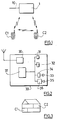
- the telephone network is a DECT standard network and includes a radio base 1 connected to a link 10 of an external network, the telephone network switched by example; the base manages the communications of a plurality of radio terminals such as those referenced C1 and C2 located in the radio coverage area of the base.
- FIG. 2 schematically shows the different functional blocks of a handset telephone C1 implemented in the context of the invention.
- the telephone handset conventionally comprises a radio transmission and reception block 30, an interface man-machine 39 and a central control unit 37.
- the radio block 30 is intended for transmit and receive data through a radio transmission channel, following the DECT protocol, in order to communicate with the base.
- the human-machine interface 39 comprises an input keyboard 3, a display screen 32, a microphone 33 and a speaker 35.
- the microphone 33 and the loudspeaker 35 are respectively connected to a analog-to-digital converter (ADC) 34 and to a converter Digital / Analogue (DAC) 36.
- ADC analog-to-digital converter
- DAC Digital / Analogue
- the input keyboard 31 includes keys telephone numbers, a key to control the display of a main menu and keys to move in the menu tree.
- the central block of command 37 includes a microprocessor, to which all the elements of the telephone handset C1 are connected, and is arranged to control the operation
- the two telephone handsets are out of reach of the based.
- a first handset C1 in the room for example that we wish to monitor. It is put into service and selected in the menu the function of monitoring.
- the handset is then in the active non-synchronized state. He sweeps at regular intervals, every 10 seconds, the channels looking for a signal from tag with the appropriate identity.
- the user places the second handset in a second room from where he wants to remotely monitor the noise emitted in the first room. He puts it into service.
- the user selects the direct mode and the number of the first telephone handset, this one corresponds to the number that it pre-recorded in memory. He presses the tap key line.
- the handset transmits a beacon signal on which the first handset synchronizes and picks up. The user can listen to the noises emitted in the first room until he hangs up.
- the handset has a means by which the loudspeaker is turned off when in monitoring mode so that it remains silent during monitoring.
- the first telephone handset C1 is arranged on the one hand to be able to turn into radio base and on the other hand to call the telephone handset C2 whose number has been previously registered.
- C1 also comprises a sound level detection means by which it triggers the line. It then turns into a radio base calling the C2 telephone handset. Assuming then that the second telephone handset C2 is in use, that is to say in the active non-synchronized state, C2 starts to ring. The user by picking up can then listen to the noises emitted in the room under surveillance.
- the calling telephone handset which turns into a radio base when direct mode communication is established, is also arranged to emit a beacon signal comprising a group tone type message. Thanks to this provision it is not necessary to provide the seizure of the number of the second telephone handset.
- the second telephone handset is set to pick up on the first ring.
- the second handset phone that was in standby will broadcast the sounds emitted in the room under monitoring without the user having to pick up.
Landscapes
- Engineering & Computer Science (AREA)
- Computer Networks & Wireless Communication (AREA)
- Signal Processing (AREA)
- Mobile Radio Communication Systems (AREA)
- Alarm Systems (AREA)
Claims (7)
- Verfahren zur Fernüberwachung eines Wohn- oder Arbeitsraums mittels zweier Telefonhandgeräte (C1, C2) eines lokalen Funkverbindungsnetzes mit Mehrfachzugriff im Zeitmultiplex, mindestens eine Funkbasisstation (1) umfassend, die an ein externes Netz wie das Fernsprechwahlnetz angeschlossen ist, und der zwei Telefonhandgeräte (C1, C2) zugeordnet sind, wobei das erste (C1) die Raumüberwachungsfunktion umfasst, und wenn diese Funktion aktiviert ist, dadurch gekennzeichnet ist, dass, wenn die beiden Telefonhandgeräte außerhalb des Funkbereichs der Funkbasisstation (1) sind und mindestens eines der beiden dazu eingerichtet ist, sich in eine Funkbasisstation verwandeln zu können, dieses letztgenannte Telefonhandgerät sich in eine Funkbasisstation verwandelt, um eine direkte Verbindung mit dem anderen Telefonhandgerät herzustellen.
- Verfahren nach dem vorhergehenden Anspruch, wobei das zweite Telefonhandgerät (C2) dazu eingerichtet ist, sich in eine Funkbasisstation verwandeln zu können, dadurch gekennzeichnet, dass es den Schritt des Inbetriebsetzens des ersten (C1) mit der Überwachungsfunktion und den Schritt des Anrufens des Telefonhandgeräts (C1) durch das Telefonhandgerät (C2) im Direktbetrieb umfasst.
- Verfahren nach einem der vorhergehenden Ansprüche, dadurch gekennzeichnet, dass der Lautsprecher des Telefonhandgeräts (C1) inaktiv ist, während die Überwachungsfunktion aktiviert ist.
- Verfahren nach Anspruch 1, dadurch gekennzeichnet, dass das Telefonhandgerät (C1) einen Schallpegeldetektor umfasst und dazu eingerichtet ist, sich in eine anrufende Funkbasisstation verwandeln zu können, wenn der Schallpegel einen vorbestimmten Schwellenwert erreicht.
- Verfahren nach einem der vorhergehenden Ansprüche, dadurch gekennzeichnet, dass das zweite Telefonhandgerät (C2) parametrisiert ist, um beim ersten Läuten abzuheben.
- Verfahren nach einem der vorhergehenden Ansprüche, dadurch gekennzeichnet, dass das anrufende Telefonhandgerät, das sich in eine Funkbasisstation verwandelt, wenn eine Verbindung im Direktbetrieb hergestellt wird, ebenfalls dazu eingerichtet ist, ein Markierungssignal zu senden, das eine Nachricht von der Art eines Gruppenrufsignals umfasst.
- Telefonhandgerät zum Durchführen des Verfahrens nach einem der Ansprüche 4 bis 6, das dazu eingerichtet ist, sich in eine Funkbasisstation verwandeln zu können, dadurch gekennzeichnet, dass es einen Schallpegeldetektor umfasst und dazu eingerichtet ist, sich nach dem Erfassen eines Schallsignals, das einen vorbestimmten Schwellenwert überschritten hat, in eine Funkbasisstation zu verwandeln.
Applications Claiming Priority (2)
| Application Number | Priority Date | Filing Date | Title |
|---|---|---|---|
| FR0109918 | 2001-07-25 | ||
| FR0109918A FR2828051B1 (fr) | 2001-07-25 | 2001-07-25 | Procede de surveillance a distance d'un espace de travail ou d'habitation au moyen de telephones mobiles |
Publications (2)
| Publication Number | Publication Date |
|---|---|
| EP1280324A1 EP1280324A1 (de) | 2003-01-29 |
| EP1280324B1 true EP1280324B1 (de) | 2005-01-12 |
Family
ID=8865872
Family Applications (1)
| Application Number | Title | Priority Date | Filing Date |
|---|---|---|---|
| EP02291869A Expired - Lifetime EP1280324B1 (de) | 2001-07-25 | 2002-07-24 | Akustisches Raumüberwachungsverfahren mit schnurlosen Telefons |
Country Status (4)
| Country | Link |
|---|---|
| EP (1) | EP1280324B1 (de) |
| DE (1) | DE60202561T2 (de) |
| ES (1) | ES2236464T3 (de) |
| FR (1) | FR2828051B1 (de) |
Family Cites Families (4)
| Publication number | Priority date | Publication date | Assignee | Title |
|---|---|---|---|---|
| FR2756998A1 (fr) * | 1996-12-06 | 1998-06-12 | Philips Electronics Nv | Dispositif de telecommunication comportant une base et au moins un appareil mobile muni d'un mode d'interphonie particulier, et procede d'initialisation de ce mode |
| FR2762175A1 (fr) * | 1997-04-11 | 1998-10-16 | Philips Electronics Nv | Appareil telephonique comportant une station de base et au moins un dispositif d'abonne, dispositif d'abonne et procede mis en oeuvre dans un tel appareil |
| FR2774250B1 (fr) * | 1998-01-23 | 2000-03-10 | Sagem | Reseau local de telephonie sans fil permettant l'etablissement de conferences avec un reseau telephonique et terminal d'un tel reseau |
| DE19802867A1 (de) * | 1998-01-26 | 1999-07-29 | Dosch & Amand Gmbh & Co Kg | Verfahren sowie System zur schnurlosen Datenkommunikation |
-
2001
- 2001-07-25 FR FR0109918A patent/FR2828051B1/fr not_active Expired - Fee Related
-
2002
- 2002-07-24 EP EP02291869A patent/EP1280324B1/de not_active Expired - Lifetime
- 2002-07-24 DE DE60202561T patent/DE60202561T2/de not_active Expired - Lifetime
- 2002-07-24 ES ES02291869T patent/ES2236464T3/es not_active Expired - Lifetime
Also Published As
| Publication number | Publication date |
|---|---|
| ES2236464T3 (es) | 2005-07-16 |
| DE60202561D1 (de) | 2005-02-17 |
| FR2828051A1 (fr) | 2003-01-31 |
| DE60202561T2 (de) | 2005-12-29 |
| FR2828051B1 (fr) | 2003-09-26 |
| EP1280324A1 (de) | 2003-01-29 |
Similar Documents
| Publication | Publication Date | Title |
|---|---|---|
| JP5521004B2 (ja) | 無線通信及びセルラー通信の同時通信を行なうセルラー式電話機 | |
| US8103315B2 (en) | Portable terminal device | |
| US20030045235A1 (en) | Smart bluetooth interface gateway to mate a non-bluetooth wireless device with a bluetooth headset | |
| US6542735B1 (en) | Method of setting security codes in a cordless telephone system with multiple communication devices | |
| KR19990036813A (ko) | 비전화 기능의 핸드세트를 갖는 무선 전화 시스템 | |
| MXPA04007666A (es) | Sistema de telefonia celular con cable. | |
| US6608889B2 (en) | Telephone having convenience feature data transfer capability | |
| EP1280324B1 (de) | Akustisches Raumüberwachungsverfahren mit schnurlosen Telefons | |
| KR100773443B1 (ko) | 휴대 단말기의 스테레오 지원 시스템 및 그 운용 방법 | |
| EP1120948B9 (de) | Mobiltelefon zum benutzen zusammen mit einem drahtlosen Telefon für eine DECT Basisstation | |
| KR100383593B1 (ko) | 무선 통신 단말의 원격제어 방법 | |
| JPH11154999A (ja) | コードレス電話機 | |
| JP3332419B2 (ja) | コードレス留守番電話機 | |
| EP1280322B1 (de) | Verfahren zur Aufbau einer Interkommunikationsverbindung in einem lokalen Funkkommunikationsnetz | |
| FR2884673A1 (fr) | Dispositif de conference telephonique de type "mains libres" interfacable a une pluralite de radiotelephones, oreillettes ou combines mains-libres | |
| EP1280323B1 (de) | Interkommunikationsverfahren zwischen mindestens drei Handapparaten in einem lokalen Funkkommunikationsnetz und Handapparat dafür | |
| KR101366313B1 (ko) | 이동통신 단말기 및 이동통신 단말기의 음성 입출력 제어방법 | |
| US20070105534A1 (en) | System and method for taking over incoming call | |
| JP2001177637A (ja) | 電話装置 | |
| JPH066429A (ja) | ルームモニタ可能なコードレス電話機 | |
| KR100258154B1 (ko) | 무선전화기에서 통화 종료시 절단음 차단장치 및 방법 | |
| KR100424615B1 (ko) | 무선전화기 및 무선전화기를 구비한 복합기기에있어서 휴대장치 통화중 고정장치로의 통화절환 및 통화해제방법 | |
| JP2005150909A (ja) | 受話音質調整機能付きボタン電話装置 | |
| KR20010036594A (ko) | 외부신호 수신 휴대용 핸즈프리 무선전화 시스템 | |
| KR20040025151A (ko) | 이동통신 시스템에서의 호처리 방법 |
Legal Events
| Date | Code | Title | Description |
|---|---|---|---|
| PUAI | Public reference made under article 153(3) epc to a published international application that has entered the european phase |
Free format text: ORIGINAL CODE: 0009012 |
|
| AK | Designated contracting states |
Designated state(s): AT BE BG CH CY CZ DE DK EE ES FI FR GB GR IE IT LI LU MC NL PT SE SK TR |
|
| AX | Request for extension of the european patent |
Extension state: AL LT LV MK RO SI |
|
| 17P | Request for examination filed |
Effective date: 20030729 |
|
| AKX | Designation fees paid |
Designated state(s): DE ES GB IT |
|
| 17Q | First examination report despatched |
Effective date: 20031010 |
|
| GRAP | Despatch of communication of intention to grant a patent |
Free format text: ORIGINAL CODE: EPIDOSNIGR1 |
|
| GRAS | Grant fee paid |
Free format text: ORIGINAL CODE: EPIDOSNIGR3 |
|
| GRAA | (expected) grant |
Free format text: ORIGINAL CODE: 0009210 |
|
| AK | Designated contracting states |
Kind code of ref document: B1 Designated state(s): DE ES GB IT |
|
| REG | Reference to a national code |
Ref country code: GB Ref legal event code: FG4D Free format text: NOT ENGLISH |
|
| REF | Corresponds to: |
Ref document number: 60202561 Country of ref document: DE Date of ref document: 20050217 Kind code of ref document: P |
|
| REG | Reference to a national code |
Ref country code: IE Ref legal event code: FG4D Free format text: FRENCH |
|
| GBT | Gb: translation of ep patent filed (gb section 77(6)(a)/1977) |
Effective date: 20050614 |
|
| REG | Reference to a national code |
Ref country code: ES Ref legal event code: FG2A Ref document number: 2236464 Country of ref document: ES Kind code of ref document: T3 |
|
| PLBE | No opposition filed within time limit |
Free format text: ORIGINAL CODE: 0009261 |
|
| STAA | Information on the status of an ep patent application or granted ep patent |
Free format text: STATUS: NO OPPOSITION FILED WITHIN TIME LIMIT |
|
| 26N | No opposition filed |
Effective date: 20051013 |
|
| REG | Reference to a national code |
Ref country code: GB Ref legal event code: 732E Free format text: REGISTERED BETWEEN 20090319 AND 20090325 |
|
| REG | Reference to a national code |
Ref country code: GB Ref legal event code: 732E Free format text: REGISTERED BETWEEN 20090326 AND 20090401 |
|
| REG | Reference to a national code |
Ref country code: DE Ref legal event code: R082 Ref document number: 60202561 Country of ref document: DE Representative=s name: , |
|
| REG | Reference to a national code |
Ref country code: DE Ref legal event code: R081 Ref document number: 60202561 Country of ref document: DE Owner name: SAGEMCOM SAS, FR Free format text: FORMER OWNER: SAGEM S.A., PARIS, FR Effective date: 20120120 |
|
| REG | Reference to a national code |
Ref country code: DE Ref legal event code: R081 Ref document number: 60202561 Country of ref document: DE Owner name: SAGEMCOM SAS, FR Free format text: FORMER OWNER: SAGEM TELECOMMUNICATIONS S. A., PARIS, FR Effective date: 20130129 |
|
| PGFP | Annual fee paid to national office [announced via postgrant information from national office to epo] |
Ref country code: GB Payment date: 20150626 Year of fee payment: 14 |
|
| PGFP | Annual fee paid to national office [announced via postgrant information from national office to epo] |
Ref country code: DE Payment date: 20150623 Year of fee payment: 14 Ref country code: ES Payment date: 20150708 Year of fee payment: 14 |
|
| PGFP | Annual fee paid to national office [announced via postgrant information from national office to epo] |
Ref country code: IT Payment date: 20150626 Year of fee payment: 14 |
|
| REG | Reference to a national code |
Ref country code: DE Ref legal event code: R119 Ref document number: 60202561 Country of ref document: DE |
|
| GBPC | Gb: european patent ceased through non-payment of renewal fee |
Effective date: 20160724 |
|
| PG25 | Lapsed in a contracting state [announced via postgrant information from national office to epo] |
Ref country code: DE Free format text: LAPSE BECAUSE OF NON-PAYMENT OF DUE FEES Effective date: 20170201 |
|
| PG25 | Lapsed in a contracting state [announced via postgrant information from national office to epo] |
Ref country code: GB Free format text: LAPSE BECAUSE OF NON-PAYMENT OF DUE FEES Effective date: 20160724 |
|
| PG25 | Lapsed in a contracting state [announced via postgrant information from national office to epo] |
Ref country code: IT Free format text: LAPSE BECAUSE OF NON-PAYMENT OF DUE FEES Effective date: 20160724 |
|
| PG25 | Lapsed in a contracting state [announced via postgrant information from national office to epo] |
Ref country code: ES Free format text: LAPSE BECAUSE OF NON-PAYMENT OF DUE FEES Effective date: 20160725 |
|
| REG | Reference to a national code |
Ref country code: ES Ref legal event code: FD2A Effective date: 20181128 |