EP1281374A2 - Geflochtene Prothese - Google Patents
Geflochtene Prothese Download PDFInfo
- Publication number
- EP1281374A2 EP1281374A2 EP02024818A EP02024818A EP1281374A2 EP 1281374 A2 EP1281374 A2 EP 1281374A2 EP 02024818 A EP02024818 A EP 02024818A EP 02024818 A EP02024818 A EP 02024818A EP 1281374 A2 EP1281374 A2 EP 1281374A2
- Authority
- EP
- European Patent Office
- Prior art keywords
- strands
- structural
- prosthesis
- strand
- nominal
- Prior art date
- Legal status (The legal status is an assumption and is not a legal conclusion. Google has not performed a legal analysis and makes no representation as to the accuracy of the status listed.)
- Withdrawn
Links
- 239000000463 material Substances 0.000 claims abstract description 34
- 230000006355 external stress Effects 0.000 claims abstract description 7
- 230000035882 stress Effects 0.000 claims abstract description 7
- 239000004753 textile Substances 0.000 claims description 68
- 238000009954 braiding Methods 0.000 claims description 50
- 238000000034 method Methods 0.000 claims description 41
- 230000008569 process Effects 0.000 claims description 41
- 229910052751 metal Inorganic materials 0.000 claims description 21
- 239000002184 metal Substances 0.000 claims description 21
- 238000000576 coating method Methods 0.000 claims description 13
- -1 polypropylene Polymers 0.000 claims description 13
- 229920002635 polyurethane Polymers 0.000 claims description 13
- 239000004814 polyurethane Substances 0.000 claims description 13
- 238000004804 winding Methods 0.000 claims description 13
- 239000000956 alloy Substances 0.000 claims description 12
- 239000011248 coating agent Substances 0.000 claims description 12
- 229910045601 alloy Inorganic materials 0.000 claims description 11
- 229920003023 plastic Polymers 0.000 claims description 8
- 239000004033 plastic Substances 0.000 claims description 8
- 229920001692 polycarbonate urethane Polymers 0.000 claims description 8
- 239000004743 Polypropylene Substances 0.000 claims description 7
- 229920001903 high density polyethylene Polymers 0.000 claims description 7
- 239000004700 high-density polyethylene Substances 0.000 claims description 7
- 229920000139 polyethylene terephthalate Polymers 0.000 claims description 7
- 229920001155 polypropylene Polymers 0.000 claims description 7
- 229920001343 polytetrafluoroethylene Polymers 0.000 claims description 7
- RTAQQCXQSZGOHL-UHFFFAOYSA-N Titanium Chemical compound [Ti] RTAQQCXQSZGOHL-UHFFFAOYSA-N 0.000 claims description 6
- 238000005452 bending Methods 0.000 claims description 6
- 229920001296 polysiloxane Polymers 0.000 claims description 6
- 239000010936 titanium Substances 0.000 claims description 6
- 238000010438 heat treatment Methods 0.000 claims description 5
- 229920000573 polyethylene Polymers 0.000 claims description 5
- 229910001220 stainless steel Inorganic materials 0.000 claims description 5
- 229910052719 titanium Inorganic materials 0.000 claims description 5
- 239000004698 Polyethylene Substances 0.000 claims description 4
- 239000010941 cobalt Substances 0.000 claims description 4
- 229910017052 cobalt Inorganic materials 0.000 claims description 4
- GUTLYIVDDKVIGB-UHFFFAOYSA-N cobalt atom Chemical compound [Co] GUTLYIVDDKVIGB-UHFFFAOYSA-N 0.000 claims description 4
- 229920000098 polyolefin Polymers 0.000 claims description 4
- 239000000602 vitallium Substances 0.000 claims description 4
- 239000000853 adhesive Substances 0.000 claims description 3
- 230000001070 adhesive effect Effects 0.000 claims description 3
- 239000002356 single layer Substances 0.000 claims description 3
- 239000010935 stainless steel Substances 0.000 claims description 3
- 230000004323 axial length Effects 0.000 claims description 2
- 238000007493 shaping process Methods 0.000 description 17
- 229920000728 polyester Polymers 0.000 description 16
- 230000035699 permeability Effects 0.000 description 10
- 229910000701 elgiloys (Co-Cr-Ni Alloy) Inorganic materials 0.000 description 9
- 238000005482 strain hardening Methods 0.000 description 9
- PXHVJJICTQNCMI-UHFFFAOYSA-N Nickel Chemical compound [Ni] PXHVJJICTQNCMI-UHFFFAOYSA-N 0.000 description 8
- 230000006835 compression Effects 0.000 description 8
- 238000007906 compression Methods 0.000 description 8
- 230000001154 acute effect Effects 0.000 description 7
- 238000013459 approach Methods 0.000 description 7
- 239000005020 polyethylene terephthalate Substances 0.000 description 7
- 206010002329 Aneurysm Diseases 0.000 description 6
- 229910001069 Ti alloy Inorganic materials 0.000 description 6
- 230000002349 favourable effect Effects 0.000 description 6
- 238000011084 recovery Methods 0.000 description 6
- 238000003483 aging Methods 0.000 description 5
- 239000008280 blood Substances 0.000 description 5
- 210000004369 blood Anatomy 0.000 description 5
- 238000004519 manufacturing process Methods 0.000 description 5
- 239000004810 polytetrafluoroethylene Substances 0.000 description 5
- 229910000531 Co alloy Inorganic materials 0.000 description 4
- 239000002131 composite material Substances 0.000 description 4
- 238000002844 melting Methods 0.000 description 4
- 230000008018 melting Effects 0.000 description 4
- 229910052759 nickel Inorganic materials 0.000 description 4
- 229910001000 nickel titanium Inorganic materials 0.000 description 4
- 230000002829 reductive effect Effects 0.000 description 4
- 230000002792 vascular Effects 0.000 description 4
- 102000008186 Collagen Human genes 0.000 description 3
- 108010035532 Collagen Proteins 0.000 description 3
- 230000004913 activation Effects 0.000 description 3
- 230000008901 benefit Effects 0.000 description 3
- 210000004204 blood vessel Anatomy 0.000 description 3
- 229920001436 collagen Polymers 0.000 description 3
- 238000010276 construction Methods 0.000 description 3
- 230000008602 contraction Effects 0.000 description 3
- 229920000295 expanded polytetrafluoroethylene Polymers 0.000 description 3
- 238000009998 heat setting Methods 0.000 description 3
- HLXZNVUGXRDIFK-UHFFFAOYSA-N nickel titanium Chemical compound [Ti].[Ti].[Ti].[Ti].[Ti].[Ti].[Ti].[Ti].[Ti].[Ti].[Ti].[Ni].[Ni].[Ni].[Ni].[Ni].[Ni].[Ni].[Ni].[Ni].[Ni].[Ni].[Ni].[Ni].[Ni] HLXZNVUGXRDIFK-UHFFFAOYSA-N 0.000 description 3
- IJGRMHOSHXDMSA-UHFFFAOYSA-N Atomic nitrogen Chemical compound N#N IJGRMHOSHXDMSA-UHFFFAOYSA-N 0.000 description 2
- 229920004934 Dacron® Polymers 0.000 description 2
- 239000004812 Fluorinated ethylene propylene Substances 0.000 description 2
- XEEYBQQBJWHFJM-UHFFFAOYSA-N Iron Chemical compound [Fe] XEEYBQQBJWHFJM-UHFFFAOYSA-N 0.000 description 2
- 239000004696 Poly ether ether ketone Substances 0.000 description 2
- 125000000218 acetic acid group Chemical group C(C)(=O)* 0.000 description 2
- 230000002411 adverse Effects 0.000 description 2
- 230000003190 augmentative effect Effects 0.000 description 2
- JUPQTSLXMOCDHR-UHFFFAOYSA-N benzene-1,4-diol;bis(4-fluorophenyl)methanone Chemical compound OC1=CC=C(O)C=C1.C1=CC(F)=CC=C1C(=O)C1=CC=C(F)C=C1 JUPQTSLXMOCDHR-UHFFFAOYSA-N 0.000 description 2
- 230000017531 blood circulation Effects 0.000 description 2
- 210000001124 body fluid Anatomy 0.000 description 2
- 239000010839 body fluid Substances 0.000 description 2
- 238000010924 continuous production Methods 0.000 description 2
- 230000002708 enhancing effect Effects 0.000 description 2
- 238000011049 filling Methods 0.000 description 2
- 238000003384 imaging method Methods 0.000 description 2
- 150000002739 metals Chemical class 0.000 description 2
- 230000036961 partial effect Effects 0.000 description 2
- 229920009441 perflouroethylene propylene Polymers 0.000 description 2
- 229920002492 poly(sulfone) Polymers 0.000 description 2
- 229920002530 polyetherether ketone Polymers 0.000 description 2
- 229920000642 polymer Polymers 0.000 description 2
- 238000006116 polymerization reaction Methods 0.000 description 2
- 229920001169 thermoplastic Polymers 0.000 description 2
- 239000004416 thermosoftening plastic Substances 0.000 description 2
- XLYOFNOQVPJJNP-UHFFFAOYSA-N water Substances O XLYOFNOQVPJJNP-UHFFFAOYSA-N 0.000 description 2
- QNRATNLHPGXHMA-XZHTYLCXSA-N (r)-(6-ethoxyquinolin-4-yl)-[(2s,4s,5r)-5-ethyl-1-azabicyclo[2.2.2]octan-2-yl]methanol;hydrochloride Chemical compound Cl.C([C@H]([C@H](C1)CC)C2)CN1[C@@H]2[C@H](O)C1=CC=NC2=CC=C(OCC)C=C21 QNRATNLHPGXHMA-XZHTYLCXSA-N 0.000 description 1
- 102000009027 Albumins Human genes 0.000 description 1
- 108010088751 Albumins Proteins 0.000 description 1
- OKTJSMMVPCPJKN-UHFFFAOYSA-N Carbon Chemical compound [C] OKTJSMMVPCPJKN-UHFFFAOYSA-N 0.000 description 1
- VYZAMTAEIAYCRO-UHFFFAOYSA-N Chromium Chemical compound [Cr] VYZAMTAEIAYCRO-UHFFFAOYSA-N 0.000 description 1
- RYGMFSIKBFXOCR-UHFFFAOYSA-N Copper Chemical compound [Cu] RYGMFSIKBFXOCR-UHFFFAOYSA-N 0.000 description 1
- 108010010803 Gelatin Proteins 0.000 description 1
- HTTJABKRGRZYRN-UHFFFAOYSA-N Heparin Chemical compound OC1C(NC(=O)C)C(O)OC(COS(O)(=O)=O)C1OC1C(OS(O)(=O)=O)C(O)C(OC2C(C(OS(O)(=O)=O)C(OC3C(C(O)C(O)C(O3)C(O)=O)OS(O)(=O)=O)C(CO)O2)NS(O)(=O)=O)C(C(O)=O)O1 HTTJABKRGRZYRN-UHFFFAOYSA-N 0.000 description 1
- 239000004705 High-molecular-weight polyethylene Substances 0.000 description 1
- 229920000914 Metallic fiber Polymers 0.000 description 1
- ZOKXTWBITQBERF-UHFFFAOYSA-N Molybdenum Chemical compound [Mo] ZOKXTWBITQBERF-UHFFFAOYSA-N 0.000 description 1
- 229910001257 Nb alloy Inorganic materials 0.000 description 1
- XUIMIQQOPSSXEZ-UHFFFAOYSA-N Silicon Chemical compound [Si] XUIMIQQOPSSXEZ-UHFFFAOYSA-N 0.000 description 1
- 229910000831 Steel Inorganic materials 0.000 description 1
- NINIDFKCEFEMDL-UHFFFAOYSA-N Sulfur Chemical compound [S] NINIDFKCEFEMDL-UHFFFAOYSA-N 0.000 description 1
- 229910000756 V alloy Inorganic materials 0.000 description 1
- 125000001931 aliphatic group Chemical group 0.000 description 1
- 210000000709 aorta Anatomy 0.000 description 1
- 230000009286 beneficial effect Effects 0.000 description 1
- 229920000249 biocompatible polymer Polymers 0.000 description 1
- 230000036760 body temperature Effects 0.000 description 1
- 229910052799 carbon Inorganic materials 0.000 description 1
- 230000008859 change Effects 0.000 description 1
- 229910052804 chromium Inorganic materials 0.000 description 1
- 239000011651 chromium Substances 0.000 description 1
- 238000001816 cooling Methods 0.000 description 1
- 229920001577 copolymer Polymers 0.000 description 1
- 229910052802 copper Inorganic materials 0.000 description 1
- 239000010949 copper Substances 0.000 description 1
- 230000007797 corrosion Effects 0.000 description 1
- 238000005260 corrosion Methods 0.000 description 1
- 229940072645 coumadin Drugs 0.000 description 1
- 238000005520 cutting process Methods 0.000 description 1
- UREBDLICKHMUKA-CXSFZGCWSA-N dexamethasone Chemical compound C1CC2=CC(=O)C=C[C@]2(C)[C@]2(F)[C@@H]1[C@@H]1C[C@@H](C)[C@@](C(=O)CO)(O)[C@@]1(C)C[C@@H]2O UREBDLICKHMUKA-CXSFZGCWSA-N 0.000 description 1
- 229960003957 dexamethasone Drugs 0.000 description 1
- 238000002405 diagnostic procedure Methods 0.000 description 1
- 238000001035 drying Methods 0.000 description 1
- 239000013013 elastic material Substances 0.000 description 1
- 238000001125 extrusion Methods 0.000 description 1
- 239000004744 fabric Substances 0.000 description 1
- 239000000835 fiber Substances 0.000 description 1
- 229920002457 flexible plastic Polymers 0.000 description 1
- 239000012530 fluid Substances 0.000 description 1
- 238000003682 fluorination reaction Methods 0.000 description 1
- 229920000159 gelatin Polymers 0.000 description 1
- 239000008273 gelatin Substances 0.000 description 1
- 235000019322 gelatine Nutrition 0.000 description 1
- 235000011852 gelatine desserts Nutrition 0.000 description 1
- 229960002897 heparin Drugs 0.000 description 1
- 229920000669 heparin Polymers 0.000 description 1
- BHEPBYXIRTUNPN-UHFFFAOYSA-N hydridophosphorus(.) (triplet) Chemical compound [PH] BHEPBYXIRTUNPN-UHFFFAOYSA-N 0.000 description 1
- 238000002513 implantation Methods 0.000 description 1
- 238000010348 incorporation Methods 0.000 description 1
- 230000028709 inflammatory response Effects 0.000 description 1
- 239000000976 ink Substances 0.000 description 1
- 229910052742 iron Inorganic materials 0.000 description 1
- 230000000670 limiting effect Effects 0.000 description 1
- 238000011068 loading method Methods 0.000 description 1
- 230000007774 longterm Effects 0.000 description 1
- WPBNNNQJVZRUHP-UHFFFAOYSA-L manganese(2+);methyl n-[[2-(methoxycarbonylcarbamothioylamino)phenyl]carbamothioyl]carbamate;n-[2-(sulfidocarbothioylamino)ethyl]carbamodithioate Chemical compound [Mn+2].[S-]C(=S)NCCNC([S-])=S.COC(=O)NC(=S)NC1=CC=CC=C1NC(=S)NC(=O)OC WPBNNNQJVZRUHP-UHFFFAOYSA-L 0.000 description 1
- 239000003550 marker Substances 0.000 description 1
- 229910001092 metal group alloy Inorganic materials 0.000 description 1
- 230000005012 migration Effects 0.000 description 1
- 238000013508 migration Methods 0.000 description 1
- 238000012986 modification Methods 0.000 description 1
- 230000004048 modification Effects 0.000 description 1
- 229910052750 molybdenum Inorganic materials 0.000 description 1
- 239000011733 molybdenum Substances 0.000 description 1
- 229910052757 nitrogen Inorganic materials 0.000 description 1
- CWEFIMQKSZFZNY-UHFFFAOYSA-N pentyl 2-[4-[[4-[4-[[4-[[4-(pentoxycarbonylamino)phenyl]methyl]phenyl]carbamoyloxy]butoxycarbonylamino]phenyl]methyl]phenyl]acetate Chemical compound C1=CC(CC(=O)OCCCCC)=CC=C1CC(C=C1)=CC=C1NC(=O)OCCCCOC(=O)NC(C=C1)=CC=C1CC1=CC=C(NC(=O)OCCCCC)C=C1 CWEFIMQKSZFZNY-UHFFFAOYSA-N 0.000 description 1
- 238000012545 processing Methods 0.000 description 1
- 230000001681 protective effect Effects 0.000 description 1
- 230000009467 reduction Effects 0.000 description 1
- 239000012858 resilient material Substances 0.000 description 1
- 208000037803 restenosis Diseases 0.000 description 1
- 238000004904 shortening Methods 0.000 description 1
- 229910052710 silicon Inorganic materials 0.000 description 1
- 239000010703 silicon Substances 0.000 description 1
- 239000013464 silicone adhesive Substances 0.000 description 1
- 239000007787 solid Substances 0.000 description 1
- 239000002904 solvent Substances 0.000 description 1
- 238000001228 spectrum Methods 0.000 description 1
- 239000010959 steel Substances 0.000 description 1
- 150000003431 steroids Chemical class 0.000 description 1
- 229910052717 sulfur Inorganic materials 0.000 description 1
- 239000011593 sulfur Substances 0.000 description 1
- 229910052715 tantalum Inorganic materials 0.000 description 1
- GUVRBAGPIYLISA-UHFFFAOYSA-N tantalum atom Chemical compound [Ta] GUVRBAGPIYLISA-UHFFFAOYSA-N 0.000 description 1
- 239000012815 thermoplastic material Substances 0.000 description 1
- WFKWXMTUELFFGS-UHFFFAOYSA-N tungsten Chemical compound [W] WFKWXMTUELFFGS-UHFFFAOYSA-N 0.000 description 1
- 229910052721 tungsten Inorganic materials 0.000 description 1
- 239000010937 tungsten Substances 0.000 description 1
- 210000005166 vasculature Anatomy 0.000 description 1
- PJVWKTKQMONHTI-UHFFFAOYSA-N warfarin Chemical compound OC=1C2=CC=CC=C2OC(=O)C=1C(CC(=O)C)C1=CC=CC=C1 PJVWKTKQMONHTI-UHFFFAOYSA-N 0.000 description 1
Images



Classifications
-
- A—HUMAN NECESSITIES
- A61—MEDICAL OR VETERINARY SCIENCE; HYGIENE
- A61F—FILTERS IMPLANTABLE INTO BLOOD VESSELS; PROSTHESES; DEVICES PROVIDING PATENCY TO, OR PREVENTING COLLAPSING OF, TUBULAR STRUCTURES OF THE BODY, e.g. STENTS; ORTHOPAEDIC, NURSING OR CONTRACEPTIVE DEVICES; FOMENTATION; TREATMENT OR PROTECTION OF EYES OR EARS; BANDAGES, DRESSINGS OR ABSORBENT PADS; FIRST-AID KITS
- A61F2/00—Filters implantable into blood vessels; Prostheses, i.e. artificial substitutes or replacements for parts of the body; Appliances for connecting them with the body; Devices providing patency to, or preventing collapsing of, tubular structures of the body, e.g. stents
- A61F2/02—Prostheses implantable into the body
- A61F2/04—Hollow or tubular parts of organs, e.g. bladders, tracheae, bronchi or bile ducts
- A61F2/06—Blood vessels
-
- A—HUMAN NECESSITIES
- A61—MEDICAL OR VETERINARY SCIENCE; HYGIENE
- A61F—FILTERS IMPLANTABLE INTO BLOOD VESSELS; PROSTHESES; DEVICES PROVIDING PATENCY TO, OR PREVENTING COLLAPSING OF, TUBULAR STRUCTURES OF THE BODY, e.g. STENTS; ORTHOPAEDIC, NURSING OR CONTRACEPTIVE DEVICES; FOMENTATION; TREATMENT OR PROTECTION OF EYES OR EARS; BANDAGES, DRESSINGS OR ABSORBENT PADS; FIRST-AID KITS
- A61F2/00—Filters implantable into blood vessels; Prostheses, i.e. artificial substitutes or replacements for parts of the body; Appliances for connecting them with the body; Devices providing patency to, or preventing collapsing of, tubular structures of the body, e.g. stents
- A61F2/82—Devices providing patency to, or preventing collapsing of, tubular structures of the body, e.g. stents
- A61F2/86—Stents in a form characterised by the wire-like elements; Stents in the form characterised by a net-like or mesh-like structure
- A61F2/90—Stents in a form characterised by the wire-like elements; Stents in the form characterised by a net-like or mesh-like structure characterised by a net-like or mesh-like structure
-
- A—HUMAN NECESSITIES
- A61—MEDICAL OR VETERINARY SCIENCE; HYGIENE
- A61F—FILTERS IMPLANTABLE INTO BLOOD VESSELS; PROSTHESES; DEVICES PROVIDING PATENCY TO, OR PREVENTING COLLAPSING OF, TUBULAR STRUCTURES OF THE BODY, e.g. STENTS; ORTHOPAEDIC, NURSING OR CONTRACEPTIVE DEVICES; FOMENTATION; TREATMENT OR PROTECTION OF EYES OR EARS; BANDAGES, DRESSINGS OR ABSORBENT PADS; FIRST-AID KITS
- A61F2/00—Filters implantable into blood vessels; Prostheses, i.e. artificial substitutes or replacements for parts of the body; Appliances for connecting them with the body; Devices providing patency to, or preventing collapsing of, tubular structures of the body, e.g. stents
- A61F2/95—Instruments specially adapted for placement or removal of stents or stent-grafts
-
- D—TEXTILES; PAPER
- D04—BRAIDING; LACE-MAKING; KNITTING; TRIMMINGS; NON-WOVEN FABRICS
- D04C—BRAIDING OR MANUFACTURE OF LACE, INCLUDING BOBBIN-NET OR CARBONISED LACE; BRAIDING MACHINES; BRAID; LACE
- D04C1/00—Braid or lace, e.g. pillow-lace; Processes for the manufacture thereof
- D04C1/06—Braid or lace serving particular purposes
-
- A—HUMAN NECESSITIES
- A61—MEDICAL OR VETERINARY SCIENCE; HYGIENE
- A61B—DIAGNOSIS; SURGERY; IDENTIFICATION
- A61B90/00—Instruments, implements or accessories specially adapted for surgery or diagnosis and not covered by any of the groups A61B1/00 - A61B50/00, e.g. for luxation treatment or for protecting wound edges
- A61B90/39—Markers, e.g. radio-opaque or breast lesions markers
-
- A—HUMAN NECESSITIES
- A61—MEDICAL OR VETERINARY SCIENCE; HYGIENE
- A61F—FILTERS IMPLANTABLE INTO BLOOD VESSELS; PROSTHESES; DEVICES PROVIDING PATENCY TO, OR PREVENTING COLLAPSING OF, TUBULAR STRUCTURES OF THE BODY, e.g. STENTS; ORTHOPAEDIC, NURSING OR CONTRACEPTIVE DEVICES; FOMENTATION; TREATMENT OR PROTECTION OF EYES OR EARS; BANDAGES, DRESSINGS OR ABSORBENT PADS; FIRST-AID KITS
- A61F2/00—Filters implantable into blood vessels; Prostheses, i.e. artificial substitutes or replacements for parts of the body; Appliances for connecting them with the body; Devices providing patency to, or preventing collapsing of, tubular structures of the body, e.g. stents
- A61F2/02—Prostheses implantable into the body
- A61F2/04—Hollow or tubular parts of organs, e.g. bladders, tracheae, bronchi or bile ducts
- A61F2/06—Blood vessels
- A61F2/07—Stent-grafts
-
- A—HUMAN NECESSITIES
- A61—MEDICAL OR VETERINARY SCIENCE; HYGIENE
- A61F—FILTERS IMPLANTABLE INTO BLOOD VESSELS; PROSTHESES; DEVICES PROVIDING PATENCY TO, OR PREVENTING COLLAPSING OF, TUBULAR STRUCTURES OF THE BODY, e.g. STENTS; ORTHOPAEDIC, NURSING OR CONTRACEPTIVE DEVICES; FOMENTATION; TREATMENT OR PROTECTION OF EYES OR EARS; BANDAGES, DRESSINGS OR ABSORBENT PADS; FIRST-AID KITS
- A61F2/00—Filters implantable into blood vessels; Prostheses, i.e. artificial substitutes or replacements for parts of the body; Appliances for connecting them with the body; Devices providing patency to, or preventing collapsing of, tubular structures of the body, e.g. stents
- A61F2/02—Prostheses implantable into the body
- A61F2/04—Hollow or tubular parts of organs, e.g. bladders, tracheae, bronchi or bile ducts
- A61F2/06—Blood vessels
- A61F2/07—Stent-grafts
- A61F2002/072—Encapsulated stents, e.g. wire or whole stent embedded in lining
-
- A—HUMAN NECESSITIES
- A61—MEDICAL OR VETERINARY SCIENCE; HYGIENE
- A61F—FILTERS IMPLANTABLE INTO BLOOD VESSELS; PROSTHESES; DEVICES PROVIDING PATENCY TO, OR PREVENTING COLLAPSING OF, TUBULAR STRUCTURES OF THE BODY, e.g. STENTS; ORTHOPAEDIC, NURSING OR CONTRACEPTIVE DEVICES; FOMENTATION; TREATMENT OR PROTECTION OF EYES OR EARS; BANDAGES, DRESSINGS OR ABSORBENT PADS; FIRST-AID KITS
- A61F2220/00—Fixations or connections for prostheses classified in groups A61F2/00 - A61F2/26 or A61F2/82 or A61F9/00 or A61F11/00 or subgroups thereof
- A61F2220/0008—Fixation appliances for connecting prostheses to the body
-
- A—HUMAN NECESSITIES
- A61—MEDICAL OR VETERINARY SCIENCE; HYGIENE
- A61F—FILTERS IMPLANTABLE INTO BLOOD VESSELS; PROSTHESES; DEVICES PROVIDING PATENCY TO, OR PREVENTING COLLAPSING OF, TUBULAR STRUCTURES OF THE BODY, e.g. STENTS; ORTHOPAEDIC, NURSING OR CONTRACEPTIVE DEVICES; FOMENTATION; TREATMENT OR PROTECTION OF EYES OR EARS; BANDAGES, DRESSINGS OR ABSORBENT PADS; FIRST-AID KITS
- A61F2220/00—Fixations or connections for prostheses classified in groups A61F2/00 - A61F2/26 or A61F2/82 or A61F9/00 or A61F11/00 or subgroups thereof
- A61F2220/0008—Fixation appliances for connecting prostheses to the body
- A61F2220/0016—Fixation appliances for connecting prostheses to the body with sharp anchoring protrusions, e.g. barbs, pins, spikes
-
- A—HUMAN NECESSITIES
- A61—MEDICAL OR VETERINARY SCIENCE; HYGIENE
- A61F—FILTERS IMPLANTABLE INTO BLOOD VESSELS; PROSTHESES; DEVICES PROVIDING PATENCY TO, OR PREVENTING COLLAPSING OF, TUBULAR STRUCTURES OF THE BODY, e.g. STENTS; ORTHOPAEDIC, NURSING OR CONTRACEPTIVE DEVICES; FOMENTATION; TREATMENT OR PROTECTION OF EYES OR EARS; BANDAGES, DRESSINGS OR ABSORBENT PADS; FIRST-AID KITS
- A61F2220/00—Fixations or connections for prostheses classified in groups A61F2/00 - A61F2/26 or A61F2/82 or A61F9/00 or A61F11/00 or subgroups thereof
- A61F2220/0025—Connections or couplings between prosthetic parts, e.g. between modular parts; Connecting elements
- A61F2220/0075—Connections or couplings between prosthetic parts, e.g. between modular parts; Connecting elements sutured, ligatured or stitched, retained or tied with a rope, string, thread, wire or cable
-
- A—HUMAN NECESSITIES
- A61—MEDICAL OR VETERINARY SCIENCE; HYGIENE
- A61F—FILTERS IMPLANTABLE INTO BLOOD VESSELS; PROSTHESES; DEVICES PROVIDING PATENCY TO, OR PREVENTING COLLAPSING OF, TUBULAR STRUCTURES OF THE BODY, e.g. STENTS; ORTHOPAEDIC, NURSING OR CONTRACEPTIVE DEVICES; FOMENTATION; TREATMENT OR PROTECTION OF EYES OR EARS; BANDAGES, DRESSINGS OR ABSORBENT PADS; FIRST-AID KITS
- A61F2240/00—Manufacturing or designing of prostheses classified in groups A61F2/00 - A61F2/26 or A61F2/82 or A61F9/00 or A61F11/00 or subgroups thereof
- A61F2240/001—Designing or manufacturing processes
-
- D—TEXTILES; PAPER
- D10—INDEXING SCHEME ASSOCIATED WITH SUBLASSES OF SECTION D, RELATING TO TEXTILES
- D10B—INDEXING SCHEME ASSOCIATED WITH SUBLASSES OF SECTION D, RELATING TO TEXTILES
- D10B2509/00—Medical; Hygiene
- D10B2509/06—Vascular grafts; stents
Definitions
- the present invention relates to body implantable devices, and more particularly to prostheses including stents and grafts intended for long term or permanent intraluminal fixation.
- a variety of patient treatment and diagnostic procedures involve the use of devices inserted into the body of a patient and intraluminally implanted.
- these devices are prostheses as disclosed in U.S. Patent No. 4,655,771 (Wallsten). These devices are flexible, tubular, braided structures formed of helically wound thread elements.
- a delivery catheter includes gripping members for securing a prosthesis to the catheter. In deployment, the gripping members and catheter are removed, allowing the prosthesis to assume a substantially cylindrical shape as it radially expands and substantially conforms to a blood vessel wall or other tissue.
- Metallic thread elements or strands are generally favored for applications requiring flexibility and effective resistance to radial compression after implantation.
- Metallic strands can be thermally formed by a moderately high temperature age-hardening process while wound about a mandrel in the desired helical configuration. The strands cooperate to provide the requisite strength, due to their high modulus of elasticity.
- the flexibility of the strands also is important, as it permits a radial compression of the stent (by an axial elongation) that facilitates delivery of the stent through narrow blood vessels or other lumens toward the intended treatment site. Because the self-expanding device generally remains at least slightly radially compressed after fixation, its restoring force can provide acute fixation.
- the flexible stent can accommodate a wider range of lumen diameters, reducing the need to precisely match the stent and lumen as to size.
- the favorable combination of strength and flexibility is due to the properties of the strands themselves, and the arrangement of strands, i.e. the axial spacing between adjacent helical strands, the braiding angles of the strands, etc. Accordingly, stents characteristically have an open mesh construction as shown in Figures 2a and 2b.
- U.S. Patent No. 4,681,110 discloses a flexible tubular liner, insertable into the aorta to treat an aneurisym.
- the liner is a tight weave of flexible plastic strands, designed to self-expand against the aneurisym to direct blood flow past the aneurisym.
- a tight weave is intended to minimize leakage, so that the liner can effectively shunt blood through to eliminate the aneurysmal sack from the blood path.
- a combination stent/graft in which a compliant but substantially fixed-radius and tightly-woven graft is sutured or otherwise coupled to a radially expandable stent.
- the stent upon release is intended to radially expand to the graft diameter.
- This generally requires a careful matching of the graft diameter with the lumen diameter at the treatment site. Otherwise, either an oversized graft is compressed between the stent and body tissue with undesirable folds or gathering of the graft material, or an undersized graft prevents the stent from expanding sufficiently to anchor the device.
- Another object is to provide a process for making a prosthesis, in which a certain portion of the strands ultimately incorporated into the prosthesis, e.g. structural strands, can be treated to assume predetermined nominal shapes without any undesirable impact on the other strands incorporated into the structure.
- a further object is to provide, in a prosthesis manufacturing process involving the interbraiding of multiple strands, a means for selectively cold-working a portion of the strands to predetermine a nominal shape of the interbraided structure.
- Yet another object is to provide an interbraided device incorporating the strength, resilience and range of diameters associated with stents, and the low permeability associated with grafts.
- a process for making a prosthesis including the following steps:
- the braiding forms a latticework of the structural strands.
- the textile strands are formed as a textile sheeting that is supported by the latticework and occupies interstices between adjacent structural strands of the latticework.
- a salient feature of the process is that the structural strands are selectively shaped, i.e. given their predetermined second nominal shapes, prior to the interbraiding step. Consequently, process conditions for selective shaping have virtually no impact on the textile strands.
- the structural strands are metallic, e.g. formed of Elgiloy or another cobalt-based alloy, certain stainless steels, or a recovery metal such as Nitinol nickel-titanium alloy. These metals provide the desired strength and resiliency, yet when thermally shaped require temperatures far above the melting points typical of the multifilament yarns suitable for the textile strands. In certain cases, significant damage can occur below (although near) the melting point.
- Certain polymers suitable for the structural strands likewise are advantageously shaped at temperatures unsuitably high for the textile strands. In either event, thermally setting or shaping the structural strands prior to interbraiding prevents this kind of damage to the textile strands.
- structural strands may be selectively shaped by cold working as well.
- Certain resilient and ductile metals are particularly well suited to cold working.
- a primary advantage is the ability to incorporate the cold-working step and the braiding step into a continuous operation.
- each structural strand on its way to a braiding station can be wrapped about a shaping pulley under sufficient tension to achieve the needed plastic deformation. Continuous shaping and braiding can substantially reduce manufacturing cost.
- the structural strands can be formed into a variety of shapes, most preferably helical.
- the helices can be wound in a single direction so that the interstices are helical. More frequently, the structural strands are wound as two sets of helices running in opposite directions, to form a latticework in which the interstices are rhombic.
- the oppositely directed helices can be interbraided, or can overlie one another, being interbraided only with the textile strands.
- the interbraided structure can incorporate further strands, for example of radiopaque material.
- the structure can incorporate one or more elastomeric strands running axially of the structure and fused to the structure along at least part of its axial length, thus to enhance radial self-expansion.
- the process can be augmented with several steps that enhance the utility of the prosthesis, such as coating the structural strands, the textile strands, or both.
- a heat setting step may be performed after braiding, when the textile strands are formed of a yarn amenable to heat setting.
- An adhesive can be applied to the ends of the integrated structure after braiding, to reduce or prevent unraveling.
- the prosthesis includes an integrated structure including an interbraiding of a plurality of structural strands and a plurality of compliant textile strands.
- the structural strands are formed of a structural material having a tendency to assume a nominal shape when in a relaxed state.
- the structural strands further have respective selected nominal strand shapes imparted by at least one of: (i) a selective plastic deformation from an original nominal strand shape to the selected nominal strand shape; and (ii) a selective thermal setting including a heating of the structural strand to a temperature greater than a melting temperature of the textile strands while the structural strand is maintained in the selected nominal strand shape.
- the structural strands have selected orientations within the integrated structure, to impart a predetermined nominal shape to the integrated structure.
- the structural strands cooperate to form a latticework
- the textile strands cooperate to form a textile sheeting supported by the latticework and occupying interstices between adjacent structural strands of the latticework.
- the structural strands preferably are monofilaments of metal, e.g. a stainless steel, an alloy including cobalt or an alloy including titanium.
- the monofilaments are polymeric, constructed of materials including PET, polypropylene, PEEK, HDPE, polysulfone, acetyl, PTFE, FEP, polycarbonate urethane, and polyurethane.
- the preferred textile strands are multifilament polymeric yarns. Suitable materials for the multifilament yarns include PET, polypropylene, polyurethane, polycarbonate urethane, HDPE (high density polyethylene), polyethylene, silicone, PTFE, ePTFE and polyolefin.
- an interbraided structure incorporating structural and textile strands is manufactured according to a process that enables a controlled shaping of the structural strands without adversely affecting the textile strands.
- the result is an intraluminal device with the favorable qualities of an open weave stent and of a tightly woven graft.
- the structural strands are shaped either thermally or by plastic deformation, before they are brought together with the textile strands for interbraiding.
- the interbraiding step involves all strands simultaneously, interweaving a compliant textile sheeting among the structural strands as the structural strands are formed into a latticework that defines the shape of the prosthesis.
- the textile sheeting is supported by the latticework and tends to conform to the shape of the latticework.
- the textile sheeting exhibits low permeability and high compliance, occupying and more preferably filling the voids between adjacent structural strands to prevent leakage of blood or other fluids, yet readily conforming to the shapes of the voids, as these shapes change responsive to radial contractions and expansions of the structure.
- FIG. 1 a deployment device 16 for delivering a prosthesis 18 to an intended fixation location or treatment site within a body lumen, and then controllably releasing the prosthesis for radial self-expansion and fixation within the lumen.
- the device includes an elongate and flexible outer catheter 20 constructed of a biocompatible polymer, e.g. polyurethane.
- a central lumen 22 runs the length of catheter 20.
- a distal portion 24 of the outer catheter surrounds prosthesis 18.
- An inner catheter 26 is contained within lumen 22 and runs along substantially the entire length of outer catheter 20.
- At the distal end of inner catheter 26 is a tapered distal tip 28.
- Prosthesis 18 surrounds inner catheter 26, and thus is confined between the inner and outer catheters.
- a lumen 30 in the inner catheter can accommodate a flexible guidewire.
- Prosthesis 18 shown completely rather than in section, is a tubular braided structure including helically wound monofilament structural strands 32 formed of a resilient material.
- prosthesis 18 is elastically compressed into a reduced radius axially elongated delivery state.
- Outer catheter 20 confines the prosthesis, maintaining it in the delivery state against an elastic restoring force.
- An annular detent 34 mounted to inner catheter 26, occupies a space between the inner and outer catheters to limit proximal travel of prosthesis 18 relative to the inner catheter. Thus, as outer catheter 20 is moved proximally relative to inner catheter 26, the detent prevents the prosthesis from moving with the outer catheter.
- Catheters 20 and 26, while maintaining prosthesis 18 in the delivery configuration, are moved transluminally, e.g. through vasculature, to deliver the prosthesis to the intended treatment site.
- inner catheter 26 is held stationary, while outer catheter 20 is withdrawn proximally.
- Detent 34 prevents prosthesis 18 from moving proximally with the outer catheter, thus to maintain the prosthesis properly aligned as it progressively radially self-expands toward a relaxed state and into intimate contact with tissue at the treatment site. Because the prosthesis does not expand completely to the relaxed state, it exerts a residual force on the tissue that tends to maintain fixation of the prosthesis. At this point the prosthesis has a diameter much larger than the diameter of distal tip 28, so that the inner catheter and tip, along with the outer catheter, are easily proximally withdrawn.
- Prosthesis 18 resembles a radially self-expanding stent, in that it is well suited for radially compressed delivery and self-expansion. Accordingly, familiarity with radially self-expanding stents is useful in considering prosthesis 18.
- a radially self-expanding stent is pictured in Figures 2a and 2b.
- the stent consists of two oppositely directed and concentric sets of helically wound thread elements or wires.
- the wires can be formed of metal or a polymeric material and have good elastic recovery.
- Each wire is selectively shaped so that its nominal shape, i.e. its shape when in a relaxed state subject to no external stresses, is helical.
- the wires cooperate to give the stent its nominal tubular shape.
- Adjacent helices in two opposite winding directions are spaced apart axially, resulting in rhombotic voids or interstices with dimensions substantially larger than the wire diameters.
- the open-mesh construction in combination with the resiliency and strength of the selectively shaped wires, enables and facilitates (a) elastic compression of the stent to a much smaller radius suitable for intraluminal delivery; (b) virtually instantaneous radial expansion of the stent when released at a treatment site; and (c) a sufficient residual force to ensure acute fixation without hooks or barbs, although such fixation options may enhance fixation.
- structural strands 32 form a latticework 35 of prosthesis 18. Like the wires of the stent, strands 32 are arranged in two oppositely directed and concentric sets of helices, spaced apart axially from one another to define rhombotic interstices. Structural strands 32 further are similar to the wires in that they exhibit the requisite strength and elasticity, are biocompatible, resistant to fatigue and corrosion, and in vascular applications are hemocompatible as well. Materials meeting these needs include certain stainless "spring” steels, cobalt-based alloys, and alloys containing titanium. Several preferred cobalt-based alloys are sold under the brand names "Elgiloy”, "Phynox" and "MP35N".
- CoCrMo alloys are described in U.S. Patent Application Serial No. 08/640,253 entitled “Cobalt-Chromium-Molybdenum Alloy Stent and Stent Graft” (J. Stinson), assigned to the assignee of this application and filed concurrently herewith. These alloys contain less than about 5 weight percent nickel, preferably less than about 2 weight percent nickel and more preferably no more than about 1 weight percent nickel. Chromium is preferably present in an amount between about 26.0 and 30.0 weight percent, and molybdenum preferably in an amount between about 5.0 and 7.0 weight percent. The alloys further can include nitrogen in an amount up to about 0.25 weight percent, and carbon in an amount up to about 0.35 weight percent.
- Other elements include iron, silicon, manganese, copper, phosphorous, sulfur and tungsten.
- the balance of the alloy in each case can be cobalt, preferably in an amount of at least 60.0 weight percent. Specific examples are described in this application, which is incorporated by reference herein.
- a preferred alloy of titanium is a recovery metal alloy of nickel and titanium, sold under the brand name "Nitinol".
- Other titanium alloys are disclosed in U.S. Patent Application Serial No. 08/598,751 entitled “Titanium Alloy Self-Expanding Stent", filed February 8, 1996 and assigned to the assignee of this application.
- Other suitable titanium alloys include titaniumzirconium-niobium alloys and a titanium-aluminum-vanadium alloy known as TI-6A1-4V.
- Suitable polymeric monofilaments include PET, polypropylene, PEEK, HDPE, polysulfone, acetyl, PTFE, FEP, polycarbonate urethane and polyurethane.
- Suitable polyurethanes and polycarbonate urethanes include those sold under the following brand names: Chronoflex AR, Chronoflex A1, Corethane, and Biomer. These monofilaments preferably have diameters in the range of about 0.002-0.015 inches (0.051-0.38 mm).
- structural strands 32 intersect each other to define a braid angle ⁇ , which is bisected by a longitudinal axis 36 of the prosthesis.
- the braid angle when prosthesis 18 is in the relaxed state, is in the range of about 60 to 150 degrees, and more preferably 80 to 140 degrees.
- radial compression of the prosthesis substantially reduces the braid angle.
- the braid angle largely determines the relationship between radial compression and axial elongation of the prosthesis. More particularly, smaller braid angles yield less axial shortening for a given amount of radial expansion. On the other hand, for a given strand size and strength, a larger braid angle imparts greater resistance to radial compression and more positive acute fixation. Accordingly a smaller braid angle generally requires a structural strand that is resilient, but stronger, i.e. with a higher modulus of elasticity.
- textile sheeting or fabric 40 is formed of multiple textile strands 42 interbraided with one another and further interbraided with structural strands 32.
- Strands 32 and 42 are illustrated in a one over one braiding pattern.
- Textile strands 42 also are provided in sets of oppositely directed helices, and intersect one another at the same braid angle ⁇ defined by the structural strands.
- Textile strands 42 preferably are multifilament yarns, although they can be monofilaments.
- the textile strands are much finer than the structural strands, ranging from about 10 to 400 denier.
- Individual filaments of the multifilament yarns can range from about 0.25 to about 10 denier.
- the multifilament yarns generally have a high degree of compliance, which may or may not include elasticity. Suitable materials include PET, polypropylene, polyurethane, polycarbonate urethane, HDPE, polyethene, silicone, PTFE, ePTFE and polyolefin.
- One suitable high molecular weight polyethylene is sold under the brand name "Spectra".
- textile sheeting 40 can be microporous, yet essentially impervious to body fluids. Also, the textile sheeting is highly compliant, conforming to changes in the shape of latticework 35 as prosthesis 18 either radially self-expands or is radially compressed. The shape of latticework 35 determines the shape of the prosthesis.
- prosthesis 18 combines the favorable attributes of self-expanding stents and grafts.
- Latticework 35 provides radial compressibility, self-expansion over a wide range of radii and residual force for acute fixation, while textile sheeting 40 reduces permeability to the extent that the prosthesis is essentially impervious to blood and other body fluids.
- prosthesis 18 is particularly well suited to treating an aneurysm.
- Figure 6 illustrates fixation of prosthesis 18 within a blood vessel having a vessel wall 44. Along the vessel wall is in an aneurysm 46. Opposite end regions 48 and 50 of the prosthesis have radially expanded into intimate contact with vessel wall 44 on opposite sides of the aneurysm.
- a medial region 52 of the prosthesis spans the aneurysm. End regions 48 and 50 effectively fix the prosthesis, due to the resilience and strength of the structural strand latticework. At the same time the prosthesis, because of textile sheeting 40, shunts blood past the aneurysm preventing any substantial leakage into the aneurysmal sack.
- a particularly favorable structure for prosthesis 18 is an interbraiding of metallic structural strands with Dacron (polyester) multifilament yarns as the textile strands.
- the metal structural strands exhibit high strength in terms of elastic moduli.
- stainless steels can have elastic moduli of about 28-30 x 10 6 psi. Titanium and alloys of titanium tend to have elastic moduli in the range of 15.4-16.6 x 10 6 psi.
- polyethylene for example, has an elastic modulus in the range of about 0.02-0.055 x 10 6 psi, and other polymeric materials have elastic moduli in this order of magnitude.
- a latticework of metallic strands is considerably more resistant to radial compression, and provides a greater residual force for acute fixation.
- the Dacron polyester multifilament yarn has a high elastic recovery and elongation (up to 36% for the polyester fiber) and a low elastic modulus, which ensure that textile sheeting 40 conforms to the latticework.
- This favorable composite structure cannot be manufactured by forming a braided structure on a mandrel, then heating the mandrel to thermally set the strands in their helical shapes.
- Thermally setting metallic structural strands entails heating the strands to temperatures up to about 1000° C. while the strands are maintained in the intended helical shape. Such temperatures are well above the melting points of polyesters and other materials most suitable for the multifilament yarn textile strands.
- Selectively shaping the structural strands is important in enhancing the predictability and control over prosthesis contractions and expansions, and also reduces any tendency of the prosthesis to unravel.
- prosthesis 18 can be fabricated according to several steps as illustrated in Figures 7 and 8.
- Figure 7 shows two structural strands (metal monofilaments) 32a and 32b, one from each set of oppositely directed structural strands, wound about a mandrel 54 and supported by respective bobbins 56 and 58. While just strands 32a and 32b are illustrated as a matter of convenience, it is to be appreciated that all of the structural strands are wound about the mandrel and maintained together for shaping. Only structural strands are present, however, as shaping occurs before interbraiding with the textile strands.
- Age-hardening is accomplished within a furnace 60 in a vacuum or a protective atmosphere. Temperatures are within the range of about 350-1000° C., with the specific temperature depending on the structural material. The filaments overlie one another to form multiple intersections, one of which is indicated at 62. Bobbins, including 56 and 58, are set to tension their respective strands during age-hardening. The appropriate duration for age-hardening varies with materials and dimensions, but can range from as brief as 30 seconds, to about 5 hours.
- nominal shape refers to the shape in a relaxed state, i.e. when under no external stress.
- the age-hardened metallic monofilaments are highly resilient, i.e. deformable under external stress but elastically returning to the nominal shape when free of the external stress.
- the strands when constructed of a recovery metal are plastically deformable when maintained below an activation temperature, which for Nitinol can be below body temperature (about 37° C.). When heated to the activation temperature or above, the structural strand returns to the selected nominal shape.
- the "nominal shape” is the shape to which the strand returns when at or above the activation temperature.
- structural strands 32 are thermoplastic rather than metallic monofilaments
- multiple strands are thermally set in similar fashion. More particularly, with the thermoplastic monofilaments wound in opposite sets about mandrel 54, the strands are heated to a heat-forming temperature in the range of about 100 to 400° C., more preferably 150 to 250° C., either within a furnace as previously described or by heating the mandrel.
- the strands are maintained at or above the heat-forming temperature for a duration generally shorter than that of thermally setting metal strands, i.e. from about 30 seconds to about 2 hours, or more preferably 5 to 15 minutes.
- thermally setting metal strands i.e. from about 30 seconds to about 2 hours, or more preferably 5 to 15 minutes.
- Only the structural strands are shaped, and before they are interbraided with the textile strands. This sequence can be advantageous even when the structural strands and textile strands are formed of the same thermoplastic material, as it enables fabrication of a prosthesis
- the thermal setting process alters the structural strands, in the sense of changing their shapes from an original or first nominal shape to a second, selected nominal shape.
- the original nominal shape is linear, with the selected nominal shape determined by the diameter of the mandrel and the pitch at which the structural strands are wound about the mandrel.
- Figure 8 schematically illustrates a braiding apparatus 64 including an annular carrier assembly 66 including a circular array of bobbins, two of which are indicated at 68 and 70.
- the apparatus further includes a mandrel 72, centered within the annular assembly and movable longitudinally relative to the assembly as indicated by the arrow.
- braiding apparatus 64 is used as follows:
- carrier assembly 66 is loaded by winding different strands onto different bobbins.
- the type of strand wound on each bobbin depends on the desired braiding pattern and ratio of structural strands to textile strands. All strands are drawn from their respective bobbins to mandrel 72, and braiding proceeds by moving mandrel 72 longitudinally, while at the same time the bobbins are moved relative to one another as dictated by the desired pattern of braiding, e.g. a two-dimensional maypole braiding. The result is a simultaneous interbraiding of the structural and textile strands onto the mandrel, as indicated at 74.
- the mandrel determines the diameter of the braided structure.
- Mandrel longitudinal speed largely determines the braid angle. Prosthesis lengths are determined by the duration of braiding, or by cutting the braided structure to predetermined lengths upon its removal from the mandrel.
- the braiding process includes controlling the structural strands as to orientation during braiding, to ensure that the individual helices cooperate to provide the desired nominal tubular configuration for the resulting latticework. Similar control of the textile strands is not necessary, due to their more compliant nature. Properly oriented structural strands diminish any unraveling tendency and result in more predictable contraction and expansion of the prosthesis. Further, from Figure 5 it can be appreciated that the textile strands, in filling the interstices between structural strands, tend to maintain the structural strands in the desired configuration of intersecting helices.
- FIG 9 schematically illustrates an alternative braiding apparatus 76 in which the structural strands are selectively shaped by cold-working.
- an annular carrier assembly 78 is mounted concentrically on a longitudinally movable mandrel 80.
- the carrier assembly supports multiple bobbins in a circular array, with two of the bobbins being shown at 82 and 84.
- a structural strand 32 has been wound on the bobbin 82, while bobbin 84 carries a textile strand 42.
- the structural strand is not thermally shaped before braiding, and thus at first has a linear nominal shape.
- Structural strand 32 is plastically deformed by cold working as it travels from bobbin 82 to the mandrel.
- a small diameter shaping pulley 86 and a larger diameter idler pulley 88 are disposed along the path traversed by strand 32.
- Shaping pulley 86 exerts a bending stress on the moving structural strand trained about this pulley, particularly on radially outward portions of the strand.
- both pulleys are shown in side elevation, it is to be understood that shaping pulley 88 actually is orthogonal to idler pulley 88 to impart the selected nominal shape.
- Bobbin 82 is supported on a carrier that includes a clutch (not shown) adjustable to control the tension applied to the strand, thereby to adjust the amount of bending stress.
- the tension is controlled so that the bending stress, at least along the radially outward portions of the strand along pulley 86, exceeds the yield stress of the material.
- the appropriate level of tension is within the range of about 200-1000 gms, depending on such factors as the material, the monofilament diameter, and the bending radius about pulley 86.
- the result is a cold-working plastic deformation, represented as a hatched segment 90 in Figure 10. It is to be appreciated that segment 90 is greatly exaggerated and intended for illustration only. The actual plastic flow is less pronounced and continuous, and changes the nominal shape of the structural strand from linear to helical.
- pulley 86 would impart a curved nominal shape to the structural strand in any event, and that the helical nominal shape with the desired pitch is obtained through proper orientation of the pulley with respect to the carrier assembly while the desired tension in the strand is maintained.
- CoCrMo alloys described in the aforementioned U.S. Patent Application Serial No. 08/640,253 entitled "Cobalt-Chromium-Molybdenum Alloy Stent and Stent Graft" are particularly well suited for this approach.
- shaping pulleys and tensioning clutches are required only in connection with the structural strands as shown, these components add complexity to the braiding apparatus.
- the advantage of this approach is that the selective shaping and braiding steps can occur closely in time and within a continuous process.
- thermal shaping is followed by cooling the strands and winding the strands onto bobbins, and therefore involves processing in a batch mode.
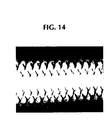
- Figures 11-14 are photographs of four different braiding structures, formed according to the following examples of the braiding process.
- the metallic monofilaments are thermally shaped prior to braiding, although they can just as well be plastically formed to achieve the same result.
- the bobbins of a braider carrier assembly are loaded with seventy-two textile filaments, each being a 100 denier polyester yarn composed of seventy filaments.
- a structural strand is wound for co-braiding with the multifilament yarn, to provide twelve structural strands in each of two opposite winding directions.
- Each structural strand is an Elgiloy wire having a diameter of 0.0043 inches (.11 mm).
- the strands are braided in a two over two braiding pattern onto an 8 mm diameter round mandrel, with the braider operated to determine a braid angle of 110°. The braid is formed to an adequate length, then removed from the mandrel.
- the resulting interbraided structure shown in Figures 11a and 11b, is a tubular composite of the polyester yarn and metal monofilaments.
- the wire latticework is formed as two sets of oppositely directed helices, with the wires in a two over two braided pattern.
- carrier bobbins are loaded with seventy-two polyester yarns of 100 denier and seventy filaments.
- a 0.0043 inch diameter Elgiloy wire, provided at every fourth carrier, is co-braided with the multifilament yarn to provide nine wires in each of two opposite winding directions.
- the strands are braided in a two over two braiding pattern on an 8 mm diameter round mandrel.
- the result, pictured in Figure 12 is a tubular interbraided structure of polyester yarn and metal monofilaments.
- the wire substructure consists of two concentric sets of oppositely directed helices, not interbraided but overlying one another.
- the carrier bobbins are loaded with seventy-two 100 denier polyester yarns formed of seventy filaments.
- a 0.0043 inch diameter Elgiloy wire is loaded at every other carrier around the braider in only one of two opposite winding directions, for a total of eighteen wires co-braided with the multifilament yarn.
- the strands are braided on an 8 mm diameter round mandrel in a two over two braiding pattern, with the braider set to form a braid angle of 110°.
- the result ( Figure 13) is a hollow tubular interbraided structure of polyester yarn and metal monofilaments.
- the wire substructure consists of a single layer of eighteen axially spaced helices in one winding direction.
- Carrier bobbins are loaded with one hundred forty-four polyester yarns of 100 denier and seventy filaments.
- An Elgiloy wire of 0.0055 inches (0.13 mm) is loaded at every sixth carrier around the braider, to provide twelve wires in each of two opposite winding directions for co-braiding with the multifilament yarn.
- the Elgiloy wire Prior to loading, the Elgiloy wire is plastically formed into the desired shape as described in connection with Figures 9 and 10.
- the strands are braided onto a 16 mm diameter round mandrel, with the braider set to provide a braid angle of 110°.
- the result, shown in Figure 14 is a tubular interbraided structure of polyester yarn and metal monofilaments, including a wire substructure consisting of twenty-four wires braided in a one over one braiding pattern.
- the carrier bobbins are loaded with ninety-six polyester yarns of 100 denier and seventy filaments.
- a 0.0055 inch diameter Elgiloy wire is loaded at every third carrier around the braider, to provide sixteen wires in each of two opposite winding directions for co-braiding with the multifilament yarn.
- the strands are braided in a two over two braiding pattern on a 12 mm diameter round mandrel, with the braider set to provide a braid angle of 110°.
- the result is a tubular interbraided structure of the polyester yarn and metal monofilaments, including a wire substructure of thirty-two wires braided in a two over two pattern.
- the resulting prosthesis has water permeability comparable to that of a vascular graft, and can be constrained to a reduced diameter and allowed to expand like a radially self-expanding stent.
- FIG. 15 shows a prosthesis 92 formed of helical structural strands 94 interbraided with multifilament yarns forming a textile sheeting 96.
- a further strand 98 is interbraided with the textile strands.
- Strand 98 is formed of a radiopaque material, e.g. tantalum.
- Strand 98 improves the fluoroscopic imaging of prosthesis 92 at or near a treatment site, to facilitate recognition of proper placement or a need to move the prosthesis.
- Other approaches to enhancing radiopacity include use of composite structural strands (e.g. wires with radiopaque cores), plated monofilaments, radiopaque inks and marker bands.
- Figure 16 illustrates a prosthesis 100 fabricated according to the following example:
- a braiding device is provided with eighteen triaxial guide tubes arranged about the carrier assembly.
- the bobbins are loaded with seventy-two polyester yarns of 100 denier and seventy filaments. Every third carrier around the braider is loaded with a 0.0043 diameter Elgiloy wire, to provide twelve wires in each of two opposite winding directions for co-braiding with the multifilament yarns.
- Eighteen aliphatic polyurethane monofilaments of 0.004 inches (0.1 mm) in diameter are provided, one such monofilament fed into each of the triaxial guide tubes for incorporation into the braided structure as axial runners.
- the strands are braided about an 8 mm diameter round mandrel in a two over two braiding pattern, with the braiding device set to provide a braid angle of 110°.
- the prosthesis is removed and heated in an oven at 150° C. for approximately ten minutes to melt the polyurethane runners, thereby fusing them to the remaining structure.
- tubular interbraided prosthesis 100 incorporating metal monofilaments 102, a sheeting 104 of the polyester yarns, and axial polyurethane runners 106.
- the wire substructure is braided in a two over two braiding pattern.
- the prosthesis has a water permeability comparable to that of a vascular graft, and can be constrained radially and allowed to self-expand like a self-expanding stent. Radial recovery is enhanced and the tendency to unravel or fray when cut is reduced, due to the axial runners.
- Another approach to reduce unraveling of the prosthesis is to apply a silicone adhesive to the opposite ends, or to submerge the prosthesis ends into a solution of a polyurethane, a silicone, or a polycarbonate urethane and a solvent having a low percentage of solids. Residual polyurethane, silicone or polycarbonate urethane remains after drying and tends to prevent unraveling.
- Figure 17 illustrates a multifilament yarn 108 with a coating 110 of TFE, or alternatively a copolymer of TFE and silicone.
- Coating 110 is applied by plasma polymerization prior to braiding. Coating 110 enhances surface properties of the yarn, for example by reducing friction.
- a prosthesis incorporating a sheeting composed of the coated yarns 108 can be deployed with less force. Also, inflammatory responses to the implanted stent may be reduced.
- structural strands 112 in Figure 18, particularly metal monofilaments are coated with PTFE, ePTFE, polypropylene, polyethylene, PET, or polyurethane. Coating may occur after selective shaping and before braiding, by over-extrusion, tape wrapping, serving or by an additional braiding step. This reduces exposure of the blood flow to metal.
- the process also can be augmented with a surface coating step after braiding, to provide a prosthesis 114 with a surface coating 116 as illustrated in Figure 19.
- a portion of the coating is removed to illustrate a covered portion of the prosthesis.
- At least one end of prosthesis 114 can be left uncovered as indicated at 118, to enhance acute fixation at the exposed end.
- the prosthesis can be coated over its entire length.
- a surface coating of heparin or coumadin reduces thrombogenicity.
- a surface coating of steroids, e.g. dexamethasone reduces the restenosis rate.
- coatings of albumin, collagen or gelatin can be incorporated to provide an acute reduction in permeability of the textile sheeting.
- prosthesis can be provided with flared ends, or may be braided with end portions that do not incorporate the multifilament yarns.
- Collagen, PGA and other biological or bioabsorbable materials can be substituted for portions of the monofilament or multifilament strands.
- Metallocene catalyzed polymers e.g. polyolefins or polypropylene, and fluorination if desired, may also be incorporated.
- a prosthesis incorporates structural strands interbraided with more tightly woven textile strands that reduce permeability.
- the structural strands are selectively shaped before their interbraiding with the textile strands, either by a thermal set or by selective plastic deformation, and in either event are shaped without adversely affecting the textile strands.
- Plastic deformation of structural strands by cold-working is advantageous in permitting a continuous process of cold-working followed by interbraiding.
- the result is an interbraided prosthesis incorporating the strength, resilience and range of radii associated with self-expanding stents, and the impermeability associated with vascular grafts, in which a selective shaping of the structural strands does not limit the range of materials useable as additional strands in the interbraided structure to reduce permeability, alter porosity, reduce friction or enhance fluoroscopic imaging.
Landscapes
- Health & Medical Sciences (AREA)
- Engineering & Computer Science (AREA)
- Biomedical Technology (AREA)
- Life Sciences & Earth Sciences (AREA)
- General Health & Medical Sciences (AREA)
- Transplantation (AREA)
- Cardiology (AREA)
- Veterinary Medicine (AREA)
- Heart & Thoracic Surgery (AREA)
- Vascular Medicine (AREA)
- Public Health (AREA)
- Animal Behavior & Ethology (AREA)
- Oral & Maxillofacial Surgery (AREA)
- Gastroenterology & Hepatology (AREA)
- Pulmonology (AREA)
- Manufacturing & Machinery (AREA)
- Textile Engineering (AREA)
- Prostheses (AREA)
- Materials For Medical Uses (AREA)
- Media Introduction/Drainage Providing Device (AREA)
- Pharmaceuticals Containing Other Organic And Inorganic Compounds (AREA)
- Compounds Of Unknown Constitution (AREA)
- Polysaccharides And Polysaccharide Derivatives (AREA)
Applications Claiming Priority (5)
| Application Number | Priority Date | Filing Date | Title |
|---|---|---|---|
| US520995P | 1995-10-11 | 1995-10-11 | |
| US5209P | 1995-10-11 | ||
| US640062 | 1996-04-30 | ||
| US08/640,062 US5758562A (en) | 1995-10-11 | 1996-04-30 | Process for manufacturing braided composite prosthesis |
| EP96925052A EP0854693B1 (de) | 1995-10-11 | 1996-08-12 | Prothese aus geflochtenem verbundmaterial |
Related Parent Applications (1)
| Application Number | Title | Priority Date | Filing Date |
|---|---|---|---|
| EP96925052.1 Division | 1997-04-17 |
Publications (2)
| Publication Number | Publication Date |
|---|---|
| EP1281374A2 true EP1281374A2 (de) | 2003-02-05 |
| EP1281374A3 EP1281374A3 (de) | 2003-07-09 |
Family
ID=26674072
Family Applications (2)
| Application Number | Title | Priority Date | Filing Date |
|---|---|---|---|
| EP02024818A Withdrawn EP1281374A3 (de) | 1995-10-11 | 1996-08-12 | Geflochtene Prothese |
| EP96925052A Expired - Lifetime EP0854693B1 (de) | 1995-10-11 | 1996-08-12 | Prothese aus geflochtenem verbundmaterial |
Family Applications After (1)
| Application Number | Title | Priority Date | Filing Date |
|---|---|---|---|
| EP96925052A Expired - Lifetime EP0854693B1 (de) | 1995-10-11 | 1996-08-12 | Prothese aus geflochtenem verbundmaterial |
Country Status (12)
| Country | Link |
|---|---|
| US (2) | US5758562A (de) |
| EP (2) | EP1281374A3 (de) |
| JP (3) | JP3398386B2 (de) |
| AT (1) | ATE227547T1 (de) |
| AU (1) | AU6529496A (de) |
| CA (1) | CA2232289A1 (de) |
| DE (1) | DE69624834T2 (de) |
| DK (1) | DK0854693T3 (de) |
| ES (1) | ES2185787T3 (de) |
| MX (1) | MX9802837A (de) |
| PT (1) | PT854693E (de) |
| WO (1) | WO1997013475A1 (de) |
Cited By (2)
| Publication number | Priority date | Publication date | Assignee | Title |
|---|---|---|---|---|
| US7101391B2 (en) | 2000-09-18 | 2006-09-05 | Inflow Dynamics Inc. | Primarily niobium stent |
| US7402173B2 (en) | 2000-09-18 | 2008-07-22 | Boston Scientific Scimed, Inc. | Metal stent with surface layer of noble metal oxide and method of fabrication |
Families Citing this family (221)
| Publication number | Priority date | Publication date | Assignee | Title |
|---|---|---|---|---|
| US6039749A (en) | 1994-02-10 | 2000-03-21 | Endovascular Systems, Inc. | Method and apparatus for deploying non-circular stents and graftstent complexes |
| US6689162B1 (en) * | 1995-10-11 | 2004-02-10 | Boston Scientific Scimed, Inc. | Braided composite prosthesis |
| US5628788A (en) * | 1995-11-07 | 1997-05-13 | Corvita Corporation | Self-expanding endoluminal stent-graft |
| EP0955954B1 (de) | 1996-01-05 | 2005-03-16 | Medtronic, Inc. | Expandierbare endoluminale prothesen |
| DE69716779T2 (de) * | 1996-01-30 | 2003-07-17 | Medtronic, Inc. | Produkte und verfahren zur herstellung von dilatatoren |
| US5718159A (en) * | 1996-04-30 | 1998-02-17 | Schneider (Usa) Inc. | Process for manufacturing three-dimensional braided covered stent |
| US6592617B2 (en) * | 1996-04-30 | 2003-07-15 | Boston Scientific Scimed, Inc. | Three-dimensional braided covered stent |
| US5800514A (en) * | 1996-05-24 | 1998-09-01 | Meadox Medicals, Inc. | Shaped woven tubular soft-tissue prostheses and methods of manufacturing |
| US6027528A (en) * | 1996-05-28 | 2000-02-22 | Cordis Corporation | Composite material endoprosthesis |
| US5925074A (en) * | 1996-12-03 | 1999-07-20 | Atrium Medical Corporation | Vascular endoprosthesis and method |
| BE1010858A4 (fr) | 1997-01-16 | 1999-02-02 | Medicorp R & D Benelux Sa | Endoprothese luminale pour ramification. |
| US5957974A (en) | 1997-01-23 | 1999-09-28 | Schneider (Usa) Inc | Stent graft with braided polymeric sleeve |
| US6159228A (en) * | 1997-05-20 | 2000-12-12 | Frid; Noureddine | Applicator for luminal endoprostheses |
| BE1011180A6 (fr) * | 1997-05-27 | 1999-06-01 | Medicorp R & D Benelux Sa | Endoprothese luminale auto expansible. |
| US6070589A (en) | 1997-08-01 | 2000-06-06 | Teramed, Inc. | Methods for deploying bypass graft stents |
| US6174330B1 (en) † | 1997-08-01 | 2001-01-16 | Schneider (Usa) Inc | Bioabsorbable marker having radiopaque constituents |
| US6626939B1 (en) | 1997-12-18 | 2003-09-30 | Boston Scientific Scimed, Inc. | Stent-graft with bioabsorbable structural support |
| US6059809A (en) * | 1998-02-16 | 2000-05-09 | Medicorp, S.A. | Protective angioplasty device |
| EP0943300A1 (de) * | 1998-03-17 | 1999-09-22 | Medicorp S.A. | Vorrichtung zum reversiblen Einbringen eines Stents |
| US6887268B2 (en) | 1998-03-30 | 2005-05-03 | Cordis Corporation | Extension prosthesis for an arterial repair |
| US6626938B1 (en) | 2000-11-16 | 2003-09-30 | Cordis Corporation | Stent graft having a pleated graft member |
| US6290731B1 (en) | 1998-03-30 | 2001-09-18 | Cordis Corporation | Aortic graft having a precursor gasket for repairing an abdominal aortic aneurysm |
| US7713297B2 (en) | 1998-04-11 | 2010-05-11 | Boston Scientific Scimed, Inc. | Drug-releasing stent with ceramic-containing layer |
| EP0951870A1 (de) | 1998-04-21 | 1999-10-27 | Medicorp S.A. | Einrichtung zum Behandeln von Aneurysmus |
| US6494907B1 (en) * | 1998-04-28 | 2002-12-17 | Intratherapeutics, Inc. | Braided stent |
| US5979288A (en) * | 1998-05-18 | 1999-11-09 | Fiberspar Spoolable Products, Inc. | Helical braider |
| US6652581B1 (en) * | 1998-07-07 | 2003-11-25 | Boston Scientific Scimed, Inc. | Medical device with porous surface for controlled drug release and method of making the same |
| US6156064A (en) | 1998-08-14 | 2000-12-05 | Schneider (Usa) Inc | Stent-graft-membrane and method of making the same |
| US20010049554A1 (en) | 1998-11-18 | 2001-12-06 | Carlos E. Ruiz | Endovascular prosthesis and method of making |
| US7018401B1 (en) | 1999-02-01 | 2006-03-28 | Board Of Regents, The University Of Texas System | Woven intravascular devices and methods for making the same and apparatus for delivery of the same |
| US9814869B1 (en) | 1999-06-15 | 2017-11-14 | C.R. Bard, Inc. | Graft-catheter vascular access system |
| US6325823B1 (en) | 1999-10-29 | 2001-12-04 | Revasc Corporation | Endovascular prosthesis accommodating torsional and longitudinal displacements and methods of use |
| US6398807B1 (en) * | 2000-01-31 | 2002-06-04 | Scimed Life Systems, Inc. | Braided branching stent, method for treating a lumen therewith, and process for manufacture therefor |
| US6622604B1 (en) * | 2000-01-31 | 2003-09-23 | Scimed Life Systems, Inc. | Process for manufacturing a braided bifurcated stent |
| US6652571B1 (en) | 2000-01-31 | 2003-11-25 | Scimed Life Systems, Inc. | Braided, branched, implantable device and processes for manufacture thereof |
| US6325822B1 (en) | 2000-01-31 | 2001-12-04 | Scimed Life Systems, Inc. | Braided stent having tapered filaments |
| US20050271701A1 (en) * | 2000-03-15 | 2005-12-08 | Orbus Medical Technologies, Inc. | Progenitor endothelial cell capturing with a drug eluting implantable medical device |
| US9522217B2 (en) | 2000-03-15 | 2016-12-20 | Orbusneich Medical, Inc. | Medical device with coating for capturing genetically-altered cells and methods for using same |
| US8088060B2 (en) | 2000-03-15 | 2012-01-03 | Orbusneich Medical, Inc. | Progenitor endothelial cell capturing with a drug eluting implantable medical device |
| WO2001070292A1 (fr) * | 2000-03-24 | 2001-09-27 | Yuichi Mori | Organe artificiel creux |
| US6468303B1 (en) * | 2000-03-27 | 2002-10-22 | Aga Medical Corporation | Retrievable self expanding shunt |
| US6468301B1 (en) * | 2000-03-27 | 2002-10-22 | Aga Medical Corporation | Repositionable and recapturable vascular stent/graft |
| US7632241B2 (en) * | 2000-05-19 | 2009-12-15 | Conmed Endoscopic Technologies, Inc. | Multi-lumen biliary catheter with angled guidewire exit |
| WO2001089419A1 (en) * | 2000-05-19 | 2001-11-29 | C.R. Bard, Inc. | Stents and stenting methods |
| US6649030B1 (en) | 2000-08-31 | 2003-11-18 | Endovascular Technologies, Inc. | Physical vapor deposition of radiopaque markings on a graft |
| WO2002035988A2 (en) * | 2000-10-31 | 2002-05-10 | Prodesco, Inc. | Graft having region for biological seal formation |
| US6843802B1 (en) | 2000-11-16 | 2005-01-18 | Cordis Corporation | Delivery apparatus for a self expanding retractable stent |
| US6942692B2 (en) | 2000-11-16 | 2005-09-13 | Cordis Corporation | Supra-renal prosthesis and renal artery bypass |
| US7314483B2 (en) | 2000-11-16 | 2008-01-01 | Cordis Corp. | Stent graft with branch leg |
| US7229472B2 (en) | 2000-11-16 | 2007-06-12 | Cordis Corporation | Thoracic aneurysm repair prosthesis and system |
| US7267685B2 (en) | 2000-11-16 | 2007-09-11 | Cordis Corporation | Bilateral extension prosthesis and method of delivery |
| US6783542B2 (en) * | 2001-02-22 | 2004-08-31 | Scimed Life Systems, Inc | Crimpable balloon/stent protector |
| US6551352B2 (en) * | 2001-05-03 | 2003-04-22 | Bionx Implants, Inc. | Method for attaching axial filaments to a self expanding stent |
| US6701191B2 (en) * | 2001-05-30 | 2004-03-02 | Cardiac Pacemakers, Inc. | Lead having composite tubing |
| US7674245B2 (en) | 2001-06-07 | 2010-03-09 | Cardiac Pacemakers, Inc. | Method and apparatus for an adjustable shape guide catheter |
| AU2002345328A1 (en) | 2001-06-27 | 2003-03-03 | Remon Medical Technologies Ltd. | Method and device for electrochemical formation of therapeutic species in vivo |
| US6626889B1 (en) * | 2001-07-25 | 2003-09-30 | Advanced Cardiovascular Systems, Inc. | Thin-walled guiding catheter with improved radiopacity |
| US6755812B2 (en) * | 2001-12-11 | 2004-06-29 | Cardiac Pacemakers, Inc. | Deflectable telescoping guide catheter |
| US7326237B2 (en) | 2002-01-08 | 2008-02-05 | Cordis Corporation | Supra-renal anchoring prosthesis |
| US7717899B2 (en) | 2002-01-28 | 2010-05-18 | Cardiac Pacemakers, Inc. | Inner and outer telescoping catheter delivery system |
| US20030145122A1 (en) * | 2002-01-30 | 2003-07-31 | International Business Machines Corporation | Apparatus and method of allowing multiple partitions of a partitioned computer system to use a single network adapter |
| US20040230288A1 (en) * | 2002-04-17 | 2004-11-18 | Rosenthal Arthur L. | Medical devices adapted for controlled in vivo structural change after implantation |
| US7105021B2 (en) * | 2002-04-25 | 2006-09-12 | Scimed Life Systems, Inc. | Implantable textile prostheses having PTFE cold drawn yarns |
| US6763559B2 (en) | 2002-04-25 | 2004-07-20 | Scimed Life Systems, Inc. | Cold drawing process of polymeric yarns suitable for use in implantable medical devices |
| DE102012016301B3 (de) | 2012-08-16 | 2013-12-12 | Admedes Schuessler Gmbh | Verfahren zum Herstellen eines Körperimplantats |
| US20040039371A1 (en) * | 2002-08-23 | 2004-02-26 | Bruce Tockman | Coronary vein navigator |
| US7172624B2 (en) * | 2003-02-06 | 2007-02-06 | Boston Scientific Scimed, Inc. | Medical device with magnetic resonance visibility enhancing structure |
| US20040225250A1 (en) | 2003-05-05 | 2004-11-11 | Michael Yablonski | Internal shunt and method for treating glaucoma |
| NL1023389C2 (nl) * | 2003-05-12 | 2004-11-15 | Hendrik Glastra | Werkwijze voor het vormen van een uit een weefsel van elkaar kruisende draden opgebouwd driedimensioneel, hol product, product verkregen onder toepassing van deze werkwijze en uitgaande daarvan verkregen lichaamsvatprothese. |
| US20040230289A1 (en) * | 2003-05-15 | 2004-11-18 | Scimed Life Systems, Inc. | Sealable attachment of endovascular stent to graft |
| JP2007500584A (ja) * | 2003-06-12 | 2007-01-18 | シー・アール・バード・インク | ステント供給カテーテル |
| US7291125B2 (en) * | 2003-11-14 | 2007-11-06 | Transcend Medical, Inc. | Ocular pressure regulation |
| US7955313B2 (en) * | 2003-12-17 | 2011-06-07 | Boston Scientific Scimed, Inc. | Composite catheter braid |
| DE102004008459A1 (de) * | 2004-02-17 | 2005-09-01 | Aesculap Ag & Co. Kg | Implantat, insbesondere Gefäßimplantat |
| US9039724B2 (en) * | 2004-03-19 | 2015-05-26 | Aga Medical Corporation | Device for occluding vascular defects |
| US8747453B2 (en) * | 2008-02-18 | 2014-06-10 | Aga Medical Corporation | Stent/stent graft for reinforcement of vascular abnormalities and associated method |
| US8777974B2 (en) * | 2004-03-19 | 2014-07-15 | Aga Medical Corporation | Multi-layer braided structures for occluding vascular defects |
| US8398670B2 (en) * | 2004-03-19 | 2013-03-19 | Aga Medical Corporation | Multi-layer braided structures for occluding vascular defects and for occluding fluid flow through portions of the vasculature of the body |
| US8313505B2 (en) * | 2004-03-19 | 2012-11-20 | Aga Medical Corporation | Device for occluding vascular defects |
| US8034096B2 (en) | 2004-03-31 | 2011-10-11 | Cook Medical Technologies Llc | Stent-graft with graft to graft attachment |
| US20050223440A1 (en) * | 2004-03-31 | 2005-10-06 | Council Of Scientific And Industrial Research | Tissue culture process for producing cotton plants |
| US7465318B2 (en) | 2004-04-15 | 2008-12-16 | Soteira, Inc. | Cement-directing orthopedic implants |
| CA2758946C (en) | 2004-05-25 | 2014-10-21 | Tyco Healthcare Group Lp | Vascular stenting for aneurysms |
| US8147534B2 (en) | 2005-05-25 | 2012-04-03 | Tyco Healthcare Group Lp | System and method for delivering and deploying an occluding device within a vessel |
| US8617234B2 (en) | 2004-05-25 | 2013-12-31 | Covidien Lp | Flexible vascular occluding device |
| US8623067B2 (en) | 2004-05-25 | 2014-01-07 | Covidien Lp | Methods and apparatus for luminal stenting |
| US8267985B2 (en) | 2005-05-25 | 2012-09-18 | Tyco Healthcare Group Lp | System and method for delivering and deploying an occluding device within a vessel |
| US20060206200A1 (en) * | 2004-05-25 | 2006-09-14 | Chestnut Medical Technologies, Inc. | Flexible vascular occluding device |
| AU2005247490B2 (en) | 2004-05-25 | 2011-05-19 | Covidien Lp | Flexible vascular occluding device |
| US20050288775A1 (en) * | 2004-06-24 | 2005-12-29 | Scimed Life Systems, Inc. | Metallic fibers reinforced textile prosthesis |
| US20060089672A1 (en) * | 2004-10-25 | 2006-04-27 | Jonathan Martinek | Yarns containing filaments made from shape memory alloys |
| US20060111649A1 (en) * | 2004-11-19 | 2006-05-25 | Scimed Life Systems, Inc. | Catheter having improved torque response and curve retention |
| US8273101B2 (en) * | 2005-05-25 | 2012-09-25 | Tyco Healthcare Group Lp | System and method for delivering and deploying an occluding device within a vessel |
| WO2007003266A1 (en) * | 2005-07-05 | 2007-01-11 | Dsm Ip Assets B.V. | Surgical repair product based on uhmwpe filaments |
| US8840660B2 (en) | 2006-01-05 | 2014-09-23 | Boston Scientific Scimed, Inc. | Bioerodible endoprostheses and methods of making the same |
| PT2526910E (pt) | 2006-01-17 | 2015-11-18 | Transcend Medical Inc | Dispositivo para tratamento de glaucoma |
| JP5388582B2 (ja) | 2006-01-17 | 2014-01-15 | トランセンド・メディカル・インコーポレイテッド | 薬剤投与処置装置 |
| US8089029B2 (en) | 2006-02-01 | 2012-01-03 | Boston Scientific Scimed, Inc. | Bioabsorbable metal medical device and method of manufacture |
| US8152833B2 (en) | 2006-02-22 | 2012-04-10 | Tyco Healthcare Group Lp | Embolic protection systems having radiopaque filter mesh |
| US20070224235A1 (en) | 2006-03-24 | 2007-09-27 | Barron Tenney | Medical devices having nanoporous coatings for controlled therapeutic agent delivery |
| US8187620B2 (en) | 2006-03-27 | 2012-05-29 | Boston Scientific Scimed, Inc. | Medical devices comprising a porous metal oxide or metal material and a polymer coating for delivering therapeutic agents |
| US8048150B2 (en) | 2006-04-12 | 2011-11-01 | Boston Scientific Scimed, Inc. | Endoprosthesis having a fiber meshwork disposed thereon |
| US8815275B2 (en) | 2006-06-28 | 2014-08-26 | Boston Scientific Scimed, Inc. | Coatings for medical devices comprising a therapeutic agent and a metallic material |
| US8771343B2 (en) | 2006-06-29 | 2014-07-08 | Boston Scientific Scimed, Inc. | Medical devices with selective titanium oxide coatings |
| CA2659761A1 (en) | 2006-08-02 | 2008-02-07 | Boston Scientific Scimed, Inc. | Endoprosthesis with three-dimensional disintegration control |
| WO2008033711A2 (en) | 2006-09-14 | 2008-03-20 | Boston Scientific Limited | Medical devices with drug-eluting coating |
| WO2008034031A2 (en) | 2006-09-15 | 2008-03-20 | Boston Scientific Limited | Bioerodible endoprostheses and methods of making the same |
| US8052744B2 (en) | 2006-09-15 | 2011-11-08 | Boston Scientific Scimed, Inc. | Medical devices and methods of making the same |
| ATE517590T1 (de) | 2006-09-15 | 2011-08-15 | Boston Scient Ltd | Biologisch erodierbare endoprothesen |
| JP2010503491A (ja) | 2006-09-15 | 2010-02-04 | ボストン サイエンティフィック リミテッド | 生物学的安定性無機層を有する生浸食性エンドプロスシーシス |
| WO2008036548A2 (en) | 2006-09-18 | 2008-03-27 | Boston Scientific Limited | Endoprostheses |
| MX2009004291A (es) | 2006-10-22 | 2009-09-07 | Idev Technologies Inc | Metodos para asegurar extremos de hebra y los dispositivos resultantes. |
| CA2667322C (en) | 2006-10-22 | 2016-09-13 | Idev Technologies, Inc. | Devices and methods for stent advancement |
| US7981150B2 (en) | 2006-11-09 | 2011-07-19 | Boston Scientific Scimed, Inc. | Endoprosthesis with coatings |
| WO2008070130A1 (en) * | 2006-12-04 | 2008-06-12 | Cook Incorporated | Method for loading medical device into a delivery system |
| US9480485B2 (en) | 2006-12-15 | 2016-11-01 | Globus Medical, Inc. | Devices and methods for vertebrostenting |
| WO2008076330A1 (en) * | 2006-12-15 | 2008-06-26 | Soteira, Inc. | Drills and methods for vertebrostenting |
| US8122809B2 (en) | 2006-12-18 | 2012-02-28 | C.R. Bard, Inc. | Balloon with dividing fabric layers and method for braiding over three-dimensional forms |
| ATE488259T1 (de) | 2006-12-28 | 2010-12-15 | Boston Scient Ltd | Bioerodierbare endoprothesen und herstellungsverfahren dafür |
| US8070797B2 (en) | 2007-03-01 | 2011-12-06 | Boston Scientific Scimed, Inc. | Medical device with a porous surface for delivery of a therapeutic agent |
| US8431149B2 (en) | 2007-03-01 | 2013-04-30 | Boston Scientific Scimed, Inc. | Coated medical devices for abluminal drug delivery |
| JP2008253297A (ja) * | 2007-03-30 | 2008-10-23 | Univ Kansai Medical | 医療用チューブ |
| US8067054B2 (en) | 2007-04-05 | 2011-11-29 | Boston Scientific Scimed, Inc. | Stents with ceramic drug reservoir layer and methods of making and using the same |
| US8409270B2 (en) * | 2007-04-16 | 2013-04-02 | Boston Scientific Scimed, Inc. | Radiopaque compositions, stents and methods of preparation |
| US7976915B2 (en) | 2007-05-23 | 2011-07-12 | Boston Scientific Scimed, Inc. | Endoprosthesis with select ceramic morphology |
| DE102007025921A1 (de) * | 2007-06-02 | 2008-12-04 | Biotronik Vi Patent Ag | Medizinisches Implantat, insbesondere Stent |
| DE102007032156A1 (de) * | 2007-07-03 | 2008-10-23 | Aesculap Ag | Textile Gefäßprothese |
| US7942926B2 (en) | 2007-07-11 | 2011-05-17 | Boston Scientific Scimed, Inc. | Endoprosthesis coating |
| US8002823B2 (en) | 2007-07-11 | 2011-08-23 | Boston Scientific Scimed, Inc. | Endoprosthesis coating |
| JP5328788B2 (ja) | 2007-07-17 | 2013-10-30 | トランセンド・メディカル・インコーポレイテッド | ヒドロゲルの拡張能力を備えた眼内植込み体 |
| JP2010533563A (ja) | 2007-07-19 | 2010-10-28 | ボストン サイエンティフィック リミテッド | 吸着抑制表面を有する内部人工器官 |
| US7931683B2 (en) | 2007-07-27 | 2011-04-26 | Boston Scientific Scimed, Inc. | Articles having ceramic coated surfaces |
| US8815273B2 (en) | 2007-07-27 | 2014-08-26 | Boston Scientific Scimed, Inc. | Drug eluting medical devices having porous layers |
| US8221822B2 (en) | 2007-07-31 | 2012-07-17 | Boston Scientific Scimed, Inc. | Medical device coating by laser cladding |
| JP2010535541A (ja) | 2007-08-03 | 2010-11-25 | ボストン サイエンティフィック リミテッド | 広い表面積を有する医療器具用のコーティング |
| US8052745B2 (en) | 2007-09-13 | 2011-11-08 | Boston Scientific Scimed, Inc. | Endoprosthesis |
| US7938855B2 (en) | 2007-11-02 | 2011-05-10 | Boston Scientific Scimed, Inc. | Deformable underlayer for stent |
| US8029554B2 (en) | 2007-11-02 | 2011-10-04 | Boston Scientific Scimed, Inc. | Stent with embedded material |
| US8216632B2 (en) | 2007-11-02 | 2012-07-10 | Boston Scientific Scimed, Inc. | Endoprosthesis coating |
| US8163004B2 (en) * | 2008-02-18 | 2012-04-24 | Aga Medical Corporation | Stent graft for reinforcement of vascular abnormalities and associated method |
| EP2387958B1 (de) | 2008-04-21 | 2013-08-21 | Covidien LP | Kugelgeflecht-Embolievorrichtung und -Ausgabesysteme |
| WO2009131911A2 (en) | 2008-04-22 | 2009-10-29 | Boston Scientific Scimed, Inc. | Medical devices having a coating of inorganic material |
| EP2268234B1 (de) * | 2008-04-23 | 2012-02-29 | Cook Medical Technologies LLC | Verfahren zum einsatz eines medizinprodukts in ein freisetzungssystem |
| US8932346B2 (en) | 2008-04-24 | 2015-01-13 | Boston Scientific Scimed, Inc. | Medical devices having inorganic particle layers |
| US7998192B2 (en) | 2008-05-09 | 2011-08-16 | Boston Scientific Scimed, Inc. | Endoprostheses |
| US9675482B2 (en) | 2008-05-13 | 2017-06-13 | Covidien Lp | Braid implant delivery systems |
| US8236046B2 (en) | 2008-06-10 | 2012-08-07 | Boston Scientific Scimed, Inc. | Bioerodible endoprosthesis |
| WO2009155319A1 (en) | 2008-06-17 | 2009-12-23 | Soteira, Inc. | Devices and methods for fracture reduction |
| EP2303350A2 (de) | 2008-06-18 | 2011-04-06 | Boston Scientific Scimed, Inc. | Endoprothesen-beschichtung |
| EP3298995A1 (de) * | 2008-06-25 | 2018-03-28 | Novartis AG | Augenimplantat mit formänderungsfähigkeiten |
| CN102137626A (zh) | 2008-07-22 | 2011-07-27 | 微治疗公司 | 脉管重塑装置 |
| US7985252B2 (en) | 2008-07-30 | 2011-07-26 | Boston Scientific Scimed, Inc. | Bioerodible endoprosthesis |
| US20100057000A1 (en) * | 2008-08-27 | 2010-03-04 | Cook Incorporated | Malecot with textile cover |
| US8353943B2 (en) | 2008-08-29 | 2013-01-15 | Cook Medical Technologies Llc | Variable weave graft with metal strand reinforcement for in situ fenestration |
| US8382824B2 (en) | 2008-10-03 | 2013-02-26 | Boston Scientific Scimed, Inc. | Medical implant having NANO-crystal grains with barrier layers of metal nitrides or fluorides |
| US8231980B2 (en) | 2008-12-03 | 2012-07-31 | Boston Scientific Scimed, Inc. | Medical implants including iridium oxide |
| EP2548538B1 (de) | 2009-01-28 | 2020-04-01 | Alcon Inc. | Implantationssysteme für augenimplantate mit steifheitseigenschaften |
| US8641753B2 (en) * | 2009-01-31 | 2014-02-04 | Cook Medical Technologies Llc | Preform for and an endoluminal prosthesis |
| WO2010101901A2 (en) | 2009-03-02 | 2010-09-10 | Boston Scientific Scimed, Inc. | Self-buffering medical implants |
| US8071156B2 (en) | 2009-03-04 | 2011-12-06 | Boston Scientific Scimed, Inc. | Endoprostheses |
| US8287937B2 (en) | 2009-04-24 | 2012-10-16 | Boston Scientific Scimed, Inc. | Endoprosthese |
| US20110105990A1 (en) * | 2009-11-04 | 2011-05-05 | Silvestrini Thomas A | Zonal drug delivery device and method |
| US20110202085A1 (en) | 2009-11-09 | 2011-08-18 | Siddharth Loganathan | Braid Ball Embolic Device Features |
| US8529492B2 (en) * | 2009-12-23 | 2013-09-10 | Trascend Medical, Inc. | Drug delivery devices and methods |
| WO2011094638A1 (en) | 2010-01-28 | 2011-08-04 | Micro Therapeutics, Inc. | Vascular remodeling device |
| EP2528541B1 (de) | 2010-01-28 | 2016-05-18 | Covidien LP | Vorrichtung für vaskuläre remodellierung |
| WO2011119573A1 (en) | 2010-03-23 | 2011-09-29 | Boston Scientific Scimed, Inc. | Surface treated bioerodible metal endoprostheses |
| US20110238094A1 (en) * | 2010-03-25 | 2011-09-29 | Thomas Jonathan D | Hernia Patch |
| US9023095B2 (en) | 2010-05-27 | 2015-05-05 | Idev Technologies, Inc. | Stent delivery system with pusher assembly |
| FI4233795T3 (fi) * | 2010-10-05 | 2024-09-09 | Edwards Lifesciences Corp | Keinosydänläppä |
| DE102010048368A1 (de) * | 2010-10-13 | 2012-04-19 | Acandis Gmbh & Co. Kg | Medizinische Vorrichtung, insbesondere Stent |
| CN103442653B (zh) | 2011-02-11 | 2016-06-01 | 柯惠有限合伙公司 | 两阶段展开动脉瘤栓塞装置 |
| WO2012134990A1 (en) | 2011-03-25 | 2012-10-04 | Tyco Healthcare Group Lp | Vascular remodeling device |
| US8621975B2 (en) | 2011-09-20 | 2014-01-07 | Aga Medical Corporation | Device and method for treating vascular abnormalities |
| US9039752B2 (en) | 2011-09-20 | 2015-05-26 | Aga Medical Corporation | Device and method for delivering a vascular device |
| WO2013049448A1 (en) | 2011-09-29 | 2013-04-04 | Covidien Lp | Vascular remodeling device |
| WO2013119332A2 (en) | 2012-02-09 | 2013-08-15 | Stout Medical Group, L.P. | Embolic device and methods of use |
| US9622892B2 (en) | 2012-04-26 | 2017-04-18 | Cook Medical Technologies Llc | Longitudinally reinforced sheath |
| NZ701992A (en) | 2012-05-14 | 2016-03-31 | Bard Inc C R | Uniformly expandable stent |
| US9155647B2 (en) | 2012-07-18 | 2015-10-13 | Covidien Lp | Methods and apparatus for luminal stenting |
| EA030047B1 (ru) | 2012-09-17 | 2018-06-29 | Новартис Аг | Система для имплантации в глаз и способ работы системы для имплантации в глаз |
| DE102012218262A1 (de) * | 2012-10-05 | 2014-04-10 | Aesculap Ag | Textile Gefäßprothesen und Verfahren zu ihrer Herstellung |
| DE102012218263A1 (de) * | 2012-10-05 | 2014-04-10 | Aesculap Ag | Textile Gefäßprothese mit einem haptisch und/oder optisch erkennbaren Orientierungsmittel |
| US9114001B2 (en) | 2012-10-30 | 2015-08-25 | Covidien Lp | Systems for attaining a predetermined porosity of a vascular device |
| US9452070B2 (en) | 2012-10-31 | 2016-09-27 | Covidien Lp | Methods and systems for increasing a density of a region of a vascular device |
| US9943427B2 (en) | 2012-11-06 | 2018-04-17 | Covidien Lp | Shaped occluding devices and methods of using the same |
| US9314248B2 (en) | 2012-11-06 | 2016-04-19 | Covidien Lp | Multi-pivot thrombectomy device |
| US9295571B2 (en) | 2013-01-17 | 2016-03-29 | Covidien Lp | Methods and apparatus for luminal stenting |
| US9157174B2 (en) | 2013-02-05 | 2015-10-13 | Covidien Lp | Vascular device for aneurysm treatment and providing blood flow into a perforator vessel |
| US20140277397A1 (en) | 2013-03-12 | 2014-09-18 | DePuy Synthes Products, LLC | Variable porosity intravascular implant and manufacturing method |
| USD723165S1 (en) | 2013-03-12 | 2015-02-24 | C. R. Bard, Inc. | Stent |
| US9463105B2 (en) | 2013-03-14 | 2016-10-11 | Covidien Lp | Methods and apparatus for luminal stenting |
| US9585695B2 (en) | 2013-03-15 | 2017-03-07 | Woven Orthopedic Technologies, Llc | Surgical screw hole liner devices and related methods |
| CN105142545B (zh) | 2013-03-15 | 2018-04-06 | 柯惠有限合伙公司 | 闭塞装置 |
| US9987163B2 (en) | 2013-04-16 | 2018-06-05 | Novartis Ag | Device for dispensing intraocular substances |
| EP2875798B1 (de) * | 2013-11-26 | 2017-03-01 | Cook Medical Technologies LLC | Geflochtener stent |
| WO2015095538A1 (en) | 2013-12-20 | 2015-06-25 | Microvention, Inc. | Vascular occlusion |
| US9675361B2 (en) | 2014-02-28 | 2017-06-13 | Cook Medical Technologies Llc | Coil occlusion device |
| EP3139972B1 (de) * | 2014-05-08 | 2020-04-29 | The Secant Group, LLC | Verbundlumen mit verstärkendem textil und matrix |
| EP3148481A4 (de) | 2014-05-28 | 2017-05-03 | Stryker European Holdings I, LLC | Gefässverschlussvorrichtungen und verfahren zur verwendung |
| US9060777B1 (en) | 2014-05-28 | 2015-06-23 | Tw Medical Technologies, Llc | Vaso-occlusive devices and methods of use |
| US9907593B2 (en) | 2014-08-05 | 2018-03-06 | Woven Orthopedic Technologies, Llc | Woven retention devices, systems and methods |
| US8956394B1 (en) | 2014-08-05 | 2015-02-17 | Woven Orthopedic Technologies, Llc | Woven retention devices, systems and methods |
| US20160074071A1 (en) | 2014-09-16 | 2016-03-17 | Woven Orthopedic Technologies, Llc | Methods of using woven retention devices and systems |
| USD740427S1 (en) | 2014-10-17 | 2015-10-06 | Woven Orthopedic Technologies, Llc | Orthopedic woven retention device |
| US10159490B2 (en) | 2015-05-08 | 2018-12-25 | Stryker European Holdings I, Llc | Vaso-occlusive devices |
| US10555758B2 (en) | 2015-08-05 | 2020-02-11 | Woven Orthopedic Technologies, Llc | Tapping devices, systems and methods for use in bone tissue |
| US10478194B2 (en) | 2015-09-23 | 2019-11-19 | Covidien Lp | Occlusive devices |
| JP6955679B2 (ja) * | 2016-07-07 | 2021-10-27 | ニプロ株式会社 | ステント |
| US11395681B2 (en) | 2016-12-09 | 2022-07-26 | Woven Orthopedic Technologies, Llc | Retention devices, lattices and related systems and methods |
| US10850073B2 (en) | 2017-05-22 | 2020-12-01 | Boston Scientific Scimed, Inc. | Devices and methods of use with devices having a radiopaque filament |
| JP7293132B2 (ja) | 2017-05-25 | 2023-06-19 | テルモ株式会社 | 接着閉塞システム |
| US11027046B2 (en) | 2017-10-31 | 2021-06-08 | Hothouse Medical Limited | Textile products having selectively applied sealant or coating and method of manufacture |
| GB201717885D0 (en) * | 2017-10-31 | 2017-12-13 | Hothouse Medical Ltd | Prothesis and method of manufacture |
| WO2019111270A1 (en) * | 2017-12-07 | 2019-06-13 | Meril Life Sciences Pvt Ltd | Braided scaffold and method of manufacturing thereof |
| EP3595589B1 (de) | 2018-05-21 | 2024-10-09 | Aran Biomedical Teoranta | Einführbare medizinische vorrichtungen mit verbundabdeckungen mit niedrigem profil |
| WO2020093012A1 (en) | 2018-11-01 | 2020-05-07 | Terumo Corporation | Occlusion systems |
| US11471264B2 (en) | 2020-04-01 | 2022-10-18 | Medtronic Vascular, Inc. | Branching stent graft with mechanical interlock |
| CN115515510A (zh) | 2020-04-28 | 2022-12-23 | 泰尔茂株式会社 | 封堵系统 |
| EP4146126A1 (de) * | 2020-06-11 | 2023-03-15 | Edwards Lifesciences Corporation | Steifes flechtelement für eine klappenprothesenfreisetzungsvorrichtung |
| WO2024210916A1 (en) * | 2023-04-07 | 2024-10-10 | Mineral City Biotechnologies, LLC | Systems and devices for enhancing visibility of internal connection mechanisms |
Citations (6)
| Publication number | Priority date | Publication date | Assignee | Title |
|---|---|---|---|---|
| US4655771A (en) | 1982-04-30 | 1987-04-07 | Shepherd Patents S.A. | Prosthesis comprising an expansible or contractile tubular body |
| US4681110A (en) | 1985-12-02 | 1987-07-21 | Wiktor Dominik M | Catheter arrangement having a blood vessel liner, and method of using it |
| WO1991010766A1 (en) | 1990-01-15 | 1991-07-25 | Albany International Corp. | Braid structure |
| WO1992016166A1 (en) | 1991-03-25 | 1992-10-01 | Meadox Medical Inc. | Vascular prosthesis |
| WO1994006372A1 (en) | 1992-09-14 | 1994-03-31 | Meadox Medicals, Inc. | A radially self-expanding implantable intraluminal device |
| WO1994006373A1 (en) | 1992-09-14 | 1994-03-31 | Meadox Medicals, Inc. | Three-dimensional braided soft tissue prosthesis |
Family Cites Families (30)
| Publication number | Priority date | Publication date | Assignee | Title |
|---|---|---|---|---|
| US4834755A (en) * | 1983-04-04 | 1989-05-30 | Pfizer Hospital Products Group, Inc. | Triaxially-braided fabric prosthesis |
| US4733665C2 (en) * | 1985-11-07 | 2002-01-29 | Expandable Grafts Partnership | Expandable intraluminal graft and method and apparatus for implanting an expandable intraluminal graft |
| US4731084A (en) * | 1986-03-14 | 1988-03-15 | Richards Medical Company | Prosthetic ligament |
| SE453258B (sv) * | 1986-04-21 | 1988-01-25 | Medinvent Sa | Elastisk, sjelvexpanderande protes samt forfarande for dess framstellning |
| US5024232A (en) * | 1986-10-07 | 1991-06-18 | The Research Foundation Of State University Of Ny | Novel radiopaque heavy metal polymer complexes, compositions of matter and articles prepared therefrom |
| IT1202558B (it) * | 1987-02-17 | 1989-02-09 | Alberto Arpesani | Protesi interna per la sostituzione di una parte del corpo umano particolarmente nelle operazioni vascolari |
| US4800882A (en) * | 1987-03-13 | 1989-01-31 | Cook Incorporated | Endovascular stent and delivery system |
| US4976812A (en) * | 1988-02-02 | 1990-12-11 | E. I. Du Pont De Nemours And Company | In-line consolidation of braided structures |
| US4917699A (en) * | 1988-05-16 | 1990-04-17 | Zimmer, Inc. | Prosthetic ligament |
| JPH059854Y2 (de) * | 1989-06-16 | 1993-03-11 | ||
| ATE120377T1 (de) * | 1990-02-08 | 1995-04-15 | Howmedica | Aufblasbarer dilatator. |
| US5064435A (en) * | 1990-06-28 | 1991-11-12 | Schneider (Usa) Inc. | Self-expanding prosthesis having stable axial length |
| JP2689998B2 (ja) * | 1990-08-22 | 1997-12-10 | インターナショナル・ビジネス・マシーンズ・コーポレイション | 暗号動作を行う装置 |
| AU659097B2 (en) * | 1990-08-28 | 1995-05-11 | Meadox Medicals, Inc. | Self-supporting woven vascular graft |
| SE9102448D0 (sv) * | 1990-08-28 | 1991-08-26 | Meadox Medicals Inc | Ravel-resistant, self-supporting woven graft |
| DE9014230U1 (de) * | 1990-10-13 | 1991-11-21 | Angiomed AG, 7500 Karlsruhe | Vorrichtung zum Aufweiten einer Stenose in einer Körperröhre |
| US5366504A (en) * | 1992-05-20 | 1994-11-22 | Boston Scientific Corporation | Tubular medical prosthesis |
| US5314446A (en) * | 1992-02-19 | 1994-05-24 | Ethicon, Inc. | Sterilized heterogeneous braids |
| JPH05269726A (ja) * | 1992-03-25 | 1993-10-19 | Mitsui Constr Co Ltd | 土木建築構造物補強材 |
| US5382259A (en) * | 1992-10-26 | 1995-01-17 | Target Therapeutics, Inc. | Vasoocclusion coil with attached tubular woven or braided fibrous covering |
| BE1006440A3 (fr) * | 1992-12-21 | 1994-08-30 | Dereume Jean Pierre Georges Em | Endoprothese luminale et son procede de preparation. |
| FI944263L (fi) * | 1993-01-14 | 1994-10-28 | Meadox Medicals Inc | Proteesi |
| CA2152594C (en) * | 1993-01-19 | 1998-12-01 | David W. Mayer | Clad composite stent |
| JP2735389B2 (ja) * | 1993-04-23 | 1998-04-02 | シュナイダー・(ユーエスエイ)・インコーポレーテッド | カバーされたステント及びステント送り装置 |
| US5389106A (en) * | 1993-10-29 | 1995-02-14 | Numed, Inc. | Impermeable expandable intravascular stent |
| US5468327A (en) * | 1994-01-24 | 1995-11-21 | University Of Massachusetts Lowell | Method and device for continuous formation of braid reinforced thermoplastic structural and flexible members |
| EP0758870A1 (de) * | 1994-05-09 | 1997-02-26 | Schneider (Usa) Inc. | Beschichteter verbundstent |
| US5556687A (en) * | 1994-10-14 | 1996-09-17 | Acromed Corporation | Composite structure suitable for use as a bone plate and method for making said structure |
| US5709713A (en) * | 1995-03-31 | 1998-01-20 | Cardiovascular Concepts, Inc. | Radially expansible vascular prosthesis having reversible and other locking structures |
| US5628788A (en) * | 1995-11-07 | 1997-05-13 | Corvita Corporation | Self-expanding endoluminal stent-graft |
-
1996
- 1996-04-30 US US08/640,062 patent/US5758562A/en not_active Expired - Lifetime
- 1996-08-12 WO PCT/IB1996/000792 patent/WO1997013475A1/en not_active Ceased
- 1996-08-12 ES ES96925052T patent/ES2185787T3/es not_active Expired - Lifetime
- 1996-08-12 CA CA002232289A patent/CA2232289A1/en not_active Abandoned
- 1996-08-12 PT PT96925052T patent/PT854693E/pt unknown
- 1996-08-12 DE DE69624834T patent/DE69624834T2/de not_active Expired - Lifetime
- 1996-08-12 DK DK96925052T patent/DK0854693T3/da active
- 1996-08-12 AT AT96925052T patent/ATE227547T1/de not_active IP Right Cessation
- 1996-08-12 JP JP51484897A patent/JP3398386B2/ja not_active Expired - Fee Related
- 1996-08-12 AU AU65294/96A patent/AU6529496A/en not_active Abandoned
- 1996-08-12 EP EP02024818A patent/EP1281374A3/de not_active Withdrawn
- 1996-08-12 EP EP96925052A patent/EP0854693B1/de not_active Expired - Lifetime
-
1997
- 1997-08-27 US US08/919,428 patent/US6019786A/en not_active Expired - Lifetime
-
1998
- 1998-04-08 MX MX9802837A patent/MX9802837A/es not_active IP Right Cessation
-
2002
- 2002-08-13 JP JP2002236082A patent/JP4354159B2/ja not_active Expired - Fee Related
-
2009
- 2009-04-02 JP JP2009090563A patent/JP5100695B2/ja not_active Expired - Fee Related
Patent Citations (7)
| Publication number | Priority date | Publication date | Assignee | Title |
|---|---|---|---|---|
| US4655771A (en) | 1982-04-30 | 1987-04-07 | Shepherd Patents S.A. | Prosthesis comprising an expansible or contractile tubular body |
| US4655771B1 (en) | 1982-04-30 | 1996-09-10 | Medinvent Ams Sa | Prosthesis comprising an expansible or contractile tubular body |
| US4681110A (en) | 1985-12-02 | 1987-07-21 | Wiktor Dominik M | Catheter arrangement having a blood vessel liner, and method of using it |
| WO1991010766A1 (en) | 1990-01-15 | 1991-07-25 | Albany International Corp. | Braid structure |
| WO1992016166A1 (en) | 1991-03-25 | 1992-10-01 | Meadox Medical Inc. | Vascular prosthesis |
| WO1994006372A1 (en) | 1992-09-14 | 1994-03-31 | Meadox Medicals, Inc. | A radially self-expanding implantable intraluminal device |
| WO1994006373A1 (en) | 1992-09-14 | 1994-03-31 | Meadox Medicals, Inc. | Three-dimensional braided soft tissue prosthesis |
Cited By (4)
| Publication number | Priority date | Publication date | Assignee | Title |
|---|---|---|---|---|
| US7101391B2 (en) | 2000-09-18 | 2006-09-05 | Inflow Dynamics Inc. | Primarily niobium stent |
| US7402173B2 (en) | 2000-09-18 | 2008-07-22 | Boston Scientific Scimed, Inc. | Metal stent with surface layer of noble metal oxide and method of fabrication |
| US7604703B2 (en) | 2000-09-18 | 2009-10-20 | Boston Scientific Scimed, Inc. | Primarily niobium stent |
| US7582112B2 (en) | 2003-02-10 | 2009-09-01 | Boston Scientific Scimed, Inc. | Metal stent with surface layer of noble metal oxide and method of fabrication |
Also Published As
| Publication number | Publication date |
|---|---|
| JP5100695B2 (ja) | 2012-12-19 |
| ATE227547T1 (de) | 2002-11-15 |
| DK0854693T3 (da) | 2003-03-10 |
| MX9802837A (es) | 1998-09-30 |
| WO1997013475A1 (en) | 1997-04-17 |
| JP2009195713A (ja) | 2009-09-03 |
| PT854693E (pt) | 2003-03-31 |
| CA2232289A1 (en) | 1997-04-17 |
| AU6529496A (en) | 1997-04-30 |
| US6019786A (en) | 2000-02-01 |
| EP0854693B1 (de) | 2002-11-13 |
| JPH11506686A (ja) | 1999-06-15 |
| DE69624834T2 (de) | 2003-07-24 |
| US5758562A (en) | 1998-06-02 |
| EP1281374A3 (de) | 2003-07-09 |
| ES2185787T3 (es) | 2003-05-01 |
| DE69624834D1 (de) | 2002-12-19 |
| JP3398386B2 (ja) | 2003-04-21 |
| EP0854693A1 (de) | 1998-07-29 |
| JP4354159B2 (ja) | 2009-10-28 |
| JP2003079744A (ja) | 2003-03-18 |
Similar Documents
| Publication | Publication Date | Title |
|---|---|---|
| US7211109B2 (en) | Braided composite prosthesis | |
| US6019786A (en) | Braided composite prosthesis | |
| US5718159A (en) | Process for manufacturing three-dimensional braided covered stent | |
| US6592617B2 (en) | Three-dimensional braided covered stent | |
| US6500203B1 (en) | Process for making stent graft with braided polymeric sleeve | |
| US5906641A (en) | Bifurcated stent graft | |
| EP0938878B1 (de) | Gefässprothese mit Drahtverstärkung | |
| EP1522277B1 (de) | Stent-Graft mit rutschbar besfestigtem Graftmaterial sowie Befestigungsverfahren | |
| EP1493402A2 (de) | Stent-Transplantat mit einer geflochtenen Manschette aus Polymermaterial |
Legal Events
| Date | Code | Title | Description |
|---|---|---|---|
| PUAI | Public reference made under article 153(3) epc to a published international application that has entered the european phase |
Free format text: ORIGINAL CODE: 0009012 |
|
| AC | Divisional application: reference to earlier application |
Ref document number: 0854693 Country of ref document: EP Kind code of ref document: P |
|
| AK | Designated contracting states |
Designated state(s): AT BE CH DE DK ES FI FR GB GR IE IT LI LU NL PT SE |
|
| PUAL | Search report despatched |
Free format text: ORIGINAL CODE: 0009013 |
|
| AK | Designated contracting states |
Designated state(s): AT BE CH DE DK ES FI FR GB GR IE IT LI LU NL PT SE |
|
| RIC1 | Information provided on ipc code assigned before grant |
Ipc: 7D 04C 1/04 B Ipc: 7A 61F 2/06 A |
|
| 17P | Request for examination filed |
Effective date: 20040107 |
|
| AKX | Designation fees paid |
Designated state(s): AT BE CH DE DK ES FI FR GB GR IE IT LI LU NL PT SE |
|
| 17Q | First examination report despatched |
Effective date: 20070807 |
|
| STAA | Information on the status of an ep patent application or granted ep patent |
Free format text: STATUS: THE APPLICATION IS DEEMED TO BE WITHDRAWN |
|
| 18D | Application deemed to be withdrawn |
Effective date: 20091215 |