EP1281390A2 - Verwendung von Kombinationen von Füllstoffen und Latexpartikeln zur Verstärkung des Lichtschutzfaktors und/oder der UV-A-Schutzleistung kosmetischer oder dermatologischer Formulierungen - Google Patents
Verwendung von Kombinationen von Füllstoffen und Latexpartikeln zur Verstärkung des Lichtschutzfaktors und/oder der UV-A-Schutzleistung kosmetischer oder dermatologischer Formulierungen Download PDFInfo
- Publication number
- EP1281390A2 EP1281390A2 EP02017190A EP02017190A EP1281390A2 EP 1281390 A2 EP1281390 A2 EP 1281390A2 EP 02017190 A EP02017190 A EP 02017190A EP 02017190 A EP02017190 A EP 02017190A EP 1281390 A2 EP1281390 A2 EP 1281390A2
- Authority
- EP
- European Patent Office
- Prior art keywords
- acid
- preparations
- advantageous
- cosmetic
- red
- Prior art date
- Legal status (The legal status is an assumption and is not a legal conclusion. Google has not performed a legal analysis and makes no representation as to the accuracy of the status listed.)
- Withdrawn
Links
Images

Classifications
-
- A—HUMAN NECESSITIES
- A61—MEDICAL OR VETERINARY SCIENCE; HYGIENE
- A61K—PREPARATIONS FOR MEDICAL, DENTAL OR TOILETRY PURPOSES
- A61K8/00—Cosmetics or similar toiletry preparations
- A61K8/02—Cosmetics or similar toiletry preparations characterised by special physical form
- A61K8/0241—Containing particulates characterized by their shape and/or structure
- A61K8/0279—Porous; Hollow
-
- A—HUMAN NECESSITIES
- A61—MEDICAL OR VETERINARY SCIENCE; HYGIENE
- A61K—PREPARATIONS FOR MEDICAL, DENTAL OR TOILETRY PURPOSES
- A61K8/00—Cosmetics or similar toiletry preparations
- A61K8/18—Cosmetics or similar toiletry preparations characterised by the composition
- A61K8/72—Cosmetics or similar toiletry preparations characterised by the composition containing organic macromolecular compounds
- A61K8/81—Cosmetics or similar toiletry preparations characterised by the composition containing organic macromolecular compounds obtained by reactions involving only carbon-to-carbon unsaturated bonds
- A61K8/8105—Compositions of homopolymers or copolymers of unsaturated aliphatic hydrocarbons having only one carbon-to-carbon double bond; Compositions of derivatives of such polymers
- A61K8/8111—Homopolymers or copolymers of aliphatic olefines, e.g. polyethylene, polyisobutene; Compositions of derivatives of such polymers
-
- A—HUMAN NECESSITIES
- A61—MEDICAL OR VETERINARY SCIENCE; HYGIENE
- A61Q—SPECIFIC USE OF COSMETICS OR SIMILAR TOILETRY PREPARATIONS
- A61Q17/00—Barrier preparations; Preparations brought into direct contact with the skin for affording protection against external influences, e.g. sunlight, X-rays or other harmful rays, corrosive materials, bacteria or insect stings
- A61Q17/04—Topical preparations for affording protection against sunlight or other radiation; Topical sun tanning preparations
-
- A—HUMAN NECESSITIES
- A61—MEDICAL OR VETERINARY SCIENCE; HYGIENE
- A61K—PREPARATIONS FOR MEDICAL, DENTAL OR TOILETRY PURPOSES
- A61K2800/00—Properties of cosmetic compositions or active ingredients thereof or formulation aids used therein and process related aspects
- A61K2800/40—Chemical, physico-chemical or functional or structural properties of particular ingredients
- A61K2800/41—Particular ingredients further characterized by their size
- A61K2800/412—Microsized, i.e. having sizes between 0.1 and 100 microns
Definitions
- the present invention relates to cosmetic and dermatological light protection preparations, in particular, it concerns sand-repellent cosmetic and dermatological Sunscreen preparations.
- the harmful effect of the ultraviolet part of solar radiation on the skin is well known.
- the rays have different effects on the organ skin: the so-called UV-C radiation with a Wavelength that is less than 290 nm is from the ozone layer in the earth's atmosphere absorbed and therefore has no physiological meaning.
- the narrower range becomes the maximum of the erythema effectiveness of sunlight around 308 nm.
- UV-A radiation with a wavelength between 320 nm and 400 nm only a negligible biological Has effect.
- numerous studies have now shown that UV-A radiation with a view to triggering photodynamic, especially phototoxic Reactions and chronic changes in the skin are far more dangerous than UV-B radiation is.
- the damaging influence of UV-B radiation can also be caused by UV-A radiation to be reinforced.
- UV-A rays About 90% of the ultraviolet radiation reaching the earth consists of UV-A rays. While the UV-B radiation is strong depending on numerous factors varies (e.g. time of year and time of day or latitude), the UV-A radiation remains independent relative to the time of year and day or geographical factors day by day constant. At the same time, the major part of UV-A radiation penetrates the living Epidermis, while about 70% of UV-B rays are retained by the horny layer become.
- Another object of the present invention was therefore light protection formulations to find, after their application, no sand sticks to the creamy skin, accordingly, which can be described as sand-repellent.
- Preparations containing the combination of substances used according to the invention can preferably one or more water phases in addition to one or more oil phases contain and for example in the form of W / O, O / W, W / O / W or O / W / O emulsions available.
- Such formulations can preferably also be a microemulsion, a solid emulsions (i.e. an emulsion which is caused by solids is stabilized, e.g. B. a Pickering emulsion), a sprayable emulsion or a hydrodispersion his.
- the preparations preferably contain those used according to the invention Combination of substances O / W emulsion.
- UV protection performance of sunscreens or the UV filters on which they are based is usually standardized in biological efficacy tests Conditions determined. With “UV protection performance” is in the sense of the present invention protection against UV-A radiation as well as against UV-B radiation meant.
- a measure of the UV protection performance the sun protection factor (SPF or SPF) or also IPD values and the like.
- the sun protection factor (SPF, often also called SPF ( s un p rotection f actor) indicates the prolongation of solar radiation, which is made possible by using the sunscreen. It is the quotient of the erythema threshold time with sunscreen and the erythema threshold time without sunscreen.
- IPD immediate pigment darkening
- - similar to the determination of the sun protection factor - Determines a value that indicates how much longer the one with the light stabilizer Protected skin can be irradiated with UV-A radiation until the same Pigmentation occurs like unprotected skin.
- the cosmetic and dermatological preparations in the sense of the present invention leave no greasy or sticky impression on the skin, are excellent skin-friendly and surprisingly characterized by that they are sand-repellent.
- Latex particles with an average particle size are advantageous in the sense of the present invention from 150 to 375 nm, in particular from 190 to 350 nm.
- latex particles which have a cavity in their interior have, which is filled with air, for example. It is particularly advantageous in According to the present invention, if this cavity is as large as possible, insofar as this is the case allow the manufacturing conditions and the stability of the particles.
- the latex particles according to the invention have a cavity of 0.1% to 50%, in particular from 5% to 50%, each based on the volume of the particles.
- Latex particles advantageous according to the invention consist of several layers and contain at least one inner polymer layer ("core polymer”) and at least one outer polymer layer ( “Shell polymer”). Core and shell polymer can be combined in one or can be produced in successive polymerization steps.
- core polymer inner polymer layer
- Shell polymer outer polymer layer
- the latex particles according to the invention are produced using conventional polymerisation reactions prepared, for example with the aid of sequential emulsion polymerization.
- Advantageous are z. B.
- Other advantageous polymerization processes are also described in the following patent applications or documents: EP-A-267 726, EP-A-331 421 and US 4,910,229 and US 5,157,084.
- Advantageous monomers for example in the context of an emulsion polymerization can be used to make the shell polymer, contain one or several non-ionic, ethylenic, unsaturated monomers, in particular one or several monoethylenic, unsaturated monomers which have at least one carboxylic acid group wear.
- the monomers from which the shell polymer is made are advantageously so chosen that the shell polymer has a glass transition temperature in at least one layer which is high enough to support the cavity in the latex particle or to receive.
- Advantageous monomers for example in the context of an emulsion polymerization can be used to produce the core polymer, contain one or several monoethylenic, unsaturated monomers which have at least one carboxylic acid group wear.
- the core polymer advantageously contains at least 5% by weight of one or more monoethylenic, unsaturated monomers, which at least one Wear carboxylic acid group, based on the total weight of the monomers of Core polymers.
- the core polymer is, for example, by emulsion homopolymerization of the monomers mentioned or by copolymerizations of two or more of such Monomers available.
- Core polymers are particularly advantageous by copolymerization a monoethylenic unsaturated monomer with one or more non-ionic, ethylenic, unsaturated monomers available.
- Advantageous polyethylenic, unsaturated monomers in the sense of the present invention which (individually or in mixtures) in core and / or shell polymer with a Content from 0.1 to 20% by weight, preferably from 3 to 20% by weight, are, for example, ethylene glycol di (meth) acrylate, allyl (meth) acrylate, 1,3-butanediol di (meth) acrylate, Diethylene glycol di (meth) acrylate, trimethylolpropane tri (meth) acrylate or Divinylbenzene.
- core and / or shell polymer can also be 0.1 to Contain 60% by weight of butadiene, in each case based on the total weight of the monomers.
- Advantageous monoethylenic, unsaturated monomers which have at least one carboxylic acid group wear are in the sense of the present invention, for.
- Particularly preferred are acrylic acid and methacrylic acid.
- Suitable non-ionic, ethylenic, unsaturated monomers for the purposes of the present invention are, for. B. styrene, vinyl toloule, ethylene, vinyl acetate, vinyl chloride, vinylidene chloride, acrylonitrile, (meth) acrylamide, C 1 - C 20 alkyl or C 3 - C 20 alkenyl esters of (meth) acrylic acid, such as methyl (meth) acrylate , Ethyl (meth) acrylate, butyl (meth) acrylate, 2-ethylhexyl (meth) acrylate, benzyl (meth) acrylate, lauryl (meth) acrylate, oleyl (meth) acrylate, palmityl (meth) acrylate, and / or stearyl ( meth) acrylate, in which the expression "(meth) acrylate” is to be understood generically for both terms "methacrylate” and "acryl
- Latex particles which are advantageous according to the invention are those in the following documents described: US 5,663,213 and EP 0 761 201.
- Latex particles are those made from water and styrene / acrylate copolymers be formed and z. B. under the trade name "Alliance SunSphere "are available from Rohm & Haas. Such commercial products have usually an active content of 25 to 27 wt .-%.
- the total amount of one or more latex particles according to the invention in the finished cosmetic or dermatological preparations becomes advantageous selected from the range from 0.1 to 10.0% by weight, preferably 0.5 to 6.0% by weight, based on the total weight of the preparations.
- Fillers in the sense of the present invention are particulate substances which in the As a rule, there is no color effect in the cosmetic formulation in which they are used produce. Furthermore, fillers according to the invention usually have a low one Refractive index and, as a result, no or very little opacity.
- fillers which, for. B. as carrier materials when formulating powders or as viscosity and sensor modulators serve in emulsions or anhydrous formulations.
- Fillers are also often used to create matting effects on the skin obtain or to absorb sebum.
- fillers generally also affects the spreadability usual formulations on the skin as well as the uniformity of a possible color effect.
- the fillers for the purposes of the present invention are advantageously selected from the group of inorganic fillers selected, for example from the group of silicates.
- Silicates are salts and esters (silicic acid esters) of orthosilicic acid [Si (OH) 4 ] and their condensation products.
- the silicates are not only the most species-rich class of minerals, but also extremely important geologically and technically. Over 80% of the earth's crust consists of silicates.
- Layer silicates are advantageous in the sense of the present invention.
- Layered silicates (phyllosilicates, leaf silicates) are (ideally) silicate structures with two-dimensionally infinite layers of [SiO 4 ] 4 tetrahedra, each tetrahedron being connected to neighboring tetrahedra via 3 bridging oxygen.
- Chemical formulas can only be approximated for layered silicates, since they have a large ion exchange capacity and silicon can be exchanged for aluminum and this in turn for magnesium, Fe 2+ , Fe 3+ , Zn and the like.
- the possibly resulting negative charge of the layers is generally compensated for by cations, in particular by Na + and Ca 2+ in interlayer positions.
- Layered silicates can be made by reversible storage of water (in the 2- to 7-fold Amount) and other substances such.
- Advantageous layered silicates which are used in the sense of the present invention can be, for example, those whose largest direction of expansion in unmodified and unswollen state with an average length of less than 10 ⁇ m Has.
- the average dimensions of the modified ones used Layered silicate particles are 1000 nm x 100 nm x 1 nm and below.
- the effective one Size of the modified layered silicate particles in a cosmetic or Dermatological formulation of course depends on the amount of stored Substances.
- Silicon oxides can also be used advantageously for the purposes of the present invention.
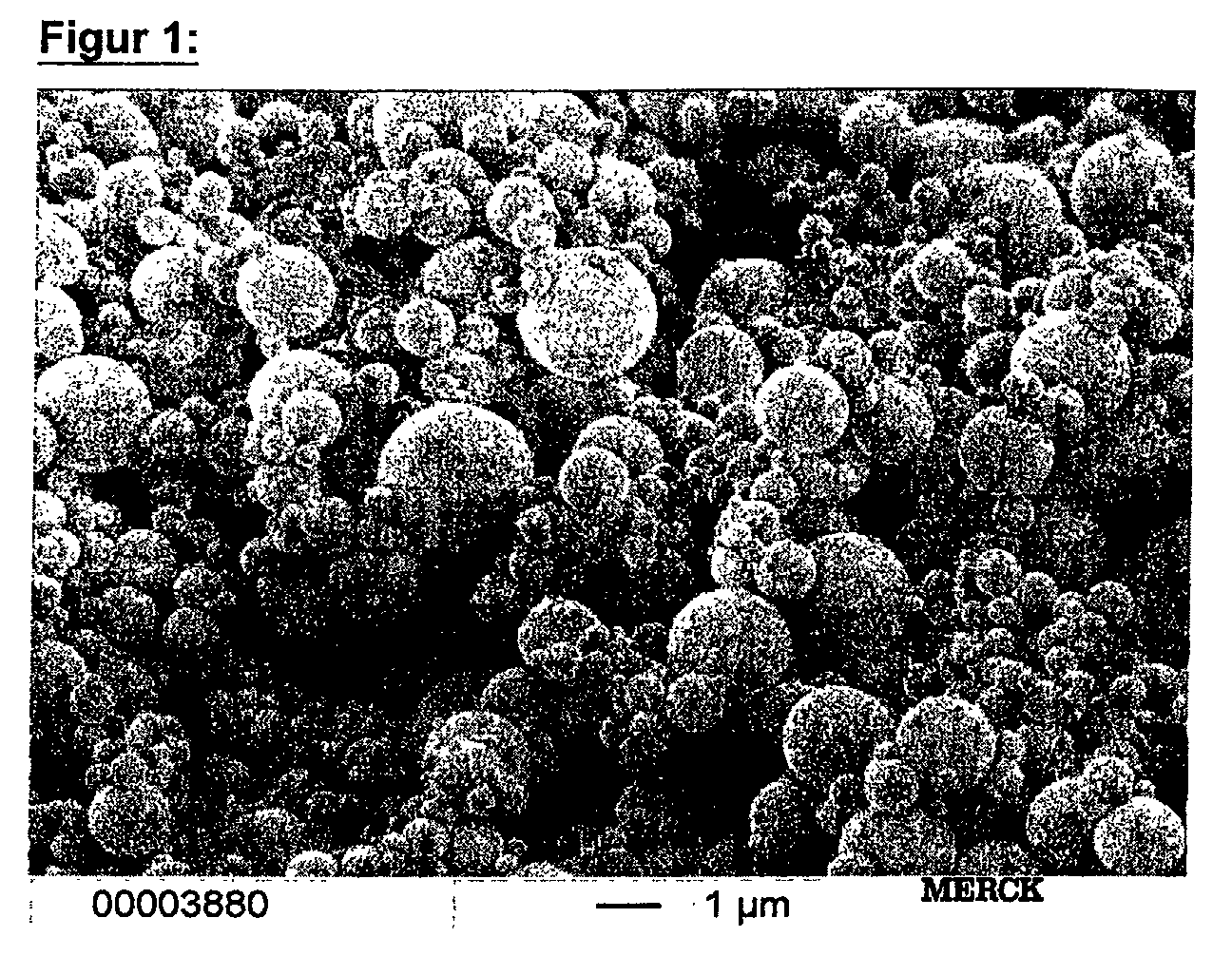
- Silicon oxides can also be produced in a spherical form, the specific one being here Surface is smaller than that of aerosils because the particles are larger and round. On Examples of this are the Ronaspheres (average particle diameter ⁇ 3 ⁇ ) from Merck (see Fig 1).
- Further fillers preferred according to the invention are silicon dioxide, their free OH groups organically modified (in whole or in part) on the particle surface.
- B the obtainable by addition of dimethylsilyl groups silica dimethyl Silylates, such as, for example, Aerosil R972 (Degussa Hüls), Aerosil R974 (Degussa Hüls), CAB-O-SIL TS-610 (Cabot), CAB-O-SIL TS-720 (Cabot), Wacker HDK H15 (Wacker-Chemie), Wacker HDK H18 (Wacker-Chemie) and / or Wacker HDK H20 (Wacker-Chemie).
- dimethylsilyl groups silica dimethyl Silylates such as, for example, Aerosil R972 (Degussa Hüls), Aerosil R974 (Degussa Hüls), CAB-O-SIL TS-610 (Cabot), CAB-O-SIL TS-720 (Cabot), Wacker HDK H15 (Wacker-Chemie), Wacker HDK H18 (Wacker-Chemie
- the silicas obtainable by adding trimethylsily groups are also advantageous Silylates (e.g. Aerosil R 812 (Degussa Hüls), CAB-O-SIL TS-530 (Cabot), Sipernat D 17 (Degussa Hüls), Wacker HDK H2000 (Wacker-Chemie)).
- Silylates e.g. Aerosil R 812 (Degussa Hüls), CAB-O-SIL TS-530 (Cabot), Sipernat D 17 (Degussa Hüls), Wacker HDK H2000 (Wacker-Chemie)).
- polymethylsilsesquioxanes obtainable from methyltrimethoxysilanes, which also have a round shape and their particle size distribution through the Manufacturing can be controlled.
- Preferred polymethylsilsesquioxanes are, for example, under the trade names Tospearl 2000 B from GE Bayer Silikones, Tospearl 145A from Toshiba, AEC Silicone Resin Spheres from A & E Connock and Wacker - Belsil PMS MK from Wacker-Chemie offered.
- Boron nitride is isoelectronic with carbon (i.e. it is graphite and diamond form possible). Boron nitride is characterized by its chemical inertness.
- the boron nitrides listed below are advantageous, for example: trade name Available at: Boron nitride powder Advanced Ceramics Boron nitride powder Sintec ceramics Ceram Blanche Kawasaki HCST Boron Nitride strongly réelle BN® Carborundum Wacker boron nitride BNP Wacker-Chemie
- fillers for the purposes of the present invention are carbonates, such as, for. B. magnesium carbonate (MgCO 3 ) and calcium carbonate (CaCO 3 ). It is particularly advantageous for the purposes of the present invention to use the carbonates as fillers in dry powders.
- MgCO 3 magnesium carbonate
- CaCO 3 calcium carbonate
- the fillers in the sense of the present invention are also advantageous selected from the group of organic fillers.
- Organic fillers advantageous according to the invention are e.g. B. natural polymers such as Silk powder, microcrystalline cellulose and / or zinc stearates.
- Organic fillers preferred according to the invention are also synthetic polymers, ie polymer particles which are present in the preparation in the form of solids, such as, for example, polycarbonates, polyethers, polyethylene, polypropylene, polyvinyl chloride, polystyrene, polyamides, polyurethanes, polyacrylates and the like.
- Z is particularly advantageous.
- B. the substance with the INCI name HDI / Trimethylol Hexyllactone Crosspolymer, which is available under the name BPD-500 / Plastic Powder D from Kobo.
- nylon polyamide 6 and Polyamide 12
- polyamide 6 and Polyamide 12 such as microfine polyamide particles, especially those under of the trade name SP-500 available from TORAY.
- polyamide 6 also: nylon 6
- polyamide 12 also: nylon 12
- Polyamide 6 is made from ⁇ -aminocaproic acid (6-aminohexanoic acid), or ⁇ -caprolactam built-up polyamide [poly ( ⁇ -caprolactam)], and polyamide 12 is a poly ( ⁇ -laurine lactam), from ⁇ -laurolactam.
- Advantages in the sense of the present invention are, for example Orgasol® 1002 (polyamide 6), and Orgasol® 2002 (polyamide 12), from ELF ATOCHEM.
- the total amount of one or more fillers according to the invention in the finished Cosmetic or dermatological preparations are advantageous from the field from 0.1 to 10.0% by weight, preferably 0.5 to 6.0% by weight, based on the Total weight of the preparations.
- the cosmetic or dermatological light protection formulations according to the invention can be composed as usual and the cosmetic or dermatological Sun protection, also for the treatment, care and cleaning of the skin and / or hair and serve as a make-up product in decorative cosmetics.
- the cosmetic and dermatological preparations are used in the for cosmetics usual way on the skin and / or the hair in sufficient quantity applied.
- the cosmetic and dermatological preparations according to the invention can Contain cosmetic auxiliaries, as they are usually used in such preparations be, e.g. B. preservatives, preservation aids, bactericides, perfumes, Anti-foaming substances, dyes, pigments, a coloring
- B. preservatives preservation aids, bactericides, perfumes, Anti-foaming substances, dyes, pigments, a coloring
- bactericides bactericides
- perfumes e.g. preservatives, preservation aids, bactericides, perfumes, Anti-foaming substances, dyes, pigments, a coloring
- bactericides e.g. bactericides, perfumes, Anti-foaming substances, dyes, pigments, a coloring
- a cosmetic or dermatological formulation such as alcohols, polyols, Polymers, foam stabilizers, electrolytes, organic solvents or silicone derivatives.
- Advantageous preservatives for the purposes of the present invention are, for example Formaldehyde releaser (such as DMDM hydantoin), iodopropyl butyl carbamate (e.g. those under the trade names Koncyl-L, Koncyl-S and Konkaben LMB from available from Lonza), parabens, phenoxyethanol, ethanol, benzoic acid and the like more.
- the preservation system usually further comprises also advantageous preservation aids, such as octoxyglycerol, glycine Soy etc.
- compositions are also obtained when added or Active ingredients antioxidants are used.
- the preparations contain advantageously one or more antioxidants.
- As cheap, but still optional Antioxidants to be used can all be for cosmetic and / or dermatological Applications suitable or customary antioxidants can be used.
- the antioxidants are advantageously selected from the group consisting of amino acids (e.g. glycine, histidine, tyrosine, tryptophan) and their derivatives, imidazoles (e.g. urocanic acid) and their derivatives, peptides such as D, L-carnosine, D- Carnosine, L-carnosine and their derivatives (e.g. anserine), carotenoids, carotenes (e.g. ⁇ -carotene, ⁇ -carotene, lycopene) and their derivatives, lipoic acid and their derivatives (e.g.
- amino acids e.g. glycine, histidine, tyrosine, tryptophan
- imidazoles e.g. urocanic acid
- peptides such as D, L-carnosine, D- Carnosine, L-carnosine and their derivatives (e.g. anserine)
- carotenoids e.g
- thioglucose e.g. thioredoxin, glutathione, cysteine, cystine, cystamine and their glycosyl, N-acetyl, methyl, ethyl, propyl, amyl, butyl and lauryl, palmitoyl) , Oleyl, ⁇ -linoleyl, cholesteryl and glyceryl esters) and their salts, dilauryl thiodipropionate, distearyl thiodipropionate, thiodipropionic acid and their derivatives (esters, ethers, peptides, lipids, nucleotides, nucleosides and salts) and sulfoximine compounds (e.g.
- buthioninsulfoxim Homocysteine sulfoximine, buthionine sulfones, penta-, hexa-, heptathioninsu lfoximin) in very low tolerable doses e.g. B. pmol to ⁇ mol / kg
- further (metal) chelators e.g. ⁇ -hydroxy fatty acids, palmitic acid, phytic acid, lactoferrin
- ⁇ -hydroxy acids e.g.
- citric acid citric acid, lactic acid, malic acid
- humic acid bile acid
- Bile extracts bilirubin, biliverdin, EDTA, EGTA and their derivatives
- unsaturated fatty acids and their derivatives e.g. ⁇ -linolenic acid, linoleic acid, oleic acid
- folic acid and their derivatives ubiquinone and ubiquinol and their derivatives
- vitamin C and derivatives e.g. B. ascorbyl palmitate, Mg - ascorbyl phosphate, ascorbyl acetate
- tocopherols and derivatives e.g.
- vitamin E acetate
- vitamin A and derivatives vitamin A palmitate
- Water-soluble antioxidants can be particularly advantageous for the purposes of the present invention are used, such as vitamins, for. B. ascorbic acid and its Derivatives.
- compositions according to the invention are very are good vehicles for cosmetic or dermatological agents in the skin, whereby preferred active ingredients are antioxidants, which protect the skin from oxidative stress can protect.
- preferred active ingredients are antioxidants, which protect the skin from oxidative stress can protect.
- Preferred antioxidants are vitamin E and its derivatives and vitamin A and its derivatives.
- the amount of antioxidants (one or more compounds) in the preparations is preferably 0.001 to 30% by weight, particularly preferably 0.05 to 20% by weight, in particular 0.1 to 10 wt .-%, based on the total weight of the preparation.
- vitamin E and / or its derivatives are the antioxidant (s) advantageous, the respective concentrations of which range from 0.001 to 10% by weight, based on the total weight of the formulation.
- vitamin A or vitamin A derivatives, or carotenes or their derivatives, the or which are antioxidants is advantageous, their respective concentrations out of the range from 0.001 to 10% by weight, based on the total weight of the formulation choose.
- the active ingredients can also be very effective are advantageously chosen from the group of lipophilic active substances, in particular from following group:
- vitamin F essential fatty acids
- the active ingredient (s) are particularly advantageously selected from the group of NO synthase inhibitors, especially when the preparations according to the invention are used for Treatment and prophylaxis of the symptoms of intrinsic and / or extrinsic Skin aging and for the treatment and prophylaxis of the harmful effects of ultraviolet Radiation intended to serve the skin.
- the preferred NO synthase inhibitor is nitroarginine.
- the active ingredient (s) are also advantageously selected from the group consisting of catechins and bile esters from catechins and aqueous or organic extracts Plants or parts of plants that contain catechins or bile esters of catechins, such as the leaves of the plant family Theaceae, especially Camellia sinensis (green tea). Particularly advantageous are their typical ingredients (such as polyphenols or catechins, caffeine, Vitamins, sugar, minerals, amino acids, lipids).
- Catechins are a group of compounds called hydrogenated flavones or anthocyanidins are to be understood and derivatives of "catechins” (catechol, 3,3 ', 4', 5,7-flavanpentaol, 2- (3,4-dihydroxyphenyl) -chroman-3,5,7-triol).
- Catatechin too ((2R, 3R) -3,3 ', 4', 5,7-flavanpentaol) is an advantageous active substance in the sense of the present Invention.
- Plant extracts containing catechins are also advantageous Green tea extracts such as B. Extracts from leaves of the plants of the species Camellia spec., Especially the types of tea Camellia sinenis, C. assamica, C. taliensis or C. irrawadiensis and crosses of these with, for example, Camellia japonica.
- Preferred active substances are also polyphenols or catechins from the group (-) - catechin, (+) - catechin, (-) - catechin gallate, (-) - gallocatechin gallate, (+) - epicatechin, (-) - epicatechin, (-) - epicatechin gallate, (-) - epigallocatechin, (-) - epigallocatechin gallate.
- Flavon and its derivatives are also advantageous active substances in the sense of the present invention. They are characterized by the following basic structure (substitution positions specified):
- flavones usually occur in glycosidated form.
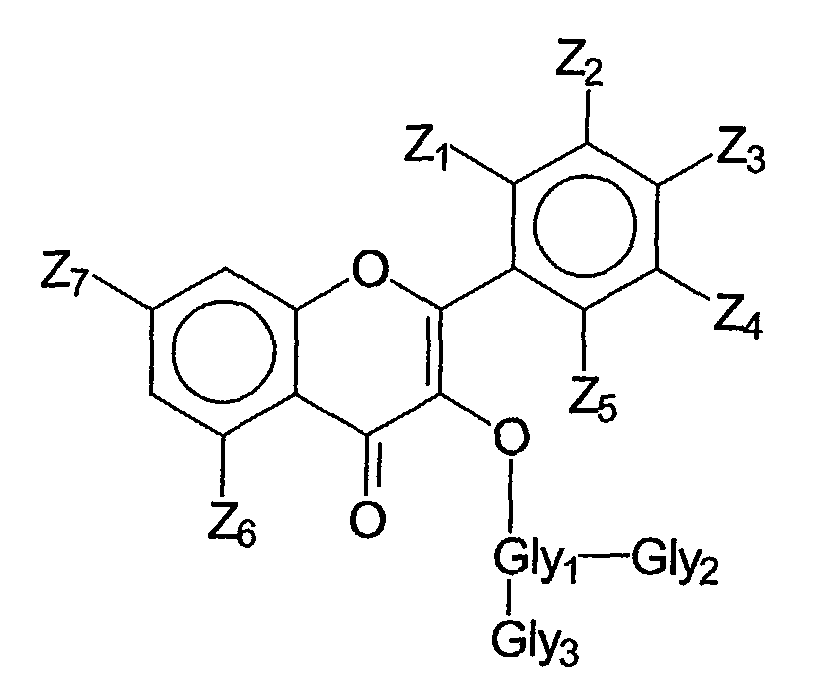
- the flavonoids are preferably selected from the group of substances of the generic structural formula where Z 1 to Z 7 are independently selected from the group H, OH, alkoxy and hydroxyalkoxy, where the alkoxy or hydroxyalkoxy groups can be branched and unbranched and can have 1 to 18 carbon atoms, and wherein Gly is selected from the group the mono- and oligoglycoside residues.
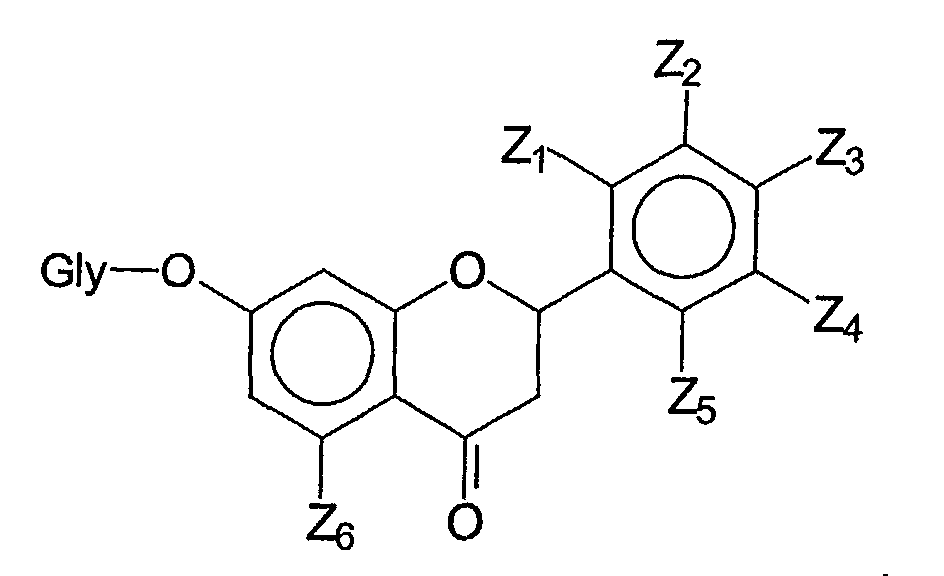
- the flavonoids can also be advantageously selected from the group of substances of the generic structural formula where Z 1 to Z 6 are independently selected from the group H, OH, alkoxy and hydroxyalkoxy, where the alkoxy or hydroxyalkoxy groups can be branched and unbranched and can have 1 to 18 carbon atoms, and wherein Gly is selected from the group the mono- and oligoglycoside residues.
- Such structures can preferably be selected from the group of substances of the generic structural formula where Gly 1 , Gly 2 and Gly 3 independently of one another represent monoglycoside residues or. Gly 2 or Gly 3 can also individually or together represent saturations by hydrogen atoms.
- Gly 1 , Gly 2 and Gly 3 are preferably selected independently of one another from the group of the hexosyl radicals, in particular the rhamnosyl radicals and glucosyl radicals.
- hexosyl radicals for example allosyl, altrosyl, galactosyl, gulosyl, idosyl, mannosyl and talosyl, may also be used advantageously. It can also be advantageous according to the invention to use pentosyl residues.
- Z 1 to Z 5 are advantageously selected independently of one another from the group H, OH, methoxy, ethoxy and 2-hydroxyethoxy, and the flavone glycosides have the structure
- the flavone glycosides according to the invention from the group which are represented by the following structure are particularly advantageous: where Gly 1 , Gly 2 and Gly 3 independently of one another represent monoglycoside residues or. Gly 2 or Gly 3 can also individually or together represent saturations by hydrogen atoms.
- Gly 1 , Gly 2 and Gly 3 are preferably selected independently of one another from the group of the hexosyl radicals, in particular the rhamnosyl radicals and glucosyl radicals.
- hexosyl radicals for example allosyl, altrosyl, galactosyl, gulosyl, idosyl, mannosyl and talosyl, may also be used advantageously. It can also be advantageous according to the invention to use pentosyl residues.
- the flavone glycoside or flavones is particularly advantageous to choose from the group ⁇ -glucosylrutin, ⁇ -glucosylmyricetin, ⁇ -glucosylisoquercitrin, ⁇ -glucosylisoquercetin and ⁇ -glucosylquercitrin.
- ⁇ -glucosylrutin is particularly preferred.
- Naringin (aurantiin, naringenin-7-rhamnoglucoside) are also advantageous according to the invention, Hesperidin (3 ', 5,7-trihydroxy-4'-methoxyflavanone-7-rutinoside, hesperidoside, hesperetin-7-O-rutinoside).
- Rutin (3,3 ', 4', 5,7-pentahydroxyflyvon-3-rutinoside, quercetin-3-rutinoside, Sophorin, Birutan, Rutabion, Taurutin, Phytomelin, Melin), Troxerutin (3,5-Dihydroxy-3 ', 4', 7-tris (2-hydroxyethoxy) -flavon-3- (6-O- (6-deoxy- ⁇ -L-mannopyranosyl) - ⁇ -D-glucopyranoside)), Monoxerutin (3,3 ', 4', 5-tetrahydroxy-7- (2-hydroxyethoxy) flavon-3- (6-O- (6-deoxy- ⁇ -L-mannopyranosyl) - ⁇ -D-glucopyranoside)) .
- Dihydrorobinetin (3,3 ', 4', 5 ', 7-pentahydroxyflavanone), Taxifolin (3,3 ', 4', 5,7-pentahydroxyflavanone), eriodictyol-7-glucoside (3 ', 4', 5,7-tetrahydroxyflavanone-7-glucoside), flavanomare ⁇ n (3 ', 4', 7,8-tetrahydroxyflavanone-7-glucoside) and isoquercetin (3,3 ', 4', 5,7-pentahydroxyflavanone-3- ( ⁇ -D-glucopyranoside).
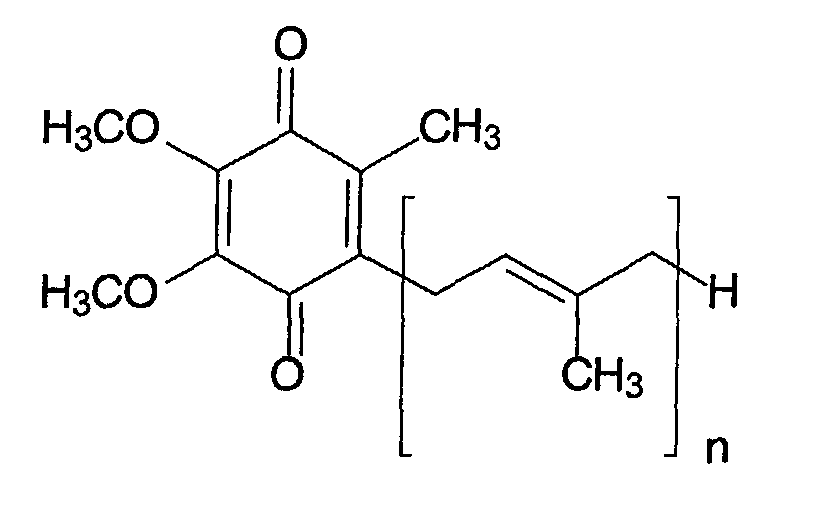
- Coenzyme Q10 which is characterized by the following structural formula, is particularly advantageous:
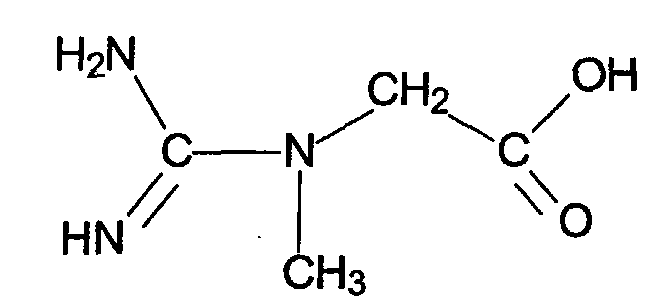
- Creatine and / or creatine derivatives are also preferred active substances for the purposes of the present invention. Creatine is characterized by the following structure:
- Preferred derivatives are creatine phosphate and creatine sulfate, creatine acetate, creatine ascorbate and those esterified on the carboxyl group with mono- or polyfunctional alcohols Derivatives.
- L-carnitine [3-hydroxy-4- (trimethylammonio) butyric acid betaine].
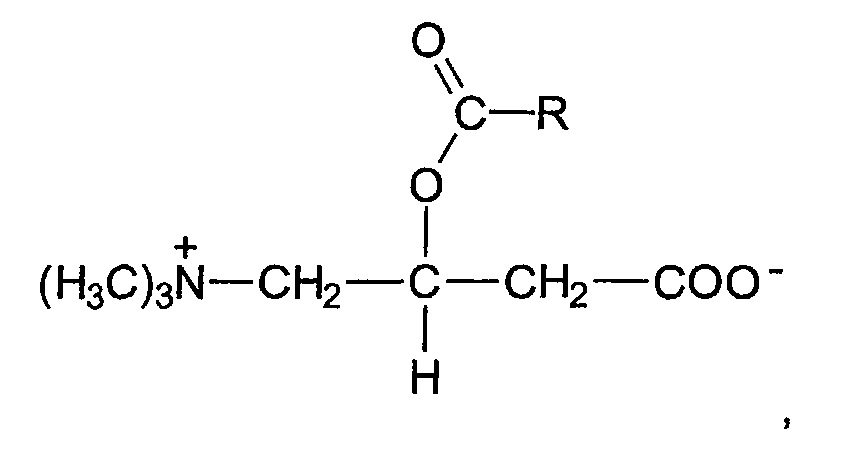
- acyl-carnitine which is selected from the group of substances of the following general structural formula where R is selected from the group of branched and unbranched alkyl radicals having up to 10 carbon atoms are advantageous active ingredients in the sense of the present invention.
- Propionylcarnitine and in particular acetylcarnitine are preferred.
- Both entantiomers D- and L-form
- selected recipes according to the invention are suitable, which e.g. B. known anti-wrinkle active ingredients such as flavone glycosides (especially ⁇ -glycosylrutin), coenzyme Q10, vitamin E and / or derivatives and the like contain, particularly advantageous for the prophylaxis and treatment of cosmetic or dermatological skin changes, as they e.g. B. occur in skin aging. They are also advantageous against the appearance of dry or rough skin.
- known anti-wrinkle active ingredients such as flavone glycosides (especially ⁇ -glycosylrutin), coenzyme Q10, vitamin E and / or derivatives and the like contain, particularly advantageous for the prophylaxis and treatment of cosmetic or dermatological skin changes, as they e.g. B. occur in skin aging. They are also advantageous against the appearance of dry or rough skin.
- the present invention relates in particular Products for the care of naturally aged skin, as well as for the treatment of Consequential damage to light aging, especially the phenomena listed under a) to g).
- the oil phase of the formulations according to the invention is advantageously chosen from the Group of polar oils, for example from the group of lecithins and fatty acid triglycerides, namely the triglycerol esters saturated and / or unsaturated, branched and / or unbranched alkane carboxylic acids with a chain length of 8 to 24, in particular 12 to 18 carbon atoms.
- the fatty acid triglycerides can be advantageous, for example can be selected from the group of synthetic, semi-synthetic and natural Oils such as B.
- cocoglyceride olive oil, sunflower oil, soybean oil, peanut oil, rapeseed oil, almond oil, Palm oil, coconut oil, castor oil, wheat germ oil, grape seed oil, safflower oil, evening primrose oil, Macadamia nut oil and the like.
- polar oil components can be used for the purposes of the present invention furthermore selected from the group of the esters from saturated and / or unsaturated, branched and / or unbranched alkane carboxylic acids with a chain length of 3 to 30 C atoms and saturated and / or unsaturated, branched and / or unbranched Alcohols with a chain length of 3 to 30 carbon atoms and from the group of esters aromatic carboxylic acids and saturated and / or unsaturated, branched and / or unbranched alcohols with a chain length of 3 to 30 carbon atoms.
- Ester oils can then advantageously be selected from the group octyl palmitate, octyl cocoate, Octyl isostearate, octyldodeceyl myristate, cetearyl isononanoate, isopropyl myristate, isopropyl palmitate, Isopropyl stearate, isopropyl oleate, n-butyl stearate, n-hexyl laurate, n-decyl oleate, Isooctyl stearate, isononyl stearate, isononyl isononanoate, 2-ethylhexyl palmitate, 2-ethylhexyl laurate, 2-hexyldecyl stearate, 2-octyldodecyl palmitate, stearylheptanoate, oleyl oleate, Oleylerucate,
- the oil phase can advantageously be selected from the group of dialkyl ethers and dialkyl carbonates.
- the oil component from the group consisting of isoeicosane, neopentyl glycol, propylene glycol dicaprylate / dicaprate, caprylic / capric / Dlglycerylsuccinat, butylene glycol dicaprylate / dicaprate, C 12-13 alkyl lactate, di-C 12-13 -Alkyltartrat, triisostearin, Dipentaerythrityl Hexacaprylate / hexacaprate, propylene glycol monoisostearate, tricaprylin, dimethyl isosorbide. It is particularly advantageous if the oil phase of the formulations according to the invention has a content of C 12-15 alkyl benzoate or consists entirely of this.
- Advantageous oil components are also e.g. B. butyl octyl salicylate (for example that available under the trade name Hallbrite BHB from CP Hall), hexadecyl benzoate and butyl octyl benzoate and mixtures thereof ( Hallstar AB ) and / or diethyl hexyl naphthalate ( Hallbrite TQ ).
- B. butyl octyl salicylate for example that available under the trade name Hallbrite BHB from CP Hall
- Hallstar AB hexadecyl benzoate
- Hallstar AB hexadecyl benzoate
- Hallstar AB butyl octyl benzoate and mixtures thereof
- Hallstar TQ diethyl hexyl naphthalate
- the oil phase may also advantageously contain non-polar oils, for example those that are selected from the group of branched and unbranched Hydrocarbons and waxes, especially mineral oil, petroleum jelly (petrolatum), Paraffin oil, squalane and squalene, polyolefins, hydrogenated polyisobutenes and isohexadecane.
- non-polar oils for example those that are selected from the group of branched and unbranched Hydrocarbons and waxes, especially mineral oil, petroleum jelly (petrolatum), Paraffin oil, squalane and squalene, polyolefins, hydrogenated polyisobutenes and isohexadecane.
- polyolefins polydecenes are the preferred substances.
- the oil phase can also advantageously contain cyclic or linear silicone oils have or consist entirely of such oils, although it is preferred in addition to the silicone oil or the silicone oils an additional content of other oil phase components to use.
- Silicone oils are high-molecular synthetic polymeric compounds in which silicon atoms are linked in a chain and / or network-like manner via oxygen atoms and the remaining valences of silicon are saturated by hydrocarbon residues (mostly methyl, more rarely ethyl, propyl, phenyl groups, etc.) ,
- the silicone oils are systematically referred to as polyorganosiloxanes.
- the methyl-substituted polyorganosiloxanes which are the most important compounds of this group in terms of quantity and are characterized by the following structural formula are also known as polydimethylsiloxane or dimethicone (INCI). Dimethicone is available in different chain lengths or with different molecular weights.
- Particularly advantageous polyorganosiloxanes for the purposes of the present invention are for example dimethylpolysiloxanes [poly (dimethylsiloxane)], which, for example, under the trade names Abil 10 to 10,000 are available from Th. Goldschmidt.
- Further Phenylmethylpolysiloxanes (INCI: Phenyl Dimethicone, Phenyl Trimethicone) are advantageous, cyclic silicones (octamethylcyclotetrasiloxane or decamethylcyclopentasiloxane), which are also called cyclomethicones according to INCI Silicones (INCI: Amodimethicone) and silicone waxes, e.g. B.
- polysiloxane-polyalkylene copolymers (INCI: Stearyl Dimethicone and Cetyl Dimethicone) and Dialkoxydimethylpolysiloxane (Stearoxy Dimethicone and Behenoxy Stearyl Dimethicone), which as different Abil wax types are available from Th. Goldschmidt.
- silicone oils are to be used advantageously for the purposes of the present invention, for example Cetyldimethicone, hexamethylcyclotrisiloxane, polydimethylsiloxane, poly (methylphenylsiloxane).
- z. B. natural animal and vegetable waxes Origin such as beeswax, china wax, bumblebee wax and other insect waxes as well as shea butter.
- preparations according to the invention can advantageously also be in the form of so-called oil-free cosmetic or dermatological emulsions are present, which a water phase and at least one UV filter substance that is liquid at room temperature included as another phase.
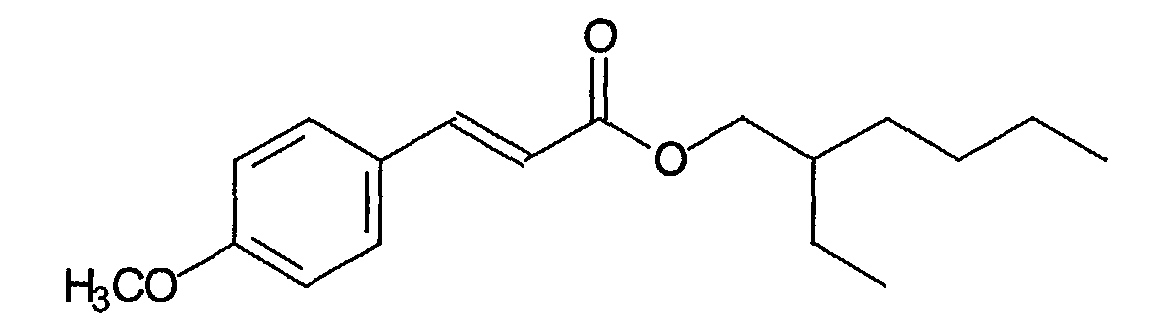
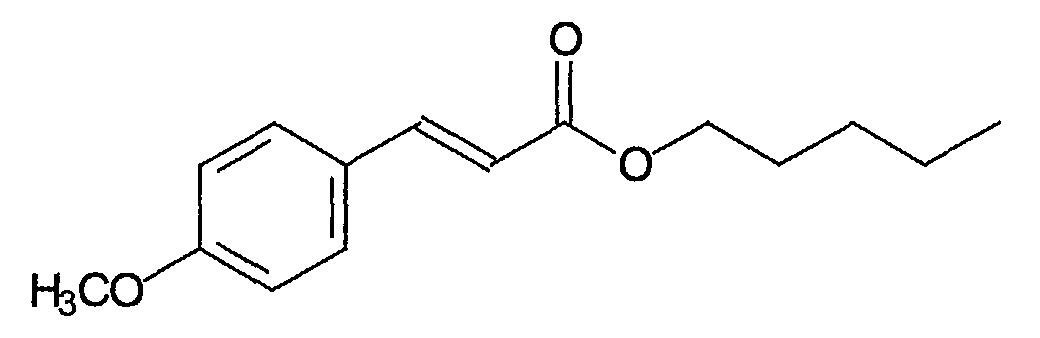
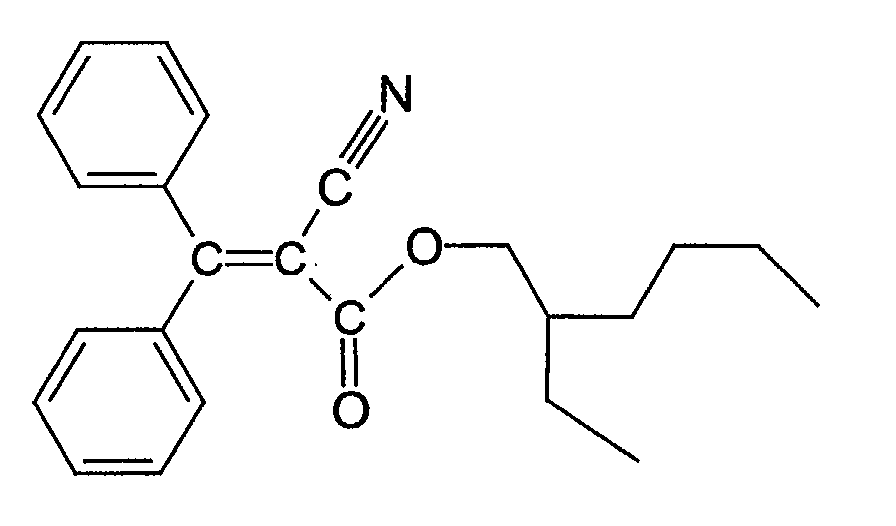
- UV filter substances liquid at room temperature in the sense of present invention are homomenthyl salicylate, 2-ethylhexyl-2-cyano-3,3-diphenylacrylate, 2-ethylhexyl-2-hydroxybenzoate and esters of cinnamic acid, preferably 4-methoxycinnamic acid (2-ethylhexyl) ester and isopentyl 4-methoxycinnamate.
- Homomenthyl salicylate (INCI: Homosalate) is characterized by the following structure: 2-Ethylhexyl-2-cyano-3,3-diphenylacrylate (INCI: Octocrylene) is available from BASF under the name Uvinul® N 539 and is characterized by the following structure: 2-ethylhexyl-2-hydroxybenzoate (2-ethylhexyl salicylate, octyl salicylate, INCI: octyl salicylate) is available, for example, from Haarmann & Reimer under the trade name Neo Heliopan OS and is characterized by the following structure: 4-methoxycinnamic acid (2-ethylhexyl) ester (2-ethylhexyl-4-methoxycinnamate, INCI: octyl methoxycinnamate) is available, for example, from Hoffmann-La Roche under the trade name Parsol MCX and is characterized by
- the total amount of one or more UV filter substances that are liquid at room temperature in the finished cosmetic or dermatological preparations is advantageous from the range 0.1% by weight to 30% by weight, preferably from 0.5 to 20% by weight selected, each based on the total weight of the preparations.
- Such oil-free emulsions can also be advantageous for the purposes of the present invention although not mandatory, also contain silicone oils and / or silicone waxes, in particular the above.
- the water phase of the preparations according to the invention can advantageously be conventional cosmetic Auxiliaries contain, such as alcohols, especially those lower C number, preferably ethanol and / or isopropanol, diols or polyols of low C number and their ethers, preferably propylene glycol, glycerol, ethylene glycol, ethylene glycol monoethyl or monobutyl ether, propylene glycol monomethyl, monoethyl or monobutyl ether, diethylene glycol monomethyl or monoethyl ether and analog products, Polymers, foam stabilizers, electrolytes and in particular one or more Thickeners, which one or which can advantageously be chosen from the Group silicon dioxide, aluminum silicates, polysaccharides or their derivatives, e.g.
- TEWL t rans e pidermal w ater l oss
- moisturizers for the purposes of the present invention are, for example, glycerol, Lactic acid, pyrrolidone carboxylic acid and urea. Furthermore, it is particularly from Advantage, polymer moisturizers from the group of water-soluble and / or in water to use swellable and / or water-gelable polysaccharides.
- hyaluronic acid, chitosan and / or a high-fucose content are advantageous Polysaccharide, which can be found in the Chemical Abstracts under the registration number 178463-23-5 filed and z. B. by the company under the name Fucogel®1000 SOLABIA S.A. is available.
- the cosmetic or dermatological preparations according to the invention can further advantageous, although not mandatory, contain fillers which, for. B. the sensory and further improve the cosmetic properties of the formulations and, for example create or intensify a velvety or silky feeling on the skin.
- advantageous Fillers for the purposes of the present invention are starch and starch derivatives (such as z. B. tapioca starch, distarch phosphate, aluminum or sodium starch octenyl succinate and the like), pigments that have neither primarily UV filter nor coloring effect have (such as boron nitride etc.) and / or Aerosile® (CAS No. 7631-86-9).
- Aerosile® which are available from DEGUSSA AG / Frankfurt, are silicon oxides and are characterized by a small particle size (e.g. between 5 and 40 nm), where the particles are to be regarded as spherical particles of very uniform dimensions. Macroscopically, Aerosile® are recognizable as loose, white powders.
- Aerosil® types examples are Aerosil® OX50, Aerosil® 130, Aerosil® 150, Aerosil® 200, Aerosil® 300, Aerosil® 380, Aerosil® MOX 80, Aerosil @ MOX 170, Aerosil® COK 84, Aerosil® R 202, Aerosil® R 805, Aerosil® R 812, Aerosil® R 974, Aerosil @ R976.
- cosmetic or topical dermatological compositions for the purposes of the present invention, for example as skin protection cream, cleansing milk, day or night cream, etc. It may be possible and advantageous, the compositions according to the invention as a basis to use for pharmaceutical formulations.
- the cosmetic and dermatological preparations according to the invention can contain dyes and / or color pigments, in particular if they are in the form of decorative cosmetics.
- the dyes and pigments can be selected from the corresponding positive list in the Cosmetics Ordinance or the EC list of cosmetic colorants. In most cases, they are identical to the colorants approved for food.
- Advantageous color pigments are, for example, titanium dioxide, mica, iron oxides (for example Fe 2 O 3 , Fe 3 O 4 , FeO (OH)) and / or tin oxide.
- Advantageous dyes are, for example, carmine, Berlin blue, chrome oxide green, ultramarine blue and / or manganese violet. It is particularly advantageous to choose the dyes and / or color pigments from the list below.
- CIN Color Index Numbers
- formulations according to the invention are in the form of products which applied to the face, it is beneficial to dye one or more substances to choose from the following group: 2,4-dihydroxyazobenzene, 1- (2'-chloro-4'-nitro-1'phenylazo) -2-hydroxynaphthalene, Ceres red, 2- (4-sulfo-1-naphthylazo) -1-naphthol-4-sulfonic acid, Calcium salt of 2-hydroxy-1,2'-azonaphthalene-1'-sulfonic acid, calcium and barium salts 1- (2-sulfo-4-methyl-1-phenylazo) -2-naphthylcarboxylic acid, calcium salt of 1- (2-sulfo-1-naphthylazo) -2-hydroxynaphthalene-3-carboxylic acid, aluminum salt of 1- (4-sulfo-1-phenylazo) -2-naphthol-6-sulfonic acid, Aluminum salt of 1- (4
- oil-soluble natural dyes such as. B. paprika extracts, ⁇ -carotene or Cochineal.
- Pearlescent pigments are based, for example, on powdered pigments or castor oil dispersions of bismuth oxychloride and / or titanium dioxide and bismuth oxychloride and / or Titanium dioxide on mica. Particularly advantageous is e.g. B. that listed under CIN 77163 Luster pigment.
- pearlescent pigment types based on mica / metal oxide are also advantageous: group Coverage / layer thickness colour
- Silver-white pearlescent pigments TiO 2 : 40-60 nm silver interference pigments TiO 2 : 60-80 nm yellow TiO 2 : 80-100 nm red
- TiO 2 100-140 nm blue
- TiO 2 120-160 nm
- Color Luster Pigments Fe 2 O 3 bronze Fe 2 O 3 copper Fe 2 O 3 red Fe 2 O 3 rotviolett Fe 2 O 3 Red Green Fe 2 O 3 black combination pigments
- B the pearlescent pigments available from Merck under the trade names Timiron, Colorona or Dichrona. Another preferred pigment is barium sulfate (BaSO 4 ).
- pearlescent pigments which are advantageous in the sense of the present invention can be obtained in numerous ways known per se.
- other substrates besides mica can be coated with other metal oxides, such as. B. silica and the like.
- Z are advantageous.
- Iron pearlescent pigments which are without the use, are particularly preferred made by mica.
- Such pigments are e.g. B. under the trade name Sicopearl Kupfer 1000 available from BASF.
- Effect pigments which are sold under the trade name are also particularly advantageous Metasomes Standard / Glitter in different colors (yello, red, green, blue) from are available from Flora Tech.
- the glitter particles are mixed with them various auxiliaries and dyes (such as the dyes with the color Index (Cl) numbers 19140, 77007, 77289, 77491).
- the dyes and pigments can be present both individually and in a mixture as well be mutually coated, with different coating thicknesses different color effects are generally produced.
- the total amount The dyes and coloring pigments are advantageous from the field from Z. B. 0.1 wt .-% to 30 wt .-%, preferably from 0.5 to 15 wt .-%, in particular from 1.0 to 10% by weight, in each case based on the total weight of the preparations.
- UV protection substances So z. B. in day creams or makeup products usually UV-A or UV-B filter substances incorporated. Also provide UV protection substances, as well as antioxidants and, if desired, preservatives, effective protection of the preparations even against spoilage. Cosmetic and dermatological are also favorable Preparations in the form of a sunscreen.
- the preparations in the sense of the present invention preferably contain at least one UV-A and / or UV-B filter substance.
- the wording can, although not necessary, optionally one or more organic and / or contain inorganic pigments as UV filter substances which are used in water and / or the oil phase can be present.
- Preferred inorganic pigments are metal oxides and / or other metal compounds which are sparingly soluble or insoluble in water, in particular oxides of titanium (TiO 2 ), zinc (ZnO), iron (e.g. Fe 2 O 3 ), zirconium (ZrO 2 ), silicon ( SiO 2 ), manganese (e.g. MnO), aluminum (Al 2 O 3 ), cerium (e.g. Ce 2 O 3 ), mixed oxides of the corresponding metals and mixtures of such oxides, as well as the sulfate of barium (BaSO 4 ).
- zinc oxides can also be used in the form of commercially available oily or aqueous predispersions.
- Titanium dioxide pigments according to the invention can be used both in the rutile crystal modification as well as anatase and can be advantageous for the purposes of the present invention be superficially treated ("coated"), for example a hydrophilic, amphiphilic or hydrophobic character should be formed or retained.
- This Surface treatment can consist in that the pigments are known per se Method with a thin hydrophilic and / or hydrophobic inorganic and / or organic layer.
- the different surface coatings can also contain water for the purposes of the present invention.
- Inorganic surface coatings in the sense of the present invention can consist of aluminum oxide (Al 2 O 3 ), aluminum hydroxide Al (OH) 3 , or aluminum oxide hydrate (also: alumina, CAS no .: 1333-84-2), sodium hexametaphosphate (NaPO 3 ) 6 , sodium metaphosphate (NaPO 3 ) n , silicon dioxide (SiO 2 ) (also: silica, CAS No .: 7631-86-9), or iron oxide (Fe 2 O 3 ).
- Al 2 O 3 aluminum oxide
- Al aluminum hydroxide Al
- Al oxide hydrate also: alumina, CAS no .: 1333-84-2
- sodium hexametaphosphate (NaPO 3 ) 6 sodium metaphosphate (NaPO 3 ) n
- silicon dioxide SiO 2
- silica also: silica, CAS No .: 7631-86-9
- iron oxide Fe 2 O 3
- Organic surface coatings in the sense of the present invention can consist of vegetable or animal aluminum stearate, vegetable or animal Stearic acid, lauric acid, dimethylpolysiloxane (also: Dimethicone), methylpolysiloxane (Methicone), Simethicone (a mixture of dimethylpolysiloxane with an average Chain length from 200 to 350 dimethylsiloxane units and silica gel) or Alginic acid.
- These organic surface coatings can be used alone, in combination and / or occur in combination with inorganic coating materials.
- Coated and uncoated titanium dioxides according to the invention can be in the form commercially available oily or aqueous predispersions are used. These predispersions can advantageously be dispersants and / or solubilizers be clogged.
- Suitable titanium dioxide particles and predispersions of titanium dioxide particles in the sense of the present invention are available under the following trade names from the listed companies: trade name coating additional components of the predispersion Manufacturer MT-150W none - Tayca Corporation MT-150A none - Tayca Corporation MT-500B none - Tayca Corporation MT-600B none - Tayca Corporation MT-100TV Aluminum hydroxide stearic acid - Tayca Corporation MT-100Z Aluminum hydroxide stearic acid - Tayca Corporation MT-100T Aluminum hydroxide stearic acid - Tayca Corporation MT-500T Aluminum hydroxide stearic acid - Tayca Corporation MT-100S Aluminum hydroxide lauric acid - Tayca Corporation MT-100F Stearic acid iron oxide - Tayca Corporation MT-100SA Alumina silica - Tayca Corporation MT-500SA Alumina silica - Tayca Corporation MT-600SA Alumina silica - Ta
- Z-oxides of the Z-Cote type are particularly advantageous for the purposes of the present invention HP1 and Z-Cote from BASF and NDM and Neutral from Haarmann and Reimer (H&R).
- titanium dioxides of the type Eusolex T-2000 are the Merck, T 805 from Degussa and MT-100Z and MT-100TV from Tayca advantageous for use in light protection emulsions.
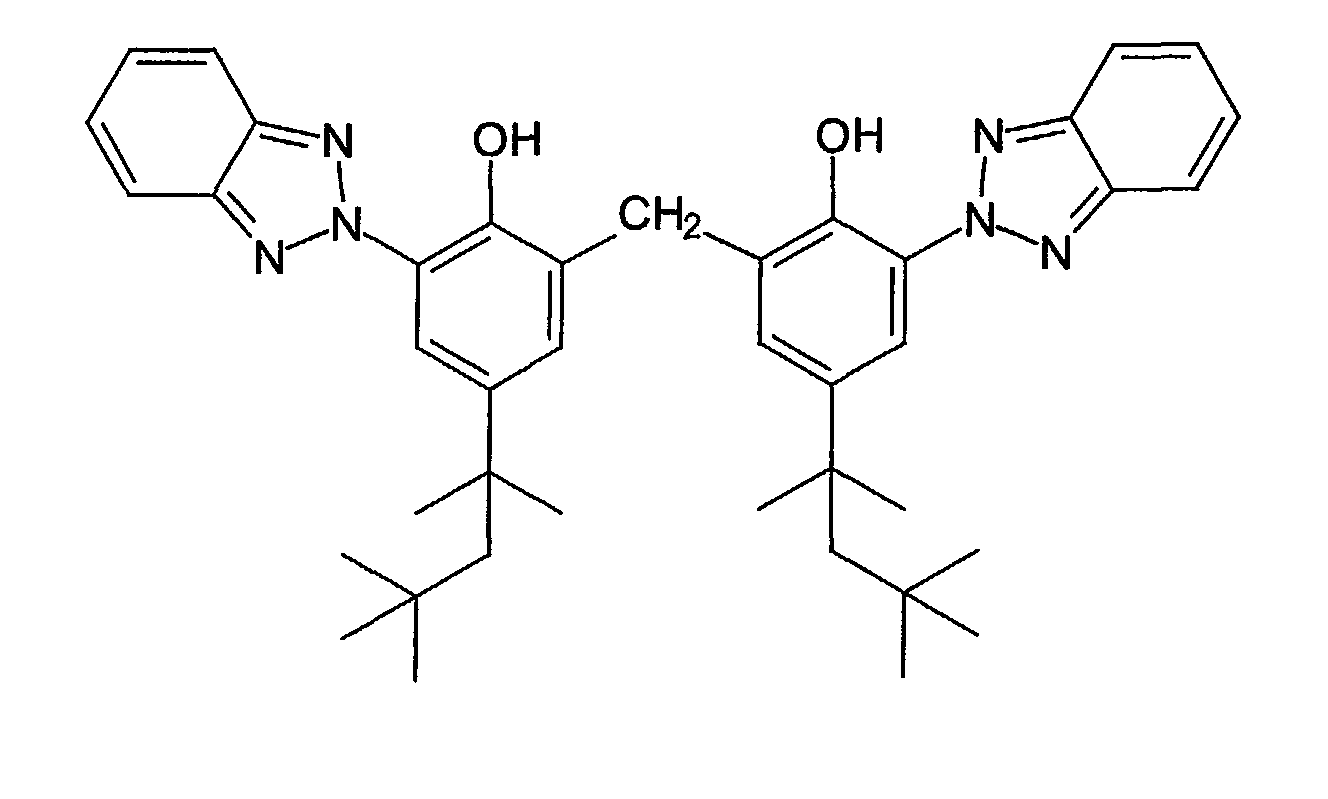
- An advantageous organic pigment for the purposes of the present invention is 2,2'-methylene-bis- (6- (2H-benzotriazol-2-yl) -4- (1,1,3,3-tetramethylbutyl) phenol) [INCI : Bisoctyltriazole], which is characterized by the chemical structural formula and is available under the trade name Tinosorb® M from CIBA-Chemicals GmbH.
- Preparations according to the invention advantageously contain substances which emit UV radiation Absorb UV-A and / or UV-B range, the total amount of filter substances z. B. 0.1% by weight to 30% by weight, preferably 0.5 to 20% by weight, in particular 1.0 is up to 15.0% by weight, based on the total weight of the preparations, of cosmetic To provide preparations that the hair or skin before protect the entire range of ultraviolet radiation. You can also use it as a sunscreen serve for hair or skin.
- UV-A filter substances for the purposes of the present invention are dibenzoylmethane derivatives, especially the 4- (tert-butyl) -4'-methoxydibenzoylmethane (CAS no. 70356-09-1), which is available from Givaudan under the Parsol® 1789 brand and from Merck under the trade name Eusolex® 9020 is sold.
- dibenzoylmethane derivatives especially the 4- (tert-butyl) -4'-methoxydibenzoylmethane (CAS no. 70356-09-1), which is available from Givaudan under the Parsol® 1789 brand and from Merck under the trade name Eusolex® 9020 is sold.
- UV-A filter substances are phenylene-1,4-bis (2-benzimidazyl) -3,3'-5,5'-tetrasulfonic acid and their salts, especially the corresponding sodium, potassium or triethanolammonium salts, in particular the phenylene-1,4-bis (2-benzimidazyl) -3,3'-5,5'-tetrasulfonic acid bis-sodium salt with the INCI name bisimidazylate, which is available, for example, from Haarmann & Reimer under the trade name Neo Heliopan AP.
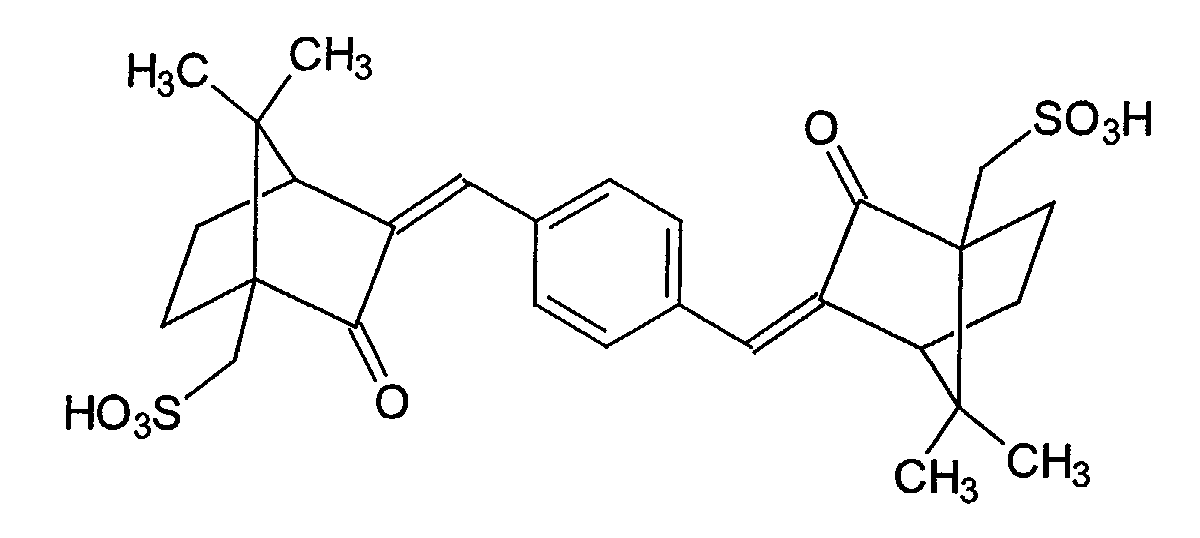
- 1,4-di (2-oxo-10-sulfo-3-bornylidenemethyl) benzene and its salts especially the corresponding 10-sulfato compounds, especially the corresponding sodium, potassium or triethanolammonium salt
- benzene-1,4-di (2-oxo-3-bornylidenemethyl-10-sulfonic acid is also called benzene-1,4-di (2-oxo-3-bornylidenemethyl-10-sulfonic acid
- UV filter substances in the sense of the present invention are also so-called Broadband filter, i.e. Filter substances that contain both UV-A and UV-B radiation absorb.
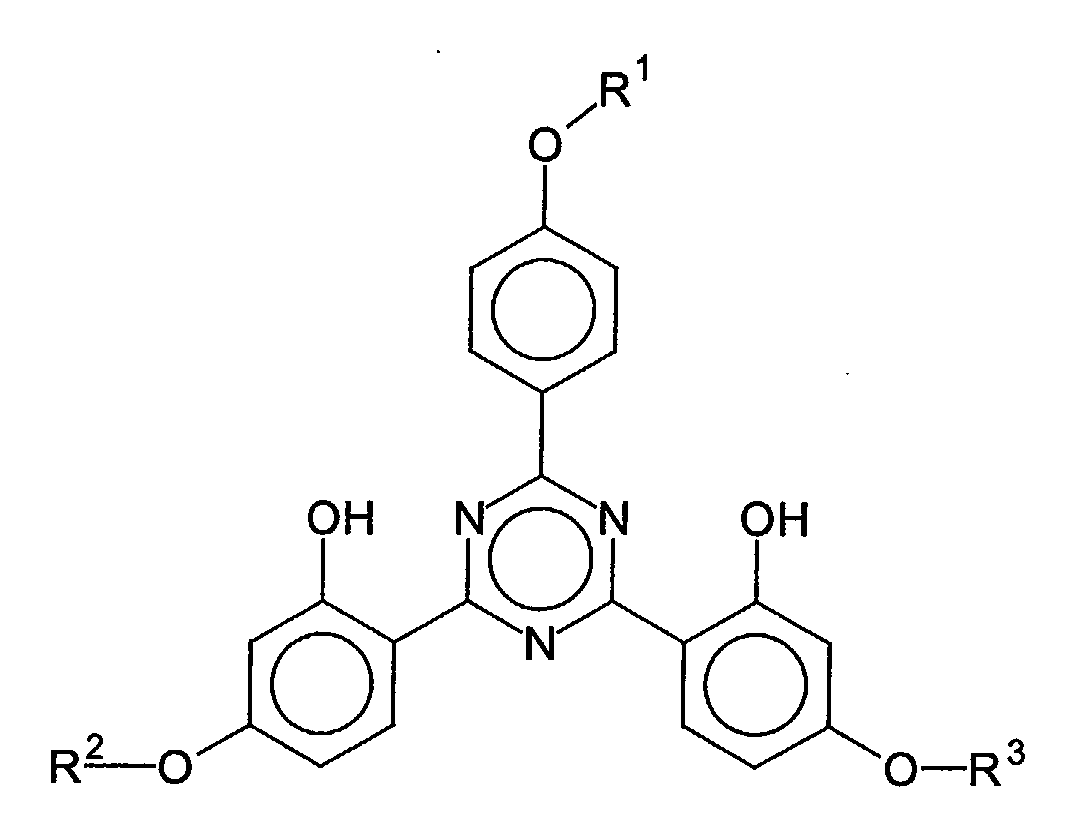
- Advantageous broadband filters or UV-B filter substances are, for example, bis-resorcinyltriazine derivatives with the following structure: where R 1 , R 2 and R 3 are independently selected from the group of branched and unbranched alkyl groups having 1 to 10 carbon atoms or represent a single hydrogen atom. Particularly preferred are 2,4-bis - ⁇ [4- (2-ethylhexyloxy) -2-hydroxy] phenyl ⁇ -6- (4-methoxyphenyl) -1,3,5-triazine (INCI: Aniso triazine), which is available under the trade name Tinosorb® S from CIBA-Chemicals GmbH.
- Particularly advantageous preparations in the sense of the present invention are: characterized by a high or very high UV-A protection, preferably contain several other UV-A and / or broadband filters, especially dibenzoylmethane derivatives [for example the 4- (tert-butyl) -4'-methoxydibenzoylmethane], benzotriazole derivatives [for example the 2,2'-methylene-bis- (6- (2H-benzotriazol-2-yl) -4- (1,1,3,3-tetramethylbutyl) phenol)], the 1,4-di (2-oxo-10-sulfo-3-bornylidenemethyl) benzene and / or its salts and / or the 2,4-bis - ⁇ [4- (2-ethylhexyloxy) -2-hydroxy] phenyl ⁇ -6- (4-methoxyphenyl) -1,3,5-triazine, individually or in any combination with each other.
- a particularly preferred UV filter substance in the sense of the present invention is also an asymmetrically substituted s-triazine, the chemical structure of which is represented by the formula is reproduced, which is also referred to below as dioctylbutylamidotriazon (INCI: dioctylbutamidotriazone) and is available under the trade name UVASORB HEB from Sigma 3V.
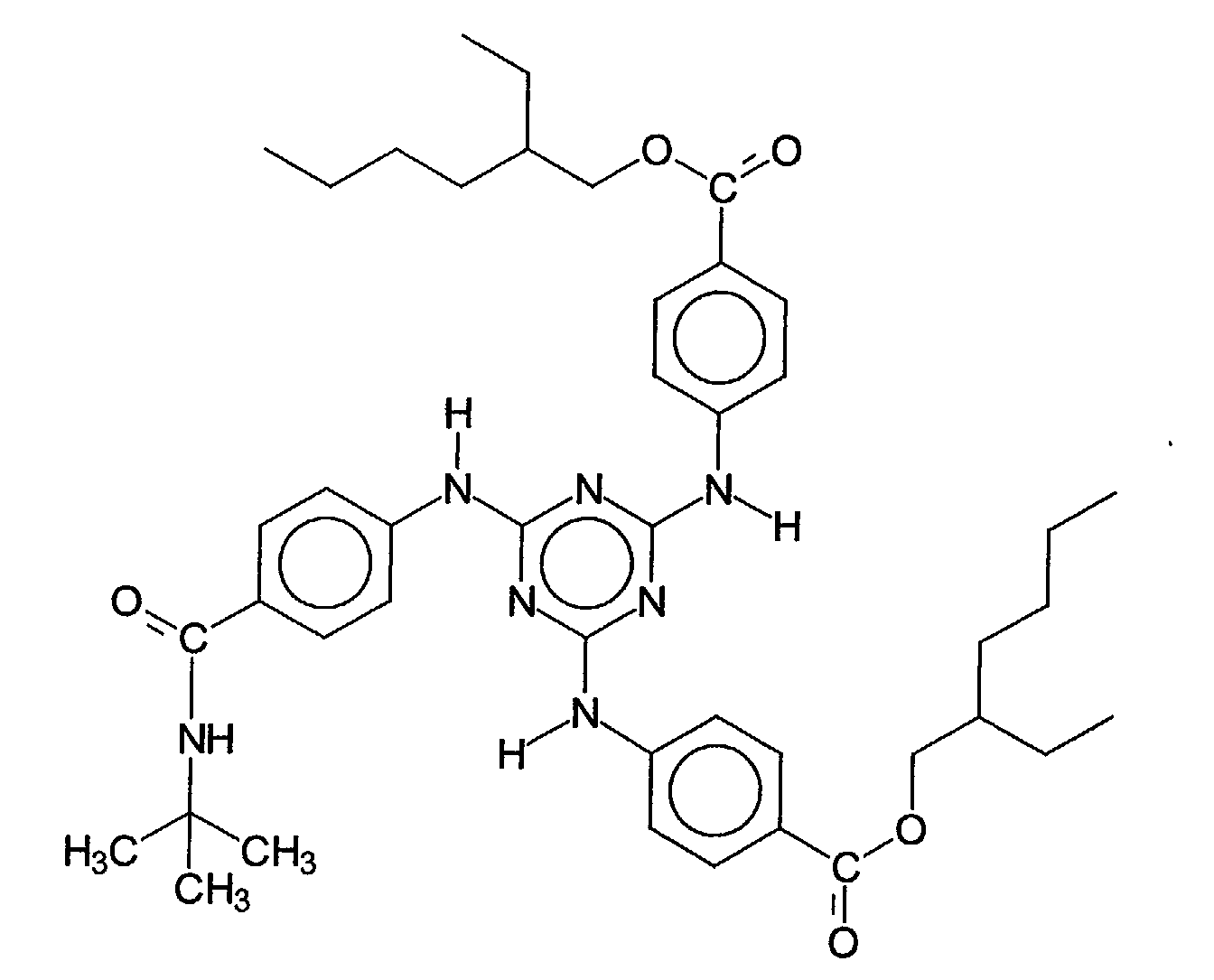
- a symmetrically substituted s-triazine is also advantageous in the sense of the present invention, 4,4 ', 4 "- (1,3,5-triazine-2,4,6-triyltriimino) tris-benzoic acid tris (2-ethylhexyl ester), synonym: 2,4,6-tris- [anilino- (p-carbo-2'-ethyl-1'-hexyloxy)] - 1,3,5-triazine (INCI: Octyl Triazone), which is sold by BASF Aktiengesellschaft under the trade name UVINUL® T 150 is sold.
- European laid-open specification 775 698 also describes bis-resorcinyltriazine derivatives which are preferably to be used and whose chemical structure is represented by the generic formula is reproduced, wherein R 1 , R 2 and A 1 represent a wide variety of organic radicals.
- Also advantageous for the purposes of the present invention are 2,4-bis - ⁇ [4- (3-sulfonato) -2-hydroxypropyloxy) -2-hydroxy] phenyl ⁇ -6- (4-methoxyphenyl) -1, 3,5-triazine Sodium salt, the 2,4-bis - ⁇ [4- (3- (2-propyloxy) -2-hydroxypropyloxy) -2-hydroxy] phenyl ⁇ -6- (4-methoxyphenyl) -1,3,5-triazine .
- An advantageous broadband filter in the sense of the present invention is 2,2'-methylenebis (6- (2H-benzotriazol-2-yl) -4- (1,1,3,3-tetramethylbutyl) phenol), which is characterized by the chemical structural formula and is available under the trade name Tinosorb® M from CIBA-Chemicals GmbH.
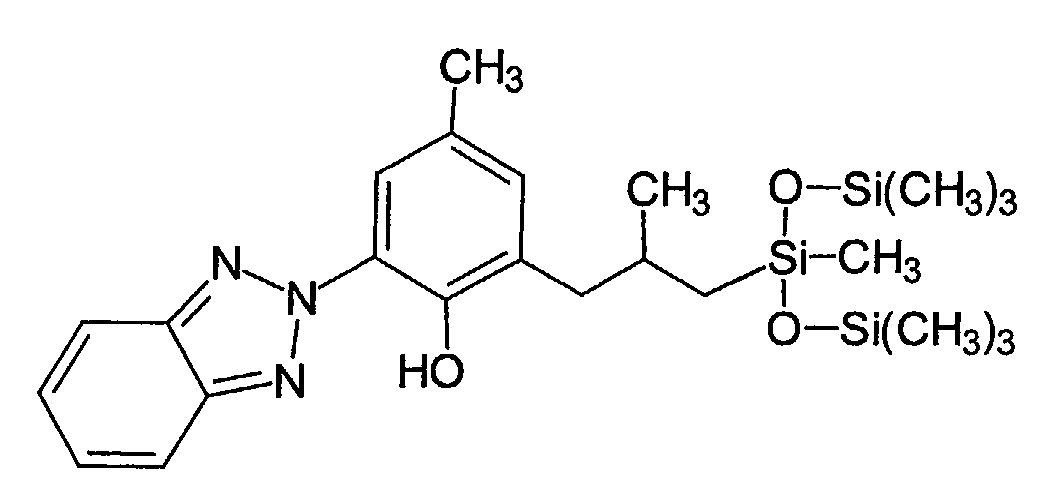
- Another advantageous broadband filter for the purposes of the present invention is 2- (2Hbenzotriazol-2-yl) -4-methyl-6- [2-methyl-3- [1,3,3,3-tetramethyl-1 - [(trimethylsilyl) oxy] disiloxanyl] propyl] phenol (CAS No .: 155633-54-8) with the INCI name Drometrizole Trisiloxane, which is characterized by the chemical structural formula is marked.
- a further light protection filter substance to be used advantageously according to the invention is ethylhexyl-2-cyano-3,3-diphenylacrylate (octocrylene), which is available from BASF under the name Uvinul® N 539 and is characterized by the following structure:
- UV filters mentioned used in the sense of the present invention of course, should not be limiting.
- the preparations according to the invention advantageously contain the substances, the UV radiation absorb in the UV-A and / or UV-B range, in a total amount of e.g. B. 0.1% by weight to 30% by weight, preferably 0.5 to 20% by weight, in particular 1.0 to 15.0% by weight, based in each case on the total weight of the preparations, for cosmetic
- a sunscreen serve for hair or skin.
- film formers in the inventive to incorporate cosmetic or dermatological preparations, for example in order to to improve the water resistance of the preparations or the UV protection performance further increase (UV-A and / or UV-B boosting).
- Both water-soluble or dispersible and fat-soluble film formers in each case individually or in combination with one another.
- B. Polyurethanes e.g. the Avalure® types from Goodrich
- Dimethicone Copolyol Polyacrylate Silsoft Surface® from the Witco Organo Silicones Group
- Advantageous fat-soluble film formers are e.g. B., the film formers from the group of polymers based on polyvinylpyrrolidone (PVP)
- Copolymers of polyvinylpyrrolidone for example PVP
- PVP are particularly preferred Hexadecen Copolymer and the PVP Eicosen Copolymer, which are under the trade names Antaron V216 and Antaron V220 available from GAF Chemicals Cooperation are, as well as the Tricontayl PVP and the like.
- W / O sunscreen emulsions 1 2 3 4 5 Cetyl dimethicone copolyol 2.50 4.00 Polyglyceryl-2 dipolyhydroxystearate 5.00 4.50 PEG-30 dipolyhydroxystearate 5.00 Ethylhexyl methoxycinnamate 8.00 5.00 4.00 Bis-ethylhexyloxyphenol methoxyphenyl triazine 2.00 2.50 1.50 2.00 1.00 Butyl methoxydibenzoylmethane 2.00 1.00 Phenyl dibenzimidazole tetrasulfonic acid 0.50 2.00 1.50 Ethylhexyl triazon 3.00 4.00 4-methylbenzylidene camphor 2.00 4.00 2.00 octocrylene 7.00 2.50 4.00 2.50 Diethyhexyl butamido triazon 1.00 2.00 Phenylbenzmidazole sulfonic acid 0.50 3.00 Methylene bis-benzotriazolyl tetra
Landscapes
- Health & Medical Sciences (AREA)
- Life Sciences & Earth Sciences (AREA)
- Animal Behavior & Ethology (AREA)
- General Health & Medical Sciences (AREA)
- Public Health (AREA)
- Veterinary Medicine (AREA)
- Birds (AREA)
- Epidemiology (AREA)
- Dermatology (AREA)
- Cosmetics (AREA)
Abstract
wobei die UV-Schutzleistung dieser Zubereitungen höher ist als die gleicher Zubereitungen, welche keine Stoffkombination aus (a) und (b) enthalten.
Description
- Rückfettungs- und Feuchthaltemittel,
- entzündungslindernde und kühlende Stoffe,
- lokal anaestesierende Stoffe und/oder
- desinfizierende Stoffe, um mögliche Hautinfektionen zu verhindern.
Verwendung von Kombinationen aus
den Nachteilen des Standes der Technik abhelfen.
lichtschutzwirksame kosmetische oder dermatologische Zubereitungen, welche neben mindestens einer üblichen UV-Filtersubstanz und/oder einer Breitbandfiltersubstanz ferner Stoffkombinationen von
Verwendung von Stoffkombinationen aus
- Talkum: Mg3 [Si4O10] (OH)2,
- Kaolin: Al2[Si2O5] (OH)4
- Montmorillonit: M+ Al [Si2O5](OH), auch Smektite genannt. Darunter fallen:
- Bentonite = Montmorillonite mit Ca (Fuller Erden) oder Na (Wyoming Bentonite)
- Hektorite: M+ 0,3(Mg2,7Li0,3)[Si4O10(OH)2], worin M+ meist Na+ darstellt,
- Glimmer (Mica), ein Alumosilikat, das leicht spaltbar ist und in tafeligen Kristallen vorliegt. Glimmer ist transparent bis durchscheinend und weist Perlglanz auf. Die wichtigste Form ist Muskovit: K Al2 [AlSi3O10] (OH, F)2. Sericite ist eine Sonderform des Glimmers, die kleinere Plättchen als Muskovit aufweist.
- Magnesiumsilikat Mg2 [Si4O10]
| Handelsname | erhältlich bei: |
| Boron Nitride Powder | Advanced Ceramics |
| Boron Nitride Powder | Sintec Keramik |
| Ceram Blanche | Kawasaki |
| HCST Boron Nitride | Stark |
| Très BN® | Carborundum |
| Wacker-Bornitrid BNP | Wacker-Chemie |
- Maisstärke Zea Mays (Amidon De Mais MST (Wackherr), Argo Brand Corn Starch (Corn Products), Pure-Dent (Grain Processing), Purity 21 C (National Starch)),
- Reisstärke (D.S.A. 7 (Agrana Stärke), Oryzapearl (Ichimaru Pharcos)),
- Distarch Phosphate (Corn PO4 (Agrana Stärke), Corn PO4 (Tri-K)),
- Sodium Corn Starch Octenylsuccinate (C* EmCap - Instant 12639 (Cerestar USA)),
- Aluminium Starch Octenylsuccinate (Covafluid AMD (Wackherr), Dry Flo-PC (National Starch), Dry Flo Pure (National Starch), Fluidamid DF 12 (Roquette)),
- PMMA: Polymethylmethacrylate
- Polyethylene Spheres
- Polyurethane
- Silikon Resins: Trimethylsiloxysilicate (z. B. SR 1000 GE Bayer Silicones)

| OH-Substitutionspositionen | ||||||||
| 3 | 5 | 7 | 8 | 2' | 3' | 4' | 5' | |
| Flavon | - | - | - | - | - | - | - | - |
| Flavonol | + | - | - | - | - | - | - | - |
| Chrysin | - | + | + | - | - | - | - | - |
| Galangin | + | + | + | - | - | - | - | - |
| Apigenin | - | + | + | - | - | - | + | - |
| Fisetin | + | - | + | - | - | + | + | - |
| Luteolin | - | + | + | - | - | + | + | - |
| Kämpferol | + | + | + | - | - | - | + | - |
| Quercetin | + | + | + | - | - | + | + | - |
| Morin | + | + | + | - | + | - | + | - |
| Robinetin | + | - | + | - | - | + | + | + |
| Gossypetin | + | + | + | + | - | + | + | - |
| Myricetin | + | + | + | - | - | + | + | + |







| Chemische oder sonstige Bezeichnung | CIN | Farbe |
| Pigment Green | 10006 | grün |
| Acid Green 1 | 10020 | grün |
| 2,4-Dinitrohydroxynaphthalin-7-sulfosäure | 10316 | gelb |
| Pigment Yellow 1 | 11680 | gelb |
| Pigment Yellow 3 | 11710 | gelb |
| Pigment Orange 1 | 11725 | orange |
| 2,4-Dihydroxyazobenzol | 11920 | orange |
| Solvent Red 3 | 12010 | rot |
| 1-(2'-Chlor-4'-nitro-1'-phenylazo)-2-hydroxynaphthalin | 12085 | rot |
| Pigment Red 3 | 12120 | rot |
| Ceresrot; Sudanrot; Fettrot G | 12150 | rot |
| Pigment Red 112 | 12370 | rot |
| Pigment Red 7 | 12420 | rot |
| Pigment Brown 1 | 12480 | braun |
| 4-(2'-Methoxy-5'-sulfosäurediethylamid-1'-phenylazo)-3-hydroxy-5"-chloro-2",4"-dimethoxy-2-naphthoesäureanilid | 12490 | rot |
| Disperse Yellow 16 | 12700 | gelb |
| 1-(4-Sulfo-1-phenylazo)-4-amino-benzol-5-sulfosäure | 13015 | gelb |
| 2,4-Dihydroxy-azobenzol-4'-sulfosäure | 14270 | orange |
| 2-(2,4-Dimethylphenylazo-5-sulfosäure)-1-hydroxynaphthalin-4-sulfosäure | 14700 | rot |
| 2-(4-Sulfo-1-naphthylazo)-1-naphthol-4-sulfosäure | 14720 | rot |
| 2-(6-Sulfo-2,4-xylylazo)-1-naphthol-5-sulfosäure | 14815 | rot |
| 1-(4'-Sulfophenylazo)-2-hydroxynaphthalin | 15510 | orange |
| 1 -(2-Sulfosäure-4-chlor-5-carbonsäure-1 -phenylazo)-2-hydroxynaphthalin | 15525 | rot |
| 1-(3-Methyl-phenylazo-4-sulfosäure)-2-hydroxynaphthalin | 15580 | rot |
| 1-(4',(8')-Sulfosäurenaphthylazo)-2-hydroxynaphthalin | 15620 | rot |
| 2-Hydroxy-1,2'-azonaphthalin-1'-sulfosäure | 15630 | rot |
| 3-Hydroxy-4-phenylazo-2-naphthylcarbonsäure | 15800 | rot |
| 1 -(2-Sulfo-4-methyl-1 -phenylazo)-2-naphthylcarbonsäure | 15850 | rot |
| 1-(2-Sulfo-4-methyl-5-chlor-1-phenylazo)-2-hydroxy-naphthalin-3-carbonsäure | 15865 | rot |
| 1-(2-Sulfo-1-naphthylazo)-2-hydroxynaphthalin-3-carbonsäure | 15880 | rot |
| 1-(3-Sulfo-1-phenylazo)-2-naphthol-6-sulfosäure | 15980 | orange |
| 1-(4-Sulfo-1 -phenylazo)-2-naphthol-6-sulfosäure | 15985 | gelb |
| Allura Red | 16035 | rot |
| 1-(4-Sulfo-1-naphthylazo)-2-naphthol-3,6-disulfosäure | 16185 | rot |
| Acid Orange 10 | 16230 | orange |
| 1-(4-Sulfo-1-naphthylazo)-2-naphthol-6,8-disulfosäure | 16255 | rot |
| 1 -(4-Sulfo-1 -naphthylazo)-2-naphthol-3,6,8-trisulfosäure | 16290 | rot |
| 8-Amino-2 -phenylazo- 1 -naphthol-3,6-disulfosäure | 17200 | rot |
| Acid Red 1 | 18050 | rot |
| Acid Red 155 | 18130 | rot |
| Acid Yellow 121 | 18690 | gelb |
| Acid Red 180 | 18736 | rot |
| Acid Yellow 11 | 18820 | gelb |
| Acid Yellow 17 | 18965 | gelb |
| 4-(4-Sulfo-1-phenylazo)-1-(4-sulfophenyl)-5-hydroxy-pyrazolon-3-carbonsäure | 19140 | gelb |
| Pigment Yellow 16 | 20040 | gelb |
| 2,6-(4'-Sulfo-2", 4"-dimethyl)-bis-phenylazo)1,3-dihydroxybenzol | 20170 | orange |
| Acid Black 1 | 20470 | schwarz |
| Pigment Yellow 13 | 21100 | gelb |
| Pigment Yellow 83 | 21108 | gelb |
| Solvent Yellow | 21230 | gelb |
| Acid Red 163 | 24790 | rot |
| Acid Red 73 | 27290 | rot |
| 2-[4'-(4"-Sulfo-1"-phenylazo)-7'-sulfo-1'-naphthylazo]-1-hydroxy-7-aminonaphthalin-3,6-disulfosäure | 27755 | schwarz |
| 4'-[(4"-Sulfo-1"-phenylazo)-7'-sulfo-1'-naphthylazo]-1-hydroxy-8-acetyl-aminonaphthalin-3,5-disulfosäure | 28440 | schwarz |
| Direct Orange 34, 39, 44, 46, 60 | 40215 | orange |
| Food Yellow | 40800 | orange |
| trans-β-Apo-8'-Carotinaldehyd (C30) | 40820 | orange |
| trans-Apo-8'-Carotinsäure (C30)-ethylester | 40825 | orange |
| Canthaxanthin | 40850 | orange |
| Acid Blue 1 | 42045 | blau |
| 2,4-Disulfo-5-hydroxy-4'-4"-bis-(diethylamino)triphenyl-carbinol | 42051 | blau |
| 4-[(-4-N-Ethyl-p-sulfobenzylamino)-phenyl-(4-hydroxy-2-sulfophenyl)-(methylen)-1-(N-ethylN-p-sulfobenzyl)-2,5-cyclohexadienimin] | 42053 | grün |
| Acid Blue 7 | 42080 | blau |
| (N-Ethyl-p-sulfobenzyl-amino)-phenyl-(2-sulfophenyl)-methylen-(N-ethyl-N-p-sulfo-benzyl)Δ2,5-cyclohexadienimin | 42090 | blau |
| Acid Green 9 | 42100 | grün |
| Diethyl-di-sulfobenzyl-di-4-amino-2-chlor-di-2-methyl-fuchsonimmonium | 42170 | grün |
| Basic Violet 14 | 42510 | violett |
| Basic Violet 2 | 42520 | violett |
| 2'-Methyl-4'-(N-ethyl-N-m-sulfobenzyl)-amino-4"-(N-diethyl)-amino-2-methyl-N-ethylN-m-sulfobenzyl-fuchsonimmonium | 42735 | blau |
| 4'-(N-Dimethyl)-amino-4"-(N-phenyl)-aminonaphtho-N-dimethylfuchsonimmonium | 44045 | blau |
| 2-Hydroxy-3,6-disulfo-4,4'-bis-dimethylaminonaphthofuchsonimmonium | 44090 | grün |
| Acid Red 52 | 45100 | rot |
| 3-(2'-Methylphenylamino)-6-(2'-methyl-4'-sulfophenylamino)-9-(2"-carboxyphenyl)-xantheniumsalz | 45190 | violett |
| Acid Red 50 | 45220 | rot |
| Phenyl-2-oxyfluoron-2-carbonsäure | 45350 | gelb |
| 4,5-Dibromfluorescein | 45370 | orange |
| 2,4,5,7-Tetrabromfluorescein | 45380 | rot |
| Solvent Dye | 45396 | orange |
| Acid Red 98 | 45405 | rot |
| 3',4',5',6'-Tetrachlor-2,4,5,7-tetrabromfluorescein | 45410 | rot |
| 4,5-Diiodfluorescein | 45425 | rot |
| 2,4,5,7-Tetraiodfluorescein | 45430 | rot |
| Chinophthalon | 47000 | gelb |
| Chinophthalon-disulfosäure | 47005 | gelb |
| Acid Violet 50 | 50325 | violett |
| Acid Black 2 | 50420 | schwarz |
| Pigment Violet 23 | 51319 | violett |
| 1,2-Dioxyanthrachinon, Calcium-Aluminiumkomplex | 58000 | rot |
| 3-Oxypyren-5,8,10-sulfosäure | 59040 | grün |
| 1-Hydroxy-4-N-phenyl-aminoanthrachinon | 60724 | violett |
| 1-Hydroxy-4-(4'-methylphenylamino)-anthrachinon | 60725 | violett |
| Acid Violet 23 | 60730 | violett |
| 1,4-Di(4'-methyl-phenylamino)-anthrachinon | 61565 | grün |
| 1,4-Bis-(o-sulfo-p-toluidino)-anthrachinon | 61570 | grün |
| Acid Blue 80 | 61585 | blau |
| Acid Blue 62 | 62045 | blau |
| N,N'-Dihydro-1,2,1',2'-anthrachinonazin | 69800 | blau |
| Vat Blue 6; Pigment Blue 64 | 69825 | blau |
| Vat Orange 7 | 71105 | orange |
| Indigo | 73000 | blau |
| Indigo-disulfosäure | 73015 | blau |
| 4,4'-Dimethyl-6,6'-dichlorthioindigo | 73360 | rot |
| 5,5'-Dichlor-7,7'-dimethylthioindigo | 73385 | violett |
| Quinacridone Violet 19 | 73900 | violett |
| Pigment Red 122 | 73915 | rot |
| Pigment Blue 16 | 74100 | blau |
| Phthalocyanine | 74160 | blau |
| Direct Blue 86 | 74180 | blau |
| Chlorierte Phthalocyanine | 74260 | grün |
| Natural Yellow 6,19; Natural Red 1 | 75100 | gelb |
| Bixin, Nor-Bixin | 75120 | orange |
| Lycopin | 75125 | gelb |
| trans-alpha-, beta- bzw. gamma-Carotin | 75130 | orange |
| Keto- und/oder Hydroxylderivate des Carotins | 75135 | gelb |
| Guanin oder Perlglanzmittel | 75170 | weiß |
| 1,7-Bis-(4-hydroxy-3-methoxyphenyl)1,6-heptadien-3,5-dion | 75300 | gelb |
| Komplexsalz (Na, Al, Ca) der Karminsäure | 75470 | rot |
| Chlorophyll a und b; Kupferverbindungen der Chlorophylle und Chlorophylline | 75810 | grün |
| Aluminium | 77000 | weiß |
| Tonerdehydrat | 77002 | weiß |
| Wasserhaltige Aluminiumsilikate | 77004 | weiß |
| Ultramarin | 77007 | blau |
| Pigment Red 101 und 102 | 77015 | rot |
| Bariumsulfat | 77120 | weiß |
| Bismutoxychlorid und seine Gemische mit Glimmer | 77163 | weiß |
| Calciumcarbonat | 77220 | weiß |
| Calciumsulfat | 77231 | weiß |
| Kohlenstoff | 77266 | schwarz |
| Pigment Black 9 | 77267 | schwarz |
| Carbo medicinalis vegetabilis | 77268:1 | schwarz |
| Chromoxid | 77288 | grün |
| Chromoxid, wasserhaltig | 77289 | grün |
| Pigment Blue 28, Pigment Green 14 | 77346 | grün |
| Pigment Metal 2 | 77400 | braun |
| Gold | 77480 | braun |
| Eisenoxide und -hydoxide | 77489 | orange |
| Eisenoxid | 77491 | rot |
| Eisenoxidhydrat | 77492 | gelb |
| Eisenoxid | 77499 | schwarz |
| Mischungen aus Eisen(II)- und Eisen(III)-hexacyanoferrat | 77510 | blau |
| Pigment White 18 | 77713 | weiß |
| Mangananimoniumdiphosphat | 77742 | violett |
| Manganphosphat; Mn3(PO4)2 · 7 H20 | 77745 | rot |
| Silber | 77820 | weiß |
| Titandioxid und seine Gemische mit Glimmer | 77891 | weiß |
| Zinkoxid | 77947 | weiß |
| 6,7-Dimethyl-9-(1'-D-ribityl)-isoalloxazin, Lactoflavin | gelb | |
| Zuckerkulör | braun | |
| Capsanthin, Capsorubin | orange | |
| Betanin | rot | |
| Benzopyryliumsalze, Anthocyane | rot | |
| Aluminium-, Zink-, Magnesium- und Calciumstearat | weiß | |
| Bromthymolblau | blau | |
| Bromkresolgrün | grün | |
| Acid Red 195 | rot |
- "Fischsilber" (Guanin/Hypoxanthin-Mischkristalle aus Fischschuppen) und
- "Perlmutt" (vermahlene Muschelschalen)
| Gruppe | Belegung / Schichtdicke | Farbe |
| Silberweiße Perlglanzpigmente | TiO2: 40 - 60 nm | silber |
| Interferenzpigmente | TiO2: 60 - 80 nm | gelb |
| TiO2: 80 - 100 nm | rot | |
| TiO2: 100 - 140 nm | blau | |
| TiO2: 120 - 160 nm | grün | |
| Farbglanzpigmente | Fe2O3 | bronze |
| Fe2O3 | kupfer | |
| Fe2O3 | rot | |
| Fe2O3 | rotviolett | |
| Fe2O3 | rotgrün | |
| Fe2O3 | schwarz | |
| Kombinationspigmente | TiO2 / Fe2O3 | Goldtöne |
| TiO2 / Cr2O3 | grün | |
| TiO2 / Berliner Blau | tiefblau | |
| TiO2 / Carmin | rot |
| Handelsname | Coating | Hersteller |
| Z- Cote HP1 | 2% Dimethicone | BASF |
| Z- Cote | / | BASF |
| ZnO NDM | 5% Dimethicone | H&R |
| ZnO Neutral | / | H&R |
| MZ- 300 | / | Tayca Corporation |
| MZ- 500 | / | Tayca Corporation |
| MZ- 700 | / | Tayca Corporation |
| MZ- 303S | 3% Methicone | Tayca Corporation |
| MZ- 505S | 5% Methicone | Tayca Corporation |
| MZ- 707S | 7% Methicone | Tayca Corporation |
| MZ- 303M | 3% Dimethicone | Tayca Corporation |
| MZ- 505M | 5% Dimethicone | Tayca Corporation |
| MZ- 707M | 7% Dimethicone | Tayca Corporation |
| Z- Sperse Ultra | ZnO (>=56%)/ Ethylhexyl Hydroxystearate Benzoate/ Dimethicone/ Cyclomethicone | Collaborative Laboratories |
| Samt- UFZO- 450/D5 (60%) | ZnO (60%)/ Cyclomethicone/ Dimethicone | Miyoshi Kasei |
| Handelsname | Coating | zusätzliche Bestandteile der Vordispersion | Hersteller |
| MT-150W | None | - | Tayca Corporation |
| MT-150A | None | - | Tayca Corporation |
| MT-500B | None | - | Tayca Corporation |
| MT-600B | None | - | Tayca Corporation |
| MT-100TV | Aluminiumhydroxid Stearinsäure | - | Tayca Corporation |
| MT-100Z | Aluminiumhydroxid Stearinsäure | - | Tayca Corporation |
| MT-100T | Aluminiumhydroxid Stearinsäure | - | Tayca Corporation |
| MT-500T | Aluminiumhydroxid Stearinsäure | - | Tayca Corporation |
| MT-100S | Aluminiumhydroxid Laurinsäure | - | Tayca Corporation |
| MT-100F | Stearinsäure Eisenoxid | - | Tayca Corporation |
| MT-100SA | Alumina Silica | - | Tayca Corporation |
| MT-500SA | Alumina Silica | - | Tayca Corporation |
| MT-600SA | Alumina Silica | - | Tayca Corporation |
| MT-100SAS | Alumina Silica Silikon | - | Tayca Corporation |
| MT-500SAS | Alumina Silica Silikon | - | Tayca Corporation |
| MT-500H | Alumina | - | Tayca Corporation |
| MT-100AQ | Silica Aluminiumhydroxid Alginsäure | - | Tayca Corporation |
| Eusolex T | Wasser Simethicone | - | Merck KgaA |
| Eusolex T-2000 | Alumina Simethicone | - | Merck KgaA |
| Eusolex T-Olio F | Silica Dimethylsilate Wasser | C12-15 Alkylbenzoate Calcium Polyhydroxystearate Silica Dimethylsilate | Merck KgaA |
| Eusolex T-Olio P | Wasser Simethicone | Octyl Palmitate PEG-7 Hydrogenated Castor Oil Sorbitan Oleate Hydrogenated Castor Oil Beeswax Stearinsäure | Merck KgaA |
| Eusolex T-Aqua | Wasser Alumina Natriummetaphosphat | Phenoxyethanol Natrium Methylparabene Natriummetaphosphat | Merck KgaA |
| Eusolex T-45D | Alumina Simethicone | Isononyl Isononanuate Polyglyceryl Ricinoleate | Merck KgaA |
| Kronos 1171 (Titandioxid 171) | None | - | Kronos |
| Titandioxid P25 | None | - | Degussa |
| Titandioxid T805 (Uvinul TiO2) | Octyltrimethylsilan | - | Degussa |
| UV-Titan X610 | Alumina Dimethicone | - | Kemira |
| UV-Titan X170 | Alumina Dimethicone | - | Kemira |
| UV-Titan X161 | Alumina Silica Stearinsäure | - | Kemira |
| UV-Titan M210 | Alumina | - | Kemira |
| UV-Titan M212 | Alumina | Glycerol | Kemira |
| UV-Titan M262 | Alumina Silikon | - | Kemira |
| UV-Titan M160 | Alumina Silica Stearinsäure | - | Kemira |
| Tioveil AQ 10PG | Alumina Silica | Wasser Propylenglycol | Solaveil Uniquema |
| Mirasun TiW 60 | Alumina Silica | Wasser | Rhone-Poulenc |



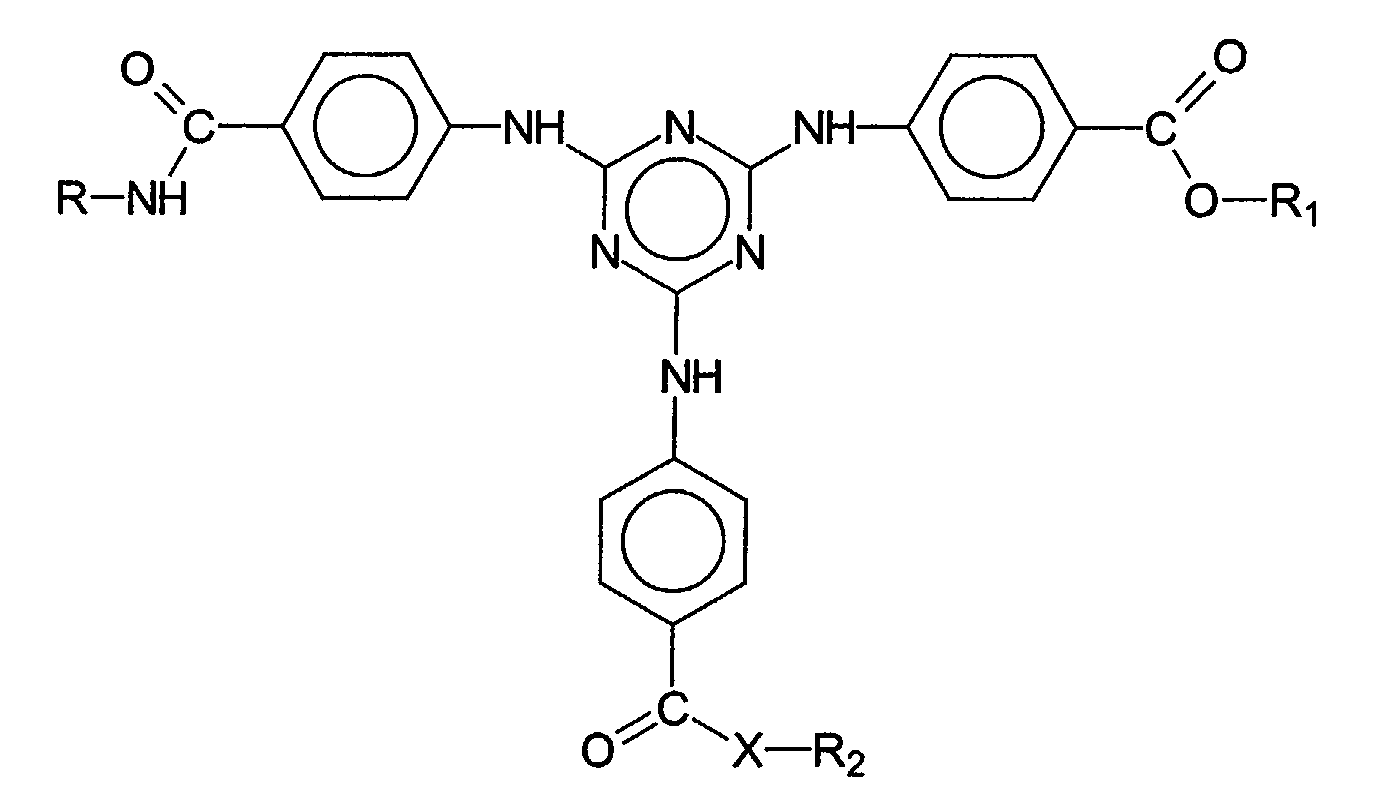
- R
- einen verzweigten oder unverzweigten C1-C18-Alkylrest, einen C5-C12-Cycloalkylrest, gegebenenfalls substituiert mit einer oder mehreren C1-C4- Alkylgruppen, darstellt,
- X
- ein Sauerstoffatom oder eine NH-Gruppe darstellt,
- R1
- einen verzweigten oder unverzweigten C1-C18-Alkylrest, einen C5-C12-Cycloalkylrest,
gegebenenfalls substituiert mit einer oder mehreren C1-C4- Alkylgruppen, oder
ein Wasserstoffatom, ein Alkalimetallatom, eine Ammoniumgruppe oder eine
Gruppe der Formel
bedeutet, in welcher
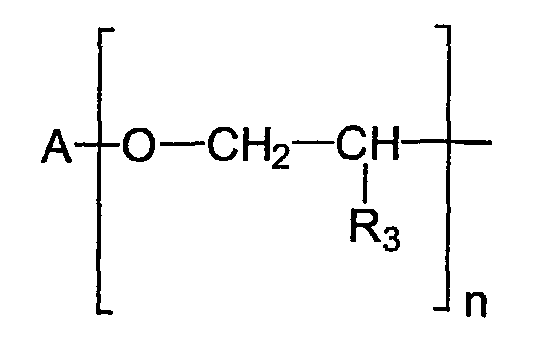
- A
- einen verzweigten oder unverzweigten C1-C18-Alkylrest, einen C5-C12-Cycloalkyl- oder Arylrest darstellt, gegebenenfalls substituiert mit einer oder mehreren C1-C4- Alkylgruppen,
- R3
- ein Wasserstoffatom oder eine Methylgruppe darstellt,
- n
- eine Zahl von 1 bis 10 darstellt,
- R2
- einen verzweigten oder unverzweigten C1-C18-Alkylrest, einen C5-C12-Cycloalkylrest,
gegebenenfalls substituiert mit einer oder mehreren C1-C4- Alkylgruppen, darstellt,
wenn X die NH-Gruppe darstellt, und
einen verzweigten oder unverzweigten C1-C18-Alkylrest, einen C5-C12-Cycloalkylrest, gegebenenfalls substituiert mit einer oder mehreren C1-C4- Alkylgruppen, oder ein Wasserstoffatom, ein Alkalimetallatom, eine Ammoniumgruppe oder eine Gruppe der Formelbedeutet, in welcher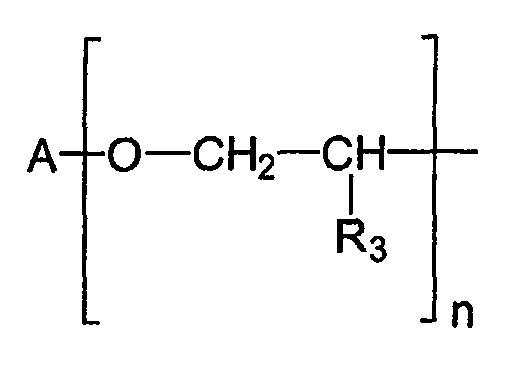
- A
- einen verzweigten oder unverzweigten C1-C18-Alkylrest, einen C5-C12-Cycloalkyl- oder Arylrest darstellt, gegebenenfalls substituiert mit einer oder mehreren C1-C4- Alkylgruppen,
- R3
- ein Wasserstoffatom oder eine Methylgruppe darstellt,
- n
- eine Zahl von 1 bis 10 darstellt,

- 3-Benzylidencampher-Derivate, vorzugsweise 3-(4-Methylbenzyliden)campher, 3-Benzylidencampher;
- 4-Aminobenzoesäure-Derivate, vorzugsweise 4-(Dimethylamino)-benzoesäure(2-ethylhexyl)ester, 4-(Dimethylamino)benzoesäureamylester;
- 2,4,6-Trianilino-(p-carbo-2'-ethyl-1'-hexyloxy)-1,3,5-triazin;
- Ester der Benzalmalonsäure, vorzugsweise 4-Methoxybenzalmalonsäuredi(2-ethylhexyl)ester;
- Ester der Zimtsäure, vorzugsweise 4-Methoxyzimtsäure(2-ethylhexyl)ester, 4-Methoxyzimtsäureisopentylester;
- Derivate des Benzophenons, vorzugsweise 2-Hydroxy-4-methoxybenzophenon, 2-Hydroxy-4-methoxy-4'-methylbenzophenon, 2,2'-Dihydroxy-4-methoxybenzophenon
- sowie an Polymere gebundene UV-Filter.
- Salze der 2-Phenylbenzimidazol-5-sulfonsäure, wie ihr Natrium-, Kalium- oder ihr Triethanolammonium-Salz, sowie die Sulfonsäure selbst;
- Sulfonsäure-Derivate des 3-Benzylidencamphers, wie z. B. 4-(2-Oxo-3-bornylidenmethyl)benzolsulfonsäure, 2-Methyl-5-(2-oxo-3-bornylidenmethyl)sulfonsäure und deren Salze.

| 1. O/W Sonnenschutz Emulsionen | |||||||
| 1 | 2 | 3 | 4 | 5 | 6 | 7 | |
| Glycerinmonostearat SE | 0,50 | 1,00 | 3,00 | 1,50 | |||
| Glyceryl Stearat Citrat | 2,00 | 1,00 | 2,00 | 2,50 | |||
| Stearinsäure | 3,00 | 2,00 | |||||
| PEG-40 Stearat | 0,50 | 2,00 | |||||
| Cetyl Phosphat | 1,00 | ||||||
| Stearyl Alkohol | 3,00 | 2,00 | 0,50 | ||||
| Cetyl Alkohol | 2,50 | 1,00 | 1,50 | 0,50 | 2,00 | ||
| Ethylhexyl Methoxycinnamat | 5,00 | 6,00 | 8,00 | ||||
| Bis-Ethylhexyloxyphenol methoxyphenyl Triazin | 0,50 | 1,00 | 2,00 | 3,00 | |||
| Butyl Methoxydibenzoylmethan | 1,00 | 2,00 | 2,00 | ||||
| Phenyl Dibenzimidazol Tetrasulfonsäure | 0,50 | 2,00 | 1,00 | ||||
| Ethylhexyl Triazon | 4,00 | 3,00 | 4,00 | 4,00 | 2,00 | ||
| 4-Methylbenzyliden Camphor | 4,00 | 4,00 | 2,00 | 4,00 | 2,00 | ||
| Octocrylen | 4,00 | 2,50 | |||||
| Diethylhexyl Butamido Triazon | 1,00 | 2,00 | 1,00 | ||||
| Phenylbenzmidazol Sulfonsäure | 0,50 | 3,00 | |||||
| Methylen Bis-Benzotriazolyl Tetramethylbuthylphenol | 1,00 | 0,50 | 0,80 | ||||
| Drometrizol Trisiloxan | 0,5 | 1,00 | |||||
| Terephthaliden Dicamphor Sulfonsäure | 1,50 | 1,00 | 0,50 | ||||
| Titandioxid | 1,00 | 1,50 | 3,00 | 2,00 | 2,00 | ||
| Zinkoxid | 1,50 | 1,00 | 2,00 | 3,00 | |||
| C12-15 Alkyl Benzoat | 2,50 | 4,00 | 7,00 | 5,00 | |||
| Dicaprylyl Ether | 3,50 | 2,00 | |||||
| Butylenglycol | 5,00 | 6,00 | |||||
| Dicaprylat/Dicaprat | |||||||
| Bornitrid CC 6097 | 0.5 | 1,5 | |||||
| Aerosil R972 | 0,5 | 2,5 | |||||
| Zea Mais | 0.1 | 0,3 | |||||
| Talk | 1,5 | ||||||
| Natrium Kornstärke Octenylsuccinat | 0,4 | ||||||
| Dicaprylyl Carbonat | 6,00 | 2,00 | 2,00 | ||||
| Dimethicon | 0,50 | 1,00 | 2,00 | ||||
| Cyclomethicon | 2,00 | 0,50 | 0,50 | ||||
| Shea Butter | 2,00 | 0,50 | |||||
| PVP Hexadecen Copolymer | 0,50 | 0,50 | 1,00 | 1,00 | |||
| Tricontanyl PVP | 0,50 | 1,00 | 1,00 | ||||
| Glycerin | 3,00 | 7,50 | 7,50 | 5,00 | 2,50 | ||
| Xanthan Gummi | 0,15 | 0,05 | 0,30 | ||||
| Sodium Carbomer | 0,20 | 0,10 | 0,20 | ||||
| Vitamin E Acetat | 0,50 | 0,25 | 0,75 | 1,00 | |||
| Polyurethan | 0,50 | 0,50 | 1,00 | ||||
| Styrene/Acrylat Copolymer | 1.00 | 1,00 | 0.50 | 2.00 | 1.50 | 1.00 | 3.00 |
| DMDM Hydantoin | 0,60 | 0,40 | 0,20 | ||||
| Konkaben LMB ® | 0,18 | 0,20 | 0,10 | 0,15 | |||
| Methylparaben | 0,15 | 0,25 | 0,50 | ||||
| Phenoxyethanol | 1,00 | 0,40 | 0,40 | 0,50 | 0,40 | 0,60 | |
| Ethanol | 2,00 | 1,50 | 3,00 | 1,00 | |||
| Parfüm | 0,20 | 0,20 | 0,20 | 0,20 | 0,20 | 0,20 | 0,20 |
| Wasser | Ad 100 | ad 100 | ad 100 | ad 100 | ad 100 | ad 100 | ad 100 |
| 2. Hydrodispersionen | |||||
| 1 | 2 | 3 | 4 | 5 | |
| Ceteareth-20 | 1,00 | 0,5 | |||
| Cetyl Alkohol | 1,00 | ||||
| Sodium Carbomer | 0,20 | 0,30 | |||
| Acrylates/C10-30 Alkyl Acrylat Crosspolymer | 0,50 | 0,40 | 0,10 | 0,10 | |
| Xanthan Gummi | 0,30 | 0,15 | 0,50 | ||
| Ethylhexyl Methoxycinnamat | 5,00 | 8,00 | |||
| Bis-Ethylhexyloxyphenol methoxyphenyl Triazin | 0,50 | 1,50 | 3,00 | 2,00 | 2,50 |
| Butyl Methoxydibenzoylmethan | 1,00 | 2,00 | |||
| Phenyl Dibenzimidazol Tetrasulfonsäure | 0,50 | 2,00 | 1,00 | ||
| Ethylhexyl Triazon | 4,00 | 3,00 | 4,00 | ||
| 4-Methylbenzyliden Camphor | 4,00 | 4,00 | 2,00 | ||
| Octocrylen | 4,00 | 4,00 | 2,50 | ||
| Diethyhexyl Butamido Triazon | 1,00 | 2,00 | |||
| Phenylbenzmidazol Sulfonsäure | 0,50 | 3,00 | |||
| Methylen Bis-Benzotriazolyl Tetramethylbuthylphenol | 0,50 | 1,00 | 0,80 | ||
| Drometrizol Trisiloxan | 1,00 | 1,50 | |||
| Terephthaliden Dicamphor Sulfonsäure | 0,50 | 1,00 | |||
| Titandioxid | 0,50 | 2,00 | 1,00 | ||
| Zinkoxid | 1,00 | 2,00 | 3,00 | ||
| Maisstärke | 0.8 | ||||
| Aerosil R972 | 1.5 | ||||
| Talk | 0.7 | ||||
| Silica | 0.5 | 2.5 | |||
| C12-15 Alkyl Benzoat | 2,00 | 2,50 | |||
| Dicaprylyl Ether | 4,00 | ||||
| Butylenglycol Dicaprylat/Dicaprat | 4,00 | 2,00 | 6,00 | ||
| Dicaprylyl Carbonat | 2,00 | 6,00 | |||
| Dimethicon | 0,50 | 1,00 | |||
| Phenyltrimethicon | 2,00 | 0,50 | 2,00 | ||
| Shea Butter | 2,00 | ||||
| PVP Hexadecen Copolymer | 0,50 | 0,50 | 1,00 | ||
| Tricontanyl PVP | 0,50 | 1,00 | |||
| Ethylhexylglycerin | 1,00 | 0,50 | |||
| Glycerin | 3,00 | 7,50 | 7,50 | 2,50 | |
| Glycin Soja | 1,50 | ||||
| Vitamin E Acetat | 0,50 | 0,25 | 1,00 | ||
| Polyurethan | 0,60 | 1,50 | 1,00 | ||
| Styrene/Acrylat Copolymer | 1.50 | 1.00 | 0.50 | 1.00 | 2.00 |
| DMDM Hydantoin | 0,60 | 0,40 | 0,20 | ||
| Konkaben LMB ® | 0,20 | 0,15 | |||
| Methylparaben | 0,50 | 0,25 | 0,15 | ||
| Phenoxyethanol | 0,50 | 0,40 | 1,00 | 0,60 | |
| Ethanol | 3,00 | 2,00 | 1,50 | 1,00 | |
| Parfüm | 0,20 | 0,20 | 0,20 | 0,20 | 0,20 |
| Wasser | ad 100 | ad 100 | ad 100 | ad 100 | ad 100 |
| 3. W/O Sonnenschutz Emulsionen | |||||
| 1 | 2 | 3 | 4 | 5 | |
| Cetyldimethicon Copolyol | 2,50 | 4,00 | |||
| Polyglyceryl-2-dipolyhydroxystearat | 5,00 | 4,50 | |||
| PEG-30-dipolyhydroxystearat | 5,00 | ||||
| Ethylhexyl Methoxycinnamat | 8,00 | 5,00 | 4,00 | ||
| Bis-Ethylhexyloxyphenol methoxyphenyl Triazin | 2,00 | 2,50 | 1,50 | 2,00 | 1,00 |
| Butyl Methoxydibenzoylmethan | 2,00 | 1,00 | |||
| Phenyl Dibenzimidazol Tetrasulfonsäure | 0,50 | 2,00 | 1,50 | ||
| Ethylhexyl Triazon | 3,00 | 4,00 | |||
| 4-Methylbenzyliden Camphor | 2,00 | 4,00 | 2,00 | ||
| Octocrylen | 7,00 | 2,50 | 4,00 | 2,50 | |
| Diethyhexyl Butamido Triazon | 1,00 | 2,00 | |||
| Phenylbenzmidazol Sulfonsäure | 0,50 | 3,00 | 2,00 | ||
| Methylen Bis-Benzotriazolyl Tetramethylbuthylphenol | 0,50 | 1,00 | 0,80 | ||
| Drometrizol Trisiloxan | 1,00 | 1,50 | |||
| Terephthaliden Dicamphor Sulfonsäure | 1,00 | 0,50 | |||
| Titandioxid | 2,00 | 1,50 | 3,00 | ||
| Zinkoxid | 1,00 | 3,00 | 2,00 | ||
| Bornitrid | 1.0 | ||||
| Aerosil | 1.2 | 0.8 | |||
| Maisstärke | 2.0 | 1.5 | |||
| Mineralöl | 10,0 | 8,00 | |||
| C12-15 Alkyl Benzoat | 9,00 | ||||
| Dicaprylyl Ether | 10,00 | 7,00 | |||
| Butylenglycol Dicaprylat/Dicaprat | 2,00 | 8,00 | 4,00 | ||
| Dicaprylyl Carbonat | 5,00 | 6,00 | |||
| Dimethicon | 4,00 | 1,00 | 5,00 | ||
| Cyclomethicon | 2,00 | 25,00 | 2,00 | ||
| Shea Butter | 3,00 | ||||
| PVP Hexadecen Copolymer | 0,50 | 0,50 | 1,00 | ||
| Tricontanyl PVP | 0,50 | 1,00 | 0,50 | ||
| Ethylhexylglycerin | 0,30 | 1,00 | 0,50 | ||
| Glycerin | 3,00 | 7,50 | 7,50 | 2,50 | |
| Glycine Soja | 1,00 | 1,50 | |||
| MgSO4 | 1,00 | 0,50 | 0,50 | ||
| MgCl2 | 1,00 | 0,70 | |||
| Vitamin E Acetat | 0,50 | 0,25 | 1,00 | ||
| Styrene/Acrylat Copolymer | 1.50 | 1.00 | 0.50 | 3.00 | 2.00 |
| Polyurethan | 0,50 | 1,50 | |||
| DMDM Hydantoin | 0,60 | 0,40 | 0,20 | ||
| Methylparaben | 0,50 | 0,25 | 0,15 | ||
| Phenoxyethanol | 0,50 | 0,40 | 1,00 | 0,60 | |
| Ethanol | 3,00 | 1,50 | 1,00 | ||
| Parfüm | 0,20 | 0,20 | 0,20 | 0,20 | 0,20 |
| Wasser | ad 100 | ad 100 | ad 100 | ad 100 | ad 100 |

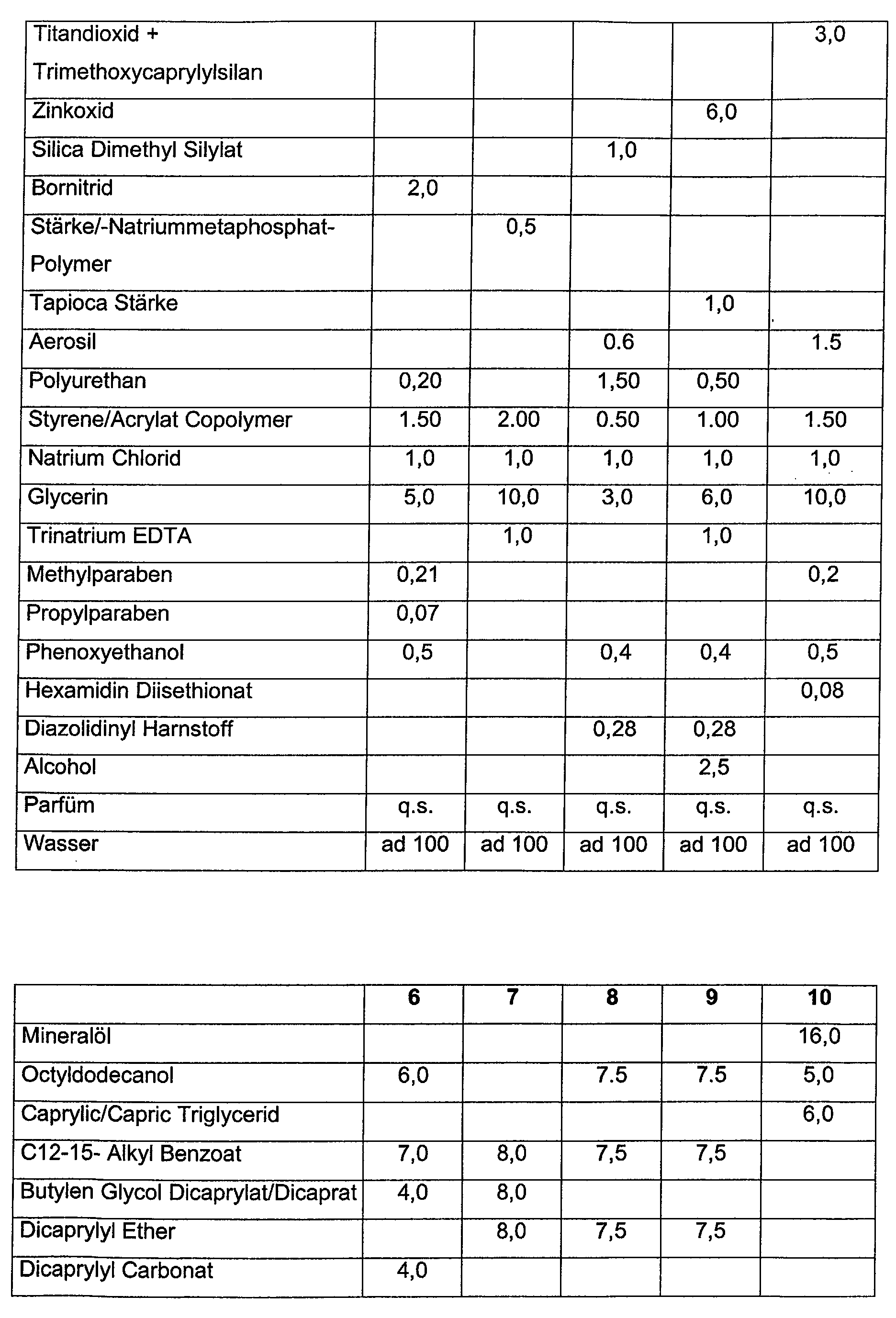
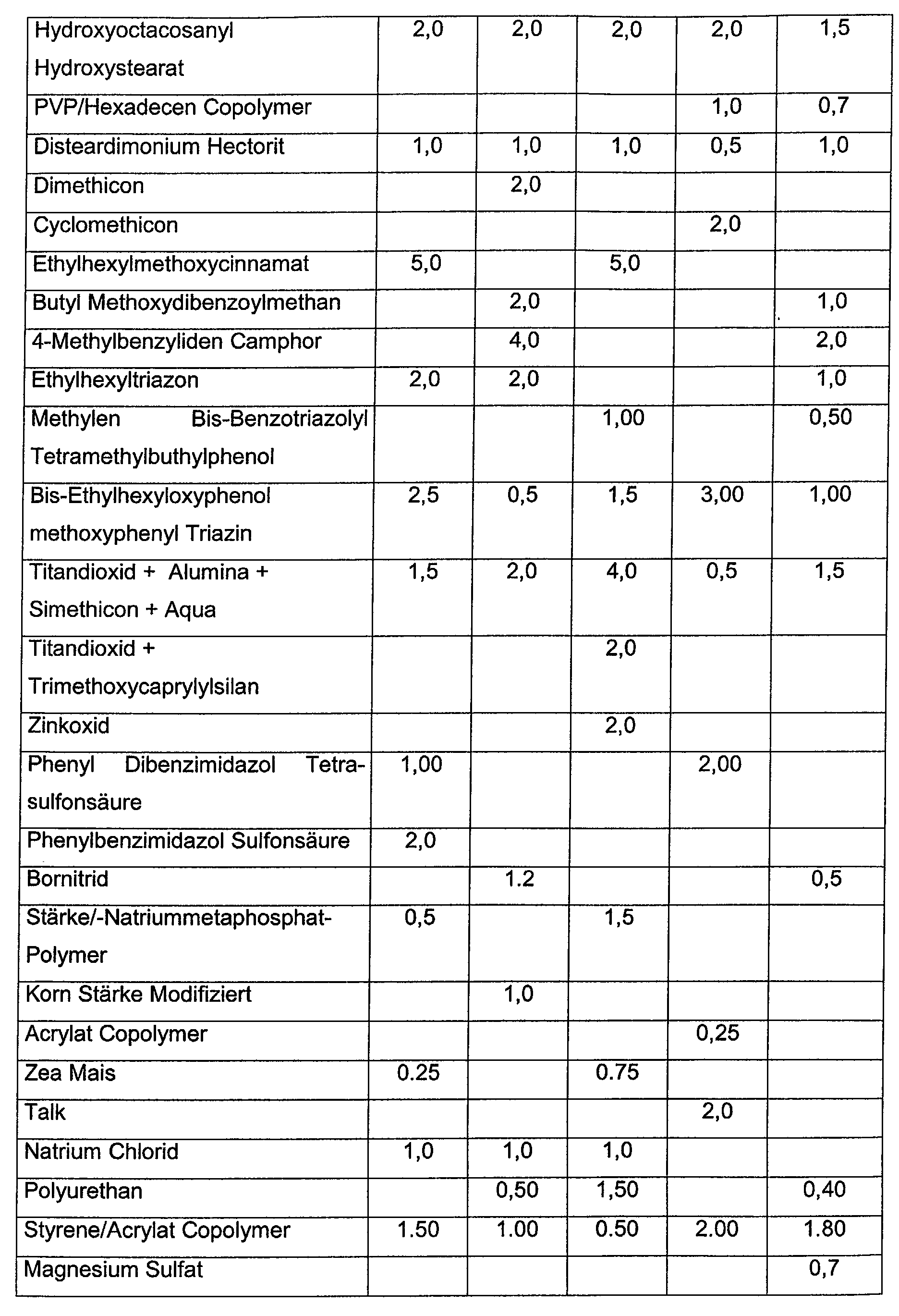
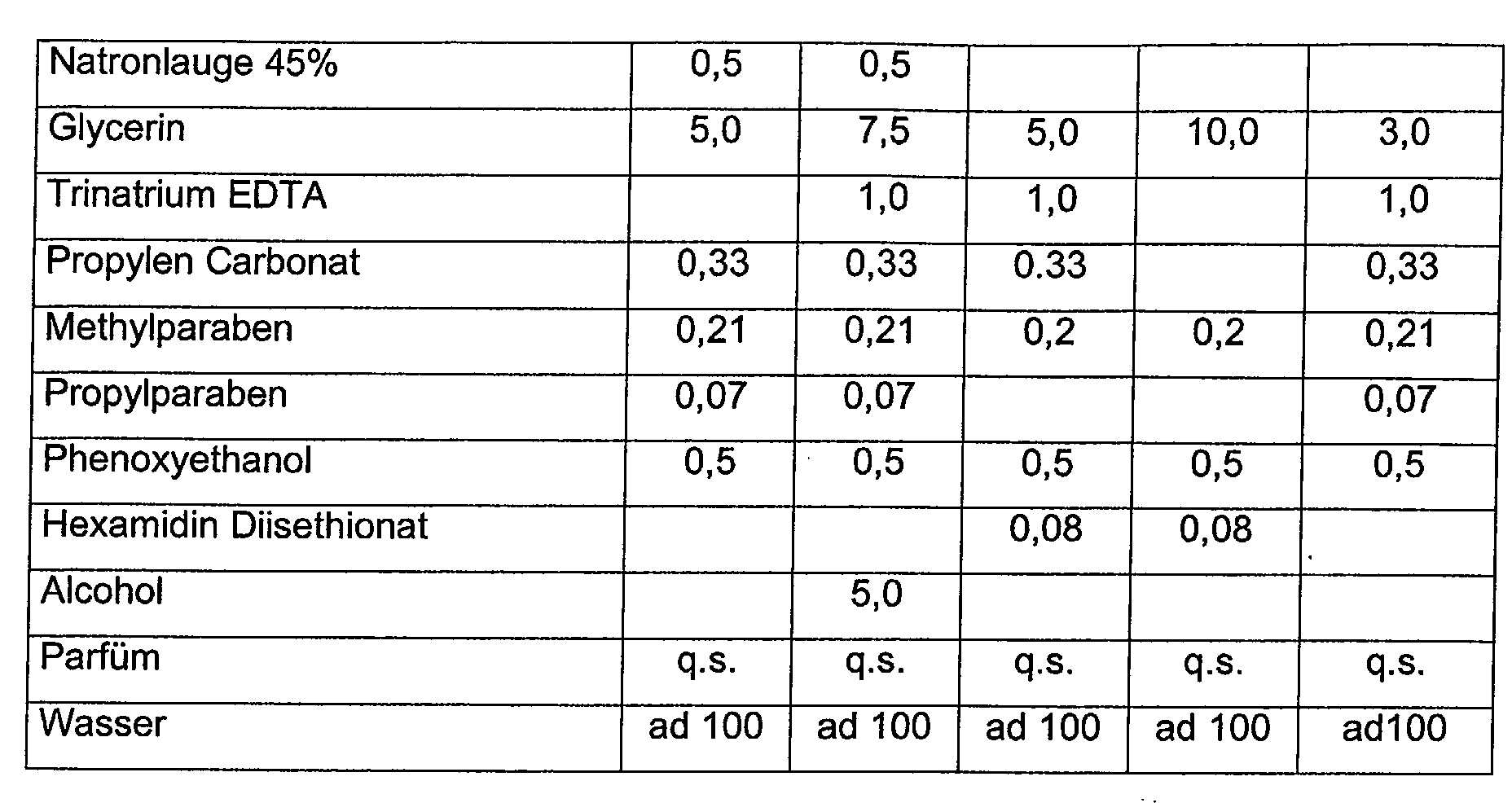
Claims (12)
- Lichtschutzwirksame kosmetische oder dermatologische Zubereitungen, welche neben mindestens einer üblichen UV-Filtersubstanz und/oder einer Breitbandfiltersubstanz ferner Stoffkombinationen vonenthalten,(a) mindestens einer Sorte von Latexpartikeln, welche eine mittlere Partikelgröße von 100 bis 400 nm haben, und(b) einem oder mehreren Typen von Füllstoffen
wobei die UV-Schutzleistung dieser Zubereitungen höher ist als die gleicher Zubereitungen, welche keine Stoffkombination aus (a) und (b) enthalten. - Verwendung von Stoffkombinationen auszur Herstellung von sandabweisen kosmetischen oder dermatologischen Lichtschutzzubereitungen.(a) mindestens einer Sorte von Latexpartikeln, welche eine mittlere Partikelgröße von 100 bis 400 nm haben, und(b) einem oder mehreren Typen von Füllstoffen
- Zubereitung nach Anspruch 1 oder Verwendung nach Anspruch 2, dadurch gekennzeichnet, daß der Aktivgehalt an einer oder mehreren Arten von Latexpartikeln aus dem Bereich von 0,5 bis 6 Gew.-% gewählt wird, bezogen auf das Gesamtgewicht der Zubereitung.
- Zubereitung nach Anspruch 1 oder Verwendung nach Anspruch 2, dadurch gekennzeichnet, daß die Latexpartikel einen mit Wasser und/oder Luft gefüllten Hohlraum aufweisen.
- Zubereitung nach Anspruch 1 oder Verwendung nach Anspruch 2, dadurch gekennzeichnet, daß die Zubereitung mindestens eine bei Raumtemperatur flüssige UV-Filtersubstanz enthält.
- Zubereitung nach Anspruch 1 oder Verwendung nach Anspruch 2, dadurch gekennzeichnet, daß die Zubereitung ölfrei ist.
- Zubereitung nach Anspruch 1, dadurch gekennzeichnet, daß die UV- und/oder Breitbandfiltersubstanz aus der Gruppe Triazine, Campherderivate und organische und/oder anorganische Pigmente gewählt wird.
- Zubereitung nach einem der vorhergehenden Ansprüche, dadurch gekennzeichnet, daß die UV- und/oder Breitbandfiltersubstanz aus der Gruppe Dibenzoylmethanderivate [insbesondere das 4-(tert.-Butyl)-4'-methoxydibenzoylmethan], 2,2'-Methylen-bis-(6-(2H-benzotriazol-2-yl)-4-(1,1,3,3-tetramethylbutyl)-phenol), 1,4-di(2-oxo-10-Sulfo-3-bornylidenmethyl)-Benzol und dessen Salze und 2,4-Bis-{[4-(2-Ethylhexyloxy)-2-hydroxy]-phenyl}-6-(4-methoxyphenyl)-1,3,5-triazin gewählt wird, wobei die Filtersubstanzen jeweils einzeln oder in beliebigen Kombinationen miteinander vorliegen können.
- Zubereitung nach einem der vorhergehenden Ansprüche oder Verwendung nach Anspruch 2, dadurch gekennzeichnet, daß die Zubereitung mindestens ein Flavonglycosid, insbesondere α-Glucosylrutin, und/oder Vitamin E und/oder dessen Derivate enthält.
- Verwendung von Zubereitungen nach Anspruch 8 oder 9 zum Schutz der Haut vor vorzeitiger Alterung.
- Verwendung von Zubereitungen nach einem der vorhergehenden Ansprüche zur Hautbefeuchtung.
- Verwendung von Kombinationen auszur Erhöhung der UV-A- und/oder UV-B-Schutzleistung kosmetischer oder dermatologischer Zubereitungen, welche mindestens eine übliche UV-Filtersubstanz und/oder eine Breitbandfiltersubstanz enthalten.(a) einem oder mehreren Typen von Füllstoffen und(b) mindestens einer Sorte von Latexpartikeln, welche eine mittlere Partikelgröße von 100 bis 400 nm haben,
Applications Claiming Priority (2)
| Application Number | Priority Date | Filing Date | Title |
|---|---|---|---|
| DE10138496 | 2001-08-04 | ||
| DE2001138496 DE10138496A1 (de) | 2001-08-04 | 2001-08-04 | Verwendung von Kombinationen von Füllstoffen und Latexpartikeln zur Verstärkung des Lichtschutzfaktors und/oder der UV-A-Schutzleistung kosmetischer oder dermatologischer Formulierungen |
Publications (2)
| Publication Number | Publication Date |
|---|---|
| EP1281390A2 true EP1281390A2 (de) | 2003-02-05 |
| EP1281390A3 EP1281390A3 (de) | 2004-02-18 |
Family
ID=7694520
Family Applications (1)
| Application Number | Title | Priority Date | Filing Date |
|---|---|---|---|
| EP02017190A Withdrawn EP1281390A3 (de) | 2001-08-04 | 2002-07-31 | Verwendung von Kombinationen von Füllstoffen und Latexpartikeln zur Verstärkung des Lichtschutzfaktors und/oder der UV-A-Schutzleistung kosmetischer oder dermatologischer Formulierungen |
Country Status (2)
| Country | Link |
|---|---|
| EP (1) | EP1281390A3 (de) |
| DE (1) | DE10138496A1 (de) |
Cited By (13)
| Publication number | Priority date | Publication date | Assignee | Title |
|---|---|---|---|---|
| WO2003037277A1 (de) * | 2001-10-26 | 2003-05-08 | Beiersdorf Ag | Glycerin enthaltende kosmetische und dermatologische zubereitungen auf der grundlage von o/w-emulsionen |
| WO2004103330A1 (de) * | 2003-05-22 | 2004-12-02 | Kemira Pigments Oy | Mischung aus titandioxid und methylen-bis-benzotriazolylphenol |
| WO2004085412A3 (en) * | 2003-03-24 | 2005-02-10 | Ciba Sc Holding Ag | Symmetrical triazine derivatives |
| EP2092930A1 (de) * | 2008-02-22 | 2009-08-26 | Stada Arzneimittel Ag | Lichtschutzzubereitung in Form einer O/W-Emulsion mit einem Lichtschutzfaktor von _> 50 |
| EP2092929A1 (de) * | 2008-02-22 | 2009-08-26 | Stada Arzneimittel Ag | Lichtschutzzubereitung in Form einer W/O-Emulsion mit einem Lichtschutzfaktor von _> 50 |
| EP2092928A1 (de) * | 2008-02-22 | 2009-08-26 | Stada Arzneimittel Ag | Lichtschutzzubereitung in Form einer Hydrodispersion mit einem Lichtschutzfaktor von _> 50 |
| WO2009094523A3 (en) * | 2008-01-23 | 2009-10-15 | Playtex Products, Inc. | Enhanced photoprotective compositions |
| WO2008155080A3 (de) * | 2007-06-18 | 2009-12-23 | Beiersdorf Ag | Styrol/acrylat-copolymere in kosmetischen sonnenschutzmitteln |
| US7887785B2 (en) | 2004-05-10 | 2011-02-15 | Momentive Performance Materials Inc. | Personal care compositions with enhanced properties, method of manufacture, and method of use thereof |
| EP2416754A4 (de) * | 2009-04-10 | 2015-04-15 | Oréal L | Uv-schutz-zusammensetzung und anwendungsverfahren |
| WO2017058404A1 (en) * | 2015-09-28 | 2017-04-06 | Rohm And Haas Company | Skin care compositions |
| EP3093007B1 (de) | 2015-05-13 | 2018-08-15 | Beiersdorf AG | Octocrylenfreies sonnenschutzmittel enthaltend diethylaminohydroxybenzoylhexylbenzoat |
| WO2023030963A1 (en) * | 2021-09-02 | 2023-03-09 | Unilever Ip Holdings B.V. | A photoprotective personal care composition |
Families Citing this family (6)
| Publication number | Priority date | Publication date | Assignee | Title |
|---|---|---|---|---|
| BRPI1011916B1 (pt) | 2009-07-07 | 2017-08-01 | Basf Se | Use of a uv filter combination, and, cosmetic preparation. |
| WO2015155095A1 (en) | 2014-04-09 | 2015-10-15 | Basf Se | Solublizing agents for uv filters in cosmetic formulations |
| BR112016023485B1 (pt) | 2014-04-11 | 2020-12-22 | Basf Se | composição cosmética |
| BR112017011314B1 (pt) | 2014-12-04 | 2020-12-15 | Basf Se | Microcápsula, processo para produzir microcápsulas, dispersão aquosa, e, uso de uma microcápsula |
| WO2016091930A1 (en) | 2014-12-09 | 2016-06-16 | Basf Se | Solubilizing agents for uv filters in cosmetic formulations |
| EP3523350B1 (de) | 2016-10-05 | 2022-12-07 | Basf Se | Uv-strahlungsabsorbierende polymerzusammensetzung |
Family Cites Families (13)
| Publication number | Priority date | Publication date | Assignee | Title |
|---|---|---|---|---|
| US5399342A (en) * | 1993-02-03 | 1995-03-21 | Dow Corning Corporation | Cosmetics with enhanced durability |
| FR2714827B1 (fr) * | 1994-01-10 | 1996-03-22 | Oreal | Composition cosmétique ou dermatologique contenant un pseudo-latex constitué de particules d'un homopolymère-filtre U.V.. |
| EP0669124A1 (de) * | 1994-02-28 | 1995-08-30 | Rohm And Haas Company | Ultraviolettstrahlung absorbierende Zusammensetzung |
| US5663213A (en) * | 1994-02-28 | 1997-09-02 | Rohm And Haas Company | Method of improving ultraviolet radiation absorption of a composition |
| FR2760361B1 (fr) * | 1997-03-10 | 1999-12-10 | Oreal | Compositions cosmetiques photoprotectrices contenant un systeme filtrant les rayons uv, une dispersion de particules de polymeres non-filmogene et une phase grasse |
| GB9715751D0 (en) * | 1997-07-26 | 1997-10-01 | Ciba Geigy Ag | Formulations |
| US5945090A (en) * | 1997-09-11 | 1999-08-31 | Randall Products International | Sunscreen preparation |
| FR2771927B1 (fr) * | 1997-12-05 | 2001-12-07 | Oreal | Composition cosmetique ou dermatologique comprenant un polymere filmogene et une emulsion aqueuse de silicone |
| FR2783415B1 (fr) * | 1998-09-18 | 2000-11-03 | Oreal | Composition cosmetique sous forme d'emulsion comprenant une dispersion de particules de polymere stabilisees en surface dans une phase grasse liquide |
| DE19842786A1 (de) * | 1998-09-18 | 2000-03-23 | Beiersdorf Ag | Emulgatorfreie feindisperse Systeme vom Typ Öl-in-Wasser und Wasser-in-Öl |
| DE19936913A1 (de) * | 1999-08-05 | 2001-02-22 | Beiersdorf Ag | Ölfreie kosmetische oder dermatologischen Zubereitungen mit einem Gehalt an unsymmetrisch substituierten Triazinderivaten und flüssigen UV-Filtersubstanzen |
| CA2322345A1 (en) * | 1999-10-14 | 2001-04-14 | Rohm And Haas Company | Method for preparing ultraviolet radiation-absorbing compositions |
| DE10046927A1 (de) * | 2000-09-21 | 2002-04-25 | Basf Ag | Farbmittelhaltige wässrige Polymerdispersion |
-
2001
- 2001-08-04 DE DE2001138496 patent/DE10138496A1/de not_active Withdrawn
-
2002
- 2002-07-31 EP EP02017190A patent/EP1281390A3/de not_active Withdrawn
Cited By (16)
| Publication number | Priority date | Publication date | Assignee | Title |
|---|---|---|---|---|
| WO2003037277A1 (de) * | 2001-10-26 | 2003-05-08 | Beiersdorf Ag | Glycerin enthaltende kosmetische und dermatologische zubereitungen auf der grundlage von o/w-emulsionen |
| WO2004085412A3 (en) * | 2003-03-24 | 2005-02-10 | Ciba Sc Holding Ag | Symmetrical triazine derivatives |
| WO2004103330A1 (de) * | 2003-05-22 | 2004-12-02 | Kemira Pigments Oy | Mischung aus titandioxid und methylen-bis-benzotriazolylphenol |
| US7887785B2 (en) | 2004-05-10 | 2011-02-15 | Momentive Performance Materials Inc. | Personal care compositions with enhanced properties, method of manufacture, and method of use thereof |
| WO2008155080A3 (de) * | 2007-06-18 | 2009-12-23 | Beiersdorf Ag | Styrol/acrylat-copolymere in kosmetischen sonnenschutzmitteln |
| AU2009206363B2 (en) * | 2008-01-23 | 2012-09-20 | Playtex Products, Llc | Enhanced photoprotective compositions |
| EP2319486A1 (de) * | 2008-01-23 | 2011-05-11 | Playtex Products, INC. | Verbesserte Lichtschutzzusammensetzungen |
| WO2009094523A3 (en) * | 2008-01-23 | 2009-10-15 | Playtex Products, Inc. | Enhanced photoprotective compositions |
| EP2092929A1 (de) * | 2008-02-22 | 2009-08-26 | Stada Arzneimittel Ag | Lichtschutzzubereitung in Form einer W/O-Emulsion mit einem Lichtschutzfaktor von _> 50 |
| EP2092928A1 (de) * | 2008-02-22 | 2009-08-26 | Stada Arzneimittel Ag | Lichtschutzzubereitung in Form einer Hydrodispersion mit einem Lichtschutzfaktor von _> 50 |
| EP2092930A1 (de) * | 2008-02-22 | 2009-08-26 | Stada Arzneimittel Ag | Lichtschutzzubereitung in Form einer O/W-Emulsion mit einem Lichtschutzfaktor von _> 50 |
| EP3020389A1 (de) * | 2008-02-22 | 2016-05-18 | Stada Arzneimittel Ag | Verwendung einer kombination eines anorganischen konsistenzgebers mit einem peg-freien w/o -emulgator |
| EP2416754A4 (de) * | 2009-04-10 | 2015-04-15 | Oréal L | Uv-schutz-zusammensetzung und anwendungsverfahren |
| EP3093007B1 (de) | 2015-05-13 | 2018-08-15 | Beiersdorf AG | Octocrylenfreies sonnenschutzmittel enthaltend diethylaminohydroxybenzoylhexylbenzoat |
| WO2017058404A1 (en) * | 2015-09-28 | 2017-04-06 | Rohm And Haas Company | Skin care compositions |
| WO2023030963A1 (en) * | 2021-09-02 | 2023-03-09 | Unilever Ip Holdings B.V. | A photoprotective personal care composition |
Also Published As
| Publication number | Publication date |
|---|---|
| DE10138496A1 (de) | 2003-02-20 |
| EP1281390A3 (de) | 2004-02-18 |
Similar Documents
| Publication | Publication Date | Title |
|---|---|---|
| EP1371359B1 (de) | Kosmetische und dermatologische Lichtschutzzubereitungen enthaltend UV-Absorber, anorganische Pigmente und organische Farbstoffe | |
| EP1434562B1 (de) | Kosmetische und dermatologische stifte | |
| EP1216690B1 (de) | Kosmetische und dermatologische Lichtschutzformulierungen mit einem Gehalt an unsymmetrisch substituierten Triazinderivaten und oberflächenaktiven Zitronensäureestern | |
| EP1443884A1 (de) | Kosmetische oder dermatologische getränkte tücher | |
| DE10138496A1 (de) | Verwendung von Kombinationen von Füllstoffen und Latexpartikeln zur Verstärkung des Lichtschutzfaktors und/oder der UV-A-Schutzleistung kosmetischer oder dermatologischer Formulierungen | |
| DE102008025576A1 (de) | Sonnenschutzzusammensetzungen | |
| EP1474099B1 (de) | Dünnflüssige, sprühbare w/o emulsionen | |
| EP1371358B1 (de) | Kosmetische und dermatologische Lichtschutzzubereitungen enthaltend UV-Absorber und synthetische organische Polymere | |
| DE202007018576U1 (de) | Kosmetische Zubereitungen mit einem Zusatz aus der Baobabpflanze | |
| EP1372576B1 (de) | Selbstschäumende oder schaumförmige zubereitungen mit anorganischen gelbildnern und partikularen festkörpersubstanzen | |
| EP1371356A2 (de) | Kosmetische und dermatologische Lichtschutzzubereitungen enthaltend eine synergistische Kombination aus UV-Absorbern und sphärischen Siliziumdioxiden | |
| EP1371357B1 (de) | Kosmetische und dermatologische Lichtschutzzubereitungen enthaltend UV-Absorber und Schichtsilikate | |
| EP1377252A2 (de) | Kosmetische und dermatologische lichtschutzformulierungen mit einem gehalt an benzotriazolderivaten und oberflächenaktiven zitronensäureestern | |
| EP1416912A2 (de) | Kosmetische und dermatologische lichtschutzformulierungen mit einem gehalt an benzotriazolderivaten und latexpartikeln | |
| EP1281389A2 (de) | Kosmetische und dermatologische Lichtschutzformulierungen mit einem Gehalt an Latexpartikeln und unsymmetrisch substituierten Triazinderivaten | |
| EP1281388B1 (de) | Kosmetische und dermatologische Lichtschutzformulierungen mit einem Gehalt an Phenylen-1,4-bis(2-benzimidazyl)-3,3'-5,5'-tetrasulfonsäure und/oder ihren Salzen und Latexpartikeln | |
| EP1216689A2 (de) | Kosmetische und dermatologische Lichtschutzformulierungen mit einem Gehalt an Phenylen-1,4-bis-(2-benzimidazyl)-3,3'-5,5'-tetrasulfonsäure und/oder ihren Salzen und oberflächenaktiven Zitronensäureestern | |
| WO2002053118A2 (de) | Lichtschutzformulierungen mit einem gehalt an oberflächenaktiven saccharoseestern | |
| EP1351660A2 (de) | Lichtschutzformulierungen mit einem gehalt an oberflächenaktiven saccharoseestern | |
| EP1365734A2 (de) | Kosmetische und dermatologische lichtschutzformulierungen mit einem gehalt an oberflächenaktiven saccharoseestern | |
| DE20221822U1 (de) | Dünnflüssige, sprühbare W/O Emulsionen | |
| CH697671B1 (de) | Kosmetische und dermatologische Zubereitungen mit einem Gehalt an Sojabohnenkeimextrakten und Taurin. | |
| DE102004002600A1 (de) | Visualisierung von Sonnenschutzmitteln auf der Haut |
Legal Events
| Date | Code | Title | Description |
|---|---|---|---|
| PUAI | Public reference made under article 153(3) epc to a published international application that has entered the european phase |
Free format text: ORIGINAL CODE: 0009012 |
|
| AK | Designated contracting states |
Designated state(s): AT BE BG CH CY CZ DE DK EE ES FI FR GB GR IE IT LI LU MC NL PT SE SK TR |
|
| AX | Request for extension of the european patent |
Extension state: AL LT LV MK RO SI |
|
| PUAL | Search report despatched |
Free format text: ORIGINAL CODE: 0009013 |
|
| AK | Designated contracting states |
Kind code of ref document: A3 Designated state(s): AT BE BG CH CY CZ DE DK EE ES FI FR GB GR IE IT LI LU MC NL PT SE SK TR |
|
| AX | Request for extension of the european patent |
Extension state: AL LT LV MK RO SI |
|
| 17P | Request for examination filed |
Effective date: 20040818 |
|
| AKX | Designation fees paid |
Designated state(s): AT BE BG CH CY CZ DE DK EE ES FI FR GB GR IE IT LI LU MC NL PT SE SK TR |
|
| 17Q | First examination report despatched |
Effective date: 20050321 |
|
| STAA | Information on the status of an ep patent application or granted ep patent |
Free format text: STATUS: THE APPLICATION HAS BEEN WITHDRAWN |
|
| 18W | Application withdrawn |
Effective date: 20060211 |