EP1281633A1 - Absorbierende oder adsorbierende Kompresse - Google Patents
Absorbierende oder adsorbierende Kompresse Download PDFInfo
- Publication number
- EP1281633A1 EP1281633A1 EP01118904A EP01118904A EP1281633A1 EP 1281633 A1 EP1281633 A1 EP 1281633A1 EP 01118904 A EP01118904 A EP 01118904A EP 01118904 A EP01118904 A EP 01118904A EP 1281633 A1 EP1281633 A1 EP 1281633A1
- Authority
- EP
- European Patent Office
- Prior art keywords
- liquid
- water permeable
- packaging system
- absorbent
- lid
- Prior art date
- Legal status (The legal status is an assumption and is not a legal conclusion. Google has not performed a legal analysis and makes no representation as to the accuracy of the status listed.)
- Withdrawn
Links
- 230000002745 absorbent Effects 0.000 title claims abstract description 54
- 239000002250 absorbent Substances 0.000 title claims abstract description 54
- 239000003463 adsorbent Substances 0.000 title claims abstract description 53
- 239000000463 material Substances 0.000 claims abstract description 170
- 238000004806 packaging method and process Methods 0.000 claims abstract description 86
- XLYOFNOQVPJJNP-UHFFFAOYSA-N water Substances O XLYOFNOQVPJJNP-UHFFFAOYSA-N 0.000 claims abstract description 85
- 239000007788 liquid Substances 0.000 claims abstract description 65
- 239000011344 liquid material Substances 0.000 claims abstract description 30
- 230000007704 transition Effects 0.000 claims abstract description 14
- 238000005260 corrosion Methods 0.000 claims description 8
- 230000007797 corrosion Effects 0.000 claims description 8
- 239000002198 insoluble material Substances 0.000 claims description 8
- 230000002401 inhibitory effect Effects 0.000 claims description 5
- 239000012530 fluid Substances 0.000 claims description 4
- 230000003100 immobilizing effect Effects 0.000 claims description 4
- 230000001681 protective effect Effects 0.000 claims description 3
- 239000011149 active material Substances 0.000 claims 10
- 239000002648 laminated material Substances 0.000 claims 2
- 239000000203 mixture Substances 0.000 claims 2
- 239000006261 foam material Substances 0.000 claims 1
- 239000003223 protective agent Substances 0.000 claims 1
- 238000007789 sealing Methods 0.000 abstract description 11
- 239000010410 layer Substances 0.000 description 66
- 230000002093 peripheral effect Effects 0.000 description 8
- 239000003795 chemical substances by application Substances 0.000 description 7
- 239000008280 blood Substances 0.000 description 6
- 210000004369 blood Anatomy 0.000 description 6
- -1 ethylene, propylene, butene Chemical class 0.000 description 4
- 239000000123 paper Substances 0.000 description 4
- 229920000642 polymer Polymers 0.000 description 4
- 229920002689 polyvinyl acetate Polymers 0.000 description 4
- 239000011118 polyvinyl acetate Substances 0.000 description 4
- 239000012812 sealant material Substances 0.000 description 4
- 229920005992 thermoplastic resin Polymers 0.000 description 4
- 229920002472 Starch Polymers 0.000 description 3
- 239000000853 adhesive Substances 0.000 description 3
- 230000001070 adhesive effect Effects 0.000 description 3
- 238000007796 conventional method Methods 0.000 description 3
- 229920001577 copolymer Polymers 0.000 description 3
- 238000002788 crimping Methods 0.000 description 3
- 238000000034 method Methods 0.000 description 3
- 229920003023 plastic Polymers 0.000 description 3
- 239000004033 plastic Substances 0.000 description 3
- 239000011241 protective layer Substances 0.000 description 3
- 239000008107 starch Substances 0.000 description 3
- 235000019698 starch Nutrition 0.000 description 3
- KAKZBPTYRLMSJV-UHFFFAOYSA-N Butadiene Chemical compound C=CC=C KAKZBPTYRLMSJV-UHFFFAOYSA-N 0.000 description 2
- 229920000742 Cotton Polymers 0.000 description 2
- 108010010803 Gelatin Proteins 0.000 description 2
- RRHGJUQNOFWUDK-UHFFFAOYSA-N Isoprene Chemical compound CC(=C)C=C RRHGJUQNOFWUDK-UHFFFAOYSA-N 0.000 description 2
- PPBRXRYQALVLMV-UHFFFAOYSA-N Styrene Chemical compound C=CC1=CC=CC=C1 PPBRXRYQALVLMV-UHFFFAOYSA-N 0.000 description 2
- 239000002253 acid Substances 0.000 description 2
- 150000007513 acids Chemical class 0.000 description 2
- 150000001336 alkenes Chemical class 0.000 description 2
- 229920000159 gelatin Polymers 0.000 description 2
- 239000008273 gelatin Substances 0.000 description 2
- 235000019322 gelatine Nutrition 0.000 description 2
- 235000011852 gelatine desserts Nutrition 0.000 description 2
- 229920005615 natural polymer Polymers 0.000 description 2
- 239000012466 permeate Substances 0.000 description 2
- 229920001495 poly(sodium acrylate) polymer Polymers 0.000 description 2
- 229920006254 polymer film Polymers 0.000 description 2
- 238000012545 processing Methods 0.000 description 2
- 239000011734 sodium Substances 0.000 description 2
- NNMHYFLPFNGQFZ-UHFFFAOYSA-M sodium polyacrylate Chemical group [Na+].[O-]C(=O)C=C NNMHYFLPFNGQFZ-UHFFFAOYSA-M 0.000 description 2
- 238000012360 testing method Methods 0.000 description 2
- 125000000391 vinyl group Chemical group [H]C([*])=C([H])[H] 0.000 description 2
- 229920003170 water-soluble synthetic polymer Polymers 0.000 description 2
- JHPBZFOKBAGZBL-UHFFFAOYSA-N (3-hydroxy-2,2,4-trimethylpentyl) 2-methylprop-2-enoate Chemical compound CC(C)C(O)C(C)(C)COC(=O)C(C)=C JHPBZFOKBAGZBL-UHFFFAOYSA-N 0.000 description 1
- LIKMAJRDDDTEIG-UHFFFAOYSA-N 1-hexene Chemical compound CCCCC=C LIKMAJRDDDTEIG-UHFFFAOYSA-N 0.000 description 1
- SMZOUWXMTYCWNB-UHFFFAOYSA-N 2-(2-methoxy-5-methylphenyl)ethanamine Chemical compound COC1=CC=C(C)C=C1CCN SMZOUWXMTYCWNB-UHFFFAOYSA-N 0.000 description 1
- OEPOKWHJYJXUGD-UHFFFAOYSA-N 2-(3-phenylmethoxyphenyl)-1,3-thiazole-4-carbaldehyde Chemical compound O=CC1=CSC(C=2C=C(OCC=3C=CC=CC=3)C=CC=2)=N1 OEPOKWHJYJXUGD-UHFFFAOYSA-N 0.000 description 1
- NIXOWILDQLNWCW-UHFFFAOYSA-N 2-Propenoic acid Natural products OC(=O)C=C NIXOWILDQLNWCW-UHFFFAOYSA-N 0.000 description 1
- NLHHRLWOUZZQLW-UHFFFAOYSA-N Acrylonitrile Chemical compound C=CC#N NLHHRLWOUZZQLW-UHFFFAOYSA-N 0.000 description 1
- 229920002134 Carboxymethyl cellulose Polymers 0.000 description 1
- 229920002101 Chitin Polymers 0.000 description 1
- 229920000858 Cyclodextrin Polymers 0.000 description 1
- IMROMDMJAWUWLK-UHFFFAOYSA-N Ethenol Chemical compound OC=C IMROMDMJAWUWLK-UHFFFAOYSA-N 0.000 description 1
- 229920000663 Hydroxyethyl cellulose Polymers 0.000 description 1
- 239000004354 Hydroxyethyl cellulose Substances 0.000 description 1
- 229920002153 Hydroxypropyl cellulose Polymers 0.000 description 1
- CERQOIWHTDAKMF-UHFFFAOYSA-N Methacrylic acid Chemical compound CC(=C)C(O)=O CERQOIWHTDAKMF-UHFFFAOYSA-N 0.000 description 1
- 229920000881 Modified starch Polymers 0.000 description 1
- 229920003171 Poly (ethylene oxide) Polymers 0.000 description 1
- 239000004952 Polyamide Substances 0.000 description 1
- 239000004372 Polyvinyl alcohol Substances 0.000 description 1
- OFOBLEOULBTSOW-UHFFFAOYSA-N Propanedioic acid Natural products OC(=O)CC(O)=O OFOBLEOULBTSOW-UHFFFAOYSA-N 0.000 description 1
- XTXRWKRVRITETP-UHFFFAOYSA-N Vinyl acetate Chemical compound CC(=O)OC=C XTXRWKRVRITETP-UHFFFAOYSA-N 0.000 description 1
- BZHJMEDXRYGGRV-UHFFFAOYSA-N Vinyl chloride Chemical compound ClC=C BZHJMEDXRYGGRV-UHFFFAOYSA-N 0.000 description 1
- 239000011358 absorbing material Substances 0.000 description 1
- 239000007864 aqueous solution Substances 0.000 description 1
- 230000004888 barrier function Effects 0.000 description 1
- 230000003115 biocidal effect Effects 0.000 description 1
- 239000003139 biocide Substances 0.000 description 1
- 230000031018 biological processes and functions Effects 0.000 description 1
- 230000000903 blocking effect Effects 0.000 description 1
- 210000001124 body fluid Anatomy 0.000 description 1
- 239000010839 body fluid Substances 0.000 description 1
- 239000001768 carboxy methyl cellulose Substances 0.000 description 1
- 235000010948 carboxy methyl cellulose Nutrition 0.000 description 1
- 239000008112 carboxymethyl-cellulose Substances 0.000 description 1
- 239000011111 cardboard Substances 0.000 description 1
- 239000001913 cellulose Substances 0.000 description 1
- 229920002678 cellulose Polymers 0.000 description 1
- 238000005119 centrifugation Methods 0.000 description 1
- 239000000919 ceramic Substances 0.000 description 1
- 239000013043 chemical agent Substances 0.000 description 1
- 238000001311 chemical methods and process Methods 0.000 description 1
- HPNSNYBUADCFDR-UHFFFAOYSA-N chromafenozide Chemical compound CC1=CC(C)=CC(C(=O)N(NC(=O)C=2C(=C3CCCOC3=CC=2)C)C(C)(C)C)=C1 HPNSNYBUADCFDR-UHFFFAOYSA-N 0.000 description 1
- 238000004140 cleaning Methods 0.000 description 1
- 239000011248 coating agent Substances 0.000 description 1
- 238000000576 coating method Methods 0.000 description 1
- 230000002939 deleterious effect Effects 0.000 description 1
- 239000002274 desiccant Substances 0.000 description 1
- 150000001993 dienes Chemical class 0.000 description 1
- 238000005516 engineering process Methods 0.000 description 1
- BFMKFCLXZSUVPI-UHFFFAOYSA-N ethyl but-3-enoate Chemical compound CCOC(=O)CC=C BFMKFCLXZSUVPI-UHFFFAOYSA-N 0.000 description 1
- 238000000605 extraction Methods 0.000 description 1
- 239000004744 fabric Substances 0.000 description 1
- 229920002457 flexible plastic Polymers 0.000 description 1
- 239000006260 foam Substances 0.000 description 1
- 239000011888 foil Substances 0.000 description 1
- 239000011521 glass Substances 0.000 description 1
- 239000003292 glue Substances 0.000 description 1
- 235000019447 hydroxyethyl cellulose Nutrition 0.000 description 1
- 239000001863 hydroxypropyl cellulose Substances 0.000 description 1
- 235000010977 hydroxypropyl cellulose Nutrition 0.000 description 1
- 238000003780 insertion Methods 0.000 description 1
- 230000037431 insertion Effects 0.000 description 1
- JEIPFZHSYJVQDO-UHFFFAOYSA-N iron(III) oxide Inorganic materials O=[Fe]O[Fe]=O JEIPFZHSYJVQDO-UHFFFAOYSA-N 0.000 description 1
- VZCYOOQTPOCHFL-UPHRSURJSA-N maleic acid Chemical compound OC(=O)\C=C/C(O)=O VZCYOOQTPOCHFL-UPHRSURJSA-N 0.000 description 1
- 239000011976 maleic acid Substances 0.000 description 1
- 238000010297 mechanical methods and process Methods 0.000 description 1
- 230000005226 mechanical processes and functions Effects 0.000 description 1
- 229910052751 metal Inorganic materials 0.000 description 1
- 239000002184 metal Substances 0.000 description 1
- 235000019426 modified starch Nutrition 0.000 description 1
- 229930014626 natural product Natural products 0.000 description 1
- 231100000252 nontoxic Toxicity 0.000 description 1
- 230000003000 nontoxic effect Effects 0.000 description 1
- 230000009965 odorless effect Effects 0.000 description 1
- 239000003921 oil Substances 0.000 description 1
- YWAKXRMUMFPDSH-UHFFFAOYSA-N pentene Chemical compound CCCC=C YWAKXRMUMFPDSH-UHFFFAOYSA-N 0.000 description 1
- 239000000575 pesticide Substances 0.000 description 1
- 229920002647 polyamide Polymers 0.000 description 1
- 229920000728 polyester Polymers 0.000 description 1
- 229920000570 polyether Polymers 0.000 description 1
- 229920000139 polyethylene terephthalate Polymers 0.000 description 1
- 239000005020 polyethylene terephthalate Substances 0.000 description 1
- 229920002451 polyvinyl alcohol Polymers 0.000 description 1
- 229920000036 polyvinylpyrrolidone Polymers 0.000 description 1
- 239000001267 polyvinylpyrrolidone Substances 0.000 description 1
- 235000013855 polyvinylpyrrolidone Nutrition 0.000 description 1
- 230000002285 radioactive effect Effects 0.000 description 1
- 150000003839 salts Chemical class 0.000 description 1
- HFHDHCJBZVLPGP-UHFFFAOYSA-N schardinger α-dextrin Chemical compound O1C(C(C2O)O)C(CO)OC2OC(C(C2O)O)C(CO)OC2OC(C(C2O)O)C(CO)OC2OC(C(O)C2O)C(CO)OC2OC(C(C2O)O)C(CO)OC2OC2C(O)C(O)C1OC2CO HFHDHCJBZVLPGP-UHFFFAOYSA-N 0.000 description 1
- 239000003566 sealing material Substances 0.000 description 1
- 239000000126 substance Substances 0.000 description 1
- 229920002994 synthetic fiber Polymers 0.000 description 1
- VZCYOOQTPOCHFL-UHFFFAOYSA-N trans-butenedioic acid Natural products OC(=O)C=CC(O)=O VZCYOOQTPOCHFL-UHFFFAOYSA-N 0.000 description 1
- 229940117958 vinyl acetate Drugs 0.000 description 1
- 239000002023 wood Substances 0.000 description 1
- 210000002268 wool Anatomy 0.000 description 1
- 239000002759 woven fabric Substances 0.000 description 1
Images


Classifications
-
- B—PERFORMING OPERATIONS; TRANSPORTING
- B65—CONVEYING; PACKING; STORING; HANDLING THIN OR FILAMENTARY MATERIAL
- B65D—CONTAINERS FOR STORAGE OR TRANSPORT OF ARTICLES OR MATERIALS, e.g. BAGS, BARRELS, BOTTLES, BOXES, CANS, CARTONS, CRATES, DRUMS, JARS, TANKS, HOPPERS, FORWARDING CONTAINERS; ACCESSORIES, CLOSURES, OR FITTINGS THEREFOR; PACKAGING ELEMENTS; PACKAGES
- B65D81/00—Containers, packaging elements, or packages, for contents presenting particular transport or storage problems, or adapted to be used for non-packaging purposes after removal of contents
- B65D81/24—Adaptations for preventing deterioration or decay of contents; Applications to the container or packaging material of food preservatives, fungicides, pesticides or animal repellants
- B65D81/26—Adaptations for preventing deterioration or decay of contents; Applications to the container or packaging material of food preservatives, fungicides, pesticides or animal repellants with provision for draining away, or absorbing, or removing by ventilation, fluids, e.g. exuded by contents; Applications of corrosion inhibitors or desiccators
- B65D81/264—Adaptations for preventing deterioration or decay of contents; Applications to the container or packaging material of food preservatives, fungicides, pesticides or animal repellants with provision for draining away, or absorbing, or removing by ventilation, fluids, e.g. exuded by contents; Applications of corrosion inhibitors or desiccators for absorbing liquids
-
- A—HUMAN NECESSITIES
- A61—MEDICAL OR VETERINARY SCIENCE; HYGIENE
- A61B—DIAGNOSIS; SURGERY; IDENTIFICATION
- A61B90/00—Instruments, implements or accessories specially adapted for surgery or diagnosis and not covered by any of the groups A61B1/00 - A61B50/00, e.g. for luxation treatment or for protecting wound edges
- A61B90/90—Identification means for patients or instruments, e.g. tags
- A61B90/94—Identification means for patients or instruments, e.g. tags coded with symbols, e.g. text
- A61B90/96—Identification means for patients or instruments, e.g. tags coded with symbols, e.g. text using barcodes
-
- A—HUMAN NECESSITIES
- A61—MEDICAL OR VETERINARY SCIENCE; HYGIENE
- A61B—DIAGNOSIS; SURGERY; IDENTIFICATION
- A61B90/00—Instruments, implements or accessories specially adapted for surgery or diagnosis and not covered by any of the groups A61B1/00 - A61B50/00, e.g. for luxation treatment or for protecting wound edges
- A61B90/90—Identification means for patients or instruments, e.g. tags
- A61B90/98—Identification means for patients or instruments, e.g. tags using electromagnetic means, e.g. transponders
-
- A—HUMAN NECESSITIES
- A61—MEDICAL OR VETERINARY SCIENCE; HYGIENE
- A61B—DIAGNOSIS; SURGERY; IDENTIFICATION
- A61B50/00—Containers, covers, furniture or holders specially adapted for surgical or diagnostic appliances or instruments, e.g. sterile covers
- A61B50/30—Containers specially adapted for packaging, protecting, dispensing, collecting or disposing of surgical or diagnostic appliances or instruments
- A61B2050/314—Flexible bags or pouches
- A61B2050/316—Flexible bags or pouches double- or multiple-walled
-
- A—HUMAN NECESSITIES
- A61—MEDICAL OR VETERINARY SCIENCE; HYGIENE
- A61B—DIAGNOSIS; SURGERY; IDENTIFICATION
- A61B50/00—Containers, covers, furniture or holders specially adapted for surgical or diagnostic appliances or instruments, e.g. sterile covers
- A61B50/30—Containers specially adapted for packaging, protecting, dispensing, collecting or disposing of surgical or diagnostic appliances or instruments
- A61B2050/314—Flexible bags or pouches
- A61B2050/318—Multi-pouches, e.g. strips of side-by-side pouches
Definitions
- the present invention relates to a novel adsorbent/absorbent material that is used in association with packaging systems and/or cleaning pads for industrial and medical applications.
- Cullen et al. Prior attempts to control leaking materials have been disclosed in U.S. Patent No. 4,749,600 (Inventors: Cullen et al.) Cullen et al. disclose a packet for absorbing and immobilizing a liquid.
- the packet looks like a sugar packet (See Figure 3 of the '600 patent) by having an outer layer and inner contents.
- an outer container like a Federal Express package. In most instances, the packet falls to the bottom edge, in particular a corner, of the outer container. See Col. 2, lines 46 of the '600 patent.
- an inner container of a liquid like a test-tube of blood (See Figure 5 of the '600 patent) is inserted into the outer container. According to the '600 patent, the bottom edge of the inner container should contact the packet. Thus, when the blood spills from the inner container, the blood may contact the packet.
- the packet has an inner layer of polyvinyl acetate and an outer layer of starch paper or any other liquid-degradable material.
- the polyvinyl acetate has to be the inner layer in order for the packet to be formed. See col 2, lines 9-11 of the '600 patent.
- the inner content is sodium polyacrylate having the formula (C 3 H 3 O 2 Na) n . It is obtainable under the trademark WATER LOCK J-550 from Grain Processing Corporation.
- a problem with the Cullen et al. attempt to immobilize a liquid is that the packet is so small that it is possible that the liquid may never contact the packet. For example, if the packet is located at the bottom of the outer container, as Cullen et al. suggest, and the liquid leaks to the top of the outer container, the packet will never immobilize the liquid since the liquid never contacts the packet. Thereby, the liquid spills from the outer container and provides little protection to the handler of the package. These results could be extremely deleterious to the handler. For example, if the liquid is HIV contaminated and that liquid contacts a cut on the handler, that handler could become infected.
- the invention relates to a packaging container designed to transport an inner container containing a liquid.
- the packaging container has at least one sealing multi-layer comprising a first water soluble film and an absorbent material.
- the inner layer of the packaging container is the water-soluble film that forms the boundary between the cavity that hold the inner container and the packaging container.
- the liquid dissolves the water-soluble film.
- the absorbent material is released to absorb and immobilize the liquid material. This immobilization prevents the liquid from escaping from the packaging container.
- '087 Patent, Abstract of the Invention The present invention discloses another embodiment of that invention which was not fully disclosed in the '087 patent.
- the present invention relates to a packaging unit designed to absorb and/or adsorb liquid that is being transported or was spilled or was released.
- the packaging unit has at least one sealing multi-layer comprising a first water soluble film and an absorbent/adsorbent material. When the liquid contacts the water soluble film, the liquid passes through the water-soluble film. When the liquid contacts the absorbent/adsorbent material, the absorbent/adsorbent material immobilizes the liquid material. This immobilization prevents the liquid from escaping from the absorbent/adsorbent material.
- the invention has a protection layer and/or a transition cap which allows units to be shipped together.
- the packaging container 10 for adsorbing/adsorbing and immobilizing a liquid is shown at Figure 1.
- the container 10 is within a roll 9 with a plurality of other containers 10.
- Each container 10 includes a multi-layer film wherein the outer layer 12 is shown.
- the outer layer 12 is any suitable material such as paper, cardboard, wood, or plastic, but preferably a water-insoluble material. Examples of some water-insoluble materials that can be used for the outer layer 12 include thermoplastic resin films, laminated films prepared from two or more thermoplastic resin films, and laminated films prepared from a thermoplastic resin film and paper, metallic foil, woven fabric or unwoven fabric.
- thermoplastic resins include polymers and copolymers of olefins, such as ethylene, propylene, butene, pentene, hexene, and the like; polymers and copolymers of vinyl compounds such as vinyl chloride, vinylidene chloride, vinylacetate, vinyl alcohol, acrylic ester, methacrylic ester, acrylonitrile, styrene and the like, polymers of diolefins such as butadiene, isoprene, and the like; copolymers of the above-mentioned olefins, or vinyl compounds; polyamides; and polyesters such as polyethylene terephthalate and the like.
- olefins such as ethylene, propylene, butene, pentene, hexene, and the like
- vinyl compounds such as vinyl chloride, vinylidene chloride, vinylacetate, vinyl alcohol, acrylic ester, methacrylic ester, acrylonitrile, styrene
- the container 10 has at least two sides - a top side 42 and a bottom side 44.
- the bottom side 44 is either the same length as the top side 42, as shown in Figure 1, or longer than the top side 42, as shown in Figures 14 and 15, so the bottom side 44 has a flap 40.
- the flap 40 is designed to fold over onto a portion of the top side 42, as shown in Figure 15 or into the top side 42.
- the bottom side 44 connects to the top side 42 as shown in Figure 17a.
- the inner layer 41 of the flap 40 contacts the top side 42 by various conventional methods.
- a conventional sealant material 90 includes polyvinyl acetate, ethylvinyl acetate or glue. These sealant materials 90 can be film-like as shown in Figure 2 or a dot matric coating as shown in Figure 3. In any case, these sealant materials 90 adhere to the top side 42 and/or underside 43 of the top side 42 by conventional sealing processes, such as crimping, adhesive, pressure sealing, or heat sealing to ensure the package 10 is tamper resistant and impact resistant.
- the material need not have an adhesive 90 thereon if the material will be crimped, as shown in Figures 10-11.
- Another method to seal the package container 10, and make it tamper resistant and impact resistant is merely heat sealing or pressure sealing the edges of the package 10 together with the tab 40 as shown in Figures 14-15, or without a tab 40 as shown in Figures 16-17.
- the packaging container 10 is used to transport liquids or gelatin materials, hereinafter liquid material (not shown), from one place to another.
- liquid material can be a biological, a radioactive, a pesticide, and/or a chemical agent.
- a vial 30 contains the liquid (not shown).
- the vial 30 is any type of container that can securely hold the liquid material (not shown) and fit within the container 10.
- the vial 30 can be a rigid material such as glass, metallic, ceramic, plastic or the like, or a flexible material like a conventional flexible plastic material.
- the vial 30 should be sealable for transportation purposes.
- An example of the seal includes a cap 36 which holds the liquid (not shown) sealed within the vial 30.
- the liquid (not shown) leaks from the vial 30. When this occurs, the inner layer of the container 10 controls the leaking.
- the container 10 has the outer layer 12, a cavity 50 to hold the vial 30, an absorbent/adsorbent material 16, and a first layer of a water-permeable material 14.
- the layers 12 and 14 are superimposed upon each other and seal together at the peripheral edges 66 of the container 10. At the peripheral edges 66, the layers 12, 14 are sealed together by conventional methods, such as heat sealing, pressure sealing, crimping, and/or adhesive. Between layers 12, 14 is the absorbent/adsorbent material 16.
- the absorbent/adsorbent material 16 is contained within the two layers 12, 14 until the liquid permeates through the first layer 14, which can dissolve or allow a liquid to penetrate therethrough.
- the first layer 14 is any conventional water permeable material, such as starch paper, polyvinyl acetate, water-soluble synthetic polymer films, water soluble semisynthetic polymer films, and water-soluble natural polymers.
- water soluble synthetic polymer films include partially saponified polyvinyl alcohol, polyethers, such as polyethylene oxide and the like, polyvinylpyrrolidone, ethylenically unsaturated acids, such as acrylic acid, methacrylic acid, maleic acid, and polymers formed from their salts thereof.
- water soluble semisynthetic polymer films include cellulose derivatives, such as carboxymethyl cellulose, hydroxyethyl cellulose, hydroxypropyl cellulose, and starch derivatives such as cyclodextrin.
- cellulose derivatives such as carboxymethyl cellulose, hydroxyethyl cellulose, hydroxypropyl cellulose, and starch derivatives such as cyclodextrin.
- starch derivatives such as cyclodextrin.
- water-soluble natural polymers those include carrageena, starch, gelatin, and chitin.
- Layer 14 can also be conventional non-woven and/or woven materials of plastic, natural products, namely, wool or cotton, or synthetic materials. In this embodiment, the layer 14 retains the position of the absorbent/adsorbent material 16 and allows liquid (not shown) to penetrate through it.
- liquid (not shown) passes through layer 14 when liquid (not shown) contacts it.
- the absorbent/adsorbent material 16 is then released.
- the material 16 absorbs and/or adsorbs by immobilizing large volumes of aqueous solutions including dilute alkalis, dilute acids and body fluids.
- the material is, in some samples, sodium polyacrylate having the formula (C 3 H 3 O 2 Na) n and variations thereof. It is obtainable under the trademark WATER LOCK J-550 from Grain Processing Corporation. Other similar material 16 can used from Gelock, Inc. of Ohio.
- the material 16 can also be a desiccant or water absorbing material.
- nullifying agent 18 such as a biocide or equivalent thereof, to nullify a specific undesirable quality of the liquid (not shown).
- nullifying agent 18 it is desirable to mix the absorbent/adsorbent material 16 and nullifying agent 18 together as shown in Figure 3.
- a second water permeable material 20 is located between the first layer 14 and the outer layer 12.
- the second layer 20 is selected from the same group of materials as the first layer 14.
- the first layer 14 superimposes upon the second layer 20 and the outer layer 12, wherein each layer 12, 14, 20 seals together at the peripheral edges 66.
- the absorbent/adsorbent material 16 and nullifying agent 18 are mixed together between the first and second layers 14, 20.
- nullifying agent 18 is between the first layer 14 and the second layer 16 while the absorbent/adsorbent material 16 is between the second layer 16 and the outer layer 12.
- Figure 6 shows the opposite configuration of Figure 5.
- Figures 7 and 8 illustrate a variation of Figures 5 and 6 respectively.
- the only difference between these figures is that Figures 7 and 8 both illustrate a third water permeable material 22.
- the third layer 22 is selected from the same group of materials as the first layer 14.
- the first layer 14 superimposes upon the second layer 20, third layer 22, and outer layer 12, wherein each interior layer 12, 14, 22, 20 seals together at the peripheral edges 66.
- Figure 9 illustrates Figure 4 without the water insoluble layer 12.
- Figure 9 illustrates Figure 4 without the water insoluble layer 12.
- alternative embodiments of the present invention also include those embodiments shown in Figures 4-8 without the water insoluble layer 22.
- Figures 10 and 11 respectively illustrate embodiments of Figures 2 and 9 without any sealing material 90. These embodiments can be sealed, for example by crimping or heat sealing. Obviously, as indicated by Figures 10 and 11, alternative embodiments of the present invention also include those embodiments illustrated in Figures 3-8.
- packages 10 can be removed from roll 9 in sets, as shown in Figures 12 and 13, or individually, as shown in Figure 9, along perforations 70. Thereby, the user can select the desired number of packages 10 to be transported.
- vials 30 are inserted into cavity 50, preferably within an air pocket therein to provide further protection.
- the air pocket can be incorporated within cavity 50 by normal insertion of the vial into the cavity 50, or by a conventional blower 801. The blower pumps air into the cavity 50 to form the air pocket. The air pocket forms within the cavity 50 only after the package 10 is sealed as shown in Figure 17a.
- the package 10 and/or vial 30 can have a security feature 80.
- the security feature 80 can be a bar code system or illustrate the fingerprint, handprint, or thumbprint of the person who supplied the liquid (not shown) and/or who obtained the liquid (not shown).
- the security feature 80 is positioned on the outer layer, 12, 22, or 20 of the package 10, on the vial 30, or both.
- the security feature 80 can also be an identification feature, which identifies the type of test to be conducted on the liquid (not shown); and/or identifies who supplied the liquid (not shown) or where the liquid (not shown) came from.
- Another alternative to the identification system can be a color code system.
- the color can cover the entire outer layer 12, 22, 20, the vial 30, or both or just a portion thereof.
- the liquid (not shown) can be extracted from the absorbent/adsorbent material 16, and the nullifying agent 18.
- the extraction can be accomplished by conventional biological processes, for example, osmosis, chemical processes, or mechanical processes, i.e., centrifugation. Thereby, the liquid (not shown) can be analyzed whether the vial 30 is broken or not.
- the package container 10 can be divided into having at least two cavities 50, 50a to hold two vials 30, 30a.
- the container 10 is divided, not always equally, along edge 34 and/or perforations 70.
- Edge 34 is formed in the same manner as the various layers of container 10 are joined at peripheral edge 66.
- the present invention 10 ensures that if for any reason liquid (not shown) leaks from vial 30, the liquid (not shown) will permeate, and dissolve in some instances, at least a portion of the first layer 14 and contact the absorbent/adsorbent material 16 and/or nullifying agent 18 that completely surrounds the vial 30. And once the liquid passes through the first layer 14, the enclosed agent, either 16 and/or 18, will nullify and/or absorb/adsorb the liquid (not shown). Thereby, the handler of the packaging container 10 will know that no liquid (not shown) should accidently leak from it.
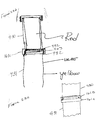
- a packaging system 10 having at least one lid 160 and a packaging container 150 with at least one exterior side 151.
- the packaging container 150 has a first layer of a water permeable material 14 and a first water impermeable material 12.
- the inner layer of the packaging container 150 is the first water permeable material 14 and the outer layer of the packaging container is the first water impermeable material 12.
- the first water impermeable material 14 and the first water impermeable material 12 are sealed together at the peripheral edges 170 of the exterior side 151.
- a first absorbent/adsorbent material 16 is positioned between the first water permeable material 14 and first water impermeable material 12 and absorbs/adsorbs, depending on the material used therein, and immobilizes any liquid material that leaks from a vial (not shown) that is transported within the container 10.
- the lid secures to the packaging container 150 by conventional means such as a snap lid as shown in Figure 18, or a screw lid, an indent lid, and an overlay lid (along with an indent lid).
- a second absorbent/adsorbent material 16a (same or different material than element 16) positioned between a second water permeable material 14a (same or different material than element 14) and a second water impermeable material 12a (same or different material than element 12) that absorbs/adsorbs and immobilizes the liquid material that leaks from a vial (not shown).
- the second water impermeable material 12a and the second water impermeable material 14a are sealed together with the absorbent/adsorbent material 16a contained within, at the peripheral edges of the at least one lid.
- the second water impermeable material 14a and a third water impermeable material 14b are sealed together with the absorbent/adsorbent material 16a contained within. This embodiment is then placed between the vessel (not shown) and the lid 160.
- the absorbent/adsorbent material 16, 16a, and/or 16b is planar in relation to the outer layer 12.
- the absorbent/adsorbent material 16, 16a, 16b can be corrugated or attached to a material which is corrugated.
- the embodiments illustrated in Figures 1-16 can have the absorbent/adsorbent material 16, 16a, 16b, be corrugated in some way or manner, or planar.
- the shape of the absorbent/adsorbent material 16, 16a, 16b depends on the configuration and amount of absorbent/adsorbent material 16, 16a, 16b needed.
- the corrugated style provides greater absorbency/adsorbency due to the increased surface area to collect the liquid.
- Figure 19b illustrates an absorbent/adsorbent pad 180.
- the difference with this pad 180 is that it has a sealable multi-layer film having at least a first layer of a water permeable material 14 and at least one layer of a water insoluble material 12.
- the water insoluble material 12 and water permeable material 14 are superimposed and bonded to each other at the peripheral edges 66 of each material.
- the water permeable material 14 allows a liquid to penetrate through the first layer 14 when the pad 180 is applied to a liquid material.
- Between each material 12, 14 is a corrugated absorbent/adsorbent material 16 that absorbs/adsorbs and immobilizes the liquid material.
- Figure 19a An alternative embodiment of Figure 19b is Figure 19a.
- This embodiment illustrates pad 180 having the same elements as Figure 19b except a multi-layered absorbent/adsorbent material 16 and a second absorbent/adsorbent material 890 which is commonly used within the medical industry, i.e., cotton, is used.
- This multi-layered material 16-890 obviously can be used in the embodiments illustrated in Figures 1-17, and maximizes the absorbency/adsorbency of the liquid.
- the pads 180 illustrated in Figures 19a and 19b can be used in medical, industrial, or hygienical applications.
- the pads 180 and containers 10 may have identifiers 80, described above, and transponders 108 incorporated in and/or thereon.
- the transponders are conventional units used to identify the pad 180 or container 10.
- the transponders 108 can also contain information about the material 180, 10, i.e., initial weight, and help locate the material 180, 10 if it is lost.
- Such transponders 180 are conventional tools known to those skilled in the art. Such as those transponders disclosed in U.S. Patent nos. 4,658,818, 5,725,578, and 5,726,630, which are hereby incorporated by reference herein.
- the technician who receives the pad 180 or container 10 would be able to determine the weight of the fluid that the adsorbent/adsorbent material 16 immobilized.
- the technician would place the material 180, 10 onto a scale 700, in particular a tray 702, as shown in Figure 20.
- the scale 700 has a conventional digital unit with a display output 704.
- the scale 700 would also have an input keypad 706 to enter the information set forth in the identifier 80, and/or a conventional bar code/transponder reader 708 that would read the bar code from identifier 80 or transponder 180. With such information, the scale 700 should tare the material 10, 180. Hence, the amount of liquid contained in the material 10, 180 would be known.
- This information would assist industrial and medical technicians know how much liquid has spilled from the industrial container or come from a human being.
- the container 900 has a top section 902 hinged to a bottom section 904.
- the bottom section 904 has a plurality of slots 910 that receive container 10, 180 or any other instrument having a bar code identifier 80 thereon (hereinafter collectively referred to as "Material 999").
- Each slot 910 is staggered from the other slot 910 so the bar code identifier 80 of each Material 999 within the slots 910 is visible.
- the top section 902 has a corresponding structure to receive the Material 999.
- the container 900 can have storage compartments 930 to store documents or other instruments thereof.
- the technician When a technician receives the container 900, the technician opens the container 900 and can read each bar code identifier 80 of Material 999 with a conventional bar code reader (not shown) without removing the Material 999 from the container 900.
- the technician will avoid unnecessary contact with the Material 999. Thereby, whatever is contained within the Material 999 has a less chance of being contaminated or damaged by a technician.
- the present invention can have a protective layer 920 within the absorbent/adsorbent material 16 as shown in Figure 22a, or outside the material 16 and within the packaging system as shown in Figure 22b.
- the protective layer 920 can be air or liquid bubble wrap, foam, or any other conventional air or liquid protective device to ensure the safe transportation of the vial 30.
- Use of protective material 920 can be used in every embodiment illustrated in this application.
- the protective layer 920 or the outer layer 12, another layer (not shown) within the packaging system, and/or the inner layer 41 can also be a vapor corrosion inhibiting liner.
- the vapor corrosion inhibiting liner protects the packaging and/or the vial 30 from corrosion, eliminating the need for the costly application and subsequent removal of greases, oils or other conventional methods of corrosion protection.
- One such inhibiting liner is made by Northern Technologies International Corporation of Lino Lakes, Minnesota, and is called the ZERUST® liner.
- the Zerust liner emits an invisible, odorless and non-toxic vapor (apparently "cleared by the FDA") that diffuses evenly throughout the interior of the packaging container.
- the ZERUST® VCI molecules will cling to metal and other rustable surfaces and protect them from rust and corrosion. After removal, the ZERUST® VCI molecules vaporize leaving the vial container clean, dry and corrosion free.
- FIG. 23 Another embodiment of the present invention is shown in Figure 23, wherein the embodiment of Figure 18 (930) is interconnected with a second embodiment of Figure 18 (931) wherein there is a transition cap 161 that allows the first container 930 to mate with the second container 931.
- the transition cap 161 is found on at least one terminal end of each container 930,931.
- the one transition cap 161 is a male coupler 161A and the other transition cap is a corresponding female coupler 161B.
- the coupler can be any system that securely mates with the other coupler.
- An example of a system is a screw-type system.
- the transition cap 161 can be just one unit so long as first and second container 930,931 have threaded edges 932 that mate with the transition cap 161C which has a barrier 933 blocking the contents from escaping from one container to another.
Landscapes
- Health & Medical Sciences (AREA)
- Surgery (AREA)
- Engineering & Computer Science (AREA)
- Life Sciences & Earth Sciences (AREA)
- Heart & Thoracic Surgery (AREA)
- General Health & Medical Sciences (AREA)
- Oral & Maxillofacial Surgery (AREA)
- Nuclear Medicine, Radiotherapy & Molecular Imaging (AREA)
- Veterinary Medicine (AREA)
- Biomedical Technology (AREA)
- Public Health (AREA)
- Medical Informatics (AREA)
- Molecular Biology (AREA)
- Animal Behavior & Ethology (AREA)
- Pathology (AREA)
- Physics & Mathematics (AREA)
- Electromagnetism (AREA)
- Food Science & Technology (AREA)
- Mechanical Engineering (AREA)
- Packages (AREA)
Priority Applications (1)
| Application Number | Priority Date | Filing Date | Title |
|---|---|---|---|
| EP01118904A EP1281633A1 (de) | 2001-08-03 | 2001-08-03 | Absorbierende oder adsorbierende Kompresse |
Applications Claiming Priority (1)
| Application Number | Priority Date | Filing Date | Title |
|---|---|---|---|
| EP01118904A EP1281633A1 (de) | 2001-08-03 | 2001-08-03 | Absorbierende oder adsorbierende Kompresse |
Publications (1)
| Publication Number | Publication Date |
|---|---|
| EP1281633A1 true EP1281633A1 (de) | 2003-02-05 |
Family
ID=8178250
Family Applications (1)
| Application Number | Title | Priority Date | Filing Date |
|---|---|---|---|
| EP01118904A Withdrawn EP1281633A1 (de) | 2001-08-03 | 2001-08-03 | Absorbierende oder adsorbierende Kompresse |
Country Status (1)
| Country | Link |
|---|---|
| EP (1) | EP1281633A1 (de) |
Cited By (3)
| Publication number | Priority date | Publication date | Assignee | Title |
|---|---|---|---|---|
| WO2007134333A3 (en) * | 2006-05-15 | 2008-01-17 | Rebecca Delegge | Dispensing package for use in treating elongated objects. |
| US7416627B2 (en) | 2005-08-31 | 2008-08-26 | Kimberly-Clark Worldwide, Inc. | Films and film laminates having cushioning cells and processes of making thereof |
| WO2025012605A1 (en) * | 2023-07-10 | 2025-01-16 | Lewendon Sarah | Modular archival storage system |
Citations (23)
| Publication number | Priority date | Publication date | Assignee | Title |
|---|---|---|---|---|
| FR682144A (fr) * | 1929-03-27 | 1930-05-23 | Rafco | Procédé et appareil pour la conservation de produits pâteux ou semisolides |
| US2687231A (en) * | 1950-11-22 | 1954-08-24 | Herbert H Somers | Stacking device |
| US3441023A (en) * | 1965-02-12 | 1969-04-29 | Page Zellstoffkrepp Gmbh | Absorption pad for the treatment of wounds and for infant care |
| FR2033223A1 (fr) * | 1969-01-07 | 1970-12-04 | Malinoise Const Mec | Support mutuel d'objets identiques empiles |
| US3621994A (en) * | 1969-11-25 | 1971-11-23 | Metropolitan Pathology Lab Inc | Laboratory specimen mailer |
| US4578070A (en) * | 1983-08-15 | 1986-03-25 | Personal Products Company | Absorbent structure containing corrugated web layers |
| WO1986002543A1 (en) * | 1984-11-02 | 1986-05-09 | Tranquility Products International, Inc. | Multi-layered absorbent products |
| US4658818A (en) | 1985-04-12 | 1987-04-21 | Miller Jr George E | Apparatus for tagging and detecting surgical implements |
| DE3624410A1 (de) * | 1986-07-18 | 1988-01-28 | Deutsche Verpackungsmittel | Verpackungseinrichtung |
| US4758241A (en) * | 1987-06-18 | 1988-07-19 | Papajohn Elissa D | Menstrual and incontinence pad |
| US4853266A (en) * | 1986-05-16 | 1989-08-01 | Multiform Desiccants, Inc. | Liquid absorbing and immobilizing packet containing a material for treating the absorbed liquid |
| EP0341056A1 (de) * | 1988-05-06 | 1989-11-08 | Minnesota Mining And Manufacturing Company | Behältnis zum Einschluss biologischer Stoffe |
| EP0344966A1 (de) * | 1988-05-31 | 1989-12-06 | Pro-Tech-Tube, Inc. | Primärbehälterschutzgehäuse für gefährliche Stoffe |
| EP0526148A1 (de) * | 1991-07-30 | 1993-02-03 | Environmental Packaging Systems Limited | Wasserdichter zylindrischer Behälter zum Transport von Untersuchungsgut oder gefährlichen Substanzen |
| US5687839A (en) * | 1993-12-30 | 1997-11-18 | Gnau, Iii; J. Russell | Container for disposing of hazardous wastes |
| US5725578A (en) | 1992-08-24 | 1998-03-10 | Lipomatrix Incoporated | Temporary implant with transponder and methods for locating and indentifying |
| US5726630A (en) | 1992-11-18 | 1998-03-10 | British Technology Group Limited | Detection of multiple articles |
| US5728083A (en) * | 1994-06-30 | 1998-03-17 | Mcneil-Ppc, Inc. | Multilayered absorbent structures |
| GB2327733A (en) * | 1997-07-19 | 1999-02-03 | Stellar Holdings Inc | Linking module for stackable containers |
| US5984078A (en) | 1997-08-04 | 1999-11-16 | United Parcel Service Of America, Inc. | Automated shuttle sorter for conveyors |
| US6161687A (en) * | 1999-02-10 | 2000-12-19 | Technicor, Inc. | Vial container |
| WO2001058764A2 (en) * | 2000-02-09 | 2001-08-16 | Sonoco Absorbent Technologies Llc. | Transport package |
| EP1127804A2 (de) * | 2000-02-25 | 2001-08-29 | Technicor, Inc. | Absorbierende Verpackung |
-
2001
- 2001-08-03 EP EP01118904A patent/EP1281633A1/de not_active Withdrawn
Patent Citations (23)
| Publication number | Priority date | Publication date | Assignee | Title |
|---|---|---|---|---|
| FR682144A (fr) * | 1929-03-27 | 1930-05-23 | Rafco | Procédé et appareil pour la conservation de produits pâteux ou semisolides |
| US2687231A (en) * | 1950-11-22 | 1954-08-24 | Herbert H Somers | Stacking device |
| US3441023A (en) * | 1965-02-12 | 1969-04-29 | Page Zellstoffkrepp Gmbh | Absorption pad for the treatment of wounds and for infant care |
| FR2033223A1 (fr) * | 1969-01-07 | 1970-12-04 | Malinoise Const Mec | Support mutuel d'objets identiques empiles |
| US3621994A (en) * | 1969-11-25 | 1971-11-23 | Metropolitan Pathology Lab Inc | Laboratory specimen mailer |
| US4578070A (en) * | 1983-08-15 | 1986-03-25 | Personal Products Company | Absorbent structure containing corrugated web layers |
| WO1986002543A1 (en) * | 1984-11-02 | 1986-05-09 | Tranquility Products International, Inc. | Multi-layered absorbent products |
| US4658818A (en) | 1985-04-12 | 1987-04-21 | Miller Jr George E | Apparatus for tagging and detecting surgical implements |
| US4853266A (en) * | 1986-05-16 | 1989-08-01 | Multiform Desiccants, Inc. | Liquid absorbing and immobilizing packet containing a material for treating the absorbed liquid |
| DE3624410A1 (de) * | 1986-07-18 | 1988-01-28 | Deutsche Verpackungsmittel | Verpackungseinrichtung |
| US4758241A (en) * | 1987-06-18 | 1988-07-19 | Papajohn Elissa D | Menstrual and incontinence pad |
| EP0341056A1 (de) * | 1988-05-06 | 1989-11-08 | Minnesota Mining And Manufacturing Company | Behältnis zum Einschluss biologischer Stoffe |
| EP0344966A1 (de) * | 1988-05-31 | 1989-12-06 | Pro-Tech-Tube, Inc. | Primärbehälterschutzgehäuse für gefährliche Stoffe |
| EP0526148A1 (de) * | 1991-07-30 | 1993-02-03 | Environmental Packaging Systems Limited | Wasserdichter zylindrischer Behälter zum Transport von Untersuchungsgut oder gefährlichen Substanzen |
| US5725578A (en) | 1992-08-24 | 1998-03-10 | Lipomatrix Incoporated | Temporary implant with transponder and methods for locating and indentifying |
| US5726630A (en) | 1992-11-18 | 1998-03-10 | British Technology Group Limited | Detection of multiple articles |
| US5687839A (en) * | 1993-12-30 | 1997-11-18 | Gnau, Iii; J. Russell | Container for disposing of hazardous wastes |
| US5728083A (en) * | 1994-06-30 | 1998-03-17 | Mcneil-Ppc, Inc. | Multilayered absorbent structures |
| GB2327733A (en) * | 1997-07-19 | 1999-02-03 | Stellar Holdings Inc | Linking module for stackable containers |
| US5984078A (en) | 1997-08-04 | 1999-11-16 | United Parcel Service Of America, Inc. | Automated shuttle sorter for conveyors |
| US6161687A (en) * | 1999-02-10 | 2000-12-19 | Technicor, Inc. | Vial container |
| WO2001058764A2 (en) * | 2000-02-09 | 2001-08-16 | Sonoco Absorbent Technologies Llc. | Transport package |
| EP1127804A2 (de) * | 2000-02-25 | 2001-08-29 | Technicor, Inc. | Absorbierende Verpackung |
Cited By (3)
| Publication number | Priority date | Publication date | Assignee | Title |
|---|---|---|---|---|
| US7416627B2 (en) | 2005-08-31 | 2008-08-26 | Kimberly-Clark Worldwide, Inc. | Films and film laminates having cushioning cells and processes of making thereof |
| WO2007134333A3 (en) * | 2006-05-15 | 2008-01-17 | Rebecca Delegge | Dispensing package for use in treating elongated objects. |
| WO2025012605A1 (en) * | 2023-07-10 | 2025-01-16 | Lewendon Sarah | Modular archival storage system |
Similar Documents
| Publication | Publication Date | Title |
|---|---|---|
| US6523681B1 (en) | Absorbent/adsorbent pads | |
| US6446794B1 (en) | Absorbent/adsorbent containers | |
| US6698285B1 (en) | Measurement device for absorbent/adsorbent objects | |
| EP0804372B1 (de) | Flexible druckbehälter und verfahren zum transport von gefährlichen stoffen | |
| US6161687A (en) | Vial container | |
| AU2004281759B2 (en) | Sterilization wraps and methods for sterilizing articles | |
| US4927010A (en) | Shipping bag for containers of potentially biohazardous liquids | |
| US5199795A (en) | Packaging for shipment and containment of hazardous wastes | |
| JPH0571175U (ja) | 運送容器 | |
| US4969750A (en) | Method of shipment and containment of hazardous liquids | |
| US5984087A (en) | Vial container | |
| US6308827B1 (en) | Labeling system for vial container | |
| US5833058A (en) | Safety bags for fluid sample containers | |
| JPH0762676B2 (ja) | 体液サンプル採取試験管複合体 | |
| US20030188981A1 (en) | Sterilizable package | |
| EP2951101B1 (de) | Behälter zum transport einer biologischen probe und kit damit | |
| CA2343629A1 (en) | Foam protective units and extenders | |
| EP0368007A2 (de) | Verpackung zum Versenden und Aufnehmen von lebensgefährlichen Flüssigkeiten | |
| EP3003559B1 (de) | Verfahren zur herstellung eines flüssigkeitsdichten behälters zum transportieren einer biologischen probe | |
| JPH10193523A (ja) | 酸素吸収能力を有する包装材料 |
Legal Events
| Date | Code | Title | Description |
|---|---|---|---|
| PUAI | Public reference made under article 153(3) epc to a published international application that has entered the european phase |
Free format text: ORIGINAL CODE: 0009012 |
|
| AK | Designated contracting states |
Designated state(s): AT BE CH CY DE DK ES FI FR GB GR IE IT LI LU MC NL PT SE TR |
|
| AX | Request for extension of the european patent |
Extension state: AL LT LV MK RO SI |
|
| 17P | Request for examination filed |
Effective date: 20030805 |
|
| AKX | Designation fees paid |
Designated state(s): AT BE CH CY DE DK ES FI FR GB GR IE IT LI LU MC NL PT SE TR |
|
| 17Q | First examination report despatched |
Effective date: 20050201 |
|
| STAA | Information on the status of an ep patent application or granted ep patent |
Free format text: STATUS: THE APPLICATION IS DEEMED TO BE WITHDRAWN |
|
| 18D | Application deemed to be withdrawn |
Effective date: 20050614 |