EP1281734A1 - Procédé de preparation d'une silice de précipitation hydrophobe ayant un dégré de blancheur élevé et une absorption d'humidité réduite - Google Patents
Procédé de preparation d'une silice de précipitation hydrophobe ayant un dégré de blancheur élevé et une absorption d'humidité réduite Download PDFInfo
- Publication number
- EP1281734A1 EP1281734A1 EP02012875A EP02012875A EP1281734A1 EP 1281734 A1 EP1281734 A1 EP 1281734A1 EP 02012875 A EP02012875 A EP 02012875A EP 02012875 A EP02012875 A EP 02012875A EP 1281734 A1 EP1281734 A1 EP 1281734A1
- Authority
- EP
- European Patent Office
- Prior art keywords
- silica
- precipitated silica
- carried out
- water
- organopolysiloxane
- Prior art date
- Legal status (The legal status is an assumption and is not a legal conclusion. Google has not performed a legal analysis and makes no representation as to the accuracy of the status listed.)
- Withdrawn
Links
- VYPSYNLAJGMNEJ-UHFFFAOYSA-N Silicium dioxide Chemical compound O=[Si]=O VYPSYNLAJGMNEJ-UHFFFAOYSA-N 0.000 title claims abstract description 258
- 239000000377 silicon dioxide Substances 0.000 title claims abstract description 127
- 230000002209 hydrophobic effect Effects 0.000 title claims abstract description 38
- 238000004519 manufacturing process Methods 0.000 title abstract description 10
- 238000002835 absorbance Methods 0.000 title 1
- 229920001296 polysiloxane Polymers 0.000 claims abstract description 46
- 239000000203 mixture Substances 0.000 claims abstract description 32
- 230000001590 oxidative effect Effects 0.000 claims abstract description 22
- 230000003750 conditioning effect Effects 0.000 claims abstract description 12
- 239000012530 fluid Substances 0.000 claims abstract description 11
- XLYOFNOQVPJJNP-UHFFFAOYSA-N water Substances O XLYOFNOQVPJJNP-UHFFFAOYSA-N 0.000 claims description 83
- 238000000034 method Methods 0.000 claims description 77
- 230000008569 process Effects 0.000 claims description 24
- 239000007789 gas Substances 0.000 claims description 22
- 238000000137 annealing Methods 0.000 claims description 10
- 238000003860 storage Methods 0.000 claims description 10
- 230000001143 conditioned effect Effects 0.000 claims description 9
- 238000002156 mixing Methods 0.000 claims description 9
- 238000010438 heat treatment Methods 0.000 claims description 8
- 238000000926 separation method Methods 0.000 claims description 6
- 238000002360 preparation method Methods 0.000 claims description 5
- 239000007787 solid Substances 0.000 claims description 5
- 239000011261 inert gas Substances 0.000 claims description 4
- OKKJLVBELUTLKV-UHFFFAOYSA-N Methanol Chemical compound OC OKKJLVBELUTLKV-UHFFFAOYSA-N 0.000 description 78
- 229920002379 silicone rubber Polymers 0.000 description 38
- 239000004945 silicone rubber Substances 0.000 description 35
- -1 polysiloxane Polymers 0.000 description 33
- 239000000523 sample Substances 0.000 description 29
- 239000000243 solution Substances 0.000 description 27
- LZZYPRNAOMGNLH-UHFFFAOYSA-M Cetrimonium bromide Chemical compound [Br-].CCCCCCCCCCCCCCCC[N+](C)(C)C LZZYPRNAOMGNLH-UHFFFAOYSA-M 0.000 description 26
- KWYUFKZDYYNOTN-UHFFFAOYSA-M Potassium hydroxide Chemical compound [OH-].[K+] KWYUFKZDYYNOTN-UHFFFAOYSA-M 0.000 description 25
- 238000004448 titration Methods 0.000 description 25
- DOIRQSBPFJWKBE-UHFFFAOYSA-N dibutyl phthalate Chemical compound CCCCOC(=O)C1=CC=CC=C1C(=O)OCCCC DOIRQSBPFJWKBE-UHFFFAOYSA-N 0.000 description 24
- 238000010058 rubber compounding Methods 0.000 description 24
- 238000010521 absorption reaction Methods 0.000 description 21
- 238000009826 distribution Methods 0.000 description 20
- 238000002845 discoloration Methods 0.000 description 19
- OKTJSMMVPCPJKN-UHFFFAOYSA-N Carbon Chemical compound [C] OKTJSMMVPCPJKN-UHFFFAOYSA-N 0.000 description 18
- QVGXLLKOCUKJST-UHFFFAOYSA-N atomic oxygen Chemical compound [O] QVGXLLKOCUKJST-UHFFFAOYSA-N 0.000 description 17
- 229910052799 carbon Inorganic materials 0.000 description 17
- 239000001301 oxygen Substances 0.000 description 17
- 229910052760 oxygen Inorganic materials 0.000 description 17
- 239000000047 product Substances 0.000 description 17
- CDOUZKKFHVEKRI-UHFFFAOYSA-N 3-bromo-n-[(prop-2-enoylamino)methyl]propanamide Chemical compound BrCCC(=O)NCNC(=O)C=C CDOUZKKFHVEKRI-UHFFFAOYSA-N 0.000 description 16
- 235000019329 dioctyl sodium sulphosuccinate Nutrition 0.000 description 16
- 235000012239 silicon dioxide Nutrition 0.000 description 16
- 239000000725 suspension Substances 0.000 description 16
- 150000001875 compounds Chemical class 0.000 description 15
- RMAQACBXLXPBSY-UHFFFAOYSA-N silicic acid Chemical compound O[Si](O)(O)O RMAQACBXLXPBSY-UHFFFAOYSA-N 0.000 description 14
- 229920002545 silicone oil Polymers 0.000 description 14
- 125000005372 silanol group Chemical group 0.000 description 12
- 230000008719 thickening Effects 0.000 description 12
- 239000003795 chemical substances by application Substances 0.000 description 11
- 239000000843 powder Substances 0.000 description 11
- 239000000126 substance Substances 0.000 description 11
- 239000000945 filler Substances 0.000 description 10
- 238000005496 tempering Methods 0.000 description 10
- 230000004992 fission Effects 0.000 description 9
- 239000011521 glass Substances 0.000 description 9
- 238000005259 measurement Methods 0.000 description 9
- 238000006243 chemical reaction Methods 0.000 description 8
- 239000008367 deionised water Substances 0.000 description 8
- 235000011118 potassium hydroxide Nutrition 0.000 description 8
- BPQQTUXANYXVAA-UHFFFAOYSA-N Orthosilicate Chemical compound [O-][Si]([O-])([O-])[O-] BPQQTUXANYXVAA-UHFFFAOYSA-N 0.000 description 7
- 230000008901 benefit Effects 0.000 description 7
- 229910021641 deionized water Inorganic materials 0.000 description 7
- 230000000694 effects Effects 0.000 description 7
- 229920001971 elastomer Polymers 0.000 description 7
- 238000001914 filtration Methods 0.000 description 7
- 239000000463 material Substances 0.000 description 7
- 239000002245 particle Substances 0.000 description 7
- 239000005871 repellent Substances 0.000 description 7
- 230000002940 repellent Effects 0.000 description 7
- 150000004760 silicates Chemical class 0.000 description 7
- FAPWRFPIFSIZLT-UHFFFAOYSA-M Sodium chloride Chemical compound [Na+].[Cl-] FAPWRFPIFSIZLT-UHFFFAOYSA-M 0.000 description 6
- 238000001035 drying Methods 0.000 description 6
- 235000013870 dimethyl polysiloxane Nutrition 0.000 description 5
- 239000006185 dispersion Substances 0.000 description 5
- 238000009472 formulation Methods 0.000 description 5
- 238000000227 grinding Methods 0.000 description 5
- 239000012535 impurity Substances 0.000 description 5
- 239000007788 liquid Substances 0.000 description 5
- 150000003961 organosilicon compounds Chemical class 0.000 description 5
- 229920000435 poly(dimethylsiloxane) Polymers 0.000 description 5
- 238000003756 stirring Methods 0.000 description 5
- IJGRMHOSHXDMSA-UHFFFAOYSA-N Atomic nitrogen Chemical compound N#N IJGRMHOSHXDMSA-UHFFFAOYSA-N 0.000 description 4
- VEXZGXHMUGYJMC-UHFFFAOYSA-N Hydrochloric acid Chemical compound Cl VEXZGXHMUGYJMC-UHFFFAOYSA-N 0.000 description 4
- 239000004890 Hydrophobing Agent Substances 0.000 description 4
- 239000004594 Masterbatch (MB) Substances 0.000 description 4
- 230000015572 biosynthetic process Effects 0.000 description 4
- 238000004364 calculation method Methods 0.000 description 4
- 238000001723 curing Methods 0.000 description 4
- 239000013530 defoamer Substances 0.000 description 4
- 239000000806 elastomer Substances 0.000 description 4
- 238000002474 experimental method Methods 0.000 description 4
- 238000011049 filling Methods 0.000 description 4
- 230000009969 flowable effect Effects 0.000 description 4
- 125000002496 methyl group Chemical group [H]C([H])([H])* 0.000 description 4
- 238000001179 sorption measurement Methods 0.000 description 4
- WFDIJRYMOXRFFG-UHFFFAOYSA-N Acetic anhydride Chemical compound CC(=O)OC(C)=O WFDIJRYMOXRFFG-UHFFFAOYSA-N 0.000 description 3
- 239000012298 atmosphere Substances 0.000 description 3
- 238000004061 bleaching Methods 0.000 description 3
- 239000003153 chemical reaction reagent Substances 0.000 description 3
- 238000012937 correction Methods 0.000 description 3
- 239000004205 dimethyl polysiloxane Substances 0.000 description 3
- LIKFHECYJZWXFJ-UHFFFAOYSA-N dimethyldichlorosilane Chemical compound C[Si](C)(Cl)Cl LIKFHECYJZWXFJ-UHFFFAOYSA-N 0.000 description 3
- 229920005645 diorganopolysiloxane polymer Polymers 0.000 description 3
- 239000003995 emulsifying agent Substances 0.000 description 3
- 239000012065 filter cake Substances 0.000 description 3
- 125000000524 functional group Chemical group 0.000 description 3
- 150000004820 halides Chemical group 0.000 description 3
- 238000001746 injection moulding Methods 0.000 description 3
- 229910052757 nitrogen Inorganic materials 0.000 description 3
- 230000001698 pyrogenic effect Effects 0.000 description 3
- 239000011780 sodium chloride Substances 0.000 description 3
- 230000003595 spectral effect Effects 0.000 description 3
- 239000004094 surface-active agent Substances 0.000 description 3
- 238000012360 testing method Methods 0.000 description 3
- VTYYLEPIZMXCLO-UHFFFAOYSA-L Calcium carbonate Chemical compound [Ca+2].[O-]C([O-])=O VTYYLEPIZMXCLO-UHFFFAOYSA-L 0.000 description 2
- LFQSCWFLJHTTHZ-UHFFFAOYSA-N Ethanol Chemical compound CCO LFQSCWFLJHTTHZ-UHFFFAOYSA-N 0.000 description 2
- 240000005110 Lotus tetragonolobus Species 0.000 description 2
- 238000005299 abrasion Methods 0.000 description 2
- 239000002253 acid Substances 0.000 description 2
- 230000032683 aging Effects 0.000 description 2
- 239000003513 alkali Substances 0.000 description 2
- 125000003342 alkenyl group Chemical group 0.000 description 2
- 125000003545 alkoxy group Chemical group 0.000 description 2
- 239000012736 aqueous medium Substances 0.000 description 2
- 239000007864 aqueous solution Substances 0.000 description 2
- 239000002585 base Substances 0.000 description 2
- 239000007853 buffer solution Substances 0.000 description 2
- 230000008859 change Effects 0.000 description 2
- 238000004132 cross linking Methods 0.000 description 2
- 239000003431 cross linking reagent Substances 0.000 description 2
- 238000004880 explosion Methods 0.000 description 2
- 239000000706 filtrate Substances 0.000 description 2
- 229910052739 hydrogen Inorganic materials 0.000 description 2
- 230000007062 hydrolysis Effects 0.000 description 2
- 238000006460 hydrolysis reaction Methods 0.000 description 2
- 125000002887 hydroxy group Chemical group [H]O* 0.000 description 2
- 239000002917 insecticide Substances 0.000 description 2
- 239000012528 membrane Substances 0.000 description 2
- 229910052751 metal Inorganic materials 0.000 description 2
- 239000002184 metal Substances 0.000 description 2
- GBMDVOWEEQVZKZ-UHFFFAOYSA-N methanol;hydrate Chemical compound O.OC GBMDVOWEEQVZKZ-UHFFFAOYSA-N 0.000 description 2
- 238000013008 moisture curing Methods 0.000 description 2
- 230000003287 optical effect Effects 0.000 description 2
- 235000019353 potassium silicate Nutrition 0.000 description 2
- 238000002310 reflectometry Methods 0.000 description 2
- 230000002787 reinforcement Effects 0.000 description 2
- 239000012763 reinforcing filler Substances 0.000 description 2
- 239000011347 resin Substances 0.000 description 2
- 229920005989 resin Polymers 0.000 description 2
- 239000013049 sediment Substances 0.000 description 2
- NTHWMYGWWRZVTN-UHFFFAOYSA-N sodium silicate Chemical compound [Na+].[Na+].[O-][Si]([O-])=O NTHWMYGWWRZVTN-UHFFFAOYSA-N 0.000 description 2
- 238000011282 treatment Methods 0.000 description 2
- 238000004073 vulcanization Methods 0.000 description 2
- FIKFLLIUPUVONI-UHFFFAOYSA-N 8-(2-phenylethyl)-1-oxa-3,8-diazaspiro[4.5]decan-2-one;hydrochloride Chemical compound Cl.O1C(=O)NCC11CCN(CCC=2C=CC=CC=2)CC1 FIKFLLIUPUVONI-UHFFFAOYSA-N 0.000 description 1
- 241001136792 Alle Species 0.000 description 1
- 101100301546 Arabidopsis thaliana REM19 gene Proteins 0.000 description 1
- IAYPIBMASNFSPL-UHFFFAOYSA-N Ethylene oxide Chemical compound C1CO1 IAYPIBMASNFSPL-UHFFFAOYSA-N 0.000 description 1
- 239000005909 Kieselgur Substances 0.000 description 1
- 239000004944 Liquid Silicone Rubber Substances 0.000 description 1
- 239000000020 Nitrocellulose Substances 0.000 description 1
- 239000004743 Polypropylene Substances 0.000 description 1
- GOOHAUXETOMSMM-UHFFFAOYSA-N Propylene oxide Chemical compound CC1CO1 GOOHAUXETOMSMM-UHFFFAOYSA-N 0.000 description 1
- XUIMIQQOPSSXEZ-UHFFFAOYSA-N Silicon Chemical compound [Si] XUIMIQQOPSSXEZ-UHFFFAOYSA-N 0.000 description 1
- NINIDFKCEFEMDL-UHFFFAOYSA-N Sulfur Chemical group [S] NINIDFKCEFEMDL-UHFFFAOYSA-N 0.000 description 1
- FJWGYAHXMCUOOM-QHOUIDNNSA-N [(2s,3r,4s,5r,6r)-2-[(2r,3r,4s,5r,6s)-4,5-dinitrooxy-2-(nitrooxymethyl)-6-[(2r,3r,4s,5r,6s)-4,5,6-trinitrooxy-2-(nitrooxymethyl)oxan-3-yl]oxyoxan-3-yl]oxy-3,5-dinitrooxy-6-(nitrooxymethyl)oxan-4-yl] nitrate Chemical compound O([C@@H]1O[C@@H]([C@H]([C@H](O[N+]([O-])=O)[C@H]1O[N+]([O-])=O)O[C@H]1[C@@H]([C@@H](O[N+]([O-])=O)[C@H](O[N+]([O-])=O)[C@@H](CO[N+]([O-])=O)O1)O[N+]([O-])=O)CO[N+](=O)[O-])[C@@H]1[C@@H](CO[N+]([O-])=O)O[C@@H](O[N+]([O-])=O)[C@H](O[N+]([O-])=O)[C@H]1O[N+]([O-])=O FJWGYAHXMCUOOM-QHOUIDNNSA-N 0.000 description 1
- 238000002479 acid--base titration Methods 0.000 description 1
- 150000001298 alcohols Chemical class 0.000 description 1
- 125000000217 alkyl group Chemical group 0.000 description 1
- 125000000304 alkynyl group Chemical group 0.000 description 1
- 150000001412 amines Chemical class 0.000 description 1
- 125000003277 amino group Chemical group 0.000 description 1
- 238000004458 analytical method Methods 0.000 description 1
- 125000003118 aryl group Chemical group 0.000 description 1
- 150000005840 aryl radicals Chemical class 0.000 description 1
- 239000010425 asbestos Substances 0.000 description 1
- QRUDEWIWKLJBPS-UHFFFAOYSA-N benzotriazole Chemical compound C1=CC=C2N[N][N]C2=C1 QRUDEWIWKLJBPS-UHFFFAOYSA-N 0.000 description 1
- 239000012964 benzotriazole Substances 0.000 description 1
- 239000012496 blank sample Substances 0.000 description 1
- 150000004758 branched silanes Chemical class 0.000 description 1
- 229910000019 calcium carbonate Inorganic materials 0.000 description 1
- 239000003054 catalyst Substances 0.000 description 1
- 238000013329 compounding Methods 0.000 description 1
- 238000009833 condensation Methods 0.000 description 1
- 238000001816 cooling Methods 0.000 description 1
- 238000005260 corrosion Methods 0.000 description 1
- 230000007797 corrosion Effects 0.000 description 1
- 150000004759 cyclic silanes Chemical class 0.000 description 1
- 238000003795 desorption Methods 0.000 description 1
- 238000011161 development Methods 0.000 description 1
- 230000018109 developmental process Effects 0.000 description 1
- 230000004069 differentiation Effects 0.000 description 1
- 238000009792 diffusion process Methods 0.000 description 1
- 239000000975 dye Substances 0.000 description 1
- 239000003792 electrolyte Substances 0.000 description 1
- 238000011156 evaluation Methods 0.000 description 1
- 239000012765 fibrous filler Substances 0.000 description 1
- 239000010419 fine particle Substances 0.000 description 1
- 238000005243 fluidization Methods 0.000 description 1
- 150000002222 fluorine compounds Chemical group 0.000 description 1
- NBVXSUQYWXRMNV-UHFFFAOYSA-N fluoromethane Chemical compound FC NBVXSUQYWXRMNV-UHFFFAOYSA-N 0.000 description 1
- 239000003205 fragrance Substances 0.000 description 1
- 230000006870 function Effects 0.000 description 1
- 239000003365 glass fiber Substances 0.000 description 1
- 239000001257 hydrogen Substances 0.000 description 1
- 238000005286 illumination Methods 0.000 description 1
- 239000003112 inhibitor Substances 0.000 description 1
- 229910052500 inorganic mineral Inorganic materials 0.000 description 1
- 150000004757 linear silanes Chemical class 0.000 description 1
- 239000007791 liquid phase Substances 0.000 description 1
- 238000003760 magnetic stirring Methods 0.000 description 1
- 238000000691 measurement method Methods 0.000 description 1
- 229910044991 metal oxide Inorganic materials 0.000 description 1
- 150000004706 metal oxides Chemical class 0.000 description 1
- 229910052914 metal silicate Inorganic materials 0.000 description 1
- 235000010755 mineral Nutrition 0.000 description 1
- 239000011707 mineral Substances 0.000 description 1
- 210000002445 nipple Anatomy 0.000 description 1
- 229920001220 nitrocellulos Polymers 0.000 description 1
- 239000000615 nonconductor Substances 0.000 description 1
- 239000003921 oil Substances 0.000 description 1
- 125000000962 organic group Chemical group 0.000 description 1
- 239000012860 organic pigment Substances 0.000 description 1
- 239000003960 organic solvent Substances 0.000 description 1
- 150000001282 organosilanes Chemical class 0.000 description 1
- 238000013021 overheating Methods 0.000 description 1
- 238000010979 pH adjustment Methods 0.000 description 1
- 239000012071 phase Substances 0.000 description 1
- 125000001997 phenyl group Chemical group [H]C1=C([H])C([H])=C(*)C([H])=C1[H] 0.000 description 1
- XNGIFLGASWRNHJ-UHFFFAOYSA-L phthalate(2-) Chemical compound [O-]C(=O)C1=CC=CC=C1C([O-])=O XNGIFLGASWRNHJ-UHFFFAOYSA-L 0.000 description 1
- 239000004014 plasticizer Substances 0.000 description 1
- 229920000570 polyether Polymers 0.000 description 1
- 229920001155 polypropylene Polymers 0.000 description 1
- 229920000915 polyvinyl chloride Polymers 0.000 description 1
- 239000004800 polyvinyl chloride Substances 0.000 description 1
- 239000011148 porous material Substances 0.000 description 1
- 239000002244 precipitate Substances 0.000 description 1
- 238000001556 precipitation Methods 0.000 description 1
- 239000002243 precursor Substances 0.000 description 1
- 238000004321 preservation Methods 0.000 description 1
- 238000011085 pressure filtration Methods 0.000 description 1
- 238000012545 processing Methods 0.000 description 1
- 230000002035 prolonged effect Effects 0.000 description 1
- 239000010453 quartz Substances 0.000 description 1
- 230000005855 radiation Effects 0.000 description 1
- 230000003014 reinforcing effect Effects 0.000 description 1
- 230000000717 retained effect Effects 0.000 description 1
- 229910052895 riebeckite Inorganic materials 0.000 description 1
- 238000005096 rolling process Methods 0.000 description 1
- 150000003839 salts Chemical class 0.000 description 1
- 239000000565 sealant Substances 0.000 description 1
- 238000005204 segregation Methods 0.000 description 1
- 229910052710 silicon Inorganic materials 0.000 description 1
- 239000010703 silicon Substances 0.000 description 1
- 150000003377 silicon compounds Chemical class 0.000 description 1
- APSBXTVYXVQYAB-UHFFFAOYSA-M sodium docusate Chemical compound [Na+].CCCCC(CC)COC(=O)CC(S([O-])(=O)=O)C(=O)OCC(CC)CCCC APSBXTVYXVQYAB-UHFFFAOYSA-M 0.000 description 1
- 239000007790 solid phase Substances 0.000 description 1
- 239000002904 solvent Substances 0.000 description 1
- 238000000527 sonication Methods 0.000 description 1
- 239000003381 stabilizer Substances 0.000 description 1
- 239000007858 starting material Substances 0.000 description 1
- 229910052717 sulfur Chemical group 0.000 description 1
- 239000011593 sulfur Chemical group 0.000 description 1
- 238000009210 therapy by ultrasound Methods 0.000 description 1
- 238000007669 thermal treatment Methods 0.000 description 1
- 238000012546 transfer Methods 0.000 description 1
- 239000000230 xanthan gum Substances 0.000 description 1
- 239000010457 zeolite Substances 0.000 description 1
Images

Classifications
-
- C—CHEMISTRY; METALLURGY
- C01—INORGANIC CHEMISTRY
- C01B—NON-METALLIC ELEMENTS; COMPOUNDS THEREOF; METALLOIDS OR COMPOUNDS THEREOF NOT COVERED BY SUBCLASS C01C
- C01B33/00—Silicon; Compounds thereof
- C01B33/113—Silicon oxides; Hydrates thereof
- C01B33/12—Silica; Hydrates thereof, e.g. lepidoic silicic acid
- C01B33/18—Preparation of finely divided silica neither in sol nor in gel form; After-treatment thereof
-
- C—CHEMISTRY; METALLURGY
- C09—DYES; PAINTS; POLISHES; NATURAL RESINS; ADHESIVES; COMPOSITIONS NOT OTHERWISE PROVIDED FOR; APPLICATIONS OF MATERIALS NOT OTHERWISE PROVIDED FOR
- C09C—TREATMENT OF INORGANIC MATERIALS, OTHER THAN FIBROUS FILLERS, TO ENHANCE THEIR PIGMENTING OR FILLING PROPERTIES ; PREPARATION OF CARBON BLACK ; PREPARATION OF INORGANIC MATERIALS WHICH ARE NO SINGLE CHEMICAL COMPOUNDS AND WHICH ARE MAINLY USED AS PIGMENTS OR FILLERS
- C09C1/00—Treatment of specific inorganic materials other than fibrous fillers; Preparation of carbon black
- C09C1/28—Compounds of silicon
- C09C1/30—Silicic acid
- C09C1/3009—Physical treatment, e.g. grinding; treatment with ultrasonic vibrations
-
- C—CHEMISTRY; METALLURGY
- C09—DYES; PAINTS; POLISHES; NATURAL RESINS; ADHESIVES; COMPOSITIONS NOT OTHERWISE PROVIDED FOR; APPLICATIONS OF MATERIALS NOT OTHERWISE PROVIDED FOR
- C09C—TREATMENT OF INORGANIC MATERIALS, OTHER THAN FIBROUS FILLERS, TO ENHANCE THEIR PIGMENTING OR FILLING PROPERTIES ; PREPARATION OF CARBON BLACK ; PREPARATION OF INORGANIC MATERIALS WHICH ARE NO SINGLE CHEMICAL COMPOUNDS AND WHICH ARE MAINLY USED AS PIGMENTS OR FILLERS
- C09C1/00—Treatment of specific inorganic materials other than fibrous fillers; Preparation of carbon black
- C09C1/28—Compounds of silicon
- C09C1/30—Silicic acid
- C09C1/3045—Treatment with inorganic compounds
-
- C—CHEMISTRY; METALLURGY
- C09—DYES; PAINTS; POLISHES; NATURAL RESINS; ADHESIVES; COMPOSITIONS NOT OTHERWISE PROVIDED FOR; APPLICATIONS OF MATERIALS NOT OTHERWISE PROVIDED FOR
- C09C—TREATMENT OF INORGANIC MATERIALS, OTHER THAN FIBROUS FILLERS, TO ENHANCE THEIR PIGMENTING OR FILLING PROPERTIES ; PREPARATION OF CARBON BLACK ; PREPARATION OF INORGANIC MATERIALS WHICH ARE NO SINGLE CHEMICAL COMPOUNDS AND WHICH ARE MAINLY USED AS PIGMENTS OR FILLERS
- C09C1/00—Treatment of specific inorganic materials other than fibrous fillers; Preparation of carbon black
- C09C1/28—Compounds of silicon
- C09C1/30—Silicic acid
- C09C1/3081—Treatment with organo-silicon compounds
-
- C—CHEMISTRY; METALLURGY
- C09—DYES; PAINTS; POLISHES; NATURAL RESINS; ADHESIVES; COMPOSITIONS NOT OTHERWISE PROVIDED FOR; APPLICATIONS OF MATERIALS NOT OTHERWISE PROVIDED FOR
- C09C—TREATMENT OF INORGANIC MATERIALS, OTHER THAN FIBROUS FILLERS, TO ENHANCE THEIR PIGMENTING OR FILLING PROPERTIES ; PREPARATION OF CARBON BLACK ; PREPARATION OF INORGANIC MATERIALS WHICH ARE NO SINGLE CHEMICAL COMPOUNDS AND WHICH ARE MAINLY USED AS PIGMENTS OR FILLERS
- C09C1/00—Treatment of specific inorganic materials other than fibrous fillers; Preparation of carbon black
- C09C1/28—Compounds of silicon
- C09C1/30—Silicic acid
- C09C1/309—Combinations of treatments provided for in groups C09C1/3009 - C09C1/3081
-
- C—CHEMISTRY; METALLURGY
- C01—INORGANIC CHEMISTRY
- C01P—INDEXING SCHEME RELATING TO STRUCTURAL AND PHYSICAL ASPECTS OF SOLID INORGANIC COMPOUNDS
- C01P2006/00—Physical properties of inorganic compounds
- C01P2006/10—Solid density
-
- C—CHEMISTRY; METALLURGY
- C01—INORGANIC CHEMISTRY
- C01P—INDEXING SCHEME RELATING TO STRUCTURAL AND PHYSICAL ASPECTS OF SOLID INORGANIC COMPOUNDS
- C01P2006/00—Physical properties of inorganic compounds
- C01P2006/11—Powder tap density
-
- C—CHEMISTRY; METALLURGY
- C01—INORGANIC CHEMISTRY
- C01P—INDEXING SCHEME RELATING TO STRUCTURAL AND PHYSICAL ASPECTS OF SOLID INORGANIC COMPOUNDS
- C01P2006/00—Physical properties of inorganic compounds
- C01P2006/12—Surface area
-
- C—CHEMISTRY; METALLURGY
- C01—INORGANIC CHEMISTRY
- C01P—INDEXING SCHEME RELATING TO STRUCTURAL AND PHYSICAL ASPECTS OF SOLID INORGANIC COMPOUNDS
- C01P2006/00—Physical properties of inorganic compounds
- C01P2006/19—Oil-absorption capacity, e.g. DBP values
-
- C—CHEMISTRY; METALLURGY
- C01—INORGANIC CHEMISTRY
- C01P—INDEXING SCHEME RELATING TO STRUCTURAL AND PHYSICAL ASPECTS OF SOLID INORGANIC COMPOUNDS
- C01P2006/00—Physical properties of inorganic compounds
- C01P2006/40—Electric properties
-
- C—CHEMISTRY; METALLURGY
- C01—INORGANIC CHEMISTRY
- C01P—INDEXING SCHEME RELATING TO STRUCTURAL AND PHYSICAL ASPECTS OF SOLID INORGANIC COMPOUNDS
- C01P2006/00—Physical properties of inorganic compounds
- C01P2006/60—Optical properties, e.g. expressed in CIELAB-values
-
- C—CHEMISTRY; METALLURGY
- C01—INORGANIC CHEMISTRY
- C01P—INDEXING SCHEME RELATING TO STRUCTURAL AND PHYSICAL ASPECTS OF SOLID INORGANIC COMPOUNDS
- C01P2006/00—Physical properties of inorganic compounds
- C01P2006/80—Compositional purity
-
- C—CHEMISTRY; METALLURGY
- C01—INORGANIC CHEMISTRY
- C01P—INDEXING SCHEME RELATING TO STRUCTURAL AND PHYSICAL ASPECTS OF SOLID INORGANIC COMPOUNDS
- C01P2006/00—Physical properties of inorganic compounds
- C01P2006/80—Compositional purity
- C01P2006/82—Compositional purity water content
-
- C—CHEMISTRY; METALLURGY
- C01—INORGANIC CHEMISTRY
- C01P—INDEXING SCHEME RELATING TO STRUCTURAL AND PHYSICAL ASPECTS OF SOLID INORGANIC COMPOUNDS
- C01P2006/00—Physical properties of inorganic compounds
- C01P2006/90—Other properties not specified above
Definitions
- the invention relates to a method for producing a hydrophobic precipitated silica exceptionally low water absorption, high whiteness and low thickening Properties in silicone rubber formulations with high reinforcement in the Silicone vulcanizates.
- organosilicon Compounds such as organopolysiloxanes are e.g. B. is known for example from DE 30 85 905.
- the annealing process carried out here is carried out under nitrogen inerting.
- hydrophobic silicates are for example from DE 24 35 860, DE 22 42 728 and DE 25 13 608 known.
- hydrophilic silicates and precipitated silicas are made hydrophobic by an implementation of the silicates and precipitated silicas with organosilicon compounds he follows.
- hydrophobizing agents e.g. Organohalosilanes or Organopolysiloxane compounds used.
- DE 26 28 975 and DE 27 29 244 describe the production of hydrophobic silicas described in which a hydrophilic precipitated silica with low water absorption is reacted with silicone oil or dimethyldichlorosilane.
- the hydrophobizing agent silicone oil
- the dry Precipitated silica is added, in the process according to DE 27 29 244
- Hydrophobing agent dimethyldichlorosilane directly into the precipitated silica suspension given.
- tempering is added after the hydrophobization step elevated temperatures, i.e. between 200 and 400 ° C.
- a disadvantage of this method is that it becomes hydrophobic in this way Precipitated silica discolored at the required process temperatures.
- the discoloration of the Silicic acid is particularly noticeable when added to silicone formulations, d. H. when these hydrophobic precipitated silicas are added to silicone rubber formulations or in silicone oil based defoaming mixtures.
- the so-called reflectance value can serve as a measure of the discoloration.
- the reflectance measurement is used to investigate the diffuse reflectivity of a sample. The higher that diffuse reflectivity of a sample, the higher its reflectance value and thus the Whiteness of the sample.
- Precipitated silicas generally have a remission value of a maximum of 97%.
- a The object of the present invention is therefore to make silicas hydrophobic carry out that the reflectance value of the original silica is ideally obtained remains.
- Discolouration occurs particularly when the precipitated silicas strongly hydrophobize that is, high methanol wettability and high carbon loads exhibit. It is precisely these properties that are common (e.g. in silicone rubber formulations) he wishes.
- the so-called DBP number can serve as a measure of the thickening.
- the DBP number gives that Capacity of a silica to DBP.
- the measuring method shows at how much g Dibuthyl phthalate per 100 g sample an abrupt increase in force can be observed in the kneader.
- the object of the present invention was therefore to provide a method for producing a To provide hydrophobic precipitated silica that has a high, covalently attached Carbon load, low water absorption, a low thickening effect good reinforcement properties in silicone rubber formulations and a high degree of whiteness having.
- the process should be applicable on an industrial scale, i.e. reproducible Provide water repellency with high whiteness and both continuously and be carried out discontinuously.
- Conditioning is preferred by heat treatment from 0.5 to 2 hours at 100 to 150 ° C or 15 to 30 h at 50 to 80 ° C. It is also possible to have a storage at room temperature (i.e. approx. 20 ° C) for at least 48 h.
- the conductivity can be below 100, 60, 30 or even below 20 ⁇ S.
- the process for the preparation of the silica according to the invention makes it possible without the Use of solvents (except water), emulsifiers, surfactants or others surface-active parts of the molecule in the hydrophobizing agent and still get along to obtain a homogeneous distribution of the hydrophobizing agent, so that this silica combines low thickening properties with no discoloration.
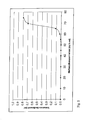
- Silicas according to the invention show a steep methanol wettability, i. H. they are homogeneously hydrophobized (Fig. 1).
- Fig. 2 shows a methanol wettability of the usual hydrophobic silicas which were annealed without the conditioning according to the invention.
- the silica according to the invention is preferably produced with a polysiloxane, so that it contains only methyl groups after the tempering as organic residues, which with a very high thermal load capacity (> 300 ° C under air access do not lead to Discoloration).
- the process according to the invention makes it possible, in particular, to lower silicas Silanol group density (the Sears number, i.e. the Alkaline consumption of an acid-base titration. Taken together with the BET surface can then be compared relative silanol group densities) and in the hydrophobic resulting silica according to the invention a high degree of whiteness (> 94% remission) achieve.
- the very low water absorption of a precipitated silica of the inventive Hydrophobic precipitated silica is made by choosing a hydrophilic one Precipitated silica with a very low silanol group density and a very homogeneous Hydrophobization with organosilicon compounds enables.
- the silanol group density is the Sears number in relation to the BET surface area.
- reaction conditions used in the process according to the invention do not lead to charring and therefore hardly discoloration. It is therefore important that the Hydrophilic basic silica has no organic impurities, otherwise the Discoloration increases. Because the resulting from the annealing, under process conditions gaseous fission products have a certain discoloration even in an oxidizing atmosphere it is important to ensure that these fission products are adequately Gas flow can be removed from the product.
- liquid polysiloxane preferably polydimethylsiloxane, preferably 30-100 cSt allows an optimal distribution on the basic silica.
- oxidative Reaction conditions can resinify the polydimethylsiloxanes used. This has the great advantage that the hydrophobizing agent is in liquid form on the silica distribute and then fix it. The amount can be increased by the oxidizing annealing Increase bound carbon significantly.
- High carbon loads and high methanol wettability improve the properties of silicas in silicone rubber formulations.
- the further diminution The moisture absorption capacity enables unpressurized vulcanizations at temperatures above 100 ° C in silicone rubber formulations because there are no annoying vapor bubbles in the vulcanizate occur.
- the high carbon silicas show in silicone rubber formulations significantly improved rheological properties, d. H. they have only a slight thickening and have low flow limits. This low thickening effect makes it flowable Manufacture silicone rubber formulations that are well over 20% more hydrophobic Precipitated silica are filled and are still processed by injection molding can.
- the higher degree of filling leads to significantly improved mechanical properties Properties of the vulcanizates.
- hydrophobic precipitated silica produced according to the invention can therefore be described in the following Applications are used:
- the silica according to the invention can be used in all without further hydrophobization Types of silicone rubber are used.
- the low DBP number leads to low compound viscosities, which is advantageous in LSR and RTV2 compounds lets use.
- the compounds have a high storage stability, the so-called Post-condensation is suppressed.
- the Silicic acid according to the invention also in moisture-curing systems such as RTV1 compounds be used.
- the compounds also have a high storage stability on. Since the moisture content of the silica according to the invention is significantly reduced the undesired curing during storage is suppressed.
- the high reflectance values of the silicas ensure attractive, discoloration-free Defoamer formulations, especially in formulations based on mineral and Silicone oil.
- silica according to the invention is special well suited as a free-flow aid for substances sensitive to hydrolysis.
- the high reflectance values of the silicas produced according to the invention also represent one here additional benefit.
- the silica according to the invention can be used as a carrier substance, in particular for Insecticides, as an insecticide as such, as an antiblocking aid or as a filler in humidity-curing silicone rubber compounds can be used.
- organosilanes or organohalosilanes can be used as the organopolysiloxane derivative are, which are usually used for the hydrophobization of precipitated silicas.
- a master batch i.e. a conditioned precipitated silica prepared according to process steps a) and b) and with a (hydrophilic) or water-containing precipitated silica z.
- B. filter cake, silica suspensions or Silica dispersions are mixed.
- the water content of the hydrophilic precipitated silica can be in the ranges already mentioned vary.
- the base silica can e.g. B. in a mass ratio of 1: 1 to 1: 3 with silicone oil z.
- B. DOW CORNING (R) 200 FLUID 50 CS (dimethylpolysiloxane 50 mPas, with trimethysilyl groups terminated, carbon content approx. 33%) can be documented (step a)).
- step b) is carried out here until a material is formed that water-wettable (methanol wettability ⁇ 20, to define methanol wettability see measuring method), which, however, contains silica and silicone oil when entering water no longer separate (if step c) immediately follows step b), then methanol wettability> 20 is preferred).
- this master batch e.g. 50% by weight of silica and 50% by weight of silicone oil
- aqueous Silica dispersions or silica suspensions form stable mixtures in which the silicone oil no longer separates from the silica.
- the total mixture contains typically 1 part by weight of silicone oil, approx. 4-8 parts by weight of silica and 20-60 Parts by weight of water. To produce such a suspension, for. B.
- the master batch e.g. 50% silica and 50% silicone oil
- the master batch e.g. 50% silica and 50% silicone oil
- the advantage of this procedure is that the water-wettable masterbatch (which contains up to 75% of hydrophobic organopolysiloxane!) can be very finely and stably distributed directly in silica precipitate suspensions or silica dishes, without the use of emulsifiers or surfactants. After drying or Filtration and subsequent drying of such a mixture can be obtained in this way organopolysiloxane-containing silica are conditioned again (step b).
- Process step b) is preferably carried out by heat treatment at 100-150 ° C. from 0.5 to 2 hours. After conditioning, a partially hydrophobic Silicic acid with a methanol wettability of 20% and more are present. in principle can be differentiated between wet and dry water repellency.
- silicate educts are aqueous Silicic acid suspensions, silicic acid dishes or highly hydrated silicic acid filter cakes deals, which are covered with the appropriate hydrophobing agents, as z. B. in DE 27 29 244 for precipitation suspensions with organohalosilanes is described.
- Dry hydrophobization means that the silicate educts are Silica powder with different moisture contents from 1 to 75% deals with the corresponding water repellents are documented. This method is e.g. B. in DE 26th 28,975.
- Organopolysiloxane derivatives are used to produce the silica according to the invention used; However, other silicon compounds can also be used, which are under react to organopolysiloxanes under the chosen reaction conditions (e.g. Dichlorodimethylsilane in an aqueous environment).
- R can be alkyl and / or aryl radicals which can be substituted with functional groups such as the hydroxyl group, the amino group, polyethers such as ethylene oxide and / or propylene oxide and halide groups such as fluoride.
- R can also contain groups such as hydroxy, amino, halide, alkoxy, alkenyl, alkynyl and aryl groups and sulfur-containing groups.
- X can be reactive groups such as silanol, amino, mercapto, halide, alkoxy, alkenyl and hydride groups.
- polysiloxane derivatives can result in salts or low-molecular substances such as NH 3 , amines, alcohols etc., which can lead to disruptive impurities.
- An important exception here are silanol-functionalized polysiloxanes, since only water is produced as an impurity that can be easily removed under the selected process conditions.
- the hydrophobizing agent can preferably be a methyl-terminated one Polydimethylsiloxane, in particular one with a viscosity of 30-100 mPas, preferably 40 - Trade 60 mPas.
- a suitable polysiloxane oil is e.g. B. DOW CORNING (R) 200 FLUID 50 CS.
- the annealing, ie process step c), is carried out at least 300, preferably above 350, very particularly preferably above 360-370 ° C. using an oxidizing gas.
- an oxidizing gas can be air, Cl 2 , NO x (NO 2 , N 2 O 5 , NO, N 2 O), O 3 , O 2 , Br 2 , F 2 or a mixture of these gases with other inert gases such as CO 2 , N 2 or burner exhaust gases are each preferably not less than 1% by volume.
- the oxidizing gas can optionally further up to 80, preferably up to 50 vol%, particularly preferably contain 20-40 vol% water.
- a good throughput of gas must be ensured in any case; the gas has to go Possibility to reach every silica particle. This is due to the fluid conditions in the achieved method according to the invention.
- Fluid conditions such as Fluidized beds or fluidized bed as defined in Römpp Lexicon Chemie 2nd edition, 1999 z. B. in a floating bed, fluid bed, fluidized bed, Fluid bed and / or bubble bed can be set.
- the procedure can be operated batchwise or continuously.
- the annealing of the polysiloxane-treated silica under oxidizing, i.e. bleaching Reaction conditions can be carried out in the fluidized bed in the presence of oxygen become.
- precipitated silica powder also polysiloxane treated silica
- They can be easily in the fluidized bed anneal.
- the decisive advantages of the fluidized bed reactor lie in the homogeneous material and Temperature distribution of the fluidized bed reactor. Even with a predominant one Wall heating and temperatures above 300 ° C only differ between wall and product temperature by a few degrees (typically only 2 - 4 ° C) because an active fluidized bed (i.e. a fluidized bed, which is operated above its fluidization point) an optimal thermal conductivity identifies.
- silicas can be tempered without annoying metal abrasion noticeable.
- the homogeneous material distribution and temperature distribution enables, at relatively low process gas throughputs (0.5 - 5 m 3 / [h ⁇ kg], this leads to relatively high fission product concentrations and thus to good hydrophobization by the fission products) and z.
- concentration range in which the oxygen has its bleaching effect is close to the critical oxygen concentration of the explosion limit of the mixture of oxygen / silicone oil fission products. If the distribution is inhomogeneous, local excess oxygen can locally lead to an ignitable mixture and thus lead to an explosion. The desired process conditions can be safely maintained with the fluidized bed.
- the heat treatments are preferably carried out with relatively low process gas throughputs (0.5-5 m 3 / [h ⁇ kg]) with oxygen contents of 4-7 vol%. This leads to relatively high fission product concentrations (which guarantees good water repellency via the gas phase), but still enables the discharge of excess fission products. At these oxygen concentrations, the fission products are almost - but not completely free of discoloration and must therefore be driven out as completely as possible.
- the heat treatment of the silica powder in the fluidized bed reactor can be carried out in a batch or continuously. In continuous operation, the reactor should be operated in such a way that the proportion of silica particles which have been exposed to the operating temperature for less than 15 minutes is as low as possible. This can be done, for example, by a suitable arrangement of weirs.
- the preferred annealing times are 0.25 - 4 h at temperatures of 330 - 400 ° C.
- the reactor size can range from laboratory scale (100 g range / filling) to pilot plant size (100 kg range / filling) up to production scale (> 100 kg / filling).
- This type of reactor has the advantage that it has average particle sizes of 5-500 ⁇ m can be operated. This means that there is not necessarily a grinding here must connect.
- the hydrophobized silicic acid after the conditioning step or Annealing be ground.
- grinding before step a) is not indicated and leads to inferior products with inhomogeneous hydrophobing.
- silica with ad [4.3] of 2-25 ⁇ m, preferably 2-15 ⁇ m, is obtained.
- Silicone rubber formulations need to fully develop their mechanical Properties of active reinforcing fillers. It is usually highly disperse Silicas used. Due to the easy machinability of LSR silicone rubber formulations (Liquid silicone rubber) - especially in the injection molding process - HTV silicone rubber formulations (hot vulcanizing Rubber) replaced by LSR silicone rubber compounds. The Reinforcing filler cause good mechanical properties in the vulcanizate without the affect the rheological properties of the silicone rubber formulations. The Silicone rubber formulations must and should be flowable after compounding Do not retighten after long storage periods.
- HTV and LSR silicone rubber formulations are used at temperatures well above 100 ° C processed.
- Water-containing fillers can lead to an annoying vapor bubble formation in of the silicone formulation.
- a water content of the filler leads to an undesirable one Curing during storage. Therefore, the water absorption characteristic, i.e. the adsorbed amounts of water at different relative humidity levels, a measure of the Process capability of the filler.
- the hydrophobic precipitated silica produced by the process according to the invention shows however a water absorption characteristic comparable to pyrogenic silicas, has no discoloration and also shows low thickening properties in Silicone rubber formulations.
- the basic silica is preferably a precipitated silica which has a very low silanol group density (the Sears number taken together with the BET surface area serves as a measure of the silanol group density).
- the low silanol group density of the basic silica is also expressed in a low loss on ignition of 3.0 ⁇ 0.5 with a BET surface area of approx. 160 m 2 / g.
- silica By mixing the silica with diorganopolysiloxanes and optionally others Substances at room temperature or only a little elevated temperature can, if necessary After the addition of crosslinking agents, masses curable to form elastomers.
- the Silicic acid according to the invention has a low thickening effect, so that the compounds are in LSR systems have them processed on injection molding machines. Mixing can be done in a known manner Way, e.g. B. in mechanical mixing devices.
- the silicas are preferably used in amounts of 5 to 50% by weight, preferably% to 40% by weight, based on the total weight of the compositions curable to form elastomers, used. Up to 50% by weight can be used for HTV organopolysiloxane elastomers become.
- the elastomer-curable compositions can contain the hydrophobicized precipitated silica, crosslinking agents and crosslinking catalysts, optionally conventionally mostly or frequently in fillers used to elastomer compositions.
- Such substances are fillers with a surface area below 50 m 2 / g, such as quartz powder, diatomaceous earth, furthermore silicon silicate and calcium carbonate, furthermore untreated pyrogenic silicon dioxide, organic resins such as polyvinyl chloride powder, organopolysiloxane resins, fibrous fillers such as asbestos, glass fibers and organic pigments , soluble dyes, fragrances, corrosion inhibitors, the masses stabilizing agents against the influence of water, such as acetic anhydride, hardening retardants such as benzotriazole and plasticizers, and dimethylpolysiloxanes endblocked by trimethylsiloxy groups.
- organic resins such as polyvinyl chloride powder, organopolysiloxane resins, fibrous fillers such as asbestos, glass fibers and organic pigments , soluble dyes, fragrances, corrosion inhibitors, the masses stabilizing agents against the influence of water, such as acetic anhydride, hardening retardants such as benzotriazole and plasticizer
- Precipitated silicas which are very suitable, are preferably used as the silicate starting material low silanol group density, i.e. a low ratio of alkali consumption / BET surface area, a relatively high CTAB surface with approximately the same BET surface area and a high one Has whiteness and purity.
- the mixture of the basic silica and the polysiloxane are up to a certain Carbon content carried out, d. H. the mixing ratio results from the mathematical relationship to the setting of the required carbon content.
- Silicas the surfaces of which are modified with non-hydrolyzable, organic groups are usually not wetted by water.
- hydrophobic silicas can be obtained from a methanol / water mixture wet.
- the proportion of methanol in this mixture - expressed in percent by weight - is a measure of the hydrophobicity of the modified silica. The higher the methanol content the better the substance is hydrophobic.
- DBP intake which is a measure of the absorbency of the precipitated silica is determined as follows:
- the Brabender plastograph is used to determine the dibutyl phthalate number.
- the DBP number is a measure of the absorbency or the absorption capacity of a person powdered product on liquid.
- the absorption capacity depends on Moisture content, the grain size and weight of the examined material.
- the density of DBP is 1.047 g / ml.
- the DBP intake is based on the anhydrous, dried substance related. When using precipitated silicas with higher Moisture is retained when this precipitated silica before determining the DBP number not to be dried, correct the value using the correction table.
- the correction value according to the water content becomes the experimentally determined DBP value added to; z. B. would have a water content of 5.8% a surcharge of 33 g / 100g for the DBP intake mean.
- the particle size is determined using a "Malvern Mastersizer” in ethanol after 5 minutes of ultrasound treatment. The measurement is carried out automatically and provides the average particle size d 4.3 from a volume distribution.
- the Datacolor 3890 spectrophotometer is used to determine the standard color value R y for silicas, silicates and zeolites (powder suspension).
- the silica to be measured is first reduced to an average particle diameter of Grind approx. 8 to 15 ⁇ m and then compress it to a tablet using a powder press.
- the amount required depends on the fine particle size of the powder. So much powder filled that the thread of the press lock reaches the last gear.
- the samples are placed under the measuring device and the menu item whiteness measurement R y and R 460 is selected on the control computer. After entering the sample name, the "Space" button is pressed to start the measurement.
- the measured values are printed out.
- Free OH groups can be found by titration with 0.1 N KOH in the range from pH 6 to pH 9 to capture.
- V 1 V * 5 e
- V 2 V * 5 e
- 10 g of the sample to be examined are accurate to 0.01 g on the precision balance weighed and filled into the graduated 250 ml glass cylinder of the tamped volume. To The volume of the tamped material is read from 1250 poundings.
- the material can be sieved through a 500 ⁇ m sieve or the sample weight can be increased. This must be stated in the test report.
- CTAB N-cetyl-N, N, N-trimethylammonium bromide
- NDSS dioctyl sodium sulfosuccinate solution
- the determination is based on ASTM 3765.
- a standard sample of type VN 3 silica must also be tested for each series of measurements.
- the sample is at constant temperature (30 ° C) exposed to different relative humidity levels. It is waited until there is a constant Weight.
- the basic silica is dried and coated with silicone oil (e.g. DOW CORNING (R) 200 FLUID 50 CS, carbon content approx. 33%, methyl-terminated silicone oil with a viscosity of 50 mPas) using a spin-flash dryer.
- silicone oil e.g. DOW CORNING (R) 200 FLUID 50 CS, carbon content approx. 33%, methyl-terminated silicone oil with a viscosity of 50 mPas
- the silica is then conditioned (by aging for at least 48 hours at room temperature) until it has a methanol wettability of at least 20%.
- Table 1.1 The analytical data of the conditioned silica are shown in Table 1.1.
Landscapes
- Chemical & Material Sciences (AREA)
- Organic Chemistry (AREA)
- Inorganic Chemistry (AREA)
- Silicon Compounds (AREA)
- Compositions Of Macromolecular Compounds (AREA)
Applications Claiming Priority (2)
| Application Number | Priority Date | Filing Date | Title |
|---|---|---|---|
| DE10138491 | 2001-08-04 | ||
| DE10138491A DE10138491A1 (de) | 2001-08-04 | 2001-08-04 | Verfahren zur Herstellung einer hydrophoben Fällungskieselsäure mit hohem Weißgrad und extrem niedriger Feuchtigkeitsaufnahme |
Publications (1)
| Publication Number | Publication Date |
|---|---|
| EP1281734A1 true EP1281734A1 (fr) | 2003-02-05 |
Family
ID=7694515
Family Applications (1)
| Application Number | Title | Priority Date | Filing Date |
|---|---|---|---|
| EP02012875A Withdrawn EP1281734A1 (fr) | 2001-08-04 | 2002-06-11 | Procédé de preparation d'une silice de précipitation hydrophobe ayant un dégré de blancheur élevé et une absorption d'humidité réduite |
Country Status (8)
| Country | Link |
|---|---|
| US (1) | US7074457B2 (fr) |
| EP (1) | EP1281734A1 (fr) |
| JP (1) | JP2003137532A (fr) |
| KR (1) | KR20030022685A (fr) |
| CN (1) | CN1210354C (fr) |
| BR (1) | BR0203040A (fr) |
| DE (1) | DE10138491A1 (fr) |
| TW (1) | TW585839B (fr) |
Cited By (3)
| Publication number | Priority date | Publication date | Assignee | Title |
|---|---|---|---|---|
| WO2006097240A3 (fr) * | 2005-03-17 | 2007-06-14 | Wacker Chemie Ag | Dispersions aqueuses d'acides siliciques partiellement hydrophobes |
| WO2009057821A1 (fr) * | 2007-10-31 | 2009-05-07 | Dow Corning Toray Co., Ltd. | Microparticule de métal ou d'oxyde métallique ayant un groupe organique contenant du silicium et son procédé de fabrication |
| US8614256B2 (en) | 2004-02-03 | 2013-12-24 | Evonik Degussa Gmbh | Hydrophobic precipitated silica for defoamer formulations |
Families Citing this family (29)
| Publication number | Priority date | Publication date | Assignee | Title |
|---|---|---|---|---|
| DE10138490A1 (de) * | 2001-08-04 | 2003-02-13 | Degussa | Hydrophobe Fällungskieselsäure mit hohem Weißgrad und extrem niedriger Feuchtigkeitsaufnahme |
| JP4209608B2 (ja) * | 2001-11-14 | 2009-01-14 | 信越化学工業株式会社 | 室温硬化性シリコーンゴム組成物 |
| WO2003106339A1 (fr) * | 2002-06-14 | 2003-12-24 | Degussa Ag | Acide silicique obtenu par precipitation contenant de l'aluminium presentant un rapport bet/ctab ajustable |
| BRPI0406904A (pt) * | 2003-01-22 | 2005-12-13 | Degussa | ácidos silìcicos especialmente precipitados para aplicações em borrachas |
| KR100960519B1 (ko) * | 2003-01-22 | 2010-06-03 | 에보닉 데구사 게엠베하 | 고무에 사용하기 위한 고분산성 실리카 |
| KR101104088B1 (ko) * | 2003-05-14 | 2012-01-12 | 에보닉 데구사 게엠베하 | 표면 개질된 침강 실리카 |
| DE102004005409A1 (de) * | 2004-02-03 | 2005-08-18 | Degussa Ag | Hydrophile Fällungskieselsäure für Entschäumerformulierungen |
| DE102004010755A1 (de) * | 2004-03-05 | 2005-09-22 | Degussa Ag | Silikonkautschuk |
| DE102004029069A1 (de) | 2004-06-16 | 2005-12-29 | Degussa Ag | Oberflächenmodifizierte Silicagele |
| JP4905652B2 (ja) * | 2005-05-13 | 2012-03-28 | 信越化学工業株式会社 | 室温硬化性オルガノポリシロキサン組成物 |
| US7276156B2 (en) * | 2005-05-26 | 2007-10-02 | Tony Mason Lockerman | Storm drain filter |
| DE102005043202A1 (de) * | 2005-09-09 | 2007-03-15 | Degussa Ag | Fällungskieselsäuren mit besonderer Porengrößenverteilung |
| DE102005043201A1 (de) * | 2005-09-09 | 2007-03-15 | Degussa Ag | Fällungskieselsäuren mit einer besonderen Porengrößenverteilung |
| DE102006024590A1 (de) * | 2006-05-26 | 2007-11-29 | Degussa Gmbh | Hydrophile Kieselsäure für Dichtungsmassen |
| US7767180B2 (en) | 2006-05-26 | 2010-08-03 | Degussa Gmbh | Precipitated silicas having special surface properties |
| DE102006048850A1 (de) * | 2006-10-16 | 2008-04-17 | Evonik Degussa Gmbh | Amorphe submicron Partikel |
| DE102007025685A1 (de) * | 2007-06-01 | 2008-12-04 | Evonik Degussa Gmbh | RTV-Zweikomponenten-Silikonkautschuk |
| DE102007052269A1 (de) * | 2007-11-02 | 2009-05-07 | Evonik Degussa Gmbh | Fällungskieselsäuren für lagerstabile RTV-1 Siliconkautschukformulierungen ohne Stabilisator |
| US7985292B2 (en) | 2007-11-26 | 2011-07-26 | Evonik Degussa Corporation | Precipitated silica for thickening and creating thixotropic behavior in liquid systems |
| DE102007061455A1 (de) | 2007-12-20 | 2009-06-25 | Evonik Degussa Gmbh | Entschäumerformulierung |
| WO2011019856A1 (fr) * | 2009-08-12 | 2011-02-17 | Edward Stoneham | Lampe à del étanche polyvalente |
| CN103911022B (zh) * | 2014-04-10 | 2016-01-20 | 福建省馨和纳米硅业有限公司 | 一种粒径可控的纳米二氧化硅及其制备方法 |
| RU2689630C2 (ru) * | 2014-06-30 | 2019-05-28 | Купер Тайр Энд Раббер Компани | Модифицированный наполнитель для приготовления резиновой смеси и маточная смесь, полученная из него |
| EP3813972A4 (fr) | 2018-06-15 | 2022-03-23 | W. R. Grace & Co.-Conn | Agent antimousse actif, son procédé de fabrication et formulation de démoussage |
| DE102020208510A1 (de) | 2020-07-07 | 2022-01-13 | Evonik Operations Gmbh | Modifizierte Kieselsäuren, Verfahren zur deren Herstellung und deren Verwendung |
| EP3954743A1 (fr) | 2020-08-12 | 2022-02-16 | Evonik Operations GmbH | Utilisation de dioxyde de silicium pour améliorer la conductivité des revêtements |
| JPWO2023074844A1 (fr) * | 2021-11-01 | 2023-05-04 | ||
| CN115504762A (zh) * | 2022-09-09 | 2022-12-23 | 南通福美新材料有限公司 | 一种高性能二氧化硅真空绝热板芯材 |
| WO2026077816A1 (fr) * | 2024-10-11 | 2026-04-16 | Evonik Operations Gmbh | Additif de dégazage pour compositions de revêtement en poudre |
Citations (4)
| Publication number | Priority date | Publication date | Assignee | Title |
|---|---|---|---|---|
| US4273589A (en) * | 1976-06-28 | 1981-06-16 | Deutsche Gold- Und Silber-Scheideanstalt Vormals Roessler | Precipitated silicic acid, method and compositions containing same |
| US4849022A (en) * | 1986-06-25 | 1989-07-18 | Toray Silicone Co., Ltd. | Method for modifying the surface of finely divided silica |
| EP0808880A2 (fr) * | 1996-04-26 | 1997-11-26 | Degussa Aktiengesellschaft | Silices silanisées |
| US5959005A (en) * | 1996-04-26 | 1999-09-28 | Degussa-Huls Aktiengesellschaft | Silanized silica |
Family Cites Families (20)
| Publication number | Priority date | Publication date | Assignee | Title |
|---|---|---|---|---|
| GB813453A (en) | 1954-12-14 | 1959-05-13 | Columbia Southern Chem Corp | Silica pigments |
| FR1234245A (fr) * | 1959-05-13 | 1960-10-14 | Rhone Poulenc Sa | Procédé de traitement de charges minérales par des dérivés organosiliciques |
| US3334062A (en) * | 1965-03-01 | 1967-08-01 | Dow Corning | Process for rendering inorganic powders hydrophobic |
| US3920865A (en) * | 1969-03-29 | 1975-11-18 | Degussa | Process of hydrophorizing highly dispersed metal or metalloid oxides |
| US3830738A (en) * | 1970-02-16 | 1974-08-20 | Ici Ltd | Surface treatment of particulate solids |
| DE2435860B2 (de) * | 1974-07-25 | 1977-10-20 | Deutsche Gold- U. Silber-Scheideanstalt, Vorm. Roessler, 6000 Frankfurt | Verfahren zur herstellung von feinteiligen hydrophoben kieselsaeuren oder silicaten |
| DE2513608C2 (de) | 1975-03-27 | 1982-08-05 | Degussa Ag, 6000 Frankfurt | Verfahren zur Hydrophobierung von Kieselsäuren und Silikaten mit Organosilanen |
| US4344858A (en) * | 1977-03-23 | 1982-08-17 | Kalcor Coatings Company, Inc. | Anti-foaming compositions |
| DE2729244A1 (de) | 1977-06-29 | 1979-01-04 | Degussa | Faellungskieselsaeure |
| US4377493A (en) * | 1981-06-26 | 1983-03-22 | Drew Chemical Corporation | Defoamer composition and use thereof |
| FR2630722B1 (fr) | 1988-04-28 | 1990-09-07 | Rhone Poulenc Chimie | Silice de precipitation hydrophobe a proprietes ameliorees |
| DE3815670A1 (de) * | 1988-05-07 | 1990-01-25 | Degussa | Feinteilige faellungskieselsaeure mit hoher struktur, verfahren zu seiner herstellung und verwendung |
| DE3835592A1 (de) | 1988-10-19 | 1990-04-26 | Degussa | Insektizide |
| WO1995005880A1 (fr) | 1993-08-20 | 1995-03-02 | Henkel Corporation | Agent antimoussant |
| IN188702B (fr) * | 1995-06-01 | 2002-10-26 | Degussa | |
| US6191122B1 (en) * | 1996-03-29 | 2001-02-20 | DEGUSSA HüLS AKTIENGESELLSCHAFT | Partially hydrophobic precipitated silicas |
| US6020395A (en) * | 1998-01-06 | 2000-02-01 | Kerr Corporation | Homogeneous microfilled dental composite material and method of preparation |
| DE19828364A1 (de) * | 1998-06-25 | 1999-12-30 | Degussa | Hydrophobe Fällungskieselsäure |
| US6239243B1 (en) * | 1999-06-10 | 2001-05-29 | Dow Corning Corporation | Method for preparing hydrophilic silica gels with high pore volume |
| WO2001012731A1 (fr) | 1999-08-19 | 2001-02-22 | Ppg Industries Ohio, Inc. | Oxydes inorganiques particulaires hydrophobes et compositions polymeres en contenant |
-
2001
- 2001-08-04 DE DE10138491A patent/DE10138491A1/de not_active Withdrawn
-
2002
- 2002-05-03 TW TW091109224A patent/TW585839B/zh not_active IP Right Cessation
- 2002-06-11 EP EP02012875A patent/EP1281734A1/fr not_active Withdrawn
- 2002-07-31 BR BR0203040-3A patent/BR0203040A/pt not_active IP Right Cessation
- 2002-08-01 JP JP2002225135A patent/JP2003137532A/ja not_active Withdrawn
- 2002-08-02 CN CN02127464.9A patent/CN1210354C/zh not_active Expired - Fee Related
- 2002-08-02 KR KR1020020045759A patent/KR20030022685A/ko not_active Withdrawn
- 2002-08-05 US US10/211,267 patent/US7074457B2/en not_active Expired - Fee Related
Patent Citations (4)
| Publication number | Priority date | Publication date | Assignee | Title |
|---|---|---|---|---|
| US4273589A (en) * | 1976-06-28 | 1981-06-16 | Deutsche Gold- Und Silber-Scheideanstalt Vormals Roessler | Precipitated silicic acid, method and compositions containing same |
| US4849022A (en) * | 1986-06-25 | 1989-07-18 | Toray Silicone Co., Ltd. | Method for modifying the surface of finely divided silica |
| EP0808880A2 (fr) * | 1996-04-26 | 1997-11-26 | Degussa Aktiengesellschaft | Silices silanisées |
| US5959005A (en) * | 1996-04-26 | 1999-09-28 | Degussa-Huls Aktiengesellschaft | Silanized silica |
Cited By (4)
| Publication number | Priority date | Publication date | Assignee | Title |
|---|---|---|---|---|
| US8614256B2 (en) | 2004-02-03 | 2013-12-24 | Evonik Degussa Gmbh | Hydrophobic precipitated silica for defoamer formulations |
| WO2006097240A3 (fr) * | 2005-03-17 | 2007-06-14 | Wacker Chemie Ag | Dispersions aqueuses d'acides siliciques partiellement hydrophobes |
| US7951848B2 (en) | 2005-03-17 | 2011-05-31 | Wacker Chemie Ag | Aqueous dispersions of partially hydrophobic silicas |
| WO2009057821A1 (fr) * | 2007-10-31 | 2009-05-07 | Dow Corning Toray Co., Ltd. | Microparticule de métal ou d'oxyde métallique ayant un groupe organique contenant du silicium et son procédé de fabrication |
Also Published As
| Publication number | Publication date |
|---|---|
| US20030130379A1 (en) | 2003-07-10 |
| DE10138491A1 (de) | 2003-02-13 |
| KR20030022685A (ko) | 2003-03-17 |
| JP2003137532A (ja) | 2003-05-14 |
| US7074457B2 (en) | 2006-07-11 |
| CN1405239A (zh) | 2003-03-26 |
| BR0203040A (pt) | 2003-05-27 |
| CN1210354C (zh) | 2005-07-13 |
| TW585839B (en) | 2004-05-01 |
Similar Documents
| Publication | Publication Date | Title |
|---|---|---|
| EP1281735B1 (fr) | Silice de précipitation hydrophobe ayant un degré de blancheur élevé et une absorption d'humidité reduite | |
| EP1281734A1 (fr) | Procédé de preparation d'une silice de précipitation hydrophobe ayant un dégré de blancheur élevé et une absorption d'humidité réduite | |
| EP1281733B1 (fr) | Silice de précipitation hydrophobe non recuite ayant un degré de blancheur élevé | |
| EP1333053B1 (fr) | Compositions de caoutchouc de silicone durcissables à température ambiante, dans un emballage et contenant de l'acide silicique hydrophobe | |
| EP1295906A1 (fr) | Formulations de caoutchouc silicone contenant de la silice hydrophobe | |
| EP2171003B1 (fr) | Procédé de production d'un dioxyde de silicium nanométrique | |
| EP0725037A1 (fr) | Granules à base de silice pyrogène, procédé pour leur préparation et leur utilisation | |
| EP0967252A1 (fr) | Silice précipitée hydrophobe | |
| EP0798348A1 (fr) | Silices précipitées partiellement hydrophobes | |
| EP3405433B1 (fr) | Procédé de production d'un acide silicique précipité modifié | |
| DE19601415A1 (de) | Granulate auf Basis von pyrogen hergestelltem Siliciumdioxid, Verfahren zu ihrer Herstellung und ihre Verwendung | |
| DE10200247A1 (de) | Silikonkautschukformulierungen mit hydrophoben Kieselsäuren | |
| EP3583154B1 (fr) | Procédé pour la fabrication de particules de polysilsesquioxane sphériques | |
| DE102013224210A1 (de) | Silanisierte hochhydrophobe Kieselsäuren |
Legal Events
| Date | Code | Title | Description |
|---|---|---|---|
| PUAI | Public reference made under article 153(3) epc to a published international application that has entered the european phase |
Free format text: ORIGINAL CODE: 0009012 |
|
| 17P | Request for examination filed |
Effective date: 20020611 |
|
| AK | Designated contracting states |
Designated state(s): AT BE CH CY DE DK ES FI FR GB GR IE IT LI LU MC NL PT SE TR |
|
| AX | Request for extension of the european patent |
Extension state: AL LT LV MK RO SI |
|
| 17Q | First examination report despatched |
Effective date: 20030829 |
|
| AKX | Designation fees paid |
Designated state(s): BE DE ES FR NL TR |
|
| RAP1 | Party data changed (applicant data changed or rights of an application transferred) |
Owner name: DEGUSSA GMBH |
|
| RAP1 | Party data changed (applicant data changed or rights of an application transferred) |
Owner name: EVONIK DEGUSSA GMBH |
|
| GRAP | Despatch of communication of intention to grant a patent |
Free format text: ORIGINAL CODE: EPIDOSNIGR1 |
|
| STAA | Information on the status of an ep patent application or granted ep patent |
Free format text: STATUS: THE APPLICATION IS DEEMED TO BE WITHDRAWN |
|
| 18D | Application deemed to be withdrawn |
Effective date: 20080103 |