EP1281967A2 - Biopuce et son procédé de production - Google Patents
Biopuce et son procédé de production Download PDFInfo
- Publication number
- EP1281967A2 EP1281967A2 EP02017951A EP02017951A EP1281967A2 EP 1281967 A2 EP1281967 A2 EP 1281967A2 EP 02017951 A EP02017951 A EP 02017951A EP 02017951 A EP02017951 A EP 02017951A EP 1281967 A2 EP1281967 A2 EP 1281967A2
- Authority
- EP
- European Patent Office
- Prior art keywords
- plate
- biochip
- probes
- binding agent
- spotted
- Prior art date
- Legal status (The legal status is an assumption and is not a legal conclusion. Google has not performed a legal analysis and makes no representation as to the accuracy of the status listed.)
- Withdrawn
Links
Images


Classifications
-
- B—PERFORMING OPERATIONS; TRANSPORTING
- B01—PHYSICAL OR CHEMICAL PROCESSES OR APPARATUS IN GENERAL
- B01L—CHEMICAL OR PHYSICAL LABORATORY APPARATUS FOR GENERAL USE
- B01L3/00—Containers or dishes for laboratory use, e.g. laboratory glassware; Droppers
- B01L3/50—Containers for the purpose of retaining a material to be analysed, e.g. test tubes
- B01L3/508—Rigid containers without fluid transport within
- B01L3/5085—Rigid containers without fluid transport within for multiple samples, e.g. microtitration plates
-
- B—PERFORMING OPERATIONS; TRANSPORTING
- B01—PHYSICAL OR CHEMICAL PROCESSES OR APPARATUS IN GENERAL
- B01J—CHEMICAL OR PHYSICAL PROCESSES, e.g. CATALYSIS OR COLLOID CHEMISTRY; THEIR RELEVANT APPARATUS
- B01J19/00—Chemical, physical or physico-chemical processes in general; Their relevant apparatus
- B01J19/0046—Sequential or parallel reactions, e.g. for the synthesis of polypeptides or polynucleotides; Apparatus and devices for combinatorial chemistry or for making molecular arrays
-
- B—PERFORMING OPERATIONS; TRANSPORTING
- B01—PHYSICAL OR CHEMICAL PROCESSES OR APPARATUS IN GENERAL
- B01L—CHEMICAL OR PHYSICAL LABORATORY APPARATUS FOR GENERAL USE
- B01L3/00—Containers or dishes for laboratory use, e.g. laboratory glassware; Droppers
- B01L3/02—Burettes; Pipettes
- B01L3/0241—Drop counters; Drop formers
- B01L3/0244—Drop counters; Drop formers using pins
-
- C—CHEMISTRY; METALLURGY
- C12—BIOCHEMISTRY; BEER; SPIRITS; WINE; VINEGAR; MICROBIOLOGY; ENZYMOLOGY; MUTATION OR GENETIC ENGINEERING
- C12Q—MEASURING OR TESTING PROCESSES INVOLVING ENZYMES, NUCLEIC ACIDS OR MICROORGANISMS; COMPOSITIONS OR TEST PAPERS THEREFOR; PROCESSES OF PREPARING SUCH COMPOSITIONS; CONDITION-RESPONSIVE CONTROL IN MICROBIOLOGICAL OR ENZYMOLOGICAL PROCESSES
- C12Q1/00—Measuring or testing processes involving enzymes, nucleic acids or microorganisms; Compositions therefor; Processes of preparing such compositions
- C12Q1/68—Measuring or testing processes involving enzymes, nucleic acids or microorganisms; Compositions therefor; Processes of preparing such compositions involving nucleic acids
- C12Q1/6813—Hybridisation assays
- C12Q1/6834—Enzymatic or biochemical coupling of nucleic acids to a solid phase
-
- G—PHYSICS
- G01—MEASURING; TESTING
- G01N—INVESTIGATING OR ANALYSING MATERIALS BY DETERMINING THEIR CHEMICAL OR PHYSICAL PROPERTIES
- G01N33/00—Investigating or analysing materials by specific methods not covered by groups G01N1/00 - G01N31/00
- G01N33/48—Biological material, e.g. blood, urine; Haemocytometers
- G01N33/50—Chemical analysis of biological material, e.g. blood, urine; Testing involving biospecific ligand binding methods; Immunological testing
- G01N33/53—Immunoassay; Biospecific binding assay; Materials therefor
- G01N33/543—Immunoassay; Biospecific binding assay; Materials therefor with an insoluble carrier for immobilising immunochemicals
-
- B—PERFORMING OPERATIONS; TRANSPORTING
- B01—PHYSICAL OR CHEMICAL PROCESSES OR APPARATUS IN GENERAL
- B01J—CHEMICAL OR PHYSICAL PROCESSES, e.g. CATALYSIS OR COLLOID CHEMISTRY; THEIR RELEVANT APPARATUS
- B01J2219/00—Chemical, physical or physico-chemical processes in general; Their relevant apparatus
- B01J2219/00274—Sequential or parallel reactions; Apparatus and devices for combinatorial chemistry or for making arrays; Chemical library technology
- B01J2219/00277—Apparatus
- B01J2219/00351—Means for dispensing and evacuation of reagents
- B01J2219/00387—Applications using probes
-
- B—PERFORMING OPERATIONS; TRANSPORTING
- B01—PHYSICAL OR CHEMICAL PROCESSES OR APPARATUS IN GENERAL
- B01J—CHEMICAL OR PHYSICAL PROCESSES, e.g. CATALYSIS OR COLLOID CHEMISTRY; THEIR RELEVANT APPARATUS
- B01J2219/00—Chemical, physical or physico-chemical processes in general; Their relevant apparatus
- B01J2219/00274—Sequential or parallel reactions; Apparatus and devices for combinatorial chemistry or for making arrays; Chemical library technology
- B01J2219/00277—Apparatus
- B01J2219/00497—Features relating to the solid phase supports
- B01J2219/00527—Sheets
-
- B—PERFORMING OPERATIONS; TRANSPORTING
- B01—PHYSICAL OR CHEMICAL PROCESSES OR APPARATUS IN GENERAL
- B01J—CHEMICAL OR PHYSICAL PROCESSES, e.g. CATALYSIS OR COLLOID CHEMISTRY; THEIR RELEVANT APPARATUS
- B01J2219/00—Chemical, physical or physico-chemical processes in general; Their relevant apparatus
- B01J2219/00274—Sequential or parallel reactions; Apparatus and devices for combinatorial chemistry or for making arrays; Chemical library technology
- B01J2219/00583—Features relative to the processes being carried out
- B01J2219/00596—Solid-phase processes
-
- B—PERFORMING OPERATIONS; TRANSPORTING
- B01—PHYSICAL OR CHEMICAL PROCESSES OR APPARATUS IN GENERAL
- B01J—CHEMICAL OR PHYSICAL PROCESSES, e.g. CATALYSIS OR COLLOID CHEMISTRY; THEIR RELEVANT APPARATUS
- B01J2219/00—Chemical, physical or physico-chemical processes in general; Their relevant apparatus
- B01J2219/00274—Sequential or parallel reactions; Apparatus and devices for combinatorial chemistry or for making arrays; Chemical library technology
- B01J2219/00583—Features relative to the processes being carried out
- B01J2219/00603—Making arrays on substantially continuous surfaces
- B01J2219/00605—Making arrays on substantially continuous surfaces the compounds being directly bound or immobilised to solid supports
-
- B—PERFORMING OPERATIONS; TRANSPORTING
- B01—PHYSICAL OR CHEMICAL PROCESSES OR APPARATUS IN GENERAL
- B01J—CHEMICAL OR PHYSICAL PROCESSES, e.g. CATALYSIS OR COLLOID CHEMISTRY; THEIR RELEVANT APPARATUS
- B01J2219/00—Chemical, physical or physico-chemical processes in general; Their relevant apparatus
- B01J2219/00274—Sequential or parallel reactions; Apparatus and devices for combinatorial chemistry or for making arrays; Chemical library technology
- B01J2219/00583—Features relative to the processes being carried out
- B01J2219/00603—Making arrays on substantially continuous surfaces
- B01J2219/00605—Making arrays on substantially continuous surfaces the compounds being directly bound or immobilised to solid supports
- B01J2219/00608—DNA chips
-
- B—PERFORMING OPERATIONS; TRANSPORTING
- B01—PHYSICAL OR CHEMICAL PROCESSES OR APPARATUS IN GENERAL
- B01J—CHEMICAL OR PHYSICAL PROCESSES, e.g. CATALYSIS OR COLLOID CHEMISTRY; THEIR RELEVANT APPARATUS
- B01J2219/00—Chemical, physical or physico-chemical processes in general; Their relevant apparatus
- B01J2219/00274—Sequential or parallel reactions; Apparatus and devices for combinatorial chemistry or for making arrays; Chemical library technology
- B01J2219/00583—Features relative to the processes being carried out
- B01J2219/00603—Making arrays on substantially continuous surfaces
- B01J2219/00605—Making arrays on substantially continuous surfaces the compounds being directly bound or immobilised to solid supports
- B01J2219/00612—Making arrays on substantially continuous surfaces the compounds being directly bound or immobilised to solid supports the surface being inorganic
-
- B—PERFORMING OPERATIONS; TRANSPORTING
- B01—PHYSICAL OR CHEMICAL PROCESSES OR APPARATUS IN GENERAL
- B01J—CHEMICAL OR PHYSICAL PROCESSES, e.g. CATALYSIS OR COLLOID CHEMISTRY; THEIR RELEVANT APPARATUS
- B01J2219/00—Chemical, physical or physico-chemical processes in general; Their relevant apparatus
- B01J2219/00274—Sequential or parallel reactions; Apparatus and devices for combinatorial chemistry or for making arrays; Chemical library technology
- B01J2219/00583—Features relative to the processes being carried out
- B01J2219/00603—Making arrays on substantially continuous surfaces
- B01J2219/00605—Making arrays on substantially continuous surfaces the compounds being directly bound or immobilised to solid supports
- B01J2219/00632—Introduction of reactive groups to the surface
- B01J2219/00637—Introduction of reactive groups to the surface by coating it with another layer
-
- B—PERFORMING OPERATIONS; TRANSPORTING
- B01—PHYSICAL OR CHEMICAL PROCESSES OR APPARATUS IN GENERAL
- B01J—CHEMICAL OR PHYSICAL PROCESSES, e.g. CATALYSIS OR COLLOID CHEMISTRY; THEIR RELEVANT APPARATUS
- B01J2219/00—Chemical, physical or physico-chemical processes in general; Their relevant apparatus
- B01J2219/00274—Sequential or parallel reactions; Apparatus and devices for combinatorial chemistry or for making arrays; Chemical library technology
- B01J2219/00583—Features relative to the processes being carried out
- B01J2219/00603—Making arrays on substantially continuous surfaces
- B01J2219/00659—Two-dimensional arrays
-
- B—PERFORMING OPERATIONS; TRANSPORTING
- B01—PHYSICAL OR CHEMICAL PROCESSES OR APPARATUS IN GENERAL
- B01J—CHEMICAL OR PHYSICAL PROCESSES, e.g. CATALYSIS OR COLLOID CHEMISTRY; THEIR RELEVANT APPARATUS
- B01J2219/00—Chemical, physical or physico-chemical processes in general; Their relevant apparatus
- B01J2219/00274—Sequential or parallel reactions; Apparatus and devices for combinatorial chemistry or for making arrays; Chemical library technology
- B01J2219/00718—Type of compounds synthesised
- B01J2219/0072—Organic compounds
- B01J2219/00722—Nucleotides
-
- B—PERFORMING OPERATIONS; TRANSPORTING
- B01—PHYSICAL OR CHEMICAL PROCESSES OR APPARATUS IN GENERAL
- B01L—CHEMICAL OR PHYSICAL LABORATORY APPARATUS FOR GENERAL USE
- B01L2300/00—Additional constructional details
- B01L2300/08—Geometry, shape and general structure
- B01L2300/0809—Geometry, shape and general structure rectangular shaped
- B01L2300/0819—Microarrays; Biochips
-
- B—PERFORMING OPERATIONS; TRANSPORTING
- B01—PHYSICAL OR CHEMICAL PROCESSES OR APPARATUS IN GENERAL
- B01L—CHEMICAL OR PHYSICAL LABORATORY APPARATUS FOR GENERAL USE
- B01L2400/00—Moving or stopping fluids
- B01L2400/02—Drop detachment mechanisms of single droplets from nozzles or pins
- B01L2400/022—Drop detachment mechanisms of single droplets from nozzles or pins droplet contacts the surface of the receptacle
- B01L2400/025—Drop detachment mechanisms of single droplets from nozzles or pins droplet contacts the surface of the receptacle tapping tip on substrate
-
- C—CHEMISTRY; METALLURGY
- C07—ORGANIC CHEMISTRY
- C07B—GENERAL METHODS OF ORGANIC CHEMISTRY; APPARATUS THEREFOR
- C07B2200/00—Indexing scheme relating to specific properties of organic compounds
- C07B2200/11—Compounds covalently bound to a solid support
-
- C—CHEMISTRY; METALLURGY
- C40—COMBINATORIAL TECHNOLOGY
- C40B—COMBINATORIAL CHEMISTRY; LIBRARIES, e.g. CHEMICAL LIBRARIES
- C40B40/00—Libraries per se, e.g. arrays, mixtures
- C40B40/04—Libraries containing only organic compounds
- C40B40/06—Libraries containing nucleotides or polynucleotides, or derivatives thereof
-
- C—CHEMISTRY; METALLURGY
- C40—COMBINATORIAL TECHNOLOGY
- C40B—COMBINATORIAL CHEMISTRY; LIBRARIES, e.g. CHEMICAL LIBRARIES
- C40B60/00—Apparatus specially adapted for use in combinatorial chemistry or with libraries
- C40B60/14—Apparatus specially adapted for use in combinatorial chemistry or with libraries for creating libraries
Definitions
- the present invention relates to a biochip comprising a plate spotted with various probes.
- FIGs 4A to 4E are diagrams for illustrating the principle of such conventional technique.
- a microplate 2 containing various probe DNAs 1 Figure 4A
- a glass plate 3 Figure 4B
- the surface of the glass plate 3 is coated with poly-1-lysine binding agent 4 for binding the DNAs 1 to the glass plate 3.
- each of the probe DNAs 1 in the microplate 2 is transferred by a pin 5 and spotted onto the glass plate 3 coated with the poly-1-lysine binding agent 4 ( Figure 4D).
- FIGS 5A to 5C are diagrams for illustrating the principle of hybridization using the biochip.
- sample DNA 11 labeled with a fluorescent substance 10 is hybridized in a hybridization solution with the probe DNAs 1 that are spotted onto the glass plate 3 of the biochip via the binding agent 4.
- the hybridization solution contains formaldehyde, SSC (NaCl, trisodium citrate), SDS (sodium dodecyl sulfate), EDTA (ethylenediamidetetraacetic acid), distilled water and the like where the mixing ratio depends on the characteristics of the DNA used.
- sample DNA 11 When the sample DNA 11 is complementary to any one of the probe DNAs 1 on the biochip, it binds to that DNA on the biochip and forms a duplex. The sample DNA 11 does not bind to probe DNAs that are not complementary thereto. However, the sample DNA 11 may bind to the binding agent 4 coating the glass plate 3, thereby remaining as garbage.
- the glass plate 3 of the biochip hybridized with the sample DNA 11 is washed in water 12 to remove the sample DNA 11 that is not bound to the probe DNAs 1.
- the fluorescent substance 10 labeling the sample DNA 11 bound to the probe DNA 1 is excited with light from a lamp 14.
- the fluorescent light emanated from the fluorescent substance 10 is detected by an optical sensor 13 such as a CCD to detect the presence of hybridization.
- the sample DNA 11 is poured onto the biochip to allow hybridization with the probe DNAs 1 spotted on the biochip followed by detection of the probe DNA bound by the sample DNA 11. Following the hybridization and prior to the detection, the biochip is washed with water to remove the sample DNA 11 that did not bind to the probe DNAs. However, since the entire surface of the glass plate 3 is coated with the binding agent 4 for binding the probe DNA to the glass plate 3, sample DNA 11 adheres to the binding agent area of the glass plate 3 where the probe DNAs 1 are not located. The sample DNA 11 bound to the binding agent 4 cannot be removed from the glass plate 3 by washing with water. Such remainder sample DNA 1 is detected as noise upon detection, rendering the detection sensitivity poor.
- the present invention aims to solve this problem, and provides a biochip in which sample DNA does not bind to area of the plate where the probes are not located.
- the present invention also provides a method for producing such biochip.
- the present invention provides a binding agent for binding probes on a plate only where the probes are to be spotted. Since no binding agent is provided on the portions of the plate where the probes are not to be spotted, the sample DNA that does not bind to the probe upon hybridization can be removed away from the biochip by washing with water. Therefore, noise produced upon detection can be eliminated and thus the S/N ratio can be enhanced for high sensitivity.
- a biochip according to the present invention includes probes spotted on a plate at a plurality of positions by using a binding agent for binding the probes to the plate, wherein the binding agent is locally spotted at positions where the probes are spotted.
- the material of the plate is selected from the group comprising glass, nylon membranes, silicone wafer, polyimide resin and polymer plastic.
- the binding agent is selected from the group comprising poly-1-lysine, carbodiimide and silylation-coating.
- a method for producing a biochip by spotting probes on a plate by using a binding agent for binding the probes to the plate according to the present invention includes a step of spotting mixtures of respective probes and the binding agent on the plate.
- An alternative method for producing a biochip by spotting probes on a plate according to the present invention includes the steps of: spotting a binding agent for binding the probes to the plate at positions where the probes are to be spotted; and spotting the probes on the plate at positions where the binding agent is spotted.
- the plate used in the inventive methods may be made of a material selected from the group comprising glass, nylon membranes, silicone wafer, polyimide resin and polymer plastic.
- the binding agent is selected from the group comprising poly-1-lysine, carbodiimide and silylation-coating.
- the probes are preferably spotted by using the inventive pin.
- a pin used for spotting a probe on a plate wherein a tip of the pin comprises at least a recess.
- the recess is of a concave shape.
- the recess comprises at least one groove.
- the recess comprises a radially-shaped groove.
- a pin used for spotting a probe on a plate has a tip provided with at least one groove.
- the groove may be a radially-shaped groove such as a cross-shaped groove.
- DNA is used as a probe although the probe is not limited thereto, and RNA or protein may also be used as a probe.
- RNA or protein may also be used as a probe.
- a glass plate is used in the examples, a nylon membrane or the like may also be used.
- FIGS 1A to 1E are schematic diagrams showing the principle of a first embodiment of the present invention.
- a microplate 2 contains various probe DNAs 1.
- a plate 3 to be incorporated into the biochip shown in Figure 1B is made of glass.
- a binding agent 4 for binding DNA to glass is dispensed into each well of the microplate 2 to be mixed therein with each of the probe DNAs 1.
- the binding agent 4 may be, for example, poly-1-lysine or carbodiimide.
- each of the mixtures of the binding agent 4 and the probe DNAs 1 is suctioned by a pin 5 (or contacted and carried by the tip of the pin 5) and spotted onto the plate 3. This process is repeated for all of the probe DNAs 1 in the microplate 2, thereby producing a biochip 20 shown in Figure 1E in which the binding agent 4 is present only at the desired portions and is not present at portions where there is no probe.
- FIGs 2A to 2E are diagrams showing the principle of a second embodiment of the present invention.
- a microplate 2 containing various probe DNAs 1 ( Figure 2A) and a plate 3 made of glass ( Figure 2B) are prepared.
- a binding agent is suctioned by, for example, a capillary tube 6 and applied on the glass plate 3 at positions where the probe DNAs are to be spotted.
- the probe DNAs 1 in the microplate 2 are suctioned with the pin 5 (or is contacted and carried by the tip of the pin 5) and spotted onto the plate 3. This process is repeated for all of the probe DNAs 1 in the microplate 2, thereby producing a biochip 30 in which the binding agent 4 is not provided on portions other than portions where the probe DNAs 1 are present (Figure 2E).
- Figures 6A to 6C are schematic diagrams showing shapes of a tip (i.e., a portion where probes are to be contacted) of a pin 5 according to the invention.
- Figure 6A shows a pin 5a with a concave tip.
- a pin 5b shown in Figure 6B has a concave tip with a cross-shaped groove.
- the concave shape of the tip of the pin allows the probe solution to be carried by surface tension by simply dipping the pin in the solution.
- the depth of the concave is optional.
- the amount of the DNA carried with the pin 5a or 5b with the concave tip is about 10 times or more the amount carried with a conventional pin with a flat tip.
- a pin 5c shown in Figure 5C has a flat tip with a cross-shaped groove. The amount of the DNA carried with this pin 5c is also higher than that carried with the conventional flat tip.
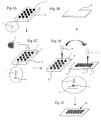
- FIGs 3A to 3C are diagrams for illustrating the principle of hybridization using the biochip 20 of the invention.
- a sample DNA 11 labeled with a fluorescent substance 10 is placed together with the biochip 20 in a hybridization solution for hybridization.
- the probe DNAs 1 are spotted on the glass plate 3 via the binding agent 4 in the biochip 20.
- the hybridization solution contains formaldehyde, SSC (NaCl, trisodium citrate), SDS (sodium dodecyl sulfate), EDTA (ethylenediamidetetraacetic acid) and distilled water where the mixing ratio differs depending on the characteristic of the DNA used.
- a biochip can be produced in which a binding agent is locally spotted only where probes are to be spotted.
- the detection sensitivity upon reading the biochip can be enhanced.
Landscapes
- Chemical & Material Sciences (AREA)
- Health & Medical Sciences (AREA)
- Life Sciences & Earth Sciences (AREA)
- Immunology (AREA)
- Engineering & Computer Science (AREA)
- Organic Chemistry (AREA)
- Chemical Kinetics & Catalysis (AREA)
- General Health & Medical Sciences (AREA)
- Hematology (AREA)
- Molecular Biology (AREA)
- Analytical Chemistry (AREA)
- Biochemistry (AREA)
- Proteomics, Peptides & Aminoacids (AREA)
- Biomedical Technology (AREA)
- Physics & Mathematics (AREA)
- Urology & Nephrology (AREA)
- Microbiology (AREA)
- Clinical Laboratory Science (AREA)
- Zoology (AREA)
- Wood Science & Technology (AREA)
- Biotechnology (AREA)
- Cell Biology (AREA)
- Biophysics (AREA)
- Pathology (AREA)
- General Physics & Mathematics (AREA)
- Bioinformatics & Cheminformatics (AREA)
- General Engineering & Computer Science (AREA)
- Genetics & Genomics (AREA)
- Food Science & Technology (AREA)
- Medicinal Chemistry (AREA)
- Apparatus Associated With Microorganisms And Enzymes (AREA)
- Investigating Or Analyzing Non-Biological Materials By The Use Of Chemical Means (AREA)
- Measuring Or Testing Involving Enzymes Or Micro-Organisms (AREA)
Applications Claiming Priority (3)
| Application Number | Priority Date | Filing Date | Title |
|---|---|---|---|
| JP10341604A JP2000157272A (ja) | 1998-12-01 | 1998-12-01 | バイオチップ及びその製造方法 |
| JP34160498 | 1998-12-01 | ||
| EP99123786A EP1006363A3 (fr) | 1998-12-01 | 1999-11-30 | Biopuce et son procédé de production |
Related Parent Applications (1)
| Application Number | Title | Priority Date | Filing Date |
|---|---|---|---|
| EP99123786A Division EP1006363A3 (fr) | 1998-12-01 | 1999-11-30 | Biopuce et son procédé de production |
Publications (2)
| Publication Number | Publication Date |
|---|---|
| EP1281967A2 true EP1281967A2 (fr) | 2003-02-05 |
| EP1281967A3 EP1281967A3 (fr) | 2004-02-04 |
Family
ID=18347370
Family Applications (2)
| Application Number | Title | Priority Date | Filing Date |
|---|---|---|---|
| EP99123786A Withdrawn EP1006363A3 (fr) | 1998-12-01 | 1999-11-30 | Biopuce et son procédé de production |
| EP02017951A Withdrawn EP1281967A3 (fr) | 1998-12-01 | 1999-11-30 | Biopuce et son procédé de production |
Family Applications Before (1)
| Application Number | Title | Priority Date | Filing Date |
|---|---|---|---|
| EP99123786A Withdrawn EP1006363A3 (fr) | 1998-12-01 | 1999-11-30 | Biopuce et son procédé de production |
Country Status (2)
| Country | Link |
|---|---|
| EP (2) | EP1006363A3 (fr) |
| JP (1) | JP2000157272A (fr) |
Cited By (3)
| Publication number | Priority date | Publication date | Assignee | Title |
|---|---|---|---|---|
| WO2004081570A1 (fr) * | 2003-03-13 | 2004-09-23 | Chengdu Kuachang Medical Industrial Limited | Matrice de puce, puce comprenant une matrice et leur preparation et application |
| WO2007099328A1 (fr) * | 2006-03-02 | 2007-09-07 | The University Court Of The University Of Glasgow | Procédés et moyens pour immobiliser des acides nucléiques sur des supports solides, et leurs utilisations |
| RU2705593C1 (ru) * | 2019-06-28 | 2019-11-11 | Общество с ограниченной ответственностью Владикавказский Технологический центр "Баспик" (ООО ВТЦ "Баспик") | Способ изготовления волоконно-оптической матрицы для биочипа (варианты) |
Families Citing this family (7)
| Publication number | Priority date | Publication date | Assignee | Title |
|---|---|---|---|---|
| US7407746B2 (en) | 2001-02-08 | 2008-08-05 | Ngk Insulators, Ltd. | Biochip and method for producing the same |
| JP4554110B2 (ja) * | 2001-05-16 | 2010-09-29 | Kisco株式会社 | Dnaチップ用結合剤、dnaチップ、およびdnaチップの製造方法 |
| JPWO2003027673A1 (ja) * | 2001-07-31 | 2005-01-13 | オリンパス株式会社 | 遺伝子検査装置およびそれを用いた標的核酸検出方法 |
| WO2003029490A1 (fr) * | 2001-10-01 | 2003-04-10 | Yingjian Wang | Procedes et reseaux de detection de molecules biologiques |
| JP4426968B2 (ja) * | 2002-09-17 | 2010-03-03 | オリンパス株式会社 | 基体上での複数成分間の反応によりターゲット物質を検出するために基体表面に液状反応成分を配置する方法および装置、並びにこの方法に使用するための物品 |
| FR2921002B1 (fr) * | 2007-09-13 | 2010-11-12 | Innopsys | Procede de depot simultane d'un ensemble de motifs sur un substrat par un macro timbre |
| KR101065078B1 (ko) | 2008-11-05 | 2011-09-15 | 삼성전자주식회사 | 바이오칩용 기판 및 그 제조 방법 |
Family Cites Families (16)
| Publication number | Priority date | Publication date | Assignee | Title |
|---|---|---|---|---|
| DE2852886A1 (de) * | 1978-12-07 | 1980-06-19 | Feinmetall Gmbh | Kontaktbaustein |
| US4591570A (en) * | 1983-02-02 | 1986-05-27 | Centocor, Inc. | Matrix of antibody-coated spots for determination of antigens |
| US5262128A (en) * | 1989-10-23 | 1993-11-16 | The United States Of America As Represented By The Department Of Health And Human Services | Array-type multiple cell injector |
| DE4024544A1 (de) * | 1990-08-02 | 1992-02-06 | Boehringer Mannheim Gmbh | Analyseelement und verfahren zu seiner herstellung |
| US5457041A (en) * | 1994-03-25 | 1995-10-10 | Science Applications International Corporation | Needle array and method of introducing biological substances into living cells using the needle array |
| US5557213A (en) * | 1994-12-01 | 1996-09-17 | Everett Charles Technologies, Inc. | Spring-loaded electrical contact probe |
| US5731152A (en) * | 1996-05-13 | 1998-03-24 | Motorola, Inc. | Methods and systems for biological reagent placement |
| DE69735112T2 (de) * | 1996-11-06 | 2006-09-07 | Sequenom, Inc., San Diego | Verfahren zur Analyse und Vorrichtung |
| WO1998020019A1 (fr) * | 1996-11-06 | 1998-05-14 | Sequenom, Inc. | Compositions et procedes d'immobilisation d'acides nucleiques sur des supports solides |
| HUP0003296A3 (en) * | 1997-07-22 | 2001-09-28 | Qiagen Genomics Inc Bothell | Apparatus and methods for arraying solution onto a solid support |
| CA2297175A1 (fr) * | 1997-07-22 | 1999-02-04 | Jeffrey Van Ness | Alignements de biomolecules reposant sur une base de polyethylenimine |
| JP4313861B2 (ja) * | 1997-08-01 | 2009-08-12 | キヤノン株式会社 | プローブアレイの製造方法 |
| US6326489B1 (en) * | 1997-08-05 | 2001-12-04 | Howard Hughes Medical Institute | Surface-bound, bimolecular, double-stranded DNA arrays |
| JP2000033712A (ja) * | 1997-09-30 | 2000-02-02 | Seiko Epson Corp | マイクロセンサーデバイス作成方法及びそれを用いた液体機能評価方法 |
| US6048695A (en) * | 1998-05-04 | 2000-04-11 | Baylor College Of Medicine | Chemically modified nucleic acids and methods for coupling nucleic acids to solid support |
| EP1129008A4 (fr) * | 1998-07-07 | 2001-12-05 | Cartesian Technology Inc | Modele de pointe et matrice a acces selectif pour transfert micro-fluidique |
-
1998
- 1998-12-01 JP JP10341604A patent/JP2000157272A/ja active Pending
-
1999
- 1999-11-30 EP EP99123786A patent/EP1006363A3/fr not_active Withdrawn
- 1999-11-30 EP EP02017951A patent/EP1281967A3/fr not_active Withdrawn
Cited By (3)
| Publication number | Priority date | Publication date | Assignee | Title |
|---|---|---|---|---|
| WO2004081570A1 (fr) * | 2003-03-13 | 2004-09-23 | Chengdu Kuachang Medical Industrial Limited | Matrice de puce, puce comprenant une matrice et leur preparation et application |
| WO2007099328A1 (fr) * | 2006-03-02 | 2007-09-07 | The University Court Of The University Of Glasgow | Procédés et moyens pour immobiliser des acides nucléiques sur des supports solides, et leurs utilisations |
| RU2705593C1 (ru) * | 2019-06-28 | 2019-11-11 | Общество с ограниченной ответственностью Владикавказский Технологический центр "Баспик" (ООО ВТЦ "Баспик") | Способ изготовления волоконно-оптической матрицы для биочипа (варианты) |
Also Published As
| Publication number | Publication date |
|---|---|
| EP1006363A2 (fr) | 2000-06-07 |
| EP1281967A3 (fr) | 2004-02-04 |
| JP2000157272A (ja) | 2000-06-13 |
| EP1006363A3 (fr) | 2000-08-16 |
Similar Documents
| Publication | Publication Date | Title |
|---|---|---|
| KR100421262B1 (ko) | 분석 실행 장치, 그 장치의 제조 방법 및 그 장치의 제조에 멤브레인을 사용하는 방법 | |
| US6653151B2 (en) | Dry deposition of materials for microarrays using matrix displacement | |
| US7070922B2 (en) | Surface treatment | |
| JPH09269325A (ja) | 凸状領域を用いた分析方法 | |
| JP3872227B2 (ja) | 新規の生物学的チップ及び分析方法 | |
| JP2003156493A (ja) | 複数の異なる結合剤を固体支持体の分離された位置に固定化させる方法 | |
| EP1281967A2 (fr) | Biopuce et son procédé de production | |
| CN102971629A (zh) | 微阵列 | |
| US6399299B1 (en) | Amplified array analysis system | |
| US20030194700A1 (en) | Biochip and method for producing the same | |
| AU2002230290A1 (en) | Arrays for determining binding of biomolecules | |
| WO2002066984A2 (fr) | Reseaux de pixels | |
| US7700371B2 (en) | Method for determining an analyte | |
| JP4037795B2 (ja) | スポットピン | |
| US20090171052A1 (en) | Polyelectrolyte Monolayers and Multilayers for Optical Signal Transducers | |
| CA2449224A1 (fr) | Procede de determination d'un analyte | |
| JP2005010004A (ja) | バイオチップ | |
| JP2003329676A (ja) | 生化学検体の検出方法と検出チップ | |
| Ligler et al. | Fluorescence Array Biosensor Part 2: Biochemistry and Application | |
| JP2006170717A (ja) | 蛋白質及びペプチドの検出方法 | |
| FR2839783A1 (fr) | Nouvelle disposition des sites de liaison d'une biopuce |
Legal Events
| Date | Code | Title | Description |
|---|---|---|---|
| PUAI | Public reference made under article 153(3) epc to a published international application that has entered the european phase |
Free format text: ORIGINAL CODE: 0009012 |
|
| 17P | Request for examination filed |
Effective date: 20020809 |
|
| AC | Divisional application: reference to earlier application |
Ref document number: 1006363 Country of ref document: EP Kind code of ref document: P |
|
| AK | Designated contracting states |
Designated state(s): DE FR GB |
|
| PUAL | Search report despatched |
Free format text: ORIGINAL CODE: 0009013 |
|
| AK | Designated contracting states |
Kind code of ref document: A3 Designated state(s): DE FR GB |
|
| STAA | Information on the status of an ep patent application or granted ep patent |
Free format text: STATUS: THE APPLICATION HAS BEEN WITHDRAWN |
|
| 18W | Application withdrawn |
Effective date: 20040218 |