EP1282249A2 - Verfahren zur Verwaltung von Mehrfachfehlern unterschiedlichen Types in Nachrichtenübertragungsnetzwerken mit Ring-Topologie - Google Patents
Verfahren zur Verwaltung von Mehrfachfehlern unterschiedlichen Types in Nachrichtenübertragungsnetzwerken mit Ring-Topologie Download PDFInfo
- Publication number
- EP1282249A2 EP1282249A2 EP02291740A EP02291740A EP1282249A2 EP 1282249 A2 EP1282249 A2 EP 1282249A2 EP 02291740 A EP02291740 A EP 02291740A EP 02291740 A EP02291740 A EP 02291740A EP 1282249 A2 EP1282249 A2 EP 1282249A2
- Authority
- EP
- European Patent Office
- Prior art keywords
- ring
- network
- protection
- failure
- span
- Prior art date
- Legal status (The legal status is an assumption and is not a legal conclusion. Google has not performed a legal analysis and makes no representation as to the accuracy of the status listed.)
- Withdrawn
Links
Images





Classifications
-
- H—ELECTRICITY
- H04—ELECTRIC COMMUNICATION TECHNIQUE
- H04L—TRANSMISSION OF DIGITAL INFORMATION, e.g. TELEGRAPHIC COMMUNICATION
- H04L12/00—Data switching networks
- H04L12/28—Data switching networks characterised by path configuration, e.g. LAN [Local Area Networks] or WAN [Wide Area Networks]
- H04L12/42—Loop networks
-
- H—ELECTRICITY
- H04—ELECTRIC COMMUNICATION TECHNIQUE
- H04J—MULTIPLEX COMMUNICATION
- H04J3/00—Time-division multiplex systems
- H04J3/02—Details
- H04J3/08—Intermediate station arrangements, e.g. for branching, for tapping-off
- H04J3/085—Intermediate station arrangements, e.g. for branching, for tapping-off for ring networks, e.g. SDH/SONET rings, self-healing rings, meashed SDH/SONET networks
-
- H—ELECTRICITY
- H04—ELECTRIC COMMUNICATION TECHNIQUE
- H04J—MULTIPLEX COMMUNICATION
- H04J2203/00—Aspects of optical multiplex systems other than those covered by H04J14/05 and H04J14/07
- H04J2203/0001—Provisions for broadband connections in integrated services digital network using frames of the Optical Transport Network [OTN] or using synchronous transfer mode [STM], e.g. SONET, SDH
- H04J2203/0028—Local loop
- H04J2203/0039—Topology
- H04J2203/0042—Ring
-
- H—ELECTRICITY
- H04—ELECTRIC COMMUNICATION TECHNIQUE
- H04J—MULTIPLEX COMMUNICATION
- H04J2203/00—Aspects of optical multiplex systems other than those covered by H04J14/05 and H04J14/07
- H04J2203/0001—Provisions for broadband connections in integrated services digital network using frames of the Optical Transport Network [OTN] or using synchronous transfer mode [STM], e.g. SONET, SDH
- H04J2203/0057—Operations, administration and maintenance [OAM]
- H04J2203/006—Fault tolerance and recovery
Definitions
- the present invention relates to the field of telecommunication ring networks and in particular to four-fiber ring topology networks where the traffic is protected by a shared MS-SPRING type mechanism. Still more in particular, it concerns how to manage possible scenarios of multiple failures of different type in such networks.
- optical fiber networks with a ring topology comprising a certain number of network nodes or elements interconnected by fiber spans in order to form a ring are known.
- the traffic in such networks is carried along the so-called paths, namelly circuits interconnecting two or more ring network elements.
- MS-SPRING Multiplexed-Shared Protection Ring
- the available band is divided into two-parts: the high priority channels (to be protected in case of failure of the ring) and the low priority channels (which are not protected and, in case of failure, are squelched).
- the high priority channels to be protected in case of failure of the ring
- the low priority channels which are not protected and, in case of failure, are squelched.
- two adjacent nodes are interconnected by four fibers (two fibers in a direction and two in the opposite one); in absence of failures, the high priority channels (indicated by the HP sign) occupy the working fiber, while the low priority channels (LP) occupy the protection fiber, till this is not required to perform ring protections.
- a span failure is defined as the break (or degradation) of one of, or both, the working fibers interconnecting two nodes, or of one of, or both, the protecting fibers; in the first case (working fibers involved in the break) the span type protection forecasts that the whole HP traffic be recovered by re-routing it onto the protection fiber of the same span.
- a ring failure is defined as the break (or degradation) of both the working fiber and the protection fiber between two adjacent nodes. In such a case, it is foreseen a ring type protection, which provides for re-routing the HP traffic, which is lost due to the break, in the direction opposite to the failure by utilizing the LP channels.
- the ring topology guarantees that, in case of a single failure, all the high priority traffic is restored. Nevertheless, the situation becomes critical when multiple failures are present in the ring: in order to maximize the protected traffic, each node should report all the failures and the local commands, in order to notify its requests to the whole ring.
- the management of protection for ring networks is standardized by the International Organisms ITU (Recommendation ITU-T G.841, Annex A) and ETSI.
- the protection protocol is based upon a pair of bytes K1, K2 of the SDH (or SONET) frame, and in particular of its MSOH section.
- ring protection In the case of ring protection, all the nodes act directly, so that the signaling can travel around the whole ring, and possibly implement some actions upon the traffic.
- a necessary condition for the management of the ring protection is that the signaling arrives at all the nodes (signaling on the long path) which will be set in a pass-through state (only the termination nodes will be in a Bridge & Switch status).
- a status code synchronizes the actions to be undertaken in order to avoid flow misconnections.
- the ITU-T G. 841 Recommendation foresees that more span or ring type requests are served in the same time on the ring, but there are no provisions for managing ring and span requests at the same time; in such a case, the traffic which passes through the span affected by a span failure is protected, but not the traffic which passes through the ring failure (the ring protection, if any, is eliminated).
- HP flows of a) and b) types are guaranteed; the HP flows of c) type are not protected, because they pass through the ring failure; the HP flows of d) type are protected in the span wherein the span protection is performed but they become lost at the point where they pass through the ring failure.
- HP flows of d) type are protected in the span wherein the span protection is performed but they become lost at the point where they pass through the ring failure.
- the main object of the present invention is providing a method of managing multiple failures of different types (ring and span failures) in transoceanic telecommunications networks having a ring topology.
- the object of the present invention is to provide a method for the automatic protection of a ring network which could save as much as HP traffic is possible.
- the basic idea of the present invention consists in implementing a coexistence, in the ring network, of ring and span protections and in individually handling each HP flow.
- no protection shall be implemented;
- the span protection shall be implemented;
- the ring protection shall be implemented;
- the ring protection shall be implemented;
- the ring protection is implemented only if there are available resources (band), namely if the corresponding LP flow is not utilized for implementing a span protection.
- the recovery of the HP traffic is higher than in the known mechanisms. Furthermore, the mechanism according to the present invention maintains the priority between span and ring protections, as suggested by the mentioned Recommendations.
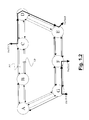
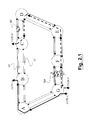
- Figures 1.1 e 1.2 show a ring network with a plurality of nodes (A, B, ...G) connected through four-fiber spans that have been schematically illustrated by arrows: a pair of arrows represent the working channels (HP) and the other pair represents the protection channels (LP).
- a plurality of protected paths are installed in the ring to bring information from a node to a further node.
- the PATH A in Fig. 1.1 is inserted into the node (or Network Element) G and dropped in the node B; the PATH B of Fig. 1.2 is inserted in the node C and dropped in the node E; the PATH C of Fig. 1.2 is inserted in the node G and dropped in the node F; finally, the PATH D of Fig. 1.1 is inserted in the node G and dropped in the node C.
- Each path of the ring network uses proper network resources.
- the traffic concerning a path is carried in a STM-n, and therefore into a corresponding AU contained in the STM-n.
- a flow passes through a network element occupying AU that have different input and output numbers (Time Slot Interchange mechanism).
- the MS-SPRING mechanism manages the single failure in a conventional manner and all the HP traffic can be saved. Should multiple failures of different type (i.d. a double failure of span and ring type) occur, the Standards foresees a priority for the span failure (the ring type protection, if already present, should be eliminated).
- the basic idea of the present invention consists in individually considering the various paths that are installed in the ring network and in evaluating if they pass through a single (ring or span single failure), a multiple failure of the same type (for instance, a double ring-type failure), a multiple failure of different type (for instance, a ring failure and a span failure) or if they do not pass through any failure.
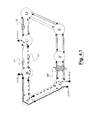
- the PATH A does not pass through any failure and therefore, no protection shall be performed on it (the PATH A' coincides with the PATH A).
- the PATH B passes through a single span type failure and a span protection shall be performed on it, thus obtaining the PATH B'.
- the PATH D passes through a double failure of different type (a ring failure in the F-G span and a span failure in the C-D span) and a ring protection shall be performed on it, thus obtaining the PATH D'.
- the PATH C passes through a single ring type failure (in the F-G path) and therefore, it is necessary to check that the LP resources to be utilized for the ring re-routing are not presently utilized for performing a span protection.
- the PATH C is originally installed on the AU-4#x HP (with x ranging from 1 to n) and the PATH B, at least as the span C-D is concerned, is installled on the AU-4#y HP (y still ranging from 1 to n).
- the PATH C can not be saved, the LP channels (possibly utilized for the LP traffic) will not sacrified. The highest priority of a span failure vis-à-vis a ring failure is nevertheless complied with.
- each node of the ring network be informed about the map of the HP traffic and the map of the LP traffic, as well as about all the failures (and their location) possibly present in the network.
- each node shoul havethe possibility to manage the signalings for both the protections. This information allow the node to know which HP flows could be saved and which could not because are not recoverable.
- the signaling has to show at the same time the presence of the span and ring type failures which are present in the ring.
- the "fish-bone" graphs (similar to those utilized in the Recommendation ITU-T G. 841) shown in the Figures 5 and 6 illustrate in a schematic manner what happens in a ring network in the case of a further failure, in addition to an already existing failure.
- the Fig. 5 considers the occurrence of a ring failure in the presence of a span protection (of higher priority) which is already active on the ring network
- the Fig. 6 considers the occurrence of a span failure (of higher priority) in the presence of an active ring protection.
- a signaling is transmitted in order to allow the coexistence of both the ring and span protections in the ring.
- a ring failure occurs between nodes F and G, initially signalled by the node F through appropriate signalings (2SF+1RF, 2 nd stage of Span Failure + 1 st stage of Ring Failure).
- RF ring failure
- nodes F and G Upon receipt of this signaling by the nodes which are adjacent to the ring failure (nodes F and G), all the other nodes are ready to manage the ring protection for the paths which pass through both the failures.
- the nodes adjacent to the span failure release the span protection and implement the ring protection for those paths which cross through both the failures. Then, each node implements the bridge and switch actions for the ring failure. At the end of these actions, the nodes which are adjacent to the ring failure transmit signalings which indicate the completion of the ring protection (2SF+2RF, 2 nd stage of Span Failure + 2 nd stage of Ring Failure).
- Fig. 6 suppose to start from a situation of single ring failure between nodes F and G wherein the various nodes have already performed the necessary bridge and switch actions and signalings of 2RF type (2 nd stage of Ring Failure) are travelling in the ring network.
- a span failure occurs between the nodes C and D, initially signaled by the node D with appropriate signalings (2RF+1SF, 2 nd stage of Ring Failure + 1 st stage of Span Failure).
- SF span failure
- all the other nodes remove the ring protections, if the span protection requires corresponding LP paths.
- the nodes which are adjacent to the ring failure transmit appropriate signalings (2SF+2RF, 2 nd stage of Span Failure + 2 nd stage of Ring Failure).
- the scope of the present invention is extended also to a node or network element which is able to implement the method steps.
- the method of the present invention can be implemented both in hardware and in software and therefore the field of the present invention is extended also to a software program for implementing the method and to a memory means wherein the software program is stored.
Landscapes
- Engineering & Computer Science (AREA)
- Computer Networks & Wireless Communication (AREA)
- Signal Processing (AREA)
- Small-Scale Networks (AREA)
- Monitoring And Testing Of Transmission In General (AREA)
- Monitoring And Testing Of Exchanges (AREA)
Applications Claiming Priority (2)
| Application Number | Priority Date | Filing Date | Title |
|---|---|---|---|
| ITMI20011657 | 2001-07-31 | ||
| IT2001MI001657A ITMI20011657A1 (it) | 2001-07-31 | 2001-07-31 | Metodo per gestire guasti plurimi di diverso tipo in reti per telecomunicazioni con topologia ad anello |
Publications (2)
| Publication Number | Publication Date |
|---|---|
| EP1282249A2 true EP1282249A2 (de) | 2003-02-05 |
| EP1282249A3 EP1282249A3 (de) | 2004-08-11 |
Family
ID=11448189
Family Applications (1)
| Application Number | Title | Priority Date | Filing Date |
|---|---|---|---|
| EP02291740A Withdrawn EP1282249A3 (de) | 2001-07-31 | 2002-07-11 | Verfahren zur Verwaltung von Mehrfachfehlern unterschiedlichen Types in Nachrichtenübertragungsnetzwerken mit Ring-Topologie |
Country Status (3)
| Country | Link |
|---|---|
| US (1) | US20030026203A1 (de) |
| EP (1) | EP1282249A3 (de) |
| IT (1) | ITMI20011657A1 (de) |
Cited By (3)
| Publication number | Priority date | Publication date | Assignee | Title |
|---|---|---|---|---|
| EP1471673A1 (de) * | 2003-04-22 | 2004-10-27 | Alcatel | Verfahren zur Verwendung der gesamten Resourcenkapazität in einem SDH-Netzwerk mit einem Verkerrsschutzmechanismus, in Gegenwart von einem paketorientierten Datennetzwerk, und dazugehörender Apparat zur Durchführung des Verfahrens |
| WO2010145574A1 (zh) * | 2009-10-29 | 2010-12-23 | 中兴通讯股份有限公司 | 视频监控业务恢复的方法和系统 |
| WO2011017863A1 (zh) * | 2009-08-12 | 2011-02-17 | 中兴通讯股份有限公司 | 光数据单元环路共享保护控制方法与装置 |
Families Citing this family (2)
| Publication number | Priority date | Publication date | Assignee | Title |
|---|---|---|---|---|
| IL151796A0 (en) * | 2002-09-18 | 2003-04-10 | Lightscape Networks Ltd | Method for protection of ethernet traffic in optical ring networks |
| JP2009231906A (ja) * | 2008-03-19 | 2009-10-08 | Nec Corp | データ伝送システム、伝送装置、およびプロテクション制御方法 |
Family Cites Families (4)
| Publication number | Priority date | Publication date | Assignee | Title |
|---|---|---|---|---|
| US6144633A (en) * | 1996-04-23 | 2000-11-07 | Hitachi, Ltd. | Self-healing network, method for transmission line switching thereof, and transmission equipment thereof |
| IT1304049B1 (it) * | 1998-12-23 | 2001-03-07 | Cit Alcatel | Metodo per ottimizzare,in caso di guasto,la disponibilita' dei canalia bassa priorita' in un anello transoceanico a fibra ottica tipo ms-sp |
| JP3765956B2 (ja) * | 1999-12-27 | 2006-04-12 | 富士通株式会社 | 双方向リング切り替え方法及びその装置 |
| US6859431B1 (en) * | 2000-01-28 | 2005-02-22 | Ciena Corporation | System and method for calculating protection routes in a network prior to failure |
-
2001
- 2001-07-31 IT IT2001MI001657A patent/ITMI20011657A1/it unknown
-
2002
- 2002-07-11 EP EP02291740A patent/EP1282249A3/de not_active Withdrawn
- 2002-07-16 US US10/195,557 patent/US20030026203A1/en not_active Abandoned
Cited By (7)
| Publication number | Priority date | Publication date | Assignee | Title |
|---|---|---|---|---|
| EP1471673A1 (de) * | 2003-04-22 | 2004-10-27 | Alcatel | Verfahren zur Verwendung der gesamten Resourcenkapazität in einem SDH-Netzwerk mit einem Verkerrsschutzmechanismus, in Gegenwart von einem paketorientierten Datennetzwerk, und dazugehörender Apparat zur Durchführung des Verfahrens |
| CN100382537C (zh) * | 2003-04-22 | 2008-04-16 | 阿尔卡特公司 | 同步数字系列网全部资源容量的使用方法及装置 |
| US7370107B2 (en) | 2003-04-22 | 2008-05-06 | Alcatel | Method for using the complete resource capacity of a synchronous digital hierarchy network, subject to a protection mechanism, in the presence of data (packet) network, and relating apparatus for the implementation of the method |
| WO2011017863A1 (zh) * | 2009-08-12 | 2011-02-17 | 中兴通讯股份有限公司 | 光数据单元环路共享保护控制方法与装置 |
| WO2010145574A1 (zh) * | 2009-10-29 | 2010-12-23 | 中兴通讯股份有限公司 | 视频监控业务恢复的方法和系统 |
| CN101699861B (zh) * | 2009-10-29 | 2013-10-16 | 中兴通讯股份有限公司 | 视频监控业务恢复的方法和系统 |
| RU2517330C2 (ru) * | 2009-10-29 | 2014-05-27 | ЗетТиИ Корпорейшн | Способ и система для восстановления службы видеонаблюдения |
Also Published As
| Publication number | Publication date |
|---|---|
| EP1282249A3 (de) | 2004-08-11 |
| ITMI20011657A0 (it) | 2001-07-31 |
| ITMI20011657A1 (it) | 2003-01-31 |
| US20030026203A1 (en) | 2003-02-06 |
Similar Documents
| Publication | Publication Date | Title |
|---|---|---|
| JP3814296B2 (ja) | Sdhネットワークにおける同期 | |
| US6246667B1 (en) | Backwards-compatible failure restoration in bidirectional multiplex section-switched ring transmission systems | |
| US7082137B2 (en) | Method of managing time-slot interchange in transoceanic MS-SPRING networks | |
| EP1411665A1 (de) | Verfahren und Vorrichtung für verteilten Schutz in einem optischen Ringtransportnetz basierend auf einer ODU-Verwaltung | |
| CN1333554C (zh) | 一种复用段保护和格状网恢复结合的方法 | |
| EP1158831B1 (de) | Verbindung zwischen MS-SPRING und SNCP Ring-Telekommunikationsnetzwerken | |
| US7054558B2 (en) | Method for traffic protection in WDM fiber optic transport networks | |
| US20030026203A1 (en) | Method of managing different type multiple failures in ring topology telecommunication networks | |
| EP1185014A2 (de) | Verfahren zum Zeitschlitztausch in klassischen MS-SPRING Netzwerken | |
| EP1235373B1 (de) | Verfahren zur Verwaltung mehrfacher Fehler verschiedener Art in einem ringförmigen Nachrichtenübertragungsnetzwerk | |
| EP1122903A2 (de) | Verfahren zur Identifizierung der aktuellen Route von Pfaden in Nachrichtenübertragungsnetzwerken des Types MS-SPRING | |
| US7355967B2 (en) | Transmission device | |
| EP1217789B1 (de) | Verfahren zur autoregeneration und wiederherstellung von verkehr | |
| EP1059772A2 (de) | Verfahren zur Wiederherstellung unidirektionaler Rundsendewege in transozeanischen MS-SP Übertragungsringen | |
| US7974185B2 (en) | Three fiber line switched ring | |
| EP1263259A2 (de) | Verfahren zur Verwaltung von Verkehrsschutz in OMS-SPRING Ringnetze | |
| EP1237311A2 (de) | Verfahren zur Verwaltung des Übergangs von einem Ringfehler zu einem Linienfehler in einem Nachrichtenübertragungsnetzwerk mit Ringtopologie | |
| EP1128702A2 (de) | Verkehrsschützmechanismus für faseroptisches Netz mit linearer Topology | |
| EP1224759B1 (de) | Signalisierung von fehlern in nachrichtenübertragungsnetzwerken | |
| US20050122913A1 (en) | Frame for optimized signalling of span and ring events in a four-fibre synchronous telecommunications network with ring topology, by using the K bytes | |
| US20060067211A1 (en) | Node device, communication system and method for redundancy configuration | |
| EP1900129B1 (de) | Verfahren zum übertragen eines lcas-protokolls über eine optische kommunikationsleitung | |
| EP1014602A2 (de) | Verfahren zur Umleitung von Wegen zwischen einen Knoten in einem MS-SP Ring und einen Knoten in einem anderen Ring beim Ausfall |
Legal Events
| Date | Code | Title | Description |
|---|---|---|---|
| PUAI | Public reference made under article 153(3) epc to a published international application that has entered the european phase |
Free format text: ORIGINAL CODE: 0009012 |
|
| AK | Designated contracting states |
Designated state(s): AT BE BG CH CY CZ DE DK EE ES FI FR GB GR IE IT LI LU MC NL PT SE SK TR |
|
| AX | Request for extension of the european patent |
Extension state: AL LT LV MK RO SI |
|
| PUAL | Search report despatched |
Free format text: ORIGINAL CODE: 0009013 |
|
| AK | Designated contracting states |
Kind code of ref document: A3 Designated state(s): AT BE BG CH CY CZ DE DK EE ES FI FR GB GR IE IT LI LU MC NL PT SE SK TR |
|
| AX | Request for extension of the european patent |
Extension state: AL LT LV MK RO SI |
|
| 17P | Request for examination filed |
Effective date: 20041005 |
|
| 17Q | First examination report despatched |
Effective date: 20050127 |
|
| AKX | Designation fees paid |
Designated state(s): AT BE BG CH CY CZ DE DK EE ES FI FR GB GR IE IT LI LU MC NL PT SE SK TR |
|
| STAA | Information on the status of an ep patent application or granted ep patent |
Free format text: STATUS: THE APPLICATION IS DEEMED TO BE WITHDRAWN |
|
| 18D | Application deemed to be withdrawn |
Effective date: 20050809 |