EP1282274A2 - Unité pour un réseau de type maitre esclave synchrones - Google Patents
Unité pour un réseau de type maitre esclave synchrones Download PDFInfo
- Publication number
- EP1282274A2 EP1282274A2 EP02017402A EP02017402A EP1282274A2 EP 1282274 A2 EP1282274 A2 EP 1282274A2 EP 02017402 A EP02017402 A EP 02017402A EP 02017402 A EP02017402 A EP 02017402A EP 1282274 A2 EP1282274 A2 EP 1282274A2
- Authority
- EP
- European Patent Office
- Prior art keywords
- access
- cycle
- monitoring device
- memory
- computing unit
- Prior art date
- Legal status (The legal status is an assumption and is not a legal conclusion. Google has not performed a legal analysis and makes no representation as to the accuracy of the status listed.)
- Withdrawn
Links
- 230000001360 synchronised effect Effects 0.000 title 1
- 238000012806 monitoring device Methods 0.000 claims abstract description 53
- 238000004891 communication Methods 0.000 claims abstract description 47
- 230000015654 memory Effects 0.000 claims abstract description 46
- 230000005540 biological transmission Effects 0.000 claims abstract description 10
- 238000013475 authorization Methods 0.000 claims abstract description 6
- 238000012544 monitoring process Methods 0.000 claims description 6
- 230000002123 temporal effect Effects 0.000 claims description 4
- 238000000034 method Methods 0.000 abstract description 26
- 230000008569 process Effects 0.000 abstract description 24
- 238000001514 detection method Methods 0.000 abstract description 7
- 125000004122 cyclic group Chemical group 0.000 abstract description 3
- 238000012545 processing Methods 0.000 description 22
- 125000002015 acyclic group Chemical group 0.000 description 16
- 238000010586 diagram Methods 0.000 description 10
- 230000008901 benefit Effects 0.000 description 6
- 230000008878 coupling Effects 0.000 description 6
- 238000010168 coupling process Methods 0.000 description 6
- 238000005859 coupling reaction Methods 0.000 description 6
- 230000000694 effects Effects 0.000 description 4
- 230000003993 interaction Effects 0.000 description 4
- 238000005259 measurement Methods 0.000 description 4
- 230000004913 activation Effects 0.000 description 3
- 230000008859 change Effects 0.000 description 3
- 238000011161 development Methods 0.000 description 3
- 230000018109 developmental process Effects 0.000 description 3
- 229910000831 Steel Inorganic materials 0.000 description 2
- 230000009471 action Effects 0.000 description 2
- 230000007257 malfunction Effects 0.000 description 2
- 238000010327 methods by industry Methods 0.000 description 2
- 210000002023 somite Anatomy 0.000 description 2
- 239000010959 steel Substances 0.000 description 2
- 238000012546 transfer Methods 0.000 description 2
- 230000006399 behavior Effects 0.000 description 1
- 230000033228 biological regulation Effects 0.000 description 1
- 230000002860 competitive effect Effects 0.000 description 1
- 230000003111 delayed effect Effects 0.000 description 1
- 230000001419 dependent effect Effects 0.000 description 1
- 238000006073 displacement reaction Methods 0.000 description 1
- 230000009977 dual effect Effects 0.000 description 1
- 230000006870 function Effects 0.000 description 1
- 230000006872 improvement Effects 0.000 description 1
- 238000009434 installation Methods 0.000 description 1
- 230000007246 mechanism Effects 0.000 description 1
- 238000005457 optimization Methods 0.000 description 1
- 230000004044 response Effects 0.000 description 1
- 238000005096 rolling process Methods 0.000 description 1
- 238000003860 storage Methods 0.000 description 1
- 238000012360 testing method Methods 0.000 description 1
- 230000001960 triggered effect Effects 0.000 description 1
Images

Classifications
-
- H—ELECTRICITY
- H04—ELECTRIC COMMUNICATION TECHNIQUE
- H04L—TRANSMISSION OF DIGITAL INFORMATION, e.g. TELEGRAPHIC COMMUNICATION
- H04L12/00—Data switching networks
- H04L12/28—Data switching networks characterised by path configuration, e.g. LAN [Local Area Networks] or WAN [Wide Area Networks]
- H04L12/40—Bus networks
- H04L12/407—Bus networks with decentralised control
- H04L12/417—Bus networks with decentralised control with deterministic access, e.g. token passing
-
- H—ELECTRICITY
- H04—ELECTRIC COMMUNICATION TECHNIQUE
- H04L—TRANSMISSION OF DIGITAL INFORMATION, e.g. TELEGRAPHIC COMMUNICATION
- H04L12/00—Data switching networks
- H04L12/28—Data switching networks characterised by path configuration, e.g. LAN [Local Area Networks] or WAN [Wide Area Networks]
- H04L12/40—Bus networks
- H04L12/40006—Architecture of a communication node
- H04L12/40026—Details regarding a bus guardian
-
- H—ELECTRICITY
- H04—ELECTRIC COMMUNICATION TECHNIQUE
- H04L—TRANSMISSION OF DIGITAL INFORMATION, e.g. TELEGRAPHIC COMMUNICATION
- H04L12/00—Data switching networks
- H04L12/28—Data switching networks characterised by path configuration, e.g. LAN [Local Area Networks] or WAN [Wide Area Networks]
- H04L12/40—Bus networks
- H04L2012/40208—Bus networks characterized by the use of a particular bus standard
- H04L2012/40221—Profibus
Definitions
- the invention relates to a subscriber for a network the preamble of claim 1.
- the DP application mainly contains the input, output and diagnostic data of the slaves, but also status and configuration data. If the DP application e.g. just data of a slave reads from the process image and at the same time the Communication processor overwrites them with new data, the DP application could read the first bytes of the record from previous DP cycle and the last bytes of the current cycle receive. This would corrupt the data and make it inconsistent.
- the rules for equidistance operation e.g. in isochronous mode Drive couplings, therefore, prescribe that only in those Periods of a cycle in which no user data transferred between master and slaves, the DP application the actual value acquisition of the slaves or the target value specification to the slaves.
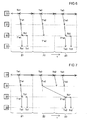
- FIG. 2 shows a simplified representation of a cycle after the PROFIBUS-DP specification in equidistant operation.
- a Time axis t runs from left to right.
- the cycle Z, x begins with a cyclical one Part ZYK, x, in which the user data between master and Slaves are exchanged.
- x can output the DP application in a PC a cycle start interrupt ZSI, x or a cycle end interrupt ZEI, x are displayed.
- x is followed by an acyclic part AZYK, x of the equidistance cycle Z, x.
- x becomes a Global Control Telegram GC, x for synchronization of the slaves before the start of the next equidistance cycle Z, x + 1 sent.
- the beginning of a cyclical part ZYK, x + 1 in Equidistance cycle Z, x + 1, which is no longer shown in full can in turn be started with a cycle start interrupt ZSI, x + 1 DP application can be communicated in the PC.
- the duration TDP one The cycle in equidistant operation is therefore the temporal one Distance between the cycle start interrupt ZSI, x and the following cycle start interrupt ZSI, x + 1. This can be set when configuring the network.
- TDPR which is derived from the acyclic Part AZYK, x and the send time of the global control telegram GC, x composes the DP application in the PC to the dual-port RAM access the communication processor without the consistency of the data records of the process image is endangered would.
- the synchronization between a thread on the PC, which the DP application executes, hereinafter referred to as the DP processing thread called, and the communication processor can interrupt-controlled via an operating system, e.g. Windows NT, integrated device drivers are done.
- an operating system e.g. Windows NT
- integrated device drivers are done.
- About mechanisms the operating system e.g. Advance a Windows semaphore, The driver then activates the on the semaphore waiting DP processing thread of the DP application. Due to a variety of operating system and computer properties, such as.
- CPU speed, number of installed Plug-in cards, displacement effects due to task changes and priority scheme, competitive operation of multiple drivers etc. is the time between generation of the interrupts and enabling the DP editing thread in many cases not deterministic.
- the activation the DP application is constantly or sporadically delayed in this way be that access to the process image in the communication processor at a time that is not permitted.
- the data of the process image from a control point of view read and updated at the wrong time. It can cause serious malfunctions or damage to a process engineering system, created by the Fieldbus components of the PROFIBUS-DP network is controlled. For example, have to be processed in a rolling mill of steel move all rollers absolutely synchronously, so wrong regulation could lead to uneven strength of the rolled steel.
- the invention has for its object a participant for a network through which such access violations recognized and displayed during operation appropriate measures for error handling are initiated can be.
- the invention has the advantage that access violations through the monitoring device safely and in real time can be recognized.
- ways to display a Access without authorization is a corresponding one Output of a message on an operator panel or generation a message to an error handling routine in the Computing unit or the communication processor called so a controlled process has entered a safety state can be.
- appropriate measures are taken. For example Can a faster CPU be used in the PC? Optimization in the BIOS of the operating system or an increase the configured equidistance time.
- There a Inconsistent data records are created in a DP application can be detected early on at the source of the error appropriate measures for error handling are initiated and possible malfunctions or damage caused thereby a process engineering system can be avoided.
- the monitoring device is preferably in the form of hardware Form of an electronic circuit and not as software realized.
- a software implementation of the monitoring device would require a relatively large amount of computation, which affect the function of the communication processor could.
- a monitoring device implemented by hardware can, however, regardless of the program processing a microprocessor, typically found in communication processors Is used, access violations in Detect real-time and safely.
- the fixed time at which the communication processor sends a first synchronization signal to the computing unit can in principle be chosen arbitrarily within the cycle become. Based on the known location within the cycle and the cycle time, the computing unit can determine when the acyclic part of a cycle begins and accesses to the Memory are allowed. However, the time monitoring is in advantageously simplified if the communication processor the first synchronization signal by outputting a Interrupts to the computing unit at the end of the cyclic part a cycle that coincides with the beginning of the acyclic Corresponds to part of the cycle, sends. The reception of the synchronization signal then has the meaning for the computing unit that they access the memory from this point on can.
- the output of an interrupt as the first synchronization signal provides a proven means of event-driven Processing of programmatically implemented processes represents.
- the computing unit of the monitoring device the beginning access to the memory by a second signal, especially by setting a start flag and the end access to the memory by a third signal, especially by setting an end flag
- this has the advantage that no time-consuming detection of accesses the computing unit by the monitoring device, for example by evaluating the addresses to which the Computing unit accesses and comparison of the access addresses with the addresses of the memory.
- the circuitry required to implement the Monitoring device reduced.
- the monitoring device can be designed in such a way that it can be set by specifying a parameter that determines the number of cycles allowed between sending the first synchronization signal and the first one thereon subsequent access of the computing unit to the memory may. A signal to indicate an error is then generated if this number is determined by one during operation Number is exceeded.
- This has the advantage that synchronization errors be recognized that may arise if the computing unit, for example as a result of runtime or Overload effects of the DP application more than a given one Number of cycles skipped without going to memory access.
- the specified number of skippable cycles can easily be used as a parameter in the DP application a register of the monitoring device is registered become.
- the monitoring device be adjustable by specifying a parameter, which is the minimum distance from the beginning of an access or the minimum distance of the end of an access of the computing unit determined on the memory at the end of the cycle in a cycle.
- the Monitoring unit then gives a signal to indicate a poor quality of access synchronization from when this distance due to an operation of the communication processor determined distance is fallen below. That has the Advantage that the monitoring device is able to constantly the quality of the access synchronization between the DP application and to monitor the equidistant bus cycle. If a projectable minimum quality is undershot, the minimum distance from the start or corresponds to the end of a cycle at the end of the cycle, one this indicating error message to the DP application by the Monitoring device triggered and by the communication processor output.
- a configuration change of a PC is an example called, by which the timing of a DP application, the so far without problems with good quality of access synchronization ran, can deteriorate significantly, so that the Danger of access violations.
- By identifying the quality of the access synchronization can this Trends recognized in good time and suitable countermeasures to be hit.
- the monitoring device together with an interface control device, a so-called interface controller, in one integrated circuit, a so-called ASIC, included his.
- interface controller a so-called interface controller
- ASIC integrated circuit
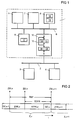
- Figure 1 is a simple automation system to control a process represented by a staff Computer 1 and a fieldbus 2 connected to it, which is designed as PROFIBUS DP, with a sensor 3 and has an actuator 4.
- the personal computer contains one Processor 5 via a PCI bus 6 with a main memory 7, a program memory 8 and a drive 9 connected is. Other components of the personal computer are not shown for clarity.
- On the Personal computer is an operating system, for example Windows NT loaded, which is not real-time capable.
- the interface between the personal computer 1 and the fieldbus 2 forms a plug-in card 10 in the personal computer 1 plugged in and connected to PCI bus 6.
- Plug-in card 10 which is also referred to as a communication processor a control program 12, which is used as a DP application in the Personal Computer 1 expires, read measurement data by the sensor 3 are detected in the process, and control commands output the actuator 4, which acts as an actuator on the process acts.
- 2 user data are cyclical via the fieldbus exchanged between the connected participants 1, 3 and 4.
- the communication processor 10 forms one PROFIBUS-DP master that the sensor 3 and the actuator 4, the both are operated as PROFIBUS-DP slaves, cyclically calls a data exchange.
- the DP application 12 and one Device drivers 13 for the communication processor 10 are in the program memory 8 of the personal computer 1 loaded.
- the processor 5 which is shared with the main memory 7 and the program memory 8 a computing unit forms, can via the PCI bus 6 on memory 14 and 15 of the Access communication processor 10, the dual-port RAM are executed and in which a process image is kept becomes.
- the communication processor 10 Output synchronization signals to the computing unit.
- the Communication processor 10 is with an interface controller 18, a so-called interface controller, and equipped with a monitoring device 19, which together in one integrated circuit, one so-called ASIC are arranged.
- Figure 2 shows the temporal structure of a cycle Z, x im Equidistance operation of the PROFIBUS DP, which is already at the beginning was explained in more detail. Only in a period of time TDPR, the outside of the cyclical part ZYK, x of the cycle Z, x the processor can access the process image be carried out in the memories 14 and 15.
- a monitoring device 30 receives one Input signal E1, which indicates the start of an access of the Calculator displays on the memory, as well as an input signal E2, through which the end of the access of the computing unit is signaled on the memory. These signals are generated and output by the DP application.
- the Monitoring device 30 supplies an output signal A1 that access by the computing unit without access authorization indicates if she has recognized such access.
- the monitoring device 30 also delivers an output signal A2 to the DP application if the shortfall a predetermined quality of access synchronization the monitoring device was found.
- a parameter P1 be given the desired minimum distance the beginning of an access of the computing unit to the memory determined at the end of the cycle in a cycle.
- Parameter P2 With another Parameter P2 becomes the desired minimum distance from the end access at the end of the cycle. Through the two Parameters P1 and P2 determine at which threshold between good and bad quality of access synchronization is distinguished. According to that Result of the threshold comparison during the operation of the Output processor A2 becomes the display processor for display poor quality of access synchronization set or not.
- a one also specified by the DP application Parameter P3 defines the permissible number of cycles between a first synchronization signal and the first subsequent access of the computing unit to the Memory may lie. This allows DP applications to be flexible should be designed: e.g. a DP application from control engineering Only save the memory every second cycle access, must in the monitoring device 30 through corresponding setting of parameter P3 can be set, that a cycle can be skipped.
- one parameter P4 is set by the DP application as the Monitoring device 30 upon detection of an impermissible Access to the memory should behave. For example if the parameter P4 was set, after detection access without access authorization by the monitoring device 30 all subsequent write accesses of the Computing unit on the process image in the memory by the Monitoring device 30 locked. This means incorrect access outside the acyclic part of the equidistant bus cycle impossible. This can be done by resetting parameter P4 Behavior can be deactivated on request. From the interface controller the monitoring device 30 receives several various status and time information X regarding the equidistant bus cycle. Examples of such information are a signal to indicate the start of the cyclical Partly as well as a signal to mark the beginning of the acyclic part of a cycle.
- the monitoring device 30 can Signals e.g. cached in a register or by Input / output circuits can be realized.
- the output signals A1 and A2, with which error states of a DP application can also be displayed by error counters or executable as error interrupts.
- the communication processor 10 issues a cycle end interrupt during a cycle corresponding to an arrow 33 to a device driver instance 31 out.
- the device driver instance 31 is by processing e.g. executable as a program under Windows NT Device driver 13 realized.
- This cycle end interrupt shows the DP application by a DP editing thread 32 is running, the beginning of the acyclic Part of an equidistant bus cycle as indicated by an arrow 34 is indicated.
- the DP application signals this Communication processor 10 the start of access to the Computing unit on the process image in the memory.
- Push through of an end flag according to an arrow 37 shows the DP application the communication processor 10 the end of access to the Computing unit to the process image.
- the monitoring device can set the two flags in the communication processor 10 detect whether access violations or whether a predetermined minimum quality of the Access synchronization was undershot.
- the communications processor informs the DP processing thread 32 about the respective error.
- the end of the cycle interrupt becomes the DP processing thread 32 by the device driver instance 31 according to an arrow 34 activated. This activation can be done by Set a common Windows semaphore to occur which of the DP processing thread 32 after each run a control loop is waiting.
- Windows semaphore other methods for Synchronization of programmatically implemented instances applicable.
- the DP processing thread takes effect 32 for example for processing a control algorithm to one in a memory area of a dual-port RAM process image held by the communication processor 10 for reading in the measurement data and outputting the calculated data Tax data too.
- the DP processing thread then waits 32 on the issuance of the cycle end interrupt in subsequent cycle.
- This loop-shaped run is in the DP processing thread 32 by an interrupted, Symbolically represented loop drawn with arrows.
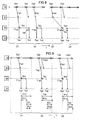
- the time diagrams in FIGS. 5 and 6 each show based on three consecutive cycles for the error-free Case and the timing diagrams in Figures 7 to 9 for typical error situations, such as access violations or poor quality of access synchronization can be detected and like the DP editing thread 32, the device driver instance 31 and the communication processor 10 in detail playing together. Due to the location of the arrows in the different horizontal levels are those at the respective actions involved components determined. Because of the loop-shaped The basic structure of the process is a component, here the Communication processor 10, for clear presentation assigned to two levels. A time axis t runs from the left to the right side of the representations. The cycles Z1, Z2 and Z3 are only for the sake of clarity Times Te1, Te2 and Te3 of their cycle end interrupts represents. The acyclic part of a cycle is each indicated by a bold double arrow, the cyclical part by a thinner double arrow.
- FIG. 6 shows a further time diagram with three cycles Z1, Z2 and Z3.
- the procedure is similar to that in FIG. 5 . shown The same parts are provided with the same reference numerals.
- the parameter P3 which is the number of cycles that can be skipped by the DP processing thread, has been set to the value 1. So skipping the Cycle Z2 permitted in the manner shown and the monitoring device in the communications processor 10 also sends no signal for display in the sequence shown in FIG. 6 an access violation.
- Figure 7 shows a further process in which all again Accesses of the computing unit to the memory in acyclic Part of the equidistant bus cycle.
- the Parameter P3 has been set to zero, i.e. no cycle from the DP processing thread 32 may be skipped.
- the Monitoring device in the communication processor 10 detects skipping a cycle by the DP application at the end of the cycle Z2, in which the DP processing thread 32 the dual-port RAM was not accessed. To do this enable, the monitoring device, for example the beginning of a cyclical part of an equidistant Bus cycle communicated within the communication processor become.
- the detected access violation is reported by the monitoring device by setting the output signal A1 reported a time Td2.
- Figure 8 shows a timing diagram with cycles Z1 to Z4.
- the two cases are clarified in which an access of the DP application partially or completely outside the permissible range.
- the parameter P3 was set to the value 1, i.e. that a Cycle when the DP processing thread 32 accesses the Dual port RAM may be skipped.
- a Cycle when the DP processing thread 32 accesses the Dual port RAM may be skipped.
- a first error by the monitoring unit reported at a time Td1 at which it recognizes that the period Tb1 in which the DP editing thread 32 accesses the dual-port RAM, not before the end of the Cycle Z1 was completed but protrudes into cycle Z2. This error occurs at time Td1, which is at the end of the acyclic part of cycle Z1, by setting the Output signals A1 displayed.
- Time range Tf1 indicated by double arrows are none Write access to the dual-port RAM taken over, provided that Parameter P4 was previously set by the DP application.
- the monitoring device at time Td3 recognized and by setting the output signal A1 appears because of the end of cycle interrupt access of the computing unit following a time Te3 the memory completely within the on the cycle Z3 following cyclical part of cycle Z4.
- Point of time Td3 of the error display is already at time Ta3, as can be determined here by the monitoring device could that the DP editing thread 32 within the cyclical part of cycle 4, in which accesses are not are allowed to access the dual-port RAM. In doing so can be assumed that the parameter P3 to one is set.
- time range Tf3 are again no accesses to the dual-port RAM, provided parameter P4 is set.
- the time diagram shown in FIG. 9 is intended to be more detailed Explanation of the detection of a decrease in the quality of the Access synchronization serve. It already serves as the basis process explained in FIG. 5, which does not indicate a Access without access authorization leads. Same parts are again provided with the same reference numerals.
- With the same Location of the computing unit's access to the memory within the cycles Z1, Z2 and Z3 are different Parameterization of the monitoring device considered by specifying various parameters P1 and P2.
- cycle Z1 there is a minimum distance TP11 from the start of access specified by the DP application at the end of the cycle is less than the determined distance T11.
- the beginning of the The processor accesses the memory by the Marked time Ta1.
- the monitoring device is not a bad quality of Access synchronization displayed.
- Monitoring quality can be done in such a way that the monitoring device at time Ta1, at which the DP application Start flag sets the remaining duration of the acyclic part of the respective cycle, which corresponds to the actual Distance of the start of access corresponds to the end of the cycle. This The value is compared with the configured minimum distance. Access synchronization is of poor quality if the difference between the determined distance and The minimum distance is less than zero.
- the Monitoring take place at time Tc1, which is the end of The processor's access to the memory is marked.
- the Cycle Z2 is of a larger value than parameter P1 went out.
- the predetermined minimum distance is in FIG. 9 plotted as time period TP12.
- the determined distance T12 is now less than the parameterized minimum distance TP12. This is done by the monitoring device in the communication processor 10 recognized at a time Td22 and by Set the output signal A2 displayed.
- the DP application became a poor quality of access synchronization reported so that appropriate measures can be taken at an early stage their improvement can be made.
- the parameterized time interval TP13 the determined distance T13 from the start of access to the end of the cycle respected.
- the minimum distance is now TP23 specified as the value of the parameter P2, which is determined by the Distance T23 is not reached. At a time Td23 this is recognized by the monitoring device and by Setting the output signal A2 will be of poor quality Access synchronization of the DP application displayed.
- the described detection and display of access violations in network participants in addition to the Application described as an embodiment in PROFIBUS also with other communication systems, for example Use in drive controls with real-time transmission can find, use. All that is required is the conditions be satisfied that the data transmission with the same length, i.e. equidistant cycles occur and that these cycles are out a cyclical part for the transmission of data in real time and an acyclic part for less time critical ones Data exists.
- the invention is also at switchable high-performance data networks, especially Ethernet, applicable.
- Each coupling unit can have more than two Be connected. Every participant is with at least one coupling unit but not directly with another Connected participants.
- Participants are, for example, computers, programmable logic controllers, field devices or other machines that share electronic data with other participants change.
- every participant every other participant of the data network can be reached directly via the data bus switchable data networks exclusively around point to point Connections, i.e. one participant can be another participant of the switchable data network only indirectly by forwarding the data to be transmitted using one or more Reach coupling units.
- switchable data networks can be divided into transmission cycles a cyclic and an acyclic part each take place, so that the invention is also easy with these data networks is applicable.
Landscapes
- Engineering & Computer Science (AREA)
- Computer Networks & Wireless Communication (AREA)
- Signal Processing (AREA)
- Debugging And Monitoring (AREA)
- Synchronisation In Digital Transmission Systems (AREA)
Applications Claiming Priority (2)
| Application Number | Priority Date | Filing Date | Title |
|---|---|---|---|
| DE10138066 | 2001-08-03 | ||
| DE2001138066 DE10138066A1 (de) | 2001-08-03 | 2001-08-03 | Teilnehmer für ein Netzwerk |
Publications (2)
| Publication Number | Publication Date |
|---|---|
| EP1282274A2 true EP1282274A2 (fr) | 2003-02-05 |
| EP1282274A3 EP1282274A3 (fr) | 2005-05-04 |
Family
ID=7694232
Family Applications (1)
| Application Number | Title | Priority Date | Filing Date |
|---|---|---|---|
| EP02017402A Withdrawn EP1282274A3 (fr) | 2001-08-03 | 2002-08-02 | Unité pour un réseau de type maitre esclave synchrones |
Country Status (2)
| Country | Link |
|---|---|
| EP (1) | EP1282274A3 (fr) |
| DE (1) | DE10138066A1 (fr) |
Cited By (2)
| Publication number | Priority date | Publication date | Assignee | Title |
|---|---|---|---|---|
| EP1615093A3 (fr) * | 2004-07-06 | 2006-05-10 | Siemens Aktiengesellschaft | Procédé pour contrôler la fonction d'esclave dans le domaine de profibus |
| US7769906B2 (en) | 2004-08-05 | 2010-08-03 | Robert Bosch Gmbh | FlexRay communication module |
Families Citing this family (6)
| Publication number | Priority date | Publication date | Assignee | Title |
|---|---|---|---|---|
| DE10308654B4 (de) * | 2003-02-27 | 2014-02-13 | Siemens Aktiengesellschaft | Datenübertragungssystem zur Verbindung einer Steuerung mit Antrieben |
| DE102004051145C5 (de) * | 2004-10-20 | 2021-03-18 | Marposs Monitoring Solutions Gmbh | Sensorsystem für eine spanabhebende Werkzeugmaschine und spanabhebende Werkzeugmaschine mit einem Sensorsystem |
| DE102005029655A1 (de) * | 2005-06-23 | 2006-12-28 | Hilscher Gesellschaft für Systemautomation mbH | Verfahren und Vorrichtung zur Synchronisation von untereinander über einen seriellen Datenbus kommunizierenden Busteilnehmern eines Automatisierungssystems |
| DE102005057000B4 (de) * | 2005-11-30 | 2013-03-07 | Knick Elektronische Messgeräte GmbH & Co. KG | Feldbusgerät zum Einsatz in Feldbussystemen, insbesondere in Prozessleitsystemen |
| DE102006051444C5 (de) | 2006-10-31 | 2011-12-08 | Softing Ag | Diagnoseverfahren und -vorrichtung für ein Feldbussystem |
| DE102010062670B4 (de) * | 2010-12-08 | 2019-09-19 | Lapp Engineering & Co. | Wartungseinheit für ein ASI-Bussystem sowie ASI-Bussystem |
-
2001
- 2001-08-03 DE DE2001138066 patent/DE10138066A1/de not_active Withdrawn
-
2002
- 2002-08-02 EP EP02017402A patent/EP1282274A3/fr not_active Withdrawn
Non-Patent Citations (4)
| Title |
|---|
| BERWANGER J ET AL: "FLEXRAY - THE COMMUNICATION SYSTEM FOR ADVANCED AUTOMOTIVE CONTROL SYSTEMS" 5. M{rz 2001 (2001-03-05), SAE TECHNICAL PAPER SERIES, SOCIETY OF AUTOMOTIVE ENGINEERS, WARRENDALE, PA, US , XP009023349 ISSN: 0148-7191 * das ganze Dokument * * |
| GO: "FlexRay fuer verteilte Anwendungen im Fahrzeug" ELEKTRONIK AUTOMOTIVE, XX, XX, Mai 2001 (2001-05), Seiten 40-43, XP002216067 * |
| S. POLEDNA, G. KROISS, TTCHECH: "TTP/C: Zeitsteuerung unterstützt Fehlertoleranz und Zusammensetzbarkeit" INTERNET ARTICLE, [Online] Februar 1999 (1999-02), Seiten 1-10, XP002316827 INTERNET Gefunden im Internet: URL:http://www.tttech.com/technology/docs/ history/TTTech_1999-02-Zeitsteuerung.pdf> [gefunden am 2005-02-08] * |
| TEMPLE C: "Avoiding the babbling-idiot failure in a time-triggered communication system" FAULT-TOLERANT COMPUTING, 1998. DIGEST OF PAPERS. TWENTY-EIGHTH ANNUAL INTERNATIONAL SYMPOSIUM ON MUNICH, GERMANY 23-25 JUNE 1998, LOS ALAMITOS, CA, USA,IEEE COMPUT. SOC, US, 23. Juni 1998 (1998-06-23), Seiten 218-227, XP010291298 ISBN: 0-8186-8470-4 * |
Cited By (2)
| Publication number | Priority date | Publication date | Assignee | Title |
|---|---|---|---|---|
| EP1615093A3 (fr) * | 2004-07-06 | 2006-05-10 | Siemens Aktiengesellschaft | Procédé pour contrôler la fonction d'esclave dans le domaine de profibus |
| US7769906B2 (en) | 2004-08-05 | 2010-08-03 | Robert Bosch Gmbh | FlexRay communication module |
Also Published As
| Publication number | Publication date |
|---|---|
| EP1282274A3 (fr) | 2005-05-04 |
| DE10138066A1 (de) | 2003-02-20 |
Similar Documents
| Publication | Publication Date | Title |
|---|---|---|
| DE4233569C2 (de) | Informationsverarbeitungsgerät mit einer Mehrzahl von Prozessor-Modulen, die einen Fehlerüberwachungskreis enthalten | |
| DE4135749B4 (de) | Prozessormodul für eine programmierbare Steuerung mit einer intelligenten Funktionsmodulschnittstelle | |
| EP0655682B1 (fr) | Unité arithmétique avec plusieures tâches | |
| DE3854594T2 (de) | Programmierbare Steuerung mit parallelen Prozessoren. | |
| DE602004005642T2 (de) | Sicherheitssteuerung zur Durchführung von Standard- und Sicherheitssteuerungsprogrammen | |
| EP0107026B1 (fr) | Dispositif de commande à programme enregistré | |
| DE2735397C2 (de) | Überwachungseinrichtung für eine programmgesteuerte Maschine | |
| DE69315343T2 (de) | Verfahren fur eingangssignalauflosung von aktiven redundanten prozesssteuerrechnern | |
| DE69121937T2 (de) | Verfahren und Gerät zum teilweisen Lauf eines Sequenzprogramms zwecks Fehlersuche | |
| DE68920929T2 (de) | Zeitgeberkanal mit mehreren Zeitgeberreferenzmerkmalen. | |
| DE602004013244T2 (de) | Hochgeschwindigkeitssynchronisation in einer doppelrechnerbasierten Sicherheitssteuerung | |
| DE69122142T2 (de) | Steuerungsanlage für ein Mehrprozessorsystem | |
| DE68922545T2 (de) | Zugeordneter Dienstprozessor mit Übertragungsmöglichkeiten zwischen Kanälen. | |
| DE19749068A1 (de) | Verfahren und Vorrichtung zur Überwachung eines Rechnersystems bestehend aus wenigstens zwei Prozessoren | |
| DE19831405A1 (de) | Steuerungssystem mit einem Personalcomputer | |
| EP1282274A2 (fr) | Unité pour un réseau de type maitre esclave synchrones | |
| DE10303490A1 (de) | Steuergerät für ein Kraftfahrzeug und Kommunikationsverfahren dafür | |
| DE102017123055A1 (de) | Slave-Vorrichtung | |
| EP1307796B1 (fr) | Reseau avec transmission de donnees par cycles equidistants | |
| DE10326542A1 (de) | Betriebsverfahren und Steuerungsprogramm für eine Zentraleinheit eines Automatisierungssystems sowie Zentraleinheit eines Automatisierungssystems und Automatisierungssystem selbst | |
| DE60122655T2 (de) | Auf externe Signale reagierender Pulsbreitenmodulator | |
| DE102009001898A1 (de) | Schaltungsanordnungen und Verfahren zur Steuerung eines Datenaustauschs in einer Schaltungsanordnung | |
| EP3143506B1 (fr) | Procédé et système permettant d'attribuer une autorisation de commande à un ordinateur | |
| EP0525214B1 (fr) | Méthode pour opérer un appareil d'automatisation | |
| DE3040429A1 (de) | Ueberwachungseinrichtung fuer ein computersystem |
Legal Events
| Date | Code | Title | Description |
|---|---|---|---|
| PUAI | Public reference made under article 153(3) epc to a published international application that has entered the european phase |
Free format text: ORIGINAL CODE: 0009012 |
|
| AK | Designated contracting states |
Designated state(s): AT BE BG CH CY CZ DE DK EE ES FI FR GB GR IE IT LI LU MC NL PT SE SK TR |
|
| AX | Request for extension of the european patent |
Extension state: AL LT LV MK RO SI |
|
| PUAL | Search report despatched |
Free format text: ORIGINAL CODE: 0009013 |
|
| AK | Designated contracting states |
Kind code of ref document: A3 Designated state(s): AT BE BG CH CY CZ DE DK EE ES FI FR GB GR IE IT LI LU MC NL PT SE SK TR |
|
| AX | Request for extension of the european patent |
Extension state: AL LT LV MK RO SI |
|
| RIC1 | Information provided on ipc code assigned before grant |
Ipc: 7H 04L 12/43 B Ipc: 7H 04L 12/40 B Ipc: 7H 04L 12/413 A |
|
| AKX | Designation fees paid | ||
| STAA | Information on the status of an ep patent application or granted ep patent |
Free format text: STATUS: THE APPLICATION IS DEEMED TO BE WITHDRAWN |
|
| 18D | Application deemed to be withdrawn |
Effective date: 20051105 |
|
| REG | Reference to a national code |
Ref country code: DE Ref legal event code: 8566 |