EP1284070B1 - Verfahren und vorrichtung zur arbitrage in einer digitalen vermittlungsstelle - Google Patents
Verfahren und vorrichtung zur arbitrage in einer digitalen vermittlungsstelle Download PDFInfo
- Publication number
- EP1284070B1 EP1284070B1 EP01911926A EP01911926A EP1284070B1 EP 1284070 B1 EP1284070 B1 EP 1284070B1 EP 01911926 A EP01911926 A EP 01911926A EP 01911926 A EP01911926 A EP 01911926A EP 1284070 B1 EP1284070 B1 EP 1284070B1
- Authority
- EP
- European Patent Office
- Prior art keywords
- ingress
- grant
- egress
- port
- ports
- Prior art date
- Legal status (The legal status is an assumption and is not a legal conclusion. Google has not performed a legal analysis and makes no representation as to the accuracy of the status listed.)
- Expired - Lifetime
Links
- 238000000034 method Methods 0.000 title claims description 36
- 230000008569 process Effects 0.000 claims description 23
- 239000011159 matrix material Substances 0.000 claims description 21
- 230000007704 transition Effects 0.000 claims description 18
- 230000037361 pathway Effects 0.000 claims description 4
- 239000013598 vector Substances 0.000 description 15
- 241001522296 Erithacus rubecula Species 0.000 description 14
- 230000005540 biological transmission Effects 0.000 description 3
- 230000000694 effects Effects 0.000 description 2
- 239000004744 fabric Substances 0.000 description 2
- 230000007246 mechanism Effects 0.000 description 2
- 230000003068 static effect Effects 0.000 description 2
- 230000001360 synchronised effect Effects 0.000 description 2
- 241000287433 Turdus Species 0.000 description 1
- 238000013459 approach Methods 0.000 description 1
- 239000000203 mixture Substances 0.000 description 1
- 230000006855 networking Effects 0.000 description 1
- 230000009467 reduction Effects 0.000 description 1
Images



Classifications
-
- H—ELECTRICITY
- H04—ELECTRIC COMMUNICATION TECHNIQUE
- H04L—TRANSMISSION OF DIGITAL INFORMATION, e.g. TELEGRAPHIC COMMUNICATION
- H04L49/00—Packet switching elements
- H04L49/15—Interconnection of switching modules
- H04L49/1553—Interconnection of ATM switching modules, e.g. ATM switching fabrics
- H04L49/1576—Crossbar or matrix
-
- H—ELECTRICITY
- H04—ELECTRIC COMMUNICATION TECHNIQUE
- H04L—TRANSMISSION OF DIGITAL INFORMATION, e.g. TELEGRAPHIC COMMUNICATION
- H04L49/00—Packet switching elements
- H04L49/25—Routing or path finding in a switch fabric
- H04L49/253—Routing or path finding in a switch fabric using establishment or release of connections between ports
- H04L49/254—Centralised controller, i.e. arbitration or scheduling
-
- H—ELECTRICITY
- H04—ELECTRIC COMMUNICATION TECHNIQUE
- H04L—TRANSMISSION OF DIGITAL INFORMATION, e.g. TELEGRAPHIC COMMUNICATION
- H04L49/00—Packet switching elements
- H04L49/30—Peripheral units, e.g. input or output ports
-
- H—ELECTRICITY
- H04—ELECTRIC COMMUNICATION TECHNIQUE
- H04L—TRANSMISSION OF DIGITAL INFORMATION, e.g. TELEGRAPHIC COMMUNICATION
- H04L49/00—Packet switching elements
- H04L49/30—Peripheral units, e.g. input or output ports
- H04L49/3081—ATM peripheral units, e.g. policing, insertion or extraction
-
- H—ELECTRICITY
- H04—ELECTRIC COMMUNICATION TECHNIQUE
- H04Q—SELECTING
- H04Q11/00—Selecting arrangements for multiplex systems
- H04Q11/04—Selecting arrangements for multiplex systems for time-division multiplexing
- H04Q11/0428—Integrated services digital network, i.e. systems for transmission of different types of digitised signals, e.g. speech, data, telecentral, television signals
- H04Q11/0478—Provisions for broadband connections
-
- H—ELECTRICITY
- H04—ELECTRIC COMMUNICATION TECHNIQUE
- H04L—TRANSMISSION OF DIGITAL INFORMATION, e.g. TELEGRAPHIC COMMUNICATION
- H04L12/00—Data switching networks
- H04L12/54—Store-and-forward switching systems
- H04L12/56—Packet switching systems
- H04L12/5601—Transfer mode dependent, e.g. ATM
- H04L2012/5678—Traffic aspects, e.g. arbitration, load balancing, smoothing, buffer management
- H04L2012/5679—Arbitration or scheduling
Definitions
- the present invention relates to arbiters for use in data switching systems and is more particularly concerned with so-called "bipartite graph" matching for use in arbitrating between connection requests for cross bar connections in a data switching system.
- a data switch is provided with a plurality of ingress ports for a plurality of respective data sources, a plurality of egress ports for a plurality of respective data destinations, a cross-bar switch (also referred to as a switching matrix) for selectively interconnecting ingress ports and egress ports, and a control unit for controlling the cross-bar switch.
- the ingress ports receive data packets including a header indicating a desired destination of the data packet, and generate and transmit to the control unit a request for a connection to the corresponding egress port.
- the control unit performs, in each of a number of "switching cycles", an arbitration process to arbitrate among the requests it receives (which in general will not be compatible) to determine a compatible sub-set of the requests, and controls the cross-bar switch to realise that sub-set of requests.
- the arbitration process is an example of a bipartite graph matching problem.
- bipartite graph matching algorithms that can be implemented in hardware are based upon round robin pointer manipulation schemes.
- the round robin implements a two-stage arbitration, in which, in a first stage, the processes generate requests to access the resource, and in the second "grant" stage, the resource decides which of those requests to grant.
- To implement the "grant" stage some form of pointer is used.
- the pointer can point to one of a number of locations corresponding to respective processes. In the simplest implementation of the round robin, the pointer moves from one location to the next in a predefined sequence once every operation cycle.
- the process corresponding to that location is granted access to the resource, and accordingly that process is sent a signal referred to here as a "grant". If there is nothing at the location selected (i.e. the corresponding process has not made a request to use the resource) then nothing is done until the next cycle.
- a logical extension to the round robin allows the pointer to skip locations that do not have any requests for the resource; this increases the efficiency of the algorithm.
- the pointer at any time indicates the last location to which a grant was given.
- each resource uses a round robin mechanism using a pointer known as a "grant pointer”, to decide, among the processes which send that resource a request, which of those requests to grant.
- a pointer known as a "grant pointer”
- each of the requesting processes which receive more than one grant must "accept” one of those grants in order to ensure exclusive access.
- each of the processes is provided with a round robin arbitration mechanism, including a pointer to indicate which, among the plurality of resources, was the one which it last accepted.
- One of the plurality of grants is selected using this "accept pointer".
- Pointer synchronisation means that the grant pointers for a plurality of resources (and/or the accept pointers for a plurality of the processes), become synchronised.
- SLIP pointer synchronisation problem
- US-A-5,500,858 to N.W.-McKeown Several methods are known which attempt to solve the pointer synchronisation problem.
- SLIP is disclosed in US-A-5,500,858 to N.W.-McKeown. Starting from a state in which the pointers are fully synchronised, SLIP achieves desynchronisation of the pointers, but only after a number of arbitration cycles which is equal to the number of ingress ports.
- an arbitration method for use in selecting the connections to be made between ingress and egress ports of a memoryless cross-bar switch of a data switching system, the arbitration method comprising a three phase process involving (i) a request phase in which each ingress port sends its connection requests to the egress ports to which a connection is required, (ii) a grant phase in which each egress port examines in a round-robin manner the requests directed to it using a grant pointer, and selects one request for grant returning a grant signal indicative of the selected request and directed to the ingress port which sent the selected request, and (iii) an accept phase in which each ingress port examines in a round-robin manner the received grant signals and selects one to accept thereby defining an ingress to egress port connection across the cross-bar switch, wherein the transition sequences for each of the grant pointers are mutually exclusive, characterised in that the mutually exclusive transitions are determined by a connection matrix setting the pathways of
- an arbitration unit for use in a data switching system comprising a plurality of ingress ports, a plurality of egress ports, a memory-less cross-bar switch and said arbitration unit for controlling the switch, the arbitration unit comprising a respective first portion for each of said ingress ports, and a respective second portion for each of said egress ports, each first portion being arranged to transmit connection request signals relating to required connections between the corresponding ingress port and the egress ports, to the second portions corresponding to those egress ports; each second portion being arranged to define a grant pointer having a transition sequence, to examine in a round-robin manner using the corresponding grant pointer the request signals directed to it, to select one request signal for grant, and to return to the first portion which transmitted that request signal a grant signal indicative of the selected request; each first portion further being arranged to examine in a round-robin manner the received grant signals and select one to accept, thereby defining an ingress to egress port connection across the
- the transitions may be represented by a table having columns representing respective egress ports.
- the entries in the table along any column represent, in order, the ingress ports to which the grant pointer of the corresponding egress port points, such that consecutive vertically descending positions represent the consecutive ingress ports to which the corresponding grant pointer points. Since the transition sequences are mutually exclusive, the table should not contain, in the same vertically descending order, multiple instances of any consecutive combination of a first ingress port and a second ingress port.
- transition sequences are "mutually exclusive" to mean that the transition sequences are such that, considering the respective points in each of the sequences which are any given ingress port, the number of sequences having a common ingress port as the next ingress port in the sequence is small compared to the number of ingress ports - such as at most two.
- the simplest way to cause the grant pointers to follow different paths, while keeping all other components of the arbiter the same as in known systems, is to reconnect the request and grant signals in a new order.
- the table represents a connection matrix defining the request and grant signal paths.
- the column corresponding to a given grant pointer represents the order in which the ingress ports are connected to it.
- a useful aspect of reordering the pointers in this way is that no extra gates are required to implement the required changes.
- the arbiter of the present invention employs, for each possible combination of an ingress port and an egress port, a respective weight value, and a connection request is only selected in said grant step if the corresponding weight value is not zero.
- a connection request is only selected in said grant step if the corresponding weight value is not zero.
- the corresponding weight value is decremented.
- the weight values are reset to default values before said selection.
- the default values (which are positive integers) thus determine the statistical frequency with which a given ingress and egress port will be selected. In principle it is possible to select the default values for each combination of an ingress and an egress port to be equal. However, it is preferable that the default values are not all identical, for a given egress port but rather there are different default values for each respective ingress port, selected according to a desired statistical frequency of connections between specific ingress and egress ports.
- a first embodiment of the invention is shown as having the known structure of a data switch. It includes a set of four ingress ports 12 (shown as a single unit), a set of four egress ports 13 (also shown as a single unit), a cross-bar switch 11 and a arbitrator unit 14 which controls the crossbar switch to selectively interconnect the ingress and egress ports.
- the ingress ports 12 receive data packets (from the left side of the figure) for transmission to the egress ports 13 (which transmit them on to the right side of the figure), and generate requests for appropriate connections in the crossbar switch 11 accordingly.
- the requests are sent to an arbitrator unit 14, which decides which requests to grant, and accordingly controls the crossbar switch 11.
- the arbitrator unit may work within constraints set by the egress ports, for example "backpressure” constraints relating to congestion downstream of the switch (i.e. off the right side of the figure). There may be further constraints on the connections made between the ingress ports and the egress ports. For example, such constraints may concern "multicast" transmissions which are to be sent from a single ingress port to multiple egress ports, with a higher level of priority than the "unicast" data packets which are considered here.
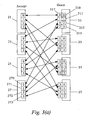
- FIG. 2 shows the schematically the internal operation of the arbitration unit 14 which is employed in the first embodiment.
- Each of four first portions 21, 23, 25, 27 is associated with a respective one of the ingress ports 12 (we may refer to these ports respectively as egress ports 0, 1, 2 and 3), and each of four second portions 31, 33, 35, 37 is associated with a respective one of the second ports (we may refer to these ports respectively as egress ports 0, 1, 2, and 3).
- each first portion which receives requests generated by the corresponding ingress ports, generates request signals.
- Each request signal relates to a connection to be made between that ingress port and one of the egress ports, and is transmitted to the corresponding one of the second portions 31, 33, 35, 37 along a respective request signal path.
- the requests generated by the first portions are derived from all of the requests generated by the ingress ports which have not yet been satisfied (in other words the first portions 21, 23, 25, 27 may keep a store of such requests, and generate its own requests based on this store), but taking into account any constraints on the arbitration unit. The detail of how this is done are known to an expert, and will not be considered here.
- each of the second portions 31, 33, 35, 37 grants exactly one of the requests it receives and transmits a grant signal to the first portion concerned along a grant signal path.
- each of the first portions 21, 23, 25, 27 which has received one or more grants, accepts exactly one of those grants, and transmits an accept signal to the second portion concerned. This completes the arbitration process.
- Each of the first and second portions has four connections for receiving/transmitting grant/request signals.
- the four locations in which the first portion 27 generates request signals and receives grant signals are labelled 270, 271, 272, and 273.
- the four locations in which the second portion 31 receives request signals and generates grant signals are labelled' 310, 311, 312, and 313.
- the grant pointer of the second portion points to these three locations in turn.
- the grant pointer of second portion 31 successively points at the first portions 21, 23, 27, 25.
- the grant pointer of the second portion 33 successively points at first portions 23, 25, 21 and 27.
- each of the locations (such as 270, 271, 271, 272) on each of the first portions is marked with an integer 0, 1, 2, 3 indicating the pointer sequence (3 is followed by 0).
- 4-element columns (such as 317) are added before the second portions 31, 33, 35, 37 to indicate schematically the values of M* for that pointer.
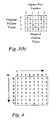
- column 317 has elements 0, 1, 3, 2 to indicate that, as the pointer of the second portion 31 moves though the successive locations 310, 311, 312 and 312, it points successively at the first portions 21, 23, 27, 25 which correspond to the respective ingress ports 0, 1, 3, 2. dhe result if as shown in Fig. 3(b*, which gives for each of the egress ports P a column showing for any "original pointer value" M, the "mapped pointer value" M* under Eqn. (1) (i.e. the next ingress port to which the location points in the presunt invention).
- Fig. 4 shows the connection matrix in a second embodiment of the invention, having 8 ingress ports and 8 egress ports, both the ingress and egress ports being labelled 0 to 7.
- pointer seven will move from zero to two.
- the matrix includes at least N transitions (i.e. vertically-downward combinations of a first M* value and a second M* value) which appear in two sequences.
- N transitions i.e. vertically-downward combinations of a first M* value and a second M* value
- the arbiter of the first three embodiments of the invention is not inherently fair under all conditions; however, when it is used in conjunction with an arrangement which allocates weights to the requests to provide bandwidth allocation, in accordance with our co-pending patent application EP 1284071, the combination guarantees fair allocation of connections.
- a fourth embodiment of the invention in which the overall aim of the arbitration is to create a new connection vector every switch cycle (equal to the vector per tensor size), where the maximum possible number of connections are made every cycle to satisfy a number of pre-ordained connections (which are not considered in detail in this document) and queued unicast/multicast/broadcast requests.
- the process is pipelined in order hide the considfrable processing required to generate each connection vector.
- the fourth embodiment has the overall structure shown in Fig.1, but the operation of the arbitration unit differs from that of known systems as discussed below.
- Each ingress port (operated by a respective ingress router) maintains a plurality of queues for "unicast" requests, that is ones directed to an single egress port.
- There is a queue for each egress port and priority level i.e. a total number of queues equal to the product of the number of egress ports and the number of priority levels).
- a separate unit determines which priority level requests are to be considered at each arbitration pipeline stage.
- the ingress router records the queue states for all pending connections for all combinations of the ingress port with egress ports and priorities.
- a single broadcast queue is also held per ingress port.
- Requests are removed from the queue states for attempted arbitration, and are returned to the queues to try again later when they are unsuccessful either due to being of a non-selected priority or due to clashing with a successful connection.
- the set of requests generated by all the ingress routers is sent to an arbitration unit as a "Request Vector".
- the arbitration unit generates a Connection Vector for transmission to the switching fabric to define the connections to be made.
- the arbitration unit contains a RAM storing pre-ordained connections required at certain times. Connections contained in the RAM are given first refusal on all available connections in the new switch cycle. If no connections are taken by the RAM in a certain arbitration cycle, and a broadcast request is received, a broadcast connection is created. Any egress ports sending backpressure will normally preclude such a broadcast connection, unless Lossy Broadcasts have been enabled. Finally, the arbitration unit removes any requests from the incoming Request Vector that clash with existing connections, and passes on the Request Vector and the Connection Vector to the first arbitration stage.
- a single arbitration stage contains three sequential phases, where each phase is considered as a unidirectional transaction between ingress and egress 'ports' (in fact, corresponding portions of the arbitration unit).
- each ingress 'port' sends a request to each egress for which it has a request in the incoming Request Vector.
- each egress 'port' issues a grant for one of its incoming requests, based on a "Hashed Weighted Round Robin" method of selection, described below and in accordance with the present invention.
- each ingress 'port' selects one of its incoming grants using a similar Hashed Round Robin (no weighting). Accepted grants represent successful connections generated by this arbitration stage.
- a separate Hashed Weighted Round Robin is used by each egress 'port' to select one of the incoming requests to grant.
- a pointer indicates the last ingrfss port to which a grant was issued which was subsequently accepted.
- the ingress ports are tested in a "hashed" order, that is one according to the present invention, for example one defined by Eqn. 1, starting from the one after that indicated by the pointer, until the first with an unmasked request is found: this request is granted.
- the hashed order of the ports is different for each of the round robins, to avoid pointer synchronisation effects.
- Each round robin also maintains a set of weight registers, one weight per ingress port.
- a request is considered masked (i.e. not a candidate for selection in the round robin) if its weight value is zero: this represents a connection that is exceeding its bandwidth allocation. If the round robin finds all active requests are masked by zero weights, the weights for all ports are reloaded from a set of initial values ("default values") and the requests retested.
- the Connection Weighting Table stores this initial weight value for every combination of ingress port and egress port, and the value controls the port-to-port bandwidth allocation. In high load situations, a large initial weight means many connections will be created before the active weights are reloaded.
- the arbitration stage adds the new connections to the incoming connection vector, and removes requests from the incoming request vector which have been accepted or which can now never be satisfied because they clash with accepted connections.
- the latter requests are returned to the routers, and the updated vectors are passed on down the pipeline.
- the set of requests considered may be different because at each pipeline stage requests of a different set of priorities are considered. For example, at the first pipeline stage, only requests of the highest priority may be included; and at second and subsequent pipeline stages, requests transmitted by the input ports may be considered irrespective of their priorities.
- the cascaded second and third arbitration stages attempt to fill in gaps in the connection vector based on requests in the request vector, and each is identical to the generic arbitration stage described above.
- the fact that the requests are potentially at a mixture of priorities does not affect the arbitration: no preference is given to "higher" priority requests.
- the requests emerging unsatisfied from the final arbitration stage are returned to the routers together with the usual blocked requests.
- the final connection vector from this stage is processed for virtual port addressing and port shadowing, passed to the switching fabric, and used to generate grants and incoming tensor indications to the ingress and egress ports respectively.
Landscapes
- Engineering & Computer Science (AREA)
- Computer Networks & Wireless Communication (AREA)
- Signal Processing (AREA)
- Physics & Mathematics (AREA)
- Mathematical Physics (AREA)
- Data Exchanges In Wide-Area Networks (AREA)
Claims (8)
- Arbitrierungs-Verfahren für den Einsatz bei der Auswahl der Verbindungen, die zwischen eingangsseitigen Ports und ausgangsseitigen Ports eines speicherlosen Cross-Bar-Switch (11) eines Datenvermittlungssystems herzustellen sind, wobei das Arbitrierungs-Verfahren einen aus drei Phasen bestehenden Vorgang umfasst, mit (i) einer Anforderungsphase, bei der jeder eingangsseitige Port (12) seine Anforderung auf Verbindung an die ausgangsseitigen Ports (13) sendet, zu denen eine Verbindung erforderlich ist, (ii) einer Freigabe-Phase, bei der jeder ausgangsseitige Port (13) in der Art eines Round-Robin-Verfahrens die an ihn gerichteten Anforderungen unter Verwendung eines Freigabeanzeigers überprüft und eine Freigabeanforderung auswählt, unter Zurücksenden eines Freigabesignals, das für die gewählte Anforderung kennzeichnend ist und an den eingangsseitigen Port gerichtet ist, der die gewählte Anforderung gesendet hat, und (iii) eine Annahmephase, bei der jeder eingangsseitige Port (12) in einer Art Round-Robin-Verfahren die empfangenen Freigabesignale überprüft und eines zur Annahme auswählt, um dadurch eine Eingangsseite-nach-Ausgangsseite-Port-Verbindung über den Crossbar-Switch zu definieren, wobei sich die Übergangs-Sequenzen für jeden Freigabeanzeiger gegenseitig ausschließen, dadurch gekennzeichnet, dass
die sich gegenseitig ausschließenden Übergänge durch eine Verbindungsmatrix bestimmt werden, die die Anforderungs- und Freigabe-Signalpfade einstellt, und
wobei die Verbindungsmatrix von einer Tabelle mit jeweils ausgangsseitige Ports darstellenden Spalten dargestellt werden kann, die Einträge in der Tabelle entlang jeder Spalte eine vertikal absteigende Ordnung der eingangsseitigen Ports, zu denen der Freigabeanzeiger des entsprechenden ausgangsseitigen Ports zeigt, darstellen und die Tabelle in derselben vertikal absteigenden Ordnung keine Mehrfachinstanzen einer beliebigen Kombination eines ersten eingangsseitigen Ports und eines zweiten eingangsseitigen Ports enthält. - Verfahren nach Anspruch 1, wobei die Tabelleneinträge der Formel

- Verfahren nach einem der vorherigen Ansprüche, der für jede mögliche Kombination eines eingangsseitigen und eines ausgangsseitigen Ports einen jeweiligen Wichtungswert einsetzt, eine Verbindungsanforderung, die lediglich in dem Freigabeschritt ausgewählt wird, wenn der entsprechende Wichtungswert nicht Null ist;
wobei das Verfahren weiterhin umfasst:Dekrementieren des jeweiligen Wichtungswertes jedes Mal dann, wenn eine Verbindung in dem Cross-Bar-Switch hergestellt wird, bei der ein eingangsseitiger und ein ausgangsseitiger Port beteiligt ist; undvor jeder Auswahl erneutes Einstellen der Wichtungswerte auf Default-Werte in der Freigabephase, wenn es für einen gegebenen ausgangsseitigen Port keine Verbindungsanforderungen gibt, deren Wichtungswerte ungleich Null sind. - Verfahren nach Anspruch 3, das weiterhin einen Schritt einschließt, die Default-Werte gemäß einer laut Statistik gewünschten Häufigkeit der Verbindungen zwischen speziellen eingangs- und ausgangsseitigen Ports einzustellen.
- Arbitrierungs-Einheit für den Einsatz bei einem Datenvermittlungssystem, die eine Vielzahl eingangsseitiger Ports (12), eine Vielzahl ausgangsseitiger Ports (13), einen speicherlosen Cross-Bar-Switch (11) und die Arbitrierungs-Einheit zum Steuern des Switch umfasst, wobei die Arbitrierungs-Einheit umfasst:jeweils einen ersten Abschnitt für jeden eingangsseitigen Port (12) und jeweils einen zweiten Abschnitt für jeden ausgangsseitigen Port (13),wobei jeder erste Abschnitt so angeordnet ist, um Verbindungsanforderungs-Signale die erforderlichen Verbindungen zwischen den entsprechenden eingangsseitigen Ports und ausgangsseitigen Ports betreffend an die diesen ausgangsseitigen Ports entsprechenden zweiten Abschnitte zu übermitteln;wobei jeder zweite Abschnitt so angeordnet ist, um einen Freigabeanzeiger mit einer Übergangs-Sequenz zu definieren, die an diesen gerichteten Anforderungssignale unter Verwendung des entsprechenden Freigabeanzeigers in der Art eines Round-Robin-Verfahrens zu überprüfen, ein Freigabe-Anforderungssignal auszuwählen, und ein Freigabe-Signal, das für die gewählte Anforderung kennzeichnend ist, an den ersten Abschnitt, der jenes Anforderungssignal übermittelt hat, zurückzusenden;wobei jeder erste Abschnitt weiterhin so angeordnet ist, um in einer Art Round-Robin-Verfahren die empfangenen Freigabesignale zu überprüfen und eines zur Annahme auszuwählen, um dadurch eine Eingangsseite-nach-Ausgangsseite-Port-Verbindung über den Cross-Bar-Switch zu definieren, wobei sich die Übergangs-Sequenzen für jeden Freigabeanzeiger gegenseitig ausschließen, gekennzeichnet durcheine Verbindungsmatrix, die die sich gegenseitig ausschließenden Übergänge durch Definieren der Anforderungs- und Freigabesignale bestimmt, wobeidie Verbindungsmatrix von einer Tabelle mit jeweils ausgangsseitige Ports darstellenden Spalten dargestellt werden kann, die Einträge in der Matrix entlang jeder Spalte in vertikal absteigender Ordnung die eingangsseitigen Ports, zu denen der Freigabeanzeiger des entsprechenden ausgangsseitgen Ports zeigt, darstellen und die Matrix in derselben vertikal absteigenden Ordnung keine Mehrfachinstanzen einer beliebigen Kombination eines ersten eingangsseitigen Ports und eines zweiten ausgangsseitigen Ports enthält.
- Arbitrierungs-Einheit nach Anspruch 5, wobei die Tabelleneinträge der Formel:

- Arbitrierungs-Einheit nach Anspruch 5 oder 6, die weiterhin für jede mögliche Kombination eines eingangsseitigen Ports (12) mit einem ausgangsseitigen Port (13) ein Arbeitsregister einschließt, in dem jeweils ein Wichtungswert gespeichert ist,
das Arbeitsregister jeden Wichtungswert jedes Mal dann dekrementiert, wenn eine Verbindung zwischen dem Cross-Bar-Switch (11) hergestellt wird, bei der der entsprechende eingangsseitige Port (12) und ausgangsseitige Port (13) beteiligt ist, und wenn es zu einem gegebenen ausgangsseitigen Port keine Verbindungsanforderungen gibt, deren Wichtungswerte ungleich Null sind, die Wichtungswerte für den ausgangsseitigen Port vor dem Auswahlschritt erneut jeweils auf Default-Werte einstellt; und
jeder zweite Abschnitt lediglich eine Verbindungsanforderung auswählt, wenn der entsprechende Wichtungswert nicht Null ist. - Datenvermittlungssystem, das eine Vielzahl eingangsseitiger Ports (12), eine Vielzahl ausgangsseitiger Ports, eine Vielzahl ausgangsseitiger Ports, einen speicherlosen Cross-Bar-Switch und eine Arbitrierungs-Einheit nach einem der Ansprüche 5 bis 7 umfasst, die so angeordnet ist, dass sie den Switch steuert.
Applications Claiming Priority (3)
| Application Number | Priority Date | Filing Date | Title |
|---|---|---|---|
| GB0012592 | 2000-05-24 | ||
| GBGB0012592.2A GB0012592D0 (en) | 2000-05-24 | 2000-05-24 | High speed digital switch arbiter |
| PCT/GB2001/001137 WO2001091386A1 (en) | 2000-05-24 | 2001-03-16 | Method and arbitration unit for digital switch |
Publications (2)
| Publication Number | Publication Date |
|---|---|
| EP1284070A1 EP1284070A1 (de) | 2003-02-19 |
| EP1284070B1 true EP1284070B1 (de) | 2007-06-06 |
Family
ID=9892258
Family Applications (1)
| Application Number | Title | Priority Date | Filing Date |
|---|---|---|---|
| EP01911926A Expired - Lifetime EP1284070B1 (de) | 2000-05-24 | 2001-03-16 | Verfahren und vorrichtung zur arbitrage in einer digitalen vermittlungsstelle |
Country Status (6)
| Country | Link |
|---|---|
| US (1) | US7002981B2 (de) |
| EP (1) | EP1284070B1 (de) |
| AU (1) | AU2001240848A1 (de) |
| DE (1) | DE60128799D1 (de) |
| GB (1) | GB0012592D0 (de) |
| WO (1) | WO2001091386A1 (de) |
Families Citing this family (11)
| Publication number | Priority date | Publication date | Assignee | Title |
|---|---|---|---|---|
| JP2000261433A (ja) * | 1999-03-04 | 2000-09-22 | Toshiba Microelectronics Corp | スイッチングエレメント及びパケットスイッチ |
| US7158512B1 (en) * | 2002-04-01 | 2007-01-02 | P-Cube Ltd. | System and method for scheduling a cross-bar |
| US20110164616A1 (en) * | 2002-10-02 | 2011-07-07 | Andiamo Systems | Methods and apparatus for processing superframes |
| US20040081108A1 (en) * | 2002-10-02 | 2004-04-29 | Andiamo Systems | Arbitration system |
| US20040225734A1 (en) * | 2003-05-07 | 2004-11-11 | Schober Richard L. | Method and system to control the communication of data between a plurality of inteconnect devices |
| US20080273531A1 (en) * | 2007-05-03 | 2008-11-06 | Xyratex Technology Limited | Data switch and a method of switching |
| GB2461693B (en) * | 2008-07-07 | 2012-08-15 | Micron Technology Inc | Switching method |
| CN101527686B (zh) * | 2009-04-07 | 2011-08-24 | 华为技术有限公司 | 一种数据交换方法和设备 |
| US10911353B2 (en) | 2015-06-17 | 2021-02-02 | Extreme Networks, Inc. | Architecture for a network visibility system |
| US10771475B2 (en) * | 2015-03-23 | 2020-09-08 | Extreme Networks, Inc. | Techniques for exchanging control and configuration information in a network visibility system |
| US10129088B2 (en) | 2015-06-17 | 2018-11-13 | Extreme Networks, Inc. | Configuration of rules in a network visibility system |
Family Cites Families (13)
| Publication number | Priority date | Publication date | Assignee | Title |
|---|---|---|---|---|
| US5500858A (en) * | 1994-12-20 | 1996-03-19 | The Regents Of The University Of California | Method and apparatus for scheduling cells in an input-queued switch |
| US5642349A (en) * | 1994-12-30 | 1997-06-24 | Lucent Technologies Inc. | Terabit per second ATM packet switch having distributed out-of-band control |
| US5734649A (en) * | 1996-05-31 | 1998-03-31 | Bbn Corporation | Data packet router |
| US6212182B1 (en) * | 1996-06-27 | 2001-04-03 | Cisco Technology, Inc. | Combined unicast and multicast scheduling |
| US5923644A (en) * | 1996-10-03 | 1999-07-13 | The Board Of Trustees Of The Leland Stanford Junior University | Apparatus and method for processing multicast cells in an input-queued multicast switch |
| US6188690B1 (en) * | 1996-12-12 | 2001-02-13 | Pmc-Sierra, Inc. | Method and apparatus for high speed, scalable communication system |
| US5978379A (en) * | 1997-01-23 | 1999-11-02 | Gadzoox Networks, Inc. | Fiber channel learning bridge, learning half bridge, and protocol |
| US6351466B1 (en) * | 1998-05-01 | 2002-02-26 | Hewlett-Packard Company | Switching systems and methods of operation of switching systems |
| US6424655B1 (en) * | 1998-05-13 | 2002-07-23 | Compaq Computer Corporation | Transpose table-biased arbitration |
| US6370148B1 (en) * | 1998-07-06 | 2002-04-09 | International Business Machines Corporation | Data communications |
| US6735212B1 (en) * | 1999-04-19 | 2004-05-11 | Pmc-Sierra, Inc. | Short and long term fair shuffling for crossbar switch arbiter |
| US6625121B1 (en) * | 1999-04-28 | 2003-09-23 | Cisco Technology, Inc. | Dynamically delisting and relisting multicast destinations in a network switching node |
| US6633580B1 (en) * | 2000-03-07 | 2003-10-14 | Sun Microsystems | N×N crossbar packet switch |
-
2000
- 2000-05-24 GB GBGB0012592.2A patent/GB0012592D0/en not_active Ceased
-
2001
- 2001-03-16 EP EP01911926A patent/EP1284070B1/de not_active Expired - Lifetime
- 2001-03-16 AU AU2001240848A patent/AU2001240848A1/en not_active Abandoned
- 2001-03-16 DE DE60128799T patent/DE60128799D1/de not_active Expired - Lifetime
- 2001-03-16 WO PCT/GB2001/001137 patent/WO2001091386A1/en not_active Ceased
- 2001-05-16 US US09/858,437 patent/US7002981B2/en not_active Expired - Lifetime
Non-Patent Citations (1)
| Title |
|---|
| None * |
Also Published As
| Publication number | Publication date |
|---|---|
| GB0012592D0 (en) | 2000-07-12 |
| US20020001304A1 (en) | 2002-01-03 |
| EP1284070A1 (de) | 2003-02-19 |
| DE60128799D1 (de) | 2007-07-19 |
| AU2001240848A1 (en) | 2001-12-03 |
| US7002981B2 (en) | 2006-02-21 |
| WO2001091386A1 (en) | 2001-11-29 |
Similar Documents
| Publication | Publication Date | Title |
|---|---|---|
| US7492782B2 (en) | Scalable crossbar matrix switching apparatus and distributed scheduling method thereof | |
| US5500858A (en) | Method and apparatus for scheduling cells in an input-queued switch | |
| Mekkittikul et al. | A practical scheduling algorithm to achieve 100% throughput in input-queued switches | |
| US8964771B2 (en) | Method and apparatus for scheduling in a packet buffering network | |
| EP1262085B1 (de) | Paketvermittlung | |
| JP3936044B2 (ja) | アクセス調停方法 | |
| US7065046B2 (en) | Scalable weight-based terabit switch scheduling method | |
| US7830903B2 (en) | Method and apparatus for scheduling packets and/or cells | |
| WO2003017593A1 (en) | Method and apparatus for parallel, weighted arbitration scheduling for a switch fabric | |
| EP1284070B1 (de) | Verfahren und vorrichtung zur arbitrage in einer digitalen vermittlungsstelle | |
| US6904047B2 (en) | Cell scheduling method of input and output buffered switch using simple iterative matching algorithm | |
| WO2003017594A1 (en) | Method and apparatus for weighted arbitration scheduling separately at the input ports and the output ports of a switch fabric | |
| US6370148B1 (en) | Data communications | |
| WO2003017595A1 (en) | Arbitration scheduling with a penalty for a switching fabric | |
| US6633568B1 (en) | Two-dimensional round-robin scheduling method with multiple selection in an input-buffered switch | |
| Schoenen et al. | Weighted arbitration algorithms with priorities for input-queued switches with 100% throughput | |
| US20050190795A1 (en) | Method and allocation device for allocating pending requests for data packet transmission at a number of inputs to a number of outputs of a packet switching device in successive time slots | |
| Mekkittikul et al. | Scheduling VOQ switches under non-uniform traffic | |
| US20030043813A1 (en) | Distribution of weightings between port control system and switch cards of a packet switching device | |
| EP1527576A1 (de) | Paketvermittlungssystem | |
| Ng et al. | On improving the performance of shared buffered banyan networks | |
| Gamvrili et al. | Multicast schedulers for ATM switches with multiple input queues | |
| Son et al. | Input polling arbitration mechanism for a gigabit packet switch | |
| Kwon et al. | Self-firing cell scheduler for input queueing ATM switches | |
| Song et al. | A simple and fast scheduler for input queued ATM switches |
Legal Events
| Date | Code | Title | Description |
|---|---|---|---|
| PUAI | Public reference made under article 153(3) epc to a published international application that has entered the european phase |
Free format text: ORIGINAL CODE: 0009012 |
|
| 17P | Request for examination filed |
Effective date: 20021219 |
|
| AK | Designated contracting states |
Designated state(s): AT BE CH CY DE DK ES FI FR GB GR IE IT LI LU MC NL PT SE TR |
|
| AX | Request for extension of the european patent |
Extension state: AL LT LV MK RO SI |
|
| RAP1 | Party data changed (applicant data changed or rights of an application transferred) |
Owner name: XYRATEX TECHNOLOGY LIMITED |
|
| RBV | Designated contracting states (corrected) |
Designated state(s): AT BE CH DE FR GB LI |
|
| 17Q | First examination report despatched |
Effective date: 20061110 |
|
| GRAP | Despatch of communication of intention to grant a patent |
Free format text: ORIGINAL CODE: EPIDOSNIGR1 |
|
| RBV | Designated contracting states (corrected) |
Designated state(s): DE FR GB |
|
| GRAS | Grant fee paid |
Free format text: ORIGINAL CODE: EPIDOSNIGR3 |
|
| GRAA | (expected) grant |
Free format text: ORIGINAL CODE: 0009210 |
|
| AK | Designated contracting states |
Kind code of ref document: B1 Designated state(s): DE FR GB |
|
| REG | Reference to a national code |
Ref country code: GB Ref legal event code: FG4D |
|
| REF | Corresponds to: |
Ref document number: 60128799 Country of ref document: DE Date of ref document: 20070719 Kind code of ref document: P |
|
| EN | Fr: translation not filed | ||
| PLBE | No opposition filed within time limit |
Free format text: ORIGINAL CODE: 0009261 |
|
| STAA | Information on the status of an ep patent application or granted ep patent |
Free format text: STATUS: NO OPPOSITION FILED WITHIN TIME LIMIT |
|
| PG25 | Lapsed in a contracting state [announced via postgrant information from national office to epo] |
Ref country code: DE Free format text: LAPSE BECAUSE OF FAILURE TO SUBMIT A TRANSLATION OF THE DESCRIPTION OR TO PAY THE FEE WITHIN THE PRESCRIBED TIME-LIMIT Effective date: 20070907 |
|
| 26N | No opposition filed |
Effective date: 20080307 |
|
| PG25 | Lapsed in a contracting state [announced via postgrant information from national office to epo] |
Ref country code: FR Free format text: LAPSE BECAUSE OF FAILURE TO SUBMIT A TRANSLATION OF THE DESCRIPTION OR TO PAY THE FEE WITHIN THE PRESCRIBED TIME-LIMIT Effective date: 20080201 |
|
| REG | Reference to a national code |
Ref country code: GB Ref legal event code: 732E Free format text: REGISTERED BETWEEN 20111215 AND 20111221 |
|
| REG | Reference to a national code |
Ref country code: GB Ref legal event code: 732E Free format text: REGISTERED BETWEEN 20120503 AND 20120509 |
|
| PGFP | Annual fee paid to national office [announced via postgrant information from national office to epo] |
Ref country code: GB Payment date: 20130313 Year of fee payment: 13 |
|
| GBPC | Gb: european patent ceased through non-payment of renewal fee |
Effective date: 20140316 |
|
| PG25 | Lapsed in a contracting state [announced via postgrant information from national office to epo] |
Ref country code: GB Free format text: LAPSE BECAUSE OF NON-PAYMENT OF DUE FEES Effective date: 20140316 |