EP1284574A1 - Procédé et dispositif pour la présentation d'une identité attribuée à un terminal de communication - Google Patents
Procédé et dispositif pour la présentation d'une identité attribuée à un terminal de communication Download PDFInfo
- Publication number
- EP1284574A1 EP1284574A1 EP01119964A EP01119964A EP1284574A1 EP 1284574 A1 EP1284574 A1 EP 1284574A1 EP 01119964 A EP01119964 A EP 01119964A EP 01119964 A EP01119964 A EP 01119964A EP 1284574 A1 EP1284574 A1 EP 1284574A1
- Authority
- EP
- European Patent Office
- Prior art keywords
- terminal
- identification
- telecommunications
- tel2
- telecommunication terminal
- Prior art date
- Legal status (The legal status is an assumption and is not a legal conclusion. Google has not performed a legal analysis and makes no representation as to the accuracy of the status listed.)
- Ceased
Links
- 238000000034 method Methods 0.000 title claims description 27
- 230000005540 biological transmission Effects 0.000 claims description 6
- 230000008569 process Effects 0.000 claims description 4
- 230000001960 triggered effect Effects 0.000 claims description 3
- 101000597183 Homo sapiens Telomere length regulation protein TEL2 homolog Proteins 0.000 description 22
- 101001057127 Homo sapiens Transcription factor ETV7 Proteins 0.000 description 22
- 102100027263 Transcription factor ETV7 Human genes 0.000 description 22
- 101000785063 Homo sapiens Serine-protein kinase ATM Proteins 0.000 description 19
- 102100039580 Transcription factor ETV6 Human genes 0.000 description 19
- 230000006870 function Effects 0.000 description 8
- 230000008901 benefit Effects 0.000 description 6
- 238000006243 chemical reaction Methods 0.000 description 5
- 101100421503 Arabidopsis thaliana SIGA gene Proteins 0.000 description 4
- 101100042610 Arabidopsis thaliana SIGB gene Proteins 0.000 description 4
- 101100042615 Arabidopsis thaliana SIGD gene Proteins 0.000 description 3
- 101100292404 Saccharomyces cerevisiae (strain ATCC 204508 / S288c) MTF2 gene Proteins 0.000 description 2
- 230000001413 cellular effect Effects 0.000 description 2
- 230000008859 change Effects 0.000 description 2
- 230000002349 favourable effect Effects 0.000 description 2
- 230000000007 visual effect Effects 0.000 description 2
- 101150074841 NAM2 gene Proteins 0.000 description 1
- 230000009286 beneficial effect Effects 0.000 description 1
- 238000010276 construction Methods 0.000 description 1
- 238000010586 diagram Methods 0.000 description 1
- 238000005516 engineering process Methods 0.000 description 1
- 230000036541 health Effects 0.000 description 1
- 238000010295 mobile communication Methods 0.000 description 1
- 230000003287 optical effect Effects 0.000 description 1
- 230000011664 signaling Effects 0.000 description 1
- 230000009466 transformation Effects 0.000 description 1
Images

Classifications
-
- H—ELECTRICITY
- H04—ELECTRIC COMMUNICATION TECHNIQUE
- H04Q—SELECTING
- H04Q3/00—Selecting arrangements
- H04Q3/72—Finding out and indicating number of calling subscriber
-
- H—ELECTRICITY
- H04—ELECTRIC COMMUNICATION TECHNIQUE
- H04M—TELEPHONIC COMMUNICATION
- H04M1/00—Substation equipment, e.g. for use by subscribers
- H04M1/57—Arrangements for indicating or recording the number of the calling subscriber at the called subscriber's set
- H04M1/575—Means for retrieving and displaying personal data about calling party
- H04M1/578—Means for retrieving and displaying personal data about calling party associated with a synthesized vocal announcement
-
- H—ELECTRICITY
- H04—ELECTRIC COMMUNICATION TECHNIQUE
- H04M—TELEPHONIC COMMUNICATION
- H04M3/00—Automatic or semi-automatic exchanges
- H04M3/42—Systems providing special services or facilities to subscribers
- H04M3/428—Arrangements for placing incoming calls on hold
-
- H—ELECTRICITY
- H04—ELECTRIC COMMUNICATION TECHNIQUE
- H04M—TELEPHONIC COMMUNICATION
- H04M2242/00—Special services or facilities
- H04M2242/22—Automatic class or number identification arrangements
-
- H—ELECTRICITY
- H04—ELECTRIC COMMUNICATION TECHNIQUE
- H04M—TELEPHONIC COMMUNICATION
- H04M3/00—Automatic or semi-automatic exchanges
- H04M3/42—Systems providing special services or facilities to subscribers
- H04M3/42025—Calling or Called party identification service
- H04M3/42034—Calling party identification service
- H04M3/42042—Notifying the called party of information on the calling party
-
- H—ELECTRICITY
- H04—ELECTRIC COMMUNICATION TECHNIQUE
- H04M—TELEPHONIC COMMUNICATION
- H04M3/00—Automatic or semi-automatic exchanges
- H04M3/42—Systems providing special services or facilities to subscribers
- H04M3/42025—Calling or Called party identification service
- H04M3/42034—Calling party identification service
- H04M3/42059—Making use of the calling party identifier
-
- H—ELECTRICITY
- H04—ELECTRIC COMMUNICATION TECHNIQUE
- H04M—TELEPHONIC COMMUNICATION
- H04M3/00—Automatic or semi-automatic exchanges
- H04M3/42—Systems providing special services or facilities to subscribers
- H04M3/487—Arrangements for providing information services, e.g. recorded voice services or time announcements
- H04M3/4872—Non-interactive information services
- H04M3/4874—Intercept announcements
-
- H—ELECTRICITY
- H04—ELECTRIC COMMUNICATION TECHNIQUE
- H04Q—SELECTING
- H04Q2213/00—Indexing scheme relating to selecting arrangements in general and for multiplex systems
- H04Q2213/13091—CLI, identification of calling line
-
- H—ELECTRICITY
- H04—ELECTRIC COMMUNICATION TECHNIQUE
- H04Q—SELECTING
- H04Q2213/00—Indexing scheme relating to selecting arrangements in general and for multiplex systems
- H04Q2213/13096—Digital apparatus individually associated with a subscriber line, digital line circuits
-
- H—ELECTRICITY
- H04—ELECTRIC COMMUNICATION TECHNIQUE
- H04Q—SELECTING
- H04Q2213/00—Indexing scheme relating to selecting arrangements in general and for multiplex systems
- H04Q2213/13103—Memory
-
- H—ELECTRICITY
- H04—ELECTRIC COMMUNICATION TECHNIQUE
- H04Q—SELECTING
- H04Q2213/00—Indexing scheme relating to selecting arrangements in general and for multiplex systems
- H04Q2213/13175—Graphical user interface [GUI], WWW interface, visual indication
-
- H—ELECTRICITY
- H04—ELECTRIC COMMUNICATION TECHNIQUE
- H04Q—SELECTING
- H04Q2213/00—Indexing scheme relating to selecting arrangements in general and for multiplex systems
- H04Q2213/13176—Common channel signaling, CCS7
-
- H—ELECTRICITY
- H04—ELECTRIC COMMUNICATION TECHNIQUE
- H04Q—SELECTING
- H04Q2213/00—Indexing scheme relating to selecting arrangements in general and for multiplex systems
- H04Q2213/13282—Call forward, follow-me, call diversion
-
- H—ELECTRICITY
- H04—ELECTRIC COMMUNICATION TECHNIQUE
- H04Q—SELECTING
- H04Q2213/00—Indexing scheme relating to selecting arrangements in general and for multiplex systems
- H04Q2213/13377—Recorded announcement
Definitions
- the invention relates to a method for displaying a identification assigned to the first telecommunications terminal with a second telecommunication terminal in one Telecommunication network with an existing speech connection between the second telecommunication terminal and one third telecommunications terminal. Furthermore, the Invention an arrangement for performing the invention Process.
- the "Panasonic GD92" mobile phone is also known that even in a mobile phone speech, noise or music can be used as individual call signals. information You can use this device at the Internet address "http: ⁇ www.panasonic.at” can be obtained.
- the calling subscriber's number is sent to the called telecommunications terminal transmitted, so usually the phone number with the entries in the called Telecommunications terminal integrated phone book compared. Depending on the search result, it will then appear either the name assigned to a phone number, if one matching entry was found, or otherwise the phone number itself represented.
- the user of a telecommunications terminal can already before switching one Voice channel decide whether to call the caller would like to accept participants or not.
- the calling number is not Subscriber himself, but an assigned number Name or both from the telecommunications network to the telecommunications terminal transmitted and displayed there.
- This Technology is widely used in in-house private branch exchanges.
- the visual display usually also works if at the moment a conversation with another participant in the Telecommunications network is managed.
- the disadvantage is that for the use of the services the observation of a Display unit of the telecommunications terminal is necessary. In in many cases this is not possible or is only possible with difficulty, for example if a telecommunications terminal with integrated display unit is held to the ear or the Users of the telecommunications terminal from health A display unit is unable to do this for any reason read.
- the invention is therefore based on the object of a method and to provide an arrangement for displaying a identification assigned to the first telecommunications terminal with a second telecommunication terminal in one Telecommunication network with an existing speech connection between the second telecommunication terminal and one improve third telecommunications terminal.
- the user can Telecommunication terminal with integrated display unit this way, during a conversation, determine which one Participant of the telecommunications network in contact with him want to kick.
- the conversion of the first telecommunication terminal assigned identification takes place in the spoken form here in the second telecommunications terminal. It is advantageous the possible use of existing ones anyway Components, such as one in the second telecommunication terminal integrated telephone book including voice memory for language selection, the CLIP and COLP services and one of the second speaker associated with the telecommunications terminal. There is a change in the telecommunications network with this Variant of the invention is not required.
- the assigned to the first telecommunications terminal Identification is in this variant of the invention from Telecommunications network already in spoken form to the second telecommunications terminal transmitted. A transformation is therefore not in the second telecommunications terminal required.
- This variant of the invention is suitable therefore especially when using existing ones Telecommunication terminals, where a conversion is only comparatively would be difficult to implement.
- Another The advantage is that for the use of the service also Telecommunication terminal is suitable, which is technical is simply constructed.
- An advantageous variant of the invention is also available if the acoustic display of the identification as a result of a Connection request between the first telecommunications terminal and second telecommunication terminal is triggered.
- This provides a possibility for the called telecommunication terminal acoustically indicate which participant of the telecommunications network with the user of the called Wants to make a call even if on the called telecommunication terminal at the same time a conversation with another participant in the Telecommunications network is managed.
- a cheap variant of the invention is given if the Identification by means of stored in the telecommunications network Information about the first telecommunication terminal is generated synthetically.
- a major advantage is that the identification, in contrast to storage in the telecommunications terminals, with this variant for every subscriber in the telecommunications network is available. For example, the name of a new subscriber in the telecommunications network from Network operator when registering in spoken language Form are stored in the network. It is also conceivable that the subscriber speaks his name himself and in the telecommunications network stores. In this way, identification can be individually designed.
- the telecommunications terminals according to the prior art often already include components that are also suitable for a Telecommunication terminal according to the invention are necessary a conversion or new construction of such devices is comparatively easy perform.
- means for receiving one Identification, as well as means for converting this identification often present in an acoustic, spoken form and can be used if they are more suitable Ways can be combined.
- Examples of this are an im Telecommunications terminal integrated phone book included Voice memory for language selection, means for using the services CLIP and COLP and a assigned to the telecommunications terminal Speaker.
- Telecommunication terminals A major advantage in the introduction of the invention Telecommunication terminals is that a change in Telecommunications network is not required for this.
- the Participants in a telecommunications network is therefore not on the introduction of the invention by the operator of the Telecommunications network bound. Otherwise apply to the method mentioned advantages also for the arrangement according to the invention.
- the telecommunications network contains means for Send one to the first telecommunication terminal assigned identification in spoken form, for example Voice machines, which are in the telecommunications network stored phone number of a telecommunication terminal convert into the desired form using text / language conversion. A conversion in the second telecommunication terminal is therefore no longer necessary.
- An advantage when introducing the arrangement according to the invention is that the telecommunications terminals are unaffected stay.
- An operator of a telecommunications network can make this service comparatively easy for everyone Make subscribers available in the telecommunications network.
- the ones mentioned for the method according to the invention apply here Benefits.
- the telecommunications network has funds includes which are suitable for the acoustic display of the Identification of a connection request from the first Telecommunication terminal to the second telecommunication terminal trigger.
- This provides a possibility for the called telecommunication terminal acoustically indicate which participant of the telecommunications network with the user of the called Telecommunication terminal wants to make a call.
- the first telecommunication terminal TEL1 User the number of the second telecommunication terminal TEL2 selected and thus a connection request to the second Telecommunications terminal TEL2 to the telecommunications network NET transmitted. Thereupon, with the help of the telecommunications network NET the ringing of the dial tone at the first Telecommunications terminal TEL1 triggered.
- the second telecommunication terminal TEL2 In the already existing connection with the second telecommunication terminal TEL2 will now be the number of the first telecommunication terminal TEL1 imported.
- the user of the second telecommunication terminal TEL2 has the choice, this connection request to accept or reject. In the example shown, the Connection request accepted.
- the Users of the second telecommunications terminal TEL2 two Options offered.
- Telecommunications terminal TEL1 there can be between the connection to the first telecommunications terminal TEL1 and already existing connection to a third party, not shown Telecommunications terminal can be switched back and forth. This function is also known as "brokering”. On the other hand, there can also be a connection between all three Telecommunications terminals are built. this function is also known as "conference”. The vote is done, for example, by pressing one for the respective purpose provided button on the second telecommunications terminal TEL2. As a result, the dial tone becomes the first Telecommunications terminal TEL1 switched off and the speech connection between the first and second telecommunications terminal TEL1 and TEL2 manufactured.
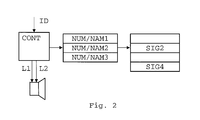
- Figure 2 includes a control unit CONT, a first table with a first to third number / name entry NUM / NAM1..NUM / NAM3, a second table with four possible Entries, the second entry a second signal SIG2 and the fourth entry includes a fourth signal SIG4 and the remaining entries are missing, and a speaker, which is symbolically represented by a first and second line L1 and L2 connected to the control unit CONT is.
- the first step is based on that of the telecommunications network signaled identification ID, in the example shown the Phone number, the entry assigned to the calling subscriber searched in the internal phone book. In our example fulfilled the second number / name entry NUM / NAM2 the criterion. A second signal SIG2 is also assigned to this entry, which in our example is the spoken name of the calling subscriber.
- Both an existing call on the first line L1, as well as the second on the second line L2 Signal SIG2 are from the loudspeaker of the telecommunication terminal radiated.
- the user of the telecommunication terminal consequently both continue to hear the existing one Conversation, as well as the name of the calling party.
- the Name can also be shown on a display unit of the Telecommunications terminal are displayed.
- the fourth signal SIG4 is in the example shown for the Case provided for an entry in the internal phone book cannot be found or no voice memo for an entry assigned. So the fourth signal is such as "Unknown Participant”.
- the field of application of the modules provided for the invention is not limited to the method according to the invention, but can also affect language selection, for example extend.
- the modules shown for the The method according to the invention is not mandatory in the telecommunications terminal but can be in a similar form from Telecommunications network can be included.
- the Case conceivable that the first table with the first to third number / name entry NUM / NAM1..NUM / NAM3 and the second table with the second and fourth signals SIG2 and SIG4 is integrated in the telecommunications network.
- the corresponding Information is then, for example, from a Switching node transmitted to the telecommunications terminal.
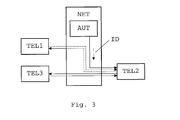
- Figure 3 comprises a first to third telecommunications terminal TEL1..TEL3, which are connected to a telecommunications network NET are connected.
- the telecommunications network contains NET also a voice machine AUT.
- the first telecommunication terminal TEL1 User the number of the second telecommunication terminal TEL2 selected and thus a connection request to the second Telecommunications terminal TEL2 to the telecommunications network NET transmitted. Thereupon, with the help of the telecommunications network NET the ringing of the dial tone at the first Telecommunications terminal TEL1 initiated. This is in the Figure by an arrow from the telecommunications network NET to symbolizes the first telecommunications terminal TEL1.
- connection from the automatic speech machine AUT to second telecommunications terminal TEL2, which is also shown with the help of an arrow.
- About these Connection becomes an identification ID of the first telecommunication terminal TEL1, for example the phone number or the Name of the owner, to the second telecommunication terminal TEL2 transmitted.
- the user takes the second telecommunication terminal TEL2 the connection request, it will Dial tone on the first telecommunications terminal TEL1 switched off, the connection to the speech machine was broken and the voice connection between the first and second telecommunication terminal TEL1 and TEL2 manufactured.
- This connection is by the dashed, opposite arrows between the first and second telecommunications terminal TEL1 and TEL2 symbolizes.
- the arrangement shows the state of the system before the user of the second telecommunication terminal has accepted the connection request.
Landscapes
- Engineering & Computer Science (AREA)
- Signal Processing (AREA)
- Computer Networks & Wireless Communication (AREA)
- Telephonic Communication Services (AREA)
Priority Applications (1)
| Application Number | Priority Date | Filing Date | Title |
|---|---|---|---|
| EP01119964A EP1284574A1 (fr) | 2001-08-18 | 2001-08-18 | Procédé et dispositif pour la présentation d'une identité attribuée à un terminal de communication |
Applications Claiming Priority (1)
| Application Number | Priority Date | Filing Date | Title |
|---|---|---|---|
| EP01119964A EP1284574A1 (fr) | 2001-08-18 | 2001-08-18 | Procédé et dispositif pour la présentation d'une identité attribuée à un terminal de communication |
Publications (1)
| Publication Number | Publication Date |
|---|---|
| EP1284574A1 true EP1284574A1 (fr) | 2003-02-19 |
Family
ID=8178364
Family Applications (1)
| Application Number | Title | Priority Date | Filing Date |
|---|---|---|---|
| EP01119964A Ceased EP1284574A1 (fr) | 2001-08-18 | 2001-08-18 | Procédé et dispositif pour la présentation d'une identité attribuée à un terminal de communication |
Country Status (1)
| Country | Link |
|---|---|
| EP (1) | EP1284574A1 (fr) |
Cited By (1)
| Publication number | Priority date | Publication date | Assignee | Title |
|---|---|---|---|---|
| EP1575252A4 (fr) * | 2003-10-20 | 2009-11-11 | Panasonic Corp | Appareil telephonique |
Citations (3)
| Publication number | Priority date | Publication date | Assignee | Title |
|---|---|---|---|---|
| US5265145A (en) * | 1991-03-28 | 1993-11-23 | Lim Boon C | Alphanumeric caller identification telephone |
| US5309512A (en) * | 1992-07-29 | 1994-05-03 | At&T Bell Laboratories | Call waiting deluxe feature |
| EP0905959A2 (fr) * | 1997-08-01 | 1999-03-31 | Comverse Network Systems, Inc. | Système téléphonique utilisant un réseau à commutation par paquets |
-
2001
- 2001-08-18 EP EP01119964A patent/EP1284574A1/fr not_active Ceased
Patent Citations (3)
| Publication number | Priority date | Publication date | Assignee | Title |
|---|---|---|---|---|
| US5265145A (en) * | 1991-03-28 | 1993-11-23 | Lim Boon C | Alphanumeric caller identification telephone |
| US5309512A (en) * | 1992-07-29 | 1994-05-03 | At&T Bell Laboratories | Call waiting deluxe feature |
| EP0905959A2 (fr) * | 1997-08-01 | 1999-03-31 | Comverse Network Systems, Inc. | Système téléphonique utilisant un réseau à commutation par paquets |
Cited By (1)
| Publication number | Priority date | Publication date | Assignee | Title |
|---|---|---|---|---|
| EP1575252A4 (fr) * | 2003-10-20 | 2009-11-11 | Panasonic Corp | Appareil telephonique |
Similar Documents
| Publication | Publication Date | Title |
|---|---|---|
| DE19622969B4 (de) | Telefon-Server | |
| DE69033126T2 (de) | Sprachen- und Bildkommunikationsgerät | |
| DE10147549A1 (de) | Vermittlungsverfahren zwischen Dialogsystemen | |
| DE102009035796A1 (de) | Benachrichtigung über Audio-Ausfall bei einer Telekonferenzverbindung | |
| DE60307737T2 (de) | Benachrichtigung für anklopfende Anrufe | |
| EP1202547B1 (fr) | Selection d'un signal de sonnerie | |
| DE3405014A1 (de) | Verfahren fuer den betrieb eines telefon-anrufbeantworters | |
| EP0589248A2 (fr) | Méthode et disposition pour l'affichage de numéros d'appel aux postes téléphoniques d'un central téléphonique privé | |
| DE20202790U1 (de) | Von mehreren Kommunikationsgeräten gemeinsam verwendbare Freihandeinrichtung | |
| WO2009000517A2 (fr) | Procédé permettant d'établir une communication téléphonique | |
| EP1286555A1 (fr) | Procédé et dispositif de présentation acoustique d'une identification attribuée à un terminal de communication | |
| EP1282293B1 (fr) | Procédé et dispositif pour le traitement d'appels dans un réseau de télécommunication et ses units liées | |
| EP0339476B1 (fr) | Méthode et dispositif pour former des messages de service de communication électroniques composés de parties vocales et non vocales | |
| WO1999066695A1 (fr) | Procede et dispositif pour produire un message d'arrivee d'appel pour un utilisateur de terminal de telecommunication | |
| DE10348149B4 (de) | Verfahren zur Durchführung einer Telefonkonferenz | |
| EP1051017A2 (fr) | Procédé et système permettant l' écoute de la conversation entrante d'un abonné connecté au répondeur téléphonique d' un reseau | |
| EP2180670A1 (fr) | Systèmes de téléphone et terminaux de communication pour une utilisation dans de tels systèmes de téléphone | |
| EP1668932A2 (fr) | Procede pour etablir une liaison de communication | |
| DE3513244C2 (fr) | ||
| EP1244284B1 (fr) | Méthode et appareil pour établir deux liaisons vocales vers une position d'agent CTI | |
| WO2000004695A1 (fr) | Procede et dispositif pour faire fonctionner un terminal de telecommunication avec emission acoustique de donnees d'identification | |
| DE10109472A1 (de) | Verfahren zum Übertragen von zusätzlichen Informationen für Telekommunikationsteilnehmern | |
| AT5668U1 (de) | Verfahren zur signalisierung in einem telekommunikationsendgerät | |
| DE10302657A1 (de) | Verfahren und Vorrichtung zur Unterscheidung von eingehenden Rufen bei analogen Telekommunikationsendgeräten | |
| DE19928256B4 (de) | Verfahren und Anordnung zum Aufbau einer Kommunikationsverbindung |
Legal Events
| Date | Code | Title | Description |
|---|---|---|---|
| PUAI | Public reference made under article 153(3) epc to a published international application that has entered the european phase |
Free format text: ORIGINAL CODE: 0009012 |
|
| 17P | Request for examination filed |
Effective date: 20020108 |
|
| AK | Designated contracting states |
Designated state(s): AT BE CH CY DE DK ES FI FR GB GR IE IT LI LU MC NL PT SE TR |
|
| AX | Request for extension of the european patent |
Extension state: AL LT LV MK RO SI |
|
| 17Q | First examination report despatched |
Effective date: 20030804 |
|
| AKX | Designation fees paid |
Designated state(s): DE FR GB IT |
|
| STAA | Information on the status of an ep patent application or granted ep patent |
Free format text: STATUS: THE APPLICATION HAS BEEN REFUSED |
|
| 18R | Application refused |
Effective date: 20041217 |