EP1285023B1 - Elastische folie - Google Patents
Elastische folie Download PDFInfo
- Publication number
- EP1285023B1 EP1285023B1 EP01925478A EP01925478A EP1285023B1 EP 1285023 B1 EP1285023 B1 EP 1285023B1 EP 01925478 A EP01925478 A EP 01925478A EP 01925478 A EP01925478 A EP 01925478A EP 1285023 B1 EP1285023 B1 EP 1285023B1
- Authority
- EP
- European Patent Office
- Prior art keywords
- film
- films
- medical
- pvc
- yield point
- Prior art date
- Legal status (The legal status is an assumption and is not a legal conclusion. Google has not performed a legal analysis and makes no representation as to the accuracy of the status listed.)
- Expired - Lifetime
Links
- 229920003023 plastic Polymers 0.000 claims abstract description 11
- 239000004033 plastic Substances 0.000 claims abstract description 11
- 238000010586 diagram Methods 0.000 claims description 11
- -1 polypropylene Polymers 0.000 claims description 8
- 239000004743 Polypropylene Substances 0.000 claims description 7
- 229920000098 polyolefin Polymers 0.000 claims description 6
- 229920001155 polypropylene Polymers 0.000 claims description 6
- 238000004519 manufacturing process Methods 0.000 claims description 5
- 238000002425 crystallisation Methods 0.000 claims description 2
- 230000008025 crystallization Effects 0.000 claims description 2
- 239000011888 foil Substances 0.000 claims 6
- 239000000463 material Substances 0.000 abstract description 9
- 230000001954 sterilising effect Effects 0.000 abstract description 4
- 238000004659 sterilization and disinfection Methods 0.000 abstract description 4
- 230000007704 transition Effects 0.000 abstract description 2
- 239000012530 fluid Substances 0.000 abstract 1
- 239000010410 layer Substances 0.000 description 22
- 239000004800 polyvinyl chloride Substances 0.000 description 12
- 229920000915 polyvinyl chloride Polymers 0.000 description 11
- 229920000642 polymer Polymers 0.000 description 7
- 239000000203 mixture Substances 0.000 description 6
- 238000007789 sealing Methods 0.000 description 4
- 239000004698 Polyethylene Substances 0.000 description 3
- 229920001577 copolymer Polymers 0.000 description 3
- 229920000573 polyethylene Polymers 0.000 description 3
- XLYOFNOQVPJJNP-UHFFFAOYSA-N water Substances O XLYOFNOQVPJJNP-UHFFFAOYSA-N 0.000 description 3
- VSKJLJHPAFKHBX-UHFFFAOYSA-N 2-methylbuta-1,3-diene;styrene Chemical compound CC(=C)C=C.C=CC1=CC=CC=C1.C=CC1=CC=CC=C1 VSKJLJHPAFKHBX-UHFFFAOYSA-N 0.000 description 2
- VEXZGXHMUGYJMC-UHFFFAOYSA-N Hydrochloric acid Chemical compound Cl VEXZGXHMUGYJMC-UHFFFAOYSA-N 0.000 description 2
- 229920001400 block copolymer Polymers 0.000 description 2
- 229920001887 crystalline plastic Polymers 0.000 description 2
- 230000007423 decrease Effects 0.000 description 2
- 239000003814 drug Substances 0.000 description 2
- 238000002474 experimental method Methods 0.000 description 2
- 230000002427 irreversible effect Effects 0.000 description 2
- 239000004014 plasticizer Substances 0.000 description 2
- 238000009864 tensile test Methods 0.000 description 2
- 229920001169 thermoplastic Polymers 0.000 description 2
- 239000012815 thermoplastic material Substances 0.000 description 2
- 239000004416 thermosoftening plastic Substances 0.000 description 2
- 229920002633 Kraton (polymer) Polymers 0.000 description 1
- 229910000831 Steel Inorganic materials 0.000 description 1
- 229920001871 amorphous plastic Polymers 0.000 description 1
- 239000002216 antistatic agent Substances 0.000 description 1
- 230000004888 barrier function Effects 0.000 description 1
- 239000002981 blocking agent Substances 0.000 description 1
- 239000000470 constituent Substances 0.000 description 1
- 230000003247 decreasing effect Effects 0.000 description 1
- 229940079593 drug Drugs 0.000 description 1
- 229920001971 elastomer Polymers 0.000 description 1
- 238000005516 engineering process Methods 0.000 description 1
- BXOUVIIITJXIKB-UHFFFAOYSA-N ethene;styrene Chemical group C=C.C=CC1=CC=CC=C1 BXOUVIIITJXIKB-UHFFFAOYSA-N 0.000 description 1
- 238000001125 extrusion Methods 0.000 description 1
- 239000000945 filler Substances 0.000 description 1
- 229920000578 graft copolymer Polymers 0.000 description 1
- 238000010438 heat treatment Methods 0.000 description 1
- 229920001519 homopolymer Polymers 0.000 description 1
- 238000001802 infusion Methods 0.000 description 1
- 239000003978 infusion fluid Substances 0.000 description 1
- 239000007788 liquid Substances 0.000 description 1
- 239000000314 lubricant Substances 0.000 description 1
- 239000008155 medical solution Substances 0.000 description 1
- 238000000034 method Methods 0.000 description 1
- 238000000465 moulding Methods 0.000 description 1
- 150000002894 organic compounds Chemical class 0.000 description 1
- 229920000307 polymer substrate Polymers 0.000 description 1
- 235000014483 powder concentrate Nutrition 0.000 description 1
- 229920005604 random copolymer Polymers 0.000 description 1
- 239000002356 single layer Substances 0.000 description 1
- 239000000243 solution Substances 0.000 description 1
- 239000007858 starting material Substances 0.000 description 1
- 239000010959 steel Substances 0.000 description 1
- 239000000126 substance Substances 0.000 description 1
- 125000000383 tetramethylene group Chemical group [H]C([H])([*:1])C([H])([H])C([H])([H])C([H])([H])[*:2] 0.000 description 1
- 238000003466 welding Methods 0.000 description 1
Images
Classifications
-
- C—CHEMISTRY; METALLURGY
- C08—ORGANIC MACROMOLECULAR COMPOUNDS; THEIR PREPARATION OR CHEMICAL WORKING-UP; COMPOSITIONS BASED THEREON
- C08J—WORKING-UP; GENERAL PROCESSES OF COMPOUNDING; AFTER-TREATMENT NOT COVERED BY SUBCLASSES C08B, C08C, C08F, C08G or C08H
- C08J5/00—Manufacture of articles or shaped materials containing macromolecular substances
- C08J5/18—Manufacture of films or sheets
-
- B—PERFORMING OPERATIONS; TRANSPORTING
- B32—LAYERED PRODUCTS
- B32B—LAYERED PRODUCTS, i.e. PRODUCTS BUILT-UP OF STRATA OF FLAT OR NON-FLAT, e.g. CELLULAR OR HONEYCOMB, FORM
- B32B25/00—Layered products comprising a layer of natural or synthetic rubber
-
- B—PERFORMING OPERATIONS; TRANSPORTING
- B32—LAYERED PRODUCTS
- B32B—LAYERED PRODUCTS, i.e. PRODUCTS BUILT-UP OF STRATA OF FLAT OR NON-FLAT, e.g. CELLULAR OR HONEYCOMB, FORM
- B32B27/00—Layered products comprising a layer of synthetic resin
- B32B27/32—Layered products comprising a layer of synthetic resin comprising polyolefins
-
- A—HUMAN NECESSITIES
- A61—MEDICAL OR VETERINARY SCIENCE; HYGIENE
- A61J—CONTAINERS SPECIALLY ADAPTED FOR MEDICAL OR PHARMACEUTICAL PURPOSES; DEVICES OR METHODS SPECIALLY ADAPTED FOR BRINGING PHARMACEUTICAL PRODUCTS INTO PARTICULAR PHYSICAL OR ADMINISTERING FORMS; DEVICES FOR ADMINISTERING FOOD OR MEDICINES ORALLY; BABY COMFORTERS; DEVICES FOR RECEIVING SPITTLE
- A61J1/00—Containers specially adapted for medical or pharmaceutical purposes
- A61J1/05—Containers specially adapted for medical or pharmaceutical purposes for collecting, storing or administering blood, plasma or medical fluids ; Infusion or perfusion containers
- A61J1/10—Bag-type containers
-
- Y—GENERAL TAGGING OF NEW TECHNOLOGICAL DEVELOPMENTS; GENERAL TAGGING OF CROSS-SECTIONAL TECHNOLOGIES SPANNING OVER SEVERAL SECTIONS OF THE IPC; TECHNICAL SUBJECTS COVERED BY FORMER USPC CROSS-REFERENCE ART COLLECTIONS [XRACs] AND DIGESTS
- Y10—TECHNICAL SUBJECTS COVERED BY FORMER USPC
- Y10T—TECHNICAL SUBJECTS COVERED BY FORMER US CLASSIFICATION
- Y10T428/00—Stock material or miscellaneous articles
- Y10T428/31504—Composite [nonstructural laminate]
- Y10T428/31855—Of addition polymer from unsaturated monomers
- Y10T428/31909—Next to second addition polymer from unsaturated monomers
-
- Y—GENERAL TAGGING OF NEW TECHNOLOGICAL DEVELOPMENTS; GENERAL TAGGING OF CROSS-SECTIONAL TECHNOLOGIES SPANNING OVER SEVERAL SECTIONS OF THE IPC; TECHNICAL SUBJECTS COVERED BY FORMER USPC CROSS-REFERENCE ART COLLECTIONS [XRACs] AND DIGESTS
- Y10—TECHNICAL SUBJECTS COVERED BY FORMER USPC
- Y10T—TECHNICAL SUBJECTS COVERED BY FORMER US CLASSIFICATION
- Y10T428/00—Stock material or miscellaneous articles
- Y10T428/31504—Composite [nonstructural laminate]
- Y10T428/31855—Of addition polymer from unsaturated monomers
- Y10T428/31938—Polymer of monoethylenically unsaturated hydrocarbon
Definitions
- the present invention relates to polypropylene multi-layer non-PVC flexible films which are substantially dimensionally stable under heat sterilization conditions, and to their use, for example in medical technology.
- the present invention relates to medical bags comprising at least one such film.
- PVC polyvinyl chloride
- the use of PVC has some disadvantages.
- plasticizers contained in the PVC film may be released and - in the case of use of the films in medical bags - be able to diffuse, for example, into the medical solution contained therein.
- hydrochloric acid is formed.
- PVC tends to absorb drugs from infusion solutions.
- non-PVC films are to be understood in the following films that do not contain PVC.
- Stretched or stretched films have good mechanical properties, they are, for example, pressure-stable and can also be equipped with water vapor-tight when using multilayer films. However, stretched films shrink when heated and are therefore not heat sterilizable.
- EP-A 0 793 713 is a multi-layer, heat sterilizable non-PVC film described which is impact resistant and suitable for the production of medical bags. For dimensional stability, no information is reported.
- the object of the present invention was to provide films which do not have the disadvantages of the prior art.
- films are to be provided, from which bags and other containers can be produced, which are dimensionally stable and preferably heat sterilizable.
- the films should preferably be biocompatible.
- a three-layer elastic non-PVC film which is not stretched and whose stress-strain diagram has no point in which the slope of the graph is ⁇ 0, comprising at least one semi-crystalline plastic having a degree of crystallization of ⁇ 50% is selected from polypropylene-based flexible polyolefins.
- the film according to the invention opposes the outer load until it ruptures with an at least constant, preferably steadily increasing, resistance, whereby it is plastically, i. fluent, expands.
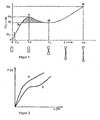
- Fig. 1 shows the stress-strain diagram of a conventional thermoplastic material.
- Conventional unstretched thermoplastic films can have up to a threshold value, the upper yield stress ⁇ s , a certain dimensional stability and elasticity. Then, in the stress-strain diagram, one observes the passing through of a maximum II, the so-called “yield point", which is defined by the upper yield stress ⁇ s [N / mm 2 ] (from the extensor force F s normalized to the surface). N]) and the upper yield point ⁇ s is determined. Beyond the yield point, the deformation continues to increase, but the tension decreases until a minimum III has passed.
- thermoplastic materials thus have after exceeding the yield point (here: maximum II) on a curve with negative slope areas, ie there is a drop in voltage and an increasing length expansion of the film takes place after exceeding the yield point not only by increasing the Tensile load, but even at a lower tensile load than required to reach the yield point.
- the yield point is usually recognized by a constriction of the specimen, which behavior is explained at the molecular level by aligning the polymer chains along the tensile direction. This constriction of the film or orientation of the polymer chains is irreversible, so that with decreasing tensile stress, the film does not assume its original shape again.
- the yield point represents the limit of the load to which a material becomes elastic, i. can react reversibly to a load or from which the material is plastically, i. essentially irreversibly deformed.
- the term yield point denotes this limit value between elastic and plastic behavior, this limit value being according to the invention is not associated with a maximum in the stress-strain curve.
- the transition between elastic and plastic behavior is fluent, the stress-strain curve has no maximum in the yield point, ie the yield point can not (a) be seen in the stress-strain diagram (b) it may be recognizable by changing the slope of the curve for the same sign of the slope, or (c) the yield point is an inflection point of the curve so that the slope of the curve at inflection equals zero
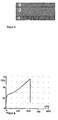
- FIG. 2 schematically shows the curves of the stress-strain diagrams of two exemplary inventive films, which have no maximum.
- the curve denoted by the numeral 1 has neither a maximum nor an inflection point, but the slope of the curve changes after exceeding a limit value.
- the curve indicated by the numeral 2 has a turning point in which the slope is equal to zero. Neither of the two curves has a point in which the slope of the curve is negative.
- the films according to the invention can also show a constriction after exceeding a limit value, which is irreversible, so that they do not assume their original shape even when the tensile load decreases.
- a plastic behavior occurs only after exceeding a threshold value up to which the material shows substantially no permanent shape change, i. behaves essentially elastically.
- a substantially elastic behavior is understood according to the invention that a material, for example a film, after taking away a load again assumes its original shape, i. undergoes essentially no permanent change in shape.
- the term "substantially no permanent change in shape” means a change in shape of at most 20%, preferably at most 15%.
- shape change includes both a distortion of the original geometric Shape, ie a deformation, as well as a pure linear expansion without distortion of the form.
- a stress-strain diagram can be measured by a tensile test, for example according to DIN 53 455 or DIN 53 504.
- a test piece of a certain length L 0 and cross-sectional area A 0 is clamped in a tractor and stretched at a constant speed to rupture.
- the force F required for this purpose is registered as a function of the respective length of the test piece.
- the required force F may also be applied instead of the tensile stress.
- DIN 53 504 the relationship between the tensile force and the change in length of the specimen during the course of the tensile test to break is recorded in a force-length change curve.
- the film according to the invention comprises at least one (partially) crystalline polymer or plastic.
- the semi-crystalline plastic is largely amorphous, wherein the term "largely amorphous plastic” is intended to designate a polymeric compound having a degree of crystallinity of ⁇ 50%, and is selected from flexible polyolefins based on polypropylene.
- Plastic according to the invention is understood as meaning polymeric materials whose main constituent consists of macromolecular organic compounds or polymers, it being possible for the polymeric materials to be both homopolymers and copolymers as well as mixtures and blends.
- Poly (PP) -based and optionally polyethylene (PE) -based flexible polyolefins such as WL 203, WL 209 and WL 116 from Huntsman Corp. are preferred.
- SIS styrene-isoprene-styrene
- the above polymers can be used as block copolymers, random copolymers, graft copolymers and / or blends or blends.
- the present invention also relates to the use of the above plastics as a film.
- At least the outer layers have a Vicat softening point above about 121 ° C, while inner layers may also have a lower softening point.
- the thickness of the individual layers is not critical.
- layers with a softening point above 121 ° C have a thickness of 10 to 100 microns, more preferably 10 to 50 microns, and an inner layer having a softening point below 121 ° C has a thickness of at least 60 microns.
- a so-called sealing layer may be provided, which is preferably arranged as an outer layer. This sealing layer can enable or improve the welding of the film according to the invention.
- polymers which are compatible with the solution are used for the sealing layer, since the sealing layer in the case of a bag made from the film according to the invention lies inside the bag after completion of the bag.
- the sealing layer in the case of a bag made from the film according to the invention lies inside the bag after completion of the bag.
- the individual layers are based on polypropylene and polyethylene Materials, optionally in combination with layers of SIS copolymers are particularly preferred.
- a film according to the invention is preferably produced by coextrusion.
- the films according to the invention are not stretched or stretched apart from a production-related orientation of less than about 2% and therefore do not practically shrink on heating.
- the films of the invention are preferably heat or hot sterilizable. Medical equipment and containers are usually autoclaved by steam sterilization at about 121 ° C.
- the monolayer or multilayer films according to the invention are preferably still dimensionally stable at these temperatures under autoclaving conditions.
- the softening temperature is determined to be Vicat VST / A / 50 for polymer and plastic materials of the invention, ie it is defined as the temperature at which a loaded steel pin with a cross-section of 1 mm 2 penetrates 1 mm deep into the plastics sample in an increasingly heated plastic sample has penetrated (see DIN ISO standard 306, ASTM D1525).
- the softening temperature is usually much lower than the temperature at which the polymeric substance would completely reach a quasi-liquid state.
- the films according to the invention preferably have a thickness of at least 50 ⁇ m. Particularly preferred films of the invention have a thickness of 50 to 500 microns.
- the films of the invention are preferably not or only slightly permeable to water vapor, ie they form a barrier to water vapor, and have good impact resistance even in the cold. It is further preferred that the films of the invention are transparent.
- the films according to the invention are according to preferred embodiments substantially free of lubricants, plasticizers, anti-blocking agents, antistatic agents, and fillers.
- the production of the films of the invention can be carried out by conventional molding methods, such as film extrusion, to form a flat or tubular film.
- the present invention further relates to the use of the film according to the invention in the field of medicine, in particular as a starting material for the production of medical bags and multi-chamber bags, for example for storing infusions and the like.
- the present invention relates to medical bags comprising at least one film according to the invention.
- Such bags are preferably fall-proof.
- a three-layered film of 200 ⁇ m thickness was prepared by coextrusion.
- the structure of the film is schematically in FIG. 3 shown.
- the layer 1 has a thickness of 30 .mu.m and comprises the flexible polyolefin WL 116 from Huntsman Corp.
- the layer 2 has a thickness of 140 .mu.m and comprises the flexible polyolefin WL 203 from Huntsman Corp.
- the third layer again has a thickness of 30 microns and comprises 85 wt .-% PP232cs198 (Polypropylene rubber, Huntsman Corp.) and 15% by weight Kraton® G 1652 (styrene-ethylene / butylene (SEB) copolymer) from Shell.
- FIG. 4 shows the tensile elongation curve after sterilization at 121 ° C.
- the force-elongation curve measured according to DIN 53 504 has no point with negative slope.
- the film exhibits elastic behavior up to a threshold, in the present example at 30 N.
Landscapes
- Chemical & Material Sciences (AREA)
- Engineering & Computer Science (AREA)
- Manufacturing & Machinery (AREA)
- Medicinal Chemistry (AREA)
- Health & Medical Sciences (AREA)
- Chemical Kinetics & Catalysis (AREA)
- Materials Engineering (AREA)
- Polymers & Plastics (AREA)
- Organic Chemistry (AREA)
- Laminated Bodies (AREA)
- Manufacture Of Macromolecular Shaped Articles (AREA)
- Materials For Medical Uses (AREA)
- Compositions Of Macromolecular Compounds (AREA)
- Springs (AREA)
- Absorbent Articles And Supports Therefor (AREA)
Description
- Die vorliegende Erfindung betrifft mehrschichtige elastische non-PVC Folien auf Polypropylen-Basis die unter den Bedingungen der Hitzesterilisation im wesentlichen formstabil sind, sowie deren Verwendung, beispielsweise in der Medizintechnik Femer betrifft die vorliegende Erfindung medizinische Beutel, welche mindestens eine derartige Folie umfassen.
- In der Medizin besteht ein Bedarf an Folien für medizinische Beutel, welche bis zu mehreren Tagen einer Druckbelastung ausgesetzt werden können, beispielsweise als IV-Bags (Beutel für intravenös applizierte Medikamente) bei Druckmanschettenanwendung oder als Pulverkonzentratbeutel, bei denen während der Anwendung ein Innendruck entsteht.
- Derartige Folien für medizinische Beutel wurden bisher in den meisten Fällen aus Polyvinylchlorid (PVC) hergestellt Die Verwendung von PVC bringt jedoch einige Nachteile mit sich. So besteht zum einen die Gefahr, daß in der PVC-Folie enthaltene Weichmacher freigesetzt werden und - im Fall der Verwendung der Folien in medizinischen Beuteln - beispielsweise in die darin enthaltene medizinische Lösung diffundieren können. Darüber hinaus wird beim Verspiegeln in der Hitze von PVC-Beuteln Salzsäure gebildet. Außerdem neigt PVC dazu, Medikamente aus Infusionslösungen zu absorbieren.
- Es wurde daher versucht, PVC durch andere Kunststoffe zu ersetzen. Beispielsweise sind in
DE 195 15 254 mehrschichtige non-PVC-Folien beschrieben, welche einen mindestens dreischichtigen Aufbau aus zwei äußeren Stützschichten und einer Mittelschicht aufweisen. Aus diesen Folien hergestellte Beutel sind jedoch einer Druckbelastung ohne bleibende Formveränderung nicht gewachsen. Unter dem Begriff "non-PVC-Folien" sind im folgenden Folien zu verstehen, die kein PVC enthalten. - Gereckte bzw. gestreckte Folien weisen gute mechanische Eigenschaften auf, sie sind beispielsweise druckstabil und können bei Verwendung mehrschichtiger Folien auch wasserdampfdicht ausgerüstet werden. Allerdings schrumpfen gereckte Folien beim Erwärmen und sind somit nicht hitzesterilisierbar.
- In der
EP-A 0 793 713 ist eine mehrlagige, hitzesterilisierbare Non-PVC-Folie beschrieben, die schlagzäh und zur Herstellung medizinischer Beutel geeignet ist. zur Formstabilität werden keine Angaben gemarcht. - Somit bestand die Aufgabe der vorliegenden Erfindung darin, Folien bereitzustellen, welche die Nachteile des Stands der Technik nicht aufweisen. Insbesondere sollen Folien bereitgestellt werden, aus denen Beutel und andere Behältnisse hergestellt werden können, welche formstabil und vorzugsweise hitzesterilisierbar sind. Femer sollten die Folien vorzugsweise biokompatibel sein.
- Diese Aufgabe wird durch die in den Ansprüchen gekennzeichneten Ausführungsformen gelöst.
- Insbesondere wird dreischichtige, elastische non-PVC Folie bereitgestellt, welche nicht verstreckt ist und deren Spannungs-Dehnungs-Diagramm keinen Punkt aufweist, in welchem die Steigung des Graphen < 0 ist, umfassend mindestens einen teilkristallinen Kunststoff mit einem Kristallisationsgrad von <50%, welcher aus flexiblen Polyolefinen auf Polypropylenbasis ausgewählt ist.
- Folglich erleidet eine derartige Folie bei vorgegebener Dicke bis zu einer festgelegten Belastung bzw. einem festgelegten Druck keine wesentliche bleibende Formveränderung und verhält sich im wesentlichen elastisch. Im Fall einer Belastung oberhalb dieses Grenzwerts setzt die erfindungsgemäße Folie der äußeren Belastung bis zum Reißen einen mindestens gleichbleibenden, vorzugsweise stetig ansteigenden Widerstand entgegen, wobei sie sich plastisch, d.h. fließend, ausdehnt.
- Die Figuren zeigen:
-
Figur 1 zeigt schematisch ein Spannungs-Dehnungs-Diagramm einer herkömmlichen thermoplastischen Folie. -
Figur 2 zeigt schematisch die Spannungs-Dehnungs-Diagramme zweier Folien, welche die erfindungsgemäßen Eigenschaften aufweisen. -
Figur 3 ist ein schematischer Schnitt durch eine mehrschichtige Ausführungsform einer erfindungsgemäßen Folie. -
Figur 4 zeigt das Spannungs-Dehnungs-Diagramm einer dreischichtigen Folie gemäß Beispiel 1. -
Fig. 1 zeigt das Spannungs-Dehnungs-Diagramm eines herkömmlichen thermoplastischen Materials. Übliche unverstreckte thermoplastische Folien können bis zu einem Schwellenwert, der oberen Streckspannung σs, eine gewisse Formstabilität und Elastizität aufweisen. Dann beobachtet man im Spannungs-Dehnungs-Diagramm das Durchlaufen eines Maximums II, des sogenannten "Yield-Punkts" (Streckgrenze), welcher durch die obere Streckspannung σs [N/mm2] (aus der auf die Fläche normierten Streckkraft Fs [N]) und die obere Fließgrenze εs bestimmt ist. Jenseits des Yield-Punkts nimmt die Verformung weiter zu, die Zugspannung nimmt jedoch ab, bis ein Minimum III durchlaufen ist. Herkömmliche thermoplastische Materialien weisen somit nach Überschreiten des Yield-Punkts (hier: Maximum II) einen Kurvenverlauf mit Bereichen negativer Steigung auf, d.h. es tritt ein Spannungsabfall auf und eine zunehmende Längenausdehnung der Folie erfolgt nach Überschreiten des Yield-Punkts nicht erst durch eine Erhöhung der Zugbelastung, sondern sogar bei geringerer Zugbelastung, als sie für das Erreichen des Yield-Punkts erforderlich war. - Im Zugexperiment ist der Yield-Punkt gewöhnlich durch eine Einschnürung des Probenkörpers zu erkennen, wobei dieses Verhalten auf molekularer Ebene durch das Ausrichten der Polymerketten entlang der Zugrichtung erklärt wird. Diese Einschnürung der Folie bzw. Ausrichtung der Polymerketten ist irreversibel, so daß bei abnehmender Zugbelastung die Folie ihre ursprüngliche Form nicht wieder annimmt. Somit stellt der Yield-Punkt den Grenzwert der Belastung dar, bis zu dem ein Material elastisch, d.h. reversibel auf eine Belastung reagieren kann bzw. ab dem sich das Material plastisch, d.h. im wesentlichen irreversibel verformt.
- Erfindungsgemäß bezeichnet der Begriff Yield-Punkt diesen Grenzwert zwischen elastischem und plastischem Verhalten, wobei dieser Grenzwert erfindungsgemäß nicht mit einem Maximum in der Spannungs-Dehnungs-Kurve verbunden ist. Wie im folgenden beschrieben werden wird, ist erfindungsgemäß der Übergang zwischen elastischem und plastischem Verhalten fließend, die Spannungs-Dehnungs-Kurve weist im Yield-Punkt kein Maximum auf, d.h. der Yield-Punkt kann (a) im Spannungs-Dehnungs-Diagramm nicht erkennbar sein, (b) er kann durch eine Änderung der Steigung der Kurve bei gleichem Vorzeichen der Steigung erkennbar sein oder (c) der Yield-Punkt ist ein Wendepunkt der Kurve, so daß die Steigung der Kurve im Wendepunkt gleich 0 ist
-
Figur 2 zeigt schematisch die Kurvenverläufe der Spannungs-Dehnungs-Diagramme zweier beispielhafter erfindungsgemäßer Folien, welche kein Maximum aufweisen. InFigur 2 weist die mit der Ziffer 1 bezeichnete Kurve weder ein Maximum noch einen Wendepunkt auf, jedoch ändert sich nach Überschreiten eines Grenzwerts die Steigung der Kurve. Die mit der Ziffer 2 bezeichnete Kurve weist einen Wendepunkt auf, in welchem die Steigung gleich 0 ist Keine der beiden Kurven weist einen Punkt auf, in welchem die Steigung der Kurve negativ ist. - Auch die erfindungsgemäßen Folien, können nach Überschreiten eines Grenzwerts eine Einschnürung zeigen, welche irreversibel ist, so daß sie auch bei abnehmender Zugbelastung ihre ursprüngliche Form nicht wieder annehmen. Dabei tritt erfindungsgemäß ein plastisches Verhalten erst nach Überschreiten eines Schwellenwerts bzw. Grenzwerts auf, bis zu welchem das Material im wesentlichen keine bleibende Formveränderung zeigt, d.h. sich im wesentlichen elastisch verhält.
- Unter dem Begriff "ein im wesentlichen elastisches Verhalten" wird erfindungsgemäß verstanden, daß ein Material, beispielsweise eine Folie, nach Wegnahme einer Belastung ihre ursprüngliche Form wieder annimmt, d.h. im wesentlichen keine bleibende Formveränderung erleidet.
- Erfindungsgemäß wird unter dem Begriff "im wesentlichen keine bleibende Formveränderung" eine Formveränderung von höchstens 20%, vorzugsweise höchstens 15% verstanden. Dabei umfaßt der Begriff Formveränderung" gemäß dieser Erfindung sowohl eine Verzerrung der bzw. Abweichung von der ursprünglichen geometrischen Form, d.h. eine Deformation, als auch eine reine Längenausdehnung ohne eine Verzerrung der Form.
- Erfindungsgemäß kann ein Spannungs-Dehnungs-Diagramm durch einen Zugversuch, beispielsweise gemäß DIN 53 455 oder DIN 53 504, gemessen werden. Dazu wird ein Prüfstück einer bestimmten Länge L0 und Querschnittsfläche A0 in eine Zugmaschine eingespannt und mit konstanter Geschwindigkeit bis zum Zerreißen gedehnt. Die hierzu erforderliche Kraft F wird als Funktion der jeweiligen Länge des Prüfstücks registriert. Die in jeder Phase des Experiments festgestellte nominelle Zugspannung σ = F/A0 wird anschließend in einem Spannungs-Dehnungs-Diagramm gegen die jeweilige Dehnung ε = (L-Lo)/Lo aufgetragen. Bei Prüfstücken einer genormten Länge und Querschnittsfläche kann auch die erforderliche Kraft F anstelle der Zugspannung aufgetragen werden. Gemäß DIN 53 504 wird in einer Kraft-Längenänderungs-Kurve die Beziehung zwischen der Zugkraft und Längenänderung des Probekörpers während des Verlaufs des Zugversuchs bis zum Reißen aufgezeichnet.
- Die erfindungsgemäße Folie umfaßt mindestens ein(en) teilkristallines/n Polymer bzw. Kunststoff. Erfindungsgemäß ist der teilkristalline Kunststoff weitgehend amorph, wobei der Begriff "weitgehend amorpher Kunststoff" eine polymere Verbindung mit einem Kristallisationsgrad von < 50% bezeichnen soll, und ist ausgewählt aus flexiblen polyolefinen auf polypropylen basis.
- Unter einem Kunststoff werden erfindungsgemäß polymere Materialien verstanden, deren Hauptbestandteil aus makromolekularen organischen Verbindungen bzw. Polymeren besteht, wobei die polymeren Materialien sowohl Homopolymere als auch Copolymere sowie Mischungen und Blends sein können.
- Bevorzugt sind flexible Polyolefine auf Polypropylen (PP)-Basis und gegebenenfalls Polyethylen (PE)-Basis wie WL 203, WL 209 und WL 116 der Fa. Huntsman Corp. Weiterhin bevorzugt sind Styrol-Isopren-Styrol(SIS)-Blockcopolymere und Mischungen und Blends davon, wie Hybrar® der Fa. Kuraray.
- Die vorstehenden Polymere können als Blockcopolymere, statistische Copolymere, Pfropfcopolymere und/oder Mischungen oder Blends eingesetzt werden.
- Die vorliegende Erfindung betrifft auch die Verwendung der vorstehenden Kunststoffe als Folie.
- Vorzugsweise weisen mindestens die äußeren Schichten einen Erweichungspunkt nach Vicat oberhalb von etwa 121 °C auf, während innen liegende Schichten auch einen niedrigeren Erweichungspunkt aufweisen können. Die Dicke der einzelnen Schichten ist unkritisch. Vorzugsweise weisen Schichten mit einem Erweichungspunkt oberhalb 121°C eine Dicke von 10 bis 100 µm, besonders bevorzugt 10 bis 50 µm, und eine innen liegende Schicht mit einem Erweichungspunkt unterhalb 121 °C eine Dicke von mindestens 60 µm auf. Des weiteren kann, falls erforderlich, eine sogenannte Siegelschicht bereitgestellt werden, welche vorzugsweise als eine äußere Schicht angeordnet ist. Diese Siegelschicht kann das Verschweißen der erfindungsgemäßen Folie ermöglichen bzw. verbessern. Für die Siegelschicht setzt man im allgemeinen Polymere ein, die lösungsverträglich sind, da die Siegelschicht bei einem aus der erfindungsgemäßen Folie hergestellten Beutel nach Fertigstellung des Beutels im Innenbereich liegt. Für die einzelnen Schichten sind auf Polypropylen und Polyethylen basierende Materialien, gegebenenfalls in Kombination mit Schichten von SIS-Copolymeren besonderes bevorzugt.
- Eine erfindungsgemäße Folie wird vorzugsweise durch Coextrusion hergestellt.
- Die erfindungsgemäßen Folien sind - abgesehen von einer herstellungsbedingten Orientierung von weniger als etwa 2% - nicht gereckt bzw. verstreckt und schrumpfen daher beim Erwärmen praktisch nicht.
- Femer sind die erfindungsgemäßen Folien vorzugsweise hitze- bzw.- heißsterilisierbar. Medizinische Geräte und Behälter werden üblicherweise durch Dampfsterilisation bei etwa 121 °C im Autoklaven behandelt. Die erfindungsgemäßen ein- oder mehrschichtigen Folien sind vorzugsweise bei diesen Temperaturen unter Autoklavierbedingungen noch formstabil.
- Die Erweichungstemperatur wird für Polymer- und Kunststoffmaterialien der Erfindung nach Vicat VST/A/50 bestimmt, d.h. sie ist als diejenige Temperatur definiert, bei der in eine zunehmend erwärmte Kunststoffprobe ein belasteter Stahlstift mit einem Querschnitt von 1 mm2 1 mm tief in die Kunststoffprobe eingedrungen ist (vgl. DIN-Iso-Norm 306, ASTM D1525). Die Erweichungstemperatur liegt meist wesentlich niedriger als diejenige Temperatur, bei der die polymere Substanz vollständig einen quasi flüssigen Zustand erreichen würde.
- Die erfindungsgemäßen Folien weisen vorzugsweise eine Dicke bzw. Stärke von mindestens 50 µm auf. Besonders bevorzugt weisen die erfindungsgemäßen Folien eine Dicke von 50 bis 500 µm auf.
- Darüber hinaus sind die erfindungsgemäßen Folien vorzugsweise nicht oder nur wenig für Wasserdampf durchlässig, d.h. sie bilden eine Barriere für Wasserdampf, und weisen auch in der Kälte eine gute Schlagzähigkeit auf. Es ist weiterhin bevorzugt, daß die erfindungsgemäßen Folien transparent sind.
- Die erfindungsgemäßen Folien sind gemäß bevorzugten Ausführungsformen im wesentlichen frei von Gleitmitteln, Weichmachern, Antiblockmitteln, Antistatika, sowie Füllstoffen.
- Die Herstellung der erfindungsgemäßen Folien kann durch übliche Formverfahren, wie Folienextrusion, unter Bildung einer Flach- oder Schlauchfolie erfolgen.
- Die vorliegende Erfindung betrifft ferner die Verwendung der erfindungsgemäßen Folie auf dem Gebiet der Medizin, insbesondere als Ausgangsmaterial für die Herstellung von medizinischen Beuteln und Mehrkammerbeuteln, beispielsweise zum Aufbewahren von Infusionen und dergleichen.
- Femer betrifft die vorliegende Erfindung medizinische Beutel, welche mindestens eine erfindungsgemäße Folie umfassen. Derartige Beutel sind vorzugsweise fallfest.
- Eine dreischichtige Folie einer Dicke von 200 µm wurde durch Coextrudieren hergestellt. Der Aufbau der Folie ist schematisch in
Figur 3 gezeigt. Die Schicht 1 weist eine Dicke von 30 µm auf und umfaßt das flexible Polyolefin WL 116 der Firma Huntsman Corp., die Schicht 2 weist eine Dicke von 140 µm auf und umfaßt das flexible Polyolefin WL 203 der Fa. Huntsman Corp.. Die dritte Schicht weist wiederum eine Dicke von 30 µm auf und umfaßt 85 Gew.-% PP232cs198 (Polypropylen-Kautschuk, Fa. Huntsman Corp.) und 15 Gew.-% Kraton® G 1652 (Styrol-Ethylen/Butylen(SEB)-Copolymer) der Fa. Shell. -
Figur 4 zeigt die Zugdehnungskurve nach dem Sterilisieren bei 121°C. Wiederum weist die gemäß DIN 53 504 gemessene Kraft-Dehnungs-Kurve keinen Punkt mit negativer Steigung auf. Femer zeigt die Folie bis zu einem Schwellenwert ein elastisches Verhalten, im vorliegenden Beispiel bei 30 N.
Claims (6)
- Dreischichtige, elastische non-PVC Folie, welche nicht verstreckt ist und deren Spannungs-Dehnungs-Diagramm keinen Punkt aufweist, in welchem die Steigung des Graphen < 0 ist, umfassend mindestens einen teilkristallinen Kunststoff mit einem Kristallisationsgrad von <50%, welcher aus flexiblen Polyolefinen auf Polypropylenbasis ausgewählt ist.
- Folie nach Anspruch 1, welche hitzesterilisierbar ist.
- Folie nach Anspruch 1 oder 2, welche einen Erweichungspunkt nach Vicat von > 121°C aufweist.
- Folie nach einem oder mehreren der vorangehenden Ansprüche, welche eine Dicke von 50 bis 500 µm aufweist.
- Verwendung einer Folie nach einem oder mehreren der Ansprüche 1 bis 4 zur Herstellung von medizinischen Beuteln.
- Medizinische Beutel, umfassend mindestens eine Folie nach einem oder mehreren der Ansprüche 1 bis 4.
Applications Claiming Priority (3)
| Application Number | Priority Date | Filing Date | Title |
|---|---|---|---|
| DE10024707A DE10024707A1 (de) | 2000-05-18 | 2000-05-18 | Elastische Folie |
| DE10024707 | 2000-05-18 | ||
| PCT/EP2001/003030 WO2001088022A1 (de) | 2000-05-18 | 2001-03-16 | Elastische folie |
Publications (2)
| Publication Number | Publication Date |
|---|---|
| EP1285023A1 EP1285023A1 (de) | 2003-02-26 |
| EP1285023B1 true EP1285023B1 (de) | 2010-12-29 |
Family
ID=7642740
Family Applications (1)
| Application Number | Title | Priority Date | Filing Date |
|---|---|---|---|
| EP01925478A Expired - Lifetime EP1285023B1 (de) | 2000-05-18 | 2001-03-16 | Elastische folie |
Country Status (11)
| Country | Link |
|---|---|
| US (1) | US20040023053A1 (de) |
| EP (1) | EP1285023B1 (de) |
| JP (1) | JP2003533571A (de) |
| KR (1) | KR20020092451A (de) |
| AT (1) | ATE493464T1 (de) |
| AU (2) | AU5221301A (de) |
| BR (1) | BR0110916A (de) |
| CA (1) | CA2407106A1 (de) |
| DE (2) | DE10024707A1 (de) |
| ES (1) | ES2359459T3 (de) |
| WO (1) | WO2001088022A1 (de) |
Families Citing this family (3)
| Publication number | Priority date | Publication date | Assignee | Title |
|---|---|---|---|---|
| US7593919B2 (en) * | 2005-02-04 | 2009-09-22 | At&T Intellectual Property I, L.P. | Internet Web shield |
| US8234220B2 (en) * | 2007-02-21 | 2012-07-31 | Weiss Kenneth P | Universal secure registry |
| KR101104197B1 (ko) * | 2007-04-11 | 2012-01-10 | 제이더블유생명과학 주식회사 | 의료용 튜브 |
Family Cites Families (5)
| Publication number | Priority date | Publication date | Assignee | Title |
|---|---|---|---|---|
| DE4317979A1 (de) * | 1993-05-28 | 1994-12-01 | Minnesota Mining & Mfg | Kunststoffband, dessen Verwendung sowie Verfahren zur Herstellung eines mit einem Kunststoffband umwickelten Körpers |
| US5498476A (en) * | 1993-10-08 | 1996-03-12 | Minnesota Mining And Manufacturing Company | Electrically insulating film backing |
| DE19515254C2 (de) * | 1995-04-26 | 1998-06-04 | Fresenius Ag | PVC-freie Mehrschichtfolie, Verfahren zur Herstellung derselben und deren Verwendung |
| IT1304704B1 (it) * | 1995-09-01 | 2001-03-28 | Manuli Stretch Spa | Film multistrato polietilenico |
| JP3597289B2 (ja) * | 1995-12-28 | 2004-12-02 | 花王株式会社 | 伸縮性素材及びその製造方法並びにそれを用いた製品 |
-
2000
- 2000-05-18 DE DE10024707A patent/DE10024707A1/de not_active Ceased
-
2001
- 2001-03-16 CA CA002407106A patent/CA2407106A1/en not_active Abandoned
- 2001-03-16 KR KR1020027014348A patent/KR20020092451A/ko not_active Withdrawn
- 2001-03-16 EP EP01925478A patent/EP1285023B1/de not_active Expired - Lifetime
- 2001-03-16 JP JP2001585237A patent/JP2003533571A/ja active Pending
- 2001-03-16 ES ES01925478T patent/ES2359459T3/es not_active Expired - Lifetime
- 2001-03-16 US US10/276,606 patent/US20040023053A1/en not_active Abandoned
- 2001-03-16 WO PCT/EP2001/003030 patent/WO2001088022A1/de not_active Ceased
- 2001-03-16 BR BR0110916-2A patent/BR0110916A/pt not_active IP Right Cessation
- 2001-03-16 AT AT01925478T patent/ATE493464T1/de active
- 2001-03-16 AU AU5221301A patent/AU5221301A/xx active Pending
- 2001-03-16 AU AU2001252213A patent/AU2001252213B2/en not_active Ceased
- 2001-03-16 DE DE50115756T patent/DE50115756D1/de not_active Expired - Lifetime
Also Published As
| Publication number | Publication date |
|---|---|
| US20040023053A1 (en) | 2004-02-05 |
| AU5221301A (en) | 2001-11-26 |
| EP1285023A1 (de) | 2003-02-26 |
| JP2003533571A (ja) | 2003-11-11 |
| DE50115756D1 (de) | 2011-02-10 |
| CA2407106A1 (en) | 2001-11-22 |
| ES2359459T3 (es) | 2011-05-23 |
| ATE493464T1 (de) | 2011-01-15 |
| BR0110916A (pt) | 2003-03-11 |
| WO2001088022A1 (de) | 2001-11-22 |
| DE10024707A1 (de) | 2001-11-29 |
| AU2001252213B2 (en) | 2006-01-05 |
| KR20020092451A (ko) | 2002-12-11 |
Similar Documents
| Publication | Publication Date | Title |
|---|---|---|
| EP0739713B1 (de) | Non-PVC-Mehrschichtfolie | |
| DE3305365C2 (de) | Aufbewahrungsbeutel | |
| DE19534455C1 (de) | PVC-freier-Mehrschichtschlauch für medizinische Zwecke, Verfahren zu dessen Herstellung und Verwendung | |
| DE3650724T2 (de) | Mehrschichtkunststoffilm, Verfahren zu dessen Herstellung und daraus hergestellte Verpackung | |
| DE3726064C2 (de) | ||
| DE3650654T2 (de) | Kunststoffzusammensetzung und diese Zusammensetzung enthaltende Filme und Mehrschichtstrukturen sowie daraus hergestellte Verpackungen | |
| DE69310601T2 (de) | Schlauch für medizinische Lösungen | |
| EP0769516B2 (de) | Verbindungsanordnung und Verfahren zum Verbinden zweier Einzelteile eines medizinischen Systems | |
| DD209389A5 (de) | Aufbewahrungsbeutel | |
| DE4410876A1 (de) | Medizinischer Mehrkammerbeutel und Verfahren zu seiner Herstellung | |
| WO2011128185A1 (de) | Mehrschichtfolie, verwendung einer mehrschichtfolie und verfahren zur herstellung einer mehrschichtfolie | |
| DE102018132343A1 (de) | Kunststofffolienverbund, Kunststoffverpackung sowie Verfahren zur Herstellung eines Kunststofffolienverbundes | |
| EP2004402A1 (de) | Peelfähige, siegelbare pla-folie | |
| DE10158345B4 (de) | Monoaxial elastische Laminatfolie | |
| DE10349011A1 (de) | PVC-freier Mehrschichtschlauch mit verbesserter Peelsicherheit für medizinische Zwecke, Verfahren zu dessen Herstellung und Verwendung | |
| EP1285023B1 (de) | Elastische folie | |
| DE3200264A1 (de) | Physiologisch unbedenklicher und oberhalb 110(grad)c sterilisierbarer beutel | |
| DE60026303T2 (de) | Polymerfilmstrukturen einsetzbar als schrumpffähige beutel | |
| DE202013103803U1 (de) | Mehrschichtfolie | |
| DE3315652C2 (de) | Tiefzieh-Verbundfolie und ihre Verwendung für die Herstellung von Vakuumtiefziehpackungen zur Aufnahme von Kunststoffbeuteln mit Blutinfusionslösung | |
| EP4626697A1 (de) | Gereckte folie, laminat mit einer solchen folie, verwendung der folie, sowie verpackung mit oder aus einer solchen folie | |
| DE102018215043A1 (de) | Verwendung eines extrusionskaschierten Folienverbunds zur Herstellung eines plastisch dreidimensional umgeformten Folienverbund-Formkörpers, derartiger Formkörper und Verpackung daraus | |
| DE1207611B (de) | Verfahren zur Verbesserung allseitig verstreckter Folien aus thermoplastischen Kunststoffen gegenueber stossartigen Beanspruchungen | |
| EP4304860A1 (de) | Flexible mehrschichtfolie mit hoher kälteschlagzähigkeit für medizinische verpackungen | |
| EP4304861B1 (de) | Flexible hitzesterilisierbare non-pvc mehrschichtfolie für medizinische verpackungen |
Legal Events
| Date | Code | Title | Description |
|---|---|---|---|
| PUAI | Public reference made under article 153(3) epc to a published international application that has entered the european phase |
Free format text: ORIGINAL CODE: 0009012 |
|
| 17P | Request for examination filed |
Effective date: 20020829 |
|
| AK | Designated contracting states |
Kind code of ref document: A1 Designated state(s): AT BE CH CY DE DK ES FI FR GB GR IE IT LI LU MC NL PT SE TR |
|
| AX | Request for extension of the european patent |
Extension state: AL LT LV MK RO SI |
|
| 17Q | First examination report despatched |
Effective date: 20041122 |
|
| APBN | Date of receipt of notice of appeal recorded |
Free format text: ORIGINAL CODE: EPIDOSNNOA2E |
|
| APBR | Date of receipt of statement of grounds of appeal recorded |
Free format text: ORIGINAL CODE: EPIDOSNNOA3E |
|
| RAP1 | Party data changed (applicant data changed or rights of an application transferred) |
Owner name: THOMAS, NICOLA |
|
| APAF | Appeal reference modified |
Free format text: ORIGINAL CODE: EPIDOSCREFNE |
|
| APBT | Appeal procedure closed |
Free format text: ORIGINAL CODE: EPIDOSNNOA9E |
|
| GRAP | Despatch of communication of intention to grant a patent |
Free format text: ORIGINAL CODE: EPIDOSNIGR1 |
|
| GRAS | Grant fee paid |
Free format text: ORIGINAL CODE: EPIDOSNIGR3 |
|
| GRAA | (expected) grant |
Free format text: ORIGINAL CODE: 0009210 |
|
| AK | Designated contracting states |
Kind code of ref document: B1 Designated state(s): AT BE CH CY DE DK ES FI FR GB GR IE IT LI LU MC NL PT SE TR |
|
| REG | Reference to a national code |
Ref country code: GB Ref legal event code: FG4D Free format text: NOT ENGLISH |
|
| REG | Reference to a national code |
Ref country code: CH Ref legal event code: EP |
|
| REG | Reference to a national code |
Ref country code: IE Ref legal event code: FG4D Free format text: LANGUAGE OF EP DOCUMENT: GERMAN |
|
| REF | Corresponds to: |
Ref document number: 50115756 Country of ref document: DE Date of ref document: 20110210 Kind code of ref document: P |
|
| REG | Reference to a national code |
Ref country code: DE Ref legal event code: R096 Ref document number: 50115756 Country of ref document: DE Effective date: 20110210 |
|
| REG | Reference to a national code |
Ref country code: SE Ref legal event code: TRGR |
|
| REG | Reference to a national code |
Ref country code: NL Ref legal event code: T3 |
|
| REG | Reference to a national code |
Ref country code: ES Ref legal event code: FG2A Ref document number: 2359459 Country of ref document: ES Kind code of ref document: T3 Effective date: 20110523 |
|
| PG25 | Lapsed in a contracting state [announced via postgrant information from national office to epo] |
Ref country code: FI Free format text: LAPSE BECAUSE OF FAILURE TO SUBMIT A TRANSLATION OF THE DESCRIPTION OR TO PAY THE FEE WITHIN THE PRESCRIBED TIME-LIMIT Effective date: 20101229 Ref country code: CY Free format text: LAPSE BECAUSE OF FAILURE TO SUBMIT A TRANSLATION OF THE DESCRIPTION OR TO PAY THE FEE WITHIN THE PRESCRIBED TIME-LIMIT Effective date: 20101229 |
|
| REG | Reference to a national code |
Ref country code: IE Ref legal event code: FD4D |
|
| PG25 | Lapsed in a contracting state [announced via postgrant information from national office to epo] |
Ref country code: GR Free format text: LAPSE BECAUSE OF FAILURE TO SUBMIT A TRANSLATION OF THE DESCRIPTION OR TO PAY THE FEE WITHIN THE PRESCRIBED TIME-LIMIT Effective date: 20110330 Ref country code: PT Free format text: LAPSE BECAUSE OF FAILURE TO SUBMIT A TRANSLATION OF THE DESCRIPTION OR TO PAY THE FEE WITHIN THE PRESCRIBED TIME-LIMIT Effective date: 20110429 |
|
| BERE | Be: lapsed |
Owner name: NICOLA, THOMAS Effective date: 20110331 |
|
| PG25 | Lapsed in a contracting state [announced via postgrant information from national office to epo] |
Ref country code: MC Free format text: LAPSE BECAUSE OF NON-PAYMENT OF DUE FEES Effective date: 20110331 Ref country code: IE Free format text: LAPSE BECAUSE OF FAILURE TO SUBMIT A TRANSLATION OF THE DESCRIPTION OR TO PAY THE FEE WITHIN THE PRESCRIBED TIME-LIMIT Effective date: 20101229 Ref country code: DK Free format text: LAPSE BECAUSE OF FAILURE TO SUBMIT A TRANSLATION OF THE DESCRIPTION OR TO PAY THE FEE WITHIN THE PRESCRIBED TIME-LIMIT Effective date: 20101229 |
|
| PLBE | No opposition filed within time limit |
Free format text: ORIGINAL CODE: 0009261 |
|
| STAA | Information on the status of an ep patent application or granted ep patent |
Free format text: STATUS: NO OPPOSITION FILED WITHIN TIME LIMIT |
|
| 26N | No opposition filed |
Effective date: 20110930 |
|
| PG25 | Lapsed in a contracting state [announced via postgrant information from national office to epo] |
Ref country code: BE Free format text: LAPSE BECAUSE OF NON-PAYMENT OF DUE FEES Effective date: 20110331 |
|
| REG | Reference to a national code |
Ref country code: DE Ref legal event code: R097 Ref document number: 50115756 Country of ref document: DE Effective date: 20110930 |
|
| PG25 | Lapsed in a contracting state [announced via postgrant information from national office to epo] |
Ref country code: LU Free format text: LAPSE BECAUSE OF NON-PAYMENT OF DUE FEES Effective date: 20110316 |
|
| REG | Reference to a national code |
Ref country code: FR Ref legal event code: PLFP Year of fee payment: 16 |
|
| REG | Reference to a national code |
Ref country code: DE Ref legal event code: R081 Ref document number: 50115756 Country of ref document: DE Owner name: POLYCINE GMBH, DE Free format text: FORMER OWNER: NICOLA, THOMAS, SPICHEREN, FR |
|
| REG | Reference to a national code |
Ref country code: FR Ref legal event code: PLFP Year of fee payment: 17 |
|
| REG | Reference to a national code |
Ref country code: CH Ref legal event code: PUE Owner name: POLYCINE GMBH, DE Free format text: FORMER OWNER: NICOLA, THOMAS, FR |
|
| REG | Reference to a national code |
Ref country code: ES Ref legal event code: PC2A Owner name: POLYCINE GMBH Effective date: 20171124 |
|
| REG | Reference to a national code |
Ref country code: GB Ref legal event code: 732E Free format text: REGISTERED BETWEEN 20171214 AND 20171222 |
|
| REG | Reference to a national code |
Ref country code: NL Ref legal event code: PD Owner name: POLYCINE GMBH; DE Free format text: DETAILS ASSIGNMENT: CHANGE OF OWNER(S), ASSIGNMENT; FORMER OWNER NAME: NICOLA, THOMAS Effective date: 20171120 |
|
| REG | Reference to a national code |
Ref country code: FR Ref legal event code: PLFP Year of fee payment: 18 |
|
| REG | Reference to a national code |
Ref country code: AT Ref legal event code: PC Ref document number: 493464 Country of ref document: AT Kind code of ref document: T Owner name: POLYCINE GMBH, DE Effective date: 20180215 |
|
| REG | Reference to a national code |
Ref country code: FR Ref legal event code: TP Owner name: POLYCINE GMBH, DE Effective date: 20180522 |
|
| PGFP | Annual fee paid to national office [announced via postgrant information from national office to epo] |
Ref country code: SE Payment date: 20200325 Year of fee payment: 20 Ref country code: IT Payment date: 20200325 Year of fee payment: 20 Ref country code: AT Payment date: 20200319 Year of fee payment: 20 Ref country code: NL Payment date: 20200323 Year of fee payment: 20 Ref country code: GB Payment date: 20200325 Year of fee payment: 20 |
|
| PGFP | Annual fee paid to national office [announced via postgrant information from national office to epo] |
Ref country code: CH Payment date: 20200325 Year of fee payment: 20 |
|
| PGFP | Annual fee paid to national office [announced via postgrant information from national office to epo] |
Ref country code: FR Payment date: 20200324 Year of fee payment: 20 Ref country code: TR Payment date: 20200313 Year of fee payment: 20 |
|
| PGFP | Annual fee paid to national office [announced via postgrant information from national office to epo] |
Ref country code: ES Payment date: 20200421 Year of fee payment: 20 Ref country code: DE Payment date: 20200529 Year of fee payment: 20 |
|
| REG | Reference to a national code |
Ref country code: DE Ref legal event code: R071 Ref document number: 50115756 Country of ref document: DE |
|
| REG | Reference to a national code |
Ref country code: NL Ref legal event code: MK Effective date: 20210315 |
|
| REG | Reference to a national code |
Ref country code: CH Ref legal event code: PL |
|
| REG | Reference to a national code |
Ref country code: GB Ref legal event code: PE20 Expiry date: 20210315 |
|
| PG25 | Lapsed in a contracting state [announced via postgrant information from national office to epo] |
Ref country code: GB Free format text: LAPSE BECAUSE OF EXPIRATION OF PROTECTION Effective date: 20210315 |
|
| REG | Reference to a national code |
Ref country code: AT Ref legal event code: MK07 Ref document number: 493464 Country of ref document: AT Kind code of ref document: T Effective date: 20210316 |
|
| REG | Reference to a national code |
Ref country code: ES Ref legal event code: FD2A Effective date: 20210625 |
|
| PG25 | Lapsed in a contracting state [announced via postgrant information from national office to epo] |
Ref country code: ES Free format text: LAPSE BECAUSE OF EXPIRATION OF PROTECTION Effective date: 20210317 |
|
| REG | Reference to a national code |
Ref country code: SE Ref legal event code: EUG |