EP1285912B1 - Verfahren zur selektiven Reduktion von Alkinverbindungen - Google Patents
Verfahren zur selektiven Reduktion von Alkinverbindungen Download PDFInfo
- Publication number
- EP1285912B1 EP1285912B1 EP02016708A EP02016708A EP1285912B1 EP 1285912 B1 EP1285912 B1 EP 1285912B1 EP 02016708 A EP02016708 A EP 02016708A EP 02016708 A EP02016708 A EP 02016708A EP 1285912 B1 EP1285912 B1 EP 1285912B1
- Authority
- EP
- European Patent Office
- Prior art keywords
- reduction
- process according
- reducing agent
- sodium
- compounds
- Prior art date
- Legal status (The legal status is an assumption and is not a legal conclusion. Google has not performed a legal analysis and makes no representation as to the accuracy of the status listed.)
- Expired - Lifetime
Links
- 238000000034 method Methods 0.000 title claims abstract description 33
- 230000009467 reduction Effects 0.000 title claims abstract description 23
- 230000008569 process Effects 0.000 title claims description 21
- 150000001875 compounds Chemical class 0.000 title description 4
- -1 penta-1,3-dienyl Chemical group 0.000 claims abstract description 21
- 239000003638 chemical reducing agent Substances 0.000 claims abstract description 15
- 150000003839 salts Chemical class 0.000 claims abstract description 11
- SBGKURINHGJRFN-UHFFFAOYSA-N hydroxymethanesulfinic acid Chemical class OCS(O)=O SBGKURINHGJRFN-UHFFFAOYSA-N 0.000 claims abstract description 9
- 125000002887 hydroxy group Chemical group [H]O* 0.000 claims abstract description 6
- 125000006239 protecting group Chemical group 0.000 claims abstract description 5
- 230000007062 hydrolysis Effects 0.000 claims abstract description 4
- 238000006460 hydrolysis reaction Methods 0.000 claims abstract description 4
- 125000000596 cyclohexenyl group Chemical group C1(=CCCCC1)* 0.000 claims abstract 5
- JVBXVOWTABLYPX-UHFFFAOYSA-L sodium dithionite Chemical compound [Na+].[Na+].[O-]S(=O)S([O-])=O JVBXVOWTABLYPX-UHFFFAOYSA-L 0.000 claims description 13
- XLYOFNOQVPJJNP-UHFFFAOYSA-N water Substances O XLYOFNOQVPJJNP-UHFFFAOYSA-N 0.000 claims description 10
- 239000000203 mixture Substances 0.000 claims description 6
- 238000002360 preparation method Methods 0.000 claims description 6
- 125000001424 substituent group Chemical group 0.000 claims description 5
- UFHFLCQGNIYNRP-UHFFFAOYSA-N Hydrogen Chemical compound [H][H] UFHFLCQGNIYNRP-UHFFFAOYSA-N 0.000 claims description 4
- CDBYLPFSWZWCQE-UHFFFAOYSA-L Sodium Carbonate Chemical compound [Na+].[Na+].[O-]C([O-])=O CDBYLPFSWZWCQE-UHFFFAOYSA-L 0.000 claims description 4
- UIIMBOGNXHQVGW-UHFFFAOYSA-M Sodium bicarbonate Chemical compound [Na+].OC([O-])=O UIIMBOGNXHQVGW-UHFFFAOYSA-M 0.000 claims description 4
- 229910052739 hydrogen Inorganic materials 0.000 claims description 4
- 239000001257 hydrogen Substances 0.000 claims description 4
- BWHMMNNQKKPAPP-UHFFFAOYSA-L potassium carbonate Chemical compound [K+].[K+].[O-]C([O-])=O BWHMMNNQKKPAPP-UHFFFAOYSA-L 0.000 claims description 4
- 239000002253 acid Substances 0.000 claims description 3
- XWGJFPHUCFXLBL-UHFFFAOYSA-M rongalite Chemical compound [Na+].OCS([O-])=O XWGJFPHUCFXLBL-UHFFFAOYSA-M 0.000 claims description 3
- 125000004178 (C1-C4) alkyl group Chemical group 0.000 claims description 2
- 239000003960 organic solvent Substances 0.000 claims description 2
- 239000011736 potassium bicarbonate Substances 0.000 claims description 2
- 229910000028 potassium bicarbonate Inorganic materials 0.000 claims description 2
- 235000015497 potassium bicarbonate Nutrition 0.000 claims description 2
- 229910000027 potassium carbonate Inorganic materials 0.000 claims description 2
- 235000011181 potassium carbonates Nutrition 0.000 claims description 2
- TYJJADVDDVDEDZ-UHFFFAOYSA-M potassium hydrogencarbonate Chemical compound [K+].OC([O-])=O TYJJADVDDVDEDZ-UHFFFAOYSA-M 0.000 claims description 2
- 229940086066 potassium hydrogencarbonate Drugs 0.000 claims description 2
- 229910000030 sodium bicarbonate Inorganic materials 0.000 claims description 2
- 235000017557 sodium bicarbonate Nutrition 0.000 claims description 2
- 229910000029 sodium carbonate Inorganic materials 0.000 claims description 2
- 235000017550 sodium carbonate Nutrition 0.000 claims description 2
- 238000004519 manufacturing process Methods 0.000 abstract description 6
- 125000002252 acyl group Chemical group 0.000 abstract 1
- 125000000217 alkyl group Chemical group 0.000 abstract 1
- GRWZHXKQBITJKP-UHFFFAOYSA-L dithionite(2-) Chemical class [O-]S(=O)S([O-])=O GRWZHXKQBITJKP-UHFFFAOYSA-L 0.000 abstract 1
- GRWZHXKQBITJKP-UHFFFAOYSA-N dithionous acid Chemical class OS(=O)S(O)=O GRWZHXKQBITJKP-UHFFFAOYSA-N 0.000 abstract 1
- YMWUJEATGCHHMB-UHFFFAOYSA-N Dichloromethane Chemical compound ClCCl YMWUJEATGCHHMB-UHFFFAOYSA-N 0.000 description 24
- 238000006722 reduction reaction Methods 0.000 description 17
- OKKJLVBELUTLKV-UHFFFAOYSA-N Methanol Chemical compound OC OKKJLVBELUTLKV-UHFFFAOYSA-N 0.000 description 12
- QTBSBXVTEAMEQO-UHFFFAOYSA-N Acetic acid Chemical compound CC(O)=O QTBSBXVTEAMEQO-UHFFFAOYSA-N 0.000 description 9
- 239000002585 base Substances 0.000 description 8
- HCHKCACWOHOZIP-UHFFFAOYSA-N Zinc Chemical compound [Zn] HCHKCACWOHOZIP-UHFFFAOYSA-N 0.000 description 6
- 239000002904 solvent Substances 0.000 description 6
- 239000011701 zinc Substances 0.000 description 6
- 229910003849 O-Si Inorganic materials 0.000 description 5
- 229910003872 O—Si Inorganic materials 0.000 description 5
- 150000001935 cyclohexenes Chemical class 0.000 description 5
- 229910052725 zinc Inorganic materials 0.000 description 5
- 230000015572 biosynthetic process Effects 0.000 description 4
- 239000011541 reaction mixture Substances 0.000 description 4
- JEBFVOLFMLUKLF-IFPLVEIFSA-N Astaxanthin Natural products CC(=C/C=C/C(=C/C=C/C1=C(C)C(=O)C(O)CC1(C)C)/C)C=CC=C(/C)C=CC=C(/C)C=CC2=C(C)C(=O)C(O)CC2(C)C JEBFVOLFMLUKLF-IFPLVEIFSA-N 0.000 description 3
- HEMHJVSKTPXQMS-UHFFFAOYSA-M Sodium hydroxide Chemical compound [OH-].[Na+] HEMHJVSKTPXQMS-UHFFFAOYSA-M 0.000 description 3
- YXFVVABEGXRONW-UHFFFAOYSA-N Toluene Chemical compound CC1=CC=CC=C1 YXFVVABEGXRONW-UHFFFAOYSA-N 0.000 description 3
- MQZIGYBFDRPAKN-ZWAPEEGVSA-N astaxanthin Chemical compound C([C@H](O)C(=O)C=1C)C(C)(C)C=1/C=C/C(/C)=C/C=C/C(/C)=C/C=C/C=C(C)C=CC=C(C)C=CC1=C(C)C(=O)[C@@H](O)CC1(C)C MQZIGYBFDRPAKN-ZWAPEEGVSA-N 0.000 description 3
- 229940022405 astaxanthin Drugs 0.000 description 3
- 235000013793 astaxanthin Nutrition 0.000 description 3
- 239000001168 astaxanthin Substances 0.000 description 3
- 238000006243 chemical reaction Methods 0.000 description 3
- RMGVZKRVHHSUIM-UHFFFAOYSA-N dithionic acid Chemical compound OS(=O)(=O)S(O)(=O)=O RMGVZKRVHHSUIM-UHFFFAOYSA-N 0.000 description 3
- 239000012442 inert solvent Substances 0.000 description 3
- 239000003586 protic polar solvent Substances 0.000 description 3
- HEDRZPFGACZZDS-UHFFFAOYSA-N Chloroform Chemical compound ClC(Cl)Cl HEDRZPFGACZZDS-UHFFFAOYSA-N 0.000 description 2
- LFQSCWFLJHTTHZ-UHFFFAOYSA-N Ethanol Chemical compound CCO LFQSCWFLJHTTHZ-UHFFFAOYSA-N 0.000 description 2
- BZLVMXJERCGZMT-UHFFFAOYSA-N Methyl tert-butyl ether Chemical compound COC(C)(C)C BZLVMXJERCGZMT-UHFFFAOYSA-N 0.000 description 2
- RAHZWNYVWXNFOC-UHFFFAOYSA-N Sulphur dioxide Chemical compound O=S=O RAHZWNYVWXNFOC-UHFFFAOYSA-N 0.000 description 2
- WYURNTSHIVDZCO-UHFFFAOYSA-N Tetrahydrofuran Chemical compound C1CCOC1 WYURNTSHIVDZCO-UHFFFAOYSA-N 0.000 description 2
- 125000002777 acetyl group Chemical group [H]C([H])([H])C(*)=O 0.000 description 2
- 229910052784 alkaline earth metal Inorganic materials 0.000 description 2
- 230000008901 benefit Effects 0.000 description 2
- 238000009835 boiling Methods 0.000 description 2
- 235000021466 carotenoid Nutrition 0.000 description 2
- 150000001747 carotenoids Chemical class 0.000 description 2
- 239000003153 chemical reaction reagent Substances 0.000 description 2
- 239000010949 copper Substances 0.000 description 2
- HGCIXCUEYOPUTN-UHFFFAOYSA-N cyclohexene Chemical compound C1CCC=CC1 HGCIXCUEYOPUTN-UHFFFAOYSA-N 0.000 description 2
- 125000001495 ethyl group Chemical group [H]C([H])([H])C([H])([H])* 0.000 description 2
- 150000002431 hydrogen Chemical class 0.000 description 2
- 239000000543 intermediate Substances 0.000 description 2
- 125000001449 isopropyl group Chemical group [H]C([H])([H])C([H])(*)C([H])([H])[H] 0.000 description 2
- 125000002496 methyl group Chemical group [H]C([H])([H])* 0.000 description 2
- NNFCIKHAZHQZJG-UHFFFAOYSA-N potassium cyanide Chemical compound [K+].N#[C-] NNFCIKHAZHQZJG-UHFFFAOYSA-N 0.000 description 2
- 238000003786 synthesis reaction Methods 0.000 description 2
- RYHBNJHYFVUHQT-UHFFFAOYSA-N 1,4-Dioxane Chemical compound C1COCCO1 RYHBNJHYFVUHQT-UHFFFAOYSA-N 0.000 description 1
- PXSBSBDNZRLRLK-UHFFFAOYSA-N 2-(2h-pyran-2-yloxy)-2h-pyran Chemical group O1C=CC=CC1OC1OC=CC=C1 PXSBSBDNZRLRLK-UHFFFAOYSA-N 0.000 description 1
- RNLWMBFNWZCOAM-UHFFFAOYSA-N 6-hydroxy-3-(3-hydroxy-3-methylpent-4-en-1-ynyl)-2,4,4-trimethylcyclohex-2-en-1-one Chemical compound CC1=C(C#CC(C)(O)C=C)C(C)(C)CC(O)C1=O RNLWMBFNWZCOAM-UHFFFAOYSA-N 0.000 description 1
- QGZKDVFQNNGYKY-UHFFFAOYSA-O Ammonium Chemical compound [NH4+] QGZKDVFQNNGYKY-UHFFFAOYSA-O 0.000 description 1
- RYGMFSIKBFXOCR-UHFFFAOYSA-N Copper Chemical compound [Cu] RYGMFSIKBFXOCR-UHFFFAOYSA-N 0.000 description 1
- LCGLNKUTAGEVQW-UHFFFAOYSA-N Dimethyl ether Chemical group COC LCGLNKUTAGEVQW-UHFFFAOYSA-N 0.000 description 1
- CYTYCFOTNPOANT-UHFFFAOYSA-N Perchloroethylene Chemical group ClC(Cl)=C(Cl)Cl CYTYCFOTNPOANT-UHFFFAOYSA-N 0.000 description 1
- PMZURENOXWZQFD-UHFFFAOYSA-L Sodium Sulfate Chemical compound [Na+].[Na+].[O-]S([O-])(=O)=O PMZURENOXWZQFD-UHFFFAOYSA-L 0.000 description 1
- DWAQJAXMDSEUJJ-UHFFFAOYSA-M Sodium bisulfite Chemical compound [Na+].OS([O-])=O DWAQJAXMDSEUJJ-UHFFFAOYSA-M 0.000 description 1
- 239000004280 Sodium formate Substances 0.000 description 1
- 230000004913 activation Effects 0.000 description 1
- 239000003513 alkali Substances 0.000 description 1
- 150000001345 alkine derivatives Chemical class 0.000 description 1
- 239000008346 aqueous phase Substances 0.000 description 1
- 150000004945 aromatic hydrocarbons Chemical class 0.000 description 1
- 125000004429 atom Chemical group 0.000 description 1
- 239000007844 bleaching agent Substances 0.000 description 1
- XQIMLPCOVYNASM-UHFFFAOYSA-N borole Chemical compound B1C=CC=C1 XQIMLPCOVYNASM-UHFFFAOYSA-N 0.000 description 1
- 239000006227 byproduct Substances 0.000 description 1
- 238000010531 catalytic reduction reaction Methods 0.000 description 1
- 239000003795 chemical substances by application Substances 0.000 description 1
- 150000008280 chlorinated hydrocarbons Chemical class 0.000 description 1
- 238000004587 chromatography analysis Methods 0.000 description 1
- 238000001816 cooling Methods 0.000 description 1
- 229910052802 copper Inorganic materials 0.000 description 1
- 150000001983 dialkylethers Chemical class 0.000 description 1
- 235000014113 dietary fatty acids Nutrition 0.000 description 1
- KPUWHANPEXNPJT-UHFFFAOYSA-N disiloxane Chemical group [SiH3]O[SiH3] KPUWHANPEXNPJT-UHFFFAOYSA-N 0.000 description 1
- RTZKZFJDLAIYFH-UHFFFAOYSA-N ether Substances CCOCC RTZKZFJDLAIYFH-UHFFFAOYSA-N 0.000 description 1
- 125000001033 ether group Chemical group 0.000 description 1
- 239000000194 fatty acid Substances 0.000 description 1
- 229930195729 fatty acid Natural products 0.000 description 1
- 150000004665 fatty acids Chemical class 0.000 description 1
- 125000002485 formyl group Chemical group [H]C(*)=O 0.000 description 1
- 125000000524 functional group Chemical group 0.000 description 1
- 239000007789 gas Substances 0.000 description 1
- 238000004817 gas chromatography Methods 0.000 description 1
- 230000036541 health Effects 0.000 description 1
- 238000010952 in-situ formation Methods 0.000 description 1
- 238000011065 in-situ storage Methods 0.000 description 1
- 125000000959 isobutyl group Chemical group [H]C([H])([H])C([H])(C([H])([H])[H])C([H])([H])* 0.000 description 1
- 229910052751 metal Inorganic materials 0.000 description 1
- 239000002184 metal Substances 0.000 description 1
- 125000004108 n-butyl group Chemical group [H]C([H])([H])C([H])([H])C([H])([H])C([H])([H])* 0.000 description 1
- 125000001280 n-hexyl group Chemical group C(CCCCC)* 0.000 description 1
- 125000004123 n-propyl group Chemical group [H]C([H])([H])C([H])([H])C([H])([H])* 0.000 description 1
- 239000012074 organic phase Substances 0.000 description 1
- HEZHYQDYRPUXNJ-UHFFFAOYSA-L potassium dithionite Chemical compound [K+].[K+].[O-]S(=O)S([O-])=O HEZHYQDYRPUXNJ-UHFFFAOYSA-L 0.000 description 1
- 239000000047 product Substances 0.000 description 1
- BDERNNFJNOPAEC-UHFFFAOYSA-N propan-1-ol Chemical compound CCCO BDERNNFJNOPAEC-UHFFFAOYSA-N 0.000 description 1
- 125000001501 propionyl group Chemical group O=C([*])C([H])([H])C([H])([H])[H] 0.000 description 1
- 125000002914 sec-butyl group Chemical group [H]C([H])([H])C([H])([H])C([H])(*)C([H])([H])[H] 0.000 description 1
- 239000012279 sodium borohydride Substances 0.000 description 1
- 229910000033 sodium borohydride Inorganic materials 0.000 description 1
- HLBBKKJFGFRGMU-UHFFFAOYSA-M sodium formate Chemical compound [Na+].[O-]C=O HLBBKKJFGFRGMU-UHFFFAOYSA-M 0.000 description 1
- 235000019254 sodium formate Nutrition 0.000 description 1
- 235000010267 sodium hydrogen sulphite Nutrition 0.000 description 1
- 229910052938 sodium sulfate Inorganic materials 0.000 description 1
- 235000011152 sodium sulphate Nutrition 0.000 description 1
- 150000003413 spiro compounds Chemical class 0.000 description 1
- 238000003756 stirring Methods 0.000 description 1
- BUUPQKDIAURBJP-UHFFFAOYSA-N sulfinic acid Chemical compound OS=O BUUPQKDIAURBJP-UHFFFAOYSA-N 0.000 description 1
- 125000000999 tert-butyl group Chemical group [H]C([H])([H])C(*)(C([H])([H])[H])C([H])([H])[H] 0.000 description 1
- 229950011008 tetrachloroethylene Drugs 0.000 description 1
- YLQBMQCUIZJEEH-UHFFFAOYSA-N tetrahydrofuran Natural products C=1C=COC=1 YLQBMQCUIZJEEH-UHFFFAOYSA-N 0.000 description 1
- PENRVBJTRIYHOA-UHFFFAOYSA-L zinc dithionite Chemical compound [Zn+2].[O-]S(=O)S([O-])=O PENRVBJTRIYHOA-UHFFFAOYSA-L 0.000 description 1
- CAAIULQYGCAMCD-UHFFFAOYSA-L zinc;hydroxymethanesulfinate Chemical compound [Zn+2].OCS([O-])=O.OCS([O-])=O CAAIULQYGCAMCD-UHFFFAOYSA-L 0.000 description 1
Classifications
-
- C—CHEMISTRY; METALLURGY
- C07—ORGANIC CHEMISTRY
- C07C—ACYCLIC OR CARBOCYCLIC COMPOUNDS
- C07C403/00—Derivatives of cyclohexane or of a cyclohexene or of cyclohexadiene, having a side-chain containing an acyclic unsaturated part of at least four carbon atoms, this part being directly attached to the cyclohexane or cyclohexene or cyclohexadiene rings, e.g. vitamin A, beta-carotene, beta-ionone
- C07C403/06—Derivatives of cyclohexane or of a cyclohexene or of cyclohexadiene, having a side-chain containing an acyclic unsaturated part of at least four carbon atoms, this part being directly attached to the cyclohexane or cyclohexene or cyclohexadiene rings, e.g. vitamin A, beta-carotene, beta-ionone having side-chains substituted by singly-bound oxygen atoms
- C07C403/08—Derivatives of cyclohexane or of a cyclohexene or of cyclohexadiene, having a side-chain containing an acyclic unsaturated part of at least four carbon atoms, this part being directly attached to the cyclohexane or cyclohexene or cyclohexadiene rings, e.g. vitamin A, beta-carotene, beta-ionone having side-chains substituted by singly-bound oxygen atoms by hydroxy groups
-
- C—CHEMISTRY; METALLURGY
- C07—ORGANIC CHEMISTRY
- C07D—HETEROCYCLIC COMPOUNDS
- C07D317/00—Heterocyclic compounds containing five-membered rings having two oxygen atoms as the only ring hetero atoms
- C07D317/08—Heterocyclic compounds containing five-membered rings having two oxygen atoms as the only ring hetero atoms having the hetero atoms in positions 1 and 3
- C07D317/44—Heterocyclic compounds containing five-membered rings having two oxygen atoms as the only ring hetero atoms having the hetero atoms in positions 1 and 3 ortho- or peri-condensed with carbocyclic rings or ring systems
- C07D317/46—Heterocyclic compounds containing five-membered rings having two oxygen atoms as the only ring hetero atoms having the hetero atoms in positions 1 and 3 ortho- or peri-condensed with carbocyclic rings or ring systems condensed with one six-membered ring
- C07D317/48—Methylenedioxybenzenes or hydrogenated methylenedioxybenzenes, unsubstituted on the hetero ring
- C07D317/62—Methylenedioxybenzenes or hydrogenated methylenedioxybenzenes, unsubstituted on the hetero ring with hetero atoms or with carbon atoms having three bonds to hetero atoms with at the most one bond to halogen, e.g. ester or nitrile radicals, directly attached to atoms of the carbocyclic ring
- C07D317/64—Oxygen atoms
-
- C—CHEMISTRY; METALLURGY
- C07—ORGANIC CHEMISTRY
- C07C—ACYCLIC OR CARBOCYCLIC COMPOUNDS
- C07C2601/00—Systems containing only non-condensed rings
- C07C2601/12—Systems containing only non-condensed rings with a six-membered ring
- C07C2601/16—Systems containing only non-condensed rings with a six-membered ring the ring being unsaturated
-
- Y—GENERAL TAGGING OF NEW TECHNOLOGICAL DEVELOPMENTS; GENERAL TAGGING OF CROSS-SECTIONAL TECHNOLOGIES SPANNING OVER SEVERAL SECTIONS OF THE IPC; TECHNICAL SUBJECTS COVERED BY FORMER USPC CROSS-REFERENCE ART COLLECTIONS [XRACs] AND DIGESTS
- Y02—TECHNOLOGIES OR APPLICATIONS FOR MITIGATION OR ADAPTATION AGAINST CLIMATE CHANGE
- Y02P—CLIMATE CHANGE MITIGATION TECHNOLOGIES IN THE PRODUCTION OR PROCESSING OF GOODS
- Y02P20/00—Technologies relating to chemical industry
- Y02P20/50—Improvements relating to the production of bulk chemicals
- Y02P20/55—Design of synthesis routes, e.g. reducing the use of auxiliary or protecting groups
Definitions
- the present invention relates to a novel process for Reduction of alkyne compounds, in particular relates to Invention a process for the preparation of cyclohexene derivatives, as intermediates for the production of carotenoids are suitable.
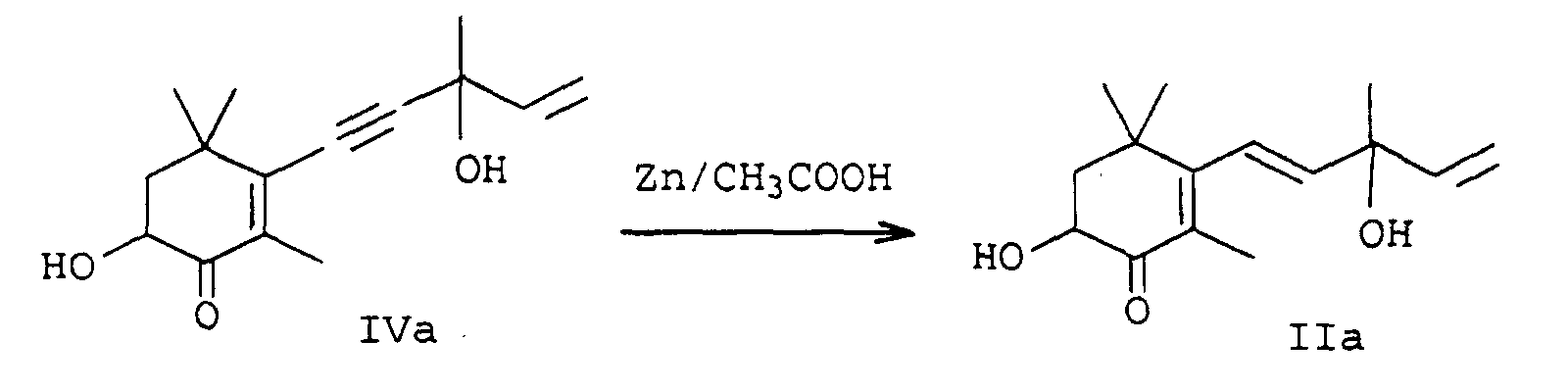
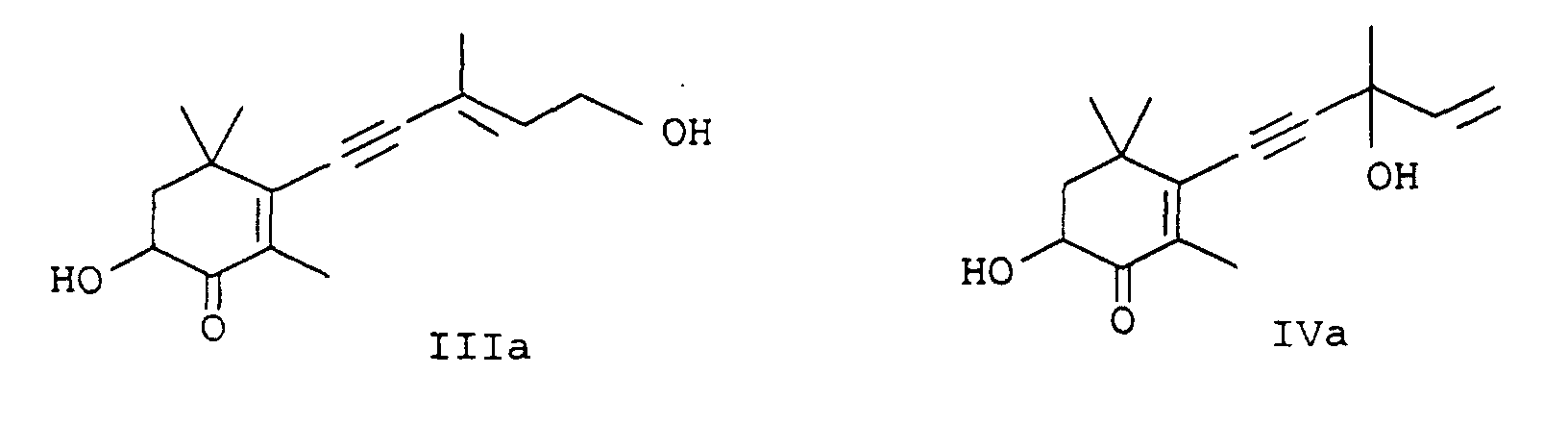
- EP-A-0 005 748 relates to another process for the preparation of astaxanthin in which the partial reduction of the alkynediol of formula IIIa is also carried out with zinc / acetic acid in methylene chloride.
- EP-A-1 197 483 describes a process for the catalytic reduction of alkyne compounds using a mixture of zinc and at least one ammonium, copper, alkali or alkaline earth metal salt.
- This method has the disadvantage that the production of the Reagent is very expensive and also the reagent always fresh must be made.
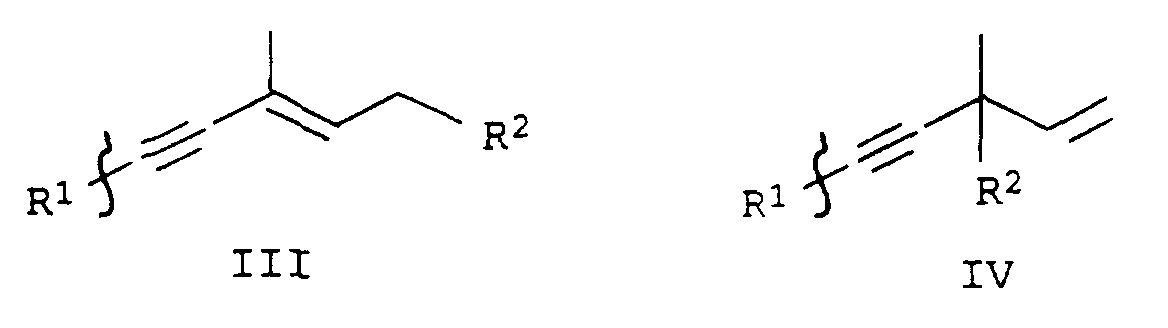
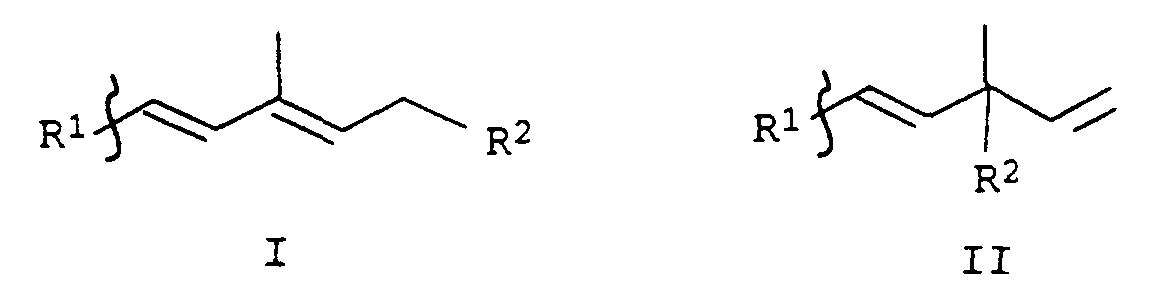
- Alkyl radicals for R 3 and R 4 are linear or branched C 1 -C 4 -alkyl chains, for example methyl, ethyl, n-propyl, 1-methylethyl, n-butyl, 1-methylpropyl, 2-methylpropyl and 1,1- Called dimethylethyl.
- Preferred alkyl radicals are methyl and ethyl.
- Suitable substituents for R 5 are linear or branched C 1 -C 4 -acyl chains, for example formyl, acetyl, propionyl, isopropionyl.
- Preferred acyl radical is acetyl.
- hydroxyl group which can be converted into a hydroxy group by hydrolysis for R 2 are those functional groups which can be converted into the hydroxy group relatively easily. Mention may be made, for example, of ether groups, such as and -OC (CH 3 ) 3 ,
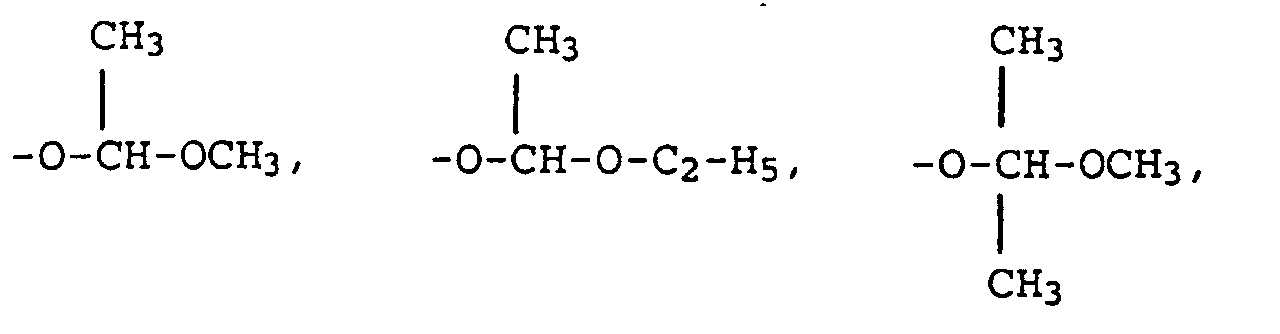
- Silyl ether groups such as -O-Si (CH 3 ) 3 , -O-Si (CH 2 CH 3 ) 3 , -O-Si (iso-propyl) 3 , -O-Si (CH 3 ) 2 (tert-butyl), and -O-Si (CH 3 ) 2 (n-hexyl) or substituted methyl ether groups, such as the ⁇ -alkoxy-alkyl ether groups of the formulas -O-CH 2 -O-CH 3 , and suitable pyranyl ether groups such as the tetrahydropyranyloxy group and the 4-methyl-5,6-dihydro-2H-pyranyloxy group.
- the tetrahydropyranyloxy group is used for R 2 or the ⁇ -ethoxy-ethoxy group of the formula
- M I 2 As salts of hyposulfurous acid are within the scope of the present invention compounds of general formula M I 2 understand (O 2 S-SO 2), in which M I is a monovalent metal. These are preferably sodium dithionite, potassium dithionite or zinc dithionite. As a particularly preferred salt from this group is called sodium dithionite.
- Suitable salts of hydroxymethanesulfinic acid are preferably sodium formaldehyde sulfoxylate or zinc formaldehyde sulfoxylate, in particular sodium formaldehyde sulfoxylate.
- a preferred embodiment of the process according to the invention is characterized in that the reducing agent used is a mixture of at least one salt of dithionic acid and a base selected from the group consisting of sodium carbonate, sodium hydrogencarbonate, potassium carbonate and potassium hydrogencarbonate.
- the combination of sodium dithionite and NaHCO 3 has proved to be particularly advantageous as a reducing agent.
- Blankit® (BASF Aktiengesellschaft), a reduction bleach based on sodium dithionite and sulfinic acid is suitable also.
- the invention likewise provides a process for the production of cyclohexene derivatives of the formula I or II, characterized characterized in that the formation of sodium dithionite in situ e.g. according to the so-called Formiatvon carried out by Sodium formate with sodium bisulfite in 80% methanol react, then by adding a base to the pH about 9.5 sets and then the agent to be reduced enters into the reaction mixture.
- Formiatvon carried out by Sodium formate with sodium bisulfite in 80% methanol react, then by adding a base to the pH about 9.5 sets and then the agent to be reduced enters into the reaction mixture.
- the in situ formation of sodium dithionite can also be achieved via the Borol process by reaction of sodium borohydride carried out with sodium hydroxide solution and sulfur dioxide
- the amount of water choose so that the base and the reducing agent dissolved available.
- Suitable inert solvents in the processes according to the invention are generally all solvents which are inert to the compounds I to IV.
- the reaction is preferably carried out in chlorinated hydrocarbons, for example in dichloromethane, perchlorethylene or chloroform, or in an ethereal solvent, such as dialkyl ethers, tetrahydrofuran or dioxane, in particular in the water-immiscible methyl tert-butyl ether.
- ethereal solvent such as dialkyl ethers, tetrahydrofuran or dioxane, in particular in the water-immiscible methyl tert-butyl ether.
- Other suitable solvents include aromatic hydrocarbons, in particular toluene, and C 1 -C 3 -alcohols, such as methanol, ethanol or propanol.
- a 10 to 70 wt .-% solution of the alkynediol in one of the above-mentioned Solvent particularly preferably a 30 to 65 wt .-% solution of the alkynediol used in methylene chloride.
- the reduction runs in a pH range of 6.0 to 10, preferably from 7.8 to 9.
- the sodium dithionite used is in an amount of about 1.1 to 5, preferably from 1.5 to 4, more preferably from 2.1 to 3 gram atom per mole of the alkynediol to be reduced.
- the reduction may be at temperatures between room temperature and the boiling point of the solvent used become.
- Preferred reaction temperatures are in the range of 30 to 100 ° C, more preferably in the range of 40 to 80 ° C.
- a particularly preferred process variant of the invention Method is characterized in that one the Reduction continuously, for example by the reaction mixture preferably consisting of alkynediols of Formulas IIIa or IVa, an organic solvent, water, a base and reducing agent in a tubular reactor or stirred tank cascade at elevated temperature in the range of 30 to 100 ° C implements.
- the procedure is generally carried out by using water, base and alkyne compounds in the order (in the case of the cyclohexene compounds of the formulas Ia and IIa, use is made of alkyne compounds of the formula IIIa or IVa, dissolved in an inert solvent). submits and finally enters the reducing agent either in portions or at once.
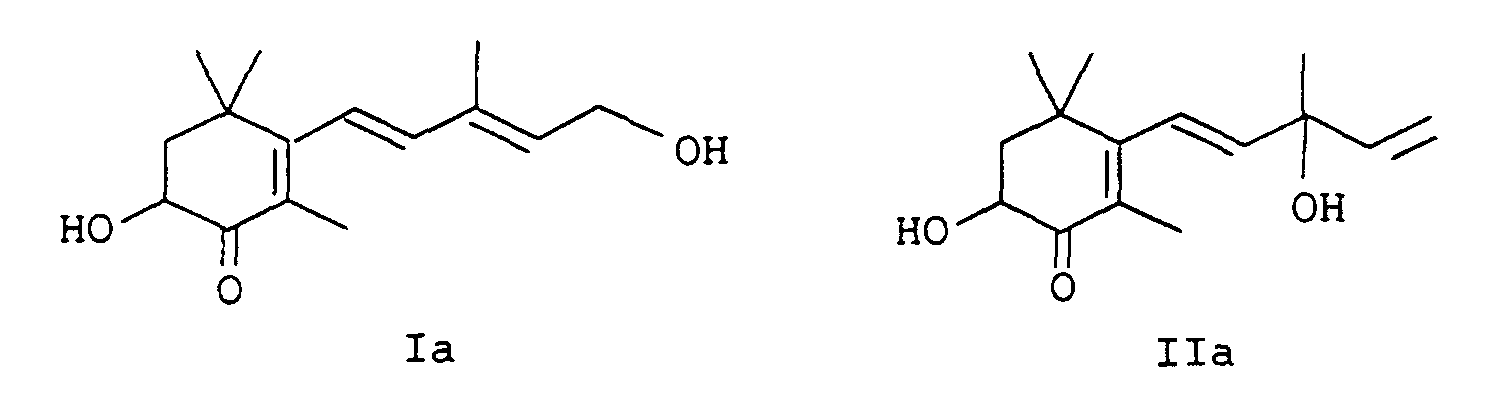
- reaction mixture was admixed with 100 ml of methylene chloride, the aqueous phase was separated and the organic phase was washed twice with 100 ml of water, dried over sodium sulfate, filtered off and the residue was washed twice with 100 ml of methylene chloride each time. After distilling off the solvent, an oily residue was obtained which, according to gas chromatographic analysis, contained 78.3% by weight GC-alkene of alkenediol of the formula IIa.
Landscapes
- Chemical & Material Sciences (AREA)
- Organic Chemistry (AREA)
- Organic Low-Molecular-Weight Compounds And Preparation Thereof (AREA)
- Heterocyclic Compounds That Contain Two Or More Ring Oxygen Atoms (AREA)
Description


- R1
-

- R2
- OH oder eine durch Hydrolyse in eine Hydroxygruppe überführbare Schutzgruppe,
- R3 und R4
- Wasserstoff, C1-C4-Alkyl;
- R5
- Wasserstoff, C1-C4-Acyl;



- Calciumhydroxymethansulfinat,
Claims (7)
- Verfahren zur Herstellung von Cyclohexenderivaten der allgemeinen Formeln I oder II,in der die Substituenten R1 und R2 unabhängig voneinander folgende Bedeutung haben:
- R1
-

- R2
- OH oder eine durch Hydrolyse in eine Hydroxygruppe überführbare Schutzgruppe,
- R3 und R4
- Wasserstoff, C1-C4-Alkyl;
- R5
- Wasserstoff, C1-C4-Acyl;
in der die Substituenten R1 und R2 die oben genannte Bedeutung haben, dadurch gekennzeichnet, dass man als Reduktionsmittel mindestens ein Salz der Dithionigen Säure, der Hydroxymethansulfinsäure oder ein Gemisch aus mindestens einem Salz der Dithionigen Säure und mindestens einem Salz der Hydroxymethansulfinsäure verwendet.
- Verfahren nach Anspruch 1, dadurch gekennzeichnet, dass man als Reduktionsmittel Natriumdithionit verwendet.
- Verfahren nach Anspruch 2, dadurch gekennzeichnet, dass man als Reduktionsmittel ein Gemisch aus Natriumdithionit und einer Base, ausgewählt aus der Gruppe, bestehend aus Natriumcarbonat, Natriumhydrogencarbonat, Kaliumcarbonat und Kaliumhydrogencarbonat verwendet.
- Verfahren nach Anspruch 1, dadurch gekennzeichnet, dass man als Reduktionsmittel Natriumformaldehydsulfoxylat verwendet.
- Verfahren nach einem der Ansprüche 1 bis 4, dadurch gekennzeichnet, dass man die Reduktion in Gegenwart von Wasser durchführt.
- Verfahren nach einem der Ansprüche 1 bis 5, dadurch gekennzeichnet, dass man die Reduktion in einem gegenüber den Cyclohexenderivaten der allgemeinen Formeln I bis IV inerten organischen Lösungsmittel durchführt.
- Verfahren nach einem der Ansprüche 1 bis 6 zur Herstellung der Cyclohexenverbindungen der Formeln Ia und IIa.

Applications Claiming Priority (2)
| Application Number | Priority Date | Filing Date | Title |
|---|---|---|---|
| DE10140180A DE10140180A1 (de) | 2001-08-22 | 2001-08-22 | Verfahren zur selektiven Reduktion von Alkinverbindungen |
| DE10140180 | 2001-08-22 |
Publications (3)
| Publication Number | Publication Date |
|---|---|
| EP1285912A2 EP1285912A2 (de) | 2003-02-26 |
| EP1285912A3 EP1285912A3 (de) | 2003-03-12 |
| EP1285912B1 true EP1285912B1 (de) | 2005-12-28 |
Family
ID=7695613
Family Applications (1)
| Application Number | Title | Priority Date | Filing Date |
|---|---|---|---|
| EP02016708A Expired - Lifetime EP1285912B1 (de) | 2001-08-22 | 2002-07-26 | Verfahren zur selektiven Reduktion von Alkinverbindungen |
Country Status (6)
| Country | Link |
|---|---|
| US (1) | US6590111B2 (de) |
| EP (1) | EP1285912B1 (de) |
| JP (1) | JP3745716B2 (de) |
| CN (1) | CN1216044C (de) |
| AT (1) | ATE314346T1 (de) |
| DE (2) | DE10140180A1 (de) |
Families Citing this family (13)
| Publication number | Priority date | Publication date | Assignee | Title |
|---|---|---|---|---|
| DE102004044262A1 (de) * | 2004-09-10 | 2006-03-16 | Basf Ag | Verfahren zur katalytischen Reduktion von Alkinverbindungen |
| EP3180311B1 (de) | 2014-08-12 | 2019-04-17 | Basf Se | Verfahren zur herstellung von astaxanthin aus astacin |
| CN106573886B (zh) | 2014-08-12 | 2020-10-30 | 巴斯夫欧洲公司 | 由环状α-酮烯醇制备环状α-酮醇的方法 |
| WO2016037785A1 (de) | 2014-09-11 | 2016-03-17 | Basf Se | Verfahren zur herstellung von astaxanthinestern |
| JP6689831B2 (ja) | 2014-10-02 | 2020-04-28 | ビーエーエスエフ ソシエタス・ヨーロピアBasf Se | アスタキサンチン及びカンタキサンチンの精製方法 |
| WO2016146803A1 (de) | 2015-03-19 | 2016-09-22 | Basf Se | Astaxanthinzusammensetzungen (iii) |
| WO2016146802A1 (de) | 2015-03-19 | 2016-09-22 | Basf Se | Astaxanthinzusammensetzungen (ii) |
| BR112017019831A2 (pt) | 2015-03-19 | 2018-05-29 | Basf Se | uso de composições de astaxantina, composição, e, processo para preparação de alimento ou alimento animal |
| EP3270910B1 (de) | 2015-03-19 | 2019-05-22 | Basf Se | Astaxanthinzusammensetzungen (iv) |
| WO2018015525A1 (en) | 2016-07-22 | 2018-01-25 | Basf Se | 6-hydroxy-3-[3-hydroxy-3-methyl-penta-1,4-dienyl]-2,4,4-trimethyl-cyclohexa-2,5-dien-1-one |
| WO2018114732A1 (en) | 2016-12-19 | 2018-06-28 | Basf Se | Process for preparing (4s)- or (4r)-3,4-dihydroxy-2,6,6-trimethylcyclohex-2-enone |
| CN110088094A (zh) | 2016-12-19 | 2019-08-02 | 巴斯夫欧洲公司 | 制备立体异构纯c9-缩醛的方法 |
| WO2022140580A1 (en) | 2020-12-24 | 2022-06-30 | Orn Almarsson | Xanthophyll derivatives |
Family Cites Families (3)
| Publication number | Priority date | Publication date | Assignee | Title |
|---|---|---|---|---|
| EP0005748B1 (de) | 1978-06-02 | 1982-12-29 | F. HOFFMANN-LA ROCHE & CO. Aktiengesellschaft | Verfahren zur Herstellung von Cyclohexenderivaten sowie Zwischenprodukte in diesem Verfahren |
| DE4322277A1 (de) | 1993-07-05 | 1995-01-12 | Basf Ag | Verbessertes Verfahren zur Herstellung von Astaxanthin, neue Zwischenprodukte hierfür sowie ein Verfahren zu deren Herstellung |
| US5530038A (en) * | 1993-08-02 | 1996-06-25 | Sun Medical Co., Ltd. | Primer composition and curable composition |
-
2001
- 2001-08-22 DE DE10140180A patent/DE10140180A1/de not_active Withdrawn
-
2002
- 2002-07-26 AT AT02016708T patent/ATE314346T1/de not_active IP Right Cessation
- 2002-07-26 DE DE50205410T patent/DE50205410D1/de not_active Expired - Fee Related
- 2002-07-26 EP EP02016708A patent/EP1285912B1/de not_active Expired - Lifetime
- 2002-08-14 US US10/217,488 patent/US6590111B2/en not_active Expired - Fee Related
- 2002-08-14 CN CN021288275A patent/CN1216044C/zh not_active Expired - Fee Related
- 2002-08-19 JP JP2002238199A patent/JP3745716B2/ja not_active Expired - Fee Related
Also Published As
| Publication number | Publication date |
|---|---|
| JP3745716B2 (ja) | 2006-02-15 |
| EP1285912A3 (de) | 2003-03-12 |
| EP1285912A2 (de) | 2003-02-26 |
| US6590111B2 (en) | 2003-07-08 |
| US20030060639A1 (en) | 2003-03-27 |
| JP2003081907A (ja) | 2003-03-19 |
| ATE314346T1 (de) | 2006-01-15 |
| CN1216044C (zh) | 2005-08-24 |
| DE50205410D1 (de) | 2006-02-02 |
| DE10140180A1 (de) | 2003-03-06 |
| CN1406932A (zh) | 2003-04-02 |
Similar Documents
| Publication | Publication Date | Title |
|---|---|---|
| EP0633258B1 (de) | Verbessertes Verfahren zur Herstellung von Astaxanthin, neue Zwischenprodukte hierfür sowie ein Verfahren zu deren Herstellung | |
| EP1197483B1 (de) | Verfahren zur katalytischen Reduktion von Alkinverbindungen | |
| DE10140180A1 (de) | Verfahren zur selektiven Reduktion von Alkinverbindungen | |
| EP0733619A1 (de) | Verfahren zur Herstellung von Astaxanthin | |
| EP0077439B1 (de) | Verfahren zur Herstellung von Cyclohexenderivaten, sowie ein neues Ausgangsprodukt und neue Zwischenprodukte in diesem Verfahren | |
| EP0107806B1 (de) | Verfahren zur Herstellung von optisch aktiven Hydrochinonderivaten sowie von d-alpha-Tocopherol | |
| DE60314410T2 (de) | Verfahren zur herstellung von modafinil | |
| EP0001089B1 (de) | Verfahren zur Herstellung von halogenvinylsubstituierten Tetrahydrofuran-2-onen, bestimmte halogenvinylsubstituierte Tetrahydrofuran-2-one | |
| DE2363464C3 (de) | Verfahren zur Herstellung von p-Alkenylphenolen | |
| EP0031875B1 (de) | Verfahren zur Herstellung von Cyclohexenderivaten | |
| DE102004044262A1 (de) | Verfahren zur katalytischen Reduktion von Alkinverbindungen | |
| DE102004012577A1 (de) | Verfahren zur Herstellung von Astaxanthin | |
| DE102004006579A1 (de) | Verfahren zur Herstellung von 2,7-Dimethyl-octa-2,4,6-triendial | |
| EP0150026A2 (de) | Chemisches Verfahren | |
| DE2824841C3 (de) | Verfahren zur Herstellung von 2-Cyclopentenonderivaten sowie diese enthaltende Parfüm-Kompositionen | |
| DE69111835T2 (de) | Hydroxycarbonylderivate und Verfahren zu ihrer Herstellung. | |
| EP0080658B1 (de) | Verfahren zur Herstellung von cyclischen 1,2-cis-Diolen aus cyclischen 1,2-Epoxiden | |
| CH656610A5 (de) | Verfahren zur herstellung von 2-cyclopentenonen. | |
| CH628634A5 (de) | Verfahren zur herstellung von 2,2'-bis(3,4-epoxy-5-oxotetrahydropyran)aether und produkt. | |
| DE3412713C2 (de) | ||
| CH617424A5 (de) | ||
| DE10352103A1 (de) | Verfahren zur katalytischen Hydrierung von Alkinverbindungen | |
| DE10355829A1 (de) | Verfahren zur katalytischen Hydrierung von Alkinverbindungen | |
| DE2361144B2 (de) | Sulfon-Alkohole und deren Ester und Verfahren zu ihrer Herstellung | |
| WO2005044790A1 (de) | Verfahren zur katalytischen hydrierung von alkinverbindungen |
Legal Events
| Date | Code | Title | Description |
|---|---|---|---|
| PUAI | Public reference made under article 153(3) epc to a published international application that has entered the european phase |
Free format text: ORIGINAL CODE: 0009012 |
|
| PUAL | Search report despatched |
Free format text: ORIGINAL CODE: 0009013 |
|
| AK | Designated contracting states |
Kind code of ref document: A2 Designated state(s): AT BE BG CH CY CZ DE DK EE ES FI FR GB GR IE IT LI LU MC NL PT SE SK TR |
|
| AX | Request for extension of the european patent |
Extension state: AL LT LV MK RO SI |
|
| AK | Designated contracting states |
Kind code of ref document: A3 Designated state(s): AT BE BG CH CY CZ DE DK EE ES FI FR GB GR IE IT LI LU MC NL PT SE SK TR |
|
| AX | Request for extension of the european patent |
Extension state: AL LT LV MK RO SI |
|
| RIC1 | Information provided on ipc code assigned before grant |
Ipc: 7C 07D 317/64 B Ipc: 7C 07C 403/08 A |
|
| 17P | Request for examination filed |
Effective date: 20030207 |
|
| AKX | Designation fees paid |
Designated state(s): AT BE BG CH CY CZ DE DK EE ES FI FR GB GR IE IT LI LU MC NL PT SE SK TR |
|
| AXX | Extension fees paid |
Extension state: RO Payment date: 20030207 Extension state: SI Payment date: 20030207 |
|
| 17Q | First examination report despatched |
Effective date: 20041116 |
|
| GRAP | Despatch of communication of intention to grant a patent |
Free format text: ORIGINAL CODE: EPIDOSNIGR1 |
|
| GRAS | Grant fee paid |
Free format text: ORIGINAL CODE: EPIDOSNIGR3 |
|
| GRAA | (expected) grant |
Free format text: ORIGINAL CODE: 0009210 |
|
| AK | Designated contracting states |
Kind code of ref document: B1 Designated state(s): AT BE BG CH CY CZ DE DK EE ES FI FR GB GR IE IT LI LU MC NL PT SE SK TR |
|
| AX | Request for extension of the european patent |
Extension state: RO SI |
|
| PG25 | Lapsed in a contracting state [announced via postgrant information from national office to epo] |
Ref country code: CZ Free format text: LAPSE BECAUSE OF FAILURE TO SUBMIT A TRANSLATION OF THE DESCRIPTION OR TO PAY THE FEE WITHIN THE PRESCRIBED TIME-LIMIT Effective date: 20051228 Ref country code: IT Free format text: LAPSE BECAUSE OF FAILURE TO SUBMIT A TRANSLATION OF THE DESCRIPTION OR TO PAY THE FEE WITHIN THE PRESCRIBED TIME-LIMIT;WARNING: LAPSES OF ITALIAN PATENTS WITH EFFECTIVE DATE BEFORE 2007 MAY HAVE OCCURRED AT ANY TIME BEFORE 2007. THE CORRECT EFFECTIVE DATE MAY BE DIFFERENT FROM THE ONE RECORDED. Effective date: 20051228 Ref country code: FI Free format text: LAPSE BECAUSE OF FAILURE TO SUBMIT A TRANSLATION OF THE DESCRIPTION OR TO PAY THE FEE WITHIN THE PRESCRIBED TIME-LIMIT Effective date: 20051228 Ref country code: SK Free format text: LAPSE BECAUSE OF FAILURE TO SUBMIT A TRANSLATION OF THE DESCRIPTION OR TO PAY THE FEE WITHIN THE PRESCRIBED TIME-LIMIT Effective date: 20051228 Ref country code: IE Free format text: LAPSE BECAUSE OF FAILURE TO SUBMIT A TRANSLATION OF THE DESCRIPTION OR TO PAY THE FEE WITHIN THE PRESCRIBED TIME-LIMIT Effective date: 20051228 Ref country code: GB Free format text: LAPSE BECAUSE OF FAILURE TO SUBMIT A TRANSLATION OF THE DESCRIPTION OR TO PAY THE FEE WITHIN THE PRESCRIBED TIME-LIMIT Effective date: 20051228 |
|
| REG | Reference to a national code |
Ref country code: GB Ref legal event code: FG4D Free format text: NOT ENGLISH |
|
| REG | Reference to a national code |
Ref country code: CH Ref legal event code: EP Ref country code: CH Ref legal event code: NV Representative=s name: SCHMAUDER & PARTNER AG PATENTANWALTSBUERO |
|
| REG | Reference to a national code |
Ref country code: IE Ref legal event code: FG4D Free format text: LANGUAGE OF EP DOCUMENT: GERMAN |
|
| REF | Corresponds to: |
Ref document number: 50205410 Country of ref document: DE Date of ref document: 20060202 Kind code of ref document: P |
|
| PG25 | Lapsed in a contracting state [announced via postgrant information from national office to epo] |
Ref country code: BG Free format text: LAPSE BECAUSE OF FAILURE TO SUBMIT A TRANSLATION OF THE DESCRIPTION OR TO PAY THE FEE WITHIN THE PRESCRIBED TIME-LIMIT Effective date: 20060328 Ref country code: DK Free format text: LAPSE BECAUSE OF FAILURE TO SUBMIT A TRANSLATION OF THE DESCRIPTION OR TO PAY THE FEE WITHIN THE PRESCRIBED TIME-LIMIT Effective date: 20060328 Ref country code: GR Free format text: LAPSE BECAUSE OF FAILURE TO SUBMIT A TRANSLATION OF THE DESCRIPTION OR TO PAY THE FEE WITHIN THE PRESCRIBED TIME-LIMIT Effective date: 20060328 Ref country code: SE Free format text: LAPSE BECAUSE OF FAILURE TO SUBMIT A TRANSLATION OF THE DESCRIPTION OR TO PAY THE FEE WITHIN THE PRESCRIBED TIME-LIMIT Effective date: 20060328 |
|
| PG25 | Lapsed in a contracting state [announced via postgrant information from national office to epo] |
Ref country code: ES Free format text: LAPSE BECAUSE OF FAILURE TO SUBMIT A TRANSLATION OF THE DESCRIPTION OR TO PAY THE FEE WITHIN THE PRESCRIBED TIME-LIMIT Effective date: 20060408 |
|
| PG25 | Lapsed in a contracting state [announced via postgrant information from national office to epo] |
Ref country code: PT Free format text: LAPSE BECAUSE OF FAILURE TO SUBMIT A TRANSLATION OF THE DESCRIPTION OR TO PAY THE FEE WITHIN THE PRESCRIBED TIME-LIMIT Effective date: 20060529 |
|
| GBV | Gb: ep patent (uk) treated as always having been void in accordance with gb section 77(7)/1977 [no translation filed] |
Effective date: 20051228 |
|
| REG | Reference to a national code |
Ref country code: IE Ref legal event code: FD4D |
|
| ET | Fr: translation filed | ||
| PG25 | Lapsed in a contracting state [announced via postgrant information from national office to epo] |
Ref country code: MC Free format text: LAPSE BECAUSE OF NON-PAYMENT OF DUE FEES Effective date: 20060731 Ref country code: BE Free format text: LAPSE BECAUSE OF NON-PAYMENT OF DUE FEES Effective date: 20060731 |
|
| PLBE | No opposition filed within time limit |
Free format text: ORIGINAL CODE: 0009261 |
|
| STAA | Information on the status of an ep patent application or granted ep patent |
Free format text: STATUS: NO OPPOSITION FILED WITHIN TIME LIMIT |
|
| 26N | No opposition filed |
Effective date: 20060929 |
|
| PG25 | Lapsed in a contracting state [announced via postgrant information from national office to epo] |
Ref country code: AT Free format text: LAPSE BECAUSE OF NON-PAYMENT OF DUE FEES Effective date: 20060726 |
|
| BERE | Be: lapsed |
Owner name: BASF A.G. Effective date: 20060731 |
|
| PGFP | Annual fee paid to national office [announced via postgrant information from national office to epo] |
Ref country code: NL Payment date: 20070703 Year of fee payment: 6 |
|
| PG25 | Lapsed in a contracting state [announced via postgrant information from national office to epo] |
Ref country code: EE Free format text: LAPSE BECAUSE OF FAILURE TO SUBMIT A TRANSLATION OF THE DESCRIPTION OR TO PAY THE FEE WITHIN THE PRESCRIBED TIME-LIMIT Effective date: 20051228 |
|
| PG25 | Lapsed in a contracting state [announced via postgrant information from national office to epo] |
Ref country code: TR Free format text: LAPSE BECAUSE OF FAILURE TO SUBMIT A TRANSLATION OF THE DESCRIPTION OR TO PAY THE FEE WITHIN THE PRESCRIBED TIME-LIMIT Effective date: 20051228 Ref country code: LU Free format text: LAPSE BECAUSE OF NON-PAYMENT OF DUE FEES Effective date: 20060726 |
|
| PGFP | Annual fee paid to national office [announced via postgrant information from national office to epo] |
Ref country code: CH Payment date: 20080815 Year of fee payment: 7 Ref country code: DE Payment date: 20080807 Year of fee payment: 7 |
|
| PG25 | Lapsed in a contracting state [announced via postgrant information from national office to epo] |
Ref country code: CY Free format text: LAPSE BECAUSE OF FAILURE TO SUBMIT A TRANSLATION OF THE DESCRIPTION OR TO PAY THE FEE WITHIN THE PRESCRIBED TIME-LIMIT Effective date: 20051228 |
|
| PGFP | Annual fee paid to national office [announced via postgrant information from national office to epo] |
Ref country code: FR Payment date: 20080718 Year of fee payment: 7 |
|
| NLV4 | Nl: lapsed or anulled due to non-payment of the annual fee |
Effective date: 20090201 |
|
| PG25 | Lapsed in a contracting state [announced via postgrant information from national office to epo] |
Ref country code: NL Free format text: LAPSE BECAUSE OF NON-PAYMENT OF DUE FEES Effective date: 20090201 |
|
| REG | Reference to a national code |
Ref country code: CH Ref legal event code: PCAR Free format text: SCHMAUDER & PARTNER AG PATENT- UND MARKENANWAELTE VSP;ZWAENGIWEG 7;8038 ZUERICH (CH) |
|
| REG | Reference to a national code |
Ref country code: CH Ref legal event code: PL |
|
| REG | Reference to a national code |
Ref country code: FR Ref legal event code: ST Effective date: 20100331 |
|
| PG25 | Lapsed in a contracting state [announced via postgrant information from national office to epo] |
Ref country code: CH Free format text: LAPSE BECAUSE OF NON-PAYMENT OF DUE FEES Effective date: 20090731 Ref country code: FR Free format text: LAPSE BECAUSE OF NON-PAYMENT OF DUE FEES Effective date: 20090731 Ref country code: LI Free format text: LAPSE BECAUSE OF NON-PAYMENT OF DUE FEES Effective date: 20090731 |
|
| PG25 | Lapsed in a contracting state [announced via postgrant information from national office to epo] |
Ref country code: DE Free format text: LAPSE BECAUSE OF NON-PAYMENT OF DUE FEES Effective date: 20100202 |