EP1286329B1 - Méthode et dispositif pour la reconnaissance phonétique - Google Patents
Méthode et dispositif pour la reconnaissance phonétique Download PDFInfo
- Publication number
- EP1286329B1 EP1286329B1 EP01307175A EP01307175A EP1286329B1 EP 1286329 B1 EP1286329 B1 EP 1286329B1 EP 01307175 A EP01307175 A EP 01307175A EP 01307175 A EP01307175 A EP 01307175A EP 1286329 B1 EP1286329 B1 EP 1286329B1
- Authority
- EP
- European Patent Office
- Prior art keywords
- phonetic
- vowel
- sound
- consonant
- parts
- Prior art date
- Legal status (The legal status is an assumption and is not a legal conclusion. Google has not performed a legal analysis and makes no representation as to the accuracy of the status listed.)
- Expired - Lifetime
Links
- 238000000034 method Methods 0.000 title claims description 34
- 230000009466 transformation Effects 0.000 claims description 16
- 238000005070 sampling Methods 0.000 claims description 13
- 230000001131 transforming effect Effects 0.000 claims description 5
- 238000001125 extrusion Methods 0.000 claims description 3
- 238000004458 analytical method Methods 0.000 description 14
- 238000010586 diagram Methods 0.000 description 14
- 230000002996 emotional effect Effects 0.000 description 12
- 239000000203 mixture Substances 0.000 description 6
- 238000007796 conventional method Methods 0.000 description 4
- 230000008451 emotion Effects 0.000 description 4
- 238000012986 modification Methods 0.000 description 2
- 230000004048 modification Effects 0.000 description 2
- 241001672694 Citrus reticulata Species 0.000 description 1
- 238000013528 artificial neural network Methods 0.000 description 1
- 238000010276 construction Methods 0.000 description 1
- 238000005516 engineering process Methods 0.000 description 1
- 239000000284 extract Substances 0.000 description 1
- 230000000704 physical effect Effects 0.000 description 1
Images






Classifications
-
- G—PHYSICS
- G10—MUSICAL INSTRUMENTS; ACOUSTICS
- G10L—SPEECH ANALYSIS TECHNIQUES OR SPEECH SYNTHESIS; SPEECH RECOGNITION; SPEECH OR VOICE PROCESSING TECHNIQUES; SPEECH OR AUDIO CODING OR DECODING
- G10L15/00—Speech recognition
-
- G—PHYSICS
- G10—MUSICAL INSTRUMENTS; ACOUSTICS
- G10L—SPEECH ANALYSIS TECHNIQUES OR SPEECH SYNTHESIS; SPEECH RECOGNITION; SPEECH OR VOICE PROCESSING TECHNIQUES; SPEECH OR AUDIO CODING OR DECODING
- G10L15/00—Speech recognition
- G10L15/02—Feature extraction for speech recognition; Selection of recognition unit
- G10L2015/025—Phonemes, fenemes or fenones being the recognition units
Definitions
- the present invention relates to methods and systems for phonetic recognition, preferably in which principles of phonetic recognition and a general database of phonetic sounds and corresponding characters are employed so as to analyse a phonetic waveform for phonetic recognition without the pre-construction of a database of personal phonetic sounds and corresponding characters.
- the conventional technology has the following drawbacks.
- a respective personal database needs to be built up for each of the users, due to differences in sound frequency, amplitude waveform and carrier waveform even for the same character in response to regional accents of the users. It also requires the build-up of a huge personal database, which increases difficulty in conducting the phonetic recognition.
- the conventional methods and systems for phonetic recognition can neither tell the difference in timbre between users nor recognise a user's emotional state.
- the present invention seeks to provide improved phonetic recognition.
- the preferred embodiment can provide a method and system for phonetic recognition which do not require a personal database of phonetic sounds and corresponding characters to be established for a user in advance.
- the phonetic recognition is implemented by using general principles of phonetic recognition and a general database of phonetic sounds and corresponding characters, and is applicable for users with different accents, so as to identify a character corresponding to a phonetic sound generated from the user, tell the difference in timbre between users and to recognise a user's emotional state. It does not require a personal database of phonetic sounds and corresponding characters for the user to be established in advance.
- the system can also recognise a tone of the phonetic sound to be able to identify a Chinese character corresponding in variation of four tones to the phonetic sound:
- a phonetic sound can be analysed in timbre characteristic for allowing a user's timbre to be recognised, while variations in volume of the phonetic sound can be analysed so as to tell the user's emotional condition.
- the preferred method for phonetic recognition comprises the steps of processing a phonetic sound generated by a user and transforming the phonetic sound into a phonetic waveform; analysing physical properties of the phonetic waveform for acquiring characteristic parameters of the waveform, and determining a fore frequency and a rear frequency of the sound packet; dividing a sound packet of the phonetic waveform into parts of consonant, wind and vowel, according to the characteristic parameters; analysing the parts of consonant and vowel for waveform characteristics thereof, so as to recognise a character consonant corresponding to the part of consonant and a character vowel corresponding to the part of vowel, and recognising a tone for the phonetic sound according to a rule for determining the fore and rear frequencies; combining the recognised parts of consonant and
- the preferred system comprises a phonetic recognition principle database, a database of phonetic sounds and corresponding characters, a phonetic transformation processing module and a phonetic recognition processing module.
- the phonetic recognition principle database includes principles of phonetic recognition to be used for processing a sound packet of a phonetic sound and dividing the sound packet into parts of consonant, wind and vowel, and determining a fore frequency and a rear frequency for the sound packet, so as to recognise the parts respectively, recognise a tone for the phonetic sound according to rules for determining the fore and rear frequencies, and combine the recognised parts of consonant and vowel or the recognised parts of consonant and vowel together with the recognised tone to be compared with a database of phonetic sounds and corresponding characters for obtaining a corresponding character for the phonetic sound.
- the principles of phonetic recognition in the phonetic recognition principle database include a rule for dividing the sound packet into the parts of consonant, wind and vowel; a rule for determining the fore and rear frequencies; a rule for recognising the parts of consonant, wind and vowel; a rule for recognising the tone for the phonetic sound; a rule for combining the recognised parts of consonant and vowel; and a rule for combining the recognised parts of consonant and vowel and the recognised tone. Some or all of these rules may be used.
- the database of phonetic sounds and corresponding characters has a phonetic sound therein consisting of a consonant and a vowel, or a consonant, a vowel and a tone, and a corresponding character for each phonetic sound.
- the phonetic transformation processing module is used for transforming a user's phonetic sound into a corresponding physical waveform signal and inputting the waveform signal to a phonetic recognition processing module for phonetic recognition.
- the phonetic recognition processing module processes the waveform signal by dividing a sound packet thereof into parts of consonant, wind and vowel, and determining a fore frequency and a rear frequency for the sound packet, so as to recognise the parts respectively, recognise a tone for the phonetic sound according to a rule for determining the fore and rear frequencies, and combine the recognised parts of consonant and vowel or the recognised parts of consonant and vowel together with the recognised tone to be compared with the database of phonetic sounds and corresponding characters for obtaining a corresponding character for the phonetic sound.
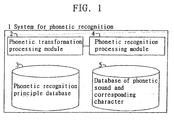
- Fig. 1 illustrates the basic system architecture of the preferred method and system for phonetic recognition.
- the system for phonetic recognition 1 includes a phonetic transformation processing module 2, a phonetic recognition principle database 3, a phonetic recognition processing module 4 and a general database of phonetic sounds and corresponding characters 5.
- the phonetic transformation processing module 2 can be an electronic device for transforming a phonetic sound into an electronic signal.
- the phonetic recognition processing module 4 is a computer mainframe.
- the phonetic recognition principle database 3 and the general database of phonetic sounds and corresponding characters 5 are stored in a memory device of the computer.
- the phonetic recognition principle database 3 contains principles of phonetic recognition, which include a rule for dividing a sound packet of the phonetic sound into parts of consonant, wind and vowel; a rule for extracting fore and rear frequencies of the sound packet; a rule for identifying consonant, wind and vowel; a rule for recognising variation in four tones; a rule for combining consonant and vowel; a rule for combining consonant, vowel and four tones; a rule for recognising timbre of the sound packet; and a rule for recognising volume variation of the sound packet.
- the principles of phonetic recognition are used to divide the sound packet into the parts of consonant, wind and vowel for identification.
- the extracted fore and rear frequencies of the sound packet are used to recognise the variation in four tones for a Chinese phonetic sound.
- Combinations of the identified parts of consonants and vowels, or combinations of consonants, vowels and four tone variations are compared with the database of phonetic sounds and corresponding characters 5, so as to obtain a character corresponding to the phonetic sound.
- the general database of phonetic sounds and corresponding characters 5 contains a character database corresponding to phonetic sounds.
- a phonetic sound is a combination of a consonant and a vowel, or a combination of a consonant, a vowel and one of four tone variations.
- Each phonetic sound has its own corresponding word.
- the phonetic transformation processing module 2 is used to transform a user's phonetic sound correspondingly into a physical waveform signal, and input the signal to the phonetic recognition processing module 4 for phonetic recognition.
- the phonetic recognition processing module 4 processes the waveform signal by dividing it into the parts of consonant, wind and vowel, and extracting its fore and rear frequencies, so as to identify, process and combine the parts of consonant, wind and vowel. Combinations of the identified parts of consonants and vowels, or combinations of consonants, vowels and four tone variations are compared by the phonetic recognition processing module 4 with the database of phonetic sounds and corresponding characters 5, so as to obtain the corresponding character for the phonetic sound.
- the phonetic recognition processing module 4 In order to identify the timbre of the user, the phonetic recognition processing module 4, according to the principles of phonetic recognition in the phonetic recognition principle database 3, analyses the sound packet for its carrier wave and edges of modulated saw wave on the carrier wave, so as to obtain the timbre characteristics and differentiate the timbre between users. In order to recognise the user's emotional condition, the phonetic recognition processing module 4 analyses the volume variation in the sound packet, which correlates with intonation and reflects the user's emotion, according to the principles of phonetic recognition in the phonetic recognition principle database 3.
- Fig. 2 illustrates the steps involved in performing the method for phonetic recognition in the use of the system for phonetic recognition of Fig. 1.
- the phonetic transformation processing module 2 receives a phonetic sound from a user and transforms it correspondingly into a physical waveform signal, which is input to the phonetic recognition processing module 4 for phonetic recognition.
- step 12 is followed.
- step 12 according to principles of phonetic recognition in the phonetic recognition principle database 3, the phonetic recognition processing module 4 processes the input waveform signal from the phonetic transformation processing module 2 by dividing a sound packet of the input waveform signal into parts of consonant, wind and vowel, and extracting its fore frequencies and rear frequencies. Then, step 13 is followed.
- step 13 the phonetic recognition processing module 4 recognises, processes and combines the parts of consonant, wind and vowel, so as to combine the recognised parts of consonant and vowel, or the parts of consonant and vowel and four tone variations. Then, step 14 is followed.
- step 14 the phonetic recognition processing module 4 compares the combinations with the general database of phonetic sounds and corresponding characters 5 so as to obtain a corresponding character for the phonetic sound, and the phonetic recognition completes.
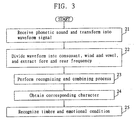
- Fig. 3 illustrates the steps involved in performing the method for phonetic recognition so as to recognise a phonetic sound, timbre and emotional condition in the use of the system for phonetic recognition of Fig. 1.
- the phonetic transformation processing module 2 receives a phonetic sound from a user and transforms it correspondingly into a physical waveform signal, which is input to the phonetic recognition processing module 4 for phonetic recognition. Then, step 22 is followed.
- step 22 according to principles of phonetic recognition in the phonetic recognition principle database 3, the phonetic recognition processing module 4 processes the input waveform signal from the phonetic transformation processing module 2 by dividing a sound packet of the input waveform signal into parts of consonant, wind and vowel, and extracting its fore frequencies and rear frequencies. Then, step 23 is followed.
- step 23 the phonetic recognition processing module 4 recognises, processes and combines the parts of consonant, wind and vowel, so as to combine the recognised parts of consonant and vowel, or the parts of consonant and vowel and four tone variations. Then, step 24 is followed.
- step 24 the phonetic recognition processing module 4 compares the combinations with the general database of phonetic sounds and corresponding characters 5 so as to obtain a corresponding character for the phonetic sound. Then step 25 is followed.
- step 25 for identifying the timbre of the user, the phonetic recognition processing module 4, according to the principles of phonetic recognition in the phonetic recognition principle database 3, analyses the sound packet for its carrier wave and edges of modulated saw wave on the carrier wave, go as to obtain the timbre characteristics and differentiate the timbre between users.
- the phonetic recognition processing module 4 analyses volume variation in the sound packet, which correlates with intonation and reflects the user's emotion, according to the principles of phonetic recognition in the phonetic recognition principle database 3.
- Fig. 4 illustrates the detailed steps involved in performing the method for phonetic recognition in the use of the system for phonetic recognition of Fig. 2.
- the phonetic transformation processing module 2 receives a phonetic sound from a user and transforms it correspondingly into a physical waveform signal, which is input to the phonetic recognition processing module 4 for phonetic recognition.
- step 32 is followed.
- step 32 according to principles of phonetic recognition in the phonetic recognition principle database 3, the phonetic recognition processing module 4 analyses physical characteristics of the waveform signal from the phonetic transformation processing module 2 so as to acquire various characteristic parameters thereof. Then, step 33 is followed.
- step 33 the phonetic recognition processing module 4 processes the waveform signal by dividing a sound packet of the input waveform signal into parts of consonant, wind and vowel, and extracting its fore frequencies and rear frequencies. Then, step 34 is followed.
- step 34 in the use of the principles of phonetic recognition, the phonetic recognition processing module 4 recognises and analyses the parts of consonant, wind and vowel according to waveform characteristics of the parts, so as to obtain a character consonant corresponding to the consonant part and a character vowel corresponding to the vowel part. Then, step 35 is followed.
- step 35 the phonetic recognition processing module 4 combines the character consonant and character vowel. Then, step 36 is followed.
- step 36 the phonetic recognition processing module 4 compares the combination of the character consonant and character vowel with the general database of phonetic sounds and corresponding characters 5 so as to obtain a corresponding character for the phonetic sound. Then, the phonetic recognition completes.
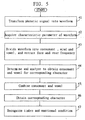
- Fig. 5 illustrates the detailed steps involved in performing the method for phonetic recognition so as to recognise a phonetic sound, timbre and emotional condition in the use of the system for phonetic recognition of the invention in Fig. 3.
- the phonetic transformation processing module 2 receives a phonetic sound from a user and transforms it correspondingly into a physical waveform signal, which is input to the phonetic recognition processing module 4 for phonetic recognition.
- step 42 is followed.
- step 42 according to principles of phonetic recognition in the phonetic recognition principle database 3, the phonetic recognition processing module 4 analyses physical characteristics of the waveform signal from the phonetic transformation processing module 2 so as to acquire various characteristic parameters thereof. Then, step 43 is followed.
- step 43 the phonetic recognition processing module 4 processes the waveform signal by dividing a sound packet of the input waveform signal into parts of consonant, wind and vowel, and extracting its fore frequencies and rear frequencies. Then, step 44 is followed.
- step 44 in the use of the principles of phonetic recognition, the phonetic recognition processing module 4 recognises and analyses the parts of consonant, wind and vowel according to waveform characteristics of the parts, so as to obtain a character consonant corresponding to the consonant part and a character vowel corresponding to the vowel part. Then, step 45 is followed.
- step 45 the phonetic recognition processing module 4 combines the character consonant and character vowel. Then, step 46 is followed.
- step 46 the phonetic recognition processing module 4 compares the combination of the character consonant and character vowel with the general database of phonetic sounds and corresponding characters 5 so as to obtain a corresponding character for the phonetic sound. Then, step 47 is followed.
- step 47 for identifying the timbre of the user, the phonetic recognition processing module 4, according to the principles of phonetic recognition in the phonetic recognition principle database 3, analyses the sound packet for its carrier wave and edges of modulated saw wave on the carrier wave, so as to obtain the timbre characteristics and differentiate the timbre between users.
- the phonetic recognition processing module 4 analyses volume variations in the sound packet, which correlates with intonation and reflects the user's emotion, according to the principles of phonetic recognition in the phonetic recognition principle database 3. Then, the phonetic recognition completes.
- Fig. 6 illustrates the detail steps involved in recognising a Chinese character correspond to a phonetic sound in the use of the system for phonetic recognition of the invention in FIG. 4.
- the phonetic transformation processing module 2 receives a phonetic sound from a user and transforms it correspondingly into a physical waveform signal, which is input to the phonetic recognition processing module 4 for phonetic recognition.
- step 52 is followed.
- step 52 according to principles of phonetic recognition in the phonetic recognition principle database 3, the phonetic recognition processing module 4 analyses physical characteristics of the waveform signal from the phonetic transformation processing module 2 so as to acquire various characteristic parameters thereof. Then, step 53 is followed.
- step 53 the phonetic recognition processing module 4 processes the waveform signal by dividing a sound packet of the input waveform signal into parts of consonant, wind and vowel, and extracting its fore frequencies and rear frequencies. Then, step 54 is followed.
- step 54 in the use of the principles of phonetic recognition the phonetic recognition processing module 4 recognises and analyses the parts of consonant, wind and vowel according to waveform characteristics of the parts, so as to obtain a character consonant corresponding to the consonant part and a character vowel corresponding to the vowel part. Then, step 55 is followed.
- step 55 according to principles of phonetic recognition in the phonetic recognition principle database 3, the phonetic recognition processing module 4 extracts fore and rear frequencies of the sound packet.
- step 56 is followed.
- step 56 the phonetic recognition processing module 4 combines the character consonant, the character vowel and the Chinese tone variation Then, step 57 is followed.
- step 57 the phonetic recognition processing module 4 compares the combination of the character consonant, character vowel and Chinese tone variation with the general database of phonetic sounds and corresponding characters 5 so as to obtain a corresponding character for the phonetic sound. Then, the phonetic recognition completes.
- Fig. 7(a) illustrates composition of a phonetic waveform.
- a sound packet of the phonetic waveform can be separated into fore, middle and rear sections, wherein wind and consonant portions reside in the fore section and are followed by a vowel portion, while the wind portion is relatively much higher in frequency than the consonant and vowel portions.
- a fore frequency can be obtained by randomly sampling a few sound packets and getting an average frequency thereof.
- a rear frequency is obtained by arbitrarily sampling a few sound packets and getting an average frequency thereof.
- Fig. 7(b) illustrates parts of consonant, wind and vowel. As shown, a general phonetic waveform can be separated into parts of consonant a, wind b and vowel c.
- the consonant part a can be classified as a gradation sound, affricate, extrusion sound and plosive according to its waveform.
- the gradation sound is characterised as being purely composed of the consonant waveform with variation in sound volume, such as Chinese phonetic symbols, “ “, “ “, “ “, “ “ (pronounced as “h”, “x”, “r”, “s” respectively).
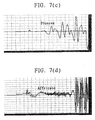
- the affricate is characterised as having the consonant waveform with a lingering sound followed by vowel waveform, such as Chinese phonetic symbols, “ “, “ “, “, “, “, “ “(pronounced as “f”, “n”, “l”, “j” respectively), as illustrated in Fig. 7(d).
- the extrusion sound is a plosive having a slower consonant waveform, such as Chinese phonetic symbols, " “, “ “ (pronounced as “zh”, “z” respectively).
- the plosive has its consonant waveform containing two or more magnified peaks, such as Chinese phonetic symbols, “ “, “ “, “ “, “ “, “ “, “ “, “, (pronounced as “b”, “p”, “d”, "t”, “g”, “k”, “q” respectively), as illustrated in Fig. 7(c).
- the wind part b is much higher in frequency than the consonants and vowels.
- the vowel part c is a waveform section located right after that for the consonant part.
- Fig. 8 illustrates composition of the vowel part in Fig. 7(b).
- repeated waveform areas in the vowel part c is called vowel packets.
- the vowel packet 0 is an initial divided sound packet at the beginning of the vowel part c, while the vowel packets 1-3 are divided sound packets showing repetition in vowels.
- following vowel packets e.g. 4
- the divided sound packets are generated by dividing the vowel waveform into independent vowel packets 0,1,2,3 etc.
- Fig. 9 illustrates characteristic parameters of the composition of the vowel part in Fig. 7(b).
- characteristic parameters such as turning number, wave number and slope
- the turning number is a count of turning points, each of which is located at a position within a tiny square in the drawing where the waveform changes the sign of slope.
- the wave number is a count of times for the waveform of the vowel packet passing through the X-axis from a lower domain to an upper domain.
- the wave number is 4 illustrated by 4 points marked as x for showing the waveform passing through the X-axis.
- the slope can be obtained by measuring the slope or sampling numbers between squares 1 and 2.
- vowels for Chinese phonetic symbols include “ “, “ “”, “ “ “ “ “” and “ “' (pronounced as “a “o”, “i”, “e” and “u” respectively).
- a fore frequency can be obtained by randomly sampling a few sound packets and getting an average frequency thereof.
- a rear frequency is obtained by arbitrarily sampling a few sound packets and getting an average frequency thereof.
- a term "point” in a phrase, "differ by points”, means a number of sampled points and relates to frequency.
- a sampling frequency of 11 kHz is equivalent to taking one sample point per 1/11000 second, in other words, 11K sampled points are taken in sampling time of 1 second.
- a sampling frequency of 50 kHz is equivalent to taking one sampled point per 1/50000 second. In other words, 50K sampled points are taken in sampling time of 1 second. That is, in 1 second sampling time, the number of sampled points is identical to the value of frequency.
- the sound packet of the phonetic sound is analysed for its carrier wave and edges of modulated saw wave on the carrier wave, so as to obtain the timbre characteristics and differentiate the timbre between users according to different carrier wave frequencies and amplitude variations for the phonetic sounds generated by the users.
- the user's emotional condition For recognising the user's emotional condition, it is analyse and process the sound packet of the phonetic sound for its amplitude, volume variation and intonation, while the volume variation and intonation reflect the user's emotion.
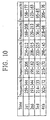
- Fig. 10 illustrates statistic frequencies for four tones of Chinese characters.
- a tone of a phonetic sound is the first tone if its frequency is between 259Hz and 344Hz.
- the tone is the second tone if its frequency is between 182Hz and 196Hz.
- the tone is the third tone if its frequency is between 220Hz and 225Hz.
- the tone is the forth tone if its frequency is between 176Hz and 206Hz.
- Fig. 11 illustrates a waveform of consonant and vowel for a Chinese character for phonetic recognition.
- a consonant part is a plosive " “”, (pronounced as “b"), while a vowel is “ “ “ (pronounced as “a”) as the wave number is 6, slope is 5 and wave number> slope. So that the consonant and vowel are combined to get a phonetic sound " " (pronounced as “ba” for Chinese character " “.” Further, intonation is inspected for Chinese phonetic tone, so as to distinguish “ “, “ “, “ “ and “”, which represent the phonetic sound " “ having the first, second, third and fourth tone respectively.
- the method and system for phonetic recognition described above allows phonetic recognition to be implemented by using principles of phonetic recognition and a general database of phonetic sounds and corresponding characters, so as to recognise a phonetic sound generated by a user and identify a character corresponding to the user's phonetic sound, without requiring a personal database of phonetic sounds and corresponding characters for the user to be establish in advance:
- the method and system for phonetic recognition can also recognise a tone of the phonetic sound to be able to identify a Chinese character corresponding in variation of four tones to the phonetic sound.
- the phonetic sound can be analysed in timbre characteristic for allowing the user's timbre to be recognised, while variation in volume of the phonetic sound can be analysed so as to tell the user's emotional condition.
Landscapes
- Engineering & Computer Science (AREA)
- Computational Linguistics (AREA)
- Health & Medical Sciences (AREA)
- Audiology, Speech & Language Pathology (AREA)
- Human Computer Interaction (AREA)
- Physics & Mathematics (AREA)
- Acoustics & Sound (AREA)
- Multimedia (AREA)
- Telephonic Communication Services (AREA)
- Information Retrieval, Db Structures And Fs Structures Therefor (AREA)
- Machine Translation (AREA)
Claims (8)
- Procédé de reconnaissance phonétique utilisant les principes de la reconnaissance phonétique et une base de données générale de sons phonétiques et des caractères correspondants pour réaliser la reconnaissance phonétique, comprenant les étapes consistant à :(1) traiter un son phonétique généré par un utilisateur et convertir le son phonétique en une onde phonétique;(2) diviser l'onde phonétique en parties de consonne, respiration et voyelle ;(3) reconnaître les parties de consonne et de respiration respectivement selon les caractéristiques de l'onde ;(4) déterminer les paramètres caractéristiques, y compris le nombre d'inversions, le nombre d'onde et la pente de l'une des ondes répétées qui constituent la partie de voyelle, sachant que le nombre d'inversions est un décompte des points d'inversion où l'onde voit sa pente changer de signe, le nombre d'onde est un décompte des temps où l'onde coupe l'axe des X pour passer d'un domaine inférieur à un domaine supérieur, et la pente est mesurée entre les points d'échantillonnage de l'onde, et reconnaître la partie de voyelle selon les règles impliquant les paramètres caractéristiques déterminés ;(5) combiner les parties reconnues afin de déterminer un caractère correspondant au son phonétique ; et(6) réaliser la reconnaissance phonétique.
- Procédé selon la revendication 1, dans lequel la partie de consonne a une forme d'onde de gradation, consonne affriquée, fricative ou plosive, et la partie de respiration présente une fréquence nettement plus élevée que les parties de consonne et de voyelle.
- Procédé selon la revendication 1 ou 2, dans lequel l'étape (2) inclut la détermination d'une fréquence avant et d'une fréquence arrière de l'onde phonétique ; l'étape (3) inclut la reconnaissance d'une tonalité pour le son phonétique selon une règle de comparaison entre les fréquences avant et arrière ; et l'étape (5) inclut la combinaison des parties reconnues et de la tonalité reconnue pour déterminer un caractère correspondant du son phonétique.
- Procédé selon la revendication 3, dans lequel, lors de l'étape (2), la fréquence avant est déterminée en calculant une fréquence moyenne pour une région de premier quart de l'onde phonétique, et la fréquence arrière est déterminée en calculant une fréquence moyenne pour une fréquence de quart final de l'onde phonétique.
- Système de reconnaissance phonétique, incluant :une base de données de principes de reconnaissance phonétique (3) incluant les principes de reconnaissance phonétique devant être utilisés pour traiter un paquet sonore d'un son phonétique et diviser le paquet sonore en parties de consonne, respiration et voyelle, et déterminer les paramètres caractéristiques incluant le nombre d'inversions, le nombre d'onde et la pente de l'une des ondes répétées qui constituent la partie de voyelle, sachant que le nombre d'inversions est un décompte des points d'inversion où l'onde voit sa pente changer de signe, le nombre d'onde est un décompte des moments où l'onde coupe l'axe des X pour passer d'un domaine inférieur à un domaine supérieur, et la pente est mesurée entre les points d'échantillonnage de l'onde, de manière à reconnaître les parties de consonne, respiration et voyelle avec un ensemble de règles respectivement, et pour combiner les parties reconnues de consonne et de voyelle en un caractère correspondant pour le son phonétique ;une base de données (5) de sons phonétiques et de caractères correspondants, dans laquelle un son phonétique est constitué d'une consonne et d'une voyelle, et a un caractère correspondant,un module de traitement de transformations phonétiques (2) permettant de transformer un son phonétique d'un utilisateur en signal d'onde physique correspondant et de délivrer le signal de l'onde à un module de traitement de reconnaissance phonétique pour la reconnaissance phonétique ; etun module de traitement de reconnaissance phonétique (4) permettant de traiter le signal d'onde en divisant un paquet sonore de celui-ci en parties de consonne, respiration et voyelle, et en reconnaissant les parties respectivement selon les principes de la reconnaissance phonétique dans la base de données de principes de reconnaissance phonétique (3), de manière à combiner les parties reconnues de consonne et de voyelle devant être comparées à la base de données de sons phonétiques et les caractères correspondants afin d'obtenir un caractère correspondant pour le son phonétique.
- Système selon la revendication 5, dans lequel les principes de reconnaissance phonétique dans la base de données de principes de reconnaissance phonétique (3) incluent une règle pour diviser le paquet sonore en parties de consonne, respiration et voyelle ; une règle permettant de reconnaître les parties de consonne, respiration et voyelle ; et une règle permettant de combiner les parties reconnues de consonne et de voyelle.
- Système selon la revendication 5, dans lequel :la base de données de principes de reconnaissance phonétique (3) inclut en outre les principes de reconnaissance phonétique devant être utilisés pour déterminer une fréquence avant et une fréquence arrière pour le paquet sonore, de manière à reconnaître une tonalité pour le son phonétique selon les règles de comparaison des fréquences avant et arrière, et permettant de combiner les parties reconnues de consonne et de voyelle conjointement avec la tonalité reconnue pour obtenir un caractère correspondant du son phonétique ; etun module de traitement de reconnaissance phonétique (4) étant en outre prévu pour déterminer la fréquence avant et la fréquence arrière du paquet sonore, de manière à reconnaître la tonalité du son phonétique selon la règle de comparaison des fréquences avant et arrière, et combiner les parties reconnues de consonne et de voyelle conjointement à la tonalité reconnue devant être comparée à la base de données (5) de sons phonétiques et des caractères correspondants pour obtenir un caractère correspondant du son phonétique.
- Système selon la revendication 7, dans lequel les principes de reconnaissance phonétique dans la base de données de principes de reconnaissance phonétique (3) incluent une règle permettant de diviser le paquet sonore en parties de consonne, respiration et voyelle ; une règle permettant de déterminer les fréquences avant et arrière ; et une règle permettant de reconnaître les parties de consonne, respiration et voyelle ; une règle permettant de reconnaître la tonalité du son phonétique ; une règle permettant de combiner les parties reconnues de consonne et de voyelle ; une règle permettant de combiner les parties reconnues de consonne et de voyelle et la tonalité reconnue.
Priority Applications (4)
| Application Number | Priority Date | Filing Date | Title |
|---|---|---|---|
| EP01307175A EP1286329B1 (fr) | 2001-08-23 | 2001-08-23 | Méthode et dispositif pour la reconnaissance phonétique |
| DE2001618306 DE60118306T2 (de) | 2001-08-23 | 2001-08-23 | Verfahren und Vorrichtung zur phonetischen Spracherkennung |
| AT01307175T ATE322066T1 (de) | 2001-08-23 | 2001-08-23 | Verfahren und vorrichtung zur phonetischen spracherkennung |
| US09/940,651 US20030050774A1 (en) | 2001-08-23 | 2001-08-29 | Method and system for phonetic recognition |
Applications Claiming Priority (2)
| Application Number | Priority Date | Filing Date | Title |
|---|---|---|---|
| EP01307175A EP1286329B1 (fr) | 2001-08-23 | 2001-08-23 | Méthode et dispositif pour la reconnaissance phonétique |
| US09/940,651 US20030050774A1 (en) | 2001-08-23 | 2001-08-29 | Method and system for phonetic recognition |
Publications (2)
| Publication Number | Publication Date |
|---|---|
| EP1286329A1 EP1286329A1 (fr) | 2003-02-26 |
| EP1286329B1 true EP1286329B1 (fr) | 2006-03-29 |
Family
ID=27736032
Family Applications (1)
| Application Number | Title | Priority Date | Filing Date |
|---|---|---|---|
| EP01307175A Expired - Lifetime EP1286329B1 (fr) | 2001-08-23 | 2001-08-23 | Méthode et dispositif pour la reconnaissance phonétique |
Country Status (2)
| Country | Link |
|---|---|
| US (1) | US20030050774A1 (fr) |
| EP (1) | EP1286329B1 (fr) |
Families Citing this family (7)
| Publication number | Priority date | Publication date | Assignee | Title |
|---|---|---|---|---|
| US7181391B1 (en) * | 2000-09-30 | 2007-02-20 | Intel Corporation | Method, apparatus, and system for bottom-up tone integration to Chinese continuous speech recognition system |
| US20030125946A1 (en) * | 2002-01-03 | 2003-07-03 | Wen-Hao Hsu | Method and apparatus for recognizing animal species from an animal voice |
| US8457962B2 (en) * | 2005-08-05 | 2013-06-04 | Lawrence P. Jones | Remote audio surveillance for detection and analysis of wildlife sounds |
| CN104049871A (zh) * | 2013-03-16 | 2014-09-17 | 上海能感物联网有限公司 | 汉语语音调用计算机程序运行的方法 |
| CN108122552B (zh) * | 2017-12-15 | 2021-10-15 | 上海智臻智能网络科技股份有限公司 | 语音情绪识别方法和装置 |
| CN112270930A (zh) * | 2020-10-22 | 2021-01-26 | 江苏峰鑫网络科技有限公司 | 一种语音识别转换的方法 |
| CN117153151B (zh) * | 2023-10-09 | 2024-05-07 | 广州易风健康科技股份有限公司 | 基于用户语调的情绪识别方法 |
Family Cites Families (15)
| Publication number | Priority date | Publication date | Assignee | Title |
|---|---|---|---|---|
| US3278685A (en) * | 1962-12-31 | 1966-10-11 | Ibm | Wave analyzing system |
| US3553372A (en) * | 1965-11-05 | 1971-01-05 | Int Standard Electric Corp | Speech recognition apparatus |
| US3588363A (en) * | 1969-07-30 | 1971-06-28 | Rca Corp | Word recognition system for voice controller |
| US3928722A (en) * | 1973-07-16 | 1975-12-23 | Hitachi Ltd | Audio message generating apparatus used for query-reply system |
| US4181813A (en) * | 1978-05-08 | 1980-01-01 | John Marley | System and method for speech recognition |
| US4343969A (en) * | 1978-10-02 | 1982-08-10 | Trans-Data Associates | Apparatus and method for articulatory speech recognition |
| US4388495A (en) * | 1981-05-01 | 1983-06-14 | Interstate Electronics Corporation | Speech recognition microcomputer |
| JPS59226400A (ja) * | 1983-06-07 | 1984-12-19 | 松下電器産業株式会社 | 音声認識装置 |
| US5175793A (en) * | 1989-02-01 | 1992-12-29 | Sharp Kabushiki Kaisha | Recognition apparatus using articulation positions for recognizing a voice |
| US5640490A (en) * | 1994-11-14 | 1997-06-17 | Fonix Corporation | User independent, real-time speech recognition system and method |
| US5751905A (en) * | 1995-03-15 | 1998-05-12 | International Business Machines Corporation | Statistical acoustic processing method and apparatus for speech recognition using a toned phoneme system |
| US5799276A (en) * | 1995-11-07 | 1998-08-25 | Accent Incorporated | Knowledge-based speech recognition system and methods having frame length computed based upon estimated pitch period of vocalic intervals |
| US6067520A (en) * | 1995-12-29 | 2000-05-23 | Lee And Li | System and method of recognizing continuous mandarin speech utilizing chinese hidden markou models |
| JPH10260692A (ja) * | 1997-03-18 | 1998-09-29 | Toshiba Corp | 音声の認識合成符号化/復号化方法及び音声符号化/復号化システム |
| US20060074664A1 (en) * | 2000-01-10 | 2006-04-06 | Lam Kwok L | System and method for utterance verification of chinese long and short keywords |
-
2001
- 2001-08-23 EP EP01307175A patent/EP1286329B1/fr not_active Expired - Lifetime
- 2001-08-29 US US09/940,651 patent/US20030050774A1/en not_active Abandoned
Also Published As
| Publication number | Publication date |
|---|---|
| US20030050774A1 (en) | 2003-03-13 |
| EP1286329A1 (fr) | 2003-02-26 |
Similar Documents
| Publication | Publication Date | Title |
|---|---|---|
| JP3162994B2 (ja) | 音声のワードを認識する方法及び音声のワードを識別するシステム | |
| Bezoui et al. | Feature extraction of some Quranic recitation using mel-frequency cepstral coeficients (MFCC) | |
| Pao et al. | Mandarin emotional speech recognition based on SVM and NN | |
| Shaw et al. | Emotion recognition and classification in speech using artificial neural networks | |
| Hansen et al. | Automatic voice onset time detection for unvoiced stops (/p/,/t/,/k/) with application to accent classification | |
| Bhanja et al. | Deep neural network based two-stage Indian language identification system using glottal closure instants as anchor points | |
| Gunawan et al. | Development of quranic reciter identification system using MFCC and GMM classifier | |
| He et al. | Stress detection using speech spectrograms and sigma-pi neuron units | |
| Piotrowska et al. | Machine learning-based analysis of English lateral allophones | |
| Birla | A robust unsupervised pattern discovery and clustering of speech signals | |
| EP1286329A1 (fr) | Méthode et dispositif pour la reconnaissance phonétique | |
| CN117219118A (zh) | 音频质检的方法及系统 | |
| JP4219539B2 (ja) | 音響分類装置 | |
| Bansod et al. | Speaker Recognition using Marathi (Varhadi) Language | |
| Płonkowski | Using bands of frequencies for vowel recognition for Polish language | |
| HK1052240A1 (en) | Speech recognition method and system | |
| JP3808732B2 (ja) | 音声認識方法及びそのシステム | |
| Kepuska et al. | Using formants to compare short and long vowels in modern standard Arabic | |
| KR100435578B1 (ko) | 음성 인식 방법 및 시스템 | |
| Karim et al. | A Multi-feature fusion approach for dialect identification using 1D CNN | |
| Shandy et al. | Implementation of Data Mining for Speech Recognition Classification of Sundanese Dialect Using KNN Method with MFCC Feature Extraction | |
| Kadhum et al. | Survey of Features Extraction and Classification Techniques for Speaker Identification | |
| Witting | A method of evaluating listeners' transcriptions of intonation on the basis of instrumental data | |
| KR100393196B1 (ko) | 음성인식장치및방법 | |
| Fotinea et al. | Emotion in speech: Towards an integration of linguistic, paralinguistic, and psychological analysis |
Legal Events
| Date | Code | Title | Description |
|---|---|---|---|
| PUAI | Public reference made under article 153(3) epc to a published international application that has entered the european phase |
Free format text: ORIGINAL CODE: 0009012 |
|
| AK | Designated contracting states |
Kind code of ref document: A1 Designated state(s): AT BE CH CY DE DK ES FI FR GB GR IE IT LI LU MC NL PT SE TR Designated state(s): AT BE CH CY DE DK ES FI FR GB GR IE IT LI LU MC NL PT SE TR |
|
| AX | Request for extension of the european patent |
Extension state: AL LT LV MK RO SI |
|
| 17P | Request for examination filed |
Effective date: 20030303 |
|
| AKX | Designation fees paid |
Designated state(s): AT BE CH CY DE DK ES FI FR GB GR IE IT LI LU MC NL PT SE TR |
|
| 17Q | First examination report despatched |
Effective date: 20040806 |
|
| GRAP | Despatch of communication of intention to grant a patent |
Free format text: ORIGINAL CODE: EPIDOSNIGR1 |
|
| GRAS | Grant fee paid |
Free format text: ORIGINAL CODE: EPIDOSNIGR3 |
|
| GRAA | (expected) grant |
Free format text: ORIGINAL CODE: 0009210 |
|
| AK | Designated contracting states |
Kind code of ref document: B1 Designated state(s): AT BE CH CY DE DK ES FI FR GB GR IE IT LI LU MC NL PT SE TR |
|
| PG25 | Lapsed in a contracting state [announced via postgrant information from national office to epo] |
Ref country code: NL Free format text: LAPSE BECAUSE OF FAILURE TO SUBMIT A TRANSLATION OF THE DESCRIPTION OR TO PAY THE FEE WITHIN THE PRESCRIBED TIME-LIMIT Effective date: 20060329 Ref country code: LI Free format text: LAPSE BECAUSE OF FAILURE TO SUBMIT A TRANSLATION OF THE DESCRIPTION OR TO PAY THE FEE WITHIN THE PRESCRIBED TIME-LIMIT Effective date: 20060329 Ref country code: IT Free format text: LAPSE BECAUSE OF FAILURE TO SUBMIT A TRANSLATION OF THE DESCRIPTION OR TO PAY THE FEE WITHIN THE PRESCRIBED TIME-LIMIT;WARNING: LAPSES OF ITALIAN PATENTS WITH EFFECTIVE DATE BEFORE 2007 MAY HAVE OCCURRED AT ANY TIME BEFORE 2007. THE CORRECT EFFECTIVE DATE MAY BE DIFFERENT FROM THE ONE RECORDED. Effective date: 20060329 Ref country code: CH Free format text: LAPSE BECAUSE OF FAILURE TO SUBMIT A TRANSLATION OF THE DESCRIPTION OR TO PAY THE FEE WITHIN THE PRESCRIBED TIME-LIMIT Effective date: 20060329 Ref country code: BE Free format text: LAPSE BECAUSE OF FAILURE TO SUBMIT A TRANSLATION OF THE DESCRIPTION OR TO PAY THE FEE WITHIN THE PRESCRIBED TIME-LIMIT Effective date: 20060329 Ref country code: AT Free format text: LAPSE BECAUSE OF FAILURE TO SUBMIT A TRANSLATION OF THE DESCRIPTION OR TO PAY THE FEE WITHIN THE PRESCRIBED TIME-LIMIT Effective date: 20060329 |
|
| REG | Reference to a national code |
Ref country code: GB Ref legal event code: FG4D |
|
| REG | Reference to a national code |
Ref country code: CH Ref legal event code: EP |
|
| REG | Reference to a national code |
Ref country code: IE Ref legal event code: FG4D |
|
| REF | Corresponds to: |
Ref document number: 60118306 Country of ref document: DE Date of ref document: 20060518 Kind code of ref document: P |
|
| PG25 | Lapsed in a contracting state [announced via postgrant information from national office to epo] |
Ref country code: SE Free format text: LAPSE BECAUSE OF FAILURE TO SUBMIT A TRANSLATION OF THE DESCRIPTION OR TO PAY THE FEE WITHIN THE PRESCRIBED TIME-LIMIT Effective date: 20060629 Ref country code: DK Free format text: LAPSE BECAUSE OF FAILURE TO SUBMIT A TRANSLATION OF THE DESCRIPTION OR TO PAY THE FEE WITHIN THE PRESCRIBED TIME-LIMIT Effective date: 20060629 |
|
| PG25 | Lapsed in a contracting state [announced via postgrant information from national office to epo] |
Ref country code: ES Free format text: LAPSE BECAUSE OF FAILURE TO SUBMIT A TRANSLATION OF THE DESCRIPTION OR TO PAY THE FEE WITHIN THE PRESCRIBED TIME-LIMIT Effective date: 20060710 |
|
| PG25 | Lapsed in a contracting state [announced via postgrant information from national office to epo] |
Ref country code: IE Free format text: LAPSE BECAUSE OF NON-PAYMENT OF DUE FEES Effective date: 20060823 |
|
| PG25 | Lapsed in a contracting state [announced via postgrant information from national office to epo] |
Ref country code: PT Free format text: LAPSE BECAUSE OF FAILURE TO SUBMIT A TRANSLATION OF THE DESCRIPTION OR TO PAY THE FEE WITHIN THE PRESCRIBED TIME-LIMIT Effective date: 20060829 |
|
| PG25 | Lapsed in a contracting state [announced via postgrant information from national office to epo] |
Ref country code: MC Free format text: LAPSE BECAUSE OF NON-PAYMENT OF DUE FEES Effective date: 20060831 |
|
| REG | Reference to a national code |
Ref country code: CH Ref legal event code: PL |
|
| NLV1 | Nl: lapsed or annulled due to failure to fulfill the requirements of art. 29p and 29m of the patents act | ||
| ET | Fr: translation filed | ||
| PLBE | No opposition filed within time limit |
Free format text: ORIGINAL CODE: 0009261 |
|
| STAA | Information on the status of an ep patent application or granted ep patent |
Free format text: STATUS: NO OPPOSITION FILED WITHIN TIME LIMIT |
|
| 26N | No opposition filed |
Effective date: 20070102 |
|
| PG25 | Lapsed in a contracting state [announced via postgrant information from national office to epo] |
Ref country code: GR Free format text: LAPSE BECAUSE OF FAILURE TO SUBMIT A TRANSLATION OF THE DESCRIPTION OR TO PAY THE FEE WITHIN THE PRESCRIBED TIME-LIMIT Effective date: 20060630 |
|
| PG25 | Lapsed in a contracting state [announced via postgrant information from national office to epo] |
Ref country code: FI Free format text: LAPSE BECAUSE OF FAILURE TO SUBMIT A TRANSLATION OF THE DESCRIPTION OR TO PAY THE FEE WITHIN THE PRESCRIBED TIME-LIMIT Effective date: 20060329 |
|
| PG25 | Lapsed in a contracting state [announced via postgrant information from national office to epo] |
Ref country code: TR Free format text: LAPSE BECAUSE OF FAILURE TO SUBMIT A TRANSLATION OF THE DESCRIPTION OR TO PAY THE FEE WITHIN THE PRESCRIBED TIME-LIMIT Effective date: 20060329 Ref country code: LU Free format text: LAPSE BECAUSE OF NON-PAYMENT OF DUE FEES Effective date: 20060823 |
|
| PG25 | Lapsed in a contracting state [announced via postgrant information from national office to epo] |
Ref country code: CY Free format text: LAPSE BECAUSE OF FAILURE TO SUBMIT A TRANSLATION OF THE DESCRIPTION OR TO PAY THE FEE WITHIN THE PRESCRIBED TIME-LIMIT Effective date: 20060329 |
|
| REG | Reference to a national code |
Ref country code: HK Ref legal event code: WD Ref document number: 1052240 Country of ref document: HK |
|
| PGFP | Annual fee paid to national office [announced via postgrant information from national office to epo] |
Ref country code: GB Payment date: 20100630 Year of fee payment: 10 Ref country code: FR Payment date: 20100806 Year of fee payment: 10 Ref country code: DE Payment date: 20100805 Year of fee payment: 10 |
|
| GBPC | Gb: european patent ceased through non-payment of renewal fee |
Effective date: 20110823 |
|
| REG | Reference to a national code |
Ref country code: FR Ref legal event code: ST Effective date: 20120430 |
|
| REG | Reference to a national code |
Ref country code: DE Ref legal event code: R119 Ref document number: 60118306 Country of ref document: DE Effective date: 20120301 |
|
| PG25 | Lapsed in a contracting state [announced via postgrant information from national office to epo] |
Ref country code: GB Free format text: LAPSE BECAUSE OF NON-PAYMENT OF DUE FEES Effective date: 20110823 Ref country code: FR Free format text: LAPSE BECAUSE OF NON-PAYMENT OF DUE FEES Effective date: 20110831 |
|
| PG25 | Lapsed in a contracting state [announced via postgrant information from national office to epo] |
Ref country code: DE Free format text: LAPSE BECAUSE OF NON-PAYMENT OF DUE FEES Effective date: 20120301 |