EP1286480A2 - Procédé et système de communication radio pour le réglage de puissance entre une station de base et une station abonnée - Google Patents
Procédé et système de communication radio pour le réglage de puissance entre une station de base et une station abonnée Download PDFInfo
- Publication number
- EP1286480A2 EP1286480A2 EP02023967A EP02023967A EP1286480A2 EP 1286480 A2 EP1286480 A2 EP 1286480A2 EP 02023967 A EP02023967 A EP 02023967A EP 02023967 A EP02023967 A EP 02023967A EP 1286480 A2 EP1286480 A2 EP 1286480A2
- Authority
- EP
- European Patent Office
- Prior art keywords
- radio
- radio station
- step size
- transmission
- station
- Prior art date
- Legal status (The legal status is an assumption and is not a legal conclusion. Google has not performed a legal analysis and makes no representation as to the accuracy of the status listed.)
- Granted
Links
Images


Classifications
-
- H—ELECTRICITY
- H04—ELECTRIC COMMUNICATION TECHNIQUE
- H04B—TRANSMISSION
- H04B7/00—Radio transmission systems, i.e. using radiation field
- H04B7/24—Radio transmission systems, i.e. using radiation field for communication between two or more posts
- H04B7/26—Radio transmission systems, i.e. using radiation field for communication between two or more posts at least one of which is mobile
-
- H—ELECTRICITY
- H04—ELECTRIC COMMUNICATION TECHNIQUE
- H04W—WIRELESS COMMUNICATION NETWORKS
- H04W52/00—Power management, e.g. Transmission Power Control [TPC] or power classes
- H04W52/04—Transmission power control [TPC]
- H04W52/30—Transmission power control [TPC] using constraints in the total amount of available transmission power
- H04W52/36—Transmission power control [TPC] using constraints in the total amount of available transmission power with a discrete range or set of values, e.g. step size, ramping or offsets
- H04W52/367—Power values between minimum and maximum limits, e.g. dynamic range
-
- H—ELECTRICITY
- H04—ELECTRIC COMMUNICATION TECHNIQUE
- H04W—WIRELESS COMMUNICATION NETWORKS
- H04W52/00—Power management, e.g. Transmission Power Control [TPC] or power classes
- H04W52/04—Transmission power control [TPC]
- H04W52/18—TPC being performed according to specific parameters
- H04W52/28—TPC being performed according to specific parameters using user profile, e.g. mobile speed, priority or network state, e.g. standby, idle or non-transmission
- H04W52/282—TPC being performed according to specific parameters using user profile, e.g. mobile speed, priority or network state, e.g. standby, idle or non-transmission taking into account the speed of the mobile
-
- H—ELECTRICITY
- H04—ELECTRIC COMMUNICATION TECHNIQUE
- H04W—WIRELESS COMMUNICATION NETWORKS
- H04W52/00—Power management, e.g. Transmission Power Control [TPC] or power classes
- H04W52/04—Transmission power control [TPC]
- H04W52/18—TPC being performed according to specific parameters
- H04W52/28—TPC being performed according to specific parameters using user profile, e.g. mobile speed, priority or network state, e.g. standby, idle or non-transmission
- H04W52/288—TPC being performed according to specific parameters using user profile, e.g. mobile speed, priority or network state, e.g. standby, idle or non-transmission taking into account the usage mode, e.g. hands-free, data transmission or telephone
-
- H—ELECTRICITY
- H04—ELECTRIC COMMUNICATION TECHNIQUE
- H04W—WIRELESS COMMUNICATION NETWORKS
- H04W52/00—Power management, e.g. Transmission Power Control [TPC] or power classes
- H04W52/04—Transmission power control [TPC]
- H04W52/18—TPC being performed according to specific parameters
- H04W52/26—TPC being performed according to specific parameters using transmission rate or quality of service QoS [Quality of Service]
-
- H—ELECTRICITY
- H04—ELECTRIC COMMUNICATION TECHNIQUE
- H04W—WIRELESS COMMUNICATION NETWORKS
- H04W52/00—Power management, e.g. Transmission Power Control [TPC] or power classes
- H04W52/04—Transmission power control [TPC]
- H04W52/38—TPC being performed in particular situations
- H04W52/40—TPC being performed in particular situations during macro-diversity or soft handoff
-
- H—ELECTRICITY
- H04—ELECTRIC COMMUNICATION TECHNIQUE
- H04W—WIRELESS COMMUNICATION NETWORKS
- H04W52/00—Power management, e.g. Transmission Power Control [TPC] or power classes
- H04W52/04—Transmission power control [TPC]
- H04W52/38—TPC being performed in particular situations
- H04W52/42—TPC being performed in particular situations in systems with time, space, frequency or polarisation diversity
-
- H—ELECTRICITY
- H04—ELECTRIC COMMUNICATION TECHNIQUE
- H04W—WIRELESS COMMUNICATION NETWORKS
- H04W52/00—Power management, e.g. Transmission Power Control [TPC] or power classes
- H04W52/04—Transmission power control [TPC]
- H04W52/38—TPC being performed in particular situations
- H04W52/44—TPC being performed in particular situations in connection with interruption of transmission
Definitions
- the invention relates to a method and a radio communication system for power control between a base station and a subscriber station, in particular for CDMA transmission methods in broadband transmission channels.
- radio communication systems In radio communication systems, messages (for example Language, image information or other data) with the help of electromagnetic waves via a radio interface transfer.
- the radio interface relates to a connection between a base station and subscriber stations, the subscriber stations being mobile stations or fixed Can be radio stations.
- the radiation of the electromagnetic Waves occur with carrier frequencies that in the intended frequency band for the respective system.
- UMTS Universal Mobile Telecommunication System
- 3rd generation systems are frequencies in the frequency band of approx. 2000 MHz is provided.
- CDMA transmission method Code division multiple access
- Transmission power control necessary in the form of a closed Control loop usually for both directions of transmission works.
- For the upward direction (radio transmission from the mobile station to the base station) evaluates the Base station broadcasts from the mobile station regarding the Transmission quality and transmits back to the subscriber station a positioning instruction issued by the subscriber station used for the following transmissions to control the transmission power becomes.
- the transmissions are in a first radio station received a second radio station and an instruction determined for the transmission power of the second radio station.
- the positioning instructions will be sent in the following transmitted from the first radio station to the second radio station, whereupon the instructions for one of their following Emissions for setting the transmission power are taken into account.
- a positioning instruction that points to a variable Step size of the transmission power setting is related.
- the variable step size becomes participant-dependent and time-dependent set by the radio stations.
- step size the faster incorrect ones will be Corrected transmission power settings, but at a cost a less precise regulation.
- step size it is Regulation more precise, but the delay is until correction of large deviations larger.
- the size of the step can be dependent on the subscriber and the time adapted to all transmission conditions and thus the regulation be improved. An improved regulation causes reduced Interference and one guaranteed for all connections Transmission quality.
- the control procedure is particularly suitable for radio interfaces, a CDMA participant separation procedure in use broadband transmission channels and one of which Variety of transmission states changing the control loop is possible.
- Typical applications are the FDD (frequency division duplex) and TDD (time division duplex) Mode in 3rd generation mobile radio systems.
- the regulation applies to upward and downward direction, so that the first radio station is either base station or subscriber station.
- step size to use depends on a Signaling, implicitly encoded within the transmitted Positioning instructions or according to one of the different transmission states with the step sizes to be used Correspondence table or calculation rule. Combinations of these measures can also be used. Which specifications for which changes in the transmission state are advantageous results from the exemplary embodiments.
- the mobile radio system shown in Fig. 1 as an example of a Radio communication system consists of a variety of mobile switching centers MSC that are networked with each other or establish access to a landline PSTN. Farther are these mobile switching centers MSC with at least each an RNM facility for allocating radio resources connected. Each of these facilities enables RNM again a connection to at least one base station BS.
- Such a base station BS can use a radio interface a connection to subscriber stations, e.g. mobile stations Build MS or other mobile and stationary devices. Each base station BS transmits at least one radio cell educated.
- Fig. 1 there is a connection V for transmission of useful information between a base station BS and a mobile station MS shown. A transmission power regulation the radio connection via this radio interface explained later, with only the transmission power setting of Mobile station MS is shown. For the reverse direction of transmission equivalent measures are applicable.
- An operation and maintenance center OMC realizes control and Maintenance functions for the mobile radio system or for parts from that.
- the functionality of this structure is different Radio communication systems transferable in which the invention can be used, especially for subscriber access networks with wireless subscriber connection.
- the transmission power control is used for radio transmission UL shown upward direction. From transmitters TX of the mobile station MS is sent information in the uplink UL, where a setting instruction for the transmission power setting TPC is taken into account.
- This TPC positioning instruction is created characterized in that in the base station BS receiving means RX Received broadcasts from the mobile station MS and control means MPC determine the positioning instruction TPC, which is then in the downward direction DL is transmitted to the mobile station MS.
- the transmission power of the mobile station MS is not arbitrary changed but gradually. Sends the mobile station MS previously with a transmission power Px, so the transmission power control this transmission power for the following transmission either increased or decreased. If a transmission error occurs, the transmission power is maintained. By a signaling of the positioning instruction TPC from the base station BS to the mobile station MS is informed which of the three Cases. However, the increase or decrease happens only with a step size ⁇ TPC that is not arbitrary but is predetermined. This step size is according to the invention ⁇ TPC dependent on participants and time.
- the step size ⁇ TPC to be used is also signaled. As long as no change in step size ⁇ TPC is announced the current step size ⁇ TPC is maintained.
- the Speed with the one step size ⁇ TPC reset depends on the signaling options from.
- the step size ⁇ TPC currently to be used is implicit in the TPC positioning instructions by means of appropriate coding contain. As in ETSI STC SMG2 UMTS-L1, Tdoc SMG2 UMTS-L1 221/98, dated August 25, 1998, pp. 29-30, is shown according to the status the positioning instruction, which is only one bit (power + (increased) or power - (decreased)) required, with two bits coded.
- the additional signaling of the step size ⁇ TPC can be done either by having more than two bits be used for signaling or that redundancy is reduced in the signaling.
- the step size ⁇ TPC to be used is fixed to certain ones Events or modes of transmission linked below are referred to as transmission states.
- the link between transfer state and step size ⁇ TPC is in an assignment table saved for both radio stations MS, BS is binding.
- step size ⁇ TPC is determined at explained some transmission states that have so far been unsatisfactory Cause control behavior for the transmission power.
- the so-called “slotted mode" in FDD mode (frequency division duplex), see also ETSI STC SMG2 UMTS-L1, Tdoc SMG2 UMTS-L1 221/98, from 25.8.1998, p.33-34, describes one Interruption of an otherwise continuous transmission Measuring purposes, e.g. a handover of the mobile station MS to one prepare another base station BS.
- the interruption can be in the up or down direction.
- the control loop is not effective, so that when resuming the transmission the previously set Transmission power often deviates greatly from the optimal one.
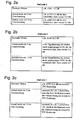
- the fast corrector of the transmission power becomes after the interruption the step size ⁇ TPC temporarily increased. It is the increase advantageously the greater the longer the Interruption continued.
- a step size ⁇ TPC of normally applies 0.5 dB, with an interruption of 5 ms for three time slots to 1.5 dB or with an interruption of 10 ms is increased to 2.0 dB before ⁇ TPC 0.5 dB applies again.
- This is fixed according to method 1 and therefore both the mobile station MS and the base station BS are known.
- Step size ⁇ TPC in the "slotted mode" announcing signaling also the one to be used subsequently Step size ⁇ TPC are signaled.
- the step size can be set depending on the duration of the interruption become. Either the duration of validity is changed Step size ⁇ TPC predefined, e.g. three Time slots, or included in the signaling.
- Another Possibility is shown in Figure 2c, for a period of time of three time slots or the rest of a frame one extended TPC coding, i.e. the implicit transfer the step size ⁇ TPC together with the positioning instruction TPC, is used to take larger steps in transmission power correction to enable.
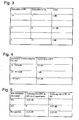
- the TDD mode (time division duplex) of the radio communication system can time slots of a frame in a frequency band assign either the up or down direction. So that can the transmission capacity on the up or down Downward direction can also be distributed to asymmetrical services to support well with optimal resource utilization. However, the asymmetry of traffic also affects the Control loop for the transmission power. In contrast to the FDD mode exists due to the common frequency band for Up and down direction not predictable possibility Delays in the signaling of the TPC actuation instruction schedule. The greater the asymmetry, the less the ability of the control loop to quickly change the Transfer conditions to follow.
- the step size ⁇ TPC therefore becomes dependent on the asymmetry established.
- there is also a signaling possible according to method 1 because of a change in asymmetry can only be done at longer intervals and one the relevant signaling takes place in any case.
- step size ⁇ TPC i.e. the signaling of the Step size ⁇ TPC through the base station BS to the mobile station MS, used because of the speed of the mobile station MS in the base station BS is estimated.
- Fig 5 gives an example of the Use of different numbers of receiving antennas on. If more than one receiving antenna is used like this there is reception antenna diversity. Use the reception side more than one antenna, so can transmit with smaller Step size ⁇ TPC can be worked.
- the step size ⁇ TPC is signaled by e.g. 0.25 dB reduced.
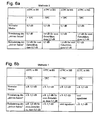
- the so-called soft handover describes a transfer state, where a mobile station MS not only in radio contact with a base station BS, but at least temporarily with at least one further base station BS. While of the soft handover are both in the up and down direction the information of the mobile station MS of more than a base station BS received or the information from sent more than one base station BS.
- the one for a mobile station MS responsible base stations BS are in an active Active set entered. In the up and down direction thus arises every time a base station BS in the active sentence was recorded or removed from it, a sudden change in macro diversity gains and the total transmission power in the downward direction.
- the transmit power setting should be able to follow that as quickly as possible.
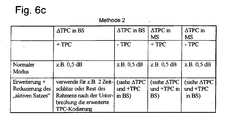
- the transmission power should be reduced as quickly as possible to the system avoid unnecessary interference. With reduction of the active set, the transmission powers should be raised quickly to ensure sufficient signal quality. In both cases, the step size ⁇ TPC becomes temporary increased. It is advantageous here when expanding of the active block, the step size ⁇ TPC only in the direction of one Reduction of the transmission power (- TPC) to enlarge and if the active block is reduced, the step size ⁇ TPC only towards an increase in the transmission power (+ TPC) enlarge.
- the change in step size ⁇ TPC can be in Downward direction may be larger, as this is in addition to the diversity gain the total transmission power also changed.
- the change can be signaled take place or according to FIG. 6c by changing the Coding of the positioning instructions TPC the transmission power setting be improved.
- the transmission status determined by the control means MPC of the base station BS After a connection is established, the transmission status determined by the control means MPC of the base station BS.
- the transmission means TX of the mobile station MS is in the upward direction UL sent. These transmissions are received by means of reception RX of the base station BS received. Keep asking the control means MPC whether the transmission state has changed in the meantime. If so then it will Step size ⁇ TPC is newly determined, otherwise it is determined at the start of the connection Keep set step size ⁇ TPC.
- the MPC control devices also determined the positioning instructions TPC, so that the positioning instruction in the downward direction DL from Transmission means TX of the base station BS to the mobile station MS can be transferred.
- the mobile station MS receives the positioning instruction TPC and provides the transmission power for the following transmissions accordingly , taking into account the step size ⁇ TPC becomes.
- the step size ⁇ TPC was either method 2 included in the TPC actuating instructions was based on the method 1 signals or was able to use method 3 from the mobile station MS reconstructed from the present transmission state become.
Landscapes
- Engineering & Computer Science (AREA)
- Computer Networks & Wireless Communication (AREA)
- Signal Processing (AREA)
- Mobile Radio Communication Systems (AREA)
- Transmitters (AREA)
- Circuits Of Receivers In General (AREA)
Applications Claiming Priority (3)
| Application Number | Priority Date | Filing Date | Title |
|---|---|---|---|
| DE19846675 | 1998-10-09 | ||
| DE19846675 | 1998-10-09 | ||
| EP99970525A EP1119925B1 (fr) | 1998-10-09 | 1999-10-08 | Procede et systeme de communication radio pour le reglage de puissance entre une station de base et une station abonnee |
Related Parent Applications (1)
| Application Number | Title | Priority Date | Filing Date |
|---|---|---|---|
| EP99970525A Division EP1119925B1 (fr) | 1998-10-09 | 1999-10-08 | Procede et systeme de communication radio pour le reglage de puissance entre une station de base et une station abonnee |
Publications (3)
| Publication Number | Publication Date |
|---|---|
| EP1286480A2 true EP1286480A2 (fr) | 2003-02-26 |
| EP1286480A3 EP1286480A3 (fr) | 2003-03-05 |
| EP1286480B1 EP1286480B1 (fr) | 2007-02-14 |
Family
ID=7884004
Family Applications (2)
| Application Number | Title | Priority Date | Filing Date |
|---|---|---|---|
| EP99970525A Expired - Lifetime EP1119925B1 (fr) | 1998-10-09 | 1999-10-08 | Procede et systeme de communication radio pour le reglage de puissance entre une station de base et une station abonnee |
| EP02023967A Expired - Lifetime EP1286480B1 (fr) | 1998-10-09 | 1999-10-08 | Procédé pour le réglage de puissance entre une station de base et une station abonnée |
Family Applications Before (1)
| Application Number | Title | Priority Date | Filing Date |
|---|---|---|---|
| EP99970525A Expired - Lifetime EP1119925B1 (fr) | 1998-10-09 | 1999-10-08 | Procede et systeme de communication radio pour le reglage de puissance entre une station de base et une station abonnee |
Country Status (14)
| Country | Link |
|---|---|
| US (1) | US6885875B1 (fr) |
| EP (2) | EP1119925B1 (fr) |
| JP (1) | JP4313952B2 (fr) |
| KR (1) | KR100648745B1 (fr) |
| CN (2) | CN1135734C (fr) |
| AT (1) | ATE237200T1 (fr) |
| AU (1) | AU763264B2 (fr) |
| BR (1) | BR9914395B1 (fr) |
| CA (1) | CA2346679C (fr) |
| DE (2) | DE59904989D1 (fr) |
| ES (1) | ES2197712T3 (fr) |
| PT (1) | PT1119925E (fr) |
| RU (1) | RU2235431C2 (fr) |
| WO (1) | WO2000022757A2 (fr) |
Families Citing this family (21)
| Publication number | Priority date | Publication date | Assignee | Title |
|---|---|---|---|---|
| US6977967B1 (en) * | 1995-03-31 | 2005-12-20 | Qualcomm Incorporated | Method and apparatus for performing fast power control in a mobile communication system |
| TW347616B (en) * | 1995-03-31 | 1998-12-11 | Qualcomm Inc | Method and apparatus for performing fast power control in a mobile communication system a method and apparatus for controlling transmission power in a mobile communication system is disclosed. |
| DE10040228A1 (de) * | 2000-08-17 | 2002-02-28 | Siemens Ag | Verfahren zur Regelung der Sendeleistung in einem Funksystem |
| EP1180854A1 (fr) * | 2000-08-18 | 2002-02-20 | Lucent Technologies Inc. | Commande de la puissance avec pas adaptatifs basés sur des mesures de paramètres de canal |
| CN1157880C (zh) * | 2000-09-25 | 2004-07-14 | 华为技术有限公司 | 多时隙功率控制方法 |
| US6718180B1 (en) | 2000-10-24 | 2004-04-06 | Telefonaktiebolaget Lm Ericsson (Publ) | Power level convergence in a communications system |
| US8199696B2 (en) * | 2001-03-29 | 2012-06-12 | Qualcomm Incorporated | Method and apparatus for power control in a wireless communication system |
| US7133461B2 (en) * | 2001-12-14 | 2006-11-07 | Motorola, Inc. | Stream transmission method and device |
| US7050759B2 (en) | 2002-02-19 | 2006-05-23 | Qualcomm Incorporated | Channel quality feedback mechanism and method |
| JP3751265B2 (ja) * | 2002-06-20 | 2006-03-01 | 松下電器産業株式会社 | 無線通信システムおよびスケジューリング方法 |
| JP4041733B2 (ja) | 2002-12-19 | 2008-01-30 | 株式会社エヌ・ティ・ティ・ドコモ | 送信電力制御方法及び制御装置 |
| US7756543B2 (en) * | 2005-09-09 | 2010-07-13 | Telefonaktiebolaget Lm Ericsson (Publ) | High speed shared radio channel transmit power control |
| EP1944903A1 (fr) * | 2007-01-11 | 2008-07-16 | Nokia Siemens Networks Gmbh & Co. Kg | Appareil et procédé d'organisation de terminaux d'un réseau de communication et terminal pour un réseau de communication |
| US7986959B2 (en) | 2007-02-14 | 2011-07-26 | Qualcomm Incorporated | Preamble based uplink power control for LTE |
| US8145127B2 (en) * | 2007-08-14 | 2012-03-27 | Motorola Mobility, Inc. | Method and apparatus for transmit power calibration in a frequency division multiplexed wireless system |
| JP4494445B2 (ja) * | 2007-09-03 | 2010-06-30 | 株式会社エヌ・ティ・ティ・ドコモ | 送信電力制御方法及び装置 |
| EP2229797B1 (fr) | 2008-01-07 | 2014-12-31 | Telefonaktiebolaget L M Ericsson (publ) | Commande de puissance de liaison montante pour terminaux limités en puissance |
| EP2221790B1 (fr) * | 2009-02-24 | 2020-11-18 | Panasonic Intellectual Property Management Co., Ltd. | Système de communication sans fil pour outil |
| KR20100100592A (ko) * | 2009-03-06 | 2010-09-15 | 삼성전자주식회사 | 무선통신시스템에서 전력제어를 위한 방법 및 장치 |
| WO2012053951A1 (fr) | 2010-10-21 | 2012-04-26 | Telefonaktiebolaget L M Ericsson (Publ) | Dispositif et procédé pour contrôler une puissance de transmission |
| KR101690660B1 (ko) * | 2011-04-29 | 2016-12-29 | 후지쯔 가부시끼가이샤 | 최대 구성 전송 전력을 보고하기 위한 방법 및 단말 기기 |
Family Cites Families (16)
| Publication number | Priority date | Publication date | Assignee | Title |
|---|---|---|---|---|
| US5485486A (en) * | 1989-11-07 | 1996-01-16 | Qualcomm Incorporated | Method and apparatus for controlling transmission power in a CDMA cellular mobile telephone system |
| SE9200915D0 (sv) * | 1992-03-24 | 1992-03-24 | Ericsson Telefon Ab L M | Methods in a cellular mobile radio communincation system |
| JP2980156B2 (ja) | 1994-05-12 | 1999-11-22 | エヌ・ティ・ティ移動通信網株式会社 | 送信電力制御方法および該制御方法を用いたスペクトル拡散通信装置 |
| TW347616B (en) * | 1995-03-31 | 1998-12-11 | Qualcomm Inc | Method and apparatus for performing fast power control in a mobile communication system a method and apparatus for controlling transmission power in a mobile communication system is disclosed. |
| US5742595A (en) | 1995-06-02 | 1998-04-21 | Dsc Communications Corporation | Processing CDMA signals |
| JP2762965B2 (ja) * | 1995-09-04 | 1998-06-11 | 日本電気株式会社 | 基地局送信電力制御方式 |
| JPH09231713A (ja) * | 1995-12-20 | 1997-09-05 | Fuji Photo Film Co Ltd | 磁気ディスクカートリッジおよび磁気ディスク駆動装置 |
| JP2803626B2 (ja) | 1996-04-05 | 1998-09-24 | 日本電気株式会社 | 移動無線端末の送信電力制御方式 |
| FI104025B (fi) * | 1996-08-28 | 1999-10-29 | Nokia Telecommunications Oy | Tehonsäätömenetelmä ja solukkoradiojärjestelmä |
| US5893035A (en) | 1996-09-16 | 1999-04-06 | Qualcomm Incorporated | Centralized forward link power control |
| JP3110333B2 (ja) * | 1997-01-23 | 2000-11-20 | 埼玉日本電気株式会社 | Tdma方式無線装置の送信ダイバシチー回路 |
| FI106666B (fi) * | 1997-01-24 | 2001-03-15 | Nokia Networks Oy | Tehonsäätömenetelmä epäjatkuvaan lähetykseen |
| EP0940930B1 (fr) * | 1998-03-03 | 2012-09-26 | NEC Corporation | Procédé de contrôle de la puissance de transmission dans un système de communication mobile de type cellulaire |
| EP1045529B1 (fr) * | 1999-04-12 | 2006-11-29 | Alcatel | Méthode pour améliorer les performances d'un système de radiocommunication mobile utilisant un algorithme de contrôle de la puissance |
| EP1045528B1 (fr) * | 1999-04-12 | 2004-02-18 | Alcatel | Méthode et circuit pour améliorer les performances d'un système de radiocommunication mobile utilisant un algorithme de contrôle de la puissance |
| ATE426956T1 (de) * | 1999-07-13 | 2009-04-15 | Alcatel Lucent | Verfahren zur leistungssteigerung eines mobilen radiokommunikationssystems unter verwendung eines leistungsregelungsalgorithmus |
-
1999
- 1999-10-08 BR BRPI9914395-0B1A patent/BR9914395B1/pt active IP Right Grant
- 1999-10-08 AU AU13742/00A patent/AU763264B2/en not_active Ceased
- 1999-10-08 CA CA002346679A patent/CA2346679C/fr not_active Expired - Fee Related
- 1999-10-08 DE DE59904989T patent/DE59904989D1/de not_active Expired - Lifetime
- 1999-10-08 DE DE59914201T patent/DE59914201D1/de not_active Expired - Lifetime
- 1999-10-08 US US09/806,646 patent/US6885875B1/en not_active Expired - Lifetime
- 1999-10-08 CN CNB998119199A patent/CN1135734C/zh not_active Expired - Fee Related
- 1999-10-08 RU RU2001112416/09A patent/RU2235431C2/ru active
- 1999-10-08 PT PT99970525T patent/PT1119925E/pt unknown
- 1999-10-08 AT AT99970525T patent/ATE237200T1/de not_active IP Right Cessation
- 1999-10-08 KR KR1020017004499A patent/KR100648745B1/ko not_active Expired - Fee Related
- 1999-10-08 WO PCT/DE1999/003249 patent/WO2000022757A2/fr not_active Ceased
- 1999-10-08 CN CNB2003101138468A patent/CN1306721C/zh not_active Expired - Fee Related
- 1999-10-08 ES ES99970525T patent/ES2197712T3/es not_active Expired - Lifetime
- 1999-10-08 EP EP99970525A patent/EP1119925B1/fr not_active Expired - Lifetime
- 1999-10-08 EP EP02023967A patent/EP1286480B1/fr not_active Expired - Lifetime
- 1999-10-08 JP JP2000576563A patent/JP4313952B2/ja not_active Expired - Fee Related
Also Published As
| Publication number | Publication date |
|---|---|
| JP2002527988A (ja) | 2002-08-27 |
| BR9914395A (pt) | 2001-06-26 |
| CA2346679A1 (fr) | 2000-04-20 |
| RU2235431C2 (ru) | 2004-08-27 |
| CN1135734C (zh) | 2004-01-21 |
| CN1496024A (zh) | 2004-05-12 |
| PT1119925E (pt) | 2003-08-29 |
| WO2000022757A2 (fr) | 2000-04-20 |
| DE59904989D1 (de) | 2003-05-15 |
| ES2197712T3 (es) | 2004-01-01 |
| EP1286480B1 (fr) | 2007-02-14 |
| AU763264B2 (en) | 2003-07-17 |
| EP1119925B1 (fr) | 2003-04-09 |
| KR20010080075A (ko) | 2001-08-22 |
| BR9914395B1 (pt) | 2013-07-02 |
| EP1286480A3 (fr) | 2003-03-05 |
| ATE237200T1 (de) | 2003-04-15 |
| JP4313952B2 (ja) | 2009-08-12 |
| KR100648745B1 (ko) | 2006-11-23 |
| EP1119925A2 (fr) | 2001-08-01 |
| WO2000022757A3 (fr) | 2000-11-09 |
| AU1374200A (en) | 2000-05-01 |
| CA2346679C (fr) | 2007-07-03 |
| CN1324527A (zh) | 2001-11-28 |
| DE59914201D1 (de) | 2007-03-29 |
| CN1306721C (zh) | 2007-03-21 |
| US6885875B1 (en) | 2005-04-26 |
| EP1119925A4 (fr) | 2002-01-07 |
Similar Documents
| Publication | Publication Date | Title |
|---|---|---|
| EP1286480B1 (fr) | Procédé pour le réglage de puissance entre une station de base et une station abonnée | |
| DE69934577T2 (de) | Funkkommunikationssystem | |
| DE60220881T2 (de) | Verfahren und vorrichtung für verbindungsqualitätsrückkopplung in einer drahtlosen übertragung | |
| DE69800116T2 (de) | Verfahren zur Leistungsteuerung in einem drahtlosen Netzwerk zur Kommunikation einer Vielzahl von Informationsklassen | |
| EP1188256B9 (fr) | Procede de reglage de la puissance d'emission dans un systeme radio, et systeme radio correspondant | |
| DE19808371C2 (de) | Verfahren und Funk-Kommunikationssystem zur Informationsübertragung zwischen einer Basisstation und weiteren Funkstationen | |
| DE602005000166T2 (de) | Wahl von Basisstations-Antennen für ein "synchronized set" und ein "active set" | |
| EP1367739A1 (fr) | Procédé de commande de la puissance d'émission dans un système radio à porteuses multiples | |
| EP1090526B1 (fr) | Commande d'acces dans un systeme de radiotelecommunication | |
| EP1226666B1 (fr) | Procede de synchronisation d'une transmission de signal ascendente dans un systeme de communication radio | |
| WO2004066646A1 (fr) | Procede pour synchronisation dans des systemes de radiocommunication | |
| DE60024503T2 (de) | Verfahren zur Sendeleistungsregelung von Basisstationen während sanften Weiterreichens | |
| EP1142423B1 (fr) | Procede de transmission de signaux sur un canal pour l'acces arbitraire a un systeme de radiocommunications | |
| EP1290813B1 (fr) | Procede pour reguler la puissance d'emission d'une station d'emission, et station d'emission | |
| DE19918371C1 (de) | Stochastische Sendeleistungseinstellung in einem Kanal zum willkürlichen Zugriff eines Funk-Kommunikationssystems | |
| DE19851288C1 (de) | Verfahren zur Signalübertragung in einem Funk-Kommunikationssystem | |
| EP1995888B1 (fr) | Procédé de commande de la puissance de transmission d'une station radio | |
| EP1593207B1 (fr) | Procédé de réglage des puissances d'émission de deux canaux d'une liaison, station et système de communication | |
| EP1060579B1 (fr) | Procede et systeme de radiotelecommunication pour transmettre des donnees | |
| DE19850849A1 (de) | Verfahren und Funk-Kommunikationssystem zur Sendeleitungsregelung zwischen einer Basisstation und einer Teilnehmerstation | |
| DE19959179A1 (de) | Verfahren zur dynamischen Änderung von Ratenanpassungsfaktoren in einem Funk-Kommunikationssystem | |
| DE19938494C2 (de) | Verfahren zur Sendeleistungseinstellung in einem Mobilfunksystem | |
| WO2000064069A2 (fr) | Procede de reglage de la puissance d'emission dans des systemes de radiocommunication | |
| EP1090516B1 (fr) | Procede de regulation de la grandeur d'une cellule radio, et station de base | |
| DE10133238B4 (de) | Verfahren zur paketvermittelten Datenübertragung in einem Funkkommunikationssystem mit mehreren Funkzellen |
Legal Events
| Date | Code | Title | Description |
|---|---|---|---|
| PUAI | Public reference made under article 153(3) epc to a published international application that has entered the european phase |
Free format text: ORIGINAL CODE: 0009012 |
|
| PUAL | Search report despatched |
Free format text: ORIGINAL CODE: 0009013 |
|
| AC | Divisional application: reference to earlier application |
Ref document number: 1119925 Country of ref document: EP Kind code of ref document: P |
|
| AK | Designated contracting states |
Kind code of ref document: A2 Designated state(s): AT BE CH CY DE DK ES FI FR GB GR IE IT LI LU MC NL PT SE |
|
| AK | Designated contracting states |
Designated state(s): AT BE CH CY DE DK ES FI FR GB GR IE IT LI LU MC NL PT SE Kind code of ref document: A3 Designated state(s): AT BE CH CY DE DK ES FI FR GB GR IE IT LI LU MC NL PT SE |
|
| RIN1 | Information on inventor provided before grant (corrected) |
Inventor name: GOLDHOFER, FRANZ Inventor name: KOEHN, REINHARD Inventor name: BENZ, MICHAEL Inventor name: KOTTKAMP, MEIK Inventor name: OBERMANNS, SEBASTIAN Inventor name: OESTREICH, STEFAN Inventor name: FAERBER, MICHAEL Inventor name: KRAUSE, JOERN, DR. Inventor name: SOMMER, VOLKER, DR. Inventor name: SITTE, ARMIN Inventor name: KLEIN, ANJA, DR. Inventor name: LANDENBERGER, HOLGER |
|
| 17P | Request for examination filed |
Effective date: 20030904 |
|
| AKX | Designation fees paid |
Designated state(s): DE FR GB |
|
| 17Q | First examination report despatched |
Effective date: 20050601 |
|
| GRAP | Despatch of communication of intention to grant a patent |
Free format text: ORIGINAL CODE: EPIDOSNIGR1 |
|
| RTI1 | Title (correction) |
Free format text: METHOD FOR REGULATING POWER BETWEEN A BASE STATION AND A SUBSCRIBER STATION |
|
| GRAS | Grant fee paid |
Free format text: ORIGINAL CODE: EPIDOSNIGR3 |
|
| GRAA | (expected) grant |
Free format text: ORIGINAL CODE: 0009210 |
|
| AC | Divisional application: reference to earlier application |
Ref document number: 1119925 Country of ref document: EP Kind code of ref document: P |
|
| AK | Designated contracting states |
Kind code of ref document: B1 Designated state(s): DE FR GB |
|
| REG | Reference to a national code |
Ref country code: GB Ref legal event code: FG4D Free format text: NOT ENGLISH |
|
| GBT | Gb: translation of ep patent filed (gb section 77(6)(a)/1977) |
Effective date: 20070307 |
|
| REF | Corresponds to: |
Ref document number: 59914201 Country of ref document: DE Date of ref document: 20070329 Kind code of ref document: P |
|
| ET | Fr: translation filed | ||
| PLBE | No opposition filed within time limit |
Free format text: ORIGINAL CODE: 0009261 |
|
| STAA | Information on the status of an ep patent application or granted ep patent |
Free format text: STATUS: NO OPPOSITION FILED WITHIN TIME LIMIT |
|
| 26N | No opposition filed |
Effective date: 20071115 |
|
| REG | Reference to a national code |
Ref country code: FR Ref legal event code: PLFP Year of fee payment: 17 |
|
| PGFP | Annual fee paid to national office [announced via postgrant information from national office to epo] |
Ref country code: GB Payment date: 20151005 Year of fee payment: 17 |
|
| REG | Reference to a national code |
Ref country code: DE Ref legal event code: R081 Ref document number: 59914201 Country of ref document: DE Owner name: MUNITECH IP S.A.R.L., LU Free format text: FORMER OWNER: SIEMENS AKTIENGESELLSCHAFT, 80333 MUENCHEN, DE |
|
| REG | Reference to a national code |
Ref country code: FR Ref legal event code: PLFP Year of fee payment: 18 |
|
| PGFP | Annual fee paid to national office [announced via postgrant information from national office to epo] |
Ref country code: FR Payment date: 20161227 Year of fee payment: 18 |
|
| PGFP | Annual fee paid to national office [announced via postgrant information from national office to epo] |
Ref country code: DE Payment date: 20161229 Year of fee payment: 18 |
|
| GBPC | Gb: european patent ceased through non-payment of renewal fee |
Effective date: 20161008 |
|
| PG25 | Lapsed in a contracting state [announced via postgrant information from national office to epo] |
Ref country code: GB Free format text: LAPSE BECAUSE OF NON-PAYMENT OF DUE FEES Effective date: 20161008 |
|
| REG | Reference to a national code |
Ref country code: FR Ref legal event code: TP Owner name: MUNITECH IP S.A.R.L., LU Effective date: 20170912 |
|
| REG | Reference to a national code |
Ref country code: DE Ref legal event code: R119 Ref document number: 59914201 Country of ref document: DE |
|
| REG | Reference to a national code |
Ref country code: FR Ref legal event code: ST Effective date: 20180629 |
|
| PG25 | Lapsed in a contracting state [announced via postgrant information from national office to epo] |
Ref country code: DE Free format text: LAPSE BECAUSE OF NON-PAYMENT OF DUE FEES Effective date: 20180501 |
|
| PG25 | Lapsed in a contracting state [announced via postgrant information from national office to epo] |
Ref country code: FR Free format text: LAPSE BECAUSE OF NON-PAYMENT OF DUE FEES Effective date: 20171031 |